Roadmap toward transit recovery and an affordable, connected, diverse, healthy and vibrant region for all
By John Goodwin, Assistant Director Of Communications & Leslie Lara-Enríquez, Assistant Director, Public Engagement, Metropolitan Transportation Commission
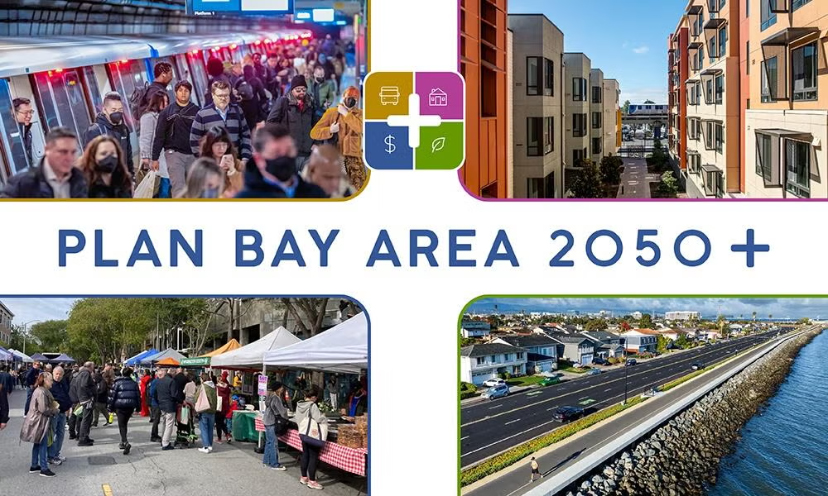
The Metropolitan Transportation Commission (MTC) today unanimously adopted Plan Bay Area 2050+ and certified the plan’s associated Environmental Impact Report — giving final approval to the Bay Area’s long-range plan for transportation, housing, economic resiliency and environmental sustainability.
Plan Bay Area 2050+ was adopted unanimously by the Association of Bay Area Governments’ (ABAG) Executive Board last week. The votes by both boards cap a nearly three-year process during which over 17,600 Bay Area residents, community organizations, advocacy groups and public sector partners contributed to the development of the new plan, which MTC and ABAG are required to develop jointly.
Defined by 35 strategies for transportation, housing, the economy and the environment, Plan Bay Area 2050+ lays out a suite of policies and investments that define what it would take to make the nine-county region more affordable, connected, diverse, healthy and economically vibrant for all residents through 2050 and beyond. From housing and transportation strategies that would reduce cost of living and construct more affordable housing to investments in public transit that prioritize service improvements in Equity Priority Communities, the goal of a more equitable Bay Area is interwoven throughout the plan. With a major focus on climate change, strategies also are crafted for resilience, including protection from hazards such as sea level rise and wildfires.
Source: Plan Bay Area
ABAG Executive Board President and Napa County Supervisor Belia Ramos, who also serves as an MTC Commissioner, acknowledged some of the region’s biggest challenges the plan seeks to address. “Today, our communities face rising costs, widening inequality and persistent housing shortages,” said Ramos. “This is not the future we want for the generations of Bay Area residents to come. Plan Bay Area 2050+ charts a course for how we can bring about our shared vision for a Bay Area where everyone has access to opportunity and a better quality of life.”
Unique to this plan cycle is the parallel Transit 2050+ planning effort, developed in partnership with Bay Area transit agencies, which culminated in the first-of-its-kind plan to re-envision the future of public transportation across the region.
“Plan Bay Area 2050+ will help shape the vital service improvements and funding solutions we need to keep Bay Area transit running, while also making it faster, more frequent, more reliable, safer and better connected,” explained MTC Commission Chair and Pleasant Hill City Councilmember Sue Noack. “Plan Bay Area 2050+ lays the groundwork for how our region can meet the challenges of today, while also advancing a shared vision for an even better tomorrow.”
Plan Bay Area 2050+’s policy and investment framework has the potential to strengthen the region for decades to come, representing a major step toward a stronger, more resilient future.
ABAG is the council of governments and the regional planning agency for the 101 cities and towns, and nine counties of the Bay Area. Contra Costa County is represented by District 4 Supervisor Ken Carlson, District 5 Supervisor Shanelle Scales-Preston, El Cerrito Councilwoman Lisa Motoyama and Walnut Creek Councilwoman Cindy Silva.
MTC is the transportation planning, financing and coordinating agency for the nine-county San Francisco Bay Area. Contra Costa County is representatives include Chair Sue Noack Mayor of Pleasant Hill representing the cities of Contra Costa County and District 2 Supervisor Candace Andersen representing Contra Costa County.
Proposed Plan for housing, transportation, the economy and environment in the nine counties will go to committee for review on Friday, March 13
Offers strategies, investments and outcomes for Contra Costa County
By John Goodwin, Assistant Director of Communications & Leslie Lara-Enríquez Assistant Director, Public Engagement, Metropolitan Transportation Commission
Plan Bay Area 2050+ is the latest long-range plan to guide growth and investment across the region’s nine counties and 101 cities. The plan seeks to advance an integrated vision for a Bay Area that is affordable, connected, diverse, healthy and vibrant for all by 2050. It focuses on the four areas of housing, transportation, the economy and environment.
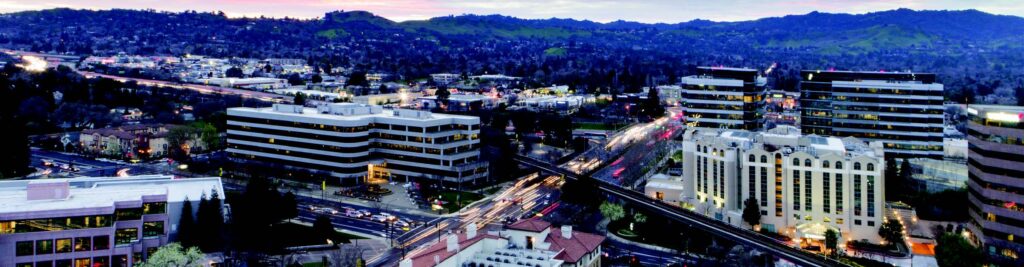
The Contra Costa Centre Transit Village. Photo credit: Karl Nielsen
The plan and its related reports will be presented for review and consideration at a joint meeting of the MTC Planning Committee with the ABAG Administrative Committee on Friday, March 13, before the documents are referred to their respective approving bodies. The ABAG Executive Board will consider certification of the Final EIR and adoption of the final plan at its March 19 meeting. At its March 25 meeting, MTC will consider certifying the Final EIR and adopting the final plan, as well as adopting the accompanying Air Quality Conformity Analysis and an amendment to the 2025 Transportation Improvement Program.
The release of the proposed final Plan Bay Area 2050+ follows a 59-day public comment period for the Draft Plan and the Draft EIR that closed on December 18, 2025. The proposed final plan and Final EIR have been updated to reflect feedback received during the public comment period.
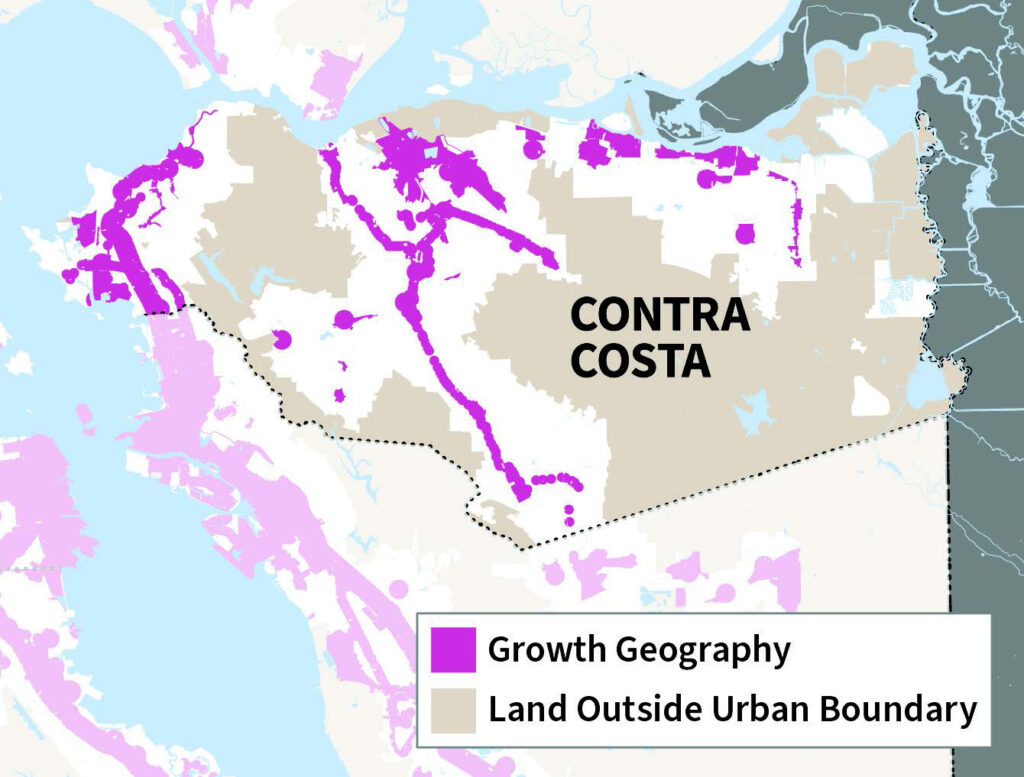
The map above shows Contra Costa County’s Growth Geographies, which are areas identified in Plan Bay Area 2050+ to help guide future housing and job growth. These areas are designated by local jurisdictions or based on their proximity to transit and access to opportunity. Source: MTG/ABAG
The Plan includes Partner Resources: Regional Tools for Local Action that local jurisdictions and partner agencies can use to develop plans, seek funding and take action to make a better Bay Area. It offers a fact sheet for each county, including Contra Costa, which spotlights strategies, investments and outcomes.
Plan Bay Area 2050+ is the latest long-range regional plan for the nine-county Bay Area. The plan lays out a series of funding and policy strategies that can create a more affordable, connected, diverse, healthy and vibrant future for all Bay Area residents in 2050. Unique to this plan cycle is the parallel Transit 2050+ planning effort, which culminated in the first-of-its-kind plan to re-envision the future of Bay Area public transit, in partnership with transit agencies across the region.
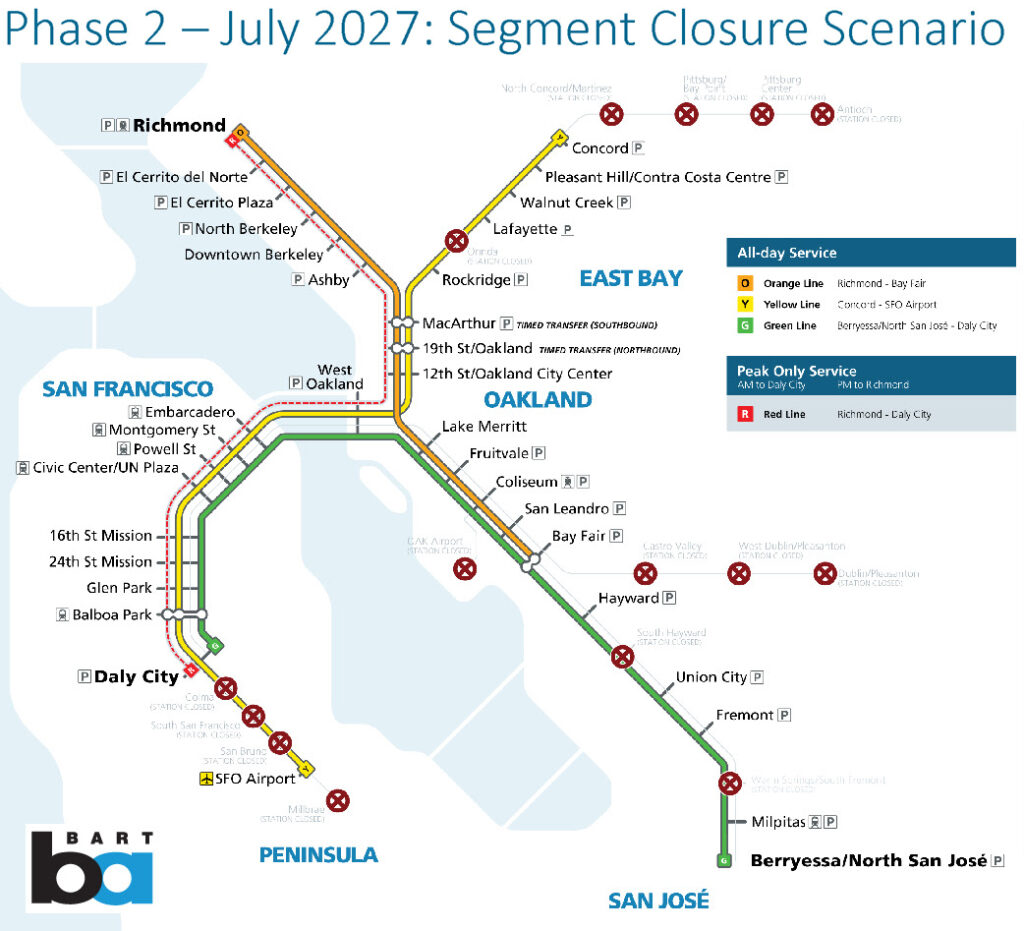
The BART Board voted to close all stations serving East County if the proposed Nov. sales tax measure fails. Source: BART
Contra Costa’s 4 representatives vote to adoptAlternative Service Plan to balance budget including 1,170 employee layoffs
Ridership still down 50% post-COVID
ByAllen D. Payton
On Thursday, Feb. 26, 2026, the BART Board of Directors, on vote of 8-1, adopted an Alternative Service Plan outlining specific budget balancing details to solve a $376M deficit for the next fiscal year if no new funds become available to BART. According to a District press release, BART is facing a structural deficit of $350M to $400M because ridership is still down 50% compared to pre-pandemic levels and BART’s current funding model relies heavily on passenger fares.
As previously reported by the Herald, the stations on the list for potential Phase 1 closure in January 2027 include the 10 lowest ridership stations: North Concord, Orinda, Pittsburg Center, Oakland International Airport, West Dublin/Pleasanton, Castro Valley, San Bruno, South Hayward, South San Francisco and Warm Springs/South Fremont.
Phase 2 Closures Include Antioch and Pittsburg/Bay Point Stations
The Phase 2 – July 2027 Segment Closure Scenario, Contingent on Phase 1 implementation, would result in a 70% reduction in train hours and 25% reduction in system miles; Segment closures would stop service on most system segments opened after 1976: Yellow line service would end at Concord, shuttering the Pittsburg/Bay Point and Antioch Stations; Orange line service would end at Bay Fair,; Blue line service would be discontinued shuttering the West Dublin/Pleasanton Station; Most stations south of Daly City would be closed except for direct service to SFO would continue for revenue retention; Service continues to Milpitas and Berryessa due to terms of BART/VTA agreements.
Based on Proposed Transit Tax Measure Failing
The plan is based on the assumption a sales tax increase measure proposed for the November ballot in five Bay Area counties fails. As previously reported, voters would be asked to consider a one-half sales tax increase in Contra Costa, Alameda, San Mateo and Santa Clara counties and a one-cent sales tax increase in San Francisco County. The 14-year regional transportation sales tax would generate approximately $980 million annually with 60 percent dedicated to preserving service on BART, Muni, Caltrain and AC Transit, as well as San Francisco Bay Ferry and smaller transit agencies providing service in the five counties to keep buses, trains and ferries moving, including WestCat, County Connection and Tri Delta Transit. About one-third of the revenue would go to Contra Costa Transportation Authority, Santa Clara VTA, SamTrans and the Alameda County Transportation Commission, with flexibility to use funds for transit capital, operations, or road paving projects on roads with regular bus service.
Also, as previously reported, an effort is underway to gather signatures to place the measure on the ballot. The sales tax increase would be in addition to the half-cent sales tax for BART operations in Contra Costa, Alameda and San Francisco counties in place since the 1960’s.
Motion and Vote Details
Following public comments and discussion among the Board members a vote was taken on the following motion: The Board adopts the attached Resolution “In the Matter of Initially Approving an Alternative Service Plan to Take Effect January 2027 in the Event the Connect Bay Area Measure Fails to Receive Voter Approval at the Statewide General Election on November 3, 2026 and BART is Unable to Secure Other Revenue Sources.”
The motion was made by District 4 Director Robert Raburn, seconded by District 1 Director Matt Rinn, and passed on a vote of 8-1 with the additional support of District 7 Director Victor Flores, District 2 Director Mark Foley, District 3 Director Barnali Gosh, District 8 Director Janice Li, Board Vice President and District 9 Director Edward Wright and Board President and District 5 Director Melissa Hernandez.
District 6 Director Liz Ames was the only member of the Board of Directors to vote “No”.
Foley represents portions of Central County and all of East County, Rinn represents portions of Central Contra Costa County, all of Lamorinda and most of the San Ramon Valley, Gosh represents all of West County and Hernandez represents portions of San Ramon.
Approved Plan Details
The plan includes specific cuts and financial strategies needed to balance both the FY27 (July 1, 2026-June 30, 2027) and FY28 (July 1, 2027-June 30, 2028) budgets. The plan includes service cuts, station closures, fare increases, a 40% reduction in system support services, laying off 1,170 employees and a series of deferrals and one-time resources. The plan does not name specific stations to be closed and makes clear the BART Board will be responsible for all decisions on station closures. You can read the Alternative Service Plan resolution, resolution attachment and presentation to the BART Board.
BART has already made budget cuts across all departments and instituted a series of cost controls, including rightsizing service, labor savings, operational efficiencies, and reducing BART’s office space footprint. At the same time, BART has also worked to increase revenue by installing new fare gates, leasing out BART parking lots, and offering new fare products such as Clipper BayPass. View a detailed list of cost savings implement by BART at bart.gov/fiscalcliff.
Alternative Service Plan Details
To take place in January 2027:
3-line service (Yellow, Blue, and Orange line service only, with limited peak service in only the peak commute direction on the Red and Green lines).
30-minute frequencies on every line.
Closing at 9 pm seven days a week.
This service plan represents a 63% reduction in train hours.
30% fare and parking fee increases (the estimated average fare would increase from $4.98 to $6.38).
Target approximately $30M in savings over 6 months from non-service budget reductions to fleet and non-fleet maintenance, police, cleaning, and administrative support functions.
Continue deferrals of priority capital allocations and retiree medical contributions.
Balance remainder of FY27 with one-time resources and financial deferrals.
Following the January 2027 cuts, staff will continuously assess ridership and revenue impacts and the performance of all District functions to determine if further reductions can be safely and legally implemented.
To take place in July 2027 if feasibly safe:
Target over $175M in annual cost reductions through a cumulative 70% reduction in service hours:
Maintain 3-line service, 30-minute frequencies on each line, closing at 9pm.
Close up to 15 stations and/or up to 25% of system track miles.
The BART Board will be responsible for all decisions on station or line segment closures.
Increase fares and parking fees up to a cumulative 50%. The estimated average fare would increase to $7.26.
Target annual operating expense savings of more than a cumulative $130M from non-service budget reductions to fleet and non-fleet maintenance, police, cleaning, and administrative support functions.
Continue to defer retiree health contributions; defer most remaining capital allocations.
Contingency:
If at any point it is determined BART can’t safely or legally operate with available resources, stop passenger service.
Use existing District tax revenues to secure system assets.
Work to determine system’s future.
Use of the State Loan
BART can’t use state loan money to avoid station closures and service cuts if no new revenue becomes available because without new revenue, there is no way to pay the loan back. The state loan primarily helps with cash flow if a November 2026 transit funding measure is successful. It is a bridge loan that gives BART reassurances money will be available to continue to deliver the best service possible until the sales tax dollars from the successful ballot measure become available for BART’s use. This is projected to happen in July 2027 but could take longer. If a funding measure succeeds, BART will use $97M in loan funds to help balance the FY27 budget.
Including 7 traffickers in Contra Costa County; Contra Costa DA’s Office, Pittsburg PD participate
By Lt. Joshua Singleton, Task Force Commander, Human Trafficking Task Force, Santa Clara District Attorney’s Office
Days after the Super Bowl, the Santa Clara County District Attorney’s Human Trafficking Task Force reported its own statistics: numbers that showed enhanced investigations resulted in the arrests of 29 traffickers and the recovery of 73 sex trafficking victims, including 10 minors. One of the victims, who was being trafficked in Oakland, was 12 years old.
Law enforcement operations were held throughout 11 Bay Area counties during the lead up to one of the world’s biggest sporting events. Similar enforcement is being prepared for the deluge of fans coming to see the 2026 FIFA World Cup soccer tournament games at Levi’s Stadium between June 13 and July 1.
District Attorney Jeff Rosen said: “Beyond football, the Super Bowl was a triumph of Bay Area law enforcement planning, organization, cooperation, and safety. Human trafficking is not a game, it’s a tragedy. However, our team was very successful. Close to 70 agencies effectively discouraged traffickers from exploiting the game and victims. For traffickers that still came to the game from all over the world with bad intentions, many ended up behind bars.”
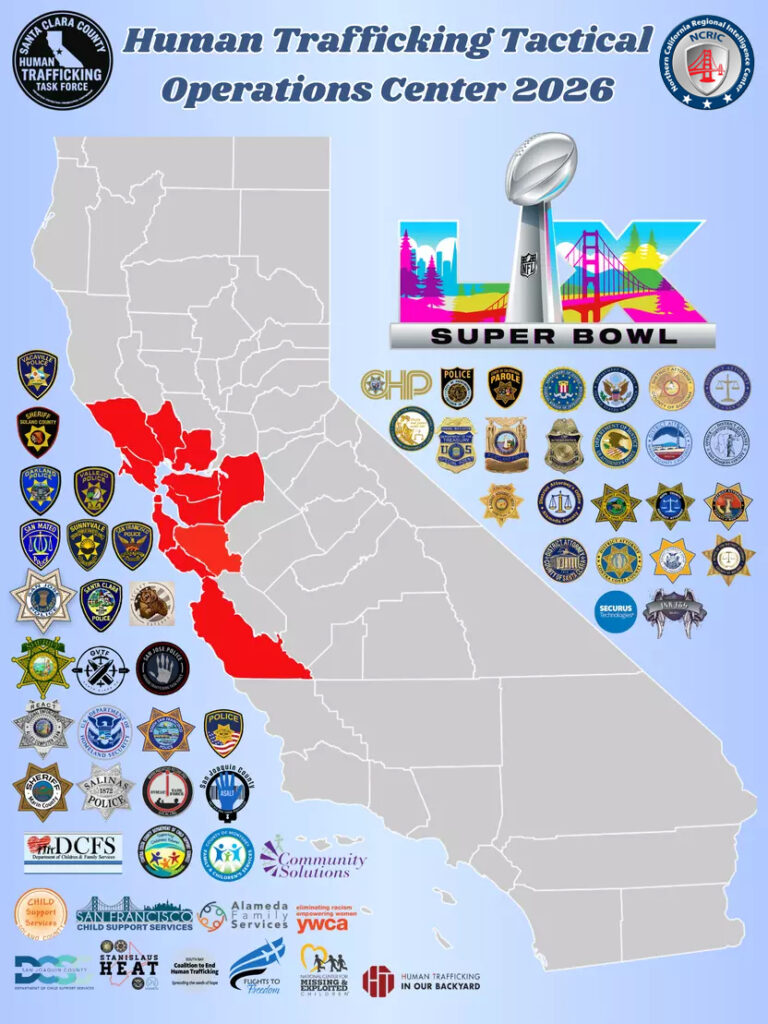
The HTTF helped organize the efforts of 67 law enforcement agencies from Sacramento to Monterey.
For two weeks before the Big Game, the Task Force set up a command center in Sunnyvale populated with more than 20 analysts from various agencies, such as the Santa Clara County Sheriff’s Office, the DA’s Crime Strategies Unit, the Contra Costa District Attorney’s Office, Pittsburg Police Department, federal agencies, and partners from community-based organizations such as In Our Backyard, and the National Center for Missing and Exploited Children. The analysts worked on tips in real time and worked alongside agents in the field to do investigations and make arrests. Operations that often take weeks took minutes in the enhanced Human Trafficking Tactical Operations Center.
Launching almost 40 operations, investigators recovered 20 victims from San Mateo County alone. Seven traffickers were arrested in Contra Costa; six in Monterey and Solano counties. In Santa Clara County, seven victims were recovered, two traffickers arrested and a firearm was seized.
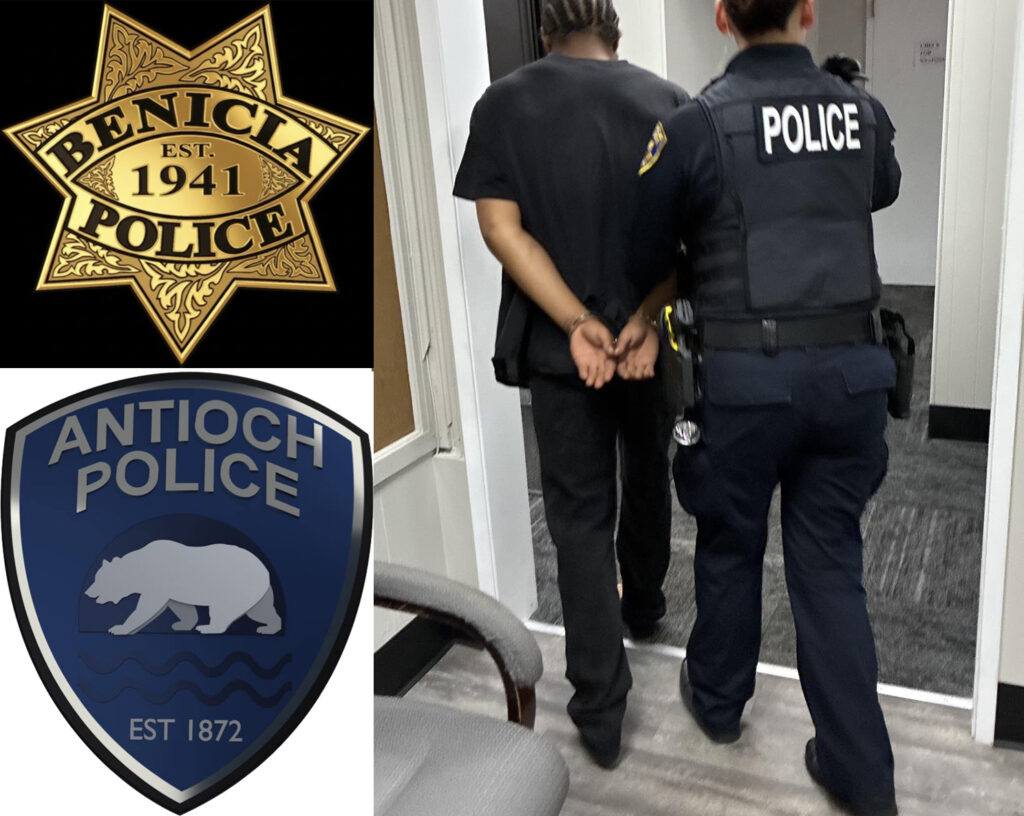
Nathaniel Leon Yancey, III was arrested by Antioch Police for a robbery in Benicia on Wednesday, Feb. 18, 2026. Photo: Benicia PD
Nathaniel Leon Yancey, III fled with two others sought by police; faces multiple charges, bail set at $101,667
By Benicia Police Department
Yesterday, Feb. 18, 2026, around 12:00 p.m., our dispatch center received a call from a resident that had been robbed of her purse and phone (note: no weapons used) as she approached the front door of her home. The incident happened in a neighborhood near Rose Drive and Columbus Parkway in Benicia. Three suspects were involved and fled the scene in a vehicle that had stolen plates. Using the stolen plate number, we were able to confirm through our ALPR system (Flock) that the vehicle was in the area of the robbery at the time it happened and also discover that the vehicle had entered the City of Antioch shortly after the robbery.
Our partners at Antioch Police Department were able to locate and stop the vehicle at which time all three suspects fled on foot. One of the suspects, Nathaniel Leon Yancey, III, a 22-year-old male from Antioch, was captured at 2:09 p.m. in the 2100 block of Peppertree Way in Antioch, brought back to Benicia PD, positively identified and subsequently transported to County Jail for booking. The suspect’s vehicle was towed back to Benicia PD and the stolen possessions were located inside.
According to the Benicia Police Department’s Citizen RIMS, the five-foot, nine-inch tall, 170-pound Yancey is Black and is charged with felony robbery, felony causing injury to an elder or dependent adult, felony conspiracy to commit a crime, violating civil rights by force or threat of force, receiving/etc. known stolen property and petty theft – all other larceny. He is currently being held in the Justice Center Detention Facility in Fairfield.
According to the Solano County Sheriff’s Department, he was born 10/23/2003, and also faces one felony charge of probation violation, rearrest/revoke. Yance’s bail is set at $101,667 and his court date is scheduled for Feb. 20 at 1:30 p.m. in Superior Court, Fairfield.
According to localcrimenews.com, while a resident of Rodeo, he was arrested on Sept. 16, 2025, in Solano County by Solano CHP, for evasion of a peace officer on the wrong side of the median and evasion with wanton disregard for safety.
Detectives continue to follow leads in order to locate and arrest the other individuals involved. Case #26-00236.
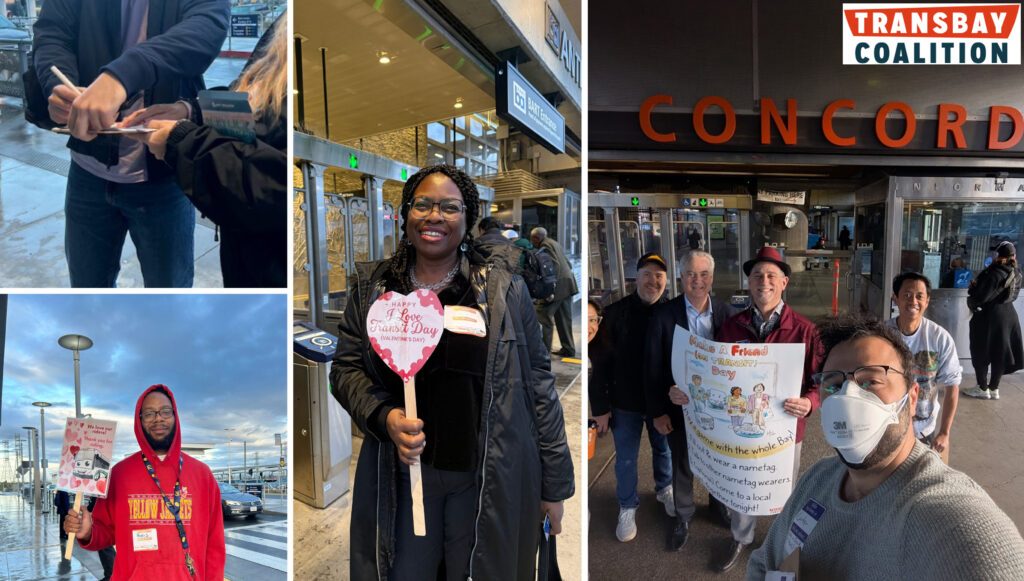
Riders at the Antioch (left & center) and Concord BART Stations (right) make friends on transit Wednesday, Feb. 11, 2026. Photos left & center by Tri Delta Transit and right by Transbay Coalition
Morning and evening riders participated in a game to make personal connections while riding transit
By Transbay Coalition
Yesterday, Wednesday, February 11th, was International Make A Friend Day, and transit advocates were helping people throughout the region to make a friend on transit. Morning and evening riders participated in a game across Contra Costa, Alameda, Santa Clara, San Mateo and San Francisco counties to make personal connections while riding transit.
Early that morning hundreds of Bay Area residents participated in Make a Friend (On Transit) Day and wore name tags as they went about their regular BART, Caltrain, ferry and bus trips to celebrate the day and build camaraderie in the Bay.
“It’s good for us all to remember the old saying that strangers are just friends you haven’t met yet.” said Carter Lavin, Transbay Coalition Co-Founder. “Transit is a shared public resource, connects us all, and is an integral part of our community. Make A Friend (On Transit) Day may be simple and a bit silly, but we hope it can bring a little more joy and connection.”
Between 7:30 and 9am at 10 BART stations, five Caltrain stations and one ferry terminal across the region, transit advocates across the region passed out materials at all corners of the Bay from Antioch to San Jose, San Francisco to Dublin/Pleasanton, Redwood City to Oakland. Despite a drizzly morning, transit riders wearing name tags with, “Hi my name is _____, ask me about ______” got to know one another while chatting about a range of topics including Bad Bunny, 3D printing, R&B, dancing, hobbits, and much more. A nice reminder that making a new friend can be as simple as getting to know your fellow transit rider.
“Make a Friend Day reminds us that friendship is a powerful bond that connects us all. Let public transit be that bridge; a simple hello to a fellow passenger today has the potential to brighten someone’s world,” says Tri Delta Transit CEO Rashidi Barnes.
In the evening, Transbay Coalition hosted free events at five locations around the Bay for people to gather and have another opportunity for folks to make some new friends.
“Make A Friend on Transit Day is a great reminder that our buses and stations are shared community spaces,” said Bill Churchill, General Manager of County Connection. “A simple hello can go a long way.”
Tri Delta Transit, County Connection and LAVTA Wheels helped with nametag distribution at Antioch, Concord and Dublin/Pleasanton BART stations– which are also bus hubs served by the agencies. BART, Caltrain and SF Bay Ferry promoted the events on social media.
“SF Bay Ferry loves to welcome enthusiastic riders onboard our vessels. We hope that Make a Friend on Transit Day is an opportunity for passengers to connect about their favorite experiences on the ferry,” shared Teo Saragi, SF Bay Ferry spokesperson.
About Transbay Coalition
The Transbay Coalition is a grassroots public transportation advocacy group championing bold near-term solutions to the Bay Area’s regional transportation crisis. Founded to campaign for dedicated bus-only lanes on the Bay Bridge and its approaches, we’re striving to create an equitable and efficient public transit system and reduce greenhouse gas emissions. Our Mission and Vision is to build an equitable, seamless, and successful transportation network in the Bay Area by building a broad-based, ongoing, grassroots movement to advocate for equitable, sustainable public transportation.
Discover Diablo Exploratory hike in Del Puerto Canyon. Photo: Kendra Smith. Inset – People enjoying our Discover Diablo hike looking for newts at Briones Regional Park. Photo: Emily Sherwood.
By Laura Kindsvater, Senior Communications Manager, Save Mount Diablo
CONTRA COSTA, ALAMEDA, STANISLAUS, AND SAN BENITO COUNTIES—Explore some of the East Bay’s premiere hiking and natural areas with Save Mount Diablo in 2026, including places normally closed to the public.
The Discover Diablo outings series offers guided hikes, themed walks, and other outdoor activities: mountain biking; rock climbing; meditation in nature; plein air painting events; and property tours.
New this year are a Green Ranch rove, and a Spanish language hike at Pine Canyon.
We’ll also be continuing much-loved events in 2026 including rock climbing at Mount Diablo State Park and Pinnacles National Park, stargazing with the Mount Diablo Astronomical Society, our Mitchell Canyon medicinal herb walk, Pinnacles condor hikes, and our tarantula treks!
Save Mount Diablo is offering a total of 36 more excursions in 2026 in Contra Costa County (Walnut Creek, Clayton, Concord, Pittsburg, Antioch, Brentwood, Oakley, Danville, and San Ramon), Alameda County (Dublin, Livermore, and Pleasanton), Stanislaus County (Patterson), and San Benito County (Hollister and San Juan Bautista). All events are free to the public. Trailblazers of all ages and skill levels are welcome to choose appropriate outings from our extensive offerings.
The Discover Diablo program began in 2017 to connect local communities to the spectacular natural world of the Mount Diablo area and to build awareness about land conservation.
Hikes and outings take place at Save Mount Diablo’s conserved properties or on park lands in the Diablo Range. These include Mount Diablo State Park, East Bay Regional Park District, Walnut Creek Open Space Foundation, Contra Costa Water District, Stanislaus County Parks, and National Park Service lands.
Discover Diablo hikes are guided by experts steeped in the natural history and lore of the region, who both educate and entertain while emphasizing the breathtaking beauty that the Diablo Range has to offer.
Save Mount Diablo hopes the Discover Diablo series will spark a passion for the Diablo Range and deepen people’s connections to the land and nature.
Ted Clement, Executive Director of Save Mount Diablo, stated, “It is the goal of the Discover Diablo program to build connections between people, Save Mount Diablo, and the land, helping our communities develop a strong sense of place and a deepened appreciation for our collective backyard. Most importantly, we want to cultivate a love of the land in participants, as that is what it will take to ensure the precious Diablo natural areas are taken care of for generations to come.”
There is something right for anyone to discover in the nooks and crannies surrounding Mount Diablo and within its sustaining Diablo Range, so be sure to hit the trails in 2026 and find your own individual inspiration!
“They should go back to the drawing board and give us a cost savings plan that demands more sacrifice from BART management, senior staff, and retirees.”
By Marc Joffe
BART has published a plan to balance its budget in the event voters reject the half-cent additional transit sales tax slated for the November 2026 ballot. BART’s plan appears to be well thought out but imposes far more inconvenience on riders than is necessary to close an expected $376 million deficit.
The most visible change is the station closures. Under its more extreme Phase 2 plan, BART would close 15 stations systemwide, including these five in Contra Costa: Orinda, North Concord, Pittsburg Bay Point, Pittsburg Center, and Antioch. Oakland Airport station would close, but SFO would stay open. Five other stations in Alameda County south of Oakland would be shuttered, as would four stations in San Mateo County south of Daly City. (See related article)
But most of these stations should not close. As BART itself recognizes, the savings from shuttering stations are not that large. And there is an alternative that would achieve a large portion of the expected savings, which is to operate the stations on an unstaffed basis. This idea may seem strange to BART riders expecting to see a station agent, but the fact is that many train stations in California operate without staff, including several on Capitol Corridor and Caltrain. Even Pittsburg Center on e-BART often operates without staff.
That said, both Pittsburg Center and North Concord have very low utilization (less than 1000 riders on an average weekday) and are reasonable candidates for closure. Indeed, BART should demolish the North Concord station and sell the parking lot to a developer for conversion to single family housing, a use consistent with the adjoining neighborhood.
Pittsburg Center, being in the median of Highway 4, does not offer a similar redevelopment option. It is one of three stations on the eBART extension connecting Antioch, Pittsburg and Bay Point using standard-gauge diesel multiple-unit trains which are incompatible with the rest of BART. The BART retrenchment plan envisions closing the whole eBART extension. A better choice would be to find a private operator to take it over.
That operator should be given discretion over fares and the option to convert the line to driverless technology in hopes of achieving a profit or at least minimizing the need for taxpayer subsidies.
As anyone who has visited an airport in the last few decades knows, driverless trains are nothing new. Outside the Bay Area, they are used for non-airport systems such as Honolulu’s Skyline and Vancouver’s Skytrain. Paris, Singapore, and other cities have successfully converted some of their lines to autonomous operation and Washington DC’s Metro is looking into doing the same thing.
Over the longer term, the entire BART system should be driverless: it could achieve large operational cost savings while maintaining or even increasing service frequency. Yet BART is not giving serious consideration to transitioning to driverless trains. When BART Director Matt Rinn spoke to CoCoTax in November I asked him about the idea and saw that he was unfamiliar with it. Staff should be discussing this option with the governing board.
They don’t do so because BART operates primarily for the benefit of staff and the labor unions that collect a portion of their salaries via dues. Riders are second, and taxpayers are a distant third.
Contra Costa taxpayers already pay plenty for transit, and, this November, it is time for us to tell BART and other agencies “no more.” They should go back to the drawing board and give us a cost savings plan that demands more sacrifice from BART management, senior staff, and retirees.
One change that should be considered is a 10% salary reduction for all BART employees receiving over $100,000 per year. Based on my analysis of 2024 wage and overtime data, this option would save $54 million. Costly overtime hours should also be limited: in 2024 alone five BART employees collected over $200,000 in overtime a piece.
BART’s plan defers advanced payments for retiree health benefits. This saves $38 million, but only by pushing the cost onto future taxpayers when the fund holding the advance retiree health funding is exhausted. Instead, the BART retiree health benefit should be eliminated just as it was for Stockton employees when that city went bankrupt in 2012. With BART facing functional bankruptcy in 2026, a similar economy is needed. Retirees can get subsidized healthcare through Covered California or Medicare just as those of us who work in the private sector usually do.
Salary and benefit cuts in addition to the layoffs BART already has planned may seem harsh, but these are the types of reductions companies have to make when they are losing money and there is less demand for their product. Because BART now needs more of our money, we have the power to veto any cost-saving plan that fails to prioritize the needs of beleaguered taxpayers and riders. Let’s exercise that veto. In November, say NO to the transit sales tax.
Marc Joffe is the President of the Contra Costa Taxpayers Association