During their meeting on Tuesday, September 22, 2026, the Antioch City Council on a vote of 4-0, with District 2 Councilman Louie Rocha absent while attending the California League of Cities conference, approve the following proclamation declaring September 15 through October 15 as Hispanic Heritage Month, in alignment with the National Hispanic American Heritage Month.
WHEREAS, the observation started in 1968 as Hispanic Heritage Week under President Lyndon B. Johnson, and was expanded by President Ronald Reagan in 1988 to cover a 30-day period starting on September 15, 2026, and ending on October 15, 2026;
WHEREAS, every year since 1988, from September 15th to October 15th, our country has celebrated Hispanic culture & contributions to our community and nation by celebrating the histories, cultures, and contributions of American citizens whose ancestors came from Spain, Mexico, the Caribbean, and
Central and South America;
WHEREAS, we begin the observance on September 15th, because it is the anniversary of independence or Independence Day for Latin American countries: Costa Rica, El Salvador, Guatemala, Honduras, and Nicaragua. In addition, Mexico and Chile celebrate their independence days on September 16th and September 18th, respectively;
WHEREAS, the theme for 2026 is “Pioneers of Change: Shaping the Future Together,” highlights the transformative contributions of Hispanic Americans and encourages individuals and organizations to explore how Hispanic culture continues to influence a more inclusive and innovative future. It emphasizes leadership, creativity, and community engagement across generation; and
WHEREAS, throughout the year, we honor the collective contributions of Hispanic and Latino Americans in our history, while uplifting the voices and service of those who continue to shape our communities.
NOW, THEREFORE, I, RON BERNAL, Mayor of the City of Antioch, hereby proclaim that September 15, 2026, through October 15, 2026, is “Hispanic Heritage Month” and encourage all residents to use this time to reflect on the rich culture, history, and contributions of Latino and Hispanic peoples to the enrichment of the City of Antioch.
Plus, discuss downtown security services, vote on emergency fuel purchase, more traffic calming devices, increasing investigative services contract, more water park repairs & improvements, and report on state and federal funds for housing and homeless
Still nothing on agenda about El Campanil Theatre although escrow closes Sept. 29th
By Allen D. Payton
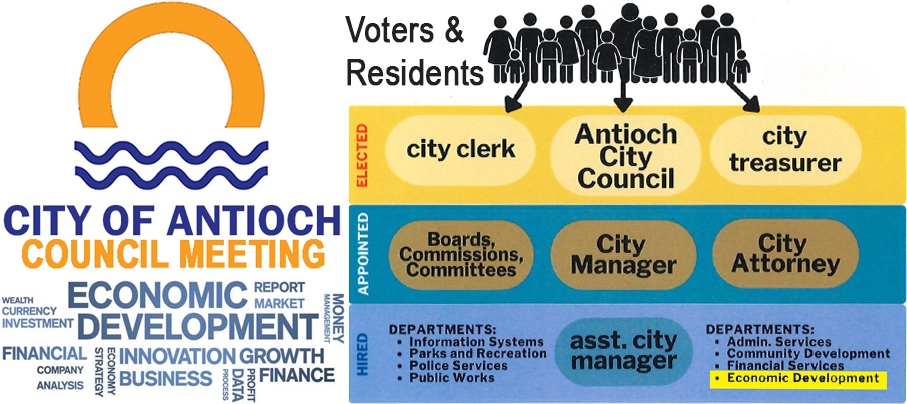
During their regular meeting Tuesday, Sept. 22, 2026, the Antioch City Council has a full agenda and will vote on reestablishing the Economic Development Department, with one staff member and either a director or combined assistant city manager dual role,emergency fuel purchase, increasing investigative services contract for the Police Department by $250,000,almost $200,000 for more traffic calming devices and $141,000 for more improvements to the water park. They will also discuss restoring private security services in downtown Rivertown and the annual report on use of state and federal funds for housing and homeless services. Finally, the Council will vote on approving a Tentative Agreement with the Confidential Unit of City employees for a one-year 3% COLA increase.
That will follow a Closed Session at 6:00 p.m. during which the Council will meet to discuss the contracts with representatives of three employee organizations: Antioch Public Employees’ Association, Treatment Plant Employees’ Association and Antioch Police Sworn Management Association.
Reestablishing Economic Development Department, Director, Staff or Dual Assistant City Manager Role, Possible Commission
Under Item 7 the Council will vote on reestablishing a standalone Economic Development Department separate from Community Development, with funding for an Economic Development Director position with an amended salary range, an Economic Development Specialist, and assigning a budget; or directing staff to revise the existing Assistant City Manager job description whose primary role would be to focus on economic development in an 80/20 scope of work structure.
As previously reported and according to the City staff report, “Per the City Council’s direction from the August 31, 2026, Study Session, below are the options for discussion.
• A standalone Economic Development Department;
• An Economic Development Director responsible for oversight and implementation of the Economic Development Strategic Plan or amending the Assistant City Manager to an 80/20 dual role;
• Status of Economic Development Commission (EDC); and
• Providing a substantial budget to the Economic Development Department for programming and successful operations.
“Under the proposed 80/20 structure, the City Manager Department would gain dedicated Assistant City Manager capacity for executive initiatives, Council priorities, interdepartmental coordination, and organizational problem-solving, while retaining responsibility for matters that cannot be delegated. This creates a tradeoff between dedicated departmental oversight and unrestricted Assistant City Manager capacity.”
In addition, Mayor Ron Bernal suggested a salary range “something similar to the current Community and Economic Development Director of $14,800 to $18,000.”
While the Commission was never officially dissolved, during their meeting on April 9, 2024, the City Council voted unanimously to dissolve their own Restructuring of the Economic Development Commission Ad Hoc Committee. According to the meeting minutes, District 1 “Councilmember Tamisha Torres-Walker explained that the committee’s purpose was to restructure the EDC to improve functionality,” but “expressed her support for dissolving the existing Ad Hoc Committee.”
During that council meeting, then-District 3 Councilwoman Lori Ogorchock asked that the vacancies on the Commission be filled to no avail.
According to Tim McCall, the Commission’s former chairman, then-mayor “Lamar (Hernandez-Thorpe) refused to fill vacancies until they didn’t have a quorum anymore. People started quitting because they could see their volunteer work was going to waste and they had better uses for their time. I asked Lamar to fill the vacancies, but he didn’t.”
Herald file photo.
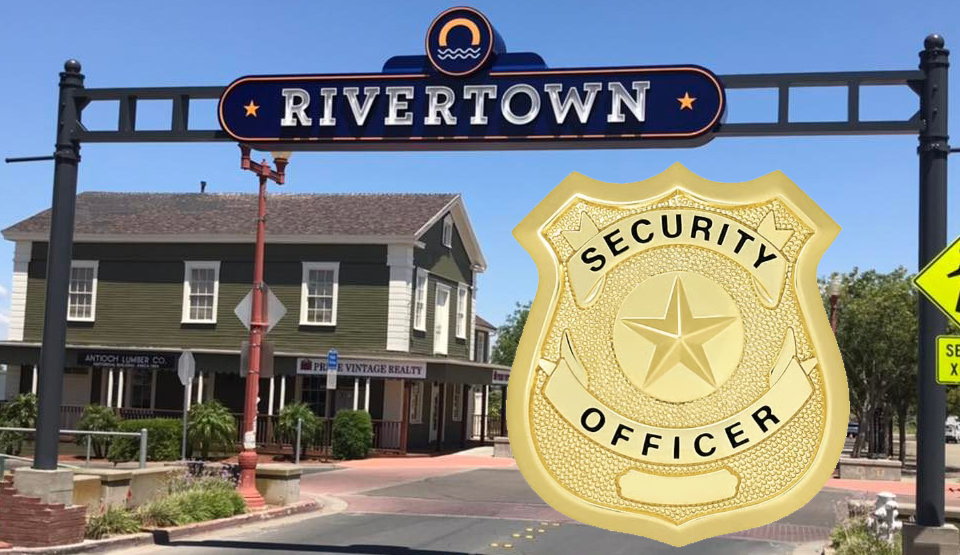
Downtown Security Services
Under Item 6, on the agenda, the Council will discuss downtown security services for City owned parking lots, property and public areas, and provide direction to staff on whether to initiate a competitive Request for Proposals (RFP) process for private security services in the Rivertown/Downtown area.
It follows the meetings held with and incorporates feedback received from downtown business owners and community members regarding hours of operation, patrol locations, scope of services and other identified needs.
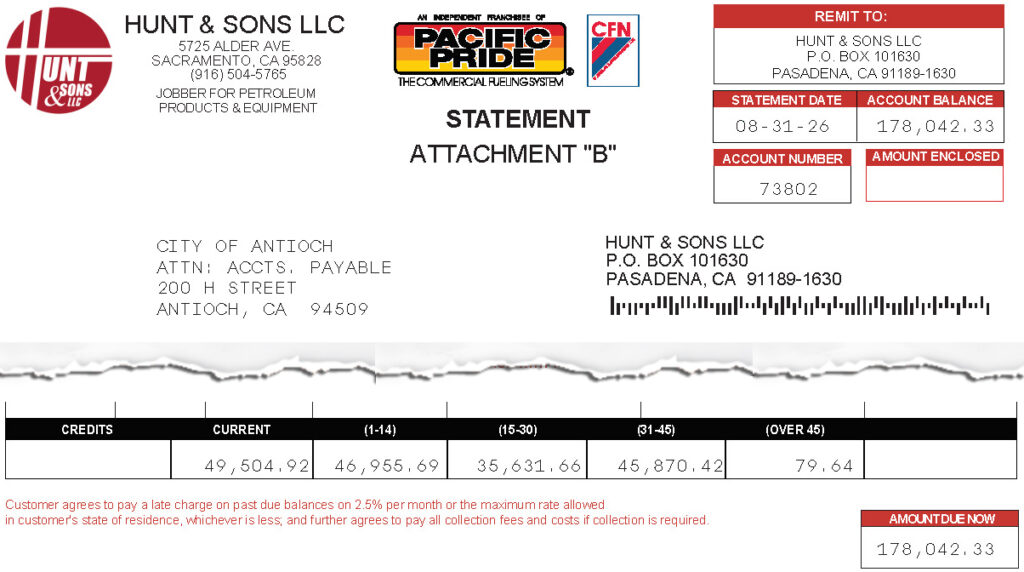
Hunt & Sons fuel purchase statement. Source: City of Antioch
Emergency Fuel Purchase Up to $500,000
Under Item 8, the Council will vote on purchasing fuel on an emergency basis through December 31, 2026, in an amount not to exceed $500,000, including applicable taxes, fees, delivery charges, and other associated costs,
to cover both the payment of outstanding fuel invoices accrued from July 1, 2026, through August 31, 2026, in the amount of $178,042.33 and the purchase of fuel necessary to maintain City operations until December 31, 2026, while City staff continue efforts to secure a new service provider for a long-term fuel supply agreement.
On April 28, 2026, the City Council approved a cooperative purchase agreement with Hunt and Sons for the purchase and delivery of unleaded and renewable diesel fuel for City operations. Hunt and Sons have not been able to meet the City’s insurance requirements and are therefore not able to perform this service under the terms of the agreement.
Since July 1, 2026, the City has continued receiving fuel deliveries from Hunt and Sons while staff, under consultation with the City Attorney’s Office, worked with the vendor to resolve the insurance requirements. The outstanding invoices will continue to accrue twice weekly as future fuel deliveries are made.
CAPER Demographics of Individuals Served FY25-26. Source: City of Antioch
Annual Report on Use of State and Federal Housing and Homeless Funds
Under Item 9 the Council will receive public comments and vote on approving the Fiscal Year 2025–26 Consolidated Annual Performance and Evaluation Report (CAPER) for submission to the U.S. Department of Housing and Urban Development.
According to the City staff report, “The CAPER details the individual goals and achievements of funded agencies during the first year (FY 2025-26) of the 2025-30 Consolidated Plan. Most agencies exceeded their goals. Below is a summary of the Priority Goals and Annual Strategies that received funding in FY 2025-26. Funding sources below are identified by their stated abbreviation for funds committed and expended:
• Community Development Block Grant (CDBG) funding from the federal Department of Housing and Urban Development;
• Housing Successor (HS) funding authorized by the State for expenditure on affordable housing and homeless services; and
• Permanent Local Housing Allocation (PLHA) funding from the State for expenditure on affordable housing and homeless services.
A total of $1,701,909.45 was spent on the various programs and a balance of $144,428.20 in Habitat for Humanity Homeowner Housing Rehabilitation funds was carried over to and will be expended in FY26-27.
Breakdown of Residents Served
According to the FY 2025-26 Summary, “Funding from the City of Antioch Community Grants Program served a total of 6,497 Antioch residents during the past year for 148% of the cumulative goal of 4,398. Of the total Antioch residents served by all programs:
• 68.8% had household incomes of 30% or less AMI (Average Median Income);
• 28.7% had incomes of 50% to 31% AMI; and
• 2.5 had incomes of 80% to 51% AMI.
The demographic breakdown of all served against the demographics of the City of Antioch is provided in the chart above.
The report also states, “Overall, community-service activities exceeded the cumulative annual service goal, with most participating agencies meeting or exceeding their individual goals. Several affordable-housing activities remain in progress or below their annual production goals and will require continued monitoring, financial reconciliation, and follow-up during FY 2026–27.”
Increasing Investigative Services Contract for Police Department to Comply with DOJ, Allen Agreements
Under Item 10, the Council will consider approving Amendment No. 2 to the contract with Chaplin and Hill Investigative Services, increasing the contract amount by $250,000 for continued investigative services “required pursuant to the USDOJ MOU, the Allen Agreement, and applicable City policies and procedures,” according to the City staff report.
Also, according to City staff, “To maintain public confidence and uphold the integrity of internal investigations, the Antioch Police Department must ensure that its process for handling allegations of misconduct is impartial and consistent with applicable federal requirements. Engaging independent, external professional investigators provides an objective means of conducting investigations involving allegations of misconduct and other matters requiring an independent review.
“This approach is consistent with national law enforcement best practices and standards. The International Association of Chiefs of Police (IACP)…recommends the use of external investigators to promote fairness and impartiality in law enforcement investigations.”
City Employee Confidential Unit One-Year 3% COLA
Under Item 11, the Council will vote on approving a Tentative Agreement with the Confidential Unit of City employees which includes a one-year 3% Cost of Living Adjustment (COLA) and benefits for FY2026/27 at a cost of $123,000 with $103,000 from the General Fund. The Confidential Unit includes a variety of staff positions: the Deputy City Clerk, Account Specialists, Analysts, Assistants, Coordinators, Specialists and Technicians. The 26 employees in the Unit have been working without a contract since September 30, 2025. See City’s Master Salary Schedule.
CONSENT CALENDAR
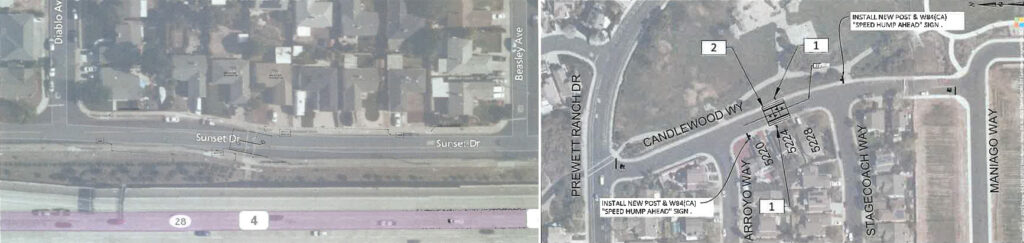
Traffic Calming projects planned for Sunset Drive (left) and Candlewood Way (right). Source for all maps: City of Antioch Public Works Dept.
More Traffic Calming Devices
After approving the expenditure of a little over $500,000 for the traffic calming devices on Sycamore Drive on Aug. 25, under Item 5.P. on the Consent Calendar, the Council will consider awarding the construction agreement to Consolidated Engineering, Inc. in the amount of $168,495 with a contingency of $30,000 for a total contract amount of $198,495 for the Neighborhood Traffic Calming Project.
Traffic Calming projects planned for D Street (left) & W. Madill Street (right).
It consists of the installation of speed hump systems, signage and thermoplastic striping. There will be a total of eight speed hump systems constructed on the following streets:
Sunset Drive between Diablo and Beasley Avenues;
E. Tregallas Road between Center Lane and Garrow Drive;
Wildflower Drive between Larkspur Drive and Lupine Court;
W. Madill Street between D and G Streets;
D Street between the Railroad and Texas Street;
East 19th Street between Acacia and Deodar Avenues;
Sunset Lane between Northridge and Daphne Courts; and
Candlewood Way between Arroyo and Stagecoach Ways.
Traffic Calming projects planned for E. Tregallas Road (left) E. 19th Street (right).
According to the City staff report, funding for the project will be from the FY 25/26 Capital Improvement Budget which has a balance of $292,292 carried over into the FY 26/27 budget of $250,000 for a total of $542,292 from Measure J Funds. Following procurement of the contract and an estimated 10% of $16,850 for construction engineering, management, inspection, testing and contract administration, that will leave an estimated fund balance of $326,947.
Traffic Calming projects planned for Sunset Lane (left) and Wildflower Drive (right).
More Water Park Repairs & Improvements
Under Item 5.Q. the Council will consider approving an amendment to the construction agreement with Top Line Engineers, Inc. in the amount of $78,232.98, for a total contract amount of $276,732.98 for Prewett Water Park Concrete Improvements 2026 Project; and under Item 5.R. they will vote on approving a second amendment to the construction agreement with Adams Pool Solutions in the amount of $63,034, for a total contract amount of $855,632 for the Prewett Water Park Pool Resurfacing Project; and approving a budget amendment to the Fiscal Year 2026/2027 Capital Improvement and Operating Budgets utilizing General Funds for the project by $75,000.
Source: City of Antioch
Allocate & Reallocate State Violence Intervention & Prevention Grant Funds
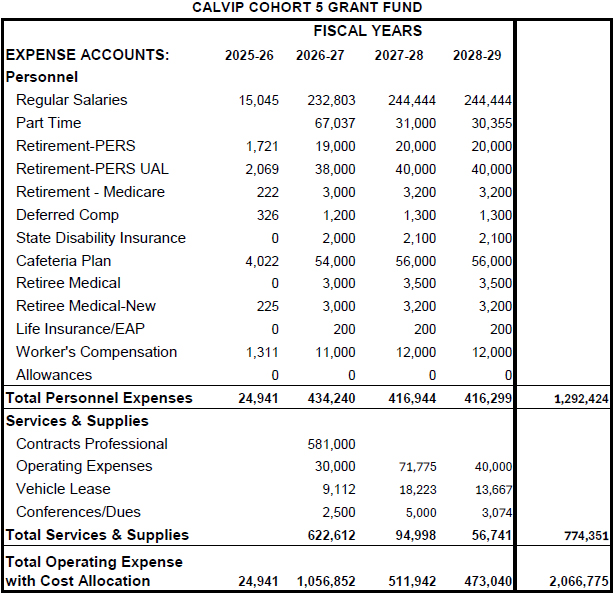
Under Item 5.S, on the Consent Calendar, the Council will vote on approving a budget amendment to appropriate and reappropriate California Violence Intervention and Prevention (CalVIP) Cohort 5 Grant funds across Fiscal Years 2025–26 through 2028–29, consistent with the approved grant award and anticipated expenditure schedule.
According to the City staff report, “On March 10, 2026, the City Council authorized acceptance of $2,066,775 in CalVIP Cohort 5 funding administered by BSCC. At that time, Council appropriated $112,000 for anticipated Fiscal Year 2025–26 expenditures and directed that the remaining grant balance be incorporated into subsequent fiscal-year budgets consistent with the grant term and approved spending plan.
“CalVIP is a competitive State grant program supporting jurisdictions disproportionately impacted by violent crime through evidence-based violence interruption, prevention, and intervention strategies. The City’s Cohort 5 award continues and expands upon violence intervention infrastructure established through prior CalVIP funding beginning in 2022.
“CalVIP Cohort 5 supports the City’s continued violence intervention and prevention activities, including personnel dedicated to program administration, violence intervention and outreach; community-based services and partnerships; participant supports; evaluation and performance measurement; and other activities authorized under the approved grant agreement.
“Because the…Cohort 5 grant extends across multiple City fiscal years, expenditure authority must be appropriately budgeted within each fiscal year in which grant-funded costs are anticipated.
The proposed budget amendment…establishes and adjusts appropriations across Fiscal Years 2025–26 through 2028–29 to align the City’s financial budget with the anticipated timing of…Cohort 5 expenditures.
Meeting Details
The Regular meeting begins at 7:00 p.m. in the Council Chambers at City Hall, 200 H Street, in historic, downtown Rivertown and can be viewed via livestream on the City’s website, on Comcast cable TV channel 24 or AT&T U-verse channel 99 or on the City’s YouTube channel.
See the complete agenda packet with staff reports here.
By Gail Murray, League of Women Voters of Diablo Valley
How secure are our elections? On Thursday, September 24 at 2:00 p.m., join a Community Conversations informative webinar exploring the safeguards that protect our voting systems and ensure every eligible vote is counted accurately.
Panelists will describe election security, ballot protection, and the processes that help maintain public confidence in our democracy. Whether you’re a new voter or a longtime election volunteer, you’ll leave with a better understanding of how safe and secure our elections really are.
Panelists:
Kristin Connelly, Contra Costa County Clerk-Recorder and Registrar of Voters
Reelected in June; focus is on voter access, election transparency and battling election misinformation.
Helen Hutchison, past president of the League of Women Voters of California
Serving at the state League, worked on initiative and referendum reform, ballot measures and redistricting.
Information on how to access the Zoom webinar will be sent to your email address 24 hours before the program.
The webinar will have simultaneous Spanish interpretation and the Contra Costa County Library will provide closed captioning. This program will be recorded and uploaded to the Library’s YouTube and the LWVDV YouTube channels after the event. For special accommodations, please contact the Library with 72 hours’ notice.
Sponsors include the League of Women Voters of Diablo Valley, the League of Women Voters of West Contra Costa County, the Contra Costa County Library and Contra Costa TV.
By Kelly Kalfsbeek, Community & Media Relations Coordinator, PIO, Contra Costa County Public Works Department
Antioch and Brentwood, CA – Contra Costa County Public Works will perform road traffic safety improvements at four sites along Deer Valley Road between Empire Mine Road and Marsh Creek Road, from Tuesday, September 8, 2026, through Friday, November 20, 2026, barring unforeseen circumstances. Work will occur between 7:00 a.m. and 5:00 p.m., Monday through Friday, excluding holidays, weather permitting.
Traffic control will be used at each site with restrictions in place to minimize impacts during commuting hours. Message boards will alert drivers to the work. Drivers should expect delays through the work zones and consider alternative routes during working hours.
The project is intended to enhance safety at four locations on Deer Valley Road. Funding for this project is provided by the Federal Highway Safety Improvement Program (HSIP) and Local Gas Tax SB1. For more information about this project, visit www.contracosta.ca.gov/Deer-Valley-Road-Traffic-Safety-Improvements
About Contra Costa County Public Works Department:
The Contra Costa County Public Works Department (CCCPWD) is responsible for the maintenance and operation of over 650 miles of roads, 79 miles of streams and channels, and over 150 County buildings. CCCPWD services include parks and recreation, sandbag distribution, flood control, road and facilities maintenance, and storm water management. CCCPWD operates two airports, Buchanan Field Airport in Concord and Byron Airport in Byron. For more information about CCCPWD, please visit us at: www.cccpublicworks.org.
Cops will be on, provide extra patrols in and around campus today
By Antioch Police Department
The Antioch Police Department is aware of messages and rumors circulating regarding a possible act of violence at Antioch High School today.
We are working closely with Antioch High School administrators and school security and are actively investigating the information that has been reported. At this time, we have no information that supports the rumor.
As a precaution, Antioch Police officers will be present at the school today, and officers will conduct additional patrols in and around the campus. We will remain in close communication with school officials throughout the day.
We understand that messages like these can be concerning for students, families, and staff. We ask everyone to rely on information from official school and Antioch Police Department sources and to avoid sharing unverified rumors or screenshots on social media.
See something, say something. If you have firsthand information, screenshots, messages, or other specific information that may assist the investigation, please contact the Antioch Police Department at (925) 778-2441. Tipsters may remain anonymous.
Please call 9-1-1 for an immediate threat or emergency.
Our Dispatch Center is receiving a high volume of calls regarding this situation. If you do not have new information to report or need police assistance, please monitor official school and Antioch Police Department channels for updates rather than calling Dispatch for a status update.
We will provide additional information if there are significant developments.
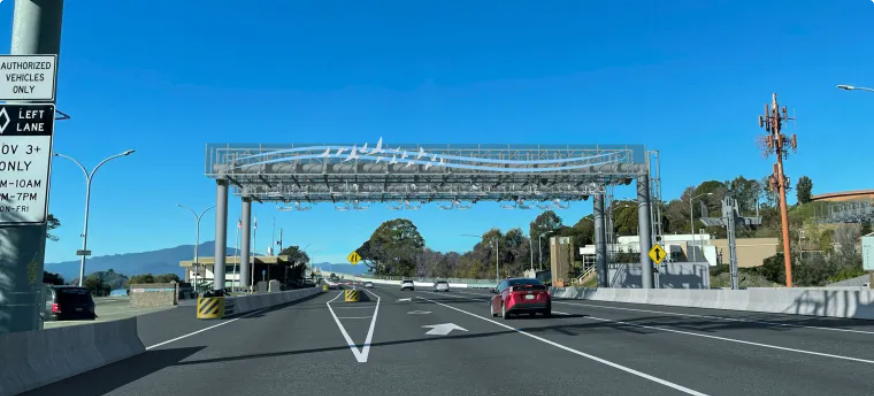
Rendering and photo of planned Antioch Bridge toll plaza with toll booths removed and new overhead gantry. Source: BATA
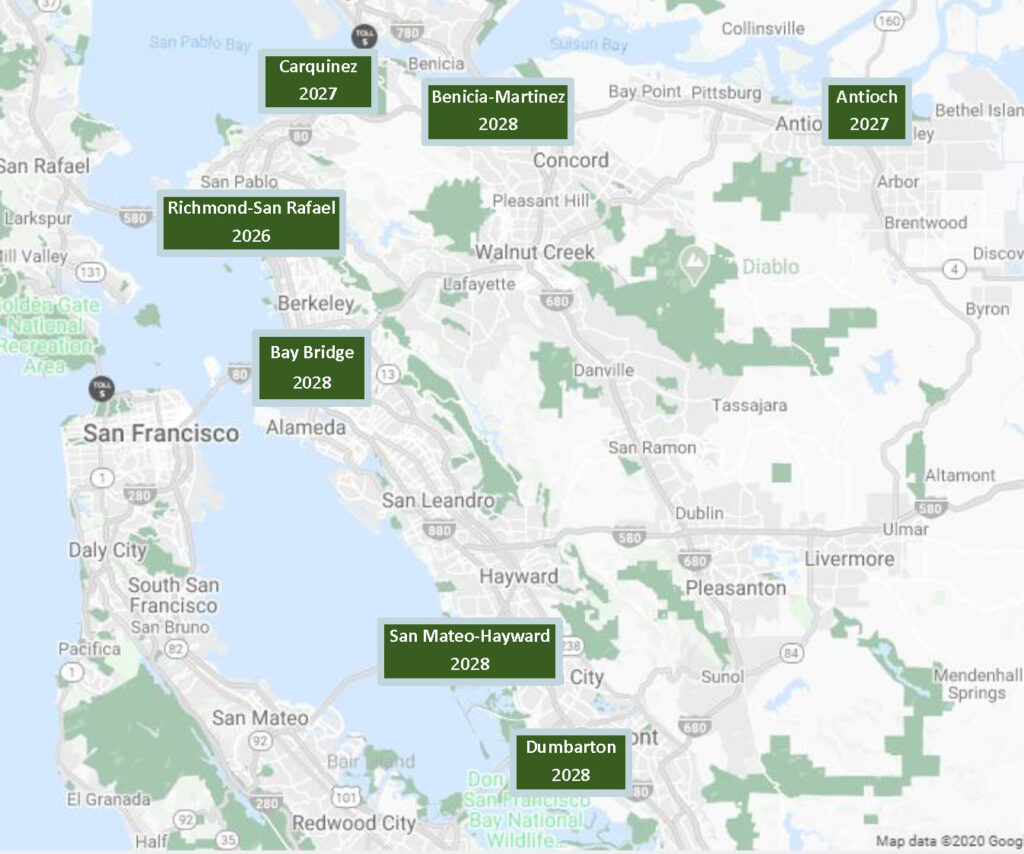
Then expand to Antioch, Benicia-Martinez and Carquinez Bridges in 2027-28; San Francisco-Oakland Bay Bridge, San Mateo-Hayward and Dumbarton Bridges in 2028
Offers high-speed toll collection system; see how an ORT gantry works
By Bay Area Toll Authority
Acting Caltrans District 4 Director and Bay Area Toll Authority (BATA) Commissioner Doanh Nguyen reminds drivers that the toll booths at the Bay Bridge and other state-owned toll bridges will soon be a thing of the past. “The transition to open-road tolling already is underway, with the new system set to debut next year at the Richmond-San Rafael Bridge.”
The Open Road Tolling (ORT) Program will streamline the driver experience when the toll booths are removed from the seven state-owned toll bridges which currently use All-Electronic Tolling (AET). They will, over time, be converted to ORT.
Why Do We Need the Open Road Tolling (ORT) Program?
The ORT Program will replace the current, aging toll system with newer “toll gantry” technology that will be optimized to process all tolls electronically.
These days, it is not necessary for drivers to stop at toll booths to pay the toll. The ORT Program will remove the toll booths and update the roadway through the toll plaza area, improving safety and highway operations.
Project Benefits
The implementation of ORT will result in more efficient tolling, increased safety at toll plazas and provide a consistent regional experience to Bay Area travelers. Implementing ORT has also been shown in other regions to improve traffic flow and reduce vehicle emissions.
What’s a Toll Gantry?
A toll gantry is an overhead structure with mounted toll readers.
Bay Area Express Lanes use gantries above part of the roadway. In the former toll plazas, the ORT Program will install gantries that cross the entire roadway.
In the illustration at the top of this page, a conceptual toll gantry design is shown at the Richmond-San Rafael Bridge. A The toll plaza has been removed and replaced with toll equipment centered over the lanes.
ORT Toll Gantry illustration. Source: BATA
How Does ORT Work?
The ORT toll system is a roadside system that detects vehicle information as drivers pass through the toll zone.
A typical ORT roadside system is shown in the figure above. Overhead cameras, antennae and associated toll equipment are mounted on gantries that span the entire width of the roadway. This equipment captures toll tag and license plate information. Inductance loops are embedded in the pavement and centered on the travel lanes. These loops are used to count the number of axles to assign the right toll rate. The Roadside Toll Equipment Enclosure houses computer processors that package the pieces of information into a single toll transaction. This data is transmitted to the FasTrak Customer Service Center to collect the toll from customers
Construction Period
Construction began in spring 2026 on the Richmond-San Rafael Bridge, the first of the Bay Area’s state-owned bridges to convert to open road tolling.
Before, during and after construction, the collection of tolls will be seamless to the customer. Customers will continue to be able to use their FasTrak toll tag or use their license plate to get an invoice in the mail. While this program will shift the location where tolls are collected from the traditional toll plaza to a gantry over the road, the toll collection process is unchanged.
Map of the Bay Area including San Francisco and the East Bay, showing the location of the seven bridges that are part of the ORT program (Antioch, Benicia-Martinez, Carquinez, Richmond-San Rafael, San Francisco-Oakland Bay Bridge, San Mateo-Hayward and Dumbarton Bridges). Source: BATA
How Do Drivers Pay Tolls?
Toll payment options will be no different under the ORT Program. Drivers can set up a FasTrak account or a Pay By License Plate account to pre-pay tolls. Vehicles without pre-paid accounts will receive an invoice in the mail. A FasTrak toll tag in the designated HOV lane with the required occupancy is required to receive HOV discounts. For more information visit the FasTrak website.
No More Cash Collection
The toll plazas in use today were designed for both cash and electronic payment.
In response to the COVID-19 pandemic, Governor Newsom removed the cash toll booth collectors from the toll plazas on March 21, 2020. This is a permanent change, so there will be no more cash collection at Bay Area toll booths. This effectively changed the toll collection system to operate as an all-electronic system.
Source: BATA
Notice of Exemption for Antioch, Benicia-Martinez & Carquinez Bridges
In September 2025, a Notice of Exemption was issued by the Bay Area Toll Authority (BATA) on the California Environmental Quality Act website for the ORT Conversion Northern Bridges Project specifically for the Antioch Bridge, Benicia-Martinez Bridge and Carquinez Bridge toll plazas. The project would replace existing toll booths with new toll gantries, which will serve the same purpose and capacity as the toll booths without expanding the use of existing highways or streets, nor create additional automobile lanes.
BATA, in coordination with the California Department of Transportation (Caltrans), proposes Open Road Tolling (ORT) systems at the Antioch Bridge (State Route-160 [SR-160]), Benicia-Martinez Bridge (Interstate 680 [I-680]), and Carquinez Bridge (Interstate 80 [I-80]) toll plazas in Contra Costa and Solano counties.
Rendering of planned future Open-Road Tolling toll gantry at the Richmond-San Rafael Bridge toll plaza. Credit: Kimley Horn and Associates
The purpose of the project is to replace aging tolling system infrastructure to improve operational efficiency through bridge toll plazas and improve safety by eliminating the need to pass through existing toll booths. The project is needed to address operational and safety deficiencies for vehicles traveling through the Antioch Bridge, Benicia-Martinez Bridge, and Carquinez Bridge toll plazas.
The existing toll collection system is aging and needs to be replaced. The existing toll collection booths and other civil infrastructure are physical barriers that act as fixed objects within the travel way of the road. The existing fanning and merging of travel lanes near the toll plazas increase the potential for collisions.
Rendering and photo of the proposed toll gantry at Carquinez Bridge with toll booths removed. Source: BATA
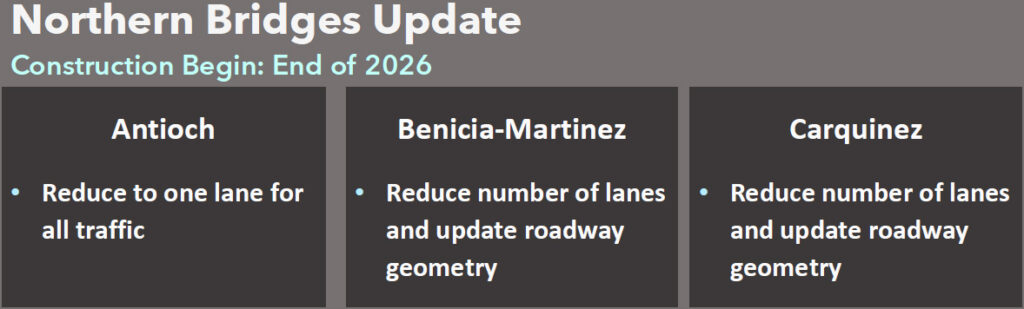
The proposed project would remove and replace existing toll booths, toll equipment, and canopies with ORT systems at the Antioch Bridge, Benicia-Martinez Bridge, and Carquinez Bridge toll plazas. This includes the construction of new ORT gantries and the installation of toll equipment buildings along SR-160, I-680, and I-80. Northbound I-680 and eastbound I-80 would be restriped to four general purpose lanes and one high-occupancy vehicle (HOV) lane through the toll plazas. Northbound SR-160 would be restriped to one lane through the toll plaza. Entrance and exit ramps to and from toll administration buildings and parking lots would be modified. Existing roadway signs would be removed, replaced, or relocated at all three bridge locations, as needed.
BATA’s Toll Policy will provide toll discounts to HOVs with FasTrak® Flex tag. All project activities are within State right-of-way, except for minor widening on the maintenance ramp for Bridgehead Road, which lies within City of Oakley right-of way. Construction is planned to begin in 2026 and is anticipated to take approximately 20 months.
Source: BATA
Public Comment
Staff updates on the program will be provided during BATA Oversight Committee meetings. Members of the public are invited to comment during these meetings.
Comments and questions may also be directed to info@bayareametro.gov with the subject line “ORT Webpage Comment.”
Get ready for a spooktacular week of fun! Campers will enjoy games, crafts, and other fall-themed fun activities.
Embrace the spirit of the autumn season with Coyote Hills CAMPtober! From relay races to scavenger hunts, there’s plenty to keep everyone active. Get creative with you join the scarecrow design contest and experience the deliciousness of the fall harvest with hot cider and mini pie creations. Join in on all the festivities with CAMPtober!
Don’t miss out- CAMPTober is the place to be!
Age at least 5yrs but less than 12yrs 11mos, Mixed
September 28 – October 2
Weekdays 9:00 a.m – 3:00 p.m
$210 resident/$231 non-resident
Click here for more information and to register and let the CAMPtober countdown begin!
Antioch’s Dozier-Libbey Medical High School ranked in top 10 in county, #229 in state, in top 8% nationally
By Contra Costa County Office of Education
PLEASANT HILL, Calif.— Several high schools across Contra Costa County earned top statewide and national rankings in the newly released 2026-27 U.S. News Best High Schools Rankings. The report recognized the schools for strong academic performance and college readiness. U.S. News reviewed more than 27,000 public high schools nationwide and ranked nearly 18,000 schools based on student outcomes, state assessment performance, college readiness and graduation rates.
Leading the county was Dougherty Valley High School in the San Ramon Valley Unified School District, which ranked No. 25 in California and No. 190 nationally. Miramonte High School in the Acalanes Union High School District followed at No. 29 in California and No. 205 nationally, and Campolindo High School, also in the Acalanes Union High School District, received a ranking of No. 34 in California and No. 243 nationally.
“These rankings reflect school communities that have the resources, rigor and strategic support in place to foster student achievement,” Contra Costa County Superintendent of Schools Lynn Mackey said. “Their performance among the top schools in the state is truly something to celebrate. My hope is that schools throughout our county can learn from these examples and help even more students thrive academically while preparing the next generation for success.”
Five Contra Costa County schools ranked among the top 100 public high schools in California:
· Dougherty Valley High School (San Ramon Valley Unified School District) — No. 25
· Miramonte High School (Acalanes Union High School District) — No. 29
· Campolindo High School (Acalanes Union High School District) — No. 34
· Acalanes High School (Acalanes Union High School District) — No. 87
· Monte Vista High School (San Ramon Valley Unified School District) — No. 92
According to U.S. News, the rankings are based on six factors, including college readiness, state assessment proficiency and performance, graduation rates, curriculum breadth and the performance of underserved students.
Top 10 Contra Costa County High Schools
· Dougherty Valley High School (San Ramon Valley Unified School District) — No. 25 California, No. 190 National
· Miramonte High School (Acalanes Union High School District) — No. 29 California, No. 205 National
· Campolindo High School (Acalanes Union High School District) — No. 34 California, No. 243 National
· Acalanes High School (Acalanes Union High School District) — No. 87 California, No. 594 National
· Monte Vista High School (San Ramon Valley Unified School District) — No. 92 California, No. 622 National
· Las Lomas High School (Acalanes Union High School District)— No. 147 California, No. 913 National
· Northgate High School (Mt. Diablo Unified School District) — No. 166 California, No. 995 National
· California High School (San Ramon Valley Unified School District)) — No. 222 California, No. 1,353 National
· Dozier-Libbey Medical High School (Antioch Unified School District) — No. 229 California, No. 1,396 National
· Making Waves Academy (Charter School in Richmond, CA) — No. 240 California, No. 1,489 National
One of 58 counties in California, Contra Costa County has the 11th largest public-school student population in the state (approximately 169,225 students). Officially established in 1932, CCCOE has a long history of providing direct services to some of the county’s most vulnerable students, including young people who are incarcerated, homeless, or in foster care, as well as students who have severe physical or emotional challenges.
CCCOE also provides support services to schools and school districts in Contra Costa County; services that can be handled most effectively and economically on a regional basis rather than by each of the county’s 286 schools or 18 school districts. These services range from budget approval and fiscal support to technology infrastructure, communication support, and high-level professional development opportunities for educators. CCCOE maintains a website at www.cocoschools.org.