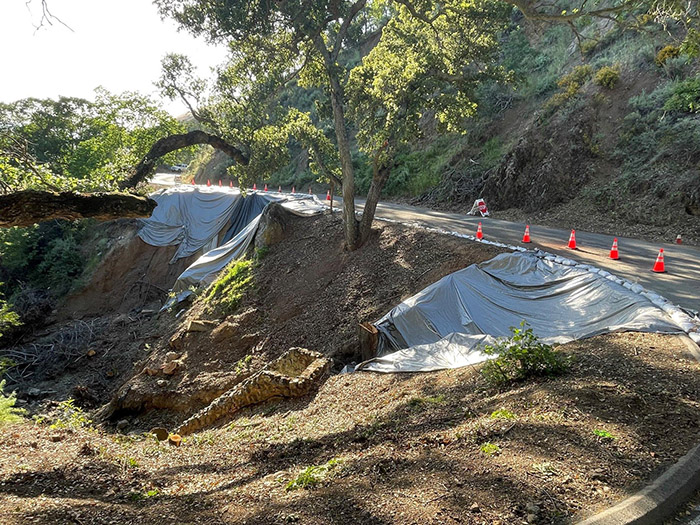
Storm damage on North Gate Road in Mt. Diablo State Park. Source: CA State Parks
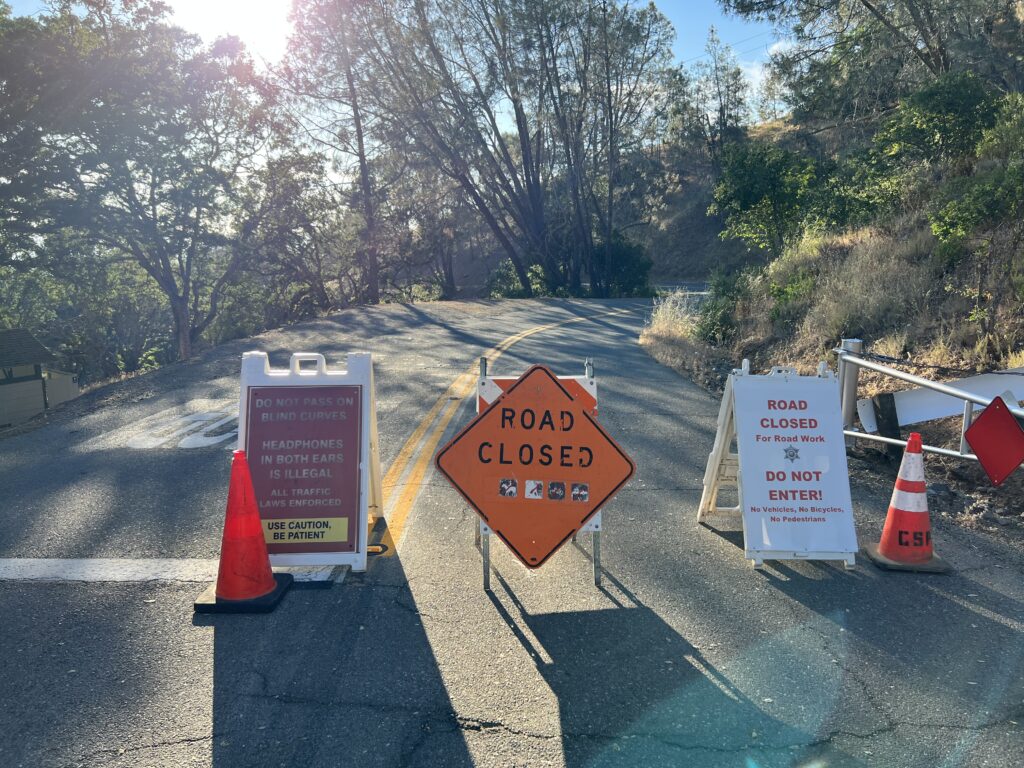
Mt. Diablo State Park temporarily closes North Gate Road for emergency slide repair through mid-Sept. WALNUT CREEK, Calif.— California State Parks announced on May 17, 2023 the temporary closure of North Gate Road at Mount Diablo State Park to pedestrians, vehicles, equestrians and bicyclists. The road will be closed May 19 through mid-September to stabilize and rebuild a section damaged by the 2023 winter storms. (Apologies to our readers. The Herald publisher just learned of this, yesterday).
Visitors will be able to access the summit and developed areas of the park from the South Gate Entrance (2675 Mt. Diablo Scenic Boulevard in Blackhawk, 94506) on the Danville side of the mountain. Whether driving or riding your bike, please ensure you are travelling at a safe speed for you, wildlife, and fellow visitors.
Located in the San Francisco Bay Area to the east of Walnut Creek, people have been drawn for generations to Mount Diablo for its spectacular views from the summit which extend over 100 miles in all directions on a clear day. Visitors have been attracted by the complex geology that has created amazing rock formations such as the “wind caves” at Rock City, and by the mountain’s variety of habitats which are home to over 600 species of plants and an amazing array of wildlife such as butterflies, bats and birds of prey, tarantulas, bobcats, lizards, snakes, and deer.
In 2021 Mount Diablo celebrated its 100th year as a state park. Though more than 100-years is a long history as a park, the importance of Mount Diablo was recognized long before that. For thousands of years Native Americans were the caretakers of this land. Many groups considered and treated the mountain as a sacred place and continue to do so today.
Since becoming a park in 1921, Mount Diablo has been protected as a natural area, and over the past 100 years the park has grown from only a few hundred acres to over 20,000 acres. Today it is a destination for those who would like to view wildlife and wildflowers, experience beautiful views, hike, camp, picnic, run, cycle, climb, ride horses, or gaze at the stars.
By Contra Costa County Office of Communications & Media
The Contra Costa Commission for Women and Girls is partnering with California Women Lead to host a State of California Commissions Appointments Workshop on July 29.
The workshop will provide information on state and local commissions, the application process, and tips for strong applications. The Commission encourages participation of active community members seeking to learn about public governance, preparing for elected office, or aiming to make more significant community impact. Learn about the value of serving on boards and commissions and why there needs to be more women at the table.
The Contra Costa Commission for Women and Girls was formed in 1984 as an advisory committee to the Board of Supervisors. The Commission provides information and advice to the Board relating to the health and welfare of women and girls in the County. The Commission strives to increase awareness of women’s and girls’ issues, celebrate achievements of local deserving women, champion opportunities for women and girls, and recommend legislative solutions at the city, county, state, and federal levels.
For further information about the California Commissions Appointments Workshop and the Contra Costa Commission for Women and Girls, please email cccwomenscommission@gmail.com.
More than 11 million arrest and conviction records automatically cleared including old arrests that never turned into charges and provides relief to people who completed all conditions of their sentence
Due to legislation pioneered by Los Angeles DA George Gascón
By Max Szabo, Prosecutors Alliance of California
SACRAMENTO–New data from the California Department of Justice (CAL DOJ) indicates that 11,164,458 records of arrest and conviction were automatically cleared between July 1, 2022 and December 31, 2022 pursuant to Assembly Bill 1076. The historic reform automated a process that individuals were already entitled to but had to seek out through an arduous process. AB 1076 requires CAL DOJ to automatically clear old arrests that never turned into charges and provides relief to people who completed all the conditions of their sentence, thereby expanding education, employment and housing opportunities for countless Californians.
“People who were arrested or convicted of low-level crimes and did what was asked of them are entitled to a second chance under the law, but bureaucratic barriers kept them in a paper prison,” said Cristine DeBerry, Founder and Executive Director of the Prosecutors Alliance of California. “That wasn’t just unfair, it was unsafe, as a criminal record hangs over people, hampering their access to employment and housing opportunities, primary factors that drive recidivism. The system had taken away hope and opportunity, but commonsense and technology enabled one of the most important reforms in years.”
The automated record clearance is due to a 2019 law, Assembly Bill 1076, which was authored by Phil Ting (D-San Francisco) and sponsored by then-San Francisco District Attorney George Gascón. The legislation mandated that the state Department of Justice automatically clear records of arrests that did not result in a conviction after the statute of limitations had passed as well as convictions involving probation and jail once an offender’s sentence was completed. Individuals sentenced to prison and anyone who had to register as a sex offender or who violated their probation is not eligible. The record clearance largely benefits individuals who had committed drugs or property crimes.
“It’s a vicious cycle, as communities of color are more likely to be arrested, they are therefore more likely to have a record that includes an arrest or conviction, and yet they were less likely to be aware that they were entitled to relief,” said LA County District Attorney George Gascón. “These were unnecessary barriers that make it more difficult to successfully reenter and break the cycle by limiting access to jobs, education and housing. Breaking down these barriers makes our system more just and our communities more safe.”
During the appropriations process that bill was limited to prospective arrests and convictions. However, a subsequent effort in 2021, AB 1038, authored again by Assemblymember Ting, and sponsored by the Prosecutors Alliance of California, made the record clearance provided under AB 1076 retroactive. That bill took effect July 1, 2023. The newly released DOJ data indicates that the relief granted thus far was pursuant to AB 1076, the initial authorizing legislation only, suggesting that the expanded eligibility profile now in effect under AB 1038 will result in the clearance of millions of additional records.
Prior to the automated record clearance, 8 million California residents had criminal convictions on their records that hampered their ability to find work and housing, secure public benefits, or even get admitted to college. Studies indicate approximately two million of them were eligible for record clearance. Millions more have old arrests on their record that never resulted in a conviction but, remain as obstacles to employment.
Under the law arrests that didn’t result in a conviction may be cleared. Convictions that carry probation or jail time are also eligible for record clearance after the individual completes all the terms and conditions of their sentence. Prior to AB 1076, however, this required individuals to be aware of their eligibility and to retain an attorney to proactively file the necessary petition. As a result, millions of Californians have been entitled to relief for years that they never realized because they had to jump through hoops to get it. In fact, nationally, only 6.5% of eligible people have been estimated to obtain record clearance within five years of eligibility. With more affluent communities more able to afford a private attorney, this bureaucracy disproportionately impacted socioeconomically disadvantaged communities and communities of color in particular.
Nearly 90% of employers, 80% of landlords, and 60% of colleges screen applicants’ criminal records. According to a 2012 study conducted by the Society for Human Resource Management, many prospective employees and housing applicants are rejected solely based on having an arrest record on file. Studies also show people with unsealed arrest records have a substantially increased chance of living in poverty, earning lower wages, with fewer educational opportunities.
The concept for the legislation grew out of DA Gascón’s effort to clear old cannabis convictions that were eligible for clearance pursuant to Proposition 64. That effort has now been adopted by prosecutors’ offices across the nation. Notably, the algorithm that enabled automated record clearance pursuant to AB 1076–much like the cannabis clearance effort–would not be possible without the help and support of Code For America. Research by the California Policy Lab of the University of California provided supporting evidence regarding the feasibility of large-scale record clearance automation, as well as its enormous potential impact on the lives of Californians. Assemblymember Phil Ting has the sincere gratitude of the Prosecutors Alliance for leading the historic initiative and seeing that all eligible and impacted Californians would obtain the relief to which they are entitled.
The Prosecutors Alliance of California is fiscally sponsored by Tides Advocacy, a social welfare organization. Contra Costa District Attorney Diana Becton is a founding member. For more information about the Prosecutors Alliance go to www.ProsecutorsAlliance.org and keep up with our work on Twitter,Instagram and Facebook.
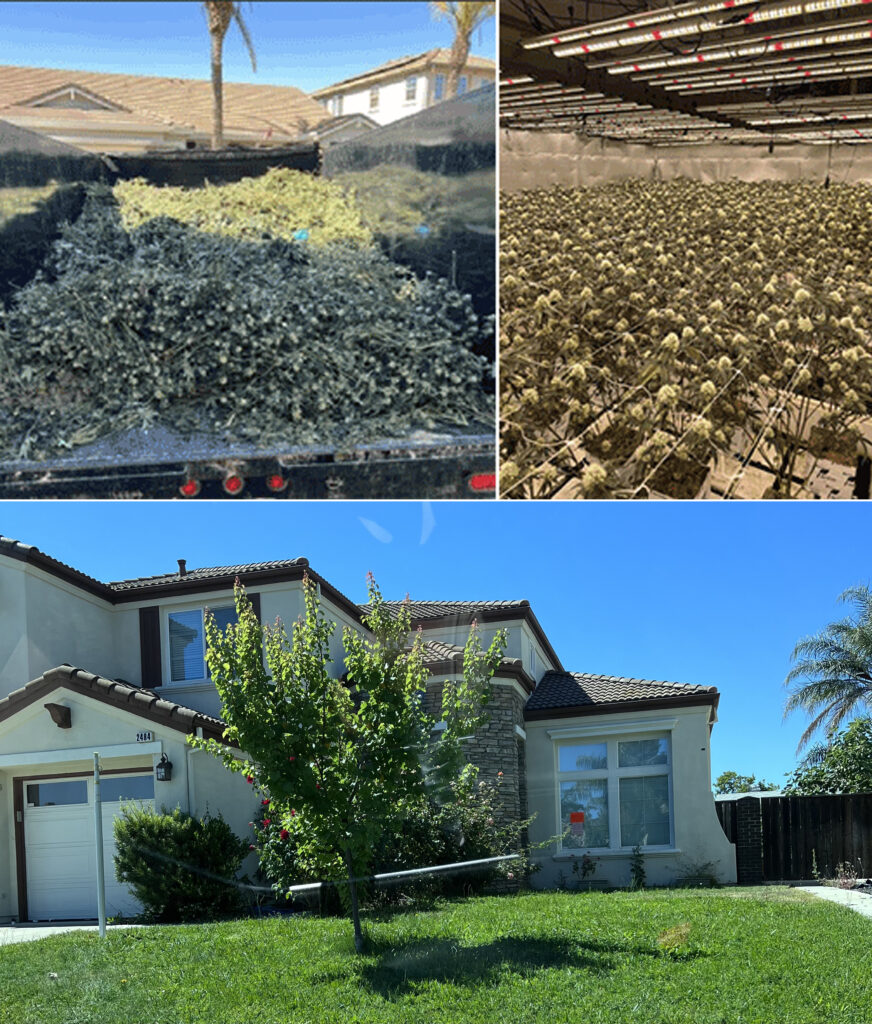
Illegal weed seized and red tagged house on Stanford Way in Antioch on Tuesday, June 20, 2023. Top photos by CA Dept of Cannabis Control. Bottom photo by Antioch resident who chose to remain anonymous.
Five Antioch homes included
By Moorea Warren, Information Officer, California Department of Cannabis Control
Thanks to the continued dedication and collaboration of the Governor’s Unified Cannabis Enforcement Taskforce (UCETF) 20 East Bay illegal indoor cannabis cultivators were shut down on June 20, and a total estimated value of over $15.3 million of illegal cannabis was seized.
An investigation spanning several weeks culminated in the operation led by the Department of Cannabis Control (DCC). There were 20 search warrants served by four units of officers and local and state partners, including the Department of Fish & Wildlife, the Department of Tax and Fee Administration, the California National Guard, and local law enforcement – five in Antioch (according to a witness two with addresses of 2460 and 2480 Stanford Way), three in Brentwood, two in Discovery Bay and ten in Pittsburg, resulting in the seizures of:
742 pounds of cannabis flower estimated valued of $1,244,762
17,121 cannabis plants estimated valued of $14,124,825
7 firearms (including 1 assault rifle)
$24,197 in cash
Several of the locations were red-tagged for safety and code violations.
From Board of Directors President Janice Li and General Manager Bob Powers:
BART is thankful for the recent action taken by the California State Legislature to restore $2 billion for the Transit and Intercity Rail Capital Program. The program is vital in funding transformative capital improvements to modernize public transportation systems such as BART.
The fate of transit operating budgets, however, presents a do-or-die decision point.
Each day BART moves closer to plunging off the fiscal cliff if the State does not provide short-term financial aid to fund transit operations.
One-time federal funds are dwindling even with BART’s stringent cost controls and will be exhausted by early 2025. If transit operations funding is not included in this year’s State budget, BART must begin making severe cuts to service and staffing, as early as this year. The State has the opportunity – and the power – to sustain BART or let BART and the Bay Area economy fail. Here’s how failure looks:
Trains only once an hour.
No trains on weekends.
No trains after 9 p.m. on weeknights.
Reduced service to San Francisco International and Oakland International airports.
Some stations closed.
Entire lines potentially shuttered
Those who will pay the biggest price for these severe cuts are those who can afford it the least. Sixty-seven percent of BART riders identify as non-white. Forty-four percent do not have a vehicle. Thirty-one percent have an income of $50,000 or lower. Seven percent are disabled. If the State fails to act, those who rely on BART as a lifeline will be stranded.
Everyone will pay the price if BART fails – even those who don’t use it. Traffic stands to drastically worsen across our already congested roadways and bridges, and regional greenhouse gas emissions will increase, further fueling climate change. Just one trip in a car emits the same amount of C02 as thirty trips taken on BART.
Businesses will struggle to move their goods with thousands more vehicles on already strained roads. BART service cuts to SFO and OAK will make tourism and convention travel unpalatable.
The Bay Area is an economic engine for the entire state, which represents the fourth largest economy in the world. But the regional economy isn’t ironclad. It needs effective public transit – BART, Muni, and other agencies – to thrive.
BART staff, labor partners and Board are focused on increasing ridership by improving the system.
Some highlights:
Adding eight to 18 additional police officers to patrol trains each shift in addition to BART’s unarmed safety staff of Ambassadors, Crisis Intervention Specialists and Fare Inspectors on trains.
A September schedule change means no rider will wait more than 20 minutes for a scheduled train, including nights and weekends.
More than doubling the Clipper START discount for eligible low-income riders.
A project to install 700 new fare gates at all stations by 2026 to deter fare evasion and increase safety.
Thorough cleaning of train car interiors twice as often.
Increasing the number of deep-clean teams by 66% to scrub heavily used stations.
These hard-earned gains for riders would be wiped out by severe service cuts. It’s a recipe for a death spiral.
If the State fails to act, not only will BART fail, but Bay Area public transit will fail. Ninety percent of all transfer trips in the Bay Area involve a connection to BART.
For BART and the Bay Area we know and love to survive, we need State help NOW.
Trains will bring visitors to celebrate at a site unique to California’s African American history
50% discount
By David Lipari, San Joaquin Joint Powers Authority
Colonel Allensworth State Historic Park is holding its annual celebratory Juneteenth event on Saturday, June 10 from 10:00 AM to 4:00 PM. In partnership, Amtrak San Joaquins has scheduled a special stop at the park for multiple trains, bookable at a 50 percent discount rate to bring travelers to the historically significant Colonel Allensworth State Historic Park.
The town of Allensworth was established in 1908 by Colonel Allen Allensworth and at one point was home to more than 300 families. The park is a California state treasure because it was the first town in California to be founded, financed, and governed by African Americans. Colonel Allensworth State Historic Park became a historical landmark in 1974.
The Juneteenth Festival is a key annual event hosted by Friends of Allensworth (FOA), a 501(c)(3) charitable organization whose mission is to support, promote, and advance the educational and interpretive activities at Colonel Allensworth State Historic Park. The Juneteenth holiday commemorates the June 19th, 1865, arrival of Union Army troops in Galveston, Texas, bearing news that the institution of slavery had been terminated, officially spreading news of the freedom of all enslaved people.
“Amtrak San Joaquins has been a long-time partner to the FOA in connecting the people of California and visitors with the historic town of Allensworth” said FOA President, Sasha Biscoe. “We encourage any individual that is interested in immersing themselves in the rich, ethnically diverse history of our state to consider taking advantage of the affordable, convenient, and fun transportation option provided by Amtrak San Joaquins and join us on June 10th to celebrate this important holiday.”
Event activities will include square dancing, self-guided tours of historic buildings, historic games with prizes, storytelling, and arts and crafts. Food and refreshment vendors will also be present. Travelers can also bring their bikes and chairs aboard Amtrak trains and Thruway buses.
The southbound trains that will be running for the event include trains 702, 710, 712, 714.
Antioch Station departure and arrival times at the park: 710 – 7:50 a.m. and 11:56 a.m.; 712 – 10:50 a.m. and 2:56 p.m.
When purchasing train tickets, a 50 percent discount will automatically be applied to the ticket purchase. Additional discount programs regularly available to riders includes:
Infants under 2 years of age ride for free
Children 2-12 years old ride half-price every day
Seniors (62+ years of age) receive 15% off
Veterans & active military members receive 15% off
Disabled riders save 15% off
Visitors attending the Juneteenth Festival will be able to take Amtrak San Joaquins trains to the Allensworth station. From there, riders will be met by a free shuttle for the short ride to the main property. The Allensworth station is normally a whistle stop on the San Joaquins available to be booked by groups desiring to visit the park.
Train tickets to Colonel Allensworth State Historic Park can be booked online at www.amtrak.com/san-joaquins-allensworth-juneteenth. For more information on how to book a group trip to Allensworth, please contact Carmen Setness, community outreach coordinator for San Joaquin Regional Rail Commission (SJRRC), at Carmen@sjjpa.com.
About Allensworth State Historic Park
The town of Allensworth is located in the heart of the Central Valley, about 30 miles north of Bakersfield, and has a rich history that is of interest to students, families, history buffs, minority community organizations, and anyone else looking to spend a fun day exploring the historic community and its restored buildings. In 1908, Allensworth was established as a town founded, financed and governed by African Americans. There were a series of challenges impeding the town’s long-term survival, but it is celebrated as a key historic icon, and in 1974 California State Parks purchased the land in order to maintain it as a site for visitors to learn and explore the Colonel’s house, historic schoolhouse, Baptist church, and library.
About the San Joaquin Joint Powers Authority (SJJPA)
Since July 2015, SJJPA has been responsible for the management and administration of Amtrak San Joaquins. SJJPA is governed by Board Members representing each of the ten (10) Member Agencies along the 365-mile San Joaquins Corridor. For more information on SJJPA see www.sjjpa.com.
Amtrak San Joaquins is Amtrak’s 6th busiest route with 18 train stations throughout the Central Valley and Bay Area, providing a safe, comfortable and reliable way to travel throughout California. Amtrak San Joaquins is currently running six daily round-trips. In addition to the train service, Amtrak San Joaquins Thruway buses provide connecting service to 135 destinations in California and Nevada including Los Angeles, Santa Barbara, San Diego, Napa Valley, Las Vegas and Reno.
Review comes amidst allegations of bigoted text messages and other potentially discriminatory misconduct
OAKLAND — California Attorney General Rob Bonta today announced initiating a civil rights investigation into the Antioch Police Department (APD). The investigation will seek to determine whether the law enforcement agency has engaged in a pattern or practice of unconstitutional policing amid deeply concerning allegations relating to bigoted text messages and other potentially discriminatory misconduct. If, through this investigation, the Attorney General’s Office determines that unlawful activity or practices took place, the office will also determine what potential actions are needed to ensure comprehensive corrective action takes place at APD. (See related articles here and here)
“It is our job to protect and serve all of our communities,” said Attorney General Bonta. “Police departments are on the front lines of that fight every day as they work to safeguard the people of our state. However, where there are allegations of potentially pervasive bias or discrimination, it can undermine the trust that is critical for public safety and our justice system. It is our responsibility to ensure that we establish a culture of accountability, professionalism, and zero tolerance for hateful or racist behavior, on or off duty.”
Under the California Constitution and California Civil Code section 52.3, the Attorney General is authorized to conduct civil investigations into whether a law enforcement agency has engaged in a pattern or practice of violating state or federal law. As opposed to a criminal investigation into an individual incident or incidents, a pattern or practice investigation typically works to identify and, as appropriate, compel the correction of systemic violations of the constitutional rights of the community at large by a law enforcement agency. With regard to the Antioch Police Department, the Attorney General has made no determinations at this time about specific complaints, allegations, or the agency’s overall policies and practices. The Attorney General’s independent investigation of APD is separate from ongoing or potential administrative or criminal investigations at the local and federal levels.
As interaction and cooperation with the community is at the core of law enforcement’s work to provide public safety and create public trust, the Attorney General encourages anyone with information relevant to this investigation to contact the California Department of Justice’s Civil Rights Enforcement Section at Police-Practices@doj.ca.gov. Members of the public may also send information to the California Department of Justice in other languages. During the course of the investigation, attorneys and special agents at the California Department of Justice will work diligently to consider all relevant information, including from community members and organizations, local officials, oversight entities, Antioch Police Department, and individual officers.
Attorney General Bonta is committed to strengthening trust between local law enforcement and the communities they serve as one key part of the broader effort to increase public safety for all Californians. In February, Attorney General Bonta launched an investigation into allegations of excessive force at the Riverside County Sheriff’s Department. Last year, the Attorney General assumed responsibility for the Los Angeles County Sheriff’s Department’s investigation related to contracts awarded to a local nonprofit. He worked with authorities in San Francisco to help ensure the continuation of local oversight efforts related to officer-involved shootings, in-custody deaths, and severe uses of force. Attorney General Bonta also opened a pattern or practice investigation into the Santa Clara County Sheriff’s Office. In 2021, the Attorney General launched an independent review of the Torrance Police Department and secured a stipulated judgment against the Bakersfield Police Department requiring an extensive range of actions to promote public safety. Attorney General Bonta also established the Racial Justice Bureau within the Civil Rights Enforcement Section to, among other things, help address issues of implicit and explicit bias in policing.
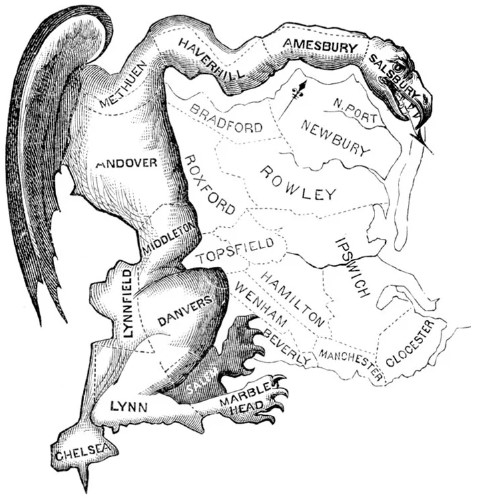
The original gerrymander in 1812 of a Massachusetts State Senate district approved by Gov. Elbridge Gerry. Source: Wikimedia Commons.
AB 764 and AB 1248 would help end gerrymandering in the state as was done in Antioch and bring local redistricting into alignment with statewide and congressional redistricting standards
SACRAMENTO – A package of statewide redistricting reform bills that would help end gerrymandering and the abuse of local redistricting processes in California passed out of the Assembly Local Government Committee on Wednesday. AB 764 (Bryan) and AB 1248 (Bryan and Allen) have recently gained a groundswell of support, pushing the bills past a massive legislative hurdle and inching them closer to becoming law. It would stop what happened in Antioch by the council majority with Districts 2, 3 and 4. (See related article)
“The abuse of our redistricting processes by incumbent politicians is a statewide issue that requires statewide solutions if California is to build a fully inclusive and representative democracy that works for everyone,” said Jonathan Mehta Stein, Executive Director of California Common Cause. “Informed by evaluations of over 100 of local jurisdictions’ redistricting processes and conversations with dozens of community-based organizations, AB 764 and AB 1248 make this vision a reality.”
Backed by civil rights, good government, and community organizations, these bills would empower communities in the redistricting process and would help end gerrymandering at the local level by strengthening current redistricting protections and establishing independent redistricting commissions for larger local jurisdictions.
AB 764 amends 2019’s FAIR MAPS Act (FMA), a bill that requires cities and counties to use standardized, fair redistricting criteria that prioritize communities when drawing district lines. The bill strengthens the FMA’s redistricting criteria, public engagement requirements, and transparency measures, and would extend its protections to additional local governments, like school boards. It would also prohibit incumbent-protection gerrymandering and would give the public greater control over a process that fundamentally should belong to them.
Under AB 1248, all counties, cities, school districts, and community college districts with a population over 300,000 would be required to establish an independent redistricting commission before the 2030 redistricting cycle that meets their own local needs. If they do not act on their own, they would be required to utilize a more detailed default commission structure outlined in state law.
“Comprehensive redistricting reform is a long-term solution for building truly representative elections and a democracy that includes everyone,” saidLaurel Brodzinsky, California Common Cause’s Legislative Director. “The momentum of AB 764 and AB 1248 shows there’s a real chance that California can end the abuse of our redistricting processes and set the national standard for prioritizing people over politicians.”
AB 764 is sponsored by California Common Cause, League of Women Voters of California, and Asian Americans Advancing Justice Southern California. AB 1248 is sponsored by California Common Cause, ACLU of Southern California, Asian Law Caucus, and League of Women Voters of California.
Registered Support for AB 764:
AAPIs for Civic Empowerment Education Fund, ACLU California Action, AFSCME, Alameda County Coalition for Fair Redistricting, Alliance San Diego, Asian Americans Advancing Justice – Asian Law Caucus, California Environmental Voters (formerly CLCV), Catalyst California, Central Coast Alliance United for A Sustainable Economy, California Common Cause, Communities for A New California (CNC), Communities United for Restorative Youth Justice (CURYJ), Community Health Councils, Courage California, Ella Baker Center for Human Rights, Indivisible CA Statestrong, Indivisible Marin, Initiate Justice, Initiate Justice Action, Inland Equity Partnership, Lawyers’ Committee for Civil Rights of The San Francisco Bay Area, League of Women Voters of California, Oakland Rising Action, OC Action, Peninsula Family Service, San Francisco Rising, Secure Justice, Silicon Valley Community Foundation, The Resistance Northridge-indivisible, The Santa Monica Democratic Club, Thrive, the Alliance of Nonprofits for San Mateo County, Voices for Progress, Young Women’s Freedom Center
Registered Support for AB 1248:
Asian Americans Advancing Justice-Southern California, California Common Cause, League of Women Voters of California, AAPIs for Civic Empowerment Education Fund, ACLU California Action, AFSCME, Alameda County Coalition for Fair Redistricting, Alliance San Diego, Asian Americans Advancing Justice – Asian Law Caucus, Asian Americans Advancing Justice-Southern California, California Environmental Voters (formerly CLCV), Central Coast Alliance United for A Sustainable Economy, Community Health Councils, Courage California, Dolores Huerta Foundation, Ella Baker Center for Human Rights, Indivisible CA Statestrong, Initiate Justice, Initiate Justice Action, Inland Empire Immigrant Youth Collective, Inland Empire United, Inland Equity Partnership, OC Action, San Francisco Rising, Santa Monica Democratic Club, The Resistance Northridge-Indivisible
About Common Cause
Common Cause is a nonpartisan, grassroots organization dedicated to upholding the core values of American democracy. We work to create open, honest, and accountable government that serves the public interest; promote equal rights, opportunity, and representation for all; and empower all people to make their voices heard in the political process.