On potential threats in response to Hamas’ call for “Day of Jihad”
SACRAMENTO – In response to Hama’s call for a global “Day of Jihad” on Friday, 13, 2023, the Governor’s Office of Emergency Services Director Nancy Ward, who serves as California’s Homeland Security Advisor, released the following statement yesterday on the efforts underway to protect the well-being of all Californians:
“As California’s Homeland Security Agency, we are actively monitoring the developing situation in Israel and Gaza and closely coordinating with our security partners to track potential impacts on the domestic threat environment.
“The situation remains dynamic and evolving. I continue to actively brief the Governor on the current situation and state intelligence and law enforcement officials are working around the clock to safeguard the safety and security of all Californians.
“We are in touch with faith leaders and communities across the state to provide support, listen to their concerns and offer the full resources of the state.
“While we are aware of statements made about potential threats on Friday, October 13, I want to emphasize that no specific and credible threat to California has been identified at this time.
“As with any potential threats to our state, Cal OES will coordinate with our partners at the local, state and federal level to ensure they have the resources and information necessary to keep our communities safe.
“All Californians have an important role to play in protecting our communities, and I encourage everyone in our state to be alert, vigilant and prepared and immediately report any suspicious activity through proper channels.”
About Cal OES
With over 38 million residents (12 percent of the US population), the State of California is the most populous state in the nation and has the third largest land area among the states (163,695 square miles). California is culturally, ethnically, economically, ecologically, and politically diverse, and maintains the eighth largest economy in the world with 13 percent of the U.S. gross domestic product. California also faces numerous risks and threats to our people, property, economy, environment and is prone to earthquakes, floods, significant wildfires, prolonged drought impacts, public health emergencies, cybersecurity attacks, agricultural and animal disasters, as well threats to homeland security. Cal OES takes a proactive approach to addressing these risks, threats, and vulnerabilities that form the basis of our mission and has been tested through real events, as well as comprehensive exercises that help us maintain our state of readiness to plan for and mitigate impacts.
Monday’s funding announcement is part of a larger, multi-level investment to advance state workforce development efforts to prioritize equity, quality jobs, and climate resilience
while meeting regional labor market needs. With the addition of these nine new projects, California is investing more than $260 million in nearly 100 active state-funded HRTPs.
The Contra Costa Refinery Transition Partnership received $400,000 in RWF funding in Spring/Summer 2022.
$7.5 million for High Road to Tribal Forest Restoration andStewardship – expands job pathways with living wages for underserved tribal and rural populations, including tree and native plant nursery work, forest health, and forest and meadow restoration.
$5.1 million for Early Care & Education Pathways to Success – this existing apprenticeship program will expand to new under-sourced regions and serve 655 new apprentices to earn certifications in education serving Pre-K to Third-grade students.
$5 million for Vocational English as a Second Language Home Care Immersion Training Program– Homebridge will partner with SEIU Local 2015 to provide language skills and advanced home care training to immigrant, refugee, and formerly incarcerated populations. Participants will immediately earn $25 an hour after graduating and have opportunities for advancement.
$5 million for Dental Assistant Training Program – will scale successful earn-as-you-learn bootcamps to more regions and fill the gap between unlicensed dental assistants and licensed Registered Dental Assistants. Target populations include low-wage workers, communities of color, youth, immigrants, and workers without a college degree.
Contra Costa County (CCC) communities, particularly low-income communities of color, bear major health burdens inflicted by the refineries and their toxic emissions. Additionally, the Bay Area refineries emit significant amounts of climate warming greenhouse gasses, posing one of the state’s most significant challenges to climate resilience. As California works to establish a carbon neutral economy, the oil refining sector will unavoidably undergo a massive transition. This transition is already taking place in CCC, where two of the four refineries are transitioning to biofuels, resulting in a significant workforce reduction–most notably at the Marathon Martinez Refinery, which laid off approximately 700 workers in 2020.
The Contra Costa Refinery Transition Partnership (CCRTP) is the first effort to bring together frontline workers and community organizations to plan for refinery transition. CCCRTP brings together CCC oil refinery workers, the refinery community, allies, and high-road industry stakeholders to develop shared strategies to prepare for this significant economic shift, including leading research and developing policy recommendations to support refinery communities and workers, as well as the development of a regional high-road economic development vision to advance CCC’s economic resilience as the state transitions to a low-carbon economy.
This project addresses the critical need to plan for economic transition in one of California’s most oil-industry dependent counties, through deep engagement and shared visioning led by impacted workers and community members themselves, in partnership with the broader community of stakeholders.
Project Highlights
• Strengthen the CCRTP for the long-term, as a coalition of frontline workers, community organizations and allies.
• Complete and publish a detailed report and recommendations on planning for refinery transition in the Bay Area.
• Complete and publish a Contra Costa High Road Economic Development Vision.
Key Partners
Contra Costa Central Labor Council
BlueGreen Alliance Foundation
United Steelworkers District 12
United Steelworkers Local 5
UA Plumbers & Steamfitters Local 342
Asian Pacific Environmental Network
California Labor Federation, Workforce & Economic Development (WED)
UC Berkeley Labor Center
A complete list of awardees can be found on CWDB’s website.
SB644 allows 24-hour hotel booking cancellations with full refund
By Steven Harmon, Office of State Senator Steve Glazer
SACRAMENTO – Consumers will be able to make cancellations with a full refund, at no charge, up to 24 hours after they make a booking with hotels, short-term rentals and third-party booking services if they book at least 72 hours before their stay under a bill signed Tuesday by Governor Gavin Newsom.
“This first-in-the-nation law will end the confusing maze of misleading cancellation policies for lodging on the Internet,” said Senator Glazer (D-Orinda, CA7), author of the bill, SB 644. “Now, consumers will have a chance to correct mistakes and cancel bookings they hadn’t intended to make and get a full refund.”
“SEC. 3. CHAPTER 2. Hotel and Private Residence Rental Reservation Refunds
A hosting platform, hotel, third-party booking service, or short-term rental shall allow a reservation for a hotel accommodation or a short-term rental located in California to be canceled without penalty for at least 24 hours after the reservation is confirmed if the reservation is made 72 hours or more before the time of check-in.
1748.82.
(a) If a consumer cancels a reservation pursuant to Section 1748.81, the hosting platform, hotel, third-party booking service, or short-term rental shall issue a refund to a consumer of all amounts paid to the hosting platform, hotel, third-party booking service, or short-term rental to the original form of payment within 30 days of the cancellation of the reservation.
(b) The refund required by this section shall include a refund of all fees charged to the consumer for optional services.”
San Joaquins trains will bring visitors to celebrate site unique to California’s African American history
By David Lipari, San Joaquin Joint Powers Authority
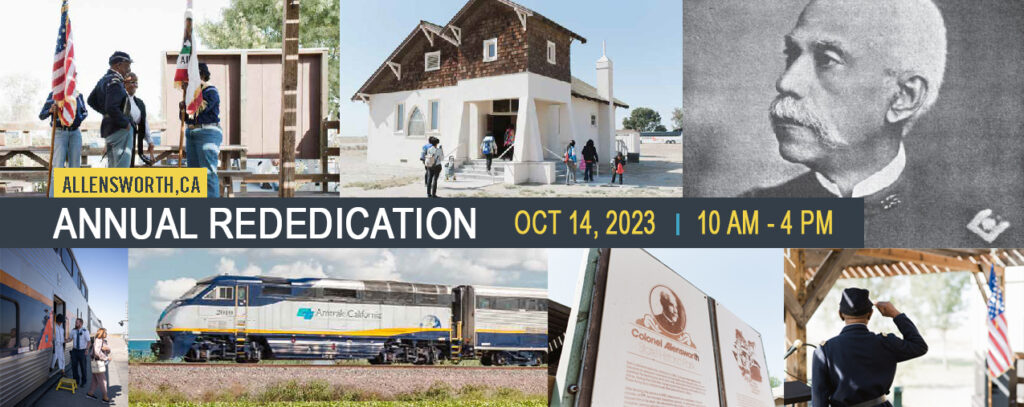
Colonel Allensworth State Historic Park is holding a celebratory “re-dedication” event on Saturday, October 14 from 10:00 AM to 4:00 PM. In partnership, Amtrak San Joaquins has scheduled a special stop at the park for multiple trains, bookable at a 50 percent discount rate to bring travelers to the historically significant park.
The town of Allensworth was established in 1908 by Colonel Allen Allensworth and at one point was home to more than 300 families. The park is a California state treasure because it was the first town in California to be founded, financed, and governed by African Americans. Colonel Allensworth State Historic Park became a historical landmark in 1974.
The re-dedication is one of four major annual events hosted by Friends of Allensworth (FOA), a 501(c)(3) charitable organization whose mission is to support, promote, and advance the educational and interpretive activities at colonel Allensworth State Historic Park. According to FOA, the re-dedication is “presented to renew the commitment of the citizens of California to help the Department of Parks and Recreation preserve the history of the ethnically diverse contributions made in the development of the state of California and our nation.”
The festival will feature historical re-enactments, storytelling, square dancing, food vendors, crafts, and more.
“We are thrilled to partner once again with Amtrak San Joaquins to reconnect Californians with the historic town of Allensworth,” stated FOA President, Sasha Biscoe. “As a cornerstone of California’s rich history, Allensworth deserves to be experienced by all. Amtrak San Joaquins continues to provide a convenient, cost-effective, and enjoyable journey to this significant location. Mark your calendars for October 14th to partake in a day of historical immersion, as we recommit to preserving this invaluable site, all while traveling in the comfort and style that only Amtrak San Joaquins can offer.”
The southbound trains that will be running for the event include trains 702, 710, 712, and 714. When purchasing train tickets, a 50 percent discount will automatically be applied to the ticket purchase. Riders can save an additional 50 percent on up to five companion tickets by using the Friends and Family Discount code (V302). Additional discount programs regularly available to riders includes:
Infants under 2 years of age ride for free
Children 2-12 years old ride half-price every day
Seniors (62+ years of age) receive 15% off
Veterans & active military members receive 15% off
Disabled riders save 10% off
Visitors attending the re-dedication will be able to take Amtrak San Joaquins trains to the Allensworth station. From there, riders will be met by a free shuttle for the short ride to the main property. The Allensworth station is normally a whistle stop on the San Joaquins available to be booked by groups desiring to visit the park.
Train tickets to Colonel Allensworth State Historic Park can be booked online at amtraksanjoaquins.com. For more information on how to book a group trip to Allensworth, please contact Carmen Setness, community outreach coordinator for San Joaquin Regional Rail Commission (SJRRC), at Carmen@sjjpa.com.
About Allensworth State Historic Park
The town of Allensworth is located in the heart of the Central Valley, about 30 miles north of Bakersfield, and has a rich history that is of interest to students, families, history buffs, minority community organizations, and anyone else looking to spend a fun day exploring the historic community and its restored buildings. In 1908, Allensworth was established as a town founded, financed and governed by African Americans. There were a series of challenges impeding the town’s long-term survival, but it is celebrated as a key historic icon, and in 1974 California State Parks purchased the land in order to maintain it as a site for visitors to learn and explore the Colonel’s house, historic schoolhouse, Baptist church, and library.
About the San Joaquin Joint Powers Authority (SJJPA)
Since July 2015, SJJPA has been responsible for the management and administration of Amtrak San Joaquins. SJJPA is governed by Board Members representing each of the ten (10) Member Agencies along the 365-mile San Joaquins Corridor. For more information on SJJPA see www.sjjpa.com. Amtrak San Joaquins is Amtrak’s 6th busiest route with 18 train stations throughout the Central Valley and Bay Area, providing a safe, comfortable and reliable way to travel throughout California. Amtrak San Joaquins is currently running six daily round-trips. In addition to the train service, Amtrak San Joaquins Thruway buses provide connecting service to 135 destinations in California and Nevada including Los Angeles, Santa Barbara, San Diego, Napa Valley, Las Vegas and Reno.
Fishing at Lake Clementine in Auburn State Recreation Area. Photo: Division of Boating and Waterways.
SACRAMENTO, Calif.— With the unofficial end of summer approaching this Labor Day holiday weekend, California State Parks’ Division of Boating and Waterways (DBW) is reminding boaters and water enthusiasts to take extra precautions to stay safe and prevent tragedies on the water. Taking a boating safety course, wearing a life jacket while recreating in the water and actively supervising children when in or near a body of water are simple actions all can take to help improve safety on California’s waterways.
Here are some key safety tips:
Always wear a life jacket. Life jackets are the easiest way to reduce the chances of drowning and increase your chances of survival if you are involved in an accident.
By California law, all children under 13 are required to wear life jackets on a moving vessel, and DBW urges everyone on a vessel, regardless of age, to always wear a life jacket as a preventative measure.
Life jackets are also required on personal watercrafts, also known as Jet Skis, regardless of age. Paddle sports, including stand-up paddleboards and kayaks, are considered vessels and the same life jacket rules apply to people aboard the paddle craft.
Ensure each life jacket is U.S. Coast Guard-approved, the right fit for the user and approved for the intended activity by checking the label. The label can be found on the inside of each life jacket along with the U.S. Coast Guard approval number.
Take a boating safety courseand get your California Boater Card. Even the most experienced boaters can learn from boating safety courses. As of Jan. 1, 2023, all operators of motorized vessels on California waterways who are 50 years of age and younger are required to carry a lifetime boater card. By 2025, all operators of motorized vessels will be required to carry one, regardless of age.
File a float plan before you head out. Share a float plan with a family member or friend with the details of your trip in the event of an emergency.
Check the weather. Know the latest weather forecast prior to going out and check regularly for changing conditions.
Leave the alcohol at home. Alcohol and boating never mix. It is against the law to operate a boat with a blood alcohol concentration (BAC) of 0.08% or more. You can be arrested even when the BAC is less than 0.08% if conditions are deemed to be unsafe. The sun, wind and wave action intensify the effects of alcohol.
Protect your loved ones:
Always supervise children by appointing a designated “water watcher,” taking turns with other adults. Do not assume that someone is watching your children.
Know your limits. Swimming in a lake, ocean or river is different than swimming in a pool.
If someone is in distress, seek help from a lifeguard or call 911 if one is not available.
Stow it, don’t throw it. Keep your trash on board. Never throw cigarette butts, fishing lines or any other garbage into waterways. Take advantage of shoreside facilities to recycle plastic, glass, metal and paper. Avoid excess packaging. Used fishing line can be deposited at a fishing line recycling station.
Download helpful boating apps to your phone. The BoatCA App is a free mobile app with information on boating facilities, life jacket loan stations, laws, boat registration and more.
The California Department of Parks and Recreation, popularly known as State Parks, and the programs supported by its Office of Historic Preservation and divisions of Boating and Waterways and Off-Highway Motor Vehicle Recreation provide for the health, inspiration and education of the people of California by helping to preserve the state’s extraordinary biological diversity, protecting its most valued natural and cultural resources, and creating opportunities for high-quality outdoor recreation. Learn more at parks.ca.gov.
With more than 60 events at over 40 California State Parks
More activities taking place week of September 2-10
California State Parks invites the public to become community scientists and celebrate California Biodiversity Day, September 7. More than 40 parks statewide will be hosting more than 60 special events and engaging activities all week long from September 2 to 10. The public is also invited to a friendly bioblitz competition to see who can record the highest number of species of plants and animals in California’s State Park System. Humboldt Redwoods State Park currently holds the record of 380 species identified in 2022.
This year marks the fifth annual celebration of California Biodiversity Day since it was first established in 2018. Since then, several executive orders and other actions by the Newsom Administration – such as the Pathways to 30×30 strategy, California’s initiative to conserve 30 percent of lands and coastal waters by 2030 – have built on this foundation to understand and protect California’s unique and precious natural resources.
In 2023, the public can choose from a variety of activities like “Perk Up in the Park” where visitors can enjoy a hot beverage and learn about Mount Tamalpais State Park’s unique biodiversity or appreciate birds with an environmental scientist at Cuyamaca Rancho State Park, or they can go on self-guided bioblitzes. Using the free iNaturalist app, participants can use their smartphones to record the different species of animals, insects, plants, fungi and more thriving within the parks. The photographs and locations of species captured during the bioblitzes in iNaturalist will help monitor the presence and range of species and contribute to an overall understanding of California’s extraordinary biodiversity.
Below are additional activities taking place throughout the week of September 2 to 10:
Salton Sea State Recreation Area – During California Biodiversity Week, visitors can go on self-guided bioblitzes and observe as many species as they can to show off the amazing biodiversity the desert has to offer. Download the iNaturalist app, take a picture, and share your findings. Get more details on the iNaturalist app.
Sue-meg State Park – Participate in a tidepool bioblitz from 8 to 10 a.m. on Saturday, September 2. Join the interpreters to explore the tidepools at Agate Beach and learn about the plants and animals that live there. Meet at the Agate Beach trailhead at 8 a.m. to hike down to the tidepools with the interpreters or meet them at the tidepools anytime from 8 to 10 a.m. The hike to Agate Beach is approximately half a mile downhill.
Crystal Cove State Park – Celebrate California Biodiversity Day on September 7 at 9 a.m. with a biodiversity bioblitz hike. Join staff for an easy one-mile hike down Moro Canyon to explore the park’s beautiful backcountry while identifying and documenting animal and plant species using the iNaturalist app. Ages 8 and up are welcome. Wear sturdy hiking shoes, bring water, and dress in layers. No registration necessary. Participants can meet at the Berns Amphitheater in the lower Moro Day Use Area.
Folsom Lake State Recreation Area – Join staff for a biodiversity themed Junior Ranger program on Saturday, September 9, from 3:30 to 5 p.m. at Nimbus Flat and Black Miners Bar Day Use Areas. The event may include a scavenger hunt and introduction to iNaturalist. Get more details on the iNaturalist app.
Past events in celebration of California Biodiversity Day have included a wide range of activities that help the public observe, understand, appreciate, and protect the amazing diversity of life in California’s State Park System. Some favorite activities have included guided nature hikes, birding walks, tide pool tours, nighttime forays, creek sampling and virtual events. The public can find this year’s full list of events at parks.ca.gov/Biodiversity and additional events at California Natural Resources Agency’s Biodiversity Day website.
What will you find during California Biodiversity Week? Observe and record the unique diversity of life within California’s State Park System using the iNaturalist app.
The California Department of Parks and Recreation, popularly known as State Parks, and the programs supported by its Office of Historic Preservation and divisions of Boating and Waterways and Off-Highway Motor Vehicle Recreation provide for the health, inspiration and education of the people of California by helping to preserve the state’s extraordinary biological diversity, protecting its most valued natural and cultural resources, and creating opportunities for high-quality outdoor recreation. Learn more at parks.ca.gov.
Urges voters, taxpayers to call the Capitol to protect Prop 13, see committee members phone numbers below
ACA 1 would make it easier to raise local special taxes by removing the Prop. 13 taxpayer protection of the two-thirds vote of the electorate required to pass
ACA 13 was just introduced last week as a devious attempt to stop the Taxpayer Protection and Government Accountability Act from passing when it’s on the ballot in Nov. 2024.
By Jon Coupal
Prior to the successful passage of Proposition 13 in 1978, Howard Jarvis tried several times to bring property tax relief to beleaguered California homeowners. While coming close, it wasn’t until 1978 when voters overwhelmingly passed Proposition 13 over the opposition of virtually every political institution and newspaper in California.
As they say, timing is everything. What changed the political dynamic so abruptly in 1978 was the fact that thousands of California homeowners were being taxed out of their homes. That also explains why, to this day, Proposition 13 retains its popularity even as the state has become more “progressive.”
Last week there were two competing press events over Assembly Constitutional Amendment 1 (ACA 1), a proposal that would erase part of Proposition 13. As the head of the Howard Jarvis Taxpayers Association, I was joined at a news conference on the Capitol’s west steps on Wednesday by several legislators who have unequivocally expressed their continued support for Proposition 13 and opposition to ACA 1. Also present were several representatives of other taxpayer groups as well as business organizations suffering under California’s excessive tax burdens.
ACA 1 is a direct attack on Proposition 13 because it would cut the vote threshold needed to pass local special taxes, dropping it from the current two-thirds vote required by Proposition 13 to only 55%. That change would make it easier for local governments to raise taxes.
Since Proposition 13 was enacted in 1978, voters have continued to support the important two-thirds vote protection. That support was reaffirmed with the passage of pro-taxpayer initiatives in 1986, 1996 and 2010.
Many people may not know that the two-thirds vote requirement did not originate in 1978. It has been in the California Constitution since 1879! For more than a century, local property owners have been protected against excessive bond debt by the requirement that local bonds – repaid only by property owners – need a two-thirds vote of the local electorate.
ACA 1 repeals the two-thirds vote protection for tax increases to support “infrastructure,” a term so expansive that local governments would be able to raise taxes for almost any purpose with a vote of just 55% of the electorate. This is a hatchet that chops away at the taxpayer protections in Proposition 13.
ACA 1 proponents are aware of Prop. 13’s enduring popularity, so not once in their over one-hour press event did they mention Proposition 13 by name. Instead, they talked about “protecting democracy,” “local control,” and taking on “right-wing interests.” (Are Californians “right wing” for wanting to keep their home instead of being taxed out of it?) Nor did the supporters of ACA 1 provide any specific example of exactly what lowering the two-thirds vote would purchase, other than to claim that it was essential to address California’s dual crises of housing and homelessness.
Opponents of ACA 1 have noted that making it easier to raise taxes makes no sense in one of the highest taxed states in America. No other state comes close to California’s 13.3% top marginal income tax rate, and we also have the highest state sales tax in America as well as the highest gas tax, not to mention gas prices. And even with Prop. 13, we rank 14th out of 50 states in per capita property tax collections. Californians pay enough.
This is a critical time. As of this writing, ACA 1 has cleared one legislative committee and may be heard by the full Assembly as early as this week. However, its main proponent, Assemblymember Cecilia Aguiar-Curry, admitted at her press conference that she didn’t quite have the votes yet. For that reason, the time is now for all defenders of Proposition 13 and advocates for limited taxation to contact their Assembly representatives and let them know that a vote for ACA 1 is a vote against Proposition 13.
This issue is so important to the Howard Jarvis Taxpayers Association that we will withhold our endorsement from any current legislator who fails to vote no on ACA 1.
Committee Hearings this Week, Taxpayers Urged to Call the Capitol
Your immediate help is needed to fight against two proposed constitutional amendments moving fast through the state Assembly. Both of these measures are attacks on PROPOSITION 13. We’re asking all HJTA members and supporters to please call the members of two committees that will be hearing these bills on Wednesday. Please call as soon as possible! Here’s all the information:
NO on ACA 1 – Hearing date: Wednesday, 8/23, Assembly Appropriations Committee
ACA 1 is a direct attack on Proposition 13 that would remove the taxpayer protection of the two-thirds vote of the electorate required to pass local special taxes. If this measure is enacted, local taxes and bonds for “infrastructure” (nearly everything) and public housing projects would pass with just 55% of the vote instead of 66.67%. This makes it easier to raise taxes, and your taxes could go up after every election. Please call the members of the Assembly Appropriations Committee and urge a NO vote on ACA 1:
Chris Holden (Chair) – (916) 319-2041 Megan Dahle (Vice Chair) – (916) 319-2001 Isaac Bryan – (916) 319-2055 Lisa Calderon – (916) 319-2056 Wendy Carrillo – (916) 319-2052 Diane Dixon – (916) 319-2072 (Please thank Assemblywoman Dixon for opposing ACA 1) Mike Fong – (916) 319-2049 Gregg Hart – (916) 319-2037 Josh Lowenthal – (916) 319-2069 Devon Mathis – (916) 319-2033 (Please thank Assemblyman Mathis for opposing ACA 1) Diane Papan – (916) 319-2021 Gail Pellerin – (916) 319-2028 Kate A. Sanchez – (916) 319-2071 Esmeralda Soria – (916) 319-2027 Akilah Weber, M.D. – (916) 319-2079 Lori Wilson – (916) 319-2011 – Represents portions of Eastern Contra Costa County
NO on ACA13 – Hearing date: Wednesday, 8/23, Assembly Elections Committee
ACA 13 was just introduced last week as a devious attempt to stop the Taxpayer Protection and Government Accountability Act from passing when it’s on the ballot in November 2024. The Taxpayer Protection and Government Accountability Act is our initiative constitutional amendment that will restore the Proposition 13 protections that have been eroded by the courts.
Some of the measure’s key provisions include:
Require all new taxes passed by the Legislature to be approved by voters
Restore two-thirds voter approval for all new local special tax increases
Clearly define what is a tax or fee
Require truthful descriptions of new tax proposals
Hold politicians accountable by requiring them to clearly identify how revenue will be spent before any tax or fee is enacted
But ACA 13 would create special rules that make it harder to pass citizen initiatives like this one. If ACA 13 is enacted, the Taxpayer Protection and Government Accountability Act would require a two-thirds vote to pass, instead of the simple majority vote that has been required for all other constitutional amendments since 1849!
Please call the members of the Assembly Elections Committee and urge a NO vote on ACA 13:
Gail Pellerin (Chair) – (916) 319-2028 Tom Lackey (Vice Chair) – (916) 319-2034 Steve Bennett – (916) 319-2038 Bill Essayli – (916) 319-2063 Alex Lee – (916) 319-2024 Evan Low – (916) 319-2026 Blanca Rubio – (916) 319-2048
Please also call your own state representatives and urge them to vote NO on ACA 1 and NO on ACA 13. You can look up their names and contact information at findyourrep.legislature.ca.gov.
Thank you for your help in this critical fight to protect Proposition 13. We greatly appreciate you! Jon Coupal is president of the Howard Jarvis Taxpayers Association.
Awards more than $40 million statewide for Resilient Workforce Program, invests in workforce opportunities that advance job quality and environmental resilience.
By Anna Champe, Communications Manager, CA Workforce Development Board
The California Workforce Development Board (CWDB), in partnership with the California Labor & Workforce Development Agency, recently awarded more than $41 million to 18 projects across the state to advance High Road Training Partnerships (HRTPs) that move underserved populations into better jobs. Today’s funding announcement is part of a larger, multi-level state investment to promote workforce development efforts that prioritize equity, quality jobs, and climate reliance while meeting regional labor market needs.
“HRTPs invest in industry-led, worker-informed efforts to deliver on the promise of a California for All,” said CWDB Executive Director Tim Rainey. “HRTP’s Resilient Workforce Program is part of California’s high road vision for the state’s workforce development system that focuses on the principles of job quality, worker voice, equity, and environmental sustainability.”
HRTPs are industry-based, worker-focused training partnerships that develop talent for California’s “high road” employers — firms that compete based on the quality of product and service achieved through innovation and investment in human capital and thus can generate family-supporting jobs where workers have agency and voice. The HRTP Resilient Workforce Program initiative will increase access to existing high-road jobs for underserved populations and create pathways for job growth for incumbents already employed with high-road employers.
Projects receiving funding include $500,000 to the Workforce Development Board of Contra Costa County for the East Bay Health Equity Initiative.
The East Bay Health Equity Initiative (EBHEI), which includes East Bay Workforce Boards and the Bay Area Health Workforce Partnership, received funding to replicate a successful Emergency Medical Technicians (EMT) training program and other in-demand health careers. The project will focus efforts on local schools providing career training in a variety of health professions and includes additional resources to enhance financial, academic and career support.
Over the last two years, the Workforce Development Board of Contra Costa County’s (WDBCCC) has established a proven model by identifying existing training providers and then adding supplemental services and resources to make those programs more accessible and better meet the needs of low-income workers, immigrants/refugees, justice-involved, veterans and other priority groups.
The project is expected to begin implementation in Spring 2024.
$5 million for Scaling Proven Allied Healthcare Adult Training Pathways– Jewish Vocational and Career Counseling Service will deliver established allied healthcare training programs in the Bay Area and work to scale them throughout the state using strategic partnerships with various healthcare institutions.
$5 million for Public Pathways – the Aggie Square Community Partnership will connect underserved populations with career, education, training, and skills in high-road, high-demand career pathways, including public sector/business, healthcare, biotechnology, and community workers.
$5 million for HRTP- Behavioral Health Expansion (BHE) – to expand substance use disorder career pathways in San Diego with the support of many diverse, invested local partners and five different education partners.
$4.8 million for Golden State Pathway to Teaching and Leading – to create no-cost pathways for paraeducators and others to earn a teaching license. The Teachers College of Western Governors University will provide education, training, and in-classroom experiences.
$4.6 million for High Road to Microelectronics– for specific company-specific and worker-customized training and certificate programs at three community colleges in the Bay Area to bring workers into quality semiconductor careers.
$4.5 million for High Road to Correctional Health Professions – to support strategic partnership between Service Employees International Union Local 1000, California Correctional Health Care Services, and multiple community colleges to expand the LVN and RN apprenticeship program, launch an RN residency program, and provide training for correctional health workers.
A complete list of awardees can be found onCWDB’s website.