Permanently protecting almost 7 acres on slopes of Mt. Diablo’s North Peak
By Laura Kindsvater, Senior Communications Manager, Save Mount Diablo
CLAYTON, CA—On Wednesday, December 20, 2023, Save Mount Diablo closed escrow on the 6.69-acre Krane Pond property on the slopes of Mount Diablo’s North Peak, permanently protecting it.
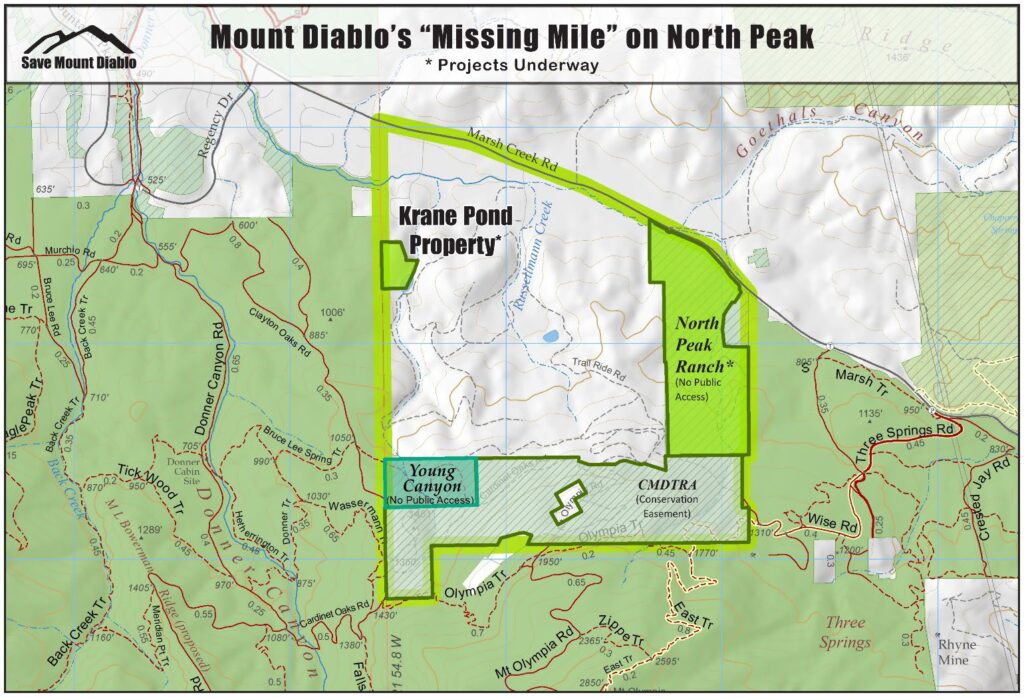
The Krane Pond property is part of the “Missing Mile,” a square mile of partly unprotected land on Mount Diablo’s North Peak.
The property has been a priority of Save Mount Diablo’s since our founding in 1971, in part because of its large pond, one of the largest on Mount Diablo’s north side, and its position directly adjacent to Mount Diablo State Park. (See related articles here and here)
Wildlife that could potentially benefit from Krane Pond. Illustration by James Woods Marshall.
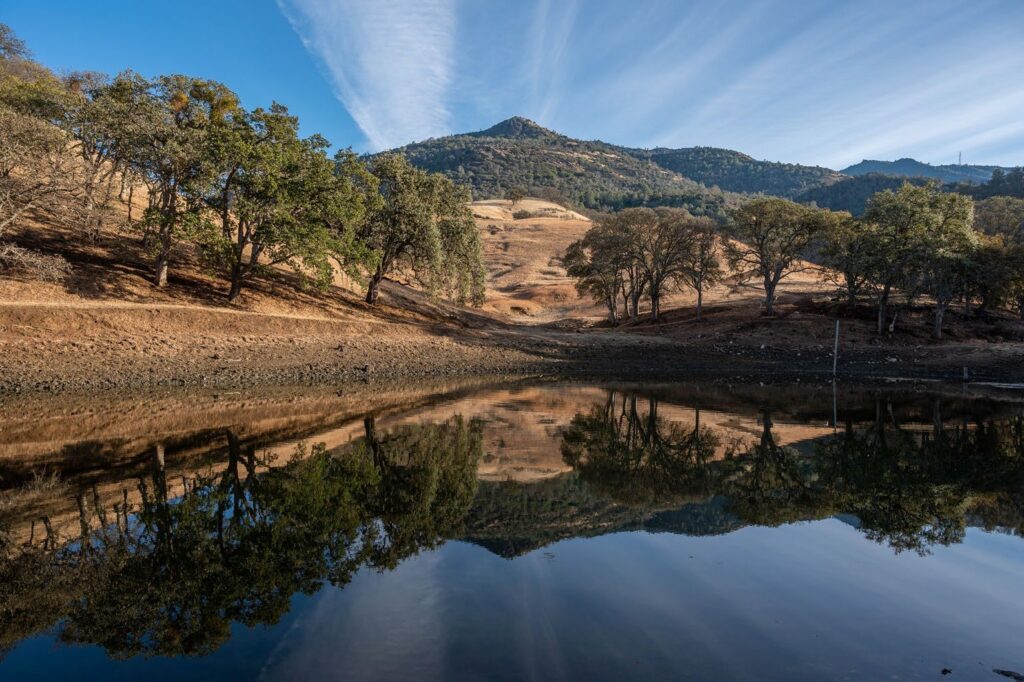
Krane Pond is a vital water source for Mount Diablo’s wildlife, one that contains water throughout most summers, unlike many of the creeks and other ponds found on Mount Diablo. The ecological significance of Krane Pond far eclipses its size.
Save Mount Diablo secured the option agreement to purchase Krane Pond in the fall of 2022, with a year to raise the necessary funds to complete the purchase. Save Mount Diablo had one year to raise the $500,000 needed to cover the various project costs for acquiring the Krane Pond property.
We are particularly grateful to have received 257 donations totaling $61,361 from the readers of Joan Morris’s East Bay Times and Mercury News column. Their gifts arrived close to the fundraising deadline, when it was a race against time to acquire the remaining funds to complete the purchase.
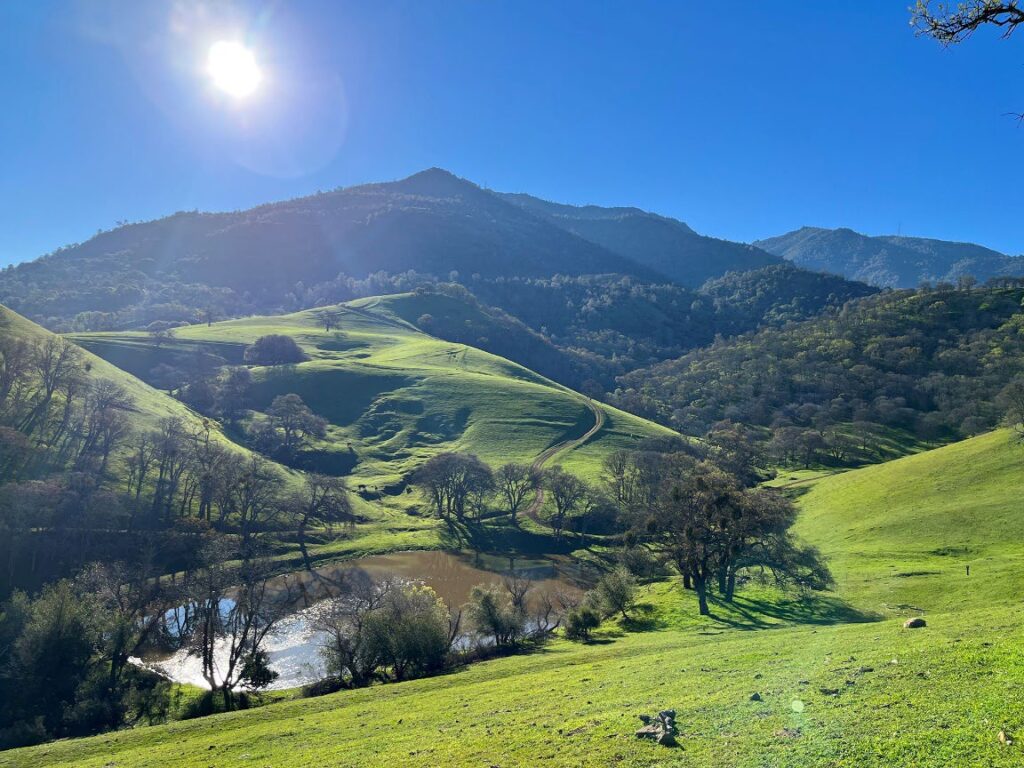
The Krane Pond property is directly adjacent to Mount Diablo State Park and harbors a large pond that is essential for wildlife. Photo: Sean Burke
A development lies along one of the property’s borders, a very real reminder of how the land could have been graded and paved over had Save Mount Diablo not acquired it.
In 1978, Walt and Roseann Krane purchased 6.69 acres of land on the outskirts of Clayton, bordered by Mount Diablo State Park and the meridian on the west side, Mount Diablo Creek on the north side, and property held by ranchers to the east.
Although the Krane family initially had plans to build a house on the property, they decided to preserve the land and eventually sold it to Save Mount Diablo.
Map of the location of the Krane Pond property in the “Missing Mile” on the north slopes of Mount Diablo’s North Peak. Map by Save Mount Diablo
About Save Mount Diablo
Save Mount Diablo is a nationally accredited, nonprofit land trust founded in 1971 with a mission to preserve Mount Diablo’s peaks, surrounding foothills, watersheds, and connection to the Diablo Range through land acquisition and preservation strategies designed to protect the mountain’s natural beauty, biological diversity, and historic and agricultural heritage; enhance our area’s quality of life; and provide educational and recreational opportunities consistent with protection of natural resources. To learn more, please visit www.savemountdiablo.org.
Pigeon Point Lighthouse at night. Photo by California State Parks using Fresnel lens.
To begin in early 2024
PESCADERO, Calif.— California State Parks today announced the selection of a contractor to rehabilitate the Pigeon Point Lighthouse, located within Pigeon Point Light Station State Historic Park. The $16 million rehabilitation project will start construction in early 2024 and is expected to be completed within two years.
Named for the 1853 wreck of the clipper ship Carrier Pigeon, Pigeon Point Lighthouse was first lit on Nov. 15, 1872. The 115-foot structure is the tallest operating lighthouse on the West Coast. Pigeon Point Light Station is listed on the National Register of Historic Places—a reminder of the days when whalers and Gold Rush-era clipper ships fought gales, stiff seas, jagged coastal rocks, and unforgiving fog. The lighthouse has been closed to the public since late 2001, when it was deemed unsafe after two large pieces of brick and iron fell from the top of the building. Funding issues, COVID-19 and a thoughtful process to ensure a contractor with the special skills to work on a lighthouse was selected have been the reasons for the continued closure of this historic building.
“California State Parks looks forward to once again providing public access to this historic landmark that continues to guide mariners along the rocky San Mateo County coast,” stated Santa Cruz District Superintendent Chris Spohrer. “Thank you to our partners for their support over the years and the public for their patience.”
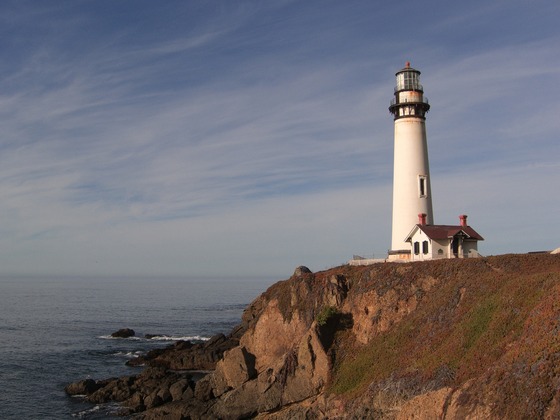
Pigeon Point Lighthouse during the day. Photo from California State Parks by J. Barrow
Sustainable Group, Inc. of Moraga, CA, and subcontractor ICC Commonwealth of North Tonawanda, New York, have extensive experience in lighthouse rehabilitation and restoration in the United States. Jointly, they have worked on nearly 100 lighthouses, including several built to the same blueprints as Pigeon Point, including Bodie Island, North Carolina; Currituck Beach, North Carolina; and Yaquina Head, Oregon, as well as numerous other tall lighthouses. For the Pigeon Point Lighthouse, the contractors will refurbish or replace all the ironwork throughout the building. Masonry elements will also be repaired or replaced as needed. A major focus of the project will be the upper belt course or cast-iron ring where two large pieces broke away in late 2001, compromising the building’s structural integrity.
Pigeon Point Light Station State Historic Park relies upon its collaborative relationships with its nonprofit partners, including Coastside State Parks Association, California State Parks Foundation and Friends of Santa Cruz State Parks. These organizations provide support for the tower restoration, the operation of the park and the development of visitor-serving programs and amenities.
To learn how the public can support the Pigeon Point Lighthouse Restoration project or enhance the visitor experience at Pigeon Point Light Station State Historic Park, please visit CoastSideStateParks.org. Restoration project updates are available at parks.ca.gov/PigeonPointLighthouseRestoration.
The California Department of Parks and Recreation, popularly known as State Parks, and the programs supported by its Office of Historic Preservation and divisions of Boating and Waterways and Off-Highway Motor Vehicle Recreation provide for the health, inspiration and education of the people of California by helping to preserve the state’s extraordinary biological diversity, protecting its most valued natural and cultural resources, and creating opportunities for high-quality outdoor recreation. Learn more at parks.ca.gov.
SACRAMENTO, Calif.— California State Parks announced on Tuesday, Dec. 19, 2023, a new approach to reserving the highly sought after Steep Ravine Cabins at Mount Tamalpais State Park. Using a lottery-style system to make a reservation, the department’s new pilot program aims to enhance access and equity by allowing outdoor enthusiasts to apply for free for a reservation drawing up to eight months in advance. The drawings are selected randomly and conducted seven months ahead of the reservation dates through California’s state park reservation system, ReserveCalifornia.
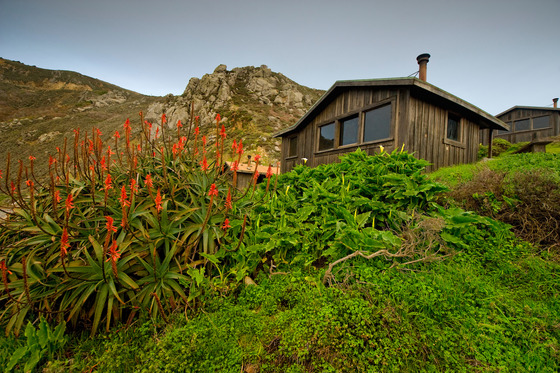
Just north of San Francisco’s Golden Gate Bridge, Mount Tamalpais State Park rises majestically from the heart of Marin County. The park offers hiking, picnicking, wildlife watching and camping opportunities. Perched on the cliffs of Mount Tamalpais, the Steep Ravine Cabins have long been a cherished destination for outdoor enthusiasts seeking a unique camping experience. Each cabin has a small wood stove, picnic table, sleeping platforms, and an outdoors barbecue, but no running water.
Launched in October of this year, the reservation lottery system ensures a fair and equitable distribution of reservations. Guests interested in reserving one of these iconic cabins will have the opportunity to enter the free drawing for a chance to secure their stay. This approach eliminates the rush and competition that often accompanies traditional booking processes, allowing more individuals and families to access the cabins at the park. If a visitor is awarded their reservation choice, they must claim and pay for the reservation within 30 days to keep it. Any unclaimed inventory will be released for reservation six months in advance.
Some key features of the pilot program at the Steep Ravine Cabins include:
Equal Opportunity: The lottery system provides an equal opportunity for anyone interested to secure a reservation, regardless of their location or previous booking history.
Transparency: The drawing process will be conducted, ensuring transparency and fairness in cabin allocation.
Accessible Information: Detailed instructions on how to participate in the drawings are available on ReserveCalifornia website, making it easy for anyone to enter.
Thus far, close to 3,400 applicants have signed up for the drawings. The pilot program is part of the department’s ongoing efforts to enhance accessibility, preserve its natural resources, and promote outdoor experiences for all.
The California Department of Parks and Recreation, popularly known as State Parks, and the programs supported by its Office of Historic Preservation and divisions of Boating and Waterways and Off-Highway Motor Vehicle Recreation provide for the health, inspiration and education of the people of California by helping to preserve the state’s extraordinary biological diversity, protecting its most valued natural and cultural resources, and creating opportunities for high-quality outdoor recreation. Learn more at parks.ca.gov.
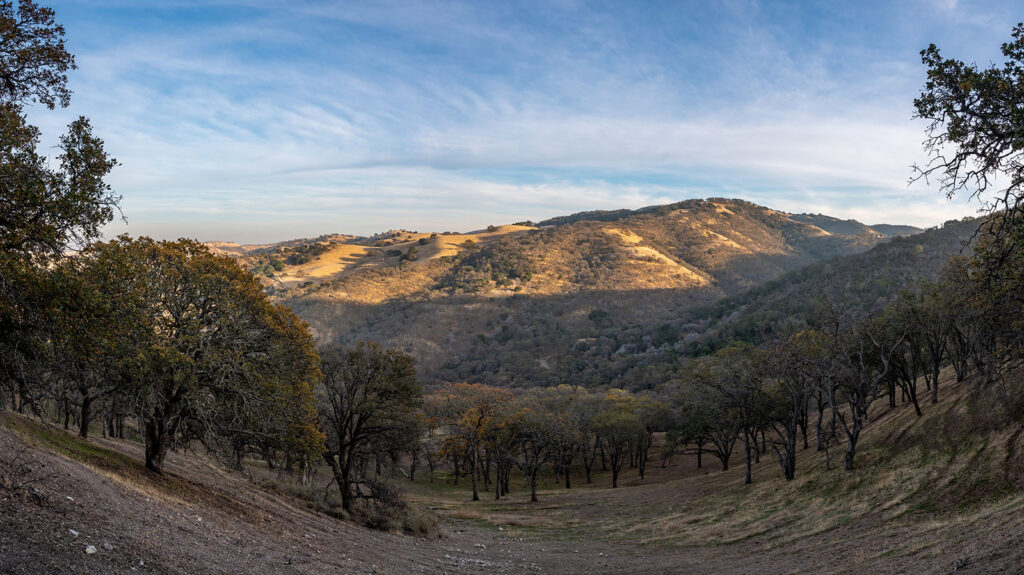
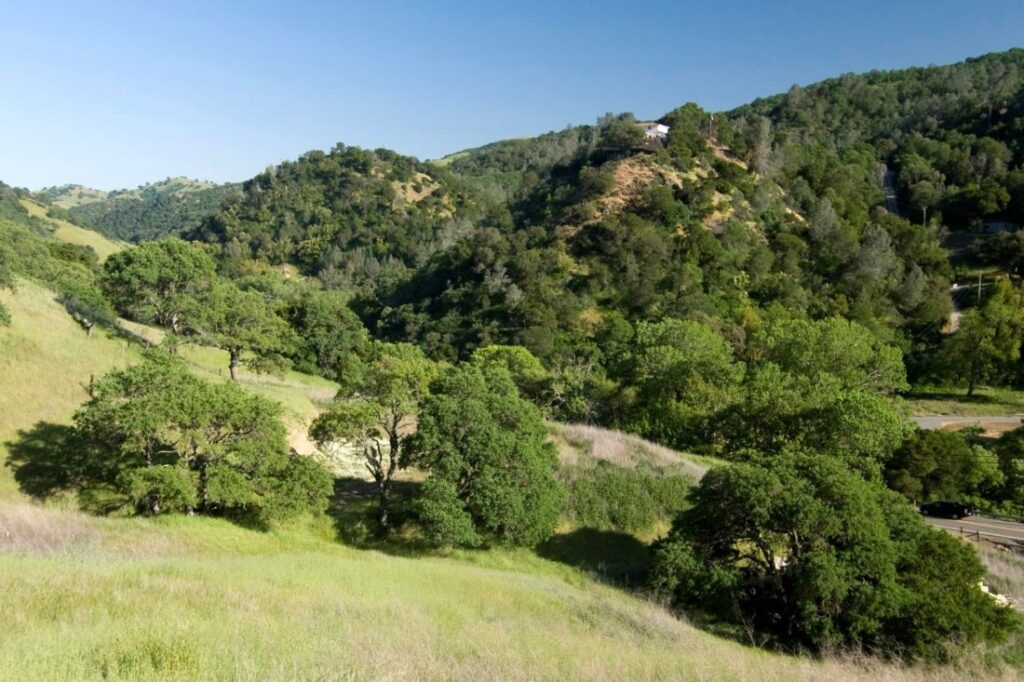
View from the Ginochio Schwendel Ranch. Photo by Scott Hein.
Rare volcanic habitat in the Dark Canyon part of Marsh Creek
SMD must raise $1.5 million within 12 months.
ByLaura Kindsvater, Senior Communications Manager, Save Mount Diablo
Just in time for the holidays, Save Mount Diablo (SMD) has optioned the 98-acre Ginochio Schwendel Ranch on Marsh Creek Road between Clayton and Brentwood. The $30,000 option payment holds the property for 12 months while Save Mount Diablo raises almost $1.5 million for acquisition and other project expenses.
It’s the first property Save Mount Diablo is purchasing directly from Contra Costa County’s Ginochio cattle ranching family, which owns nearly 7,000 acres on and around Mount Diablo. The property includes extremely rare dacite volcanic habitat along Marsh Creek’s Dark Canyon section. The Ginochio Schwendel Ranch is the fifth acquisition project Save Mount Diablo has participated in this year. Save Mount Diablo expects to close escrow on its Krane Pond property next week on December 20th.
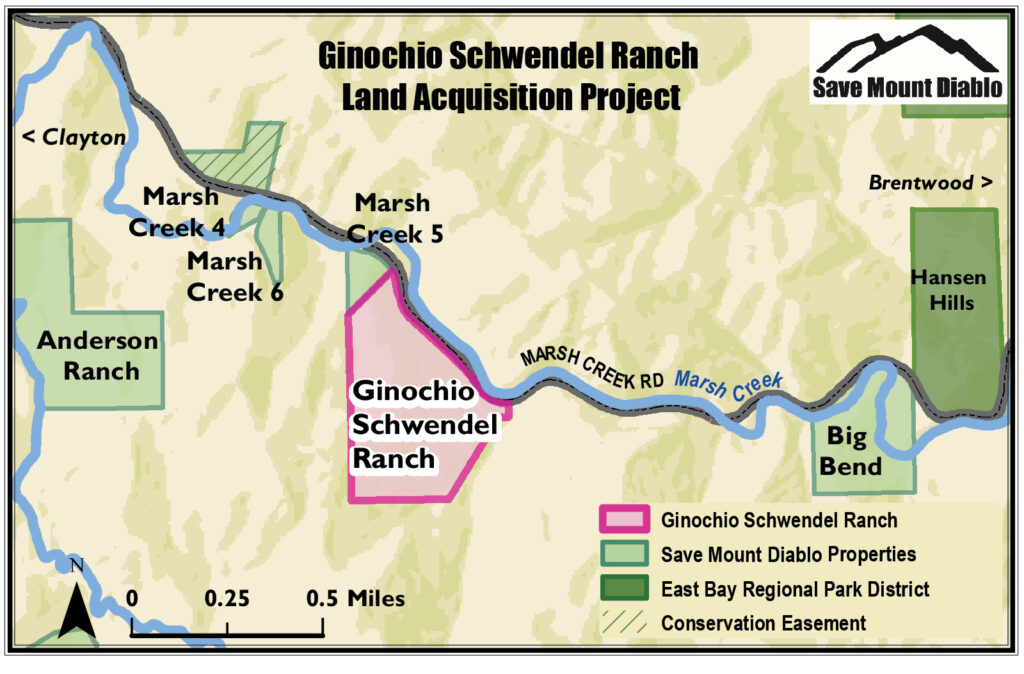
Map showing the location of the Ginochio Schwendel Ranch and other properties protected by Save Mount Diablo along Marsh Creek, the least-disturbed stream in Contra Costa County. Map by Roxana Lucero.
Save Mount Diablo’s Executive Director, Ted Clement, stated, “We are so thankful for our Save Mount Diablo team, including our amazing supporters, and the Ginochio family who together have enabled us to enjoy so much success this year in advancing our time-sensitive land conservation mission, even in the waning days of 2023. This is the first time Save Mount Diablo has bought a property directly from the Ginochio family, the most important landowning family in Contra Costa County. The Ginochios own several high priority properties on the slopes of the mountain. They’ve been amazing stewards of their land for generations. The Ginochio Schwendel Ranch will expand our abutting Marsh Creek 5 preserve. They both share very unusual volcanic geology and are in the high priority Marsh Creek wildlife corridor. If we don’t protect the Ginochio Schwendel Ranch, the property will eventually be divided up and developed, causing its special conservation values to be lost. We’re going to need help from our generous donors and agency partners to fund this project in the next 12 months.”
The Ginochio Family
The Ginochio family arrived in Contra Costa in 1867 and settled in Concord and the coal mining town of Nortonville, and then diversified into ranching. Over 156 years, they created and have stewarded the biggest cattle ranching operation in the county.
The Ginochios own nearly 7,000 acres, including the most important ranches remaining west, north, and east of Mount Diablo. Much of the land is in the Marsh Creek watershed, like the Ginochio Schwendel Ranch. But each generation has more family members, and over time, ranching has become more difficult.
Historically when the family has sold property, they’ve used the funds to buy more agricultural land. When another of their properties was condemned after World War II, the Ginochios bought the Schwendel Ranch. They will continue to own 665 acres north of Marsh Creek Road.
According to John Ginochio, a member of the ranching family, “I’m pleased to make this deal with Save Mount Diablo. When you think of influence, people often think about big environmental groups. Personally, I think Save Mount Diablo is the most influential environmental organization in our area. I’ve worked cooperatively with them for over 50 years. They’re financially sound and have the funds to make solid deals and the integrity to go with it. We graze cattle on a number of SMD properties. I’m happy to see this part of the Ginochio Schwendel Ranch go to Save Mount Diablo because they have always been a good neighbor.”
Added Ginochio, “This parcel south of Marsh Creek Road hasn’t been especially useful for cattle grazing but it’s always been interesting because of its unusual pink soil. I learned more about its volcanic character from Save Mount Diablo as they sponsored research on their neighboring property. I’m really happy we can help expand the protected volcanic habitat instead of more houses.”
The 98-acre Ginochio Schwendel Ranch would expand on Save Mount Diablo’s adjacent 7.4-acre Marsh Creek 5 preserve, an unusual volcanic dome. Marsh Creek 5 was protected in 2011. That same year and one parcel away, Save Mount Diablo also protected a similar volcanic dome, its 5.7-acre Marsh Creek 6 preserve, where the organization demolished a house overlooking the canyon and restored habitat.
According to Seth Adams, Save Mount Diablo’s Land Conservation Director, “The Ginochio Schwendel Ranch is part of the east-west Marsh Creek riparian, road, and trail corridor, and near the western end of the Dark Canyon section of the riparian corridor. Solid blue oak and live oak woodland, it is part of the wooded habitat corridor from Black Diamond Mines through Clayton Ranch south to Morgan Territory Regional Preserve and Mount Diablo State Park. Steep wooded slopes rise from Marsh Creek Road to flatter meadows, then climb higher in one direction, while dropping into a canyon in another. I consider John Ginochio a good friend and I hope this is just the first conservation project with the family.”
Ginochio Schwendel Ranch is a beautiful wooded 98-acre property, most of a steep volcanic knoll rising from 530 feet to 1,140 feet—with dramatic views. The property is quite visible from a variety of protected lands and from both directions of Marsh Creek Road. Development of the property would degrade the visual value of the road corridor, a Contra Costa County General Plan–designated “Scenic Route.” The most likely development threat is minor subdivision and ongoing fragmentation to more houses over time. Development would destroy the habitat, wells would damage the unusual hydrology, and roads and pads would require removal of many trees. Dark Canyon is a critical fire danger area, and part of the property burned several years ago.
Save Mount Diablo and our partners have protected more than 15 miles of the 33-mile Marsh Creek riparian corridor. Marsh Creek is the second longest, least-disturbed creek in Contra Costa County. The creek is across the road in this case, but the overall corridor and this upland habitat are very rich.
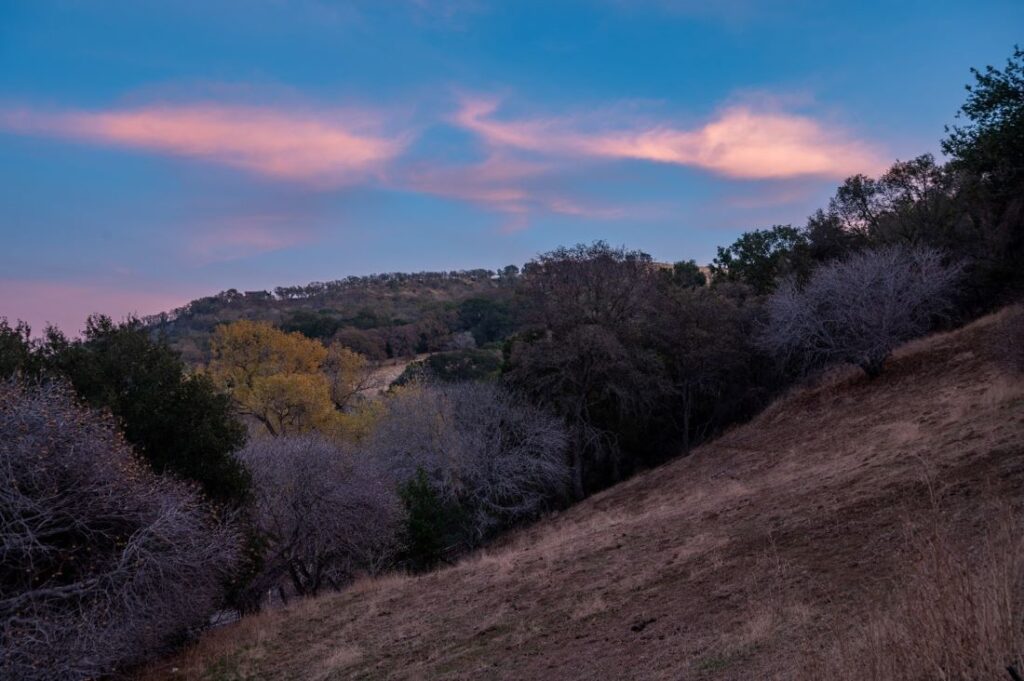
The Ginochio Schwendel Ranch at sunset in November 2022. Photo by Scott Hein.
As with our neighboring Marsh Creek 5 preserve, we know the property supports listed species such as Alameda whipsnake and California red-legged frog, along with a whole suite of rare or unusual plants such as endemic Contra Costa manzanita and Mount Diablo fairy lantern, western hop tree, and Hartweg’s umbrellawort. An on-site fire road accesses the property and will allow much better access to our neighboring Marsh Creek 5 preserve. In the future, we hope the property will help with the creation of a section of the Clayton to Round Valley Marsh Creek Trail.
The Ginochio Schwendel Ranch is the fifth acquisition project Save Mount Diablo has participated in this year. After a successful community-based public fundraising campaign this fall, Save Mount Diablo expects to close escrow on its 6.69-acre Krane Pond property next week. Save Mount Diablo recently made its eighth installment payment on the 87-acre North Peak Ranch. In August, Save Mount Diablo purchased the critical 10-acre Balcerzak inholding within Mount Diablo State Park, situated in Curry Canyon, including the most remote house on Mount Diablo, in just a few weeks. And in April, the East Bay Regional Park District closed escrow on the $11.2 million 768-acre Finley Road Ranch property with Save Mount Diablo’s assistance, providing a location for a new regional staging area for Riggs Canyon and Morgan Territory Regional Preserve.
The Schwendels
We’re just getting to know the history of the property. The Schwendel Ranch was originally pieced together from homesteads and holdings by the heirs of railroad interests. One owner was Joseph or “Josef” Schwendel, a well-known Austrian musician who played the violin or cornet until his death in 1930. He was the organizer of the Clayton Silver Cornet Band in the 1870s. Frank Schwendel was born about 1883. Sometime during that period, Frank Schwendel took ownership of part of the land. Apparently, Mary Berendsen owned another part in 1927. When her husband died, she married Frank. They were still living in the area in 1940 when he was 57 and she was 63, and he still owned the land in 1946 when he granted an easement to PG&E. Schwendel children married members of the Frank family, who arrived in Clayton in the 1870s, and the Cakebread family. The Ginochio family bought their part of the Schwendel Ranch after World War II.
“Anna (Berendsen) Berkheimer has lived in Brentwood since 1981, but Clayton will always be her home. Berkheimer was born in Clayton . . . in a building that is known as the Clayton Club, a country and western bar,” according to the Clayton Historical Society and reprinted from an article that ran in the Brentwood News on August 13, 1987. “’Before Prohibition my father ran the saloon and mother took care of the dining room.’. . . ”Berkheimer was the daughter of Carl Berendsen, who emigrated to the United States from Denmark at the age of 17. Her mother’s parents were also from Denmark. . . . In 1926 her father drowned in Marsh Creek after driving his vehicle off the bridge and her mother subsequently married Frank Schwendel, who was born and raised in the Marsh Creek area. Schwendel owned 1,200 acres between Brentwood and Clayton and Berkheimer assisted with many of the chores on the ranch. ‘I learned how to milk cows, drive a tractor, and quite a few other things, but I really enjoyed it even though it was hard work,’ she said.”
The Ginochio Schwendel Ranch harbors oak woodland and rare volcanic plant habitat. Photo by Scott Hein.
Why Does the Ginochio Schwendel Ranch’s Geology Matter?
Complex geology = complex soils = rich botany. As rocks break down, soils are formed, and when the geology is complex, so are the soils. Because they’re high in some minerals, chemicals, and trace elements, and deficient in others, rocky soils often exclude some plants and are speciation sites where others evolve into new forms. These volcanic dacite intrusions are high silica and break down into sands that hold water and support a different plant community and rare plant species, often with springs on their slopes or base. Their vegetation is brighter green and lusher than surrounding areas, often dense with trees or poison oak.
A dozen volcanic, mostly dacitic intrusions have been mapped along Marsh Creek at the northeast corner of Mount Diablo State Park. In 2011, Save Mount Diablo protected 7.4-acre Marsh Creek 5, including one volcanic dome and then later that year a similar dome, 5.7-acre Marsh Creek 6. Another volcanic dome is found in Mount Diablo State Park at Perkins Canyon, which is easily accessible. Marsh Creek 5 and Marsh Creek 6 are two volcanic exposures on either side of the Marsh Creek Springs resort. These properties form a volcanic habitat found nowhere else in central or eastern Contra Costa County. The 98-acre Ginochio Schwendel Ranch is part of this same volcanic area.
The volcanic domes at Save Mount Diablo’s Marsh Creek 6 and Marsh Creek 5 preserves, with Ginochio Schwendel Ranch rising beyond. Photo by Scott Hein.
There’s not as much igneous rock in Contra Costa County as in the North Bay, but it’s not all that unusual, especially on Mount Diablo. The most common igneous rocks on Mount Diablo are old ocean crust formed deep out at sea. These rocks included parts of Diablo’s main peaks. Also, present are pillow basalts formed at underwater eruptions along a mid-ocean ridge. These pieces of igneous rock were carried to North America and added to the continent by the movement of tectonic plates.
In the Oakland hills, more recent volcanoes erupted and spread lava and ash locally years ago. And in various places around Contra Costa County, ash from eruptions farther away are consolidated as “tuff” beds. The pink Lawlor Tuff is an age marker around Diablo, laid down on a flat to rolling landscape before the peaks were exposed, and steeply folded as Mount Diablo emerged.
Save Mount Diablo’s Marsh Creek 5 and Marsh Creek 6 properties are different. So is the Ginochio Schwendel Ranch.
We began studying the geology of the volcanic deposits after we acquired these Marsh Creek properties and sponsoring research into their origin in grants in 2018 and 2019 from our Mary Bowerman Science and Research program. Ultimately a chapter was included, “Neogene volcanism on the eastside of Mount Diablo, Contra Costa County, California” with findings in a new geology book, Regional Geology of Mount Diablo, California in 2021.
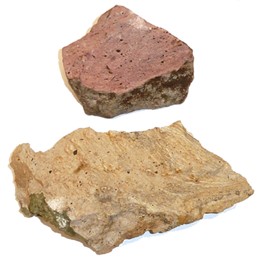
Volcanic rocks from Save Mount Diablo’s Marsh Creek 5 preserve and Ginochio Schwendel Ranch acquisition project. Photo by Save Mount Diablo.
“Neogene volcanic rocks are located to the east and north of Mount Diablo, near the eastern boundary of the San Andreas fault system . . . probably associated with the northward migration of the Mendocino Triple Junction along the western plate boundary in California . . . This event produced a series of volcanic centers along the plate boundary . . . referred to as the Coast Range Volcanic Suite.”
These spots are of high silica, much younger igneous rock visible in mound- or dome-like surface exposures, within a four-mile northwest-southeast band, a mile and a half wide. They’re strangely steep because they resist erosion and look like mushroom caps, compared to more erosive sedimentary Great Valley Group geology nearby. Marsh Creek threads through them near the intersection of Morgan Territory and Marsh Creek roads. The volcanic intrusions are also one of the most limited habitats in the East Bay, retain water more than surrounding areas, and are often associated with springs and rare plants. The Ginochio Schwendel Ranch includes part of the biggest mapped exposure of these dacite intrusions.
The rare geology and plant habitat on the Ginochio Schwendel Ranch is just one more thing that makes Mount Diablo special.
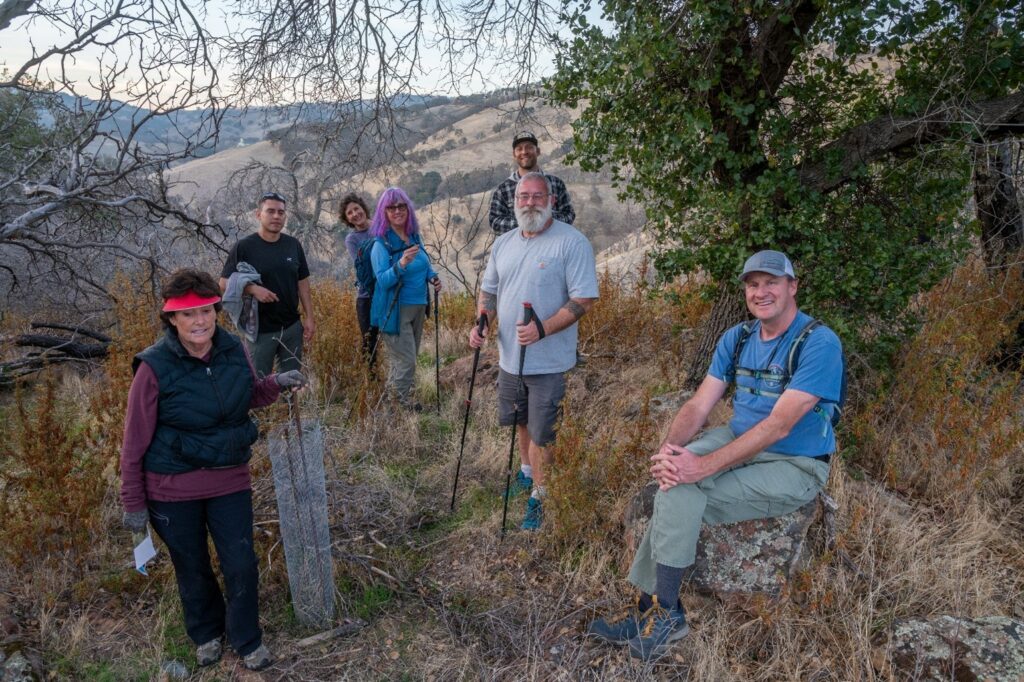
Save Mount Diablo staff and committee members on a land tour on November 22, 2022 to investigate the Ginochio Schwendel Ranch and Save Mount Diablo’s Marsh Creek 5 preserve. Left to right: Joan Duffield, Juan Pablo Galván Martínez, Margaret Kruse, Shirley Langlois, Seth Adams, Sean Burke, and Ted Clement. Photo by Scott Hein.
About Save Mount Diablo
Save Mount Diablo is a nationally accredited, nonprofit land trust founded in 1971 with a mission to preserve Mount Diablo’s peaks, surrounding foothills, watersheds, and connection to the Diablo Rangethrough land acquisition and preservation strategies designed to protect the mountain’s natural beauty, biological diversity, and historic and agricultural heritage; enhance our area’s quality of life; and provide educational and recreational opportunities consistent with protection of natural resources. To learn more, please visit www.savemountdiablo.org.
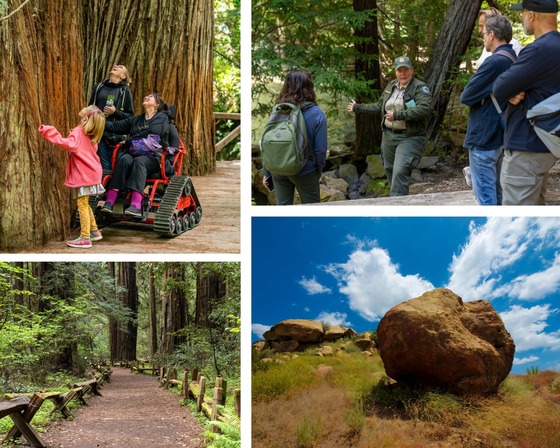
Hikers at Prairie Creek Redwoods State Park. Track chairs will be available for visitors with mobility challenges. Top right: Many First Day Hikes will be guided by State Parks staff or volunteers. Bottom left: Armstrong Redwoods State Natural Reserve in Sonoma County is just one state park hosting a First Day Hike. Bottom right: Hike for an opportunity to learn about the history and geology at Santa Susana Pass State Historic Park in Los Angeles County. Source: CA State Parks
California State Parks welcomes the public to start 2024 in a healthy way and to enjoy the fresh air with the annual First Day Hikes, on Monday, January 1. Currently, up to 60 state parks will be participating, with over 70 guided hikes taking place across the state. Californians and visitors from around the world can hike amongst the gentle redwoods or learn about the geology of the desert or catch a glimpse of bald eagles and other unique wildlife—California has some of the most unique and iconic parks in the country for everyone to explore.
First Day Hikes is a national-led effort that encourages individuals and families to experience, with a seasoned guide, the beautiful natural and cultural resources found in the outdoors and in doing so may inspire them to take advantage of these treasures throughout the year and an individual’s lifetime.
With more than 70 guided hikes taking place in California’s State Park System on January 1, distance and difficulty will vary per hike or activity. Visitors are encouraged to check out details of start times and description of hikes. This year’s First Day Hikes webpage–parks.ca.gov/FirstDayHikes2024–is more interactive, as the public can search a map of locations by park name, county and region. Visitors are also able to see the status of the hike and the last time it was updated, and by zooming into the map, they can find hikes taking place near that region of the map. Additionally, the webpage provides information on new hiking opportunities around the holiday. For example, Carpinteria State Beach will offer a hike the morning of Saturday, December 30, and La Purísima Mission State Historic Park will have a Last Day Hike of the year the morning of Sunday, December 31.
Below are a few hikes taking place on January 1:
Angel Island State Park: Join a 5-mile hike to the top of Angel Island’s Mount Caroline Livermore. The hike will pass through oak woodlands, chaparral and wind-blown hillsides. Visitors can take in spectacular views of San Francisco and the Golden Gate Bridge.
Ocotillo Wells State Vehicular Recreation Area: Instead of a hike, visitors can come in their four-wheel-drive vehicle at the Discovery Center for a quick tour of the western portion of the park. Explore ancient seashore, mesquite dunes and desert washes. See interesting geology, desert plants, signs of wildlife and maybe even some wildflowers. The route will consist of a roughly 20-mile loop, arriving back at the Discovery Center at its conclusion.
Calaveras Big Trees State Park: Hikers can experience a snowshoe-guided hike through the park’s North Grove. Snowshoes will be available to borrow, and the first portion of the program will be an introduction to how to snowshoe.
Salt Point State Park: Hikers can enjoy the pristine beauty of the Sonoma coast. This 2.5-mile, three-hour, easy-to-moderate and round trip hike takes participants along the ocean terrace from Gerstle Cove to Stump Beach.
Santa Susana Pass State Historic Park: Visitors can enjoy spectacular views of the Simi Hills and the San Fernando Valley and learn about the history of the Butterfield Overland Stage Route The park will offer four hikes of different lengths and difficulty.
Most parks require a parking fee for the hikes. However, if visitors have checked out the State Library Parks Pass or have qualified for the Golden Bear Pass, they can enter for free at participating parks. Additionally, parents of fourth graders are invited to download the California State Park Adventure Pass that allows free entrance to visit park units like Millerton Lake State Recreation Area or Samuel P. Taylor State Park. Learn more about these free passes at parks.ca.gov/OutdoorsForAll.
As with any outing, it is important for all visitors to recreate responsibly. Below are helpful tips to stay safe during First Day Hikes and all year long:
Know Before You Go: Prior to leaving home, check the statusof the park unit you want to visit to find out what restrictions and guidelines are in place. Have a backup plan in case your destination is crowded. Stay home if you are sick.
Play It Safe: Find out what precautions you should take when exploring the outdoors, especially if this is your first time visiting the State Park System. For example, make sure to dress in layers, bring plenty of snacks and water, and wear appropriate hiking shoes.
Leave No Trace: Leave areas better than how you found them by staying on designated trails and packing out all trash. Do not disturb wildlife or plants.
Visitors can also use apps to stay safe and enhance their experience in the outdoors with:
what3words:Use the what3words app to communicate precise locations within any of the 280 state parks using just three words. This tool aids dispatchers in emergency situations, enabling assistance to those in need. Share locations with family and friends, and provide directions to events, trails or campsites using this convenient app. To learn more on how the app works, visit ca.gov/what3words.
OuterSpatial:Discover the ultimate guide to California’s state parks with the OuterSpatial app. Navigate through interactive maps, receive real-time updates and stay connected with fellow outdoor enthusiasts. Enhance your exploration by monitoring visits, completing challenges like the Passport to Your California State Parks and sharing memorable experiences.
Visitors are encouraged to share their experiences on social media using the hashtags: #HikeInto2024, #FirstDayHikes, #HikeWithCAStateParks and #CAStateParks.
By Dave Mason, Public Information Supervisor, East Bay Regional Park District
On December 3, the Park District held a grand opening celebration for the Tyler Ranch Staging Area in Sunol and the opening of 2,800 acres of new open space for hiking, biking, and horseback riding. New amenities include 78 parking spaces, equestrian staging/trailer parking, accessible restrooms, a small family picnic area, and access to 18 miles of trails.
The new parkland offers panoramic views of the Bay Area, including the San Francisco Bay, Mount Diablo, Brushy Peak, Mission Peak, Mount Umunhum, and Mount Tamalpais. From the staging area to Sunol Ridge, there is a challenging trail with 1,700 feet of elevation gain. Further north along the ridgeline is Sunol Peak at 2,163 feet, just under the height of Mission Peak.
The new parkland is part of Pleasanton Ridge Regional Park, which covers over 9,000 acres. For more information, visit www.ebparks.org/parks/pleasanton-ridge.
The Park District recently updated Ordinance 38 to allow Class I e-Bikes on all trails where regular bikes are allowed, and Class II e-Bikes on all paved Regional Trails. Class 1 e-Bikes are pedal-assist and require pedaling for assistance from the electric motor. Class II e-Bikes have a throttle and allow pedal assist but do not require pedaling for assistance from the electric motor. All e-Bikes must follow the 15-mph bike speed limit. Bikers should also remember to slow down around others, call out or ring their bell when passing, and stay on designated trails only. For more information, visit www.ebparks.org/recreation/biking.
Holiday Fun in East Bay Regional Parks. The winter holidays are a great time to get into nature and spend time with family and friends. Christmas at the Patterson House at Ardenwood Historic Farm in Fremont celebrates a turn of the 20th century holiday at a beautifully restored Queen Anne mansion fully decorated for the holidays. Purchase tickets in advance online or at the door, as space allows. Winter Wonderland at the Tilden Merry-go-Round at Tilden Regional Park in Berkeley is a beloved East Bay holiday tradition! Ride the carousel, visit with Santa or Olaf, view the lights and decorations, and enjoy holiday treats. Winterfest at the Tilden Steam Train at Tilden Regional Park in Berkeley offers a spectacular ride through the park on the Redwood Valley Railway with lights and holiday decorations. For more information, visit www.ebparks.org/holidays-parks.
Wintering Ladybugs at Reinhardt Redwood. Every year, between October and February, ladybugs cluster together in large groups to hibernate. A single cluster may contain hundreds of thousands of ladybugs. They cluster together in shrubs during cold winter weather, then disperse in the springtime. You can see them along the trails in many parks and open spaces, but one of their favorite places to gather is the intersection of Stream and Prince trails at Reinhardt Redwood Regional Park. For more information, visit www.ebparks.org/parks/reinhardt-redwood.
New Year Activities. The new year brings new excitement and opportunities to get into nature. Kick off the year with a naturalist-led hike or activity! For more information, visit www.ebparks.org/calendar and search “New Year.”
The East Bay Regional Park District is the largest regional park system in the nation, comprising 73 parks, 55 miles of shoreline, and over 1,300 miles of trails for hiking, biking, horseback riding, and environmental education. The Park District receives more than 25 million visits annually throughout Alameda and Contra Costa counties in the San Francisco Bay Area.
Mount Diablo, CA— California State Parks Foundation today announced that its Mount Diablo Bike Turnout campaign raised $755,090 exceeding its goal of $750,000. California State Parks, California State Parks Foundation, and Mount Diablo Cyclists have partnered to build Phase Two of bike safety turnouts at Mount Diablo State Park.
“State Parks is very appreciative of the community’s enthusiasm around this project,” said Clint Elsholz, Acting District Superintendent of Diablo Range District. “The generosity of so many will accelerate our progress around enhancing safety measures at Mount Diablo State Park.”
For many years, cycling at Mount Diablo State Park has been a popular — but dangerous — activity. From 2010 to 2014, there was an average of 23 car and bike collisions per year. According to California State Park officials, this also frequently resulted in road rage showdowns between drivers and riders.
Bike turnouts allow bicyclists, who move at slower speeds as they pedal uphill, to pull out of the main traffic lane into their own lane so that vehicles can pass safely. After the first turnouts were created, collisions dropped to three accidents in two years, and road rage significantly diminished.
With the completion of 30 bike turnouts in 2022, there are now 45 total at Mount Diablo State Park.
This project was inspired by the memory of Joe Shami who was a passionate advocate for increasing safety for bicyclists and cars at Mount Diablo State Park. Known by locals as “The Legend of Mount Diablo,” Joe’s passion for Mount Diablo State Park and cycling was exemplified by over a decade of weekly trips up the mountain well into his 80s.
“Tragically, Joe was struck and killed by a vehicle while riding his bicycle in Lafayette,” said Randy Widera, Director of Programs of the California State Parks Foundation. “Although he is not with us today, Joe left a special gift in his will of $123,415.61 to California State Parks Foundation to fund additional bike turnouts on Mount Diablo.”
In an incredible show of dedication to this work, California State Parks allocated the same amount as Joe’s gift with an additional $123,415.61 from the department’s annual roads allocation funding. Taking this initial funding as a challenge, a passionate group of volunteers comprised of Alan Kalin, Mark Dedon, and Ted Trambley spent the past four months doing outreach in the park and at Peet’s Coffee in Danville with locals, cyclists, and visitors.
“We absolutely enjoyed all our time and effort meeting and speaking with the thousands of motorists and cyclists,” said Alan Kalin. “The vast majority of folks understood the critical importance that bike turnouts could make, how they help prevent collisions and save lives.”
Through their efforts and with the support of California State Parks Foundation, they inspired over 300 individuals, organizations, and companies to donate an additional $508,259.26 lifting the campaign to a total of $755,090.48 raised.
Currently, Phase Two of the Mount Diablo Bike Turnout project is anticipated to break ground in late spring of 2024. For more information on this project, please contact Randy Widera, Director of Programs, California State Parks Foundation at randy@calparks.org.
To learn more about this project, please watch this short video. Please see here for a map of existing and future bike turnout areas and photos of Mount Diablo.
California State Parks Foundation, an independent, member-supported nonprofit with over 50 years of history, is dedicated to protecting and preserving the California state park system for the benefit of all. We work in parks and in Sacramento with partners, park staff, and policymakers to address the challenges parks face. To make real and lasting change we are working to build a movement of people who enjoy and advocate for their parks now, and for future generations. Learn more at www.calparks.org, or find California State Parks Foundation on Facebook, or Instagram and Twitter (@calparks).
California State Parks provides for the health, inspiration and education of the people of California by helping to preserve the state’s extraordinary biological diversity, protecting its most valued natural and cultural resources, and creating opportunities for high quality outdoor recreation.
Mount Diablo Cyclists’ mission is to improve the safety for Cyclists, Motorists, and Pedestrians on the Roads of Mount Diablo.
About Mount Diablo State Park
Located in the San Francisco Bay Area to the east of Walnut Creek, people have been drawn for generations to Mount Diablo for its spectacular views from the summit which extend over 100 miles in all directions on a clear day. Visitors have been attracted by the complex geology that has created amazing rock formations such as the “wind caves” at Rock City, and by the mountain’s variety of habitats which are home to over 600 species of plants and an amazing array of wildlife such as butterflies, bats and birds of prey, tarantulas, bobcats, lizards, snakes and deer.
In 2021 Mount Diablo celebrated its 100th year as a State Park. Though 100 years is a long history as a park, the importance of Mount Diablo was recognized long before that. For thousands of years Native Americans were the caretakers of this land. Many groups considered and treated the mountain as a sacred place and continue to do so today.
Since becoming a park in 1921, Mount Diablo has been protected as a natural area, and over the past 100 years the park has grown from only a few hundred acres to over 20,000 acres. Today it is a destination for those who would like to view wildlife and wildflowers, experience beautiful views, hike, camp, picnic, run, cycle, climb, ride horses, or gaze at the stars.
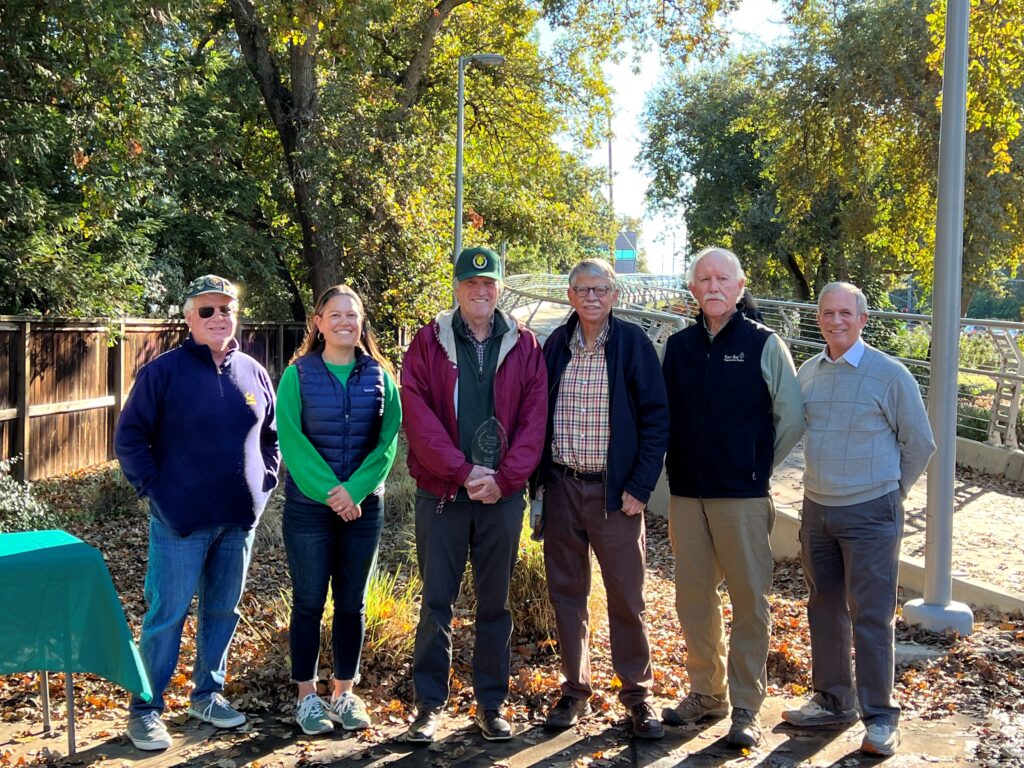
Rep. Mark DeSaulnier (center with award) is joined by (L-R) Park District General Manager Sabrina Landreth, Board President Dennis Waespi, Board Members Colin Coffey and John Mercurio, and Regional Parks Foundation Immediate Past President Les Hausrath. Photo: EBRPD
By Dave Mason, Public Information Supervisor, East Bay Regional Park District
“U.S. Representative Mark DeSaulnier has been a great champion and supporter of the East Bay Regional Park District,” said Park District Board President Dennis Waespi. “The 2023 Radke Championing Advocacy Award recognizes the Representative for his many years of advocacy for the Park District, including as a Concord City Council Member, Contra Costa County Supervisor, State Legislator, and now as a U.S. Representative.”
Representative DeSaulnier is the first award recipient serving in Washington, D.C.
“The Park District thanks Representative Mark DeSaulnier for his leadership in obtaining critical funds in the Federal budget for expanding access to the outdoors and providing a welcoming space for visitors to learn the important history at Thurgood Marshall Regional Park – Home of the Port Chicago 50,” said Park District General Manager Sabrina Landreth. “Representative DeSaunier has been a true partner and champion for the Park District throughout the years.”
Representative Mark DeSaulnier is known for championing policies that promote sustainability, environmental protection, and mitigate the consequential effects of climate change. He led the effort to secure a $3 million Community Benefit Project application for a future Visitor Center at Thurgood Marshall Regional Park – Home of the Port Chicago 50. The visitor center is envisioned as a joint facility with the National Park Service (NPS) to provide outdoor recreational opportunities, connect the public with the natural and human history of the park, and serve as a welcoming center for NPS to share the history of events commemorated by the Port Chicago Naval Magazine National Memorial.
“The East Bay Regional Park District provides invaluable service to our community by creating opportunities for outdoor activity that benefit our physical and mental health, protecting the environment, and hosting wildlife educational programs,” said Congressman DeSaulnier. “I am proud to have called the Park District a partner over many years in our efforts to ensure public access to parklands, preserve habitats, and share the history of our East Bay lands, and am honored to be recognized with the 2023 Radke Championing Advocacy Award.” The Radke Championing Advocacy award is named for late Park District Board Member Ted Radke, who advanced state and federal support for park funding. Former Director Radke strengthened the Park District’s ties in Sacramento and Washington, D.C. Radke served 36 years on the Park District Board of Directors and was the longest-serving Board member in its 89-year history.
The East Bay Regional Park District is the largest regional park system in the nation, comprising 73 parks, 55 miles of shoreline, and over 1,300 miles of trails for hiking, biking, horseback riding, and environmental education. The Park District receives more than 25 million visits annually throughout Alameda and Contra Costa counties in the San Francisco Bay Area.