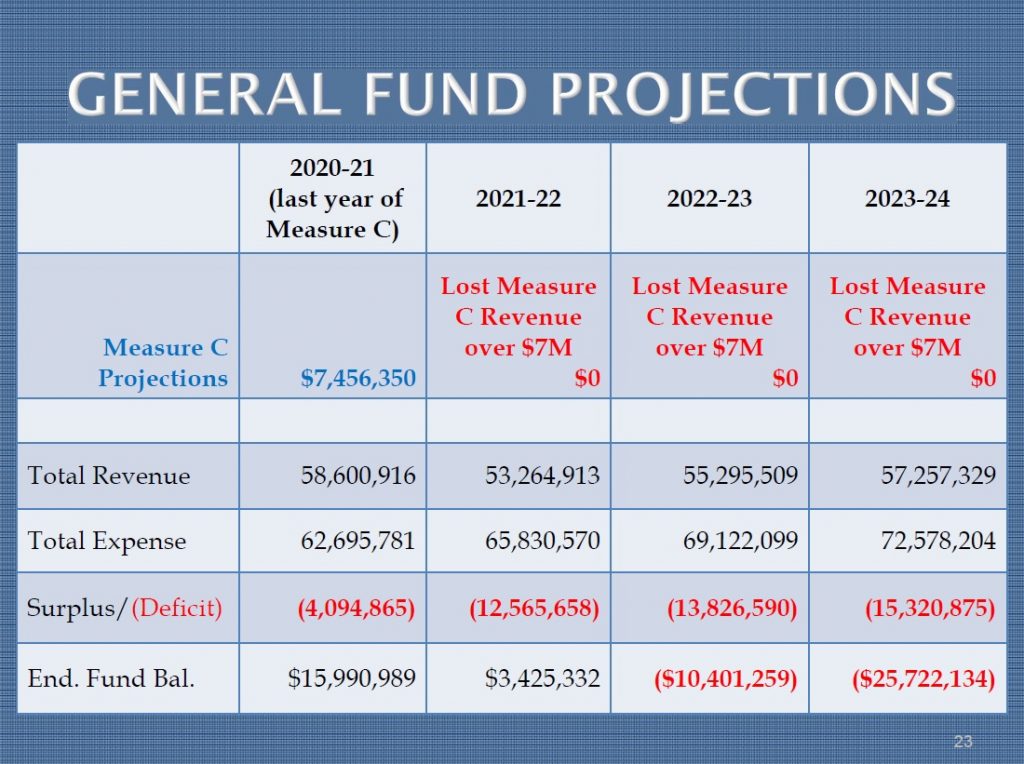
Chart from city staff report presented to the Antioch City Council on Tuesday, April 11, 2017.
 I was informed this week that there is some confusion in the community about the City of Antioch’s finances due to the headline for an article published on the Antioch Herald website, last week.
The headline read “City Council learns Antioch again facing bankruptcy” which is accurate, based on the staff report at the Council meeting on Tuesday, April 11,2017. The chart included with the article shows that in the 2021-22 fiscal year, without the city’s half-cent sales tax Measure C being re-approved by the voters, the city’s General Fund balance will cross the line from zero dollars. Even if Measure C is renewed that financial event occurs two years later.
I have since updated the headline to reflect that bankruptcy will occur “within five years.” But, the original headline was accurate and we stand by it. Folks, let me be frank. First, you need to understand the meaning of words and their use in a sentence. Second, you have to read the article to understand what’s going on, not just the headline.
When a government agency or a business is facing bankruptcy, it doesn’t mean it has filed for or is in bankruptcy. It means it has to make some changes to avoid it.
That’s exactly what needs to be done at City Hall and they have five years to do it.
Two things have caused this. As the article states, “Antioch’s $52.7 million General Fund budget is projected to begin deficit spending by $2.6 million in July of next year due largely to increased police staffing, pay and benefit hikes for all city employees and increased payments to the California Public Employees Retirement System.” (PERS)
The recent approvals, by the previous council and the current council majority, of the city employ contracts with increases to pay and benefits will cost the city over $9 million over the next five years. Those contracts extend one year beyond the sunset of Measure C in 2021. That council majority does not include current Mayor Sean Wright and Mayor Pro Tem Lamar Thorpe who both opposed the new contracts, but couldn’t do anything to stop them once they were on the council.
PERS is now requiring cities to pay more towards the unfunded liabilities of the pensions of past employees. That’s because for years, PERS has been projecting an overly aggressive and unrealistic return on their investments, and now reality has hit them in the face. The result is each city and government agency in California has to contribute more money to PERS to make up for the difference in what they projected and what is needed to pay for the pensions of current and future retirees.
At the end of Tuesday night’s meeting on April 25, Mayor Sean Wright said “Antioch is in fine financial shape. For those who ask if we are filing for bankruptcy the answer is no. We have $25 million in reserves with no debt.”
His second sentence is correct, as I’ve pointed out, above. Wright’s first sentence is also correct – today. But, he’s aware and we all are, now with the staff report, that just because the city has $25 million in reserves, today doesn’t mean it will be in fine financial shape, just a few years from now. Wright is also aware that action must be taken to keep the city in “fine financial shape.”
As the city staff report on April 11, and above and below charts show, that even if we vote to renew Measure C, the city’s half-cent sales tax passed by voters in 2013, the city’s General Fund balance will be zero dollars in less than seven years.
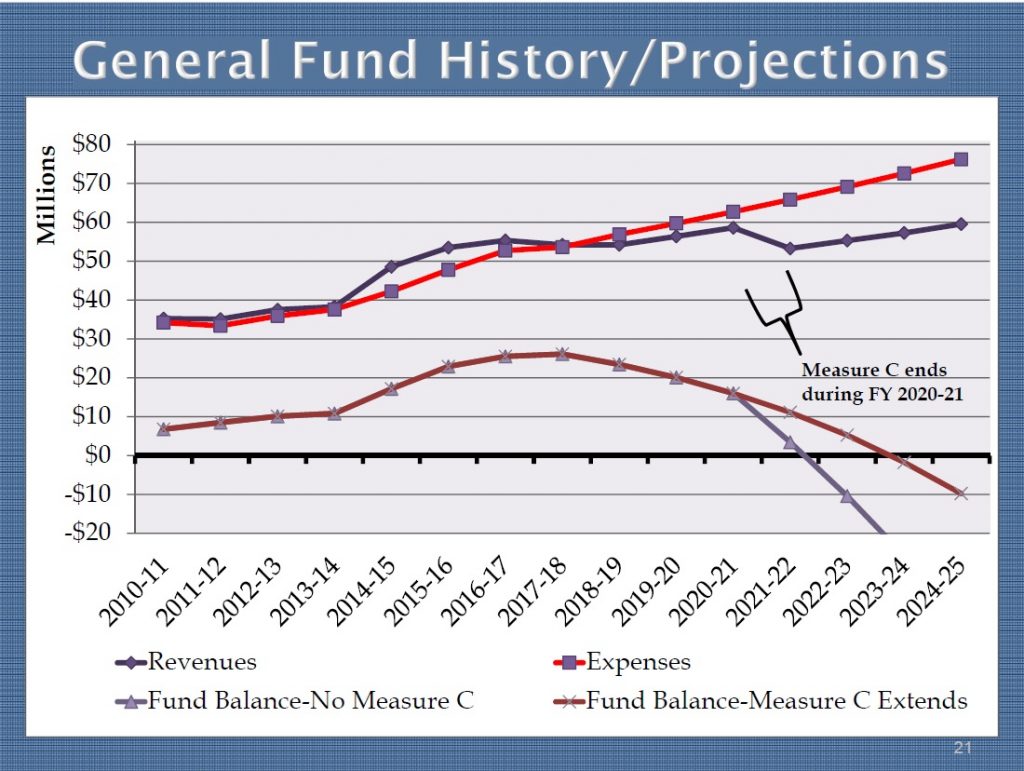
City of Antioch General Fund Projection Chart from city staff report to council on 4/11/17.
If the Council doesn’t do three things over the next few years, Antioch will run out of those reserves and be upside down financially, which means bankruptcy.
First, the council needs to reopen and renegotiate the employee contracts. The City of Richmond just approved new contracts for their police and firefighters without a pay raise. (That city is facing the same financial challenges as Antioch, also because of PERS and even with a new tax increase. See related article, here.) Antioch should have done the same, at least until they had hired the 22 additional officers we were promised “immediately” in 2013 if we passed Measure C. Plus, all the other city employees enjoyed 13% in pay raises just a few years ago when the council ended Furlough Fridays. The council majority must have forgotten about that.
Message to the council majority: we didn’t give you two tax increases, including Measure O, to give pay raises to city staff. That was nowhere in the ballot language of either measure.
Second, the city needs to fulfill its promise and hire the 11 additional sworn police officers. So far, they’ve given us a net 11 additional officers out of the 22. They need to start budgeting for 111, not 102 like they’ve been doing. There were 89 sworn officers on the force when that promise was made.
That will result in crime being reduced which will help Antioch be able to attract business, as well as an increase in property values, which gives the city more tax revenue, without raising taxes.
Third, the city needs to more aggressively pursue new businesses to locate in Antioch. Now that the eBART extension and Hillcrest station will be opening next year, that area should be prime for attracting new businesses.
That will result in more sales and property tax revenue to the city, and possibly without having to either renew Measure C or increase other taxes – and to be frugal and responsible, the council needs to plan for and base their budgets on the expectation that it won’t be renewed.
The time to develop a plan to implement these three actions is now. I trust and hope that with the new leadership on the council and inside City Hall with a new city manager, it can and will be done.