ANTIOCH, CA — The City of Antioch is alerting residents to a door-to-door scam in which individuals are falsely claiming that the city’s tap water is unsafe in an attempt to sell high-cost water filtration systems.
In a recent report, a resident was approached by a person claiming to test water quality. The individual presented a false test result alleging the presence of “13 cancer-causing contaminants” and attempted to pressure the resident into purchasing a reverse osmosis system. When the resident declined to provide personal information, the individual became aggressive.
“These individuals are not associated with the City of Antioch, or our Water Department,” said Ivona Kagin, Laboratory Supervisor at the Water Treatment Plant. “Tap water is tightly regulated by the U.S. Environmental Protection Agency. We want to reassure residents that Antioch’s drinking water meets or exceeds all federal and state requirements. Details are published in our annual Consumer Confidence Report: https://www.antiochca.gov/583/Water-Treatment. If your water becomes unsafe to drink, the City of Antich will notify you and provide information on how to protect yourself.”
Residents are urged to follow these safety guidelines:
Do not allow unverified individuals into your home.
Always ask for official identification.
Look for a City of Antioch badge and marked city vehicle.
Call the Water Department at (925) 779-7060 to confirm if someone is a city employee.
Report aggressive or suspicious activity to the Antioch Police Department.
Kagin emphasized that legitimate city employees will never arrive unannounced. All official visits are scheduled in advance and conducted by trained staff with proper identification.
For more information about Antioch’s water quality or to verify any city-related service visit, please contact the Water Department directly or visit http://www.antiochca.gov/water.
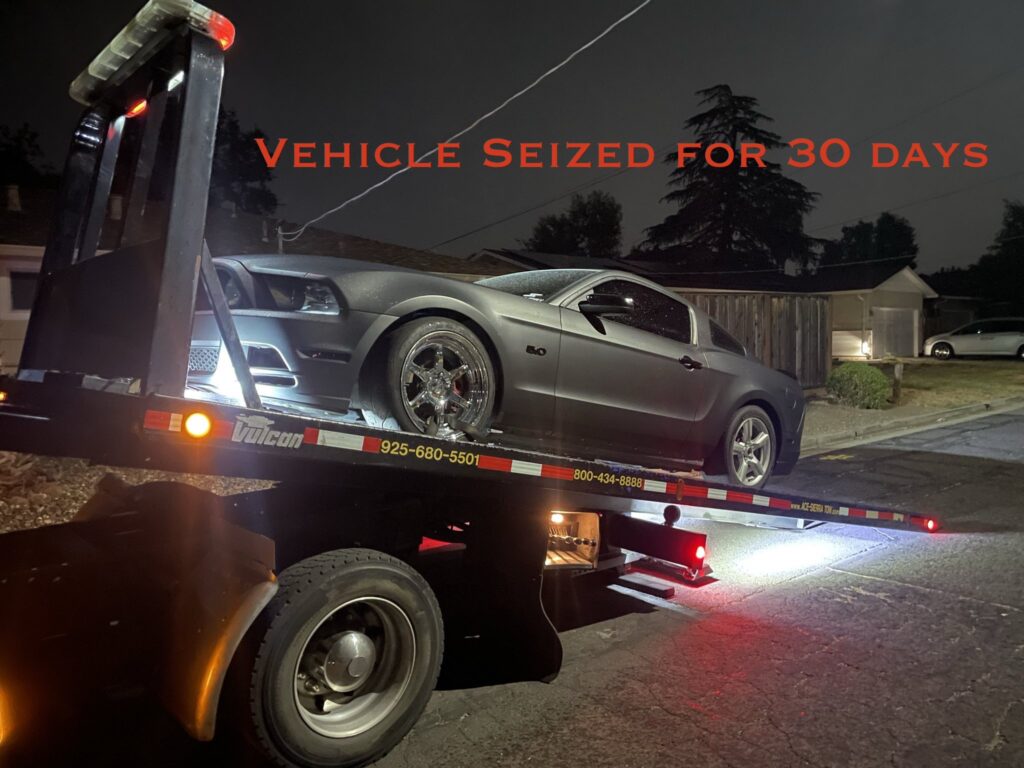
The vehicle of a main participant in last Friday night’s sideshow in Antioch was seized and towed. Photo: CHP Contra Costa
23rd vehicle impounded
By CHP Contra Costa
As a result of Friday night’s joint enforcement operation in the City of Antioch, CHP Investigators have seized a vehicle belonging to one of the main participants involved in the illegal sideshow activity.
This action follows the disruption of two large-scale sideshows, involving more than 200 vehicles and 300 spectators. During the operation, 22 vehicles were initially impounded, and multiple arrests were made. (See related article)
This latest seizure reinforces our ongoing commitment to holding individuals accountable for reckless and dangerous driving behavior that puts the community at risk.
This enforcement effort was made possible through the coordinated work of the CHP’s Golden Gate Division Investigative Services Unit, Contra Costa CHP, Antioch Police Department, and CHP Office of Air Operations.
Sideshows are not just dangerous — they’re criminal. Vehicle seizures and arrests will continue for those involved.
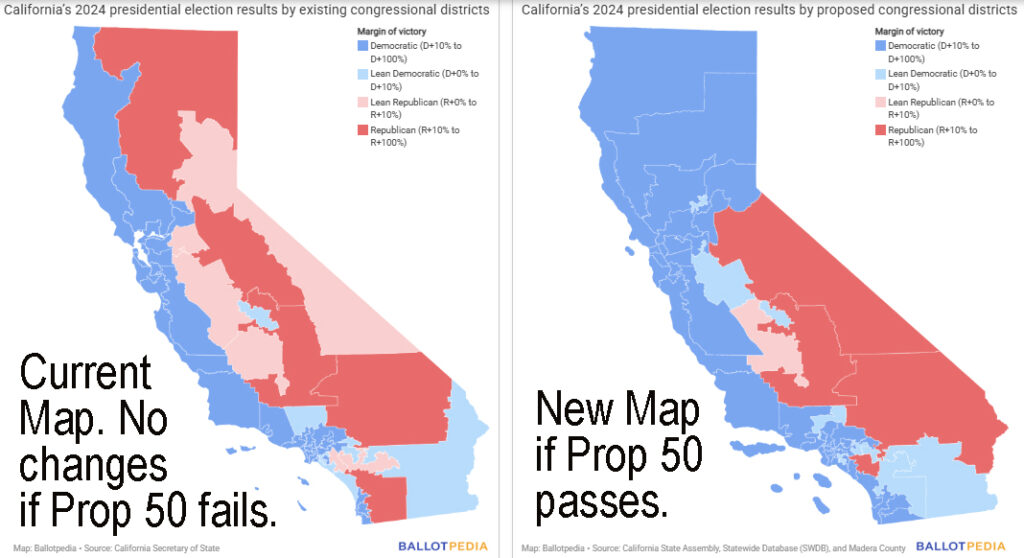
Under Proposition 50, five Republican-held congressional districts would shift to become more Democratic, based on presidential election results from 2024. Source: Ballotpedia
“Will cost taxpayers millions of dollars” more
Sacramento, CA – The California Office of the Secretary of State announced on Monday that a correction notice will be mailed to voter households in response to the discovery of a map labeling error in the official 2025 Voter Information Guide (VIG).
On page 11 of the guide, a proposed congressional district contained in the map provided by the Legislative Analyst’s Office (LAO) was inadvertently labeled as District 22 instead of District 27. A separate map provided by the LAO on page 15 included the correct identification of District 27.
To ensure voters receive accurate information, a correction postcard will be mailed to all voter households who received the guide with the typo. The “https://voterguide.sos.ca.gov/“ website has also been updated to reflect the corrected map.
“Accuracy in voter information is essential to maintaining public trust in California’s elections.” said Weber. “We are taking swift, transparent action to ensure voters receive correct information. This mislabeling does not affect proposed districts, ballots, or the election process; it is solely a labeling error. Every eligible Californian can have full confidence that their vote will be counted and their representation is secure.”
According to a report by the L.A. Times, “There are 23 million registered voters in California, but it’s unclear if the postcards will be mailed to each registered voter or to households of registered voters. Even if the corrective notices are mailed to voter households rather than individual voters, the postage alone is likely to be millions of dollars, in addition to the cost of printing the postcards. The special election, which the legislature called for in August, was already expected to cost taxpayers $284 million.”
“When politicians force the Secretary of State to rush an election, mistakes are bound to happen,” said Amy Thoma, a spokesperson for one of the campaigns opposing the effort. “It’s unfortunate that this one will cost taxpayers millions of dollars.”
Includes Medicare and commercial health plansaccording to NCQA
By Elissa Harrington, Sr. Media Relations & PR Rep, Kaiser Permanente Northern California
OAKLAND, Calif. – Based on national assessments of overall patient experience and clinical quality, Kaiser Permanente Northern California is once again recognized as having the highest-rated health plans in California and among the highest in the nation.
Kaiser Permanente’s Medicare and commercial health plans in Northern California each received 5 out of 5 stars – the highest rating possible, according to the National Committee for Quality Assurance (NCQA) 2025 Health Plan Ratings. This is the 10th ratings period that Kaiser Permanente Northern California has received this designation.
Nationally, only 11 health plans are rated 5 stars. NCQA also ranks Kaiser Permanente Northern California health plans as best in the state for treatment outcomes and prevention efforts.
“These national ratings speak to the high-quality care Kaiser Permanente Northern California provides to its members and patients every day and our efforts to improve health care outcomes,” said Mike Bowers, FACHE, interim president of Kaiser Permanente’s Northern California region. “Our focus on treatment, prevention, and an overall exceptional patient care experience is why our health plans are recognized as best in the state and among the top health plans nationally.”
For 2025, NCQA rated nearly 1,000 plans – commercial, Medicare, and Medicaid – for quality and service nationwide. All of Kaiser Permanente’s commercial and Medicare plans received the highest rating, or were tied for the highest rating, in all the geographic regions we serve. Kaiser Permanente had more 5-star or 4.5-star plans than any other health care organization for the tenth ratings cycle in a row.
“Our highly-skilled clinicians are consistently delivering world-class, high-value care to our patients,” said Maria Ansari, MD, FACC, CEO and executive director of The Permanente Medical Group. “We continue to be recognized as a national leader because of our commitment to driving better health results through innovation, evidence-based treatments, and patient-centered care.”
NCQA is a national, private not-for-profit organization that surveys health plans for performance in a wide range of clinical service measures including consumer experience, prevention, population health, and treatment.
NCQA primarily used the 2024 Healthcare Effectiveness Data and Information Set, or HEDIS®, to establish its ratings. HEDIS is the most widely used performance measurement tool in health care.
Kaiser Permanente is committed to helping shape the future of health care. We are recognized as one of America’s leading health care providers and not-for-profit health plans. Founded in 1945, Kaiser Permanente has a mission to provide high-quality, affordable health care services and to improve the health of our members and the communities we serve. We currently serve nearly 12.6 million members in 8 states and the District of Columbia. Care for members and patients is focused on their total health and guided by their personal Permanente Medical Group physicians, specialists, and team of caregivers. Our expert and caring medical teams are empowered and supported by industry-leading technology advances and tools for health promotion, disease prevention, state-of-the-art care delivery, and world-class chronic disease management. Kaiser Permanente is dedicated to care innovations, clinical research, health education, and the support of community health. For more information, go to about.kp.org.
Police break up a sideshow at E. 18th Street and Hillcrest Avenue in Antioch Friday night, Sept. 26, 2025. Video of CHP Helicopter video. Source: Antioch PD
More than 200 cars, 300 spectators at 2 intersections
By Antioch Police Department
Last night, Friday, Sept. 26, 2025, we teamed up with our friends at CHP Golden Gate for a DUI and sideshow suppression detail funded by CA Office of Traffic Safety. Our planning paid off. We located two intersections where more than 200 vehicles and roughly 300 spectators were gathering to start a sideshow.
Eventually, the crowd overtook Hillcrest Avenue and the E. 18th Street intersection, blocking traffic and preventing fire trucks and ambulances from getting through. Together, we stopped the activity before it escalated further.
22 vehicles seized for 30 days
4 stolen vehicles recovered
30+ citations issued
Several felony arrests made
1 DUI arrest
Sideshows are not only dangerous for drivers and spectators they also put our entire community at risk by blocking emergency vehicles from doing their jobs.
A big thank you to @chpgoldengate for partnering with us to keep our community safe!
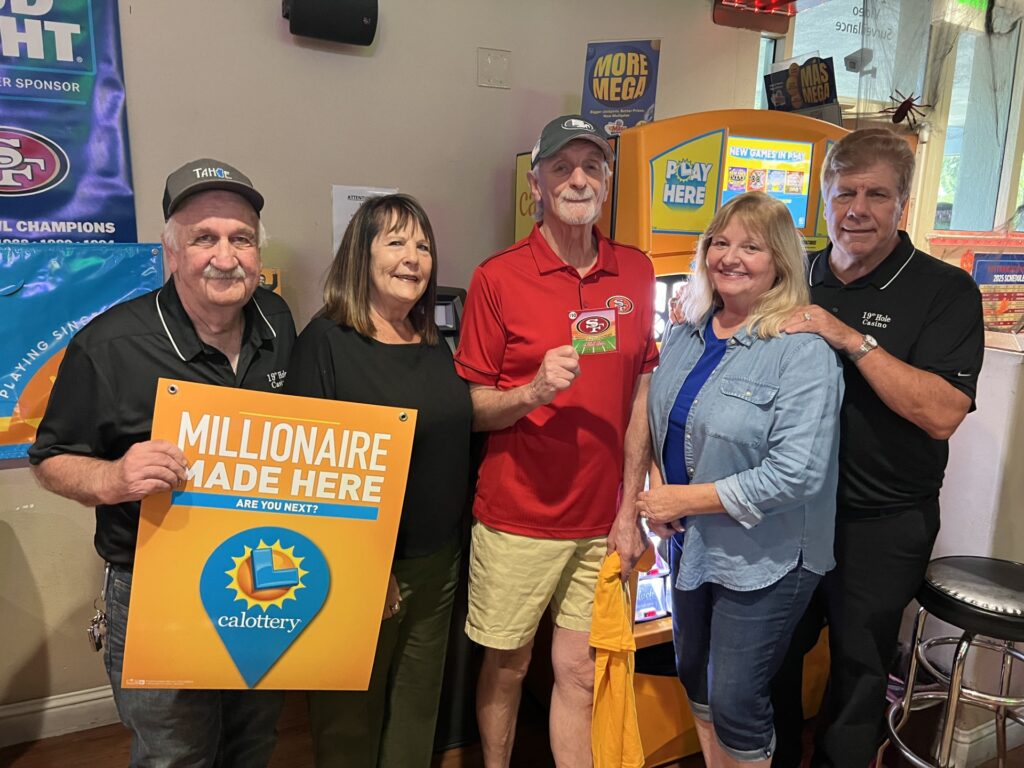
Lotto winner Bruce Hilliard celebrates on Friday, Sept. 26, 2025, with The 19th Hole co-owner Steve and is wife Marlene Scudero, Dorothy and co-owner Eddie Beaudin next to the machine that issued the winning ticket. Photos by Allen D. Payton
Purchased at The 19th Hole; one of 16 NFL $1M Scratchers available statewide; 2nd million-dollar winner in Antioch in 3 years
Will give some to family, pursue “bucket list”, continue to work at Lowe’s
By Allen D. Payton
According to Eddie Beaudin, co-owner of The 19th Hole, Antioch’s only cardroom, one of their patrons, long-time Antioch resident Bruce Hilliard, bought a winning $1 million Lotto Scratcher last Saturday, Sept. 20, 2025, out of the machine at the business.
“It was a $10, 49er-themed NFL Scratcher ticket that won,” Beaudin shared. “It’s pretty exciting.”
Beaudin’s partner, Steve Scudero, their wives, other patrons and friends of Hilliard, as well as Mayor Ron Bernal, gathered at The 19th Hole Friday, September 26, to celebrate his winnings.
Erin, one of the bartenders, who is Irish, said, “I was here when he won. I was his lucky charm!”
Asked what he planned to do with the funds, Hilliard said, “I’m setting up my great grandsons for college and will help out a couple family members, set some aside and enjoy life a little bit.”
About his granddaughter he said, “She said, ‘No’. They’re doing real well. One way or another they’re going to get a chunk of it.”
Hilliard also said he will continue working at Lowe’s on Auto Center Drive.
“It keeps me on an even keel,” he stated.
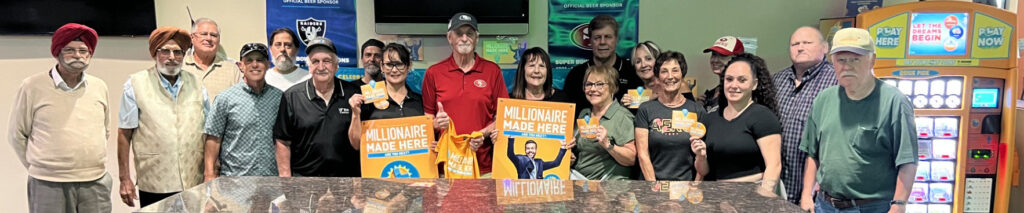
Lotto winner Bruce Hilliard (center) celebrates at The 19th Hole with the owners and those of the liquor store that had the last million-dollar winner in Antioch, Mayor Ron Bernal, employees and friends on Friday, Sept. 26, 2025.
Asked how much he’d spent on the Lotto over the years Hilliard said he’s “been playing the Lotto forever. A lot of years.”
But it was his first $20 that day. He spent $10 on another Lotto ticket and $10 on the winner. He had to go the state Lottery’s district office in Richmond to cash it in. They said he’ll be receiving a check within four to six weeks.
“The federal government will take out $250,000,” he said. “That’s what they told me.”
Asked what else he’s going to spend the money on, a new car or a trip, Hilliard said, “I’m just taking it day by day. My truck is running good. I’m remodeling my house myself.”
“I’ll start doing some of my bucket list. Maybe take a cruise. Play Pebble Beach,” the avid golfer added. “It’s something The 19th Hole has never experienced,” Beaudin stated. “Steve and myself have known Bruce for about 50 years, since the 1970’s. He always comes back and says ‘Hi’ to me and Steve. Bruce gives back to the community.”
He volunteered for the Stand Down on the Delta, earlier this month as an example.
“What a thing,” Beaudin continued. “I’m just glad it’s somebody here.”
“I just wish it was my wife,” he added with a laugh.
“I had to verify this with the state police. An officer came to visit me on Monday morning,” Beaudin explained. “He wanted to see footage of Bruce buying the ticket. We have 17 cameras in the place.”
Describing what he saw on the videos, the co-owner said, “Bruce had to validate it. He walks three steps. There’s no look on his face. Let’s go to another camera. He took three more steps and goes, ‘Yeah. Yeah!’” as Beaudine raised his hands.
“The biggest winners, here, before were $10,000, twice,” Beaudin shared. “We’ve been here 40 years in May as long as the Lottery,” which is celebrating it’s 40th anniversary this year.”
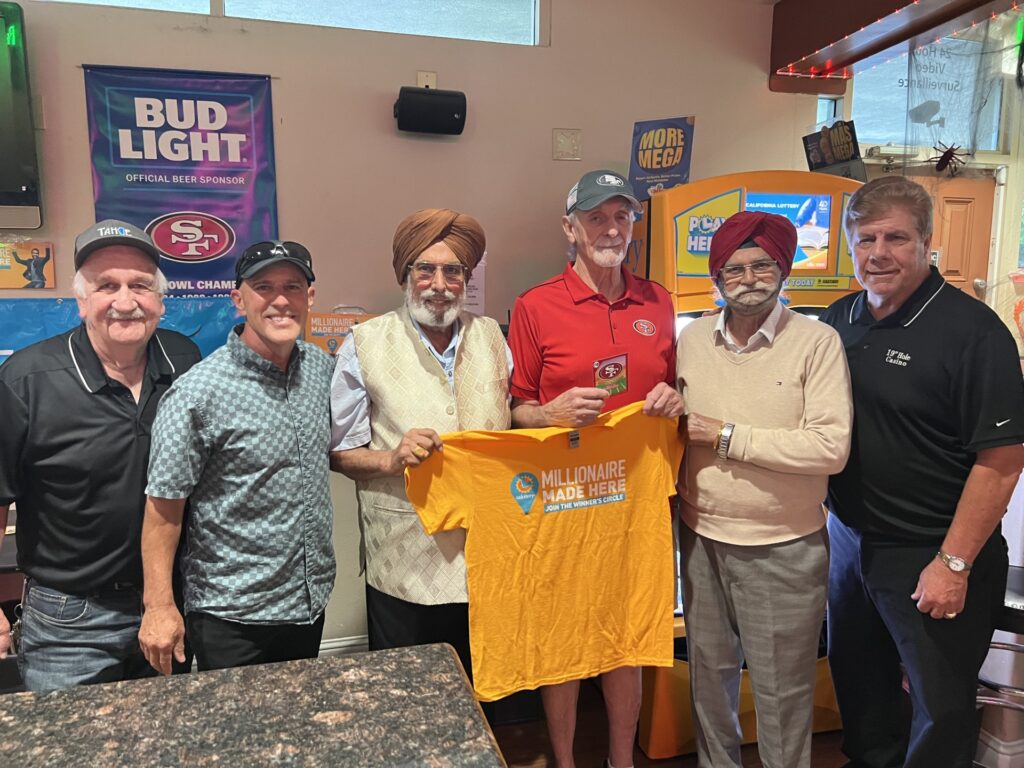
Lotto winner Bruce Hilliard (49er shirt) is joined by (L-R) Steve Scalise, Mayor Bernal, Ajit Singh Sooch and Jagjit Singh Chawla owners of the liquor store where the other million-dollar winner in Antioch bought the ticket three years ago, and Eddie Beaudin.
Second Million Dollar Winner in Antioch in 3 Years
“Three years ago the owner of the liquor store next door had a million dollar winner,” Beaudin stated. “
Owners Ajit Singh Sooch and Jagjit Singh Chawla of the liquor store next to The 19th Hole and the one in the 7-11 shopping center at Hillcrest Avenue and E. 18th Street, which had the other $1 million Lotto winner, attended Friday’s celebration.
“There are 16 million NFL team ticket winners statewide. We’re the first ones,” Beaudin exclaimed. Scudero said in amazement, “He put just $10 in there. That’s a first. He plays more scratchers than anyone else. I just want to say congratulations, Bruce. It couldn’t happen to a better guy. I’m just happy it was a regular.” Hilliard shared a few words to those in attendance saying, “I just want to say thank you all, especially to The 19th Hole and to the Lottery for loading the ticket.”
Representatives of the state Lottery, who were on hand said, “We didn’t load the machine. They did,” pointing to Beaudin and Scudero.
“And you’re a true Niner fan!” Eddie said.
“Congratulations Bruce. I’m just glad it wasn’t more money,” Bernal said with a laugh. “That ruins people. It was just the right amount of money.”
He will receive a check for $750,000 in about four to six weeks, Hilliard reiterated. The state doesn’t receive any of his winnings. The business that sold the ticket receives one-half percent of the winnings or $5,000, Sooch shared.
My family moved here in 1964. Except for 16 years in Oakley, he’s been here ever since.
“Bruce was a 1973 Antioch High grad and played wide receiver on the 1972 league championship Turkey Bowl team,” Beaudin shared about the winner.
“The game was played on Thanksgiving against Miramonte at DVC,” Scudero added.
Then all who wanted took photos with Hilliard next to the Lotto banner and machine which issued the winning ticket. The 19th Hole is located at 2746 W. Tregallas Road behind the Main Post Office.
As previously reported, on Thursday, September 18, 2025, at approximately 10:21 p.m., the Antioch Police Department dispatch center received multiple calls reporting shots fired in the area of D and W. 19th Streets. When officers arrived on scene, they located four victims suffering from gunshot wounds. All were men. Antioch police officers provided aid to the victims at the scene. Two victims died at the scene.
On Friday, September 26, 2025, Jimmy Lee, Director of Public Affairs for the Contra Costa County Sheriff-Coroner’s Office, identified the two deceased men as Julio Castaneda, age 33, out of Oakley and Thomas Vega Espinoza, age 42, whose city of residence is unknown
They were initially reported as ages 23 and 37 years old.
Lt. Bill Whitaker confirmed the ages provided by Lee saying, “Those ages are correct. We didn’t have them 100 percent identified, initially. We got a bad name from a family member, and it wasn’t actually the right person.”
“Both were innocent victims and not even the intended targets,” he added.
The Antioch Police Department’s Investigations Bureau, consisting of Crime Scene Investigators and detectives with the Violent Crimes Unit, responded to take over the investigation. This is an active investigation, and no further information will be released at this time.
Additional inquiries, tips, or information can be directed to Antioch Police Detective John Cox at (925) 481-8147 or by email at jcox@antiochca.gov.
Existing transportation funding strained by rising construction costs, population growth, potential decrease in state gas tax revenue
“115 of 1,374 bridges are rated poor/structurally deficient, with significant deterioration” – TRIP Report
By Carolyn Bonifas Kelly, Director of Communication & Research, TRIP
San Francisco, CA – While additional state and federal transportation funding is allowing California to repair and improve roads and bridges, a new report documents looming challenges including population growth, rising congestion, construction cost inflation and declining fuel-tax revenue. The report by The Road Information Program, TRIP, a national transportation research nonprofit based in Washington, DC, examines California’s road and bridge conditions, congestion and reliability, highway safety, economic development, vehicle travel trends, and the impact of recent state and federal transportation funding increases.
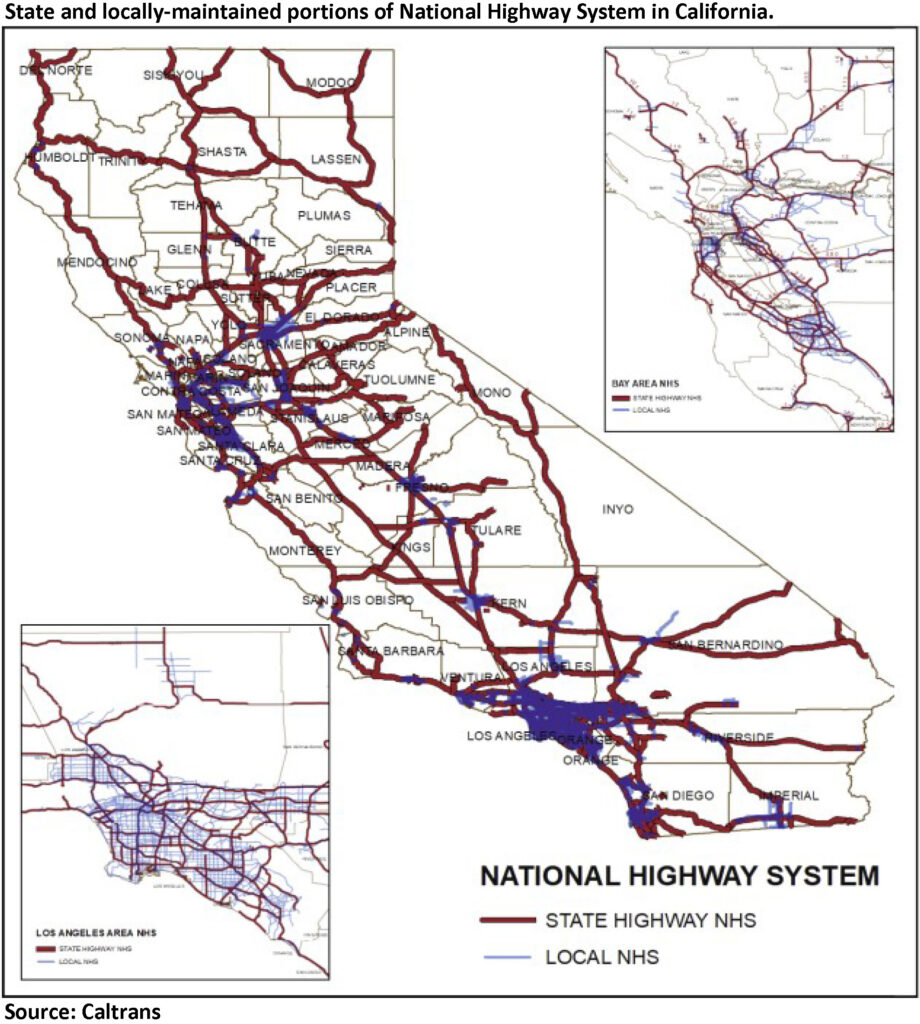
The TRIP report, “Keeping California Mobile: Providing a Modern, Sustainable Transportation System in the Golden State,” finds that throughout the state, traffic fatalities have increased significantly in the last decade despite recent downward trends, 50 percent of major roads are in poor or mediocre condition, five percent of locally and state-maintained bridges (20 feet or more in length) are rated poor/structurally deficient, and traffic congestion costs the state’s drivers $55 billion annually in lost time and wasted fuel. In addition to statewide data, the TRIP report includes regional pavement and bridge conditions, congestion data, highway safety data, and cost breakdowns for the Los Angeles, Riverside-San Bernardino, Sacramento, San Diego, San Francisco-Oakland and San Jose urban areas.
The TRIP report finds that 73 percent of major locally and state-maintained roads in the San Francisco-Oakland urban area are in poor or mediocre condition, costing the average motorist an additional $1,106 each year in extra vehicle operating costs, including accelerated vehicle depreciation, additional repair costs, and increased fuel consumption and tire wear. Statewide, 28 percent of California’s major roads are in poor condition and 22 percent are in mediocre condition. TRIP estimates that the state’s drivers lose $24.2 billion annually in extra vehicle operating costs as a result of driving on deteriorated roads.
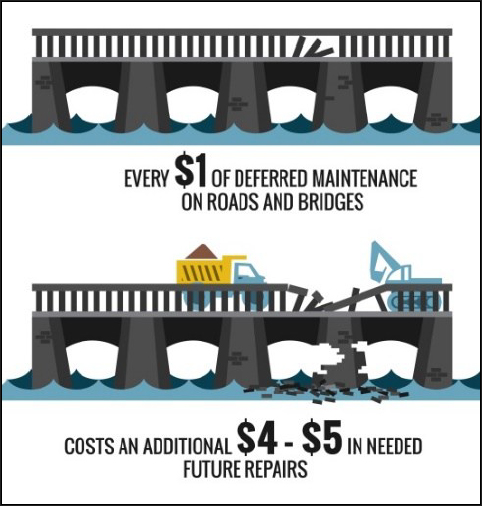
In the San Francisco-Oakland area, eight percent of bridges (115 of 1,374 bridges) are rated poor/structurally deficient, with significant deterioration to the bridge deck, supports or other major components. This includes locally and state-maintained bridges that are 20 feet or longer. Statewide, five percent of California’s bridges are rated poor/structurally deficient. Most bridges are designed to last 50 years before major overhaul or replacement. In California, 54 percent of the state’s bridges were built in 1969 or earlier.
According to the TRIP report, traffic congestion in the San Francisco-Oakland area causes 111 annual hours of delay for the average motorist and costs the average driver $3,406 annually in lost time and wasted fuel. On average, San Francisco-Oakland drivers waste 38 gallons of fuel annually due to congestion. Statewide, drivers lose $55 billion annually because of lost time and wasted fuel due to traffic congestion. Due to the Covid-19 pandemic, vehicle travel in California dropped by as much as 41 percent in April 2020 (as compared to vehicle travel during the same month the previous year).By 2025, vehicle miles of travel in California had rebounded to five percent below 2019’s pre-pandemic levels. Congestion reduces job accessibility significantly. In California’s six largest metros, the number of jobs accessible within a 40-minute drive during peak hours were reduced by 44 percent in 2023 as a result of traffic congestion.
Source: TRIP
Traffic crashes in California claimed the lives of 24,508 people from 2019 to 2024. The state’s 2024 traffic fatality rate of 1.19 fatalities for every 100 million miles traveled was slightly lower than the national average of 1.2. The number of traffic fatalities and the fatality rate per 100 million vehicle miles of travel in California spiked dramatically in 2020 and 2021 before falling each year from 2022 to 2024. But, despite recent progress, from 2014 to 2024 the number of traffic fatalities in California increased 24 percent and the state’s traffic fatality rate increased 29 percent. From 2019 to 2023, 30 percent of those killed in California crashes involving motorized vehicles were pedestrians or bicyclists. In the San Francisco-Oakland area, 36 percent of traffic fatalities between 2019 and 2023 (306 of 934) were pedestrians or bicyclists.
“California’s future depends on transportation infrastructure that can withstand the challenges of a changing climate and a growing population,” said Senator Dave Cortese, chair of the California Senate Transportation Committee. “These investments don’t just move people and goods—they cut emissions, strengthen communities, create jobs, and spur economic growth. The TRIP report makes clear that smart infrastructure investments are among the most powerful tools we have to support California’s workforce and drive long-term economic prosperity.”
Improvements to California’s roads, highways and bridges are funded by local, state and federal governments. In April 2017, the California legislature enacted SB 1 — the Road Repair and Accountability Act. SB 1 increased state revenues for transportation by increasing the state’s gasoline and diesel taxes, implementing a transportation investment fee on vehicles and initiating an annual fee on zero emission vehicles. SB 1 is estimated to increase state revenues for California’s transportation system by an average of $5.2 billion annually through to 2027. In addition to state transportation funding, the Infrastructure Investment and Jobs Act (IIJA), signed into law on November 2021, provides $25.3 billion in federal funds to the state for highway and bridge investments in California over five years, representing a 29 percent increase in annual federal funding for roads and bridges in the state over the previous federal surface transportation program. The IIJA is set to expire on September 30, 2026.
“California’s transportation system is the backbone of our daily lives, connecting millions of people to work, school, and opportunity,” said Assemblymember Lori Wilson, chair of the California State Assembly Transportation Committee. “The TRIP report provides the proof points behind what we already know: our infrastructure needs are urgent and growing. As we transition to cleaner vehicles and more sustainable mobility, we must secure fair and reliable funding solutions to ensure tomorrow’s infrastructure serves Californians better than today’s.”
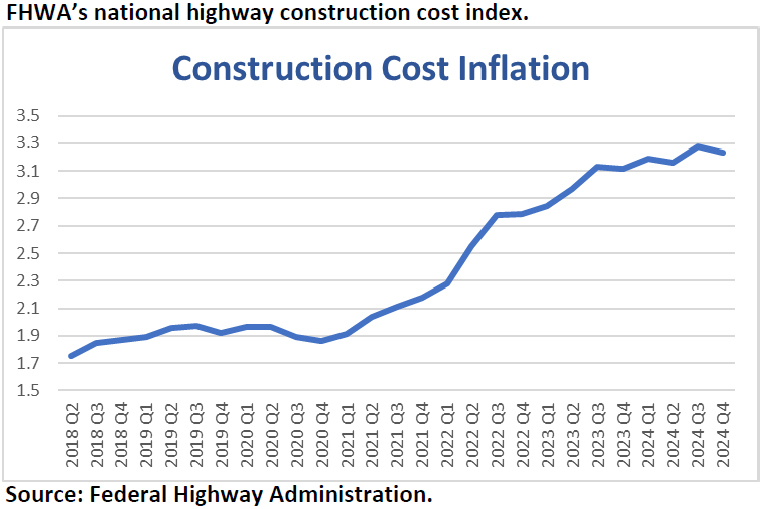
The ability of revenue from California’s motor fuel tax – a critical source of state transportation funds – to keep pace with the state’s future transportation needs is likely to erode as a result of increasing vehicle fuel efficiency, the increasing use of electric vehicles and inflation in highway construction costs. The Federal Highway Administration’s national highway construction cost index, which measures labor and materials cost, increased by 48 percent from the beginning of 2022 through the fourth quarter of 2024.
The California Legislative Analyst’s Office (LAO) found that steps taken by California to reduce greenhouse gas emissions, including programs and policies that are targeted at increasing the adoption of zero-emission vehicles (ZEVs), increasing the use of lower-carbon fuels, and reducing the number of vehicle miles traveled will reduce state transportation revenues by $4.4 billion over the next decade. This reduction in state transportation spending which is projected to result in poorer road conditions. However, the recent federal rollbacks to California strict emissions requirements will impact these programs and policies.
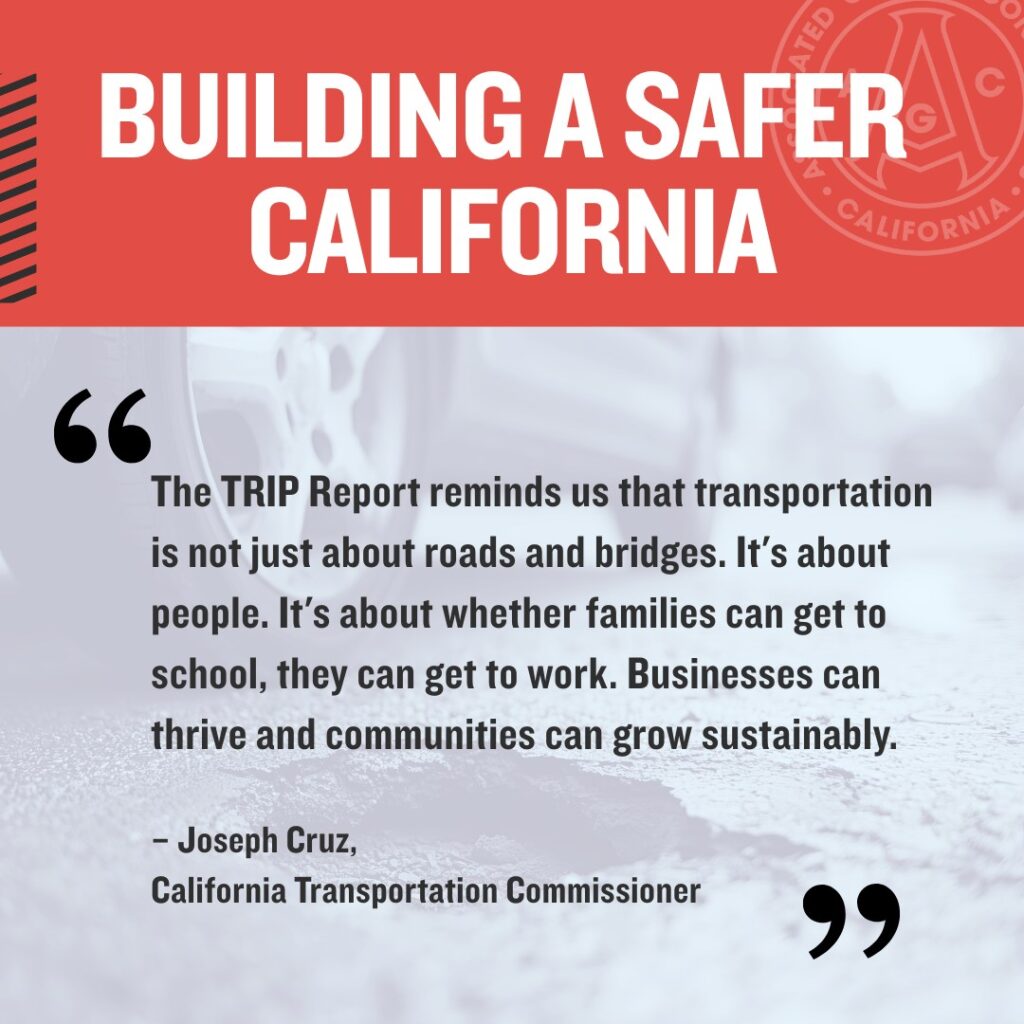
“Our deteriorating transportation system costs Californians lives, time, and money,” said California Transportation Commissioner Joseph Cruz. “Every investment in improving and maintaining our roads, bridges, and transit networks is an investment in people. These projects don’t just build infrastructure – they create good jobs, support local economies, and ensure California’s workforce is at the center of the solution.”
Source: TRIP
The efficiency and condition of California’s transportation system, particularly its highways, is critical to the health of the state’s economy. In 2023 California’s freight system moved 1.4 billion tons of freight, valued at $2.8 trillion. From 2022 to 2050, freight moved annually in California by trucks is expected to increase 65 percent by weight and 100 percent by value (inflation-adjusted dollars). The design, construction and maintenance of transportation infrastructure in California supports approximately 420,000 full-time jobs across all sectors of the state economy. Approximately 7.1 million full-time jobs in California in key industries like tourism, retail sales, agriculture and manufacturing are dependent on the quality, safety and reliability of the state’s transportation infrastructure network.
“California’s transportation dollars are already being stretched thin by increased inflation in construction costs and declining fuel tax revenue,” said Dave Kearby, TRIP’s executive director. “Without additional transportation investment, needed projects that would make the state’s roads safer, smoother and more efficient will not move forward.”