Archive for the ‘News’ Category

Contra Costa Event Park in Antioch to be converted into potential care site for COVID-19 patients

Friday, April 10th, 2020

By Kim McCarl, Assistant to the Director, Communications, Contra Costa Health Services

Contra Costa County is preparing to use the Contra Costa Event Park in Antioch as a site to care for COVID-19 patients, should the need arise.

As part of local emergency preparations, the county has been exploring and preparing “alternate care sites” in preparation for the likely surge of patients in local hospitals who test positive for Coronavirus (COVID-19). The building, which is normally used as an exhibit hall during the annual county fair, is located in the Contra Costa Event Park at 1201 W. 10th Street and has capacity for 43 people who test positive for COVID-19 and need medical care, but do not need to be hospitalized.

“The fairgrounds alternate care site is a great example of state, county, city and non-profit agencies coming together to create increased capacity to care for patients needing fewer resources, which frees up critical hospital beds in our healthcare system to fight COVID-19,” said Federal Glover, District V Supervisor.

Contra Costa and other Bay Area counties recently extended a regional stay-at-home order through May 3 hoping that continued physical-distancing measures will reduce the impact of COVID-19 on area hospitals.

“The Contra Costa Event Center, City of Antioch and the Red Cross really stepped up to help make this site happen,” said Diane Burgis, District III Supervisor. “This site would not be possible without their assistance.”

The Red Cross has shared expertise in standing up critical care sites for individuals displaced by emergency situations with County officials working on the Fairgrounds site.

“The Red Cross is proud to be working closely with our government and public health officials to support their efforts to keep our community safe with the planning and opening of the alternate care site in Antioch,” said Briana Taylor, Regional Disaster Chair for the American Red Cross Northern California Coastal Region. “It is impressive to see the whole community work together during this stressful time.”

The Craneway Pavilion in Richmond is equipped with 250 beds for COVID-positive patients who do not require hospitalization. Should a surge require the facility to open, COVID-positive patients are likely to be housed at the Craneway Pavilion first. (See related article) The Concord Shelter and Philip Doran Respite Center will house individuals who may not need hospitalization but require closer observation than provided at Craneway Pavilion. The county anticipates that Contra Costa Event Center will be the last facility to open.

“Although the City of Antioch did not request for the county to select a site within our city, we understand the gravity of the moment,” said Antioch Mayor Sean Wright. “In the fight to save lives, the world has been asked to step up and do more, Antioch is no exception to this reality. By working together, we will hopefully be able to minimize the number of lives lost to this horrible pandemic.”

The 23rd District Agricultural Association is home to the Contra Costa County Fair that has hosted hundreds of thousands of guests for over seventy-five years. The Event Park celebrates all that is best in Contra Costa County while preserving the agricultural heritage of the community.

“The Contra Costa Event Park is here to help the community during this time of need, and happy to work with the County of Contra Costa as we all work together to end this pandemic,” said Joe Brengle, chief executive officer of the Contra Costa Event Park.

“The county has been working in two of our buildings to prepare them should the need arise,” he told the Herald on Wednesday.

This year’s county fair was cancelled by the Fair Board on March 18. (See related article)

Contra Costa County and the Board of Supervisors continue to work in real time to respond to community needs while preparing to meet the challenges ahead.

Allen Payton contributed to this report.

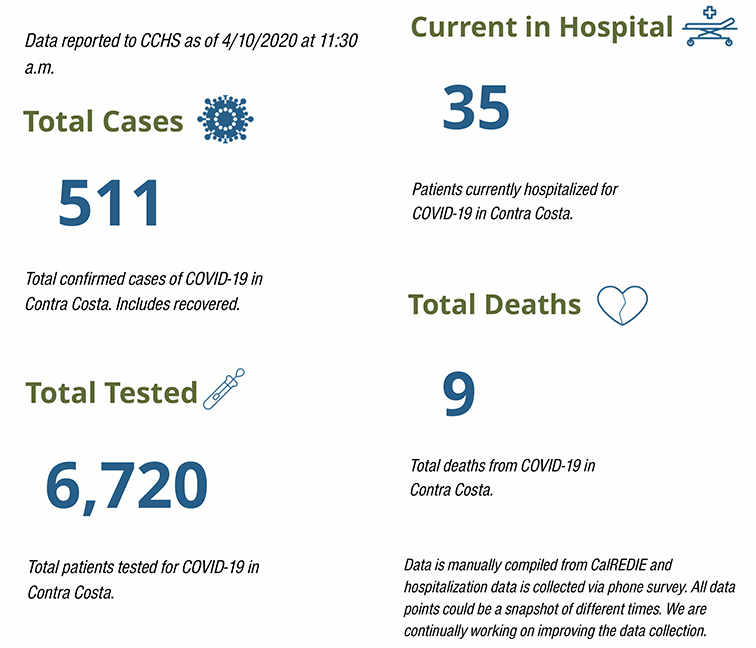
Contra Costa Health Services reminds residents to observe religious practices at home this weekend – 9 deaths now reported in county

Friday, April 10th, 2020

Friday, April 10, 2020

Contra Costa Health Services (CCHS) reminds the public that county residents should observe their faiths at home while the health officer’s stay-at-home order remains in place, though this month is a time of significant religious activity for many people.

The health officer order, a measure to protect our community from the spread of COVID-19, requires Contra Costa residents to stay home except for essential trips, such as to find food, healthcare or to provide care for someone who cannot leave their home, or to go to and from an essential job.

The order lasts through May 3, a period that may affect important observances for many faiths, such as Good Friday, Holy Week, Orthodox Easter, Passover, Ramadan, and others.

“The COVID-19 pandemic has disrupted our lives, and we empathize with anyone who is unable to practice their religious traditions and celebrations as usual during this challenging time,” said Dr. Chris Farnitano, Contra Costa County Health Officer. “However, to protect everyone in the community, we must avoid gatherings outside of one’s immediate household to reduce the spread of the virus.”

CCHS thanks the county’s faith community for helping to keep their members safe from COVID-19 and urges faith leaders to continue to suspend in-person gatherings and not bring large groups of people together while the health order remains in place.

Suspending in-person gatherings does not mean suspending worship. Many organizations continue to observe together, through livestreaming or by watching recorded services online.

Learn more about COVID-19 in Contra Costa County, including how to protect yourself, at cchealth.org/coronavirus, or call the Contra Costa Coronavirus Call Center with questions at 1-844-729-8410. The call center is open daily from 8 a.m. to 5 p.m.

Save Mt. Diablo expands efforts to protect the 150-mile long Diablo Range

Thursday, April 9th, 2020

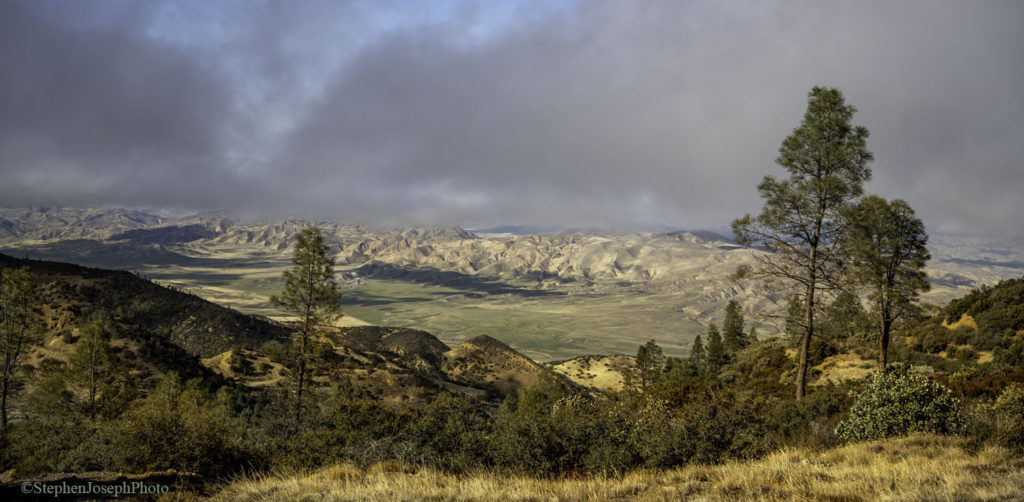
View of the Diablo Range from the top of San Benito Mountain, at 5,241 feet the Diablo Range’s highest peak. The Diablo Range covers 12 counties and 5,400 square miles, but most people have never heard of it. Copyright Stephen Joseph; used with permission.

California’s next big conservation story, right in our backyards

Cover of the Spring 2020 issue of Bay Nature magazine. Credit Bay Nature.

By Laura Kindsvater, Communications Intern, Save Mount Diablo

Save Mount Diablo has launched a campaign to connect Mount Diablo to the whole of the Diablo Range, a 150-mile long mountain range and biodiversity refuge that’s next door to millions of people, but that most people know nothing about.

“The Diablo Range is the missing piece of the California conservation map,” says Save Mount Diablo Land Conservation Director Seth Adams. “It’s California’s next great conservation story.”

“Seventy-five percent of the ecologically important area around Mount Diablo has been preserved,” explains Edward “Ted” Sortwell Clement, Jr., Save Mount Diablo’s Executive Director, “while in the full 150-mile range, only 24 percent of the landscape has any protection. We’re going to change that. Save Mount Diablo’s first step is defining the range as a whole for the conservation community and the public and educating them about its importance.”

Save Mount Diablo’s public educational efforts will include the full 150-mile Diablo Range. As part of this campaign, Save Mount Diablo helped to sponsor a newly published cover story and supplement about the Diablo Range in Bay Nature magazine, with the Santa Clara Valley Open Space Authority. “The Spine of California,” by Bay Nature Digital Editor Eric Simons, explores the most rugged, plant-rich stretch of California you’ve never heard of.

The cover story is the first article ever published specifically about the Diablo Range, and it includes the first ever published map of the public and protected lands of the Diablo Range. “Our first effort is to put this place on the map,” notes Adams.

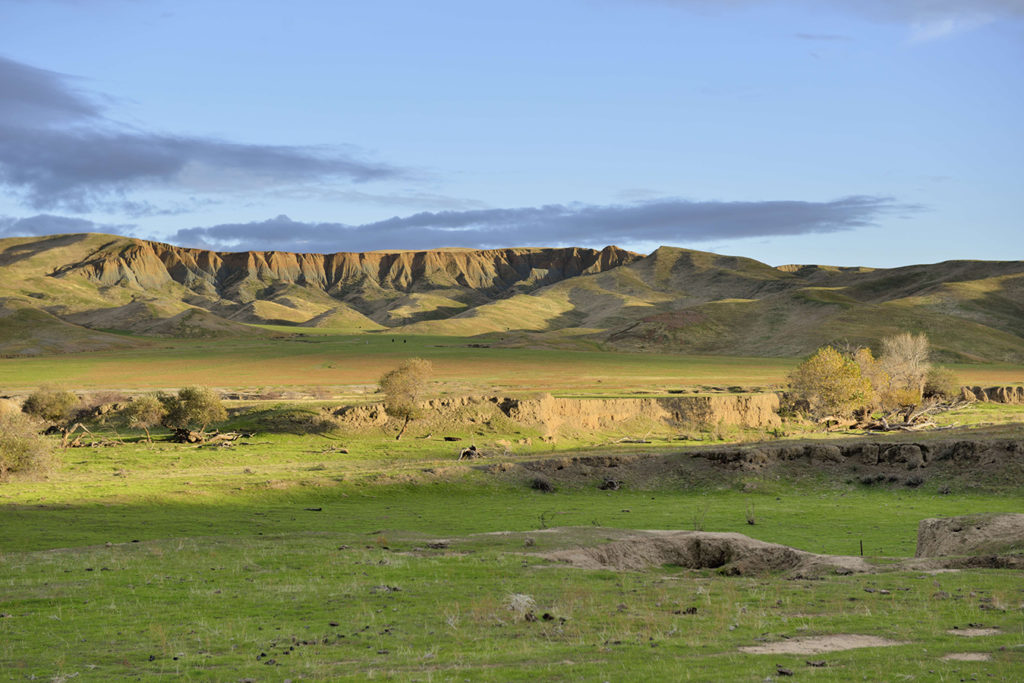
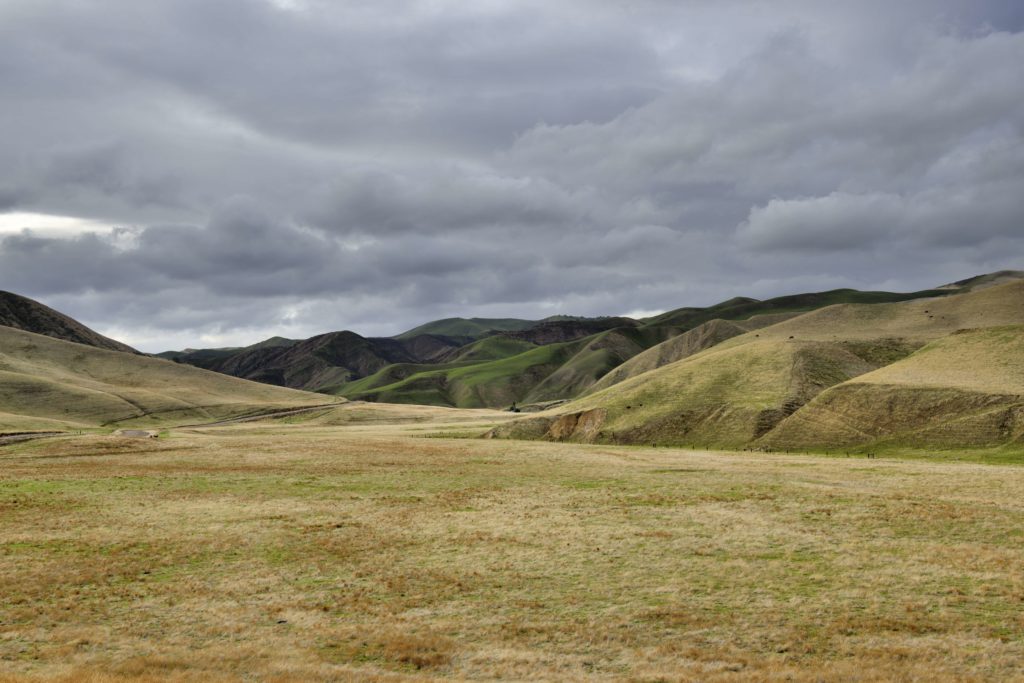
Panoche Valley and the Panoche Hills, part of the Diablo Range. The Diablo Range is threatened by both alternative and fossil-fuel based energy development, and in the Panoche Valley, large solar farms are beginning to pop up. Credit Al Johnson.

Also, as part of the campaign, Save Mount Diablo recently expanded the geographic area in which it now does its land use advocacy; it now includes the three northern counties of 12 crossed by the Diablo Range. The organization’s primary acquisition focus remains north of Highway 580 and around the main peaks of Mount Diablo. The organization recently announced two acquisition projects on the main peaks, the 154-acre Trail Ride Association conservation easement on North Peak for which it needs to raise a little over $1,040,000 and the $650,000 Smith Canyon project adjacent to Curry Canyon.

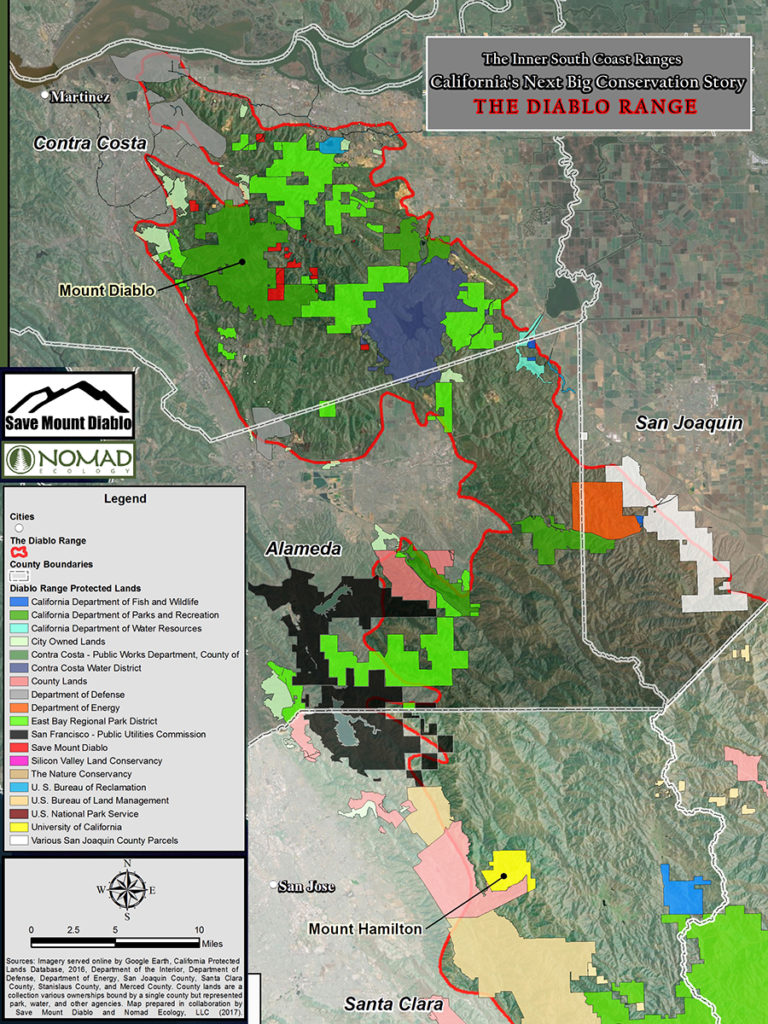
Map showing the northern Diablo Range. Save Mount Diablo recently expanded the area in which it works down to the Santa Clara County line. In addition to Contra Costa County between Highway 680 and the Byron Highway, Save Mount Diablo’s area of interest now encompasses portions of southeastern Alameda County and southwestern San Joaquin County, including a critical wildlife corridor linking Mount Diablo to the rest of the Diablo Range and a vulnerable region of spectacular biodiversity (Cedar Mountain, Corral Hollow, and the greater Mines Road area). Map prepared in collaboration by Save Mount Diablo and Nomad Ecology, LLC.

In addition to working in Contra Costa County between Highway 680 and the Byron Highway, Save Mount Diablo now also works in southeastern Alameda and southwestern San Joaquin Counties.

This area includes an essential, 10-mile-wide wildlife corridor (Altamont Pass is part of it) that connects Mount Diablo to the rest of the Diablo Range. It also includes one of the most important and vulnerable biodiversity hotspots in California.

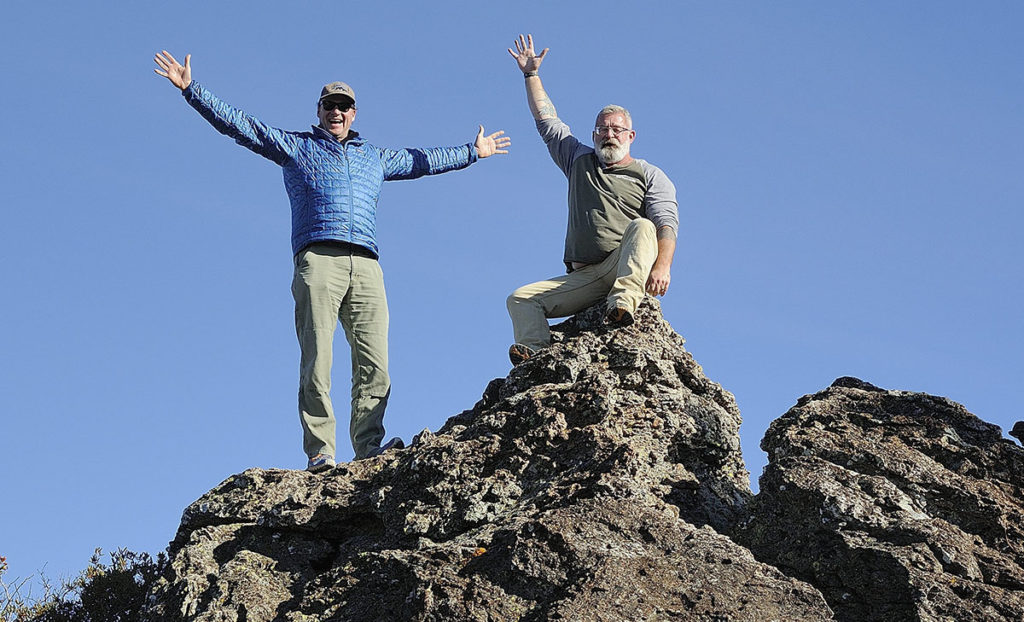
Save Mount Diablo Executive Director Ted Clement and Land Conservation Director Seth Adams waving from on top of San Benito Mountain, at 5,241 feet the highest point in the Diablo Range. Credit Al Johnson.

According to Simons, “The 150-mile range of mountains from the Carquinez Strait to the oil fields of the southern San Joaquin Valley holds some of the largest remaining wild places in California. It is a rugged, remote, difficult realm, a biodiversity ark incised by the San Andreas Fault. It is a historic mixing place, where Central Valley Yokuts and coastal Ohlones traded and danced, where California’s ever-more-diverse future residents will seek escape and recreation. And it is nearly unparalleled in ecological significance.”

The Diablo Range stretches from the Carquinez Strait all the way to the Antelope Valley in Kern County and contains some of the largest remaining unprotected wild places in California. The mountain range is huge, rugged, and remote. Bounded by Highway 101 to the west and Interstate 5 to the east, the 150-mile long, 40- to 50-mile wide area is a blank spot on the map for the public focused on its outer grassland foothills. “Five miles in and 500 feet up,” Adams says, “oaks and chaparral appear, and it’s Mount Diablo multiplied.”

In the southern Diablo Range is a huge area of serpentine geology and associated soils. These soils are toxic to most plants, but home to many rare plant species that have evolved to handle the toxicity. Some of these plants are “serpentine endemics”—they can live nowhere else. Pictured here: the serpentine barrens at San Benito Mountain. Copyright Stephen Joseph; used with permission.

The Diablo Range covers 5,400 square miles and has many peaks, some of which are taller than Mount Diablo. The tallest one is San Benito Mountain at 5,241 feet. Mount Diablo measures at 3,849 feet.

The range is extremely important for wildlife, crossed only by two major highways at Altamont and Pacheco Passes. It serves as a reservoir of biodiversity, a core habitat for wildlife in California.

Although golden eagle populations are declining in western North America, they’re stable in California because of the Diablo Range.

Serpentine ecosystems at San Benito Mountain. Copyright Stephen Joseph; used with permission.

The northern Diablo Range supports the highest density of golden eagles on the planet. The Diablo Range could also be the source for replenishing the genetic diversity of mountain lion populations in the Santa Cruz Mountains.

Tule elk, nearly hunted to extinction in the 1970s, have recovered quickly in the Diablo Range. Bay checkerspot butterflies have their last stronghold along Coyote Ridge just above San Jose. And the Diablo Range offers great habitat for California condors to expand into as they recover from the brink of extinction.

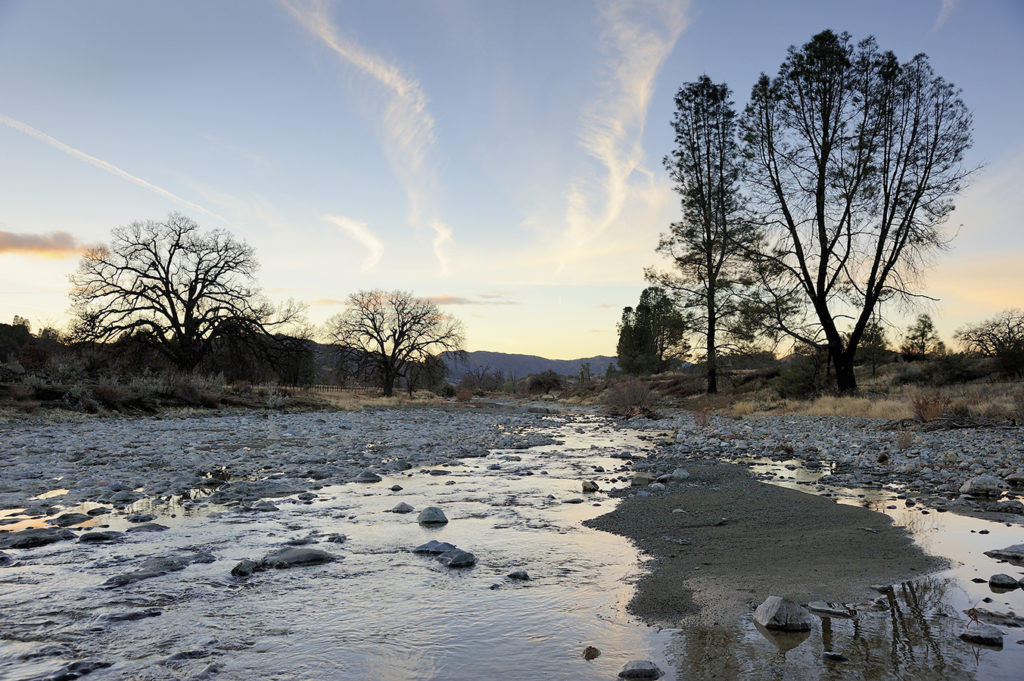
Headwaters of the San Benito River. Credit Al Johnson.

The Diablo Range is threatened by energy development (both alternative and fossil fuel-based energy), suburban sprawl, and proposed dams and reservoirs. Wind turbines endanger golden eagles and other birds. And the Panoche Valley, part of the Diablo Range, now has a 4,800-acre solar farm.

This mountain range harbors incredible biodiversity that supports many rare, endemic (plants or animals found nowhere else), or disjunct species (plants that are cut off from other populations and not expected to be there). It contains large swaths of land with serpentine soils, on which rare plant species that live nowhere else grow. And some of the soils are “vertic clays,” which also support rare and endemic plant species.

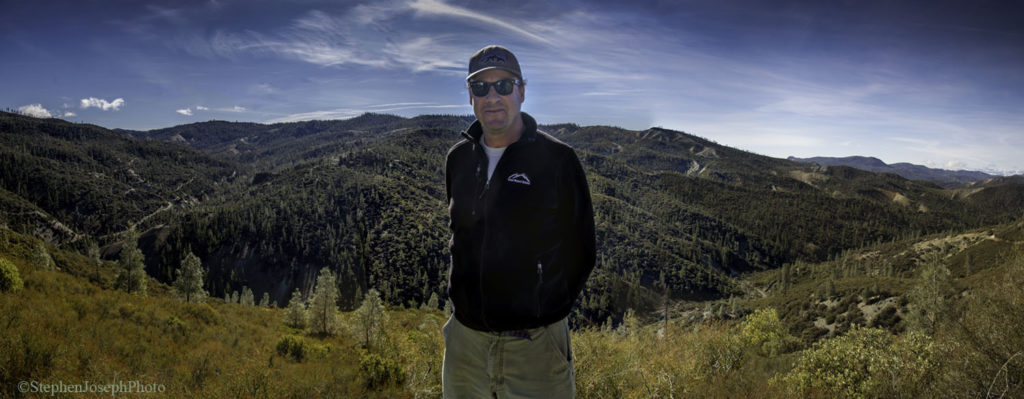
Save Mount Diablo Executive Director Ted Clement and the Diablo Range. Copyright Stephen Joseph; used with permission

Although the Diablo Range is right next to some large cities, large areas of it have limited to no cell phone coverage, light pollution, or major roads, an indication of its habitat connectivity.

Read more about the Diablo Range and Save Mount Diablo’s work to protect it in the Bay Nature cover story.

The Panoche Hills, part of the Diablo Range. Credit Al Johnson.

About Save Mount Diablo

Save Mount Diablo is a nationally accredited, nonprofit land trust founded in 1971 with a mission to preserve Mount Diablo’s peaks, surrounding foothills, and watersheds through land acquisition and preservation strategies designed to protect the mountain’s natural beauty, biological diversity, and historic and agricultural heritage; enhance our area’s quality of life; and provide recreational opportunities consistent with the protection of natural resources. Learn more at www.savemountdiablo.org.

Disaster response jobs for U.S. Small Business Administration’s relief efforts

Thursday, April 9th, 2020

The SBA is hiring temporary employees to assist with disaster relief efforts. Bilingual language skills a plus. Must be a U.S. citizen.

Join our team! The SBA is hiring additional employees to assist with disaster relief efforts. Bilingual language skills are a plus. Remote jobs are available nationwide.

In response to the Coronavirus (COVID-19) pandemic, SBA is hiring for a number of positions.

Call Center Customer Service Representative (CSR)

Customer Service Representatives are needed with backgrounds in finance, credit, banking, accounting, and mortgage lending.  Students of business/finance may also apply. Strong computer skills are a must.  Texas notaries with experience closing loans, legal documents, etc. are also desired. Spanish speaking is a plus.

Disaster Recovery Specialist (Supersedes previous announcement, EXC-20-054-CSC-10752837, to amend duty location)
GS-0301-07/09; Full time (Temp)
Office of Disaster Assistance (ODA); Customer Service Center; Duty Station Negotiable.
Open to United States Citizens

Document Preparation/Legal Review/ Loan Closings

Attorneys/Paralegals are needed to review and close SBA Disaster Loans. Real Estate experience is a plus. Individuals waiting on bar results may apply. Attorneys must present a current bar card, but may be licensed in any state.

Paralegal Specialist
GS-0950-09/11; Full time (Temp)
Office of Disaster Assistance (ODA); Processing Disbursement Center (PDC); Fort Worth, TX;
Open to United States Citizens

Attorney Advisor (Gen)
(Supersedes previous announcement, EXC-20-057-PDC-10755112, to amend duty location)
GS-0301-09/11; Full time (Temp)
Office of Disaster Assistance (ODA); Processing and Disbursement Center (PDC); Duty Station Negotiable.
Open to United States Citizens

Legal Assistant
GS-0986-06/07; Full time (Temp)
Office of Disaster Assistance (ODA); Processing Disbursement Center (PDC); Fort Worth, TX;
Open to United States Citizens

Loan Processing/Credit Analysis/Mortgage Underwriting

Credit Analysts, Loan Officers, and Mortgage Underwriters are needed with experience evaluating financial information; determining creditworthiness and repayment ability; and making loan decisions (or recommendations) based on overall financial condition.

Loan Specialist (Commercial) – Virtual
GS-1165-12; Full time (Temp)
Office of Capital Access (OCA); Virtual.
Open to United States Citizens

Loan Specialist (Commercial) – Virtual
GS-1165-12; Full time (Temp)
Office of Capital Access (OCA); Virtual.
Open to United States Citizens

Loan Specialist (Commercial)
GS-1165-09; Full time (Temp)
Office of Capital Access (OCA); Various Duty Stations.
Open to United States Citizens

Loan Specialist (Commercial)
GS-1165-09; Full time (Temp)
Office of Capital Access (OCA); Various Duty Stations.
Open to United States Citizens

Loan Processing Assistant
GS-1101-07; Full time (Temp)
Office of Capital Access (OCA); Various Duty Stations.
Open to United States Citizens

Loan Servicing Assistant
GS-1101-07; Full time (Temp)
Office of Capital Access (OCA); Various Duty Stations.
Open to United States Citizens

Supervisory Loan Specialist (Commerical)
GS-1165-13; Full time (Temp)
Office of Capital Access (OCA); Various Duty Stations.
Open to United States Citizens

Supervisory Loan Specialist (Commerical)
GS-1165-13; Full time (Temp)
Office of Capital Access (OCA); Various Duty Stations.
Open to United States Citizens

Loan Specialist (Gen) (Supersedes previous announcement, EXC-20-065-PDC-10753859, to amend duty location)
GS-0301-09/11; Full time (Temp)
Office of Disaster Assistance (ODA); Processing and Disbursement Center (PDC); Duty Station Negotiable.
Open to United States Citizens

Loan Assistant
GS-1165-05/07; Full time (Temp)
Office of Disaster Assistance (ODA); Processing Disbursement Center (PDC); Fort Worth, TX;
Open to United States Citizens

Program Support

Program Support Assistant
GS-0301-05/06/07; Full time (Temp)
Office of Disaster Assistance (ODA); Processing and Disbursement Center (PDC); Fort Worth, TX.
Open to United States Citizens

Antioch to receive $27 million settlement from California’s Department of Water Resources

Thursday, April 9th, 2020

To be used for brackish water desalination plant

By Rolando Bonilla, PIO, City of Antioch

On April 14th, the Antioch City Council will consider the adoption of a resolution approving a historic settlement agreement between the City and California Department of Water Resources (DWR). (See related articles here and here)

The agreement pays Antioch $27 million, which guarantees that they will be able to utilize its 150-year old water rights and remain in the Delta for the long-term.  The $27 million, in addition to $43 million in State grants and loans, completes the financing for the $70 million brackish water desalination plant.

In 1968, the City of Antioch and DWR entered into a settlement agreement in which DWR pays Antioch one-third the cost of supplemental water needed when the Delta became too salty as a result of DWR’s upstream diversions.

“This agreement is a major milestone for Antioch because it will be invested into the construction of the City’s Brackish Water Desalination Project,” said Ron Bernal, City Manager, City of Antioch. “Adoption of this resolution will improve water quality for our residents, improve water reliability for our residents, and stabilize future water cost increases for our residents.” Bernal emphasized, “The impacts of climate change will be significantly mitigated by the project for the foreseeable future. Antioch is committed to using our water rights and staying in the Delta.”

According to DWR, they believe the Brackish Water Desalination Project is designed in an environmentally appropriate manner, promotes regional self-reliance and recognizes the value of the project that will serve Antioch’s citizens in a manner consistent with the State of California’s goals pertaining to water supply resiliency, climate change, and sea-level rise.

Antioch Police focusing on serious crimes, DA working to lower jail population during coronavirus shelter in place

Wednesday, April 8th, 2020

“I’m trying to keep our officers as healthy as possible, for as long as possible, to keep our community as safe as possible.” – Antioch Police Chief Brooks

“We are still filing criminal cases against violent or serious felonies and some misdemeanors like domestic violence,” – Scott Alonso, PIO, CCDA’s Office

Antioch Police Chief Tammany “T” Brooks. Photo by APD.

By Allen Payton

In response to questions asked and concerns expressed by residents about how crime and criminals are being dealt with during the coronavirus pandemic and shelter in place, the Herald reached out to Antioch Police Chief Tammany Brooks and the Contra Costa District Attorney’s office.

When asked what the Antioch Police Department is doing right now to fight crime and if they are not responding to certain calls, Chief Brooks responded, “Antioch police officers are still responding to all serious, emergency, and in-progress calls.  Other calls for service like suspicious circumstances or low-level crimes without suspect information may result in an officer not responding.  Instead, these are being handled by telephone or by filing an online report.  When appropriate, we are still taking reports, we are still making arrests, and we are still filing cases with the DA’s office.”

“I can understand residents’ frustration with these new temporary protocols, as they are accustomed to receiving full service from us. However, during this global pandemic, we are all figuring out ways to adjust to the health threat we are facing and change our daily routines to fit current circumstances,” he continued. “The general public is being ordered to stay at home and only go out to conduct essential business.  They can control the social distancing around them when out in public or choose what they will or won’t touch.  Police officers don’t have those same safeguards.”

“In an effort to keep our officers safe and healthy, we are trying to limit their exposure to situations that are truly necessary.  This in turn helps keep our community members healthy as well,” Brooks explained. “Think about it, officers can contact multiple people on duty from various lifestyles, with unsanitary hygiene habits, or who may be sick or have been exposed to someone who was sick.  By limiting the number of people officers contact, it reduces the likelihood that the officer will get infected, or the officer infecting others if they are asymptomatic.”

“We have taken several steps to reduce the number of officers who may be quarantined if any of them get exposed to COVID-19 or becomes ill. But there are a number of police agencies that have upwards of 20% of their police officers out of work due to illness or quarantine.  For us that would amount to 22 officers out of work. Such a hit would have drastic effects on our ability to respond to emergency or life-threatening calls,” he explained. “So, I’m trying to keep our officers as healthy as possible, for as long as possible, to keep our community as safe as possible.”

“Nothing in our world is normal right now, and we are all being asked to make sacrifices.  When this virus is under control and these orders are lifted, service levels will be restored.  Until then, I ask for everyone’s patience and understanding as we all do the best we can,” Brooks concluded.

District Attorney’s Office Actions

When asked what is happening with those who are arrested, Scott Alonso, Public Information Officer for the Contra Costa District Attorney’s Office responded, “We are working with our justice partners to lower the jail population. As you may know the Judicial Council…issued new rules on bail effective April 13. (See related article) We are still filing criminal cases against violent or serious felonies and some misdemeanors like domestic violence.”

“The local agencies are citing and releasing certain individuals. We are also not filing non-serious cases at this time,” he continued. “Defendants are also making motions in court to be released and plead their case for release pending final disposition. We are usually not objecting to an ‘OR’ release (release on your own recognizance).”

Antioch School Board approves construction of final project at Antioch High during shelter in place

Wednesday, April 8th, 2020

Hold first ever online, virtual meeting

By Allen Payton

The Antioch Unified School District Board of Trustees held their first virtual, online meeting on Wednesday, April 8, 2020 due to the coronavirus/COVID-19-related shelter in place. It was a “light agenda” as Board President Diane Gibson-Grey explained, due to the long-distance learning by all the students in the district. (See the complete agenda, here) (Watch the meeting on their YouTube channel)

They approved allowing construction on the final work on Antioch High School from the Measure B bond funds. The board also approved the School Plan for Student Achievement Second Interim Report dealing with the district’s finances.

During discussion of items pulled from the Consent calendar, Trustee Crystal Sawyer-White asked about a contract with Learned and Associates, to complete work (Agenda Item 9.O.) and a possible conflict of interest, since the owner, Chris Learned used to work for the district.

The $50,000 consulting services contract includes:

  • Representing the District with the completion of the 400 wing project at Antioch High School,
  • Representing the District with remediation work on the Administration/Library Building at Antioch High School,
  • Assisting the District with developing, implementing, and providing construction management for the recent $10.7 million bond sale,
  • Representing the District on project closeout to assure final DSA approval, and
  • Providing the District assistance on the sale of surplus property.

“Our director of facilities recently left the district,” Deputy Superintendent Jessica Romeo said. “There is still some work to be done. Mr. Learned knows our district and does know construction. So, I reached out to him to see if he could help us.”

“I noticed his company is located in Nevada. Is there someone else locally we could hire?” Sawyer-White asked.

“I didn’t go out to bid on this because I know Mr. Learned would be coming down, here to work on this.” Romeo said.

The item passed 4-1 with Sawyer-White voting no.

On agenda item 9.P., an increase in an existing agreement with Marzano Resources for professional development by $1,500, Sawyer-White had some concerns.

“I researched this particular bidder and he’s located out of state,” she stated. “Due to COVID-19 I would think this is on hold.

“This is for next year, actually it’s continued work. We have been working with Marzano this year and last. This is actually for next year. We just needed to bring back an addendum to it,” Romeo responded. “It’s for professional development both for teachers and administrators. It goes through 2021. If there is some reason we can’t do the August 3rd date we won’t be charged for it and it will be held at a later date.”

Trustee Ellie Householder had an issue with the matter, as well.

“I just want to let folks know I’m going to be voting no on this,” she said. “Before the shelter in place…I was in touch with the superintendent for an expenditure report for LCAP funds. It was going to be an item for discussion on the agenda for the meeting that was cancelled. I know it’s not of utmost important, right now. I don’t feel comfortable voting on anything with LCAP funds until I get the expenditure report.”

The item was approved 4-1 with Householder voting no.

Approved School Plan for Student Achievement at Three Schools

Also, on the agenda was a report on the 2019-2020 School Plan for Student Achievement (SPSA) Second Interim Report.

According to the staff report, each district school shall establish a school site council to develop, approve, and annually review and update an SPSA for schools that participate in state and federal categorical programs. The Board shall…review and approve each school’s SPSA.

Each of the following schools participate in a federal categorical program(s) and are designated as schoolwide programs (SWP).  SWP schools are not required to identify specific students as eligible to participate in programming, nor are they required to ensure that Title I services are supplementary.  This flexibility allows schools to maximize the impact of federal investment in support of all students that align with school and district goals outlined in the Local Control and Accountability Plan (LCAP).  Staff has reviewed the plans to ensure that funding is used appropriately to support student achievement as required by California Education Code.

Plans for following schools were approved by their elected School Site Councils and are attached for your approval: Marsh Elementary School, Mno Grant Elementary School and Live Oak High School

The SPSAs were originally Board approved in May 2019.  The original plans did not include Title I carryover funds that were released for allocation in November 2019.  These updated plans simply reflect changes to include allocations with carryover funds.

In response to a question by Householder about the impact the shelter in place would have on the district’s finances, Romeo explained, that the state’s “advice, right now is to be as cautious as possible, regarding spending. We expected the COLA (Cost Of Living Adjustment) to go down. With the unemployment rate I expect that COLA to go down further.”

Sawyer-White also asked about the impact.

Romeo mentioned funds from the federal stimulus that will help the district.

“To be prepared for the distance learning, I think we need to consider laptops, Chrome books. Are we going to consider going more 21st Century?” Sawyer-White asked.

“A lot of our textbook publishers we work with are going to be publishing digital books,” said Associate Superintendent Christine Ibanez. “Long term…we will have more capability of digital learning and blended learning model.”

“If we can find some silver lining in all this, this is one of them,” she continued. “This has given us the opportunity to expand and explore those options.”

The motion passed 5-0.

Approved Allowing Construction at Antioch High During Shelter in Place

The only other major agenda item, that required immediate action, was item 13A – Resolution No. 2019-20-38 Designating Certain District Construction Projects as an Essential Governmental Function and Delegating Authority for the Superintendent or her Designee to Make Such Determinations on Such Construction Projects as are Necessary to Comply with State and Local Health & Safety Orders Issued in Response to COVID-19.

Deputy Superintendent Romeo explained, “under the shelter in place in Contra Costa County there is an exception for construction. The project for the 400 Wing was well on its way. I spoke with the general contractor, and they have stringent social distancing practices in place.”

Householder wanted to add a provision that the resolution remain in place until the shelter in place is lifted.

“The resolution would only be until the shelter in place is lifted,” Romeo explained. “That would be fine. It does it anyway. But that would be fine to put it in place.”

Gibson-Gray seconded the motion for discussion.

“Is this the final project for Antioch High School?” asked Sawyer-White. “This has been going on since I was elected.”

“This is the final project…the end of the Measure B money,” Romeo explained.

The motion failed on a 2-3 vote, with Gibson-Gray, and Trustees Mary Rocha and Gary Hack dissenting.

“I would ask the board if there is a motion to approve the resolution,” Romeo stated.

Gibson-Gray then made a new motion without the provision Householder wanted. It passed 5-0.

“Thank you to Trustee Hack for reminding me of my job. Since I was elected it’s been a state of chaos,” Gibson-Gray said.

“If you have items for the agenda, please email those to either me or Superintendent Anello,” Gibson-Gray then said.

But Sawyer-White wanted to propose one related to the COVID-19 situation, during the meeting.

“Some of the parents are asking, they’re online, now,” Sawyer-White said.

“If it’s an essential item, go ahead,” said Gibson-Gray.

“I’m concerned about the safety of staff. There’s a non-profit willing to donate gear,” Sawyer-White said.

“I’m going to step in here,” said Gibson-Gray. “Future agenda items are supposed to be one sentence.”

“Protective gear. I’m concerned,” Sawyer-White responded.

“We can put it as an item for discussion then the board gives direction for staff,” Anello said.

“OK. Thank you,” Sawyer-White said.

“Does the board want to put it on a future agenda?” Gibson-Gray asked.

“Yes,” Sawyer-White responded.

Rocha asked whether it was something staff could handle.

“I just want to caution the board, you can’t discuss whether we want something on the agenda or not,” Anello said.

“We will place it on a future agenda,” Gibson-Gray then said in response.

The board then adjourned the meeting on a 5-0 vote at 8:00 p.m.

 

California Judicial Council adopts new rules to lower jail population, sets bail at $0, suspends evictions and foreclosures

Tuesday, April 7th, 2020

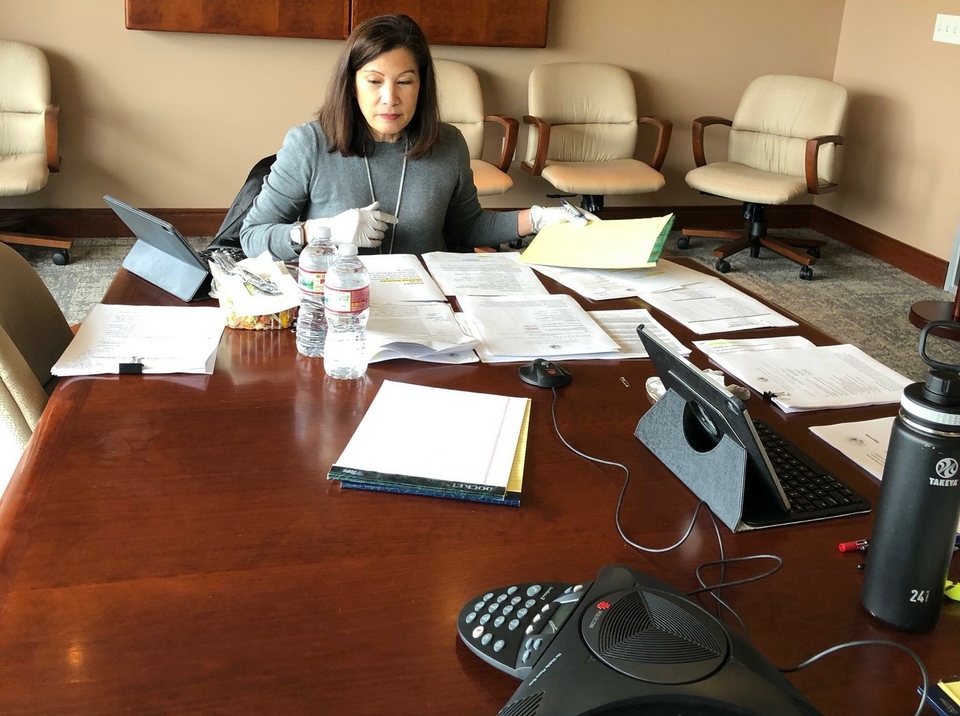
Judicial Council Chair, Chief Justice Tani G. Cantil-Sakauye ran the teleconference call from the council’s office in Sacramento. Photo by JCC.

11 temporary emergency rules include $0 statewide bail for misdemeanors and lower-level felonies during COVID-19 pandemic to “safely reduce jail populations”

By Blaine Corren, Senior Communications and Public Affairs Analyst, California Judicial Council

VIA TELECONFERENCE—At its meeting on Monday, April 6, 2020, the Judicial Council of California approved 11 temporary emergency rules, including setting bail statewide at $0 for misdemeanors and lower-level felonies to “safely reduce jail populations” and staying eviction and foreclosure proceedings to protect Californians from losing their homes during the COVID-19 pandemic.

This was the second emergency council meeting of court and branch leaders from around the state to consider further measures to ensure California courts—which remain open as “essential services” under Gov. Newsom’s stay-home executive order—can meet stringent health directives while also providing due process and access to justice.

“We are at this point truly with no guidance in history, law, or precedent,” said Chief Justice Tani Cantil-Sakauye, chair of the council. “And to say that there is no playbook is a gross understatement of the situation. In developing these rules, we listened to suggestions from our justice system partners, the public, and the courts, and we greatly appreciate all of the input. Working with our court stakeholders, I’m confident we can preserve the rule of law and protect the rights of victims, the accused, litigants, families and children, and all who seek justice. It’s truly a team effort.”

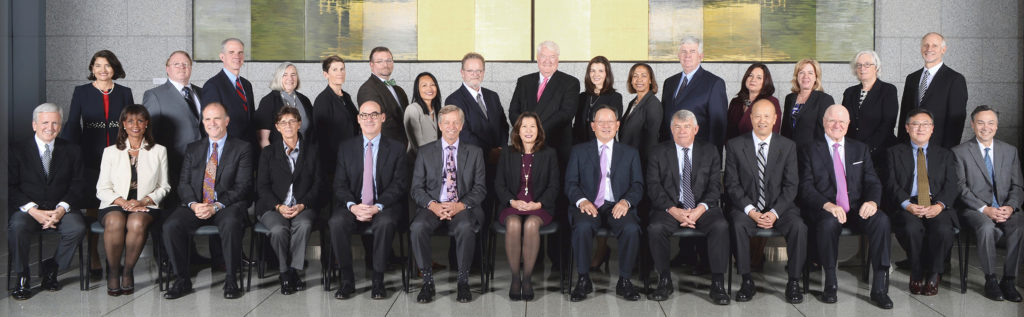
Members of the Judicial Council of California. Photo from 2018 by JCC.

The council received and considered more than 100 written comments on the new rules from judges, public defenders, district attorneys, law enforcement, legal aid and advocacy groups, unions, attorneys, court reporters, interpreters, and other justice system partners.

Among the actions the council approved, to go into effect immediately:

  • Suspend the entry of defaults in eviction cases;
  • Suspend judicial foreclosures;
  • Allow courts to require judicial proceedings and court operations be conducted remotely, with the defendant’s consent in criminal proceedings;
  • Adopt a statewide emergency bail schedule that sets bail at $0 for most misdemeanor and lower-level felony offenses;
  • Allow defendants to appear via counsel or remote technologies for pretrial criminal hearings;
  • Prioritize hearings and orders in juvenile justice proceedings and set a structure for remote hearings and continuances
  • Extend the timeframes for specified temporary restraining orders;
  • Extend the statutes of limitations governing civil actions; and
  • Allow electronic depositions in civil cases.

The council previously approved a number of temporary measures at its first emergency meeting Mar. 28 to give courts flexibility to continue to provide essential services to the public while protecting health and safety during the pandemic.

For a complete list of emergency orders taken by the California court system in response to the COVID-19 pandemic, see the California Courts Newsroom.

About the Judicial Council

Under the leadership of the Chief Justice and in accordance with the California Constitution, the council is responsible for ensuring the consistent, independent, impartial, and accessible administration of justice. Judicial Council staff implements the council’s policies.