Archive for the ‘News’ Category

Park district turning Black Friday green with FREE Park Day

Tuesday, November 23rd, 2021

Special Visitor Center activities planned, one at Black Diamond Mines Regional Preserve in Antioch

By Dave Mason, Public Information Supervisor, Public Affairs, East Bay Regional Park District

For the past seven years, the East Bay Regional Park District has celebrated Green Friday, the day after Thanksgiving, as a healthy outdoor alternative to Black Friday holiday shopping. To encourage time in nature, the Park District is again making Green Friday a FREE Park Day, meaning all District fees are waived for park entrance and activities, including parking, dogs, horses, boat launching, fishing, as well as entry to Ardenwood Historic Farm.

“Time in nature improves physical and mental health and is a great way to relieve holiday stress,” said Park District Board President Dee Rosario. “The day after Thanksgiving is a great opportunity to get outside and spend time with family and friends.”

The fee waiver does not include State fees for fishing licenses and watercraft inspections for invasive mussels or privately operated concessions such as the Tilden Merry-Go-Round and Redwood Valley Railway steam train.

The Park District’s Green Friday is part of the “#OptOutside” movement that started in 2015 when REI closed its doors on Black Friday and encouraged its employees and the public to explore the outdoors instead of shopping. Millions of people and hundreds of organizations now participate in #OptOutside each year.

Visitor Center activities planned for Green Friday include:

To find a park or activity, visit www.ebparks.org/parks.

The East Bay Regional Park District is the largest regional park system in the nation, comprising 73 parks, 55 miles of shoreline, and over 1,300 miles of trails for hiking, biking, horseback riding, and environmental education. The Park District receives more than 25 million visits annually throughout Alameda and Contra Costa counties in the San Francisco Bay Area.

Contra Costa, 22 other DA’s reach settlement with gas station owner for underground storage tank environmental violations

Monday, November 22nd, 2021

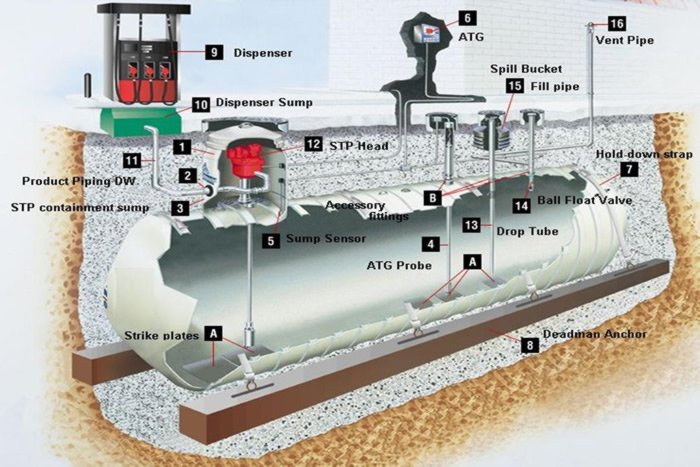
Gas station underground storage tank diagram. Source: EPA

$1.1 million in civil penalties; 113 tanks statewide, seven in Contra Costa County

By Bobbi Mauler, Executive Assistant, Contra Costa County Office of the District Attorney

Contra Costa County District Attorney Diana Becton announced today that the Contra Costa County District Attorney’s Office, together with 22 other California District Attorneys and City Attorneys, have reached a settlement with the Orange, California-based Hassan & Sons, Inc., H&S Energy, LLC and H&S Energy Products, LLC (formerly known as Colonial Energy, LLC),  (collectively referred to as “H&S Energy”) over allegations that the companies violated state laws regarding the operation and maintenance of motor vehicle fuel underground storage tanks (“USTs”). The settlement includes $1,100,000 in civil penalties, and investigative costs. H&S Energy has 113 fueling stations in California, of which, seven locations are in Contra Costa County. The settlement follows an investigation by local environmental health agencies of H&S Energy stations’ non-compliance with many provisions of the UST regulations.

The companies, started in 1996, have built and acquired gasoline and convenience stores throughout the state under the Chevron, Texaco, Shell, Extra Mile, and their own, Power Market brand, including locations in Bay Point, Brentwood, Oakley, Pittsburg and Martinez.

“UST owners and operators must comply with the applicable regulations in order to prevent potential harm to the environment,” said D.A. Becton. “H&S Energy was cooperative with the People’s investigation and expended significant resources in order to bring their stations into compliance.”

Under the settlement, which includes a Final Judgment and Permanent Injunction entered in Solano County Superior Court Case No. FCS057332 by the Honorable E. Bradley Nelson, H&S Energy must implement certain compliance assurance programs including hiring an environmental compliance manager and bi-annual environmental audits and reports submitted to the People. In addition, H&S Energy must pay $900,000 in civil penalties and $200,000 in costs. $550,000 is due within five days after entry of judgment, and the remaining $550,000 is due October 22, 2022.

Allen Payton contributed to this report.


House passes Biden’s $2.2 trillion Build Back Better Act spending bill, see what’s in it

Sunday, November 21st, 2021

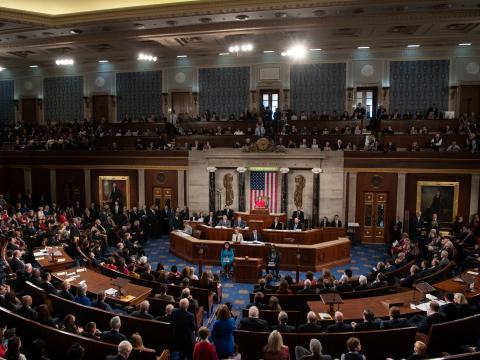
Source: U.S. House of Representatives.

All five Contra Costa Congressmen vote in favor; DeSaulnier praises passage calling it historic investment in American families; likely to be changed in the Senate, where support of all 50 Democrats is needed; CBO says it will increase deficit by almost $800 billion over next five years

By Allen Payton

The U.S. House of Representatives passed President Biden’s $2.2 trillion Build Back Better Act, H.R. 5376, also known as the budget reconciliation package, on Friday, on a mainly partisan vote of 220-213 with all Republican members and only one Democrat voting no. It now moves on to the Senate.

According to Roll Call, “Two key holdouts —West Virginia’s Joe Manchin III and Arizona’s Kyrsten Sinema — have yet to offer a public endorsement of the package. Senate Majority Leader Charles E. Schumer, (D-N.Y.), set a Christmas deadline for final passage.”

The 2,702-page bill passed following a record-breaking, 8 1/2-hour filibuster speech by Minority Leader Kevin McCarthy, (R-Bakersfield). He said, “it’s the most irresponsible spending bill in the history of America.”

According to the Summary of Cost Estimate by the Congressional Budget Office the legislation will increase the deficit by almost $800 billion through Fiscal Year 2026. However, “The CBO estimates that enacting this legislation would result in a net increase in the deficit totaling $367 billion over the 2022-2031 period, not counting any additional revenue that may be generated by additional funding for tax enforcement.”

However, according to the Committee for a Responsible Federal Budget, the legislation could result in a net deficit increase of $2.2 to $2.7 trillion if temporary provisions are made permanent without offsets.

DeSaulnier’s Statement on Passage

On Friday, Congressman Mark DeSaulnier (D, CA-11), who  represents portions of Antioch, issued the following statement upon passage of the Build Back Better Act (H.R. 5376), which passed the U.S. House of Representatives by a vote of 220-to-213.

“Today’s passage of the Build Back Better Act is a victory for families across the country and in Contra Costa. Through its historic investments in early, primary, and secondary education and childcare, we are finally ensuring that all children have the opportunity to thrive both in and out of the classroom, no matter where they live or how much their parents earn. From free preschool for three- and four-year-olds to lowering the cost of high-quality childcare, this bill would give over 90% of parents with young children the opportunity to reenter the workforce knowing their children are safe, cared for, and learning.

By finally calling on the wealthiest Americans and big corporations to pay their fair share, every provision in this bill is paid for and we are making a statement that our children are our priority. I urge the Senate to pass the Build Back Better Act without delay to deliver this much needed relief to families as quickly as possible. American families are counting on it.”

In addition, Build Back Better would:

  • Provide monthly payments of $300 per child under 6 and $250 per child ages 6 to 17 for more than 35 million families under the Child Tax Credit;
  • Devote the necessary resources to combat the climate crisis through expanded tax credits for clean energy and programs to drive down pollution;
  • Lower the cost of prescription drugs and expanding Medicare, Medicaid, and the Affordable Care Act;
  • Bring down costs of long-term care and supporting care workers;
  • Expand opportunities for workforce development programs; and
  • Create affordable housing.

Unpopular Provisions in Bill

According to polling, only 39% of battleground voters support “Build Back Better” while 46% oppose it.

Some of the most unpopular items in the bill include:

  • A natural gas tax that will increase home heating costs, electricity rates, and raise gas prices.
  • An eighty-thousand-dollar tax break to wealthy homeowners in New York, New Jersey, and California.
  • A $3,600 a year child tax credit to illegal immigrants for every child they bring into America or give birth to after arriving.
  • 87,000 new IRS agents to increase audits of taxpayers that will look through the bank accounts of every American earning or spending more than $600 per year to make sure they are paying enough taxes, disproportionally affecting small business owners.

What’s In the Bill

According to the National Review, the legislation includes:

$555 billion in subsidies to move America from one source of energy to another, including up to $12,500 per new electric car purchase;

$220 billion for clean energy & climate resilience;

$190 billion to establish or expand clean energy & electric tax credits;

$60 billion to establish or expand clean fuel & vehicle tax credits;

$75 billion to establish or expand other climate-related tax benefits; and

$10 billion to enact infrastructure & related tax breaks;

$400 billion for universal pre-school and day care, including $18 billion in the first three years to create universal pre-kindergarten. Then, the program would be funded by a mixture of federal and state funds;

$300 billion for restoration of the state and local tax (SALT) deduction eliminated in the Tax Cuts and Jobs Act of 2017. According to CNBC the bill, “raises the cap on the state and local tax deduction from $10,000 to $80,00 in 2021, which will benefit the richest households in the country, according to the Tax Foundation.”

$200 billion to extend and expand both the Child Tax Credit and the Earned Income Tax Credit, for four weeks of paid parental, sick or caregiving leave;

$90 billion for what the White House describes as “Equity and Other Investments”;

$38 billion in new energy taxes;

$9 billion to higher-learning institutions for “qualified environmental justice programs”;

$7 billion for service groups for projects related to “climate resilience and mitigation”;

$3.5 billion for ports to purchase “zero-emission” equipment;

$3 billion to fund pandemic preparedness;

$3 billion for better records and hospitals for veterans;

$3 billion in “climate justice block grants” that go into projects in disadvantaged communities. The criterion for grants is based on the race of the projects’ sponsors;

$450 million for nontraditional climate apprenticeship programs;

$350 million to “rebuild” the National Labor Relations Board and $321 million to “rebuild” the Equal Employment Opportunity Commission;

$275 million to upgrade the health-care system in Hawaii which also gets $5 million to save endangered plants;

$200 million to preserve Native American languages;

$150–$250 million (estimated) as tax credits to “local” news organizations, excluding government entities, except NPR and PBS. Note: “Local” is broadly defined, and appears to include almost all news organizations, including the New York Times and Washington Post. The bill also contains a rich new deduction for trial lawyers;

$124 million to combat substance abuse;

$85 million for studying the risks of climate change for “pregnant, lactating or post-partum individuals”;

$50 million to train and certify more doulas; and

$5 million to save desert fish.

According to CNBC, “To pay for the bill, House Dems are proposing increasing some taxes on businesses and the wealthiest Americans. It includes a 5% surtax on adjusted gross income (AGI) over $10 million for individuals and an additional 3% on AGI over $25 million.”

See more details on the Committee for a Responsible Federal Budget website.

Biden issues Executive Order on Implementation of the Infrastructure Investment and Jobs Act

Sunday, November 21st, 2021

Executive Order on Implementation of the Infrastructure Investment and Jobs Act

NOVEMBER 15, 2021

By the authority vested in me as President by the Constitution and the laws of the United States of America, and in order to effectively implement the historic infrastructure investments in the Infrastructure Investment and Jobs Act (the Act), it is hereby ordered as follows:

Section 1.  Background.  The Infrastructure Investment and Jobs Act is a once-in-a-generation investment in our Nation’s infrastructure and competitiveness. It will help rebuild America’s roads, bridges, and rails; expand access to clean drinking water; work to ensure access to high-speed Internet throughout the Nation; tackle the climate crisis; advance environmental justice; and invest in communities that have too often been left behind.  It will accomplish all of this while driving the creation of good-paying union jobs and growing the economy sustainably and equitably for decades to come.

Critical to achieving these goals will be the effective implementation of the Act by my Administration, as well as by State, local, Tribal, and territorial governments.

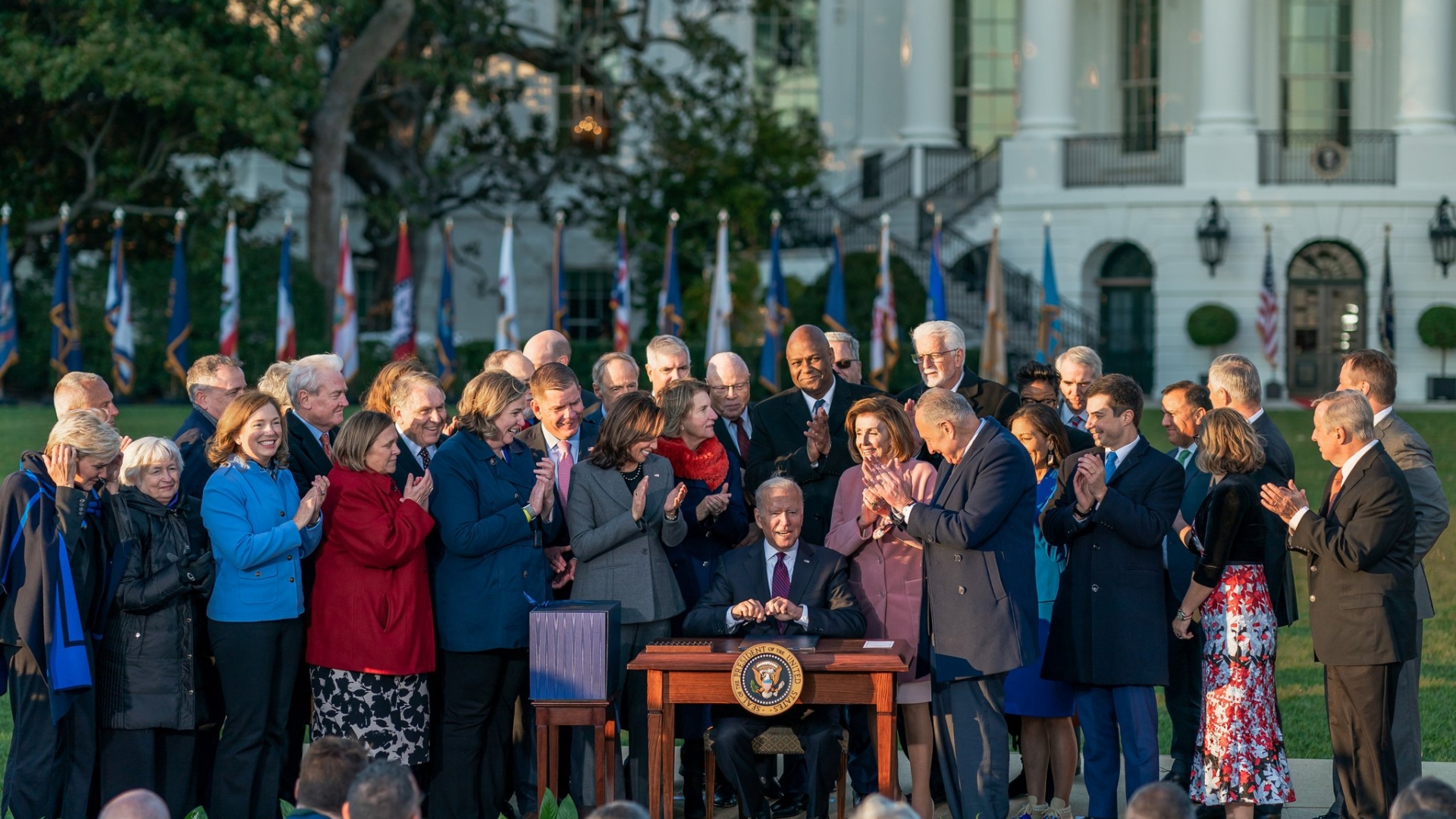
President Biden signed the infrastructure bill during a ceremony on the back lawn of the White House surrounded by members of his cabinet, the House and Senate on Monday, Nov. 15, 2021. Source: U.S. Speaker of the House website

Sec. 2.  Implementation Priorities.  In implementing the Act, all agencies (as described in section 3502(1) of title 44, United States Code, except for the agencies described in section 3502(5) of title 44), shall, as appropriate and to the extent consistent with law, prioritize:

(a)  investing public dollars efficiently, working to avoid waste, and focusing on measurable outcomes for the American people;

(b)  increasing the competitiveness of the United States economy, including through implementing the Act’s Made-in-America requirements and bolstering United States manufacturing and supply chains;

(c)  improving job opportunities for millions of Americans by focusing on high labor standards for these jobs, including prevailing wages and the free and fair chance to join a union;

(d)  investing public dollars equitably, including through the Justice40 Initiative, which is a Government-wide effort toward a goal that 40 percent of the overall benefits from Federal investments in climate and clean energy flow to disadvantaged communities;

(e)  building infrastructure that is resilient and that helps combat the crisis of climate change; and

(f)  effectively coordinating with State, local, Tribal, and territorial governments in implementing these critical investments.

Sec. 3.  Infrastructure Implementation Task Force.  (a)  There is established within the Executive Office of the President the Infrastructure Implementation Task Force (Task Force).  The function of the Task Force is to coordinate effective implementation of the Infrastructure Investment and Jobs Act and other related significant infrastructure programs within the executive branch.

(b)  The Assistant to the President for Economic Policy and Director of the National Economic Council shall serve as Co‑Chair of the Task Force.

(c)  There is established within the Executive Office of the President the position of White House Infrastructure Coordinator, who shall serve as Co-Chair of the Task Force.

(d)  In addition to the Co-Chairs, the Task Force shall consist of the following members:

(i)     the Secretary of the Interior;

(ii)    the Secretary of Agriculture;

(iii)   the Secretary of Commerce;

(iv)    the Secretary of Labor;

(v)     the Secretary of Transportation;

(vi)    the Secretary of Energy;

(vii)   the Administrator of the Environmental Protection Agency;

(viii)  the Director of the Office of Management and Budget;

(ix)    the Director of the Office of Personnel Management;

(x)     the Assistant to the President and Director of the Domestic Policy Council;

(xi)    the Assistant to the President and National Climate Advisor; and

(xii)   the heads of such other executive departments, agencies, and offices as the Co-Chairs may from time to time invite to participate.
(e)  The Co-Chairs may coordinate subgroups consisting of Task Force members or their designees, as appropriate.

Sec. 4.  General Provisions.  (a)  Nothing in this order shall be construed to impair or otherwise affect:

(i)   the authority granted by law to an executive department or agency, or the head thereof; or

(ii)  the functions of the Director of the Office of Management and Budget relating to budgetary, administrative, or legislative proposals.

(b)  This order shall be implemented consistent with applicable law and subject to the availability of appropriations.

(c)  This order is not intended to, and does not, create any right or benefit, substantive or procedural, enforceable at law or in equity by any party against the United States, its departments, agencies, or entities, its officers, employees, or agents, or any other person.

JOSEPH R. BIDEN JR.

THE WHITE HOUSE,

November 15, 2021.


Antioch City Clerk for third time mails response letter to petition for Mayor Thorpe’s recall further delaying signature gathering

Saturday, November 20th, 2021

State Elections Code only requires it be “in writing”; Householder ignores organizers repeated requests to receive letter via email; refuses to answer questions, admit her mistake in second response letter

By Allen Payton

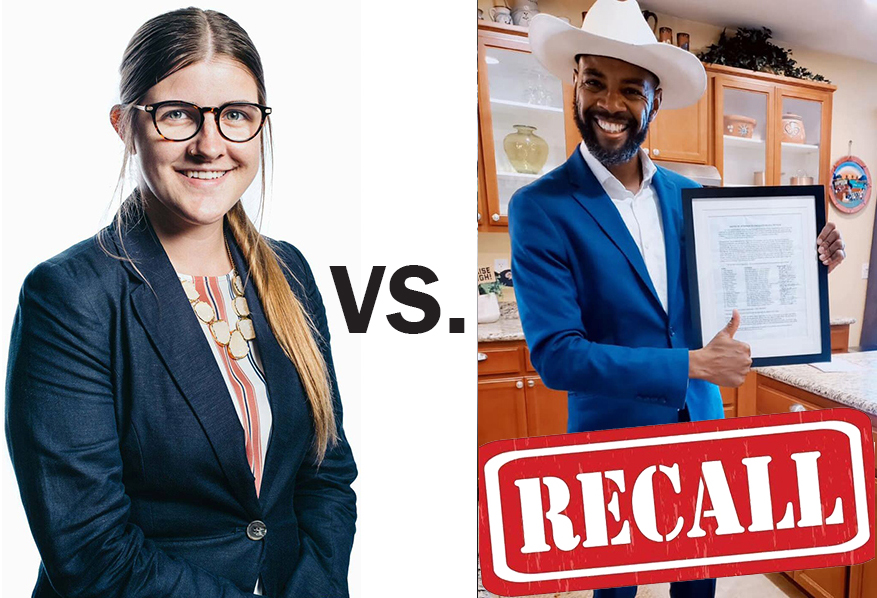
Antioch City Clerk Ellie Householder, a political ally of Mayor Lamar Thorpe, has once again chosen to mail her printed response letter to proponents of his recall, further delaying the signature gathering. On Friday, Nov. 19, 2021, organizer Kathy Cabrera was informed that Householder had mailed her response letter This is the third time the city clerk has chosen to do so. (See related article)

It was on the 10th day since they submitted their recall petition for the third time, which is the legal limit for Householder’s response.

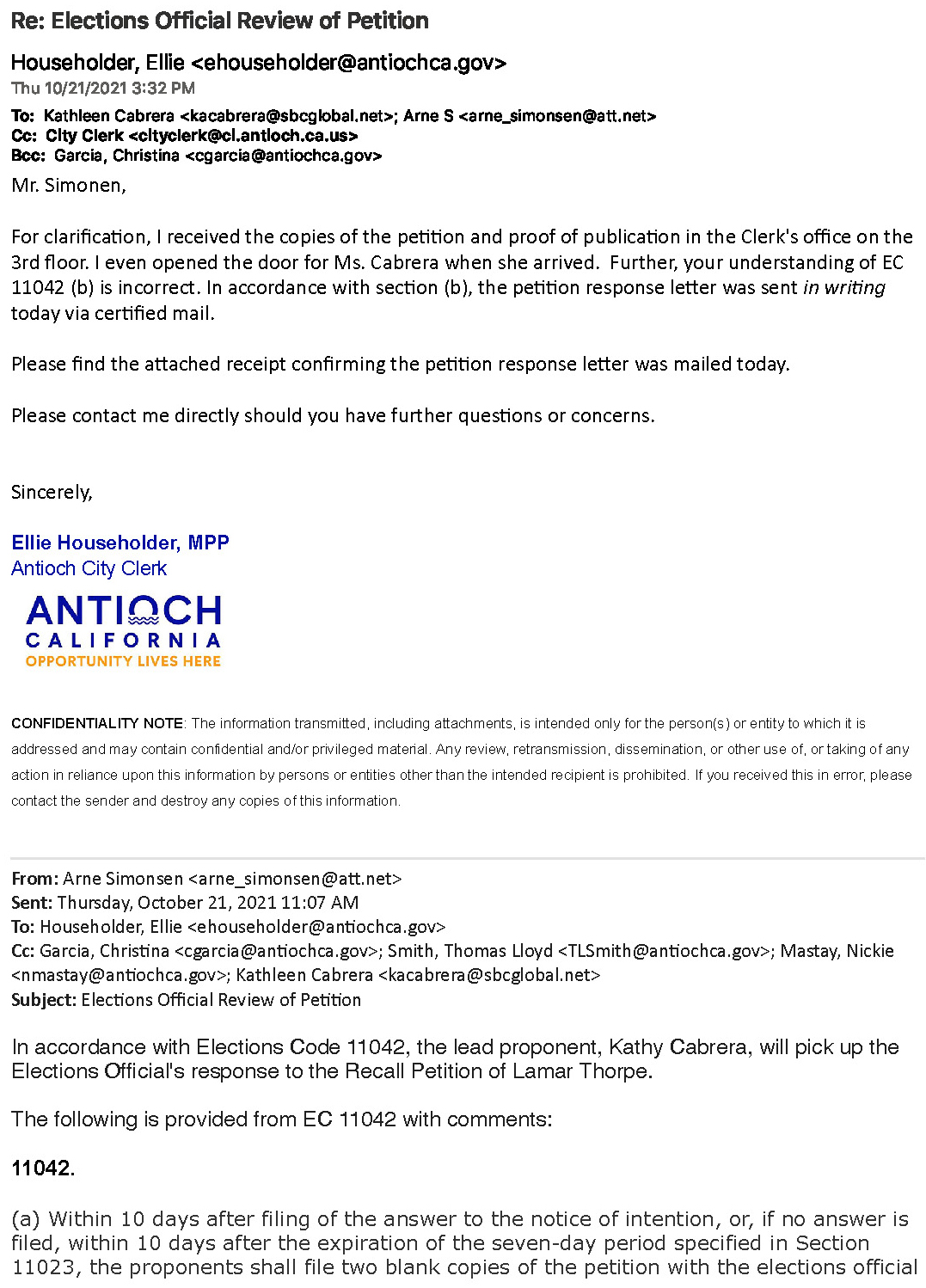
The second time the city clerk was due to provide her response letter to the petition on Oct. 21, fellow organizer and former Antioch City Clerk Arne Simonsen, who earned the advanced, professional designation of Master Municipal Clerk from the International Institute of Municipal Clerks, emailed Householder, writing, “In accordance with Elections Code 11042, the lead proponent, Kathy Cabrera, will pick up the Elections Official’s response to the Recall Petition of Lamar Thorpe.” He further shared the language from that code section.

In an email response that same day, Householder, who has not yet earned the lesser designation of Certified Municipal Clerk wrote, “For clarification, I received the copies of the petition and proof of publication in the Clerk’s office on the 3rd floor. I even opened the door for Ms. Cabrera when she arrived. Further, your understanding of EC11042 (b) is incorrect. In accordance with section (b), the petition response letter was sent in writing today via certified mail. Please find the attached receipt confirming the petition response letter was mailed today.” (The designation of MPP Householder uses in her email correspondence refers to her Master in Public Policy degree.)

However, the state’s Elections Code section 11042 (b) only requires, as both Simonsen and Householder pointed out that, “The elections official…shall…notify the proponents in writing of his or her finding.”

Following is the complete subsection they referenced.

Elections Code Section 11042 “(b) At the time of the filing of the two blank copies of the petition, the proponents shall also file proof of publication of the notice of intention, if the notice of intention was published, or an affidavit of posting of the notice of intention, if the notice of intention was posted.  The elections official or, in the case of a recall of a state officer, the Secretary of State, shall, within 10 days of receiving the blank copies of the petition, notify the proponents in writing of his or her finding.”

Questions for Householder Go Unanswered

A voicemail was left on Householder’s cell phone Friday afternoon and an email was sent to her Friday night asking why she mailed the response letter instead of emailing it, as Cabrera has repeatedly asked Householder, including in emails sent on Sept. 27, Nov. 2, 3, 4 and 16. Emails_Cabrera Householder

Additional questions were asked of Householder in the Friday night email, including, “can you please provide the requirement that ‘in writing’ means on a physical piece of paper to support your reasoning? Also, where does it require you to mail your response letter? If it must be printed on a piece of paper, couldn’t you have called Ms. Cabrera and let her know she could meet you or your staff at the City Clerk’s office for one of you to hand it to her the day you issued it? If so, why didn’t you instead of making her and the other recall proponents wait two or three more days to receive it in the mail?”

Householder was also asked, “Did it really take you and/or your staff 10 days to review their petition? If so, what took so long? Asking again, why couldn’t you follow the petition template provided by the County Clerk’s office that was used for your recall, instead of the template provided by the California Secretary of State’s office? Finally, will you admit to making a mistake in your last response letter requiring them to provide the names of the Top Funders when they have yet to form a campaign committee?”

Householder did not respond prior to publication time on Saturday afternoon.

Cabrera expects to receive Householder’s response letter by Monday, Nov. 22, almost two months after Thorpe was served with his recall notice on Sept. 24. (See related article)

Please check back later for any updates to this report.

Former Antioch Mayor Pro Tem Joy Motts announces another run for District 1 in 2022

Saturday, November 20th, 2021

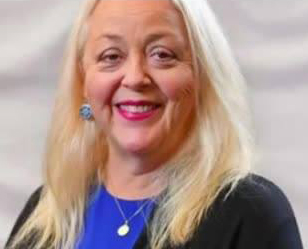
Joy Motts. Photo from Facebook.

By Allen Payton

On Oct. 5, without any fanfare and long before the redistricting process has been completed, former Antioch Mayor Pro Tem and Councilwoman Joy Motts posted on her Community Advocate Joy Motts Facebook page that she will be running, again for District 1 in 2022. She was first elected to the council in 2018 for a two-year citywide seat, but lost for re-election last year for another two years by 212 votes to current District 1 incumbent Tamisha Torres-Walker, placing second in a three-way race with former Antioch Mayor Pro Tem and Councilman Manny Soliz, Jr. (See related article)

A former Antioch School Board Trustee, Motts was elected in 2010 and served until 2014, but lost for re-election placing fourth in a race for three seats. She ran again in 2016 but lost, placing fourth, again in the race for three seats. Motts then set her sights on city council and was elected as the top vote-getter in a six-person race in 2018, for a two-year, citywide seat, resulting in her being chosen by the council as Mayor Pro Tem during the first year of her term. Following redistricting, District 1 where she and her husband live, and District 4 were chosen as two-year seats, when all four seats were up for election, along with the mayor’s seat in 2020. (See related article)

In her Facebook post, Motts wrote:

“Dear Friends and Community Members,

I am excited to announce today that I will be running for Antioch City Council in 2022 as your representative for District 1. For over 20 years I have been a dedicated and passionate advocate for Antioch and especially for the residents of north Antioch. Serving in many capacities over the years as your School Board member that spearheaded the renovation of Antioch High School, as your Councilwoman who supported our business community and public safety, as the President of the Celebrate Antioch Foundation bringing back Antioch’s 4th of July and many other celebrations to Antioch’s families. I am tenured, experienced and I will continue to fight for a safer and better quality of life for all of Antioch’s residents.

I will be your leader who works hard, shows up, governs with respect, does the research, listens to my constituents, and knows that building relationships and collaboration are the key to achieving what is in the best interest of our community. We have many challenges in our community, but we also have so many opportunities on which to build upon. I hope to have your support in this journey. More to follow.”

Then on Oct. 26, she posted a photo of her from the last campaign showing the endorsement by the East Bay Times.

As she mentioned, Motts, a lifelong Antioch resident, currently serves the community as president of Celebrate Antioch Foundation which organizes the events, mainly in Rivertown, including the July 4th and Holiday Delites Celebrations. She is also leading the effort to use the former Antioch Lumber Company lot, known as The Yard, for a new town square, for which she will make a presentation to the city council during next Tuesday’s meeting.

The council election will be held November 8, 2022.

Ribbon cutting for renovated Antioch City Council Chambers Monday, Nov. 22

Saturday, November 20th, 2021

$2 million in improvements including plaza and Leo Fontana Fountain still under construction

By Allen Payton

The Antioch City Council Chambers renovation is finally complete. After spending about $1.5 million, the City invites the public to join the council and staff on Monday, November 22, 2021, from 5:00 – 6:00 PM for a ribbon cutting ceremony.

According to the various bids for the council chambers, walkway, plaza and Leo Fontana Fountain, the costs for renovations totals about $2 million and construction began in 2019. The plaza and fountain are still under construction which began earlier, this year.

Improvements

According to Swatt | Miers Architects, hired by the city council for the renovation redesign, “The City of Antioch has long been proud of their public buildings including the Police Facility, Animal Services Facility, and Prewett Family Park — all designed by Swatt | Miers Architects partner George Miers. So, when it came time to renovate their 1980’s Council Chamber, they awarded the commission to SMA.

This project included both the interior renovation of the existing Council Chamber and the enclosure of an existing open-air breezeway that connects the City Hall to the Council Chamber.

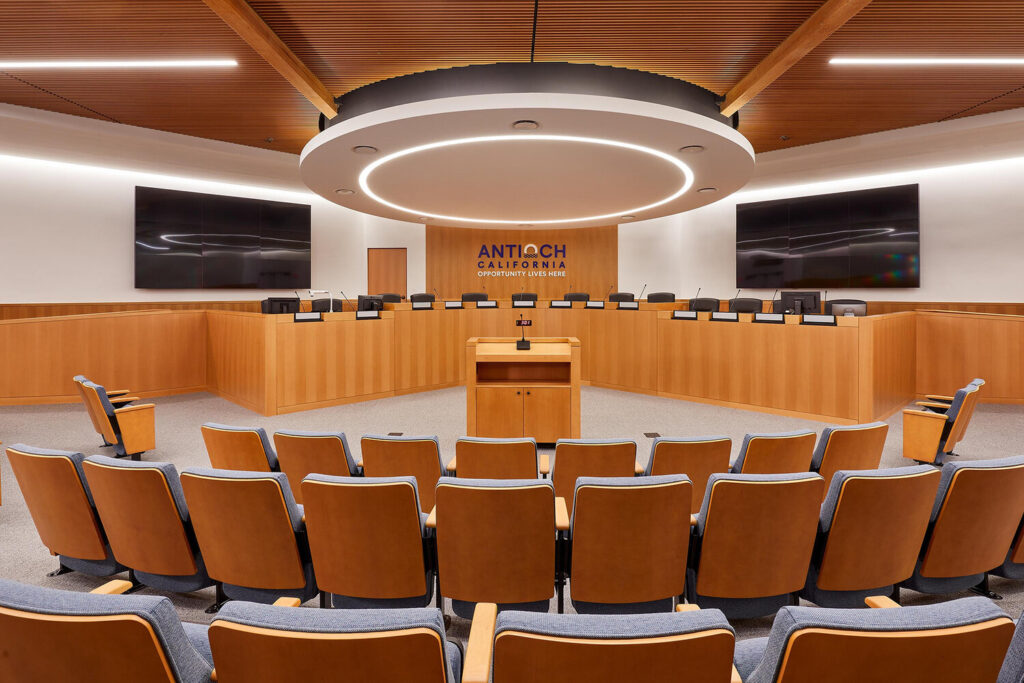
City of Antioch Council Chambers renovation view from the audience. Photo: Swatt | Miers Architects

Designed in 1980 by Mackinley, Winnaker and McNeil Architects, this well-used 3,083 SF, stand-alone facility was long overdue in meeting current code and modern functional requirements including ADA, audio-visual/closed circuit TV, modern lighting/energy design and acoustical attenuation. Additionally, public restrooms had not been provided in the Council Chamber structure. Rather, the public needed to leave the building via a covered walkway and use the main City Hall restrooms. Aside from the inconvenience, security was a significant City concern. Operating on a limited budget, the following design features were implemented;

  • The existing 450 SF covered walkway was converted into an enclosed interior Entry Vestibule linking City Hall and Council Chambers.
  • The existing semi-circular seating layout was redesigned to meet ADA accessibility and related requirements for all public, staff and Council member seating.
  • A comprehensive lighting design focusing on user and TV broadcast needs.
  • A comprehensive AV/TV broadcast design.
  • New seating, acoustical wall panels and floor finishes.
  • New dais, speaker podium and staff seating casework.
  • A new acoustical wood ceiling featuring a unique, tilted plane above the dais designed to enhance both acoustics and lighting.
  • Redirection of existing axial public entrance to the sides.”

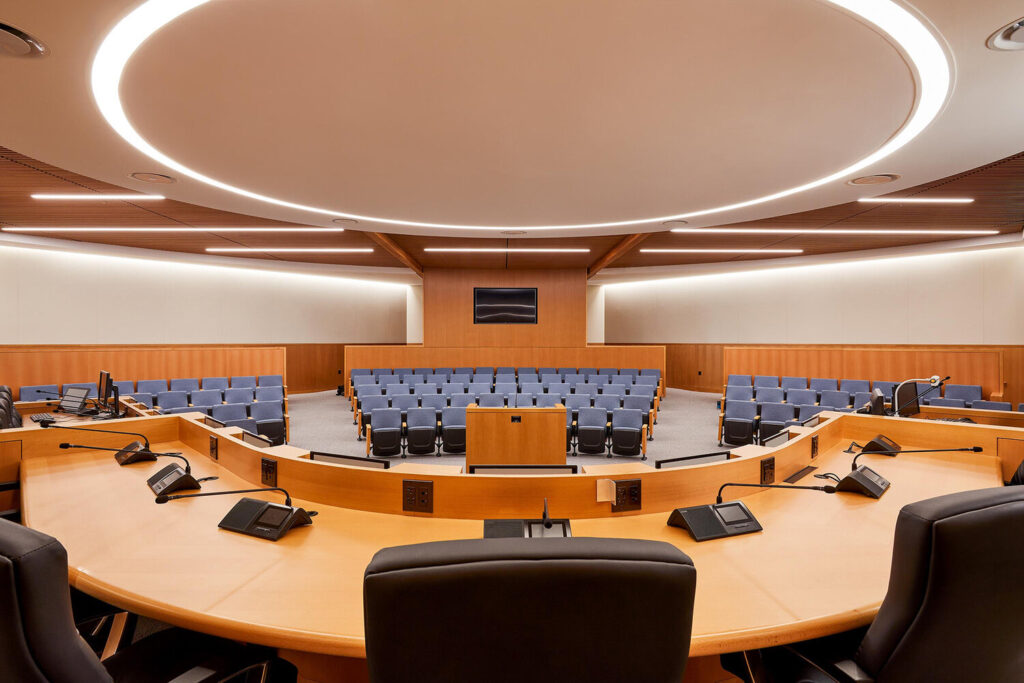
View from the dais in the renovated Antioch Council Chambers. Photo by Swatt | Miers Architects

Antioch City Hall and Council Chambers are located at 200 H Street between W. 2nd and W. 3rd Streets in Antioch’s historic, downtown Rivertown.


Contra Costa College District COVID-19 vaccine mandate for staff, students now in effect

Saturday, November 20th, 2021

Photo source: CDC

Unanimous vote by trustees; all visitors, including vendors and subcontractors, required to complete health assessment prior to visiting a 4CD facility.

By Timothy Leung, Public Information Officer, Contra Costa Community College District

At their September 8, 2021, meeting, the Contra Costa Community College District (4CD) Governing Board passed a resolution on a unanimous vote establishing a COVID-19 vaccine requirement for all employees, and students who attend at least one in-person class or visits a 4CD facility or campus. All visitors, including vendors and subcontractors, are strongly encouraged to be vaccinated and will be required to complete a health assessment prior to visiting a 4CD facility. Ward 2 Trustee and Board Vic President Dr. Walters made the motion, and it was seconded by Ward 5 Trustee Fernando Sandoval. The vote was unanimous, including the student trustee. (See Item 21.A.)

The vaccine requirement became effective on Monday, November 1, 2021, in order to provide time for those currently unvaccinated to become fully vaccinated. The 4CD Governing Board determined that requiring vaccines for students and employees is necessary to ensure the health and safety of the 4CD community.

Employees and students can apply for a vaccination exception or deferral in the following situations: (a) medical excuse from receiving COVID-19 vaccine due to medical conditions or precaution; b) disability; (c) during the period of any pregnancy; or (d) religious objection based on a person’s sincerely held religious beliefs, practice or observance. When an exception or deferral has been approved, regular weekly COVID-19 testing with evidence of negative test results will be required for any unvaccinated person accessing District campuses or facilities.

4CD is evaluating various technology solutions that will track the vaccination status and test results in a secure system designed to protect the privacy of students and employees in accordance with applicable laws.

“In making this decision, 4CD reached out to its students, faculty, classified professionals, and managers and received overwhelming support to take this action,” said Chancellor Bryan Reece. “COVID-19 and its many variants will be with us for a while, so we must take prudent steps like this one so we can continue providing face-to-face instruction and services for our students, while ensuring we have a safe place to learn and work for our students and staff.”

4CD continues to monitor and adhere to health guidelines from federal, state and local health authorities, and advocates vaccination is the most effective way to prevent transmission and limit COVID-19 hospitalizations and deaths.

Visit 4CD’s website at https://www.4cd.edu/covid19/index.html for more information.

About the College District

The Contra Costa Community College District (4CD) is one of the largest multi-college community college districts in California. The 4CD serves a population of 1,019,640 people, and its boundaries encompass all but 48 of the 734-square-mile land area of Contra Costa County. 4CD is home to Contra Costa College in San Pablo, Diablo Valley College in Pleasant Hill, Los Medanos College in Pittsburg, as well as educational centers in Brentwood and San Ramon. The District headquarters is located in downtown Martinez. For more information visit www.4cd.edu.