Archive for the ‘Health’ Category

Gov. Newsom issues executive order on actions in response to COVID-19 including CSU admissions criteria, deadline for real estate license extensions

Friday, April 17th, 2020

The order also addresses background checks for essential workers

SACRAMENTO (Apr 16, 2020) – On Thursday, Governor Gavin Newsom signed an executive order addressing a variety of issues in response to the COVID-19 pandemic, including adjusting admissions requirements for the California State University system and providing flexibility for 60 days on background checks for critical infrastructure sectors. (See the entire order, below).

Specifically, the CSU system will be able to waive hearing requirements to be able to make adjustments to admissions criteria for students applying this coming fall to enter as freshmen in the fall of 2021.

Additionally, the order will allow the California Department of Justice to develop procedures to perform name-based background checks to protect health and safety and avoid delays in processing employment for critical sectors, such as health care services and care and support for vulnerable populations.

The executive order also will allow federal stimulus checks to flow directly to custodial parents owed back child support payments and will additionally allow for commercially licensed food trucks to be able to temporarily operate in roadside rest areas for a period of 60 days, to ensure essential infrastructure workers have access to food. Caltrans will be charged with developing and implementing a process to administer the temporary permits.

The text of the Governor’s executive order can be found here and a copy can be found here.

Learn more about the state’s ongoing COVID-19 response efforts here. Visit covid19.ca.gov for critical steps Californians can take to stay healthy, and resources available to those impacted by the outbreak.

EXECUTIVE ORDER N-52-20

WHEREAS on March 4, 2020, I proclaimed a State of Emergency to exist in California as a result of the threat of COVID-19; and

WHEREAS despite sustained efforts, COVID-19 continues to spread and is impacting nearly all sectors of California; and

WHEREAS the COVID-19 pandemic and the necessary physical distancing measures implemented have affected governmental agencies, workers, private businesses, and California residents alike, with associated impacts on adherence to certain statutory and regulatory deadlines; and

WHEREAS a shortage of fingerprinting services has arisen in California despite those services being included among the essential critical infrastructure sectors identified pursuant to Executive Order N-33-20, and this shortage is impacting other essential critical infrastructure sectors, including the healthcare sector and other programs that provide care and support to vulnerable Californians; and

WHEREAS to prevent potential impairment of delivery of critical healthcare services and of care and support for vulnerable populations, the California Department of Justice, working in concert with the California Health and Human Services Agency and other agencies and departments, is developing procedures to perform name-based criminal background checks, consistent with Penal Code sections 11105.7 and 11105.75, and subject to certain conditions, including a requirement that each applicant’s identity and criminal history be verified by fingerprints as soon as practicable after an initial check based on other identifying information has been performed; and

WHEREAS individuals who are tested for COVID-19 should have access to test results, and important information on test interpretation, isolation, and care guidance, in an expeditious and deliberate manner; and

WHEREAS illness due to COVID-19 and physical distancing requirements imposed to limit spread of the virus impede the ability of the California Coastal Commission, the State Water Resources Control Board, members of the public, and others to meet certain time limits set forth in the Permit Streamlining Act and the Public Resources Code; and

WHEREAS the COVID-19 pandemic and subsequent school closures has disrupted the lives and educational progress of K-12 students, impacting their ability to meet existing admissions prerequisites for the California State University system; and

WHEREAS it is important that the trucking industry have access to food at highway rest areas while maintaining the critical supply chain throughout this state; and

WHEREAS federal financial relief provided under the Coronavirus Aid, Relief and Economic Security Act (CARES Act) should be made swiftly available to individuals who would otherwise be entitled to it—including custodial parents and other caregivers entitled to past due support—notwithstanding state law providing that certain federal tax refund offsets should first be applied to support owed to the State; and

WHEREAS under the provisions of Government Code section 8571, I find that strict compliance with various statutes and regulations specified in this order would prevent, hinder, or delay appropriate actions to prevent and mitigate the effects of the COVID-19 pandemic.

NOW, THEREFORE, I, GAVIN NEWSOM, Governor of the State of California, in accordance with the authority vested in me by the State Constitution and statutes of the State of California, and in particular, Government Code sections 8567, 8571, and 8627, do hereby issue the following Order to become effective immediately:

IT IS HEREBY ORDERED THAT:

1) The timeframes set forth in Business and Professions Code, Division 4, Part 1, Chapter 3, Article 2 (Section 10150, et seq.) are hereby extended for a period of 60 days. The deadlines specified in Business and Professions Code, Division 4, Part 1, Chapter 3, Article 4 (Section 10200, et seq.), related to payment of real estate license application, and renewal fees, are hereby extended for a period of 60 days.   2) The timeframes set forth in the Business and Professions Code Division 4, Part 1, Chapter 3, Article 2.5 (Section 10170 et seq.), relating to continuing education requirements for real estate licensees, are hereby extended for a period of 60 days.

3) The deadlines specified in existing Orders issued by the Real Estate Commissioner pursuant to Business and Professions Code, Division 4, Part 1 are hereby extended for a period of 60 days.

4) The June 1, 2020 deadline specified in Education Code section 8434(g), related to the election of a representative for family childcare providers, is extended to August 1, 2020.

5) The requirements specified in Harbors and Navigation Code section 1176 and in California Code of Regulations, title 7, sections 217.5 and 217.10 that a pilot be found fit-for-duty as a condition of having his or her license renewed and that a pilot trainee be found fit-for-duty to be allowed to continue in the training program are temporarily waived. The temporary waiver of a fit-for-duty determination applies to pilots whose license expires between April 1, 2020, and July 31, 2020, and to trainees whose anniversary of admission to the training program falls between these same dates. These fit-for-duty requirements must be satisfied by December 31, 2020, unless this Order is further extended.

6) The training requirements specified in California Code of Regulations, title 7, section 215 relating to continuing education for pilots are temporarily waived for those pilots required to complete training in 2020. These pilots must satisfy these waived training requirements by June 30, 2021, unless this Order is further extended.

7) The three-year maximum length of the training program for pilot trainees specified in Harbors and Navigation Code section 1171.5 (c) and California Code of Regulations, title 7, section 214 (c) is extended by one year for trainees who have been unable to train on vessels because of the COVID-19 pandemic.

8) The provisions of California Vehicle Code section 2501 requiring all licenses issued to privately owned or operated ambulances used to respond to emergency calls, privately owned armored cars, and fleet owner inspection and maintenance stations that expire one year after the licenses are issued are hereby extended for a period of 60 days from the license expiration date. This extension is applicable to licenses expired on or after March 4, 2020, or will expire within 60 days from the date of this Order.

9) For holders of current commercial driver’s licenses or certificates, whose required medical certificate has or will expire on or after March 1, 2020, the timeframes set forth in Vehicle Code section 12804.9(c), and accompanying regulations, pertaining to possessing a valid medical certificate in order to maintain a valid commercial driver license or certificate, are waived until June 30, 2020.

10) The time limits set forth in the Permit Streamlining Act in Government Code sections 65943, 65950, 65952, and 65956, and in Public Resources Code sections 30512, 30513, 30603, 30606, 30621, 30622, 30625, 30714, and 30812 are suspended, with respect to actions by or matters before the California Coastal Commission or the State Water Resources Control Board, for a period of 60 days. This paragraph pauses the time limits in the referenced sections but does not restart them, and should be construed to toll those timeframes for 60 days, such that no time should be counted for 60 days, but that any days that elapsed prior to this suspension are still counted.

11) To the extent any provision of state law might restrict the exercise of the California Department of Justice’s authority to conduct criminal background checks pursuant to Penal Code section 11105 based on identifying information other than fingerprints for individuals performing tasks that require licensure pursuant to pursuant to Division 2 of the Business and Professions Code or providing services or care pursuant to the California Community Care Facilities Act (Chapter 3 of Division 2 of the Health and Safety Code), the California Residential Care Facilities for the Elderly Act (Chapter 3.2 of Division 2 of the Health and Safety Code), the California Child Day Care Facilities Act (Chapter 3.4 of Division 2 of the Health and Safety Code) or In-Home Supportive Services (Article 7 of Chapter 3 of Part 3 of Division 9 of the Welfare and Institutions Code and Welfare and Institutions Code sections 14132.95, 14132.952, and 14132.956), those provisions are suspended for a period of 60 days.

12) To the extent any provision of state law might restrict the exercise of the California Department of Justice’s authority to waive or eliminate the applicable fee for a criminal background check conducted pursuant to Paragraph 11, those provisions are suspended for a period of 60 days.     13) Health and Safety Code section 123148(b)(1) is suspended to the extent it requires a health care professional to review COVID-19 test results before those test results may be disclosed to a patient via the Internet or other electronic means, on the condition that any such disclosure must be conducted in accordance with an order of the State Public Health Officer or a local public health officer, and with guidance issued by the California Department of Public Health pursuant this paragraph. The California Department of Public Health shall issue guidance concerning large-scale COVID-19 testing, as well as appropriate test interpretation, isolation, and care measures to be undertaken in conjunction with such testing.

14) All requirements in Education Code section 89030.5, which permits a change in the criteria for admission to a California State University campus to become effective only after public hearings have been held and only after a period of at least six months or one year (as applicable) has elapsed after that change is approved by the chancellor, are waived through June 30, 2021.

15) The restrictions for commercial activities in safety roadside rest areas specified in Streets and Highways Code sections 225 and 225.5 and Vehicle Code sections 22518, 22520.5 and 22520.6, and accompanying regulations, are suspended for a period of 60 days, to the extent necessary to allow commercially licensed food trucks to operate and sell food in designated safety roadside rest areas in compliance with a temporary permit issued by Caltrans. Caltrans is authorized to develop and implement a process to issue and administer temporary permits allowing commercially licensed food truck vendors that otherwise are in compliance with state and local licensing and permitting requirements to operate and sell food in designated safety roadside rest areas. The development and implementation of this process shall not be subject to the Administrative Procedure Act, Government Code section 11340 et seq.

16) Code of Civil Procedure section 695.221(e), concerning credits to the State from certain collections received from federal tax refund offsets when the recipient of such a refund owes past due support, is suspended.

IT IS FURTHER ORDERED that as soon as hereafter possible, this Order be filed in the Office of the Secretary of State and that widespread publicity and notice be given of this Order.

This Order is not intended to, and does not, create any rights or benefits, substantive or procedural, enforceable at law or in equity, against the State of California, its agencies, departments, entities, officers, employees, or any other person.


Contra Costa Health Officer issues new “Cover Your Face” order

Friday, April 17th, 2020

N-95 face mask.

Violation of or failure to comply with this Order is a misdemeanor punishable by fine, imprisonment, or both. (California Health and Saf. Code, § 120295.)

By Kim McCarl, Assistant to the Director, Communications, Contra Costa Health Services

A new health order in Contra Costa County requires anyone working at or visiting an essential business, such as a grocery store or gas station, to wear face coverings to help reduce the spread of COVID-19.

The order, effective Wednesday, April 22, also requires public transit and government workers to wear masks when they come close to others, or where the public is likely to be present. (See the complete, six-page order, here.)

Members of the public must mask when they:

  • work at an essential business
  • are inside an essential business, such as a grocery store
  • visit a healthcare provider or facility
  • wait in line for or ride public transportation

Businesses must take reasonable measures, such as posting signs, to remind visitors about masking, and not serve customers who do not observe the order. Workers do not need to mask if they are alone in a personal office but must put them on when others enter.

“We now know that a significant number of people with COVID-19 lack symptoms, or become infectious before they start showing symptoms,” said Dr. Chris Farnitano, Contra Costa County’s health officer. “That is why we all need to start wearing cloth face coverings in public settings where it’s sometimes hard to maintain physical distancing, such as standing in line at the store.”

The new order does not extend to people driving in personal vehicles alone or with members of their households. Contra Costa residents are encouraged to continue to observe safe physical distancing when they go out to exercise or for recreation.

When outside, everyone must carry masks or face coverings and use them whenever they come near six feet of others outside their own households.

People engaged in more strenuous exercise, such as running or bicycling, should stay further apart from others while breathing heavily and take steps to avoid breathing on others, such as moving to the other side of the road to avoid pedestrians and wearing a mask if possible.

The new order does not replace the county’s stay-at-home health order or the need to maintain physical distancing, wash hands frequently and cover coughs and sneezes – all fundamental to reducing the spread of COVID-19.

“Stay in place, maintain your space, cover your face,” Dr. Farnitano said. “One key way the COVID-19 virus spreads is through respiratory droplets that people expel when they breathe or sneeze. By masking and observing physical distancing, we can help protect everyone in the community.”

The order does not require children 12 and younger to wear masks. Children 2 years old or younger must not wear them because of the risk of suffocation.

Face coverings can be anything made of cloth, fabric or other permeable material that covers the nose and mouth and the lower part of the face. Medical-grade masks are not required – a T-shirt or bandana works fine, Dr. Farnitano said.

Masks with one-way valves for easy breathing do not qualify as face coverings under the order because they can release respiratory droplets into the surrounding air.

Visit cchealth.org/coronavirus to read the order or for more information about COVID-19. Visit the Centers for Disease and Control at https://www.cdc.gov/coronavirus/2019-ncov/prevent-getting-sick/cloth-face-cover.html for video instructions to make and use cloth face coverings.

Contra Costa Coronavirus Update: 631 cases, 46 in Antioch, 16 total deaths in county

Thursday, April 16th, 2020

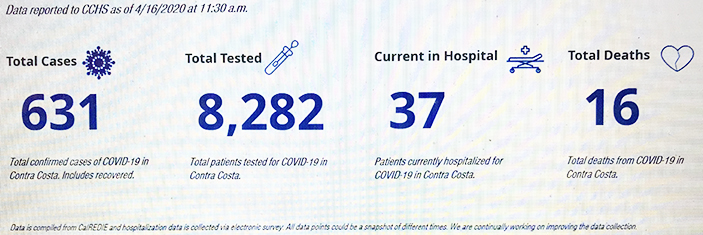
CC Health Services Coronavirus Dashboard statistics as of April 16, 2020 at 11:30 a.m.

By Allen Payton

As of Thursday, April 16, 2020 at 11:30 a.m. Contra Costa Health Services (CCHS) is reporting a total of 631 cases of COVID-19/coronavirus, and a total of 16 deaths in the county on their dashboard. There are 37 people diagnosed with the virus currently hospitalized.

There were 41 new cases reported on Monday, 16 more on Tuesday and 18 more cases reported on Wednesday.

Of those who have tested positive in the county, Antioch has a total of 46 cases.

A total of 8,282 people have been tested for the virus in the county.

The county’s coronavirus dashboard is now offering hospital information. It shows the daily Intensive Care Unit Occupancy Rate and Ventilator Utilization for all hospitals in the county.

The largest category of those who have been diagnosed with the virus continue to be people ages 41-60 with 227 cases, 188 cases for those age 21-40, 144 cases among those age 61-80, another 47 cases of those age 81-100 and 24 cases of those age 20 and under.

To see the all the statistics provided by CCHS, click here.

Contra Costa County delivers sanitation stations to slow COVID-19 in homeless camps

Thursday, April 16th, 2020


By Kim McCarl, Assistant to the Director, Communications, Contra Costa Health Services

Contra Costa County and several of its cities are working to reduce the spread of COVID-19 in local homeless encampments by placing handwashing stations and portable toilets near them.

Four handwashing stations and four portable toilets with attached handwashing stations were placed at Martinez’s Waterfront Amphitheater on Tuesday, the first of several sanitation equipment deliveries planned in coming days.

The stations were ordered through the Contra Costa County Emergency Operations Center in support of local cities that requested the assistance, including Antioch, Richmond and Walnut Creek.

“We must work proactively with our homeless population to reduce the spread of COVID-19, and to save lives,” said Candace Andersen, chair of the Contra Costa County Board of Supervisors. “People who lack housing are particularly vulnerable. Without running water, it is very difficult to wash your hands and practice the hygiene needed to reduce your risk of infection.”

City governments in Antioch, Richmond and Walnut Creek are now determining where to place as many as 10 handwashing or portable toilet stations each, based on locations frequented by residents in their communities who are experiencing homelessness.

“During this challenging time, we need to support each other. We have been working closely with all cities in Contra Costa to ensure they have what they need to meet the most pressing response needs at the local level,” said Supervisor Federal Glover, whose district includes Martinez.

Nearly 2,300 people need housing on any given night in Contra Costa, according to the most recent data available through the county’s annual homeless point-in-time count.

“Assisting people who need housing during this challenging time helps everyone,” Martinez City Councilmember Noralea Gipner said. “To flatten the curve and keep our healthcare system ready to respond, we need to reduce the risk of COVID-19 to the most vulnerable people in our community.”

CORE outreach teams from Contra Costa Health Services’ Division of Health, Housing and Homeless Services (H3) have been delivering sanitation supplies, such as hand sanitizer, to people living outdoors for several weeks to help improve sanitation at area homeless encampments.

H3 has also coordinating closely with county homeless service providers to identify clients who are at elevated risk due to age or health and place them in hotel rooms, and to temporarily transfer occupants of crowded shelters to hotels to better maintain physical distancing.

Through California’s Project Roomkey, H3 has secured 450 hotel rooms in the county for temporary use by homeless residents. As of Tuesday, no COVID-19 outbreaks have been reported at homeless shelters or service providers in Contra Costa County.

Visit cchealth.org/coronavirus to read the order or for more information about COVID-19.

County health officer suspends intakes, orders social distancing at homeless shelters

Tuesday, April 14th, 2020

ORDER OF THE HEALTH OFFICER OF THE COUNTY OF CONTRA COSTA

No. HO-COVID19-07

SUSPENDING INTAKES AT HOMELESS SHELTERS

SOCIAL DISTANCING AT HOMELESS SHELTERS

DATE OF ORDER: April 14, 2020   Please read this Order carefully. Violation of or failure to comply with this Order is a misdemeanor punishable by fine, imprisonment, or both. (California Health and Safety Code, § 120295.)

SUMMARY OF THE ORDER California is in a State of Emergency because of the Coronavirus Disease 2019 (COVID-19) pandemic. The spread of the novel coronavirus that causes COVID-19 is a substantial danger to the health of the public within the County of Contra Costa (“County”). COVID-19 can easily spread between people who are in close contact with one another. This Order is issued based on scientific evidence and best practices as currently known and available to protect vulnerable members of the public from avoidable risk of serious illness or death resulting from exposure to COVID-19. The age, condition, and health of a significant portion of the population of the County place it at risk for serious health complications, including death, from COVID-19. There is growing evidence of transmission risk from infected persons before the onset of symptoms. Thus, all individuals who contract COVID-19, regardless of their level of symptoms (none, mild or severe), may place other vulnerable members of the public at significant risk. Currently, there is no vaccine available to protect against COVID-19 and no specific treatment. The Health Officer of the County of Contra Costa has determined that there is an increased risk of COVID-19 among persons living in large homeless shelters, and that the shelters must be depopulated temporarily to help slow COVID-19’s spread and prevent the healthcare system in the County from being overwhelmed. On April 14, 2020, the depopulation of Bay Area Rescue Mission located at 200 Macdonald Avenue, Richmond CA 94801 (“the Shelter”), will commence.

UNDER THE AUTHORITY OF SECTIONS 101040 AND 120175 OF THE CALIFORNIA HEALTH AND SAFETY CODE, THE HEALTH OFFICER OF THE COUNTY OF CONTRA COSTA (“HEALTH OFFICER”) ORDERS:

  1. Commencing on April 14, 2020 at 2:00 p.m., the owner and operator of the Shelter (collectively “Shelter Operator”) and all staff members and volunteers who work in the Shelter shall suspend the intake of persons to reside at the Shelter, including but not limited to accepting applications, conducting interviews and background checks, or otherwise authorizing any person to stay overnight at the Shelter if the person is not a resident of the Shelter as of the time and date set forth above.
  2. To the extent that the Shelter Operator currently provides or arranges for services to be provided to residents of the Shelter or other homeless persons, other than providing space for overnight stays, those services may continue to be offered, but only on the condition that all participants practice social distancing as set forth in Paragraph 3.
  3. All residents of and other persons who enter the Shelter shall practice social distancing by remaining at least 6 feet away from all other persons while in the Shelter.
  4. This Order shall become effective at 2:00 p.m. on April 14, 2020 and will continue to be in effect until it is extended, rescinded, superseded, or amended in writing by the Health Officer.
  5. Copies of this Order shall promptly be: (1) made available at the Office of the Director of Contra Costa Health Services, 1220 Morello Avenue, Suite 200, Martinez, CA 94553; (2) posted on the Contra Costa Health Services website (https://www.cchealth.org); and (3) provided to any member of the public requesting a copy.
  6. If any provision of this Order or its application to any person or circumstance is held to be invalid, then the reminder of the Order, including the application of such part or provision to other persons or circumstances, shall not be affected and shall continue in full force and effect. To this end, the provisions of this Order are severable.
  7. Questions or comments regarding this Order may be directed to Contra Costa Health Services at (844) 729-8410.

IT IS SO ORDERED:

Chris Farnitano, M.D. Health Officer of the County of Contra Costa   Dated: April 14, 2020

Gov. Newsom unveils six indicators he will consider before modifying stay-at-home order

Tuesday, April 14th, 2020

SACRAMENTO (April 14, 2020) – Governor Gavin Newsom today unveiled six key indicators that will guide California’s thinking for when and how to modify the stay-at-home and other orders during the COVID-19 pandemic. (View presentation here)

The Governor noted that the progress in flattening the curve, increased preparedness of our health care delivery system and the effects of other COVID-19 interventions have yielded positive results. However, these actions have also impacted the economy, poverty and overall health care in California. Any consideration of modifying the stay-at-home order must be done using a gradual, science-based and data-driven framework.

“While Californians have stepped up in a big way to flatten the curve and buy us time to prepare to fight the virus, at some point in the future we will need to modify our stay-at-home order,” said Governor Newsom. “As we contemplate reopening parts of our state, we must be guided by science and data, and we must understand that things will look different than before.”

Until we build immunity, our actions will be aligned to achieve the following:

  • Ensure our ability to care for the sick within our hospitals;
  • Prevent infection in people who are at high risk for severe disease;
  • Build the capacity to protect the health and well-being of the public; and
  • Reduce social, emotional and economic disruptions

California’s six indicators for modifying the stay-at-home order are:

  • The ability to monitor and protect our communities through testing, contact tracing, isolating, and supporting those who are positive or exposed;
  • The ability to prevent infection in people who are at risk for more severe COVID-19;
  • The ability of the hospital and health systems to handle surges;
  • The ability to develop therapeutics to meet the demand;
  • The ability for businesses, schools, and childcare facilities to support physical distancing; and
  • The ability to determine when to reinstitute certain measures, such as the stay-at-home orders, if necessary.

The Governor said there is not a precise timeline for modifying the stay-at-home order, but that these six indicators will serve as the framework for making that decision.

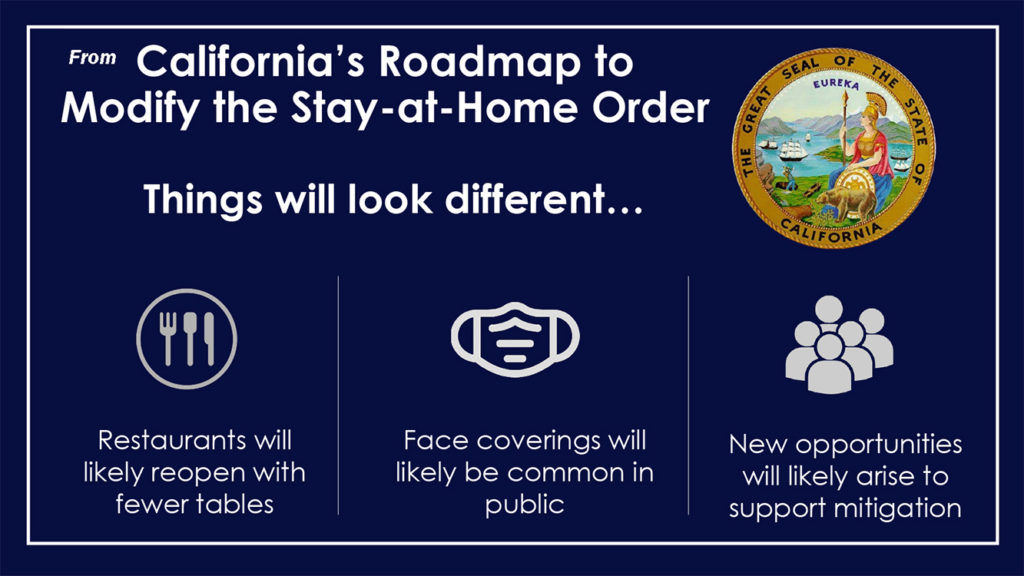
He also noted that things will look different as California makes modifications. For example, restaurants will have fewer tables and classrooms will be reconfigured.

For more information on California’s response, visit covid19.ca.gov.

Newsom, Oregon and Washington governors announce western states pact for reopening economies

Monday, April 13th, 2020

States agree region will move toward reopening based on health outcomes

Gov. Newsom. Photo: Office of the California Governor.

SACRAMENTO (April 13, 2020) — Today, California Governor Gavin Newsom, Oregon Governor Kate Brown and Washington Governor Jay Inslee announced an agreement on a shared vision for reopening their economies and controlling COVID-19 into the future.

Joint statement from the Governors:

“COVID-19 has preyed upon our interconnectedness. In the coming weeks, the West Coast will flip the script on COVID-19 – with our states acting in close coordination and collaboration to ensure the virus can never spread wildly in our communities.

We are announcing that California, Oregon and Washington have agreed to work together on a shared approach for reopening our economies – one that identifies clear indicators for communities to restart public life and business.

While each state is building a state-specific plan, our states have agreed to the following principles as we build out a West Coast framework:

Our residents’ health comes first. As home to one in six Americans and gateway to the rest of the world, the West Coast has an outsized stake in controlling and ultimately defeating COVID-19.

Health outcomes and science – not politics – will guide these decisions. Modifications to our states’ stay at home orders must be made based off our understanding of the total health impacts of COVID-19, including: the direct impact of the disease on our communities; the health impact of measures introduced to control the spread in communities —particularly felt by those already experiencing social disadvantage prior to COVID-19; and our health care systems’ ability to ensure care for those who may become sick with COVID-19 and other conditions. This effort will be guided by data. We need to see a decline in the rate of spread of the virus before large-scale reopening, and we will be working in coordination to identify the best metrics to guide this.

Our states will only be effective by working together. Each state will work with its local leaders and communities within its borders to understand what’s happening on the ground and adhere to our agreed upon approach.

Through quick and decisive action, each of our states has made significant progress in flattening the curve and slowing the spread of COVID-19 among the broader public. Now, our public health leaders will focus on four goals that will be critical for controlling the virus in the future.

  • Protecting vulnerable populations at risk for severe disease if infected. This includes a concerted effort to prevent and fight outbreaks in nursing homes and other long-term care facilities.
  • Ensuring an ability to care for those who may become sick with COVID-19 and other conditions. This will require adequate hospital surge capacity and supplies of personal protective equipment.
  • Mitigating the non-direct COVID-19 health impacts, particularly on disadvantaged communities.
  • Protecting the general public by ensuring any successful lifting of interventions includes the development of a system for testing, tracking and isolating. The states will work together to share best practices.

COVID-19 doesn’t follow state or national boundaries. It will take every level of government, working together, and a full picture of what’s happening on the ground.

In the coming days the governors, their staff and health officials will continue conversations about this regional pact to recovery.”

Contra Costa Health order requires masks, temperature checks for health facility visitors

Monday, April 13th, 2020

By Kim McCarl, Assistant to the Director, Communications, Contra Costa Health Services

Residential care and other licensed healthcare facilities in Contra Costa County must screen all staff and visitors for signs of illness and adhere to a strict masking policy, according to a new health officer order that begins Tuesday.

The order is intended to protect medically vulnerable patients and reduce the spread of COVID-19 within the facilities that care for them, Contra Costa Health Officer Dr. Chris Farnitano said.

“The age and health of many county residents, particularly those living in congregate care settings, places them at higher risk of serious health complications, including death, from COVID-19,” Farnitano said. “This order is another precaution we can take as a community to protect our vulnerable residents.”

The order applies to licensed residential care facilities, including nursing and senior care facilities, psychiatric facilities, group homes, residential recovery houses and homeless shelters.

Beginning Tuesday, April 14, anyone who is not a patient or resident at an applicable facility must submit to temperature and symptom screening, and facilities must exclude anyone who has had symptoms of respiratory illness or fever in the past seven days, or a temperature of 100 degrees Fahrenheit or higher.

The order does not apply to facility patients or residents, or people seeking care for their symptoms.

Facilities must now log screenings of staff and visitors, and staff and visitors must wear surgical masks, or cloth masks if surgical masks are not available, and practice physical distancing at the facility.

Facilities with known or suspected COVID-19 cases must notify emergency dispatchers and ambulance transporters of the presence of the virus at the facility, and the COVID-19 status of any patient transported to or from the facility.

Licensed care facilities are also now required to minimize the staffing of employees working at multiple facilities, and to keep records of any employees who worked at another healthcare facility during the previous 14 days.

Visit cchealth.org/coronavirus to read the order or for more information about COVID-19.