







Archive for the ‘Health’ Category

Union agreement with Kaiser will help healthcare workers treating COVID-19 patients

Monday, April 13th, 2020

80,000 workers who are members of the Coalition of Kaiser Permanente Unions covered by agreement

By Steve Trossman, Service Employees Union International

OAKLAND, Calif. – An agreement with healthcare giant Kaiser Permanente will ease some of the major burdens facing workers on the frontlines of the coronavirus pandemic, including assistance with childcare and temporary shelter, and extra leave for workers who are tested or diagnosed with COVID-19.
The measures provide support for 80,000 workers who are members of the Coalition of Kaiser Permanente Unions, more workers than covered by any such agreement in the nation. They apply to full-time, part-time and per-diem employees and can serve as a model for other hospitals and health systems to protect healthcare workers and the public.

“As healthcare workers in the middle of this pandemic, we know our duty is to our patients and the community, and we take that duty very seriously. But we can only give our best if we know our own lives and our families are protected as well,” said Juanita Kamhoot, who works in surgical survices at Kaiser Sunnyside Medical Center in Clackamas, OR. “This agreement will make a real difference at a time when we need every healthcare worker on the job and focused on taking care of COVID-19 patients.”

The agreement focuses on three key areas:

CHILD-CARE ASSISTANCE: With schools closed, many healthcare employees are having difficulty finding affordable childcare. Under the agreement, Kaiser employees who work 32 hours a week or more in a KP facility will be eligible for a grant of $300 per week to pay for childcare for children 14 or younger (and disabled, dependent children). It can be used to pay for their own caregiver (as long as they are not a spouse or domestic partner) or to find childcare outside of the home.

The stipend will last until May 31, 2020 and will be pro-rated for employees who work between 20 and 32 hours (including per-diem employees) with a minimum of $210 a week.

TEMPORARY SHELTER: Kaiser will work with several hotel chains to provide alternative shelter for employees who:

  • Test positive for COVID-19;
  • Work a double shift;
  • Work multiple 12-hour shifts;
  • Have fewer than 8 hours between shifts; or
  • Have a household member who either has COVID-19 or is in a CDC-defined vulnerable group.

Eligibility applies to all employees working at least 20 hours per week (including per-diem employees) at a KP facility between April 13 and May 31, 2020.

EIGHTY ADDITIONAL HOURS OF LEAVE FOR EMPLOYEES WHO TEST POSITIVE FOR COVID-19: Employees working at a KP facility more than 20 hours a week (including per-diem employees) who test positive for COVID-19 will receive up to 80 hours of administrative leave. This is above and beyond regularly accrued leave. Employees who are sent home from Kaiser and are awaiting a test result will also be covered.

The Coalition of Kaiser Permanente Unions comprises labor unions in California, Oregon, Washington, Colorado, Hawaii, Virginia, Maryland and the District of Columbia, representing more than 80,000 Kaiser caregivers. To learn more, visit https://www.unioncoalition.org/.

Rapid Response Fund formed to bring emergency relief to county residents impacted by COVID-19

Saturday, April 11th, 2020

Contra Costa Regional Health Foundation’s first round of grants will go to the Food Bank of Contra Costa and Solano, the Contra Costa Crisis Center, Shelter, Inc., Catholic Charities East Bay and White Pony Express

By Kim McCarl, Assistant to the Director, Communications, Contra Costa Health Services

MARTINEZ — Beyond its devastating health implications, COVID-19 is undermining basic living conditions for tens of thousands of people living in the Bay Area, especially those that are most vulnerable. The Contra Costa Regional Health Foundation (CCRHF) has established a COVID-19 Rapid Response Fund and has been selected as a lead partner organization in the newly formed COVID-19 Regional Response Fund supported by the Silicon Valley Community Foundation.  The COVID-19 Rapid Response Fund is also supported by the Chan Zuckerberg Initiative as well as individual donors.

The CCRHF Rapid Response Fund is moving quickly to help those individuals in desperate need. Locally, the Contra Costa Regional Health Foundation will play an important role in identifying highest risk populations and funding organizations to provide needed assistance.

“The economic impact of COVID-19 in the Bay Area is immense, with the biggest impact on people who have been living on the margins. These are families that can’t wait for government assistance in a few weeks, they are suffering and in jeopardy now,” explains CCRHF Chair Bette Felton. “Thanks to the amazing generosity of the Silicon Valley Community Foundation and the Chan Zuckerberg Initiative, as well as individual donors, we can now move rapidly, locate the organizations best suited to safeguard those people at high risk and make sure they have the funds and resources to help protect our communities.”

We understand this is a dynamic and changing situation.  Based on our understanding of the greatest needs at this time, the Fund is supporting four key areas: food distribution, financial assistance, shelter and emergency housing, and support for essential workers.

“Grants will be made on a timely basis to organizations best equipped to address these needs among the county’s most vulnerable populations. Given the urgency of the crisis, our priority is to find organizations with the proven capacity that can move quickly,” says Felton.

In light of that urgency, in its first round of funding, the CCRHF is extending grants to five organizations: the Food Bank of Contra Costa and Solano, the Contra Costa Crisis Center, Shelter, Inc., Catholic Charities East Bay and White Pony Express.  These initial grants will quickly amplify the impact these organizations are positioned to make.

Additional organizations will be considered in future funding cycles, based on:

  • the organization’s ability to reach populations most vulnerable to the economic or health risks posed by this public health crisis,
  • its capacity to move expeditiously and
  • the ability of the organization to deploy the funds expediently.

For additional information about the COVID-19 Rapid Response Fund and the Contra Costa Regional Health Foundation visit https://www.ccrhfcovid-19.org/

About the Contra Costa Regional Health Foundation

Established in 2003, the Contra Costa Regional Health Foundation is a 501 (c)3 non-profit organization that supports Contra Costa Health Services in its work to care for and improve the health of all the people in Contra Costa County with special attention to those who are the most vulnerable.

Contra Costa coronavirus Update: 2 more deaths for 11 total, 530 cases

Saturday, April 11th, 2020

From CCHealth.org

More cases in people ages 41-60 than any other age range

By Allen Payton

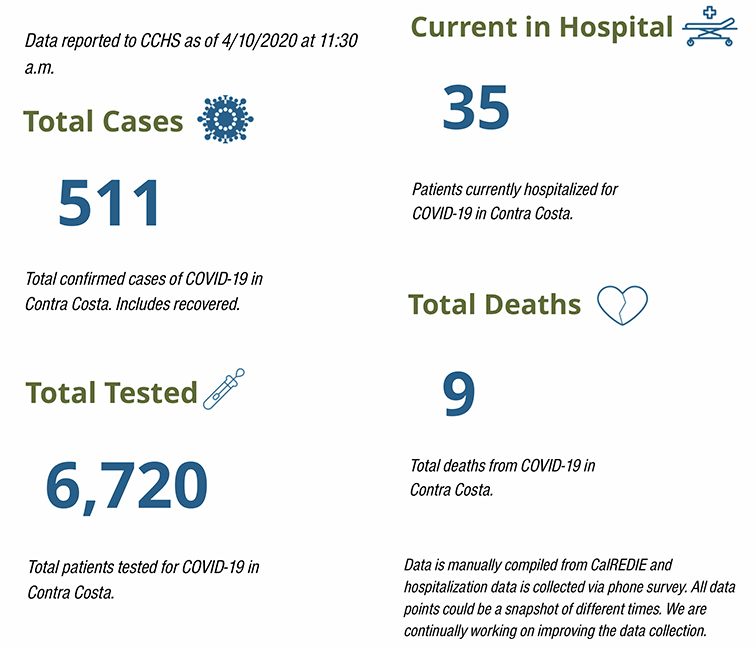
As of Saturday, April 11, 2020 at 11:30 a.m. Contra Costa Health Services (CCHS) is reporting a total of 530 cases of COVID-19/coronavirus, and two more deaths for a total of 11 in the county. There are 37 people diagnosed with the virus currently hospitalized. There are 38 cases in Antioch.

A total of 6,938 people have been tested for the virus. 

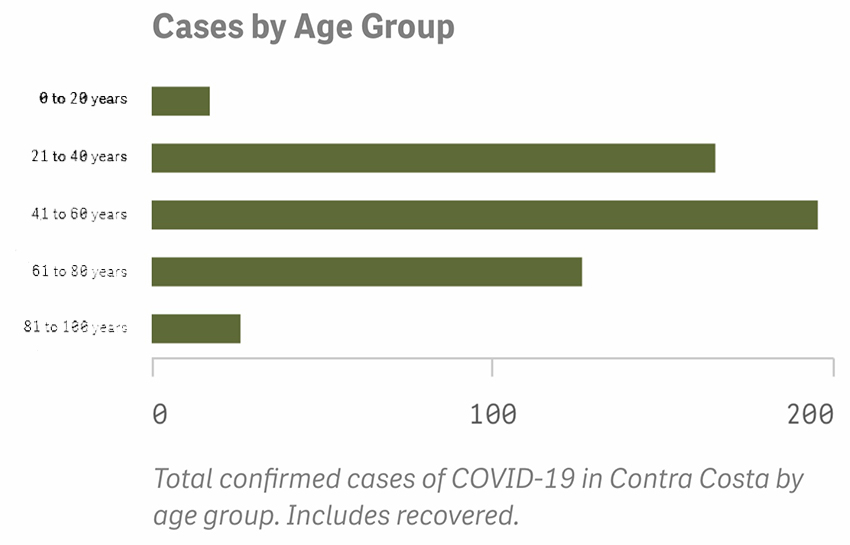
The majority of those who have been diagnosed are ages 41-60 with 195 cases, 165 cases for those ages 21-40, 126 cases among those ages 61-80, another 26 cases of those ages 81-100 and 17 cases of those age 20 and under.

To see the all the coronavirus statistics provided by CCHS, click here.

Contra Costa Event Park in Antioch to be converted into potential care site for COVID-19 patients

Friday, April 10th, 2020

By Kim McCarl, Assistant to the Director, Communications, Contra Costa Health Services

Contra Costa County is preparing to use the Contra Costa Event Park in Antioch as a site to care for COVID-19 patients, should the need arise.

As part of local emergency preparations, the county has been exploring and preparing “alternate care sites” in preparation for the likely surge of patients in local hospitals who test positive for Coronavirus (COVID-19). The building, which is normally used as an exhibit hall during the annual county fair, is located in the Contra Costa Event Park at 1201 W. 10th Street and has capacity for 43 people who test positive for COVID-19 and need medical care, but do not need to be hospitalized.

“The fairgrounds alternate care site is a great example of state, county, city and non-profit agencies coming together to create increased capacity to care for patients needing fewer resources, which frees up critical hospital beds in our healthcare system to fight COVID-19,” said Federal Glover, District V Supervisor.

Contra Costa and other Bay Area counties recently extended a regional stay-at-home order through May 3 hoping that continued physical-distancing measures will reduce the impact of COVID-19 on area hospitals.

“The Contra Costa Event Center, City of Antioch and the Red Cross really stepped up to help make this site happen,” said Diane Burgis, District III Supervisor. “This site would not be possible without their assistance.”

The Red Cross has shared expertise in standing up critical care sites for individuals displaced by emergency situations with County officials working on the Fairgrounds site.

“The Red Cross is proud to be working closely with our government and public health officials to support their efforts to keep our community safe with the planning and opening of the alternate care site in Antioch,” said Briana Taylor, Regional Disaster Chair for the American Red Cross Northern California Coastal Region. “It is impressive to see the whole community work together during this stressful time.”

The Craneway Pavilion in Richmond is equipped with 250 beds for COVID-positive patients who do not require hospitalization. Should a surge require the facility to open, COVID-positive patients are likely to be housed at the Craneway Pavilion first. (See related article) The Concord Shelter and Philip Doran Respite Center will house individuals who may not need hospitalization but require closer observation than provided at Craneway Pavilion. The county anticipates that Contra Costa Event Center will be the last facility to open.

“Although the City of Antioch did not request for the county to select a site within our city, we understand the gravity of the moment,” said Antioch Mayor Sean Wright. “In the fight to save lives, the world has been asked to step up and do more, Antioch is no exception to this reality. By working together, we will hopefully be able to minimize the number of lives lost to this horrible pandemic.”

The 23rd District Agricultural Association is home to the Contra Costa County Fair that has hosted hundreds of thousands of guests for over seventy-five years. The Event Park celebrates all that is best in Contra Costa County while preserving the agricultural heritage of the community.

“The Contra Costa Event Park is here to help the community during this time of need, and happy to work with the County of Contra Costa as we all work together to end this pandemic,” said Joe Brengle, chief executive officer of the Contra Costa Event Park.

“The county has been working in two of our buildings to prepare them should the need arise,” he told the Herald on Wednesday.

This year’s county fair was cancelled by the Fair Board on March 18. (See related article)

Contra Costa County and the Board of Supervisors continue to work in real time to respond to community needs while preparing to meet the challenges ahead.

Allen Payton contributed to this report.

Contra Costa Health Services reminds residents to observe religious practices at home this weekend – 9 deaths now reported in county

Friday, April 10th, 2020

Friday, April 10, 2020

Contra Costa Health Services (CCHS) reminds the public that county residents should observe their faiths at home while the health officer’s stay-at-home order remains in place, though this month is a time of significant religious activity for many people.

The health officer order, a measure to protect our community from the spread of COVID-19, requires Contra Costa residents to stay home except for essential trips, such as to find food, healthcare or to provide care for someone who cannot leave their home, or to go to and from an essential job.

The order lasts through May 3, a period that may affect important observances for many faiths, such as Good Friday, Holy Week, Orthodox Easter, Passover, Ramadan, and others.

“The COVID-19 pandemic has disrupted our lives, and we empathize with anyone who is unable to practice their religious traditions and celebrations as usual during this challenging time,” said Dr. Chris Farnitano, Contra Costa County Health Officer. “However, to protect everyone in the community, we must avoid gatherings outside of one’s immediate household to reduce the spread of the virus.”

CCHS thanks the county’s faith community for helping to keep their members safe from COVID-19 and urges faith leaders to continue to suspend in-person gatherings and not bring large groups of people together while the health order remains in place.

Suspending in-person gatherings does not mean suspending worship. Many organizations continue to observe together, through livestreaming or by watching recorded services online.

Learn more about COVID-19 in Contra Costa County, including how to protect yourself, at cchealth.org/coronavirus, or call the Contra Costa Coronavirus Call Center with questions at 1-844-729-8410. The call center is open daily from 8 a.m. to 5 p.m.

California Judicial Council adopts new rules to lower jail population, sets bail at $0, suspends evictions and foreclosures

Tuesday, April 7th, 2020

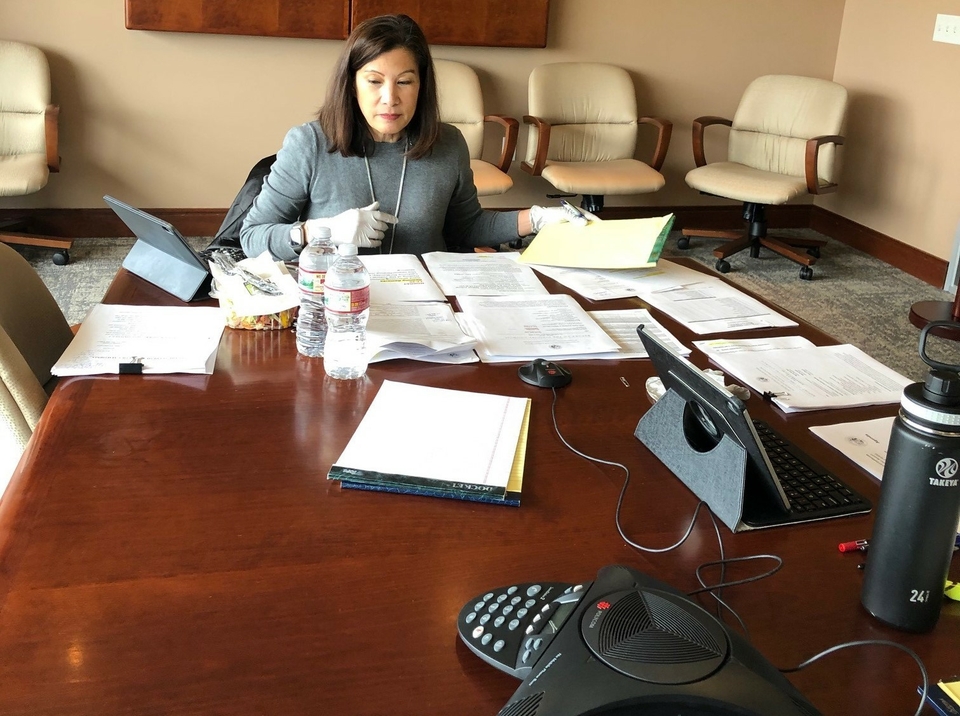
Judicial Council Chair, Chief Justice Tani G. Cantil-Sakauye ran the teleconference call from the council’s office in Sacramento. Photo by JCC.

11 temporary emergency rules include $0 statewide bail for misdemeanors and lower-level felonies during COVID-19 pandemic to “safely reduce jail populations”

By Blaine Corren, Senior Communications and Public Affairs Analyst, California Judicial Council

VIA TELECONFERENCE—At its meeting on Monday, April 6, 2020, the Judicial Council of California approved 11 temporary emergency rules, including setting bail statewide at $0 for misdemeanors and lower-level felonies to “safely reduce jail populations” and staying eviction and foreclosure proceedings to protect Californians from losing their homes during the COVID-19 pandemic.

This was the second emergency council meeting of court and branch leaders from around the state to consider further measures to ensure California courts—which remain open as “essential services” under Gov. Newsom’s stay-home executive order—can meet stringent health directives while also providing due process and access to justice.

“We are at this point truly with no guidance in history, law, or precedent,” said Chief Justice Tani Cantil-Sakauye, chair of the council. “And to say that there is no playbook is a gross understatement of the situation. In developing these rules, we listened to suggestions from our justice system partners, the public, and the courts, and we greatly appreciate all of the input. Working with our court stakeholders, I’m confident we can preserve the rule of law and protect the rights of victims, the accused, litigants, families and children, and all who seek justice. It’s truly a team effort.”

Members of the Judicial Council of California. Photo from 2018 by JCC.

The council received and considered more than 100 written comments on the new rules from judges, public defenders, district attorneys, law enforcement, legal aid and advocacy groups, unions, attorneys, court reporters, interpreters, and other justice system partners.

Among the actions the council approved, to go into effect immediately:

  • Suspend the entry of defaults in eviction cases;
  • Suspend judicial foreclosures;
  • Allow courts to require judicial proceedings and court operations be conducted remotely, with the defendant’s consent in criminal proceedings;
  • Adopt a statewide emergency bail schedule that sets bail at $0 for most misdemeanor and lower-level felony offenses;
  • Allow defendants to appear via counsel or remote technologies for pretrial criminal hearings;
  • Prioritize hearings and orders in juvenile justice proceedings and set a structure for remote hearings and continuances
  • Extend the timeframes for specified temporary restraining orders;
  • Extend the statutes of limitations governing civil actions; and
  • Allow electronic depositions in civil cases.

The council previously approved a number of temporary measures at its first emergency meeting Mar. 28 to give courts flexibility to continue to provide essential services to the public while protecting health and safety during the pandemic.

For a complete list of emergency orders taken by the California court system in response to the COVID-19 pandemic, see the California Courts Newsroom.

About the Judicial Council

Under the leadership of the Chief Justice and in accordance with the California Constitution, the council is responsible for ensuring the consistent, independent, impartial, and accessible administration of justice. Judicial Council staff implements the council’s policies.

Contra Costa coronavirus Update: Now 442 cases, 7 total deaths

Tuesday, April 7th, 2020

By Allen Payton

As of Tuesday, April 7, 2020 at 11:30 a.m. Contra Costa Health Services (CCHS) is reporting a total of 442 cases of COVID-19/coronavirus, and two more deaths for a total of 7 in the county. There are 29 people diagnosed with the virus currently hospitalized, a decrease of three since Friday.

A total of 5,831 people have been tested for the virus. To see the all the statistics provided by CCHS, click here.

Cancer Support Community reschedules 6th Annual Hope Walk due to COVID-19 shelter in place

Monday, April 6th, 2020

New Date is October 17, 2020

By Alexandra Rubin, Director of Communications, Cancer Support Community San Francisco Bay Area

WALNUT CREEK, April 6, 2020 – Cancer Support Community San Francisco Bay Area (CSC) has announced that their 6th annual Hope Walk, originally scheduled for May 16, has been rescheduled to October 17. The fun event, which is a major fundraiser for the organization, draws over 1,000 registered walkers and more than 70 exhibitors to Heather Farm Park each year.

“The Hope Walk is a way for our members, supporters, and the whole community to come out and celebrate the great work that Cancer Support Community does, which is helping people live longer and live better when faced with cancer,” said CSC’s Development Director and the event’s manager, Carol Louisell. “And, it’s just a really great time for families to get out and get some exercise along with music, entertainment, and a thousand friends!”

While the Hope Walk has had to be postponed due to the shelter-in-place order, CSC has been able to continue bringing support, hope, and healing to cancer patients and their caregivers without interruption. CSC started providing virtual support groups the same day the order was announced, on Monday, March 16. By the next week, CSC not only had very strong participation in support groups and individual counseling sessions – with their therapists and facilitators working from their homes – but also had moved many movement classes and some workshops online.

“This is exactly what our mission is,” said James Bouquin, CSC’s Chief Executive Officer. “We help people deal with the unexpected, dramatic crisis of cancer every day. It’s one of the most isolating of diseases, creating anxiety and fear. We are proud and profoundly grateful that we can continue to be a source of hope, community, and relief for our members.”

People can register for the walk and make donations at http://www.hopewalkbayarea.net/. All registrations for the May date will be transferred to the new date.

CSC’s gala, “An Evening of Hope and Healing,” is still scheduled for September 19. For information on either of these events, please contact Carol Louisell at clouisell@cancersupport.net.

About Cancer Support Community San Francisco Bay Area

Celebrating 30 years in the East Bay, Cancer Support Community provides comprehensive, integrative care—including counseling, support groups, nutrition training, exercise classes, and patient education programs—for people with cancer, their caregivers, and their families. Our evidence-based services enable cancer patients to partner with their medical teams to manage their treatment and recovery most effectively, increase their chances for survival, reduce their chances of recurrence, and provide for the highest possible quality of life. We never turn anyone away, and all of our services are always provided free of charge. With services provided at our Walnut Creek center, in local medical centers throughout the Bay Area, and now in Antioch, we serve more than 2,200 people annually.