







Hold labor negotiations with employee groups; appoint Parks & Rec Commissioners
By Jaden Baird, PIO, City of Antioch
During their meeting on Tuesday, May 12, 2026, the Antioch City Council will consider the following items:
4:00 PM – Closed Session
Conference with Labor Negotiators – Employee organizations: Management Unit, Treatment Plant Employees’ Association, Operating Engineers Local Union No. 3, Confidential Unit, Antioch Police Officers Association and Antioch Police Sworn Management Association.
5:00 PM – Special Meeting / Budget Study Session
User Fee Study
Fiscal Year 2026–27 Budget Development discussion and Council direction
This item was postponed from last Tuesday’s special meeting. (See related article)
Source: City of Antioch
7:00 PM – Regular City Council Meeting
Proclamations:
National Police Week
National Public Works Week
Mental Health Awareness Month
Presentations:
• Accessory Dwelling Units (ADU) Community & Workforce Partnership
• BART Alternative Service Plan Update
Key Council Agenda Items:
Parks and Recreation Commission appointments
Citywide landscape maintenance services agreement
Throughout the City’s rights-of-way and medians, to Elite Maintenance & Tree Service for the period July 1, 2026 through June 30, 2029, in the amount of $4,176,983, with an option to extend an additional two fiscal years in the amount of $2,849,660, for a total contract amount not to exceed $7,026,643 over the five (5) year period.
Procedures for responding to technological disruptions during meetings (SB 707)
Report on new State housing laws (AB 130 & SB 131)
Additional Items of Interest:
Code enforcement staffing updates
Laurel Ranch Townhomes easement agreements
Meeting Details
Meetings are held in the Council Chambers at City Hall at 200 H Street in historic, downtown Rivertown and are broadcast live on Comcast Channel 24, AT&T U-verse Channel 99, and streamed online on the City’s website.
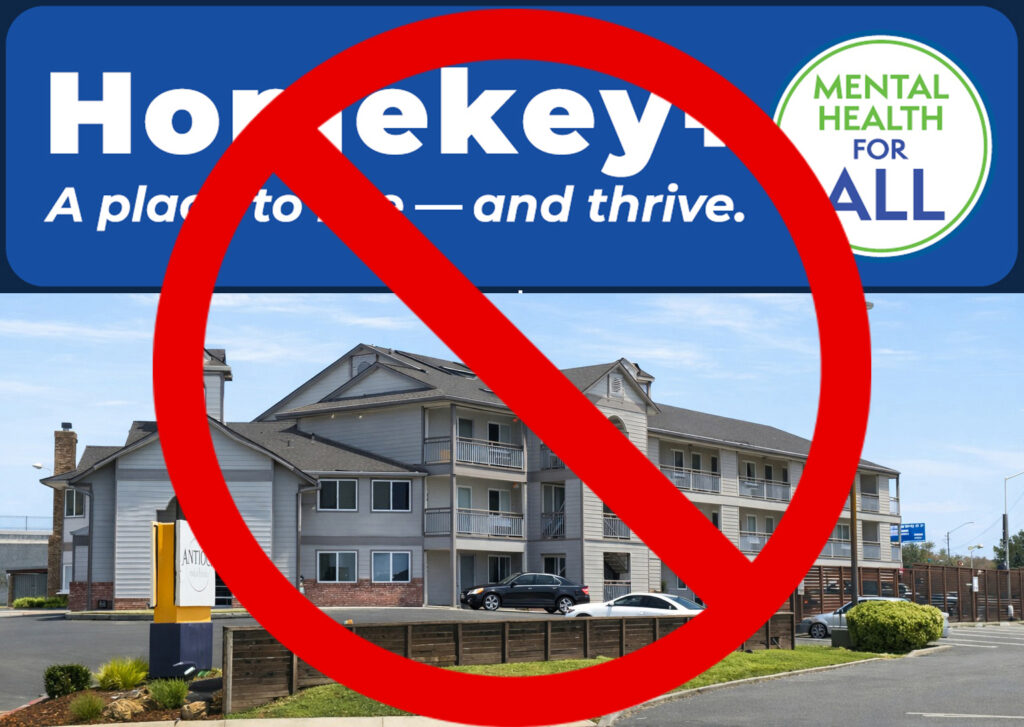
Antioch Inn & Suites formerly Comfort Inn located across from the Lowe’s store on Mahogany Way. Photos courtesy of Mike Barbanica
Governor Newsom announces $111 million in voter-approved Prop 1 funding to communities to get people off the streets and connected to mental health care
To date, Homekey+ has created 50 supportive housing projects with 2,471 affordable homes —including 620 homes for veterans
By Office of the Governor of California
SACRAMENTO – Building on California’s strategies leading to a 9% reduction of unsheltered homelessness last year, Governor Gavin Newsom today announced the award of voter-approved Proposition 1 funding to create another six affordable housing communities including one in Antioch. The communities are part of the state’s Homekey+ program to expand supportive housing and behavioral health services statewide. Today’s announcement creates 307 new permanent supportive homes to provide stability for veterans and other Californians who are experiencing or at risk of homelessness and living with behavioral health challenges.
Last year, the Antioch City Council approved purchase of the hotel, formerly the Comfort Inn, now, the Antioch Inn & Suites, “to serve as permanent housing for homeless families/individuals with prior behavioral health issues” and veterans. But it’s still operating as a hotel. Recently, the Council discussed using the location for the unhoused voucher program and a possible site for a warming center but did not pursue either use.
Our state investments have launched critical programs for local communities to help get vulnerable people off the streets and into housing and care. Together, we’re breaking cycles of homelessness that took decades to create — and we’re doing it with urgency, compassion, and accountability.
Governor Gavin Newsom
Governor Newsom is the first governor to have prioritized new housing, homeless, and mental health programs, and is turning around the impacts of this national crisis on California, leading the first reduction in unsheltered homelessness in more than 15 years.
More than 1.2 million adults in California live with a serious mental illness, and 1 in 10 residents meet the criteria for a substance use disorder, greatly increasing their odds of experiencing homelessness.
Proposition 1, advanced by the Governor in partnership with the Legislature and approved by voters in 2024, helps local communities provide vital care and housing for these vulnerable residents. Prop 1 is transforming California’s behavioral health systems with a $6.4 billion Behavioral Health Bond for housing, services, and treatment for veterans and people experiencing homelessness, including $2.25 billion through Homekey+ to serve individuals with mental health or substance use challenges and veterans.
“Proposition 1 and Homekey+ funds are supporting communities throughout California by investing in affordable homes with supportive services,” said Business, Consumer Services and Housing Agency Secretary Tomiquia Moss. “The homes created through today’s awards will provide stability and dignity to Californians most in need.”
With today’s awards, Homekey+ has so far allocated $858.8 million to support 50 permanent supportive housing projects that will create 2,471 affordable homes throughout California for individuals experiencing or at risk of homelessness with behavioral health challenges. Of these homes, 620 are reserved for veterans.
“Each new Homekey+ award means more than housing. It means stability, dignity, and a fresh start for veterans in need,” said CalVet Secretary Lindsey Sin. “With 75 more veterans’ homes in this round, and 620 total veterans’ units across 50 projects, we are seeing the real impact of strong partnerships and a shared commitment to those who served. CalVet is proud to continue working alongside the California Department of Housing and Community Development and local partners to turn these projects into places where veterans can rebuild their lives.”
Approximately $1.033 billion in Proposition 1 bond funds are currently available through Homekey+ to cities, counties, housing authorities, and tribal entities for permanent supportive housing projects serving veterans. Another $1.11 billion is available for projects serving all target populations, through a combination of Proposition 1 bond funds and Homeless Housing, Assistance, and Prevention Program (HHAP) funds.
In addition to supportive affordable housing through Homekey+ and HHAP, through Proposition 1 bonds, the state is also funding 6,800 residential treatment beds and 26,700 outpatient treatment slots for behavioral health.
“HCD is working with CalVet to advance California voters’ vision for a state in which people with mental health challenges have the services and support they need to succeed in a life lived off the streets,” said HCD Director Gustavo Velasquez. “We have reached a point where the numbers are reflecting the cumulative impact of our programs, and we look forward to building on those successes under the soon-to-be California Housing and Homeless Agency.”
The Homekey+ awards announced today total $111 million to create 307 homes across six projects, with 75 units for veterans and six manager units:
The City of Antioch in partnership with California Supportive Housing, will receive nearly $34.9 million in Homekey+ funds to acquire and rehabilitate a hotel into 85 homes, including one manager’s unit. The project will set aside 21 units for veterans and 21 units for transitional age youth. The development known as CSH Mahogany Housing is conveniently located near two bus stops and a busy commercial area that offers amenities such as a grocery store, pharmacy, restaurants, retail stores, and two major medical centers. It is located on Mahogany Way near Auto Center Drive, adjacent to Highway 4 across from Lowe’s.
The City of Cudahy in partnership with National Community Renaissance of California and Prima Development, will receive just under $8 million in Homekey+ funding to fill a financing gap for Amanda Villas. The project will have a total of 140 homes, including two manager’s units. The project dedicates 69 units to individuals experiencing chronic homelessness, 18 of which are designated as Homekey+ units for people facing a behavioral health challenge. In addition to Homekey+ funds, HCD’s Multifamily Finance Super NOFA Program awarded $6.7 million in 2023. Project-based rental subsidies of $33.1 million have been committed by the Los Angeles County Development Authority.
The County of Fresno, in partnership with UP Holdings California, LLC and RHCB Development LP, will receive just over $27 million in Homekey+ funding for Sendero Commons, a new construction project with 88 homes, including one manager’s unit. The project dedicates 45 units to veterans. HCD’s No Place Like Home program awarded $10 million in 2022. The Homekey+ award will fill the financing gap and replace the need for tax credits.
The Housing Authority of the City of Los Angeles, in partnership with The RightWay Foundation, will receive more than $12.5 million in Homekey+ funding to acquire two newly constructed buildings with a total of 33 homes, including two manager’s units, to serve youth who are experiencing or at risk of homelessness with a behavioral health challenge. All units include a kitchen and private bathroom
The City of Los Angeles, in partnership with National Community Renaissance of California, will receive $15.6 million in Homekey+ funding to rehabilitate a motel into Huntington Villas, with 52 homes for individuals experiencing homelessness with a behavioral health challenge and one manager’s unit. The project also has funding and rental subsidy commitments from Los Angeles County.
The County of Santa Barbara, in partnership with DignityMoves, will receive a Homekey+ award of just over $11.7 million to build the 30-home Calle Real Family Village to serve veterans, youth, and other Californians experiencing or at risk of homelessness, as well as one on-site manager. Nine units are dedicated for veterans, with three of those reserved for veterans aged 18-24. The project will utilize modular units and include indoor and outdoor community spaces. It is located within one-half mile of transportation stops, a medical clinic.
This adds to state investments made by the administration and Legislature since 2019 to help local communities address homelessness, including the launch of the first-in-the-nation Homekey program that has funded nearly 16,000 homes across more than 250 projects that will house an estimated 172,000 Californians over the projects’ lifetimes; $4.95 billion through current and previous rounds of the HHAP Program; $2.2 billion through Homekey+ to serve individuals with mental health or substance use challenges and veterans; $1 billion in Encampment Resolution Funds to provide services and housing to help 23,000 individuals across 120 encampment sites transition from homelessness.
The Homekey+ NOFA allocates funding by region based on a proportionate share of veterans and others experiencing homelessness, and by share of extremely low-income households whose rent is more than half of their income. There are also allocations for rural projects and for projects serving youth experiencing or at risk of homelessness. Homekey+ applications will continue to be reviewed and approved on a rolling basis.
Reversing a decades-in-the-making crisis
From the very first moments of the Newsom administration, California has approached the decades-in-the-making housing and homelessness crisis with focus and urgency. No other state has devoted as much time and attention to these twin problems – and California is a leader in producing positive results. Governor Newsom, in partnership with the Legislature, has continued to make progress in reversing decades of inaction, leading to a 9% reduction in unsheltered homelessness, a first in more than 15 years:
Expanding shelter and support — Providing funding and programs for local governments, coupled with strong accountability measures to ensure that each local government is doing its share to build housing, and create shelter and support, so that people living in encampments have a safe place to go.
Addressing mental health and its impact on homelessness — Ending a long-standing 7,000-bed shortfall in California’s behavioral health system by rapidly expanding community treatment centers and permanent supportive housing units. In 2024, voters approved Governor Newsom’s Proposition 1, which is transforming California’s behavioral health systems. It is estimated that funding from Proposition 1 will create 6,800 residential treatment beds and 26,700 outpatient treatment slots for behavioral health care.
Creating new pathways for those who need the most help — Updating conservatorship laws for the first time in 50 years to include people who are unable to provide for their personal safety or necessary medical care, in addition to food, clothing, or shelter, due to either severe substance use disorder or serious mental health illness. Creating a new CARE court system that creates court-administered plans for up to 24 months to help people struggling with schizophrenia and other psychotic disorders, often with substance use challenges, get the treatment and housing they need to recover and thrive.
Streamlining and prioritizing building of new housing — Governor Newsom made creating more housing a state priority for the first time in history. He has signed into law groundbreaking reforms to break down systemic barriers that have stood in the way of building the housing Californians need, including broad CEQA reforms.
Removing dangerous encampments — Governor Newsom has set a strong expectation for all local governments to address encampments in their communities and help connect people with support. In 2024, Governor Newsom filed an amicus brief with the Supreme Court defending communities’ authority to clear encampments. After the Supreme Court affirmed local authority, Governor Newsom issued an executive order directing state entities and urging local governments to clear encampments and connect people with support, using a state-tested model that helps ensure encampments are addressed humanely and people are given adequate notice and support.
The Antioch School Board meeting on May 6, 2026, was held in the Deer Valley High School Theater to accommodate an expected large attendance by teachers, staff and the public. But that did not materialize. Photos by Allen D. Payton
“It would be unconscionable that we would be taking away livelihoods without readjusting pay scales, first.” – Board Vice President Olga Cobos-Smith
No public comments allowed before failed vote on budget cuts, but allowed before staff cut votes
“It is painful to make cuts. But it is more painful when local control is lost and folks who think we’ve saved their jobs, they’re actually not saved, now.” – Board President Dr. Jag Lathan
“Please do not solve this deficit on the backs of students with disabilities, families and the staff who serve them.” – Antioch resident
By Allen D. Payton
In spite of the Antioch Unified School District facing a $32 million deficit, during a long meeting, sparsely attended by the public, Wednesday night, May 6, 2026, the Board of Trustees on split votes, opposed the proposed $18.7 million in budget cuts and staff cuts of 175 positions. Only Board President and Area 2 Trustee Dr. Jag Lathan and Area 1 Trustee Antonio Hernandez voted for the cuts. Board Vice President and Area 4 Trustee Olga Cobos-Smith, Area 3 Trustee Dee Brown and Area 5 Trustee Mary Rocha voted against.
The meeting was held in the Deer Valley High School Theater with the expectation of greater attendance than the District’s Board Room could accommodate. But that turned out to not be necessary.
Vote #1 – Budget Cuts
For agenda item 6.A., Resolution 2025-2026-61 entitled, “Adoption of Proposed Budget Reductions for the 2026-27 Fiscal Year”. That resolution read: “NOW, THEREFORE, BE IT RESOLVED, the District is recommending that the Board of Education adopt the proposed 2026-27 budget reductions of $18,759,069 for the 2026-27 budget in support of its fiscal solvency goals and the restoration and retention of the mandatory 3.0% Reserve for Economic Uncertainties required under California Education Code 33128.3.”
Hernandez moved approval of the resolution under item 6.A., seconded by Lathan. Without public comment on the agenda item, or discussion or comments by the board members, and Lathan ignoring a call of a point of order from the member of the public, the trustees voted on the motion to adopt and it failed on a 2-3 vote.
Vote #2 – Teachers & Other Certificated Staff Cuts
The final person to speak during 29 minutes of public comments on agenda items 6.B. and C., said, “Please do not solve this deficit on the backs of students with disabilities, families and the staff who serve them.”
The board then took up item 6.B. and Hernandez spoke first saying, “For today, I have to do what I believe is fiscally prudent…to put our district in the best light,” before the vote on Resolution No. 2025-2026-58. It was entitled “Adopting the Administrative Law Judge Decision and Authorizing Final Layoff of Certificated Employees Due to Reduction or Discontinuance of Particular Kinds of Services.”
Brown said she wanted information on “what the fall start was going to look like” so she and Cobos-Smith could present it to the community, first. “I didn’t get that information. I’m still waiting for that information,” Brown continued. “I don’t want to make a vote on something rushed, for me. I cannot make haste decisions. That’s just who I am and this is a huge decision. So, I will be voting ‘no’,” she concluded.
Rocha, who presented her fellow trustees and District staff with her opposition to the cuts which was provided to and published by the Herald, yesterday, simply said, “I will be voting ‘no’. So, go ahead.” (See related article)
Lathan responded saying, “I’m really concerned. I’ve seen this play out. Although, in the end…it is painful to make cuts. But it is more painful when local control is lost and folks who think we’ve saved their jobs, they’re actually not saved, now.”
The motion to adopt the resolution to cut 78 teachers and other Certificated employee positions was made by Hernandez and seconded by Lathan. It read in part, “BE IT FURTHER RESOLVED that the employment of the affected certificated employees listed on Exhibit Ais hereby terminated effective upon the close of the current school year, i.e., the end of each affected employee’s last working day prior to July 1, 2026.” The motion also failed on a 2-3 vote with the same split of trustees.
Vote #3 – Classified Staff Cuts
Hernandez moved approval of item 6.C., Resolution No. 2025-2026-60, entitled, “Reduction or Discontinuance of Classified Services in Accordance with Administrative Law Judge Decision” with Lathan seconding the motion.
Before the vote, Hernandez said, “Again, I hope that we have more time. But, you know, I have to vote yes and move this forward. Because at least with all the information I have now, this is our only financial decision moving forward.”
Cobos-Smith responded by saying, “And I’ll also reiterate my point. It would be unconscionable that we would be taking away livelihoods without readjusting pay scales, first.”
The resolution to cut 97.4964 Full Time Equivalent Classified employee positions “for lack of work or lack of funds” included, “BE IT FURTHER RESOLVED that the employment of the affected classified employees listed on Exhibit Ais hereby terminated effective upon the close of the current school year, i.e., the end of each affected employee’s last working day prior to July 1, 2026.” The motion to adopt was also moved by Hernandez and seconded by Lathan and it failed on a 2-3 vote, with the same two trustees voting in favor and three voting against.
The Board then did not vote to cancel the May 13th regular school board meeting as the motion by Rocha did not receive a second.
“If we’re going to do any kind of reductions in staffing it has to be done by May 15th. So, that will be our last opportunity to do that,” Hernandez said. Lathan confirmed his information. Rocha then withdrew her motion.
Watch the Board meeting video on the District’s YouTube channel. See the votes beginning at the 2:13:20 and 2:50:19 marks.
AUSD staff presentation cover for Board of Trustees meeting on May 6, 2026. Source: AUSD
“to address the District’s structural deficit” of $32 million
Meeting in Deer Valley High Theater
Rocha issues statement challenging cuts
By Allen D. Payton
During their meeting tonight, Wednesday, May 6, 2026, the Antioch School Board will vote on over $18.7 million in cuts for the 2026-27 School Year budget which will include eliminating 48 teaching and 30 other Certificated employee positions and over 97 other staff positions in the Antioch Unified School District.
To accommodate what is expected to be an attendance larger than the Board Room can hold, the meeting will be held beginning at 7:00 p.m. in the Deer Valley High School Theater at 4700 Lone Tree Way.
The regular meeting will follow a Closed Session at 6:00 p.m. in which the Board will hold labor negotiations with various employee groups including the Antioch Education Association representing the District’s teachers; California School Employees Association, Chapter 85 which consists of what are referred to as the Classified employees; Antioch Management Association and Senior Management.

Source: AUSD
Regular Agenda
Under agenda 6. Action Items, the Board will consider three matters:
B. Resolution No. 2025-2026-58, Adopting the Administrative Law Judge Decision and Authorizing Final Layoff of Certificated Employees Due to Reduction or Discontinuance of Particular Kinds of Services; and
C. Approval of Resolution No. 2025-2026-60, Reduction or Discontinuance of Classified Services in Accordance with Administrative Law Judge Decision.
According to the District staff presentation for Item 6.A., entitled “2026-27 Proposed Budget Reduction Plan”, the Board is being asked to “approve the proposed budget reductions and fiscal actions to address the District’s structural deficit of $32 million and support ongoing financial stability” with “Estimated savings of $18,759,069 beginning in 2026–2027, with ongoing multiyear impact.”
The proposals include eliminating 78 Full Time Equivalent (FTE) Certificated positions, including 15 elementary, 10 secondary and 23 other teachers, plus, three vice principals saving approximately $10,147,363.58. An additional 97.4964 FTE cuts to Classified or other staff are proposed for a total of approximately $7,454,787.84. (See Draft Resolutions here and here).
The proposed Budget Reduction Resolution also includes “approximately $24,000,000 potential reduction for Fiscal Year 2027–28 and 2028-29.”
Source: AUSD
The Proposed Budget Reductions presentation includes lists of Academic and Fiscal Pressures the District is facing:
Academic Pressures
• Ongoing need to improve student achievement and close learning gaps
• Increased demand for targeted interventions and support services
• Staffing needs to maintain reasonable class sizes and program quality
• Expanded services for special education, multilingual learners, and at-risk students
• Mental health, counseling, and student wellness supports
• Maintaining breadth of programs (CTE, arts, athletics, enrichment)
• State accountability requirements and performance expectations, and
• Recruitment and retention of qualified teachers and staff
• Declining or fluctuating enrollment impacting revenue
• Uncertainty in state funding and economic conditions
• Inflationary increases in operating costs (utilities, transportation, materials)
• Limited flexibility due to restricted funding sources
• One-time funds expiring (e.g., pandemic relief), and
• Need to maintain adequate reserves and avoid state intervention
Source: AUSD
Rocha Issues “Concerns Regarding Proposed Budget Reductions and Impact on Students”
Serving in what is expected to be her final year of her final term, Area 5 Trustee Mary Rocha will present the following letter to her fellow board members during the meeting tonight:
Dear Superintendent and Fellow Board Members,
As elected members of this Board, we were entrusted by our community to serve the best interests of our students while exercising fiscal responsibility, accountability, and sound educational judgment. Our role is not only to oversee the financial health of the district, but also to ensure that decisions made today do not compromise the educational opportunities, wellbeing, and future success of the students we were elected to serve.
After reviewing the information presented regarding the proposed reductions intended to save approximately $18 million, I believe there are significant concerns that require further clarification and thoughtful consideration before moving forward.
The proposed reductions include the removal of coordinators, teachers, paraprofessionals, wellness staff, and other essential personnel whose work directly supports students and school operations on a daily basis. These are not peripheral positions; they are integral to maintaining academic support systems, student engagement, school safety, and equitable access to learning.
Additionally, reducing the number of teachers will inevitably increase classroom sizes unless the district is anticipating a substantial decline in enrollment, of which the Board and community have not yet been fully informed. Larger class sizes limit individualized instruction, reduce teacher accessibility, and may negatively impact student achievement and classroom climate.
I am also deeply concerned about the proposed closure of wellness centers. These centers serve as critical support spaces for students experiencing emotional, behavioral, or mental health challenges during the school day. If wellness centers are eliminated, what is the district’s plan to ensure students continue receiving these supports? Will school counselors be expected to absorb these responsibilities in addition to their current academic and counseling caseloads? If so, has an analysis been conducted regarding the feasibility and impact of such expectations?
Equally important are the implications surrounding the reduction or removal of English Language Development services. English learners depend on specialized instructional support in order to acquire the language skills necessary to access curriculum across all grade levels and subject areas. If these services are reduced, who will assume responsibility for ensuring these students receive the support required for academic success and compliance with educational obligations?
Most importantly, I respectfully ask: where is the written plan demonstrating that these proposed $18 million in reductions will not negatively affect students? Before approving cuts of this magnitude, I believe the Board and the community deserve to see a comprehensive impact analysis outlining how student learning, student wellbeing, academic outcomes, and equitable access to services will be preserved for approximately 17,000 students across the district.
As Board members, we must ensure that financial decisions remain aligned with our educational mission and responsibilities to students, families, staff, and the broader community. Fiscal stewardship is essential; however, it must be balanced with our obligation to protect the instructional and support systems that students rely upon every day.
I respectfully urge that we continue these discussions transparently, collaboratively, and with a student-centered focus before final decisions are made.
Antioch City Manager Bessie Scott’s performance will be evaluated by the city council Tuesday afternoon, May 5, 2026. Photo: City of Antioch
Deal with possible lawsuit by city employee during special meeting before another budget study session
Staff does not provide baseline budget to council as requested but shows annual deficits for this, next two years
By Allen D. Payton
CORRECTION: This reporter and members of the community misinterpreted the intent of the agenda items for today’s City Council Closed Session meeting. Because nothing was agendized to discipline or release a city employee, it was not possible for the Council to discuss terminating City Manager Scott.
During a special afternoon Closed Session meeting today, Tuesday, May 5, 2026, the Antioch City Council will discuss City Manager Bessie Scott’s performance evaluation, then deal with a potential lawsuit from an unnamed city employee and appoint an interim city manager. That means Scott could be placed on paid leave. That meeting begins at 4:00 p.m. It will be followed by another budget session at 5:30 p.m.

Scott started in October 2024 and just completed 19 months in her position out of her two-year contract. As previously reported, she was hired on a split, 3-2 City Council vote in August 2024.

The fact that City staff did not provide “a baseline budget that represents only the required minimum municipal services that the City has to provide” for the 2026-27 Fiscal Year, as requested by the mayor, according to the staff report for the Budget Study Session, that may be one of the reasons for the Council’s actions.
The Closed Session agenda reads as follows:
1) PUBLIC EMPLOYEE PERFORMANCE EVALUATION: CITY MANAGER.
This closed session is authorized pursuant to California Government Code section 54957(b)(1).
2) CONFERENCE WITH LEGAL COUNSEL- SIGNIFICANT EXPOSURE TO LITIGATION. The city is in receipt of facts and circumstances that might result in litigation against the City which are known to a potential plaintiff and that pertain to potential employment-related claims by the potential plaintiff against the City. This closed session is authorized pursuant to California Government Code sections 54956.9(d)(2) and 54956.9(e)(2). Number of cases: One.
3) PUBLIC EMPLOYEE APPOINTMENT: ACTING CITY MANAGER. This closed session is authorized pursuant to California Government Code section 54957.
The legal matter may be a possible lawsuit by Scott if she is being terminated for cause and the council doesn’t plan to pay her six months of severance included in her contract. But that is mere speculation as the agenda provides no other information to the public.
Mayor Ron Bernal and the four council members were asked why they’re holding a meeting to fire the city manager and hire an acting city manager at 4:00 p.m. when most people can’t attend. They were also asked why now when she only has six more months on her contract.
Only Freitas responded with, “They Mayor is responsible for setting the agenda. And, due to confidentiality I am legally prevented from discussing this matter with you.”
Additional efforts to reach Bernal and efforts to reach Scott were unsuccessful prior to publication time.
Adjustments from City Council meeting on April 28, 2026. Source: City of Antioch
Budget Study Session – Includes Deficits for This, Following Two years
For the special Budget Study Session beginning at 5:30 p.m., City staff did not provided the Council with the requested baseline budget. The staff report for the one agenda item reads, “At the Special Meeting of April 21, 2026, the Mayor requested that staff provide a baseline budget that represents only the required minimum municipal services that the City has to provide; to then afford the City Council to layer upon that budget to address priorities. As stated by the City Manager and Finance Director, with only 9 weeks to go until the City is required to adopt a budget, this is an impossible exercise to complete in such a short time frame to ensure we have time to research legal mandates as well as do a thorough review of departmental expenditures for what ‘qualify’ as the bare minimum and what is considered to be beyond the minimum. Should Council want to pursue this budget process, it is recommended to start this in August for building the Fiscal Year 2027-28 budget and potential mid-year adjustment for Fiscal Year 2026-27.”
Furthermore, the staff report reads, “With the budget as presented this evening, Council will need to determine what the acceptable level of deficit they are willing to proceed with and potentially direct specific cuts to incorporate if the Council is not willing to adopt this budget.”
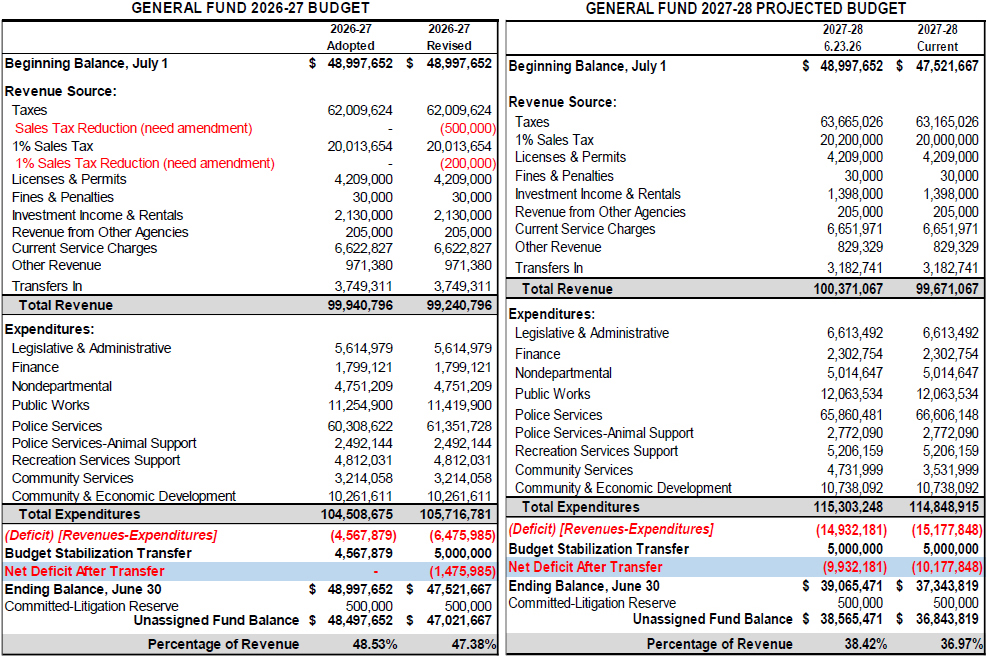
Included in the proposed budget are the adjustments the Council proposed at their meeting on April 28th which amount to almost $2.4 million in cuts, plus, the $5 million transfer from the Budget Stabilization Fund.
Source: City of Antioch
Even with those cuts and an annual transfer of $5 million from the Budget Stabilization Fund, the General Fund Budget Summary shows an ending deficit for this year of $4.7 million, proposed for the 2026-27 Fiscal Year of $6.5 million and projected for the 2027-27 Fiscal Year of $13.4 million.
The Closed Session will begin and the Budget Study Session will be held in the Council Chambers at City Hall located at 200 H Street in Antioch’s historic, downtown Rivertown. They can also be viewed via livestream on the City’s website, on Comcast Cable Channel 24 or AT&T U-verse Channel 99 and a recording posted later on the City’s YouTube Channel. The public can speak before the Closed Session to give input prior to the council adjourning to the closed door meeting.
Oversight Committee not holding Council accountable to 80-10-10 split
By Allen D. Payton
The City of Antioch is supposed to be spending the funds from Measure W’s one-cent sales tax measure, passed by the voters in November 2018, on an 80-10-10 split, with 80% for maintaining public safety, 10% for youth services and the remaining 10% to support quality of life, and fiscal stability and accountability. However, the 2023-24 budget spent only 60% of Measure W funds on police, last year’s budget increased the amount to 65.4% and the current fiscal year’s City budget allocated 70%. Plus, last year’s budget only allocated 4.6% to Youth Network Services.
Funds in Fiscal Year 2024-25 instead were spent on Code Enforcement and homeless services, as well as street lighting and landscaping.
According to the adopted 2025-26 City Budget, “The adopted fiscal year 2023-25 budget allocated 60% of funds to the Police Department, 20% to Quality of Life and 20% to Youth. For fiscal year 2025-26, City Council is allocating 70% to the Police Department, 15% to Quality of Life and 15% to Youth” ignoring the original intent of the council that voted to place the measure on the ballot.
City of Antioch Measure W Funding allocations FY25 versus FY26 Budgets. Source: City of Antioch
Sales Tax Citizens’ Oversight Committee Report
According to the Sales Tax Citizens’ Oversight Committee Fiscal Year 2024-25 Annual Report on Measure W provided to the City Council on March 24, 2026 (relegated to the Consent Calendar under agenda item 5.N.), “In FY24, the City received $20,160,685 in Measure W revenue and allocated funds at 60% Police, 20% Quality of Life, and 20% Youth.”
For the fiscal year that ended June 30, 2025, “The largest share of Measure W funds—65.4%, or $13,077,475—was directed to the Antioch Police Department. These funds supported a portion of police personnel costs ($40,376,709 in total department personnel expenditures) and services and supplies ($11,436,353). Measure W revenue represents approximately 24.5% of the Police Department’s total FY25 expenditures of $53,413,941, sustaining patrol operations, 911 response capacity, and related public safety services.”
Also, according to the report, the other Measure W revenues were spent in FY 2024-25 in order of greatest amount to least, as follows:
Recreation 15.4%;
Code Enforcement 8.6%;
Youth Network Services 4.6%;
Quality of Life 4.4%; and
Landscape Enhancements 1.6%
Source: City of Antioch Sales Tax Citizens’ Oversight Committee FY2024-25 Report.
2024-25 Measure W Expenditure Report Details
Under section 3 entitled, “Alignment with City Council Stated Priorities” the report offers details for each of those expenditure categories, but does not identify which council stated the priorities nor cite when that occurred. The report reads as follows:
Youth Violence Prevention and Community Safety
The Public Safety and Community Resources (PSCR) Department received $878,748 (100% Measure W funded) for Quality of Life programs. Within the department’s broader operation, the Violence Intervention and Prevention unit had a budget of $281,094 with $137,814 expended, during the fiscal year while the Housing and Homelessness unit budgeted $351,575 and expended $207,645. Community Engagement budgeted $27,697 with $27,629 expended. These programs directly address community safety, violence intervention, and quality of life for Antioch residents.
Youth Afterschool and Summer Programs
A combined total of $3,998,811 in Measure W funds supported youth-focused programs. Youth Network Services received $919,813 (100% Measure W funded) for personnel ($477,538) and services and supplies ($442,275). Recreation received $3,078,998, representing 46.7% of the department’s total expenditures. Recreation’s programs include youth afterschool activities, summer programming, and community recreation services.
Code Enforcement and Community Cleanup
Code Enforcement received $1,714,021 in Measure W funds, constituting 81.6% of the division’s total expenditures. The division’s work addresses illegal dumping, nuisance abatement, and property maintenance standards—directly supporting the Council’s priorities of cleaning up parks and combating blight. Personnel costs totaled $1,785,197, with services and supplies at $314,916.
Landscape Enhancements
A total of $325,000 (100% Measure W funded) was transferred to the Lighting and Landscape Districts for maintenance and enhancements across the city’s public landscaped areas, contributing to park and neighborhood beautification.
History of Measure W
As previously reported, during their meeting on Tuesday, July 24, 2018, the Antioch City Council voted 5-0 to place a ballot measure that would extend and double the transaction and use tax, or sales tax, permanently from the half-cent sales tax of Measure C, passed in 2013, to one cent. (See related article)
The council members discussed the draft version of the proposed one-cent sales tax measure. It allocated 60% of revenue for the maintenance of public safety, 20% for youth services, and the remaining 20% for supporting quality of life and fiscal stability and accountability.
But during the meeting the council discussed changing these amounts from percentages of 60-20-20 to an 80-10-10 allocation had the support of three council members. That split was advocated for by both Councilwoman Lori Ogorchock, who included it in her motion which was seconded by Councilman Tony Tiscareno, and Mayor Sean Wright during his comments.
20-Year Sunset Clause, Public Oversight Added
Then during a special meeting on August 7, 20218, the Council on a 3-2 split vote, approved adding a 20-year sunset clause and including language to continue the Citizens Sales Tax Oversight Committee to the measure with then-Mayor Pro Tem Lamar Thorpe and Councilwoman Monica Wilson voting against. Placing the measure on the ballot required a two-thirds vote of the council, or favorable votes by four of the five councilmembers.
The council held another meeting two days later on August 9th at which the two who opposed it switched course. They joined the other three councilmembers for a unanimous, 5-0 vote to included both the 20-year sunset clause and citizens oversight language in the ballot measure.
Council Meeting Minutes on Measure W Votes
According to the minutes of the council meeting on July 24, 2018, the original motion is reported as follows:
“Councilmember Ogorchock moved to 1) Adopt the resolution of the City Council of the City of Antioch Calling for a Municipal Election on November 6, 2018 to Request City Voters Extend and increase the City’s Transaction and Use Tax from One-Half Cent to One Cent to Provide for Public Safety and 911 Service, Support Youth, and Maintain Other Quality of Life Services; and, 2) Enact an Ordinance of the City Council of the City of Antioch Submitting a Proposition to The Voters of the City of Antioch to Amend Article 4 of Chapter 5 of Title 3 of the Antioch Municipal Code to Increase the City’s Transactions and Use Tax from a Half Cent to One Cent and to Impose This Tax Until Repealed by the Voters. 3) Maintain Public Safety target for Antioch Police Department at 80 percent, support youth services 10 percent, support quality of life/fiscal stability and accountability at 10 percent.
Councilmember Tiscareno seconded the motion”
In addition, the minutes read, “Mayor Wright…noted that he would support 80 percent of the tax being allocated to public safety.”
However, following input from the city attorney and city clerk, the motion adopted by the council did not include specific allocation figures. According to the meeting’s minutes for the item: “Following discussion, Councilmember Ogorchock amended her motion. Councilmember Tiscareno agreed to second the amended motion, which was approved as follows:
“On motion by Councilmember Ogorchock, seconded by Councilmember Tiscareno, the City Council unanimously 1) Adopted a Resolution of the City Council of the City of Antioch Calling for a Municipal Election on November 6, 2018 to Request City Voters Extend and Increase the City’s Transaction and Use Tax from One-Half Cent to One Cent to Provide for Public Safety and 911 Service, Support Youth, and Maintain “Other Quality of Life Services; and 2) Enacted an Ordinance of the City Council of the City of Antioch Submitting a Measure to The Voters of the City of Antioch to Amend Article 4 of Chapter 5 of Title 3 of the Antioch Municipal Code to Increase the City’s Transactions and Use Tax from a Half Cent to One Cent and to Impose This Tax Until Repealed by the Voters. With the following changes:
Amending the Ordinance under the ‘Now, Therefore, Be It Resolved’ to read: ‘that the People of Antioch do ordain as follows:’
Striking the word ‘Proposition’ from the Ordinance and replacing it with ‘Measure’.”
Again, the additional clauses adding a 20-year sunset and citizen oversight to the measure were adopted at later meetings in 2018 before the measure’s final language was placed on the ballot.
Measure W Ballot Language
The final ballot language included in the measure which passed with 66.11% of the vote but only needed a simple, 50% plus, one vote was as follows: Antioch’s Quality of Life Measure. To maintain Antioch’s fiscal stability, police patrols, 911 emergency response, youth violence prevention programs; ensuring water quality/safety; repairing streets; cleaning up parks/illegal dumping; restoring youth afterschool/summer programs; other essential services; shall the measure be adopted approving an ordinance to renew the sales tax at the one-cent rate, raising approximately $14,000,000 annually, expiring in twenty years, with mandatory annual independent financial audits, and independent citizens oversight?
Although the first motion to place Measure W on the ballot, which had majority council support, included the 80-10-10 split, it is not part of the actual ballot language, meaning the city council is not bound by those amounts and can spend the funds in any way they deem necessary.
Page 2 of the Antioch Herald October 2018 edition.
Yes on W Campaign Message
Yet, that’s how the measure was sold to the voters and how Antioch residents expect the funds to be spent.
Since the measure passed, the new Department of Public Safety and Community Resources was formed, with attempts by some council members to redefine and expand the meaning of “public safety” in Antioch to include more than just police services. Yet, the campaign in support of Measure W was very specific.
In a letter to the editor on Oct. 30, 2018, then-Mayor Wright wrote, “Measure W gives us a choice to increase our financial ability to make our community safer, create more activities for our youth after school and to improve our quality of life.”
Plus, in a Yes on W campaign ad run on page two of the Antioch Herald October 2018 edition, under “The Whys on W” headline it read, “Maintaining 911 police response and number of officers patrolling the streets.” At the time, there were 97 sworn officers on the Antioch Police force.
That was in spite of the commitment by the city council of hiring 22 more police “immediately” from the funds generated by Measure C, the half-cent sales tax precursor to Measure W, which passed in 2013 when there were 90 sworn officers on the force.
The ad also offered the other Whys, including, “Maintaining quality of life and financial stability; Ensuring water quality and safety; Cleaning up illegal dumping; and Restoring after school and summer programs for youth.”
Committee’s Incorrect Claims
While the Oversight Committee’s report claims, “Expenditures across all funded departments were within budgeted amounts for FY25, demonstrating sound fiscal management of Measure W resources,” it’s clear the revenues have been not been appropriately allocated. In fact, past and current councils have been robbing Peter to pay Paul, as the old saying goes, which is what those who opposed the measure were afraid of.
Furthermore, the committee concluded its report claiming, “Measure W revenues for FY25 were expended in a manner consistent with the City Council’s stated priorities,” they’re ignoring the fact the council majority at the time they voted to place the measure on the ballot supported the 80-10-10 allocation split. So, even if the city council has since then, or in 2024 before adopting the FY 2024-25 budget, voted to change the allocation split of Measure W revenues, the funds were not “expended in a manner consistent with the City Council’s stated priorities” and are definitely out of alignment with the original intent.
Committee Needs to Represent and Advocate for Original Intent of the Council, Will of the Voters
Every year, the Oversight Committee’s report should include the city council’s original intent of allocating the revenue from Measure W on an 80-10-10 split and remind the current council members and public of that fact. Simply reporting how the council and City spent the funds based on information provided by City staff isn’t good enough. They need to hold the current council members accountable and advocate on behalf of the voters and residents of Antioch that they fulfill that intent. Otherwise, what’s the point of having an oversight committee? The members need to remember that although they were appointed to the committee by the city council, they’re not there to please the council but to represent the will of the people. Hopefully, the five new members who are expected to soon be appointed will.
Measure W funds listed as “1% Sales Tax” under Revenue Source. Source: City of Antioch
Council Needs to Return to Original Intent of Measure W Revenue Allocation
As the city council works to finalize the Fiscal Year 2026-27 budget they need to be reminded of the original intent of the allocation of Measure W revenues and increase the amount being spent on police to 80%. While it’s good the council has expressed support for increasing the total number of sworn officers on the Antioch Police force, the allocation of the correct percentage of Measure W funds should be a key part of that. The good news is the projected revenue from Measure W for the next fiscal year is expected to increase by almost $120,000 to a little over $20.1 million. So, that will help some and it makes the math simple: $16.08 million to police, $2.01 million to youth services and $2.01 million to quality of life budget items. It all comes down to priorities.
Application deadline for 5 vacancies: Friday, May 1st
By City of Antioch
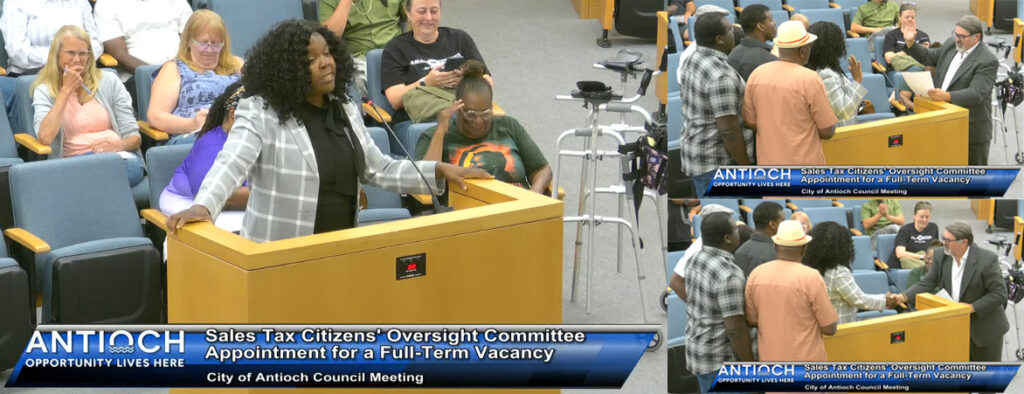
The City of Antioch encourages residents to become involved in their local community. One way to do so is to serve on one of the various Boards, Commissions, and Committees. Any interested resident is invited to apply for the following vacancies by Extended Deadline Date: 5:00 p.m., Friday, May 1, 2026.
SALES TAX CITIZENS’ OVERSIGHT COMMITTEE
Three (3) Full-Term Vacancies, expiring March 2030
Two (2) Part-Term Vacancies, expiring March 2028
The Sales Tax Citizens’ Oversight Committee shall review the expenditures and report publicly how the funds from the City’s Measure W one-cent sales tax are being used to address the City Council’s stated priorities of maintaining Antioch’s fiscal stability, police patrols, 911 emergency response, youth violence prevention programs; ensuring water quality/safety; repairing streets; cleaning up parks/illegal dumping; restoring youth afterschool/summer programs; and other essential services. Each year, an independent auditor shall complete a public audit report of the revenue raised and its expenditure. The Committee’s review shall be completed in conjunction with the City’s budget process. The Committee’s report on its review, whether oral or written, shall be considered by the City Council at a public meeting before April 1 of each year. Any written report shall be a matter of public record.
The Council’s intent of Measure W is to split the revenue on the following basis: 80% for the maintenance of public safety, 10% for youth services, and the remaining 10% for supporting quality of life and fiscal stability and accountability. The sales tax passed by Antioch voters in November 2018 lasts for 20 years. (See related Herald articles here, here and here)
The official ballot measure language reads: “Antioch’s Quality of Life Measure. To maintain Antioch’s fiscal stability, police patrols, 911 emergency response, youth violence prevention programs; ensuring water quality/safety; repairing streets; cleaning up parks/illegal dumping; restoring youth afterschool/summer programs; other essential services; shall the measure be adopted approving an ordinance to renew the sales tax at the one-cent rate, raising approximately $14,000,000 annually, expiring in twenty years, with mandatory annual independent financial audits, and independent citizens oversight?”
Committee Seats: Seven (7) Members, 4-year terms.
Meetings: The Committee shall meet at least twice a year.
Staff Liaison: Dawn Merchant, City of Antioch Finance Director
Requirements:
Must be a resident of the City of Antioch.
At least one member of the Committee shall have a financial, accounting or auditing background.
Commissioners are required to submit the Fair Political Practices Commission (FPPC) Form 700 (Statement of Economic Interests) upon assuming office, and every year thereafter.
Commissioners are required to complete a 2-hour online AB1234 Ethics course within one year of their appointment.
Newly appointed and reappointed Members are required to take an Oath of Office administered by the City Clerk.
To be considered for the vacancy position(s), please complete an application and submit it to the City Clerk’s Office by the deadline date listed above. Applications are located on the City’s Website: www.antiochca.gov and may be picked up in person at Antioch City Hall, 200 H Street, Antioch, CA.
Please email your completed application to: cityclerk@antiochca.gov. You can also drop off your application (Attn: City Clerk) in the water billing drop-off box located in the parking lot just outside of Antioch City Hall.
Plus, this year’s National Night Out and Sister City activities; but no mention of Holiday Delites Celebration
By Allen D. Payton
During their special meeting budget workshop on Tuesday, April 21, 2026, the Antioch City Council directed staff to keep funding for four community events and activities. They include this year’s Juneteenth celebration, the July 4th celebration on the nation’s 250th Independence Day and the National Night Out event. Also, the council protected funding for this year’s Sister City activities with Chichibu, Japan.
While reviewing a list of Deficit Reduction Proposals from city staff, Council postponed decisions for several of the items asking for more information from staff, first. Those are expected at a Budget Session before next Tuesday’s regular Council meeting.
Council’s decisions on the Deficit Reduction Proposals for FY 2026-27 budget. Source: City of Antioch
“Since we’re hosting, this year, I’ll say ‘no’,” Mayor Pro Tem and District 3 Councilman Don Freitas said to the recommendation to “Pause Sister City Activities.” The other three council members and Mayor Ron Bernal agreed.
Following are the costs to the City’s General Fund budget for the four items:
Juneteenth – $54,606, which includes vendors, supplies and police staffing;
July 4th – $157,586, which includes fireworks, vendors, supplies and police staffing;
National Night Out – $3,842 for police overtime; and
Sister City activities – $15,000
City Finance Director Dawn Merchant asked the council members to confirm they were agreeing to only fund the three events, plus, Sister City activities, they each responded, “Yes.”
However, none of the council members or staff mentioned the annual Holiday Delites Celebration in December which wasn’t on the list for cutting. A question asking about funding for that event was sent to council members and staff.
UPDATE: Later, Bernal responded, “Forgot about that one. I’m sure we can add it when we do our next study session.”