Archive for the ‘City Council’ Category

Antioch council to consider requiring large grocery stores give workers hazard pay of $3-$5 per hour more Tuesday night

Monday, April 12th, 2021

Will also consider forming a “Police Reform Standing Committee of the Whole City Council” to handle complaints against police officers.

Also expected to hire San Francisco firm to handle branding of new downtown dining district without giving local companies the opportunity

By Allen Payton

During their meeting tomorrow night, Tuesday, April 13, 2021, the Antioch City Council will consider an urgency ordinance that will require large grocery stores pay their employees an additional $3.00 to $5.00 per hour for “hazard pay” during the COVID-19 pandemic. That’s in spite of the fact Councilwoman Tamisha Torres-Walker, who proposed the ordinance, is wanting to attract a grocery store into District 1 which she represents, north of Highway 4, where the now closed Lucky’s store was located on E. 18th Street. It’s also in spite of the fact that Governor Newsom has announced the state expects to completely reopen just two months from now on June 15.  (See entire agenda, here)

In addition, the council will consider formalizing the process for notifications by the Antioch Police Department of significant events that occur in the city. The council will also consider forming a “Police Reform Standing Committee of the Whole City Council to handle complaints against police officers and “review Antioch Police Department (APO) policies, including those that pertain to use of force.”

Also on the agenda is a $40,000 contract for branding the city’s proposed new waterfront dining district, with Evviva Brands, the same San Francisco-based company that was hired to rebrand the city with a new logo and advertising, for which the city spent over $400,000. The contract was not sent out to bid to give local advertising and branding agencies the opportunity to do the work.

Hazard Pay for Grocery Store Workers

Modeled after Concord’s ordinance, the proposed Antioch urgency ordinance for grocery stores with over 300 employees to pay their workers “hazard pay” for 120 days or until Contra Costa County enters the lowest risk level – Yellow Tier under State Health orders whichever is later. According to the city staff report, the purpose of the ordinance is “to compensate grocery retail workers for the clear and present dangers of doing their jobs as essential workers during the Covid-19 pandemic.” Urgency Ord Lg Grocery Stores Temp Hazard Pay ACC041321

The ordinance was proposed by Torres-Walker during a previous council meeting. She was asked if she would also be proposing the same for garbage collectors, restaurant employees, hospital employees, dentist office employees and anyone else required to work in essential businesses that interact with the public during this time of COVID-19. Torres-Walker was also asked if the ordinance will hurt her efforts to bring another grocery store to her district, but she did not respond before publication time. (Please check back later for any updates to this report.)

The staff report also points out if the council adopts such an ordinance that “it is highly likely” the city will be sued by the California Grocers Association and “that the City will incur significant legal costs in defense of the ordinance, and potential exposure to attorney’s fees if the litigation is successful.”

The council meeting will begin with a study session for Fiscal Years 2021-23 budget development at 5:30 p.m. followed by the regular council meeting at 7:00 p.m. It can be viewed via Comcast channel 24, AT&T U-verse channel 99, or live stream on the city’s website at www.antiochca.gov/government/city-council-meetings/live/.

If you wish to provide a written public comment, you may do so any of the following ways by 3:30 p.m. the day of the Council Meeting: (1) Fill out an online speaker card, located at https://www.antiochca.gov/speaker_card, or (2) Email the City Clerk’s Department a tcityclerk@ci.antioch.ca.us.

To provide oral public comments during the meeting, click the following link to register in advance to access the meeting via Zoom Webinar: https://www.antiochca.gov/speakers. You may also provide an oral public comment by dialing (925) 776-3057. To ensure that the City Council receives your comments, you must submit your comments in writing by 3:30 p.m. the day of the City Council Meeting.

Antioch mayor offers annual State of the City address virtually

Thursday, April 8th, 2021

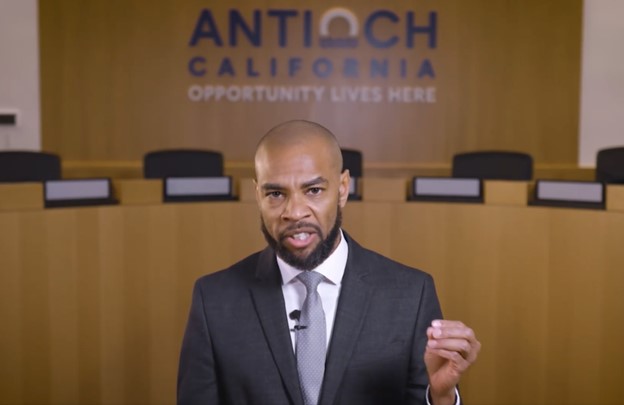
Antioch Mayor Lamar Thorpe offered his State of the City 2021 address on Wed., April 7. Video screenshot

Plans to introduce legislative package for youth in May for “aiding school system in improving overall academic achievement and safety”

By Allen Payton

Without any prior announcement, Antioch Mayor Lamar Thorpe posted a video of his 2021 State of the City address on his mayor’s Facebook page on Wednesday, April 7. He then also emailed it on Thursday afternoon from his campaign email address. The Herald learned of it in a message to this reporter’s personal email account. Filmed inside the refurbished Council Chambers, no one was in attendance, including other council members nor members of the media.

Asked why there was no presentation by City Manager Ron Bernal or Chief of Police Tammany Brooks, and no slide shows as in past years, Thorpe did not respond.

Following are his prepared remarks:

“As our city and the world begin to see the light at the end of the tunnel from the largest pandemic in our lifetime, we cannot deny that the world has changed dramatically.

Equally, as a result of COVID-19, we cannot ignore the fact that over half a million Americans have lost their lives, including Antioch residents. And, we cannot also forget the countless more who have been impacted by the pain and suffering of having contracted COVID 19 and the pain and suffering of having to close a business or lose a job.

2020 was a difficult year, and 2021 is proving to be just as difficult but I come to you with a message of hope.

When I ran for mayor in the midst of the pandemic, I did so because I have never stopped believing in our city, and what we can accomplish when we work together.

Throughout this pandemic, our city has worked hard to provide you with some level of comfort.

From putting a hold on evictions to providing small business grants and establishing vaccination sites, our city has been focused on a better tomorrow.

As critical as our COVID response has been, as a new mayor, I also know the importance of keeping focus and ensuring that every aspect of our city government is working to best serve you.

A few months ago, in my first address to our community, I told you, there is nothing, absolutely nothing anyone can tell me that Antioch and its people cannot do. I meant every word it.

Within my first 90 days as mayor, along with the support of the City Council, we have passed the first phase of the largest police reform package in the City’s history.

For the first time, and frankly, decades overdue, our city’s police officers will be equipped with body-worn cameras. Every police vehicle will be outfitted with dash cameras.  This will ensure increased public transparency and accountability.

In that same spirit, I have a message for police officers from other agencies who have violated the public’s trust, don’t even bother to apply to the Antioch Police Department. We’re currently improving our hiring practices to weed individuals who have no business being police officers.  Antioch will not be a stop for officers with troubled pasts.

We all value the work of our police officers. We value it so much that the public has placed much responsibility on our police to solve all of our problems. That’s not right and it’s not fair to our men and women working to protect our community. From homeless to mental health, the public has started to redefine law enforcement as social work.

We’re working to undo this unfair burden placed on our police department so that they can better focus on preventing and fighting crime.

Thank my colleagues for moving forward with a proposal to build a citywide mental health crisis response team to ensure our city is responding to your needs in an appropriate manner.

Dispatching our police officers to chase unhoused residents from corner to corner is gross mismanagement of our city’s limited resources. If you are at home watching this message, you understand the privilege of having a place to call home.

For that reason, I want to ensure that our unhoused neighbors have the same experience.

That is the dignity of having a place to call home.

I’m committed to ensuring we stabilize the chronically homeless and move them towards permanent housing. There are many reasons why this is the right thing to do but no other reason comes close to the fact that we’re talking about human beings who only deserve to be treated as human beings.

There are some who will be upset with me and my colleagues. That’s fine. I will personally sleep well at night knowing we’re fighting to treat people with humanity.

While eliminating these responsibilities from our police department is critical for public safety, we can’t naively believe that the police department can prevent crime all on its own. They can’t. They need you, they need me, they need the entire community to be engaged in developing community violence solutions strategies particularly around gun violence.

We have seen our fair share and enough is enough. We have to get to the root of this problem.

That being said, another group that has gone chiefly ignored by the city is children under the age of 18, which happens to make up a third of Antioch’s population.

Youth development is a top priority for me and my council colleagues. I’m currently working on developing a legislative package for May related to youth that will be directly tied to aiding our school system in improving overall academic achievement and safety.

As a city, we must recognize that Antioch, like our children, is growing up.

We have gone from a small town just off of the Delta to now being the largest growing city in Contra Costa.

This growth is bringing new opportunities.

New ideas.

And very much like how the Delta meets the San Francisco Bay, the Antioch that was and the Antioch of now is occurring.

I recognize that, to some in our community, this change can be a bit overwhelming.

But allow me the opportunity to extend my hand to you and say: ‘I chose Antioch for the same reason you chose it. Because this is the city where I bought my home and am raising my daughter.’

If we all lead with the understanding that Antioch called us because it was our land of opportunity, and a place where we can raise our children, I am certain that many of the walls that exist will evaporate under the shared experience of wanting a place to call home.

There is more that unites us than divides us.

Regardless of who is in the White House, let us remember that we all have to live together.

The national debate does not determine how our parks are funded.

It does not determine how we keep our streets clean or support our small businesses.

What determines that, is what we do when we work together.

Imagine how much more we can accomplish when we come together as a community and focus on what unites us.

As we continue working towards a new normal, I recognize that the road ahead will still have hurdles that our city must overcome in order to truly make our city the best version of itself that it can be.

But I step on that path with the full faith and optimism that every single one of us wants what is best for our city.

In closing, thank you for providing me with the honor of being your mayor.”


State says Measure T’s growth limitations in Antioch’s Sand Creek area “cannot…be adopted, implemented or enforced”

Thursday, April 1st, 2021

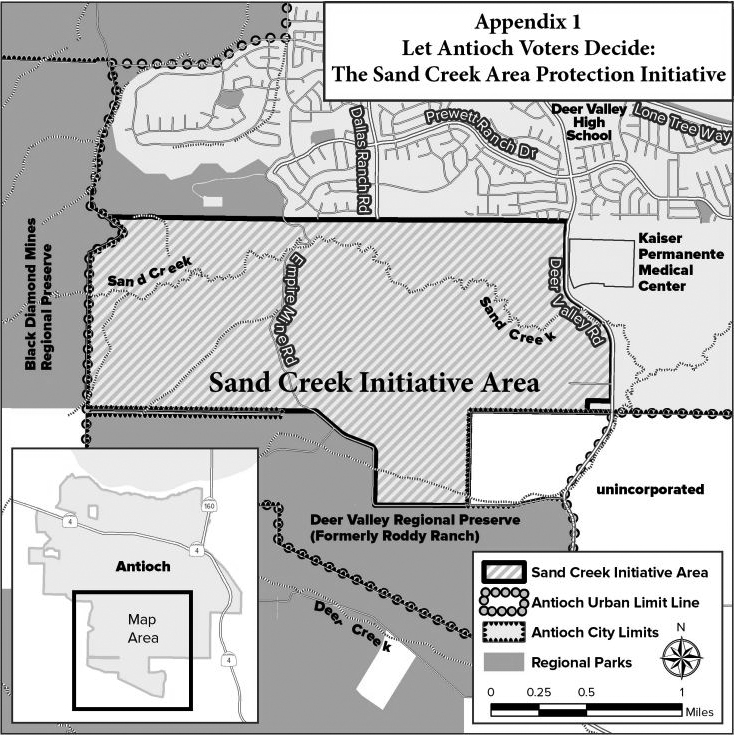
The Let Antioch Voters Decide: The Sand Creek Area Protection Initiative known as Measure T on the November 2020 ballot cannot be implemented.

Violates state law known as SB330, the Housing Crisis Act of 2019

Would have devalued property by over 99%, downzoning it from 2 homes per acre to 1 home per 80 acres

Cities and counties must approve new homes or face hefty fines which will fund low-income housing

By Allen Payton

As was reported in news articles and an editorial by the Herald during the 2020 fall election campaign, the state has issued an opinion letter confirming that the residential growth limitations in Measure T on the November ballot, “cannot permissibly be adopted, implemented or enforced.” That’s due to the passage of SB330, the Housing Crisis Act of 2019, which went into effect on Jan. 1, 2020, also as previously reported. Known as the Let Antioch Voters Decide: The Sand Creek Protection Initiative, the measure passed by almost 79% of the vote.

SB330 added Section 66300 to California Government Code preventing cities and counties from reducing zoning of residential property by either council action or citizen initiative until Jan. 1, 2025.  Also, if a city council doesn’t approve new housing within existing allowable zoning, the new law requires a court to fine the city a minimum of $10,000 per housing unit denied and force the city to approve the new homes, and require they spend the funds from the fines on additional, low-income housing.

SB330 and State Housing Law

The language of SB330 reads, “(c) It is the intent of the Legislature, in enacting the Housing Crisis Act of 2019, to do both of the following: (1) Suspend certain restrictions on the development of new housing during the period of the statewide emergency described in subdivisions (a) and (b). (2) Work with local governments to expedite the permitting of housing in regions suffering the worst housing shortages and highest rates of displacement.”

Furthermore, the act reads, “The Legislature finds and declares that the provision of adequate housing, in light of the severe shortage of housing at all income levels in this state, is a matter of statewide concern and is not a municipal affair…Therefore, the provisions of this act apply to all cities, including charter cities.”

In addition, the new law reads, “with respect to land where housing is an allowable use, an affected county or an affected city shall not enact a development policy… that would  have any of the following effects: Changing the general plan land use designation, specific plan land use designation, or zoning of a parcel or parcels of property to a less intensive use or reducing the intensity of land use within an existing general plan land use designation, specific plan land use designation, or zoning district below what was allowed under the land use designation and zoning ordinances of the affected county or affected city, as applicable, as in effect on January 1, 2018.”

Also, the new law amended Section 65589.5 of the Government Code that reads, “the court shall impose fines on a local agency… in a minimum amount of ten thousand dollars ($10,000) per housing unit in the housing development project on the date the application was deemed complete.” Furthermore, the law requires, “the local agency shall commit and expend the money” from the fines “for the sole purpose of financing newly constructed housing units affordable to extremely low, very low, or low-income households.”

So, not only will the new homes in the development that was denied be built, but the city will be fined and the funds from the fines must be used to build additional, low-income housing.

Finally, According to the HCD, “Since 1969, California has required that all local governments (cities and counties) adequately plan to meet the housing needs of everyone in the community. California’s local governments meet this requirement by adopting housing plans as part of their ‘general plan’ (also required by the state). General plans serve as the local government’s ‘blueprint’ for how the city and/or county will grow and develop and include seven elements: land use, transportation, conservation, noise, open space, safety, and housing. The law mandating that housing be included as an element of each jurisdiction’s general plan is known as ‘housing-element law.’

California’s housing-element law acknowledges that, in order for the private market to adequately address the housing needs and demand of Californians, local governments must adopt plans and regulatory systems that provide opportunities for (and do not unduly constrain), housing development. As a result, housing policy in California rests largely on the effective implementation of local general plans and, in particular, local housing elements.” Each of the regions in the state must develop a plan for their Regional Housing Needs Allocation and Housing Elements.

The Bay Area’s current Regional Housing Need Allocation Plan (RHNA) projected 187,990 units needed between Jan. 31, 2015 and Jan. 31, 2023 and another 441,176 units will be needed between 2023 and 2031, according to the HCD and the Association of Bay Area Governments. In the new RHNA, it requires Antioch to add 2,481 more housing units by 2030. (See related article)

City of Antioch Letter to HCD Regarding Measure T and SB330

A letter was sent on Jan. 8, 2021 from an attorney hired by the City of Antioch to the California Department of Housing and Community Development (HCD) seeking their advice and opinion on implementing Measure T. In that letter, attorney David Mehretu of Meyers Nave asked Paul McDougall, Housing Policy Manager for HCD to review Measure T for a determination of its “validity under SB 330 as follows: Letter to HCD Re Measure T (Antioch)

  1. Whether Measure T’s housing development restrictions are proscribed under Section 66300(b)(1)(A) of the Government Code.
  2. Whether, pursuant to Sections 66300(b)(1)(B)(i) and (ii) of the Government Code, Measure T’s housing development restrictions constitute “a moratorium or similar restriction or limitation on housing development . . . within [Sand Creek] . . . to specifically protect against an imminent threat to the health and safety of persons residing in, or within the immediate vicinity of [Sand Creek] . . . ”.
  3. Whether Measure T acts as an impermissible cap on housing pursuant to Section 66300(b)(1)(D)(ii) of the Government Code; and
  4. Whether Antioch may, consistently with SB 330, enforce Measure T’s housing development restrictions.”

Response Letter from HCD Explains Why Measure T Violates State Law

In a March 9th response letter entitled “Enforceability of Measure T’s Reduction in Land Use Intensity pursuant to Housing Crisis Act of 2019 – Letter of Technical Assistance,” McDougall wrote, “the City requested the California Department of Housing and Community Development’s (HCD) opinion as to the enforceability of a reduction in the intensity of land use included in the City’s voter-approved initiative Measure T.” HCD Antioch SB 330 Letter 03.09.2021

“HCD’s opinion is based on the mandatory criteria established by the Legislature with the passage of Senate Bill 330 in 2019, known as the Housing Crisis Act of 2019,” McDougall wrote.

“HCD finds that the less intensive use provisions of Measure T are impermissible under Government Code section 66300,” and “Measure T effectively acts as a ‘…cap on the number of housing units that can be approved…’, a violation of Government Code section 66300…,” he wrote.

McDougall offered one caveat writing, “the City could enforce the reduction in intensity contemplated in Measure T, notwithstanding this opinion, if and when it concurrently changes the development standards, policies, and conditions applicable to other parcels within the jurisdiction to ensure that there is no net loss in residential capacity.” However, he further wrote, “nothing in Measure T provides for an equal increase in intensity of land use elsewhere in the jurisdiction, therefore, these provisions of Measure T cannot be permissibly adopted, implemented, or enforced consistent with Government Code section 66300.”

He concludes his letter offering the state’s opinion that Measure T is impermissible.

“Measure T appears to have been drafted to assure that housing development in the City is restricted in a manner that preserves agriculture and open spaces (Measure T, section 1). However, there is minimal analysis in Measure T to support this outcome. Measure T language more readily suggests it was passed primarily with the intent to restrict future housing development as opposed to accommodating future residential growth as intended in the City’s general plan,” the HCD Housing Policy Manager continues.

“In sum, the provisions of the voter-approved Measure T result in a lesser intensity of land use and create a development cap, resulting in a reduction in the total number of housing units that can be built within the Initiative Area than what is currently allowed in the City’s General Plan. Accordingly, HCD is of the opinion that such a reduction in the intensity of land use created by Measure T cannot permissibly be adopted, implemented, or enforced consistent with Government Code section 66300,” McDougall concluded.

Measure T is Moot, Council Must Approve New Homes

Therefore, as previously reported, the state has confirmed that Measure T, which would have devalued four privately owned parcels on the west side of Deer Valley Road by over 99% from two homes per acre to just one home per 80 acres, is moot and will have no impact on the development of new housing in Antioch. It would have affected less than 900 housing units remaining of the total 4,000 homes allowed in the City of Antioch’s Sand Creek Focus Area of the general plan. But now those housing projects will move forward in the planning process and can be expected to be approved.

That’s because the council must adopt all new housing projects in the Sand Creek area and anywhere else in the city, until Jan. 1, 2025, which don’t require any zoning changes or general plan amendments, or the city will face state fines of $10,000 per unit, at a minimum, and the homes will still be approved and allowed to be built, and the fines fund additional, low-income housing in the city, according to SB330.




Antioch Council votes to pursue mental health response team to respond to crises instead of sending police

Wednesday, March 24th, 2021

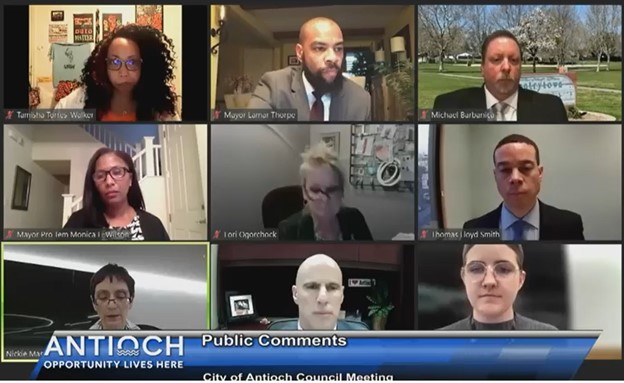
Antioch City Council members and staff participate in the regular meeting on Tuesday, March 23, 2021. Video screenshot.

Leaves open option to be pilot city for county’s new program

“Deep down in my heart I think Mr. Quinto would still be with us if we had something like this in our community,” Mayor Pro Tem Monica Wilson.

By Allen Payton

A request for proposal (RFP) to hire a consultant to design a model for a mental health crisis response team, to be sent out on certain calls instead of police officers, was approved on a 5-0 vote by the Antioch City Council during their meeting on Tuesday night, March 23, 2021. It’s part of the mayor’s police reform proposals at the urging of Mayor Pro Tem and District 4 Councilwoman Monica Monica Wilson.

All the public comments were in favor of the city pursuing a team.

“I did have a conversation with someone, today. It was in the context of the CAHOOTS model,” said District 1 Councilwoman Tamisha Torres-Walker. “I want to say I agree with a process that includes residents who have lived an experience. I’d also like to consider that we have something that is specific to our city, but how we also draw down resources from the county. Some kind of way the CORE program is involved. But not enough. So, we need to do something. If we’re asking for oversight and transparency of the police department, we wouldn’t move forward on a process that doesn’t include that for a mental health response program.”

“I haven’t seen a mental health response program that doesn’t include a police involvement…that they at some point they don’t call law enforcement in,” Torres-Walker stated. “We have to decide what those triggers are. There are some things that our law enforcement department should not respond to.”

“One of the things I didn’t like about the county model, it just focuses on mental health,” she continued. “A person could use substances for so long that they develop mental health issues or have mental issues that they use.”

“There are some models where you can work with fire…which we do not have in this city which is unfortunate,” Torres-Walker added.

“This has been a long-time coming,” Wilson said. “With mental health in particular with deregulation and funding being taken away…and now, all they can call is our police department. Yes, CAHOOTS is the first organization I reached out to in pursuit of multiple models. Definitely I want something that’s going to be 24 hours that deals with mental health and drug addiction.”

“Yes, I believe the community should be involved in the input into what is unique to the City of Antioch,” she continued. “I would just really like the city manager to move forward to prepare an RFP so we can work with a consultant. I’m definitely very excited.”

“Deep down in my heart I think Mr. Quinto would still be with us if we had something like this in our community,” Wilson concluded.

“I definitely support some kind of response team…someone with the training who can step in,” District 2 Councilman Mike Barbanica stated. “My only concern is we’re hiring another consultant on the eve of the county program being implemented in 90 days…and they’re looking for a pilot city. I’d love to be the pilot city.”

“I’m not sure about hiring a consultant…who would go outside and look for a resource,” District 3 Councilwoman Lori Ogorchock said. “A 5150 or a 5185 they’re going to have to go to county. I think that because of the county’s program coming up in a short period of time, we could throw our hat in…we are the second largest city in the county.”

“Concord is doing a 2-11 CORE team…with the county, something like a mental health crisis team,” she continued. “If we want to jump in and get something started…we can work to be the trial city.”

“As we learned from homeless, we’re better off designing our own,” Mayor Lamar Thorpe said. “I heard nothing but county. I think their process is going to be much longer.”

“I also want to look at the cost. The CAHOOTS model is $2 million,” Ogorchock said. “I don’t think the county would have that same issue.”

“A vote on this isn’t saying we don’t want a program, it’s just saying we want a consultant?” Barbanica asked.

“I think it would bring in some estimates,” Thorpe responded.

“So, if we say yes to getting a consultant, it’s going to take a while,” Ogorchock said. “I would ask that we not stop pursuing the county option.”

“It could be both, and. The county is supposed to provide these services to our community, anyways,” Torres-Walker said. “I do think it could be a both, and, and we should discuss what that would look like.”

“I don’t want us to have amnesia. The reason we’re talking about providing homeless services, is because the county is not providing it,” Thorpe said. “I see the limited staff that they have…there is no infrastructure out here.”

“Going this route does not eliminate the county,” Wilson stated.

“When we’re under resourcing it’s a recipe for disaster,” Thorpe said.

“I’m glad that Mayor Pro Tem Wilson and Councilwoman Torres-Walker agree that we can do both,” Ogorchock said.

The motion by Torres-Walker, seconded by Wilson to direct staff to develop a request for proposal to hire a consultant to develop a plan for a crisis response team passed on a 5-0 vote.


Antioch Council bans future acquisition of surplus military equipment on 4-1 vote

Tuesday, March 23rd, 2021

Including safety and other free equipment the Pentagon no longer needs

“The chief hasn’t gone out and ordered a bunch of weapons. These are safety items for our officers,” – Councilman Barbanica

Antioch Police Chief Tammany Brooks rides in his department’s MRAP vehicle during Antioch’s 2017 Holiday DeLites Parade.

By Allen Payton

During their meeting on Tuesday night, March 23, as part of the mayor’s police reform efforts, immediately following public comments that were mixed on the matter, with some in support and others opposed, District 1 Antioch Councilwoman Tamisha Torres-Walker made a motion to “ban the acceptance and or acquisition of surplus military equipment in the future.” Mayor Pro Tem Monica Wilson seconded the motion. It does not prevent the Antioch Police Department from using the equipment it already has, including the MRAP (Mine-Resistant Ambush Protected) vehicle.

District 2 Councilman Mike Barbanica spoke against the motion saying, “in our city in the last 12 months we’ve taken over 400 guns off the streets. We’re taking over a gun a day off the streets of our city. This equipment is free to our city. The government doesn’t allow us to sell it. The chief has reached out through this program. We’ve talked about the rescue vehicle. But other things, a robot that can deliver a phone when there’s a hostage situation or someone is in mental crisis, instead of sending in an officer.”

“Some sights for patrol rifles that we didn’t have to go out and buy, for free,” he continued. “First aid kits. The chief hasn’t gone out and ordered a bunch of weapons. These are safety items for our officers…to keep our community safe, as well.”

“I think this is a mistake,” Barbanica concluded.

District 3 Councilwoman Lori Ogorchock asked, “my only request is, can’t we do this on a case-by-base basis and not say ‘none’? It’s got to come before council and if the council decides, we can just say ‘no’.”

“The last time we had this conversation, it was my understanding we had very little military grade equipment,” said Torres-Walker. “This says, ‘in the future.’ Some of us remember the militarization of police happened on the heels of the war on drugs. And we had the theft of property. It has negatively impacted people of color, especially Black people.

“If we’re doing our jobs well, we won’t need military equipment,” she continued. “Most of these people acquire these weapons by breaking in your home and stealing your stockpile of weapons.”

“Stop tinkering around the edges,” Torres-Walker added.

“For the record, I don’t believe our police department…you don’t get trained to use military equipment,” Mayor Lamar Thorpe said. “Military equipment is not the standard across our nation. Those are unusual aspects of policing. We’re choosing not to move in that direction anymore. I trust our police officers to do their jobs and not need military equipment to do them.”

The motion passed on a 4-1 vote with Ogorchock voting yes, after a bit of a hesitation, to ban “the City’s future procurement of surplus military equipment by transfer or acquisition.” Barbanica cast the sole vote against the motion.

Federal Program

The U.S. Defense Logistics Agency’s 1033 program allows the Pentagon to give extra military equipment to local police departments across the United States. It’s part of their mission of disposing obsolete and unneeded excess property turned in by U.S. military units around the world. The type of property ranges from military-specific equipment and vehicles to generic office furniture, computers, medical items, and shop equipment. DLA Disposition Services disposes of this property in a variety of ways, including reutilization or transfer to other military components or federal agencies, donating through programs like computers for schools, destruction for scrap metal and resale to the general public.

In the National Defense Authorization Act for fiscal years 1990 and 1991, Congress authorized the transfer of excess DoD property to federal, state and local law enforcement agencies. Congress later passed the NDAA for fiscal year 1997, which allows law enforcement agencies to acquire property for bona fide law enforcement purposes – particularly those associated with counter-drug and counter-terrorism activities. The program has been named the “1033 Program,” which refers to the numbered section of the 1997 NDAA that granted permanent authority to the Secretary of Defense to transfer defense material to federal, state and local law enforcement agencies.

A bill introduced by Congressman Hank Johnson will “prevent transfers of equipment inappropriate for local policing, such as military weapons, long-range acoustic devices, grenade launchers, weaponized drones, armored military vehicles, and grenades or similar explosives.” But the bill faces an uphill battle for passage in the Senate.

According to a report on The Hill, “former President Obama curtailed the 1033 program in 2015 after local police suppressed protests in Ferguson, MO, using military-grade equipment. But the Trump administration rescinded the restrictions in 2017. President Biden has been expected to issue an executive order reimposing limits on the program.”

Antioch will no longer be allowed to receive any of the surplus equipment.

Council unanimously approves Antioch’s second gated new home community

Tuesday, March 23rd, 2021

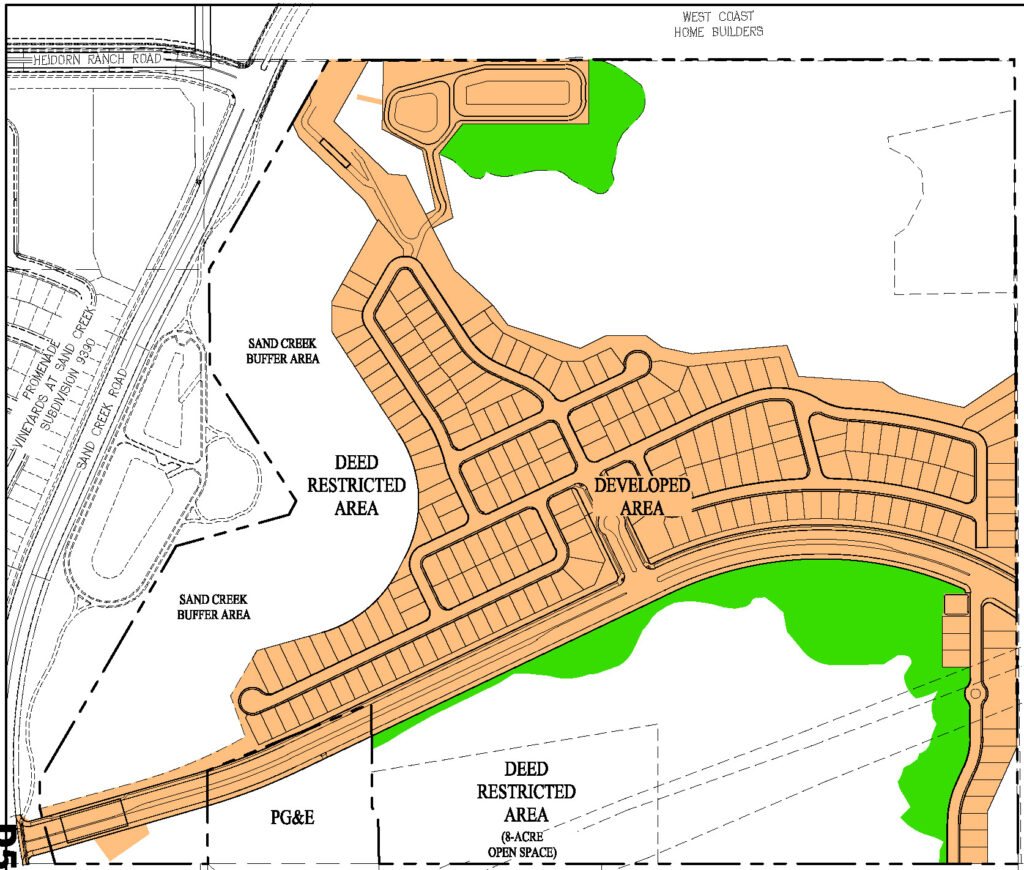
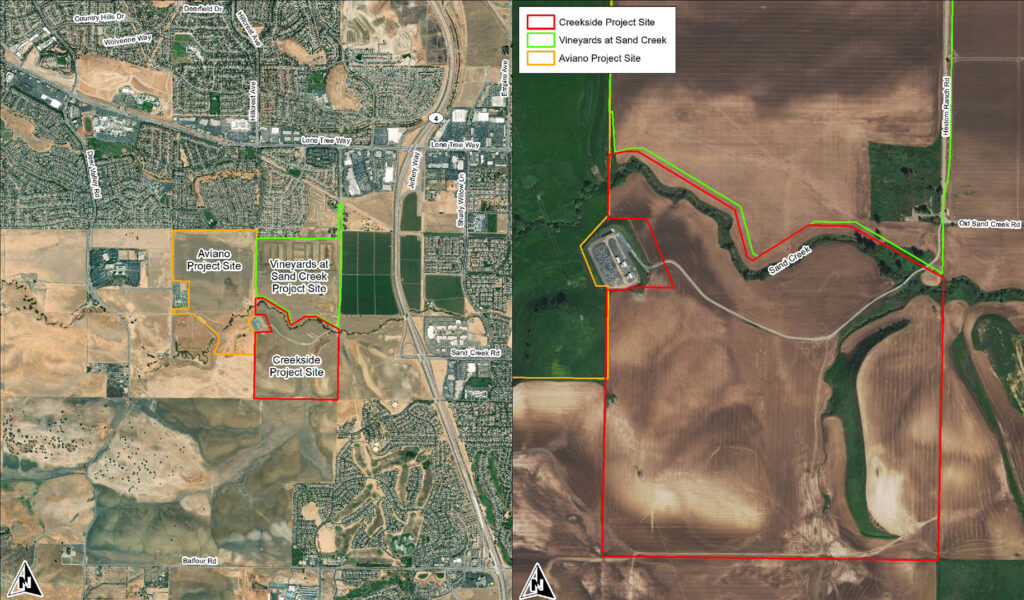
Site map for Creekside at Sand Creek project ACC032321.

220-home development on east end of Sand Creek area south of creek

By Allen Payton

During their meeting on Tuesday night, March 23, 2021 the Antioch City Council unanimously approved a new, 220-unit, single family home subdivision in the Sand Creek Focus Area known as Creekside at Sand Creek. It will be the city’s second gated home community and located immediately south of the Vineyards at Sand Creek new home project, along the city’s eastern boundary with Brentwood. It’s the second phase of the land development project by GBN Partners. The first gated community is the Cielo new home project on the north side of Sand Creek.

The council also approved final maps for both the 641-unit Vineyards at Sand Creek project and 641-unit Aviano Farms project on 5-0 votes. The actions confirmed acceptance of all the improvements required and that the developers have fulfilled all the conditions when the projects were approved in 2016.

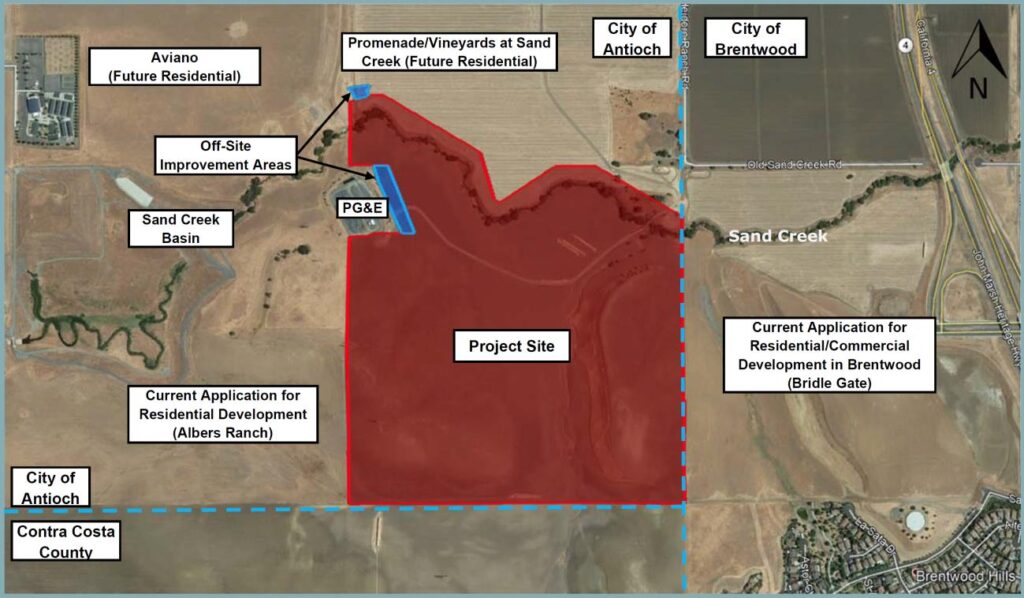
Creekside at Sand Creek location map.

Creekside at Sand Creek

Antioch city staff presented the details of the 158-acre project, sharing that the proposed residential units would consist of either non-age restricted units, senior/active adult units, or a combination of both, at the discretion of the developer. The project improvements would include parks, trails, landscaping, and traffic circulation improvements. The remainder of the site, including Sand Creek and the associated buffer area, would be retained as open space.

The project required the approval of a General Plan text and map amendment to the Sand Creek Focus Area to change the land use designations of the site from Open Space/Senior Housing and Hillside, Estate and Executive Residential/Open Space to Medium Low Density Residential/Open Space. In addition, the text of the General Plan is being modified to allow single family units on small lots that are not age-restricted.

Finally, the project will include the construction of a bridge over Sand Creek to connect to and extend Hillcrest Avenue.

Matt Beinke of Blackhawk Services Company and GBN Partners, LLC, made the owner’s presentation on the project.

“It’s been several years in the making dating back to the Vineyards at Sand Creek. It’s always been envisioned as an extension and a phase of that community,” he stated.

“Non-age restricted. It’s a gated community. There are no impacts on Antioch schools. This is in the Brentwood schools,” Beinke stated. “It will build out infrastructure. This has a PLA (project labor agreement) on it so it will be a union construction project.”

There was no opponent to speak during the public hearing.

There were six written comments, all in support.

“One prevailing issue…is the need for more affordable housing. You have the ability to address this tonight,” wrote former Antioch Mayor Don Freitas.

Another was by Derek Cole, an electrical workers union member, asking the council to support the project for the jobs it will create.

Thomas Lawson called in and said he was the business manager of a construction union, speaking in favor of the jobs and apprenticeship program, saying it will bring “union jobs, infrastructure and tax revenue to the City of Antioch.”

“How many local jobs will this bring into our community?” asked District 2 Councilman Mike Barbanica.

“This is going to go on, the field work for a year, and the buildout for five years. The vertical construction, the jobs…it’s in the 100’s,” Beinke responded.

“I’m not excited about the small lots,” Barbanica added.

“I’ll add…one of my first meetings as a new elected council member, then-Mayor Sean Wright and I want out to this property,” Thorpe said. “Mr. Beinke presented the concept.”

District 1 Councilwoman Tamisha Torres-Walker said, “it would have been nice to see the project labor agreement part of it to understand and what number of those jobs will be local. When we say hire local, union it’s my understanding this won’t guarantee Antioch residents will be hired.”

“Staff doesn’t usually address the issue of project labor agreements. That’s outside of our scope,” said Community Development Director Forrest Ebbs. “We know council likes to have that from the proponent.”

“Likewise, in our presentation, because our time is limited…we don’t have them (union partners) specifically as part of the presentation team,” Beinke explained. “The apprenticeship part of this is huge.”

“I just think that for myself it would be good to understand, you know, good jobs. Who wouldn’t want that?” Torres-Walker asked. “How many would be those coming from outside of our community?”

“I’m excited about this project,” she concluded.

District 3 Councilwoman Lori Ogorchock then made the motions to approve the project, including a General Plan Amendment and they each passed on 5-0 votes.

Antioch council approves new car wash on Lone Tree Way

Tuesday, March 23rd, 2021

Rendering of the future Ducky’s Car Wash approved by council for Lone Tree Way in Antioch on Tuesday, March 23, 2021. From owner’s presentation.

By Allen Payton

During their meeting on Tuesday night, the Antioch City Council approved Ducky’s Car Wash on Lone Tree Way near the intersection of Country Hills Drive and Mokelumne Drive on 5-0 votes. Ducky’s Car Wash ACC032321

Richard Miller, the owner, said, “We are bringing forth a project that we think will be very positive for the citizens of Antioch. I am a family-owned business. We have nine other car washes and this will be our tenth.”

He also owns one in Brentwood at the corner of Balfour Road and Brentwood Blvd.

“We had a prior approval and then the great recession hit that caused everyone to pause. But now we have a very clear path to constructing this project,” Miller continued. “It’s a real sleek and heavily landscaped corner.”

“We use the most environmentally conscious processes,” he shared, and said that they participate in the community with fundraisers.

There was no opponent nor any public comments on the matter.

The green area will be the location of the future Ducky’s Car Wash in Antioch.

District 2 Councilman Mike Barbanica asked about how the number of jobs and local hire.

“100% local. We will only hire local,” Miller responded. “The staffing requirements will vary, from between five and seven. We’re rally giving people their first jobs. It’s not a big number. But you can imagine there’s a big turnover. So, we’ll employ about 20 per year.”

“I love the concept, here. The color and the sleek design,” said District 3 Councilwoman Lori Ogorchock. “I hope we have more out of the box designs like this one, here. This type of business will bring a lot of recognition because it’s so different. I’ve gone to the Ducky’s in Brentwood because it’s right next to the bowling alley.”

She asked if the same concept could be applied to the Antioch location.

“It’s actually an express car wash,” Miller explained. “What you’re asking about in Brentwood, is a flex serve. This model is for those who want a fast, clean car wash in three minutes. This is not your self-serve car wash. No. We clean your car, we dry it then you go into the vacuum lanes. You have that option. What you’re asking me…is whether or not we can provide an additional service. It’s really a customer-generated response. We’ve seen demand in Brentwood for that and we may see the demand for that in Antioch. If so, we will offer that.”

“That’s not an expectation we should have, now,” Mayor Lamar Thorpe said.

“We are going to be totally responsive to what the public needs,” Miller added. “We have the flexibility in our business model to respond to the customer, because that’s what we do.”

The council approved the motions by Barbanica and Ogorchock for both the California Environmental Quality Act requirements and final development plan on 5-0 votes.

Dec. 24 email on Quinto case from Antioch acting police chief to assistant city manager shows “County Protocol invoked”

Thursday, March 18th, 2021

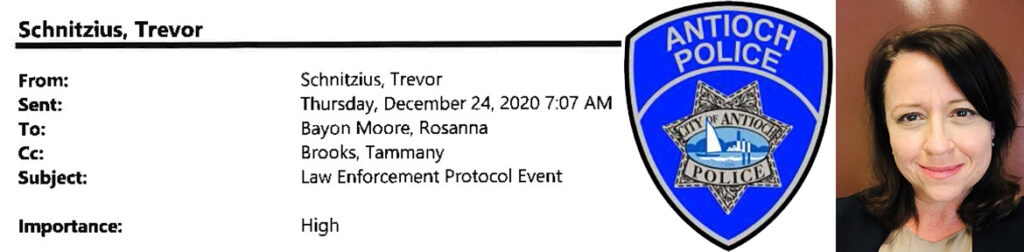
Header of Captain Schnitzius’ Dec. 24 email regarding the Angelo Quinto incident to Assistant City Manager Rosanna Bayon Moore.

Entitled Law Enforcement Protocol Event; Importance: High

No evidence of communication with council members or public from city management or APD

“Since then, the council has been informed. It’s a work in progress…” – Councilman Mike Barbanica

By Allen Payton

In response to a public records request, on Monday, March 15, 2021 Antioch city staff released a copy of the email message from Antioch Police Captain Trevor Schnitzius to Assistant City Manager Rosanna Bayon Moore and copied to Chief T Brooks, regarding the incident with Angelo Quinto on Dec. 23 during which he lost consciousness and was subsequently transported to the hospital. Quinto later died at the hospital on Dec. 26. Schnitzius was acting police chief as both Brooks and City Manager Ron Bernal were on vacation at the time of both. (See related articles here and here)

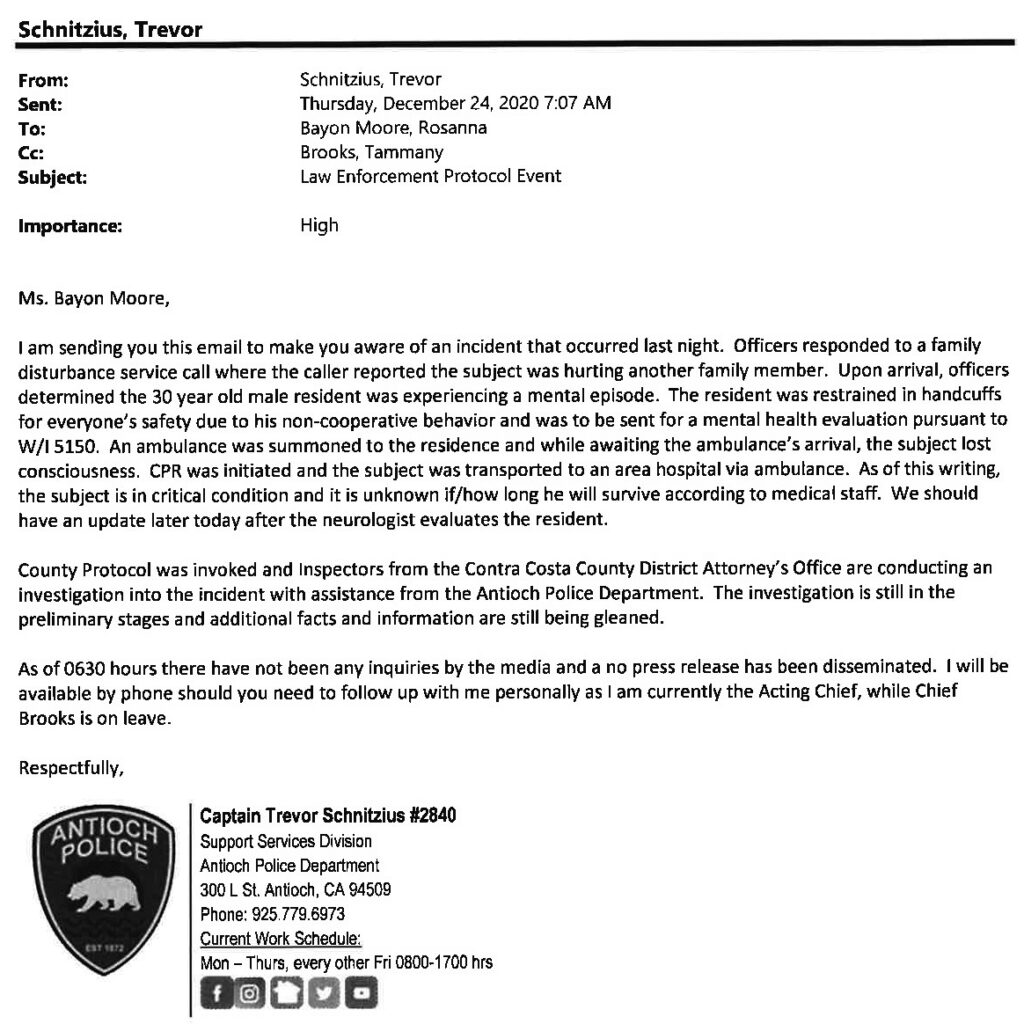
The email was sent at 7:07 a.m. on Dec. 24, 2020. The subject line reads: “Law Enforcement Protocol Event” and “Importance: High”. Email fr Schnitzius to Bayon Moore re Quinto 122420

The email reads, “Officers responded to a family disturbance service call where the caller reported the subject was hurting another family member. Upon arrival, officers determined the 30 year old male resident was experiencing a mental episode. The resident was restrained in handcuffs for everyone’s safety due to his non-cooperative behavior and was to be sent for a mental health evaluation pursuant to W/I 5150. An ambulance was summoned to the residence and while awaiting the ambulance’s arrival, the subject lost consciousness.”

The email continued explaining what occurred the night before: “CPR was initiated and the subject was transported to an area hospital via ambulance. As of this writing the subject is in critical condition and it is unknown if/how long he will survive according to medical staff. We should have an update later today after the neurologist evaluates the resident.

County Protocol was invoked and inspectors from the Contra Costa County District Attorney’s Office are conducting an investigation into the incident with assistance from the Antioch Police Department. The investigation is still in the preliminary stages and additional facts and information are still being gleaned.

As of 0630 hours there have not been any inquiries by the media and a no press release has been disseminated. I will be available by phone should you need to follow up with me personally as I am currently the Acting Chief, while Chief Brooks is on leave.”

The Dec. 24 email frrom Schnitzius to Bayon Moore and Brooks regarding the Angelo Quinto incident on Dec. 23, 2020.

Bayon Moore Refuses to Respond

Further questions were sent to Bayon Moore and all council members on Monday, March 15, if she had informed them of either the Dec. 23rd incident or Quinto’s death on Dec. 26th. They were asked: “Were any of you aware of that (email from Schnitzius)? Did she contact any of you, at that time? Were you contacted by any member of city staff about Mr. Quinto’s death on Dec. 26th? Anything else you would like to share about it?”

In addition, Bayon Moore was asked, “did you in turn inform the mayor and/or any of the council members at that time of the communication from Captain Schnitzius? If so, please provide a copy of that email. If no, why not? Did you expect or ask Captain Schnitzius if he had or was going to do so?”

Finally, additional questions were sent to her asking “were you informed by Ron (Bernal) or had the understanding that it’s your responsibility to inform the council members of such an event, or it was the police department’s? Were you informed of Mr. Quinto’s death on Dec. 26th and did you in turn inform any of the council members?”

Mayor, Two Council Members Respond

As previously reported, Mayor Lamar Thorpe, who was also on vacation at the time of both the police incident and Quinto’s death, said he was unaware of the email message from Schnitzius to Bayon Moore. Thorpe also previously stated that he learned about the incident on social media and spoke to Chief Brooks on Dec. 31st asking if there had been an in-custody death.

“I have never received a text from the city manager about the police department. If I had I would have found that unusual as that has never happened. I know I have communications from Captain Moorefield when he was acting chief,” Thorpe shared when reached for comment on the question if the council members were informed by Bayon Moore. “The question to ask is did Captain Schnitzius inform the council.”

District 2 Antioch Councilman Mike Barbanica responded to the same question saying, “I was not advised of the incident. I learned of it on social media three weeks to a month later. I reached out to Chief Brooks about it. I was advised that there was a notification to the assistant city manager and at some time point the mayor, but I don’t know when.”

“I made it clear that any event of this nature in the city, I felt, the council should be made aware of it,” he continued. “Since then, the council has been informed.”

Barbanica spoke of his experience as a Pittsburg Police officer, in which the department informed the council members of major events that occurred in that city.

“I was not used to not being notified about things occurring…of any major event that occurs in the City of Antioch,” he stated. “I’m not looking for any investigative details, just the information of what happened.”

“It’s a work in progress getting this in place,” Barbanica added.

When asked on Wed., March 17 if she had found the email message she referred to previously, District 3 Councilwoman Lori Ogorchock responded, “I cannot find it. I was still looking for it, yesterday with no luck.”

03/20/21 UPDATE: Chief Brooks Responds to Additional Questions

Additional questions were sent to Chief Brooks asking if Schnitzius had contacted any of the council members about either the Dec. 23rd incident with Angelo Quinto or his death on Dec. 26th? He responded, “No he did not.  His only communication was with the assistant city manager.”

Asked if the captain was informed that was part of his responsibility as acting chief on major matters, such as an incident requiring the invoking of the county protocol, Brooks responded, “no, I failed to give him that direction prior to leaving on vacation.”

Regarding Thorpe’s comments, Brooks also added, “the mayor and other councilmember are correct.  Past practice has been they received notification from the police chief directly.  Obviously, the inadvertent lapse of immediate council notification in this case has justifiably moved council to seek/create a formal notification process to prevent this oversight from happening again.”

Another Public Records Request

As a result of the lack of response from Bayon Moore and the other two council members, and no record of any communication from her to Ogorochock that could be found, another public records request was submitted on March 16 for any and all communication between Bayon Moore and council members about both the Dec. 23rd incident with Quinto and his death on Dec. 26th. City staff has 10 days to respond.

Please check back later for any updates to this report.