







Archive for the ‘Business’ Category

Guest Column: This little-known federal agency is key to out-competing China

Monday, August 5th, 2024

International Trade Commission protecting America’s innovation edge

By Frank Cullen

A little-known federal agency might be our most powerful asset in the race for global tech leadership. The International Trade Commission has the power to deter patent infringement abroad and at home by blocking infringers’ access to the huge American market.

It’s up to policymakers to make sure this asset gets deployed to the full extent of the law.

Here’s the problem: In today’s knowledge economy, ideas are the coin of the realm. But America’s intellectual property is under constant attack.

That’s because a 2006 Supreme Court decision, eBay v. MercExchange, severely curtailed the rights of IP owners. Previously, patent holders could easily stop infringers with court orders, called injunctions, preventing the sale of knock-off products that illegally incorporated patented technology.

But the eBay case changed the procedure for obtaining a court injunction. Patent holders now must prove that money alone can’t make them whole for the damage the infringement caused. Though intended to curb certain types of abuse of injunctive authority, the decision unintentionally made it nearly impossible for legitimate innovators to stop infringement, often leaving them with the sole option of pursuing lengthy legal battles for financial compensation.

Enter the ITC. This body wields the power to swiftly bar infringing foreign-manufactured products from the U.S. market entirely. For a government body, the ITC moves fast, typically resolving cases in 12 to 18 months, compared to the years-long slog of district court litigation.

Its administrative law judges are experts in complex patent issues and can grant exclusion orders now mostly unavailable in federal courts. This combination of speed, expertise, and decisive action makes the ITC an increasingly important venue for companies seeking to protect their innovations from copycats.

Established in 1916 as the U.S. Tariff Commission, the ITC has evolved alongside the American economy as we transitioned from a manufacturing powerhouse to an innovation-driven economy.

This evolved role was on full display in a recent high-profile case. When medical device maker Masimo accused the Apple Watch of infringing its blood oxygen monitoring patents, it turned to the ITC. The result? An import ban on infringing Apple Watch models that held Apple to account promptly. The ban demonstrates the ITC’s ability to check the power of even one of the world’s most dominant companies.

The ITC’s role is crucial to preserving America’s innovative edge. When a biotech startup pours its resources into a potentially life-saving drug, or when a telecom company invests billions in 5G technology, they need to know their intellectual property will be protected. The ITC’s ability to swiftly block infringing products creates a powerful deterrent against IP theft.

Critics of the ITC argue that its powers could potentially be used to stifle competition or harm consumers. But while there’s always a delicate balance between protecting innovation and protectionism, the ITC has built-in safeguards, starting with a public-interest requirement to weigh factors like health, safety, and competitive conditions into its decisions. It’s not a blunt instrument, but a precision tool designed to protect innovation while preserving fair competition.

As we look to the future, strengthening and modernizing the ITC should be a priority. This could involve increasing its resources to handle a growing caseload, streamlining its procedures, and potentially expanding its authority. We also need to educate our innovators more fully about the ITC as a forum for IP protection.

The future of American technological leadership depends on the choices we are making now — in policy, investment, and legal strategy.

Frank Cullen is executive director of the Council for Innovation Promotion. This originally ran in The Hill.


Police seek suspect in $500,000 jewelry theft from Antioch JCPenney store

Wednesday, July 24th, 2024
A thief can be seen on JCPenney store surveillance video smashing jewelry display cases on June 15, 2024. Video screenshot. Source: APD

Smash and grab robbery occurred June 15th, APD just learned of it

By Antioch Police Department

Community, take a good look at these videos and help us find the man behind this jewelry smash and grab that happened at JCPenney in the Slatten Ranch shopping center off Slatten Ranch Road and Empire Avenue.

We were just made aware of this theft that happened on June 15th. Antioch police officers responded to an alarm call just after 10:00 p.m. from the JCPenney on Slatten Ranch Road. Officers reviewed the store surveillance video which shows the suspect approaching the glass jewelry cases, taking a hammer or tool, smashing the glass and taking off with nearly half-a-million dollars in jewelry.

The suspect was also seen on video walking into the store at 8:25 p.m. and hiding in the store for a few hours before committing the crime. If you have any information about the identity of the suspect, please contact Detective Cole Shaffer cshaffer@antiochca.gov or (925) 481-8604.

Christmas In July at Willow Park Mercantile July 15-31

Saturday, July 13th, 2024
Paid advertisement.

Willow Park Mercantile is located at 205 G Street in historic, downtown Rivertown. For more information, visit willowparkmercantile.com.

Antioch’s Caring Haven honored as Bay Area’s Premier Home Care Agency

Friday, July 12th, 2024
Best of Best Review award for Caring Haven owned by CEO Nicola “Nikki” Lopez.

Founded and owned by Jamaican immigrant Nikki Lopez

Caring Haven, headquartered in Antioch, has proudly been recognized as the Best Senior Care Agency in the Bay Area by Best of Best Review. This accolade reflects the agency’s unwavering dedication to providing dignified care for seniors and veterans.

Founded last October by CEO and Chief Care Officer Nicola “Nikki” K. Lopez, MBA, an inspiring immigrant from Jamaica, Caring Haven is built on the foundation of family love and care. Nikki’s personal values shape the company’s mission: “We ensure every client is seen, heard, and empowered, just as we care for our own family. Each loved one we serve is treated with the same affection and dignity our CEO gives to her grandma.”

The company slogan is “Elevating Life, Embracing Care” and their service areas include Antioch, Discovery Bay, Brentwood, Oakley, Pittsburg, Tracy, Concord, Martinez, Pleasant Hill, Walnut Creek including Rossmoor, Benicia, Vallejo, Rio Vista and surrounding areas.

According to the awards organization, “At Best of Best Review, we take great pride in recognizing the outstanding companies that stand out in their fields, and this year, Caring Haven LLC has earned a distinguished place as the ‘Best Senior Care Agency in the Bay Area’. This accolade reflects the unparalleled dedication, compassion, and expertise that Caring Haven brings to home care services.

Nicola’s journey, as an immigrant navigating corporate America, has shaped her passion for providing top-tier, empathetic care. This dedication is evident in the way Caring Haven embraces diversity, equity, and inclusion, placing people over profit.

A Testament to Excellence

Caring Haven’s commitment to excellence is evident in the glowing testimonials from clients and partners. Latrice Roberson from Grace and Glory Hospice notes, ‘Nikki’s smile and calm manner can bring an individual’s anxiety down to where they feel empowered to move forward. Her loyalty and dedication to the health industry speaks volumes and shows her empathy towards others.’

Another satisfied client shares, ‘Caring Haven was an absolute godsend recently when my 100-year-old mother’s full-time caregiver came down with Covid. Nikki Lopez personally filled in, ensuring my mother received the care she needed. Her compassion and dedication are unmatched.’

Rigorous Selection Process

Caring Haven’s recognition as the “Best Senior Care Agency in the Bay Area” was not earned lightly. Hundreds of agencies were evaluated based on several criteria, including:

  • Client Satisfaction: Testimonials and reviews highlighted the exceptional care and dedication of the caregivers.
  • Expertise and Knowledge: Demonstrated through comprehensive and personalized care plans.
  • Authenticity and Trustworthiness: Evident in the agency’s transparent and heartfelt communication with clients.
  • Performance Metrics: High client retention rates and positive health outcomes.
  • Competitive Differentiation: Unique DEI-led approach and unwavering focus on community and compassion.

Personalized and Compassionate Care

The care provided by Caring Haven is not just about meeting physical needs but also nurturing the emotional and psychological well-being of clients. For instance, one client recalls how Nikki from Caring Haven quickly responded to an urgent request for a caregiver, connecting deeply with the family and ensuring the service started promptly. This personalized attention and genuine compassion are what make Caring Haven stand out.

A Legacy of Dedication

Caring Haven’s mission is clear: to make every client feel seen, heard, and empowered. The team’s dedication to building meaningful relationships and creating a nurturing environment is reflected in every aspect of their service. From companionship and assistance with daily activities to respite care, Caring Haven ensures that clients receive comprehensive support tailored to their individual needs.

Pros of Choosing Caring Haven LLC:

  • Compassionate and personalized care
  • Quick response time and professional service
  • Highly skilled and empathetic caregivers
  • DEI-led approach prioritizing people over profit
  • High client satisfaction and retention rates”

About the award, Lopez said, “People are literally trusting me with their lives and others are trusting me with those who matter most to them. It’s humbling, and not a task I take lightly.”

“It was a surprise, I didn’t expect it,” she added.

Lopez’s commitment extends beyond her company. She is an active member of the Antioch and Brentwood Chambers of Commerce and serves on three significant boards in Contra Costa County: the Economic Opportunity Council (EOC), Equal Employment Opportunity Commission (EEOC), and the Aging Council on Aging (ACAOC).

Additionally, Caring Haven hires and trains the best Care Team ensuring all clients receive a consistent level of professional, dignified, and reliable care. 

Caring Haven is credentialed with the Veterans Administration (VA) and Medicaid, and also accepts private pay and various long-term care insurance plans, including workers’ compensation for post-surgery or rehab patients. Their comprehensive services include companionship, personal care, dementia care, and more.

For those seeking quality care for their loved ones, Caring Haven is the trusted choice. Visit their website at www.caringhavenhomecare.com or call 925.331.0590 for more information.

Allen D. Payton contributed to this report.

New Contra Costa health permit allows home kitchens to sell meals to the public

Monday, July 1st, 2024
Photo: Contra Costa Health

Microenterprise Home Kitchen Operations can offer meals for dine-in, delivery and takeout and with limits, in addition to Cottage Food Operations already allowed

By Contra Costa Health

Contra Costa residents interested in selling home-cooked food to the public can now get a health permit to do so, an affordable option for entrepreneurs that ensures the safety of their customers.

Beginning July 1, Contra Costa Health (CCH) offers a new type of food permit for small-scale, home-based restaurants operated inside private homes by their residents. Microenterprise Home Kitchen Operations (MEHKOs) can offer meals for dine-in, delivery and takeout. MEHKOs can offer meals for dine-in, take-out, and/or delivery, and can also be used as a commissary for permitted food carts.

“By providing this option we ensure that people who sell food out of their homes do so in a safe manner that protects the health of our community,” said Federal Glover, chair of the Contra Costa County Board of Supervisors. “We also open the door for neighborhood businesses, and for more access to healthy, nutritious food in areas where options may be limited.”

The board unanimously adopted an ordinance in May authorizing the county to offer the permit under terms of a 2018 state law. Several other Bay Area jurisdictions already do so, including Alameda, San Mateo, Santa Clara and Solano counties, and the City of Berkeley.

The permit allows meals to be stored, handled, and prepared to be served or delivered in a private residence. Most other food permits require a commercial kitchen in a restaurant or similar facility.

A permitted home can also serve as a space to prepare food for sale on street carts, a requirement to obtain a cart vendor health permit that has proven to be a significant barrier in Contra Costa.

As with holders of standard commercial food permits, MEHKO permit holders must meet requirements relating both to the spaces where their businesses operate and the food-safety training of operators. CCH will inspect each permit holder annually or more often.

The MEHKO permits do limit the holder to selling no more than 30 meals per day and 90 meals per week, and no more than $100,000 in gross annual sales. There are also some limitations regarding the type of food that may be served.

CCH will schedule workshops throughout the county later this year for potential applicants.

“This permit is great for new entrepreneurs who are just getting started,” CCH Environmental Health Director Kristian Lucas said. “It’s also a way for the public to know that a seller advertising on social media is complying with food safety regulations.”

MEHKO permit holders will be required to display their permits at their homes, and their health inspection records will be available to the public at cchealth.org.

Cottage Food Operations Already Allowed

Contra Costa Health offers two kinds of permits for home-based food operations. In addition, to the new MEHKO, the county also allows Cottage Food Operations (CFO) which “is a home-based operation that allows limited amounts of certain foods to be prepared in a home kitchen for retail sale. A CFO can prepare and package non-potentially hazardous foods from home. The California Department of Public Health maintains a listing of foods approved to be sold from a private residence. Some examples of these foods include cookies, candies, jams/jellies, muffins, cakes, and pies. Only foods on the state listing are approved as cottage food products.

According to the California Department of Public Health Food and Drug Branch, “There are two different classes of CFO’s:

Class A: This type of CFO can sell home-kitchen prepared foods directly to the public. This includes transactions made via the phone, internet, and any other digital method. A direct sale may be fulfilled in person, via mail delivery, or using any other third-party delivery service. A Class A operator’s current maximum gross annual sales are $75,000.

Class B: This type of CFO can sell home-kitchen prepared foods directly to the public or indirectly through restaurants and food markets. A direct sale may be fulfilled in person, via mail delivery, or using any other third-party delivery service. An indirect sale may be fulfilled in person, via mail delivery, or third-party delivery service. The current gross annual sales for a Class B operator are $150,000.

In Antioch, home-based business owners are also required to obtain a Home Occupation Use Permit from the City.

For more information about the new and CFO permits, including how to apply, visit cchealth.org/homekitchens.

Pacific Senior Care Services celebrates 10 years in business

Friday, June 28th, 2024
Kelly Gonzales is the founder and owner of Pacific Senior Care Services LLC.

Started in owner’s former Antioch home, honored with awards each year

By Allen D. Payton

Having finished commercial aviation and tourism studies at Columbia College and working for an airline at an airport in Peru, Kelly Gonzales immigrated to the United States at age 19.  Then after working in banking and financial services for 20 years, she wanted to pursue her passion and did that by forming Pacific Senior Care Services in 2014 using her skills to help place people into care homes.

Gonzales was particularly inspired by the care her retired Army colonel and veterinarian father needed and received in Lima, Peru after he suffered a stroke. But she couldn’t really help him living over 15 hours away by flight. Instead, Gonzales and her team have been able to fulfill the company’s slogan and mission of “Meeting Elder Needs With Love and Compassion” in Contra Costa County and the Bay Area.

“My father was the main reason I started the business,” she said.

Now her company is celebrating its 10th Anniversary in business. A former Antioch resident, Gonzales started the business in her home then opened the company’s main office in Walnut Creek.

“I thank the Lord for enabling me to fulfill my calling,” she shared. “I never thought in my life I would be doing this. Working with the right people we’ve been able to help many families in the community. It’s been a blessing. I have good people around me, our support staff, and contractors.” She thanked them and “all those who gave us leads through the years.”

“Families who we’ve helped call us later and let us know of others we can provide services to,” Gonzales stated.

The company’s short-term plans include, “opening an office in Sacramento, later this year, Lord willing, and relocate our other office from San Mateo to Redwood Shores to serve families on the peninsula,” she said.

Gonzales’ daughter, who is a Certified Medical Assistant and attended Diablo Valley College, and now in the process of earning her nursing designation, works with her making it a family-operated business.

“We are also forming a homecare agency with partners in the industry,” she continued. They plan to also offer that service in the Sacramento area and San Mateo County.

Gonzales’ and Pacific Senior Care Services were chosen to represent the National Long Term Care Planning Council to create a team in the Bay Area.

“The San Francisco Bay Elder Planning Council was created to help solve critical aging issues and planning for the final years by providing a free central source of information, with senior advisors and professionals within our network,” she shared. “Guiding family members seeking help for their loved ones is the main focus. Another purpose of our planning council is to encourage people to prepare for the future needs for aging services.”

Awards & Honors

Under Gonzales’ leadership Pacific Senior Care Services PSCS) has also been honored with several awards through the year, including being named one of the 2024 Best Full Service Senior Care Providers in California by Global Health & Pharma Magazine, Social Care Awards.

Last year the company was honored in the California Business Awards 2023 as a Leading Provider of Senior Care Services – Northern California by the New World Report and in 2017 and 2022 PSCS was honored for Excellence in Customer Service by City Beat News.

The company has been honored with other awards every year they’ve been in business.

For more information about Pacific Senior Care Services visit their website www.pacificseniorcareservices.net.


Link to – Pacific Senior Care Services LLC (longtermcarelink.net)

www.longtermcarelink.net/listingprofiles/2667-PACIFIC-SENIOR-CARE-SERVICES-LLC-California.htm

Social Care Awards

Best Full Service Senior Care Providers

2024 – California

Pacific Senior Care Services LLC (2024 Winner: Social Care Awards) – GHP News (ghp-news.com)

State Senate approves Glazer bill to revive newsrooms

Friday, June 28th, 2024

SB 1327 gets required two-thirds vote approving $500 million in annual tax credits

Funded by fee on large internet companies

SACRAMENTO – Senator Steve Glazer’s bill to help strengthen local newsrooms with $500 million in annual tax credits was approved Thursday on a required two-thirds vote. It now moves to the Assembly.

The bill, SB 1327, was approved on a bipartisan 27-7 vote. A two-thirds vote was required because the bill assesses a Data Extraction Mitigation Fee on large Internet companies. It would distribute the money through tax credits to California news organizations.

“The passage today of my bill, SB 1327, is a step toward helping to revive news organizations across California,” said Glazer, D-7-Contra Costa. “Independent journalism is the lifeblood of our democracy by keeping our citizens informed on the workings of their government.

“This measure will mitigate the damage caused by platforms who use our personal data and their subsequent advertising profits to gut our mainstream news channels. I will continue to work with all stakeholders in the weeks ahead to chart a path forward that restores and expands independent news organizations, so critical to our democracy.”

Assemblywoman Buffy Wicks, D-14-Oakland, who represents portions of West Contra Costa County and has her own legislation, AB 886, to help news organizations, applauded the bill’s passage.

“I am encouraged to see SB 1327 move forward, and grateful to my Senate colleagues for recognizing the importance of this issue,” said Wicks. “The advancement of Sen. Glazer’s bill will allow us to continue working collaboratively toward a solution that protects and grows newsrooms across California.”

Building owner, City working on new, historic mural for 4th Street wall in Antioch’s downtown Rivertown

Tuesday, June 25th, 2024
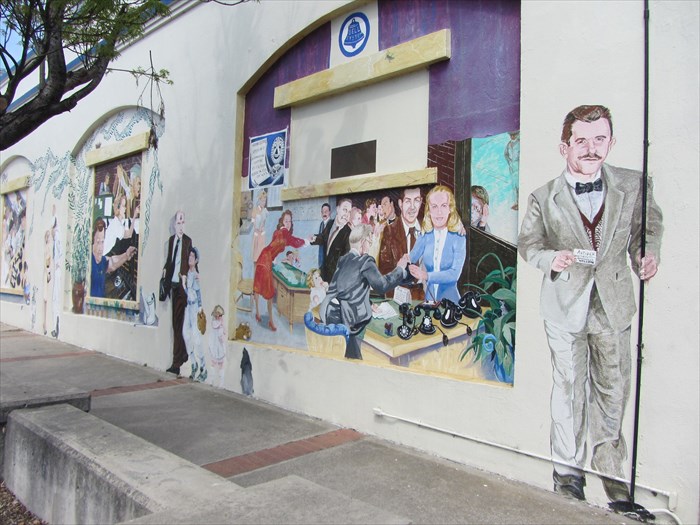
The historic mural on the W. 4th Street side of the building on the corner of G Street that is being removed will be updated and repainted. Photo by waymarkings.com.

“We’re going to update it” – Sean McCauley

By Allen D. Payton

Good news for those concerned about the removal of the historic mural on the W. 4th Street side of the building on the corner of G Street in Antioch’s downtown Rivertown.

After reading the Herald article about the mural, Sean McCauley who, with his partner Ron Harrison, owns the building, shared that a new mural would be painted on the building.

“We’re going to update it,” he stated.

“We are working with (Acting City Manager) Kwame (Reed) and (Mayor) Lamar (Hernandez-Thorpe), to redo the mural and to depict a similar and more inclusive scene for the community,” McCauley shared. “Grant funds were secured for this mural and others.”

Asked about the funds for the other murals in Rivertown, specifically the Sesquicentennial mural on the side of the building at 505 W. 2nd Street he said, “The only mural that was in bad shape was the one on W. 4th Street.”

“It wasn’t just the paint. The stucco was failing on the building and has been for years,” McCauley explained. “The building was literally falling off and hitting people.”

“We aren’t going to take the easement off of it,” he continued. “We’re working with Kwame and Brad to get a good mural up there. This is a positive thing for downtown.”

“We tried to get in contact with the muralist (who lives out of state) but she isn’t interested in redoing it,” said McCauley. “We have a muralist we’re working with on our downtown Pittsburg buildings and trying to use the same muralist for this one.”

The design is not done yet but it “will be more inclusive”, he reiterated.

“It’s a $650,000 to $700,000 investment that we’re putting into that G Street block (between W. 3rd and 4th Streets),” McCauley stated. “We’re doing what we can to improve the downtown.”

That includes investments by the two partners purchasing and improving multiple other buildings in Rivertown, including the Salon Suites on W. 4th and I Streets, and bringing several restaurants to the Rivertown Dining District including Smith’s Landing Seafood Grill, Monica’s Riverview, Guadalajara Taqueria, Abuelita’s House Pastries and Peruvian Sandwiches, and Buford’s BBQ.

In addition, Sylvia’s Florist is returning to Antioch and will soon open in McCauley’s building at 101 H Street in the old Casino building next to Waldie Plaza.

Scene inside the phone company office shows two boys outside the window on W. 4th Street. Photo by waymarkings.com

UPDATE 1: Original Mural Leader Wants Replacement to be Historically Correct

After reading the article above, former Antioch Councilwoman Elizabeth Rimbault, who was instrumental in leading the effort for the W. 4th Street mural, offered additional information about who it depicted and wants to ensure the replacement is historically correct.

“The original Operators Telephone Office Mural was historically correct for the occupants of the corner office in the 1940’s and 1950’s of downtown Antioch. The people depicted were real and were prominent figures of the time with names and families some still in Antioch,” she shared.

“Bill Friedrickson was the telephone repairman leaning against the truck and in the late 1990’s cleared hundreds of pounds of abandoned phone wires in the attic of the Historical Society Museum when they acquired the Riverview Union High School,” Rimbault continued. “Bob Beswick was a driving force of the community without serving on the city council.”

“When it is stated, the new mural will be more ‘inclusive’, does that mean people will be painted in that were not an employee of the phone company? Or not a resident in 1950? That would constitute revised history which I am sad to say there has been too much of that in Antioch lately in these 2020’s being more politically driven,” she stated. “I suggest that as the Historical Society received all rights, obligations, and remaining funds from the Antioch Friends of the Arts, that the Society be given final say of correctness of all historical facts depicted in the new design of the mural.”

“The boys seen in the window were just children that Char Downs Siska, the artist, painted in. They don’t depict anyone specific,” Rimbault added.

“It should be noted the only murals granting a city easement are W. 4th and G Street and 505 2nd Street. All other murals on private buildings and walls are totally the property owners’ right to choose,” she stated.

UPDATE 2: Mural Leader Suggests Depicting Two Black Sisters to Make New Mural Inclusive While Maintaining Historical Accuracy

After a few days thinking about it, Rimbault shared additional historical information about a Black family who lived in Antioch during the time the mural depicted. She offered a suggestion of adding depictions of two of the sisters to make the new mural more inclusive and keeping it historically accurate, as McCauley mentioned.

“Hold the presses,” Rimbault requested after her memory was triggered. “The mural was for 1951. It’s possible that at that time the Blanton (sp) family lived on railroad property near Railroad Avenue and A Street. The two oldest girls were in Antioch schools until Vergy was told to attend Pittsburg High School as she was graduating from junior high to high school. Her sister Joyce was in my husband’s Class of ‘61 and Vergy would have been in the Class of ’62.”

“If you count backwards, both girls would have been six and seven years old in 1951 and the only Black children in Antioch at the time,” Rimbault stated. “So, if the mayor wants the mural to be inclusive, two children looking into the operators’ window need to be little girls and it could be a tribute to the two, as they had many friends in school and should have been allowed to stay. But due to the underlying, unwritten law of Antioch the superintendent of schools suggested to their parents they would be better off in Pittsburg where they would be able to date boys of their own race.”

“And little girls would be more appropriately curious about all the women operators,” she added.

“Years ago, Joyce attended my husband’s class reunion of 50 years and had always considered it her class even though she was made to transfer as a junior,” Rimbault shared. “Her sister had a much harder adjustment, dropping out later and died as a young woman.”

“It’s amazing what memories this situation has caused to flood back to me. Have not thought about this in years,” the former Antioch historian mused.