




Archive for the ‘Technology’ Category

Beat a cyberbully – here’s how parents can help

Tuesday, November 2nd, 2021

Victims of cyberbullying can feel helpless and may not know what to do. Free resources on jw.org help children, teens and parents successfully deal with bullying.

Antioch couple shares their approach

By Ezra Smith, Public Information Desk, Jehova’s Witnesses United States Branch

While remote learning during the COVID-19 pandemic lowered reported instances of bullying, parents fear that, for some students, going back to school will mean going back to being bullied.

Adrian and his wife Nalana, who live in Antioch, understand the threat bullying may pose to their children.

“As parents, it can be a pretty big concern. It can be a big worry that if your child is on some social networking site, they can be targeted,” Nalana said.

Now 15 years after the inception of National Bullying Prevention Month in October, technology’s ever-greater presence in children’s lives has given bullying a new outlet. With just a click, cyberbullies can taunt, harass and threaten relentlessly, even reaching into the home via cellphone or computer. As a result, victims report feeling hopeless, isolated and even suicidal.

What can parents do to protect their kids? Taking an interest in their children’s online world can make a difference, says the National Parent Teacher Association.

This interest does not necessarily require parents to become tech experts. Instead, the federal stopbullying.gov site advises parents to watch for subtle clues that something is wrong, such as their child becoming withdrawn, hiding their screen when others are nearby or reacting emotionally to what is happening on their device.

For Adrian and Nalana, that means being keenly aware of what “normal” looks like for their two teenagers, ages 16 and 18.

“Watching for different body language or different characteristics in your children is important as parents,” Adrian said. “So, if we feel we see something, we’ll converse with one another. That way, we are able to head it off better if there is a problem.”

Talking with kids openly — and often — helps too. “The more you talk to your children about bullying, the more comfortable they will be telling you if they see or experience it,” UNICEF says in its online tips for parents.

As their two daughters enter their teens, Houston parents Thiago and Auboni have found that talking less and listening more works best. “We try to focus on being approachable and listening actively without reaction,” Thiago said.

Beyond talking, listening and observing their kids, parents should not be afraid to make and enforce rules for online activities, experts say.

Thiago and Auboni’s girls are allowed to play online games, but they are expected to turn off the live chat feature to limit interactions with strangers. “We reassure the girls that we trust them and respect their privacy, but they have to stay within the boundaries we’ve set,” Auboni said.

Adrian and Nalana take a similar approach. While they do have full access to their children’s devices, they do not feel the need to constantly monitor their children’s activity online. “The more trust they earn, the less reason we have to hover over them as much, because we see them living by our guidelines,” Adrian said.

Both families cited the tips and reminders they have considered together with their kids from free resources available on jw.org, the official website of Jehovah’s Witnesses.

Adrian and Nalana’s 16-year-old daughter especially recommends one of the site’s short animated videos, “Beat a Bully Without Using Your Fists”.

Glydways completes feasibility study with Eastern Contra Costa cities and Tri Delta Transit to advance micro transit system

Friday, April 9th, 2021

Glydways vehicles and station rendering. Source: Glydways

Could be feeder system to BART from downtowns

The Tri Delta Transit Board of Directors has unanimously approved a resolution to support feasibility study findings regarding a Dynamic Personal Micro Transit (DPMT) system in Eastern Contra Costa County.

As a strong community partner and forward-thinking transit agency, Tri Delta Transit’s decision sets the stage for multiple cities in Eastern Contra Costa County to partner with Glydways to bring an innovative 28-mile, personal micro transit solution to the region through a public-private partnership model.

The feasibility study was conducted by Advanced Mobility Group (AMG) at the request of the Cities of Pittsburg, Antioch, Oakley, and Brentwood, as well as Contra Costa County and the Contra Costa Transportation Authority.  Glydways Feasbility Study TDT BOD 032421

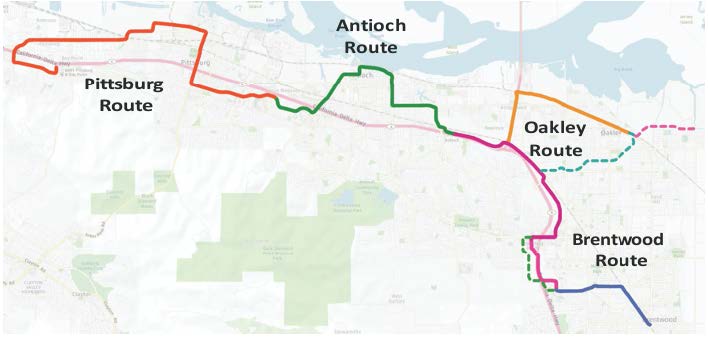
The study focused on a 28-mile DPMT system with 56 boarding locations planned between the Pittsburg/Bay Point BART Station and downtown Brentwood. The system is anticipated to complement existing transportation modes such as Tri Delta Transit bus service, Bay Area Rapid Transit (BART), and the Amtrak San Joaquins train line, and could deliver connectivity to more than 7 million riders annually.

Draft Glydways Eastern Contra Costa County routing plan. Source: Glydways

With the feasibility study conclusions affirmed by Tri Delta Transit, the findings will also be presented to each city council for the above-mentioned cities in the coming months. The support of Tri Delta Transit’s board for a mobility option that complements existing transit service is significant, since it smooths the path for cities, partners, and stakeholders to consider entering into a project development agreement with Glydways to further plan and fund the potential system.

“We are looking forward to our collaboration with Glydways to deploy this new innovative mobility option in our community that we serve and increase public transportation options,” said Jeanne Krieg, CEO of Tri Delta Transit.

Founded by Mark Seeger in 2016, Glydways is a system of on-demand autonomous vehicles, right-sized to carry passengers to their personalized destinations, privately. These vehicles operate on dedicated roads that are closed off to all other forms of transport. These roads form an interconnected network optimized for mass-transit throughput. Passengers enjoy a direct-to-destination journey with a consistently premium experience.

“At Glydways, we believe that mobility is a basic human right. We believe that access to affordable housing, employment, education, commerce, and healthcare leads to social and economic prosperity—and that the key to the equitable distribution of this prosperity is access to low-cost and ubiquitous mobility for everyone, everywhere,” said Seeger, CEO of Glydways. “In a post-pandemic world where transit budgets and programs face hesitant ridership, mobility systems must be more efficient, passenger-focused, and resilient than ever. For riders, Glydways changes the concept of public transit to a premium passenger experience without the premium cost and frustration of traffic.”

Glydways is currently completing construction on its demonstration facility at GoMentum Station in Concord and anticipates being able to provide product demonstration in Spring 2021. GoMentum Station, in Contra Costa County, was chosen as the site for the first demonstration based on its reputation for advancing innovative mobility options. This initial demonstration will be the first to showcase the full potential of the Glydways system as a more sustainable and affordable mode of mass mobility for everyone.

Based in South San Francisco, Glydways has partnered with numerous Bay Area cities, transportation agencies, technology providers, employers, and experienced international infrastructure firms to bring mass micro transit into the 21st century and provide mobility that improves communities.

Those familiar with the CyberTran system, being developed in Richmond, will recall its leaders obtained unanimous support from the Cities of Oakley, Brentwood and Antioch in 2017 to pursue federal funding for a system from the Antioch-Hillcrest BART station to the Byron Airport. CyberTran is proposed to be the system of choice for the East County extension to BART and the Glydways system would serve as a connector, bringing passengers to the future BART stations. (See related article) (Note: The publisher of the Herald has a financial interest in CyberTran International, Inc.)

Contra Costa Transportation Authority partners with Minnesota DOT to expand autonomous vehicle testing opportunities

Thursday, October 8th, 2020

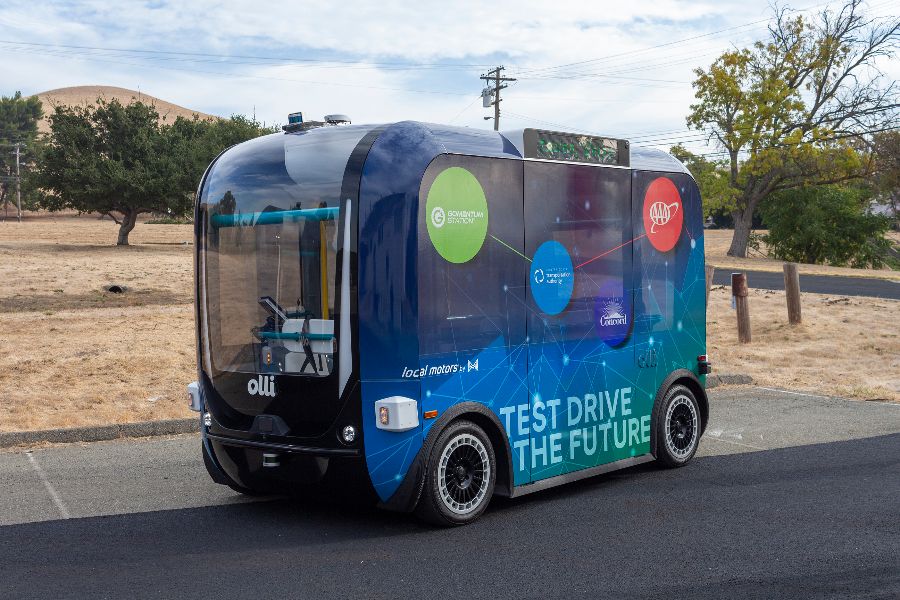
Local Motors Shared Autonomous Vehicle preparing for a test run at GoMentum Station. Photo: CCTA

By Linsey Willis, Director of External Affairs, CCTA

The Contra Costa Transportation Authority proudly announces a new partnership with the Minnesota Department of Transportation– an agency dedicated to advancing transportation technology research – to share knowledge and testing facilities in an effort to advance safer, smarter, more efficient transportation networks that not only benefit both California and Minnesota, but can inform transportation technology implementation across the United States.

MnDOT’s Connected and Automated Vehicle team is actively working to advance research and deployment of Intelligent Transportation Systems, Connected Vehicle applications and Autonomous Vehicle technologies with the help of MnROAD–the state’s cold weather pavement testing facility. MnROAD has over 50 unique test sections on several roadways, including two 3.5-mile, high-speed corridors on Interstate 94 and a 2.5-mile, low-speed, closed access road. MnDOT also partners with Camp Ripley, a military and civilian training facility operated by the Minnesota National Guard, which has a 4.3-mile emergency vehicle operations course. With some of the most extreme weather conditions in the nation, Minnesota offers testing simulations that cannot be replicated elsewhere, which provides unique opportunities to test the safety features of CV and AV technologies.

Through this partnership, CCTA will have access to MnROAD facilities and likewise, MnDOT will have access to GoMentum Station in Concord, California – one of the largest secure connected and automated vehicle proving grounds in the country. GoMentum Station augments MnDOT’s testing with varied terrain, and real-life infrastructure including roads, bridges, tunnels, intersections and parking lots provide the environment needed to accelerate testing of the first and last mile applications, and the ability to safely test technology to its limits. CCTA also has many long-standing research and manufacturing partnerships that offer coordination opportunities for MnDOT.
“With this new collaboration, we’ll be able to test in conditions that just can’t be replicated here in Contra Costa,” stated Randy Iwasaki, Executive Director of CCTA. “Our partnership with a state agency like MnDOT will open new doors to shared research opportunities for a small agency like ours, and it’s exciting to be partnering with an agency that has similar goals in the arena of connected and automated vehicle technology.”

“Minnesota is excited to partner with one of the nation’s leading institutions in this work as we explore innovations in smart mobility, connected and automated vehicles and how advancing technologies are impacting communities,” said Kristin White, MnDOT CAV-X Executive Director. “Through collaboration and information sharing, we’re committing to learning from CCTA, sharing best practices and together advancing research that supports our regions and national goals. We believe this partnership can be a model for other regions to advance smart mobility.”

About the Contra Costa Transportation Authority

The Contra Costa Transportation Authority (CCTA) is a public agency formed by Contra Costa voters in 1988 to manage the county’s transportation sales tax program and oversee countywide transportation planning efforts. With a staff of twenty people managing a multi-billion-dollar suite of projects and programs, CCTA is responsible for planning, funding and delivering critical transportation infrastructure projects and programs that connect our communities, foster a strong economy, increase sustainability, and safely and efficiently get people where they need to go. CCTA also serves as the county’s designated Congestion Management Agency, responsible for putting programs in place to keep traffic levels manageable. More information about CCTA is available at ccta.net.
Background on MnDOT CAV Program

MnDOT’s Connected and Automated Vehicle Office (CAV-X) was launched in 2018 and is now one of the nation’s leading tech startups and idea incubators within state government. Building off its strong history in Intelligent Transportation Systems research, CAV-X advances research, policy, planning and strategy to help the Midwest prepare for the changes that advancing technologies will bring. This multi-disciplinary team combines the fields of law, policy, engineering, planning, and communications to develop strategic partnerships that advance the state’s goals to build a safe, equitable, accessible, healthy, and sustainable transportation system. CAV-X oversees over 100 projects in research, deployment and development with more information found at mndot.gov/automated.

About GoMentum Station

GoMentum Station in Concord, California is owned and operated by AAA, and it is the autonomous vehicle testing facility where the Contra Costa Transportation Authority leads and facilitates collaborative partnerships among multiple automobile manufacturers; original equipment manufacturers and Tier 1 suppliers; communications suppliers; technology companies; researchers and academia; public agencies and other partners. At GoMentum Station, technology, innovation and commercialization will converge to define the next generation of transportation network infrastructure. More information about GoMentum Station is available at gomentumstation.net.

Tri Delta Transit launches on-demand shuttle service to BART stations, nearby destinations

Monday, June 17th, 2019

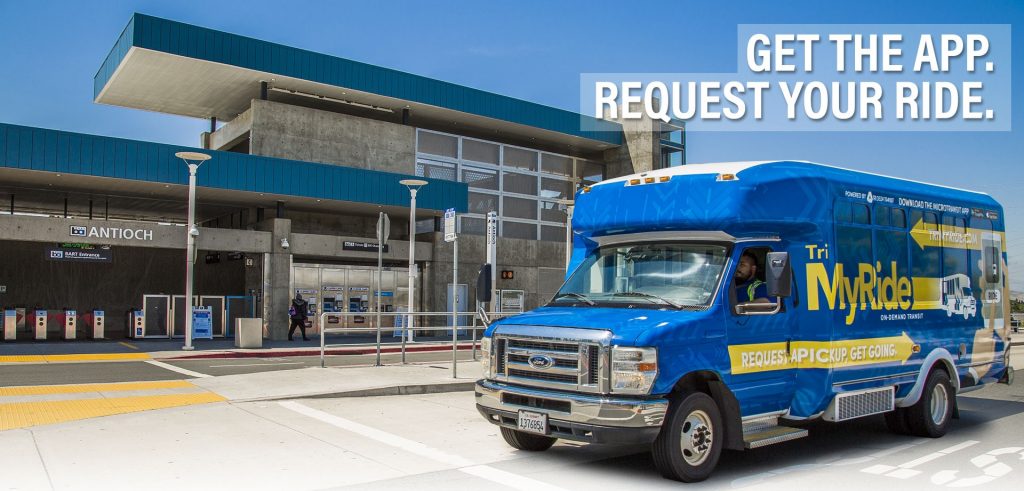
The new Tri MyRide will take riders to and from the Antioch and Pittsburg-Bay Point BART Stations or nearby destinations. Photo from TriMyRide.com

Only $2.00 per trip, much less than Uber or Lyft

Eastern Contra Costa County Transit Authority (Tri Delta Transit) is excited to announce the launch of Tri MyRide, a flexible and dynamic on-demand shuttle service operating in neighborhoods near the Antioch BART Station and Pittsburg Bay Point BART Station. This six-month pilot program shuttle service begins operation today, Monday June 17. Tri MyRide operates Monday thru Friday from 5am to 8pm.

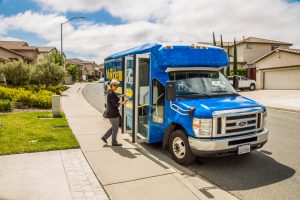
Photo by TriDeltaTransit.

Similar to ride-hailing services, Tri MyRide uses a smartphone app for riders to schedule customized curb-to-curb trips. Tri MyRide allows riders to plan their customized trips anywhere in the Hillcrest/Antioch BART service area or San Marco/Pittsburg Bay Point BART service area to BART or to a designated point of interest located in the service area. The app, known as Microtransit by TransLoc, is connected to proprietary software that allows bus operators to pick-up and drop-off passengers in an efficient manner.

The service uses small, neighborhood-friendly shuttle buses that easily maneuver on residential streets. Tri MyRide operators undergo the same background screening as other Tri Delta Transit operators, and all vehicles are equipped with surveillance cameras to ensure safe transport. The shuttle buses are wheelchair accessible and accommodate people with disabilities.

The cost to ride is only $2.00 per trip. Payment may be made through the Microtransit app or with cash. The low-cost makes Tri Delta Transit’s Tri MyRide more affordable than traditional ride-hailing services, which could cost riders at least more than three times the amount for a similar trip.

“By partnering with technology companies, Tri Delta Transit is meeting the evolving needs of passengers in our community. Tri MyRide allows our agency to provide on-demand service from the convenience of a smart phone app.” said Chief Executive Officer Jeanne Krieg.

The service requires using the Microtransit app on your smartphone.

HOW IT WORKS

The six-month pilot program is being implemented in partnership with Tri Delta Transit and TransLoc, a Ford Smart Mobility Company. To use this new ride share program, passengers located within the service area first download the free Microtransit by TransLoc app to their smartphone and request a ride. Following a Tri MyRide request, the Microtransit app will provide passengers with an estimated pick-up time, track their bus in real-time, and alert them when the ride is about to arrive. Passengers are also notified when their ride is about to reach their destination.

Tri Delta Transit is one of the innovative transit agencies throughout the nation piloting microtransit technology. The new microtransit services are intended to complement existing public transportation services. By providing flexible, on-demand transportation services, transit agencies are bringing improved mobility and greater accessability to the communities they serve.

ABOUT TRI DELTA TRANSIT

Tri Delta Transit provides over 3,000,000 trips each year to a population of over 250,000 residents in the 225 square miles of Eastern Contra Costa County. They currently operate 15 local bus routes Monday – Friday, four local bus routes on weekends, door-to-door bus service for senior citizens and people with disabilities, on-demand rideshare services and shuttle services to community events. To learn more, visit TriDeltaTransit.com.

ABOUT TRANSLOC

TransLoc is the maker of mission-critical transit operations solutions for flexible on-demand and fixed route systems for both public and private transit agencies, and university and business campus transit systems. TransLoc is the largest provider of agency-owned microtransit systems for municipal transit agencies in the U.S., with the company’s products used at more than 400 agencies. To learn more, visit TransLoc.com.

For additional information about Tri MyRide, please visit TriMyRide.com.

City of Antioch launches new website

Tuesday, September 11th, 2018

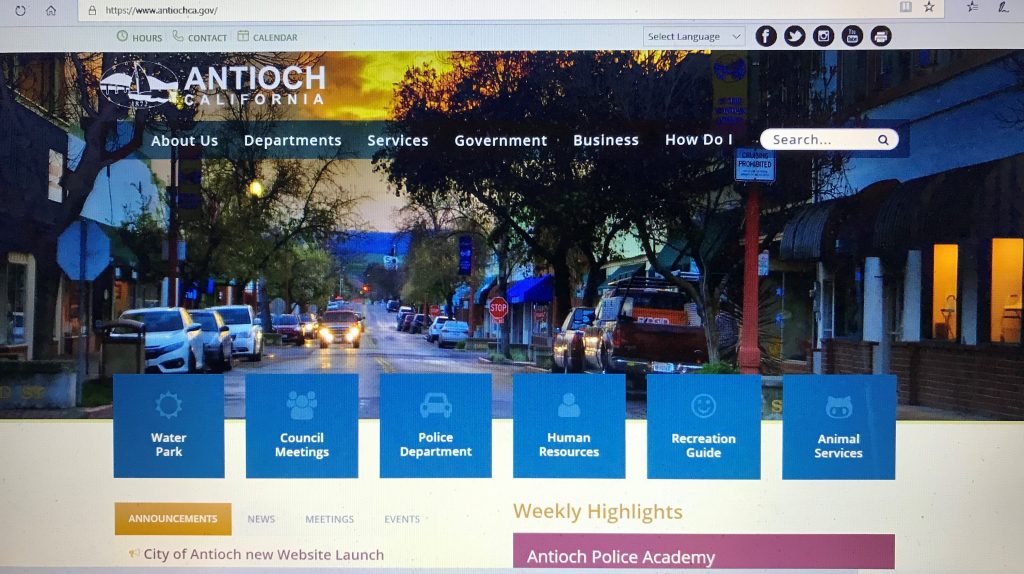
Screenshot of the City of Antioch’s new website.

The City of Antioch is excited to announce the launch of its redesigned website and new domain name at www.antiochca.gov. The site has a fresh, contemporary look and will be easier for residents and customers to navigate through with an improved search engine to help users more easily find the information they need.  

The new site’s graphics, navigation, and content provide a clear window into City governance, operations, and services while making it easy for users to access information on activities and opportunities, request services, and interact with City staff.  The site takes City Services to our local community, businesses and beyond, furthering our commitment to accessible, and efficient local government.

Website improvements also include clarifying content and adding consistent navigation at each page header. In addition, the new format is compatible with smartphones and tablets by automatically reformatting to the device being used.

“We are excited to have a website that is easier to use and provides better engagement for our residents,” said Ron Bernal, Antioch City Manager. “The new site gives us the opportunity to provide more transparency about City business and also informs our community about important topics, projects and City happenings.”

Rep. McNerney to host net neutrality town hall meeting in Antioch Sunday, March 4

Saturday, March 3rd, 2018

From Congressman Jerry McNerney

As your representative in Congress, I take very seriously my responsibility to be your voice in Washington. So when you called, emailed and wrote letters by the thousands, expressing your concerns about the Federal Communications Commission’s (FCC) plan to eliminate net neutrality protections, I took action.

Prior to the FCC’s vote to repeal net neutrality, I submitted a formal request to address the full Commission. I wanted to make the case for maintaining a free and open internet, and to share some of the stories you’ve shared with me – stories of small business owners, veterans, students and so many more who rely on the internet for nearly every aspect of daily life. Unfortunately, FCC Chairman Ajit Pai denied my request.

Thankfully, there was someone on the Commission who wanted to ensure your voice and the voices of Americans across the country were heard. FCC Commissioner Mignon Clyburn, who stood strong and voted against the repeal, submitted a written statement on my behalf and read her own compelling dissent in opposition to the repeal of these crucial protections.

Commissioner Clyburn will be joining me this Sunday, March 4th from 3:00-4:30 PM at the Antioch Community Center for a town hall on net neutrality. We’ll be discussing your concerns and talking about how we move forward in the fight for a free and open internet.

For more information or to RSVP please call (925) 754-0716 or email McNerneyRSVP@mail.house.gov.

I hope to see you there.

Reps. DeSaulnier, Smucker introduce bipartisan bill to spur innovative changes to transportation systems

Wednesday, October 4th, 2017

Washington, DC – Today, Wednesday, October 4, 2017, as we recognize National Smart Cities Week, U.S. House Transportation and Infrastructure Committee Members Representatives Mark DeSaulnier (D-CA) and Lloyd Smucker (R-PA) announced bipartisan legislation that would establish $100 million in new grant funding for cities to invest in and use innovative technologies and solutions for the purpose of improving transportation and mobility. The Moving FIRST Act (H.R. 3901) was introduced to build upon the Department of Transportation’s Smart Cities Challenge, by increasing the funding available and making it an annual grant opportunity.

“Seventy five percent of all Americans are expected to live in urban areas by 2050. We need to invest in the best way to move our people and our goods in ways that reduce congestion, improve public health, and are tailored to the needs of our communities,” said DeSaulnier. “We’ve already seen how smart technologies succeed in the Bay Area and California, and I am proud to partner with my colleague Representative Smucker to create grant opportunities for cities across the nation, and of all sizes, to advance cutting edge technologies.”

“This week is National Smart Cities Week – a perfect time to refocus our efforts in support of innovative and creative solutions to help our cities work better,” said Smucker. “Investments in smart infrastructure projects help move people to job centers, products to market, and connect economic hubs. Expanding initiatives like the Smart Cities Challenge will help kick start improvements in transit and connectivity in cities like Lancaster and Reading. I am glad to work with Rep. DeSaulnier to introduce the Moving FIRST Act and I look forward to continuing my work to improve our nation’s infrastructure.”

H.R. 3901 would make annual grant awards available to communities of all different sizes which seek to advance projects like autonomous vehicle technology and sensor-based infrastructure in order to meet the transportation challenges they face. Specifically, the bill establishes the Strengthening Mobility and Revolutionizing Transportation (SMART) Challenge Grant, which will annually award:

  • A large city with up to $50 million in grant funding
  • A mid-sized city with up to $50 million in grant funding
  • Two rural communities or regional partnerships with up to $20 million in grant funding or 20% of the total funds available

Senators Catherine Cortez Masto (D-NV) and Richard Burr (R-NC) introduced companion legislation, S. 1809, in the Senate.

National Smart Cities Week brings together city leaders, innovative companies, and policymakers to engage in a national dialogue to better understand and prepare for the ways new technologies will impact the ‘city of the future.’

Tri Delta Transit launches new mobile app for security

Tuesday, October 3rd, 2017

As of Monday, October 2, Tri Delta Transit is offering ‘Tri Delta Watch,’ a mobile security app that instantly allows riders to notify police or dispatchers of security incidents on buses and at bus stops. The free app allows riders to anonymously send text reports with pictures or videos to dispatchers who can respond to or address the problem. Contacting local police directly is an option of the app, which is made simple via a one-click 911 button for more serious situations.

The free security application is available at the Apple App Store and Google Play for iPhone and Android devices; search Tri Delta Watch. Once downloaded, riders can report suspicious activity, and incidents that might require law enforcement’s presence on board Tri Delta Transit buses.

“Occurrences that might merit the use of the app are extremely rare on our buses,” said Mike Furnary, Director of Marketing. “Having the app is just another means to help us keep it that way.”

Tri Delta Watch and similar security apps are important new components in the industry’s effort to enhance safety for customers and drivers. The U.S. Department of Homeland Security adopted the “If You See Something, Say Something” public awareness campaign in 2010. Transit agencies, including Tri Delta Transit, have launched a variety of advertising and outreach efforts to educate riders about the importance of being vigilant in reporting suspicious, illegal or inappropriate behavior and activities, as well as unattended packages.

The smartphone app allows customers to assist security efforts by reporting suspicious activity in a timely manner. When a rider sees a suspicious situation, with the click of a button, they can directly call police or discretely submit a report with photos or video, incident descriptions, and GPS coordinates to transit officials. If the user chooses to submit a picture or video, the camera flash is automatically disabled to not draw attention to the rider.

The mobile app allows riders to report incidents such as suspicious activity, disruptive behavior, crime in progress, and security or safety issues. Riders may also report immediately threatening situations such as fighting, or attacks on drivers.

Once a report is initiated, real-time two-way communication is enabled. Dispatchers may ask the rider for more details about the situation or provide instructions, as needed. In the event of an active incident, the dispatcher and reporter are able to communicate concerning details about those involved, what bus they are on, and assessment of the suspect’s behavior. The dispatcher can advise and communicate with the customer or contact the appropriate person or agency for assistance if necessary.

“Safety and security begins with all of us,” said Furnary. “If you see something, say something.”

Tri Delta Transit provides over 3,000,000 trips each year to a population of over 250,000 residents in the 225 square miles of Eastern Contra Costa County. They operate 13 local bus routes Monday – Friday, 4 local bus routes on weekends, door-to-door bus service for senior citizens and people with disabilities, and shuttle services to community events. For additional information about Tri Delta Transit, please visit www.trideltatransit.com.