






Archive for the ‘Sports’ Category

Golf column: The Greatest Teacher

Wednesday, October 31st, 2012
By Ron Parish, PGA Director of Golf, Lone Tree Golf Course

Who is it? Hank Haney? One of the Harmon brothers? Jim McClean? Michael Breed? David Leadbetter? Martin Hall? Or should we go Old School? Bob Toski? Jim Flick? Tommy Jacobs? I could keep going. It would be nice to spend time with one of these guys wouldn’t it? But then you might have to look at the finances and see if you can afford such and engagement. Several of these instructors command a four digit fee. I propose that you already meet regularly with one if not the greatest teachers of all time. Do you realize that? Each one of you. Who? The golf ball. Really Coach Ron? Really? Yes, really. The question is, are you listening?

Granted, there are things that a qualified PGA instructor can and will help a student improve in their game. There are times when we don’t realize some things are going on and we need to have someone shed some insight, and getting lessons and an understanding of fundamentals is vital. But the golf ball is constantly teaching us and I don’t believe enough golfers are listening. I try and stress this to my students but I have to be honest, I get frustrated because they aren’t listening. So I will pose a few questions to help you get where I am coming from and hopefully help the golf ball teach you.

What does the golf ball know? Only the club head, and the golf ball is trying to tell you the message the club head is sending. By the way, the message it is sending is coming from the shaft, which is held by you and your body, and so you are ultimately telling the club head what to do and again it is the only thing the ball knows. So how does the golf ball teach us? Here are some of my top experiences with students and hopefully this will help:

Full swing

  • The bladed ball. This one is pretty darn common with beginners. There is something innate for a beginner here. I think it comes from an uncertainty or doubt because they know they are new to the game, or because a fear to disturb the grass when hitting down on the ball, and so what happens? Blade after blade, singed night crawlers and nervous gophers. What’s the ball telling you? You are hitting the ball on the leading edge not the clubface. What do you do? Check your ball position, possibly move it back in your stance and then keep your eye on the back of the ball and hit down and brush the grass after you hit the ball. A little divot is good for a beginner. If you hit it fat, don’t beat yourself up, just keep at it and you will learn to hit the ball first.

  • Slices. The golf ball is telling you the clubface is open in relation to the path of the club head. Remedy? Start with the grip. Rotate hands towards the back foot (stronger) when gripping the club and move the ball back in your stance until you start to hit it straight or with a draw.

  • Driver that flies low and shoots offline. The ball is telling you the path of the club head is coming in too steep and not sweeping enough. Tee the ball high, keep the ball position forward and really sweep the take away low to the ground. On the way through, pretend there is a small nail sticking in the back of the ball just below the equator and the club head is going to sweep through and drive the ball squarely through the golf ball. A good drive should launch at about 45 degrees.

  • Putts that don’t feel solid and come up short. If everything is square and the path is good, the ball is telling you it needs to hit the sweet spot of the putter. Tape two band-aids just outside of your sweet spot, leaving a small opening to hit the ball, and then practice hitting putts right on it. I bet you will find the ball rolling your intended distance soon.

  • Chips that are chunky. The ball is telling you to hit the little ball before the big one. Move the golf ball back in your stance. Keep stance open. Keep your weight favoring the forward foot and keep your hands ahead throughout the motion. These things will help you meet the golf ball first. Still not getting it? Push yourself. Practice chipping and see how far you can move the ball back in your stance. 2”. 4’, 6’ behind your back foot? Try it and watch what happens, I bet you will start making good contact with the golf ball and you will figure things out.

These are just a few examples, there are many more, but my point is mainly made so to help yourself learn. Watch and listen to what the golf ball does instead of getting frustrated at a missed shot and you will be more easily able to make change and improve your game.

I hope this helps. Thanks to all the golfers that frequent Lone Tree and for all you do for our course and golf in the area. Please try to bring someone new to the game soon or let them know about a golf program offered here or elsewhere. Someone else is out there who would like to have the fun that you are having with this great game.

If you are interested in reviewing other articles from Coach Ron go to www.lonetreegolfcourse.com under “The Course” tab.
Tickets on sale for Big Little Game recognition Luncheon October 31

Monday, October 15th, 2012

Sponsorships available

For the past ten years, the Kiwanis Club of Pittsburg and Delta-Antioch have joined together to present the “Big Little Game” Football recognition Luncheon for the age old rivalry between the Pittsburg High and Antioch High Football teams.

This worthy endeavor brings together business and community member, football players, along with school administrators and coaches of both high schools, for sportsmanship and scholarship recognition. All the Senior players are invited as our guests to participate in the luncheon and the program. During the luncheon, a senior football player from each school, picked by his coach and fellow players, receives a scholarship.

Please put this year’s touching, yet humorous event on your calendar, Wednesday, October 31, 2012, from 11:30 AM – 1:00 PM at the Pittsburg Elk’s Lodge, Pittsburg. This event has proven to be a wonderful success and we hope you can join us!

On behalf of the Kiwanis Clubs of Pittsburg and Delta-Antioch, I would like to ask for your support for the 11th Annual Pittsburg – Antioch “Big Little Game” luncheon. Tickets for the luncheon are $20. Sponsorship opportunities are also available, beginning at $100 Supporter Level (includes two luncheon tickets), $250 Fan Level (includes four luncheon tickets), $500 Coach Level (includes eight luncheon tickets). A souvenir program will be printed for the luncheon, identifying all the sponsors.

Please feel free to contact me if you have questions about sponsoring the event. The deadline for sponsorships/tickets reservations is Friday, October 26, 2012. For more information, reserve your spot at the luncheon or in the program, please call Tim Stone (925) 432-3145 or Email tim@readyprint.com or Jim Craft, (510) 541-8074 or Email jcraft@stsacademy.org. Thank you in advance for your support and consideration.


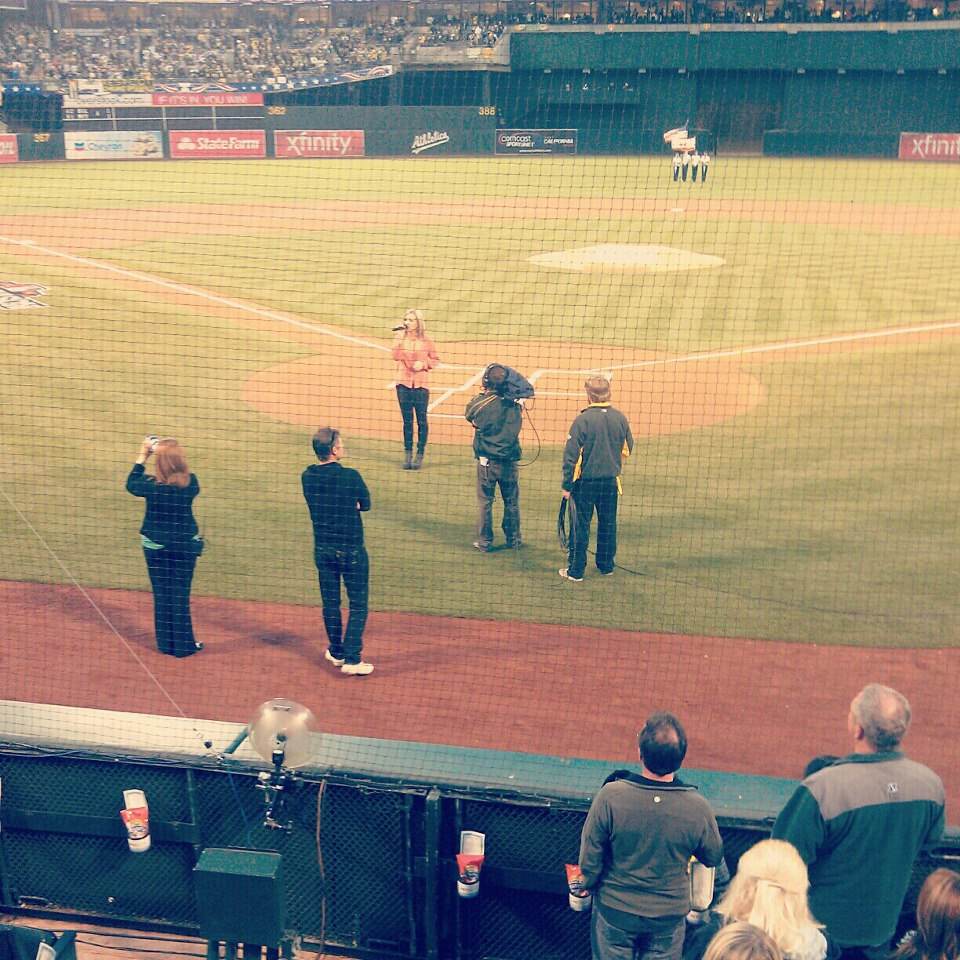
Antioch singer Jessica Caylyn sings National Anthem at A’s final playoff game, Thursday night

Friday, October 12th, 2012

Jessica Caylyn sings the National Anthem at the Oakland A’s playoff game in the Coliseum on Thursday night, October 11, 2012.

Antioch resident Jessica Caylyn was chosen to sing the National Anthem before the sell-out crowd at the Oakland A’s American League Division Series game against the Detroit Tigers on Thursday night, October 11, 2012.

Here’s what she had to say about the experience: “I’ve sang the Anthem at several games, races, etc., but I was a little nervous because my voice was more tired then usual. Also, I could feel the energy level of the crowd and it was much bigger then regular season games. I didn’t meet any of the players this time around, that’s okay though I got my fair share of eye candy. Ha! It’s not only an honor but very exciting to sing our nation’s most well respected song, for so many people. I think artists tend to forget what the song actually represents, in that moment it’s not all about shining as a vocalist. It’s about delivering the song in a classy manner. I just hope the crowd felt that I did it justice!”

For more information about Jessica, visit www.JessicaCaylyn.com.

Golf Column: How’s Your Belly Button?

Wednesday, October 3rd, 2012

By Ron Parish

Do I have your attention? Quite a funny title for a golf article but in simplicity, a great tip for the golf motion. So how is your belly button? Generally speaking, new golfers are successful with their hands and arms. Innately, these are the parts of our bodies that we know how to use the best when it comes to athletic activities so it isn’t too hard to get them engaged or focus on them. But new players often have a challenge getting there core and lower body involved in the swing.

This becomes particularly evident on the follow through when the hands and arms swing through to a finish on their own becoming somewhat discombobulated with the torso; resulting in an off balanced finish. So let’s think about a few other sports to help create a correlation that may help.

·Forehand in tennis. The tennis player swings the racket back not only with the hands and arms but the turn of the torso (belly button); the weight is on the back foot and then on the forward swing the lower body transfers the weight forward, followed by the turning of the core, followed by the hands and arms swinging forward; the torso doesn’t just stop it keeps turning towards target ala Andre Agassi as the eyes stay focused on the ball and the hands and arms then accelerate through.

·Knockout punch in boxing (Not the jab). Again we see a turning of the core that creates a slight transfer to the rear leg, then the lower body followed by the core lead on the forward swing; and then the arms and hand come through but all while the core is turning and leading over to the front foot.

·My favorite analogy, Baseball pitch from pitchers mound (or football pass deep). Shoulders are turning on the windup along with the core (shoulders about 90 degrees, core about 45 degrees), the lower body balances and stores the energy of the windup (particularly in the right hip….a really good golf association here) and then lower body transfers energy forward off the rubber; the core or belly button follow towards home plate leading ahead of the hands and arms.

So to keep things simple try these two drills:

·Take your back hand (the hand farthest from the target; for a right handed player his right hand) and hold a seven iron with just your thumb and first two fingers. Slowly swing the club with your one arm back and forth, increasing the length of the swing with each motion. Keep swinging back and forth until you go to full length motion. Notice how your arms swing and work with your core and belly button, and also how your legs balance things going back and forth. This is the golf motion.

·Hit balls and just finish with the belly button facing the target. Try hitting a bucket of balls and just see what happens with this one swing thought. There is a really good chance that the arms will sink up with the core, and the legs will sink up with the core and you will find yourself swinging with everything working together.

If you are interested in reviewing other articles from Coach Ron go to www.lonetreegolfcourse.com under “The Course” tab. Thanks for playing this great game and be sure to share it with someone else.
Golf Column: Improve Your Fairway Wedge by Adding Acceleration and Hitting the Ball Crisply

Tuesday, August 14th, 2012

Off distance wedge shots from the fairway are one of the key areas of the game that separates better players from mid to high handicappers. It is very common for the mid and high handicappers to take too long of swing and try to decelerate just the right amount to get the ball to go the right distance.

This creates a multitude of errant shots which include fat, bladed, blocks right and pulls left, besides shots rarely going the correct distance. Oten when they do go the right distance there isn’t any check on the ball so it bounces right on through the green.

Better players will keep the acceleration in this shot which helps the ball not only go the right distance but also stay on line and and “check” with backspin. Here are some keys to help you understand this off distance shot and improve your scoring:

The lie. Understand that you need to be in the fairway or short cut grass to play this shot. The lie has to be tight. A “hard pan” lie will also apply. With this shot we are trapping the ball between the clubface and the turf in a downward fashion; “trap” is a key concept; unlike a shot coming from the rough where a player might try and slide the club under the ball.

The ball. Play a ball that spins. This is essential. There are a lot of them out there to chose from. I use a Titleist Pro V1 which has a Urethane cover and a firm outer core so as to help the ball get the check on this type of short shot. A hard ball isn’t going to cut it.

The groves. The USGA recently changed the rulings on the manufacturing of wedges, but unless you are playing USGA and tour events, you don’t have to worry about playing wedges with conforming groves and I would encourage you not to so you can get the benefit of the technology.

The set up.

– Ball position: We are going to trap the ball here, so the ball position must be back. Anywhere from 1” to 3” behind center. The further back, the lower the shot is going to take off. When playing into the wind, keep it further back so you can hit it low and driving and keep control of the ball.

– Stance: Narrow and open with weight slightly forward. This will help with the trapping motion, particularly the opened stance. You don’t want the club going inside on the back swing too fast but rather more with the alignment of the feet. This will allow for a steeper decent on the ball and the trap or pinch motion. For those who are old enough to remember, a la “Lee Trevino”.

-The Swing motion:

§ Let the wrists set or cock on the way back, but keep them firm on the way down and through. Setting them on the way back helps set up the “trap” to the shot. Firm on the way through keeps from flipping the clubhead and sliding it under the ball and makes the clubface literally trap the ball between it and the ground.

§ Use your core. This isn’t an arm only shot. In fact it is more of a shot from your core and torso leading the acceleration.

§Use your legs. The legs are very important and the better golfer realizes it. The legs shifting the weight back and forth keep the shot in rhythm and works in unison with the core.

§Finally, hit down. If you set up right you will be able to hit down hard and aggressive through the ball and you will catch the ball first. You don’t need to worry about fatting the shot even though you are going to take some turf because of the way you set up. So take a divot. That is going to help with the trap and getting some spin.

If you are interested in reviewing other articles from Coach Ron go to www.lonetreegolfcourse.com under “The Course” tab. Thanks for playing this great game and be sure to share it with someone else. Next month: The “skidder”.
Strength Through Diversity – Golf Column

Thursday, July 12th, 2012

At Lone Tree, we are a First Tee facility. The summer session just began and I have the privilege to teach the Eagle class which is the level the kids achieve after completing Player, Par, and Birdie certifications. The program is fantastic and this month I wanted to give readers a feel for the fun the kids and coaches have by sharing one of the life skill and golf skill concepts we touch upon in Eagle class, Strength through Diversity. The following are some of the activities that we will introduce to the kids that introduce diversity and appreciation for diversity. The coaches goal is to keep the learning “activity based” (not lectured based learning). Some activities are as follows

  • Diversity warm up/introduction: Discussion regarding favorite food and favorite foods their family enjoys during the holidays. This is always interesting conversation with the kids and stimulates great conversation and interest in other family traditions.

  • Play an entire hole with their #7 iron. By having the limits of the seven iron, appreciatition for other clubs occur, ie. The driver and the distance it gets from the teeing area. Because they putt with a #7 iron, they get creative on how to putt. I’ve seen hooded #7 irons, bellied 7 iron putts, and even putts off the toe of the 7 iron. With this exercise they also learn to change different ball positions to hit the ball lower and get more roll if the shot calls for it, or in the situation where they have to have a softer shot, they move ball position forward to get more height or softness in the shot. So again learning about the diversity of shots with diversity in their set up.

  • Play a team alternate shot where one player hits only metal-woods, one hits only full irons, one is only the dedicated chipper or sand shot, and one is only putting. We follow with discussion of how if you are good with the driver, you might want to put a good putter or chipper on your team to help your be the most competitive. We talk about how when doing a group report at school do you want all team members who are just like yourself or is their strength by having a mix of people with different talents and abilitities?

  • Chip with various clubs. Initially, we start with a basic chip shot on short, fairway cut grass and ask the kids to chip and get it close. Leaving instructions at that. Invariably the kids grab their wedge and chip away. Then we try the same shot but with a putter (texas wedge). Then with a hybrid or fairway wood. Then with a 7 iron. Then we will try these diverse clubs in different positions, just off the green but in the rough; or up against the curtain of the green. The learning for different clubs in different positions occurs fast. You might try it, chips aren’t always about the wedge.

  • We hit clubs while seated in a chair on the driving range. Or while kneeling on a towel. Standing on one leg, then the other. Or with one arm only. Further understanding of how the swing works occurs from these exercises and when mentioned that golfers with physical disabilities might play in a similar manner, appreciation continues.

At the end of such activities, we close with discussion and the kids have much to share. It is truly a delight. You might try a couple of the above and see if you can strengthen your golf game and more through such an activity.

To add a personal note, As your Pro, there is not a day that I don’t think of this life skill while working at your golf course. The diversity of golfers and patrons that support and frequent here, and the diversity and dedication of managers and employees here, paired with the diversity of our Lone Tree Board of Directors and their business acumen they lend, and the support and commitment from the various City Officials and representatives, and the patronage of the untold community organizations truly make Lone Tree an amazing public Golf Course and Event Center, the best public course in Northern California in my opinion, one that truly embodies and understands the First Tee’s concept of Strength through Diversity. Thank you to the so many who are a part in that.

If you are interested in further supporting the First Tee, The annual First Tee Golf Tournament and fundraiser will be help at Lone Tree and Diablo Creek on July 20, 2012. Go to www.lonetreegolfcourse.com under events to get more information.

Ron Parish is the Director of Golf at Lone Tree Golf Course in Antioch, and a member of the PGA.

Learn from Mr. October, Stay Within Yourself

Thursday, June 7th, 2012

There is trial and error in the game of golf. No way around it. I believe some golfers recognize this way more than others, and golfers who play and practice within themselves are able to grow and learn from their trial and error more easily.

I had the good fortune to give the great baseball player Reggie Jackson a series of lessons when I was in Southern California in my early professional years, and it struck me within the first five minutes of the first lesson of how he recognized this.

He came to the course with two other ball players and immediately after their arrival, the other two younger players were pounding drivers while Reggie was patiently working with a 7 iron. Reggie pointed over and said, “See, I’ve made a lot of mistakes, and that’s how I’ve learned. I’m new to the game and I don’t need to be doing that right now. Pounding drivers is a lot of fun and feels good but I know I need to be right here, with this club learning fundamentals.”

Reggie was exactly right. Here he was, strong as an ox, with the ability to hit it a mile, but he had the discipline to resist the urge to pound it, in order to develop his understanding of the fundamentals and learn how to stay within himself.

Don’t get me wrong, there are times I believe in going after the ball, but doing so within yourself is vital for being able to do so repeatedly and consistently. Here are some practice pointers for learning how to stay within yourself and grow in your understanding of your game:

Work the wedge. Practice the pitch, chip, chip, pitch, half wedge, flop, bump n run, wind cheater, and more. To develop your full swing, practice with the wedge more than any other club in your bag. There is a sequence to the motion in the golf swing, and these small shots with their various ball positions and adjustments will help you learn the timing of your swing. It is like learning to dance.

Do you jump right out on the dance floor and go as fast as possible right out of the gate? No, you get the steps down slowly, and then as you gain confidence in repeating, you then start to quicken up the pace. So using the wedge is rehearsing and getting the steps down slowly; something all golfers need to continually do.

Hit shots on the range with varying percentages of power. Take your 7 iron and hit some balls full length of backswing but half (50%) power. I’ll bet you will be surprised. That golf ball is going to fly farther then you thought it would. Then move up by 10% increments and hit some shots swinging 60%, 70%, 80% up to 100%.

This is a great way to learn about how to keep the club swinging on a good path and plane. Also, a great way to learn about the best tempo for your swing. You may just find that when you swing 90% and 100% that the club has more of a tendency to get yanked off the correct path and plane and not fly as far and accurate. Try this with a hybrid or 5-wood too; you’ll probably have some fun and you might even find your balance improving.

On the range, hit at your usual 8-iron green with your 7-iron. Really try and land 7 irons on that green. By taking a club more to hit to the target, you have to stay within yourself. You are also going to learn how to keep the flight of the shot lower by practicing this way which will give you more ball control.

This type of control can come in handy when trying to hit greens and also when playing on windy days.

I hope these pointers help you with your game. Read all of my columns on the Lone Tree Golf Course’s website at www.LoneTreeGolfCourse.com and look under “The Course” and “Your Pro’s Corner”.

Cyclists Race Through East County in Amgen Tour of California

Monday, May 21st, 2012

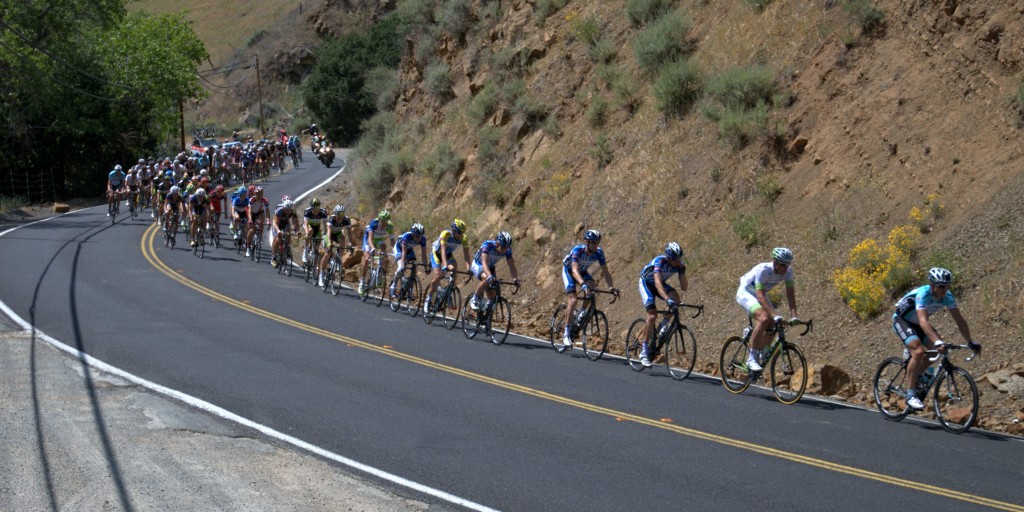
Amgen Bike race competitors head east down Marsh Creek Road. Photo by Brad Bennett

Over 100 cyclists raced through the roads of Contra Costa County, up Mt. Diablo and down Marsh Creek Road in East County on Tuesday, May 15, during Stage 3 of the Amgen Tour of California 2012 Bike Race.

The race lasted from May 13 to the 20th, with eight stages throughout the state.

According to the Amgen Tour of California website “Stage 3 of the 2012 Amgen Tour of California started in north San Jose…and made its way down to the city of Livermore. For the first time in the history of the race, the riders were challenged with a climb up Mt. Diablo, one of the most revered climbs in California. Peter Sagan (SVK) [Slovakia] of Liquigas-Cannondale crossed the finish line first taking his third stage win of the 2012 race and making Amgen Tour of California history by winning three consecutive stages.”

According to the Associated Press, “The seventh annual event began May 13 in Santa Rosa with a field of 128 representing 16 teams. The 735-mile race, which had 110 finishers, progressed to the Bay Area before taking a largely inland route to Southern California.”

After eight epic days of racing along some of California’s most iconic roadways, highways and coastlines, the 2012 Amgen Tour of California concluded at L.A. LIVE in downtown Los Angeles, with Rabobank’s Robert Gesink of the Netherlands winning the overall race.

For Gesink, the win marked a both a remarkable comeback and bittersweet win in remembrance of his father, who passed away after a cycling accident in October 2010.

“I dedicate this win for my father,” said Gesink, who said his father attended the 2009 Amgen Tour of California to see his son place 8th overall and win the race’s Best Young Rider jersey that year. “For me emotionally it is something really big to be back at this high level and to win a stage here, the toughest stage of all. It’s a good thing to be back in California and to be winning again.”

American teammates David Zabriskie and Tom Danielson of the Garmin-Barracuda team took second and third place overall. It was Zabriskie’s fourth second-place finish in America’s Greatest Race, having finished second in 2006, 2009, 2010 and 2012.

“Sure, I’d like to win, doesn’t anyone?,” said Zabriskie. “But it was a good tour for the Garmin-Barracuda team.”

About the Amgen Tour of California

The largest cycling event in America, the 2012 Amgen Tour of California is a Tour de France-style cycling road race, created and presented by AEG, that challenges the world’s top professional cycling teams to compete along a demanding course from May 13-20, 2012.

About Amgen

Amgen discovers, develops, manufactures, and delivers innovative human therapeutics. A biotechnology pioneer since 1980, Amgen was one of the first companies to realize the new science’s promise by bringing safe, effective medicines from lab to manufacturing plant to patient. Amgen therapeutics have changed the practice of medicine, helping millions of people around the world in the fight against cancer, kidney disease, rheumatoid arthritis, bone disease and other serious illnesses. With a deep and broad pipeline of potential new medicines, Amgen remains committed to advancing science to dramatically improve people’s lives. To learn more about our pioneering science and vital medicines, visit http://www.amgen.com. Follow us on www.twitter.com/amgen.

About AEG

AEG is one of the leading sports and entertainment presenters in the world. AEG, a wholly owned subsidiary of The Anschutz Company, owns or controls a collection of companies including facilities such as STAPLES Center, The Home Depot Center, Sprint Center, The O2, Nokia Theatre L.A. LIVE and Best Buy Theater Times Square; sports franchises including the Los Angeles Kings (NHL), two Major League Soccer franchises, two hockey franchises operated in Europe, management of privately held shares of the Los Angeles Lakers, the ING Bay to Breakers foot race, and the Amgen Tour of California cycling road race; AEG Live, the organization’s live-entertainment division, is a collection of companies dedicated to all aspects of live contemporary music performance, touring, and a variety of programming and multi-media production. For more information, visit AEG today at www.aegworldwide.com.