Archive for the ‘Politics & Elections’ Category

“So You Want to Run for Office” East County campaign school in Antioch Wednesday

Tuesday, February 1st, 2022

East County residents interested in running for office, this year will have the opportunity to learn from County Elections staff, Fair Political Practices Commission, local elected officials and campaign professionals during a campaign school Wednesday night, Jan. 2.

Dates:  02/02/2022

Time:               6:00 – 9:00pm

Location:         Antioch Community Center at Prewett Family Park

4703 Lone Tree Way, Antioch

Program:

Welcome:    Helen Nolan, Assistant Registrar

Moderator:  Contra Costa County District 3 Supervisor Diane Burgis

Presentations:

  1. Filing for Office Speakers: 6:10 – 6:30pm
  • Contra Costa Elections Supervisor, Rosa Mena
  • Brentwood City Clerk, Margaret Wimberly
  1. Campaign Financial Disclosures Speakers: 6:35– 7:00pm
  • Contra Costa Elections Specialist, Olga Hernandez
  • NetFile, Tom Diebert
  • FPPC, Chloe Hackert (Via Zoom)
  1. Changes for Future Elections: 7:05 – 7:15
  • Contra Costa County Assistant Registrar, Helen Nolan
  1. Bay Area Trust in Elections: 7:15 -7:25
  • Contra Costa County Deputy Clerk-Recorder-Registrar, Tommy Gong

Break:  7:25 – 7:35

  1. Communicating the Message Speakers:7:40 – 8:15pm
  • Consultant, Allen Payton, Del Rey Advertising & Marketing Agency
  • Voters Edge, Shawn Gilbert
  • Social Media, Jenna Valle-Riestra (Via Zoom)
  1. Encouraging Future Leaders Speakers: 8:20 – 8:55pm
  • Contra Costa College Governing Board Trustee, District 5, Fernando Sandoval
  • Contra Costa County Office of Education, District 5, Annette Lewis
  • City of Pittsburg City Council Vice Mayor, Shanelle Scales
  • City of Brentwood Councilwoman, Susannah Meyer

We would like to make sure that we are clear about a couple of details of the event:

  • The purpose of the event is for residents to learn about the specifics of how to run for office, there will not be any campaigning or candidacy promotion at this event.
  • This is the final of three events that we have held (Lafayette, Richmond, and Antioch) and all events are the same format and information with a few different panelists.

While everything points to the latest trends in Coronavirus transmission rates being in decline, we understand that the Omicron strain of the virus is still a big factor, and our county continues to have specific rules in place with regard to indoor venues and events. We want to make sure that all of our participants and panelists understand all of the current rules in place, and that we provide all options for everyone to participate fully.

Please note that as of December 29, 2021, the current mask mandate requires all people in Contra Costa, regardless of vaccination status to mask in public indoor settings. (For our panelists, you will be requested to keep your mask on while speaking). We will also be taking precautions with the seating to assure that our panelists and participants are socially distanced.

Please self-monitor and if you have any of the following symptoms, please do not attend this event in person:

  • Fever or chills
  • Cough
  • Shortness of breath or difficulty breathing
  • Fatigue
  • Muscle or body aches
  • Headache
  • New loss of taste or smell
  • Sore throat
  • Congestion or runny nose
  • Nausea or vomiting
  • Diarrhea

While we feel that we are providing a safe in-person event given all the protocols in place, we understand that some people may not feel comfortable attending in-person.  If you are not comfortable attending this event in-person, please join us via Zoom:

Topic: Antioch Candidate Workshop

Time: Feb 2, 2022 06:00 PM Pacific Time (US and Canada)

Join Zoom Meeting

https://us02web.zoom.us/j/87938930334?pwd=cklnZXFwN3V6R1dUdm1ZVkNhVFlsQT09

Meeting ID: 879 3893 0334

Passcode: 550253

One tap mobile  +16699009128,,87938930334#,,,,*550253# US (San Jose)

Thank you for your understanding and patience as we continue to navigate the pandemic and attempt to make this event as accessible as possible.  https://us02web.zoom.us/account/report

If you have any questions or concerns, please feel free to contact either one of us prior to the event:

Dawn Kruger, Civic Outreach/Engagement Specialist

Dawn.Kruger@cr.cccounty.us

925-335-7805

Karen Tedford, Civic Engagement Aide

Karen.tedford@cr.cccounty.us

925-335-7863

Contra Costa County Clerk-Recorder-Elections Department

We will see you soon!

Contra Costa Supervisors to act on affordable housing, election campaign funding ordinances Tuesday

Monday, January 31st, 2022

Will celebrate Inaugural Asian and Pacific Islander Lunar New Year, honor City of Antioch’s Sesquicentennial

By Daniel Borsuk

An ordinance concerning Contra Costa County’s affordable housing status and other proposed ordinances designed to boost election campaign funding for Supervisors and Non-supervisor candidates along with an Inaugural celebration recognizing the Asian and Pacific Islander New Year will be some of the Agenda Items the Contra Costa County Board of Supervisors will either take action on or pay tribute to at a meeting on Tuesday, February 1.

The Supervisors will meet remotely, starting at 9:00 a.m.  Proceedings will be televised on Comcast Cable twenty-seven, ATT/U-Verse Channel 99 and WAVE Channel 32 and can be seen live online at www.contracosta.ca.gov.

Public Hearing on Inclusionary Housing Ordinance

Supervisors will hold a hearing to determine if the county’s Inclusionary Housing Ordinance is “Consistent with the State’s definition of low-income household and qualifying income units and exempt community care facilities from the County’s Affordable Housing Requirements,” according to the report from the Contra Costa County Conservation and Development.

In effect since 2006, the proposed ordinance would align the County’s Ordinance with changes in the state’s definition of extended low, very low-, low- and moderate-income households and their respective qualifying income limits.

The proposed ordinance would exempt Community Care Facilities from the County’s Affordable Housing Requirements.

Election Campaign Ordinance

Supervisors will consider an Election Campaign Ordinance for Supervisorial and Non-supervisoral candidates increasing individual donations from $1,675 to $2,500.  The County’s Election Campaign Ordinance was first adopted in 1984 and was last revised in 2005.

The Election Campaign Ordinance also applies to other County Elected Positions such as Recorder-elections, Treasurer, Assessor, District Attorney, and Sheriff-Coroner.

A few weeks ago, when Supervisors first reviewed this ordinance, they had briefly studied the idea of raising donations to $5,000, the state limit, but decided to not go that route.

Inaugural Asian and Pacific Islander New Year Celebration

The Board of Supervisors will conduct their inaugural Asian and Pacific Islander New Year Celebration with Susan Kim, executive director of the Contra Costa Family Justice Center, and Professor Kent Wong, Director of the University of California Los Angeles Labor Center, as speakers.   The multi-cultural ceremony will feature dance, music, food, and unique customs of many of the Asian and Pacific Islander communities represented in Contra Costa County including Nepalese, Filipino, Chinese, Vietnamese, Cambodian, Laotian, Tai, and Indian communities.

“We want to recognize one of the most important celebrations for our Asian and Pacific Islander communities and dismiss monolithic stereotypes by featuring the diversity in our Asian communities,” said Board Chair, Supervisor Karen Mitchoff. “Contra Costa County will make history on the first day of this year’s Lunar New Year, February 1st, with the inaugural event as we honor and celebrate the many different Asian and Pacific Islander cultures and traditions. As an important and integral part of our County family, we celebrate the new year with you, and wish everyone a happy and prosperous new year!”

The Asian and Pacific Islander New Year Celebration will be shown at www.contracostaca.gov/6068 or www.contracostatv.org. The community can watch on Contra Costa Television (CCTV) Channels; COMCAST Cable 27.

Rodeo Senior Housing Project  

Supervisors will hold a hearing on a proposal to permit Conservation and Development Director John Kopchick to sign a Development and Loan Agreement between the County and La Loma Rodeo EAU LLC for the sale of county owned property at 710 Willow Ave. in Rodeo.

The Rodeo development calls for the construction of a PA 67-unit affordable unit senior housing project with community space. The developers will receive from the county a $4,450,000 loan from the Housing Succession Low Moderate-Income Funds for construction of the building. The County would sell the County-owned property to La Loma Rodeo for $980,000.

Will honor City of Antioch’s Sesquicentennial – 150th Anniversary

District 3 Supervisor Dianne Burgis who represents portions of Antioch, will present her resolution for adoption that recognizes the City of Antioch’s Sesquicentennial or 150th Anniversary of Incorporation. Antioch was founded as Smith’s Landing in 1849 when the twin Smith brothers purchased land from John Marsh, owner of Rancho Los Medano, who had constructed a landing on the San Joaquin River. Following the death of Reverend Joseph Horton Smith in 1850, the residents, under the leadership of Rev. William Wiggins Smith, gathered during the July 4, 1851 picnic and renamed the town Antioch after the biblical city in Syria where the followers of Christ were first called Christians.  The City of Antioch was incorporated on February 6, 1872, becoming Contra Costa County’s original city. (See related article)


BART Board will consider third proposed map during final redistricting public outreach meeting Wednesday

Saturday, January 29th, 2022

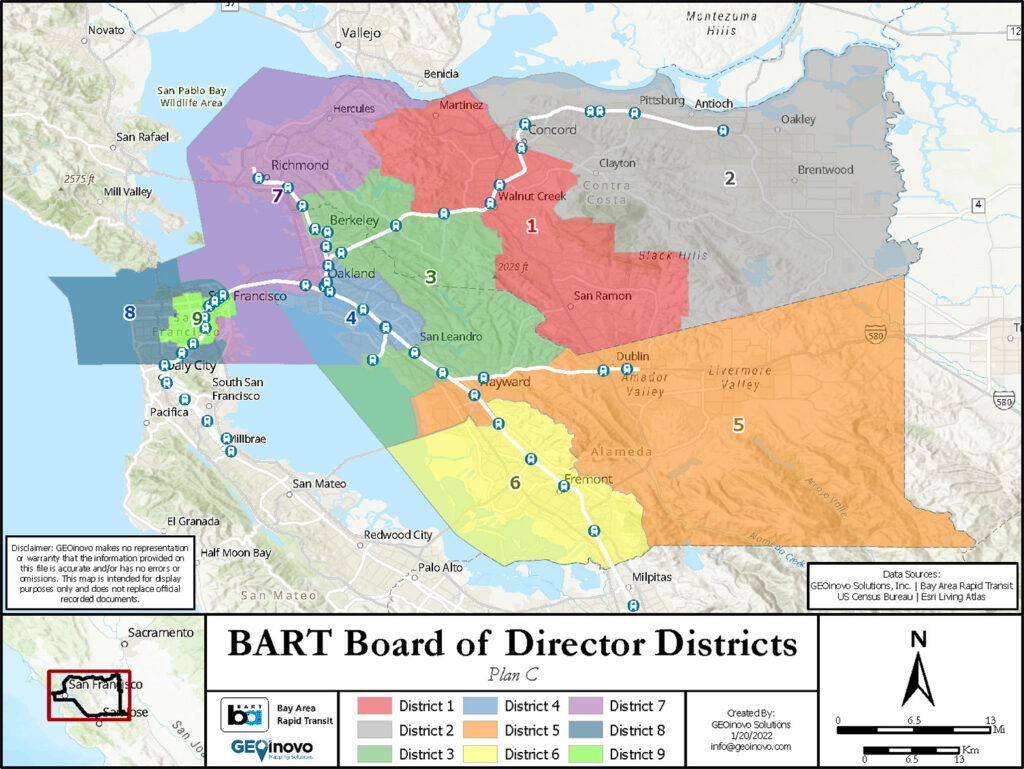
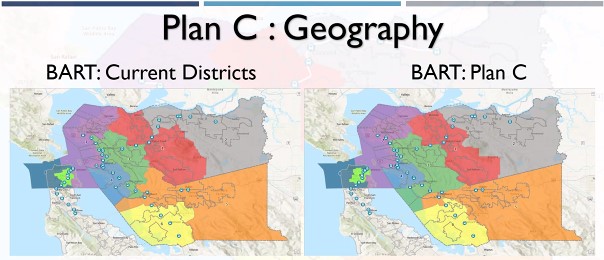
Proposed BART Districts 2022 Plan C.

Approaching critical phase – but few people seem interested, participating

The BART redistricting process is reaching a critical phase, with just one more virtual meeting for public outreach, scheduled for 6 pm on Wednesday, February 2nd. Few people seem interested in participating in the process in spite of the significant impact redistricting has on who will run for office and be elected over the next 10 years. Only two people offered public comments at the last BART meeting on redistricting, including the publisher of the Herald, Allen Payton.

Join the virtual meeting on 2/2/22 at 6pm on Zoom:

https://us06web.zoom.us/j/82168419186
Webinar ID: 821 6841 9186

Or Telephone US: +1 669 900 6833  (Toll Free) or 888 475 4499

BART election districts are redrawn every 10 years following the U.S. Census. The primary purpose of redistricting is to ensure population equality among districts.

Once the public outreach has concluded, the BART Board of Directors will continue to discuss the process and advance the work at upcoming Board meetings, including a special meeting of the Board of Directors. Meetings and agendas will be announced in advance. Sign up for Board meeting notices here.

BART Districts 2022 Plan C comparison

BART has provided the following draft maps and census population and race/ethnicity data:

BART Board Districts Map Plan A

BART Board Districts Map Plan B

BART Board Districts Map Plan C

Census population and race/ethnicity data by District (Current, Plan A, Plan B, Plan C)

BART has rolled out mapping tools to enable public input for redistricting.

BART interactive mapping tool for redistricting: This tool gives residents the ability to create and share a Community of Interest and/or draft Board Member districts. Map submissions will appear in the gallery on the main landing page, enabling residents to view public input for redistricting.

BART Districts and Demographic Data: This web mapping tool is for visualizing BART districts and demographic data.
In addition to the interactive mapping tool, BART is providing a Community Input Map to allow residents to identify and provide supplemental information regarding their Community of Interest. This feature can be used on a mobile device and is offered in English and Spanish (Español), providing residents with an app that can be used to submit community information in their language of choice.

Community Input Map: English

Community Input Map: Spanish

Learn more about BART Redistricting at bart.gov/redistricting.

This process is guided by traditional redistricting principles as well as the U.S. Constitution, the California Constitution, the federal Voting Rights Act, the BART District Act, and the Fair and Inclusive Redistricting for Municipalities and Political Subdivisions (FAIR MAPS) Act.

Allen Payton contributed to this report.

Analysis: Antioch School Board should scrap the maps for redistricting at Wednesday meeting

Wednesday, January 26th, 2022

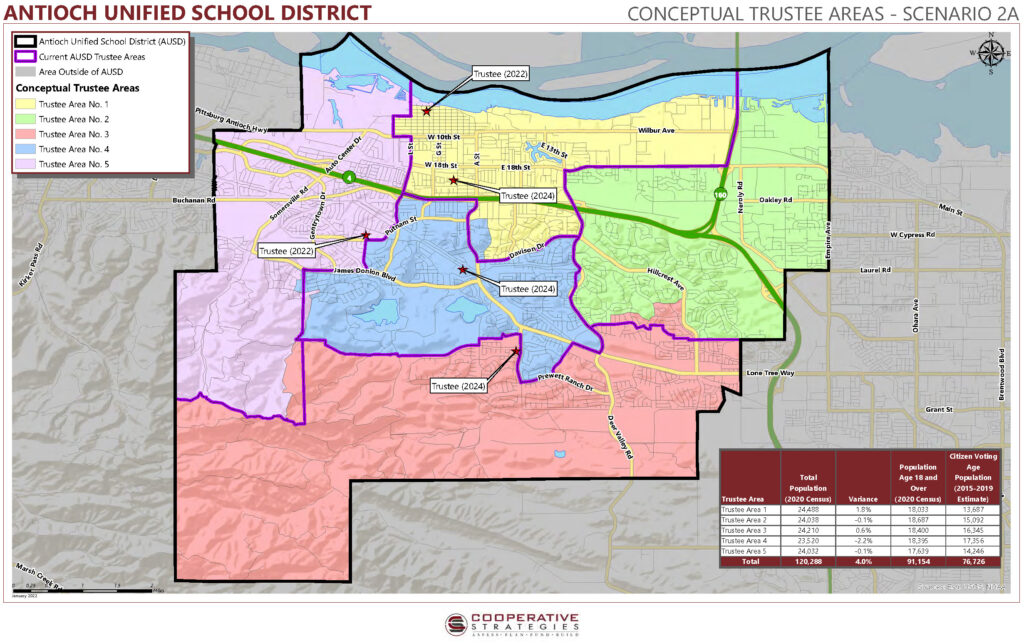
Proposed Antioch School Board Trustee Areas Redistricting Map Scenario 2A. Source: AUSD

All 3 gerrymandered to protect incumbents, except for one trustee; very few changes from 2019 map based on 2010 Census with 13,400 fewer residents

Board should start over and allow more public input with online mapping tool

By Allen Payton

Official Notice

Subject: Post Census Redistricting

Date: Wednesday, January 26, 2022 (During the Regular Board of Education Meeting)

Time: Open Session 7:00 p.m.

Location: Deer Valley High School Theater 4700 Lone Tree Way, Antioch, CA 94531

NOTICE IS HEREBY GIVEN that the Governing Board of the Antioch Unified School District will hold a public hearing during its Regular Board Meeting on Wednesday, January 26, 2022, to receive community feedback regarding post census redistricting. To ensure Trustee Areas are in compliance with Education Code 5019.5, the District must review and potentially adjust its electoral map. This hearing will provide the AUSD Board of Education an opportunity to review initial draft scenarios adjusting the boundaries for trustee areas and to accept feedback from the community regarding the proposed changes. Proposed maps can be viewed at https://www.antiochschools.net/domain/3540.

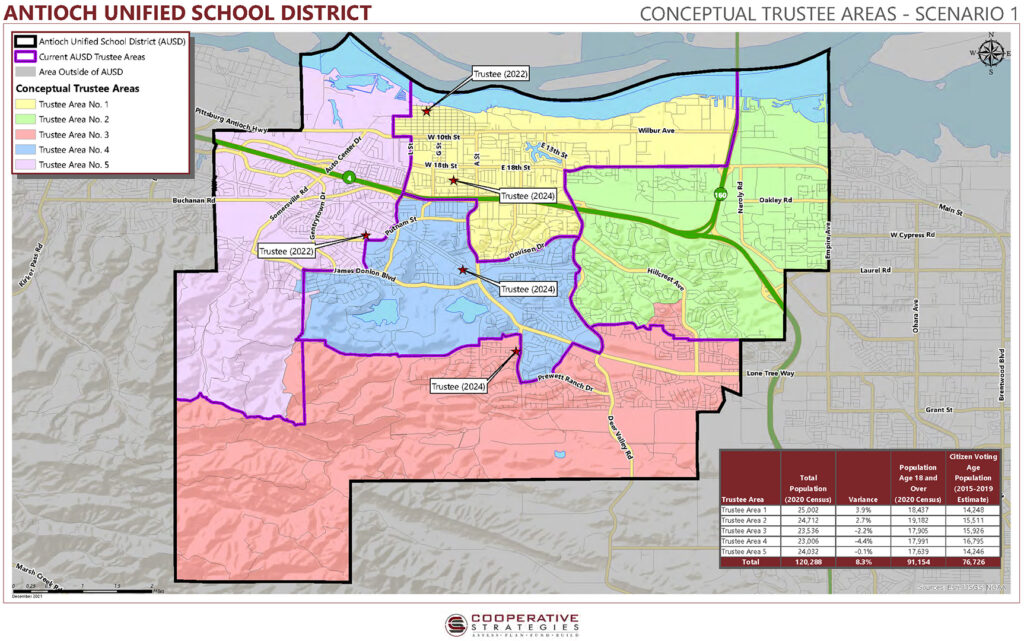
Proposed Antioch School Board Trustee Areas Redistricting Map Scenario1. Source: AUSD

Analysis

During their next regularly scheduled Antioch School Board meeting tonight, Wednesday, January 26, 2022, the Antioch School Board will consider three maps that are very similar to their current map. That’s in spite of a population growth of 13,386 in the district during the decade of 2010 to 2020. The current trustee area map was approved by the board in 2019 based on the 2010 Census. (See related article)

The three proposed maps, drawn by a consultant and labeled Scenario 1, 2 and 3, all show where the current trustees live, which is a political matter and is not a required criteria for the board to consider, based on either federal or state law. The trustee area boundary lines don’t make much sense other than protecting incumbents. The only exception is Trustee Ellie Householder who moved from the current Area 2 to Area 1, last year. The map only uses major roads as boundaries between Areas 1 and 2. For example, both Trustee Mary Rocha barely lives inside Area 5 and Trustee Clyde Lewis, Jr. barely lives inside Area 3.

Plus, the maps don’t respect communities of interest, a basic principle of redistricting, splitting the Mira Vista Hills area south of James Donlon Blvd. into Areas 2 and 4. In addition, the maps don’t primarily use major roads as dividing lines, especially between Areas 3 and 4 and between Areas 2 and 3.

Also, the current map and all three proposed maps unnecessarily have the area bounded by Lone Tree Way, Deer Valley Road and Country Hills Drive, where no one lives, included in Area 4 instead of Area 2 creating a strange shape. That area is one Census Tract and can easily be moved between trustee areas.

Trust areas are legally allowed to have a maximum population deviation from average of 5% or 10% maximum between areas. Scenario 1 has a deviation of 8.3% between trustee areas, Scenario 2 offers a deviation of 1.2% and Scenario 3 has a deviation of 4.0%.

Scrap Proposed Maps, Offer Public Online Mapping Tool

What the board should do is scrap the three proposed consultant’s maps and start over by opening the process to the public – putting we the people in charge of choosing who it is will represent us, not the other way around – and provide an online mapping tool like the Antioch City Council and other cities have done. But the board should use the same tool as on the City of Brentwood’s city council redistricting website, since it’s the easiest to use of those in the county and BART’s that I’ve tried.

What the board and council should have done is form independent citizen redistricting commissions, like both the city councils of Brentwood and Martinez have done, to truly put the process in the hands of the public and take the politics out of it. (See related article)

While the board must have a final map approved by March 1, that gives them the two meetings in February, and if necessary, they could hold a separate redistricting workshop, to consider maps drawn and submitted by the public. They need to direct their redistricting consultant to get the online mapping tool up by Friday.

We shall see if they’re interested in doing what’s best for the people they were elected to represent or what will protect their own political interests.

The meeting will begin at 7:00 p.m. and can be viewed in-person or online at https://youtu.be/VFJxu3aBpYw. Public comments can only be made in person at the meeting by completing and submitting a speaker card.

Analysis: Antioch council to consider narrowing redistricting map choices from 13 to two Tuesday night

Tuesday, January 25th, 2022

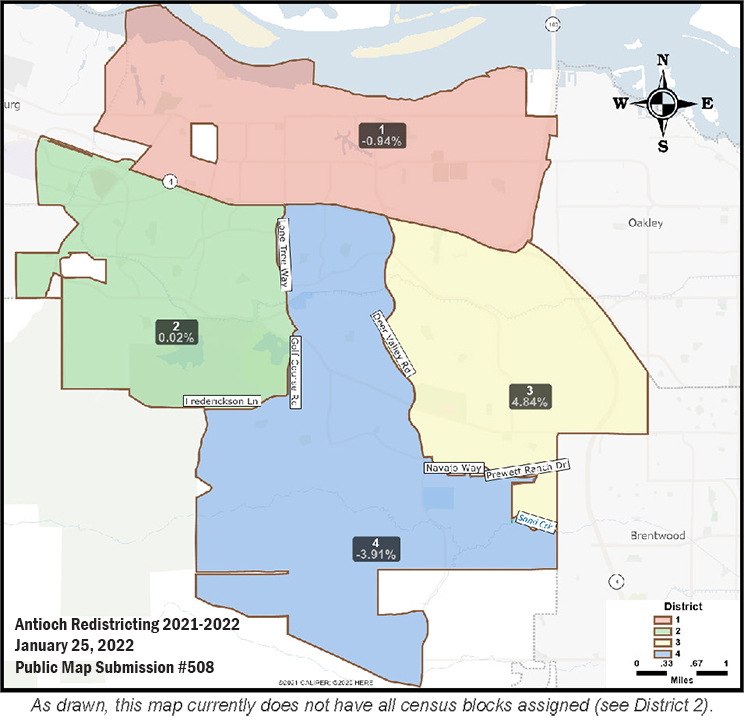
Antioch Redistricting Public Map 508. The Census Tract missing in District 2 is open space and no one lives there, so it doesn’t affect the population figures.

Why is redistricting so important?

Let the people choose their representatives, not the other way around

“It shouldn’t be in the hands of politicians” – Lamar Thorpe

New map doesn’t have to be based on current map; Council should choose maps drawn by members of the public

ThHerald recommends Maps 508 (58 revised), 91 and 95 as best alternatives; consultant should also provide details for all publicly submitted maps

By Allen D. Payton

During their meeting Tuesday night, Jan. 25, 2022, the Antioch City Council will consider narrowing down the number of redistricting maps they will consider to just two from the current map approved in 2018. So far, three maps were created and submitted by the consultant, Q2 Data and Research, based on input from the council members, which made slight adjustments to the current map. Q2 provided details for each of the four council districts showing specific streets in each of Maps A, B and C. In addition, members of the public have drawn and submitted n10 alternative maps but Q2 did not provide the same details for each of the four districts for those maps, numbers 34, 39, 49, 58, 87, 91, 95, 503 and now, 508 which is 58 revised. (See agenda item, here – ACC012522 – Redistricting)

Why Redistricting is So Important

Every 10 years, in the year following the Census when the new population figures are determined, district lines must be redrawn to comply with the spirit of one-person-one-vote as intended by the U.S. Constitution. Redistricting should be based on principles not politics. Redistricting is so important because how the new district boundaries are drawn will determine who can run for office and who the voters will elect to represent them.

Thus, we the people should be in control of redistricting, so we get to choose who represents us, rather than the elected officials choosing who it is they will represent. While it would be best to have no population percentage deviation between districts, as it is with redrawing congressional districts, which are required to have a difference of no more than one person, all other districts are legally allowed a maximum deviation of 5% from average.

“It Shouldn’t Be in the Hands of Politicians”

During the districting process in 2018, then-Mayor Pro Tem Lamar Thorpe said, “This is why I hate this process. It shouldn’t be in the hands of politicians.” But neither he nor any other council member proposed forming an independent citizens’ redistricting commission to redraw the council district boundaries, as both Brentwood and Martinez have done. (See related article) So the Antioch Council members will make the decision about their own districts and the public’s opportunity to have a say are during the public hearings on redistricting.

Fortunately, the council had Q2 create a redistricting page on the City’s website, provide an online mapping tool for the public to use to create their own alternative map, and Q2 posted each of the maps for the public to review. Plus, Mayor Thorpe has insisted on having all the maps included in each council discussion, as they were submitted by members of the public. (See Draft Maps and Public Map Submissions on that page)

New Map Doesn’t Have to Be Based on Current Map

At the Council’s Jan. 10th public hearing on redistricting, Karin Mac Donald, owner and Senior Researcher of Q2 said, “there is no law…that says you must start with the districts drawn in the last process.” So, the council can completely scrap the current map, which is based on the 2010 Census figures, and approve a completely new map, which must be based on the 2020 Census population of Antioch which grew by almost 13,000 residents during that time.

Redistricting Principles

During BART’s process, the consultant offered Key Points to Consider in Redistricting, which include:

“Traditional Redistricting Principles – Since decennial redistricting began in the late 1960s, traditional criteria and principles have developed. While the equal population of election districts is the overriding principle there are accompanying goals. In varying degrees, the criteria are compactness, continuity, respect for communities of interest, preserving political subdivisions, and the core of previous districts. All are not of equal weight and all are subordinate to an equal population. Care must be taken not to dilute the voting strength of minorities.

Compactness – Compactness refers to a districts’ geographic shape and how its interior is dispersed within its boundaries. A circle is a perfectly compact shape. In redistricting, the notion of compactness is difficult to evaluate because one begins with irregularly shaped borders and the political subdivisions may be irregular in shape. Geometric measures of compactness are often misleading because geographic features and relationships are more complex than simple geometry. The principle of compactness should be considered functionally and must compete with other criteria.

Continuity – Continuity requires that all parts of a district be connected. Districts can be drawn that are contiguous by way of water or a bridge. While crossing water is allowed it should be minimized as it makes it more difficult to respect communities of interest.

Preserving Political Subdivisions – An attempt should be made to minimize splitting cities and well-defined neighborhoods; and

Respect for Communities of Interest – Communities of interest are subjective and difficult to define. A community of interest has some common thread of shared interest. Those communities can be based on such diverse elements as geography, language, socio-economic-cultural interests, even transportation corridors. Race may be considered, but it may not be the sole reason for drawing a district in a particular manner.”

Use Common Sense, Follow State & Federal Law, No Consideration for Incumbency

Also, according to the BART redistricting process, “new districts should be drawn deliberatively and with common sense. Adherence to traditional redistricting principles and the federal Voting Rights Act will ensure fair and reasonable districts.”

The council must also follow the state’s FAIR MAPS Act when redrawing district boundaries, as Mac Donald pointed out, previously. But the council members do not have to consider to incumbency, in other words, where the current council members live. The Antioch School Board didn’t when they created their first district maps in 2018, resulting in two incumbents living in the same district. The same could occur with the council’s redistricting process when choosing a final map.

Council Should Choose Maps Drawn by Members of the Public

If the Council is going to “whittle it down the number of maps” as suggested by Mac Donald during the Jan. 10th public hearing, they should choose maps submitted by the public in order to reduce both the appearance of political influence and consideration of where incumbents live. Of the nine publicly submitted maps, I recommend that the Council choose among Maps 91, 95 and of course, 58, which I drew and submitted, as finalists.

The online mapping tool for the public only allows the creation of districts using Census Blocks, but the mapping software used by the consultants can be as specific as moving one house between districts. So, if the Council wants to make minor adjustments to any of the publicly submitted maps, Q2 staff can easily accommodate them.
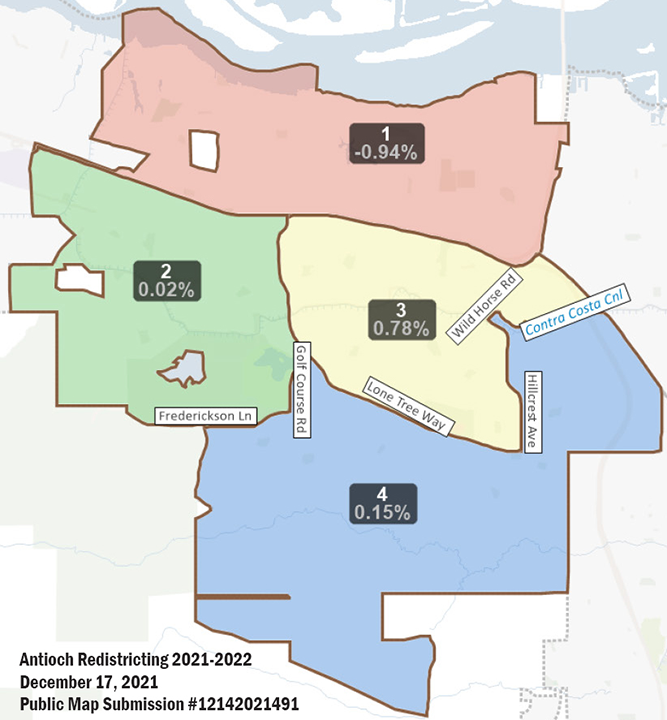
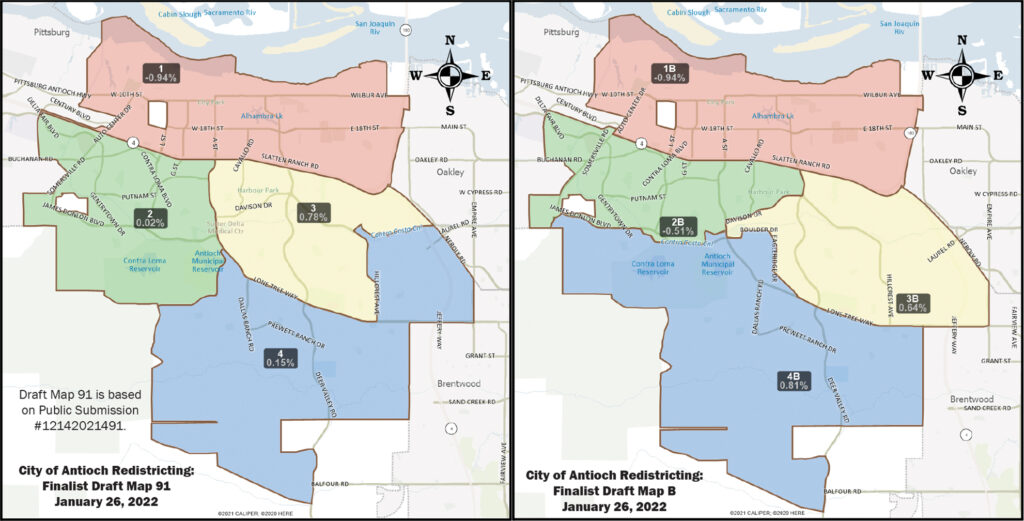
Antioch Redistricting-Public Submission Map #91.

Map 91 Analysis

Map 91 is a combination of the current council districts map and map 58 by connecting all three districts on the south side of Highway 4 to the freeway. However, this map connects District 4 to Highway 4 on the east side of the city, instead. The map also moves the Mira Vista Hills area from District 4 to District 2 which is one reason I like this map, plus the use of major roadways such as Lone Tree Way and Hillcrest Avenue, and the canal as common-sense dividing lines.

While District 4 is less compact than in other maps and looks kind of strange, like a fat seahorse, seated camel or short-necked and legged giraffe, it makes District 3 more compact than it is currently.

CORRECTION: It would be great if the six homes between Hillcrest Avenue and the canal, east of Wildhorse Road could be moved into District 3 instead of District 4, to eliminate the small section that looks like the aforementioned creature’s left ear. But, according to Jane Hood of Q2, Census Tracts cannot be divided and this time, compared to 10 years ago, there are fewer Census Tracts.

While the note beneath Map 91 in the staff report reads, “As drawn this map doesn’t have all census tracts assigned (See District 2)” that’s only the Contra Loma Reservoir in which no resident lives. Since fish don’t yet have the right to vote, adding that census tract won’t change any of the population statistics for that district.

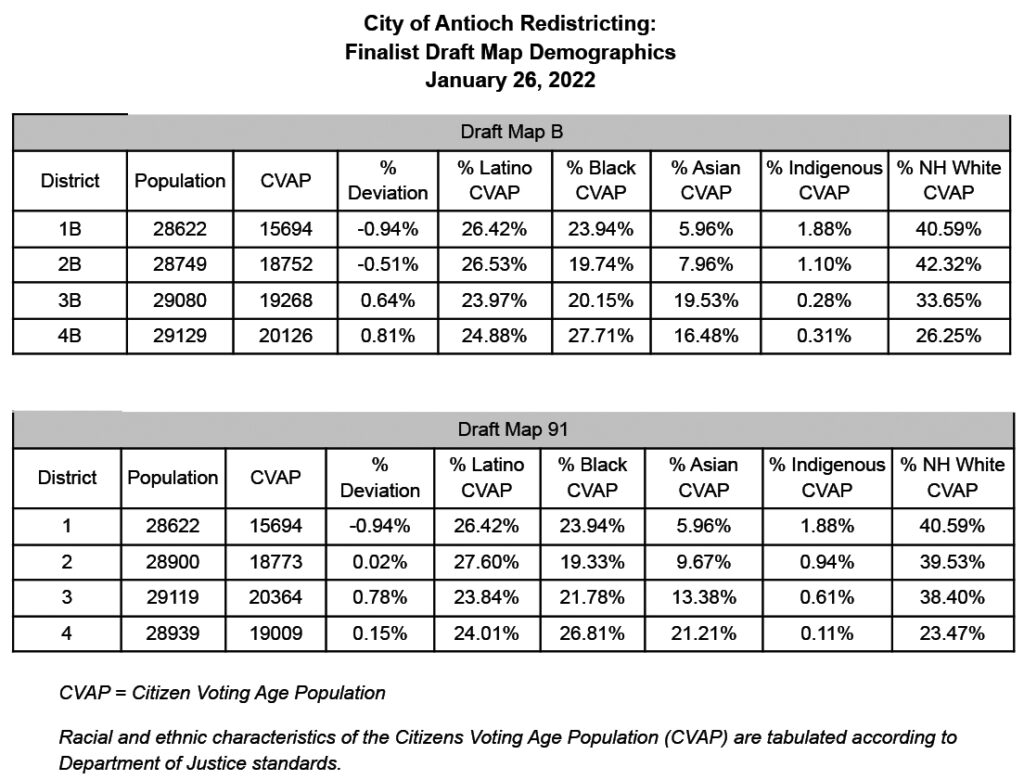
The map also offers one of the lowest population deviations of all the publicly submitted maps. The greatest population deviation in Map 91 is just 1.72% between Districts 1 and 4, which is the least among the three final maps I’m recommending.
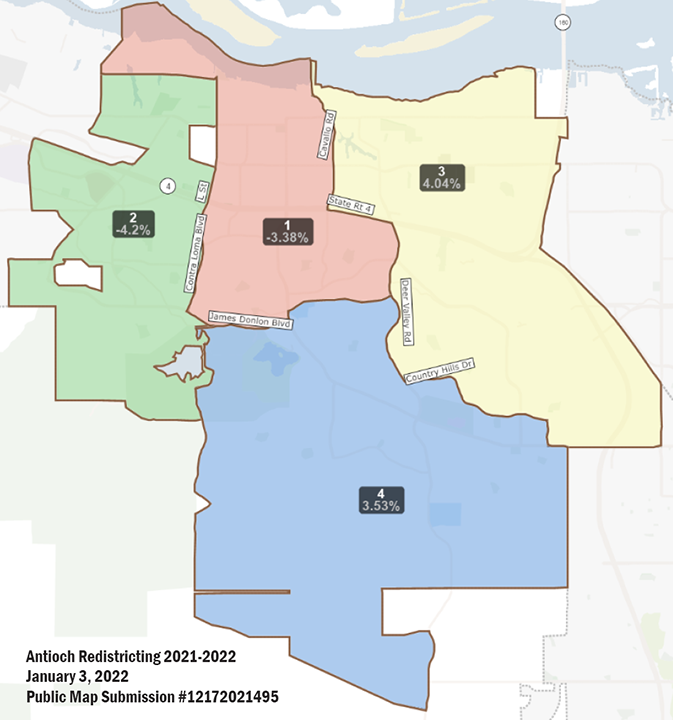
Antioch Redistricting-Public Submission Map #95.

Map 95 Analysis

Of all but one of the public submissions, Map 95 significantly changes things from the current map by dividing the area north of Highway 4 between three council districts, numbers 1, 2 and 3, which is what I like best about this map. Although it goes against the argument made during the 2018 districting process that the residents north of Highway 4 wanted to have their own representative on the council, that hasn’t served that part of the city well, nor did it result in the election of a Hispanic council member, which is why the council switched to district elections in the first place, under threat of a lawsuit they were told they couldn’t win.

That’s in spite of the fact there are and/or have been Hispanic elected officials on both the city council and school board. Another fact is, after the school board switched to district elections, Antonio Hernandez was elected in 2020 to represent the current Area 1, which includes portions of both the north and south sides of Highway 4, giving the board two Hispanic trustees. The other, Trustee Mary Rocha, has not yet run in a district election, but lives in Area 5 and whose seat is up in November. (See current Antioch School Board Trustee Area Map)

The comment provided by the creator of Map 95 reads, “It results in three council members representing the waterfront instead of just one. It also serves to more unify the city between older parts and newer parts instead of dividing it like the current districts do with just one district north of Highway 4. It also combines the Mira Vista Hills area south of James Donlon Blvd. with the older areas north of James Donlon Blvd. and the newer area west of Somersville Road which is more of a Community of Interest.”

The move of the Mira Vista Hills area south of James Donlon Blvd. from District 4 to District 2 is another reason I like this map, plus the use of major roadways and the canal as common-sense dividing lines.

The note beneath Map 95 is that below Map 91 and for the same reasons dealing with not including the Contra Loma Reservoir in which no resident lives, unless there’s a secret Navy Submarine base in it that the public is unaware of.

The greatest population deviation in Map 95 is 8.24% between Districts 2 and 3, which is the most among the three finalists I support.
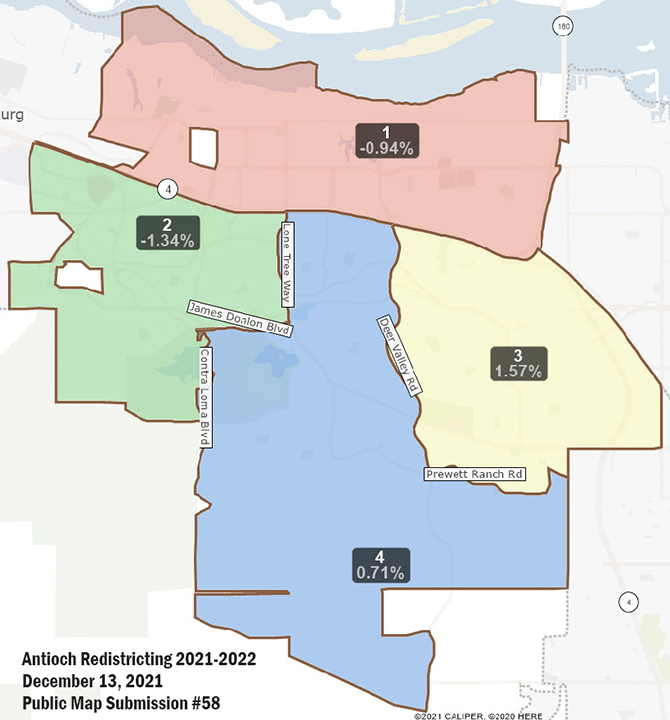
Antioch Redistricting-Public Submission Map #58.

Map 58 Analysis

Except for District 1, Map 58 changes things significantly from the current map, connecting all the three other districts to Highway 4. It makes Districts 2 and 3 more compact and primarily uses the major roads of Lone Tree Way, James Donlon Blvd. and Hillcrest Avenue/Deer Valley Road to separate Districts 2, 3 and 4. As with Map 95 it also moves the Mira Vista Hills area south of James Donlon Blvd. from District 4 into District 2 which makes more sense.

While Map 58, as drawn, divides the homes in the same homeowners’ association along Prewett Ranch Road east of Deer Valley Road, between Districts 3 and 4, up to 992 residents in the older homes on the south side of the street can be moved from District 4 into District 3, and still keep District 3 within the 5% population deviation from average.

CORRECTION: It would be great if the dividing line for Districts 3 and 4 could be between the homes in the newer subdivisions in the Sand Creek area and the homes in the neighborhoods along Prewett Ranch Drive. But that would require splitting up a Census Tract.

The greatest population deviation in Map 58 is currently just 2.91%, also between Districts 2 and 3. However, if the homes on the south side of Prewett Ranch Drive are moved into District 3, the deviation would increase.

Map 508 (58 Revised)

A revised Map 58 was drawn and submitted Monday night, and is labeled #508, did part of that, by moving some homes on the south side of Prewett Ranch Drive east of Deer Valley Road from District 4 into District 3. In addition, Map 508 moves the homes on the south side of James Donlon Blvd. between Lone Tree Way and Tabora Drive, as well as the Contra Loma Reservoir area from District 4 into District 2.

The changes increase the population deviation to 8.75%. But that should be acceptable, as it leaves District 4 with the least current population, which again, is expected to have the greatest population growth with the new homes in the Sand Creek area over the next decade.

Public Hearing Tuesday Night, Jan. 25

The council meeting begins at 7:00 p.m. immediately followed by the public hearing on redistricting at 7:05 p.m. and can be viewed in-person in the Council Chambers at 200 H Street and are televised live on Comcast channel 24, AT&T U-verse channel 99, or live stream at www.antiochca.gov/government/city-council-meetings.

Public Comments

Members of the public wishing to provide public comment may do so one of the following ways (#2 pertains to the Zoom Webinar):

  1. Fill out an online speaker card by 3:00 p.m. the day of the Council Meeting located at: , https://www.antiochca.gov/speaker_card.
  2. Provide oral public comments during the meeting by clicking the following link to register in advance to access the meeting via Zoom Webinar: https://www.antiochca.gov/speakers

– You will be asked to enter an email address and a name. Your email address will not be disclosed to the public. After registering, you will receive an email with instructions on how to connect to the meeting.

– When the mayor announces public comments, click the “raise hand” feature in Zoom. For instructions on using the “raise hand” feature in Zoom, visit: https://www.antiochca.gov/raise_hand. When calling into the meeting using the Zoom Webinar telephone number, press *9 on your telephone keypad to “raise your hand”. Please ensure your Zoom client is updated so staff can enable your microphone when it is your turn to speak.

  1. Email comments to cityclerk@ci.antioch.ca.us by 3:00 p.m. the day of the Council Meeting. The comment will be read into the record at the meeting (350 words maximum, up to 3 minutes, at the discretion of the mayor). IMPORTANT: Identify the agenda item in the subject line of your email if the comment is for Announcement of Community Events, Public Comment, or a specific agenda item number. No one may speak more than once on an agenda item or during “Public Comments”.

All emails received by 3:00 p.m. the day of the Council Meeting will be entered into the record or the meeting. Speakers will be notified shortly before they are called to speak.




Nomination papers for candidates in April 5 special election for Assembly District 11 available Tuesday

Saturday, January 22nd, 2022

The current map of State Assembly District 11. Source: Statewide Data Base

Due to vacancy created by Jim Frazier’s resignation; winner will serve out remainder of term through December

By Dawn Kruger, Civic Outreach/Engagement Specialist, Contra Costa County Clerk-Recorder-Elections Department

The April 5th, 2022, special state election gets into full swing on Tuesday, January 25th as nomination papers will be made available for candidates running for the current California State Assembly District 11 office. The current district includes Antioch, Oakley, Brentwood, Discovery Bay, Bethel Island, Byron and Knightsen in Contra Costa County.

The special election is to fill the vacancy created by former Assemblyman Jim Frazier who announced his resignation, last month, effective Dec. 31. On Jan. 7, the day Gov. Newsom issued a proclamation calling for the special election.

If one candidate receives a majority of the votes (50% + 1), no special general election will be held. The winner will serve out the remainder of the two-year term through early December. If a special general election is needed it will be held June 7, the same day as the regular primary election and the candidate with the most votes in that election wins.

A separate election will be held during the June primary and November general elections for the new Assembly District 11, which now only includes Brentwood, Oakley, Discovery Bay, Bethel Island, Byron and Knightsen in Contra Costa County.

The nomination period runs through 5:00 p.m. Thursday, February 10, 2022.  Papers for the special California Assembly District 11 election are available at the Contra Costa Elections Office, 555 Escobar Street, Martinez.

For further information on this special election and key dates, go to https://www.cocovote.us/april-5-2022-special-primary-election-assembly-district-11/.

“This special election was just announced by the governor earlier this month and we don’t want our constituents to be surprised,” said Deborah Cooper, Contra Costa Registrar of Voters. “If you are considering running for office, the Contra Costa County Elections Office provides a candidate manual with comprehensive information about the process and we are available to assist you.”

The Contra Costa Elections Division is offering appointments to interested candidates on weekdays from 8:30 am to 4:30 pm. Filing documents and information will be provided to interested constituents at their appointment.

The process takes 20 minutes. Due to the current surge in the pandemic/Covid-19, we are asking constituents to schedule an appointment through email at candidate.services@vote.cccounty.us or by calling us at 925-335-7800.

All visitors will be asked to check-in at the Elections lobby and will be required to wear a mask and observe social distancing guidelines.

For more information, visit www.cocovote.us or call (925) 335-7800.

Allen Payton contributed to this report.

After 16 years in Congress McNerney will not seek reelection clearing path for Rep. Harder to run in new CA-9

Tuesday, January 18th, 2022

Rep. McNerney official photo. Map of new California Congressional District 9. Source: www.wedrawthelinesca.org/final_maps

Represented portions of Antioch for 10 years; newly redrawn 9th District viewed as more favorable for a Republican to win; three candidates in San Joaquin County pull papers to run for open seat; Congressman Harder from neighboring district announces candidacy

By Allen Payton

Eight-term Democratic Congressman Jerry McNerney (CA-09) issued the following statement announcing he will not run for re-election in 2022, making him the Democrat in the House of Representatives to make a similar announcement.

“Today I am announcing that I will not seek reelection in California’s newly created 9th Congressional District.

I am honored that the citizens of California’s 9th Congressional District chose me as their representative in the past five elections, and that those in California’s previous 11th Congressional District gave me the privilege of representing them for three terms.

I am very proud of the many accomplishments that my staff and I have achieved in Congress, including the creation of a major veteran’s health center facility in San Joaquin County, providing outstanding help for constituents with federal agencies, and securing major investments in infrastructure and public safety, broadband, education, childcare, and health care access. I have always fought tirelessly for those in need, and I will continue to do so.

I am grateful for the love and support of my family, who have been by my side throughout this journey. I could not have done this without them.

I will keep working for the people of my district throughout the remainder of my term and look forward to new opportunities to continue to serve.”

The current California 9th Congressional District map from 2011-21 which includes portions of Antioch. Source: Office of Congressman McNerney

Republicans Respond

Both the current and new 9th District maps encompass most of San Joaquin County, which added Tracy, Manteca and Ripon, and portions of Eastern Contra Costa County. That part of the district has shrunk to just include Discovery Bay and Byron, and no longer includes Brentwood, Oakley, Bethel Island, Knightsen and portions of Antioch. The new district is considered to be more favorable for a Republican to win.

National Republican Congressional Committee Spokeswoman Torunn Sinclair responded to McNerney’s announcement writing, “No one wants to run as a House Democrat. Jerry McNerney is making the smart decision to quit instead of watching Democrats lose their majority.”

“Any Democrat who runs in this district is vulnerable because their Party is responsible for higher prices, increased crime and the highest unemployment rate in the country,” she added.

According to Ballotpedia.org, McNerney is the 28th Democrat in the House to not seek re-election. So far, 13 Republicans have also announced they’re not running for re-election, this year.

McNerney’s Election History

The 70-year-old McNerney was first elected in 2006 defeating Pombo by 53 to 46%. In 2010, McNerney narrowly defeated David Harmer by 48 to 46.9% with a third-party candidate receiving 5.1% of the vote. Following redistricting in 2011, McNerney moved from Pleasanton to Stockton to run in the newly drawn district and ran in the new 9th District in 2012 defeating Ricky Gill by a margin of 55.6% to 44.4% of the vote.

Rep. Harder’s Twitter announcement on Dec. 22, 2021.

Four Candidates So Far, Filing Process Began Jan. 3

According to the Contra Costa Elections Division no candidate has pulled papers to run in the 9th District. But according to the San Joaquin County Registrar of Voters office, three people have pulled papers to run which include progressive Democrat Harpreet Singh Chima, San Francisco resident Karena Apple Feng, and Republican Khalid “Jeffrey” Jafri, an unsuccessful candidate for State Assembly in 2012 and 2020.

Congressman Josh Harder, a Democrat who represents the current CA-10 district, announced on his Twitter feed Tuesday morning that he’s running in the CA-9 congressional district. He had previously announcing last month he was running in neighboring district CA-13 in his “hometown” of Turlock, which is split between districts CA-5 and -13 and located over 20 miles outside of CA-9. But that tweet was deleted as of Tuesday morning. (See all CA congressional district maps)

Rep. Harder’s Twitter announcement on Jan. 18, 2022.

The Signatures In-Lieu of the Filing Fee Period began on Jan. 3 and ends Feb. 9. Each signature reduces the amount of filing fee candidates are required to pay to get on the ballot. That is followed by the Candidate Nomination Period which runs from Feb. 14 to March 11. But that will be extended another five days until March 16 since the incumbent is not running.

The Primary Election is on Tuesday, June 7. The top two candidates in the race will face each other in the General Election in November.

Participate in democracy during BART’s remaining redistricting meetings

Saturday, January 15th, 2022

Proposed BART Districts 2022 Plan A

For redrawing BART director districts; next meeting today at 9:00 a.m.

RELEASE DATE: 01/14/2022

Have a direct say in democracy by participating in BART’s redistricting meetings. The next virtual meeting is scheduled for January 15, at 9 am, followed by two 6pm meetings on January 22nd and February 2nd.

BART election districts are redrawn every 10 years following the U.S. Census. The primary purpose of redistricting is to ensure population equality among districts.  This process is guided by traditional redistricting principles as well as the U.S. Constitution, the California Constitution, the federal Voting Rights Act and the BART District Act.

Districts must be contiguous and should also be compact, minimize splitting cities, respect communities of interest and follow natural and man-made boundaries.

Proposed BART Districts 2022 Plan B

Key Points to Consider in Redistricting

Traditional Redistricting Principles

Since decennial redistricting began in the late 1960s, traditional criteria and principles have developed. While the equal population of election districts is the overriding principle there are accompanying goals. In varying degrees, the criteria are compactness, continuity, respect for communities of interest, preserving political subdivisions, and the core of previous districts. All are not of equal weight, and all are subordinate to an equal population. Care must be taken not to dilute the voting strength of minorities.

Compactness

Compactness refers to a districts’ geographic shape and how its interior is dispersed within its boundaries. A circle is a perfectly compact shape. In redistricting, the notion of compactness is difficult to evaluate because one begins with irregularly shaped borders and the political subdivisions may be irregular in shape. Geometric measures of compactness are often misleading because geographic features and relationships are more complex than simple geometry. The principle of compactness should be considered functionally and must compete with other criteria.

Continuity

Continuity requires that all parts of a district be connected. Districts can be drawn that are contiguous by way of water or a bridge. While crossing water is allowed it should be minimized as it makes it more difficult to respect communities of interest.

Preserving Political Subdivisions

An attempt should be made to minimize splitting cities and well-defined neighborhoods.

Respect for Communities of Interest

Communities of interest are subjective and difficult to define. A community of interest has some common thread of shared interest. Those communities can be based on such diverse elements as geography, language, socio-economic-cultural interests, even transportation corridors. Race may be considered, but it may not be the sole reason for drawing a district in a particular manner.

Preserving the Core of Prior Districts

Preserving the core of a previous district is thought to be the least disruptive to the voters in each area. One, of course, would not seek to maintain a previous district that was legally objectionable.

New districts should be drawn deliberatively and with common sense. Adherence to traditional redistricting principles and the federal Voting Rights Act will ensure fair and reasonable districts.

Community participation is available via Zoom on January 15, 2022 starting at 9 am at https://us06web.zoom.us/j/88956838390

You may join the Committee Meeting via Zoom by calling 1-669-900-6833 and entering access code 889 5683 8390. Dial *9 to raise your hand when you wish to speak, and dial *6 to unmute when you are requested to speak.

Virtual Meetings of BART’s Redistricting Committee and Archived Video 

The BART Redistricting Committee consists of Directors Lateefah Simon (Chairperson), Elizabeth Ames and Mark Foley. Here is the remaining proposed redistricting outreach meeting schedule, materials, zoom information, and videos of previous meetings are provided below the list of meetings dates:

  • Meeting 4: Saturday, January 15, 2022, 9 am
  • Meeting 5: Saturday, January 22, 2022, 6 pm
  • Meeting 6: Wednesday, February 2, 2022, 6 pm

January 8, 2022 Meeting – A virtual meeting was held Saturday, January 8, 2022 from 12 to 2 pm. Watch the video of the 1/8/22 meeting.

December 15, 2021 Meeting – A virtual meeting was held Wednesday, December 15, 2021 from 6 to 8 pm. Watch the video of the 12/15/21 meeting.

December 1, 2021 Meeting – A virtual meeting was held Wednesday, December 1, 2021 from 1 to 3 pm. Watch the video of the 12/1/21 meeting.

Documents from the December 1 meeting:

BART Board Districts Map Plan A
BART Board Districts Map Plan B
Table of BART District’s Citizen Voting Age Population (CVAP) by Race/Ethnicity
Table of Population by BART District, 1990-2030(estimate)

November 10, 2021 Meeting – The first virtual meeting was held Wednesday, November 10, 2021 from 1 to 3 pm. Watch the video of the 11/10/21 meeting.

Current District Maps and Early Drafts of Potential (Not Final) New Maps

District 1
Current District 1 Map
Potential new maps (not final):
District 1 Plan A
District 1 Plan B

District 2

Current District 2 Map
Potential new maps (not final):
District 2 Plan A
District 2 Plan B

District 3

Current District 3 Map
Potential new maps (not final):
District 3 Plan A
District 3 Plan B

District 4

Current District 4 Map
Potential new maps (not final):
District 4 Plan A
District 4 Plan B

District 5

Current District 5 Map
Potential new maps (not final):
District 5 Plan A
District 5 Plan B

District 6

Current District 6 Map
Potential new maps (not final):
District 6 Plan A
District 6 Plan B

District 7

Current District 7 Map
Potential new maps (not final):
District 7 Plan A
District 7 Plan B

District 8

Current District 8 Map
Potential new maps (not final):
District 8 Plan A
District 8 Plan B

District 9

Current District 9 Map
Potential new maps (not final):
District 9 Plan A
District 9 Plan B

Mapping Tools for Public Engagement

BART has rolled out mapping tools to enable public input for redistricting.

BART interactive mapping tool for redistricting: This tool gives residents the ability to create and share a Community of Interest and/or draft Board of Director districts. Map submissions will appear in the gallery on the main landing page, enabling residents to view public input for redistricting.

BART Districts and Demographic Data: This web mapping tool is for visualizing BART districts and demographic data.

In addition to the interactive mapping tool, BART is providing a Community Input Map to allow residents to identify and provide supplemental information regarding their Community of Interest. This feature can be used on a mobile device and is offered in English and Spanish (Español), providing residents with an app that can be used to submit community information in their language of choice. Explore these tools using the links below.

Community Input Map: English

Community Input Map: Spanish

Information about current District boundaries

BART 2011 Election Districts Final Report – Adopted 12/1/2011 (10 Mb .pdf file)
All BART Districts
Counties Included: Alameda, Contra Costa, San Francisco
Map: All BART Districts (.pdf file)

District: 1
Counties Included: Contra Costa
Cities Included: Acalanes Ridge, Alamo, Alhambra Valley, Blackhawk, Camino Tassajara, Castle Hill, Clayton, Concord, Contra Costa Centre, Danville, Diablo, Lafayette, Martinez, Mountain View, Norris Canyon, North Gate, Pacheco, Pleasant Hill, Port Costa, Reliez Valley, San Miguel, San Ramon, Saranap, Shell Ridge, Vine Hill, Walnut Creek
Map: BART District 1 (.pdf file)

District: 2
Counties Included: Contra Costa
Cities Included: Antioch, Bay Point, Bethel Island, Brentwood, Byron, Clyde, Concord, Discovery Bay, Knightsen, Oakley, Pacheco, Pittsburg, Vine Hill
Map: BART District 2 (.pdf file)

District: 3
Counties Included: Alameda, Contra Costa
Cities Included: Albany, Ashland, Berkeley, Castro Valley, Cherryland, El Cerrito, Kensington, Lafayette, Moraga, Oakland, Orinda, Piedmont, San Lorenzo
Map: BART District 3 (.pdf file)

District: 4
Counties Included: Alameda
Cities Included: Alameda, Oakland, San Leandro
Map: BART District 4 (.pdf file)

District: 5
Counties Included: Alameda
Cities Included: Castro Valley, Cherryland, Dublin, Fairview, Hayward, Livermore, Pleasanton, Sunol
Map: BART District 5 (.pdf file)

District: 6
Counties Included: Alameda
Cities Included: Fremont, Hayward (partial), Newark, Sunol, Union City
Map: BART District 6 (.pdf file)

District: 7
Counties Included: Alameda, Contra Costa, San Francisco
Cities Included: Albany, Bayview, Berkeley, Crockett, East Richmond Heights, El Cerrito, El Sobrante, Emeryville, Hercules, Kensington, Montalvin Manor, North Richmond, Oakland, Pinole, Richmond, Rodeo, Rollingwood, San Francisco, San Pablo, Tara Hills
Map: BART District 7 (.pdf file)

District: 8
Cities Included: San Francisco
Counties Included: San Francisco
Map: BART District 8 (.pdf file)

District: 9
Cities Included: San Francisco
Counties Included: San Francisco
Map: BART District 9 (.pdf file)

Learn more at www.bart.gov/redistricting.