Archive for the ‘News’ Category

Assembly passes bill to allow non-physicians to perform abortions

Friday, May 31st, 2013

By Allen Payton

On Tuesday, May 28, 2013, AB 154, the bill to allow nurses, midwives and physicians assistants to perform abortions passed the California State Assembly. The bill will next be heard in the Senate.

Proponents of the bill claimed there is a necessity to expand access to abortions and that allowing non-physicians to perform abortions, women will not have to travel from rural communities to have abortions.

Assemblyman Jim Frazier, who represents Antioch in the State Assembly, voted for the bill.

“The indisputable fact is that expanding the categories of licensed abortionists will compromise the quality of women’s health in California.” Dr. Val Smith, Ph.D, a statistician in behavioral science testified at a recent hearing, “As a matter of public policy, I request that committee members weigh the inconvenience of women crossing county lines to obtain abortions against the certainty of compromised women’s health.”

Assemblywoman Marie Waldron, R-Escondido, says allowing nurses to do surgical abortion procedures places women’s lives and health at risk.

“This is not a simple procedure. It is basically a surgery,” said Waldon, whose brother is a doctor. “Abortion at all costs, especially the cost of women’s health, is wrong.”

The 49-24 vote sent Assembly Bill 154 to the Senate, where pro-life groups hope to fight it.

“California has the most abortions in the nation and the highest rate per capita. But that is not good enough for the abortion business,” says California Right to Life. “Assembly Bill 154 will no longer require that abortions be done by physicians, but allow mid-wives, nurses, and nurse practitioners to use the powerful instruments of death throughout the state.”

To read the entire and review the vote history of the bill, click here.

State Assembly approves Frazier’s tire recycling bill

Friday, May 31st, 2013

Increases Grant Funding to Cities, Counties, and Other Local Governmental Agencies

Sacramento, CA – A bill by Assemblymember Jim Frazier (D-Oakley) to increase funding to cities and counties for transportation projects that utilize environmentally friendly Rubberized Asphalt Concrete cleared the State Assembly and now moves on to the Senate. Assembly Bill 513 also increases grant funding to local governmental agencies, such as regional park districts that include access for people with disabilities.

Rubberized Asphalt Concrete (RAC) is a road paving material that combines waste tires and asphalt binder to create a strong and durable product that successfully recycles tires. RAC not only benefits the environment by reducing the number of tires that are landfilled or burned each year,  but it also provides more durability than regular asphalt and reduces road noise by around five decibels.

“I had hands-on experience with RAC as Chair of the State Route 4 Bypass Authority and was able to see the direct benefits of this product,” said Assemblymember Jim Frazier. “This bill will help us be good stewards to the environment and incentivizes the use of this great product in paving and disability access projects.”

In California, about 23.4 million waste tires are landfilled, exported, or burned each year. If not managed correctly, these waste tires pose a threat to California’s environment, public health, and safety. Stockpiled waste tires are a major fire risk and are an ideal breeding ground for mosquitos, which carry many diseases such as West Nile Virus, Yellow Fever, and Malaria.

“RAC is a proven product that has many benefits, including being cost effective, durable, safe, quiet, and a great alternative to traditional road paving materials,” said Karen Keene from the California State Association of Counties. “This bill would encourage activities that promote reducing waste tires going to landfills and eliminating stockpiling.”

To contact Assemblymember Jim Frazier please visit his website at www.asmdc.org/members/a11/ or call his District Offices at 707-399-3011.

Follow Assemblymember Jim Frazier on Facebook and “Like” him for updates on events and happenings in the 11th AD.

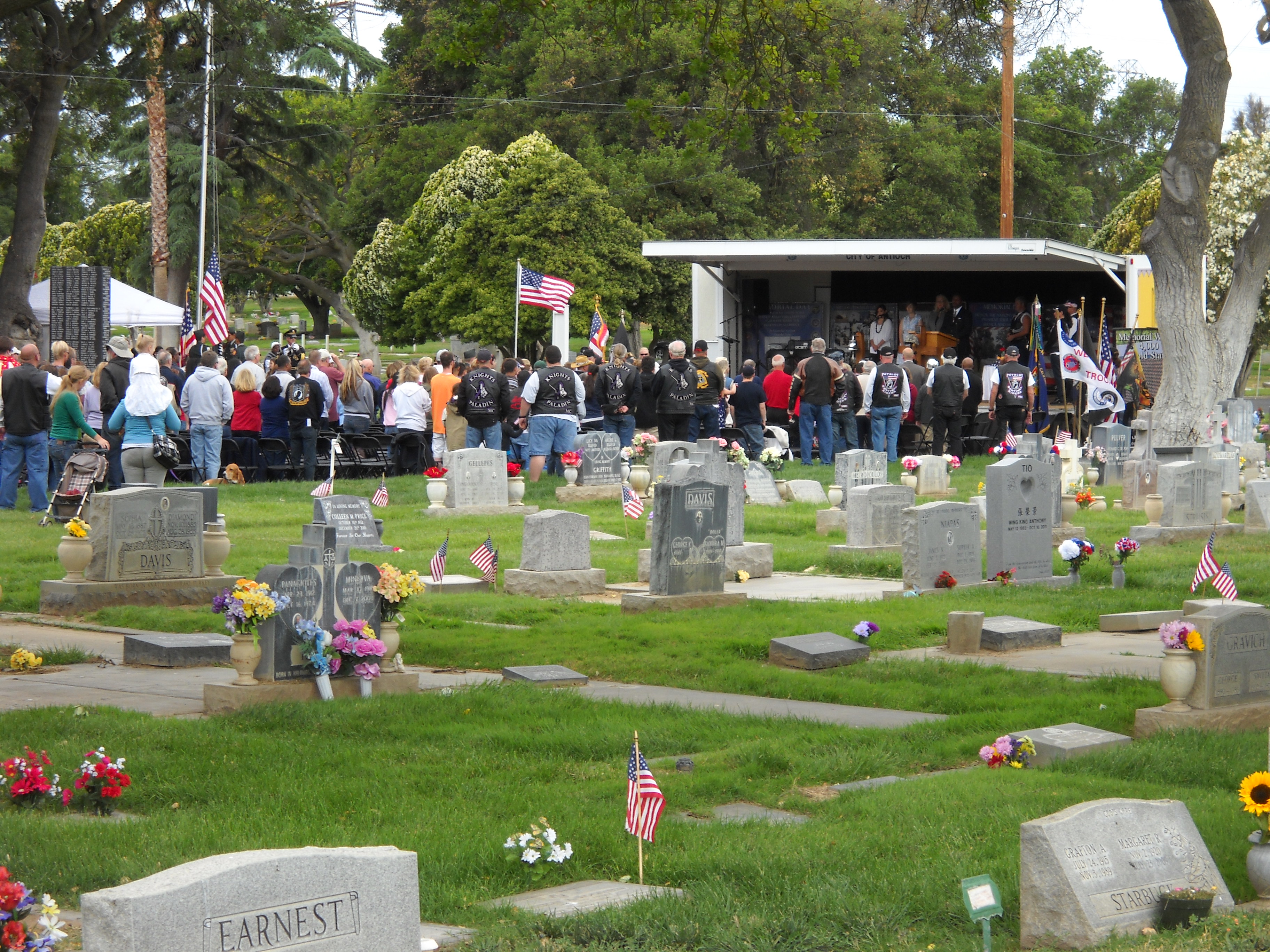
Antioch honors those fallen in battle during annual Memorial Day ceremonies

Monday, May 27th, 2013

Antioch Memorial Day 2013

By Allen Payton

A few hundred Antioch residents gathered under cloudy skies at the Oak View Memorial Park on Monday morning, to celebrate Memorial Day and honor those who made the ultimate sacrifice for our freedoms.

With the theme from the book of John, chapter 15, verse 13 in the Bible, “Greater love hath no man than this, that a man lay down his life for his friends,” the ceremonies were led by Antioch Mayor Wade Harper and Antioch School Board President Joy Motts.

Beginning with a prelude by the Deer Valley High School band and followed by a motorcycle procession led by the Patriot Sentinel Riders Veterans Motorcycle Club, the audience was led in the Pledge of Allegiance by Isabella Alfonso and enjoyed the National Anthem sung by Carolina Bruno.

Following greetings by Congressman Jerry McNerney and speakers Tom Karas, the Commander of VFW Post #6435 and LTC Taddeo (Retired), the two winners of the student essay contest, first for high school, Erin McDaid and then for middle school, Jade Estrada, read their essays.

That was followed by a variety of remembrances, including the POW/MIA Table, the presentation of the Memorial Walls, the Two Bell cermony, the presentation of the Wreath by Harper and Karas, the placement of a rose on the 9-11 Monument by former Mayor Jim Davis and Tony Fettig of the American Legion Post 161, and finally the 21-gun salute, closing prayer and the playing of taps.

BART to run on Sunday schedule on Memorial Day, Monday, May 27

Saturday, May 25th, 2013

On the Memorial Day holiday on Monday, May 27, 2013, BART will run on a Sunday schedule, meaning service starts around 8 am.

In addition, because it is a parking holiday, parking permit and fee requirements are not enforced in station parking facilities that day, excluding APLT Airport / Long Term Parking Permit reservations. For more info on parking go to www.bart.gov/parking.

Various track maintenance work is being done around the BART system that may affect some trips; for more detail see separate passenger bulletins posted at www.bart.gov/news or sign up to receive BART Service Advisories for delay notices.

To sign up for BSAs, please visit us on the web at www.bart.gov/advisories. You may also call 511 to get up-to-date service information.

Antioch Council to pursue two tax measures for November ballot

Friday, May 24th, 2013

By James Ott

Come November Antioch voters might have their choice of no less than two measures that aim to hire more police and code enforcement officers to help curb crime in the city.

At their May 14 meeting city council members voted to introduce a half cent sales tax measure to the upcoming ballot after a survey of 400 Antioch voters showed that a majority of those polled were very concerned about crime in the city and would support such a measure to fix the problem.

The council also directed staff members to work with a citizens group to place a second tax measure on the ballot that has seen a lot of support from Antioch residents recently. The measure would tax local landlords about $240 a year for their rentals and the money would also go to help police and code enforcement agencies in the city.

“I’d say we need to put both [tax measures] on the ballot,” said Mayor Wade Harper.

The council leaned toward placing both measures on the ballot despite survey conductors EMC Research suggesting that it might be confusing to voters if there are two measures aimed at accomplishing the same goal on the same ballot.

“In our experience having too many measures that are trying to accomplish the same thing can be confusing to the voters,” said EMC Research Consultant Ruth Bernstein. “I can’t say it as a guarantee…but they might think rather ‘why are they talking about the technicalities [of two measures] instead of focusing on the solution?’”

Bernstein also cited her company’s survey which showed that while a very strong 67 percent of voters would vote yes or are leaning toward voting yes on the half cent sales tax measure only 35 percent felt the same way about the proposed rental tax measure.

City council members like Gary Agopian however thought that the poll focused too much on the half cent sales tax measure and didn’t really reflect the large amount of support he has seen growing for the rental tax measure.

“I’m a little bit concerned that we didn’t dig a little deeper on the business license [rental tax measure],” said Agopian. “In the survey we got a lot of different looks at the half cent sales tax side yet here we have just a couple of different general questions [about the rental tax] and no specific numbers or why it would be valuable.”

Despite what the survey said, several citizens at the meeting showed up to voice their support for the rental tax measure, many of them participants in the Saturday Morning Breakfast Club – members of which presented their own ballot measure to the city during the meeting and are going out to collect signatures of support.

One of those club members is former Antioch mayor Don Freitas who said that there is a large amount of support for the rental tax measure among Antioch voters and that the survey’s questions were confusing, leading to misinformation and skewed results about the subject.

Freitas like many other supporters of the rental tax prefer to call it a “business tax” because they see rental properties as a business that is currently making revenue in the city tax free.

In the end the council showed some faith in both measures the half cent sales tax measure on the ballot and directed staff to help the Friday Morning Breakfast Club with their ballot proposal and their signature gathering.

There was some hope at the meeting that if they were given enough clear information perhaps Antioch residents would vote for both measures and provide sorely needed revenue to a city that facing a $3.6 million dollar deficit and a $13 million drop in their general fund revenues over the last five years and has lost 40 percent of their staff as a result. City Manager Jim Jakel calculated that Antioch would need $11.3 million in additional moneys every year for the city to get back to pre-recession service levels for its citizens.

The half-cent sales tax is expected to generate about $3.8 million a year while rough estimates for the rental tax peg it at $2.6 to $2.8 million dollars a year.

The good news for both ballot measures is that research seems to show that Antioch residents are very concerned about public safety and a lack of money at the city and seem to be willing to pony up the funds if they believe it will help those areas of concern.

EMC Research’s survey showed that 65 percent of residents feel that crime, drugs, violence and a lack of police are the biggest areas of concern in the city – the very two areas that both ballot measures seek to remedy.

“We’re not seeing what we see in other cities where jobs and the economy are the main concern,” said Bernstein. “Overwhelmingly it’s crime and lack of police that bother Antioch residents and we see a willingness to put their money where their mouth is.”

Contra Costa Council’s name change to East Bay Leadership Council reflects organization’s regional scope

Wednesday, May 22nd, 2013

Private sector leader Tom Terrill to succeed Linda Best as CEO this summer

Following the unanimous endorsement of the Contra Costa Council Board of Directors at the April 19 board meeting, and approval earlier this month by the broader membership, the Concord-based Contra Costa Council has changed its name to the East Bay Leadership Council (EBLC). The new name reflects a broader geographic scope of the private-sector, public-policy organization and the influence of the Council as a whole. In recent years, the Council has adopted a regional approach in its task force work and public policy considerations, which suggested a logical extension down the I-680 corridor to the Tri-Valley, including the Amador, Livermore and San Ramon valleys.

Tom Terrill, a recognized private-sector leader in regional economic development and real estate development, has been named to succeed Linda Best as president and CEO of the Council. (He will also succeed Best as executive director of the Contra Costa Economic Partnership, the nonprofit arm of the Council and a coalition of business and government leaders dedicated to creating and retaining quality jobs in the region.) Best announced in February that she would retire this summer.

“We are pleased to welcome Tom Terrill in a new leadership role for the Council and the Economic Partnership,” said Council Chair Bob Brown. “As a respected associate, past Council chair and regional business leader, Tom has extensive experience in economic development and working with complex government/community development issues. We believe he is the best person to fill the large shoes that Linda Best leaves. We are fortunate to have such leaders in our region, and we thank Linda for her great dedication and contribution to regional vitality.”

Council Chair Brown appointed a Visioning Committee last July, chaired by 2012-2013 Council Chair David Bowlby, to consider a name change that reflected the Council’s regional orientation and to conduct outreach with community and business leaders in the Tri-Valley. Committee members met with Chamber of Commerce executives of Dublin, Pleasanton and Livermore, and the Innovation Tri-Valley Leadership Group. They also met with leaders of the Tri-Valley Business Council, which will now be formally integrated into the East Bay Leadership Council.

“We took a deliberative approach in our due diligence, and received a very warm response from Tri-Valley leaders, who agree that we have many issues in common, including transportation, workforce development, permit streamlining and CEQA reform,” said Brown. “We believe the region can benefit from our organizations working together on these important issues. With redistricting, we now share several elected representatives at state and federal levels.”

AJ Major, chairman of the Board of the Tri-Valley Business Council, stated, “The East Bay Leadership Council is a prestigious body, and we look forward to having this organization be the new base for initiatives previously undertaken by the Tri-Valley Business Council so that, together, we can realize an even greater future for our region and our communities.”

“We are very excited about working with the Council’s leadership and integrating with its task forces on the many issues we share,” said James Paxson, general manager of Hacienda, Pleasanton, and Tri-Valley Business Council board member.

About Tom Terrill and Linda Best

Tom Terrill has extensive experience in economic development and working with complex government/community development issues. He has owned his own investment development company since 1997, been in the commercial development industry for 35 years, and has worked extensively in both Contra Costa and Alameda Counties. He has also been very involved with both the Contra Costa Council and Contra Costa Economic Partnership for many years, serving in leadership positions, including chair, in the 1990s.

Terrill devotes significant time to volunteer and community activities. He recently served as a member of the Blue Ribbon Task Force on Long Range Fiscal Strategies for the City of Walnut Creek. He often teaches urban and real estate economics at Saint Mary’s College and guest lectures at the Fisher Center for Real Estate & Urban Economics at the Haas School of Business, UC Berkeley. A member of the Urban Land Institute, he has been involved with UrbanPlan, a course curriculum used in high schools and colleges. Terrill has also served as president of the Walnut Creek Education Foundation. He is a graduate of UC Berkeley with a degree in economics.

Linda Best has been Council president and CEO for nine years. She serves on the boards of John Muir Health, Opportunity Junction, and STAND! For Families Free of Violence. She was honored as “Woman of the Year for the 15th Assembly District” in 2011 and was named “one of the Bay Area’s most influential women in business” by the San Francisco Business Times in 2009 and 2010. Best says she will continue her interest in the work of the Council. She also looks forward to spending more time with family and on nonprofit boards on which she serves.

About the East Bay Leadership Council (formerly the Contra Costa Council): The Council, also referred to as the EBLC, is a private sector, public policy organization with a membership that includes business, nonprofit organizations, government, education and labor. The mission of the Council is to provide advocacy on public policy issues affecting the economic vitality and quality of life in the Greater East Bay region. For more information, see www.eastbayleadershipcouncil.com.


McNerney works to address backlog of Veterans’ Claims at Department of Veterans Affairs

Tuesday, May 21st, 2013

Washington, D.C. – Congressman Jerry McNerney (D-Stockton) today heralded the House Appropriations Committee’s inclusion of his recommended action to direct the U.S. Department of Veterans Affairs (VA) to address the backlog of disability claims at its regional offices across the country.  Congressman McNerney asked that any regional office with an average wait time for pending claims of 200 days be required to provide quarterly reports to Congress in order to increase oversight and accountability for reducing the backlogs of claims.  He wrote a letter detailing this request to the Subcommittee on Military Construction, Veterans Affairs and Related Agencies that gained vast bipartisan support.

“The backlogs we currently see at the Oakland regional office and other VA offices across the country are unacceptable.  We need to take steps to hold the VA responsible for providing the benefits and services that our veterans have earned and deserve.  It is my hope that we will see concrete results.  It is a simple matter of doing our best to provide for the men and women who have sacrificed so much to preserve our way of life,” said Congressman McNerney.  “Accountability and oversight are a critical component to ensure that the backlog finally gets addressed.”

The portion of the committee report that was included at Congressman McNerney’s request reads:

—The Committee finds the VBA back-log in processing disability compensation claims unacceptable. Although for years the Committee has fully funded the President’s budget request for additional staffing and increased information technology funding for the Veterans Benefits Management System (VBMS), the claims backlog continues to grow. Backlog as defined by the Department is the number of claims taking more than 125 days to process. The most recent data indicate that the average number of days to process a claim is 292, with averages in some regional offices exceeding 450 days. Currently, 69 percent of the VA compensation caseload is backlogged, although VA estimated in its 2013 budget the percentage in backlog would be 40 percent in 2013. The Committee understands the VA believes the agency will be able to process claims within 125 days by 2015 when the VBMS is fully operational. While the Committee supports the use of technology to improve performance, the Committee is highly skeptical that the VBMS system will be able to eliminate these enormous backlogs by 2015. Therefore, the Committee intends to initiate a new level of oversight to ensure that it has monthly information identifying the changes in timeliness occurring at each of the 56 regional offices. As of the date of the publication of this House report, the Department is instructed to provide the Committee each month, ten days after the prior month has ended, a report that identifies for each month cumulatively throughout the fiscal year, both nationally and for each regional office: (1) the average number of days disability compensation claims are pending; (2) the share of the rating inventory that has been pending more than 125 days; (3) the rating claims accuracy on a three-month average; and (4) the month-to-month change in these indices, both by numeric value and percentage. The report may be in spreadsheet format. In addition, for each regional office with an average number of days pending for disability claims in excess of 200 days, the Department shall report to the Committee on a quarterly basis the actions taken, such as increases in claims processor FTE, staffing transfers, additional training, and technology adaptations, within the last quarter to reduce the backlog. While these reports are for the use of the Appropriations Committee, they are to be made available by the VA Office of Congressional and Legislative Affairs to any Member of the House of Representatives upon request.

The letter Congressman McNerney sent to the Appropriations Subcommittee on Military Construction, Veterans Affairs and Related Agencies can be read by clicking here: 4.23.13 VA Oversight.

Assembly passes Frazier bill to enhance teen driver safety

Tuesday, May 21st, 2013

AB 1113 Will Help Prevent Future Automobile Accidents, Injuries and Fatalities

SACRAMENTO, CA – The California Assembly gave final approval to Assembly Bill 1113, introduced by Assemblymember Jim Frazier (D–Oakley), which will add restrictions on California’s provisional licensing law.

The provisional licensing program was designed to protect young, inexperienced drivers by giving them more time to gain driving experience prior to full licensure. The program has been effective in reducing novice driver accidents, deaths, and injuries; however, a significant safety problem still remains for teenage drivers.

Motor vehicle crashes are the leading cause of death for teens in the United States. Teen drivers have the highest rate of involvement in crashes that result in the death of other people, such as their passengers, pedestrians, or drivers and passengers in other vehicles. “I am all about saving lives and this will establish better safety practices for inexperienced teen drivers, helping to prevent unnecessary motor vehicle fatalities throughout California,” said Frazier.

AB 1113 seeks to strengthen California’s provisional licensing law by requiring that the provisional driver’s license remain in effect until an individual reaches the age of 18, lowers the current nighttime driving restriction from 11:00 p.m. to 10:00 p.m., modifies the age restriction on the transporting of passengers from 20 years of age to 21 years of age, and increases the 6-month learner permit requirement to 9-months.

The bill passed with bipartisan support and now proceeds to the Senate for further consideration.

For more information or to RSVP, please visit www.asmdc.org/members/a11/ or call Jim’s district offices at 707-399-3011 or 925-778-5790.