







Archive for the ‘News’ Category

McNerney works to address backlog of Veterans’ Claims at Department of Veterans Affairs

Tuesday, May 21st, 2013

Washington, D.C. – Congressman Jerry McNerney (D-Stockton) today heralded the House Appropriations Committee’s inclusion of his recommended action to direct the U.S. Department of Veterans Affairs (VA) to address the backlog of disability claims at its regional offices across the country.  Congressman McNerney asked that any regional office with an average wait time for pending claims of 200 days be required to provide quarterly reports to Congress in order to increase oversight and accountability for reducing the backlogs of claims.  He wrote a letter detailing this request to the Subcommittee on Military Construction, Veterans Affairs and Related Agencies that gained vast bipartisan support.

“The backlogs we currently see at the Oakland regional office and other VA offices across the country are unacceptable.  We need to take steps to hold the VA responsible for providing the benefits and services that our veterans have earned and deserve.  It is my hope that we will see concrete results.  It is a simple matter of doing our best to provide for the men and women who have sacrificed so much to preserve our way of life,” said Congressman McNerney.  “Accountability and oversight are a critical component to ensure that the backlog finally gets addressed.”

The portion of the committee report that was included at Congressman McNerney’s request reads:

—The Committee finds the VBA back-log in processing disability compensation claims unacceptable. Although for years the Committee has fully funded the President’s budget request for additional staffing and increased information technology funding for the Veterans Benefits Management System (VBMS), the claims backlog continues to grow. Backlog as defined by the Department is the number of claims taking more than 125 days to process. The most recent data indicate that the average number of days to process a claim is 292, with averages in some regional offices exceeding 450 days. Currently, 69 percent of the VA compensation caseload is backlogged, although VA estimated in its 2013 budget the percentage in backlog would be 40 percent in 2013. The Committee understands the VA believes the agency will be able to process claims within 125 days by 2015 when the VBMS is fully operational. While the Committee supports the use of technology to improve performance, the Committee is highly skeptical that the VBMS system will be able to eliminate these enormous backlogs by 2015. Therefore, the Committee intends to initiate a new level of oversight to ensure that it has monthly information identifying the changes in timeliness occurring at each of the 56 regional offices. As of the date of the publication of this House report, the Department is instructed to provide the Committee each month, ten days after the prior month has ended, a report that identifies for each month cumulatively throughout the fiscal year, both nationally and for each regional office: (1) the average number of days disability compensation claims are pending; (2) the share of the rating inventory that has been pending more than 125 days; (3) the rating claims accuracy on a three-month average; and (4) the month-to-month change in these indices, both by numeric value and percentage. The report may be in spreadsheet format. In addition, for each regional office with an average number of days pending for disability claims in excess of 200 days, the Department shall report to the Committee on a quarterly basis the actions taken, such as increases in claims processor FTE, staffing transfers, additional training, and technology adaptations, within the last quarter to reduce the backlog. While these reports are for the use of the Appropriations Committee, they are to be made available by the VA Office of Congressional and Legislative Affairs to any Member of the House of Representatives upon request.

The letter Congressman McNerney sent to the Appropriations Subcommittee on Military Construction, Veterans Affairs and Related Agencies can be read by clicking here: 4.23.13 VA Oversight.

Assembly passes Frazier bill to enhance teen driver safety

Tuesday, May 21st, 2013

AB 1113 Will Help Prevent Future Automobile Accidents, Injuries and Fatalities

SACRAMENTO, CA – The California Assembly gave final approval to Assembly Bill 1113, introduced by Assemblymember Jim Frazier (D–Oakley), which will add restrictions on California’s provisional licensing law.

The provisional licensing program was designed to protect young, inexperienced drivers by giving them more time to gain driving experience prior to full licensure. The program has been effective in reducing novice driver accidents, deaths, and injuries; however, a significant safety problem still remains for teenage drivers.

Motor vehicle crashes are the leading cause of death for teens in the United States. Teen drivers have the highest rate of involvement in crashes that result in the death of other people, such as their passengers, pedestrians, or drivers and passengers in other vehicles. “I am all about saving lives and this will establish better safety practices for inexperienced teen drivers, helping to prevent unnecessary motor vehicle fatalities throughout California,” said Frazier.

AB 1113 seeks to strengthen California’s provisional licensing law by requiring that the provisional driver’s license remain in effect until an individual reaches the age of 18, lowers the current nighttime driving restriction from 11:00 p.m. to 10:00 p.m., modifies the age restriction on the transporting of passengers from 20 years of age to 21 years of age, and increases the 6-month learner permit requirement to 9-months.

The bill passed with bipartisan support and now proceeds to the Senate for further consideration.

For more information or to RSVP, please visit www.asmdc.org/members/a11/ or call Jim’s district offices at 707-399-3011 or 925-778-5790.

Community forum on Thursday to announce Contra Costa Sheriff’s new Detainer Policy on illegal immigrants

Tuesday, May 21st, 2013

After months of negotiations, Sheriff Livingston set to announce new policy on limiting cooperation with Secure Communities Program

By the Contra Costa Interfaith Supporting Community Organization (CCISCO)

As the TRUST Act moves through the California legislature, the office of Contra Costa Sheriff David Livingston will be participating in a community forum on Thursday, May 23, 2013 to announce a new policy that will limit the County’s cooperation with the controversial “Secure Communities” program which critics charge has resulted in the unnecessary separation of hundreds of thousands of families over the past five years.  Contra Costa County has one of the highest rates of immigrant detention in California and has had the highest rate of non-criminal deportations in the Bay Area.

WHAT:  Public Forum to Announce New Detainer Policy in Contra Costa County

WHO:  Representatives of Contra Costa Sheriff’s Office; clergy; over 200 community leaders; law enforcement officials; public officials

WHEN:  Thursday, May 23, 2013 at 7:00pm

WHERE: Community Presbyterian Church of Pittsburg, 200 E. Leland Road, Pittsburg

BACKGROUND:  After more than twelve months of organizing and negotiations, Contra Costa Sheriff David Livingston has agreed to implement a new policy that will limit the level of cooperation with the federal Secure Communities program.  The new policy is being lauded as one of the fairest in the state of California and signals growing support among law enforcement officials to re-examine their cooperation with the controversial federal immigration program which has resulted in hundreds of thousands of deportations over the past five years.  The announcement comes at a critical moment as the California legislature is debating a similar proposal that would enact similar restrictions on local cooperation with the federal program.  California Governor Jerry Brown vetoed the TRUST Act last October and cited the need for more support from law enforcement as key to gaining his support this session.  

200 community members are expected to attend with some giving testimonials of family members who have lost loved ones to deportations.

The Contra Costa Interfaith Supporting Community Organization (CCISCO) is a federation of 20 religious congregations representing 38,000 families in Contra Costa County.  CCISCO is an active member of the PICO National Network.  PICO National Network is the largest grassroots, faith-based organizing network in the United States. PICO works with 1,000 religious congregations in more than 200 cities and towns through its 60 local and state federations. PICO and its federations are non-partisan and do not endorse or support candidates for office. PICO urges people of faith to consult their faith traditions for guidance on specific policies and legislation. Learn more at www.piconetwork.org.

Assembly passes TRUST Act to limit federal Secure Communities immigration enforcement program

Tuesday, May 21st, 2013

SACRAMENTO – The California Assembly today passed AB 4, the TRUST Act, a bill to reign in excesses committed under the federal Secure Communities program and repair damages it caused to community trust in law enforcement.

The bill now moves to the Senate for consideration.

AB 4 is this year’s version of the TRUST Act passed by the Legislature in 2012, but vetoed by Gov. Jerry Brown, who pledged to act on the issue in his veto message. The bill – passed Thursday on a 44-22 vote – seeks to reduce the deportation of Californians under the discredited S-Comm program. The federal program, ostensibly designed to expel people with serious convictions, has instead resulted in the deportation of more than 95,000 people. More than two-thirds of those had either never been convicted of any crime, or convicted only of low level offenses.

Recent research confirms that the program has led to decreased confidence in the police in Latino communities, where residents report being much less likely to contact law enforcement.

The bill allows local jails to detain people for extra time after receiving requests from Immigration and Customs Enforcement if the person has been convicted of a crime designated as a severe or violent felony. Local officials will still have the discretion to hold people, or grant release on bail, as the severity of charges warrant. These ICE requests are voluntary, according to the California Attorney General.

Assembly Members spoke on the floor of outrageous incidents that have taken place under S-Comm. These included a Bakersfield woman threatened with deportation when police were called to her home about barking dogs and a UC Berkeley academic standout who decided not to report being mugged for fear it would jeopardize his family’s immigration situation.

Assembly Member Tom Ammiano, the bill’s author, has pledged to work with Governor Brown to try to address his concerns that led to the 2012 veto, so that the bill could go into effect and reduce the deportations starting in 2014.

Assembly Member Jim Frazier, who represents Antioch, voted in favor of the bill, according to the legislative record, which can be seen by clicking here.

To read the entire text of the bill, click here.

Obamacare’s Tax Hike Train Wreck

Monday, May 20th, 2013

The most destructive Obamacare tax increases are just around the bend

By John Kartch, Americans for Tax Reform

WASHINGTON, D.C. – Asked about Senator Max Baucus’s (D-Mont.) recent “train wreck” comments, President Obama said, “A huge chunk of it [Obamacare] has already been implemented.” Unmentioned was the wave of destructive Obamacare tax increases that will begin to hit Americans during the next tax filing season and beyond:

Starting in tax year 2013:

Obamacare Surtax on Investment Income: A new, 3.8 percent surtax on investment income earned in households making at least $250,000 ($200,000 single). This tax hike results in the following top tax rates on investment income:

*Other unearned income includes (for surtax purposes) gross income from interest, annuities, royalties, net rents, and passive income in partnerships and Subchapter-S corporations. It does not include municipal bond interest or life insurance proceeds, since those do not add to gross income. It does not include active trade or business income, fair market value sales of ownership in pass-through entities, or distributions from retirement plans. (Bill: Reconciliation Act; Page: 87-93)

Obamacare Medicare Payroll Tax Increase:

First $200,000 ($250,000 Married) Employer/Employee

All Remaining Wages Employer/Employee

Pre-Obamacare

1.45%/1.45% 2.9% self-employed

1.45%/1.45% 2.9% self-employed

Obamacare

1.45%/1.45% 2.9% self-employed

1.45%/2.35% 3.8% self-employed

(Bill: PPACA, Reconciliation Act; Page: 2,000-2,003; 87-93)

Obamacare Medical Device Tax: Medical device manufacturers employ 409,000 people in 12,000 plants across the country. Obamacare imposes a new 2.3 percent excise tax on gross sales – even if the company does not earn a profit in a given year. In addition to killing small business jobs and impacting research and development budgets, this will make everything from pacemakers to artificial hips more expensive. (Bill: PPACA; Page: 1,980-1,986)

Obamacare High Medical Bills Tax: Before Obamacare, Americans facing high medical expenses were allowed a deduction to the extent that those expenses exceeded 7.5 percent of adjusted gross income (AGI). Obamacare now imposes a threshold of 10 percent of AGI. Therefore, Obamacare not only makes it more difficult to claim this deduction, it widens the net of taxable income.

According to the IRS, 10 million families took advantage of this tax deduction in 2009, the latest year of available data. Almost all are middle class. The average taxpayer claiming this deduction earned just over $53,000 annually. ATR estimates that the average income tax increase for the average family claiming this tax benefit will be $200 – $400 per year. To learn more about this tax, click here. (Bill: PPACA; Page: 1,994-1,995)

Obamacare Flexible Spending Account Tax: The 30 – 35 million Americans who use a pre-tax Flexible Spending Account (FSA) at work to pay for their family’s basic medical needs face a new Obamacare cap of $2,500. This will squeeze $13 billion of tax money from Americans over the next ten years. (Before Obamacare, the accounts were unlimited under federal law, though employers were allowed to set a cap.) Now, a parent looking to sock away extra money to pay for braces will find themselves quickly hitting this new cap, meaning they would have to pony up some or all of the cost with after-tax dollars.

Needless to say, this tax will especially impact middle class families.

There is one group of FSA owners for whom this new cap will be particularly cruel and onerous: parents of special needs children. Nationwide there are several million families with special needs children and many of them use FSAs to pay for special needs education. Tuition rates at one leading school that teaches special needs children in Washington, D.C. (National Child Research Center) can easily exceed $14,000 per year. Under tax rules, FSA dollars can be used to pay for this type of special needs education. This Obamacare tax provision will limit the options available to these families. (Bill: PPACA; Page: 2,388-2,389)

Starting in tax year 2014:

Obamacare Individual Mandate Non-Compliance Tax: Starting in 2014, anyone not buying “qualifying” health insurance – as defined by President Obama’s Department of Health and Human Services — must pay an income surtax to the IRS. The Congressional Budget Office recently estimated that six million American families will be liable for the tax, and as pointed out by the Associated Press: “Most would be in the middle class.”

In addition, 100 percent of Americans filing a tax return (140 million filers) will be forced to submit paperwork to the IRS showing they either had “qualifying” health insurance for every month of the tax year or they obtained an exemption to the mandate.

Americans liable for the surtax will pay according to the following schedule:

1 Adult

2 Adults

3+ Adults

2014

1% AGI/$95

1% AGI/$190

1% AGI/$285

2015

2% AGI/$325

2% AGI/$650

2% AGI/$975

2016 +

2.5% AGI/$695

2.5% AGI/$1390

2.5% AGI/$2085

(Bill: PPACA; Page: 317-337)

Obamacare Employer Mandate Tax: If an employer does not offer health coverage, and at least one employee qualifies for a health tax credit, the employer must pay an additional non-deductible tax of $2,000 for all full-time employees. This provision applies to all employers with 50 or more employees. If any employee actually receives coverage through the exchange, the penalty on the employer for that employee rises to $3,000. If the employer requires a waiting period to enroll in coverage of 30-60 days, there is a $400 tax per employee ($600 if the period is 60 days or longer). (Bill: PPACA; Page: 345-346)

Obamacare Tax on Health Insurers: Annual tax on the industry imposed relative to health insurance premiums collected that year. The tax phases in gradually until 2018. Fully imposed on firms with $50 million in profits. (Bill: PPACA; Page: 1,986-1,993)

Starting in tax year 2018:

Obamacare Tax on Union Member and Early Retiree Health Insurance Plans: Obamacare imposes

a new 40 percent excise tax on high cost or “Cadillac” health insurance plans, effective in 2018. This tax increase will most directly affect union families and early retirees, who are likely to be covered by such plans. This Obamacare tax will be levied on insurance policies whose premiums exceed $10,200 for an individual and $27,500 for a family. Middle class union members tend to be covered by such plans in states like Ohio, Pennsylvania, Wisconsin, and Michigan. Higher threshold ($11,500 single/$29,450 family) for early retirees and high-risk professions. CPI +1 percentage point indexed. (Bill: PPACA; Page: 1,941-1,956)

Americans for Tax Reform is a non-partisan coalition of taxpayers and taxpayer groups who oppose all tax increases. For more information or to arrange an interview please contact John Kartch at (202) 785-0266 or by email at jkartch@atr.org.

Memorial Day Pet Road Trip – Top Tips for Safe Pet Car Travel

Monday, May 20th, 2013

Memorial Day symbolizes the start of summer for you and your pet. Before you start planning trips to the beach and summer getaways, keep in mind that it’s important to plan ahead for pet travel and always keep the best interests of your furry, four-legged friend in mind.  Traveling with your pet can be a wonderful and bonding experience or a not so pleasant one.  It’s all a matter of proper planning and preparation.

Here are the top tips to ensure your Memorial Day getaway with your pet is a safe one.

  • No Heads Out the Window:  Although many pets find that sticking their head out the window is the best part of the road trip, it’s not safe.  Your pet can easily be injured by flying debris.  This should go without saying, but NEVER travel with a pet in the back of a pickup truck. Some states have laws restricting such transport and it is always dangerous.

  • Frequent Pit Stops:  Always provide frequent bathroom and exercise breaks. Most travel service areas have designated areas for walking your pet. Be sure to stay in this area particularly when you pet needs a potty break, and of course, bring along a bag to pick up after your pet.  When outside your vehicle, make sure that your pet is always on a leash and wearing a collar with a permanent and temporary travel identification tag.

  • Proper Hydration:  During your pit stops be sure to provide your pet with some fresh water to wet their whistle.  Occasionally traveling can upset your pet’s stomach. Take along ice cubes, which are easier on your pet than large amounts of water.

  • Watch the Food Intake:  It is recommended that you keep feeding to a minimum during travel.  Be sure to feed them their regular pet food and resist the temptation to give them some of your fast food burger or fries (that never has a good ending!).

  • Don’t Leave Them Alone:  Never leave your pet unattended in a parked vehicle. On warm days, the temperature in your vehicle can rise to 120 degrees in minutes, even with the windows slightly open. In addition, an animal left alone in a vehicle is an open invitation to pet thieves.

  • Practice Restraint:  Be sure that your pet is safely restrained in your vehicle.  Utilizing a pet safety harness, travel kennel, vehicle pet barrier, or pet car seat are the best ways to keep your pet safe.  They not only protect your pet from injury, but they help by keeping them from distracting you as you drive.  A safety harness functions like a seatbelt.  While most pets will not have a problem adjusting to it, you may want to let them wear the harness by itself a few times before using it in the vehicle. If your pet prefers a travel kennel, be sure it is well ventilated and stabilized.  Many pet owners prefer vehicle barriers, particularly for larger pets.  Vehicle barriers are best suited for SUVs.  Smaller pets are best suited for pet car seats.  The car seat is secured in the back seat using a seat belt and your pet is secured in the car seat with a safety harness.  In addition to it’s safety features, a pet car seat will prop up your smaller pet, allowing them to better look out the window.  No matter what method you choose, back seat travel is always safer for your pet.

  • Safe and Comfortable:  Whatever method you choose to properly restrain your pet in your vehicle, be sure to make their comfort a priority.  Just as it’s important for your “seat” to be comfortable for your long road trip, your pet’s seat should be comfortable too. Typically their favorite blanket or travel bed will do the trick. There are also some safe and very cozy pet car seats available that your pet may find quite comfy.

Careful preparation is the key to ensuring that you and your pet have a happy and safe trip.
About TripsWithPets.com

TripsWithPets.com is the #1 online resource for pet travel. It was named BEST pet travel site by Consumer Reports! TripsWithPets.com offers resources to ensure pets are welcome, happy, and safe when traveling.  The website features a directory of pet friendly hotels & accommodations across the U.S. and Canada, airline & car rental pet policies, dog friendly beaches, search by route, pet travel tips, pet travel supplies, along with other pet travel resources.

Contra Loma Blvd and L Street closure this week

Saturday, May 18th, 2013

The California Department of Transportation (Caltrans) and the Contra Costa Transportation Authority (CCTA) are widening State Route 4 (SR-4) through Pittsburg and Antioch. As part of this construction work, the contractor is demolishing the inactive portion of the existing SR-4 bridge structure over Contra Loma Boulevard/L Street. In order to ensure crew and public safety during this work, the contractor will close all lanes of Contra Loma Boulevard/L Street in the northbound and southbound directions between the westbound SR-4 on-ramp and the eastbound SR-4 off-ramp on Monday through Thursday evenings, May 20-23 from 11:00 pm to 5:00 am.

The detours for this work will be as follows:

Monday through Wednesday Evenings

o Northbound motorists will be directed right on Fitzuren Road, left on G Street, left on 18th Street, left on L Street, right on westbound SR-4 on-ramp. Motorists will have the option to turn right onto L Street from 18th Street.

o Southbound motorists will be directed right on westbound SR-4 on-ramp, exit on Somersville Road/Auto Center Drive loop off-ramp, right on Somersville Road, left on Delta Fair Boulevard, left on Buchanan Road, straight to Contra Loma Boulevard. Thursday Evening Only

o Northbound motorists will be directed right on Fitzuren Road, left on G Street, left on 18th Street, left on L Street, right on westbound SR-4 on-ramp. Motorists will have the option to turn right onto L Street from 18th Street.

o Southbound motorists will be directed right on westbound SR-4 on-ramp, exit on Somersville Road/Auto Center Drive loop off-ramp, left on Auto Center Drive, left on Century Boulevard, left on Delta Fair Boulevard, left on Buchanan Road, straight to Contra Loma Boulevard.

Breaking News – Accident during Amgen Tour bicycle race shuts down part of Marsh Creek Road

Saturday, May 18th, 2013
049

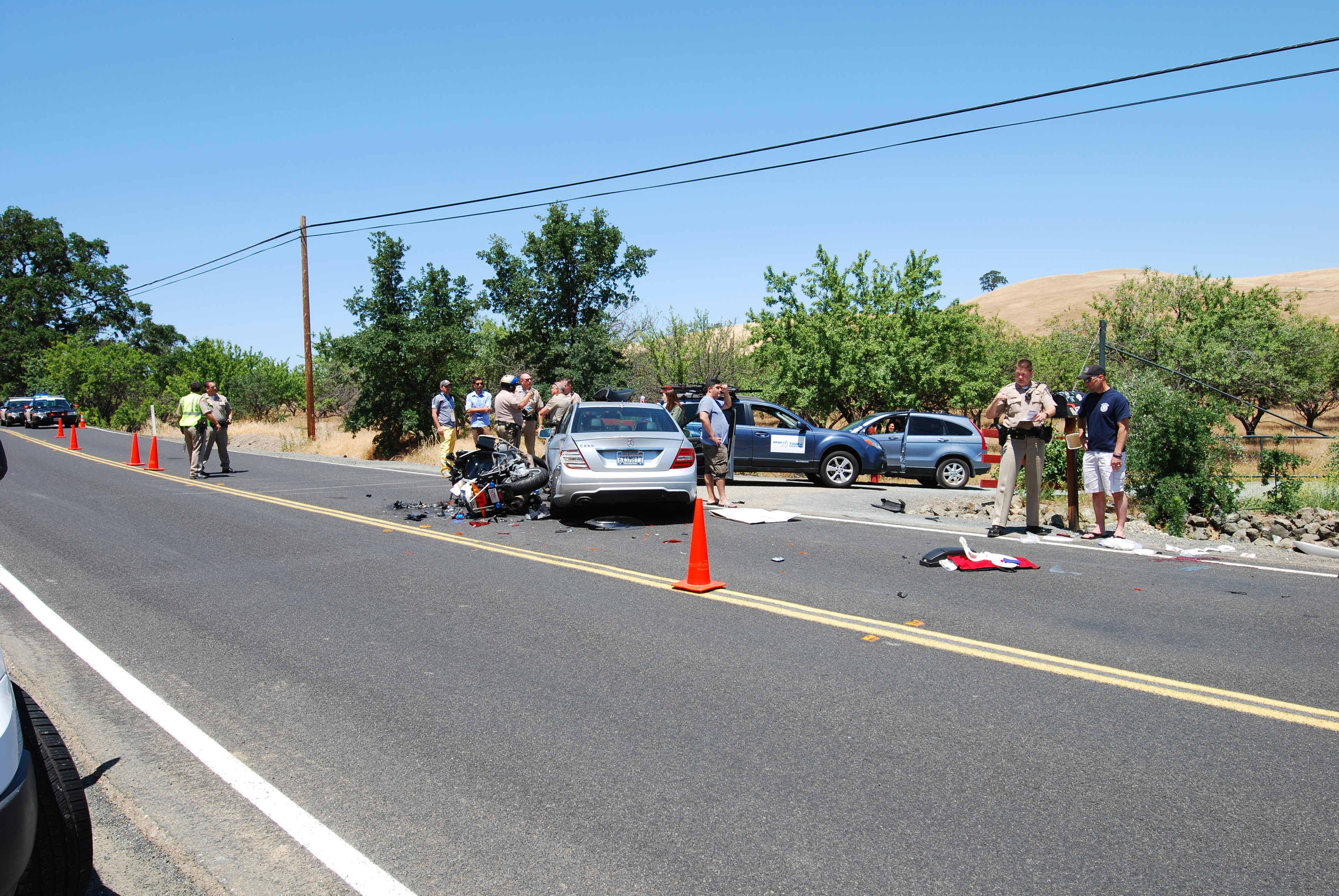
A car hit a CHP Motorcycle officer, today on Marsh Creek Road, during the Amgen Tour of California bicycle race. – by Bradley Bennett

BREAKING NEWS

By Bradley Bennett

A portion of Marsh Creek Road is down to one lane and under traffic control as a CHP officer was hit by motorist during the Amgen Tour of California bicycle race, today, Saturday, May 18, 2013. The officer was stopped and directing traffic for the race, when he was struck by a silver Mercedes.

The officer was transported to Round Valley Regional Park and airlifted to John Muir Medical Center in Walnut Creek.

It was reported that he was off of his motorcycle when hit and evidently does not remember what had happened.

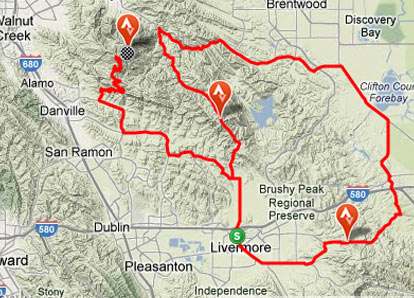
The race is currently under way, during Stage 7 of 8 stages, which began at 11:30 a.m., taking bicyclists from Livermore and to the top of Mt. Diablo.

For more information about the race and today’s stage, click here.

042

Cyclists race down Marsh Creek Road during Stage 7 of the Amgen Tour of California race, today near Mt. Diablo. – by Bradley Bennett

AMgen Stage 7

Amgen Stage 7 route, May 18, 2013