Archive for the ‘News’ Category

Antioch Police make three separate arrests for mail theft, stolen cars Thursday night

Friday, June 12th, 2020

Suspect arrested and stolen mail on stolen car in Antioch, Thursday night, June 11, 2020. Photos by APD.

Some mail stolen from Brentwood, one car stolen in Pleasant Hill

By Antioch Police Department

You’ve probable read how diligent #APDNightShift is in keeping watch of our city while you sleep — and they did not disappoint last night! Officers found a total of three occupied stolen vehicles and made three separate arrests, including one of particular note:

A little after 2:00 am, an officer spotted a Honda reported stolen from Pleasant Hill in the area of Hillcrest Avenue and East Tregalllas Road. After a stop was made, officers searched the car and found several pieces of mail stolen from our good neighbors over in Brentwood. BrentwoodPD showed up to help-out and took possession of the stolen mail, with the intention of returning it to the victims. The driver was arrested and given free shuttle service (courtesy of an APD chauffeur) to the County Jail, where he was booked on the stolen vehicle plus mail theft charges.

Mail theft continues to be a huge problem across the East Bay. If you haven’t already, please consider using a locking mailbox and signing up for Informed Delivery. Victims of mail theft often have their identity stolen and used to open fraudulent credit accounts (it’s a big headache). Never place outgoing mail in yours, and instead drop it off at the Post Office or a blue Postal Service delivery bin. Informed Delivery is a service from the Post Office that provides daily emails with scanned images of the mail being delivered to your address. You can sign up for this free service by visiting this link: https://informeddelivery.usps.com/…/pages/intro/start.action

#AntiochPD   #BrentwoodPD   #CVC10851


Antioch Council to hold special meeting Tuesday to discuss forming police reform ad hoc committee

Friday, June 12th, 2020

Police Crime Prevention Commission Chairman questions need, accuses Thorpe of playing politics

By Allen Payton

The Antioch City Council will hold a special meeting Tuesday night, June 16, 2020 to discuss and consider forming a Police Reform Ad Hoc Committee. It’s being done at the request of Councilman Lamar Thorpe who stated his desire to place the matter on a future council meeting agenda, at the end of this past Tuesday night’s regular council meeting. 

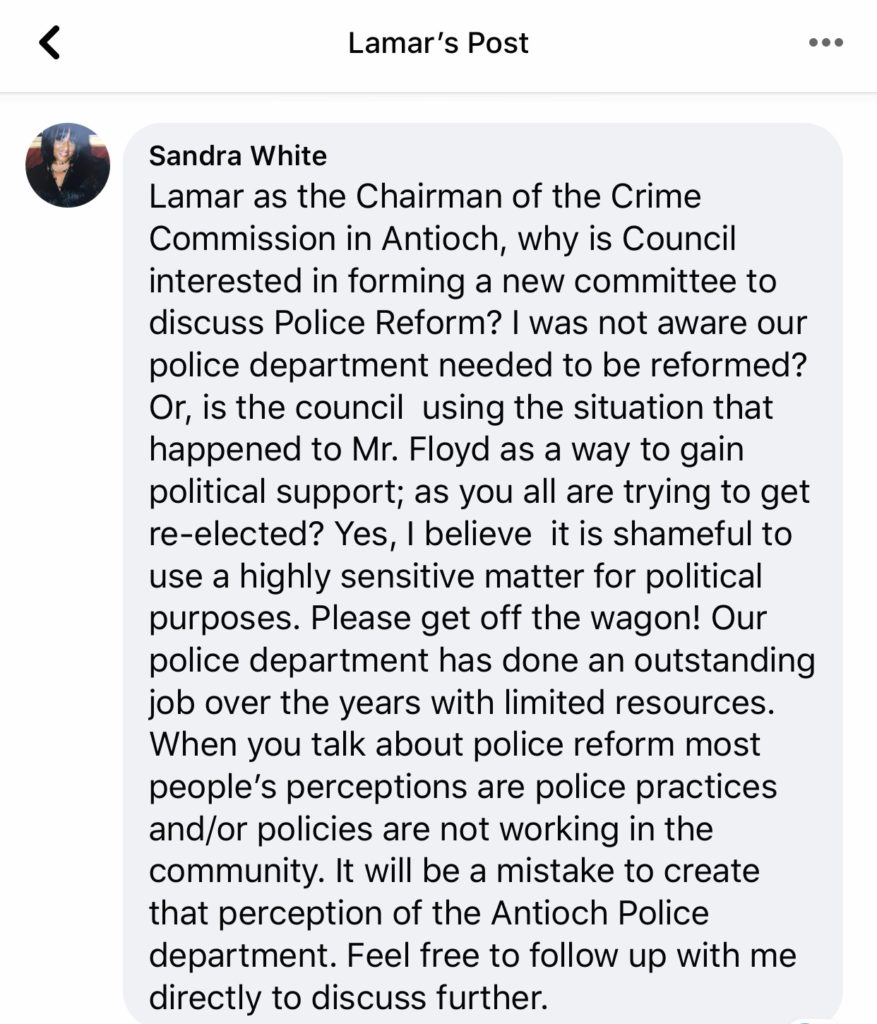
However, Police Crime Prevention Commission Chair Sandra White, in a comment on Thorpe’s personal Facebook page, questioned the need for it.

“Lamar as the Chairman of the Crime Commission in Antioch, why is Council interested in forming a new committee to discuss Police Reform?” she asked. “I was not aware our police department needed to be reformed? Or, is the council using the situation that happened to Mr. Floyd as a way to gain political support; as you all are trying to get re-elected?”

“Yes, I believe it is shameful to use a highly sensitive matter for political purposes,” White continued. “Please get off the wagon! Our police department has done an outstanding job over the years with limited resources. When you talk about police reform most people’s perceptions are police practices and/or policies are not working in the community. It will be a mistake to create that perception of the Antioch Police department.”

“Feel free to follow up with me directly to discuss further,” she concluded.

Antioch Police Crime Prevention Commission Chair Sandra White’s comment on Councilman Lamar Thorpe’s Facebook post on Wednesday, June 10, 2020.

However, her comment has been deleted. When reached for comment Thorpe wrote in a text about White and her comment, “She is not my friend on FB (Facebook). I delete all comments from people who are not my friends on FB. She’s more than welcome to comment on my public profile.”

Asked if his post was still on his personal page and why not use the Police Crime Prevention Commission instead of forming a council ad hoc committee, Thorpe did not respond.

Earlier this week, while speaking with the Herald about the eight reform recommendations he offered on Monday as part of the national 8 Can’t Wait campaign, and about what Antioch Police Chief T Brooks shared that the department was already implementing five of them and didn’t recommend implementing the other three, Thorpe said, “I want all eight.”

According to the staff report on the single item agenda, the council it is recommended they “Discuss and consider formation of a Police Reform Ad Hoc Committee including whether it shall review existing policies, rules, practices, customs, and general orders of the Antioch Police Department and make recommendations including but not limited to:

A. Prevention of excessive use of force by police officers against members of the public, including banning police from using carotid artery restraints and chokeholds;

B. Elimination of military equipment from the police department (“Demilitarization”);

C. Required use of conflict de-escalation approaches by all sworn officers when interacting with the public;

D. Increased police accountability, including the process for receipt and review of public complaints against the police for excessive use of force, racial and/or ethnic profiling, and other police misconduct;

E. Improvement of police officer candidate recruitment, screening, training and hiring practices including an analysis of policies concerning implicit bias, candidate diversity and candidate background checks; and

F. Police department budget appropriations.

2) Confirm the appointment of two (2) members for the Police Reform Ad Hoc Committee, if the ad hoc committee is desired;

3) Confirm the duration of the Police Reform Ad Hoc Committee, if the ad hoc committee is desired;

4) Adopt the resolution to form the Police Reform Ad Hoc Committee, if the ad hoc committee is desired; and

5) Determine whether to hold study sessions to discuss and consider the findings and recommendations of the Police Reform Ad Hoc Committee and, if so, when to schedule the study sessions.”

The council meeting will begin at 7:00 p.m. and can be viewed on Comcast Cable Channel 24 or via livestream on the city’s website. Use the form on that same page to submit a comment either for general public comments on topics not on the agenda or on the one agenda item, to be read during the meeting. Comments are limited to 350 words.

Contra Costa County Library launching Front Door Service beginning Monday

Friday, June 12th, 2020

Beginning Monday, June 15, the Library will offer Front Door Service at 23 community libraries. The service will allow patrons to pick-up books, DVDs and audiobooks placed on hold through the Library’s website at ccclib.org.

Those patrons with holds on the shelf from early March, before the Health Order began, will have the opportunity to make appointments first. This is necessary to clear the thousands of holds currently on library shelves and make room for new holds. Those patrons will be contacted with instructions explaining how to make an appointment to pick up their materials. Appointments are encouraged, but not required. Those coming to the library without appointments may experience a wait.

New holds can be placed beginning on Thursday, June 18, and appointments will be open to any patron who wishes to pick up available holds. Patrons will be notified when their holds are ready. They will make an appointment at the appropriate location and schedule a pick-up time. Once at the library location, the patron will call or text the number on the sign at the front of the building. Staff will confirm the library card number and collect the items. Materials will be placed in a bag with the patron’s name on it and put on a table at the front door. It is a safe, contactless process.

“We are eager to reconnect with library users and take this important step toward reopening,” said County Librarian Melinda Cervantes. “Staff are taking every precaution to provide visitors with a safe, library experience.”

Front Door Service is available during regularly scheduled hours at 23 locations. See the full list of locations and hours here. All libraries will be closed on Sundays. Front Door Service will not be available at the Pinole, Pleasant Hill or Prewett locations until further notice.

For the safety of our patrons and staff, Library items will be quarantined for a minimum of 72 hours in between each use. Staff will wash their hands frequently, wear masks and observe social distancing protocols. Patrons approaching the front door should also wear a mask and observe social distancing guidelines. All returns should be placed in the book drop.

Stay tuned to ccclib.org for more information about how to use Front Door Service.

For questions about library services, contact staff via Chat, Monday – Friday from 10 a.m. to 5 p.m. or text questions to (925) 290-7627.

Contra Costa receives state variance to continue and more control over reopening plan

Thursday, June 11th, 2020

From Contra Costa Health Services

The State of California this week granted Contra Costa County a variance that allows more local control over when some activities restricted by the COVID-19 pandemic may resume.

The variance allows Contra Costa to move ahead with its road map for reopening at a pace that is appropriate for local conditions, which includes hair salons, indoor dining, gyms and schools in coming weeks.

“We are able to reopen more businesses and activities because the people of Contra Costa have diligently followed the health orders restricting our activities for many months,” said Candace Andersen, chair of the Contra Costa County Board of Supervisors. “We remain committed to a safe and careful reopening for our county.”

In an attestation filed to the state this week, Contra Costa Health Services (CCHS) outlined the progress at managing the spread of COVID-19 locally and how the local healthcare system is preparing in the event of a new surge in cases.

If safe to do so, hair salons and barber shops can reopen for business on June 17, according to a timeline released by CCHS. Indoor dining, bars, gyms and fitness centers, hotels and some indoor entertainment venues may follow July 1.

The county’s timeline could change if community health indicators worsen, such as an increase in the number of new cases or patients hospitalized with COVID-19.

Contra Costa is the first of six counties in the lower Bay Area to seek or receive a variance from the state COVID-19 health order, joining the North Bay counties of Napa, Solano and Sonoma.

Visit cchealth.org/coronavirus for more information about Contra Costa’s response to the COVID-19 pandemic.


Antioch School Board president donates annual stipend, training and travel allocation back to district

Thursday, June 11th, 2020

“I’m going to stand in solidarity with the employees” – Trustee Diane Gibson-Gray

Antioch School Board President Diane Gibson-Gray. Herald file photo.

By Allen Payton

In light of the recent layoffs to district classified staff, during the Antioch School Board meeting on Wednesday night, June 10, 2020, Board President Diane Gibson-Gray gave back her $10,800 in monthly stipend, and annual training and travel budget allocation, and suggested the board members do the same.

Each trustee receives $400 per month in stipend and annual travel and training budgets totaling $6,000 each.

“That would be $54,000 per year if we all do it,” she said.

“I’m not in agreement with that,” said Sawyer-White. “I have health care benefits for myself and my son. Other districts are considering cuts with administrators.”

She then mentioned wanting to complete governance training using her travel and training budget allocation.

“No one has completed governance training. There can be cuts, elsewhere,” Sawyer-White added.

“I’m just suggesting people volunteer. I’m going to do it on my own,” Gibson-Gray stated.

“This is kind of a tie back. This is why a budget study session would be important,” said Trustee Ellie Householder. “What impact $54,00 would have on the budget? I do not feel comfortable in doing that at this time.”

“When I put this on, we weren’t going to be in the position we’re going to be in June,” Gibson-Gray explained. “I’m just going to give mine back. I’m going to stand in solidarity if we’re unable to give employees raises.”

The board then moved on to other matters.

Approve Job Description for New Centralized Registration & Enrollment Technician

In other action, the board approved the job description of the new Centralized Registration and Enrollment Technician on a 4-1 split vote, with Trustee Crystal Sawyer-White voting against.

According to the staff report, the Centralized Registration/Enrollment Technician will assist parents/guardians and students with District programs, student assignment procedures and enrollment under the direction of a Director, Educational Services or other assigned administrator. The position will perform a variety of technical and specialized functions unique to the Centralized Enrollment Center.

The position will consolidate the responsibilities of all the school site registration and enrollment staff that were given layoff notices effective the end of July, due to the board’s vote at their last meeting on May 27, 2020. (See related article).

Sawyer-White was not happy with the creation of the new position and wanted the registrars for each school restored.

“It took my son over two hours to go through registration,” she complained. “We need the registrars back at the schools.”

To watch and listen to the complete Antioch School Board meeting on YouTube click here. For this discussion see the 2:09 mark of the video and item 11 of the meeting agenda by clicking here.

Civil rights group sends formal legal letter to Contra Costa supervisors to ensure county stops violating churches’ constitutional rights

Thursday, June 11th, 2020

Claims “Restricting Religious Gatherings to 12 Participants Unconstitutionally Violates Right to Equal Protection”

“…the County’s Order violates federal and state law while unashamedly discriminating against houses of worship.”

On Wednesday, June 10, 2020 a formal legal letter was by attorney Harmeet Dhillon, founder of the Center for American Liberty, to members of the Contra Costa County Board of Supervisors, to ensure county health services staff follows through with their commitment to change the requirement to a recommendation that places of worship gather names and contact information of those who attend services and provide it to the county upon request. (See related articles, here, here and here). In addition, the letter points out that the county’s health order limiting indoor services to 12 people also violates the Constitution. 2020.06.10_HDhillon CAL Letter to Contra Costa County

June 10, 2020

Contra Costa County Board of Supervisors

651 Pine Street

Martinez, CA 94553

Re: Unconstitutional Contra Costa Health Services Order No. HO-COVID19-17, Specifically Regarding “Additional Businesses” (section 3 of Appendix C-1, Updated June 5, 2020)

Dear Board of Supervisors:

We write today, on behalf of clients in Contra Costa County, to demand the immediate rescission of Contra Costa Health Services Order NO. HO-COVID19-17 (the “Order”). The Order is concerning for two reasons: (1) Its requirement that houses of worship—and only houses of worship—keep and upon request disclose “a record of attendance” to Contra Costa Health Services violates both state and federally protected rights of associational privacy; (2) Restricting religious gatherings to no more than 12 participants violates First and Fourteenth Amendment protection. And while we appreciate the County’s recent announcement that it plans to revise its requirement that houses of worship keep and disclose attendance lists, until such plans manifest, we reiterate our objection over its current text.

  1. Restricting Religious Gatherings to 12 Participants Unconstitutionally Violates First Amendment Rights

The First Amendment to the U.S. Constitution prohibits government actors from enforcing any “law respecting an establishment of religion, or prohibiting the free exercise thereof.” U. S. Const. amend. I; see also Cantwell v. Connecticut, 310 U.S. 296, 303 (1940) (applying the First Amendment to the States through the Fourteenth Amendment). Under strict scrutiny, the government cannot burden religious activity unless it first establishes (1) a compelling interest for imposing such burdens, and (2) that the burdens are the “least restrictive means” necessary to further that compelling interest. Federal courts routinely enjoin the enforcement of laws and policies under this standard. See e.g., Church of the Lukumi Babalu Aye, Inc. v. City of Hialeah 508 U.S. 520, 524 (1993).

The County’s Order severely burdens religious expression. The Order’s restriction on indoor religious services—limiting the number of participants to 12 persons or 25% of the building’s capacity, whichever is less—does not survive exacting scrutiny in that it is not the least restrictive means to accomplish the County’s interest in public health. Simply put, there are better ways for the County to accomplish its interest in public health that do not burden religious expression as much. For example, restricting participation on a percentage basis only—with respect to facility seating capacity—is a better solution. Twelve people in a sanctuary that holds one thousand looks very different from twelve people in a sanctuary that holds one hundred people.

In other words, percentage-based restrictions accommodate larger houses of worship while satisfying the County’s interest in public health and social distancing.

  1. Restricting Religious Gatherings to 12 Participants Unconstitutionally Violates Right to Equal Protection

The Fourteenth Amendment of the Constitution provides that “[n]o State shall . . . deny to any person within its jurisdiction the equal protection of the laws.” U.S. Const. amend. XIV, § 1.

Equal protection requires the state to govern impartially—not draw arbitrary distinctions between

individuals based solely on differences that are irrelevant to a legitimate governmental objection. City of Cleburne, Tex. v. Cleburne Living Ctr., 473 U.S. 432, 446 (1985).

Here, the County’s 12-person limit on religious gatherings is nothing if not arbitrary. This is more restrictive than statewide health guidelines, according to the California Department of Health for places of worship, which currently limits attendance to 25% of building capacity or a maximum of 100 attendees, whichever is less; it is unclear where Contra Costa County’s “12 person” idea originates.

Additionally, no other establishment in Contra Costa County is subject to these more restrictive and draconian requirements. Costco, laundromats, marijuana dispensaries, and countless other purely secular entities are not burdened by this arbitrary, 12-person limitation.

On April 14, 2020, the United States Attorney General, William Barr, issued a statement addressing the disparate treatment being afforded to houses of worship.

As we explain in the Statement of Interest, where a state has not acted evenhandedly, it must have a compelling reason to impose restrictions on places of worship and must ensure that those restrictions are narrowly tailored to advance its compelling interest. While we believe that during this period there is a sufficient basis for the social distancing rules that have been put in place, the scope and justification of restrictions beyond that will have to be assessed based on the circumstances as they evolve.

Religion and religious worship continue to be central to the lives of millions of Americans. This is true more so than ever during this difficult time. The pandemic has changed the ways Americans live their lives. Religious communities have rallied to the critical need to protect the community from the spread of this disease by making services available online and in ways that otherwise comply with social distancing guidelines.

The County may not treat houses of worship as second class entities; at a minimum, it must treat them equitably with respect to secular counterpart. Contra Costa Health Services Order NO. HO-COVID19-17 does the opposite—it targets houses of worship with more burdensome restrictions.

III. The Order Infringes Upon Constitutionally Protected Right to Privacy Under State Law

The right to privacy is an inalienable right under California law.3 This privacy interest irrefutably extends to participation in religious gatherings.

In Church of Hakeem, Inc. v. Superior Court, Alameda County, 110 Cal. App. 3d 384 (Ct. App. 1980), the court expressly declined to mandate disclosure of member names and addresses, even after allegations of criminal activity or wrongdoing by the church. In City of Carmel-by-the-Sea v. Young, 2 Cal. 3d 259 (Ct. App. 1970), the court affirmed a list of freedoms afforded constitutional protections, such as the freedom of association and privacy in one’s associations, encompassing privacy of the membership lists of a constitutionally valid organization. In Pacific Union Club v. Superior Court, 232 Cal. App 3d 60 (Ct. App. 1991), the court provided a robust analysis of associational rights and ultimately upheld a private club’s right not to disclose member lists.

Applied here, Contra Costa County’s Order requiring houses of worship to create and preserve the names and contact information of those in attendance at a worship service or ceremony, and then disclose such information “immediately upon request” unconstitutionally violates privacy rights while chilling religious expression. Whether gathering for political, social, or religious reasons, the right of association is sacrosanct. Unfortunately, the County’s Order deprives Californians their right to pray, worship, repent, and seek spiritual guidance privately. Rather, the Order subjects their most intimate religious activities to potential publication.

3 “All people are by nature free and independent and have inalienable rights. Among these are enjoying and defending life and liberty, acquiring, possessing, and protecting property, and pursuing and obtaining safety, happiness, and privacy.” Cal. Const. Art. 1 § 1
  1. The Order Violates Right to Privacy Protected by Federal Law

The “Court has recognized the vital relationship between freedom to associate and privacy in one’s associations.” Nat’l Ass’n for Advancement of Colored People v. State of Ala. Ex rel. Patterson, 357 U.S. 449, 462 (1958). Citing American Communications Ass’n, C.I.O., v Douds, 339 U.S. 382, 402 (1950), the Court explained,

‘A requirement that adherents of particular religious faiths or political parties wear identifying arm-bands, for example, is obviously of this nature.’ Compelled disclosure of membership in an organization engaged in advocacy of particular beliefs is of the same order. Inviolability of privacy in group association may in many circumstances be indispensable to preservation of freedom of association, particular where a group espouses dissident beliefs.

Here, Contra Costa County’s Order tramples Californians’ right to privacy and in doing so, violates the Due Process Clause. Similar to the state of Alabama in NAACP v. Alabama, Contra County is requiring houses of worship to disclose the identities of congregants gathering to worship. And similar to the state of Alabama, this mandatory disclosure of religious expression “curtails the freedom to associate,” “denying “the ‘liberty’ assured by the Due Process Clause of the Fourteenth Amendment,” and is “subject to the closest scrutiny.” Id. at 460-61.

  1. Attendance Recordation Requirement Violates Equal Protection Protected by Federal Law.

By the Order’s express terms, the Order discriminates against places of worship by requiring places of worship to create and maintain attendee lists, yet the Order places no other such burdens on any other non-religious establishment whatsoever. As the United States Supreme Court has noted, “a law burdening religious practice that is not neutral or not of general application must undergo the most rigorous of scrutiny.” Church of the Lukumi Babalu Aye, Inc. v. Hialeah, 508 U.S. 520, 546 (1993). Further, “A law is not generally applicable if its prohibitions substantially under include non-religiously motivated conduct that might endanger the same governmental interest that the law is designed to protect.” Stormans, Inc. v. Wiesman, 794 F.3d 1064, 1079 (9th Cir. 2015) (citing Lukumi, 508 U.S. at 542–46). So, “In other words, if a law pursues the government’s interest ‘only against conduct motivated by religious belief,’ but fails to include in its prohibitions substantial, comparable secular conduct that would similarly threaten the government’s interest, then the law is not generally applicable.” Id.

The County fails this standard. Houses of worship are uniquely burdened by this public disclosure requirement. And again, no other entity appears to be subjected to this standard.

In conclusion, we believe the County’s Order violates federal and state law while unashamedly discriminating against houses of worship. For these reasons, the Center for American Liberty respectfully requests that Contra Costa Health Services Order NO. HO-COVID19-17, requiring houses of worship to record and disclosure attendance at religious services, be either rescinded or amended to cure its constitutional defects. We look forward to hearing your response.

Regards,

Harmeet K. Dhillon

cc: John Gioia, Candace Anderson, Diane Burgis, Karen Mitchoff, Federal D. Glover

Antioch School Board votes 5-0 to support ballot measure increasing business property taxes in state by $12 billion per year

Wednesday, June 10th, 2020

Repeals part of Proposition 13’s protections

By Allen Payton

During their meeting on Wednesday, June 10, 2020 the Antioch School Board unanimously passed a resolution without debate, supporting the California Schools and Local Communities Funding Act of 2020 on the November ballot. The measure would raise taxes on commercial and industrial property in California, repealing part of the tax protections in Proposition 13 that was passed by almost 63% of voters in 1978. (Read here or below: Resolution 2019-20-51 Schools and Local Communities Funding Act of 2020)

According to the non-profit, non-partisan Ballotpedia page on the measure, “Proposition 13 (1978) requires that residential, commercial, and industrial properties are taxed based on their purchase price. The tax is limited to no more than 1 percent of the purchase price (at the time of purchase), with an annual adjustment equal to the rate of inflation or 2 percent, whichever is lower.” UPDATE: As of July 1, 2020 Secretary of State Alex Padilla has assigned the measure the number of Proposition 15 on the November ballot.

Supporters are calling the protections for business property “loopholes” in the state’s tax system. According to Ballotpedia, “the ballot initiative would amend the state constitution to require commercial and industrial properties, except those zoned as commercial agriculture, to be taxed based on their market value” which is “known as split roll.”

Superintendent Stephanie Anello asked “the board to approve a resolution asking that the state fully fund education. As you know during difficult financial times, because our revenue is based on state revenue the schools are the first that are usually cut, that’s why you often see us revising our budget, which looks like we’re going to be doing in the next 45 days.”

“So, this is asking the legislature and the governor to consider Prop 98 not the floor, meaning the guarantee that was made to schools, that they would get at least that amount,” she continued. “It was never meant to be the ceiling. And what we find is that is often the ceiling. During difficult budget times, schools have to face difficult financial realities.”

Anello made no mention of Proposition 13 nor does the resolution.

Only one member of the public, Valerie Luke, submitted a comment on the matter, writing, “We are once again in a situation of fighting over scraps to try and meet the needs of our students. The funding system for our schools is deeply flawed and we’re always trying to figure out how to do more with less.”

“A coalition of education and community groups have been working many years on a solution to the education funding problem in California,” she continued. “Changing our tax code to eliminate loopholes that allow some big business from avoid paying property taxes will raise some $12 billion for our schools every year in our state.”

K-12 Schools & County Ed Offices Will Receive $2.67 to $4.1 Billion Annually If Passed

However, also according to Ballotpedia, schools would receive less than 40% of the estimated $7.5 to $12 billion generated from the tax increase. That’s because, “First, the revenue would be distributed to (a) the state to supplement decreases in revenue from the state’s personal income tax and corporation tax due to increased tax deductions and (b) counties to cover the costs of implementing the measure. Second, 60 percent of the remaining funds would be distributed to local governments and special districts, and 40 percent would be distributed to school districts and community colleges (via a new Local School and Community College Property Tax Fund).”

Ballotpedia further explains that “Revenue appropriated for education would be divided as follows: 11% for community colleges and 89% for public schools, charter schools, and county education offices. There would also be a requirement that schools and colleges receive an annual minimum of $100 (adjusted each year) per full-time student.”

Class Warfare Rhetoric in Resolution

The resolution uses class warfare rhetoric with statements such as, “the lack of adequate local funding is the result of an inequitable tax system in which corporations and wealthy investors do not pay their fair share in property taxes” and “loopholes in California’s property tax system allows a fraction of major commercial and industrial properties to avoid regular reassessment and use shady schemes to hide change in ownership”, as well as “these loopholes and tax schemes result in millions of dollars going to corporations and wealthy investors rather than to schools and local communities for essential services”

Householder Compares Facebook’s Property Taxes to Disney’s

Trustee Ellie Householder was the only member of the board to speak on the resolution, saying, “One of the things I find the most striking about this, when we’re talking about closing the corporate loophole…The thing that struck such a big chord with me, the fact that Disneyland…is paying property taxes on the value of that land in 1957 dollars.”

“So, you can imagine that a company like say Facebook that has just recently built a facility in the South Bay is paying a lot more property taxes than this multi-billion-dollar company,” she continued. “This is not going to increase taxes on individuals, but it’s just going to make sure that companies like the Disney Corporation give their fair share for schools.”

“With that I proudly make a motion to support the resolution,” Householder concluded.

Trustee Gary Hack seconded the motion and without any further discussion, it passed on a 5-0 vote.

Disneyland actually pays property taxes based on the value of its land in 1976 the base year stipulated in Prop. 13, plus the 2% maximum annual increase included in that ballot measure. Assuming it was increased by 2% every year since then, Disney is now paying property taxes based on almost 230% of the 1976 value of it’s property.

Facebook Founder & Wife Back Measure

Householder’s reference to Facebook’s property taxes may not be random, as one of the major funders of the Schools and Communities First campaign, leading the effort in support of the measure, is listed on its website as Chan Zuckerberg Advocacy. Also, according to the campaign’s website, it is “sponsored by a Coalition of Social Justice Organizations”.

The Chan Zuckerberg organization’s correct name is the Chan Zuckerberg Initiative (CZI) and was formed by Facebook founder Mark Zuckerberg and his wife Priscilla Chan, who are each listed as Co-Founder and Co-CEO. Among a variety of efforts, according to the CZI website, through the Reforming Policies & Practices, under their Advocacy efforts, they “work to shape policies that tangibly impact communities” and “raise awareness of key issues, support frontline organizations, and contribute to ballot and legislative measures.”

According to a one-page flier provided on the campaign’s website, the measure “Levels the playing field for all the businesses that already pay their fair share.” So, if it passes, Facebook’s older competitors in the state will have to pay the same property tax rate as the Zuckerbergs’ company does.

Opponents Of Measure Say It Will Hurt Jobs

Former state Director of Finance, Tom Campbell, one of the opponents of the measure warns, “In repealing Proposition 13 for businesses, California will be forfeiting our best argument to attract new jobs – a long-term sacrifice that will hollow-out California’s economy, costing us far more than $10 billion in a very short time.”

Commercial Property Tenant Rents Could Increase, Cause Decrease in Property Values

“It’s short-sighted,” said Aaron Meadows, the owner of commercial property and a property manager in Antioch, who commented after the board’s vote. “It’s going to be an additional cost to the corporation. It’s going to be passed on to the consumers. And the corporations are going to leave the state. We’re already losing headquarters. They’re leaving San Francisco and moving to Texas.”

“Why would their headquarters want to stay here?” he asked. “Why would Chevron want to stay here and keep their headquarters in San Ramon?”

“Commercial property managers will ask for reassessments if they get assessed to high,” Meadows continued. “They could potentially cause an assessment decrease, if the values aren’t keeping up.”

“In some commercial and retail buildings, property taxes are passed on to tenants as triple net,” he explained. “So, rents on the small business owner tenants will increase.”

“Plus, values will potentially decrease,” Meadows stated. “It might increase in the short term for property tax purposes. But, when we have to pass those additional taxes on to tenants, it could make it more difficult to lease the space, which reduces revenue resulting in the value of the property decreasing.”

An effort to reach Antioch Chamber of Commerce chairman Richard Pagano, to get the perspective of local businesses, was unsuccessful prior to publication time. In addition, following the meeting an email was sent to Anello asking if she wrote the resolution or for the source of it. Please check back later for any updates to this report.
WHEREAS, for four decades, school districts in California have experienced underinvestment and devastating cuts causing California’s school funding to fall behind and resulting in fewer services and resources for students and teachers;
WHEREAS, the lack of adequate local funding is the result of an inequitable tax system in which corporations and wealthy investors do not pay their fair share in property taxes;
WHEREAS, loopholes in California’s property tax system allows a fraction of major commercial and industrial properties to avoid regular reassessment and use shady schemes to hide change in ownership;
WHEREAS, these loopholes and tax schemes result in millions of dollars going to corporations and wealthy investors rather than to schools and local communities for essential services;
WHEREAS, experts estimate that the California Schools and Local Communities Funding Act reclaims $12 billion in property tax revenue every year to ensure that our schools and communities have the resources to educate all of our kids and the services to support all of our families;
WHEREAS, the California Schools and Local Communities Funding Act does not affect property taxes for homeowners or renters because the initiative exempts all residential property;
WHEREAS, academic researchers at the University of Southern California (USC) have identified that the vast majority of the reclaimed revenue will come from just a fraction of large properties;
WHEREAS, California schools are falling behind, ranking lowest in the nation with the largest number of students per teacher and the fewest counselors per student;
WHEREAS, per-pupil funding has declined from the top 10 in the nation to 39th;
WHEREAS, the top-ranked state spends $10,259 more per-pupil to educate their children than California spends;
WHEREAS, the measure invests up to $4 billion annually for K-14 schools to ensure that our kids receive the world-class education they deserve;
WHEREAS, California should be a leader in innovation by educating the next generation of students to compete in the global economy;
WHEREAS, the California Schools and Local Communities Funding Act guarantees funding to all school districts, over and above Proposition 98 funding, and following the local control funding formula to all students in need in all districts;
WHEREAS, the measure also provides billions in funding yearly for cities, counties, and special districts in locally controlled revenues for affordable housing, parks, libraries, emergency responders, health and human services, libraries, public infrastructure, and much more;
WHEREAS, the measure incentivizes the development of residential units and provides more funding for communities to invest in affordable housing;
WHEREAS, the measure provides new tax incentives to spur new investment in small businesses by eliminating the business personal property tax on equipment for California’s small businesses;
WHEREAS, the measure also exempts all small business owners whose property is worth $3 million or less;
WHEREAS, the measure levels the playing field for businesses that already pay their fair share in our communities;
WHEREAS, the California Schools and Local Communities Funding Act of 2020 is on the November 2020 ballot;
THEREFORE, be it Resolved, that the Antioch Unified School District endorses the California Schools and Local Communities Funding Act of 2020 for a ballot measure in November 2020.


Antioch Police services are just 27.3% of overall city budget, not 62%

Tuesday, June 9th, 2020

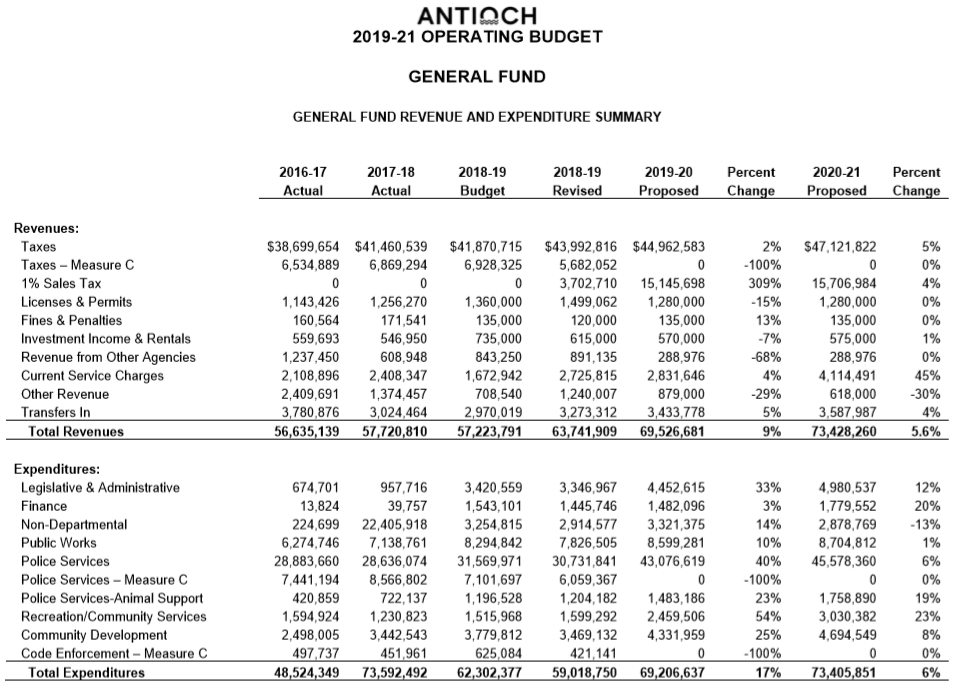
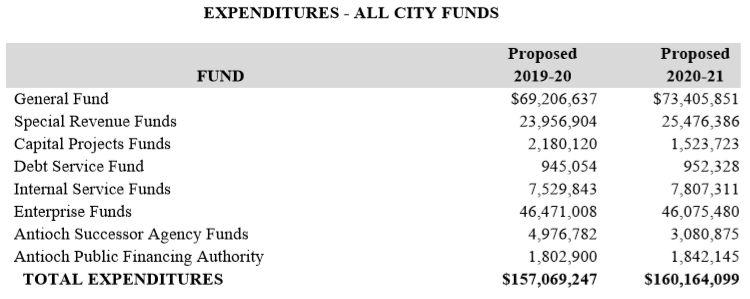
From page 55 of the City of Antioch’s Adopted Budget for 2019-21 (page 70 of the overall document).

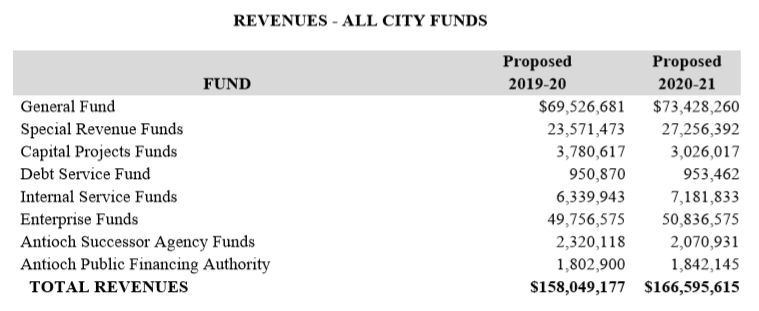
With total annual budget revenues of $158 million the City of Antioch spends $43 million on police services.

By Allen Payton

This is in response to public comments during the Antioch City Council meeting on Tuesday, June 9, 2020 which included calls for the defunding of the police department claiming it takes up 62% of the city’s budget. In addition, copies of the city’s General Fund pie chart were distributed to participants during a Black Lives Matter protest held in Antioch on Tuesday. Hopefully, this will help educate them so they make policy suggestions in the future based on the facts, not rumor and misinformation.

From page vi of the City of Antioch’s Adopted Budget for 2019-21 (page 10 of the overall document).

What all of those people didn’t do was their homework, which could have been accomplished with a simple online search to learn about the actual details in the city’s two-year budget for the 2019-2020 and 2020-21 fiscal years. Please click here to view and see pages vi (10) and vii (11) of the 330-page document that can be found on the Finance Department’s page on the City’s website. (NOTE: This last sentence has been corrected. The previous pages referred to the June 25, 2019 Antioch Council meeting agenda in which the proposed two-year budget was included for council adoption and was 776 pages long).

In the current 2019-20 fiscal year ending on June 30th, the General Fund makes up just 44% of the city’s overall budget. That figure is projected to rise slightly to 44.1% in the next fiscal year beginning July 1st. Of that 62% was spent on police and public safety this year and 62.1% is budgeted in the 2020-21 fiscal year. So, that means only 27.3% to 27.4% of the city’s budget was and will be spent on police services during the current two-year budget cycle.

From page vii of the City of Antioch’s Adopted Budget for 2019-21 (page 11 of the overall document).

What the people who spoke during the council meeting also don’t seem to understand, remember or be aware of – most likely because they are young and couldn’t vote when the ballot measures passed or don’t live here – is that the voters of Antioch voted twice to pass a sales tax increase and spend most of the additional revenue on more police and public safety.

As a result, the City of Antioch has been hiring more police since 2013, and just last year, finally fulfilled the promise made in 2013 by the then-mayor and council members of 22 more police officers, immediately. That was when there were 89 sworn officers on the force and Antioch now has 115 sworn officers.

Then, with the passage of Measure W in 2018, increasing the sales tax to one percent, the voters told the council to spend most of the funds to “restore the number of police officers patrolling City streets” and “to increase investment in code enforcement, clean up blight, road repairs, support youth and senior services, and attract new business and jobs to Antioch.” The priorities for use of the Measure W sales tax funds are as follows:

  • Continuing to maintain 911 police response and restore the number of police officers patrolling City streets
  • Ensuring water quality and safety
  • Maintaining Antioch’s quality of life and financial stability
  • Cleaning up illegal dumping
  • Restoring after-school and summer programs for youth

Going back to the City’s original formation documents in 1872, the City of Antioch was incorporated for the purpose of “police and other matters.” Police services and public safety have always been the number one reason the city government exists and the top budget priority. But, it does not make up more than a majority of the City’s overall budget. It’s closer to one-fourth.