







Archive for the ‘News’ Category

Council places “flawed” Sand Creek “Let Antioch Voters Decide” initiative on November ballot

Tuesday, June 9th, 2020
Will cost city $100,000; could face pre- and post-election legal challenges due to new legislation possibly making the initiative moot and costing city even more.

By Allen Payton

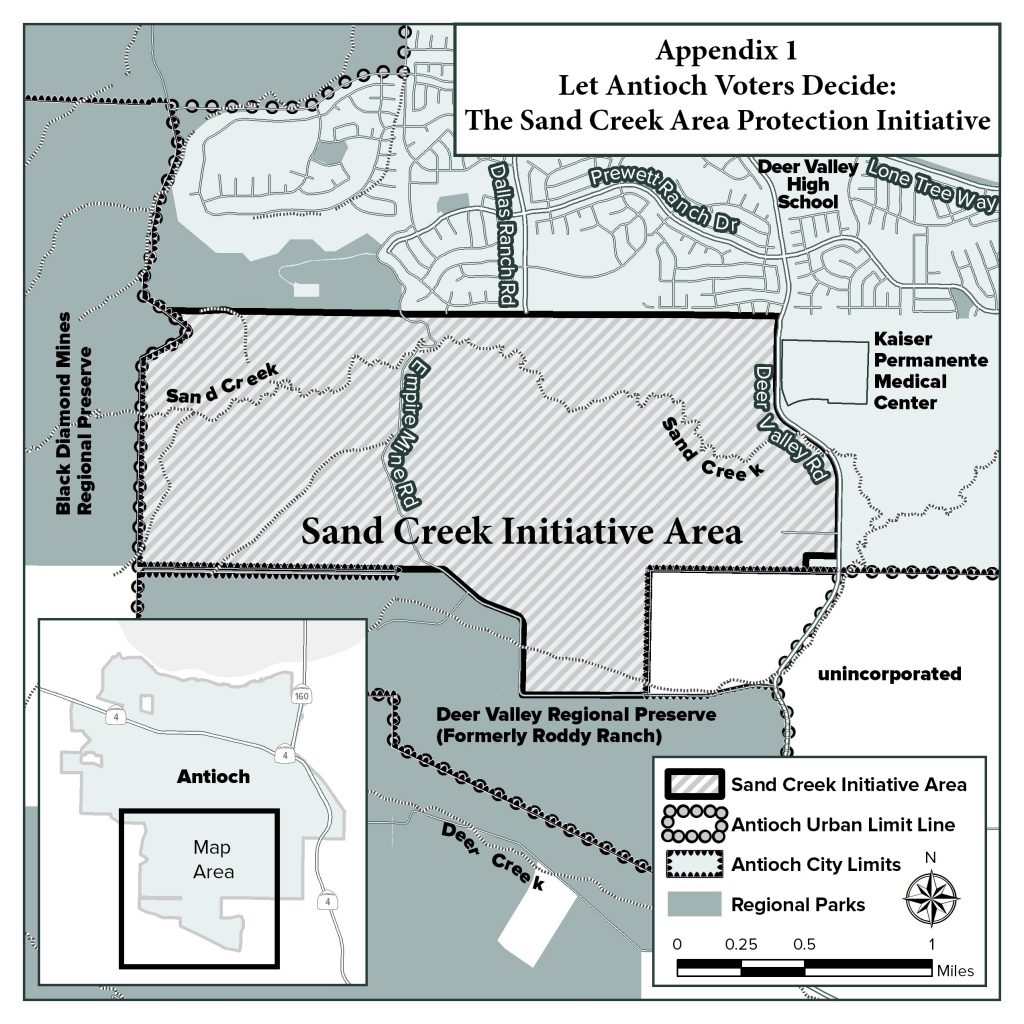
In response to the direction given by a judge in a court case over two initiatives affecting new home development in the Sand Creek Focus Area that the council adopted in 2018, the Antioch City Council voted 5-0 to place the one initiative sponsored by the environmental community on the November 2020 ballot.

That court case resulted in the judge tossing out the council’s adoption of the environmentalist-backed Let Antioch Voters Decide (LAVD) initiative. It also invalidated both the initiative sponsored by Richland Communities, the developer of the 1,100-home project known as The Ranch, as well as their development agreement. In his ruling, the judge also ordered the city council place the LAVD initiative on the ballot. However, the decisions in the lawsuits by adjacent property owners The Zeka Group owners of Zeka Ranch, and the Oak Hill Park Company are still being appealed by the backers of the LAVD initiative. (See related articles here, and here)

According to a previous Herald news report, following a 30-day study by city staff, their report found the initiative limited the total number of housing units to 2,100 in the entire Sand Creek Area. Since the past and current councils had already approved more than 2,300 homes, then no more homes could be built, including the proposed 301-unit, gated senior home community east of Deer Valley Road, known as The Olive Groves on the Albers Ranch property. However, both Seth Adams of Save Mount Diablo and the attorney for Richland said that the intent of each initiative was to only affect property on the west side of Deer Valley Road.

The LAVD initiative will directly impact the proposed Zeka Ranch project (see related article), west of The Ranch project, on the west side of Empire Mine Road, as well as three other properties directly south of Richland property, including Oak Hill’s. Zeka’s proposed number of homes would be reduced from 300 to 400, down to just one home per 80 acres, resulting in just a total of eight homes.

In addition, since the judge’s decisions, new legislation, SB330, was passed by the state legislature and signed into law by Gov. Newsom, last year which prevents cities from downzoning land already zoned residential, either by council action or through the initiative process.

Yet, according to Derek Cole, the city’s contract attorney working on matters dealing with the Sand Creek initiative, “cities have mandatory duties whenever proposed ballot measures receive the signatures necessary to qualify for the ballot.  In this case, because the ‘9212’ report and approval of the initiative are no longer options, the City can only take action to call an election as to the initiative.  City staff is aware of the SB 330 legislation that took effect this year, but as the Staff Report explains, the City Council cannot assume the role of the courts in deciding any legal issues associated with the measure.  The State Supreme Court made very clear in a 2017 decision that the duty to call an election on an initiative is mandatory, even when an initiative’s legality is questioned.”

“The council could adopt an argument against the initiative,” added City Attorney Thomas Smith.

During public comments Joanna Garaventa, with the East Bay Chapter of the California Native Plant Society, spoke in favor of the initiative. She submitted a letter to the council, but when speaking it was difficult to understand her for the purpose of adding her comments to this report.

Andrew Bassak, an attorney with Hanson Bridgett, representing The Zeka Group, opposed the placement of the initiative on the ballot as “it would negatively affect the development that’s been planned for the past 30 years.”

He referred to SB330, the new residential development law.

“The city lacks authority to place the initiative on the ballot…under the California Elections Code. That passed years ago,” Bassak explained. “There is no authority under the stayed Superior Court ruling. That judgement is currently subject to appeal, by one of the proponents of the initiative. Save Mt. Diablo wants to have its cake and eat it, too.”

“The cost of putting it on the ballot will be over $100,000,” he stated. “Placing it on the ballot will result in more litigation” both before…and after the November election. Those litigations could easily double the $100,000 amount. This is just squandering resources that could be spent elsewhere. The city should wait until the court of appeals decision is over.”

Bassak submitted a letter to the mayor and council before the meeting. In it he wrote, “the Initiative is fundamentally flawed and, if placed on the ballot, will be subject to avoidable costly pre-election litigation.” 06-09-20 Zeka Group Attorney Letter to Antioch re LAVD Initiative

Seth Adams, the Land Conservation Director for Save Mt. Diablo, which sponsored the LAVD initiative said, “Please move forward with placing our initiative on the ballot and please formally endorse the initiative.”

“Over 9,000 citizens signed the petition to place the initiative on the ballot,” he continued. “The courts said to place the initiative on the ballot. It did not invalidate the initiative.”

“Our attorneys have provided information to the city that explains why they can place the initiative on the ballot,” Adams added. Emails from Save Mt. Diablo’s attorney to City of Antioch re LAVD Initiative

All the other thirteen public comments were in favor of placing the initiative on the ballot.

Councilwoman Lori Ogorchock then asked about how SB 330 affected the initiative.

“SB330 is legislation…that became effective in January of this year and is retroactive two years,” Smith said. “Under the new regulation any affected city is precluded from adopting policy…of lesser standard. It is preventing the downzoning of land, from residential to something that would not allow development.”

“It is one of the factors that would have to be taken into consideration if the initiative passed,” he continued. “However, at this time, the council can move forward.”

“There may be a pre-election challenge or a post-election challenge,” Smith added. “SB330 could affect it in determining if the initiative is valid.”

“Not only did 9,000 of our citizens sign petitions to place this on the ballot, but the courts directed the council to place it on the ballot,” said Mayor Pro Tem Joy Motts. “I believe it’s an environmentally sensitive, efficient development. So, I am in favor of moving the initiative forward and placing it on the November ballot.”

Ogorchock then moved to place the initiative on the ballot. Councilwoman Monica Wilson seconded the motion.

Smith then asked if the two actions could be separated, with the council deciding if they want to include a ballot argument against the measure.

Ogorchock then shortened her motion to not include a ballot argument.

Thorpe then asked staff to come back with something at a future council meeting, for council to decide whether or not to endorse or oppose the initiative.

However, the council can only submit an argument against the initiative, Smith explained.

Ogorchock and Wilson withdrew their motion and Ogorchock made a new motion and Thorpe seconded it.

“Do we want to make an argument against the initiative?” she asked. Wilson, Thorpe and Motts all said “no”.

“I just need you to make a motion that you do not want to make an argument against the initiative,” Smith explained.

Ogorchock then made a friendly amendment to her own motion that the council will not include an argument against the initiative. Thorpe accepted the amendment to the motion.

That motion passed on a 5-0 vote, that the council will not include a ballot argument against the initiative.

Then Ogorchock returned to her original motion to place the initiative on the November ballot. It was seconded by Wilson and the motion also passed 5-0.

Efforts to reach Seth Adams and city staff to obtain a copy of the letter sent to the City from Save Mt. Diablo’s attorney before the meeting, were unsuccessful prior to publication time. Please check back later for any updates to this report.

Civil rights organization issues legal statement on Contra Costa’s requirement churches gather worshippers’ information

Tuesday, June 9th, 2020

May also challenge 12-person or 25% capacity limit for indoor services

Following is the statement from the Center for American Liberty’s Founder Harmeet K. Dhillon concerning the Contra Costa Health Services Order No. HO-COVID19-17. (See related article)

“The Center for American Liberty was contacted recently regarding the June 5, 2020 Order issued from Contra Costa Health Services (Order No. HO-COVID19-17). This Order was concerning for several reasons and we intend to formally reach out to Contra Costa County with an analysis of our concerns.

The June 5, 2020 Order, as presently written, specifically singles out places of worship by requiring that places of worship in Contra Costa County create and preserve a list of persons in attendance, and then disclose such attendance list upon request to the government – a burden that is notably not placed on other establishments in Contra Costa County. Such burden is unconstitutional and is discriminatory on its face.

The California Constitution provides certain inalienable rights, including the right to privacy, to freely assemble, and to enjoy one’s religion- Californians deserve to freely worship and assemble without fear that his or her name and address will end up in a government database. The Center for American Liberty welcomes any official change to this June 5, 2020 Order and will continue to be vigilant about any attempts to discriminate against houses of worship or people of faith in California.

Additionally, the June 5, 2020 Order currently limits houses of worship to a 12 person or 25% limit (whichever is fewer), which is arbitrary, and we will also be monitoring, and potentially challenging, this disparate burden on places of worship and people of faith in Contra Costa County.”

Antioch Police Chief responds to councilman’s eight police reforms showing five have already been implemented

Tuesday, June 9th, 2020

Provides reasons he doesn’t recommend implementing all of them

Chief Tammany Brooks. Photo by APD.

The following was issued on Tuesday, June 9, 2020 in response to questions from the public and media about eight proposed reforms for the Antioch Police Department, explaining how five of the eight have already been implemented. (See related article)

Message from Chief Tammany Brooks

In the past few days, I have received numerous inquiries from the media and the public regarding a national campaign called 8 Can’t Wait. As such, I wanted to provide some clarifying information so our community can be more informed on the reality of how our current policy compares to the recommendations made by the 8 Can’t Wait campaign. I will also explain why I do not believe at this time it would be prudent to follow all eight of the recommendations.

Three things I want you to consider before I go through each of the 8 Can’t Wait recommendations:

  • The entire Antioch Police Department Policy Manual is accessible for anyone to review through our police department website, and has been for about two years.
  • The Antioch Police Department uses Lexipol software to continually update our policies. Lexipol is the nation’s leading provider of public safety policy and training solutions for law enforcement. This system ensures that all policies are aligned with State and Federal law and policies are continuously updated as laws change.
  • In 2019, California passed two pieces of legislation that are important to this conversation. AB 392 (Weber) set a new legal standard for police officers’ use of deadly force here in California. SB 230 (Caballero) set national precedent by establishing a minimum use of force policy standard for ALL departments.

Now let’s look at each 8 Can’t Wait recommendation, and whether it is currently in use at the Antioch Police Department:

De-Escalation Requirement: Yes

This recommendation, while not directly articulated, is part of the legal standard for all California police departments. SB 230 requires that “officers utilize de-escalation techniques, crisis intervention tactics, and other alternatives to force when feasible.

Use of Force Continuum: No

The use of force continuum is an outdated model that has proved impractical, even dangerous, when applied in real life situations. Instead, our policy focuses on various factors used to determine the reasonableness of force in any situation, as set forth in the training and policy requirements of SB 230.

Restrict Chokeholds and Strangleholds (including carotid restraint): Yes

During my 25 years here at APD, chokeholds and strangleholds have never been authorized uses of force. However, our current policy as seen on our website allows for the use of the carotid restraint. However, Last Friday, Governor Newsom instructed California POST to cease training officers in its use and stated he intended to sign pending legislation that would ban its use throughout the entire state. Because of this, I have already issued a departmental directive, immediately prohibiting the use of the carotid restraint by our officers. This will be formally updated in an upcoming update to our use of force policy.

Require Officers to give verbal warning when possible before using deadly force: Yes

This is already included in our current policy in section 300.4, and reads, “Where feasible, the officer shall, prior to the use of force, make reasonable efforts to identify themselves as a peace officer and to warn that deadly force may be used, unless the officer has objectively reasonable grounds to believe the person is aware of those facts.”

Prohibit Officers from shooting at people in moving vehicles: No

I do not believe outright prohibitions in all circumstances is reasonable or accounts for situations where the driver of a vehicle may be threatening death or great bodily injury to others. Section 300.4.1 of our current policy already limits when an officer can shoot at a moving vehicle. It reads, “Officers should move out of the path of an approaching vehicle instead of discharging their firearm at the vehicle or any of its occupants. An officer should only discharge a firearm at a moving vehicle or its occupants when the officer reasonably believes there are no other reasonable means available to avert the threat of the vehicle, or if deadly force other than the vehicle is directed at the officer or others.”

Require Officers to exhaust all other reasonable alternatives before using deadly force: No

This language was previously suggested in AB 392, but was removed due to its ambiguity, no clearly defined means of objectively deciding what other alternatives might be reasonable in every situation, and concerns associated with the second-guessing of split-second decisions with the benefit of hindsight 20/20. Officers’ decisions concerning any use of force alternatives should be judged based on the totality of the circumstances and reasonable officer standard in AB 392.

Require Officers to intervene: Yes

This is already in our current policy in section 300.2.1, and reads, “Any officer present and observing another officer using force that is clearly beyond that which is objectively reasonable under the circumstances shall, when in a position to do so, intercede to prevent the use of unreasonable force. An officer who observes another employee use force that exceeds the degree of force permitted by law should promptly report these observations to a supervisor.”

Require comprehensive reporting: Yes

Comprehensive reporting on cases involving use of force is covered in our current policy in sections 300.5, 300.5.1, and 300.5.2. Additionally, SB 230 already requires “comprehensive and detailed requirements for prompt internal reporting and notification regarding a use of force incident.”

The Antioch Police Department takes great pride in serving our community with integrity and compassion. As I have previously mentioned, our officers undergo continuous training, covering topics such as proper use of force, fair and impartial policing, interpersonal communications, crisis intervention training, and de-escalation techniques.

These types of trainings have helped us minimize the need to use force in many situations. In 2019, Antioch Police Officers responded to more than 94,600 calls for service – of which, only 0.1% required a use of force. As noted in our current policy, each reportable use of force is tracked in a system called Blue Team, and reviewed and evaluated by a supervisor and members of my command staff to ensure the use of force (and circumstances surrounding it) are in legal compliance and within policy.

I hope this helped answer any questions you may have had.

Sincerely,

Chief T Brooks

County backs off requiring worship service attendees give names and contact info, now recommending churches gather it

Tuesday, June 9th, 2020

By Allen Payton

Contra Costa County health officials are backing down on their requirement in the latest order issued June 5 that places of worship gather names and information of all attendees, keep it for 14 days and provide it to the county immediately upon request. According to a statement issued Tuesday morning, “health officers will be working with county attorneys to revise the order to reflect this as a recommendation but not a requirement.”

The action comes following a series of email exchanges between the Herald and county supervisors and staff over the past several days about the requirement, an article and public outrage on social media challenging the constitutionality of the requirement, the inconsistent and unfair application to only places of worship, and no other organization or business, including protesters or restaurants offering outdoor dining in which people sit for extended periods of time with their masks off in order to it.

A legal effort was in the works as of Monday, with several residents agreeing to sign on to a legal demand letter to be sent to the county. But that now appears to be unnecessary.

Following is the Statement Regarding Requirements for Religious Gatherings

“In the health order issued June 5 by Contra Costa Health Services, religious organizations were required to maintain a list of attendees at religious services and cultural ceremonies in the event of an outbreak of COVID-19. The intention was to facilitate quick, complete contact tracing if a participant at the event tests positive.

Health officers will be working with county attorneys to revise the order to reflect this as a recommendation but not a requirement. If a participant tests positive for COVID-19, the host will be asked to assist CCHS with contact tracing associated with the gathering.

To mitigate the risk of transmission to the greatest extent possible, CCHS encourages participants to wear face coverings at all times, maintain social distance when possible, practice good hand hygiene, and stay home if sick.”

According to Kim McCarl, Assistant to the Director of Contra Costa Health Services for Communications, As we revise the language, the recommendation will apply to any allowed gatherings.

Council candidate says Antioch councilman’s police reform efforts grandstanding for political gain

Monday, June 8th, 2020

Claims Thorpe knew Antioch Police already implementing five of eight reforms before releasing his proposal

Mike Barbanica.

In a press release on Monday evening, Antioch City Council candidate Mike Barbanica slammed Antioch Council Member Lamar Thorpe, who is up for re-election in November, for his proposal to call for an ad hoc committee to deal with what he labels so-called reforms at the Antioch Police Department”. Thorpe listed eight reforms endorsed by the national 8 Can’t Wait Campaign and four actions the council can take promoted by the Obama Foundation on its website. (See related article)

“Antioch residents want change – real change – so we can honestly address racism in our community,” said Barbanica, candidate for city council in District 2. “We don’t need another Antioch bureaucracy led by politicians who claim to know what’s best for our community.”

Barbanica stated that the Antioch Police Department has already implemented five of the eight reforms advocated by 8 Can’t Wait and is in the process of reviewing the other three for possible implementation.

He added that Thorpe was advised of this information by the APD before he sent out his press release.

“Shame on Mr. Thorpe for grandstanding on this issue for his own political gain,” Barbanica said. “What we need is more ongoing thoughtful communication between our police officers, our community, Antioch’s faith leaders and business owners – not the establishment of some shill of a committee that exists for the purpose of promoting a politician’s own political agenda.”

Barbanica, a longtime Antioch resident, local business owner and retired police lieutenant from the neighboring City of Pittsburg, said he is proud of the hard work and dedication of Antioch’s police officers, noting that, under Police Chief Tammany Brooks, Antioch PD has been responsive to the needs of our community.

“Can we do better? We can always do better and we need to come together, as a community, to better understand the needs of our African American and Latino residents, he said. “But establishing a committee of politicians who will use it as a pedestal to pontificate about the causes of racism is not the answer.

Barbanica added that George Floyd’s murder, and the protests that have followed, have awakened all of us to the need for social justice reform that can only begin in earnest by us initiating honest dialogue, by our listening and communicating with one another, so we can re-create a society that is fair and just for all persons who live here.

6/9/20 UPDATE:  When reached for comment, Councilman Thorpe said “what I knew was that I asked the chief to get clarity on this, and he sent me an email response and he said ‘in spirit we do some of these. We have officially two on the books so far. But I can look into and we can do these things in spirit.’”

“He had some concerns about other ones,” he continued. “What I did was call on the chief to adopt all of them. The issue is not whether not I knew. The fact of the matter is they’re not written in our policies. There’s a difference between researching and considering adopting them.”

“I’m calling for the remaining six to be implemented,” Thorpe stated. “Let’s make it about policy. Five of them doesn’t complete the eight. I’m saying all of them.”

Allen Payton contributed to this report.

Antioch Councilman proposes police reforms, to call for ad hoc committee at Tuesday’s meeting

Monday, June 8th, 2020

Thorpe seeks six of eight immediate policy reforms, claims only two have already been implemented

Video screenshot of Antioch Councilman Lamar Thorpe during a protest in Antioch on Sunday, June 7, 2020. From his Facebook page.

By Allen Payton

In response to the death of George Floyd at the hands of four former Minneapolis Police Officers, and the ensuing protests in Antioch and throughout the country, Antioch Councilman Lamar Thorpe has jumped on the bandwagon of a nationwide effort led by the Obama Foundation, to limit police interactions with suspected criminals by proposing a list of reforms for the Antioch Police Department he wants the rest of the council to consider.

In a press release he issued on Monday, Thorpe said he “fully endorses the enactment of eight specific policy recommendations that are part of the national 8 Can’t Wait Campaign and claims two of eight recommendations are policy in Antioch.

Thorpe is calling on Antioch Chief of Police to enact the remaining six.

“Something is happening with the consciousness of America. People all over the country and here in Antioch are saying ‘enough is enough,’ and they expect change,” Thorpe said. “After 15 days of sustained protest, demonstrations and civil unrest, it’s time to take action, before one more senseless killing takes place. Let’s think globally and act locally.”

The most controversial of the remaining six recommendations is the banning of chokeholds and strangleholds, including a technique Antioch police use called the carotid restraint, which involves placing pressure on a person’s neck to restrict blood flow. In an independent autopsy, medical examiners determined that pressure placed on Floyd’s carotid artery impeded blood flow to his brain and contributed to his death.

More than a dozen California cities have banned carotid restraints following Floyd’s murder. Assembly Bill 1196, introduced last week by state Assemblyman Mike Gipson, D-Carson, would make the carotid restraint illegal in California. Thorpe is calling on Gov. Gavin Newsom to sign the bill.

Following are the eight policy recommendations:

  1. Ban police use of chokeholds and strangleholds, including the carotid restraint
  2. Require officers to de-escalate situations whenever possible
  3. Require officers to exhaust all options before shooting, including less lethal force
  4. Ban officers from shooting at moving vehicles
  5. Establish a use of force continuum that restricts using the most severe force to most extreme situations
  6. Require comprehensive reporting for each time an officer fires or points their weapon at someone
  7. Require verbal warnings before using deadly force (already an Antioch policy)
  8. Require officers to intervene to stop excessive force by other officers (already an Antioch policy)

According to the Obama.org website, “More than 1,000 people are killed by police every year in America, and Black people are three times more likely to be killed than White people.” That’s because, as a CNBC article on police violence in America reports, “according to Mapping Police Violence, one research group…Black people accounted for 24% of those killed, despite making up only about 13% of the population.” But the article also reports that, “no comprehensive official database exists for tracking police violence, though there have been efforts at the federal level to create one.”

That article further reports, “the data from Mapping Police Violence is sourced from three databases — killedbypolice.net, fatalencounters.org and the U.S. Police Shootings Database — as well as original research focused on social media, obituaries, criminal records databases, police reports and other sources, according to the group.”

At the Tuesday, June 9, 2020 Antioch Council meeting, Councilmember Thorpe will call for the formation of a City Council Ad-Hoc Committee on Police Reforms to be composed of council members, legal advisers, police leaders, police union representatives and community advocates. The role of the committee will be to examine potential long-term reforms in the following areas:

  1. Demilitarize our local police
  2. Increase police accountability
  3. Improve police hiring practices
  4. Excessive use of force
  5. Budget appropriations

“While it’s important for our city to take immediate preventative steps, such as banning use of carotid restraints, creating successful police reforms will require the involvement of the entire community,” Thorpe said. “The ad-hoc committee approach is one of the best tools we have as city councilmembers to create lasting policy change that works.”

Additionally, he has signed the Obama.org’s “My Brother’s Keeper Alliance Pledge”, to have Antioch become an MBK Community which asks local officials to:

  1. Review the police use of force policies in my community
  2. Engage my community by including a diverse range of input, experiences, and stories in our review
  3. Report the findings of our review to my community and seek feedback within 90 days of signing this pledge
  4. Reform my community’s police use of force policies based on findings

When asked for his thoughts on Thorpe’s proposed reforms, Antioch Police Chief T Brooks responded, “I look forward to hearing the discussion between Councilman Thorpe and the rest of the city council on this proposal.  I am especially interested in what specific reforms they believe are necessary at the Antioch Police Department.”

A question to the chief asking if there any of the other six reforms on the proposed list have been implemented by the Antioch Police Department went unanswered prior to publication time.

The online Antioch City Council meeting begins at 7:00 p.m. and can be viewed on Comcast Local Cable Channel 24 or via livestream on the city’s website at www.antiochca.gov/government/city-council-meetings/live/.

Please check back later for any updates to this report.

Two from Antioch die in crash on 680 in Danville by wrong-way DUI driver from Concord Sunday

Monday, June 8th, 2020

By CHP – Contra Costa

Early yesterday morning, Sunday, June 7, 2020, at about 3:45am, Contra Costa CHP was advised of a wrong way driver traveling southbound in the northbound lanes of I-680 near El Pintado road, in the Danville area. The wrong way vehicle then collided head on into a vehicle traveling in the northbound lanes of I-680. Upon emergency personnel and CHP arrival, the solo female driver of the wrong way vehicle was located and detained and had suffered non-life-threatening injuries. Tragically the female driver and male passenger of the victim vehicle that was hit by the wrong way driver, were both declared deceased at the scene. A secondary non-injury collision occurred with the victim fatality vehicle shortly after the original wrong way collision. The Contra Costa County Sheriff’s Coroner’s Office will be handling the release of identity of the deceased female driver and deceased male passenger.


In our initial investigation, it appears the female driver of the wrong way vehicle (Camille Veraanne Kimball, 27 years old from Concord, driving a 2020 Ford Fusion) was driving southbound in the northbound lanes of I-680, north of El Pintado Road. The victim vehicle (2012 Honda Civic) driven by a 46-year-old female from Antioch with her 26-year-old male front passenger also from Antioch, was traveling in the northbound lanes of I-680 at El Pintado road. Kimball continued to drive her Ford wrong way on I-680 and crashed head on into the victim’s Honda, just north of El Pintado. Tragically the driver and the passenger of the Honda did not survive and were both pronounced deceased at the scene.

Kimball suffered non-life-threatening injuries and was transported to John Muir hospital. Kimball was also suspected of driving under the influence/impaired. While at the hospital, Kimball was investigated and arrested for felony DUI and vehicular manslaughter. Due to her injuries, she was admitted to the hospital and will remain there until discharged into police custody for booking into the county jail.

This incident is still under investigation. If anyone witnessed this collision, the wrong way Ford Fusion vehicle prior to the collision, or the events leading up to the collision, please contact Contra Costa CHP in Martinez at (925) 646-4980. Thank you.

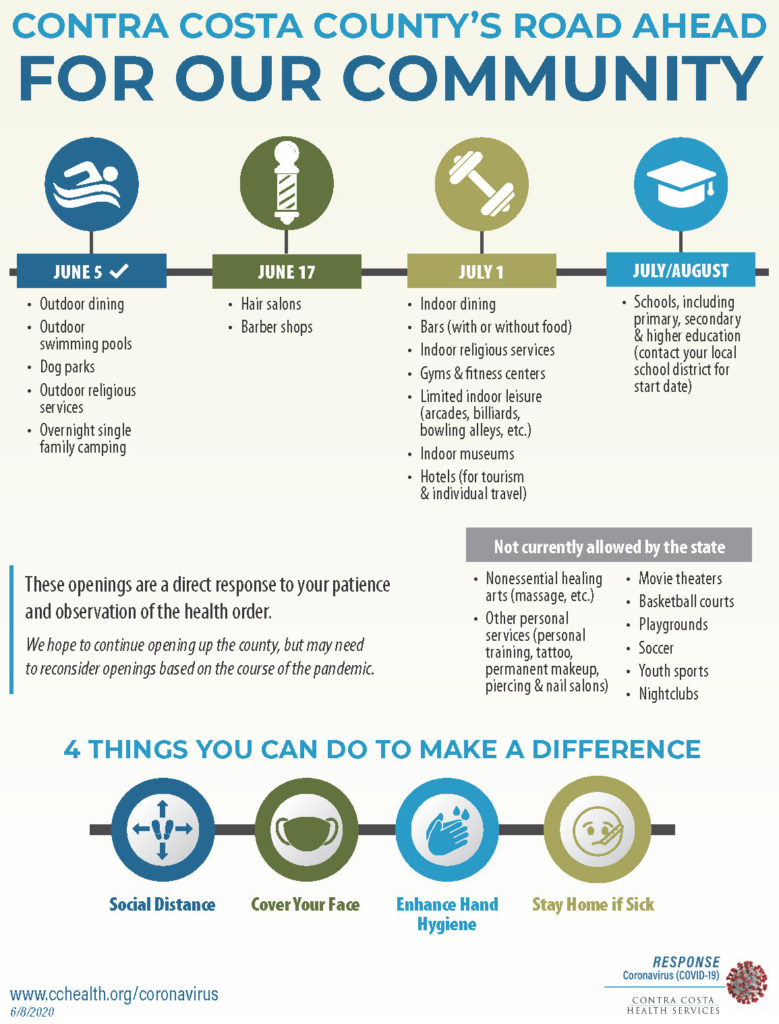
Contra Costa’s updated Road Ahead includes indoor religious services, bars to reopen July 1st

Monday, June 8th, 2020

According to Kim McCarl, the county health services communications assistant, the “guidelines will be the same as the state’s”. No word on if the requirement to create lists of the names and contact information of all attendees to be given to the county upon demand will still be included. (See related article)