Antioch Police Officer Yega and K-9 unit Loki made the arrest on Sept. 27, 2026. Photos: Antioch PD
Driver on parole for homicide, has history of 22 other arrests; both adult brothers already out of custody
By Allen D. Payton
According to Antioch Police, “while on patrol in the area, Officer Drace conducted a traffic stop on Lemontree Way at L Street after observing a Honda with multiple Vehicle Code violations.
During the stop, officers learned the driver was on active parole for homicide. A parole search of the vehicle was conducted, but initially, nothing was found.
“K9 Officer Loki, a firearm-detection K9, responded to the scene with his handler, Officer Yega.
“Loki was deployed for an open-air sniff of the vehicle and alerted to the driver-side front floorboard, indicating the possible presence of a firearm.
“Officers conducted a secondary search of the area. After removing the floor carpet, officers located a stolen, concealed, loaded firearm equipped with an extended magazine.
“The driver was arrested and booked into county jail.
“Great work by our officers and K9 Loki!”
In addition, the male adult driver and his two male passengers, one his adult brother, and the other a juvenile, were also arrested.
Source: APD CitizenRIMS
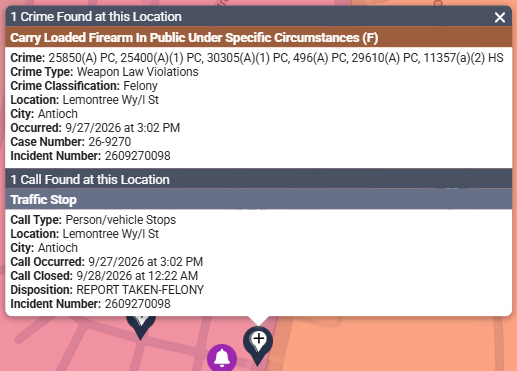
According to the Antioch Police Department’s CitizenRIMS Crime Map, the stop and arrests occurred on Sept. 27, 2026, at 3:02 PM.
According to Lt. Bill Whitaker, “Three people were arrested, all Oakland residents. The third was a juvenile with a different last name.”
The two adult males are Joshua Jermaine Richard, age 20, described as five-feet, seven inches tall, 120-pounds, and his brother, 27-year-old Jeremiah Prince Roland Richard, described as five-feet, six inches tall and 165-pounds. Both are listed as Black or African American.
Joshua’s crime is listed as felony 25850(A) PC carrying a loaded firearm in public under specific circumstances and he’s also charged with 25400(a)(1) Pc: Carry Concealed Weapon In Vehicle (F), 496(a) Pc: Receive/etc Known Stolen Property (F), 32310(c) Pc: Large Capacity Magazine Posession, 11357(a)(2) Hs: Possession Less Than 28.5 Grams Mj Or 4 Grams Cannabis By 18-20 Yr Old, 30305(A)(1) PC: felon in possession of ammunition, and 29610(A) PC: minor in possession of a firearm.
Jeremiah is charged with 25850(a) Pc: Carry Loaded Firearm In Public Under Specific Circumstances (F), 25400(a)(1) Pc: Carry Concealed Weapon In Vehicle (F), 496(a) Pc: Receive/etc Known Stolen Property (F), 29800(a)(1) Pc: Felon/addict/possess/etc Firearm (F), 30305(a)(1) Pc: Prohibited Person Own/possess/etc Ammunition/etc (F)
Case Number: 26-9270 Incident Number:2609270098.
According to the Contra Costa County Sheriff’s Office, as of Sep 30th at 7:51 PM, Joshua is out of custody with no charges filed. According to localcrimenews.com, Joshua is a resident of Emeryville and this is his first arrest.
According to localcrimenews.com, Jeremiah was also charged with 3056, Violation Parole: Felony and 466, Possession Of Burglar’s Tools. Jeremiah also has a history of 22 other arrests dating back to 2017
Rescued produce sorted at White Pony Express before delivery to community partners in Contra Costa County. Photo: WPE
Guest Commentary
By Tyler McCarthy, Outreach Associate, White Pony Express
On Friday afternoon, for a student who eats breakfast and lunch at school, the dismissal bell does more than end the school day. It starts a 68-hour clock. The last dependable school meal of the week has just been served. The next one won’t arrive until Monday morning.
We hear from our school partners what those hours can mean. As one parent liaison put it: “My thinking was that if I can give them a meal for Saturday, then they only have to get through Sunday. That lessens the need.”
California has done something remarkable. In 2022–23, it became the first state in the nation to guarantee every public school student access to free breakfast and lunch, regardless of family income. Nearly 3.5 billion school meals have been served since the program began.
It works. And at a time when changes to federal nutrition programs are putting additional pressure on some California families, it’s an achievement we must protect.
But hunger doesn’t follow a school calendar.
California’s universal meals program feeds children during the school day. Children still need to eat Friday night, Saturday, Sunday, holidays and school breaks. California has also embraced summer grocery benefits for eligible families, another important piece of the solution. But summer assistance does not solve the gap that arrives every week between Friday afternoon and Monday morning.
For a family already choosing between rent, utilities, transportation, and groceries, those aren’t simply gaps in a schedule. They can be the days the refrigerator runs empty. That’s where White Pony Express makes an enormous difference.
Every day, White Pony Express drivers collect surplus food from grocers, farms, wholesalers, and restaurants – high-quality food that is perfectly good but has nowhere to go. We sort it for quality the same day and deliver it, free of charge, to neighbors throughout Contra Costa County. Of the 135,000 people White Pony Express serves each year, nearly one-third – about 40,300 – are children.
Photo: WPE
Our School Pantry Program brings fresh groceries directly into 23 school communities where 80 percent or more of students qualify for free or reduced-price meals. Families shop at no cost, with no forms and no questions asked.
One pantry coordinator remembers a young mother raising three children alone after losing her husband. She came to the pantry for groceries, including peanut butter and chicken.
“She doesn’t have money to buy much,” the coordinator told us, “but she told me it’s a blessing to have White Pony Express helping us.”
Since the School Pantry Program began in 2015, White Pony Express has delivered more than three million pounds of food to school communities – the equivalent of roughly 2.5 million meals.
The model works because it connects two resources that already exist: good food that would otherwise go unused and trusted neighborhood schools where families already gather.
It also demonstrates something larger. Public programs and community organizations do not have to compete with one another. They can complete one another.
Photos: WPE
California has shown what is possible when we make a public commitment to feed children at school and then build a system capable of doing it at an extraordinary scale. Now we need to look just as honestly at the hours the school cafeteria cannot cover.
More than two million California children still lack reliable access to healthy food. For them, the problem doesn’t begin Monday morning. It begins Friday afternoon, when the bell rings. And that is a gap communities like ours can – and must – close.
To volunteer, donate food, or support the School Pantry Program, visit whiteponyexpress.org.
Prevents former ICE agents with history of misconduct from becoming law enforcement officers in California
Claims participating in ICE operations during Trump’s 2nd term “demonstrates an immorality”
Could be challenged in court, deemed unconstitutional
By Allen D. Payton
On Tuesday, Sept. 29, 2026, Governor Gavin Newsom signed into law AB 1627, the Misconduct Ends Law-enforcement Trust Act of 2026 (MELT ICE) by Assemblywoman Anamarie Ávila Farías (D-Martinez), which disqualifies officers employed by U.S. Immigration and Customs Enforcement (ICE) from being employed as a peace officer in California, if they “engaged in serious misconduct that would have resulted in their certification being revoked…if employed as a peace officer in this state.”
While the law makes clear that existing police hiring rules covering serious misconduct by former law enforcement officers now, also apply to officers involved in immigration enforcement, it applies even if the ICE officer was not found guilty of misconduct in their current or previous position.
However, the soon to be new law could be challenged in court because of possible violation of federal labor law and deemed unconstitutional in part due to the “immorality” clause. That clause reads, “Participating in the operations of United States Immigration and Customs Enforcement on or after January 20, 2025, demonstrates an immorality that California cannot afford to have in its ranks of peace officer.”
On August 30th, the bill passed the state Senate on 29 to 10 party-line vote, and the Assembly by 57 to 16 also on a party-line vote. It was enrolled and presented to the Governor on Sept. 9th at 1 p.m.
Part of Package of Federal Immigration Enforcement Related Bills Signed by Governor
According to a press release from the governor’s office that day, “Governor Newsom signed 21 bills earlier today cementing California’s longstanding efforts to support immigrant communities and reflecting on the state’s response to an intensified federal immigration enforcement environment.”
“This action builds on years of work by Governor Newsom and the Legislature to support (illegal) immigrant families, protect communities and the economy from reckless immigration actions, strengthen transparency and oversight of detention facilities, and ensure that state resources are focused on public safety and the needs of Californians.
The governor’s office claims the package of bills, “Prohibits ICE officers who have committed serious misconduct on the job from becoming peace officers or public employees in California.”
Included in the bills was AB 1627 by Ávila Farías, described as “Public employment: disqualifications”, and known as the MELT ICE Act.
Legislative Counsel’s Digest of AB 1627
According to the Legislative Counsel’s Digest, “Existing (state) law specifies circumstances that disqualify a person from holding office or being employed as a peace officer, including, among other things, any person previously employed in law enforcement in any state or United States territory or by the federal government whose name is listed in any of specified indexes whose certification as a law enforcement officer in that jurisdiction was revoked for misconduct or who, while employed as a law enforcement officer, engaged in serious misconduct that would have resulted in their certification being revoked by the commission if employed as a peace officer in this state.
“This bill would specify that, for purposes of the disqualification circumstances described above, the terms ‘employed in law enforcement’ and ‘law enforcement officer’ include a law enforcement officer employed in any state or United States territory or by the federal government who engages in immigration enforcement, as provided.”
Bill Text Claims Participating in ICE Operations During Trump’s Second Term “Demonstrates an Immorality”
According to the Bill Text in, “SECTION 1. The Legislature finds and declares all of the following:
“(a) Beginning in 2025, United States Immigration and Customs Enforcement officers have terrorized California residents, United States citizens and noncitizens alike, through untargeted arrests and brutality based on nothing more than a person’s racial appearance, language spoken, means of earning a living, or exercise of First Amendment-protected expression.
“(b) Beginning in 2025, the United States Department of Homeland Security has recruited peace officers to United States Immigration and Customs Enforcement with the promise of being unrestrained in the manner in which officers engage with civilians or by the laws of the State of California.
“(c) Participating in the operations of United States Immigration and Customs Enforcement on or after January 20, 2025, demonstrates an immorality that California cannot afford to have in its ranks of peace officers whose duties include interacting with the public.”
Further according to the Bill Text, “…except as provided in subparagraph (B), any person previously employed as a sworn law enforcement officer or individual contractor, and personally engaged in immigration enforcement,” is “disqualified from holding office as a peace officer or being employed as a peace officer of the state, county, city, city and county, or other political subdivision, whether with or without compensation, and is disqualified from any office or employment by the state, county, city, city and county, or other political subdivision, whether with or without compensation, which confers upon the holder or employee the powers and duties of a peace officer.”
Subparagraph B (ii) reads, “‘Immigration enforcement’ includes any and all efforts to investigate, enforce, or assist in the investigation or enforcement of any federal civil immigration law, and also includes any and all efforts to investigate, enforce, or assist in the investigation or enforcement of any federal criminal immigration law that penalizes a person’s presence in, entry, or reentry to, or employment in, the United States.”
However, the bill “does not prohibit or restrict any governmental entity or official from sending to, or receiving from, federal immigration authorities information regarding the citizenship or immigration status, lawful or unlawful, of an individual, or from requesting from federal immigration authorities immigration status information, lawful or unlawful, of any individual, or from maintaining or exchanging that information with any other federal, state, or local governmental entity.” That means existing law enforcement officers can cooperate with ICE within limits of California’s sanctuary state laws.
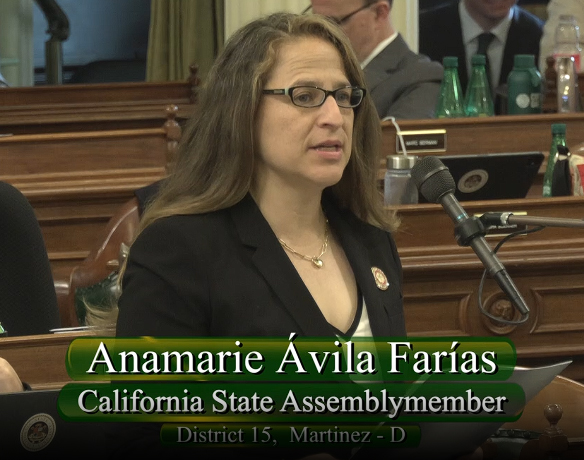
Assemblywoman Ávila Farías speaks about her bill, AB1627 on the Assembly Floor On May 27, 2026. Video screenshot source: CalMatters
Ávila Farías Comments About Bill, Signing by Governor
A press release issued earlier this year, after the State Assembly passed her bill, reads, “On the Assembly Floor, Assemblymember Ávila Farías emphasized that ICE enforcement has created fear across California—impacting both citizens and immigrants alike—and legislation is needed to proactively safeguard our communities and critical spaces.”
She is further quoted in a FOX11 Los Angeles report as saying in a statement, “California’s peace officers…must be guardians of constitutional rights, not participants in their erosion.” and “argued that participating in ICE operations during this period ‘demonstrates an immorality that California cannot afford to have in its ranks.’”
In her brief speech on the Assembly Floor on May 27th, Avila Farias said, “Communities are safer when we are policed by people who are committed to protecting the public rather than kidnapping them.”
During a presentation before the Assembly Standing Committee on Public Safety in April, she said, “Frankly, I don’t want my kids or anyone else’s counting on people who flaunt the rule of the law.” Ávila Farías also claimed, “this bill, does not have any legal issues, and challenges, because we’re simply doing a modest expansion of existing law in a way to protect our community members and holding the highest regard of what our law enforcement professionals. It also is not honing into the individuals that are doing their jobs to the letter of the law. This is protecting vulnerable community populations…”
She repeated her remarks before the state Senate Standing Committee on Public Safety in June saying, “AB 1627 ensures that immigration enforcement personnel are disqualified from becoming a peace officer in California if they have committed misconduct in their prior roles. This bill is about restoring public trust and holding federal law enforcement to the same standards as any other peace officer in California.”
About the governor signing her bill Ávila Farías said, “Our kids deserve role models in uniform, not individuals tied to fear and intimidation. AB 1627 is about accountability, integrity, and reducing harm before it happens. With the signing of the MELT ICE Act of 2026, California sends a clear message: Federal agents who have disregarded constitutional rights are not to be entrusted with peace enforcement roles in our state. Thank you, Governor Newsom, for your commitment to upholding the rule of law and protecting our communities.”
Ávila Farías’ office issued a press release about the bill’s signing.
“Today, Governor Gavin Newsom signed my bill to prevent former ICE employees with documented histories of misconduct from becoming peace officers in California.
“AB 1627, the Misconduct Ends Law-Enforcement Trust Act of 2026, started with people in my community speaking up. One year ago, at a No Kings Rally in Concord, our community came together and spoke out about the fear many immigrant families were experiencing. That community activism helped inspire this legislation, and I am proud that their voices helped lead to meaningful change.
“AB 1627 was not written overnight. It was the result of many conversations, a lot of listening, and working with people who care deeply about public safety and accountability.
“At the heart of this bill is a simple principle: if someone has a documented history of misconduct, they should not be able to leave one agency and simply put on another uniform without accountability.
“I am honored and humbled to have played a part in creating one more barrier to prevent individuals who have abused their authority from becoming peace officers in California. This is about protecting public trust and making sure the people entrusted with a badge are held to a high standard.
“I want to thank Governor Newsom, my legislative colleagues, the community partners who stood with me, and the law-enforcement professionals who worked with us throughout this process. “This is what people power looks like. A community raised its voice, we listened, we worked together, and we turned that vision into law.
“AB 1627 takes effect January 1, 2027.”
Opposed by Statewide Police Organization
According to a report on MSN.com, “The Peace Officers Research Association of California (PORAC) has voiced opposition to the bill. ‘This bill is unnecessary, duplicative and it jeopardizes qualified immunity for California employees,’ stated David Mastagni on behalf of PORAC.
The report further claims, “Critics argue the measure represents ‘guilty by association’ and could worsen existing staffing shortages in California’s police departments and schools. According to data from PORAC, law enforcement agencies throughout California have lost over 3,300 sworn officers since 2020, with an average of 10% of policing roles remaining unfilled.”
Could Be Challenged in Court, Deemed Unconstitutional
However, the new law could be ruled unconstitutional if challenged in court as questions have arisen whether the state can legally enforce a lifetime ban on a specific class of former federal employees without violating federal labor protections or constitutional due process.
According to a report by iHeart Radio in February, “Legal experts question whether California can legally enforce a lifetime ban on a specific class of federal employees without violating federal labor protections or constitutional due process rights.”
Inclusion of the “immorality” clause could give further basis for a court challenge.
By Harlo Pippenger, Consultant, Gold Runner & Ahdel Ahmed, Public Relations Manager, San Joaquin Joint Powers Authority
Stockton, CA – More than 100 years ago, Allensworth, CA was founded as a bold vision of freedom, opportunity, and self-determination. Amtrak’s Gold Runner invites you to honor that vision at the Allensworth Rededication on Saturday, October 10 from 11:00 AM to 4:00 PM. In partnership, Amtrak’s Gold Runner has scheduled a special stop at the park for multiple trains, bookable at exclusive half-price “Allensworth fares”.
Gold Runner will offer special-priced train tickets to the event from stations across its corridor, which connects the Bay Area and Sacramento to Bakersfield, with bus connections to Southern California. Trains will make a stop at the Allensworth station (CNL), which is normally a whistle stop for pre-booked groups. Riders can combine the event fare with Gold Runner’s standard discounts for children, seniors, veterans, and riders with disabilities, listed on the Deals webpage.
Hosted by California State Parks, the Annual Rededication of Col. Allensworth State Historic Park honors the park’s original dedication in 1976. Join us for historical re-enactments, tours of historic buildings, square dancing, arts and crafts, and food vendors.
Founded in 1908 by Colonel Allen Allensworth, a formerly enslaved man, the town was designed to be a self-sustaining community where African Americans could live, work, and thrive. Today, visitors can see the legacy of this trailblazing community come alive through re-enactments, storytelling, and tours of the lovingly restored and reconstructed early 20th century buildings. Step into the Colonel’s house, walk through the halls of the historic schoolhouse, and explore the church and library for an inspiring journey through a pivotal moment in history.
“The Annual Rededication celebration is a chance to reflect on what Colonel Allensworth and the town’s founders built here, and to make sure that story keeps reaching new people,” said Lori Wear, California State Parks. “We’re glad to be working with Gold Runner again this year. With the cost of driving going up, the train gives families an affordable way to get here, and that matters for a park that belongs to all Californians.”
The southbound trains running for the event include trains 702 (11:41 am arrival), 710 (12:41pm arrival). Northbound trains include 713 (9:40 arrival), 715 (11:39 arrival), 717 (2:46 arrival). Riders must select “Col Allensworth State Park, CA (CNL)” when purchasing train tickets. A discount will automatically be applied, and if eligible, riders can then combine this reduced ticket with additional savings regularly available which include:
Infants under 2 years of age ride for free
Children 2-12 years old ride half-price every day
Seniors (62+ years of age) receive 15% off
Veterans & active military members receive 15% off
Visitors attending the Rededication Celebration via the Gold Runner trains will arrive at the Allensworth station (CNL), which will serve as a special stop for this event. Upon arrival, two complimentary 29-passenger shuttles provided by Tulare County Area Transit will transport riders between the train platform and the historic schoolhouse. Typically, a whistle stop available only to pre-booked groups, the Allensworth station (CNL) will be fully activated for travelers on October 10, offering a rare and seamless opportunity to experience this historic park by rail.
Train tickets to Colonel Allensworth State Historic Park can be booked online at the Colonel Allensworth landing page or contact Carmen Setness, community outreach coordinator for San Joaquin Regional Rail Commission (SJRRC), at csetness@sjrrc.com.
About Allensworth State Historic Park
The town of Allensworth is located in the heart of the Central Valley, about 30 miles north of Bakersfield. Boasting a rich history that is of interest to students, families, history buffs, minority community organizations, and anyone else looking to spend a fun day exploring the historic community and its restored buildings. In 1908, Allensworth was established as a town founded, financed and governed by African Americans. There were a series of challenges impeding the town’s long-term survival, but it is celebrated as a key historical icon. In 1974 California State Parks purchased the land in order to maintain it as a site for visitors to learn and explore the Colonel’s house, historic schoolhouse, Baptist church and library. For more information visit Colonel Allensworth State Historic Park.
About the San Joaquin Joint Powers Authority (SJJPA)
Since July 2015, SJJPA has been responsible for the management and administration of Gold Runner, previously Amtrak San Joaquins. SJJPA is governed by Board Members representing each of the ten (10) Member Agencies along the 365-mile Gold Runner Corridor. For more information on SJJPA see www.sjjpa.com. Gold Runner is Amtrak’s 6th busiest route with 18 train stations throughout the Central Valley and Bay Area, providing a safe, comfortable and reliable way to travel throughout California. Gold Runner is currently running six daily round-trips. In addition to the train service, Gold Runner Thruway buses provide connecting service to 135 destinations in California and Nevada including Los Angeles, Santa Barbara, San Diego, Napa Valley, Las Vegas and Reno.
It’s the time of year when the Spring pups are being told to move out….so they look a bit “lost” while they navigate the world solo.
Our Animal Control Officer will respond to sick, injured (immobile) or aggressive coyotes, but we do not trap them for simply being present.
We have an abundance of “urban coyotes”. With the beautiful backdrop of Black Diamond Mines Regional Park and Contra Loma Regional Park and all of our trails meandering through the City it shouldn’t be a great shock to see a coyote here and there in residential areas as access is so easy. Yes, they come out during the day, in the evening and at night – foraging for food is not time specific.
Residential areas provide habitat (food, water, shelter and space) for coyotes. Plentiful food sources exist such as mice, rabbits, squirrels and gophers. Urban coyotes have also learned to take advantage of the ample human-associated foods, such as garbage, pet food, birdseed and compost piles. Some coyotes have also learned that unattended pets are an easy food source. Shelter and water can be found in parks, yards and natural areas.
Availability of their natural food sources and ample access to garbage, pet food, and bird feeders attracts coyotes to our neighborhoods. In addition, some residents illegally place food out for other wildlife such as turkeys or community cats, which compounds the problem. Some coyotes have also discovered pets are easy prey.
Keep food sources at bay.
Weight down your trash cans, don’t let garbage overflow.
Don’t leave food out for your pets, community cats or other wildlife.
Keep your pets in at night.
Secure coops & cages.
Pools, ponds and fruit trees are the number 1 attractants for small wildlife that coyotes prey on, create barriers or fencing to keep predators out.
Do not run or turn your back on a coyote. Be as big and loud as possible. Wave your arms, clap your hands and throw objects at the coyote. Shout in a loud authoritative voice. If the coyote does not leave the area, face the coyote and slowly back away.
Keep your pets up to date on their rabies vaccinations and on leash when in the parks and trails or any other public area.
If there is an aggressive coyote, it is acting sick/irrational or is seriously injured please call us at (925) 779-6989 and inform Fish & Wildlife at (916) 414-6464.
By Juliet V. Casey, Director of Marketing and Media Design, Los Medanos College and Loni Swain, Director of Communications, Campaign for College Opportunity
Pittsburg, Calif. – The Campaign for College Opportunity named Los Medanos College a 2026 Pathway Champion of Placement for its Latino Student Success in English. This award recognizes colleges where Latino students are completing transfer-level English at the highest rates, with particular attention to closing racial equity gaps.
“We commend your institution’s commitment to advancing equitable student success and strengthening California’s transfer pathway,” said Jessie Ryan, president of The Campaign for College Opportunity. “This achievement underscores the extraordinary efforts of your faculty and staff to ensure all students, especially those historically underrepresented, have the opportunity to succeed.”
Ryan added that LMC is leading the way, showing what is possible “when equity and excellence go hand in hand.”
“Los Medanos College is a culturally rich institution, where more than 45% of the student population identifies as Latinx,” LMC President Ralston said. “We are honored and proud of this recognition.”
Ralston said that as a federally designated Hispanic-Serving Institution, LMC prioritizes improving transfer-level English completion for this population but has not done so in isolation. The college’s Student Equity Plan includes strategies designed to address shared and intersecting barriers to completion of all students, she said.
Morgan Lynn, chair of LMC’s English Department, faculty members have been making student-centered, holistic, and innovative changes to our programming and pedagogy.
“This award is a testament to all of our committed faculty, who have dedicated themselves to truly putting students first,” she said.
LMC Vice President of Instruction A’kilah Smith applauded the English Department for their notable work.
“I’m especially proud of our English faculty and colleagues who have embraced the opportunity to rethink how we support students, remove barriers, and create pathways to early success in college-level English,” Smith said.
Marisa Johnson, director of policy impact for The Campaign for College Opportunity, said LMC’s approach stands out. During the 2023-2024 academic year, LMC’s overall transfer-level English completion rate within one year of initial enrollment was 69.4% and 65.1% among Latino students, below the threshold to qualify for the award. After implementing its equity plan, which includes targeted initiatives, services, guidance and resources, LMC’s completion rate overall and for Latino students both rose to 72%.
“So, this award really represents closing the equity gap for last year’s English gateway courses,” Johnson said.
Rachel Anicetti, LMC dean of Liberal Arts and Sciences, said the award also reflects LMC’s commitment to equity.
“I am incredibly proud for our English faculty and their collaborative investment in professional development, learning communities, and equitable teaching practices,” she said.
Pathway Champion awards honor campuses advancing landmark reforms in equitable placement (AB 705 and 1705, Irwin), which maximize student success in transfer level-courses, and the Associate Degree for Transfer (ADT), which streamlines transfer between community colleges and CSUs. Since the passage of AB 705 and AB 1705 (Irwin), California Community Colleges have made historic progress in ensuring students are placed directly into transfer-level courses.
The Campaign for College Opportunity is recognizing 40 Pathway Champions this year. The 40 honorees include California Community Colleges and CSU campuses.
Source: The Campaign for College Opportunity
About Los Medanos College (LMC): LMC is one of three colleges in the Contra Costa Community College District serving the East Contra Costa County community. Established in 1974, LMC has earned federal designations as a Minority-Serving and Hispanic-Serving institution. It offers award-winning transfer and career-technical programs, support services, and diverse academic opportunities in an inclusive learning environment. With exceptional educators, innovative curriculum, growing degree and certificate offerings, and state-of-the-art facilities, the college prepares students to succeed in their educational pursuits, in the workforce, and beyond. LMC’s Pittsburg Campus is located on 120 acres bordering Antioch, with an additional education center in Brentwood. For more information visit www.losmedanos.edu.
About the Campaign for College Opportunity: The Campaign for College Opportunity is a coalition representing business, labor, civil rights, religious groups and civic organizations working to ensure that California keeps the promise of college opportunity to California’s next generation of students. The coalition is dedicated to ensuring every Californian can attend and succeed in college, building a stronger future for California’s communities and the students who power them.
El Campanil Theatre Preservation Foundation Board President Sharon Sobel Idul, the theatre and 60-Day Notice posted on the front door of the ticket office Wednesday morning, Sept. 30th. Sources: Sobel Idul and El Campanil Theatre.
Following receipt of 60-day rental termination notice
By Sharon Sobel Idul, Board President, El Campanil Theatre Preservation Foundation
The El Campanil Theatre Preservation Foundation (ECTPF) has been served with a 60-day notice from the attorney representing the new owners terminating our tenancy. These owners made no attempt to discuss the Foundation’s continued operations at the theatre with ECTPF before the notice was served. (See related article)
We know this news will be difficult for the many people who love the theatre. We want our audiences, artists, and neighbors to hear this clearly: all shows currently on the calendar through November 30 will take place. We look forward to seeing you all soon.
We are also working with Black Diamond Ballet to see whether its beloved production of Nutcracker can be moved to an earlier date at El Campani Theatre. We know how much this holiday tradition means to our community and we will share an update as soon as plans are confirmed.
For years, you have filled the seats, made donations, volunteered your time, brought friends to performances, and spoken up for this theatre. Your support has meant more to us than we can say. We are grateful to be part of a community that cares so deeply.
We hope you’ll join us for the shows ahead. Bring someone who has never been to El Campanil Theatre. Share an event you’re excited about. Most of all, come enjoy the music, dance, and stories that this stage was made for.
Find upcoming shows, tickets at www.ElCampanilTheatre.com. We will share further updates as they become available.
Source: El Campanil Theatre
State law requires a 60-day notice to terminate tenancy for commercial buildings.
As previously reported, on August 20th, Sobel Idul issued a statement that included, “The El Campanil Theatre Preservation Foundation (ECTPF)…is a tenant of the theatre property, which is owned by an out-of-state landlord. We are aware of the potential sale of the property and of fundraising efforts being circulated online by a potential buyer. Those efforts are independent of ECTPF and do not reflect the mission of our organization and it is unlikely that we would be able to continue to provide theatre programming at El Campanil Theatre if they acquire the space.
She further wrote, “We hope the city, our community, and artists alike can come together to help maintain our mission, if not we will no longer be able to continue our arts management in this space.”
“For now, our focus remains on operating the theatre, welcoming audiences and community organizations, supporting the artists and renters who bring this stage to life, and continuing to be a gathering place for Antioch and the surrounding region,” Sobel Idul concluded in her Aug. 20th statement.
About the El Campanil Theatre Preservation Foundation
The El Campanil Theatre Preservation Foundation is the nonprofit organization dedicated to maintaining and operating El Campanil Theatre, a historic performing arts venue in downtown Antioch, California. Originally opened in 1928, the theatre is a cherished cultural landmark presenting live performances, films, and educational programs for audiences of all ages. The Foundation relies on community donations to preserve this beloved institution and keep the arts thriving in East Contra Costa County.