







Archive for the ‘Housing’ Category

MTC, ABAG release draft of new long-range plan for Bay Area

Wednesday, October 22nd, 2025
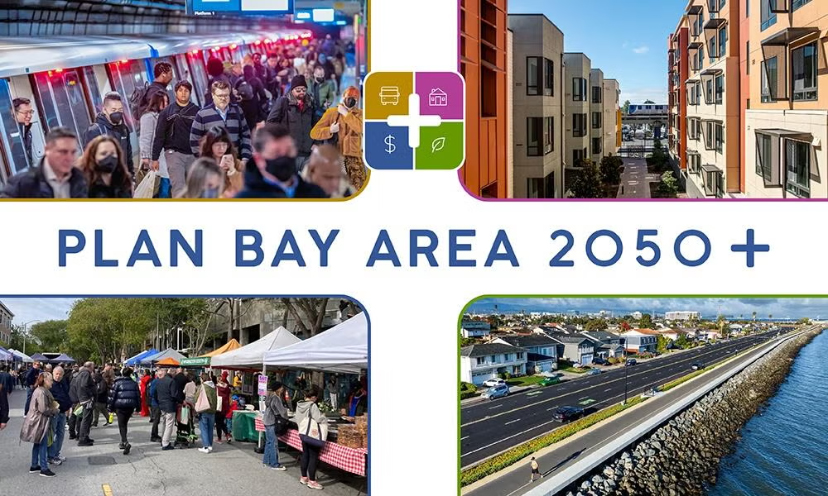
Source: Plan Bay Area

Public comment through Dec. 18 on Draft Plan Bay Area 2050+, EIR for housing, transportation, economic development and the environment

East Bay Webinar Nov. 5

By Veronica Cummings, Principal Public Information Officer, Engagement & John Goodwin, Assistant Director of Communications, Metropolitan Transportation Commission 

After more than two years of public discussion, technical analyses and refinement, the Metropolitan Transportation Commission (MTC) and the Association of Bay Area Governments (ABAG) today released Draft Plan Bay Area 2050+ and the Plan Bay Area 2050+ Draft Environmental Impact Report for public review and comment.

Draft Plan Bay Area 2050+ charts a course for the future of the Bay Area over the next 25 years. Designed to guide growth and investment across the region’s nine counties and 101 cities, the latest plan aims to advance an integrated vision for a Bay Area that is affordable, connected, diverse, healthy and vibrant for all. The plan contains 35 strategies for public policies and investments that can be implemented to help the Bay Area build more homes, reduce commute times, and create vibrant downtowns and natural areas for everyone to enjoy. These strategies also aim to keep people safe from natural hazards, support a strong economy and provide stable housing.

Unique to this plan cycle is Transit 2050+, a parallel and first-of-its-kind planning effort conducted by MTC and ABAG in partnership with Bay Area transit agencies to re-envision the future of Bay Area public transit.
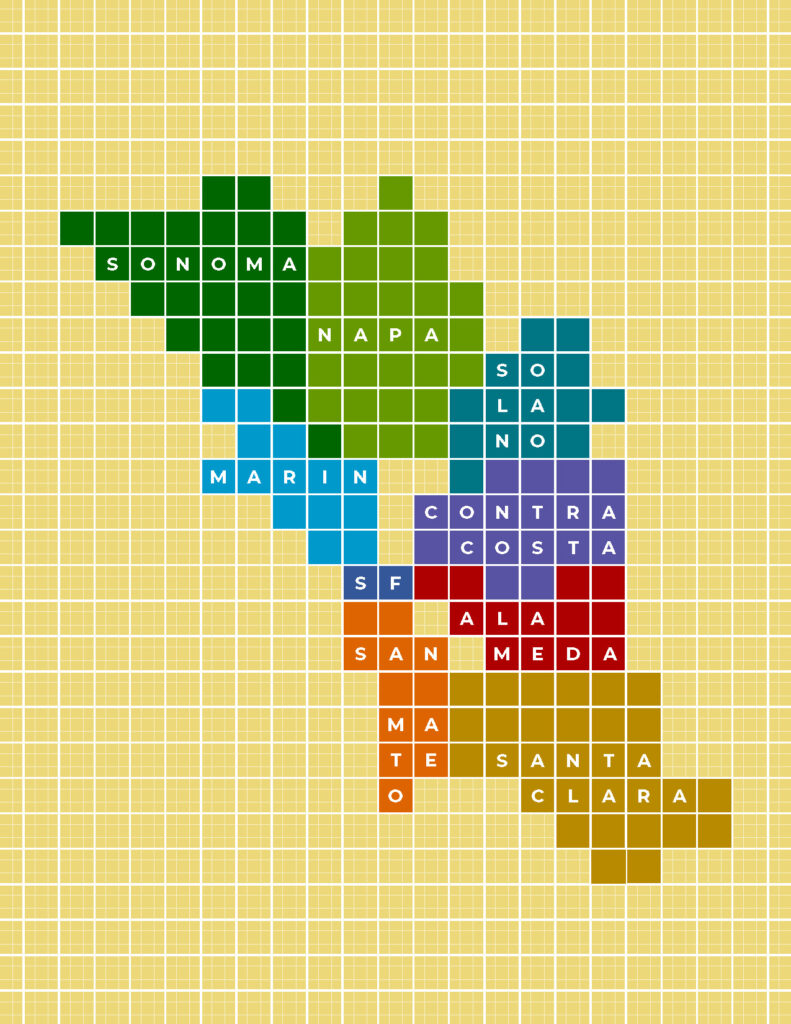
Plan Bay Area includes all nine Bay Area counties and 101 cities. Source: Plan Bay Area

MTC and ABAG have scheduled a series of webinars and public hearings for comment on Draft Plan Bay Area 2050+ and associated supplemental reports, as well as on the Draft Environmental Impact Report for Plan Bay Area 2050+. All interested people, agencies and other organizations are encouraged to attend a webinar or public hearing, where they can ask questions and offer comments on these documents. Full event details are listed below:

  • Webinar #1 — North Bay 
    Wednesday, October 29, 2025 
    12-1:30 p.m. 
    Zoom link: https://bit.ly/northbaywebinar 
  • Webinar ID: 892 3077 8001 
  • Passcode: 256814 
  • 888-788-0099 US Toll Free   
  • Webinar #2 — West Bay 
    Wednesday, October 29, 2025 
    6-7:30 p.m. 
    Zoom link: https://bit.ly/westbaywebinar 
    Webinar ID: 831 4140 5598 
    Passcode: 096944 
    888-788-0099 US Toll Free   
  • Webinar #3 — South Bay 
    Thursday, October 30, 2025 
    6-7:30 p.m. 
    Zoom link: https://bit.ly/southbaywebinar    
    Webinar ID: 822 2561 7467 
    Passcode: 356845 
    888-788-0099 US Toll Free   
  • Webinar #4 — East Bay 
    Wednesday, November 5, 2025 
    6-7:30 p.m. 
    Zoom link: https://bit.ly/eastbaywebinar  
    Webinar ID: 869 8283 4999 
    Passcode: 682098 
    888-788-0099 US Toll Free 

In addition to these webinars, MTC and ABAG will host three public hearings around the Bay Area to provide opportunities for all interested agencies, organizations and individuals to comment on the Draft Plan and Draft Environmental Impact Report. The full list of hearings is as follows: 

  • Public Hearing #2 — Fremont  
    Wednesday, December 3, 2025, at 6 p.m. 
    Olive Hyde Art Center and Gallery -or- Zoom 
    123 Washington Boulevard, Fremont 
    Zoom link: https://bit.ly/drafthearing2  
    Webinar ID: 875 7625 3306 
    Passcode: 178983 
    888 788 0099 US Toll Free 
  • Public Hearing #3 — Novato  
    Thursday, December 4, 2025, at 6 p.m. 
    Best Western Plus Novato Oaks Inn -or- Zoom 
    215 Alameda del Prado, Novato 
    Zoom link: https://bit.ly/drafthearing3  
    Webinar ID: 898 0347 9624 
  • Passcode: 129009 
  • 888 788 0099 US Toll Free 

Interested Bay Area residents, agencies and organizations also are encouraged to view and comment on the draft plan online at planbayarea.org/draftplan. Comments will be reviewed by officials from both ABAG and MTC as they consider the adoption of Final Plan Bay Area 2050+, slated for early 2026.

Written comments will be accepted via mail to MTC Public Information Office, Attn: Plan Bay Area -or- Draft EIR Comments, 375 Beale Street, Suite 800, San Francisco, CA, 94105; or via email (Draft Plan Bay Area 2050+ inbox: info@planbayarea.org; Draft EIR inbox: eircomments@bayareametro.gov). Comments by phone can made at (415) 778-2292.

The comment period for all documents will close Dec. 18, 2025, at 5 p.m. 

Questions? Visit planbayarea.org, email info@planbayarea.org or call (415) 778-6757. 

Accessible Meetings 

Do you need an interpreter or any other assistance to participate? Please call (415) 778-6757. For TDD or hearing impaired, call 711, California Relay Service, or (800) 735-2929 (TTY), (800) 735-2922 (voice) and ask to be relayed to (415) 778-6700. We require at least three working days’ notice to accommodate requests.

¿Necesita un intérprete u otra asistencia para participar? Por favor llámenos con tres días de anticipación al (415) 778-6757. Para telecomunicaciones para personas sordas y discapacitadas, favor de llamar al 711, el Servicio de Retransmisión de California (CRS) para TTY/VCO/HCO a Voz o para Voz a TTY/VCO/HCO al (800) 855-3000 y pedir que lo retrasmitan al (415) 778-6700.

您是否需要口譯或任何其他協助才能參加?請致電(415)778-6757。若需使用TDD或為聽障人士人士,請致電711,加州轉接服務,或(800)735-2929(TTY),(800)735-2922(語音),然後要求轉接至(415)778-6700。請至少提前三個工作日提出申請,以便我們能為您提供適當的口譯安排。

ABAG is the council of governments and the regional planning agency for the 101 cities and towns, and nine counties of the Bay Area. MTC is the transportation planning, financing and coordinating agency for the nine-county San Francisco Bay Area. 

City of Antioch seeks Housing Manager

Friday, October 10th, 2025

By City of Antioch

The City of Antioch is looking for a visionary leader ready to make a difference as the Housing Manager. If you’re passionate about housing stability, equity and public service, this is your opportunity to lead transformative change in our community.

  • Salary: $120,168.00 – $146,076 (DOQ)
  • Full benefits including CalPERS retirement

Empathy, leadership, and collaboration required.

Apply now: Housing Manager | Job Details tab | Career Pages

Don’t wait—help us build a better Antioch.

Job Details

Under direction from the Public Safety and Community Resources Director, serves as the City’s principal authority on housing policy, strategy, and program implementation. Provides strategic leadership in planning, developing, and managing the City’s housing portfolio, including affordable housing development, homelessness response, tenant protections, and federally funded programs. Oversees and advances the City’s housing goals in alignment with state mandates, regional plans, and local priorities, ensuring regulatory compliance, fiscal stewardship, and community impact.  The Housing Manager manages, supervises, develops, maintains, directs and coordinates the activities of the Housing Division whose functions include providing direct public service. This position is responsible for embedding an equity lens, harm reduction, housing first, and cultural responsiveness throughout the Division’s programs and staff leadership, ensuring services are delivered with empathy, cultural competence, and respect for residents of all backgrounds and lived experiences.

Examples of Duties

The following duties are typical for this classification. Incumbents may not perform all of the listed duties and/or may be required to perform additional or different duties from those set forth below to address business needs and changing business practices.

  1. Manage the operations of the Housing Division, including planning, developing, and administering housing programs, homelessness response initiatives, affordable housing projects, tenant/landlord mediation, and community funded activities, utilizing Community Development Block Grant (CDBG) federal funding, Housing Successor state funding, Permanent Local Housing Allocation (PLHA) state funding, and other federal, state and local funding sources.
  2. Lead strategic planning, organization, and management of the Housing Division, implementing practical, long-term solutions to housing needs and affordable housing developments.
  3. Provide leadership in embedding principles of equity, cultural responsiveness, harm reduction, and housing first across all Housing Division programs and policies, ensuring staff are trained and programs are implemented with empathy and cultural competence.
  4. Oversee preparation, implementation, and compliance for community grant programs with local, state, and federal agencies; maintain accurate records for all program activities and monitoring for compliance with applicable federal and state regulations.
  5. Administer the City’s Fair Housing Program and Tenant/ Landlord and Rental Programs, including compliance with state and federal laws, and implementation of renter protections including tenant protection ordinances, rent stabilization, and anti-harassment and eviction protection programs.
  6. Direct the City’s Unhoused Resident Services Program, including bridge housing, shower and laundry services, food distribution partnerships, and shelter referrals.
  7. Monitor current and proposed legislation, codes, and policies affecting the City’s housing programs; recommend changes to City programs and policies as needed.
  8. Identify and pursue funding opportunities; prepare and administer CDBG and Housing Successor Agency funds; ensure compliance with all funding requirements.
  9. Oversee and monitor housing assistance programs such as the Antioch Home Ownership Program, Fair Housing Services, Rental Assistance, and Eviction Protection Programs.
  10. Establish and manage performance metrics to evaluate housing program outcomes, ensuring data-driven decision-making and continuous improvement.
  11. Negotiate and administer contracts with consultants, contractors, and developers related to Housing Division activities.
  12. Coordinate community outreach and education activities; maintain positive relationships with residents, nonprofits, developers, lenders, and real estate professionals.
  13. Prepare staff analyses and reports for City Council, the CDBG Standing Committee, and the Planning Commission; attend and present at public meetings.
  14. Coordinate housing program activities with other City departments; represent the Housing Division at community and regional meetings; address citizen complaints and concerns.
  15. Manage the Division’s budget, monitor expenditures, and maintain established service levels and objectives.
  16. Represent the City in regional housing discussions with other agencies and community groups.
  17. Develop, train, and implement new or revised housing policies, standards, and regulations.
  18. Supervise, train, and evaluate assigned staff.
  19. Maintain strong working relationships with co-workers, other City employees, and the public using principles of excellent customer service.
  20. Perform related duties as required.

Typical Qualifications

The following generally describes the knowledge and ability required to enter the job and/or be learned within a short period of time in order to successfully perform the assigned duties.

KNOWLEDGE OF:

  • Principles, practices, and regulations related to affordable housing program administration and development.
  • Principles of harm reduction, housing first, and equity-centered program administration, and their application in supervising staff and designing housing and homelessness policies.
  • Community Development Block Grant (CDBG) program requirements, including eligible activities, compliance, and reporting as evidenced by HUD.
  • Principles of housing development, rehabilitation, and construction.
  • Federal, state, and local laws, codes, and regulations governing public housing development and rehabilitation programs.
  • Best practices for addressing homelessness, including trauma-informed care and housing-first models.
  • Affordable housing program finance and administration, including grants, budgets, and feasibility analysis.
  • Research methods, data analysis, and needs assessment techniques related to housing trends.
  • Legislative processes at the county, state, and federal level related to housing and homelessness.
  • Principles and methods of community outreach, stakeholder engagement, and public communication.
  • Budget development, financial management, and resource allocation.
  • Project and contract management principles and negotiation strategies.
  • Management, supervision, training, and employee development techniques.

ABIITY TO:

  • Plan, organize, and administer complex housing programs and projects within established requirements and guidelines.
  • Lead with empathy and cultural responsiveness, fostering a team culture that respects diverse socioeconomic backgrounds, lived experiences, and varying abilities.
  • Develop and implement affordable housing strategies that address community needs.
  • Analyze and interpret housing finance data to evaluate program costs and benefits.
  • Interpret, apply, and explain housing-related laws, regulations, and policies clearly to a wide range of audiences.
  • Identify and pursue grant and funding opportunities from multiple sources; prepare competitive applications and ensure compliance with funding requirements.
  • Establish and maintain effective working relationships with community groups, agencies, developers, and internal City departments.
  • Negotiate and manage contracts and agreements effectively.
  • Communicate effectively in writing and orally, including delivering clear and persuasive presentations.
  • Supervise, train, and evaluate the work of assigned staff.
  • Prepare accurate, clear, and concise written reports, budgets, and correspondence.
  • Organize work, set priorities, meet deadlines, and adapt to changing priorities.
  • Represent the City professionally in meetings, negotiations, and public events.
  • Maintain confidentiality and exercise discretion in handling sensitive information.
  • Model and enforce safe work practices. 

Education and Experience Guidelines

Education/ Training:

  1. Bachelor’s degree from an accredited college or university with major course work in Urban Planning, Community Development, Public Administration, Business Administration, Social Work, Housing Studies, or a related field.

Experience:

  1. Five years of progressively more responsible experience in housing program development and implementation, with 
  2. At least two years in a supervisory capacity.

License or Certificate:

  1. Possession of an appropriate, valid driver’s license.  An out-of-state valid Motor Vehicle Operator’s License will be accepted during the application process, but a valid California license must be obtained within six (6) months of appointment to the position.

Supplemental Information

PHYSICAL DEMANDS AND WORK ENVIRONMENT

The conditions herein are representative of those that must be met by an employee to successfully perform the essential functions of this job. Reasonable accommodations may be made to enable individuals with disabilities to perform the essential job functions.

Environment: 
Work is performed primarily in a standard office setting with travel to different sites; incumbents may be required to work extended hours including evenings and weekends and may be required to travel outside City boundaries to attend meetings.

Physical: 
Primary functions require sufficient physical ability and mobility to work in an office setting and field environment; to stand or sit for prolonged periods of time; stoop, bend, kneel, crouch, reach, and twist; to lift, carry, push, and/or pull moderate amounts of weight; to operate office equipment requiring repetitive hand movement and fine coordination including use of a computer keyboard; to travel to other locations using various modes of private and commercial transportation; and to verbally communicate to exchange information.

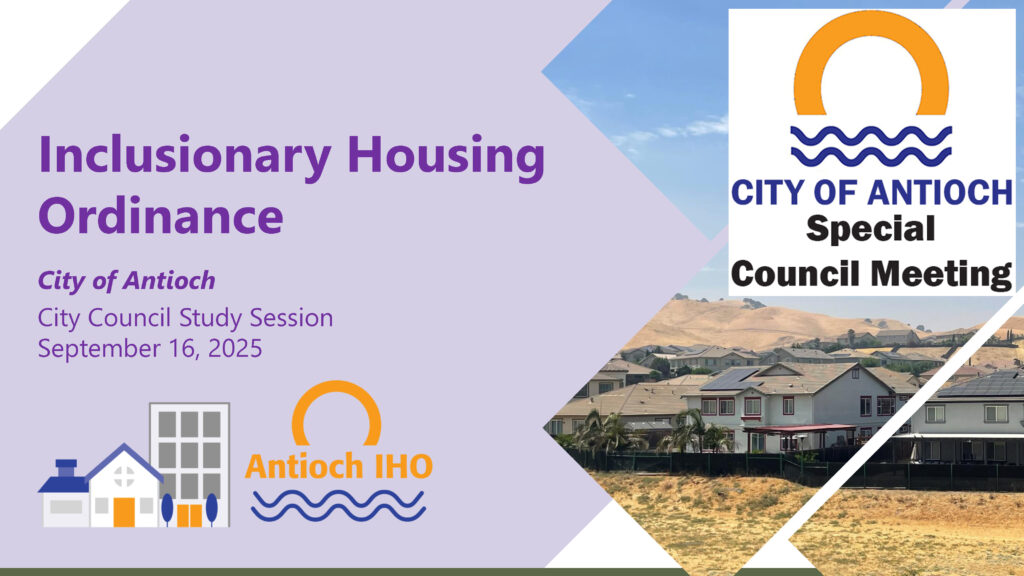
TONIGHT! Antioch Council to hold special meeting on possible Inclusionary Housing Ordinance

Tuesday, September 16th, 2025
Source: City of Antioch

Would require developers to allocate percentage of housing units in market-rate developments as affordable or below-market rate

May increase costs to new home buyers, reduce number of new housing units; “there would likely be a fiscal impact” to City, possibly increase revenue from developer fees

By Allen D. Payton

During  a special meeting tonight, Tuesday, September 16, 2025, beginning at 6:00 p.m., the Antioch City Council will hold a study session to discuss a possible Inclusionary Housing Ordinance (IHO) and give direction to staff to develop one for a future vote.

According to the City staff report for the one item on the agenda, “An IHO, often referred to as inclusionary zoning, is an ordinance that requires developers to allocate a percentage of housing units in market-rate developments as affordable, or below-market rate (BMR) units.” Staff is recommending the Council support an IHO and a apply a 15% total inclusionary requirement to both rental and for-sale projects.

Background: “On May 27, 2025, the City Council held a study session on the possible adoption of an IHO, which is an Implementation Measure contained within the City’s Certified 6th Cycle Housing Element at Program 2.1.10. The possible adoption of an IHO can also be used for compliance with the Metropolitan Transportation Commission’s Transit Oriented Communities (MTC TOC) Policy, as discussed in the May 27, 2025 staff report, linked below.

“Staff and the project team provided a project overview, discussed the legal and local contexts of IHOs, presented the draft financial feasibility analysis, discussed the outreach process to date, and detailed next steps. Members of the community provided public input, however, due to time constraints, the City Council was unable to provide feedback and direction to staff.

“A second study session was held by the City Council on August 26, 2025. Similar to the prior study session, members of the public provided input and yet again, the City Council was unable to provide feedback and direction to staff due to the lateness of the hour. The City Council requested a Special Meeting for consideration of an IHO and has dedicated tonight’s meeting to this singular policy discussion.”

Staff Questions and Recommendations to Council

During tonight’s study session the staff are asking for answers from the Council on a variety of questions to develop an ordinance including:

  1. Should staff move forward with preparation of an IHO? Staff Recommendation: Yes.
  2. Should the IHO apply to rental projects, for-sale projects, or both? Staff Recommendation: Both
  3. Should the IHO include specific income category breakdowns – for example 5% VLI (Very Low Income), 5% LI, 5% MI – or should the developer be able to choose any affordability or combination of affordabilities? Other breakdowns could be 5% ELI, and 10% VLI or 5% ELI, 5% VLI & 5% LI or 3% ELI, 7% VLI & 5% LI, etc. Staff Recommendation: 15% total inclusionary requirement and this should apply to rental and for-sale projects.
  4. Should rental housing and for sale housing have different inclusionary requirements or the same inclusionary requirements? Staff Recommendation: Breakdown of specific income categories: 5% ELI, 5% VLI, 5% LI Maintain compliance with the MTC TOC Policy.
  5. Should rental housing and for sale housing have different inclusionary requirements or the same inclusionary requirements? Staff Recommendation: All housing types maintain the same inclusionary requirements.
  6. What should the threshold project size be to be included in the IHO? Staff Recommendation: Developments of 5 units and projects less than 5 pay an in-lieu fee.
  7. Should the units be affordable in perpetuity? Staff Recommendation: Yes.
  8. Should an in-lieu fee option be included as an alternative means? And should other alternative means be included? Staff Recommendation: An in-lie fee option should be included.
  9. Should the ordinance encourage on-site construction? If so, then by what means? Staff Recommendation: Encourage on-site construction by requiring a higher inclusionary ordinance requirement when a developer pays the in-lieu fee.
  10. Should there be developer incentives, beyond State Density Bonus Law? If so, by what means? Staff Recommendation: Waivers and fee deferrals

Challenges With IHO’s

According to the National Housing Conference, “ While advocates view inclusionary zoning as a way to increase the stock of economically integrated affordable homes at little cost to the public, critics charge that inclusionary zoning policies amount to a ‘tax’ on new development that unduly burdens developers and adversely impacts the cost and availability of market-rate homes.”

In addition, “Common opposition arguments include:

  • Inclusionary zoning ordinances increase the cost of new development, which may then be passed on to market-rate buyers through increased home prices.
  • Inclusionary zoning ordinances cause developers to build fewer units — either because developers choose to build in jurisdictions without inclusionary policies and/or because the inclusionary policies change the economics of development such that other land uses (e.g., retail) are more profitable.
  • By reducing the supply of new homes, inclusionary policies increase the cost of market-rate housing in the community implementing the policy and in neighboring areas (as reductions in supply in one jurisdiction may increase home prices for the whole metropolitan area by reducing the supply of housing available to satisfy the area’s demand).
  • Inclusionary zoning policies unfairly place the burden of economic integration on housing developers.
  • The possibility that units produced by an inclusionary housing program might have a negative impact on nearby home values.”

A commentary on SRQmagazine.com by Christine Robinson, Executive Director of The Argus Foundation, entitled, The Negative Effects of Inclusionary Housing reports, “According to a study on Pittsburgh’s (Pennsylvania) inclusionary zoning policies, developers often respond to mandatory affordability requirements by decreasing the total number of units they build. This occurs because the cost of providing affordable units often makes projects financially unfeasible. As developers struggle to balance profitability with affordability requirements, some may abandon projects that require affordable housing even with increased density or scale back their ambitions.”

“While inclusionary zoning policies aim to create a more equitable housing market, the negative effects seen in Pittsburgh and elsewhere demonstrate that these policies may have unintended consequences that worsen housing affordability and reduce the availability of housing overall.”

Possible Fiscal Impacts to the City

Also according to the staff report, “Should the City Council choose to adopt an Inclusionary Housing Ordinance in the future there would likely be a fiscal impact due to increased staffing and administrative costs to implement the ordinance. There is also the possibility of additional revenue generation for housing production should the City Council choose to adopt an in-lieu fee as an alternative means of compliance.”

Meeting Details

The meeting will be held in the Council Chambers at City Hall, 200 H Street, in Antioch’s historic, downtown Rivertown. It can also be viewed can also be viewed via livestream on the City’s website and on the City’s YouTube Channel.

Click to read the full agenda packet, tonight’s presentation and the May 27, 2025 City staff report.

Free Antioch Home Ownership Program online education workshop March 4-6

Friday, February 28th, 2025

Secure up to $120,000 in down payment subsidies applied towards purchasing a home in Antioch.

3 parts, 3 nights; deadline to register is 5:00 pm Monday, March 3rd

By Walter Zhovreboff, Administrative Director, Bay Area Affordable Housing Alliance

The Bay Area Affordable Homeownership Alliance (BAAHA) and the City of Antioch are sponsoring a free virtual HUD approved homebuyer education workshop from 5:00pm to 7:30pm Tuesday March 4 through Thursday March 6, 2025.

Reservations are required for the free workshop. Attendants for this free workshop series will receive a Certificate of Completion from a HUD approved education provider.

Workshop Times
The City of Antioch is sponsoring a free HUD approved homebuyer education workshop. The three-part workshop will be presented from:
• Part I Tuesday March 4th from 5pm – 7:30 pm
• Part II Wednesday March 5th from 5pm – 7:30 pm
• Part III Thursday March 6th from 5pm – 7:30 pm
Households must attend all three sessions to secure the HUD approved education certificate.

The workshop is scheduled over three Zoom sessions delivered from 5:00pm to 7:30pm, commencing on Tuesday, March 4 through Thursday March 6, 2025. Attendees must attend all three sessions to obtain their HUD Homebuyer Education Certificate. Deadline to register is 5:00 pm Monday, March 3, 2025.

Workshop Topics
The homebuyer education workshop will be covering the following key topics.
• Understanding the importance of credit to purchase a home
• Preparing for homeownership
• Qualifying for a first mortgage
• Shopping for a home
• Managing money
• Information regarding the AHOP resources, including how to apply for the AHOP Down Payment Assistance Subsidy

A-1 CHS provides all homebuyer education workshop participants with a required individual free one on one homebuyer counseling session.

Workshop Sponsors and Presenters

The workshop is specifically directed towards households who are interested in applying for and participating in the AHOP resources, including securing up to $120,000 in down payment subsidies applied towards purchasing a home in Antioch.

This free workshop is sponsored by the City of Antioch. Approved homebuyer education providers usually charge a fee which can range up to $100 to participate in a HUD approved homebuyer workshops.

The workshop is being taught by A-1 Community Housing Services. A-1 CHS is a non-profit community partner that is assisting AHOP participants with their homebuyer education and counseling needs. Additional presenters at the workshop will include:
• Administrative Director of BAAHA
• Managing Director CA – CRA Residential Lending with First Citizens Bank

Workshop Registration
Households must register to attend the City of Antioch’s free HUD approved homebuyer education workshop. Reservations can be made at: https://www.myhomegateway.org/ahop-homebuyer-education-workshop.html.

Make your reservation by no later than 5:00PM Monday March 3, 2025.

Additional information on Antioch Home Ownership Program (AHOP) is available at https://www.myhomegateway.org/ahop.html.

Shelter Inc offering low income apartments in Pittsburg

Thursday, December 5th, 2024
Paid advertisement

For more information visit www.shelterinc.org.

Antioch Fair Housing Webinar Nov. 7

Monday, November 4th, 2024

Presented by City of Antioch 12:00 p.m. – 1:00 p.m.

Are you up to date with the California Fair Employment and Housing Act (FEHA)? This act protects people with disabilities from discrimination in housing and employment. Whether you’re a landlord, agent, tenant, or just interested in fair housing, this session is for you!

What to Expect: Gain insights on FEHA, learn how to stay compliant, and understand your rights and responsibilities.

For more information or compliance questions, reach out to our Housing Specialist at (925) 779-7017.

Join us to help create a fairer, more inclusive community!

Note: This session is for informational purposes only and does not provide legal advice.

Antioch Local Tenant Protections Webinar Nov. 7

Saturday, November 2nd, 2024

To register for the webinar click, here.

Glazer announces $2.5 million incentive program for construction of 350 ADUs in Contra Costa, Alameda counties

Friday, September 6th, 2024

Antioch among 15 cities eligible to participate in ADU Accelerator Program

By Steven Harmon, Policy Analyst/Communications, Office of State Senator Steve Glazer

SACRAMENTO – Senator Steve Glazer, D-Contra Costa, announced a newly created program to encourage the construction of hundreds of Accessory Dwelling Units in Contra Costa and Alameda Counties.

The ADU Accelerator Program, secured in the budget through Senator Glazer’s efforts, offers rebates of up to $15,000 for qualifying ADU plans and projects. This $2.5 million state-funded initiative is intended to facilitate the construction of 350 ADUs among the 15 cities and towns in the East Bay.

“It is no secret the State of California is facing a shortage of available and affordable housing, and no one knows this better than our local cities and towns,” Glazer said. “From my first days in the State Senate, I have been a staunch supporter of cities seeking new and unique ways to spur the production of housing while blending new developments within the fabric of their communities.”

“I’m hoping that cities in my district can show what can be achieved when cities work together with the state on an incentivized program aimed at producing more affordable housing,” Senator Glazer said.

The program, approved in the 2023 budget, will be administered by the California Department of Housing and Community Development.

The 15 cities are: Antioch, Brentwood, Clayton, Concord, Danville, Dublin, Lafayette, Moraga, Oakley, Orinda, Pittsburg, San Ramon, Walnut Creek in Contra Costa County and Livermore and Pleasanton in Alameda County.

Qualifying cities must have a Certified Housing Element that meets the substantial compliance requirements of Housing and Community Development.

Below is an overview of the new program along with guidelines to apply and receive funds.

Senate District 7 – ADU Accelerator Program | GUIDELINES

Program Overview

Some cities are taking steps to encourage and facilitate the construction of ADUs through the development of permit-ready plans, including architectural design work. Other cities are waiving processing fees to bring down the cost of housing.

This new program will be piloted by Senator Glazer’s District 7, composed of 15 cities in the East Bay of the San Francisco Bay Area. The program will be administered by the California Department of Housing and Community Development for the purpose of advancing or “accelerating” the production of 350 ADUs through a series of programs.

Program Funding

Section 19.564 of the Budget Act of 2023 provides $2,500,000 to be allocated by the California Department of Housing and Community Development for implementation of the ADU Accelerator Program (“Program”) to grant funds to cities for the creation of pre-approved permit-ready accessory dwelling unit plans and an incentive program.

Program Eligibility

  • Fifteen (15) cities located in Senate District 7, including: Antioch, Brentwood, Clayton, Concord, Danville, Dublin, Lafayette, Livermore, Moraga, Oakley, Orinda, Pittsburg, Pleasanton, San Ramon, and Walnut Creek.
  • Qualifying cities must have a Certified Housing Element that meets the substantial compliance requirements of Housing and Community Development.

Program Details

1.      Incentive Program. Available Funding: $1,725,000

A.    Low-Income Restricted ADUs

Provide individual rebates of up to $15,000 to property owners who obtain building permits to construct an ADU and receive a certificate of occupancy within 18 months of issuance. Rebates will be provided for units that are deed restricted to low-income households for a minimum of 20 years; based upon the following sliding scale:

  • $15,000 for units < 50 square feet
  • $10,000 for units between 501-750 square feet
  • $5,000 for units between 751-1,000 square feet
  • No rebates for units over 1,000 square feet.

B.     Non-restricted ADUs

Provide individual rebates of up to $7,500 to property owners who obtain building permits to construct an ADU and receive a certificate of occupancy within 18 months of issuance. Rebates will be provided for units that are deed restricted to low-income households for a minimum of 20 years. Funds are awarded based upon the following sliding scale:

  • $7,500 for units < 50 square feet
  • $5,000 for units between 501-750 square feet
  • $2,500 for units between 751-1,000 square feet
  • No rebates for units over 1,000 square feet.

Example:

  • City of Dublin has a population of 72,917 (as of January 1, 2024)
  • Per Capita: $1.87
  • Eligible for Award of $136,352 ($1.87 per capita x 72,917 population)
  • Divided by average of $5,000 per unit (unrestricted)

Potential ADUs Added: 27 ADUs

2.      Permit Ready Prototype ADU Plans. Available Funding: $750,000

Qualified cities receive funding toward preparing prototypical permit-ready ADU plans (“ADU Plans”), including design elevations and construction drawings. Permit-ready plans are intended to streamline the ADU development process and facilitate additional ADU development in the community. Cities may partner with other cities on applications in this category to leverage investment. The maximum grant per city will be $50,000.

Cities may not be reimbursed for permit-ready ADU plans that were prepared prior to the launch of this program. Program funds may be used to modify or update existing permit-ready ADU plans or to create additional permit-ready ADU plans. Cities may also seek compensation from other eligible cities they share plans with.

Application Process

To receive funds, qualified cities must complete and submit an electronic application to the Town of Danville, Fiscal Agent. All funds must be expended as prescribed below and no later than September 30, 2026, after which these funds would be considered unexpended “Excess Funds” subject to re-allocation. 

Incentive Program

An application must include (a) the anticipated number of units proposed to be produced through the program; and (b) amount requested based on the per capita amount identified in the Funding Eligibility section.

Funding will be distributed to cities upon receipt of the application. Any unused funding must be returned to the Town of Danville, Fiscal Agent, at the end of the 18-month period and may be reallocated to cities that meet their targets and have additional need.

Permit-Ready Prototype ADU Plans

An application must include (a) brief description of the plans to be developed including the number of floor plans and ADU sizes; and (b) requested funding amount. The maximum funding is $50,000 per agency. Cities may partner with other eligible cities on applications in this category to leverage funding investment.

Funding will be distributed to cities upon receipt of the application. Permit-ready plans must be completed and available to prospective permittees within 12 months of grant award and include a city resolution adopting the ADU Plans.

Excess Funds

Any funding that has not been expended pursuant to these program guidelines by September 30, 2026, must be returned to the Fiscal Agent, the Town of Danville. These Excess Funds will be reallocated to other eligible agencies pursuant to the Incentive Program Guidelines. Funds will be re-allocated on a first come, first served basis. In the event of multiple requests, consideration will be given to which city or cities will generate the largest number of affordable units.

Application Deadlines

Applications are accepted via electronic submittal only

Incentive Program: September 1, 2024 – March 31, 2025 (may be extended if additional funds are available to be rolled over from the Permit-Ready program).

Permit-Ready Prototype ADU Plans: September 1, 2024 – March 31, 2025.

Program Administration

As authorized through the California Budget Act of 2023 and the California Department of Housing and Community Development, the Town of Danville will act as the fiscal agent (“Fiscal Agent”) to receive funding applications and distribute Program funds. The Town of Danville will receive a 1% fee ($25,000) for administering the program.

General program questions can be directed to Planning Division c/o Jessica Lam, Town of Danville at jlam@danville.ca.gov or (925) 314-3337.

Applications and application-related correspondence can be directed to SD7.ADUProgram@danville.ca.gov.

Biannual Reporting

Eligible recipients will be required to submit Biannual Progress Reports which summarize the number of ADUs that have been permitted and finaled for the reporting period as well as cumulatively for the life of the program through September 30, 2027.

Biannual Progress Reports will be filed with the Fiscal Agent at SD7.ADUProgram@danville.ca.gov.

*Applications are accepted via electronic submittal only