







Archive for the ‘Health’ Category

Contra Costa health officials to address Gioia’s complaints of COVID-19 vaccine inequity in high minority population areas of West, East County

Thursday, January 28th, 2021
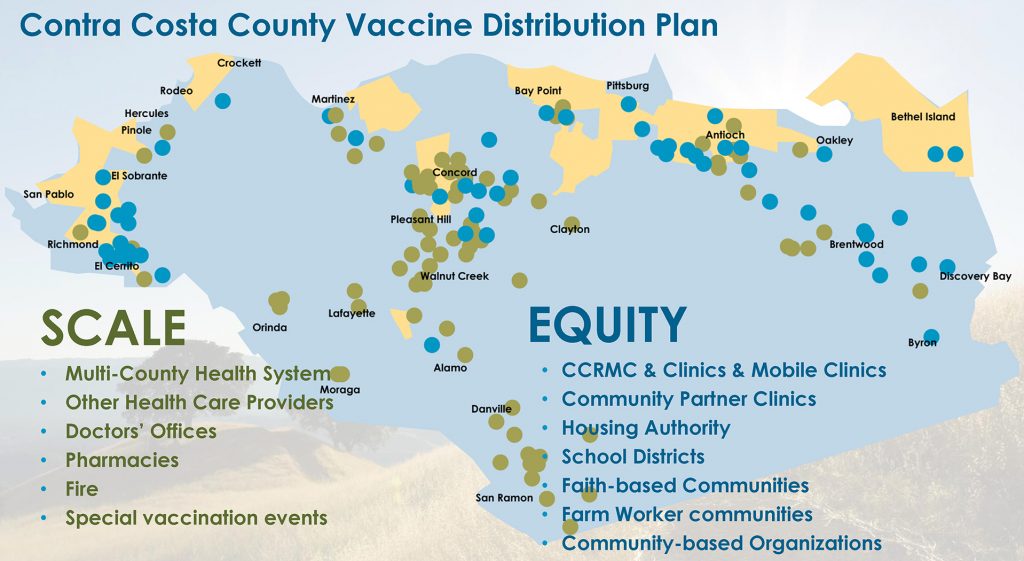
Source: Contra Costa Health Services

Less than 5% immunization compared to 11-13.8% in Alamo, Lafayette and Walnut Creek where the population is older.

The county is distributing the vaccine primarily to residents 75 years and older, said Contra Costa County Health Officer Dr. Chris Farnitano – “I really do believe we are at the turning of the tide of this pandemic at this point.”

Annual Board Retreat held virtually
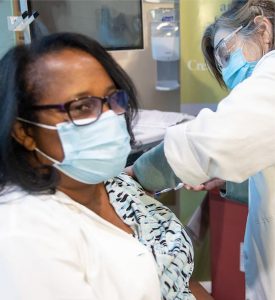
Photo: CC Health Services.

By Daniel Borsuk

During the Contra Costa Board of Supervisors annual retreat Tuesday, Jan. 26, the county’s top health official made a major admission, saying her department will investigate questions into claims of unequal distribution of COVID-19 vaccination injections in areas with high populations of Black and Latino residents.

Contra Costa Health Services Director Anna Roth was put in the hot seat by District 1 Supervisor John Gioia who, like last week, raised similar questions as to why the COVID-19 vaccine is being unequally distributed in the district he represents. His district includes the cities of Richmond and El Cerrito and other communities with high percentages of minorities who are more prone to be stricken with coronavirus, than in other communities that tend to be wealthier and have higher percentages of white residents.

Gioia also cited other high percentage minority communities like Antioch, Bay Point, and Pittsburg in supervisorial District 5 for exposing residents to the COVID-19.  District 5 is represented by Supervisor Federal Glover of Pittsburg who did not comment on the issue.

Gioia said the vaccination rate in Antioch is five percent, in Bay Point it is 4.3 percent, in Richmond it’s 4.5 percent, while in Alamo the vaccination rate is 11 percent, 12 percent in Lafayette, and 13.8 percent in Walnut Creek.

“You make a very important point.  The early data is showing an inequity,” Health Director Roth said.  “We hear your request for a more specific plan.”

Last week, when Gioia raised the same inequity issue, Roth did not acknowledge the Supervisor’s issue as significant enough for possible further study.

Discussion about the vaccine inequity distribution issue arose at the same time Tuesday that President Joe Biden’s administration announced it would boost the supply of COVID-19 vaccines by about 16 percent for the next three weeks.  White House officials said the order would buy enough additional doses to vaccinate most of the U.S. population with a with a two-dose regimen by the end of summer.  Contra Costa County Health officials were unavailable to comment about that development. Like all counties in California, vaccine distribution is overseen by the state.

However, during the Health Services COVID-19 Response Update to the board, Dr. Chris Farnitano, the county’s health officer, pointed out that the county is distributing the vaccine primarily to residents 75 years and older. Of 93,000 doses administered, 61,000 have been given to citizens older than 75 years, he explained.

“I really do believe we are at the turning of the tide of this pandemic at this point,” Farnitano also stated at the end of the presentation.

Retreat Highlights

During their remotely held retreat, the supervisors were presented glimpses of the 2021 budget, economic forecasts, future capital improvement projects, redistricting, economic development, and developments planned at the two County-owned airports in Byron and at Buchanan Field in Concord.

Among some of the highlights of the presentations were:

  • Supervisors expressed their preference for the potential construction of a 20,000 square foot, two-story office building with 80 underground parking spaces to be built at 651 Pine St., the former site of the 12-story McBrien Administration Building that will be demolished now that that county’s new four story $95 million administration David Twa Administration Building has been completed and is open for limited occupancy due to COVID-19.

“The economy will be roaring back,” forecast economist Dr. Christopher Thornberg. He made the prediction despite the fact that California faces a $54 billion budget deficit, “public transit like BART is going to have a tough time getting out of this thing, but electrically powered cars I see coming down the pike.”

  • Former County Administrator David Twa will oversee work on the county’s redistricting process, a process that occurs every 10 years to adjust supervisorial district boundaries. The complex process involves conducting public hearings and meeting state and federal guidelines that are dependent on when the federal government releases 2020 census data.  There is concern that due to COVID-19, the availability of census data might be delayed.
  • The two county airports at Byron and Buchanan have generated a 9% increase in revenue for the county since 2017. The Byron airport recently landed, said Airports Director Keith Freitas, a vertical take landing aviation company.  There are 10 ongoing development projects at the airports including fire station No. 9 and a new administration building at the Buchanan Airport in Concord.
Stay-at-Home order lifted for Bay Area, Contra Costa returns to purple tier

Monday, January 25th, 2021

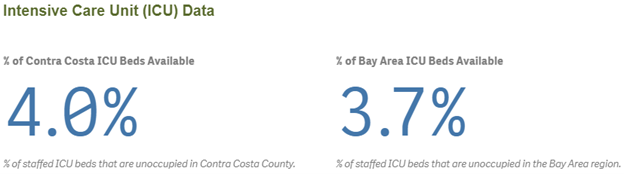
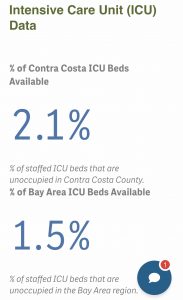
Available ICU beds in Contra Costa County and Bay Area as of Monday, Jan. 25, 2021. Screenshots of CCHealth Services’ website.

Outdoor dining allowed again; hair salons, barber shops can reopen.

State and local stats don’t match.

“The state has changed how they are calculating,” – Scott Alonso, Contra Costa Health Services spokesman

Contra Costa County is urging residents and businesses to continue practicing health safety measures and avoiding risky activities after California lifted its regional stay-at-home order today in the Bay Area. The state lifted the order Monday morning, effective immediately.

Some significant changes resulting from Contra Costa’s return to the purple tier include:

  • Restaurants may offer outdoor dining, following the state health guidelines.
  • Hair salons, barber shops and personal services such as nail salons may reopen following state health guidelines.
  • Outdoor social gatherings involving 25 or fewer people, from three or fewer different households, are now permitted.
  • For the full list of what businesses and venues are allowed to be open as of Monday, Jan 25. click here.
  • More information available at org/coronavirus

The state order helped the region meet the deadly surge in COVID-19 infections following the winter holiday season. But per capita, the adjusted average number of new infections reported every day in Contra Costa was 46.2 in the last week – nearly seven times the threshold for a county to enter the purple tier of the state’s Blueprint for a Safer Economy.

“Our county continues to experience a winter surge in COVID-19 transmission,” said Dr. Chris Farnitano, Contra Costa County health office. “While we are making progress in vaccinating our most vulnerable residents, we are still weeks or months away from seeing the effects of immunization in our community.”

The purpose of the state’s regional stay-at-home order was to slow COVID-19 transmission to protect the intensive care unit (ICU) bed capacity of hospitals and healthcare systems from overwhelming medical surge.

CCC & Bay Area ICU beds availability as of Saturday, Jan. 23, 2021.

Staffed ICU beds in Contra Costa hospitals continue to see heavy use, with 137 of 163 beds occupied on Saturday, including both COVID-19 patients and patients with other major health problems put the county at almost 16%, over the 15% state required threshold. All hospitals in the county remain on contingency care status, and most elective surgeries continue to be postponed.

However, on Saturday the Contra Costa Health Services’ COVID-19 website showed ICU bed capacity in the county at only 1.2% and 2.0% Bay Area-wide. On Monday the CCHS website shows the availability of ICU beds in Contra Costa is 4.0% and 3.7% in the Bay Area, far below the 23% the state is now claiming. Asked why that was, Scott Alonso, a spokesman for CCHS responded, “The state has changed how they are calculating. We are awaiting further information from CDPH and will update the CCHS website once ready and able when we hear from them.”

Health guidelines regarding physical distancing and use of face coverings outside the home remain in effect, as do occupancy caps for indoor businesses and requirements limiting close-contact gatherings of people from different households. Check the state’s web page for industry-specific guidance.

“Under no circumstances should anyone view the state action today as a reason to let down their guard. We have made progress, but we need to continue what we are doing to keep our families and communities safe,” Farnitano said. “It is just common sense.”

Contra Costa has kicked off a countywide drive to provide 1 million doses of COVID-19 vaccine by July 4. County residents who are older than 75 can now get a vaccination appointment by calling 1-833-829-2626 or using Contra Costa Heath Services (CCHS) online request form at cchealth.org/coronavirus. The county expects to extend vaccine eligibility to more people in coming weeks.

Please check back later for any updates to this report.

Allen Payton contributed to this report.


Contra Costa County plans to administer 1 million COVID-19 vaccines by July 4

Saturday, January 23rd, 2021

Photo: FDA

Reflecting the countywide commitment to protect all Contra Costa residents from COVID-19, Contra Costa Health Services (CCHS) announced Friday a new goal for the county and its healthcare partners: Deliver 1 million doses of COVID-19 vaccine by Independence Day. That would cover most county residents. The population is currently estimated to be 1,153,526 as of 2019.

“There is no higher priority in Contra Costa County than delivering COVID-19 vaccine to as many eligible residents as possible, as quickly as possible,” said Diane Burgis, chair of the Contra Costa County Board of Supervisors. “We believe this is a realistic goal, provided our supply of vaccine increases.”

The county’s announcement follows a promise yesterday from new President Joe Biden to administer 100 million doses during the first 100 days of his administration.

“Together with our partners in the community, from large health systems to independent doctor’s offices to supermarket pharmacies, we are building the infrastructure to vaccinate hundreds of thousands of county residents, quickly and safely,” said Anna Roth, director of Contra Costa Health Services (CCHS). “When doses arrive, they do not sit in freezers. They go straight to the public.”

Screenshot of FDA video.

Contra Costa went from providing zero doses to more than 5,800 per day during the first month that COVID-19 vaccine became available, and the daily average continues to climb as community health providers offer more shots to patients and members, and as CCHS opens more county-operated community immunization sites.

If the state can supply enough vaccine, CCHS and our partners together will soon have capacity to provide up to 9,000 doses of vaccine daily. With anticipated contributions from other health systems in the community, Contra Costa could achieve its million-dose goal by July 4.

This week, CCHS also launched its new vaccine-appointment phone line – 1-833-VAX-COCO (1-833-829-2626). Now, those who are unable to schedule vaccine appointments online can call us and book an appointment Monday-Friday, 8 a.m. – 8 p.m. Eligible residents seeking appointments are encouraged to use the online form unless they do not have internet access or have difficulty using the online form.

Other local resources, including links to other healthcare providers in the community now offering vaccine, are available at coronavirus.cchealth.org/get-vaccinated.

CCHS also has a new data dashboard on its COIVD-19 web page, cchealth.org/coronavirus, that provides daily updates for the county’s vaccination campaign. More than 65,000 doses of COVID-19 vaccine have been administered so far in the county.

In addition to the first wave of vaccine recipients, which included healthcare and emergency workers and people who live or work in residential care facilities, all county residents 65 and older can now request an immunization appointment through CCHS.

Appointments with CCHS are not first come, first served. Every day we prioritize appointments for people who are in the highest risk categories, according to state and federal guidelines, especially people who are 75 or older.

Appointments for other eligible residents can vary according to several factors, including age, underlying health concerns, how close they live to a vaccination site where an appointment is available, and whether they live in a neighborhood or community that is especially impacted by COVID-19. Because vaccine is scarce, the reality is that it may take weeks for some eligible residents to get a vaccine.

As more private health systems serving Contra Costa expand capacity to serve their members and patients, more county residents will hear from their own healthcare providers about how and when they can access COVID-19 vaccine.

Visit cchealth.org/coronavirus for local information about the COVID-19 pandemic and Contra Costa’s immunization campaign.

Allen Payton contributed to this report.


City of Antioch, Contra Costa Health Services convert Nick Rodriquez Community Center into COVID-19 vaccination clinic

Friday, January 22nd, 2021

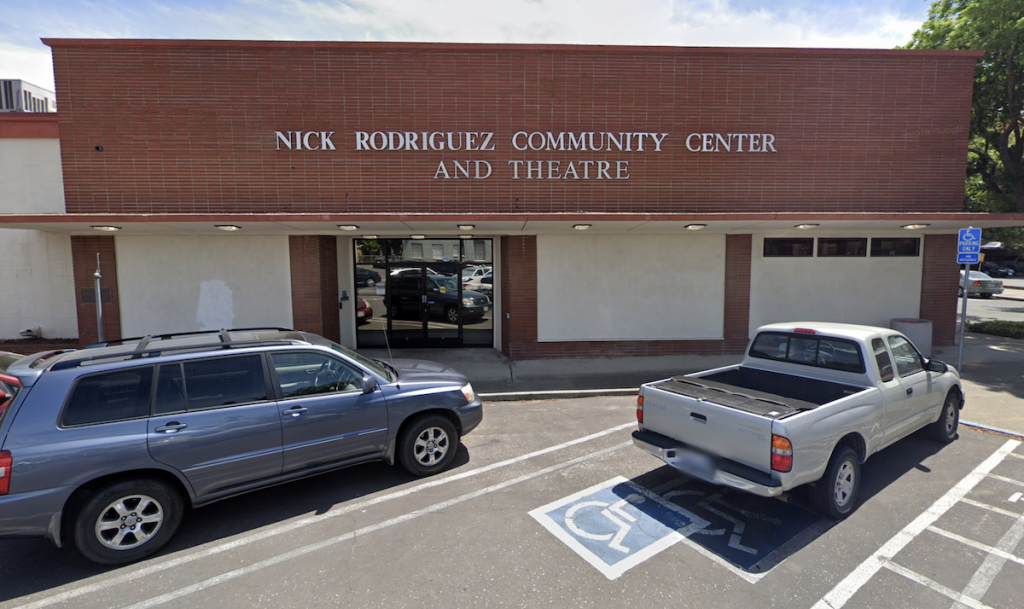
Nick Rodriguez Community Center in downtown Rivertown. Photo: City of Antioch

By Rolando Bonilla, Public Information Officer, City of Antioch

Antioch, Calif., (January 22, 2021) – Today, the City of Antioch announced a partnership with Contra Costa Health Services to convert the Nick Rodriquez Community Center into a vaccine clinic.

As a service to the community, the City of Antioch is waiving its $22,000 monthly fee for use of the facility in order to make vaccinations more accessible to Antioch residents.

“Given the magnitude of the COVID-19 crisis, it is going to take everyone working together to get the world out of this crisis,” said Ron Bernal, City Manager, City of Antioch. “Through this partnership, the City’s goal is to make it easier for residents to have access to a critical life-saving vaccine.”

The clinic will provide no-cost vaccines to eligible Contra Costa County residents. Eligibility is established by federal and state guidelines regarding COVID-19 vaccine distribution.

Vaccinations will be by appointment only. For details about who is currently eligible for an appointment, and to request an appointment through an online form, visit cchealth.org/coronavirus.

Eligible residents who have difficulty using the form or have no internet access can request an appointment by calling 1-833-829-2626.

The Nick Rodriguez Community Center is located at 213 F Street in Antioch’s historic, downtown Rivertown.

Kaiser Permanente awards $8.15 million for racial equity across U.S., one grant in Contra Costa

Tuesday, January 19th, 2021

Photo courtesy of Kaiser Permanente.

In Northern California, grant funding to three grassroots and nonprofit organizations, including one in Contra Costa County, will address structures and practices that prevent communities of color from achieving good health and well-being.

By Kerri Leedy, PR and Media Relations Manager, Kaiser Permanente Northern California 

OAKLAND, CA – On Martin Luther King, Jr. Day, Kaiser Permanente, the nation’s largest integrated, nonprofit health system, announced it has awarded $8.15 million to support dozens of nonprofit and community-based organizations whose programs address systemic racism and its accompanying trauma on individuals and communities of color. These grants are part of the $25 million commitment Kaiser Permanente announced in June 2020 to promote health equity and break the cycle of racial inequities, injustices, and stresses that lead to poor health outcomes for its members and communities.

“As we reflect on the legacy of Martin Luther King Jr., I hope Kaiser Permanente is one of many voices plainly saying that there is much, much work still to be done to realize Dr. King’s ideal of an equitable society that guarantees every individual the opportunity to thrive,” said Greg A. Adams, Kaiser Permanente chairman and CEO. “I am encouraged as I see what progress is possible through organization, activism, and advocacy — and I want our support to enable future generations to follow that path to create change.”

This first set of grants, awarded to 39 organizations in eight U.S. states and the District of Columbia, support established national and regional community-based organizations led by people of color, addressing racial and social justice or trauma, including the lifelong impacts of adverse childhood experiences (ACEs).

In Northern California, a total of $975,000 in grants will help three community-based organizations work to end systemic racism and the resulting trauma experienced by people of color.

“It is fitting that we announce these grants on the day when our nation honors Martin Luther King Jr. and his vision of a just and equitable society,” said Yvette Radford, vice president, Kaiser Permanente Northern California External and Community Affairs. “These investments will support our community partners in organizing, advocating, and advancing policies and practices that foster racial equity and justice, healing, and the opportunity for every individual to thrive.”

The following Northern California organizations will each receive $325,000 over the next 24 months, as part of Kaiser Permanente’s $8.1 million investment:

  • RYSE Inc.: Young people of color in Richmond and West Contra Costa will be engaged in RYSE’s leadership pipeline to build the next generation of leaders grounded in racial and social justice. They will work with adult stakeholders to help shape racially just policies and practices.
  • Faith in Action Network (PICO California): Leveraging its organizing expertise and deep connections with Black faith leaders, congregations and directly impacted communities, PICO will work to dismantle systemic racism, reconstruct public safety systems, and help heal, protect and save Black lives.
  • Public Health Advocates (PHA) in Stockton: Working with youth leaders, PHA will educate students on the impact of trauma, develop a campaign to reduce mental health stigma, and create safe healing and support spaces. PHA will work to address racist policies and practices with bi-weekly education and leadership training of youth to help them understand the relationship between public policy, trauma, and health outcomes. 

“This funding sends a message of hope to our youth that they are critical to this movement and have the power to make positive change,” said Tanice Wallace, program manager for Public Health Advocates’ Faces of Resilience program, which will receive additional funding through Kaiser Permanente’s racial equity grants. “Our program helps young people understand the roots of structural racism, then we offer them tools and the opportunity to work toward racial equity in their communities.”

Among the initiatives funded is a $2 million national partnership with PolicyLink to design and scale racial equity strategies, projects, and campaigns. The core issues PolicyLink addresses include housing justice, water equity and climate resilience, corporate racial equity, and reducing inequality.

“To truly honor Dr. King, we must build a just and fair society where all can participate, prosper, and reach their full potential. Sadly, due to us not heeding Dr. King’s charge, more than 100 million people – 1 in 3 Americans – still live in or near poverty,” said Michael McAfee, president and CEO of PolicyLink. “Our partnership with Kaiser Permanente will support creating anti-racist practices and policies inside the organization, within Kaiser Permanente’s vast network, and in the broader society. This project will help to ensure that all people in America — particularly those who face the burdens of structural racism – participate in a just society, live in a healthy community of opportunity, and prosper in an equitable economy.”

As part of this partnership, PolicyLink will also play a role in working with organizations receiving grants – convening, engaging, and mobilizing regional grantees to catalyze learning and action communities. Kaiser Permanente and PolicyLink will evaluate the outcomes of funded programs, with input from a panel of national racial justice and trauma experts, to track and measure overall progress. The grants will be distributed through Kaiser Permanente’s fund at the East Bay Community Foundation.

In addition, in celebration of Martin Luther King Jr. Day, an estimated 1,700 Kaiser Permanente employees in Northern California took part in the organization’s 17th Annual MLK Day of Service. Due to COVID-19, all volunteering was done safely and virtually. Projects ranged from making calls and writing letters to seniors and others who are isolated by the pandemic to creating blankets, masks, and wellness journals for people in need.

Kaiser Permanente Northern California is also donating a 1,000-square-foot mural to the Black Cultural Zone at Oakland’s Liberation Park where it will soon be permanently installed. Two local Oakland artists created the dynamic and colorful piece of art, which depicts images that reflect the Black community and culture.

About Kaiser Permanente

For 75 years, Kaiser Permanente has been committed to shaping the future of health and health care — and helping our members, patients, and communities experience more healthy years. We are recognized as one of America’s leading health care providers and not-for-profit health plans. Since July 21, 1945, Kaiser Permanente’s mission has been to provide high-quality, affordable health care services and to improve the health of our members and the communities we serve. We currently serve 12.4 million members in eight states and the District of Columbia. Care for members and patients is focused on their total health and guided by their personal Permanente Medical Group physicians, specialists and team of caregivers. Our expert and caring medical teams are empowered and supported by industry-leading technology advances and tools for health promotion, disease prevention, state-of-the-art care delivery and world-class chronic disease management. Kaiser Permanente is dedicated to care innovations, clinical research, health education and the support of community health.

Join Lori Lopez’s Wild Heart Yoga, today

Friday, January 15th, 2021

Fulfill your New Year’s resolution to get in shape and lose that Quarantine 15.
Get 7 Days Free!
Register today at WildHeartYoga.net

Council approves use of city facilities for COVID testing, vaccinations, Ogorchock calls for council action against Torres-Walker

Wednesday, January 13th, 2021

Council hears 170 public comments in response to Torres-Walker’s video; appoints Ogorchock, Torres-Walker to City/School District Standing Committee; and approves each of their three Stand-By Council Members

By Allen Payton

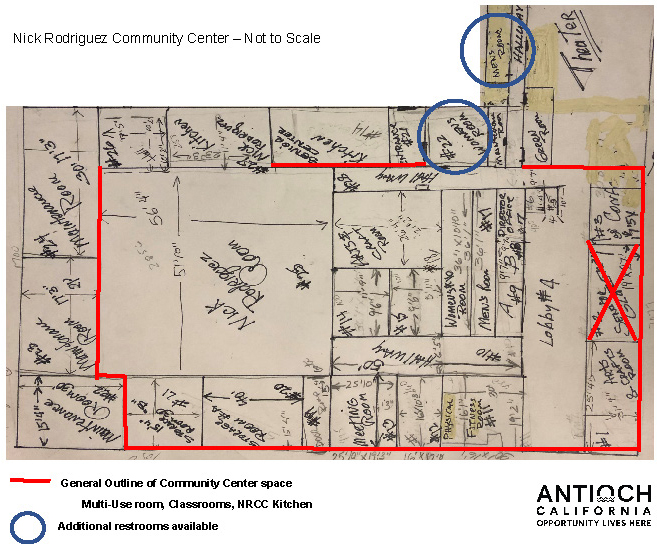
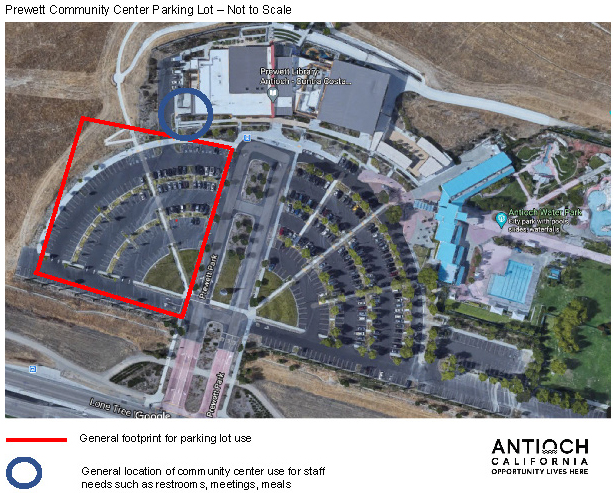
During their Tuesday, Jan. 12, 2021 meeting, the Antioch City Council approved the use of the Nick Rodriguez Community Center and Antioch Community Center parking lot inside Prewett Park for COVID-19 testing and vaccinations on a 4-0-1 vote.

In addition, before the outside investigation has been completed, offering the Antioch Police Department’s side of what happened during the Dec. 29 incident involving Councilwoman Tamisha Torres-Walker’s sons riding off-road vehicles on city streets, about 170 members of the public offered their comments. Some were in support of Torres-Walker, her work in the community and her video response against the police, while others called for her censure, removal, resignation and/or recall. (See related article)

Approve COVID-19 Testing & Vaccination at City Facilities

The City Council voted 4-0-1 to approve a mutual aid response to COVID-19 pandemic agreement with Contra Costa County Health Services

“We need to get these out to individuals as quickly as possible. So, I’m excited about this,” Ogorchock said.

Torres-Walker abstained on the vote. It was her third one during the meeting. Asked, during a break in the meeting, why she was abstaining on the votes, Torres-Walker did not respond.

Public Comments

Due to the large number of general, public comments, Mayor Lamar Thorpe limited them to one-minute each from the regular three minutes usually allotted. The comments were mixed with many of those in support of Torres-Walker from outside of the city, including the Black Panther Party of Oakland, calling for body worn and car cameras for police, and independent investigations by either outside agencies or a citizen police oversight board.

Other comments, mainly from Antioch residents, called for Torres-Walker’s censure, and/or removal or recall for her comments during her Facebook Live video.

Comments were also critical of Thorpe and other council members for not censuring her, as well as Thorpe for traveling to Mexico during the COVID-19 Stay-At-Home order, late last month.

Ogorchock Calls for Council Action Against Torres-Walker, Thorpe says “Words Matter”

During council members’ committee reports and comments, Ogorchock shared prepared comments calling for action against Torres-Walker for her video comments saying, “We as council members set the tone for our community, we are the leaders here, in the city of Antioch, we are held to a higher standard. We need to be cognitive of the language we use, such as profanity.  Are the words we’re using offensive, will they be harmful in anyway to others? If the answer is yes, then we should not be using them.

There are a couple of choices for those that found the FB post created by Councilmember Torres-Walker and her language to be offensive, can it be tolerated, or individuals can speak up.  That is what has happened, several citizens have written emails, sent texts, used Messenger and posted on social media sites as to how they feel the use of certain words to be disrespectful of the title in which Councilmember Torres-Walker holds.

We as council now need to decide, is this the behavior acceptable of an elected official? If we as the governing body do not do anything is this going to be the new norm for us as electeds? We as council members have to ask ourselves is this good governance, does this type of behavior show respect and professionalism towards the title we worked so hard during our campaign to achieve?  What does it say to our employees, if we do not hold ourselves accountable for our behavior? Do we want our citizens to lose confidence in us?

I believe there should be accountability and consequences for these actions, and I will be asking that council add an agenda item to discuss any course of action deemed appropriate. Lastly, I heard this from Pastor Dr. Lamont Francies, he said ‘before you react get all the facts’.”

Thorpe also shared some prepared remarks saying, “Words matter”, then spoke about what occurred at the Capitol in Washington, D.C. on Wednesday, Jan. 6. He then brought his comments back to local matters.

“So, I’ll say again, words matter. How we say them matters, and who we say them too, matters. I want to say to my fellow elected officials, including our city clerk and city treasurer, our roles are 24/7 even though we’re a part time legislative body.

We are the keepers of the public trust. And, it’s our responsibility to ensure that collectively we hold ourselves accountable in maintaining and respecting the public trust. We’re here to represent the entire City of Antioch and all of its people including those who are unhoused.

What we say out in the community including social media is a reflection of all of us. What groups you participate in via social media whereas an example, members have to remind themselves not to be racist, reflects all of us.

Equally important is how other public voices conduct themselves in the public arena. Nationally we’ve witnessed the destruction that can occur when online platforms and bloggers help flame distrust of government, disinformation and racist stereotypes. Locally, such bloggers need to be held accountable for their deliberate efforts to undermine our local democratic institutions.

Our city is a microcosm of our nation. Acknowledging respectfully different opinions, perspectives and ideals as well as bringing them to the table is not dividing us but instead uniting us as we heal our differences to head towards a stronger tomorrow. One such opportunity is police reform.”

“Police reform has been an issue we’ve been working on tirelessly for the past several months,” Thorpe continued. “Immediately following the Bridging the Gap Conversations, a study session will be held on Feb 23. Then on Feb. 26 and 27 the council will hold a Vision and Strategic Planning Session, he shared.

“The month of March will be dedicated to the issue of police reform,” Thorpe concluded.

Other Agenda Items

The council chose to table the formation of a Sesquicentennial Ad Hoc Committee, to bring it back, later. It passed on a 4-0-1 vote with Torres-Walker abstaining, again.

The council then voted unanimously to appoint Ogorchock and Torres-Walker to serve on the City/School Standing Committee.

Finally, the council voted to appoint their Stand-By Council Members, a list of three Antioch residents who will represent the council members if they are killed or incapacitated and will act in their place, City Manager Ron Bernal explained.

Thorpe nominated Nichole Gardner, Antioch School Board Trustee Antonio Hernandez and Antioch Parks and Recreation Commission Chair Marie Arce as his Stand-By Council Members. The motion to approve their appointment passed 5-0.

Mayor Pro Tem Monica Wilson nominated Harry Thurston, Alia Thompson and Cornelius Johnson, and the motion to approve passed 5-0.

Torres-Walker said she was paying respect to the indigenous people who previously occupied the Antioch area, then nominated Tiki Flow, Kabibi Columbus and Angelica Tripp as her Stand-By Council Members. It passed on a 5-0 vote.

Councilman Mike Barbanica nominated Kristine Barbanica, William Barbanica II and Benjamin McCurdy. The motion passed 4-0-1 with the councilman abstaining.

Ogorchock nominated former Mayor Don Freitas, Keith Archuleta and former Councilman Tony Tiscareno.

“Wait. Tony Tiscareno isn’t in your district,” Thorpe said.

“They don’t have to be,” Ogorchock responded.

The motion to approve her nominees then passed 5-0.

Future Agenda Items

Barbanica asked to place, “body cams and dash cams on the future agenda.”

“They are on the future agenda,” Thorpe said.

“I want us to look into civilian oversight on the agenda and using outside agencies to investigate police use of force,” Torres-Walker requested.

“We’ll be talking about that Feb. 23rd,” Thorpe said.

“And one more, as well. Access to healthy and affordable food options in District 1 being that there isn’t a grocery store there, now,” Torres-Walker added.

Ogorchock then asked to discuss in the future a way to honor Najee Harris, “like with a key to the city.”

“Yes, yes,” Thorpe responded.

The council then adjourned in memory of Tom Guarino, the government affairs representative for PG&E who passed away, recently from COVID-19. The council held a moment of silence in his honor prior to adjourning at the unusual hour of midnight.

Contra Costa issues proposed COVID-19 vaccination distribution schedule

Wednesday, January 13th, 2021

Contra Costa County’s healthcare system is gearing up to provide as many as 7,000 vaccines per day in an effort to vaccinate all eligible residents over the next six months. The county expects to triple the number of vaccines offered this week as capacity grows.

Vaccination efforts in Contra Costa County have been in startup mode over the past month, building scheduling systems and putting the staff in place to meet demand. This is all being done during the biggest surge of the pandemic.

“We are at the beginning of the biggest public health immunization campaign in history and it’s going to take time,” Contra Costa Health Services (CCHS) Director Anna Roth said. “At some point, everyone who wants a COVID vaccine will be able to get one. While we aren’t there yet, making vaccine available to everyone is our top priority.”

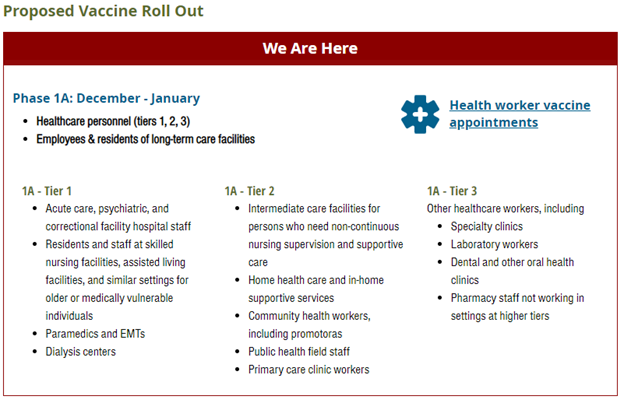
As of now, all but 1,400 of the 43,675 doses allocated in Contra Costa have been assigned to people in Phases 1A and 1B priority groups. All the doses are expected to be given within the next 14 days, Roth said.

With vaccine in limited supply now, immunizations have only been available to priority groups in high-risk settings, such as frontline healthcare workers and nursing-home residents and staff. As of Jan. 10, 30,245 doses have been administered in the county by various health providers, including Contra Costa Health Services (CCHS) and John Muir Health, as well as the federal long-term care partnership with CVS and Walgreens. Safeway and Rite-Aid are completing their registration process with the state. Safeway will begin offering shots at one location this week with additional sites coming on board in the next two weeks.

Contra Costa County Deputy Health Officer and COVID Operations Chief Dr. Ori Tzvieli asked for the public to be patient as health systems build capacity to keep up with the flow of vaccine supply and meet demand.

“We continue to redirect every resource available to getting shots in arms,” Dr. Tzvieli said. “At the same time, we are developing partnerships and networks that will ensure every pharmacy and healthcare provider in the county can provide the vaccine as more and more people are eligible to receive it.”

The County has opened several vaccination sites across Contra Costa at health centers and other large facilities to vaccinate eligible individuals, and we are opening more sites every week. CCHS has also begun shifting staffing from COVID testing sites to vaccination efforts to increase capacity. We also have activated our volunteer Medical Reserve Corps to give vaccine, and the health department is working with fire agencies to use paramedics to administer vaccine.

County health departments aren’t the only ones who are stepping up. Private health systems such as Kaiser, Sutter and John Muir Health — who are the primary healthcare providers for the vast majority of Contra Costa residents – are all scaling up their efforts to vaccinate their own members and let them know when it’s their turn. Pharmacies are also coming online to provide vaccinations as more people become eligible. CVS and Walgreens are already vaccinating those living in long-term care facilities and their staff.

About 900,000 Contra Costa residents will be eligible for vaccine once the County reaches Phase 2 of the distribution plan. To reach community-immunity levels, 75% of those eligible (725,000 people) would need to be vaccinated in the county. In order to immunize 725,000 people over the next six months (104 business days), roughly 7,000 people will need to be vaccinated every business day on average. That will require a significant boost in vaccinations from current levels. During the first few weeks since a vaccine became available in mid-December, 30,245 shots have been given – about 1,200 a day.