Learn the ABC & D’s of Medicare at TreVista Antioch Oct. 23
Tuesday, October 5th, 2021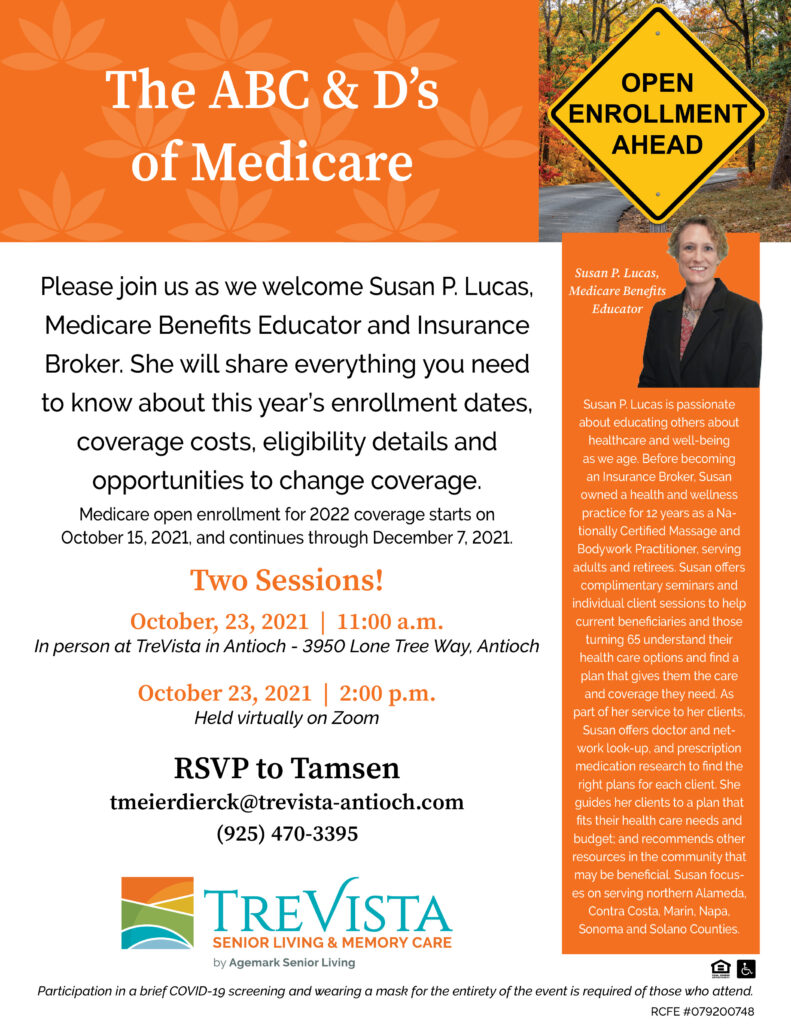












ANTIOCH, Calif. – Citing massive understaffing, difficult working conditions, and a series of unfair labor practices, more than 350 healthcare workers at Sutter Delta Medical Center in Antioch will strike next week. Workers will walk off the job and onto the strike picket line at 5 a.m. on Monday, October 4th.
Employees at Sutter Delta Medical Center say conditions are dire for caregivers and patients inside their facility as management ignores concerns about understaffing and working conditions. Workers are worried about patient and staff safety and say they’ve been pushed to the limit by their employer.
“We’re drowning. There’s just not enough staff,” said Jennifer Stone, an emergency room technician at Sutter Delta Medical Center. “We’re wearing too many hats – we’re talking down angry COVID patients, then we’re rushing to a code, then we’re talking to family members who just lost a loved one. We can’t give adequate care. We feel like management is ignoring our concerns and is leaving us to fend for ourselves. We can’t do it all anymore.”
Workers at Sutter Delta Medical Center say staffing shortages predate the COVID-19 pandemic and, as a result of years of poor staffing and management decisions by Sutter, the hospital already didn’t meet adequate staffing for average patient levels. Frontline caregivers say COVID exacerbated this already strained infrastructure, and their employer’s response to the pandemic has only worsened the preexisting crisis.
WHAT: Caregivers in their uniforms will walk off the job joined by their coworkers and supporters, including SEIU-UHW President Dave Regan. Later, caregivers in their uniforms and scrubs will form picket lines, hold signs, chant, and give speeches.
WHEN: MONDAY, October 4 5 a.m. Walkout 11 a.m. Speaking program
WHERE: Sutter Delta Medical Center, 3901 Lone Tree Way (main entrance), Antioch
SEIU-United Healthcare Workers West (SEIU-UHW) is a healthcare justice union of more than 100,000 healthcare workers, patients, and healthcare activists united to ensure affordable, accessible, high-quality care for all Californians, provided by valued and respected healthcare workers. Learn more at www.seiu-uhw.org.
Sutter Health Responds
Sutter Delta Medical Center received a strike notice from SEIU in late September. In response a Sutter spokesperson issued the following statement.
“We received notice that SEIU intends to strike for five days at Sutter Delta Medical Center in Antioch beginning October 4. We are disappointed union leaders have chosen to distract from patient care by taking this action, especially at a time when we should be focusing our attention on caring for our community.
The union has proved its disregard for our patients and communities by engaging in a strike while refusing to make a good faith effort to reach a deal. In fact, Sutter Delta negotiators twice offered to work with a neutral federal mediator and the union refused –twice. It’s a clear statement that the union is more interested in flexing its political power than reaching a fair agreement on behalf of its members.
We stand by our offer, and SEIU should too: they negotiated this contract, were confident enough to place it on a ballot, and it was recently approved by more than 3,000 employees at seven other SEIU-represented hospitals across our system.
We value our caregivers and their continued commitment to compassionate patient care in the face of an unprecedented health crisis, which is why our proposed contract guaranteed pay and benefits that are as good or better than others in the area:
o 13% salary increase over four years: 3% yearly salary increases each year for 3 years and a 4% increase in year 4
o 100% employer paid health coverage for employees and their families.
o Funding to support access for our employees to education, credentialing and growth opportunities and creates a pipeline for new hires.
We will continue to focus on our patients, as always, despite the union’s strike. Regardless of the union’s actions, our commitment to providing our patients with high-quality, safe patient care remains unchanged.”
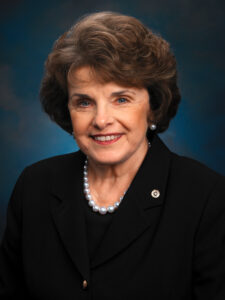
U.S. Senator Dianne Feinstein. Official photo
Washington—Senator Dianne Feinstein (D-Calif.), on Wednesday, introduced the U.S. Air Travel Public Safety Act, a bill that would require all passengers on domestic airline flights to either be fully vaccinated, have recently tested negative for COVID-19 or have fully recovered from COVID-19.
The bill would require the Secretary of Health and Human Services, in consultation with the Federal Aviation Administration, to develop national vaccination standards and procedures related to COVID-19 and domestic air travel in order to prevent future outbreaks of the disease.
The bill would also require the CDC’s Advisory Committee on Immunization Practices to make recommendations for COVID-19 vaccine use in health care settings and among health care personnel in other settings.
The legislation builds on a current CDC requirement that all air passengers traveling to the United States from a foreign country must provide proof of a negative COVID-19 test result or documentation of recovery from COVID-19. Last week, the Biden administration announced it will work with airlines to implement additional protocols to prevent the spread of COVID-19 on international flights.
“We know that air travel during the 2020 holiday season contributed to last winter’s devastating COVID-19 surge. We simply cannot allow that to happen again,” Feinstein said.
“Ensuring that air travelers protect themselves and their destination communities from this disease is critical to prevent the next surge, particularly if we confront new, more virulent variants of COVID-19. This bill complements similar travel requirements already in place for all air passengers – including Americans – who fly to the United States from foreign countries. This includes flights from foreign countries with lower COVID-19 rates than many U.S. states.
“It only makes sense that we also ensure the millions of airline passengers that crisscross our country aren’t contributing to further transmission, especially as young children remain ineligible to be vaccinated.”
The bill is supported by the Infectious Diseases Society of America and the American Public Health Association.
Dr. Barbara D. Alexander, president of the Infectious Diseases Society of America and professor of medicine and pathology at Duke University School of Medicine said: “Vaccination is a critical strategy to end the COVID-19 pandemic, and vaccination requirements in multiple settings are an important mechanism to boost vaccination rates, prevent infections and hospitalizations and save lives. The Infectious Diseases Society of America supports Senator Feinstein’s legislation to require vaccination for domestic air travel as part of our nation’s broader COVID-19 vaccination strategy.”
Background
To contact the senator’s office, visit Contact – United States Senator for California (senate.gov).
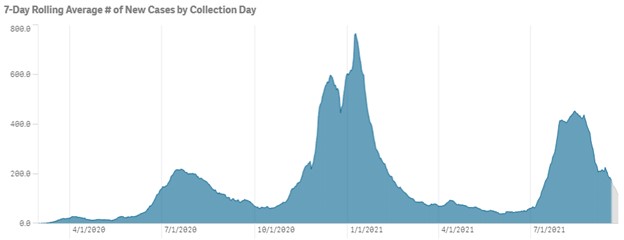
7-Day Rolling Average Number of New Cases in Contra Costa County April 1-Sept. 19, 2021. Source: CCC Health Services
By Allen Payton
The statistics on the Contra Costa Health Services Coronavirus Dashboard show COVID hospitalizations and cases in the county were already declining before the new health orders by county health officer, Dr. Chris Farnitano, issued them on Sept. 14. While the data trails the report by seven days, as the dashboard states, “data from the last 7 days is still being reported”, all the COVID-related stats continued to decline before the orders went into effect last Wednesday, Sept. 22.
The press release from CCHS on Sept. 15 read, “While the peak of the surge seems to have passed.” But the statistics showed it had passed. (See related article)
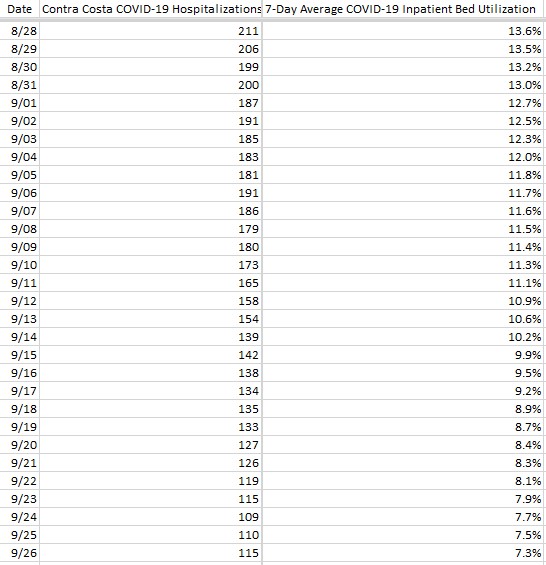
Total Contra Costa County Hospitalizations of COVID patients and percentage of all patients Aug. 28-Sept. 26, 2021. Source: CCHS
Hospital Bed Utilization
The 7-Day Average COVID-19 Inpatient Bed Utilization in the county decreased from 11.5% on Sept. 8 to 9.9% by the time the orders were issued on the Sept. 15. That continued to decrease to 8.1% on Sept. 22. They have continued to decrease through Sunday to 7.3% and were on the decrease since Aug. 28 when the percentages were first included in the stats, from 13.6%.
The statistics also show the percentage of COVID inpatient beds to Contra Costa Total Hospitalizations has decreased from a high of 19.4% on Sept. 6 to 10.7% on Sunday, Sept. 26.
In addition, of all the inpatient ICU beds in the county, about one-third have been filled by COVID patients has decreased from a high of 46% to 29% between Aug. 28 and Sept. 26.
New Cases
The Seven Day Rolling Average number of new COVID cases in the county peaked on Sept. 10 at 217.3, almost two weeks before the new health orders went into effect on Wed., Sept. 22.
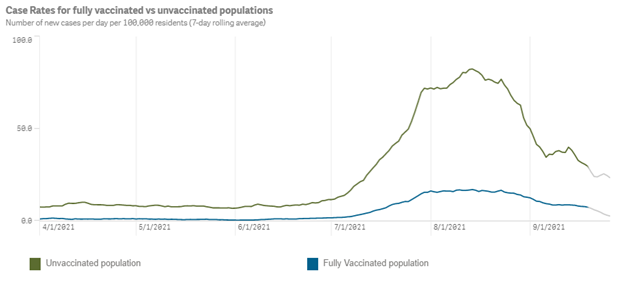
Contra Costa County Case Rates per 100,000 vaccinated vs unvaccinated April 1 – Sept. 19, 2021. Source: CC Health Services
Case Rates
The Case Rates for unvaccinated people in the county at 40 per 100,000 population and fully vaccinated people at 8.7 peaked on Sept. 13, one day before the new health orders were issued. Both continued to decline through Sept. 19 to 29.6 and 7.4 respectively, three days before the orders went into effect.
Questions for Farnitano & CCHS Staff
In light of that information, Farnitano and health services staff were asked the following questions via email Monday evening: “Why are the latest orders still in place? Are you willing to lift them, now? If not, what else must occur for that to happen?”
Response From CCHS Staff
Karl Fischer, Contra Costa Health Services spokesman responded, “For the past few weeks Contra Costa County’s COVID-19 transmission data have been trending in the right direction after a severe, sudden spike in new cases, hospitalizations and deaths earlier this summer.
It’s also true that county data remain elevated since that spike, far above where they were when California relaxed its health orders in mid-June. As the press release you quoted correctly points out, our average daily case rate is similar to what we were recording in February, on the downslope of another severe spike. That information is also available on the dashboard.
It is no accident that our county is now trending in the right direction.
COVID-related public health measures, including recent health orders requiring people to wear masks when visiting indoor public spaces and show proof of vaccination or a recent, negative test result to enter the indoor parts of some high-risk public establishments, are helping to reduce transmission of the virus in our county.
For example, on Aug. 3, the day our indoor masking health order took effect, the 7-day average number of daily new COVID-19 cases reported in our county was 412. One month later, on Sept. 3, that number had dropped to 245.9.
We hope to see similar improvement in coming weeks from the most recent health order, which took effect just last week. But, as I mentioned, we are a long way from the levels of community transmission we experienced in spring, when the state briefly seemed to be emerging from the pandemic.
With winter approaching, a season where the spread of respiratory viruses such as COVID-19 is common, we are doing everything we can to prevent another severe surge, most importantly working to increase vaccination rates across our community – to save lives, keep our schools and businesses open, and our hospitals functioning.”
However, as the Dashboard shows, Contra Costa County was already trending in the right direction” two weeks before the new health orders went into effect.
Additional Questions
An additional question was sent late Wednesday afternoon, asking, “since Contra Costa was already significantly trending in the right direction through not just Sept. 3 but it continued through Sept. 22, with just the indoor mask-wearing order, why the need for the additional proof of vaccination or testing mandate? Is it an effort to pressure the unvaccinated to get vaccinated by taking away more of their freedoms?”
09/30/21 UPDATE: CCHS spokesman, Karl Fischer responded, “Contra Costa has made significant progress in lowering the number of new reported cases and hospitalizations in recent weeks. But, as I mentioned in my last response, our transmission data are still substantially far above the levels considered safe by the State of California when it lifted its health order on June 15.
I know you are aware of this information, as it is available on our public dashboard, but our 7-day rolling average number of daily new COVID-19 cases was 152.9 on Sept. 22, compared to 45.3 on June 15. Per capita, on June 15 we averaged 1.5 daily new hospital admissions due to COVID-19 for unvaccinated people, compared to 5.5 on Sept. 22. Contra Costa has a long way to go before it reaches the transmission levels the state considered just safe enough to reopen, just three months ago.
Contra Costa is committed to doing everything in its power to reduce COVID-19 transmission as quickly and effectively as possible – lives depend on it. That is why the county this month added a new, temporary requirement for patrons using the indoor areas of certain establishments where the virus is at high risk of spreading to show proof of vaccination at the door, or a recent, negative test result.
We believe this health order will help our community continue its progress reducing COVID-19 transmission, perhaps even accelerate it, and it may also help to head off another massive holiday surge in cases, hospitalizations and deaths, like the one we experienced last winter.
We encourage anyone who is eligible to get vaccinated. Our transmission data are now slowing down thanks to the 80%+ of county residents who have already chosen to get vaccinated, and the willingness of the majority to temporarily endure inconvenience so we all may eventually enjoy living in a community where there is no elevated risk of contracting a deadly but highly preventable disease.
Why No Recovery Documentation Option in Contra Costa?
On Wednesday, U.S. Senator Diane Feinstein (D-CA) on Wednesday, introduced the U.S. Air Travel Public Safety Act, a bill that would require all passengers on domestic airline flights to either be fully vaccinated, have recently tested negative for COVID-19 or have fully recovered from COVID-19. According to her office’s press release, “the legislation builds on a current CDC requirement that all air passengers traveling to the United States from a foreign country must provide proof of a negative COVID-19 test result or documentation of recovery from COVID-19.”
In response, the additional questions were sent to CCHS staff: “Why isn’t that last option, recovery documentation, being offered to people in Contra Costa to comply with the latest health orders if it’s allowed to be used for people traveling into our country? They aren’t even required to provide proof of vaccination. But we Americans do to participate in something that takes much less time than an international flight. Their plane trips are much longer than an hour which is usually the length of time it takes to have an indoor, sitdown meal. If that’s the science the federal government is following, why isn’t the CCHS also following it?”
Fischer replied, “Contra Costa Health Services did not include a provision for proof of prior infection in the Sept. 14 health order because, in our analysis of available research, we determined that the science remains unsettled around the efficacy or duration of natural immunity following a COVID-19 infection. We do have a better understanding of immunity provided by the available COVID-19 vaccines, thanks to the extensive clinical trials performed to ensure their safety and efficacy before they were made available to the public, and their performance in protecting millions of people worldwide this year.
While it’s true that someone who has COVID-19 must wait 90 days after their infection ends before testing again, they can receive COVID-19 vaccine as soon as their isolation period ends. So, in no case are patrons left without options for using the indoor portions of establishments affected by this order.”
Those who choose not to get the vaccine for one reason, or another will have to take a test and prove negative within three days each time they want to dine indoors at a restaurant, go to the gym, a bar, to the movies or another entertainment venue, such as a bowling alley.

By Antonia Ehlers, PR and Media Relations, Kaiser Permanente Northern California
OAKLAND, CA – For the sixth year, Kaiser Permanente Northern California’s Medicare health plan is rated 5 out of 5 stars, making it the highest rated plan in the region – and among the highest rated in the country.
In the National Committee for Quality Assurance (NCQA) Health Plan Ratings 2021, published today, Kaiser Permanente’s Medicare health plan in Northern California received 5 stars and its commercial health plan received 4.5 stars. Kaiser Permanente’s Southern California region received the same ratings – making the two plans among the highest rated in California and the nation.
“Kaiser Permanente continues to be recognized nationally for what matters most to our members and patients: high quality care and exceptional service,” said Carrie Owen Plietz, FACHE, president of Kaiser Permanente’s Northern California region. “We are proud to be a leader in health care delivery and these ratings, which are so consistent over time, demonstrate our commitment to putting our patients and their health at the center of all we do.”
“This recognition is a tribute to the dedication and expertise of our highly-skilled physicians, nurses, and staff,” said Richard S. Isaacs, MD, FACS, CEO and executive director of The Permanente Medical Group. “Through our innovative, personalized, and technologically advanced approach to health care, we continue to transform care delivery while having a positive and often life-changing impact on the health and well-being of our members and patients.”
NCQA analyzed over 1,000 health plans in the nation – private, Medicare, Medicaid – for quality and service. Only 17 health plans in the country, or about 1.6 percent, were rated 5 out of 5 stars. In all, Kaiser Permanente has six of those highest rated plans.
NCQA is a national, private not-for-profit organization that surveys health plans for performance in a wide range of clinical service measures including consumer experience, prevention and treatment. All Kaiser Permanente health plans were rated 4 stars or higher. For the sixth year in a row, all Kaiser Permanente Medicare health plans were rated highest (or tied for the highest) in the areas they serve. Kaiser Permanente serves more than 12.5 million members in eight states and the District of Columbia.
The NCQA’s Health Insurance Plan Ratings are based on combined scores for health plans in Healthcare Effectiveness Data and Information Set®, commonly called HEDIS; the Consumer Assessment of Healthcare Providers and Systems®, or CAHPS; and NCQA Accreditation standards scores.
The ratings and methodology are posted on the NCQA’s website at www.ncqa.org.
About Kaiser Permanente
Kaiser Permanente is committed to helping shape the future of health care. We are recognized as one of America’s leading health care providers and not-for-profit health plans. Founded in 1945, Kaiser Permanente has a mission to provide high-quality, affordable health care services and to improve the health of our members and the communities we serve. We currently serve almost 12.5 million members in 8 states and the District of Columbia. Care for members and patients is focused on their total health and guided by their personal Permanente Medical Group physicians, specialists, and team of caregivers. Our expert and caring medical teams are empowered and supported by industry-leading technology advances and tools for health promotion, disease prevention, state-of-the-art care delivery, and world-class chronic disease management. Kaiser Permanente is dedicated to care innovations, clinical research, health education, and the support of community health. http://about.kaiserpermanente.org
By Daniel Borsuk
With the clock ticking, a battalion of upset Contra Costa County Fire District fire fighters remotely protested before the Contra Costa County Board of Supervisors that they refuse to obey a “draconian” August 13 Contra Costa Health Services order requiring county first responders to be fully vaccinated or face termination.
The county health order that goes into effect Friday, Sept. 17 was drafted by Contra Costa County Health Officer Dr. Chris Farnitano and adopted by the board of supervisors in a closed session because of its employment ramifications for many veteran fire fighters and sheriff deputies and other first responders who might refuse to take the vaccine for personal, political or religious reasons.
Dr. Farnitano claims the tough vaccine employment order for first responders arises at a time the number of COVID-19 patients in county hospitals is on the rise.
But a check with the Contra Costa Health Department’s COVID-19 website shows there are 154 COVID-19 patients in county hospitals. That is down 9.3 percent over the past two weeks, the CCCHD website showed.
In addition, the county health department reported 2,421 active COVID-19 cases. That is down 45.9 percent from two weeks ago.
Nearly 85 percent of Contra Costa residents are vaccinated, county health department data shows. The national vaccination rate is 73.9 percent.
The new vaccine employment edict applies to fire department and sheriff office personnel. There were no personnel from the sheriff’s office who protested against Dr. Farnitano’s vaccination/employment order.
Nearly 40 firefighters, many with more than 20 years in service, from all ranks including engineers, firefighters, and captains, protested against the county health officer’s order.
“This is an infringement of our freedom of choice,” said Collin Spencer, a fire fighter/paramedic.
Upon opposing the vaccine mandate, fire fighter Nick Sandburg, a father of two with a “pregnant wife” commented, “I don’t think the vaccine is effective. I oppose the vaccine mandate. Just give us universal testing.”
“None of us took this lightly,” said District 4 Supervisor Karen Mitchoff. “This is about protecting the public.”
District 2 Supervisor Candace Andersen was more direct commenting “I am really shocked about the misinformation that our fire fighters have about the COVID-19 vaccine. Somewhere there is a big disconnect.”
It’ll be interesting what the fire fighters will do when the Sept. 17 deadline arrives. The county could be in a major fire crisis if large numbers of well trained, experienced fire fighters are let go especially during the start of the county’s peak fire season.
In the past month, there were 206 vegetation fires that CCCFD responded to and in one day there were seven structure fires, reported Contra Costa County Fire Department Chief Louis Brousard III.
Board Supports LAFCO Consolidation of Fire Departments
Supervisors, serving as commissioners of the Contra Costa County Fire District, pushed along on a 5-0 vote to have the Contra Costa Local Agency Formation Committee (LAFCO) to act on consolidating the Contra Costa County Fire Protection District and financially struggling East Contra Costa Fire District.
ECCFD board member Joe Young told supervisors he will oppose the consolidation at the district’s board meeting on Sept. 16 because the consolidated district will continue to inadequately fund fire services in Oakley, Brentwood, and Discovery Bay. Young not elaborate at the supervisors’ meeting.
“There are a lot of details that have yet to be addressed on consolidation,” admitted CCCFPD Fire Chief Broussard. “We’ll bring leaders from both organizations to make this a successful annexation.”
While giving Board Chair Diane Burgis credit for being a key player in the merger of the two districts, District 1 Supervisor John Gioia said the newly enlarged fire district will draw fire protection upgrades especially with equipment and personnel once “millions of dollars of Proposition X sales tax funds” pour into the district. Gioia was a big backer for the Prop. X ballot measure to appear on last November’s election ballot.
A proposal to consolidate the Rodeo-Hercules Fire District into the enlarged CCCFPD was not considered by the supervisors. That proposal was dropped.

By Allen Payton

Source: The Rutherford Institute.
Shades of Nazi Brown Shirts will begin next week in Contra Costa County as patrons of restaurants, gyms and entertainment venues will hear something similar to the phrase used during World War II by the Hitler-led German regime, “Your Papers, Please!” That’s because as of Wednesday, Sept. 22, by order of the county’s unelected health officer, Dr. Chris Farnitano, those types of businesses in the county must require patrons show proof of vaccination or a recent negative COVID test in order to enter, even though “the peak of the surge seems to have passed” as mentioned in the press release from Contra Costa Health Services.
According to the press release, “The new order applies to businesses where people remove face coverings to eat or drink indoors, such as restaurants, bars and entertainment venues, and to gyms and other indoor fitness facilities, including yoga and dance studios, where patrons breathe more heavily due to exercise.”
However, the announcement doesn’t provide what percentage of COVID cases in the county can be attributed to those types of businesses, supporting the need for the order. It also doesn’t allow for those who have proof of recovering from COVID in the past three months, as they have higher levels of anti-bodies than people who have been fully vaccinated, especially those who received their shot or shots five to eight months ago.
The order was issued Tuesday afternoon in the following press release:
COVID-19 Proof of Vaccination or Test Required for Some Contra Costa Businesses
Contra Costa County joined San Francisco, Berkeley and other communities across the U.S. today with a countywide health order that increases COVID-19 safety in restaurants, gyms and other indoor businesses where there is elevated risk of the virus spreading.
The new order, effective September 22, requires patrons of these businesses to show proof they are fully vaccinated to enter indoor areas, or a negative COVID-19 test result from the past three days.
Contra Costa has endured a severe spike in COVID-19 cases and hospitalizations this summer due to the increasing prevalence of the highly infectious delta variant of the virus and unvaccinated residents.
While the peak of the surge seems to have passed, data show the county’s daily case rate remains as high as it was last February. There were 15 COVID-related deaths in Contra Costa from August 25 to 31, and 20 from September 1 to 7, the two highest seven-day totals since March. Unvaccinated residents account for 95.9% of the county’s deaths so far.
COVID-19 case rates are about five times higher in unvaccinated county residents compared to fully vaccinated residents, hospitalization rates are approximately 16 times higher, and death rates are approximately 22 times higher.
“This order is necessary now to save lives, protect our overburdened healthcare system, and slow the pandemic enough to keep our schools open,” said Dr. Chris Farnitano, Contra Costa County Health Officer. “Reducing community transmission of the virus now is key to preventing future spikes in cases from overwhelming our county’s hospitals during the winter months.”
The new order applies to businesses where people remove face coverings to eat or drink indoors, such as restaurants, bars and entertainment venues, and to gyms and other indoor fitness facilities, including yoga and dance studios, where patrons breathe more heavily due to exercise.
The order also includes a requirement for workers in indoor areas of these businesses to show proof of full vaccination against COVID-19 by November 1 or test weekly for COVID-19.
To show proof of vaccination, patrons must show photo ID and their vaccination record cards from the Centers for Disease Control & Prevention (CDC), or copies or pictures of their cards. Documentation from healthcare providers will also be accepted, as will digital COVID-19 vaccine records issued by the State of California.
Visit myvaccinerecord.cdph.ca.gov for a link to your digital vaccination, which can be downloaded on to your smartphone.
Visit cchealth.org/coronavirus for more information about this health order, or to find a safe, fast and free COVID-19 vaccination in Contra Costa County.
###
Restauranteurs Respond
Restaurant owners in the county responded to the news with frustration. “How is it our responsibility to be the vaccine police!!” shared one owner who chose to remain anonymous.
“Kiss the restaurants good-bye,” said another, also anonymously.
However, another restaurant owner said anonymously, “We need to contribute to the pandemic to get better.”
Questions For Health Services
In response, questions were sent to county health services staff asking, “what percentage of COVID cases in the county can be attributed to restaurants, indoor entertainment venues and gyms, please?”
In addition, they were asked, “why not include what other countries are requiring for those who want to travel there, which is proof of having COVID within the past three months, since those folks have higher levels of antibodies than those who have been vaccinated, especially those who have been five to eight months ago?”
9/16/21 UPDATE: No Percentages of Impact from Affected Businesses
Contra Costa Public Health Services spokesman Will Harper responded with the following: “We can’t give you an exact percentage of cases that can be attributed to restaurants and the other high-risk venues covered in the order. Due to the nature of these businesses, it is not always possible to identify all the patrons who were exposed and infected by a case at one of these sites. What we can say is that indoor settings where people remove their masks, such as restaurants and bars, or where they breathe heavily, such as in a gym, increase the risk of COVID-19 transmission. As the order states, outbreaks have been documented in bars, gyms, and restaurants in California this year.
Currently there is no scientific consensus on the strength or duration of natural immunity after a covid-19 infection, or how reliably to measure this. For now, we felt most confident in requiring proof of vaccination. Vaccination is still recommended for people who have had Covid-19 to boost their immunity and protect them from a repeat infection from Covid-19. We have clear data showing that vaccinated people are more protected the unvaccinated people, regardless or prior Covid-19 infection history.”
9/17/21 UPDATE: No “Metric” for Ending Latest Order, County Wants “Significant Portion” of 5-11 Year Olds Vaccinated
A follow up question was sent asking what factors Dr. Farnitano will use to determine when this latest order will end.
Harper responded, “While we have not defined a specific metric at this time, the key measures we will be looking at to inform when it is safe to lift indoor masking requirements and venue verification and test requirements include the impact on our health care system (have our Covid-19 hospitalization and ICU levels returned to June, 2021 levels), the impact on schools (are significant numbers of students missing out on classroom time due to illness, isolation and quarantine) and our community vaccination rates (which will be crucial to preventing another surge if other public health measures are relaxed), especially if we are able to vaccinate a significant portion of the 5-11 year old population once the vaccines are approved for them. California learned an unfortunate lesson that the vaccination rates we had in June were not sufficient to prevent a serious surge without other interventions like indoor masking in place.”
Additional Questions Go Unanswered
Additional questions were sent to Harper, asking, why do you want to vaccinate a significant portion of the 5-11 population when such a minuscule percentage of that age group are contracting the virus and a much smaller number have died?
In addition, he was asked about one of his previous responses, how can it both be that “Currently there is no scientific consensus on the strength or duration of natural immunity after a covid-19 infection, or how reliably to measure this” and “We have clear data showing that vaccinated people are more protected than unvaccinated people, regardless of prior Covid-19 infection history”?
Please check back later for any other updates to this report.
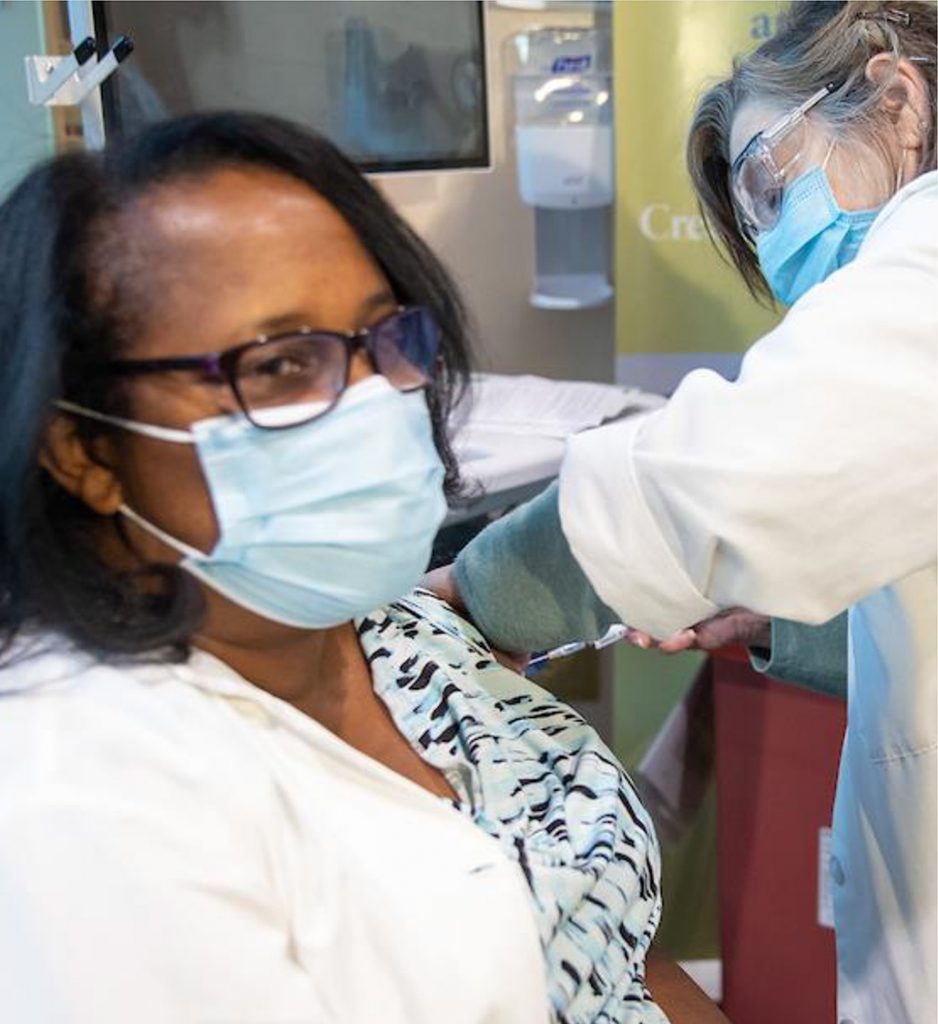
Photo courtesy of CC Health Services.
 By Allen Payton, Publisher
During their meeting Tuesday night, the Antioch City Council will consider approving a “COVID-19 Mandatory Testing and Vaccination Policy” for all city employees, contractors and volunteers. It would require they get one of the COVID-19 vaccines or undergo weekly testing. According to the city staff report for the agenda item, “During the August 24, 2021 City Council meeting, the City Council directed staff to return to Council with a resolution…with costs borne by the City, time to do so would be limited to a certain duration, and the policy would include a start and end date.” (See agenda Item 13)
It was proposed by Mayor Lamar Thorpe during a press conference in August and supported by him, and all council members except District 2 Councilman Mike Barbanica.”
That was in spite of the fact that two of the council members, Districts 1 and 3 Councilwomen Tamisha Torres-Walker and Lori Ogorchock spoke against a mandate, during that meeting, before voting to support it.
Don’t Know Costs, Yet
Also, according to the staff report the city doesn’t even know, yet what the cost of such a mandate will be. It reads, “Costs related to this policy are unknown at this time. Costs may include, but may not be limited to, the cost of weekly testing, the cost of a third part to administer the test, mileage, loss in productivity.”
Wait for Lawsuits Over Other Mandates to Be Settled
Multiple lawsuits are expected to be filed against President Biden’s national mandate he just issued in an executive order, last week. According to the New York Post, “Larry Cosme, president of the Federal Law Enforcement Officers Association, issued a statement Thursday calling the mandate unnecessary, overbearing and counterintuitive.
‘This executive order villainizes employees for reasonable concerns and hesitancies and interest the federal government into individual medical decisions,’ Cosme said. ‘People should not be made to feel uncomfortable for making a reasonable medical choice.’”
There has also been a lawsuit filed “by a slew of unions” against Mayor DeBlasio for his mandate in that city.
Antioch council members should hold off for the results of those lawsuits before opening up our city to legal challenges and costs.
Violates Health Privacy – Were City Employee Groups Consulted?
Questions were sent to city staff, early Monday afternoon asking, “Have city staff met with the various employee groups to meet and confer on the proposed ordinance for mandating COVID-19 vaccines or weekly testing? If so, what were the results of those meet and confer meetings? Do their contracts need to be amended? If so, did all the groups agree to that?”
They were also asked, “isn’t this a violation of privacy of city employees, contractors, and volunteers, specifically with regards to their health and medical care, since they have to reveal to other city staff members if they’ve had a specific medical treatment or not?”
APOA Requests for Meet and Confer Ignored
Corporal Steve Aiello, Vice President of the Antioch Police Officers Association said there’s been no meet and confer, yet for his organization.
“On two occasions the APOA has reached out to the city, to (Administrative Services Director) Nickie Mastay in personnel and requested a meet and confer,” he stated. “But there’s been no response.”
“It’s a work condition change,” Aiello added as the reason a meet and confer is required.
Additional questions were then sent to City Manager Ron Bernal, after Monday work hours with, “Ron, I just spoke with Steve Aiello of the APOA. He said they’ve sent two email messages to Nickie Mastay requesting a meet and confer on the vaccine and testing mandate, but she has not responded. Is that correct? If so, why not? He said it’s required since it’s a change to their work conditions. Is that true? If so, shouldn’t the APOA and all the city’s employee groups have a meet and confer on the mandate before the council takes a vote?” As of 6:30 p.m. he has not responded to either the emailed nor texted questions, nor has City Attorney Thomas Lloyd Smith.
Please check back later for their responses should they provide them.
Painful Weekly Testing Alternative, Punishment for No Vaccine, One Test Ineffective
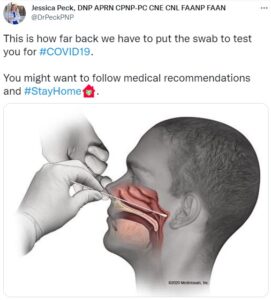
Nurse’s tweet of COVID test graphic.
While the proposed policy includes an alternative for weekly testing for those employees, contractors and volunteers who choose to not take a vaccine, have any of the council members been tested? Do they know how painful it is having those swabs scrape the back of your nose and throat? If not, all four should undergo that, first to see what they’re planning on subjecting our city employees, contractors and volunteers to that weekly pain, before voting to mandate it as one of the two options.
According to a New York Times report, “If you’ve seen the test (there are plenty of Instagram videos), then you know it looks as if someone is poking your brain: A swab is inserted deep in through your nostrils…The test itself is quick — only a few seconds — but most describe the sensation as highly uncomfortable.”
According to a Newsweek report, “’This test being demonstrated is a nasopharyngeal swab or NP swab collection. It uses a small flocked swab on a flexible plastic shaft to collect a sample from the posterior nasopharynx,’ Wesley Long, a microbiologist from Houston Methodist Hospital, told Newsweek. ‘Nasopharynx’ is a term that refers to the back part of your nose where it joins the throat.”
I watched as my son get a COVID test last year, and he winced when they put those long swabs up his nostrils. Then I had a test recently and now I know why he winced. I did, too. Ouch, two times! So, basically, that part of the mayor and council majority’s mandate would effectively serve as punishment for those employees, contractors and volunteers who won’t take the vaccine.
Plus, one of the COVID-19 tests that has been in use since February 2020 has been determined ineffective and discontinued by the CDC – but not until Dec. 31, 2021 for some unknown reason – because it can’t tell the difference between the virus and the flu. Yet, those test kits are still being used. The CDC has requested that a new test be developed. The council should wait on that, as well.
Dangerous Side Effects of Vaccines, Other Medical Conditions, Religious Exemption
I’m not going to get into all the details of the fact that there are good reasons for people who don’t want the vaccines due to all their dangerous side effects, have other medical conditions that prevent them from taking the vaccine or have a fundamental religious conviction for not wanting the jab.
Vaccines Still in Clinical Trials, Mandate Violates Nuremberg Code
Plus, all three of the vaccines are still undergoing clinical trials one until Nov. 1, another until 2023 and the third until 2024! (See Moderna Dose-Confirmation Study to Evaluate the Safety, Reactogenicity, and Immunogenicity of mRNA-1273 COVID-19 Vaccine in Adults Aged 18 Years and Older here, Pfizer-BioNTech COVID-19 BNT162b2 Vaccine Effectiveness Study here, and Janssen-Johnson & Johnson Study of (COVID-19) in Adults here)
So, they’re still experimental and therefore such a mandate clearly violates the Nuremberg Code which was established after World War II in response to the Nazis experimenting on the Jews during the Holocaust and others. It prohibits medical experimentation on humans without their consent.
According to the National Institutes of Health website the first lines read, “The Nuremberg Code 1. The voluntary consent of the human subject is absolutely essential.”
CDC – “Effective Therapeutics Are Available”
According to the CDC’s website under the subheading, “SARS-CoV-2 Monoclonal Antibody Therapies” it reads, “In the United States, there are three anti-SARS-CoV-2 monoclonal antibody treatments with FDA Emergency Use Authorization (EUA) for the treatment of COVID-19: bamlanivimab plus etesevima, casirivimab plus imdevimab, and sotrovima.” In addition, the CDC website reads, “effective therapeutics are available.”
The only public mention of monoclonal antibody therapies by the government or major media that I’ve read or heard has been about what Florida Gov. Ron DeSantis is doing in his state to offer it to his state’s residents at multiple locations. Yet, the CDC’s website offers treatment recommendations and guidelines for administering the alternative therapies.
According to a report by CBS4 Miami, “Monoclonal antibody treatments can be prescribed by health care providers to individuals 12 years of age and older who have been diagnosed with COVID-19 or who have been exposed to someone with COVID-19 and are at high risk for severe illness and hospitalization.”
Council Should Wait
For these reasons and more, the council should wait to approve the testing and vaccine mandate policy. In the meantime, just follow the current CDC guidelines and if a city employee, contractor or volunteer is experiencing COVID symptoms, the must stay home and self-quarantine for 10 days.
However, if the council insists on moving forward with their mandate, they must include the three effective therapies in their policy, so employees who don’t want the vaccine will have an alternative to painful, weekly testing. Otherwise, they’re acting like they’re medical experts, and worse, Nazis, not following the science, the CDC or FDA, nor abiding by the Nuremberg Code and giving OUR city employees – because they work for and are paid by we the people – all the options available to them.
Proposed Policy
Following is the language for the proposed policy resolution:
RESOLUTION NO. 2021/**
RESOLUTION OF THE CITY COUNCIL OF THE CITY OF ANTIOCH ADOPTING A COVID-19 TESTING AND VACCINATION POLICY
WHEREAS, the City has an interest in protecting the health, safety, and welfare of City personnel, community members with whom City personnel interact, and all residents and visitors of the City;
WHEREAS, many City employees come in close contact with members of our community as part of their daily job duties and this often includes members of our community who are unable to receive the COVID-19 vaccine at this time, such as children under the age of twelve, or those with medical conditions contraindicated for the vaccine;
WHEREAS, all City of Antioch employees are designated to be Disaster Service Workers under California Government Code sections 3100-3109 and are required to return to work during an emergency;
WHEREAS, all City employees shall either be vaccinated for COVID-19 or be subject to weekly COVID-9 testing requirements; and
WHEREAS, this policy is an effective way to ensure that City personnel do not pose harm to the public or other employees.
NOW, THEREFORE, BE IT RESOLVED by the City Council of the City of Antioch as follows:
Section 1. The COVID-19 Testing and Vaccination Policy shall address: vaccinations; weekly testing for City employees and contracted personnel at the City’s expense for a specified duration that commences on October 1, 2021.
Section 2. Policy implementation shall be administratively executed by the City Manager and incorporatee any applicable Federal, State and local policy directives on an ongoing basis.
Hundreds of Sutter Delta healthcare workers to strike citing short staffing, unfair labor practices
Sunday, October 3rd, 2021Contra Costa health data show COVID cases were on decline before new health orders issued
Wednesday, September 29th, 2021Kaiser’s Medicare plan receives highest rating for the 6th year
Saturday, September 18th, 2021Fire fighters protest COVID-19 vaccine mandate at Contra Costa Supervisors meeting
Thursday, September 16th, 2021Contra Costa restaurants, gyms, theaters must require proof of vax or COVID test as of Sept. 22
Tuesday, September 14th, 2021















© 2026 Antioch Herald - Entries (RSS) - Comments (RSS) - Log in
Theme design by Christian Gnoth - 