Archive for the ‘Health’ Category

Contra Costa Supervisor Burgis recovering after successful pacemaker implant

Saturday, October 23rd, 2021

Second surgery in past three years to address heart defect since birth

By Mark Goodwin, Chief of Staff, Supervisor Diane Burgis

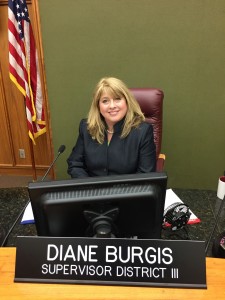
Supervisor Diane Burgis. Herald file photo.

Contra Costa County Board of Supervisors Chair Diane Burgis is recovering at home following successful surgery to implant a pacemaker as a precaution to help steady an irregular heartbeat. Doctors discovered the irregular heartbeat during a series of routine preventative medical visits.

In a post on her Facebook page on Friday, Burgis, who remarried earlier this year, wrote, “All is good! Had a pacemaker put in this week. I am home recovering. Thanks for all the well wishes.”

The surgery went very smoothly, and while she will need to take it easy for a few weeks during recovery, she will not skip a beat in fulfilling the duties of her office. The residents of Contra Costa County, particularly those in District 3, will continue to receive the same high level of service, sound decision-making, and representation they depend on and deserve.

Since birth, Supervisor Burgis has been living with a congenital heart defect and was diagnosed with aortic stenosis, a narrowing of the aortic valve, and had a successful valve replacement surgery in February 2019.

She thanks the medical team at Kaiser Medical Center in Walnut Creek and her physicians for their care and encourages everyone to keep up with their regular medical visits, especially during the continuing COVID-19 pandemic.

“If I hadn’t gone in for my routine preventative appointments, I wouldn’t have known that my heart was not doing its job to its full capacity,” Burgis observed. “Throughout the COVID-19 pandemic, I have been encouraging people to keep up with their regular exams and tests rather than waiting to get medical care. I’m glad that I followed my advice.”

Cards and well wishes may be sent to the supervisor at her main office, 3361 Walnut Blvd., Suite 140, Brentwood, CA 94513.

Burgis represents District 3, the largest of the five Contra Costa County Board of Supervisor districts, including Bethel Island, Brentwood, Byron, Discovery Bay, Knightsen, Oakley and parts of Antioch in Eastern Contra Costa County, and Blackhawk, Diablo, and Tassajara Valley in the San Ramon Valley portion of the district.

Allen Payton contributed to this report.

Antioch hires social justice organization to develop non-emergency crisis response system, survey residents

Monday, October 18th, 2021

Expertise is in data gathering, but no experience developing a program; recruiting workers at $20 per hour for survey; focus is on people of color and impoverished residents

By Allen Payton

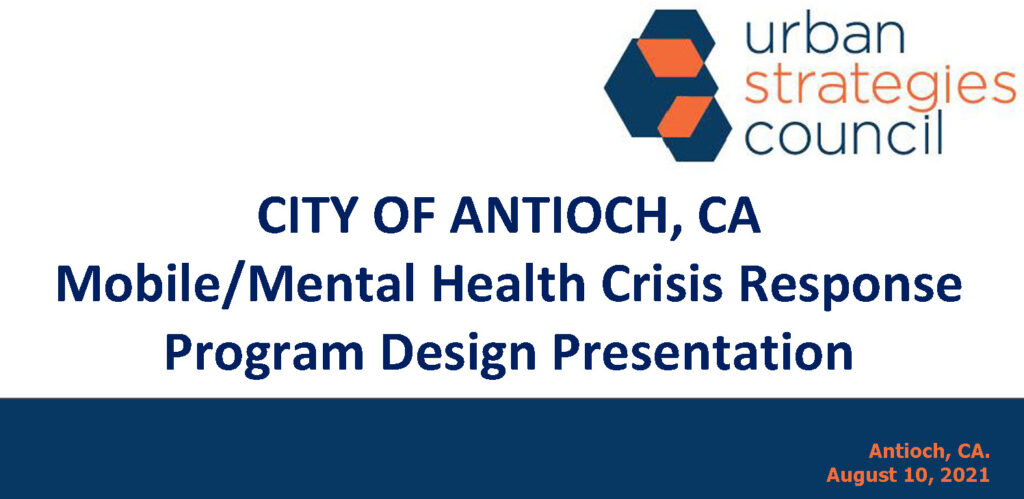
During the August 10th Antioch City Council meeting Urban Strategies Council (USC), a-not-for-profit social justice organization, was introduced and hired to design a mobile, mental health crisis intervention model for the City of Antioch, to address non-emergency calls using well-trained community respondents. Urban Strategies Council presentation ACC081021

According to city staff, some calls to 911 and the City’s non-emergency number are for situations that do not need a police officer to respond. To develop Antioch’s program public feedback is needed. USC is collecting input from Antioch residents who have experience with the 911 system or feedback on how the City addresses non-emergency 911 calls and community needs. This survey aims to understand community needs from the voice of the people most impacted.

According to USC’s presentation to the city council, the community resident survey is “focusing on most impacted residents – African-American, Asian-Pacific Islander, Latinx (Latino/Hispanic).” The presentation also shows they plan to have a pilot program developed by the end of this month.

According to Assistant City Manager Rosanna Bayon Moore, “USC is in the process of outreach for the City’s program design phase.  A survey is one of the many ways they are collecting information to inform the program design.”

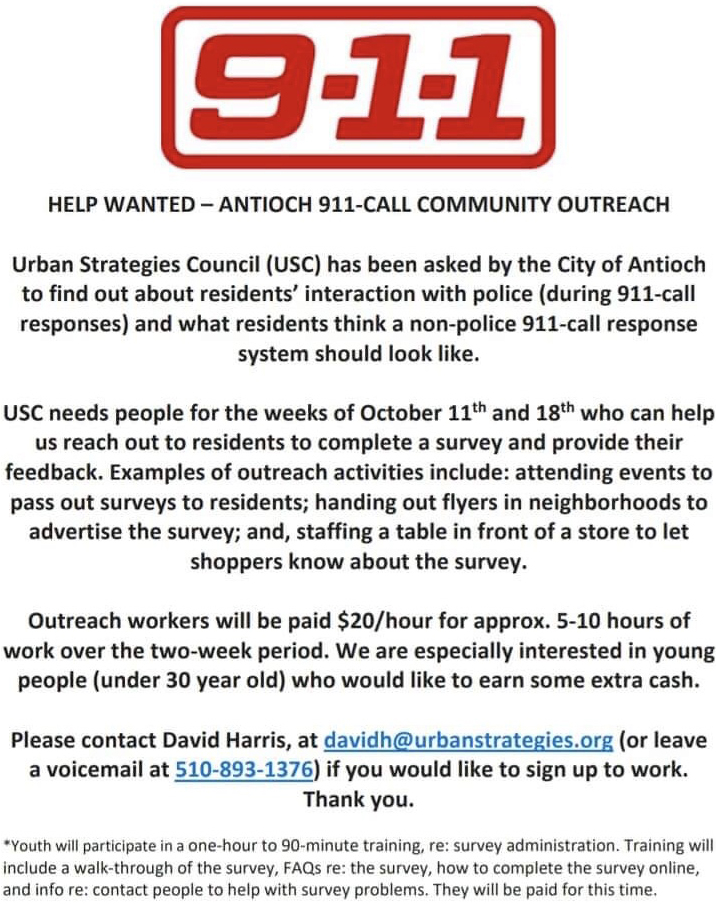
USC has been recruiting workers to help with the survey, offering to pay $20 per hour this past week and next. One was sent to all staff at Antioch High School, according to Jon Davis who works for the school district.

According to their website, USC is “a regional research and advocacy organization dedicated to social, economic, and racial equity. We work to hold institutions and systems accountable to community needs.” Their “mission is to eliminate persistent poverty in the Bay Area by working with partners to transform low-income neighborhoods into vibrant, healthy communities.”

Their work focuses on the issue areas of Criminal Justice Reform, Boys and Men of Color, Economic Opportunity, Pathways to Career and College, and Violence Prevention. Regarding USC’s approach, they write, “In order to move the needle on persistent poverty, we need to change the systems that are currently ineffective, and so we focus  on reforming the systems that serve low-income communities.”

Asked why the organization was chosen and what experience they have in developing a non-emergency response system for a city, what does their mission have to do with developing a non-emergency response system, who suggested USC as the organization to hire for this, a staff or council member, and how much the City is paying them to develop the program and do the survey.

Bayon Moore responded Saturday evening with the following: “The City seeks to establish an effective mobile crisis intervention response program.  This initiative is supported by the entire City Council.  Staff’s work in this area is a high priority which is why the program is being overseen by the City Manager’s Office.

Multicultural literacy is a centerpiece of our approach to program design that cannot be ignored or minimized in terms of importance.  This includes but is not limited to being aware and mindful of all resident needs, including our neighbors who may not participate in conventional public processes.

Urban Strategies Council was selected by a multi department interview process that included PD.  The engagement threshold is within the City Manager’s signature authority.

I suggest you take a closer look at USC’s professional skills and capabilities.  The August presentation I’ve already shared includes a link to materials that describe their prior work and Antioch’s actual scope of work, again, including but not limited to a survey.”

In response, some questions were repeated, and further questions were asked of Bayon Moore late Saturday night, including “how much is the contract for with USC? If they do have any experience developing a non-emergency response program/mobile, mental health crisis intervention model, can you please provide that information or point to where it can be found on their website? What does their mission have to do with developing a non-emergency response system? Why is this focused on people of color and impoverished residents? Is the effort of the survey and entire response program focused on them as is USC’s mission and focus areas? Also, how does USC know, as it shows in the presentation to Council on Aug. 10th, without first surveying Antioch residents, that ‘African-American, Asian-Pacific Islander, Latinx’ are the ‘most impacted residents’ of our city? Do they have some previously gathered data to support that claim? Were any other organizations considered for the project that might have more or any experience developing and implementing one in a city? Finally, without having to take the survey, can you please provide a list of the questions they’re asking?”

Questions were also sent Saturday afternoon to David Harris, President and CEO of USC, asking what experience they have in developing a non-emergency response system for cities and how would a system in Antioch fulfill his organization’s mission. He was also asked, without first surveying Antioch residents, how can he claim, as it shows in his presentation, that “African-American, Asian-Pacific Islander, Latinx” are the “most impacted residents” of our city, and does he have some previously gathered data to support that claim. Finally, Harris was asked if it was one of the city staff or council members who contacted him for the presentation and contract with the city, and if he was still recruiting workers for this next week. He did not respond before publication time, early Monday afternoon.

Harris called late Monday afternoon and agreed to call back later that evening following his organization’s board meeting, or the next day, but did not.

The survey is anonymous and confidential and takes seven minutes to complete.

English/Inglés: https://www.surveymonkey.com/r/Antioch_2021

Spanish/Español: https://www.surveymonkey.com/r/Antioch_Spanish

Please check back later for any updates to this report.

Contra Costa to lift masking requirements in some indoor settings on Nov. 1 

Thursday, October 14th, 2021

Won’t lift all mask requirements until county reaches 80% fully vaccinated which includes kids ages 5-11 who aren’t yet eligible for vaccinations; figure also includes those under age 5

“This will allow vaccinated people to FEEL safe removing their masks” – Contra Costa County Health Officer Dr. Chris Farnitano (emphasis added)

By Contra Costa County Health Services

With COVID-19 cases and hospitalizations declining, Contra Costa County will lift masking requirements on Nov. 1 in certain indoor settings where everyone is fully vaccinated

Eligible settings are in controlled spaces not open to the general public, including offices, gyms and fitness centers, employee commuter vehicles, indoor college classes and organized gatherings in any other indoor setting, such as a religious gathering.

Under the order, participating businesses, organizations and hosts must verify that all patrons, employees and attendees are fully vaccinated before allowing people inside their facilities not to wear face coverings. There can be no more than 100 persons present at these facilities, and the group of those present must gather on a regular basis. Those present should also not have COVID-19 symptoms.

“This will allow vaccinated people to feel safe removing their masks at the office and when they’re working out at the gym,” said Dr. Chris Farnitano, health officer for Contra Costa County. “Of course, people in these places can keep wearing masks if that makes them feel more comfortable.”

Indoor-masking requirements would remain in effect for the time-being in public settings, such as bars, restaurants and retail stores until other targets are met. Masking would also still be required in indoor K-12 school settings.

San Francisco and Marin County recently issued similar orders easing masking requirements as COVID cases and hospitalizations have steadily declined since their peaks in the summer. In Contra Costa County, COVID-related hospitalizations are down to 69 from a summer high of 227 in August. Case rates in the county have seen a similar decline over the past two months.

Cases and hospitalizations spiked in the summer after the state relaxed restrictions and the highly contagious Delta variant swept through the country.

Dr. Farnitano said masking requirements had to be reinstated in the summer to blunt the impact of the Delta surge and keep hospitals from being overwhelmed. With the surge receding, Dr. Farnitano said it makes sense now to lift mask requirements in non-public places like offices and gyms for vaccinated people, who are less likely to get infected with COVID or transmit the virus.

“We’re in a safer place than we were two months ago,” Dr. Farnitano said. “My hope is that two months from now vaccinated people won’t have to wear masks in other places like restaurants, bars and retail stores. The way we get there is for those who remain unvaccinated to get immunized.”

The County will lift its indoor masking requirements for restaurants, bars and retails stores when certain criteria are met, including when 80% of residents are fully vaccinated. As of Thursday, 71.6% of all county residents were fully vaccinated.

CCC Vaccination Percentage as of 10:30 AM on Oct. 14, 2021. Source: Contra Costa Health Services COVID Vaccine Dashboard

Discrepancy in Fully Vaccinated Percentages Clarified

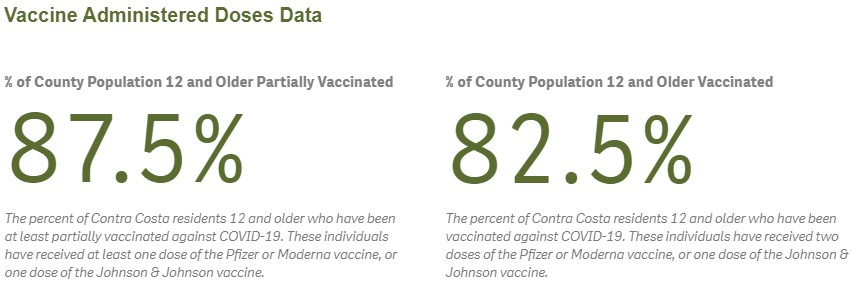
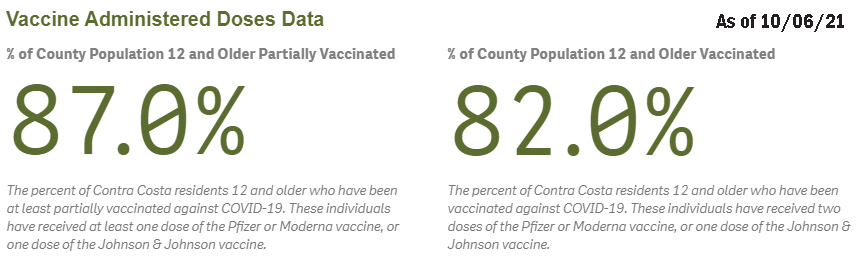
That 71.6% figure differs significantly from what is on the county’s COVID Vaccine Dashboard, which shows 82.5% of residents over age 12 are fully vaccinated, as of today, Oct. 14, 2021 at 11:30 a.m.

Health Services staff was asked, “which is the correct figure, the 82.5% as it shows on your Vaccine Dashboard, or 71.6%? Why the difference?”

Health Services spokesman Karl Fischer responded, “Both are actually correct. The higher percentage, found on our vaccination dashboard, refers to county residents who are vaccinated, and who are also 12 and older. (Younger people are not yet able to get vaccinate).

The other percentage, which we display on the front page, is our percentage of all county residents who are vaccinated, including those younger children who are not yet eligible for vaccine. We began displaying this metric last week, after we announced the criteria for lifting the county’s face covering requirement, because the percentage of the total population that is vaccinated is part of that criteria.”

The 80% requirement applies to the county’s total population, including all of those under age 12, both those ages 5-11 not yet eligible for vaccination as well as those under age 5. According to Fischer, the county uses California Department of Finance projections rather than the 2020 Census Data. Asked why, Fischer said he had to research that.

The statistic showing the percentage of total population fully vaccinated is not currently included on the county’s COVID Vaccine Dashboard. Fischer said he’d look into it and that it might already be in the works to add it.

Please check back later for any updates to this report.

Allen Payton contributed to this report.


In spite of opposition Contra Costa Supervisors approve COVID-19 vaccine anti-misinformation resolution

Wednesday, October 13th, 2021

“The Board…declares that COVID-19 health misinformation is an urgent public health crisis” – from resolution

“You are spreading misinformation that the vaccine is the be all and end all…” – county resident Carolyn Stream

“We are going to be as loud as we can be and as visible as we can be to put out information that is correct…” – Supervisor John Gioia

County might enter the less health restrictive yellow ranking by the end of October, currently has less than 75 COVID-19 patients hospitalized in county hospitals. – Contra Costa Health Officer, Dr. Chris Farnitano

Discuss $110 million Measure X half-cent sales tax revenue wish list

By Daniel Borsuk

The Contra Costa County Board of Supervisors, on a 5-0 vote, approved a resolution aimed at turning around rising public skepticism against the COVID-19 vaccines during their regular, weekly meeting on Tuesday. It is entitled “Declaring COVID-19 Misinformation as a Public Health Crisis”. (See resolution and below)

Supervisors listened to 50 speakers, mostly opposed to the resolution that “declares COVID-19 health misinformation is an urgent public health crisis affecting our entire community and the County of Contra Costa commits to combating health misinformation is an urgent public health crisis affecting our entire community and County of Contra Costa commits to combating health misinformation and curbing the spread of falsehoods that threaten the health and safety of our residents.”

“We are going to be as loud as we can be and as visible as we can be to put out information that is correct, science-based and corrects the general misinformation that’s out there,” resolution-co-author District 1 Supervisor John Gioia said.

“We are not making any judgement against anyone,” said co-author Supervisor Karen Mitchoff of Pleasant Hill. “We’re not infringing on anyone’s free speech rights.  This is not the case.  We are calling out the misinformation that leads some to not be vaccinated.”

One message in the resolution states: “The Board of Supervisors and County of Contra Costa is troubled by and actively discourages the spread of COVID-19 misinformation as it is a dangerous threat to public health.”

“There are ae people who don’t believe in public officials,” said District 2 Supervisor Candace Andersen of Danville. “I will support this resolution because it conveys prudent decisions based on scientifically based information.”

District 5 Supervisor Federal Glover went right to the point. “Get your shot and protect yourself and your loved ones.”

But supervisors got an earful of criticism from the 50 speakers who viewed the supervisors’ resolution as a move in the wrong direction, a direction towards infringements of freedom of speech, “freedom of medical choice,” and “freedom of medical information.”

One such speaker, Lucy Busto of Oakley bristled at the supervisors for considering a resolution that would “infringe on our medical freedom of choice.”  She said, “We have no idea what the long-term effects of these vaccines are.”

“You are spreading misinformation that the vaccine is the be all and end all when there are many unanswered questions about the vaccine,” said another speaker, Carolyn Stream.

But retired nurse Mary Schreiber urged supervisors to adopt the resolution saying, “This is really supported by our health care professionals.”

Contra Costa County Health Officer Dr. Chris Farnitano, who also reported the county might enter the less health restrictive yellow ranking by the end of October, currently has less than 75 COVID-19 patients hospitalized in county hospitals.

“You are infringing on our rights to medical information,” said Lucy Busto of Oakley. “We have no idea what the long-term effects of these vaccines are”

“You are spreading misinformation that the vaccine is the be all end all”, said resolution opponent Carolyn Strum.  “We should have the freedom for information. No one should have the right to control information.”

Supervisors’ Measure X Wish List

With the county expect to plow in $110 million in Measure X sales tax revenues, $23 million more than initially estimated prior to vote passage last November, supervisors began to reveal their funding priorities with the additional money that the county officials expect to flow into county coffers.

During a presentation from Measure X Community Advisory Board Chair Mariana Moore, supervisors indicated what county operations should receive Measure X funding priority for the upcoming 2022-2023 fiscal year.

Initially county officials expected the Measure X tax would drive in $87 million in revenues, but higher than expected consumer retail sales has pumped up the initial projection.

Code enforcement, transit, fire services, sheriff response and patrols were top Measure X priorities Supervisor Mitchoff listed. Mitchoff will serve as board chair next year, her final year in office.

Board vice chair Glover rattled off the office of racial justice and equity, the northern waterfront planning project, animal services, youth services center, and mental got top billing.

Trails and public transit were on District 2 Supervisor Candace Andersen’s Measure X list.

District 1 Supervisor John Gioia said county hospital, health clinics, transitionary housing and fire services especially in East County were on his Measure X list.

Improving fire services in East County, especially with the proposed consolidation for the Contra Costa County Fire District with the East Contra Costa County Fire District, was Chair Diane Burgis’ chief funding priority.
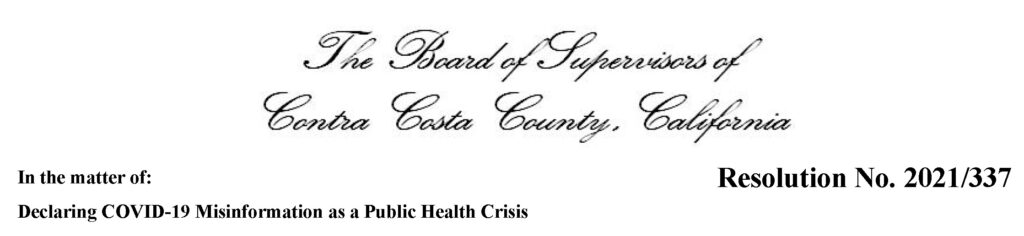
WHEREAS, Health misinformation has significantly undermined public health efforts and the unmitigated proliferation of health misinformation has created a culture of mistrust and has prolonged the COVID-19 pandemic, endangering the health and safety of all Contra Costa County residents and visitors; and

WHEREAS, The coronavirus (COVID-19) pandemic has resulted in over 95,000 cases and 921 deaths in Contra Costa County as of September 25, 2021; and

WHEREAS, The spread of COVID-19 has had a devastating impact on our health and safety, our regional economy, our elder residents, our communities of color, our mental health, the educational development of our children and every aspect of our lives; and

WHEREAS, In Contra Costa County, there are significantly lower vaccination rates for residents 20-29 years old, residents who identify themselves as White, Latinx (i.e. Latino/Hispanic), African-American, and more than one race/ethnicity, men, and in certain communities across the county and particularly in East and West County; and

WHEREAS, The COVID-19 vaccines have met the Food and Drug Administration’s (FDA) rigorous scientific standards for safety, effectiveness, and manufacturing quality and have been proven to be safe and effective; and WHEREAS, The Pfizer-BioNTech vaccine, brand name Comirnaty, has received full FDA approval and been proven to be highly effective in preventing serious disease, hospitalization and death from COVID-19 and that its benefits outweigh its risks; and

WHEREAS, The COVID-19 vaccine is available to everyone in Contra Costa County at no cost, regardless of income, residency within the county, health coverage or immigration status, and is administered by health professionals, like nurses and doctors; and

WHEREAS, misinformation has caused confusion and has led to eligible people declining COVID-19 vaccines, rejecting public health measures such as face coverings and physical distancing, and using unproven treatments; and

WHEREAS, On July 15, 2021, the United States Surgeon General issued his first advisory describing the “urgent threat” posed by the rise of false information of COVID-19 – one that continues to put “lives at risk” and prolong the pandemic; and

WHEREAS, Recent surges in infections and hospitalizations from COVID-19 in Contra Costa have highlighted the importance of clear and unequivocal communications from public officials that vaccines are the best protection against severe illness and hospitalizations; and

WHEREAS, Urgent action is needed to curb the spread of COVID-19 by combating misinformation, thereby supporting our healthcare system and saving lives; and

WHEREAS, There would be substantial detriment on Contra Costa County and its residents and visitors if not acted upon immediately; and

WHEREAS, Trusted community members, such as health professionals, faith leaders, educators, and leaders of Black, Indigenous, Latinx and other communities of color nationwide and in Contra Costa have spoken directly to their communities to address COVID-19 related questions by town halls, meetings, social media, and traditional media; and

WHEREAS, The Board of Supervisors and the County of Contra Costa is troubled by and actively discourages the spread of COVID-19 misinformation as it is a dangerous threat to public health; and

WHEREAS, Contra Costa Health Services continues to carry out its mission to care for and protect all Contra Costa County residents from COVID-19, especially our most vulnerable; and

WHEREAS, Contra Costa Health Services engages with our communities through building partnerships and trust with community organizations and residents, trusted messengers, and COVID-19 Ambassadors; and

WHEREAS, Contra Costa Health Services maintains a coronavirus website as a source of credible, up-to-date information regarding COVID-19 for Contra Costa residents at cchealth.org.

NOW, THEREFORE, BE IT RESOLVED, that the Board of Supervisors of Contra Costa County declares that COVID-19 health misinformation is an urgent public health crisis affecting our entire community and the County of Contra Costa commits to combating health misinformation and curbing the spread of falsehoods that threaten the health and safety of our residents; and

BE IT FURTHER RESOLVED the Board of Supervisors and the County of Contra Costa will develop and support policies and strategies that protect the health and safety of Contra Costa County residents through the promotion of evidence-based interventions, including face coverings and vaccination; and

BE IT FURTHER RESOLVED that Contra Costa Health Services will continue to share facts and scientific information about COVID-19, to correct misinformation including vaccine myths, to identify and give a platform to culturally relevant medical experts and trusted messengers, to respond to questions and requests for information on social media, and to work with our media and community partners to reach a broad audience with factual, timely information.

Allen Payton contributed to this report.

 

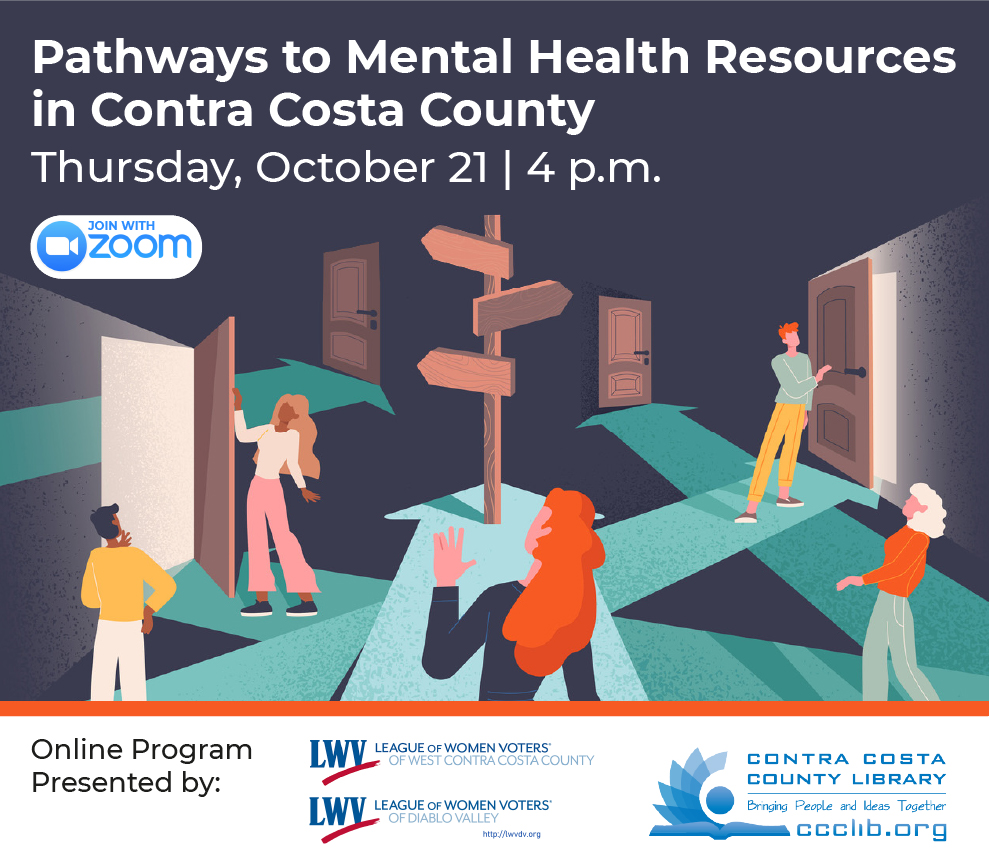
Pathways to Mental Health Services in Contra Costa County webinar October 21

Tuesday, October 12th, 2021

Contra Costa County and nonprofits are responding to the challenge of the growing emotional and mental health impacts of the pandemic. Learn about the pathways to mental health resources the county and nonprofits offer and the challenges to improve mental health outcomes as we seek to create a healthier community for everyone.

Join a Zoom webinar on October 21 from 4:00 p.m. to 5:30 p.m., where a panel will discuss the resources available.

Dr. Cindy Mataraso, Director of Clinical Services at Crestwood Behavioral Health, will moderate the panel.

Panelists include:

  • Rebecca Bauer Kahan, Member, California State Assembly
  • SuSun Kim, Director of the Family Justice Center, Contra Costa County
  • Dr. Suzanne Tavano, Director of Behavioral Health Services, Contra Costa County
  • Gigi Crowder, Executive Director of National Alliance on Mental Illness, Contra Costa County

Register at https://tinyurl.com/lwv-mental-health

The program is co-sponsored by the League of Women Voters of Diablo Valley, the League of Women Voters of West Contra Costa County and the Contra Costa County Library.  The Library will provide closed captioning for this event.

The program will be recorded and posted on the following sites after the meeting:

LWVDV YouTube channel

Contra Costa County Library YouTube channel

For more information contact: programs@lwvdv.org


Getting ready for 2022 Medicare Annual Enrollment

Sunday, October 10th, 2021

Tips for navigating plan options during the COVID-19

By Rick Beavin, Desert Pacific Medicare President at Humana

The annual Medicare Advantage and Medicare Prescription Drug Plan enrollment period is approaching. From October 15 to December 7, millions of people eligible for Medicare can sign up, switch or leave a health care plan to fit their coverage needs for 2022. Due to the ongoing COVID-19 pandemic, Medicare information and resources are available to help you choose the plan that’s right for you while staying safe. Websites, online educational events and one-on-one meetings with sales agents are all great ways to learn about your Medicare plan options. At the same time, it’s important to access Medicare resources online while protecting your personal information and avoiding fake offers and other scams.
Here are some tips for how to prepare for the Medicare annual enrollment period:

  1. Use an online tool

Go to the Medicare Plan Finder on Medicare.gov to compare plans, benefits and get an estimated cost for each plan based on an average member. If you are interested in Medicare Part D, which helps cover the cost of prescription medications, you can also enter the names of prescription medications you take to ensure those medications are covered by the plan you are considering.

On Medicare.gov, you can also learn about and enroll in Medicare Advantage plans, sometimes called Part C or MA Plans, and visit an insurance company’s website to understand more about what they offer. Insurance companies that offer Medicare Advantage plans can provide detailed information about their plans and services, plus prescription pricing information and other benefits. You can also check whether your primary care physician or other providers are in-network with the Medicare Advantage plan.

  1. Connect with experts

Many insurance companies are offering online workshops to review 2022 Medicare Advantage plan options. Also, check to see if you can schedule a one-on-one meeting with an insurance company sales agent in-person or by phone or video chat. Before you attend an education event or meeting, it’s a good idea to prepare a list of questions so that you can ensure you get the information you need. Does the plan include vision, hearing and dental coverage? Will telehealth services be covered? Is transportation to your medical appointments included?

  1. Protect yourself against Medicare scams

The federal Medicare agency has warned that scammers may try to use the pandemic to steal Medicare beneficiaries’ Medicare numbers, banking information or other personal data. Scammers may try to reach out to you by phone, email, text message, social media or by visiting your home. Only give your Medicare number to your doctor, pharmacist, hospital, health insurer or other trusted health care provider. Do not click links in text messages and emails from unknown sources, and hang up on unsolicited phone calls.

If you are not comfortable accessing plan information online, you will have the option to meet in-person with an agent this year. Or Medicare.gov has an option for setting up a phone call. To learn more, go to Medicare.gov or call 1-800-MEDICARE (800-633-4227).


Contra Costa, Bay Area health officers issue criteria for lifting indoor masking requirements

Thursday, October 7th, 2021

Source: CCC COVID Dashboard 10/07/21

“with regional data showing that the surge is now receding, and with the Bay Area one of the most vaccinated regions in the country, the health officers agree it is time to plan for a transition.”

Total population includes residents under age 12 who are not yet eligible for vaccinations.

As decisions to vaccinate and wear face coverings indoors drive down COVID-19 case rates and hospitalizations, health officers for the nine Bay Area jurisdictions that require face coverings in most indoor public spaces today reached consensus on criteria to lift those health orders.


These health officers continue to work together across the Bay Area to protect public health with a consistent regional approach, and to plan for the next phase of response to COVID-19 as this wave of the pandemic ebbs.

The counties of Contra Costa, Alameda, Marin, Napa, San Francisco, San Mateo, Santa Clara, Sonoma and the City of Berkeley will lift the indoor masking requirement in public spaces not subject to state and federal masking rules when all the following occur:

1) The jurisdiction reaches the moderate (yellow) COVID-19 transmission tier, as defined by the Centers for Disease Control & Prevention (CDC), and remains there for at least three weeks

AND

2) COVID-19 hospitalizations in the jurisdiction are low and stable, in the judgment of the health officer

AND

3) 80% of the jurisdiction’s total population is fully vaccinated with two doses of Pfizer or Moderna or one dose of Johnson & Johnson (booster doses not considered) NOTE – Total population includes residents under age 12 who are not yet eligible for vaccinations.

OR

Eight weeks have passed since a COVID-19 vaccine has been authorized for emergency use by federal and state authorities for 5- to 11-year-olds.

Curr

Most Bay Area health departments issued the masking requirements for their respective jurisdictions on August 3, following a summer surge in cases, hospitalizations and deaths.

But with regional data showing that the surge is now receding, and with the Bay Area one of the most vaccinated regions in the country, the health officers agree it is time to plan for a transition.

“It is no accident that transmission is slowing in Contra Costa County. Public health interventions, including the masking requirement, are working,” said Dr. Chris Farnitano, Contra Costa’s health officer. “We believe that health orders, along with vaccination, outreach and education are all adding layers of protection against COVID-19 in our community – and saving lives.”

Lifting a local indoor mask mandate would not prevent businesses, nonprofits, churches or others with public indoor spaces from imposing their own requirements. As COVID-19 easily spreads through airborne droplets, face coverings remain highly powerful in preventing its spread.

Each jurisdiction will rescind its order when criteria are met in that respective county or city. The criteria were developed to assist in determining the safest time to lift the indoor masking orders, based on regional scientific and medical consensus. The criteria also provide safety for school children, ages 5-11, who need the added protection of masks in the community to keep case rates low so they can remain in school until they can be vaccinated.

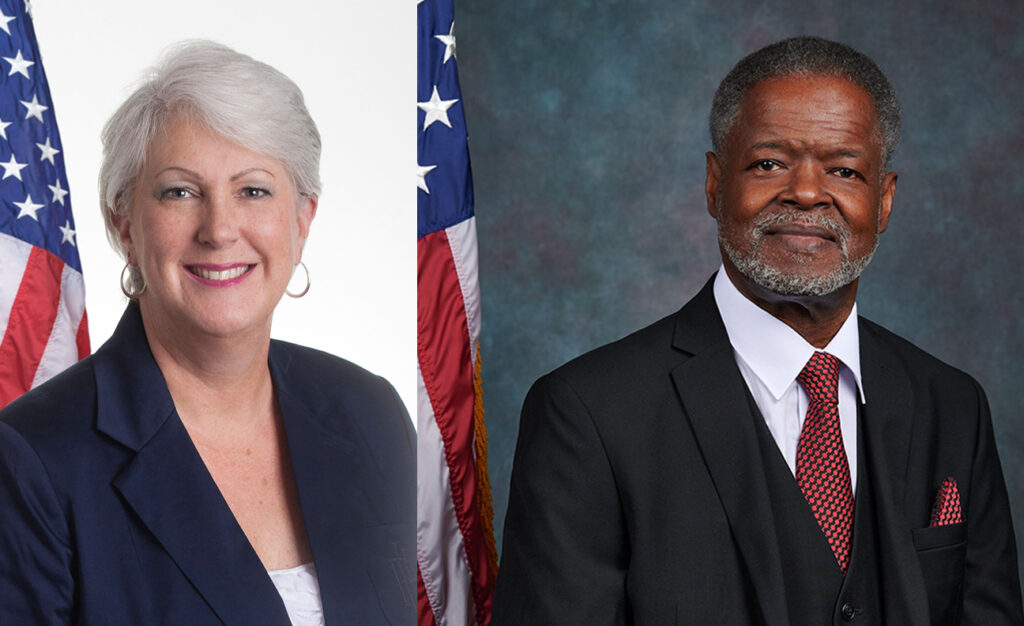
“Contra Costa is coming back strong, thanks to so many of our residents making healthy choices, such as getting vaccinated, or doing the courteous thing and wearing masks in places where the risk of transmission is a little higher,” said Diane Burgis, chair of the Contra Costa County Board of Supervisors. “I’m thankful for every resident who has done their part.”

California’s health guidance for the use of face coverings will remain in effect after local masking requirements are lifted, meaning that people who are not fully vaccinated for COVID-19 must continue to wear masks in businesses and indoor public spaces.

The state also requires face coverings for everyone, regardless of vaccination status, in healthcare facilities, public transit and adult and senior care facilities. California’s masking guidelines in K-12 schools would also not be affected by changes to local health orders.

An FDA advisory committee is scheduled to consider an application from Pfizer-BioNTech to grant emergency use of its COVID-19 vaccine for 5- to 11-year-olds on October 26.

Visit cchealth.org/coronavirus for local information about COVID-19 and Contra Costa County’s emergency response to the pandemic.

Glover takes one year pass on gavel, hands chair to Mitchoff in her final year on Contra Costa Board of Supervisors

Thursday, October 7th, 2021

New Contra Costa County Board of Supervisors Chair Karen Mitchoff and Vice Chair Federal Glover. Photos: CCC

County public meetings to continue online for 30 more days; COVID cases decrease by 27.9% over past two weeks

By Daniel Borsuk

In a show of respect for her 34 years of public service, retiring Contra Costa County Board of Supervisor Karen Mitchoff will manage the board’s gavel in 2022, a year when vice chair Federal Glover would have taken over the board leadership duties from current chair Diane Burgis of Brentwood.

Vice chair Glover of Pittsburg, who would have customarily been automatically approved by his supervisorial colleagues as chair for 2022, made the motion to transfer the board chair duties to Mitchoff as an act of respect for her public service dating back to 1981 in the office of late Contra Costa Sherriff-Coroner Richard Rainey as his executive secretary.

Glover, who represents District 5 on the board, will continue to serve as vice chair in 2022 and assume the chair duties in 2023.

Mitchoff of Pleasant Hill has served as District IV Supervisor since January 2011.

Supervisor Mitchoff had initially announced her candidacy for the position of Contra Costa County Recorder-Clerk when former officer holder Joe Canciamilla resigned and sentenced for violating Fair Political Practices Commission laws by spending more than $130,000 in campaign funds for personal uses. Mitchoff eventually stepped away from actively pursuing the County Recorder-Clerk post when Assistant Recorder-Clerk Debbi Cooper announced her candidacy and eventually won the supervisors’ approval to accept the top post.

“I talked to Supervisor Mitchoff, who plans to not run for reelection after next year, to serve as our chairperson as an honor,” said Supervisor Glover. “Therefore, I would make a motion to nominate Karen Mitchoff as chair for 2022 and Glover serve as vice chair for 2022.”

Glover’s motion passed on a 5-0 vote.

“I want to thank Mr. Glover to allow me to serve as board chair in my final year on the board,” said Mitchoff. “It shows how wonderful it is to be on this board. We are always respectful and kind.”

Mitchoff’s eventual departure raises the question of who might run for her position.

Among some of the potential candidates are Ken Carlson, a gay retired Concord police officer who serves on the Pleasant Hill City Council. Concord City Councilmember Edi Birsan has also frequently said he would run for the supervisorial post.

Mitchoff, a Portland, OR native, is a Cal State East Bay B.A. graduate in Human Development and has an elected and appointed public service record that includes election to the Pleasant Hill City Council in 2008 and service as mayor in 2010. She was appointed to the Pleasant Hill Recreation and Park District Board of Directors in 2003 and election to the Board of Directors in 2004 and 2006. From 1992 to 1996 she served on the Pleasant Hill Planning Commission.

Online Meetings for 30 More Days

The return of in person public meetings, especially at the Contra Costa County Board of Supervisors’ brand new $100 million county administration building in downtown Martinez, will be on hold for at least another 30 days because of Gov. Gavin Newsom’s signing of Assembly Bill 361. The law now allows public meeting to be held onlin through January 31, 2022. At least through November the supervisors and all county commissions and advisory panels – the Assessment Appeals Board, Merit Board, Planning Commission, and Measure X Advisory Commission – will continue to conduct meetings remotely.

The supervisor’s resolution states:

“The Board of Supervisors finds that in person meetings of the Board of Supervisors would present risks to the health or safety of the public, staff and officials attending meetings, in light of the high case rate of COVID-19 infections in the county.

“As authorized by Assembly Bill 361, effective immediately and for the next 30 days the Board of Supervisors, acting in all its capacities and all its subcommittees, will use teleconferencing for meetings with the provisions of Government Code section 54953e.”

County COVID-19 Cases and Vaccinations

In the meantime, the Contra Costa Health Services reported there were 1,532 COVID-19 cases reported in the past two weeks, for a 36.8 percent decrease. Seventy-three COVID-19 patients were hospitalized, a 27.9 decrease over the past two weeks, department records show.

The Contra Costa County Health Services also reported the county’s vaccination rate for residents ages 12 and older, who have received at least one dose of the COVID-19 vaccine, is 86.3 percent compared to a 75.9 percent national rate.