Contra Costa Health’s Environmental Health Program is certified by the California Department of Resources Recycling and Recovery (CalRecycle) as the LEA for Solid Waste in the county. The LEA ensures that all solid waste disposal facilities and medical waste generators comply with applicable local, state and federal codes and regulations.
The three-member panel hears matters related to solid waste enforcement, permits and appeals.
County residents who have an interest in public policy and solid waste management are encouraged to apply for this volunteer opportunity. Panelists receive a stipend of $50 on those days on which the panel meets. The County Board of Supervisors will appoint to fill three vacancies for a four-year term ending on March 31, 2030.
Applications should be returned to the Clerk of the Board of Supervisors, County Administration Building, 1025 Escobar Street, Martinez, CA 94553 no later than 5 p.m. on Friday, March 6, 2026. Applicants should plan to be available for public interviews via video conference on Monday, March 23, 2026.
For more information about the LEA Independent Hearing Panel, contact Tim Kraus, Contra Costa County Environmental Health, at (925) 608-5549 or Tim.Kraus@cchealth.org.
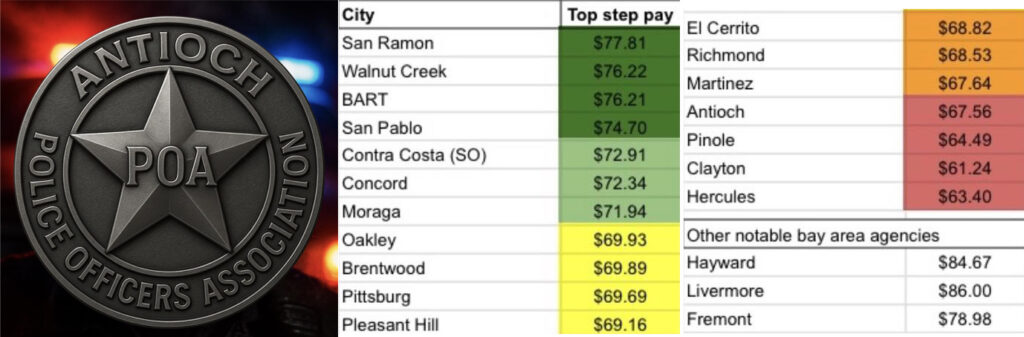
Hourly top step pay comparison among police agencies in Contra Costa County. Source: APOA
Include Dispatchers in public, social media campaign for new contract
“150 days out of contract and no relief in sight.” – APOA
APD Management also out of contract but working under previous one
So far, six Closed Session Conferences with Labor Negotiators held
Share Barbanica’s social media post regarding concerns about City spending more money on another homeless hotel
By Allen D. Payton
Ignoring the advice of City Manager Bessie Scott to Antioch Police Officers Association has continued their public campaign regarding the lack of a contract with the City since the end of August with an added complaint of the difference in pay with other local agencies. They’ve included Dispatchers’ pay in their list of complaints and with posts on their Facebook page and Instagram account as part of their campaign.
Antioch PD Among Lowest Top Step Hourly Pay in County
In a post on the organization’s Facebook page on Friday, Jan. 30, 2025, they show a chart of top step hourly pay for police officers for 17 agencies in Contra Costa County plus, BART Police. It shows Antioch PD has one of the lowest levels of pay. Their contract used to include a requirement that they be paid the second highest in the county, as Antioch is the second largest city by population. But now, 14 other police agencies offer a higher top step pay than Antioch which offers $67.56 per hour. Neighboring agencies pay more with Oakley PD at $69.93, Brentwood PD at $69.89 and Pittsburg at $69.69. San Ramon PD offers the highest top step pay in the county at $77.81 per hour.
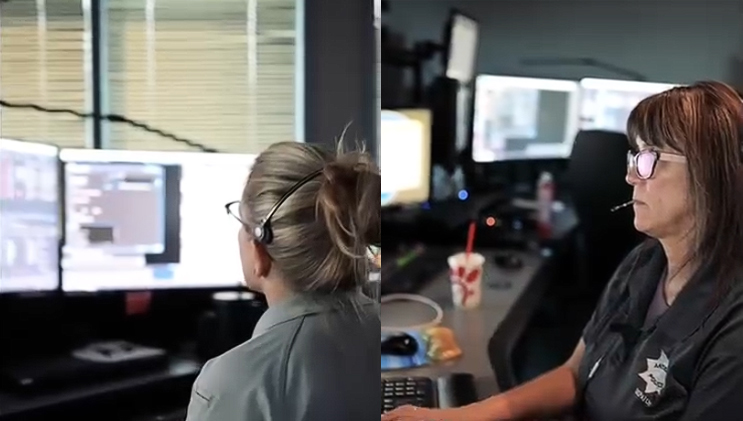
APD Dispatchers are also out of contract. Source: APOA video screenshots
Antioch Dispatchers Also Affected
In a separate post on Saturday, January 31st, the APOA shared a video about Dispatchers’ pay and wrote, “The lack of a contract for the APOA is far more problematic than you may have thought. The pay gap extends to our members in dispatch as well! 150 days out of contract and no relief in sight.”
The video includes an audio narrative with subtitles which reads, “Every call for help in Antioch starts the same way. With a dispatcher answering the phone. But here’s the reality. Antioch police dispatchers are significantly underpaid compared to neighboring agencies.
“Dispatchers at the Contra Costa County Sheriff’s Office and Pittsburg Police earn nine thousand nine hundred dollars more per year than Antioch. Concord dispatchers make twenty-two thousand four hundred four dollars more. Pleasant Hill pays seventeen thousand eighty-eight dollars more. Richmond dispatchers earn twenty-six thousand six hundred seventy-six dollars more annually. Walnut Creek pays seventeen thousand nine hundred seventy-six dollars more. Brentwood pays twelve thousand five hundred sixty-four dollars more. And Martinez pays sixteen thousand forty-four dollars more than Antioch.
“These aren’t small differences. They’re life-changing pay gaps. And they come with real consequences. When experienced dispatchers can earn tens of thousands more by crossing city lines, recruitment suffers. Retention suffers.
“Antioch dispatchers are working understaffed and often work sixteen-hour shifts to cover the empty spots. That means fewer dispatchers, longer wait times, increased stress, and heavier workloads for those who stay.
“If Antioch wants to recruit and retain skilled dispatchers, pay must reflect the responsibility of the job. That means a meaningful contract with competitive salaries. Because when dispatchers leave, everyone in this city feels the impact.”
In addition, APOA has been posting more videos on their Facebook page and Instagram account as part of their campaign.
Antioch Police Management Also Out of Contract
Members of the Antioch Police Sworn Management Association were asked if they have a new contract with the City and if theirs also expired at the end of August. Captain Desmond Bittner responded, “It expired the same time as APOA’s. I had them (the City) add language saying the contract will continue until we worked out a new one.”
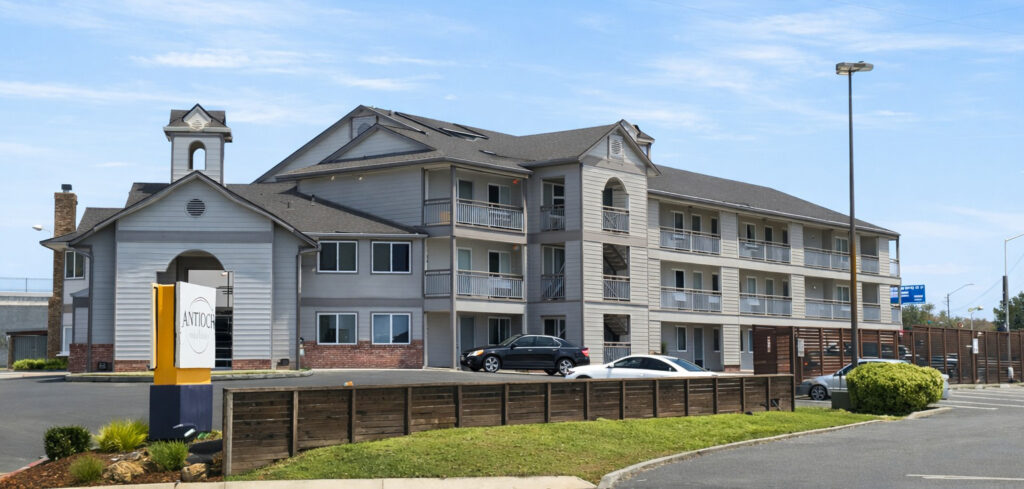
The former Comfort Inn now Antioch Inn & Suites will be used to house the homeless at $1.2 million per year. Photo courtesy of Mike Barbanica
Share Former Councilman Barbanica’s Post About City Expenditures for Homeless
The APOA also reposted comments by former Antioch Councilman Mike Barbanica about the City considering spending funds on another homeless hotel writing, “We want the public to see where their money is going!”
In a post on his “Community Member” Facebook page, Barbanica, a former Pittsburg Police Lieutenant, showed a photo of the now closed Comfort Inn, located on Mahogany Way at Highway 4 and Auto Center Drive and entered the discussion writing, “$1,200,000 potentially every year, local taxpayer funded…up to 15 years…
If other funding falls short, Antioch taxpayers are on the hook!
Transparency note: I didn’t author this from a single document. I reviewed staff reports, press reports, spoke with several people familiar with the proposal, and used AI to help compile a neutral, fact-based outline so the numbers could be seen clearly. The goal here is clarity, not advocacy.
Here’s the total City of Antioch financial commitment for the proposed Homekey+ housing project if it is approved and funded by the state:
1. One-time Local Match – The city would provide a one-time contribution of $750,000 toward acquisition and rehabilitation of the property when the Homekey+ award is received.
2. Annual Operating Subsidy – The City would commit up to $1.2 million per year to help operate the facility.
3. Duration of Operating Support – That annual subsidy is for five years, with two optional extensions of five years each (for a potential total of 15 years of subsidy) if the project continues to meet Homekey+ program guidelines.
4. Overall Total Estimate – Based on the staffing report and Council discussion, the total projected financial commitment over the long term is roughly $18 million–$19 million if you include the operating subsidies plus the one-time match (i.e., ~$1.2 M × 15 years = ~$18 M, plus the ~$750 K match).
Summary of Antioch’s Commitment if Homekey+ is Approved
Component Amount
One-time contribution (acquisition/rehabilitation) $750,000, Annual operating subsidy Up to $1.2 M per year
Duration of subsidy 5–15 years (with extensions), Approximate total over full life ~$18 M–$19 M
Important Notes
This commitment only takes effect if the state awards Homekey+ funding and the City moves forward with the project after award.
The operating subsidy requirements could be reduced if alternative funding sources or partners contribute support, but the report assumes the full amount will initially be covered by the City.
WHAT COULD THIS MEAN?
The $1.2 million per year is a CITY / local commitment, not state money.
Now the break down so there’s no ambiguity.
Who pays what in the Antioch Homekey+ project
State of California (Homekey / Homekey+)
Through California Department of Housing and Community Development:
Pays up-front capital costs: Property acquisition, Rehabilitation / conversion, This is a one-time grant, not ongoing funding,
The state does NOT commit to covering long-term operations.
City of Antioch (local funds)
From Antioch: One-time local match, $750,000 (city funds), Annual operating subsidy, Up to $1.2 million per year, Initially 5 years, With two optional 5-year extensions, Potential exposure: up to 15 years
This money comes from local sources: City General Fund, Measure funds / local housing allocations, Other city-controlled revenue (not guaranteed state funding), The staff reports are explicit that the City is responsible for covering operating shortfalls if other funding does not materialize.
What that means… The state helps buy and convert the building, The city commits to keeping it running, If other funding falls short, Antioch taxpayers are on the hook, That’s why council members and staff describe it as a long-term fiscal obligation, not just a grant.”
—————
Six Closed Session Conferences with Labor Negotiators to Discuss Contracts
To date, the City Council, City Manager Bess Scott and a representative from the City Attorney’s Office have held six Closed Session meetings entitled Conference with Labor Negotiators with representatives of the APOA and City employee groups to discuss their contracts. The first one was held August 12 followed by additional meetings on Aug. 26, Sept. 9, Oct. 14, 2025, and Jan. 13 and 27, 2026.
Questions for APOA, City Staff, CouncilGo Unanswered for Now
Questions were asked of APOA leadership, when did negotiations begin and who represented the organization.
Questions were also emailed on Saturday, January 31st, to City Manager Scott, Mayor Bernal, the four council members and the City Attorney’s Office staff. They were asked, “Why wait so long to begin negotiations when the contracts for at least the APOA and APD Management Association ended on August 31st? Is that usual practice? Why not start sooner? Why didn’t you have meetings before every regular meeting to get things worked out?”
They were also asked, “Besides the APOA and APD Management Association, have the contracts also expire for the other employee groups, including the Management Unit, Treatment Plant Employees’ Association, Operating Engineers Local Union No. 3 and Confidential Unit? If not, when do their contracts expire?”
Finally, the council and staff members were asked, “How long are the new contracts expected to last? One year, two, three or five years?”
The questions were resent to City staff and council members early Tuesday morning, Feb. 3, 2026. But no responses were received prior to publication time. Please check back later for any updates to this report.
Provides “fiscal bridge” until revenue from possible 5-county sales tax increase measure on November ballot kicks in
By Rebecca Long, Director, Legislation & Public Affairs and John Goodwin, Assistant Director of Communications, Metropolitan Transportation Commission
SAN FRANCISCO, Jan. 30, 2026… The Office of Governor Newsom, the California Department of Finance and the Metropolitan Transportation Commission (MTC) on Friday reached an agreement on a $590 million loan for Bay Area transit agencies that will avert major service cuts at AC Transit, BART, Caltrain and SF Muni during the 2026-27 fiscal year that begins July 1. Negotiated in close coordination with the affected transit agencies — which together face a projected deficit of more than $800 million in the next fiscal year — the new agreement will sustain operations used by hundreds of thousands of daily transit riders across the region.
“California is following through in our support for Bay Area transit and the riders who rely on it every day,” said Gov. Newsom. “This agreement between my Administration and the Metropolitan Transportation Commission provides essential short-term financing to support Bay Area transit operations while the region works together on long-term funding solutions. Public transit is essential to our economy and to communities across California, and through continued partnership with regional and local agencies, we are delivering a more stable and reliable system – now and for the future.”
A regional funding measure authorized by the Legislature last year via state Senate Bill 63, authored by senators Scott Wiener of San Francisco and Jesse Arreguín of Berkeley, may appear on the November 2026 ballot in Alameda, Contra Costa, San Francisco, San Mateo and Santa Clara counties. If the measure qualifies for the ballot and is approved by voters, it would establish a temporary 14-year sales tax to support transit operations. But these funds would not begin flowing until around July 1, 2027. The state loan provides a fiscal bridge until the sales tax dollars potentially could be available. (See related articles here and here)
“Today is a huge win for Bay Area transit and for both transit riders and drivers,” said Sen. Wiener. “For the past year, we’ve worked hard to craft a bridge loan to ensure BART, Muni, Caltrain and AC Transit are not forced to enact massive service cuts — potentially going into a death spiral — as we build toward a regional revenue measure to stabilize and strengthen these systems for the long run. I’m proud of our work with regional stakeholders and the Governor to make this loan a reality. Public transportation is part of the Bay Area’s lifeblood, and we must do everything in our power to strengthen it and protect it from service cuts. So many Bay Area residents rely on transit to get to work, school, or family, and service cuts would also explode traffic congestion. We must not let this happen, and we won’t let it happen.”
Today’s agreement authorizes the loan to be funded no later than July 1, 2026, using money awarded but not yet allocated for Bay Area projects by the California Transportation Commission through the state Transit Intercity Rail Capital Program (TIRCP). Because many transit capital projects have long construction timelines and the TIRCP is continuously replenished, the loan is structured to uphold the state’s commitments to awarded projects while minimizing risk to project schedules.
“MTC greatly appreciates the time and energy the Department of Finance and the Governor’s office put into this loan negotiation,” said Commission Chair Sue Noack, who represents Contra Costa County and also serves as mayor of Pleasant Hill. “It was critical to reach agreement on funding that would avert major service cuts this year while also protecting the Bay Area’s priority capital projects and this agreement does just that.”
Consistent with state Senate Bill 105 enacted last fall, the loan agreement includes a clearly defined repayment structure, a guaranteed revenue source to secure the loan and an agreed-upon interest rate:
12-year repayment term, with interest-only payments during the first two years.
Repayment secured by the “revenue-based” portion of State Transit Assistance (STA) that goes directly to the transit agencies.
Variable interest rate tied to the state’s Surplus Money Investment Fund, ensuring the state is fully repaid at the same rate it would have earned had the funds remained in state accounts.
BART General Manager Bob Powers noted that his agency, “is currently developing detailed budget plans for two funding scenarios to close our projected $376 million operating deficit for Fiscal Year 2027 through either new revenue and efficiencies or through service reductions, station closures, fare increases, layoffs, and across-the-board internal cuts. A state loan gives us reassurance money will be available to continue to deliver the best service possible for the Bay Area. We are thankful to Governor Newsom and the Department of Finance for finding a path to fund transit operations during such an unprecedented scenario brought on by the pandemic and remote work. We also thank the Bay Area Legislative Caucus for their supportive efforts and look forward to working with the Legislature on early action to include the loan within the state budget.”
“This bridge loan will help us maintain Muni service for one crucial year for everyone who depends on transit to get where they need to go,” said Julie Kirschbaum, Director of Transportation at the San Francisco Municipal Transportation Agency, which operates Muni. “We thank the Metropolitan Transportation Commission for its leadership and the Governor and the Department of Finance for their collaboration. We are deeply appreciative of the tireless efforts of Mayor Daniel Lurie, State Senator Scott Wiener, State Senator Jesse Arreguín, the Bay Area Legislative Caucus, the Board of Supervisors and the transit advocates who kept this loan alive last year. With this key agreement completed, securing the additional funding we need to address our ongoing deficit is the critical priority.”
“San Francisco’s recovery is essential to the success of our region and our state,” noted Mayor Daniel Lurie. “Our city cannot continue its comeback without a safe, reliable transit system. This agreement is a major step forward towards securing the bridge loan needed to sustain our comeback and ensure transit systems can continue serving the families, seniors, students, and workers who rely on them every day. We’re already delivering greater accountability and efficiency for Muni, and ridership is continuing to climb toward pre-pandemic levels. I’m grateful to our partners at MTC and Governor Newsom for finalizing the agreement and prioritizing our city and our region’s recovery.”
Caltrain General Manager Michelle Bouchard made a similar point, “We are so grateful to the Governor, our delegation members, and our state and regional partners for stepping in and supporting public transit in the Bay Area at this critical time. This loan will allow us to preserve the service that made Caltrain the fastest growing transit agency in the U.S.”
“For 65 years, AC Transit’s north star has been delivering safe, reliable, and affordable bus service to the East Bay,” said Salvador Llamas, AC Transit General Manager and CEO. “That legacy was put at risk by unprecedented pandemic-related budget shortfalls. This state loan safeguards existing service levels and brings immediate relief to the more than 3 million riders each month who were at risk of losing some of the service they rely upon for the essentials of life. We thank Governor Newsom and our local and state partners for making this possible, and while long-term funding challenges remain, today we celebrate a critical win for our riders and communities.”
Senate Bill 63 co-author Jesse Arreguín also sounded a note of thanks, “I am grateful to the Governor and my legislative colleagues for supporting Bay Area transit with this loan. This agreement is a huge win to keep our transit agencies running and ensure that the Bay Area can continue as a major economic engine, while not compromising critical transit projects. At a time when we are at risk of significant service cuts that would grind the region to a halt, this additional funding will provide a vital lifeline to the Bay Area’s major transit agencies and provide fiscal stability as we move forward on a broader regional self-help measure this year.”
Claim they’ve been working without a contract since last Sept.
See UPDATE 1 from City Manager Scott – “Public safety remains a priority for leadership and currently encompasses 68% of the General Fund Budget…These are difficult decisions, and there are no simple solutions.”
See UPDATE 2 from Councilwoman Torres-Walker who recommends “a 3% one-time retention bonus across all city departments to maintain quality municipal services.”
See UPDATE 3 from Scott with corrected percentage of public safety expenditures at 57% in which she includes Animal Services
By Allen D. Payton
In a post on their Facebook page on Thursday, Jan. 29, 2026, the Sgt. Rick Hoffman, President of the Antioch Police Officers Association, the union that represents the non-management sworn officers, posted the following statement:
Antioch Police Working Without a Contract as Staffing Remains Below Standard
“The Antioch Police Officers Association, which represents sworn police officers, emergency dispatchers, and community service officers, has been working without a labor contract since September 2025. The City’s most recent offer includes no cost-of-living increases through June 2026, effectively imposing a pay freeze on public safety employees who are already underpaid compared to their peers in Contra Costa County. While surrounding cities have invested in competitive contracts that retain experienced personnel and maintain staffing levels, Antioch now ranks among the lowest-paid public safety agencies in the region for cities of similar size and calls for service volume.
“The police department is authorized for 115 sworn officers, but 10 positions are frozen due to budgetary constraints. Fewer than 90 officers are currently serving the community, roughly 75 percent of the previously authorized staffing level. With many officers new or still in training, experienced personnel are limited, and staffing remains well below accepted standards for a city of more than 115,000 residents.
“Emergency dispatch staffing is equally strained. Dispatchers are working frequent, mandatory overtime to ensure 911 calls are answered, and sworn officers are often necessary to work overtime in dispatch functions, an inefficient use of trained peace officers who would otherwise be available for patrol and enforcement duties.
“After a sharp rise in crime during 2024, early 2025 data shows crime trending back toward Antioch’s five-year average. This has occurred only because officers and dispatchers have absorbed heavier workloads and stretched limited resources, an approach that cannot be sustained long term.
“Despite these conditions, the City has expanded other areas of its budget while repeatedly stating there is no capacity for fair pay increases. Neighboring cities have made different choices by investing in retention, experience, and staffing stability. Without a competitive contract, Antioch risks continued turnover, loss of institutional knowledge, and erosion of recent gains.
“The Antioch Police Officers Association remains committed to reaching a fair and competitive agreement. Our members will continue to serve this community, and the Association urges City leadership to invest in a stable, experienced public safety workforce before the consequences are felt by every resident.”
Questions for City Manager, Council
Immediately prior to publication time, questions were sent to City Manager Bessie Scott, Mayor Ron Bernal and all four council members asking when they expect the contract to be ready for the APOA’s vote and why it has taken so long to finalize their contract when it expired last August.
City Manager Says They “Have Been in Negotiations Since the Expiration of the Prior Agreement”
3:10 UPDATE 1: In response, City Manager Scott wrote, “The City of Antioch recognizes the dedication and professionalism of our police officers, emergency dispatchers, and community service officers. Their work—particularly during a period of staffing challenges and elevated service demands—is deeply appreciated and does not go unnoticed.
“It is true that the City and the Antioch Police Officers Association have been in negotiations since the expiration of the prior agreement. The City remains committed to reaching a fair and sustainable contract through the collective bargaining process. Those discussions are ongoing, and we believe the bargaining table—not public correspondence—is the appropriate forum for resolving outstanding issues.
“Like many cities across California, Antioch is facing significant fiscal constraints driven by rising pension obligations, inflationary pressures and uncertainty in long-term revenues. The City’s proposals reflect a responsibility to balance competitive compensation with the need to maintain essential services, avoid deeper staffing reductions and protect the City’s long-term financial stability. These are difficult decisions, and there are no simple solutions.
“The City is acutely aware of current staffing levels within the Police Department and Emergency Communications. Recruitment and retention remain priorities, and we continue to evaluate strategies to improve staffing while living within our financial means. At the same time, Antioch has made substantial investments across city services to meet resident needs and address deferred infrastructure, public safety support functions, and quality-of-life concerns. Public safety remains a priority for leadership and currently encompasses 68% of the General Fund Budget, while the remaining 32% goes towards other vital services. Too, the city was able to enter into a settlement agreement with the US Department of Justice in 2025, as well as with another case, Allen v. Antioch, that recently wrapped up earlier this year.
“We value our employees and the vital role they play in keeping Antioch safe. The City looks forward to continuing productive, good-faith negotiations with the Association and remains committed to reaching an agreement that supports both our workforce and the community we collectively serve.”
None of the council members responded as of the first update.
9:00 PM UPDATE 2: However, District 1 Councilwoman Tamisha Torres-Walker posted the following on her official Facebook page earlier Friday:
“The City is aware of recent local media coverage regarding ongoing contract negotiations between the City and the Antioch Police Officers Association (APOA).
“Negotiations remain ongoing, and the City continues to engage in the collective bargaining process in good faith.
“To date, over the past several months, the City has not received notice from any sworn officers or dispatchers indicating that they have accepted employment elsewhere.
“The City values its first responders and recognizes the critical role they play each day in serving and protecting the community.
“Like many municipalities, the City is facing significant financial challenges. The City recognizes the importance of striking a balance between fiscal responsibility and ensuring that employees are compensated fairly and in alignment with comparable positions within the region.
“I am recommending that this Council consider a 3% one-time retention bonus across all city departments to maintain quality municipal services.”
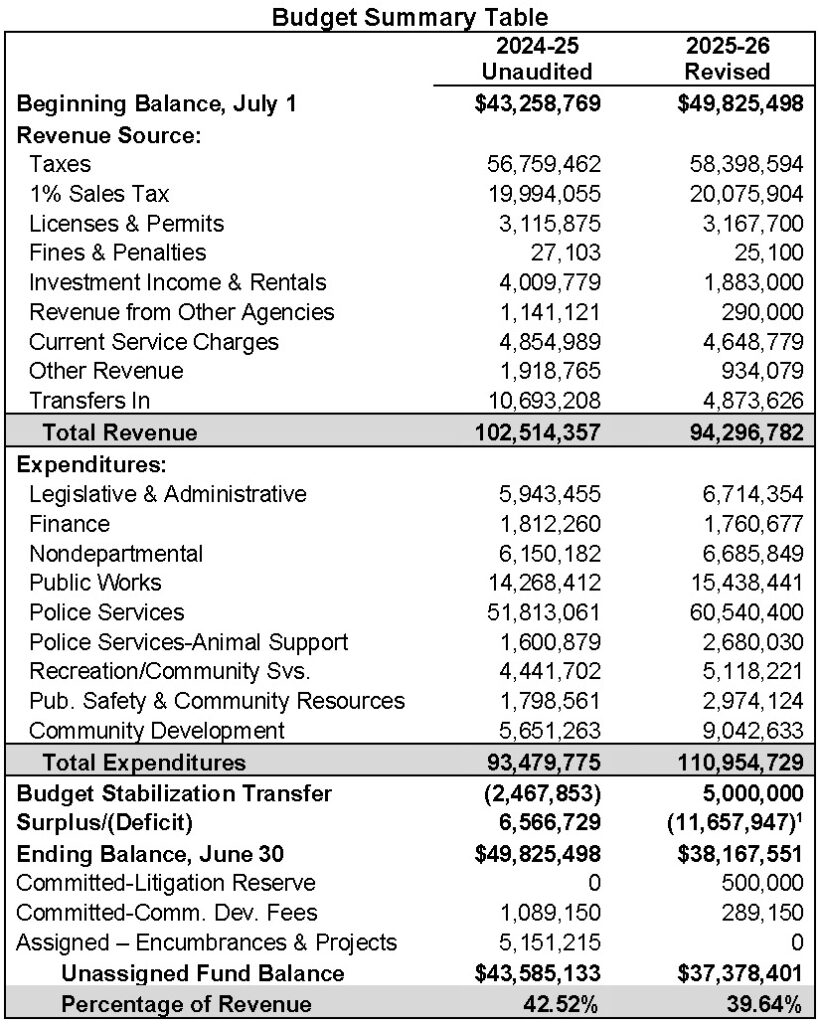
Source: City of Antioch
2/2/26 3:00 PM UPDATE 3 & CORRECTION: In response to questions about the 68% figure she used to describe public safety expenditures, City Manager Scott provided the following: “Correction yes – the current FY26 Police Department budget ($60,390,400 Police Services + $2,680,030 Animal Services Support) is 57% of the total General Fund Budget $63,390,400/$110,954,729. The Police budget DOES NOT include Public Safety and Community Resources.”
According to City Finance Director Dawn Merchant the correct figures are based on the budget revised by the City Council on Nov. 20, 2025, which increased the budget for Police Services by $1,832,910 for the year.
Counting only Police Services, they comprise 54.6% of this fiscal year’s General Fund budget.
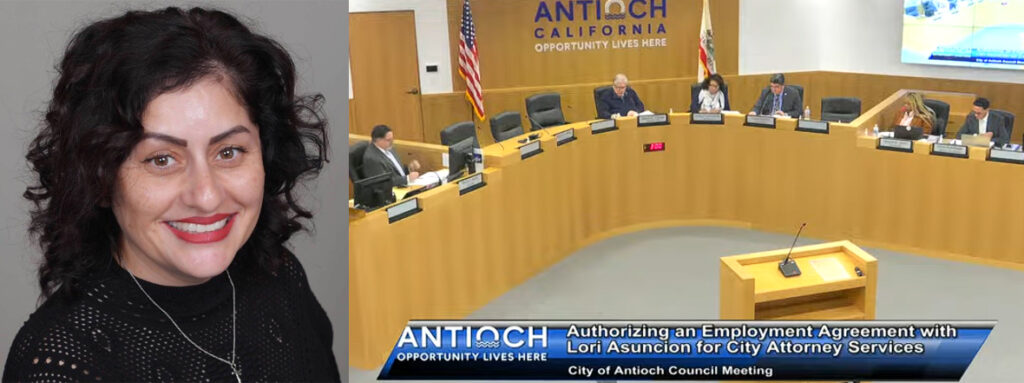
Lori Asuncion’s request was granted by the three members of the Antioch City Council in attendance during their meeting Tuesday night, Jan. 27, 2026. Sources: LinkedIn profile photo (left) and YouTube video screenshot (right).
By Allen D. Payton
During last night’s Antioch City Council meeting, on Tuesday, Jan. 27, 2026, the three members in attendance voted to postpone the vote to hire Lori Asuncion as the new City Attorney. The former Stockton City Attorney, who resigned two weeks ago while facing possible termination, submitted a last-minute request to wait until the full council was in attendance. (See related article)
Both Mayor Ron Bernal, who was traveling to Washington, D.C. for the 94th Winter Meeting of the U.S. Conference of Mayors, and District 4 Councilwoman Monica Wilson, whose mother recently passed away, were absent from the meeting
After Mayor Pro Tem and District 3 Councilman Don Freitas, who was chairing the meeting, read the agenda item’s description, but before the council considered the matter, Assistant City Attorney Kevin Kundinger informed the members of the matter.
“Actually, with this item, I received a request from Ms. Asuncion through the City Attorney that this be continued to a date where the entire council was present. That was the request that I received approximately 40 minutes ago.”
“OK. We can do that. It might delay things,” said Freitas.
“It is just a request that I received,” Kundinger reiterated.
“What does council?” Freitas began to ask. But District 1 Councilwoman Tamisha Torres-Walker spoke over him asking, “Couldn’t we vote tonight and do a ceremonial vote when everybody is…?” Then cutting her off Freitas said, “No. I can see, I’m sure she wants five votes” as Torres-Walker laughed and said at the same time, “I know what she doin’. But I’m good with making a motion to continue it to the next council meeting.”
Accepting that as the motion, Freitas asked for a second which was provided by District 2 Councilman Louie Rocha. With no public comment or further council discussion on the item, the motion passed 3-0. (See the 2:41:10 minute mark of the Council meeting video)
The next council meeting is scheduled for Tuesday, Feb. 10th.
Former Stockton City Attorney Lori Asuncion is expected to be hired as the new Antioch City Attorney next Tuesday night. Photo source: LinkedIn
Quit while facing possible termination last week, Lori Asuncion leaves behind split, dysfunctional council
Expected to be offered the new job, be paid $288,000 salary and $225,000 in benefits per year, 25% more than in City 3x Antioch’s size
By Allen D. Payton
During their regular meeting on Tuesday, Jan. 27, 2026, the Antioch City Council will vote on hiring a new, permanent city attorney. The Council has decided to offer the position to former Stockton City Attorney Lori Asuncion who resigned last week during the Stockton City Council meeting on Jan. 12th. The move follows several closed session meetings with both the consultant, Recruiter Joe Gorton, from the Bob Hall & Associates recruiting firm, and candidates during the recruitment process.
It will be a little over a year since Thomas Lloyd Smith resigned the position last Jan. 17th. Since then, Derek Cole has served as Antioch’s Interim City Attorney.
According to a Jan. 13, 2026, report by Stocktonia, a local, nonprofit, digital news source, “Faced with the possibility of termination, Lori Asuncion resigned as Stockton City Attorney on Tuesday evening. Asuncion’s resignation was effective immediately and received a 7-0 vote from the council. The council also voted unanimously to appoint Assistant City Attorney Taryn Jones as acting city attorney, effective immediately.
“The leadership shake-up came six days after councilmembers Brando Villapudua, Michele Padilla and Mariela Ponce asked Stockton’s city clerk to put an item considering Asuncion’s dismissal on Tuesday’s closed session agenda.”
However, other council members questioned the trio’s move. According to the article, “Vice Mayor Jason Lee described Asuncion as ‘a stellar employee’ in a statement to Stocktonia. ‘She was one of the steady rails of City Hall — someone people relied on, trusted and respected.’”
“According to Jones’ announcement at Tuesday’s council meeting, Asuncion’s resignation is subject to a separation agreement, which includes the city paying her $3,500 in attorney’s fees and a mutual non-disparagement agreement between Asuncion and the city. The purpose of the attorney’s fees payment wasn’t explained.”
The issue of Asuncion’s possible firing dates back to last August according to a report by the Stockton Record. “As Stockton City Council members continue to accuse each other of misconduct, some on the council may attempt to oust City Attorney Lori Asuncion,” the Aug. 12, 2025, article reads. “The agenda for Tuesday’s closed session shows the city attorney is scheduled for a performance review. A subsequent item, which doesn’t name a specific employee, references the dismissal, discipline or release of a public employee, followed by the appointment of a replacement — identified as the city attorney.”
Another Stocktonia report, published prior to the Jan. 13th council meeting, further revealed the split and dysfunction among city council members. It reads, “Infighting on — and off — the dais seems unlikely to subside any time soon.” The article also shared emailed comments by Asuncion defending herself to one of the council members who made the “request to add the item concerning the city attorney’s possible firing to Tuesday’s agenda.”
“I am fully aware of my charter duties, and I work diligently to stay out of your council’s frequent political battles,” Asuncion said in the email. “I don’t have personal allegiances to any of the council because my client is the City of Stockton,” adding that “It is my practice regardless of what may be the circumstances of my interaction with each councilmember to maintain a productive, respectful, and professional relationship with (each) individual.”
Asuncion’s Experience & Education
According to the Antioch City staff report for the agenda item, #6, “Ms. Asuncion has considerable experience in municipal law. She has served as the City Attorney in Stockton, with a population of nearly 325,000, since 2022. Ms. Asuncion began employment with Stockton in 2007 as a Deputy City Attorney and was elevated to Assistant City Attorney in 2018. She worked in private civil practice between 2005 and 2007.”
According to her LinkedIn profile, Asuncion was promoted to City Attorney in September 2022.
She “has practiced law for more than two decades, brings considerable legal experience to Antioch. She has served as the chief legal officer for a city nearly three times Antioch’s population. She manages a large, full department that includes an assistant and deputy city attorneys. Throughout her 18-year career with Stockton, she has advised several city departments and managed litigation involving her city. She is also well experienced in drafting municipal ordinances and agreements and in matters involving public records management. All of this experience gives her ample qualifications to continue her legal career with Antioch,” the staff report continues.
“Ms. Asuncion has been active in professional development. She has served on the California League of Cities/City Attorneys Departments’ Nominating and Legal Advocacy Committee and as an editor of its Municipal Law Handbook.
“Ms. Asuncion received her law degree from the University of the Pacific-McGeorge Law School in 2005 and a Bachelor of Arts from California State University-Stanislaus in 2002.”
Proposed Compensation
If hired, according to the City staff report, “Asuncion will earn an annual salary of $288,000 ($24,000 per month). She would accrue 12 sick days per year and receive 30 days of vacation per year, with 15 of those days ‘frontloaded’ at the start of her employment. Ms. Asuncion’s agreement would entitle her to six months of severance pay in the event of a not-for-cause separation of employment. The City would further pay for Ms. Asuncion’s dues for the California State Bar Association and Contra Costa County Bar Association and would pay for her attendance of professional development conferences and events (e.g., Cal Cities-City Attorneys Spring Conference).
“Ms. Asuncion is a ‘classic’ PERS employee and would receive full cafeteria benefits. Combining the value of her salary and total benefits, the total annualized cost of her compensation would be $513,028 ($225,028 of which would be for benefits).”
According to Transparent California, in 2024, Asuncion earned Regular pay of $290,601, Other pay of $15,300 for Total pay of $305,901. In addition, she received $98,700 in benefits for a total compensation package of $404,601 per year.
Stockton Already Recruiting for New City Attorney
The City of Stockton staff already posted a recruiting message for a new city attorney Thursday afternoon, Jan. 22, 2026, on that City’s Facebook page and offers candidates only one week to apply. It reads, “The City of Stockton is seeking to fill one (1) City Attorney vacancy and is looking for a dynamic, forward-thinking legal leader to join our executive team.
“The ideal candidate is a person of the highest integrity, committed to strong customer service, responsive to organizational needs, and transparent in all internal and external relationships.
“This role requires the ability to manage highly complex legal issues within a collaborative, fast-paced environment, while planning and directing the operations of the City Attorney’s Office and coordinating closely with City departments and divisions.
“Application Deadline: Jan 29 • 11:59 PM.”
Antioch Council Meeting Details
A Closed Session begins at 5:00 p.m. to discuss employee group contracts and the regular meeting begins at 7:00 p.m. in the Council Chambers at City Hall located at 200 H Street in Antioch’s historic, downtown Rivertown. It can also be viewed via livestream on the City’s website and the City’s YouTube Channel, on Comcast Cable Channel 24 or AT&T U-verse Channel 99.
Investigate the operations of local government officers, departments and agencies
Application deadline: March 13, 2026
By Contra Costa County Grand Jurors Association
The Contra Costa County Superior Court is accepting applications for Civil Grand Jury Service for the Fiscal Year 2026-2027 term.
Contra Costa County’s Grand Jury consists of 19 citizens. A new Grand Jury is impaneled each year. Grand Jurors are officers of the Court, and function as an independent body under the guidance of a Superior Court Judge. Jurors are impaneled in June and are expected to attend a two-week training in June. Each term serves through June of the following calendar year.
Every year, in each of California’s 58 counties, a group of ordinary citizens takes an oath to serve as grand jurors. Its function is to investigate the operations of the various officers, departments and agencies of local government. Each Civil Grand Jury determines which officers, departments and agencies it will investigate during its term of office.
Apart from the investigations mandated by the California Penal Code, each County’s Grand Jury decides what it will investigate. Investigations may be initiated in response to letters from citizens, newspaper articles and personal knowledge.
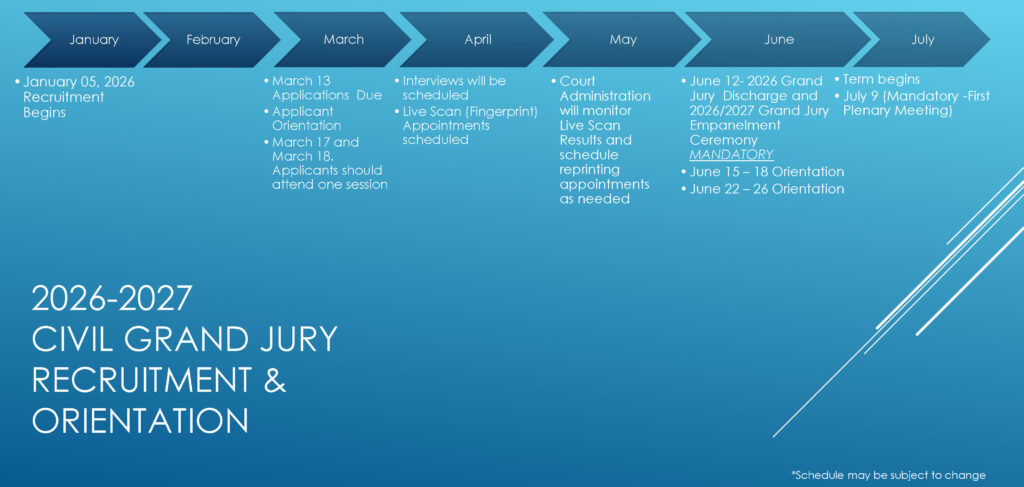
If you are interested in applying, please complete the application and review the timeline below.
The City of Antioch is offering an interactive orientation webinar where local, small business owners will learn how to access FREE one-on-one mentorship through Pacific Community Ventures’ Business Advising program.
We’ll walk you through a demo of the platform, highlight key features like the mobile app, and show you how these tools can support your mentorship journey and help grow your business.
Pacific Community Ventures’ BusinessAdvising.org platform connects small business owners across America with free and confidential expert business advising to help them seize opportunities and overcome challenges.
Pacific Community Ventures is a non-profit community investor that unlocks economic opportunity and climate resilience for small business owners and workers. Through access to affordable capital, pro bono business advising, ethical technology and AI, we partner with entrepreneurs to grow, hire, and prosper. For more information visit www.pacificcommunityventures.org.