






Archive for the ‘Drugs’ Category

Two former Antioch cops sentenced to time served, community service

Friday, February 13th, 2026

Former Antioch Police Officers Timothy Manly Williams (left) and Daniel Harris (right) were sentenced on Jan. 13, 2026, to time served. Herald file photos

No prison time; both testified against former colleagues

By Allen D. Payton

The final cases of Antioch Police Officers that were the focus of the Contra Costa DA and FBI investigations were settled last month with two former officers given sentences of time served. As a result, Timothy Manly Williams and Daniel Harris will not face any time in prison. Both testified against their former colleagues.

According to a previously published report by the U.S. Attorney’s Office Northern District of California, Manly Williams pleaded guilty on Nov. 28, 2023, to destruction, alteration and falsification of records in federal investigations, obstruction of official proceedings and deprivation of rights under color of law. Manly Williams was sentenced to “six months’ custody, followed by three years of supervised release, and 100 hours of community service.

Harris pleaded guilty on Sept. 17, 2024 to conspiracy to distribute and possess with intent to distribute anabolic steroids, and possession with intent to distribute anabolic steroids as well as bank fraud. Harris was sentenced to “twelve months and a day of custody, followed by three years of supervised release, and 100 hours of community service.”

Both men’s sentencing hearings were held on Jan. 13, 2026, but no statement was issued by the U.S. Attorney’s Office Northern District of California, which prosecuted both cases.

Manly Williams’ Case Details

According to the Sentencing Memorandum for Manly Williams, “In May 2021, the Antioch Police Department (“APD”) discovered during a routine audit something surprising: their own police officer, Timothy Manly Williams, had called a subject of a wiretap he was monitoring. From all appearances, he had intentionally burned the wire and attempted to cover it up. A sprawling federal investigation would eventually result in various criminal charges against ten Antioch or Pittsburg Police Department (“PPD”) officers or employees, including Manly Williams.

“In August 2023, Manly Williams was indicted for his concealment of that call during the wiretap, which constituted criminal falsification of records and obstruction of justice, as well as for his unconstitutional destruction of a citizen’s cell phone following his then-roommate APD Officer Morteza Amiri’s release of a police canine to bite a suspect.

“By September 2023, Manly Williams had already met with the government a first time. By November 2023, he had promptly pleaded guilty to his crimes. In March 2025, he testified in the jury trial involving that same former roommate regarding another dog bite for which he was present, and Amiri’s concealment of facts surrounding that bite. He also admitted to additional criminal conduct not specifically referenced in the indictments.

“Manly Williams’ crimes were very serious, particularly given his role as a police officer sworn to uphold the law and protect his fellow citizens. However, his immediate acceptance of responsibility and cooperation with the government was also very significant, particularly given that same role, and the government accordingly moves for a downward variance pursuant to § 5K1.1 for his substantial assistance to authorities.

“Based on the nature and circumstances of the serious offenses, the defendant’s history and characteristics (including his role as a sworn police officer), the need for deterrence, and the need to avoid unwarranted sentence disparities given the sentences already imposed by this Court, as well as the government’s motion for the equivalent of a five-level downward departure pursuant to § 5K1.1, the government recommends that the Court impose a sentence of six months’ custody, followed by three years of supervised release, and 100 hours of community service. This proposed sentence is sufficient, but not greater than necessary, to achieve the goals set forth in 18 U.S.C. § 3553(a)(2).

“The government’s investigation also revealed other relevant criminal conduct, which Manly Williams admitted carrying out, including:

• While employed as a police officer with PPD and APD, Manly Williams illegally purchased anabolic steroids, Schedule III controlled substances, from PPD Officer Patrick Berhan and APD Officer Daniel Harris.

• While employed as a police officer with PPD and APD, Manly Williams misused confidential law enforcement databases by performing searches for the benefit of himself or friends without a proper law enforcement purpose. For instance, in approximately December 2020 he searched for the criminal history of his friend for no legitimate law enforcement purpose; and in approximately February 2021 he searched or caused law enforcement databases to be searched for warrants for no legitimate law enforcement purpose.

• While employed as APD police officers, Manly Williams and APD Officer Morteza Amiri illegally took marijuana and/or marijuana products seized from APD law enforcement activity, including in approximately December 2020 when Amiri stated to Manly Williams, “I got a basketball size bag of weed in my trunk.” Instead of filing reports with APD on the seizures of marijuana or submitting the marijuana into evidence, Amiri and Manly Williams personally consumed the marijuana in violation of APD policy and, in at least one instance in approximately November 2020, Manly Williams arranged for the sale of such marijuana and received proceeds from its sale.

• While employed as an APD police officer, Manly Williams illegally facilitated the removal or dismissal of traffic tickets for the benefit of himself, friends, or colleagues without a proper law enforcement purpose, including in approximately October 2020 via other APD officers in which the recipient of a ticket provided tequila bottles in exchange for those officers not appearing in court for a traffic ticket, and in approximately April 2021 at the behest of a PPD, who requested that a particular traffic ticket be disregarded.

• While employed as an APD police officer, Manly Williams wrongfully posted law enforcement-sensitive information to his Instagram account using the story feature to “close friends” who were outside the law enforcement community.”

The Memorandum also explained, Manly Williams had no previous arrests and did not have criminal convictions resulting in any Criminal History Points, placing him in Criminal History Category I and “the government agreed with the Sentencing Guidelines calculation of the United States Probation Office.

Read more details in Manly Williams’ Sentencing Memorandum.

Harris’ Case Details

According to his Sentencing Memorandum, “Defendant Daniel Harris, a police officer with the Antioch Police Department (“APD”), began purchasing illegal anabolic steroids for his own personal use around 2019. He then began selling and distributing these Schedule III controlled substances to numerous other law enforcement officers at APD and neighboring law enforcement agencies. Among others, Harris sold illegal anabolic steroids to fellow APD officer Devon Wenger, and also agreed with Wenger to distribute them to Wenger’s friend B.M. Harris’ prolific sale and distribution of illegal anabolic steroids continued through March 2022 as he was in the process of moving from California to Texas, only coming to a halt after the FBI executed search warrants that located and seized troves of illegal anabolic steroids from a postal package destined for Harris (including steroids for Wenger’s friend), from Harris’ California residence, and from Harris’ new residence in Weatherford, Texas.

“The government’s investigation also revealed that Harris’ criminal activity while employed as an APD officer was not limited to the purchase and distribution of illegal anabolic steroids: he further committed bank fraud by falsifying information in his application for a mortgage to purchase his Texas residence.

“Harris’ crimes were particularly serious given Harris’ role as a law enforcement officer sworn to uphold the law. However, following his indictment and arrest, Harris took responsibility for his actions and pleaded guilty to all of these crimes, agreed to meet with the government and cooperate, and ultimately testified before the jury as to his and Wenger’s conduct involving the distribution of illegal anabolic steroids.

“Based on the nature and circumstances of the serious offenses, the defendant’s history and characteristics (including his role as a sworn police officer), the need for deterrence, and the need to avoid unwarranted sentence disparities given the sentences already imposed by this Court, as well as the government’s motion for the equivalent of a three-level downward departure pursuant to § 5K1.1, the government recommends that the Court impose a sentence of twelve months and a day of custody, followed by three years of supervised release, and 100 hours of community service. This proposed sentence is sufficient, but not greater than necessary, to achieve the goals set forth in 18 U.S.C. § 3553(a)(2).”

In addition the Memorandum explains, “In February 2022, Harris knowingly supplied inaccurate information to a financial institution in connection with his application for a mortgage. During this time, Harris applied for, and subsequently received, a $494,000 loan from Mortgage Financial Services LLC with the intent to defraud the financial institution to purchase a residence…in Weatherford, Texas. Harris provided false information in and omitted material facts from his application.”

Read more details in Harris’ Sentencing Memorandum.
Traffic stop leads to arrest of Antioch man for meth possession, suspended license

Thursday, January 29th, 2026
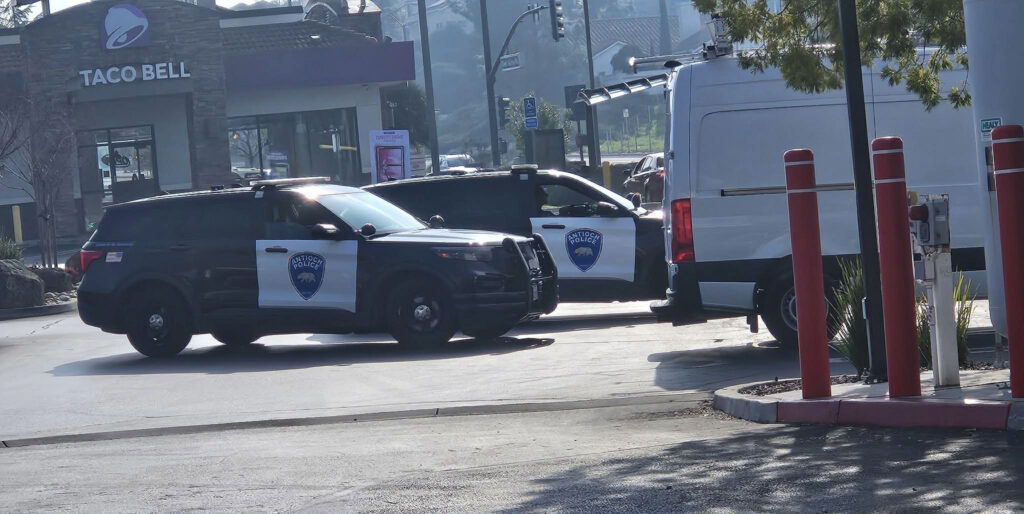
A traffic stop by Antioch Police in the Hillcrest Crossings shopping center ended with an arrest for meth possession, more Tuesday afternoon, Jan. 27, 2026. Photo courtesy of resident who chose not to be identified

At least the 19th arrest, 13th by Antioch PD since 2014 for 37-year-old Robert Lay

By Allen D. Payton

In response to a resident witnessing police action on Tuesday afternoon, Jan. 27, 2026, Antioch Police Lt. Michael Mellone of the Field Services Division explained, a “traffic stop for a red light turned into an arrest for meth possession and driving on a suspended license.”

The incident occurred in the parking lot of the Hillcrest Crossings Shopping Center, off Deer Valley Road, between the Safeway gas station and Taco Bell.

Police arrested Robert Anthony Lay, a 37-year-old male from Antioch, Mellone shared.

According to the Contra Costa County Sheriff’s Office, born 11/16/1988, the six-foot, two-inch tall, 200-pound suspect was arrested at 1:27 p.m., is Hispanic but also listed as White, and is being held in the West County Detention Facility on no bail.

According to localcrimenews.com, it’s at least the 19th time Lay has been arrested since 2014 and 13 of those were by Antioch Police. He faced charges for hit-and-run, vehicle theft, possession of burglar’s tools, conspiracy to commit a crime, vandalism and multiple charges of receiving stolen property – motor vehicle, reckless driving, driving with a suspended license for drunk driving, possession of a controlled substance, including for sale and bringing a controlled substance into a prison, plus, possession of drug paraphernalia and revocation of probation.

According to the Herald’s archives, – On 10/5/2015 at 5:10 p.m., an officer was patrolling near Lemontree and Peppertree Way and saw 26-year-old Robert Lay driving recklessly though the area. Lay continued to drive erratically while the officer attempted to catch up to him. Lay hit a parked car and eventually pulled into the 76 gas station on Contra Loma Blvd. Officers made contact with Lay and detained him. A records check revealed he had an outstanding felony arrest warrant for the charge of possession of stolen property. Lay was arrested for the warrant, hit and run and reckless driving. Lay’s vehicle was impounded and he was booked at the county jail.

The Herald thanks the resident for the photo of the scene and information about the arrest.

Rep. Harder’s Safer Response Act to protect law enforcement from fentanyl exposure signed into law

Thursday, January 8th, 2026
Fentanyl. Photo: CDC

One in five emergency calls are for overdoses, exposing first responders to contamination and infection

New law spearheads nationwide effort to stop overdose deaths and crack down on trafficking

By Julie S. Kramer, Press Secretary, Office of Congressman Josh Harder

WASHINGTON – On Dec. 11, 2025, Rep. Josh Harder (D-CA-09) announced that his bipartisan bill to protect law enforcement from fentanyl exposure has been signed into law, unlocking $57 million every year through 2030 for overdose training for local law enforcement. Led with Rep. Mike Lawler (R-NY-17), the Safer Response Act was included in a broader package of substance use prevention and recovery legislation that passed the Senate in September, alongside the rollout of a brand-new nationwide initiative to combat the fentanyl crisis.

Fentanyl in our community puts everyone at risk:

  • Despite declines, fentanyl overdoses continue to be the leading cause of death for Americans aged 18-45, killing nearly 50,000 people last year alone.
  • This creates an escalating crisis for first responders, with up to one-in-five emergency medical service calls involving overdose response.
  • First responders are at risk of accidental exposure, contamination, and infection when responding to overdose emergencies.

“Our brave first responders never hesitate to answer the call and step in to save lives every single day, and they shouldn’t have to worry about self-exposure while they’re working to reverse life-threatening fentanyl overdoses,” said Harder. “This bill is going to bring millions for better training and modern resources to Valley departments, which will mean fewer lives lost to the deadly fentanyl epidemic. I’m grateful that lawmakers from across the aisle joined together to send this to the President’s desk, and I’m committed to ensuring our community continues to benefit from common-sense laws like this.” 

How the Safer Response Act supports law enforcement:

  • New technical assistance for local first responders to address overdoses.
  • Additional training on how first responders and emergency medical services can protect themselves in the event of exposure.
  • Outreach coordination teams to bridge gaps between public and private medical and emergency response partnerships.

Harder has made cracking down on the growing fentanyl crisis a top priority – he helped pass a bipartisan bill to put more fentanyl traffickers behind bars, and he is leading new legislation to close drug manufacturing loopholes that traffickers use to escape justice. Earlier this year, Harder met with more than 200 narcotics officers representing state associations across the country, including in California, as part of the National Narcotic Officers’ Associations’ Coalition’s (NNOAC) 2025 Delegate Conference. 

Congressman Harder represents the 9th Congressional District of California. Following the passage of Prop. 50 last November, the new district boundaries will include Pittsburg, Antioch and portions of Oakley and other areas in Eastern Contra Costa County. Harder is expected to run for re-election in the new district.

Allen D. Payton contributed to this report.

Opinion: “Free” federal program blowing hole in state budgets

Tuesday, August 5th, 2025

340B Drug Pricing Program costing employee health plans $5B per year

“Hospitals realized they could buy heavily discounted drugs and resell them to insured, middle-class patients at huge markups.”

By Dan Crippen

An obscure, supposedly free federal program is blowing a hole in state budgets — by depriving state governments of billions in corporate tax revenue and inflating costs for their public employee health plans. 

The culprit is the 340B Drug Pricing Program, which Congress established in 1992 to help safety-net hospitals. Once enrolled, qualifying hospitals and clinics and their partner pharmacies — collectively called “covered entities” — can purchase medicines directly from drug manufacturers or wholesalers at roughly 50% discounts. 

Congress expected only about 90 hospitals to participate. Today, more than 2,600 hospitals are enrolled. 

This explosive, unintended growth is the result of the program’s lax requirements. Covered entities are not required to expand charity care or even report how they use their 340B earnings.

Hospitals realized they could buy heavily discounted drugs and resell them to insured, middle-class patients at huge markups. In some cases, hospitals have charged cancer patients nearly ten times what they paid to acquire the drug. 

The opportunity to upcharge patients has proven irresistible and fueled the program’s bloat. In 2023, covered entities purchased $124 billion worth of medicines — but only paid $66 billion, meaning they received roughly $58 billion in discounts. 

Numerous audits have revealed that many hospitals use the funds to subsidize expansion in affluent neighborhoods, rather than support low-income or uninsured patients.

This perverse behavior harms state taxpayers. Because most 340B hospitals are technically non-profits, their earnings aren’t taxed. As a result, states collect about $3.5 billion less in corporate income tax and other tax revenue than they otherwise would. That’s money not available for public health, education, infrastructure, or employee benefits.

The 340B program hurts states in other ways, too.  

The program incentivizes hospital systems to acquire independent clinics — which don’t qualify for 340B — and designate them as “child sites” that subsequently become eligible for 340B. 

This leads to higher healthcare spending, since care at hospital-owned sites is more expensive than at clinics and independent practices. 

Care at 340B hospitals tends to be more expensive than care at competing hospitals, too. The average per-patient prescription spending at 340B hospitals is 150% higher than non-340B hospitals.

All told, large employers and their workers spend over $5 billion more per year on health care as a result of 340B. Every extra dollar that businesses spend on health care is a dollar that’s deducted from their taxable income. 

The program also inflates costs for state employee health plans. Utah recently found that its Public Employees Health Program is losing out on $3.9 million in rebate savings due to 340B.

Some state lawmakers are unwittingly compounding the damage by making it easier for pharmacies to contract with 340B hospitals and clinics. 

Instead of boosting care for poor patients, 340B drains public resources while enriching large hospital systems. Reform is desperately needed.

Dan Crippen is the former Director of the Congressional Budget Office. This piece originally ran in RealClearHealth.

Antioch couple arrested in Humboldt County with cocaine, Xanax, firearms, two juveniles

Monday, December 23rd, 2024
William Pree (2015 arrest photo by Antioch PD) and Josephine Daniels (Source: Facebook) were arrested with drugs, guns and ammunition by the Humboldt County Drug Task Force on Dec. 21, 2024.

William Pree, Lucy Daniels apprehended following traffic stop during cross state trip

Alleged prison gang leader, Pree was convicted for 2015 murder of man in Antioch which was overturned on appeal

By Humboldt County Drug Task Force

On Saturday, December 21st, 2024, Agents with the Humboldt County Drug Task Force (HCDTF) and Deputies with the Marijuana Enforcement Team (MET) served a search warrant on William Lavon Pree (43 years old from Antioch). During the month of December, HCDTF received information that Pree was traveling to the Bay Area and purchasing large quantities of narcotics for the purpose of sales, and that he was in possession of firearms. Pree is a convicted felon for numerous violent offenses involving firearms including attempted homicide. 

HCDTF Agents observed Pree travel from Humboldt County, to Los Angeles, and then the Bay Area. Upon Pree’s return to Humboldt County, Agents conducted a traffic stop on his vehicle on Hwy 101 at Hookton Road in Loleta. The vehicle had four occupants, Josephine Lucy Daniels (Age 48 from Antioch), Willaim Pree, and two juveniles (ages 5 and 17). All occupants were detained without incident.

Agents searched Pree’s vehicle and located over 450 Xanax bars, a half-pound of cocaine, a loaded 10MM Glock handgun, a loaded 9mm ghost pistol (privately manufactured with no serial number) equipped with a “Glock Switch” enabling the firearm to shoot fully automatic, more ammunition, high-capacity magazines, and a digital scale.

Both juveniles were transported to a safe location by law enforcement and Humboldt Child Welfare Services will receive the criminal report. Pree and Daniels were placed under arrest and transported to the Humboldt County Correctional Facility where they were both booked on the following charges:

11351 HS – Possession of narcotics for the purpose of sales 

11352(A) HS – Trafficking narcotics

11352(B) HS – Trafficking narcotics through noncontiguous counties 

11370.1 HS – Possession of a loaded firearm/narcotics

32625(A) PC – Possession of a machine gun

30605(A) PC – Possession of an assault weapon

25400(A)(1) PC – Illegally possessing a firearm inside of a vehicle

24610 PC – Possession on a non-detectable firearm

29800(a)(1) PC – Felon in possession of a handgun (Pree only)

30305(a)(1) PC – Felon in possession of ammunition (Pree only)

273A(A) PC – Felony child endangerment

According to localcrimenews.com, Press is Black and was also arrested by Antioch Police in September 2015 for being an accessory after the fact.

As previously reported, Pree was arrested in September 2015 for murder of 23-year-old Antioch resident, Kartiae Ely, who was shot in the driveway of an apartment building in the 1800 block of Cavallo Road and subsequently died from his injuries.

According to a Dec. 2023 Mercury News report, Pree is “An alleged prison gang leader accused of ordering the murder of a man over his gang’s attempts to take over an Antioch ‘money block’ has been released from jail after a judge lowered his bail to $200,000 in a pending murder case, court records show. William…Pree and his co-defendant, 45-year-old Edward Robinson, were convicted of murder in 2017, only to have the case be overthrown by an appeals court” in 2023.

According to the Humboldt County Sheriff’s Department, he is being held in the Humboldt County Correctional Facility in Eureka. Also, according to the Humboldt County Sheriff’s Dept, Daniels is of American Indian/Alaska Native descent and as of Sunday, Dec. 22 had bonded out of custody.

Anyone with information related to this investigation or other narcotics related crimes is encouraged to call the Humboldt County Drug Task Force at 707-267-9976.

Allen D. Payton contributed to this report.

As Prop 36 goes into effect CA Attorney General Bonta issues info bulletin to law enforcement

Friday, December 20th, 2024

Increases penalties for shoplifting and certain drug crimes

On Dec. 13, California Attorney General Rob Bonta issued an Information Bulletin to all law enforcement agencies in the state about Proposition 36 which passed overwhelmingly in November and went into effect on Wednesday, Dec. 18th. The bulletin highlights the statutory changes and additions made to current law under the proposition known as “The Homelessness, Drug Addiction, and Theft Reduction Act.”

“Ultimately, our success in combating organized retail crime hinges on our ability to work together, innovate, and remain steadfast in our commitment to protecting our neighborhoods and businesses,” said Attorney General Bonta. “Let us harness the strength of our partnerships, the power of new legislation, and the collective resolve of our community to create a safer and more secure environment for everyone. My office is committed to fighting organized retail crime head on.”

Proposition 36 modifies existing law and adds substantive charges and enhancements to areas of the Penal Code and Health and Safety Code regarding theft, property damage, and drug-related crimes. The changes include the creation of new felony theft and drug crimes targeting recidivist offenders, removal of eligibility for the sentences of certain offenses to be served in county jail pursuant to Penal Code section 1170(h) as opposed to state prison, and alignment of the punishment for crimes involving fentanyl with that of other similar controlled substances.

Following is Bonta’s Information Bulletin:

TO: ALL CALIFORNIA LAW ENFORCEMENT AGENCIES PROPOSITION 36: “The Homelessness, Drug Addiction, and Theft Reduction Act”

On November 5, 2024, California voters passed Proposition 36, known as “The Homelessness, Drug Addiction, and Theft Reduction Act.” Proposition 36 takes effect on December 18, 2024.

Proposition 36 modifies existing law and adds substantive charges and enhancements to areas of the Penal Code and Health and Safety Code regarding theft, property damage, and drug-related crimes. The changes include: (1) the creation of new felony theft and drug crimes targeting recidivist offenders; (2) removal of eligibility for the sentences of certain offenses to be served in county jail pursuant to Penal Code section 1170(h); and (3) alignment of the punishment for crimes involving fentanyl with that of other similar controlled substances.

The purpose of this bulletin is to highlight the statutory changes and additions made by Proposition 36.

CHANGES UNDER PROPOSITION 36 RELATING TO THEFT AND PROPERTY DAMAGE

Penal Code section 490.3 (Aggregation of Losses in Multiple Thefts): Proposition 36 creates a new Penal Code section 490.3 which permits aggregation of the value of property or merchandise stolen during multiple thefts to meet the $950 threshold for a felony without having to prove that the various crimes were motivated by one intention, one general impulse, and one plan. This new section applies to theft or shoplifting, including, but not limited to, violations of Penal Code sections 459.5, 484, 488, and 490.2.

Penal Code section 490.3 applies “notwithstanding any other law,” and is therefore broader than other laws such as Penal Code section 487, subdivision (e) and the new Penal Code section 12022.10,1

1 which would permit aggregation only in limited circumstances, such as if the acts were motivated by one intention, one general impulse, and one plan, or only if there was a common scheme or plan, respectively.

Penal Code section 666.1 (Felony Crime of Theft with Two Prior Thefts): Penal Code section 666.1 is a new, recidivist felony offense of committing petty theft or shoplifting while having two or more prior misdemeanor or felony convictions for specified theft-related crimes. A first conviction under Penal Code section 666.1, subdivision (a)(1) is punishable in county jail pursuant to Penal Code section 1170(h), second or subsequent convictions are punishable in county jail or state prison. Other notable aspects of Penal Code section 666.1 include:

  • There is no “washout” timeframe on the prior convictions that qualify a defendant to be charged with a violation of Penal Code section 666.1(a)(1)—all prior convictions qualify, regardless of when they occurred.
  • Although Penal Code section 666.1 does not mandate that the two or more specified prior convictions be alleged in the accusatory pleading, existing authority suggests that the prior convictions must be alleged and proved at preliminary hearing so a defendant can be held to answer on a Penal Code section 666.1 charge. (See People v. Casillas (2001) 92 Cal.App.4th 171.)
  • Section 666.1 applies “notwithstanding any other law,” meaning that it will apply even if a defendant could alternatively have been prosecuted for a misdemeanor theft-related charge pursuant to another statute.
  • Upon arrest on a Penal Code section 666.1 charge, subdivision (c) requires judicial review prior to release from custody to make an individualized determination of the arrestee’s risk to public safety and likelihood to return to court.

Penal Code section 12022.6 (Excessive Takings Enhancement): Proposition 36 re-enacts and modifies several aspects of the Penal Code section 12022.6 enhancement, which was repealed at the end of 2017 because of a sunset date. Penal Code section 12022.6 applies when an offender takes, damages, or destroys property in the commission or attempted commission of a felony, or commits a felony in violation of Penal Code section 496 (possessing/receiving/selling stolen property). This enhancement must be pled and proved. The enhancements are as follows:

  • One-year enhancement – loss or property value over $50,000
  • Two-year enhancement – loss or property value over $200,000
  • Three-year enhancement – loss or property value over $1 million
  • Four-year enhancement – loss or property value over $3 million
  • One-year enhancement for every additional loss or property value of $3 million (imposed in addition to the four-year, $3 million enhancement)

The enhancements may be imposed if the combined losses to the victims or the combined property values from all felonies exceed the threshold amounts and arise from a common scheme or plan. The enhancement permits the court to impose a Penal Code section 12022.6 enhancement and another enhancement on a single count, including an enhancement pursuant to new Penal Code section 12022.65 (acting in concert to take, damage, or destroy property—see below). Thus, a defendant may be punished for both acting in concert (Pen. Code § 12022.65) and for taking or damaging property valued at more than $50,000 (Pen. Code § 12022.6). The punishment specified in Penal Code sections 12022.6, subdivisions (a)(1) and (a)(2) will continue to apply where Penal Code section 186.11 has been charged, as it previously did.2

Penal Code section 12022.65 (Theft or Property Damage In-Concert Enhancement): Penal Code section 12022.65 is a new enhancement that applies when an offender acts in concert with two or more persons to take, attempt to take, damage, or destroy property, in the commission or attempted commission of a felony. This enhancement has a range of one, two, or three years and must be pled and proved.

CHANGES UNDER PROPOSITION 36 RELATING TO CONTROLLED SUBSTANCES

Health and Safety Code section 11369 (Warning to Dealers of Hard Drugs): Proposition 36 creates a new section 11369 in the Health and Safety Code section 11369 which requires the trial court to advise anyone convicted of a violation of Health and Safety Section 11351, 11351.5, 11352, 11378, 11378.5, 11379, 11379.5, or 11379.6 involving a hard drug,3 that distributing, selling, furnishing, administering, giving away, or manufacturing any drug is extremely dangerous and deadly to human life, and if the conduct continues, the defendant can be charged with homicide, up to and including murder.4 The admonishment must be given to the defendant in writing and the court record must reflect that the admonishment was given.

Health and Safety Code section 11370.1 (Possessing a Drug While Armed with a Firearm): Health and Safety Code section 11370.1 is modified by Proposition 36 to expand the felony crime of unlawfully possessing a specified substance while armed with a loaded, operable firearm to include any substance containing fentanyl. Health and Safety Code section 11370.1 continues to apply to substances containing cocaine, cocaine base, heroin, methamphetamine, or phencyclidine, and continues to provide punishment of two, three, or four years in state prison.

Health and Safety Code section 11370.4 (Controlled Substance Weight Enhancement): Health and Safety Code section 11370.4 is modified by Proposition 36 by adding a new subdivision (c), which provides a range of enhancements for a violation of Health and Safety Code sections 11351, 11352, or a conspiracy to violate either section, involving fentanyl.5 The following chart breaks down the nine new weight enhancements for fentanyl in specific quantities:

Source: Office of the CA Attorney General

New subdivision (e) provides that notwithstanding Penal Code section 1170, subdivision (h)(9), a defendant convicted of an underlying violation specified in Health and Safety Code section 11370.4 (e.g., Health & Saf. Code §§ 11351, 11351.5, 11352, 11378, 11378.5, 11379, and 11379.5) who admits a weight enhancement or for whom a weight enhancement is found true for any of the listed controlled substances, is punishable in state prison and not county jail pursuant to Penal Code section 1170, subdivision (h).

Health and Safety Code section 11395 (“Treatment-Mandated Felony Act”): Proposition 36 creates Health and Safety Code section 11395, a new, recidivist felony offense of possessing a “hard drug” and having two or more prior felony or misdemeanor convictions for specified drug-related crimes. A violation of Health and Safety Code section 11395 is punishable in county jail pursuant to Penal Code section 1170(h) for a first conviction. Subsequent convictions are punishable in state prison. Both first and subsequent convictions are wobblers and eligible for probation unless otherwise prohibited. Other notable aspects of Health and Safety Code section 11395 include:

  • Section 11395 applies “notwithstanding any other law,” meaning that it will apply even if a defendant would have been eligible for a misdemeanor drug possession charge (e.g., Health & Saf. Code § 11350 or 11377), Penal Code section 1000 drug diversion, or probation for a non-violent drug possession offense pursuant to Penal Code section 1210.1.
  • The two or more prior convictions of specified crimes within Health and Safety Code section 11395, subdivision (c) may be either misdemeanor or a felony convictions.
  • There is no “washout” timeframe on the prior convictions that qualify a defendant to be charged with a violation of Health and Safety Code section 11395—all prior convictions qualify, regardless of when they occurred.
  • Prior convictions must be pled and proven. (Health & Saf. Code, § 11395, subd. (c).)
  • Upon booking for a violation of Health and Safety Code section 11395, subdivision (f) requires judicial review prior to release from custody to make an individual determination of the arrestee’s risk to public safety and likelihood to return to court.

Health and Safety Code section 11395 also provides an option for treatment in lieu of incarceration for its offenses. Health and Safety Code section 11395, subdivision (d) provides that a defendant may choose treatment instead of county jail, state prison, or a grant of probation with county jail as a condition of probation.6 Upon successful completion of the treatment program, the positive recommendation of the  treatment program, and a motion by the defendant, the court shall dismiss the Health and Safety Code section 11395 charge. (Heath & Saf. Code, § 11395, subd. (d)(3).)

Penal Code section 12022, subdivision (c) (Drug Crimes While Personally Armed with a Firearm): Proposition 36 amends Penal Code section 12022, subdivision (c) to provide that the enhancement for individuals convicted of specified drug offenses and who are personally armed with a firearm, must serve the additional term in state prison instead of county jail. Subdivision (c) is further amended to provide that, notwithstanding Penal Code section 1170, subdivision (h)(9), a defendant convicted of a specified underlying violation who admits a Penal Code section 12022, subdivision (c) firearm enhancement or has such an enhancement found true, is punishable in state prison even if the underlying offense is a section 1170, subdivision (h) county jail offense.

Penal Code section 12022.7 (Great Bodily Injury (GBI) Enhancement For Drug-Related Injury): Proposition 36 amends Penal Code section 12022.7 to add subdivision (f)(2), which explicitly provides that “a person who sells, furnishes, administers, or gives away a controlled substance is deemed to have personally inflicted great bodily injury when the person to whom the substance was sold, furnished, administered, or given suffers a significant or substantial physical injury from using the substance.” This creates a great bodily injury enhancement that can be charged when the person to whom an offender supplies a drug suffers a serious injury from using the drug, including death.7

1 Penal Code section 12022.10 is a new enhancement created by Senate Bill 1416, effective January 1, 2025, for selling, exchanging, or returning for value, property acquired through one or more acts of shoplifting, theft, or burglary from a retail business. It also applies to attempted selling, exchanging, or returning, and has a sunset date of January 1, 2030. By contrast, Penal Code section 490.3 does not address the aggregation of sales of stolen property.

2 Assembly Bill 1960, effective on January 1, 2025, adds a Penal Code section 12022.6 excessive taking enhancement that is almost identical to that in Proposition 36. The non-substantive difference is that AB 1960 contains a sunset date of January 1, 2030, and Proposition 36 does not contain a sunset date.

3 “Hard drug” means a controlled substance listed in Health and Safety Code section 11054 or 11055, except that it does not include substances listed in Health and Safety Code section 11054, subdivisions (d) and (e), or, with the exception of methamphetamine, any other substance listed in Health and Safety Code section 11055, subdivision (d). (Health & Saf. Code, § 11369, subd. (d).)

4 Vehicle Code section 23593 similarly provides that, upon conviction of certain Vehicle Code provisions, courts are required to give an advisement about the dangers of drinking and driving, and warn that if someone is killed, the offender can be charged with murder.

5 Health and Safety Code section 11370.4, subdivision (a)(1) removes fentanyl from the list of controlled substances. The modification to Health and Safety Code section 11370.4 puts fentanyl in its own subdivision (c)(1) and lowers the quantity thresholds because fentanyl is more lethal than other substances in small doses. Health and Safety Code section 11370.4, subdivision (a)(1) still applies to heroin, cocaine, and cocaine base and does not change the quantities or punishment for those substances.

6 Section 11395 is a deferred entry of judgment program, in which the defendant must plead guilty or no contest before going into treatment; it is not a diversion program.

7 This new language abrogates the California Supreme Court’s decision in People v. Ollo (2021) 11 Cal.5th 682, which held that furnishing a drug that causes death does not necessarily qualify as personal infliction of great bodily injury.

Allen D. Payton contributed to this report.

Initiative to repeal Prop 47 soft-on-crime measure qualifies for Nov. ballot

Tuesday, June 11th, 2024
Photos: Californians for Safer Communities

Allows felony charges and increases sentences for certain theft and drug crimes, including fentanyl

Sacramento, CA – California Secretary of State Shirley N. Weber, Ph.D. announced that an initiative became eligible for the November 5, 2024, General Election ballot on June 10, 2024.

In order to become eligible for the ballot, the initiative needed 546,651 valid petition signatures, which is equal to five percent of the total votes cast for governor in the November 2022 General Election.

A measure can become eligible via random sampling of petition signatures if the sampling projects that the number of valid signatures is greater than 110 percent of the required number. The initiative needed at least 601,317 projected valid signatures to become eligible by random sampling, and it has exceeded that threshold today.

On June 27, 2024, the Secretary of State will certify the initiative as qualified for the November 5, 2024, General Election ballot, unless it is withdrawn by the proponent prior to certification pursuant to Elections Code section 9604(b).

While the proponents of the initiative, Californians for Safer Communities labeled it The Homelessness, Drug Addiction, and Theft Reduction Act. But Attorney General Rob Bonta’s official title and summary of the measure is as follows: ALLOWS FELONY CHARGES AND INCREASES SENTENCES FOR CERTAIN DRUG AND THEFT CRIMES. INITIATIVE STATUTE.

– Allows felony charges for possessing certain drugs, including fentanyl, and for thefts under $950—both currently chargeable only as misdemeanors—with two prior drug or two prior theft convictions, as applicable. Defendants who plead guilty to felony drug possession and complete treatment can have charges dismissed.

– Increases sentences for other specified drug and theft crimes.

– Increased prison sentences may reduce savings that currently fund mental health and drug treatment programs, K-12 schools, and crime victims; any remaining savings may be used for new felony treatment program.

Summary of estimate by Legislative Analyst and Director of Finance of fiscal impact on state and local governments: Increased state criminal justice system costs potentially in the hundreds of millions of dollars annually, primarily due to an increase in the state prison population. Some of these costs could be offset by reductions in state spending on local mental health and substance use services, truancy and dropout prevention, and victim services due to requirements in current law. Increased local criminal justice system costs potentially in the tens of millions of dollars annually, primarily due to increased court-related workload and a net increase in the number of people in county jail and under county community supervision. (23-0017A1)

According to Ballotpedia.com, the political action committee supporting the measure, Californians to Reduce Homelessness, Drug Addiction, and Theft, has raised over $7.2 million to support the effort. Of that amount $2.5 million was contributed by Walmart, $1.0 million from Home Depot, $500,000 from Target, $300,000 each from 7-Eleven and California Correctional Peace Officers Association Truth in American Government Fund.

The Secretary of State’s tracking number for this measure is 1959 and the Attorney General’s tracking number is 23-0017A1.

The proponent of the measure is Thomas W. Hiltachk of the Bell, McAndrews & Hiltachk law firm. They can be reached at (916) 442-7757. The address for the proponent is 455 Capitol Mall, Suite 600, Sacramento, CA 95814.

For more information about how an initiative qualifies for the ballot in California, visit https://www.sos.ca.gov/elections/ballot-measures/how-qualify-initiative/

Allen D. Payton contributed to this report.

National Prescription Drug TAKE BACK Day Saturday, Oct. 28

Friday, October 27th, 2023
Source: CCC Sheriff’s Office

By Contra Costa County Sheriff’s Department

On Saturday, October 28, 2023, from 10 AM to 2 PM, the Contra Costa County Office of the Sheriff and the Drug Enforcement Administration (DEA) will give the public another opportunity to prevent pill abuse and theft by ridding their homes of potentially dangerous, expired, or unused prescription drugs.

Needles and sharps cannot be accepted; only pills, patches, and liquids sealed in their original containers will be accepted. Vape pens or other e-cigarette devices from individual consumers are accepted only after the batteries are removed from the devices.

The service is free and anonymous; no questions asked. Bring your pills for disposal at the following sites:

DROP OFF LOCATIONS

Muir Station – 1980 Muir Road, Martinez

Bay Station – 5555 Giant Highway, Richmond

Valley Station – 150 Alamo Plaza, #C, Alamo

Delta Station – 14830 Highway 4, Discovery Bay

Danville Police Department – 510 La Gonda Way, Danville

Lafayette Police Department – 3471 Mt. Diablo Blvd., Lafayette

Orinda Police Department – 22 Orinda Way, Orinda

For more information about the disposal of prescription drugs, locations, or the Take Back event, visit: www.dea.gov/takebackday.