Archive for the ‘Police & Crime’ Category

CHP requests public’s help investigating Hwy 4 shooting in Antioch Friday afternoon, injured driver being treated

Saturday, June 20th, 2020

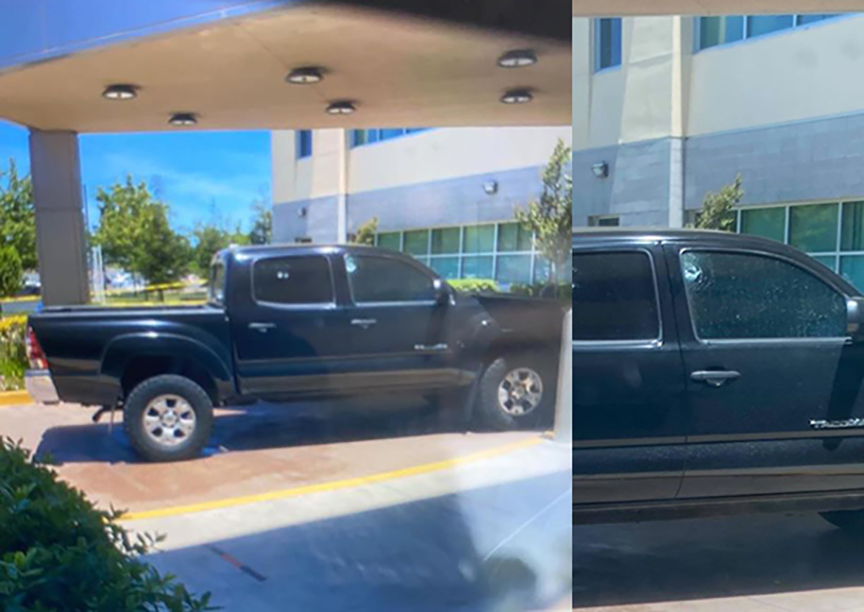
Truck of gunshot victim with bullet holes at John Muir Outpatient Center in Brentwood Friday afternoon, June 19, 2020. Photos by witness who chose not to be identified.

Driver shows up at medical center in bullet riddled truck. Freeway blocked, traffic backed up for miles.

By CHP – Golden Gate Division

An apparent targeted shooting occurred on eastbound Highway 4, west of Lone Tree Way near Laurel Road in Antioch. The shooting, which took place around noon on Friday, left the driver of a black pickup truck with a gunshot wound to his leg. At this time, it appears someone traveling in a grey SUV (possibly a 90’s model Mitsubishi) shot at the pickup approximately three times and fled the scene. The driver of the pickup is currently being treated for his injuries at a local hospital.

According to witnesses, the gunshot victim drove his truck to John Muir Outpatient Center in Brentwood, with some of his wounds already bandaged up and the truck, riddled with bullet holes, almost struck the building. He ran inside, collapsed and was later transported to another hospital in the area.

Detectives assigned to CHP – Golden Gate Division Investigative Services Unit (ISU) are actively investigating this shooting. Our detectives are requesting assistance from the public in gathering the details surrounding this incident. If you or anyone you know have any information that might be helpful, please call the CHP Investigative Tipline at (707) 917-4491.

Allen Payton contributed to this report.

Antioch Council votes down ad hoc committee on police reform, will hold study sessions with all five members and Police Crime Prevention Commission

Thursday, June 18th, 2020

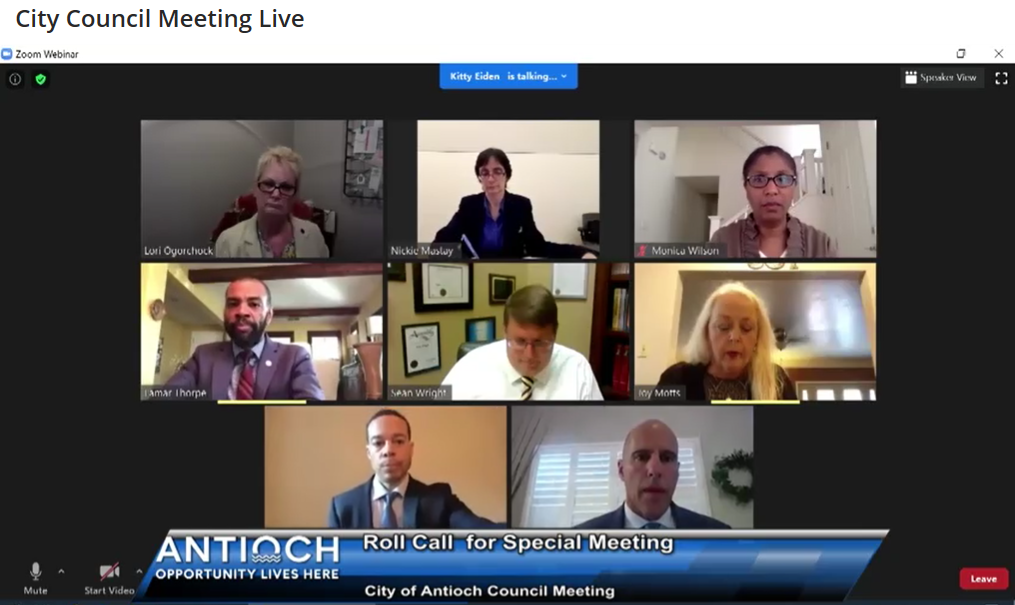
Antioch Council Members, City Attorney Thomas Smith and City Manager Ron Bernal listened as city staff members read the final 200 public comments during the continuation of Tuesday night’s special meeting on Thursday, June 18, 2020. Screenshot from City website.

“this is too big, too important for our community (to settle for a two-member ad hoc committee). What I see is a series of forums…but it would be inclusive of everyone on the council.” – Mayor Sean Wright

By Allen Payton

During the second of two special meetings this week and after listing to seven hours of public comments from over 700 people, the Antioch City Council voted on a split vote Thursday night to oppose the formation of a two-person ad hoc committee on police reform as Councilman Lamar Thorpe had called for. He and Councilwoman Monica Wilson voted for it while the other three members voted against. Instead the council agreed to have Mayor Sean Wright call the first, of what is expected to be a series of public study sessions to discuss the matter as a whole, that will include the Police Crime Prevention Commission, and set it for Tuesday night, June 30.

At the first session, Antioch Police Chief T Brooks is expected to speak first, followed by those who have had issues with the police department, as Wright put it.

The meeting ran much smoother than Tuesday’s, as the various form letters submitted by several people on both sides of the issue were read once by city staff members, while just reading the names of all those who submitted the same letters. Wright opened the meeting saying there were about 200 public comments left to read.

Dan Stills was the first of only two members of the public available on Zoom to speak. He said, “now that we get staff, along comes the notion of…defunding police and the ad hoc committee. I am one of the silent majority, opposed to the ad hoc committee. We will be voting in November. I implore all of you to work with the police chief to make any necessary changes. We don’t need to dismantle…now is not the time to tear it down and rebuild it.”

City Finance Director Dawn Merchant then read some of the form letters and mentioned the names of all those who had submitted them.

One comment quoted the city’s Vision Statement and wrote in favor of forming the ad hoc committee.

“Chief Brooks has explained that the department has already implemented six of the eight reforms” read one letter opposing the ad hoc committee.

“Why do we need another politician run committee? We’re tired of your committees and lack of action,” wrote retired Antioch Sergeant Larry Hopwood and five others.

Another letter asked for a community forum led by Chief Brooks and submitted by several people.

“Racism is something that needs to be discussed by the entire community,” wrote one letter submitted by several members of the public

“I’ve been in Antioch since 1965…this is just a kneejerk reaction to what’s going on,” read a letter by one resident.

Carol Allen wrote, “We need our police not a committee of grandstanding politicians.”

Matt Vargas wrote, “Have you ever been burglarized, assaulted? I have. You defund our police and it takes longer to respond. We’re already understaffed.”

“I’ve seen no improvement in my neighborhood and it’s only gotten worse,” read another letter.

“Now is not the time to cut funding. Measure C is scheduled to sunset in 2021,” read another. That last part is not correct. Measure C’s half-cent sales tax was replaced by a full cent sales tax with the passage of Measure W.

“Please do not follow the cities of Oakland and San Francisco that have citizen boards run the police department,” read another letter by a Mr. Crum.

Michael Gobel wrote opposing the ad hoc committee, “We need to support these men and women who lay their lives on the line for us.”

Gary Shu opposed the ad hoc committee writing, “Do not defund our police. If we do our peaceful world as we know it will end. What about the school kids with no protection?”

“If you defund the police in Antioch, I want every dollar back I paid in taxes,” read another letter from a member of the public.

Wayne Butler wrote, “Leave the police alone. We still don’t have enough cops in this crime-ridden city. 97.3% of cops don’t even fire their gun in their entire 30-year career.”

“I would like to defund the police, they are fat and only go after women and minorities,” read another letter in support of the ad hoc committee.

“Antioch police activity must remain at the current level,” wrote another member of the public.

Nancy Green wrote, “I think APD is doing a good job.”

Sal Sbranti wrote, “I do not believe that the actions of the Antioch Police Department require us to support a witch hunt sponsored by Lamar Thorpe and Monica Wilson. Lamar’s comments and endorsement of “8 can’t wait” displays his bias and that alone should eliminate him from being a member of any ad hoc committee. The statements that Lamar has made, makes Antioch and our stellar police department look bad. Stellar?- violent crime down 15% from 2015 to 2019, citizens complaints down 40% from 2017 to 2019. Antioch Citizens passed “Measure C” in November of 2013 and “Measure W” in November of 2018, and it was April of this year when we finally met the goal number of Police that this City Council Authorized. If a committee is to be formed, it should not be called “Police Reform Committee” as again, that displays Lamar’s and the City Attorneys bias and the pre-judgement of this council.”

“I’ve personally heard stories of police brutality by people, here in Antioch. I expect the city council to put their full effort into this,” read another letter.

“I’ve seen the quality of life in Antioch deteriorate every year I’ve lived, here. Because the members of the committee will not be held accountable, I’m against it,” read another.

Megan wrote, “Countless lives have been taken. Antioch is not an exception. You must disarm and dismantle the police. We want a new community not cops.”

Steve Libator wrote against the ad hoc committee but in favor of a community forum, “You want to bring attention to yourself. Please stop.”

“Maybe you can teach officers how to love people who don’t look like them. While I do support the police, I was disappointed with the way the chief handled the COVID-19 situation and left us to fend for ourselves,” wrote another member of the public in favor of forming the ad hoc committee.

Sara Gubeer, a 2018 graduate of Dozier-Libbey wrote supporting the ad hoc committee about the deaths of people across the country. “The police don’t actually serve or protect anyone. First, we must start with our own community.”

Robert Pohl wrote against forming the ad hoc committee. “We voted twice to increase funding for police Now people want to defund it, which doesn’t make sense. Antioch has a diverse and progressive police department.”

Luis Crockett wrote “I don’t support our chief and police officers, they are racist and constantly profile black and brown members of our community. This has to stop now.”

Victor Wen, a DVHS alumni class of 2020 submitted the same form letter making accusations against the police department and called for it to be defunded and disarmed.

Beverly Knight who opposed the ad hoc committee wrote, “The police portrayed on the national news are not the Antioch Police Department. Chief Brooks works hard to make community policing an imperative. I will believe APD will embrace positive change. Don’t try to fix something that’s not broken.”

Sarah Laughlin, a 2015 DVHS graduate who is getting her law degree wrote, “I’ve seen this community’s ability to lift people up but also tear it down. I’ve seen how the local school system that targets black and brown students.”

Vanessa Helmann wrote, “I don’t believe a special committee will serve our community.”

John Fischer wrote, “This attempt…is a slap in the face of the police department. The letter sent out by Chief Brooks was well written. I don’t agree with all that he wrote.

“I do not agree with an ad hoc committee…there is a need to begin a comprehensive approach…to build trust between the police and the community,” wrote another member of the public, citing new legislation introduced in Congress.

Tina Gillette wrote, “I live in District 1…that is represented by Joy Motts. While most of us support the protesters” and called for community forum.

Lucy Meinhardt wrote, “Our entire country is in a state of upheaveal. Continiuing to improve our policing is what is needed. There’s no reason Antioch cannot be part of this national movement” and asked that representatives of color lead the effort.

“Antioch PD works with people of all races in the community. We all need to live together as one. Focus on our real problems,” wrote another.

Harry Raymond wrote, “The City of Antioch is blessed by a very well run police department. The citizens of Antioch…twice agreed to more taxes. APD finally reached the target minimum after a number of years.”

Ariana Edwards wrote, “This community needs care not cops. It’s time for reform” and supported the ad hoc committee.

“It’s time to defund the police…and invest in the community and schools, instead,” another letter read.

“The council can look past the current hysteria” wrote another person who called for a standing committee of three council members. But that would violate the state’s Brown Act open meeting law, which is why sub- and ad hoc committees

NAACP East County Branch submitted a comment calling for, “wholly and unequivocally a police oversight committee in the City of Antioch…that will mete out discipline.”

Mike Barbanica wrote, “What we don’t need is more political grandstanding by members of our city council. Vote no on the ad hoc and look at alternatives that will involve the entire community.”

Willie Mims, a Pittsburg resident and member of the NAACP East County Branch, wrote, “Since the murder of George Floyd, the whole country and the world are protesting police brutality, white racism and white supremacy.  You, who live in the City of Antioch, must not place your heads in the sand and put a mask over your eyes in order to cover up the fact that you have not experienced some of these same incidents here in your own town.  You had and still do have some officers operating under the Color of Law.

This city must not be afraid to welcome a thorough review and reevaluation of the police department’s excessive force policy, an examination of its accountability component, and its use and misuse of its canine unit when dealing with non-aggressive citizens.  Not only that, but there should be some serious ongoing training in racial profiling, racial bias and de-escalation techniques, especially when dealing with mental health issues, black people, and other peoples of color.

A civilian oversight commission would be best for the city of Antioch and should be put in place to address any complaints against the police department.

And lastly, I stand with the city council as they grapple with this American racial problem.  I take issue, however, with the police association and their attack upon certain council members.  Their resistance to either review or to even consider a citizen oversight committee is quite troubling.  Whatever the case, the issue of race is placed back on both Antioch’s and America’s table of destiny. I hope that the council will do what is right. Know this, that I stand with those people wanting change at this time in our history.”

Joel Firstenberger praised Chief Brooks and wrote, “I don’t support the political views of Black Lives Matter. I do not want the council to take on this agenda to please two board members.”

“Antioch can be a beacon of how to operate the police department. This isn’t political. It’s personal. I have black sons and want to know this town embraces their beautiful lives,” wrote one resident.

Another member of the public wrote about “an instigator and a follower…is this leadership we need…? Absolutely not.”

Gary Walker wrote, “My husband and I would like to support an ad hoc committee…to give voice to the people…and has a laser focus agenda. We only see positive change from this initiative.”

Zoe Jones wrote, asking for the council to defund the police and spending it on other things in the community.

Ruth Pastor wrote, “We don’t have enough police as it is, now.”

Sandy McGee wrote, “I think an ad hoc committee is a slap in the face” to the police department. Councilman Thorpe needs to pick something else to help your campaign.”

“I am a rare species of a Republican in this town, but I support the formation of an ad hoc committee…” wrote another member of the public.

Edward Piller wrote, “We must listen to our hearts and the youth. Please support the ad hoc committee.”

“Being a roofing contractor is four times more dangerous” than being a police officer, read another letter.

Community Development Director Forrest Ebbs continued to read the remainder of the emailed public comments.

One of the form letters, mainly submitted by recent, local high school graduates, called for the implementation of 8 to Abolition which claims the 8 Can’t Wait effort won’t work and instead, wants to simply abolish police departments and prisons.

According to their website, Campaign Zero released its 8 Can’t Wait campaign, offering a set of eight reforms they claim would reduce police killings by 72%. As police and prison abolitionists, we believe that this campaign is dangerous and irresponsible, offering a slate of reforms that have already been tried and failed, that mislead a public newly invigorated to the possibilities of police and prison abolition, and that do not reflect the needs of criminalized communities.”

“The end goal of these reforms is not to create better, friendlier, or more community-oriented police or prisons. Instead, we hope to build toward a society without police or prisons, where communities are equipped to provide for their safety and wellbeing.” The organization wants to Defund the Police and city officials to, “Reject any proposed expansion to police budgets. Demand the highest budget cuts per year, until they slash police budget to zero. Slash police salaries across the board until they are zeroed out.”

“Our police should be part of the solution,” read one letter. “Let’s create a community-based committee…not an ad hoc for a political agenda.”

“I support the ad hoc committee for police reform…if you believe the Antioch PD. The entire institution of police is based on racism. I can almost guarantee that the top level of police in Antioch have not taken a class on diversity,” read another letter.

Andrew Johnson wrote, “this is a political stunt. There are other issues the council should be focused on. More action and less political propaganda. It’s a dumpster fire of an idea.”

Jim Lanter wrote, “I believe Chief Brooks and the department would take a big step back if this committee was formed. Do we need conversation? Yes. Can it be done in another form? Yes…in a peaceful, open forum…”

“All cops are thugs…of a racist, capitalist system. Shame on all of you,” read another letter.

“Mr. Thorpe, a lot of the items you told us you would work on when you were elected haven’t gotten done,” read another letter.

Another member of the public wrote, “Thank you for supporting the police…in brutalizing the poor. All hail capitalism. All hail our ruling class.”

Theresa Householder wrote, “we need more police training…police reform. Period.”

Antioch School Board Member Ellie Householder wrote, “There’s no reason our community can’t have a conversation about police reform. I respect our police. It’s not a political action to call for police reform. Don’t listen to the voice of the minority.”

“Please for the safety of our residents, defund the APD,” read another letter.

Linda Reilly wrote, “You already moved funds from Measure W against the will of Antioch voters. Quit fighting the race war.” However, the funds from Measure W cannot all be spent on police, as that would violate the law, since it was passed as a general tax requiring only a majority vote to pass, and not a special tax, which would require a two-thirds vote to pass. So, some of the funds – as was written in the language of the measure – must be spent on other things in the city, such as youth programs.

Shagoofa Khan wrote, “People are finally realizing change needs to happen, now. This ad hoc committee is not an attack on the police department. All I want is to see Antioch to thrive and be the best it can be. It’s not just the police that can keep us safe, but all of us, together.”

Former Antioch Mayor Pro Tem and Planning Commissioner Manny Soliz, Jr. wrote, “I am categorically opposed to the creation of an ad hoc committee to review Police and Public Safety issues. In light of events at the state and federal level, this proposal is a politically motivated gimmick, a trick to portray certain city leaders as concerned about the public. They are motivated by the upcoming election in November, and nothing else. These committees have a long history of weakening public safety, creating an environment where criminal elements can thrive and endanger citizens, private property and precious business interests. We have a police Chief and department dedicated to protecting the city, and doing so in accordance with accepted ethical policing practices. Our police department is already adopting the measures outlined to avoid the recent events happening in other communities. So, I ask, what problem are we trying to solve?”

“Focus on the issues Antioch is facing: crime prevention, code enforcement, homelessness and economic development,” he continued. “Just a final thought, what do you think a manufactured problem says about our image? Weak leadership leads to a weak community. Abandon this ill-conceived, politically motivated committee. Let’s not create problems where they really don’t exist.”

Kerry Ingvardsen opposed the ad hoc committee writing, “We already have a Police Crime Prevention Commission.”

Former Police Crime Prevention Commissioner Harry Thurston wrote, “The Antioch Police Department, as with all city police departments, has been granted by the citizens of Antioch extensive rights, including the use of deadly force, to apprehend and detain citizens accused of violating federal, state, county and city laws, ordinances. It imperative, within a democracy, community oversite and control is fully implemented over any department that has been granted such rights.

Within the city of Antioch, a significant percentage of the City’s citizenry feel they have little to no oversight control on the development, implementation or changes to the Antioch Police Department policies and associated departmental funding. In addition, there is a feeling of a lack of accountability by the Antioch Police Department, including the administration of grievances pertaining to the excessive use of force, racial and/or ethnic profiling and police misconduct.

Whether or not these perceptions are correct, they are real within various communities of Antioch. Thus, with input from the community, these perceptions need to be examined and when found valid, addressed to the satisfaction of the Antioch citizenry.”

Nichole Gardener wrote about a cleanup of a homeless encampment. “I witnessed the city spending $50,000…defund the Antioch Police Department and start funding services for the homeless on our streets.”

“The police are a stain on our city. People feel unsafe by their presence. Antioch spends over 60% of the budget on police. (which is false) Redirecting at least 50% of the police budget to other programs would give our children a city we can be proud of,” read another letter.

Antioch School Board Trustee Mary Rocha wrote, “I do not support the ad hoc committee. It is a conflict of interest if council members sit if it the committee is established.”

Frank Sterling wrote of his own attack by APD in which he passed out. “When I awoke, I was kicked in the face. After two years I was cleared.”

Retired Antioch Police Chief Allan Cantando wrote, “I have to question the motives of councilmember Thorpe in calling for an ad-hoc committee especially as it comes on the heels of Mr. Thorpe sending out a press release regarding APD practices that he knew contained incorrect information. What was your motive in misleading the citizens of Antioch then Mr. Thorpe, and what is it now? It appears that Mr. Thorpe is planting those proverbial weeds in his backyard, just so he can pull them and appear to be a hero.

This is the epitome of political grandstanding and a disservice to the community you are paid to serve. If the city council decides to move forward with this, it should not be an ad-hoc committee, but rather a conversation with our community. Complete a community survey with our residents and then have a community discussion with our residents about the things Antioch police are doing well as well as the things they can improve upon. Once again, Councilman Thorpe, you continue to show that you are nothing more than an opportunist intent on dividing the City of Antioch.”

Jim Becker supporting the formation of an ad hoc committee wrote, “I would support forming it with transparency.”

“Funding police will only increase crime,” another member of the public wrote.

“I do stand with the blue. Without them this city would be hell,” read another letter.

Velma Wilson wrote, “I’m against forming an ad hoc committee…it undermines the leadership of Chief Brooks. T is a black man who has black sons and deals with the same issues as the black community. Let’s not be divisive…that will lead to bitterness in our community. No to the ad hoc committee and yes to a community forum.”

“Every person of color is affected by this system. We need change in this city,” wrote another resident.

The final comment read was by someone named Amber who wrote, “The money taken from the APD budget can be used for more important funds.”

Bill Bunting was on the Zoom call and wanted to know what do police officers have to know to be hired.

However, City Attorney Thomas Smith explained to him, that “Public comment is the time for people to make comment not for Q and A.”

Council Discusses Matter Votes Down Ad Hoc Committee

The council then took up the matter.

“This is obviously a very important topic. I don’t believe we’ve ever had this many comments form the public on a topic,” said Mayor Wright. “I wish we could have allowed three minutes each but that would have taken three times long. There was a lot shared over the seven hours of listening. We heard from both sides. The common thread was that we want to have a discussion. It’s important we have a conversation. Tonight, we’re not talking about what reforms that need to take place. Just what

Mayor Pro Tem Joy Motts was called on, first and attempted to make a motion, but it was disallowed.

“If this is a conversation you want to hold, what is the vehicle you want to use?” Attorney Smith asked. “There is an option of a study session. The ad hoc is outside of the Brown Act, so, there isn’t a public notice required. If the council decides to use that” they would have to decide “who are the members, who would sit on it. It could go on as long as nine months, or even a year. The council would decide the scope of what to be discussed.”

“The study sessions would be the entire city council with reports from the ad hoc,” he explained. “You could have both. You could also add panelists. There would be checklists for the public to have input. This study session is an idea by Mayor Wright. You’d have the entire public involved in the dialogue. If you decide you don’t want to use the tools listed on the agenda, the mayor could call a special meeting to decide the tools you want to use.”

“I just wanted to thank the community for sharing their views,” Motts continued. “This is an important issue. I see Pittsburg already held a town hall in which the police department and the entire council participated. It’s too important of an issue to not include the entire council. I’d like to make a motion that we hold a town hall or community forum as soon as possible and bring the full council together, the police department and community, rather than doing an ad hoc at this time.”

“This is just a process point…the agenda doesn’t identify a town hall as an option,” Smith said. “What you’re calling for if it includes the council as a whole, you can decide tonight…it’s letting the mayor know, then the mayor can call that special meeting.”

“Are you saying that motion is invalid?” asked Wright.

“If it’s the will of the council, you can call a special meeting at any time, mayor, you have the authority to do that,” Smith stated.

Councilwoman Lori Ogorchock said she seconded the motion and then said, “I’ll ask Joy that you include the Police Crime Prevention Commission handle that as a special study session.”

However, Smith reiterated that the motion was invalid because that option wasn’t on the council’s meeting agenda.

“It’s on here, formation of a police ad hoc committee. If she changes it to a study session with the police commission,” Ogorchock responded.

“I don’t think this is something that can be handled by the Police Crime Commission,” Motts said. “I think it’s something we all need to be involved with.”

Smith said the mayor can call a special meeting at any time without this motion.

“When we discussed the motion… it was some sort of ad hoc committee,” Wright said. “The first and the second is a motion they can’t make?”

“We know there are two members that want to have a meeting such as that, if there is a third, which could be you, you can go ahead and take that into consideration and call a special meeting,” Smith reiterated to the mayor.

Thorpe Reads Prepared Speech

“Normally when someone suggests an ad hoc, the person who suggested it gives their two cents,” Councilman Lamar Thorpe said. “I like what Mayor Tem Motts suggested. But not absent the ad hoc committee. All our meetings were public, but they were workshops.”

He then read a prepared statement.

“I’m somewhat blown away,” he said. “I do want to apologize to Councilwoman Wilson. I’m the one who suggested the ad hoc committee. You had nothing to do with that. So, I’m somewhat blown away by that.”

He then said, “I’m not a politician, I’m a father, a homeowner…”

“How long anyone has lived here does not give their voice any more power than anyone else,” Thorpe stated. “Because I love my city, I’m willing to have difficult conversations. I want to make a difference and serve all the people of Antioch. All the people of Antioch,” he repeated.

“I want to just have a conversation about reform. That doesn’t mean a negative,” he continued.

“I find it ironic that a small group of special interests are fighting to keep this from happening,” he said. “Isn’t that why people are protesting on the streets of our nation, today?”

“Let me be clear, I have not attacked the police department. Why is the police department so above us all we can’t ask questions in a public setting?” he asked.

Thorpe then called for the formation of the ad hoc committee.

Councilwoman Monica Wilson spoke next, saying, “All of us tried really hard to hear everyone. The world is changing and communities all over the world are having these discussions.”

“I’m also amazed at the resistance to have this conversation,” she continued. “I always wanted to begin a dialogue with our community. The desire to have an ad hoc committee is because our city can always do better.”

“For those in our community who feel everything is fine, I want them to recognize there are some in our community who don’t feel the same way,” Wilson said. “When we do have these town halls…show up and make your voices be heard.”

Ogorchock, Wright, Motts Push for Study Sessions With All Council Members Present

Ogorchock then said, “I thank everyone for all their emails and phone calls. There is one common thread…everyone wants their voices heard. All council members want to be heard. An ad hoc committee would only allow two council members. We don’t want just one. We need quarterly meetings. I personally want to see us all sit together, so everybody’s voice gets to be heard.”

“To have 700 citizens share how much they care how important this is, and to have a community to want to be a part of it,” Wright said. “To be on an ad hoc committee is very powerful, to go out and do the research. When I wasn’t on an ad hoc committee I didn’t get all the information. Everybody in their own way, everyone of these five council members have let me know they want to be on this ad hoc committee.”

“To be honest, this is too big, too important for our community,” he continued. “What I see is a series of forums…but it would be inclusive of everyone on the council. That’s how big this moment is. Let’s do something that would include all of us to have this conversation. This is a bigger moment, not that ad hoc committees aren’t good and can do a lot of research.”

“We tried to do that before with the cannabis, but it didn’t work, no one showed up. It was too formal for people,” Thorpe said. “I think it limits folks’ participation.”

“When we tried cannabis, we tried to get people to make comments, no one did,” Wright said. “But we had 700 people participate. If we don’t get anyone to participate, we can then go to the ad hoc committee.”

Thorpe then made the motion to create the police reform ad hoc committee. Wilson seconded his motion.

“I just think it’s too big to have an ad hoc committee,” said Wright.

“I was encouraged what Pittsburg was able to pull off,” Motts said.

“What did they do?” asked Thorpe. “They had a meeting and looked at their budget. They didn’t make any change to their police. They didn’t do anything.”

“That’s what I read,” Motts said. “Nevertheless, I do have faith we as a council can handle it. The community has expressed themselves like never before. I can’t see moving forward without their participation and have everyone at the table. I’d really like to try this first and come together as a community.”

The motion failed on a vote with Ogorchock, Motts and Wright voting no.

“Now that we’re talking about an open forum, I really don’t want to wait on that,” Ogorchock said.

“If we look at the next Tuesday, as a fifth Tuesday, we could have our first session,” Wright said. “We really need to have a conversation…what our series of panelists we want to hear. Who should be there?”

“Faith leaders, NAACP,” suggested Ogorchock.

“Let’s make sure it’s a broad group of people,” Wilson stated.

“It’s a series,” Wright explained.

“I think police reform advocates, the 8 Can’t Wait, what are the changes they really want to see,” one of the council members said.

“Crime commissioners,” added Ogorchock.

“I think the Police Crime Prevention Commissioners should be added to it,” Wright agreed.

“We need to hear from the chief, what changes are already being made,” Wright said. “At some point we need to hear from the community, what are our blind spots.”

“I’d like to hear from members of our community who have had issues with the police,” he added. “Maybe an hour for the chief, first. Then members of the community.”

“The sooner, the better, we’re wanting to hear what everyone wants to say,” said Ogorchock.

“So, Thomas I’m going to look to you, if this is what the majority wants to do,” Wright then said wrapping up the discussion.

“Yes. I think you have substantial direction from the council for you to call a special meeting,” City Attorney Smith said. “At the end of that meeting you can have a time for council to discuss items moving forward.”

“I just want to thank everyone for their comments,” Ogorchock reiterated to conclude the meeting. “We want all those 700, there.”


Payton Perspective – By 8:1 margin more people oppose than support forming ad hoc committee on police reforms in Antioch, time to de-esculate the situation

Thursday, June 18th, 2020

Antioch Council members should have handled call for police reforms better instead of causing unnecessary division in our city.

Forming committee sends wrong message that there are systemic problems in the APD.

By Allen Payton

Last week Antioch Councilman Lamar Thorpe announced his support and desire for the implementation of eight reforms by the Antioch Police Department, as part of a nationwide effort known as 8 Can’t Wait. Police Chief T Brooks, responded the next day explaining how five of the reforms have already been or are being implemented in his department, and why he doesn’t recommend implementing the other three.

That upset Thorpe and he is now demanding the other three be implemented, as well.

Then, Councilwoman Monica Wilson, in Facebook and Twitter posts on Tuesday, June 9, also jumped on the nationwide bandwagon in support of the 8 Can’t Wait effort. In a completely inappropriate way, based on assumptions, she called out her fellow council members, all whom are white, to support the effort, by interjecting race into her complaint that they weren’t speaking out in favor of the reforms, because they aren’t black, writing “We need to stop expecting Black politician’s (sic) to carry the full weight of creating change; I call on my council colleagues to do the same.”

I contacted and asked Mayor Sean Wright, Mayor Pro Tem Joy Motts and Councilwoman Lori Ogorchock if they had heard of the eight proposals before last week. Wright said no, he hadn’t heard of them, before last week. Motts and Ogorchock both said they hadn’t heard of them until after the death of George Floyd. All Wilson had to do was call her council colleagues and inform them about the eight proposed reforms and ask what their thoughts were about them, and why they supported any or all of them or not. That would have been the responsible thing to do as one of our elected leaders, instead of playing the race card and calling them out publicly on social media.

She needs to apologize publicly, tonight to her fellow council members and the public whom they were all elected to serve, for doing so.

Minds Already Made Up, Irresponsible

But, what matters most for this discussion is that, even before hearing from the hired expert on the matter in Antioch, Chief Brooks, before the ad hoc committee is formed or community forums held, and even before taking any public input on the matter, both Thorpe and Wilson have already made up their minds that all eight reforms are necessary to be implemented in our city. Their premature announcements also assume the reforms weren’t already being implemented – which we learned the next day, most have been or are.

That’s not responsible leadership or representative government, that’s political gamesmanship and appearing to get out in front of an issue in the direction it’s already headed to appear to be the leader on the matter, to score points with voters.

What Was A United Effort Is Now Divided

What started out as pretty much everyone being on the same side of wanting those who caused the death of George Floyd – which may be determined to be murder based on the charges against the former police officers – got turned into an issue by some radical elements, their uneducated followers and kneejerk, reactionary, publicity seeking politicians in our nation, that is dividing our country, and now our city.

Those politicians – including three in Antioch, adding Antioch School Board Trustee Ellie Householder to that list, who outrageously participated in a protest at Mayor Pro Tem Motts’ home Wednesday evening – are being irresponsible, elected representatives, who are unnecessarily stirring up their followers and others, using false information and exaggeration, most of which has nothing to do with Antioch.

Very Vocal Minority

The fact is, those supporting the formation of the ad hoc committee and calling for the defunding of the Antioch Police Department are a very vocal minority in our community. In fact, according to City Clerk Arne Simonsen, whose office received all the emailed public comments for Tuesday’s and tonight’s special council meetings, those who oppose the ad hoc committee versus those who support it are running against on an eight-to-one (8:1) margin.

700 people is a pretty good sampling. Nationwide political campaign polls are many times based on the surveying of just 1,000 people to arrive at their results. So, to have only about 90 people write in support of forming the ad hoc committee and over 600 public comments against it, the council members are in a pretty safe position if they oppose forming one.

Furthermore, let’s remember that in 2013 over 68% of the voters in Antioch supported the passage of Measure C, the half-cent sales tax to hire 22 more sworn officers, and in 2018 over 66% of Antioch voters approved Measure W, which increased that tax to a full cent, and most of the funds from it are to be used for even more police and public safety.

Committee Unnecessary as Input Already Received

Besides, with over 700 members of the public submitting comments, even though some aren’t from Antioch, the council has already received the input of the public. I seriously doubt that many people will actually show up at each of the ad hoc committee meetings or community forums, to give additional input.

But, if the council chooses to hold community forums, they must include members from the Police Crime Prevention Commission including the chair, which is made up of our fellow citizens who were appointed by the council to help improve public safety and reduce crime in our community.

No Defunding or Redirecting Funds Spent on Antioch Police

The bottom line is this. In Antioch, at a time we need more police officers on the force to continue to reduce crime in our city, the council must not defund, reduce or redirect any money currently being spent on police or even bring it up as a discussion item. After two votes by the people who overwhelmingly supported increases in spending to hire the necessary number of officers which is 115 currently, but which should be at least 126 to get to 1.2 officers per 1,000 population – the goal our city’s had for the past 25 years – any council member who supports doing anything different should not seek re-election.

Reforms Already Being Implemented, More Issued

What needs to happen is for the council to allow Chief Brooks to give a public report at one of their meetings of what he and his department are already doing to implement the eight reforms, and any other that are being issued by either President Trump, with his announcement on Tuesday, and by the state, with Governor Newsom’s announced reforms, earlier this month. Then, if any council member isn’t satisfied, they can ask to have an item placed on a council meeting agenda, and make a motion to direct the chief to implement whatever other reforms they believe are necessary. If it receives a second and a vote of at least three council members, then it passes and the chief will have to implement them or face being replaced.

That’s how things are supposed to be responsibly handled by the policy-making city council members, and in the future, that’s how they should be.

Unify Don’t Divide

The good news is most of our community is united and want more police, reduced crime and if any reforms are needed, for them to be implemented. We trust our police chief to continue to hire cops that understand how to handle themselves and serve we the people, and will also continue to mete out those officers who shouldn’t be wearing the badge.

What’s also needed is for those calling for the radical ideas of defunding and redirecting funds from police, whether it’s based on false information or just the desire to spend those dollars elsewhwere, to get educated about the issues and understand how police are funded, their purpose – to protect our rights, our families and our property – and stop the false accusations against the Antioch Police Department and its officers. We need all of our elected officials to use their positions responsibly to inform and educate based on facts, and unify instead of divide. Don’t let what’s happening elsewhere in our nation, that’s being hyped by the national media, to happen in Antioch.

There’s been a call for police to de-escalate their interactions with the public. Let’s have our council members be good examples and de-escalate this situation, tonight.

Those are my thoughts, hopes and prayers for our city during this challenging time.

Antioch Council receives over 700 comments from divided city on forming police reform ad hoc committee

Wednesday, June 17th, 2020

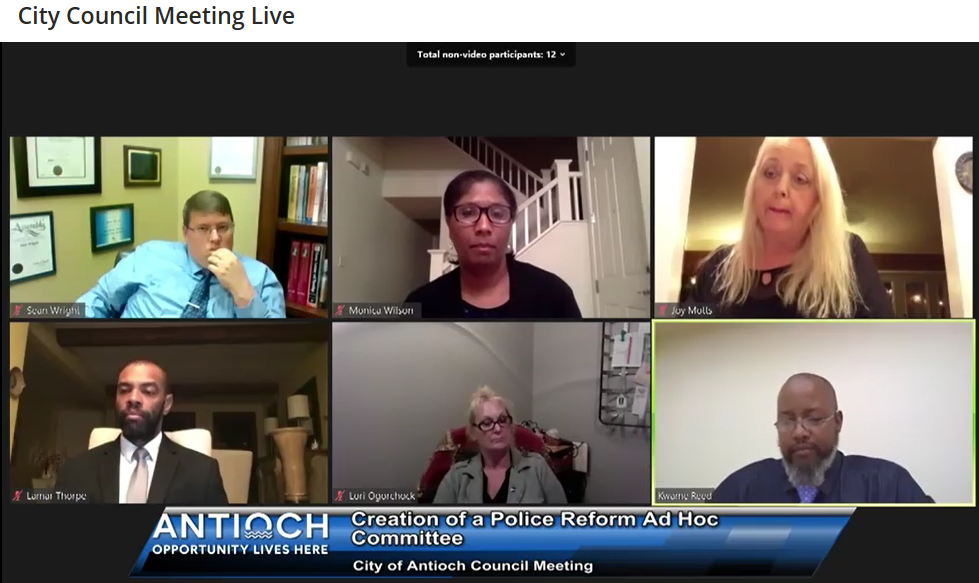
Tired Antioch City Council members listed to the reading of public comments by city staff, including Economic Development Director Kwame Reed (bottom right) until almost 11 p.m. Screenshot from city website.

Council will hold continuation meeting Thursday to hear the remaining comments, make decision.

“We want care and community, not cops…a community that polices itself…make police obsolete,” read one form letter that was repeated multiple times having been submitted by a variety of people.

“A committee of grandstanding politicians” is how another form letter in opposition to the ad hoc committee read.

By Allen Payton

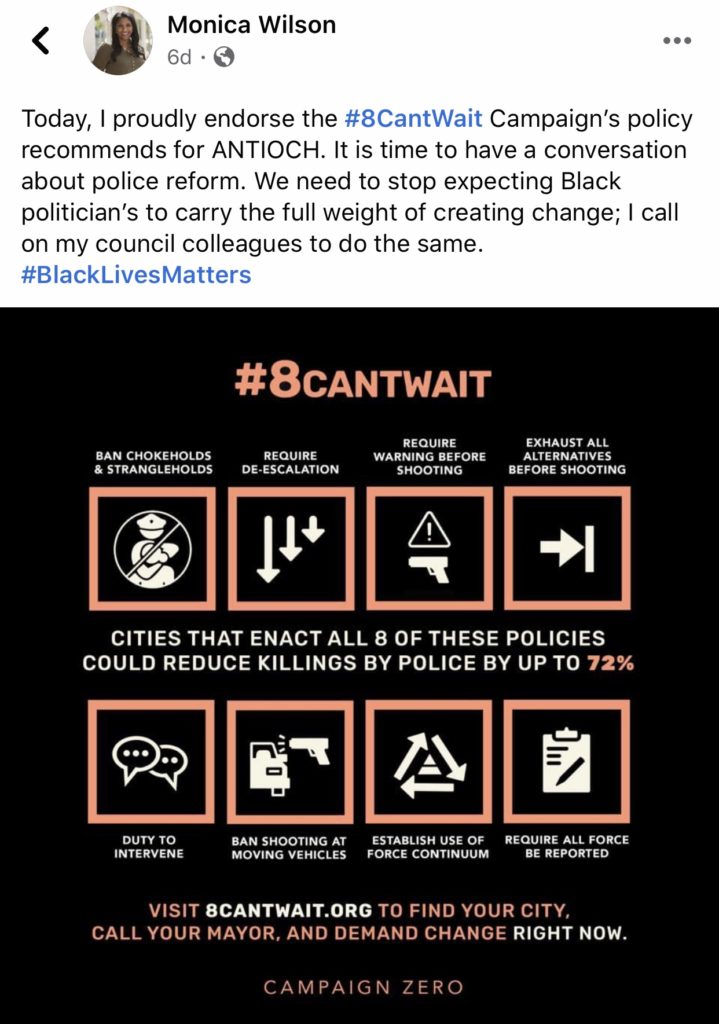
A post by Monica Wilson on her Facebook page, last week, supporting the eight proposed police reforms.

During a special meeting on Tuesday night, June 16, 2020 the Antioch City Council listened to a portion of over 700 comments submitted by members of the public via email about the formation of a police reform ad hoc committee. Most of the public comments read by city staff were the same exact form letters, with one in favor of the ad hoc committee making sweeping accusations against the Antioch Police Department and endorsing the eight proposed police reforms being pushed by Councilman Lamar Thorpe and supported by Councilwoman Monica Wilson. She urged her fellow council members to support their effort, writing in a Facebook post last week, We need to stop expecting Black politician’s (sic) to carry the full weight of creating change; I call on my council colleagues to do the same. (See related articles here and here).

Richard King wrote “we need the entire community to solve the problems.”

Sandy Smith wrote, “if there are complaints and concerns give them to Chief Brooks.” She opposed the formation of the ad hoc committee.

Robert Cisneros, opposing to the formation of the ad hoc committee, wrote, “what we need is a community-based forum.”

One of the form letters submitted by a variety of people read, “The city of Antioch has its own long history of police misconduct. Black lives continue to be taken even in cities where the eight reforms have been implemented. Demilitarize the police. I demand the resignation of Officer Michael Mellone.”

Kyla Hawkins, a self-described young, taxpaying citizen in Antioch wrote, “there needs to be systematic reform in all areas of enforcement.” She suggested all police officers take psychology and other college courses.

Michael Meruho opposed the creation of the ad hoc committee writing, “I voted for the sales tax measure for more police.” He instead supported a public forum and to look at other approaches.

Christine King wrote, “I have seen the community relations of our officers improve. Chief Brooks gained my respect immediately by taking responsibility of his department.” She opposed the formation of the ad hoc committee.

Lilly Metcalf, a 2018 graduate of Deer Valley High School (DVHS) repeated the same statement as others, regarding the deaths of George Floyd and Breana Taylor, and about the eight police reforms. “Antioch has some of these reforms already in place and they don’t work,” read the form letter she submitted.

Another writer wrote that forming the ad hoc committee, “only serves to permit politicians to pontificate on racism for their own political ambitions” and supported a community forum instead.

“We need our police not a grandstanding committee of politicians,” wrote Sal Gutierrez.

Brittany Ponce wrote to oppose “the ad hoc committee of politicians on the police.”

Another comment read, “I don’t know why city council is spending time on police reform when the department is not to the level for a city our size. We need to come together and give our suggestions to Chief T.”

Chris Hoyt wrote, “I register my opposition to the ad hoc committee” and repeated the claim that it would be a “committee of grandstanding politicians.”

“This will be uncomfortable,” wrote Joe Columbo in support of forming the ad hoc committee.

Following is one of the form letters submitted for public comment:

“Dear Antioch City Council,

My name is [YOUR NAME] and I am a resident of [YOUR NEIGHBORHOOD/DISTRICT]. I am writing to demand that the Antioch City Council adopt a budget that redirects funding away from the police and prioritizes community wellbeing.

In 2019, the City of Antioch allocated 44 million dollars to our police system, in comparison to 4 million dollars directed towards community development. This disparity is unacceptable. I join the calls of those across the country and demand that the City Council defund the Antioch Police Department and re-allocate those funds towards programs that promote a safer and more equitable community, such as mental health services, affordable housing, and education.

As members of the City Council, it is your duty to represent your constituents. I am urging you to completely revise the budget for the 2020-2021 fiscal year, in favor of a budget that reflects the actual needs of Antioch residents. As history has shown us, “reform” is not enough. We must take a hard look at the ways that the current system in place fails to serve, and in fact actively harms our community, and come together to reimagine the role of police in our city.

Thank you for your time,

[YOUR NAME]

[YOUR ADDRESS]

[YOUR EMAIL]

[YOUR PHONE NUMBER]”

Mayor Wright Tried To Batch the Common Emails

“We talked about batching these,” said Mayor Sean Wright. “We’re hearing the same letter over and over again.”

“We tried to batch them,” said one city staff member.

“At least get the information of the individual who submitted it,” said City Attorney Thomas Smith. “If the body of the content is the same and the only thing different is that they attended Deer Valley High School…they have to be identical in the content. That’s the reason for reading them all.”

“With one minute, if we’re not getting to the part that’s different…I’m not looking to deny anyone their right to be heard,” Wright explained.

“We don’t want to take letters where people are going different ways…and lump them in together,” Smith said.

“Beyond the one minute there are slight differences,” said Parks and Recreation Director Nancy Kaiser, who had been reading the email messages.

“All of these will be part of the record,” Wright stated.

“I still think it’s the identical batch,” Smith said. “If you batch them and they’re identical then you can take the time to read the entire letter. If there are differences…my advice here, Nancy is keep reading. Everyone else try to batch them.”

“I’ve had only two interactions with police…very unprofessional,” wrote another member of the public. “There are too many POC (people of color) being stopped…because they were driving nicer cars.”

Mayor Wright Interrupts Meeting Again to Stop the Repeated Comments

After several more of the form letters were read, Mayor Wright interrupted the reading of the emails for a second time, saying, “We’d like to put those together and we can mention all the different people and where they are from.”

He then called for a 10-minute recess.

“Adding another bureaucratic committee is not the answer” wrote another member of the public. “This cannot be about members whose purpose is to write press releases and Facebook posts.”

Angela Baxter, a business owner wrote, “I’m deeply vested in this community. I can’t believe that suggestions that accountability…is met with such opposition. Accountability doesn’t mean we hate the police or want them to disappear.”

Monica Ambrees wrote, “I 100% believe in Chief Brooks. There is absolutely no need for an ad hoc committee.”

Bill Brulman wrote, “We cannot allow criminals free reign in our society. I support APD 100%.”

Angela Garcia wrote, “I do not want this council to create an ad hoc committee. Antioch is starting to make a dent in crime. We don’t need to eliminate the police military equipment. The police chief’s efforts to address the eight is sufficient.”

Rita Cross wrote, “Our police department and all police departments have my full support. I have complete trust in our police chief Tammany Brooks. To suggest an ad hoc committee undermines the trust. Defunding and hating toward the police is not the solution.”

Curtis Holzer wrote, “I cannot be silent anymore. After living here for 33 years and 25 years in business, I have put my time, money, blood, sweat and tears into this city. What I have received is deterioration. I’ve had to remove my address from my business advertising because people refuse to business in Antioch.” He opposed the formation of the ad hoc committee.

Another effort was made to batch the form letters instead of reading them all.

“I want to say one thing to alert us…if we batch letters that are all of a similar perspective, and we don’t batch letters that are of a different similar perspective, then there will be an equity thing,” Attorney Smith said. “But it’s early.”

“Batching…if it’s the same letter over and over again. We’re going to hear similar concepts on each side. If it’s a form letter…that’s what we’re trying to take out,” said Mayor Wright.

“If someone’s a great writer and is able to write their own individual thing…we don’t want to create differences…and if everyone who is from one perspective is batched, we’re narrowing their voice,” Smith said.

Jennifer Cooper wrote, “I firmly believe the chief of police and the department can handle the recommendations instead of a committee.”

Harvey Brisco opposed the formation of ad hoc committee, writing, “Their idea is the stupidest idea, yet. The Antioch Police Department has improved 100%. I’ve seen more good from T Brooks since he’s been in office than the entire city council since I moved here in 2012.”

A resident named Maury wrote, “I don’t believe improvement comes from closed door discussion”

Lori Curry wrote, “It sounds like a few on the council are trying a power grab.”

Barry Gordon wrote, “There’s always room for improvement. This isn’t a jab at the APD.” He suggested all police officers get trained in martial arts or wrestling to take down a suspect to avoid using their weapons.

Deja Younger, an Antioch High School graduate wrote, that the council should “…not spend 62% of its budget on police…instead spent on improving the schools and affordable housing.”

Former Planning Commission member Martha Parsons wrote, “I oppose item one on the agenda. I believe it’s a political stunt. Anyone who votes for it should not be reelected. We already have a Police Crime Prevention Commission. Antioch is not Oakland or San Francisco and we don’t want to become like them.”

David Retford wrote, “I would like to register my opposition to the formation of an ad hoc committee. We do not have an unrepairable police force. Stop the political gamesmanship of certain members of the council.”

2019 Antioch Citizen of the Year for Lifetime Achievement Ralph Garrow wrote, “you should have some public forum for review of the Antioch Police Department although I’m not aware of any systemic problems.”

Eric and Peggy Wunderly wrote, “We urge you not to form an ad hoc committee on police procedures.”

Joe Davis wrote, “If you Google crime statistics in Antioch, California…being a victim of crime in Antioch is 1 in 27.” He wrote about the passage of both Measures C and W, crime decreasing and complaints against the APD, as well.

A comment submitted by someone with just initials included, “Black or white, both should obey the law. Don’t sacrifice our police”

A resident named Ashika wrote, “I’m standing alongside to defund and reform the police.”

Anthony Duarte wrote, “do away with policies that discriminate against people of color, indigenous people…” and supported the adoption of the eight reforms.

Two ladies named Dee and Nora submitted the same exact comment writing, “Councilmembers Lamar Thorpe and Monica Wilson, please leave our APD out of your political agenda. What experience do you have in policing?” Chief Tammany Brooks “has kept the peace, here.”

The next group of comments were the same as read before opposing the formation of the ad hoc committee.

“We’re tired of your committees and lack of action on a number of fronts,” included one of the comments.

Yet Another Attempt Was Made to Batch the Same Comments

A very large batch, Nancy Kaiser said submitted the same comment. “More than 24 or 25.”

“The problem we face is, to put 25 voices in one read letter, you’re sort of tilting…part of this is for people to understand…we would want something similar on the other side,” reiterated Attorney Smith.

“This batch of comments is similar to individual comments I’ve read earlier this evening,” said Kaiser. “I barely read a quarter of it.”

“This would allow us to read the entirety of it,” Wright said.

“We can read the entire comment, then post all of the comments online,” Smith responded. “If I’m seeing an equity concern, I’m going to raise an equity concern.”

“The balancing we’re dealing with is trying to get to all the comments over three nights dealing with one agenda item,” Wright said.

“Yes, we do,” Smith responded.

Kaiser then read the complete form letter from those supporting the ad hoc committee.

The other part of the letter included suggestions of “a community garden run by youth to bring food justice to Antioch,” and wanting “a community that polices itself: to “make police obsolete” and mentioned “environmental racism,” as well as “We want care and community, not cops.”

One of the comments was from a graduate of Independence High School graduate in Brentwood.

Most of the form letters were submitted by local high school graduates, mainly from the graduating classes of 2015, 2016, 2017, 2018 and 2019.

Kaiser then read the complete letter submitted by several people who opposed the formation of the ad hoc committee.

Kaiser then turned over the reading of additional letters to City Finance Director Dawn Merchant for another 20 minutes before the council took another break.

“Do you know how many, Nancy you did?” asked Thorpe.

“I do not, my apologies,” Kaiser responded.

Merchant then began reading more emailed comments.

Heredia – I support making the ad hoc committee.”

Another public comment read forming the ad hoc committee “is to say that our chief of police, Tammany Brooks is not doing his job. Before making their jobs any harder, reform our city before reforming our police department.”

The next comment read, “More cops and higher cop budgets are not the answer. If you want people to respect police, then don’t let them get away with breaking the law.”

Marcus Lopez demanded the implementation of the eight reforms.

A variety of comments mentioned the police budget, incorrectly stating it takes up 62% of the city budget. It actually is 62% of the General Fund, which consists of 44% of the entire budget. So, the police budget is 27.3% of the entire city budget.

A resident named Lamont wrote, “As a 47-year-old man, I’ve seen the harassment against black men. By shifting money away from police… to more art programs, more community centers… there will be less reason to rob and steal.”

Maria Hernandez, a 15-year-old, shared the stories of her father’s friend and father. “I’m in fear of the police and how they profile black and brown men in our community,” she wrote.

Darrel Oland wrote, “defund APD and spend the money on schools…get rid of racist police” and that people were “Trying to twist this into a political stunt.”

“Antioch residents want change,” Oland’s comment continued. “For Antioch police to oppose this…that’s a terrible way of leading, Chief Brooks. Don’t deny Antioch residents change.”

Another public comment asked, “How many separate jobs that police officers are asked to perform?”

One public comment read, “I don’t want to meet with the police, I don’t want to kneel with the police, I don’t want to dance with the police. I want to defund the police. The city currently spends over half the annual budget on the police force,” which is incorrect, as explained earlier in this report.

“We need to defund the Antioch police department and…invest in mental health…create a work force of mental health workers…” wrote another member of the public.

Before Kwame Reed, the city’s Economic Development Director, read the next batch of about 150 comments, someone asked how many Merchant had read and she responded, “I don’t know. But we are about half-way through.”

The complete letter of one member of the public was received via email on Wednesday.

Antioch resident Jim Nevins wrote, “and I implore you to defund the police department SIGNIFICANTLY this fiscal year and get on a path to replacing the police force entirely. These millions of dollars could and should go directly to programs that better the lives of your residents. In addition TAX your rich corporations and residents, create jobs with that money to fix up your community, to provide mental health care and substance use harm reduction/ treatment, fix the streets, free food and activity programs for kids, parks, helping the elderly live independantly. Unarmed workers in their own neighborhoods trained in de-escalation, mental healthcare and first aid, more city employed paramedics to respond to medical emergencies and car accidents (that are not employees of a company out to make a profit,) enough jobs with fair wages for your poor residents plus real funded programs for those who dont fit into the job market due to mental or other disability will literally solve all the problems that police respond to. I don’t wanna hear it about gangs. The police are the biggest armed gang in our city, they are costing us lives and tens of millions of dollars each year. They do not have the support or respect of your constituency because they have lost it, or in the case of poor people, black people and people of color —failed to ever earn it. I urge you to defund the Antioch PD effective this quarter. See further information below. Thanks for reading, Jim”

And then included the form letter submitted by others. “In 2019, the City of Antioch allocated 44 million dollars to our police system, in comparison to 4 million dollars directed towards community development. This disparity is unacceptable. I join the calls of those across the country and demand that the City Council defund the Antioch Police Department and re-allocate those funds towards programs that promote a safer and more equitable community, such as mental health services, affordable housing, and education.

As members of the City Council, it is your duty to represent your constituents. I am urging you to completely revise the budget for the 2020-2021 fiscal year, in favor of a budget that reflects the actual needs of Antioch residents. As history has shown us, “reform” is not enough. We must take a hard look at the ways that the current system in place fails to serve, and in fact actively harms our community, and come together to reimagine the role of police in our city.

Thank you for your time.”

The meeting was adjourned about 10:50 p.m.

Additional Form Letters

Thursday, June 18, 2020 UPDATE: Following are three additional form letters either supporting or opposing the formation of a police reform ad hoc committee that were submitted by a variety of people as their public comment on the matter reprinted verbatim. According to City Clerk Arne Simonsen the letters opposing the formation of the ad hoc committee outnumbered those in favor by a margin of eight-to-one (8:1).

OPPOSE

“I am voter in Antioch and I ask that you read into the record my OPPOSITION to creating another AD HOC Committee, this one on Police Reform. I support our Chief and Police Officers and would like you to consider another option that brings OUR WHOLE COMMUNITY TOGETHER to discuss ways to eliminate racial bias in our community. Please consider my viewpoint on this. NO AD HOC, please.”

SUPPORT    

“My name is [Name Here}, I am a resident of Antioch, and Deer Valley Alumni from Class of [Year}.

Over the past three weeks, our nation has been seized by a number of protests calling for an end to police violence following the murders of George Floyd, Tony McDade, Breonna Taylor, and countless others. The City of Antioch also has its own, long history of police misconduct and it is time we held our local law enforcement accountable for their actions. Recently, Councilman Lamar Thorpe endorsed Campaign Zero’s “8 Can’t Wait” policy recommendations for police reform. While I see why this is the path the city of Antioch wants to take, Antioch already has some of these eight policies in place and they do not work. I would instead like to shift towards the focus of 8toAbolition.

I am standing alongside the call to defund and disarm the local police. However, I recognize 8Can’tWait alone is not enough, and it does not fulfill the call towards abolition. Black lives continue to be taken even in cities that already have many of these eight reform policies. We should be working towards preventative actions, actions that decrease criminizalition in communities. For example, when we defund the police – we could take this budget to fund education, housing, community gardens, healthcare, and so much more. We could create a curriculum that has a focus on critical race & ethnic studies in k-12, that teaches the true history of the U.S. and abroad, and create a safe campus environment that doesn’t allow cops to roam around. We could focus on building affordable housing so folks are not left behind, and houseless folks won’t be criminalized by cops for sleeping where they can. We could focus on building and fostering a community garden that is youthled to bring food justice to Antioch, where folks have experienced environmental racism through food deserts. We could fund PPE for our local hospitals so frontline healthcare workers aren’t stressed when clocking into work that they might catch the virus and endanger their loved ones when they get home. We could do so much more and imagine so much more past a community that polices itself. If we create a strong community, we make
policing obsolete.

In light of this, I’d also like to talk about Councilman Thorpe’s proposal to form an ad-hoc committee on Police Reforms. I stand with the call that this committee could be behind the demilitarization of our local police, along with the readjustment of our city budget. However, I believe this community could do so much more for the safety of Antioch residents if we invest in the actions I listed above. Such as cutting police ties with the school district, creating a good k-12 curriculum that includes CRES, and fostering community gardens that tackle food insecurity and environmental racism.

Additionally, as we work towards these adjustments, I demand the resignation of officer Michael Mellone. Mellone was hired to the Antioch Police Department despite fatally shooting a homeless man in San Francisco. He was suspended for 45 days following this incident, but had already quit the San Francisco PD and joined the Antioch Police Department by the time this decision was made. Not only did he escape consequences for his actions in San Francisco, his reckless behavior and ill-judgment was deemed ok for Antioch. At a time when our nation is examining state-sanctioned violence, racism, and police brutality, I hope you all recognize Mellone’s presence threatens the well-being of Antioch’s Black and Brown residents, who are most often the victims of police violence.

I trust that you will open the links to see the resources I have picked for you to read. I urge the City of Antioch to create an ongoing conversation through this planned committee. We want care and community, not cops. I also urge for the immediate resignation of officer Michael Mellone. Public opinion is with me.”

OPPOSE

“I am a longtime resident of the Bay Area and a voter.

I urge you to vote NO on the creation of Lamar Thorpe’s AD HOC committee on police reform. First, it’ll be just another platform for political pontificating. Second, have you read the agenda language? It is a stepping stone to defunding the Antioch Police Department, WHICH ANTIOCH RESIDENTS STRONGLY OPPOSE. We don’t need less police, we need more police. Third, this added government bureaucracy won’t do anything to deal with racism in our community. We need real change – change that only our community as a whole can effectively address.

Please look for other options and VOTE NO on the formation of a shell committee that will do nothing to address African American residents’ needs.”

Publisher’s Note: Thank you to City Clerk Arne Simonsen for providing these last three letters.

The Antioch City Council will hold a follow up meeting to hear the reading of the remaining public comments on Thursday, June 18, 2020 at 7:00 p.m. To watch the meeting via livestream, visit the city’s website, here https://www.antiochca.gov/government/city-council-meetings/live/

DA charges former Contra Costa County Clerk Canciamilla with 34 felonies for perjury & grand theft related to campaign accounts

Wednesday, June 17th, 2020

By Scott Alonso, Public Information Officer, Contra Costa District Attorney

Joe Canciamilla.

Martinez, Calif. — Today, Wednesday, June 17, 2020, the Contra Costa County District Attorney’s Office filed a criminal complaint of 34 felonies against defendant Joseph Canciamilla of Pittsburg. Canciamilla is the former Contra Costa County Clerk-Recorder and a former county supervisor and assemblymember. He also created a campaign account for Contra Costa County Superior Court Judge. Canciamilla is also a licensed member of the California State Bar. Canciamilla’s first court appearance will be on July 27 at 8:30 a.m. in Department 31.

Canciamilla is accused of 30 felony counts of perjury for his alleged misstatements on 30 separate campaign disclosure statements (Form 460s). Canciamilla signed these campaign finance statements under the penalty of perjury. The additional four felony counts relate to personal grand theft of campaign funds for his personal use, totaling $261,800.68. The allegations span conduct from 2010 to 2016.

The personal expenditures made by Canciamilla’s campaign committees for the defendant’s own use were for various purposes, such as:

  • Personal vacation to Asia
  • Restaurants
  • Airfare via Southwest Airlines and American Airlines
  • Repayment of a Personal Loan
  • Transfers from his Campaign Bank Accounts to his Personal Accounts

All of these campaign statements started initially in 2010 with Canciamilla not reporting investment gains in a campaign bank account. While this practice is permissible, using the proceeds of any stock gains for personal use is prohibited. Canciamilla concealed from his Form 460s the gains and losses associated with this investment account. Ultimately, Canciamilla spent more on personal expenses than the unreported investment gains. He therefore had to then transfer personal funds into this campaign bank account to make up the difference.

“In total, the false statements signed by Canciamilla omitted critical information from the campaign finance disclosures. The information left off these forms left the public in the dark about how a candidate and then county-wide elected official spent campaign funds. Given the recent history of misconduct by various elected officials in Contra Costa County, Canciamilla’s behavior is troubling and he must be held accountable,” stated Contra Costa County District Attorney Diana Becton.

The DA’s Office was notified of possible criminal activity associated with Canciamilla’s campaign accounts in early 2017 by the Franchise Tax Board. The criminal investigation by the DA’s Office included hundreds of hours examining seven different bank accounts held by the defendant. The two primary financial institutions Canciamilla used were Contra Costa Federal Credit Union and Charles Schwab.

Ultimately, Canciamilla was fined $150,000 by the California Fair Political Practices Commission in a civil stipulation for the multiple errors in his campaign finance statements, which concealed the personal use of campaign funds for his own benefit.

The statements signed by Canciamilla included various campaign accounts, such as his campaign account for judge (“Friends of Joe Canciamilla for Judge 2012” and campaign account for clerk-recorder (“Joe Canciamilla Canciamilla for Contra Costa County Clerk/Recorder”).

See related articles on this matter, here and here.


Former cop & Antioch Police Crime Prevention Commissioner, now private investigator shares concerns about police reform ad hoc committee

Wednesday, June 17th, 2020

Dear Editor:

Following is the letter I sent to the council.  My goal is to educate the council and have them conclude this ad-hoc commission is not needed.  Feel free to print this letter so the community can be educated also.


Dear Mayor and City Council,

My name is Jesse Zuniga, I moved to Antioch in 1989, from the inner Bay Area.  I served as a police officer for the City of Hayward between 1983 -1994.  In 1994, I lateraled to the City of Tracy where I served as a police officer until I retired in 2002.  I also served as an Antioch Police Crime Prevention Commissioner for two terms.  Since moving to Antioch, I have worked in partnership with our police department and city government to maintain a safe and clean community in order to improve the quality of life for our residents.  I have been a private investigator for nearly 20 years, and I serve as an independent panel investigator for the Peace Officers Research Association of California (PORAC’s) Legal Defense Fund.  My firm provides independent and neutral legal investigations for PORAC’s legal defense fund when police officers are accused of misconduct or criminal behavior.  I travel throughout the state conducting such independent investigations.

I am aware of the “Ad Hoc Police Commission” that has been proposed by council members Lamar Thorpe, Monica Wilson and Thomas Smith, our city attorney.  I would like to provide you a summary of educational and valuable facts to consider before implementing a “police oversight commission.”

In my nearly 20 years of subcontracting as an independent investigator to PORAC’s legal defense fund, I have conducted hundreds of investigations involving first responders in both San Francisco (SF) and Oakland.  Both of these Bay Area cities have independent police oversight commissions.  I can attest to the fact that these oversight commissions are comprised of civilians and attorneys that have little knowledge about police practices.  Oversight police commissions are judging police officers’ tactics, practices, training policies and providing a sense of reform within their police organizations.  These commissions are often implementing policies and procedures that put the safety of first responder at high risk, because these policies conflict with state and federal laws and the California Peace Officers Standards and Training regulations.  Oakland PD was mandated by the Federal Court to implement a variety of reform procedures in the early 2000’s that led to officer deaths, following the infamous Oakland Riders trial and the establishment of new policies by their police oversight commission.

The California Peace Officers Standards and Training (POST), provides exemplary training and guidelines that conform with state and federal standards to keep officers and the community they protect safe.  The POST training standards and guidelines are also supported by State and Federal Law. Police chiefs and sheriffs implement rules, regulations, policies and procedures that conform to the POST training standards and State and Federal standards/laws.  Law enforcement agencies often submit their rules and regulations/policies and procedures to POST for review and approval by the POST commission.  POST also conducts frequent audits and provides oversight to each law enforcement agency;  the POST audit process is very strict.  The strict standards that a police agency must meet are being evaluated by professionals in the law enforcement field to ensure officer safety and the safety of their constituents.

My experience with the SF and Oakland oversight commissions has shown me that civilian oversight commissions often make decisions based on personal bias’ or perceptions instead of reviewing a situation objectively and adhering to the POST standards, state and/or federal law standards.  The personal, emotional and political decisions of oversight commissions have proven to be costly to their cities and detrimental to the safety of their law enforcement personnel.  Commissions make decisions to impose discipline upon officers based on personal feelings or agendas, which often violate the Peace Officer’s Bill of Rights, the California Government Code, the agency’s policies and procedures and state and federal law.  The officers in question have the right to appeal the commission’s decision via an administrative proceeding or a court of law.  The expense of the appeal process is incurred by the city who imposes the discipline.  Frequently, the employee is reinstated by an administrative hearing officer/court judge.  Upon reinstatement, the city must make the employee whole by way of full reimbursement of lost earnings and benefits.  Because the administrative and court process can take years, the costs range from hundreds of thousands of dollars to millions per employee.   In many cases, the commission’s decisions will override the imposed legal disciplinary recommendation by a police chief or sheriff.  We saw this recently in Oakland.  The Oakland commission used a predetermined outcome regarding a police officer’s use of force, which was in conflict with the police chief’s recommendation.  The former Oakland police chief’s decision was based upon the POST standards, state and federal law standards.  The commission’s predetermined disciplinary outcome did not meet the legal standards; the commission attempted to strong arm the former Oakland police chief following the commission’s decision.  The chief’s refusal to violate departmental policy, along with state and federal law led to the unilateral commission decision to terminate the Oakland police chief.  The former chief has filed a lawsuit against the city of Oakland and if the chief is awarded compensation or the city coordinates a settlement agreement, either can prove costly to the city of Oakland.  Antioch’s city attorney Thomas Lloyd Smith was a member of the Oakland commission that terminated the Oakland Chief.  Mr. Lloyd has served on the Oakland oversight commission since October 2017 and his term expires in October 2020.  Mr. Lloyd has first hand knowledge of the adverse affects the Oakland oversight commission has had on the Oakland community and police department.

Poor political decisions by an oversight commission have negative affects on a police organization and will create low morale that will lead to an exodus of police officers.  The recruiting/hiring process and training new officers is costly.  Subsequently, applicants are less likely to seek a job opportunity where the city government and commission do not support their officers’ and community members’ safety.  Cities like Oakland and SF have been struggling for decades to retain qualified officers, therefore, those cities have lowered their hiring standards, which attracts less desirable applicants that cannot meet the strict hiring standards of other agencies.  Antioch has benefitted from the hiring of the experienced and highly qualified officers who have left Oakland, SF and Stockton due to the unsavory political climates created by their oversight commissions.  

A few years back, the Antioch Police Department suffered from poor political decisions.  The results of the poor political decisions led to officers leaving the Antioch Police Department to work for other Bay Area agencies where the officers were valued as professionals.  I have been involved in investigating several administrative police disciplinary matters within the Antioch Police Department.   I also have professional relationships with many current officers, some of which came from other police departments.   Recently, the Antioch Police Department’s morale has improved, community relations have improved significantly, community based policing has been implemented in a successful manner, and accountability within the police department is equal amongst the ranks.  Implementing an oversight police commission can diminish all of these positive gains.

I would like to provide a summary of checks and balances already in place, and to provide some educational facts regarding the 6 points outlined on your ad-hoc commission meeting agenda:

  1.  “Prevention of excessive use of force by police officers against members of the public, including banning police from using carotid artery restraints and chokeholds;”  The application of the carotid restraint is a technique that is only used in extreme circumstances where a combative suspect needs to be subdued because the suspect’s active resistance and the use of other techniques and or tools have proven to be completely ineffective.  The carotid restraint is rarely used and has proven to be effective when an officer’s life or community member’s life is at risk.  As with any technique or tool used, there can be negative implications.  Although the risk of death is present when applying the carotid restraint, statistics show that death as a result of the carotid restraint is very minimal and is not as lethal as discharging a firearm.
  2.  “Demilitirazation”, elimination of military equipment from the police department.  Police agencies nation wide have had to Implement military style equipment and tactics in order to match the military style weapons and military type body armor criminals posses and often use in mass school shootings, malls and places of worship.  In 1997, TWO bank robbers in North Hollywood armed with AK-47s were responsible for shooting multiple officers and citizens during the botched robbery.  The police officers carrying handguns were outgunned by the robbers.  The Los Angeles SWAT team was deployed and one suspect wearing body armor was shot 28 times before becoming disabled.  The 1997 North Hollywood incident created the nation wide implementation, demand and need of military style weapons and tactics by police in order toprotect law abiding citizens and law enforcement personnel.  It is not reasonable nor responsible to take police departments back to the days of carrying revolvers (which carry six bullets) while criminals are armed with AR-15’s, AK 47’s, or many other assault type weapons that can carry or fire 30, 50 or hundreds of bullets in seconds, or bullets that can pierce a typical police bullet proof vest or concrete walls.  The use of armored vehicles, military style weapons and military type protective gear is necessary to protect the police officers while they risk their lives protecting their communities.  Criminals engaging in violent assaults in a community while using military style weapons must be met with equal or superior tools to neutralize the threat.In 2009, four Oakland police officers were killed by one suspect who was armed with a military style weapon.  One officer was killed during a traffic stop and the other three officers were SWAT team members who were ambushed by the suspect.  Had the Oakland SWAT and the Alameda County SWAT team members not been equipped with the approrpiate military gear there may have been more officers or community members killed by one suspect.  Luckily, Oakland Police and the Alameda County Sheriff’s Department SWAT teams and patrol officers were properly equipped and trained to neutralize such a violent suspect without further loss of life or harm to the Oakland community.   I am confident you would not want Antioch PD to suffer such a loss or be ill prepared to handle such a devastating and dangerous act of terror in our community.
  3.  “Required use of conflict de-escalation approaches by all sworn officers when interacting with the public”.  De-escalation tactics are taught and used everyday by police officers.  People must understand that when an officer implements his/her de-esclation tactics there are two critical points that need to occur for the de-escalation tactic to be successful.  First, the suspect has to mentally recognize the de-escalation process and second, the suspect has to agree and engage in the de-escalation process.  If the suspect refuses to recognize or engage in the de-escalation process then the de-escalation process is rendered unsuccessful and useless.  Once the de-escalation tactics are refused by the suspect, the officer must recognize the refusal and immediately implement other tactics to control the situation in order to protect the suspect, the officers or community members.
  4.  “Increased accountability, including the process of receipt and review public complaints against the police for excessive use of force, racial and/or ethnic profiling, and other police misconduct”.  California POST and the state and federal laws are already in place to seek accountability that is within the law.  The law already allows for a review of public complaints pertaining to the use of force or other personnel complaints.  This is called a “pitches motion” and it can be filed in court.  There is also a public records request process, however, there are legal standards implanted by the state and federal government that must be met by the police agency prior to releasing the information requested.  There are also legal standards for the reporting of racial and/ethnic profiling that must be met by a police agency.
  5.  “Improvement of police officer candidate recruitment, screening, training, and hiring practices including an analysis of policies concerning implicit bias, candidate diversity and candidate background checks; and” .  California POST has strict standards for the police hiring process.  Applicant have to pass a series of physical and medical exams, an intense multi phase psychological exam (which will expose the exact objectives you outlined), a polygraph exam, and an intense background check tho include behaviors that are seen from the time an applicant was a child to adulthood.  The criteria is so strict that most applicants fail the background, psychological exam or the polygraph, which disqualifies the applicant from proceeding with the hiring process.
  6.  “Police Department budget appropriations” . The police department manager/chief has checks and balances for the budget process.  The police budget is overseen and approved by the city manager, the city treasurer and ultimately the city council.

It is my hope that after reviewing the summary of information provided, you can agree that there are many substantive and strict legal checks and balances already in place.   If we are to seek equity and accountability, then let’s demand that of everyone, including those who engage in behavior that is detrimental to the safety of our community.  As council members you took an oath to represent all members of our community and your constituents.  Creating a police oversight commission will only increase costs and decrease safety for our police officers and our community.

Thank you for your consideration,

Jesse Zuniga, Jr.

Antioch


President Trump issues Executive Order on safe policing for safe communities

Tuesday, June 16th, 2020

Law & Justice

Issued on: June 16, 2020

By the authority vested in me as President by the Constitution and the laws of the United States of America, it is hereby ordered as follows:

Section 1.  Purpose.  As Americans, we believe that all persons are created equal and endowed with the inalienable rights to life and liberty.  A fundamental purpose of government is to secure these inalienable rights.  Federal, State, local, tribal, and territorial law enforcement officers place their lives at risk every day to ensure that these rights are preserved.

Law enforcement officers provide the essential protection that all Americans require to raise their families and lead productive lives.  The relationship between our fellow citizens and law enforcement officers is an important element in their ability to provide that protection.  By working directly with their communities, law enforcement officers can help foster a safe environment where we all can prosper.

Unfortunately, there have been instances in which some officers have misused their authority, challenging the trust of the American people, with tragic consequences for individual victims, their communities, and our Nation.  All Americans are entitled to live with the confidence that the law enforcement officers and agencies in their communities will live up to our Nation’s founding ideals and will protect the rights of all persons.  Particularly in African-American communities, we must redouble our efforts as a Nation to swiftly address instances of misconduct.

The Constitution declares in its preamble that one of its primary purposes was to establish Justice.  Generations of Americans have marched, fought, bled, and died to safeguard the promise of our founding document and protect our shared inalienable rights.  Federal, State, local, tribal, and territorial leaders must act in furtherance of that legacy.

Sec. 2.  Certification and Credentialing.  (a)  State and local law enforcement agencies must constantly assess and improve their practices and policies to ensure transparent, safe, and accountable delivery of law enforcement services to their communities.  Independent credentialing bodies can accelerate these assessments, enhance citizen confidence in law enforcement practices, and allow for the identification and correction of internal deficiencies before those deficiencies result in injury to the public or to law enforcement officers.

(b)  The Attorney General shall, as appropriate and consistent with applicable law, allocate Department of Justice discretionary grant funding only to those State and local law enforcement agencies that have sought or are in the process of seeking appropriate credentials from a reputable independent credentialing body certified by the Attorney General.

(c)  The Attorney General shall certify independent credentialing bodies that meet standards to be set by the Attorney General.  Reputable, independent credentialing bodies, eligible for certification by the Attorney General, should address certain topics in their reviews, such as policies and training regarding use–of-force and de-escalation techniques; performance management tools, such as early warning systems that help to identify officers who may require intervention; and best practices regarding community engagement.  The Attorney General’s standards for certification shall require independent credentialing bodies to, at a minimum, confirm that:

(i)   the State or local law enforcement agency’s use-of-force policies adhere to all applicable Federal, State, and local laws; and

(ii)  the State or local law enforcement agency’s use-of-force policies prohibit the use of chokeholds — a physical maneuver that restricts an individual’s ability to breathe for the purposes of incapacitation — except in those situations where the use of deadly force is allowed by law.

(d)  The Attorney General shall engage with existing and prospective independent credentialing bodies to encourage them to offer a cost-effective, targeted credentialing process regarding appropriate use-of-force policies that law enforcement agencies of all sizes in urban and rural jurisdictions may access.

Sec. 3.  Information Sharing.  (a)  The Attorney General shall create a database to coordinate the sharing of information between and among Federal, State, local, tribal, and territorial law enforcement agencies concerning instances of excessive use of force related to law enforcement matters, accounting for applicable privacy and due process rights.

(b)  The database described in subsection (a) of this section shall include a mechanism to track, as permissible, terminations or de-certifications of law enforcement officers, criminal convictions of law enforcement officers for on-duty conduct, and civil judgments against law enforcement officers for improper use of force.  The database described in subsection (a) of this section shall account for instances where a law enforcement officer resigns or retires while under active investigation related to the use of force.  The Attorney General shall take appropriate steps to ensure that the information in the database consists only of instances in which law enforcement officers were afforded fair process.

(c)  The Attorney General shall regularly and periodically make available to the public aggregated and anonymized data from the database described in subsection (a) of this section, as consistent with applicable law.

(d)  The Attorney General shall, as appropriate and consistent with applicable law, allocate Department of Justice discretionary grant funding only to those law enforcement agencies that submit the information described in subsection (b) of this section.

Sec. 4.  Mental Health, Homelessness, and Addiction.  (a)  Since the mid-twentieth century, America has witnessed a reduction in targeted mental health treatment.  Ineffective policies have left more individuals with mental health needs on our Nation’s streets, which has expanded the responsibilities of law enforcement officers.  As a society, we must take steps to safely and humanely care for those who suffer from mental illness and substance abuse in a manner that addresses such individuals’ needs and the needs of their communities.  It is the policy of the United States to promote the use of appropriate social services as the primary response to individuals who suffer from impaired mental health, homelessness, and addiction, recognizing that, because law enforcement officers often encounter such individuals suffering from these conditions in the course of their duties, all officers should be properly trained for such encounters.

(b)  The Attorney General shall, in consultation with the Secretary of Health and Human Services as appropriate, identify and develop opportunities to train law enforcement officers with respect to encounters with individuals suffering from impaired mental health, homelessness, and addiction; to increase the capacity of social workers working directly with law enforcement agencies; and to provide guidance regarding the development and implementation of co-responder programs, which involve social workers or other mental health professionals working alongside law enforcement officers so that they arrive and address situations together.  The Attorney General and the Secretary of Health and Human Services shall prioritize resources, as appropriate and consistent with applicable law, to support such opportunities.

(c)  The Secretary of Health and Human Services shall survey community-support models addressing mental health, homelessness, and addiction.  Within 90 days of the date of this order, the Secretary of Health and Human Services shall summarize the results of this survey in a report to the President, through the Assistant to the President for Domestic Policy and the Director of the Office of Management and Budget, which shall include specific recommendations regarding how appropriated funds can be reallocated to support widespread adoption of successful models and recommendations for additional funding, if needed.

(d)  The Secretary of Health and Human Services shall, in coordination with the Attorney General and the Director of the Office of Management and Budget, prioritize resources, as appropriate and consistent with applicable law, to implement community-support models as recommended in the report described in subsection (c) of this section.

Sec. 5.  Legislation and Grant Programs.  (a)  The Attorney General, in consultation with the Assistant to the President for Domestic Policy and the Director of the Office of Management and Budget, shall develop and propose new legislation to the Congress that could be enacted to enhance the tools and resources available to improve law enforcement practices and build community engagement.

(b)  The legislation described in subsection (a) of this section shall include recommendations to enhance current grant programs to improve law enforcement practices and build community engagement, including through:

(i)    assisting State and local law enforcement agencies with implementing the credentialing process described in section 2 of this order, the reporting described in section 3 of this order, and the co responder and community-support models described in section 4 of this order;

(ii)   training and technical assistance required to adopt and implement improved use–of-force policies and procedures, including scenario-driven de-escalation techniques;

(iii)  retention of high-performing law enforcement officers and recruitment of law enforcement officers who are likely to be high-performing;

(iv)   confidential access to mental health services for law enforcement officers; and

(v)    programs aimed at developing or improving relationships between law enforcement and the communities they serve, including through community outreach and listening sessions, and supporting non profit organizations that focus on improving stressed relationships between law enforcement officers and the communities they serve.

Sec. 6.  General Provisions.  (a)  Nothing in this order shall be construed to impair or otherwise affect:

(i)   the authority granted by law to an executive department or agency, or the head thereof; or

(ii)  the functions of the Director of the Office of Management and Budget relating to budgetary, administrative, or legislative proposals.

(b)  This order shall be implemented consistent with applicable law and subject to the availability of appropriations.

(c)  This order is not intended to, and does not, create any right or benefit, substantive or procedural, enforceable at law or in equity by any party against the United States, its departments, agencies, or entities, its officers, employees, or agents, or any other person.

DONALD J. TRUMP

THE WHITE HOUSE,
June 16, 2020.


Antioch Police Officers respond to call for police reform ad hoc committee, ask public’s help

Friday, June 12th, 2020

By Antioch Police Officers Association

The amazing men and women of the Antioch Police Department need the support of our citizens. Council members Lamar Thorpe and Monica Wilson are attacking the great work being done by the Antioch Police Department. The special meeting set for Tuesday is nothing more than two council members searching for power and using this platform to push their agenda and further their political careers. (See related article)

The APOA believes we can always do better, and will always embrace conversation and positive change to strengthen the relationship with our community. The proposed ad hoc committee is going to give politicians power to create policies within the Police department. No Council should have that power. The department head (chief of police) should be the only one making policies for the police department.

The Antioch Police Department has always maintained a high level of transparency, and will continue to do so under SB 1421. Additionally, The Antioch Police Department has some of the strictest hiring standards in the Bay Area, and will continue to maintain that high standard.

Lamar Thorpe wants power and control over the police department, a profession he knows nothing about and a department he should not be creating policy for.

Please send in your comments to the council showing support for the Antioch Police Department and letting the council know there is no need for an ad hoc committee.

Sean Wright- swright@ci.antioch.ca.us
Joy Motts- jmotts@ci.antioch.ca.us
Lamar Thorpe- lthorpe@ci.antioch.ca.us
Lori Ogorchock- logorchock@ci.antioch.ca.us
Monica Wilson- mwilson@ci.antioch.ca.us