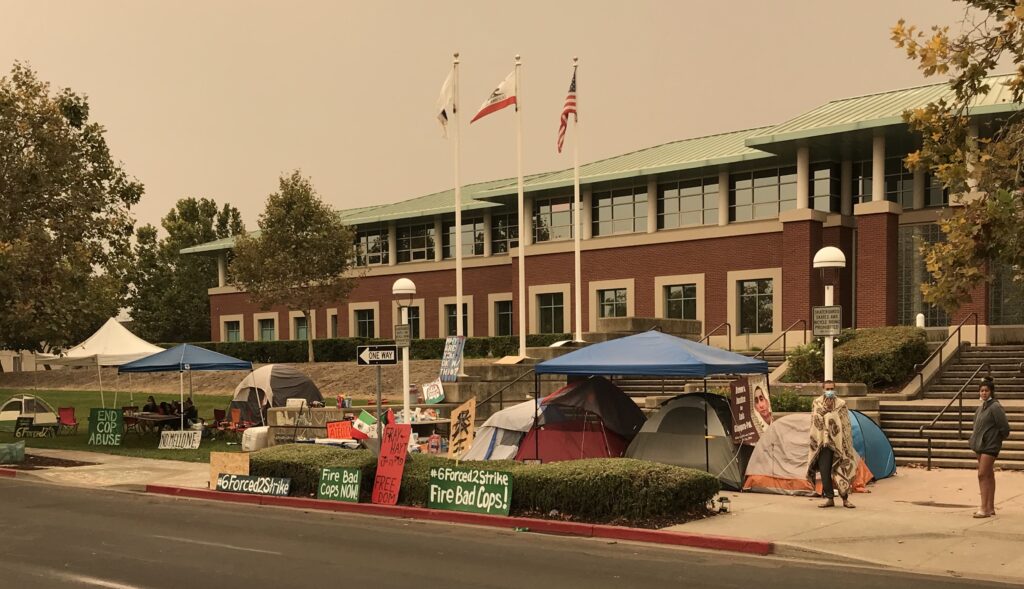
Hunger strikers and other protesters set up a camp site in front of the Antioch Police Facility on L Street.
Protest continues; mayor claims supporters used “intimidation tactic” at his work office, pounding on door before and during council meeting; blames Thorpe for protests; Thorpe denies
“Last night we realized we could starve and die on this lawn and our demands wouldn’t be met and no change would happen as a result of our deaths,” – Lacey Brown, protester and former hunger striker
By Allen Payton
Calling themselves the “#6Forced2Strike”, a group of Antioch residents have decided to give up their hungry strike on day six of the protest in front of the Antioch Police Facility. But they still want their demands met of the “immediate termination” of Antioch Police Officer Michael Mellone who shot and killed a homeless man in April 2016, while he was on the San Francisco Police force. They are also demanding Antioch Police Officers Association President Corporal Steve Aiello step down from that position for a comment he wrote on Facebook about an open hand slap of a protester as an acceptable response to being flipped off in the face. He later publicly apologized. (See related article).
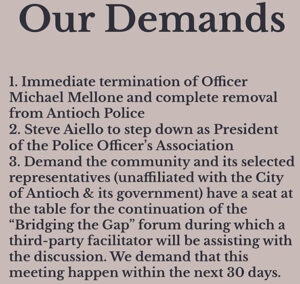
The strikers and protesters demands of the Mayor and City Council.
Mellone was facing discipline in summer 2019 following a three-and-a-half-year investigation by both the SFPD Internal Affairs Division (IAD), which recommended a 10-day suspension, and the Department of Police Accountability (DPA), a citizen-staffed local governmental agency, which is overseen by the San Francisco Police Commission, also a volunteer citizen body. According to their website, the DPA “receives, investigates and makes findings on civilian complaints of on-duty misconduct by sworn members of the San Francisco Police Department. Yet, in one of the most liberal cities in America, the citizens in charge of police oversight only recommended Mellone be suspended for 45-days, not that he be fired.
According to multiple news reports, Mellone was not facing discipline for his lethal use of force in the death of Luis Gongora Pat, but for escalating the situation and his non-lethal use of a bean bag gun. Gongora Pat was shot four times with bean bags, yet still lunged at Mellone and his sergeant at the time, using a large kitchen knife. Gongora Pat had a high level of methamphetamine in his system at the time.
In addition, the San Francisco District Attorney cleared Mellone and his sergeant and justified the officer’s use of deadly force.
Mellone was also promoted to sergeant during the time between the shooting in 2016 and August 2019, when he left the SFPD and was hired, again by the Antioch Police Department. He had previously worked for APD until 2013. The investigation in San Francisco was not closed until December 2019
As previously reported by the Herald, Mayor Sean Wright called for Antioch’s own investigation into the shooting of Gongora Pat by Mellone. Antioch Police Chief T Brooks said that an outside investigator was hired to review the 1,800 pages of documents from the San Francisco investigation.
Brooks said on Tuesday that the Antioch investigation continues and didn’t give a date for when it will be completed. Asked if he had given the investigators a date certain to complete their work, he responded, “No. I want them to do a thorough investigation.”
The strikers’ additionally, “Demand the community and its selected representatives (unaffiliated with the City of Antioch & its government) have a seat at the table for the continuation of the ‘Bridging the Gap’ forum during which a third-party facilitator will be assisting with the discussion. We demand that this meeting happen within the next 30 days.”
According to Mayor Wright, the next city council forum on police reform and race relations has been in the works already for either later this month or next month, once the city finalizes hiring a moderator, selected through a Request for Proposal (RFP) process. He and Councilman Lamar Thorpe serve on the council-appointed subcommittee working on the forums.
Council Meeting Public Comments
Several people submitted comments which were read by city staff at the beginning of the Tuesday night council meeting, almost all of them supporting those on the hunger strike and their demands.
Antioch resident Lacey Brown, who referred to herself as one of the hunger strikers, said about Wright, “We also saw he wrote that we were holding him hostage in his office. I feel it shocking that you would say such a lie. We have been calling you and you haven’t responded. We call you Sean ‘No Comment’ Wright. People are coming by and in your name harassing us. I’m completely shocked. If you want more come on down and talk to us.”
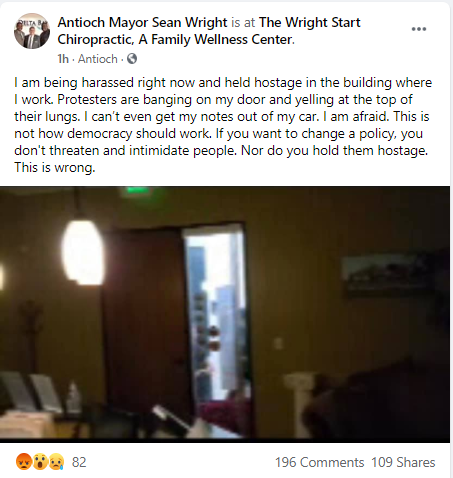
Mayor Wright’s post on his campaign FB page 09-08-20.
She was referring to a post by Wright on his Antioch Mayor Sean Wright Facebook page at 7:08 p.m. during the council meeting in which he was participating from his chiropractic office in Antioch. He wrote, “I am being harassed right now and held hostage in the building where I work. Protesters are banging on my door and yelling at the top of their lungs. I can’t even get my notes out of my car. I am afraid. This is not how democracy should work. If you want to change a policy, you don’t threaten and intimidate people. Nor do you hold them hostage. This is wrong.”
That post had reached over 22,000 people on Facebook as of 10 p.m. Tuesday night.
Michael Samson, running for Walnut City Council also spoke during the public comments period of the Antioch City Council
“I got to admit there was a lot of tension in the air, because of those threats that have been posted or are circulating,” he said of those involved with the hunger strike. “Every time a car would drive by there would be tension. There really is a legitimate threat out there. The inaction in response to a really, bold and courageous protest is really upsetting to me. These are people who are protesting for public safety. We have to recognize that the police are part of the problem. The fact that Officer Mellone is still on the Antioch Police force is making your city less safe.”
Julio Mendez, candidate for Mayor of Antioch, wrote, “Do the right thing. The Mellone decision reflects poorly on our city and the APD. This is time for the good ones to step up. These strikers are committed, and the world is watching.”
Someone named Jeff wrote, “If people want to go hungry that’s on them. They won’t starve. Don’t bow down to these unreasonable threats.”
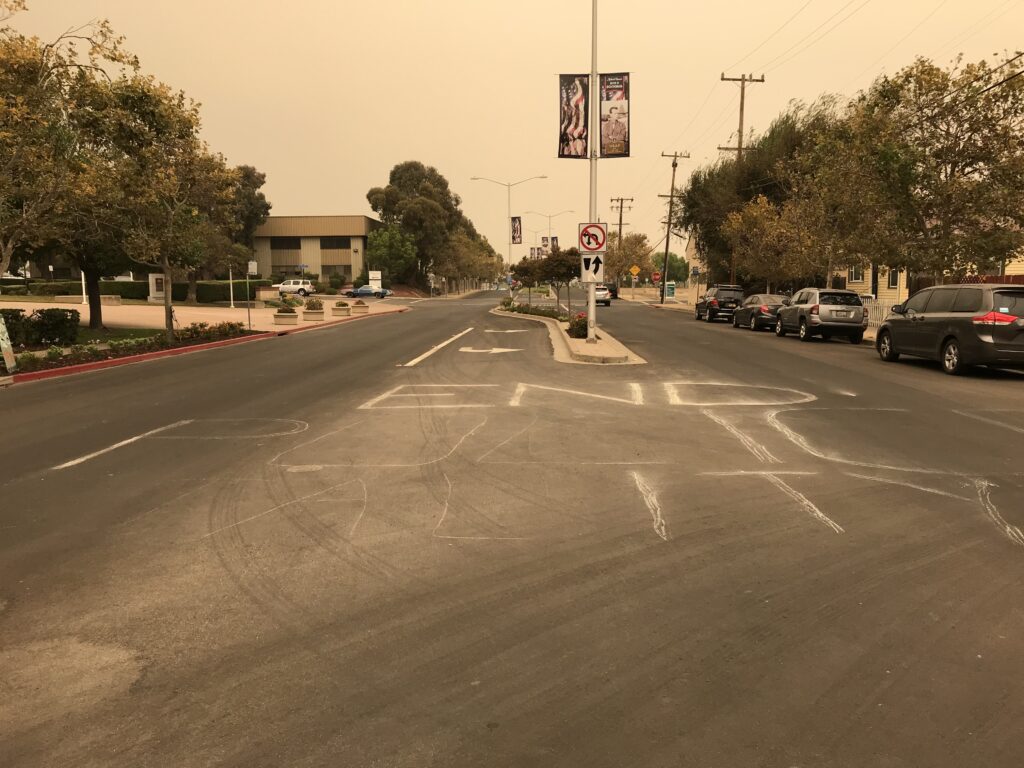
A faded “End Police Brutality” message was written in chalk on L Street in front of the APD Facility.
Hunger Strike Latest in Series of Antioch Protests
The effort to pressure Mayor Wright and council members to meet their demand of firing Mellone has been occurring since protests began earlier this year, including at City Hall, in which city employees were blocked from entering and required police to form a blockade to give them access to the building, and at council members’ homes. A video was shared on social media of protesters at Mayor Pro Tem Joy Motts’ home demanding she support a two-council member ad hoc committee, instead of having all five council members participate in the forums.
Most of those involved are recent graduates of high schools in Antioch over the past five years, based on self-identifying in their public comments during council and school board meetings. One of the leaders of the effort is Shagoofa Khan, a 2018 Antioch Youth of the Year, the same year she graduated from Dozier-Libbey Medical High School and ran unsuccessfully for the Antioch School Board. She ran on a slate with Householder. Khan is also one of the former six hunger strikers.
“The bureaucracy makes it slow,” Thorpe said during the council committee reports, explaining the delay in holding the second community forum.
On the matter of Aiello and Mellone he said, “from my perspective, it’s not our place to get into the affairs of the local police union. That’s their choice. Regards to the Mellone investigation, I’ve grown quite frustrated and want to get information back on that.”
“The investigation of Officer Mellone has been going on a long time. I’d like to get a report on that,” Motts added, echoing Thorpe’s comment.
Regarding the community forums on public safety and race relations she added more explanation for the delay saying, “We decided on June 30th to send out an RFP to hire a moderator. We formed a subcommittee of Mayor Wright and Councilmember Thorpe.”
Wright Responds, Tells About Protest
Wright responded to the comments by Lacey Brown about the protest at his private office, explaining why he had left the meeting and turned off his Zoom camera, at one point. He said, “about 30 minutes before this meeting, as I tried to prepare, individuals came to my office and were pounding on my door for about an hour. When I opened the door, they had their phones ready to record. When I had my phone ready to record, they all scattered.”
“It was an intimidation tactic that they used,” he continued. “That’s what took place. No lies. The video is the video. I just don’t think this is politics. It is what it is. But I just don’t think it’s right. I have called people and talked, I’m happy to have conversations with people. They can send me emails. But I haven’t received those emails.”
Crys Sandiforth wrote a comment below Wright’s Facebook post confirming his account, “I was in the building. This was intense and out of hand. There is a way to dialogue safely and respectfully for both sides. This was not it.”
When reached for comment about the matter, Antioch Police Chief T Brooks responded, “Officers were dispatched to a group of people creating a disturbance at the mayor’s chiropractic office. Officers contacted approximately 12 people who agreed to leave the area and not return. No further action was taken.”
“No one was arrested,” he added.
Antioch Council District 3 candidate, Antwon Webster also commented on Wright’s Facebook page writing, “I’m glad that no one got injured. In today’s climate, we are smothered in Protest, Pandemic, and Wildfires. When is enough, enough? How much negativity can we continue to breath? It’s time for everyone to just come together and leave hatred behind. The sight of all this anger is just so disgusting. How about we try something new. Constructive dialogue….a conversation that clears up uncertainty or lack of understanding. It’s time Antioch…it’s time to move Antioch forward.”
Wright later shared that a man knocked on his office door, and he walked out to his outer office saying, “I’m looking for a chiropractor. I told him I was closed. I’m not taking patients. There were more people were in the hallway and they started banging on the door and using a bullhorn. Had I opened the door I assumed they would have rushed in.”
Hunger Strikers Share Their Side, Answer Questions
Meeting with a few of those staging the protest at the APD Facility, two of them spoke with the Herald, Shagoofa Khan and Lacey Brown.
Asked about the protest at Mayor Wright’s office, Brown said, “there were less than 10 protesters at his office, last night.” Asked if either of them were there, they said “no.”
Asked if they aware that the mayor, city council, nor city manager have the authority to fire a police officer and only the chief does, Brown responded simply, “well aware of it.”
“You have killer cops, here and we’re letting them stay on the force,” interjected a masked woman who wouldn’t give her name, wasn’t one of the hunger strikers but was there to support them. She was very upset because she said her son had been beaten by Antioch Police in front of her in 2014.
Asked why they were calling for Mellone’s resignation instead of facing the same discipline recommended by the authorities in San Francisco including the citizen-run DPA, of a 45-day suspension, in one of the most liberal cities in America, Brown responded, “If Mellone had stayed in San Francisco and taken his 45-day suspension we would have been outside the DA’s protesting for him to be fired.”
They were next asked if they were aware of the 1,800 pages of documents and that the mayor had called for the investigation into Mellone, and that it took the investigation in San Francisco three-and-a-half years before the recommended discipline.
“We are not out here ignorant of the case or ignorant of the process,” Brown stated.
How long are you willing to wait for the actions that you’re wanting done, they were then asked.
“If we have a violent police officer on the streets for three-and-a-half years how much damage could they do while waiting for the report to be completed?” asked Brown.
She spoke of the need for a different process for dealing with police officers stating, “I do believe Antioch should have a citizens oversight committee because there aren’t wearing body cameras.”
“For a precedent to be set something has to be done the first time,” Brown explained about the protests happening in Antioch, this year. “We are not satisfied with the processes that are in place. We are asking for all the city leaders…to brainstorm for a new situation.”
“This is the first hunger strike in Antioch, ever,” Khan added.
“The problem with leaders in Antioch is they think that complaining about one cop we’re vilifying the entire police force,” Brown shared.
“Every time we encounter a cop, they think we hate the entire force,” Khan said. “It’s not that we hate APD, hate Chief Tammany Brooks, we want accountability. When we as citizens do something wrong, we either go to jail or get a ticket. But when a cop does something wrong there’s no accountability.”
“You have a lot of young people who are frustrated,” said the lady in the mask. “You have older people who are tired. They have to sit in pain in silence. If the police do something, it’s covered up. They pay the families out of a civil suit. Mellone killed that man. That money can’t bring him back.”
Hunger Strike Ends
Asked if they were still on their hunger strike, in the light of boxes of pizza sitting on the table nearby, and if they had been rotating with some staying on site and others going home to sleep and eat, as someone claimed in a comment on Facebook, Brown responded, “For six days there were six people all on a hunger strike, juice and water, zero calorie drinks. Last night we realized we could starve and die on this lawn and our demands wouldn’t be met and no change would happen as a result of our deaths.”
“So, we will continue to occupy this space and others will continue to join us,” she added.
“Our thoughts are in the emails sent,” Brown continued. “We said we understand no one entity can bring about these changes.”
Opposition & Support
As this reporter was on the scene a young man in a truck drove by and flipped off the protesters and said “f… you”. Then turned around and drove back the other direction and repeated his comment and gestures.
Both Khan and Brown laughed and said that was nothing, as they had experienced greater opposition, both on social media and in persion, including threats of violence.
“Do the world a favor and shoot yourself in the face” Khan said someone wrote.
“Two others drove by and said that in a group chat it’s being discussed that they were planning to come in the middle of the night and ‘f… us up’,” Brown stated. “I asked if that included murder and rape. He said, all options were open. He said he would know when they were done when he saw ambulances at the scene.”
However, Brown and Khan wanted to point out the support they had received.
“There have been literally 100’s of people who have dropped off food, water, supplies, pop-ups, blankets,” Khan shared.
“We had 30 people who have watched us while we slept,” Brown stated. “The neighbors have even offered help, if we need to run to their house for shelter.”
More Questions & Answers
They were also asked since they’re calling for the resignation of Corporal Aiello from his position as APOA President for his comments on social media, even after he had apologized, will they also call for Ellie Householder’s resignation for her comments on social media against fellow Antioch School Board trustee, Mary Rocha?
“I believe that they were different,” Brown responded. “If you read Ellie Householder’s tweets, she didn’t actually justify any violence against Mary (Rocha) or Diane (Gibson-Gray). They lied. People did stand behind Diane’s car. But no one hit them. People were blocking the doors.”
Wright Blames Thorpe for Protests in Email
Brown mentioned an email sent out by Wright’s campaign on Wednesday blaming Thorpe for the protests. The Herald also received the email.
Wright wrote, “Last night was a turning point for me. Protesters surrounded my chiropractic office last night (thank God my last patient had already left), banging on my door and windows and yelling at the top of their lungs. I had to call the police. This isn’t how democracy should work – not through intimidation, bullying and fear. (See my Facebook post, below)
I wholeheartedly support peaceful protest as the cornerstone of our free society, but that is not what was happening last night. Come to find out, most of these same protesters who have pitched tents in front of the Antioch Police Department aren’t even from Antioch. They go city-to-city intimidating elected officials, not asking, but MAKING DEMANDS. (They came from Lodi and next are going to protest in El Cerrito.)
And they were coaxed here by my opponent, Lamar Thorpe, to forward his agenda and to “stir things up” in our city in the hope you will elect him as your next Mayor.
What is especially disturbing … is how Mr. Thorpe is USING these young protesters, to do his own dirty work while he stays quiet as the man behind the curtain. Now, they’re on a hunger strike and, please take my word for this, if anything happens to even one of these young protesters (regardless of where they come from), my opponent will be the one to answer to our community.
Antioch has had enough of this chaos and it’s time we stand up and take our community back. EMAIL ME HERE and let me know if you’ll join me.
Dr. Sean Wright – Antioch Mayor
Asked if Thorpe is behind their protest as Wright and other people are claiming, Brown responded, “Not only does Lamar Thorpe get blamed for everything he gets credit for everything including my non-profit organization, Justice Advocates and Resources of East County.”
“That was obvious from the way he dismissed us, last night,” Khan said. “Not just Lamar, but none of the city council acknowledged us. The Chief (Brooks) hasn’t acknowledged us.”
Asked if he had seen or heard about Wright’s email, Thorpe responded, “Yes, I read his nonsense. While he’s busy trying to turn me into the ‘boogeyman’, I’m going to focus on telling voters about what I’ve done as a council member and what I plan to do as their next mayor.”
Asked if he was responsible for the protests he responded simply, “No.”
Back to the issue of their protest, Brown said, “I don’t think it would be unreasonable for the mayor or the city council to say, ‘I share your concerns’.”
“The stuff we’re doing is for a conversation for change,” Khan stated.
“This isn’t our first action,” Brown pointed out. “This is an escalated thing.”
The protest continues at the Antioch Police Facility, but now, it’s no longer a hunger strike.











 Martinez, Calif. – Today, Tuesday, September 15, 2020 the Contra Costa County District Attorney’s Office is announcing three homicide cold cases, involving multiple defendants who are gang members affiliated with the Sureños, were filed recently. The gang violence was focused in South Concord and near Monument Boulevard. This successful effort was due to the years-long investigation and operation led by the FBI Safe Streets Task Force and local partners, including Concord Police, FBI, U.S. Attorney’s Office of Northern California, Bureau of Alcohol, Tobacco & Firearms along with our Office. Two cases were filed last week, and one was filed yesterday, totaling four homicides involving 11 defendants. (See related article)