Archive for the ‘Business’ Category

Shop in Antioch’s historic, downtown Rivertown on Small Business Saturday Nov. 27

Tuesday, November 23rd, 2021

Saturday, November 27, 2021 is Small Business Saturday – a day to celebrate and support small businesses and all they do for their communities. This year, we know that small businesses need our support now more than ever as they navigate, retool and pivot from the effects of the coronavirus pandemic. Please join SBA and organizations across the country in supporting your local small businesses by shopping at a small business.

Each year, the merchants in Antioch’s historic, downtown Rivertown celebrate Small Business Saturday, the first Saturday after Thanksgiving and invite shoppers to Shop Local. Shop Small. Shop Rivertown.

Antioch’s Rivertown and the new Rivertown Dining District are located in the area of the city between A Street and Auto Center Drive and north of West 10th Street to the river.

Founded by American Express in 2010 and officially cosponsored by SBA since 2011, Small Business Saturday has become an important part of small businesses’ busiest shopping season. Historically, reported projected spending among U.S. consumers who shopped at independent retailers and restaurants on Small Business Saturday reached an estimated $19.8 billion according to the 2020 Small Business Saturday Consumer Insights Survey commissioned by American Express. The survey also found that 97% of shoppers recognized the positive impact they can make by shopping small and 85% of them reported they also encouraged friends and family to Shop Small® as well.

The highly successful team of SBA, Women Impacting Public Policy (WIPP), and American Express will be kicking off the 2021 holiday season by encouraging consumers to support our nation’s nearly 32 million independent businesses this Small Business Saturday and all holiday season long.


Contra Costa, 22 other DA’s reach settlement with gas station owner for underground storage tank environmental violations

Monday, November 22nd, 2021

Gas station underground storage tank diagram. Source: EPA

$1.1 million in civil penalties; 113 tanks statewide, seven in Contra Costa County

By Bobbi Mauler, Executive Assistant, Contra Costa County Office of the District Attorney

Contra Costa County District Attorney Diana Becton announced today that the Contra Costa County District Attorney’s Office, together with 22 other California District Attorneys and City Attorneys, have reached a settlement with the Orange, California-based Hassan & Sons, Inc., H&S Energy, LLC and H&S Energy Products, LLC (formerly known as Colonial Energy, LLC),  (collectively referred to as “H&S Energy”) over allegations that the companies violated state laws regarding the operation and maintenance of motor vehicle fuel underground storage tanks (“USTs”). The settlement includes $1,100,000 in civil penalties, and investigative costs. H&S Energy has 113 fueling stations in California, of which, seven locations are in Contra Costa County. The settlement follows an investigation by local environmental health agencies of H&S Energy stations’ non-compliance with many provisions of the UST regulations.

The companies, started in 1996, have built and acquired gasoline and convenience stores throughout the state under the Chevron, Texaco, Shell, Extra Mile, and their own, Power Market brand, including locations in Bay Point, Brentwood, Oakley, Pittsburg and Martinez.

“UST owners and operators must comply with the applicable regulations in order to prevent potential harm to the environment,” said D.A. Becton. “H&S Energy was cooperative with the People’s investigation and expended significant resources in order to bring their stations into compliance.”

Under the settlement, which includes a Final Judgment and Permanent Injunction entered in Solano County Superior Court Case No. FCS057332 by the Honorable E. Bradley Nelson, H&S Energy must implement certain compliance assurance programs including hiring an environmental compliance manager and bi-annual environmental audits and reports submitted to the People. In addition, H&S Energy must pay $900,000 in civil penalties and $200,000 in costs. $550,000 is due within five days after entry of judgment, and the remaining $550,000 is due October 22, 2022.

Allen Payton contributed to this report.


Hallo-weekend activities at The Red Caboose in Antioch

Thursday, October 28th, 2021

Antioch’s Markstein Sales Company president Laura Markstein honored for work on “Distributors Against Human Trafficking Initiative”

Monday, October 25th, 2021

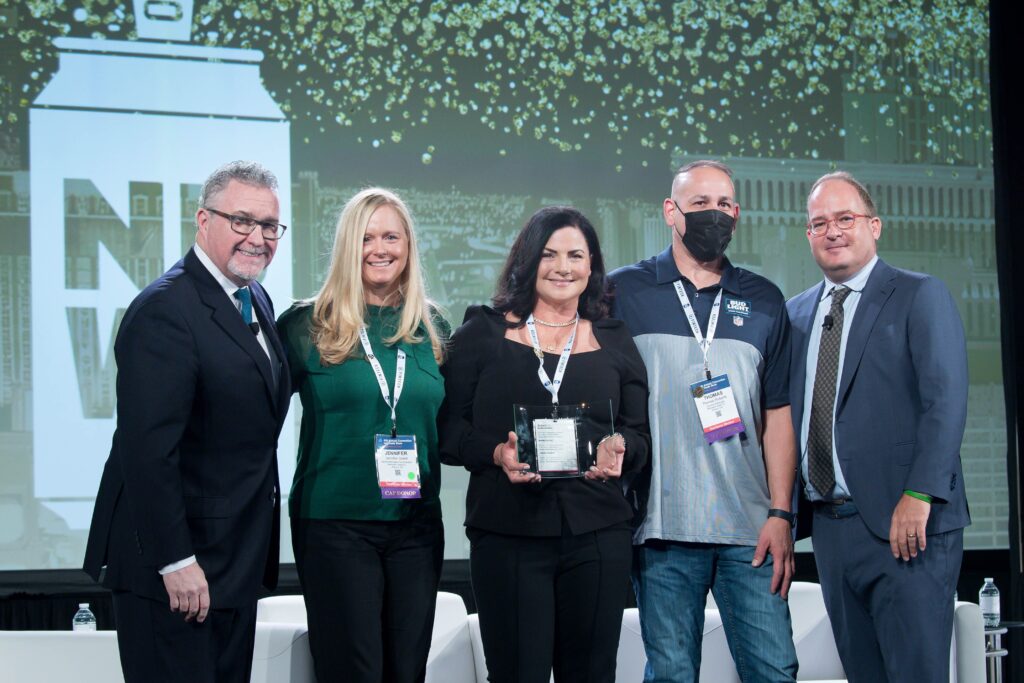
Laura Markstein (center) is honored with the Public Affairs Award at the 84th Annual National Beer Wholesalers Association Convention Oct. 3-6, 2021 and joined by (L-R) NBWA President and CEO Craig Purser, Markstein General Manager Jennifer Grant, Markstein Director of Operations Tom Roberts, and new NBWA Chairman of the Board Peter Heimark. Photo: Markstein Sales Company

The company has worked relentlessly both locally and nationally to combat human trafficking with programs and promotions aimed at stopping this heinous crime

Markstein Sales Company, the largest woman-owned and operated wholesale beverage distributor in Northern California, announced that its president, Laura Markstein, has been awarded the esteemed Public Affairs Award by the National Beer Wholesalers Association (NBWA) for her company’s work helping to end human trafficking in the United States. This award, given to one individual per year, if given at all, was announced at the NBWA 84th Annual Convention earlier this month. As a long-time supporter and sponsor of the local New Day for Children organization that provides funding to help American children who have been recovered from sex trafficking, Markstein took her efforts to a national level during 2021 when her company joined the NBWA’s Distributors Against Human Trafficking Initiative.

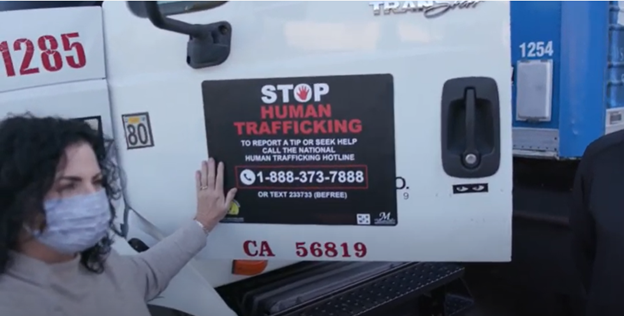
As part of its effortsMarkstein installed signage on all of its 75 vehicles that are typically on the roads of Contra Costa and Alameda Counties 14 hours per day, six days per week. The goal of these signs was to raise awareness locally and to provide easy access to hotline information for people that suspect, or know of, human trafficking cases. Markstein also provided personalized training, leveraged from both NBWA and New Day for Children, for all truck drivers and merchandisers so they know what to look out for on their daily routes and in the businesses they serve. Complementing these efforts, Markstein also regularly appealed to other companies around the country to join in the fight to end human trafficking. (See related article)

Owner Laura Markstein places a sign on one of the company’s trucks. Herald file photo.

“Once we learned that our beer and beverage drivers had a unique visibility to many of the prime locations where traffickers often exploit victims, we wanted to leverage our position and do all we could to help fight this tragedy,” said Laura Markstein, CEO of Markstein Sales Company. “While we are proud of the work we have done to help this cause, this is a growing problem in our country and it needs every company and American citizen to do their part to help – whether that be company sponsored programs or simply a watchful eye in someone’s everyday life. These efforts make a tangible difference and we can all do our part to help.”

Human trafficking is a growing problem in the U.S., with more than 11,500 human trafficking cases reported in 2019 alone. California has consistently had the highest human trafficking rates in the United States with 1,507 cases reported in 2019.

“We chose Laura for this award because her company exemplifies what every beer and beverage distributor in the U.S. could be doing to help stop human trafficking,” said Craig Purser, President and CEO of NBWA. “If every member in every state across the country also contributes their part to help spot human trafficking while on their daily routes, we can make significant progress towards ending this criminal activity.”

The NBWA Initiative

In 2020, the National Beer Wholesalers Association launched Distributors Against Human Trafficking, to help combat human trafficking in the United States. Working alongside state attorneys general, NBWA created an awareness training video to help more than 140,000 beer distribution employees in the U.S. recognize and report signs of human trafficking. To date, NBWA has successfully trained nearly 24,000 beer distributors from 207 companies, surpassing its initial goal to train 10,000 distributors by the end of 2021. Beer distributors are uniquely positioned to help fight this heinous crime given their level of access to locations often unseen by the public as they visit around 600,000 licensed retail locations across the country.

About Markstein Sales Company

Markstein Sales Company is a fourth-generation, woman-owned and operated wholesale beverage distributor based in Antioch, Calif. Founded in 1919 with just a horse, a wagon and six cases of beer, Markstein is now in its 102nd year and distributing over four million cases annually to 2000 retailers in the Bay Area. The company’s portfolio is composed of multiple world-class beers including the Anheuser-Busch InBev and Constellation Brands family of beers, several high-quality craft beers and many others, as well as non-alcoholic beverages. Markstein is known for outstanding customer service, dedication to their employees and commitment to the community. The company continues to rank as best in class by retailers and is one of the top ten largest Woman Owned Businesses in the Bay Area. More information can be found at https://www.marksteinsalescompany.com


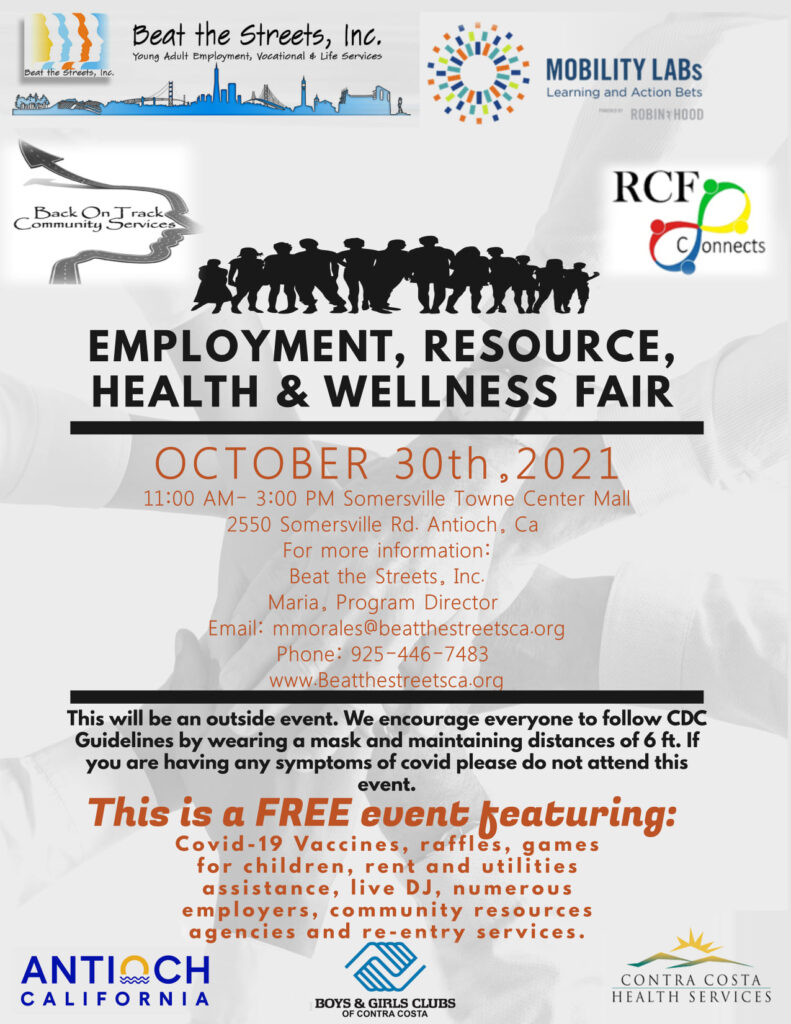
Employment Resource, Health & Wellness Fair in Antioch Oct. 30

Monday, October 18th, 2021

Antioch’s Mau Loa Ohana Hula and Tahitian Dance Studio reopens with exciting night of Polynesian dancing, surprises

Wednesday, October 13th, 2021

Mau Loa Ohana dancers Dec. 2019. Source: Mau Loa Ohana

See unique costumes by Antioch designer

After a nearly two-year hiatus, due to COVID-19, the troupe of Polynesian dancers from the Mau Loa Ohana Hula and Tahitian Dance Studio in Antioch, owned and operated by Monique Castaneda, is returning to the stage for a very special night of exciting entertainment and everyone is invited to attend.

Please join us on Saturday evening, October 23, 2021, at the Liberty High School Theater in Brentwood, for an evening filled with exciting Polynesian music and dancing along with a very special treat for everyone who attends.  The doors open at 7:00 PM and the show starts at 7:30 PM.  (Facemasks are required.) Tickets are $15.00 per person and can be purchased at the dance studio located at 1360 Sunset Drive in Antioch. (just a couple doors down from Aladino’s Pizza) or you can call them at (925) 550-8155.

This event is very special because Castaneda and the Mau Loa Ohana dancers have recently teamed up with an extraordinary costume designer from Antioch, Julie Carlson of Outside of the Box Costume and Apparel Designs. She, like Castaneda used to be a Tahitian dancer herself and they will be presenting something extra special to the audience that evening. 

Carlson has created an extremely unique Tahitian dance costume design. It will be the first time anyone has publicly debuted a Tahitian dance costume that incorporates this unique feature, giving the entire dance a new look and feel.  Carlson looked everywhere to see if anyone else has done anything like this and could not find anything that is even remotely like her new design. Prepare yourselves to be wowed!

For years, Castaneda had been dreaming that someday, someone would create such a costume. Throughout the years, Castaneda and her dance teams tried to come up with a way of creating a costume with these unique features, but alas, they couldn’t quite figure out how to make it happen.

The exact same story was true for Carlson but when she recently returned from a vacation in Hawaii this past July, she was once again inspired to try to bring her vision of this unique and new Tahitian dance costume design into reality.  And it appears that Carlson finally figured how to do it.  She then contacted Castaneda and they set up a time to meet each other for the very first time.  We’ll see what happens next. But both women think, with the help of the Mau Loa Ohana dancers, this exciting new costume design will, as they say, “go viral”.

Liberty High School is located at 850 2nd Street in Brentwood.

See you on the 23rd!

Governor signs Senator Glazer’s key local proposals

Friday, October 8th, 2021

Small wineries can open two off-site tasting rooms     

Local governments gain new tools for overseeing short-term rentals

Thousands of acres of East Bay wilderness to be preserved

By Steven Harmon, Policy Analyst/Communications, Office of Sen. Steve Glazer

State Senator Steve Glazer. (D-7-Orinda)

Governor Gavin Newsom has signed three long-standing proposals advanced by Senator Steve Glazer, (D-7-Orinda), that will have a direct impact on residents of Contra Costa and Alameda counties.

“It’s very gratifying to see important legislative priorities for my district signed into law,” Senator Glazer said. “These are bills and proposals that I’ve been working on with partners, in some cases, for years. I’m thankful to Governor Newsom for ushering them across the finish line with his signature, a nice reward for all the hard work put in by key allies and friends.”

The three proposals that Gov. Newsom signed were:

Winegrowers: Offsite Tasting Rooms (SB 19)

SB 19 will allow licensed winegrowers or brandy manufacturers to operate two off-site tasting rooms under their winegrower licenses. This bill will particularly help small and family-owned wineries to operate as California continues to recover from the Pandemic.

Approximately 55 wineries are located in Senator Glazer’s district, including in Livermore, Oakley, Brentwood, Byron and Moraga.

“Small and family-owned wineries have struggled the most among wineries, because they rely heavily on visitors and direct sales,” said Senator Glazer. “With tourism taking a terrible hit from the pandemic and consequences of the wildfires, I’m glad that Governor Newsom recognized that these wineries are in need of that additional outlet to provide tastings and sales to their customers.”

Prior to the current tasting room closures caused by the COVID-19 pandemic, many wineries viewed additional off-site tasting rooms as a significant benefit. This was even more pressing for many small wineries looking to expand business opportunities, especially those wineries that produce their wine in an agreement to use the facility and equipment of a second (usually larger) winery.

Steven Kent Mirassou, owner and winemaker of Steven Kent winery, part of the Livermore Valley Wine Country Association, said SB 19 will make a difference to the industry, but also to wine enthusiasts.

“The ability to take care of people – which is the true center of hospitality and wine – is important at all times,” Kent Mirassou said. “It is especially crucial during the pandemic when we are all striving to maintain connections with our larger circle of friends and patrons, that small wineries remain open and thriving. I am so appreciative of the hard work and perseverance that Senator Glazer and his staff have shown in helping us continue to add joy and richness to peoples’ lives.”

With the COVID-19 pandemic, tasting rooms have been required to either close or significantly alter their operations for tastings, but can continue to operate sales for curbside pickup or delivery. Tourism has become almost nonexistent and is not expected to recover for several years. As a result, the impact from COVID-19 to the wine industry is estimated to be $5.9 billon, with a $3 billion loss in tasting room sales.

In addition, the 2020 wildfires had a substantial impact on the wine industry. According to the Wine Institute, the estimate of damage from 2020 wildfires amounts to $3.7 billion, including a loss of $41 million in tasting room sales and $57.6 million in lost winery structures.

Allows Increased Fines on Short Term Rental Violations – to Rein in House Parties (SB 60)

Under SB 60, cities and counties can now impose increased penalties on short-term rental hosts who violate local property rental laws – an attempt to rein in house parties, sometimes violent, that have been occurring at short term rentals because of lax oversight of these properties. SB 60, which took effect immediately, authorizes localities to impose fines up to $5,000 for a violation of a short-term ordinance.

“These large gatherings have made some short-term rental properties the sites of underage drinking, brawls, noise complaints, and violence,” Senator Glazer said. “I’m grateful to Governor Newsom for signing this bill so that local governments have the tools to ensure the safety of those who want to continue to use short-term rentals, and of our residents who live nearby these properties.”

The legislation was sparked by a spate of violence at short-term rental properties, most notably a mass shooting in Orinda, where five people were killed. Other abuses at short-term rentals occurred in Los Angeles and other locales in Northern California, including a party at a Sunnyvale rental where a teenager was shot and killed in August after violence erupted at the gathering. (See related articles, here, here, here and here)

Smaller fines were proving to be ineffective in deterring violations. Hosts were able to charge so much rent for big houses that the fines, if they occurred, were just seen as a cost of doing business.

“Violence and destructive behavior at short term rentals has become a true public safety issue in cities throughout California, as residents of Orinda know all too well,” Orinda Mayor Amy Worth said. “I am thankful that mayors like me will now have the ability to impose fines at a level high enough to get the attention of property owners who operate short term rentals to ensure the safety of our residents. Senator Glazer has been a true champion of this issue, and we are thankful for his hard work on making this California law.”

The use of short-term rentals has skyrocketed by 105 percent over just the past three years, according to vacation rental data compiled by AirDNA. Though short-term rentals offer a way to improve tourism and earn owners some extra money, their recent proliferation has allowed bad actors to use the platform to advertise and secure homes for large parties, oftentimes in violation of local ordinances.

The Covid-19 pandemic led to an increase in people using short-term rentals to evade public health restrictions on large public gatherings. Noise complaints as a result of parties have tripled since the start of the pandemic, according to Host Compliance, which tracks legal compliance among short-term rentals for 350 cities and counties in the U.S.

In the last half of 2019, 42 people were shot inside or just outside a short-term rental property nationwide and 17 people died.
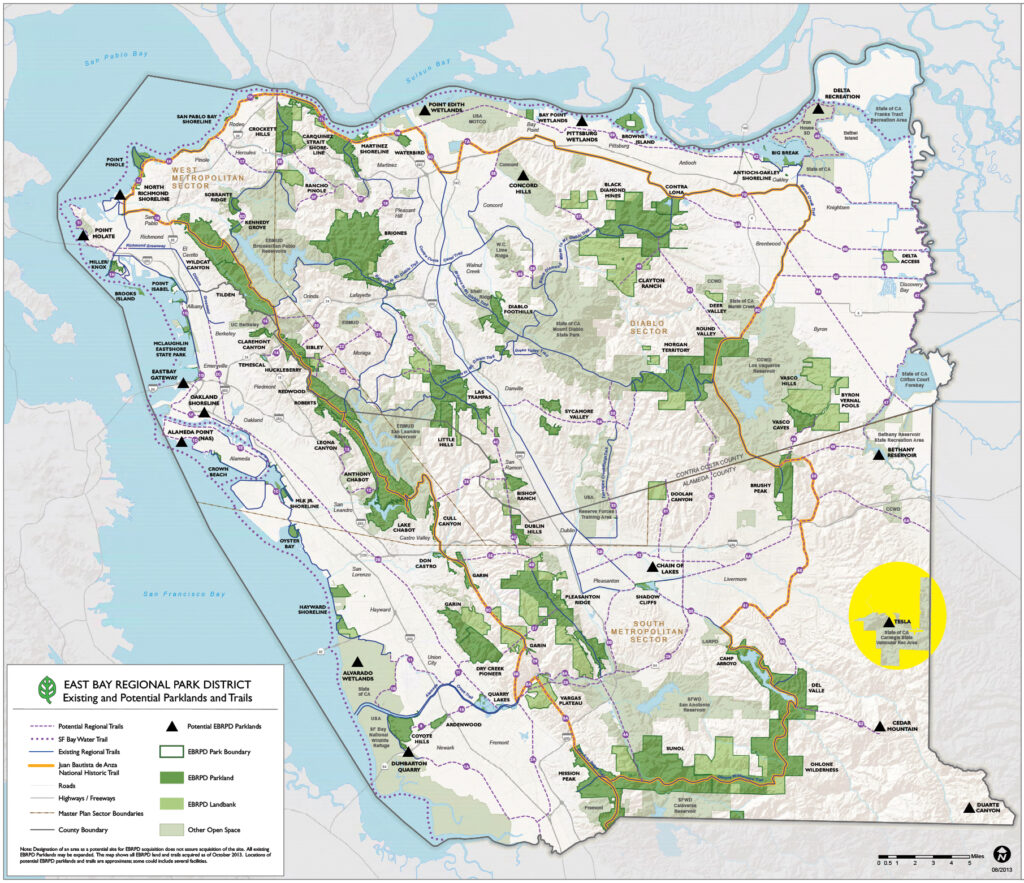
East Bay Regional Park District 2013 Master Plan Map designating Tesla site (yellow area) as a potential regional preserve. Source: EBRPD

Tesla Land Preservation (Budget)

Thousands of acres of East Bay wilderness threatened by the expansion of an off-highway vehicle park will instead be preserved. (See related article)

The legislation, approved in the Governor’s recent budget bills and took effect immediately, ends plans to expand the Carnegie State Vehicular Recreation Area into the 3,100-acre Tesla parcel in the southeast corner of Alameda County, which scientists have described as a biologically unique habitat and Native Americans have long considered to be a sensitive historical site.

That land will now become a new state park closed to motorized recreation. The state will reimburse the Off-Highway Vehicle fund for the purchase price of the land, its appreciation in value, and the money spent planning the expansion, which was opposed from the start 20 years ago by nearby residents and public agencies. That money will go toward the purchase and development of an off-road park at another location.

“Our community and region will preserve this natural and cultural treasure, leaving it pristine for future generations to enjoy,” Senator Glazer said. “Meanwhile, off-road enthusiasts will be able to keep their current park and receive funding to develop another park on land that’s more suitable to that kind of recreation. I appreciate the hard work that so many key individuals played in moving this critical environmental and cultural issue to the Governor’s desk, and, of course, for the Governor to work with all the players to sign this important agreement.”

Senator Glazer partnered with Assembly member Rebecca Bauer-Kahan, the Sierra Club, Friends of Tesla Park and other environmental organizations and individuals in getting the final approval from the governor’s office. Earlier, former Assembly member Catharine Baker worked with Senator Glazer on the same issue.

Nancy Rodrigue, a leading member of the Friends of Tesla Park steering committee and Livermore resident, said she was proud that years of hard work and persistence paid off.

“A very special thank you goes to Senator Glazer and Assembly member Rebecca Bauer-Kahan for the many years of work on this special project,” Rodrigue said. “Tesla Park will now be a reserve with no motorized recreation. Instead, the future holds Tesla as a protected native landscape for hikers, history buffs, nature lovers, researchers and educators.

“Saving Tesla Park has been a long, difficult, and now a rewarding journey, and we are grateful for the tremendous work of so many for saving Tesla as a legacy for future generations,” Rodrigue continued. “We are looking forward to planning the next phase of Tesla Park as a nature and cultural preserve, providing passive recreation and education to the community of the Bay area, the San Joaquin Valley, and Northern California.”


 

Contra Costa health data show COVID cases were on decline before new health orders issued

Wednesday, September 29th, 2021

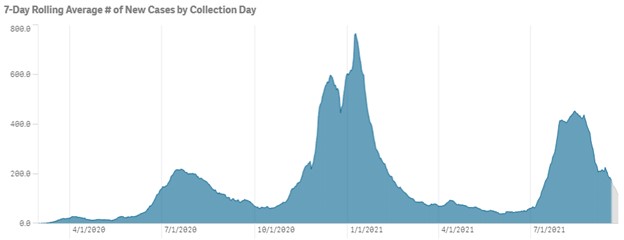
7-Day Rolling Average Number of New Cases in Contra Costa County April 1-Sept. 19, 2021. Source: CCC Health Services

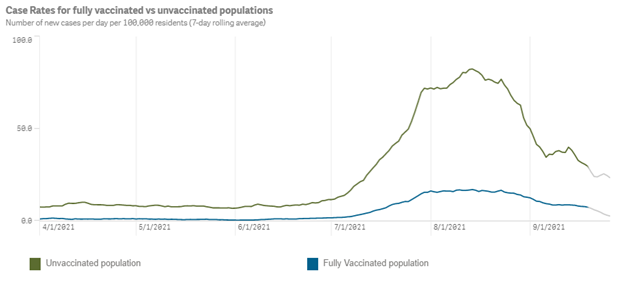
“Case Rates for unvaccinated people in the county…peaked on Sept. 13, one day before the new health orders were issued.”

“…we are a long way from the levels of community transmission we experienced in spring…” – Contra Costa Health Services spokesman

By Allen Payton

The statistics on the Contra Costa Health Services Coronavirus Dashboard show COVID hospitalizations and cases in the county were already declining before the new health orders by county health officer, Dr. Chris Farnitano, issued them on Sept. 14. While the data trails the report by seven days, as the dashboard states, “data from the last 7 days is still being reported”, all the COVID-related stats continued to decline before the orders went into effect last Wednesday, Sept. 22.

The press release from CCHS on Sept. 15 read, “While the peak of the surge seems to have passed.” But the statistics showed it had passed. (See related article)

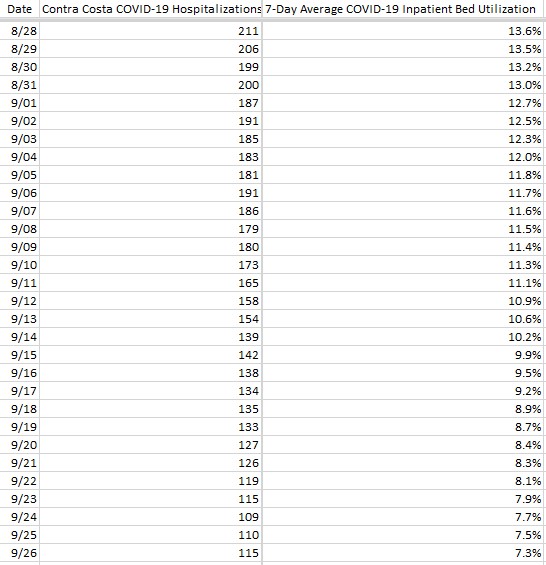
Total Contra Costa County Hospitalizations of COVID patients and percentage of all patients Aug. 28-Sept. 26, 2021. Source: CCHS

Hospital Bed Utilization

The 7-Day Average COVID-19 Inpatient Bed Utilization in the county decreased from 11.5% on Sept. 8 to 9.9% by the time the orders were issued on the Sept. 15. That continued to decrease to 8.1% on Sept. 22. They have continued to decrease through Sunday to 7.3% and were on the decrease since Aug. 28 when the percentages were first included in the stats, from 13.6%.

The statistics also show the percentage of COVID inpatient beds to Contra Costa Total Hospitalizations has decreased from a high of 19.4% on Sept. 6 to 10.7% on Sunday, Sept. 26.

In addition, of all the inpatient ICU beds in the county, about one-third have been filled by COVID patients has decreased from a high of 46% to 29% between Aug. 28 and Sept. 26.

New Cases

The Seven Day Rolling Average number of new COVID cases in the county peaked on Sept. 10 at 217.3, almost two weeks before the new health orders went into effect on Wed., Sept. 22.

Contra Costa County Case Rates per 100,000 vaccinated vs unvaccinated April 1 – Sept. 19, 2021. Source: CC Health Services

Case Rates

The Case Rates for unvaccinated people in the county at 40 per 100,000 population and fully vaccinated people at 8.7 peaked on Sept. 13, one day before the new health orders were issued. Both continued to decline through Sept. 19 to 29.6 and 7.4 respectively, three days before the orders went into effect.

Questions for Farnitano & CCHS Staff

In light of that information, Farnitano and health services staff were asked the following questions via email Monday evening: “Why are the latest orders still in place? Are you willing to lift them, now? If not, what else must occur for that to happen?”

Response From CCHS Staff

Karl Fischer, Contra Costa Health Services spokesman responded, “For the past few weeks Contra Costa County’s COVID-19 transmission data have been trending in the right direction after a severe, sudden spike in new cases, hospitalizations and deaths earlier this summer.  

It’s also true that county data remain elevated since that spike, far above where they were when California relaxed its health orders in mid-June. As the press release you quoted correctly points out, our average daily case rate is similar to what we were recording in February, on the downslope of another severe spike. That information is also available on the dashboard 

It is no accident that our county is now trending in the right direction.  

COVID-related public health measures, including recent health orders requiring people to wear masks when visiting indoor public spaces and show proof of vaccination or a recent, negative test result to enter the indoor parts of some high-risk public establishments, are helping to reduce transmission of the virus in our county.  

For example, on Aug. 3, the day our indoor masking health order took effect, the 7-day average number of daily new COVID-19 cases reported in our county was 412. One month later, on Sept. 3, that number had dropped to 245.9.

We hope to see similar improvement in coming weeks from the most recent health order, which took effect just last week. But, as I mentioned, we are a long way from the levels of community transmission we experienced in spring, when the state briefly seemed to be emerging from the pandemic.  

With winter approaching, a season where the spread of respiratory viruses such as COVID-19 is common, we are doing everything we can to prevent another severe surge, most importantly working to increase vaccination rates across our community – to save lives, keep our schools and businesses open, and our hospitals functioning.”

However, as the Dashboard shows, Contra Costa County was already trending in the right direction” two weeks before the new health orders went into effect.

Additional Questions

An additional question was sent late Wednesday afternoon, asking, “since Contra Costa was already significantly trending in the right direction through not just Sept. 3 but it continued through Sept. 22, with just the indoor mask-wearing order, why the need for the additional proof of vaccination or testing mandate? Is it an effort to pressure the unvaccinated to get vaccinated by taking away more of their freedoms?”

09/30/21 UPDATE: CCHS spokesman, Karl Fischer responded, “Contra Costa has made significant progress in lowering the number of new reported cases and hospitalizations in recent weeks. But, as I mentioned in my last response, our transmission data are still substantially far above the levels considered safe by the State of California when it lifted its health order on June 15.

I know you are aware of this information, as it is available on our public dashboard, but our 7-day rolling average number of daily new COVID-19 cases was 152.9 on Sept. 22, compared to 45.3 on June 15. Per capita, on June 15 we averaged 1.5 daily new hospital admissions due to COVID-19 for unvaccinated people, compared to 5.5 on Sept. 22. Contra Costa has a long way to go before it reaches the transmission levels the state considered just safe enough to reopen, just three months ago.

Contra Costa is committed to doing everything in its power to reduce COVID-19 transmission as quickly and effectively as possible – lives depend on it. That is why the county this month added a new, temporary requirement for patrons using the indoor areas of certain establishments where the virus is at high risk of spreading to show proof of vaccination at the door, or a recent, negative test result.

We believe this health order will help our community continue its progress reducing COVID-19 transmission, perhaps even accelerate it, and it may also help to head off another massive holiday surge in cases, hospitalizations and deaths, like the one we experienced last winter.

We encourage anyone who is eligible to get vaccinated. Our transmission data are now slowing down thanks to the 80%+ of county residents who have already chosen to get vaccinated, and the willingness of the majority to temporarily endure inconvenience so we all may eventually enjoy living in a community where there is no elevated risk of contracting a deadly but highly preventable disease.

Why No Recovery Documentation Option in Contra Costa?

On Wednesday, U.S. Senator Diane Feinstein (D-CA) on Wednesday, introduced the U.S. Air Travel Public Safety Act, a bill that would require all passengers on domestic airline flights to either be fully vaccinated, have recently tested negative for COVID-19 or have fully recovered from COVID-19. According to her office’s press release, “the legislation builds on a current CDC requirement that all air passengers traveling to the United States from a foreign country must provide proof of a negative COVID-19 test result or documentation of recovery from COVID-19.”

In response, the additional questions were sent to CCHS staff: “Why isn’t that last option, recovery documentation, being offered to people in Contra Costa to comply with the latest health orders if it’s allowed to be used for people traveling into our country? They aren’t even required to provide proof of vaccination. But we Americans do to participate in something that takes much less time than an international flight. Their plane trips are much longer than an hour which is usually the length of time it takes to have an indoor, sitdown meal. If that’s the science the federal government is following, why isn’t the CCHS also following it?”

Fischer replied, “Contra Costa Health Services did not include a provision for proof of prior infection in the Sept. 14 health order because, in our analysis of available research, we determined that the science remains unsettled around the efficacy or duration of natural immunity following a COVID-19 infection. We do have a better understanding of immunity provided by the available COVID-19 vaccines, thanks to the extensive clinical trials performed to ensure their safety and efficacy before they were made available to the public, and their performance in protecting millions of people worldwide this year.

While it’s true that someone who has COVID-19 must wait 90 days after their infection ends before testing again, they can receive COVID-19 vaccine as soon as their isolation period ends. So, in no case are patrons left without options for using the indoor portions of establishments affected by this order.”

Those who choose not to get the vaccine for one reason, or another will have to take a test and prove negative within three days each time they want to dine indoors at a restaurant, go to the gym, a bar, to the movies or another entertainment venue, such as a bowling alley.