Ribbon cutting for new location of Antioch’s Bonafide Sisterhood May 26
Friday, May 12th, 2023













East Contra Costa Republic Women Federated presents former member of foreign policy advisory panel during 2016 presidential campaign
For an individual ticket visit https://square.link/u/QxL23oBt
For a couple’s ticket visit https://square.link/u/YiLOI20c
For more information email RepublicanWomenECC@gmail.com.

During possible attempted gas theft
By Allen D. Payton
According to the Contra Costa Fire Protection District (Con Fire), a fire in the Antioch BART parking lot on Thursday was extinguished after a total of six vehicles were extensively damaged. Con Fire crews, along with Antioch and BART police, responded. The fire appears to have been caused during an attempted gasoline theft. The incident remains under investigation.



By PIO Ashley Crandell, Antioch Police Department Community Engagement Unit
On May 10, 2023, California Attorney General Rob Bonta announced the Department of Justice (DOJ) has launched a civil rights investigation into the Antioch Police Department. Chief Steven Ford welcomes this investigation and pledges full cooperation with DOJ officials, just as we have done with the joint FBI-Contra Costa DA investigation already taking place. We understand the importance of ensuring our policies, procedures, and practices are in line with expectations of 21st Century Policing.
In furtherance of our commitment toward meaningful reform, the Antioch Police Department is pleased to announce that we have joined other progressive policing agencies across the United States (and globally) in pledging to enhance trust and collaboration between police and the community we serve. The pledge is part of an initiative called the Trust Building Campaign which was started by the International Association of Chiefs of Police (IACP), the world’s largest and most influential professional association for police leaders. In joining the Trust Building Campaign, the Antioch Police Department has pledged to implement 25 key policies and leading practices within a 36-month period.
As we complete the Trust Building Campaign pledge, the Antioch Police Department will prioritize actions encouraging positive community-police partnerships within six focus areas (bias-free policing, use of force, leadership and culture, recruitment, hiring, and retention, victim services, and community relations). These areas and their associated key practices are designed to promote safe, effective interactions, create strategies to prevent and reduce crime, and improve the wellbeing and quality of life for all.
In a world where information is spread so quickly, it is critical, now more than ever, that law enforcement have the trust of the community that they will provide truth, transparency, and justice.
Through the Trust Building Campaign, the IACP is committed to addressing these, and other issues, on a national and international level.
Statement from Chief Steven Ford:
“We are excited to announce this partnership with the IACP Trust Building Campaign. This initiative aligns with our Strategic Plan goals that we have been progressively implementing during our Public Safety Partnership and emphasizes our commitment to advancing public safety practices through community engagement, transparency, and bias-free policing. We look forward to collaborating with our community stakeholders, justice partners, and industry experts to ensure success in meeting the goals of this campaign.”
For more information about the Trust Building Campaign, visit the IACP’s website at https://www.theiacp.org/iacp-trust-building-campaign.
25 Key Policies and Promising Practices
1. Establish a policy on bias-free policing.
2. Increase transparency and accountability of police use of force. Publish use of force and complaint process policies.
3. Provide officers with training and coaching on cultural responsivity.
4. Train officers on the unique makeup and needs of their communities based on country of origin, religious and cultural practices, etc. which may conflict with local laws.
5. Adopt the elements of the National Consensus Policy on Use of Force into the agency’s policies and procedures. Publish use of force policy
6. Provide regular training on the agency’s use of force policy. Training should include scenario-based exercises that incorporate de-escalation techniques.
7. Document all use of force beyond handcuffing in agency records. Review these records on an annual basis to identify trends that need to be addressed in policy and training.
8. Participate in the National Use of Force database.
9. Establish an agency policy or statement that recognizes the sanctity of life and the importance of preserving human life during all encounters. Adopting the IACP Oath of Honor will meet this requirement.
10. Participate in accreditation, certification, or credentialing process that has an independent organization that reviews an agency’s policies and procedures.
11. Ensure training and policy reflect a culture of equity, diversion, inclusion, accountability, and that promote procedural justice for community members and employees alike.
12. Establish an employee wellness program that includes both physical and mental health.
13. Conduct a culture assessment of the organization, with steps taken to address areas of concern.
14. Provide body armor to officers and require the wearing of soft body armor while on uniformed patrol.
15. Embrace the guardian officer rather than the warrior mindset in recruiting and training.
16. Establish minimum educational standards or equivalency requirements that can be met by prior life experience. Provide officers with the opportunity for advanced education and training opportunities.
17. Verify potential hires with the national decertification database before hiring experienced officers.
18. Include measures of problem-solving, trust-building, and cultural responsivity in metrics of officer performance.
19. Train officers in Trauma-Informed Responses.
20. Train officers on best practices, resources, and tools for communicating with community members who do not speak English or whose ability to communicate is impaired.
21. Establish partnerships to provide for mental health, substance abuse, and youth deflection/diversion resources in their community.
22. Educate communities on the dynamics of policing and set reasonable expectations for their police. Establish shared expectations of the role police have in the community and solicit review and input from the community on agency policies and procedures.
23. Establish a clear and timely complaint process that does not require written or sworn statements to submit. Complaint processes and policies should be accessible to all.
24. Conduct a regular recurring survey of the community to measure the level of trust in the police.
25. Establish written strategies to engage with youth and marginalized groups in the community to develop positive relationships with police officers and how to interact safely with police.
95 more homeless residents than in 2020
Contra Costa County’s annual survey to document people experiencing homelessness showed a four percent increase overall in 2023 compared to 2020, according to a report released by Contra Costa Health’s Health, Housing and Homeless Services team (H3).
H3 and its community partners, including more than 200 volunteers, canvassed across the county to count the number of people living in emergency shelters or outdoors on Jan. 25, 2023 and released preliminary findings of the 2023 Point in Time count (PIT) this week.
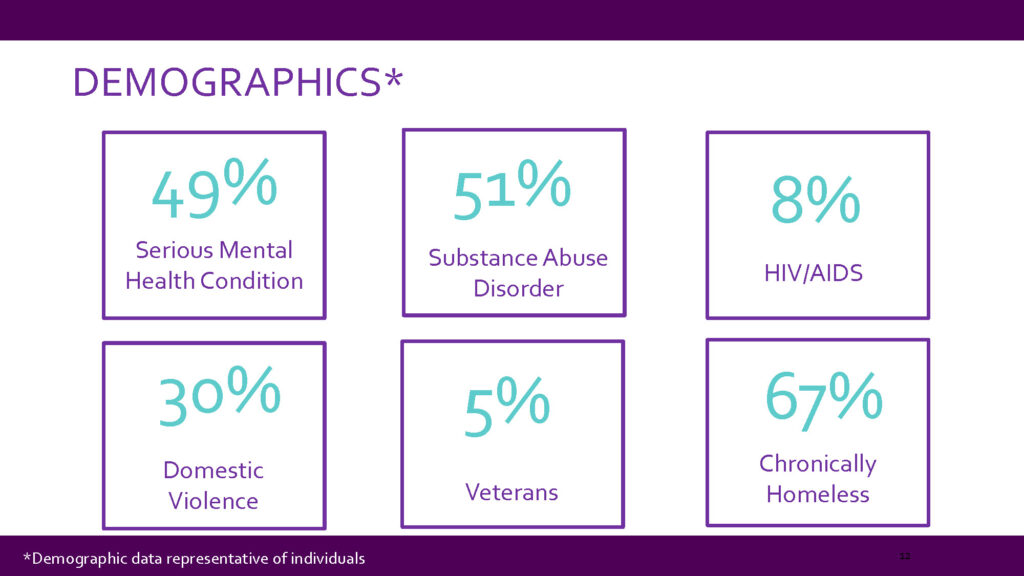
The PIT provides a one-day snapshot of homelessness in Contra Costa. It impacts funding, includes important data and demographics, and helps inform how Contra Costa Health (CCH) can most effectively provide services to people experiencing homelessness. (See Powerpoint presentation)
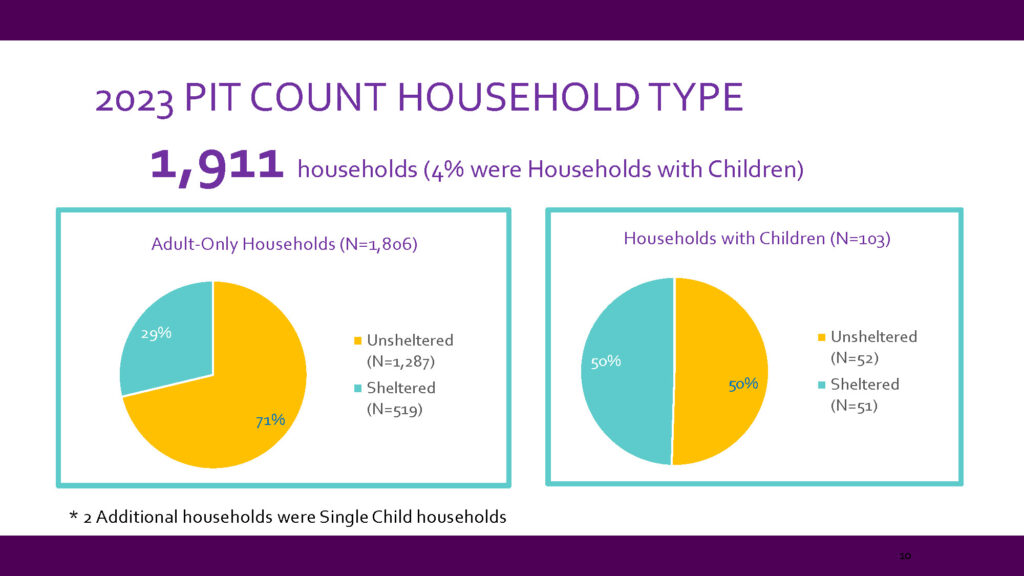
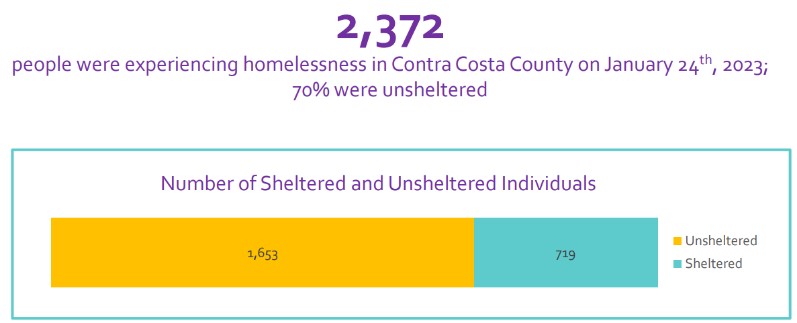
The preliminary findings show that 2,372 people were without housing during that 24-hour period, including 1,653 people who were unsheltered. That is a 4% increase from the 2020 PIT, which counted 2,277 people experiencing homelessness.
“There’s no one reason why people lose their housing,” said John Gioia, Chair of the County Board of Supervisors. “We are working hard on many fronts to create more housing opportunities with supportive services, including investing $12 million per year in a newly established Housing Trust Fund. Contra Costa County is also working with other counties statewide to reform the homeless system of care in California to link funding with accountability for outcomes.”
Since 2020, bed capacity in the county increased by over 560 beds and CCH opened Delta Landing thanks to the state’s Homekey program, which added critically needed services in East County.
“This year’s PIT count shows that homelessness rates in the county are relatively stable and similar to pre-pandemic numbers,” said H3 director Christy Saxton. “This is a testament to the services we work to provide to people who are experiencing homelessness in our communities, but there is more work to be done.”
The full PIT report, expected to be completed in June, will include additional geographic and demographic data. Visit cchealth.org/h3 for more information on homeless services and resources.

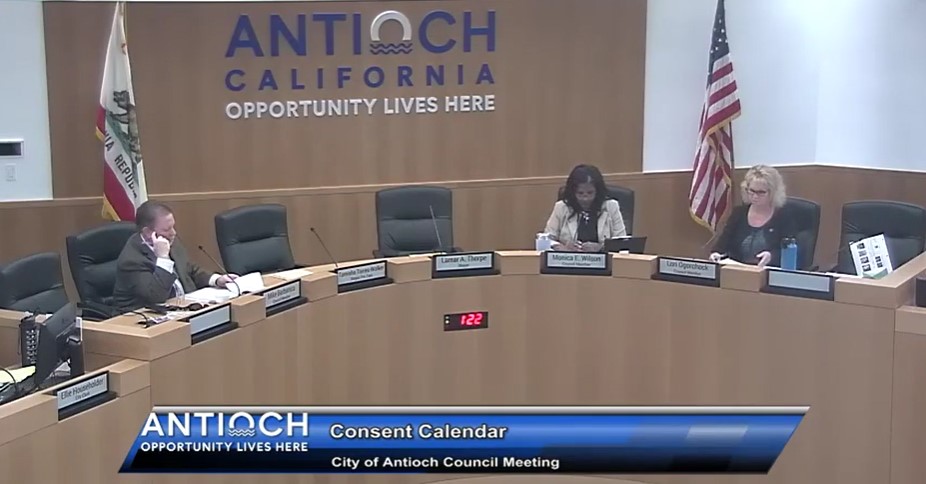
After Ogorchock switched positions in March; Thorpe hour late to meeting without explanation
By Allen D. Payton
With the final vote to revise the Antioch tobacco products sales ban ordinance on the Consent Calendar during Tuesday night’s meeting, Mayor Pro Tem Tamisha Torres-Walker was absent and Mayor Lamar Thorpe was an hour late to the meeting. That left the vote up to the other three council members, including District 4 Councilwoman Monica Wilson who opposed the changes. During the March 28th meeting District 3 Councilwoman Lori Ogorchock reversed her previous support for the entire ban, joining Torres-Walker and District 2 Councilman Mike Barbanica. The motion to adopt the revised ordinance failed on a 2-1 vote with Wilson voting against.
According to the staff report on the agenda item, Section C. of the current ordinance reads, “No tobacco retailer shall sell, offer for sale, possess with the intent to sell, offer in exchange for any form of consideration, or provide at no cost any of the following: (1) Any package of fewer than twenty little cigars; (2) Any package of fewer than six cigars; and (3) Any package of cigarettes, little cigars, or cigars at a price that is less than ten dollars per package, including applicable fees and taxes.”
Retailers had complained to the city council that they were unfairly targeted and there wasn’t a level playing field with retailers in neighboring cities. As a result, that section was removed in the revised ordinance which the council passed 3-2.
But the failure of the second reading of the ordinance leaves that section in place and any revisions to the ordinance requires the council to start the process again.
A separate effort to remove the ban on the sale or transfer to family members of tobacco retailers in the city was sent back to the Planning Commission for review and a recommendation vote. That will return to the city council for a decision at a future meeting.
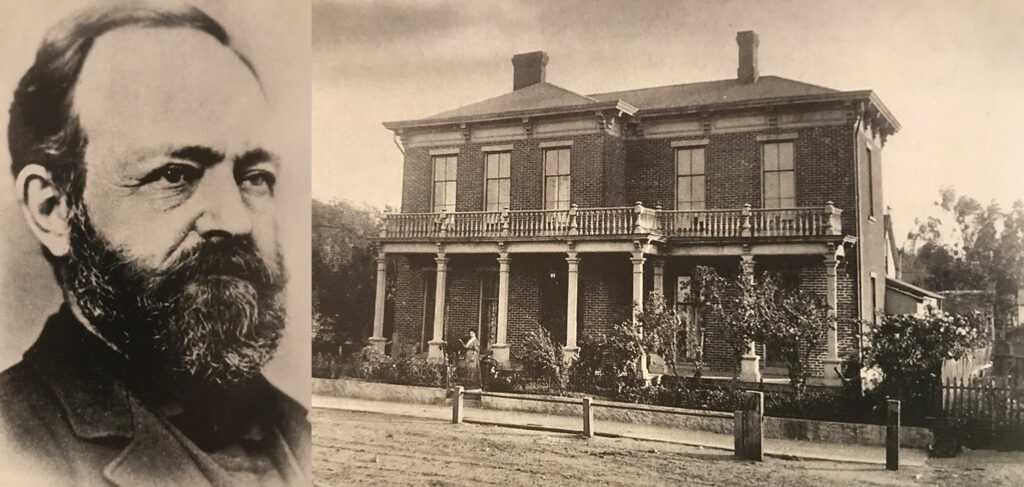
Historian says he helped start the fire in the City’s Chinatown to protect his home
By Allen D. Payton
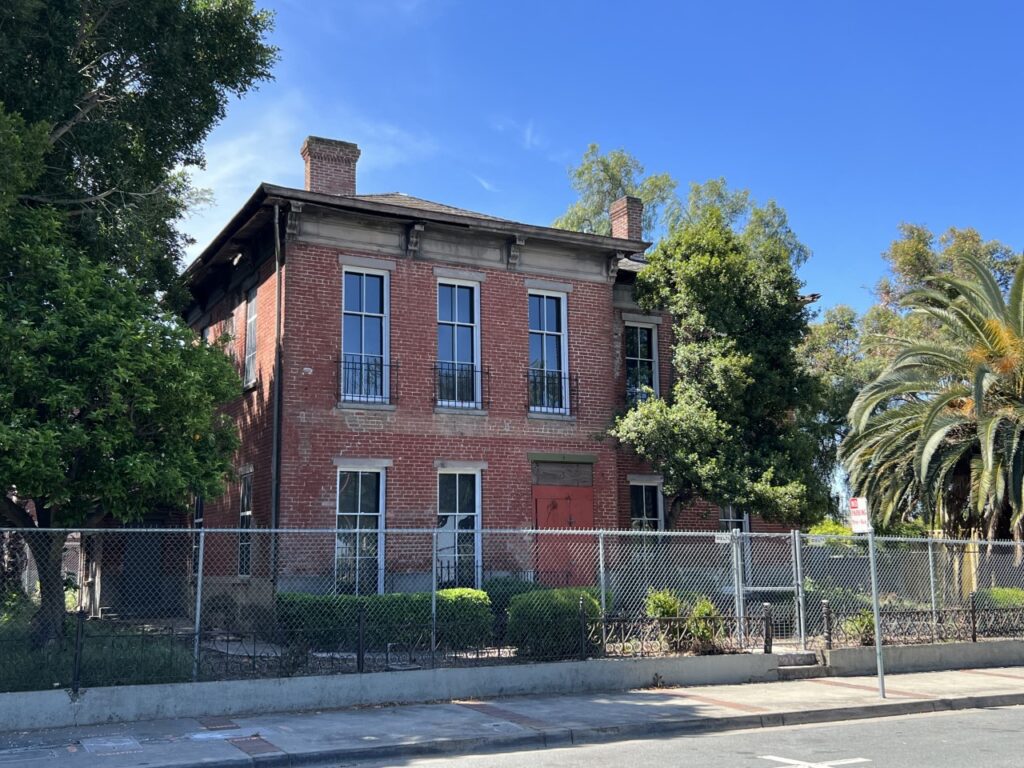
The Roswell Butler Hard House is one of the remaining historic buildings in Antioch’s downtown Rivertown, and it was built and owned by the city’s first mayor. The Hard House is a state landmark as it was the location of the first meeting of the city’s board of directors on February 6, 1872 – the date of the City’s incorporation. Hard was the first president of the board, which later became the city council, and the brass plaque from the state for the building is currently at the Antioch Historical Museum.
Located at 815 W. First Street, the building, listed on the National Register of Historic Places on September 30, 1993, was once going to be donated to a non-profit organization, Friends of the Hard House. The group planned to reinforce it to earthquake standards and completely restore the building. Other ideas were to turn it into a bistro or offices. But the City dragged its feet and the non-profit’s effort ended as the members got older and the man who was going to do the construction fell ill, and their organization lost its non-profit status from the IRS.
Then the state disbanded all redevelopment agencies in California and tried to take control of the Hard House, as money from the City’s redevelopment agency had been spent to purchase the home. But since it sits on the same lot as the Lynn House, next door, and the lot would have to be subdivided, first, the City was able to keep the Hard House.
Since then, Mayor Lamar Thorpe has proposed using it as office space for the council members, which he suggested at their meeting on Nov. 23, 2021.
Burning Chinatown to Protect Hard’s House
According to former Councilwoman Elizabeth Rimbault, a former member of the Antioch Historical Society and co-author of the history book entitled Images of America: Antioch, Mr. Hard was also the city’s first constable and is the one who instigated setting the fire in the Chinese laundry in 1876. But the fire didn’t start there, she shared. It started in the white residents’ area of W. First, Second and Third Streets and was heading toward Chinatown. Two-thirds of the city was already burned down when Hard and others started the fire in the Chinese laundry as a backfire, to keep it from reaching his house on the other side of Chinatown.
They got away with it because the Chinese residents didn’t own the land nor the buildings because by state law they couldn’t, at that time. It was owned by white residents including Hard. But the Chinese residents did own the businesses inside the buildings.
In June 2021, Thorpe and the four other council members signed a resolution they adopted the previous month, apologizing on behalf of the city’s residents for their racism against Chinese immigrants in the late 1800’s including the burning down of the city’s Chinatown. But the resolution didn’t mention the actions of Hard and others nor the reason behind it. (See related article)
Hard was so mean, Rimbault shared, that he literally chased Rev. William Wiggin Smith, one of the community’s two founders, off of his own property. Smith’s original farm was built before Hard built his house right next door and they shared a fence line. When Smith was out of town, Hard would put Smith’s wife and children out on the street trying to evict them and take over their property. Finally, Smith had enough and over a three-day period, he and his son dismantled his farmhouse and moved it on ox-pulled sleds south of the John Marsh estate and rebuilt it there. It was called the Mountain House. That’s where Mountain House Road and the community in San Joaquin County derive their name.
On a side note, after his twin brother, Joseph Horton Smith, died, William bought the point (now called Rodger’s Point where the City’s old boat ramp is located across from the former Red Caboose Restaurant on Fulton Shipyard Road) and lived there, as well.
Rimbault wanted to make sure the Hard House is recognized for its historic value to Antioch and to set the record straight on the burning of Antioch’s Chinatown. But she doesn’t want Mr. Hard recognized. “Because he was a mean son-of-a- you know what,” Rimbault added.
This is all in the book available for purchase at the Antioch Historical Society Museum entitled, The Transcription of the Diary of William Wiggin Smith, which Rimbault retyped had printed with a donation from the local Veterans of Foreign Wars Post. (See related article)
The museum is located at 1500 W. Fourth Street in Antioch and is open from 1 p.m. to 4 p.m. on Wednesdays and Saturdays. For more information visit their website at www.antiochhistoricalmuseum.org, the Facebook page or call (925) 757-1326.
Ribbon cutting for new location of Antioch’s Bonafide Sisterhood May 26
Friday, May 12th, 2023Annual count shows slight increase in homelessness in Contra Costa County
Thursday, May 11th, 2023History of Antioch’s Hard House and its owner, the city’s first constable and mayor
Thursday, May 11th, 2023















© 2026 Antioch Herald - Entries (RSS) - Comments (RSS) - Log in
Theme design by Christian Gnoth - 