Author Archive

East County Idol Auditions

Friday, December 23rd, 2011

Auditions are being held for the fourth installment of the East County Idol, sponsored by the Antioch Music Foundation. The show comes to the El Campanil Theatre February 24th at 7:30. Auditions will be held at East County Mall, Somersville Town Centre January 21st and 28th from 10 to 6.

Prizes are $400, $200 and $100. The program, emceed by radio celebrity Kim Dooley, will be rebroadcast. Auditions are open to any high school student living in Far East County. Show tickets are $10 and proceeds benefit needy students. For audition spots or ticket info call Walter Ruehlig at (925) 756-7628.

Take Back Antioch Fundraiser and Benefit Auction

Wednesday, December 21st, 2011

Please join Take Back Antioch on January 9th for a Spaghetti Feed and Benefit Auction to raise money for Lone Tree Elementary and Diablo Vista Elementary Schools.

Both these schools were recently affected by arson and vandalism. Proceeds from the fundraiser will be designated for ‘Safety and Security’ needs at both schools. All funds raised will be split 50/50 between the participating schools.

The feed will be held on January 9th from 5 PM to 8:30 PM at The Red Caboose Restaurant located at 210 Fulton Road in Antioch. Diablo Vista seating from 5-7; Lone Tree seating from 6:30-8:30. Tickets are $7 ($3/child 12 and under) and can be purchased at the door or in advance by emailing info@takebackantioch.com.

TBA is accepting donations from local business for the Benefit Auction. To donate a product or service to the auction please contact Veli Waller at tbaspaghettifeed@gmail.com. In exchange, participating businesses will be thanked at the event.

Beware – County Plans New ‘Clean Water’ Tax

Tuesday, December 20th, 2011

To the editor:

On December 6, 2011, the Board of Supervisors adopted election procedures for Prop 218, a new property-related fee which will be imposed throughout Contra Costa County. This is apparently a parcel tax disguised as a “Clean Water Fee.”

A public hearing to discuss the proposed fee has been scheduled for February 7, 2012. Written notices were allegedly mailed in mid-December 2011 to record owners of each identified parcel (or everyone who owns property in Contra Costa County). I own my home in Antioch, but, to date, have not received my notice. Have you?

At the public hearing, the Board will consider all protests against this fee. If written protests are presented by a majority of property owners, then the fee will not be imposed. Otherwise, ballots will be mailed 45 days prior to election close date of April 6, 2012. A majority vote by mail-in voters is sufficient to impose this new fee.

The election process to approve Prop 218 is a farce. It was designed to avoid detection rather than truly give the people a voice. The county has more than 1 million people. How many are property owners? Could the chambers of the Board of Supervisors accommodate all property owners? Why require written protest at a public hearing? Why the urgency and not wait for a regular election? How much more will election by mail cost? Do we really need to burden people struggling to pay their mortgage with a new tax?

Noticeably, District 3 Supervisor Mary Piepho has immediately started her campaign for approval of Prop 218 through her December 7, 2011 article appearing in Contra Costa Times titled “Delta At Risk And Needs Our Help Now.” She has also hit the campaign trail speaking before the Antioch City Council on the urgent needs of the delta without actually mentioning the Board of Supervisors’ plan to tax property owners with a “Clean Water Fee.”

Once imposed, this tax will be with you for ten years. On February 7, 2012, you have a choice; speak up (and write down your protest); or get out your checkbook.

Cynthia Ruehlig

Dozier-Libbey Wins Distinguished School Award

Monday, December 19th, 2011

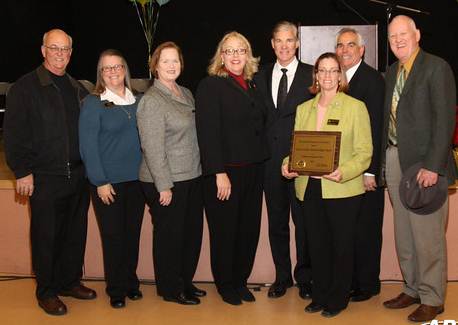
Proudly accepting a plaque of recognition as a California Distinguished School is Dozier-Libbey Medical High School Principal Nancie Castro. In attendance on December 8th at the Dozier-Libbey gym were (L-R) Antioch Board Trustees Gary Hack, Claire Smith, Diane Gibson-Gray, Joy Motts, State Superintendent of Public Instruction Tom Torlakson, Antioch Superintendent Dr. Donald Gill and Trusttee Walter Ruehlig. (Photo courtesy of ABC School Portraits)

Antioch’s Dozier-Libbey Medical High School received some early Christmas presents in the form of several awards and accolades, including being named a California Distinguished School in an award ceremony earlier this month.

The California Department of Education gives the Distinguished School award every year to schools that demonstrate academic success through high test scores among all of their students, regardless of background.

Closing the achievement gap was a particular focus of this year’s award, which is now celebrating its own silver anniversary.

California State Superintendent of Public Instruction Tom Torlakson was on hand at the packed ceremony to present the award to the medical career focused high school.

Torlakson said that Dozier-Libbey won the award because of its high Academic Performance Index, (API), scores and its career themed, “real-world” focused education which he said is the future of education in the State.

“Here at Dozier-Libbey … every student is valued, every student challenged,” said Torlakson. “This philosophy of having every student helped and creating and understanding relevance every day … is a big reason [for the award].”

The high school, which specializes in a rigorous curriculum that exceeds California public school requirements with a focus on math, science and careers in the medical field, has improved its API scores every year since it opened its doors in 2008.

This year student’s average API scores were in the mid 800s, placing them among the top high schools in the county.

Dozier-Libbey Principal Nancie Castro believes her school is one of the best around. And, like Torlakson, she sees Dozier-Libbey’s “real-world,” student-centric learning model as something that could revive the state’s ailing public education system.

“I believe in my heart that this is a model that works for all kids,” said Castro. “Getting experience for students outside the classroom, really bringing relevance to what they’re learning – it means they’ll blossom. And [the award] is validation that what we’re doing here really works.”

As if to prove Castro’s point further, Dozier-Libbey also received a California Linked Learning Certification at the ceremony for its use of up to date, career-focused education to help improve student engagement, achievement and eventual transition to college as well as an additional award for Exemplary Career Technical Education Program.

Dozier-Libbey’s small size – it will hold a maximum of 600 students by the time the school is at capacity – allowed all of its students to attend the ceremony, including the school band. The enthusiastic cheers from the bleachers seemed to prove the students were just as proud of the award as the school staff.

“It’s a really great honor,” said Nazifa Fazli, 17. “I think it encourages everyone to try even harder.”

Another student and future pediatrician, Raymond Maciel, 17, said that the awards give the students and staff a chance to show special their school is. “Dozier-Libbey, from its environment to its excellent teachers – it makes our futures one step easier to achieve,” he said.

17-year-old student Celynn Knight summed up the ceremony by simply saying, “Everyone here is a family.”

After all of the accolades perhaps that’s the one thing that really sets Dozier-Libbey apart.

Brown, Salazar Commit to Delta Plan

Monday, December 19th, 2011

California Governor Edmund G. Brown Jr. and Secretary of the Interior Ken Salazar today reaffirmed their strong mutual resolve to moving forward with the Bay Delta Conservation Plan (BDCP) and reinforced their joint commitment to effective action to achieve the dual goals of a healthy San Francisco Bay Delta ecosystem and a reliable water supply for California.

As part of today’s statement, Governor Brown and Secretary Salazar announced several actions that will ensure a fair, open and transparent process and a full opportunity for input by all interested parties in the development of a plan to address the future of California’s San Francisco Bay Delta – most significantly, revisions to the draft BDCP Memorandum of Agreement (MOA) that are responsive to the comments received by a wide range of water stakeholders in recent weeks.

“It is clear that our Delta ecosystem needs repair and restoration. We shouldn’t wait for a natural disaster to force our hand,” said Governor Brown. “This agreement takes us in the right direction to protect California’s water supply.”

“Successfully developing a science-based Bay Delta Conservation Plan holds the promise of breaking from the unsustainable status quo and being a game-changer for California,” said Secretary Salazar. “That is why the Obama administration is joining with Governor Brown and recommitting funding and technical assistance to support what could become the largest restoration project in history.”

Today’s actions come in response to public comments on the draft MOA. They reconfirm that all members of the public who have a stake in the future of the San Francisco Bay Delta will have an opportunity to participate in development of the BDCP, that the agencies’ commitment to an aggressive BDCP schedule will not trump their commitment to scientific integrity, and that the process will be transparent, with all draft documents available to all members of the public.

In response to concerns raised about a prior draft of the MOA, Secretary Salazar said: “I have personally reviewed the concerns raised about the previous draft of the MOA, and we have heard the public loud and clear. Today we are responding to these concerns by proposing changes that underscore our commitment that no special advantages have been or will be granted to any party in developing this plan for the future of the Bay Delta. I am proud to endorse this process, and I know that it will continue to benefit from the great work of my Deputy Secretary David J. Hayes and Bureau of Reclamation Commissioner Mike Connor, as well as the rest of our team working with the state and interested stakeholders on the front lines of this challenging effort.”

The comments received during the public comment period, which ended on Nov. 16, identified several opportunities to improve the MOA – chief among them a renewed agreement of all stakeholders to the dual goals of the BDCP: a healthy Bay Delta ecosystem and a reliable water supply for California. To that end, Secretary Salazar and Governor Brown released today a comprehensive response to public comments that included a revised MOA, a commitment to post all draft documents on the internet, and a commitment to work with stakeholders to develop additional agreements or a statement of principles that will guide the agencies’ work on the BDCP. These documents, including a redlined version of the MOA, are available at www.BayDeltaConservationPlan.com.

The responses reflect the commitment shared by all parties to an open, transparent, and inclusive process; the imperative that any schedule not take precedence over the application of sound science in the development of a successful BDCP; and the willingness of state and federal agencies to engage directly with all interested entities to ensure their full and complete participation in BDCP development activities.

It is important to note that the Delta Reform Act of 2009 requires the beneficiaries of the project to pay for the planning process. This follows a long-standing principle of Delta water policy – for the entities that will benefit from an improvement to pay for that improvement. California law would have to change to have Delta communities or some third party pay for this process.

The actions announced today include:

Commitment to Transparency – As announced on Nov. 29, 2011, key BDCP-related documents will be posted on the BDCP website and made available to all interested parties concurrently – enhancing transparency in developing the BDCP and providing all parties prompt access to key documents. These documents are considered preliminary drafts and are being made available prior to the release of the formal public review drafts of the BDCP and the Environmental Impact Report/Environmental Impact Statement (EIR/EIS).

A list of key BDCP-related draft documents to be released and expected release dates have been posted on the BDCP website at www.BayDeltaConservationPlan.com. The formal public review and comment process for the drafts of the BDCP and EIR/EIS is expected to commence in the spring of 2012.

Commitments to Other Stakeholders – To confirm and elevate their commitment to provide full access to all stakeholders, the state and federal agencies will extend the opportunity to develop and enter into appropriate agreements or statements of principles regarding development of the BDCP with other interested stakeholders – such as local governments, special districts, and non-governmental organizations (NGOs).

Specific Modifications to the MOA – State and federal agencies have proposed to the other parties to the MOA several modifications to the MOA in response to key concerns raised during the comment period. Proposed edits are shown on the redline/strikeout version of the MOA posted on the BDCP website.

Prioritizing Sound Science – State and federal agencies will conduct a monthly review of the BDCP schedule to evaluate any changed circumstances that may affect the schedule. The agencies will then publicly disclose any adjustments to the schedule that are made on an ongoing basis and the reasons for such adjustments. The aggressive schedules in the MOA will not trump the obligation to develop and evaluate the BDCP using the sound and credible scientific information.

Policy-level Engagement – Policy-level representatives from state and federal agencies will further build on their engagement in direct dialogue with a number of stakeholder groups to allow the policy-level representatives to gain a better understanding of the key issues to be addressed further during development of the BDCP.

511 Traffic Info Updates Website

Monday, December 19th, 2011

Navigating Bay Area Traffic Just Got Easier

The award-winning 511 traveler information system is offering new functionality to the Bay Area traveling public through a significant update and overhaul of the 511 Traffic page.

The new 511 Traffic page, now being launched in beta at trafficbeta.511.org, provides information to help commuters avoid traffic jams and incidents, and suggests alternate routes to keep travelers moving and reduce congestion in the Bay Area.

Visitors to the 511 Traffic page at traffic.511.org will see a banner at the top of the page inviting them to go to the beta version. The new page features real-time and predicted traffic information and driving times, an enhanced map with improved navigation and easier access to information, and personalization, such as saved recent trips and map preferences.

511 Traffic excels at providing highly accurate, real-time and predicted traffic information for the Bay Area.

“We made major enhancements to our traffic map and information tools based on input from 511 users,” says Shauna Callow, 511 Website Coordinator and Project Manager. “We’re excited to offer a beta version of the new 511 Traffic page now so users can help us confirm the page is working as designed.” The full launch of the new 511 Traffic page is expected spring 2012.

The enhanced traffic map shows travelers real-time traffic congestion, incidents, and construction projects on freeways and highways, at a glance.

Users can also use map tools to view predicted traffic congestion (based on historical averages) when planning a future trip – especially one that requires arriving on-time, like a trip to the airport. 511 operators update incident and construction information 24/7 so that 511 users can access information specific to their trip, whenever they need it.

“The 511 Traffic page is the only resource of its kind built and continually customized for the Bay Area,” says Callow. “So much of the work that we do is related to collecting and verifying traffic data, so it’s exciting to release these website improvements that enable travelers to quickly access this powerful data via a fresh, streamlined design.”

The 511 Driving TimesSM feature delivers personalized point-to-point driving times, including speeds and incidents along a route, and is now better integrated into the traffic map. Travelers can find out how long a trip will take to the minute, given current traffic conditions.

Users can check a typical driving time compared to the current time to know whether conditions are better or worse than usual. When available, alternate routes are provided to allow travelers to choose a different path and avoid congested areas.

511 users can also calculate driving times for a specific future day and time. For example, when making weekend getaway plans, users can enter their trip and select “Fridays” as the day type to view predicted driving times for Friday travel.

With cookies enabled, 511 Traffic will personalize the user experience so that each time users return, their maps preferences and trips are immediately available to them. The Recent Trips feature will save up to three of a user’s most recent trips for quick access to current driving times, incidents, and speeds along the route.

As always, the 511 Traffic page consistently provides the most accurate, latest-breaking traffic news and emergency information affecting drivers. When urgent news breaks or emergencies occur, 511 Traffic displays a ticker at the top of the page to make sure motorists stay informed about major traffic impacts in the region and their commute alternatives.

511 is a one-stop phone and web source for up-to-the-minute Bay Area traffic, transit, rideshare and bicycling information. It’s free of charge and available 24 hours a day, 7 days a week from anywhere in the nine-county Bay Area.

Call 511 or visit 511.org. 511 is managed by a partnership of public agencies led by the Metropolitan Transportation Commission, the California Highway Patrol, and the California Department of Transportation.

Santa Visits Antioch Historical Museum

Monday, December 19th, 2011

KAISER HONORED BY QUALITY MEASUREMENT GROUP

Monday, December 19th, 2011

Ten Kaiser Permanente Northern California hospitals, including the one in Antioch, have been named 2011 Leapfrog Top Hospitals, an honor that rewards medical centers for outstanding success in such areas as using electronic health records to reduce medication and other errors, lowering infection rates, maintaining appropriate physician and nursing staffing, and other measures of safety and efficiency.

“It is an honor to see our Antioch and Walnut Creek hospitals receive this designation,” said Ginger Campbell, senior vice president and area manager for Kaiser Permanente’s Diablo Area. “This reinforces our commitment to quality and reflects the personalized and consistent level of dedicated care we provide to our patients.”

Over the past three years, 13 Kaiser Permanente facilities in Northern California have been named Top Leapfrog Hospitals.

“Kaiser Permanente is consistently recognized by several independent third-party organizations for providing high-quality health care, and this latest honor from Leapfrog is further testament that our physicians, nurses and staff members are consistently delivering personalized, coordinated and technologically advanced care that is improving the health and well-being of our patients and the communities we serve,” said Gregory A. Adams, president of Kaiser Foundation Health Plan/Hospitals, Inc. in Northern California.

Kaiser Permanente Northern California’s Top Hospitals in 2011 are Antioch, Oakland, Richmond, Roseville, San Francisco, San Jose, South Sacramento, South San Francisco, Walnut Creek and Vacaville.

Eight Kaiser Permanente hospitals in Southern California also received the honor, which means that 18 of this year’s 65 Top Hospitals in the U.S. are Kaiser Permanente facilities in California. They were chosen from a field of nearly 1,200 hospitals around the country surveyed this year.

The 18 honored Kaiser Permanente hospitals were all in the “urban” category, and comprised more than a third of the 52 top urban hospitals listed nationally. The other categories surveyed were children’s hospitals (10 honored nationally) and rural hospitals (three nationally).

“The physicians, nurses and staff of Kaiser Permanente consistently deliver outstanding quality care and service that is personalized, technologically advanced and closely coordinated across all disciplines—primary care, specialty care, outpatient care and inpatient care,” said Robert Pearl, MD, executive director and CEO of The Permanente Medical Group.

“Our excellent ratings from Leapfrog and other third-party organizations reflect the excellence and superiority of our integrated model for medical care, which enables our medical group, hospitals and health plan to work together on behalf of our patients to achieve the highest quality outcomes.”

The Leapfrog Group is a coalition of public and private purchasers of employee health coverage founded a decade ago to work for improvements in health care safety, quality and affordability. Initially organized by the Business Roundtable, it is now an independent advocacy group working with a broad range of partners, including hospitals and insurers. The annual survey is the only voluntary effort of its kind.

The 2011 list includes university and other teaching hospitals, children’s hospitals and community hospitals in rural, suburban and urban settings. The selection is based on the results of the Leapfrog Group’s national survey that measures hospitals’ performance in crucial areas of patient safety and quality. The questions Leapfrog asks on its survey are consistent with measures used by The Joint Commission, National Quality Forum and Centers of Medicare and Medicaid Services.

The results of the survey are posted on a website open to the patients and families, the public and employers and other purchasers of health care. It is the most complete picture available of a hospital’s quality and safety. The website is www.leapfroggroup.org.

About Kaiser Permanente
Kaiser Permanente is committed to helping shape the future of health care. We are recognized as one of America’s leading health care providers and not-for-profit health plans. Founded in 1945, our mission is to provide high-quality, affordable health care services and to improve the health of our members and the communities we serve. We currently serve 8.9 million members in nine states and the District of Columbia. Care for members and patients is focused on their total health and guided by their personal physicians, specialists and team of caregivers. Our expert and caring medical teams are empowered and supported by industry-leading technology advances and tools for health promotion, disease prevention, state-of-the art care delivery and world-class chronic disease management. Kaiser Permanente is dedicated to care innovations, clinical research, health education and the support of community health. For more information go to www.kp.org/newscenter.