







Archive for the ‘News’ Category

Republican Dave Miller to challenge Jim Frazier for State Assembly

Saturday, August 8th, 2015
Dave Miller

Dave Miller

Fairfield, CA – Former Solano County Republican 2nd Vice Chairman Dave Miller, announced, Friday, that he will be running for the position of State Assemblyman to represent the 11th District to replace incumbent Jim Frazier (D – Oakley). Miller has a good knowledge of the district, having lived in Discovery Bay as well as Fairfield for the last five years. His wife, Amy is Director of Advanced Practice Services at NorthBay Hospital in Fairfield.

Miller retired from a 28-year career in social services finance and fraud investigation. In addition to working in New York political circles, Dave was active on the campaigns of former Governor and 2016 presidential candidate George Pataki, for the 12 years he was Governor of New York State.

Since moving to California in 2011, he has started, with the help of his associates, a nationwide premier political consulting and strategy firm, with clients in California, Wisconsin, Tennessee, New York and Nevada. He also served as California Field Coordinator to Governor Jon Huntsman’s 2012 presidential campaign and Chief of Staff to USAF Col. Rick Tubbs’ congressional campaign in Contra Costa and Solano Counties.

“We are 465 days out, and 465 days from releasing ourselves from the tax and spend policies of Jim Frazier and his associates in Sacramento,” Miller said. “The policies Jim Frazier believes in, like introducing a constitutional amendment to raise property taxes on both homeowners and businesses, overriding Proposition 13, a ballot initiative overwhelmingly passed by California voters, signifies that the time for super majorities in Sacramento must end, and it’s time to return a more compassionate and conservative form of government to the people.”

“Speaking of ballot initiatives, in less than three years in office, Jim Frazier has voted to increase the fees to file such ballot initiatives from a simple $200 and to a staggering $8,000,” he added. “That’s a 3,900% increase, and a sure fire way to limit, if not freeze altogether, public debate and comment on issues pertinent to all Californians.”

“It recently learned that the I-10 bridge on the California/Arizona border had collapsed,” Miller stated. “You’re probably wondering: how does a bridge collapse hundreds of miles away have anything to do with the 11th Assembly District? Because Jim Frazier is Chairman of the Assembly Transportation and Infrastructure Committee. It’s his job to provide legislative oversight of Cal Trans. Last year, Cal Trans inspected the same bridge mentioned earlier, and according to the report, they gave it a 95% safety score.”

“Looking deeper, in the 800+ page report, I discovered there are nearly 400 bridges and overpasses in the 11th Assembly District alone, that had worse safety scores than the I-10 bridge which collapsed,” Miller continued. “Mr. Frazier cited ‘deferred maintenance’ as the cause for the bridge collapse, but if it scored 95% on its last safety inspection, one year ago, and Cal Trans stated in its report, it required no maintenance at all, how could you now claim it required ‘deferred maintenance’?”

“Just knowing that Assemblyman Frazier seems to have forgotten how important bridges and overpasses are key to our very way of life here in the Bay Area, (and all across California) is of great concern to me, not only as a Candidate, but as a Taxpayer as well,” he added. “It’s just proof that he and his Democratic associates in Sacramento are completely happy with the status quo.”

Miller offered his campaign platform

“If elected I will push for big bold reforms in Sacramento that effect you every day. I will:

•Cut my own personal salary and give that back money to hard working high school graduates in our district who excel in Math and Science. My only caveat: that they seek work upon graduation in the State of California I want to help your kids be successful – in California, and keep them here for generations to come. I will dole it out in the form of a scholarship program, to help offset college costs.

•I will propose the first Electronic Legislature in the nation. Should drastically help California see relief in legislature costs, such as per diems, staff payroll, and greatly cripple the influence of special interests prior to a crucial vote.

•Propose the California Sacred Trust Act. This amendment would greatly restore public confidence in how government operates in the future. Let’s remember we are one of the largest states in the “United States of America,” not the “Divided States of America” let’s set the standard.

•Propose sweeping massive regulatory reform, including tangible prison reforms.

•Get serious about our Water Crisis, but not with the current proposals being thrown around today, but with Desalination Plants up and down the coast, with the water storage to protect it.

•Opposition to High Speed Rail. I’ve seen firsthand, grandiose, wide-eyed, government-funded transportation projects that looked great on paper, but crash and burn inside two years’ time. See Rochester Business Journal.com and search “Flawed Business Plan sank Fast Ferry.”

•Improving the Business Climate in California. We were once the world’s 5th largest economy, we’ve dropped to 12th. It all goes back to the Regulations this Government feels the need to lump on your everyday life. The good news is: “we can’t get any worse!” We are 50th in the Nation in Economic Growth, and states to succeed in business.

•Propose a Guest Worker ID program. If it can be done in Kuwait, a country of 8 million people, which has 20 million Saudis working in their nation’s oil fields, it can be done here in California. Use an E-Verify system to sort out the law-abiding illegal immigrants from the ones who feel the need to survive by committing violent crimes, who harm or kill American citizens. Give these law abiding illegals the opportunity for citizenship.

•Phased in Voter ID Program. Program phased in over four-year period. As a social service provider, I’ve seen what not having a photo ID can do for a person, it can keep them from doing simple things we take for granted like cashing a check or getting documents notarized. If, after four years, you haven’t applied, you must get a DMV license to conduct business.

•Study the possibility of a Trimester School System, and its effects on hard working families.

•Implement a two year vehicle registration cycle on all vehicles registered at DMV. Study the effects of how that impacts the work flow at the agency.”

“With the advent of an electronic legislature on the horizon, I, along with all my colleagues, can be in their Assembly and Senate District offices and more responsive to the needs of its citizens more,” Miller said. “As a former social services provider, who used to see as many as 200 clients a day, that is what I look most forward too – working with my constituency, as should every elected official.”

“These are just some of the sweeping changes I plan to make when elected to become your next Assemblyman. I know I can do a better job, because I have nearly 28 years of government service backing me up. I look forward to meeting as many folks as I can in the months ahead, as well as re-engaging with some old friends from East Bay,” he added. “And folks…..that’s how I roll.”

The 11th Assembly District includes Antioch. Frazier was first elected to the position in 2012.
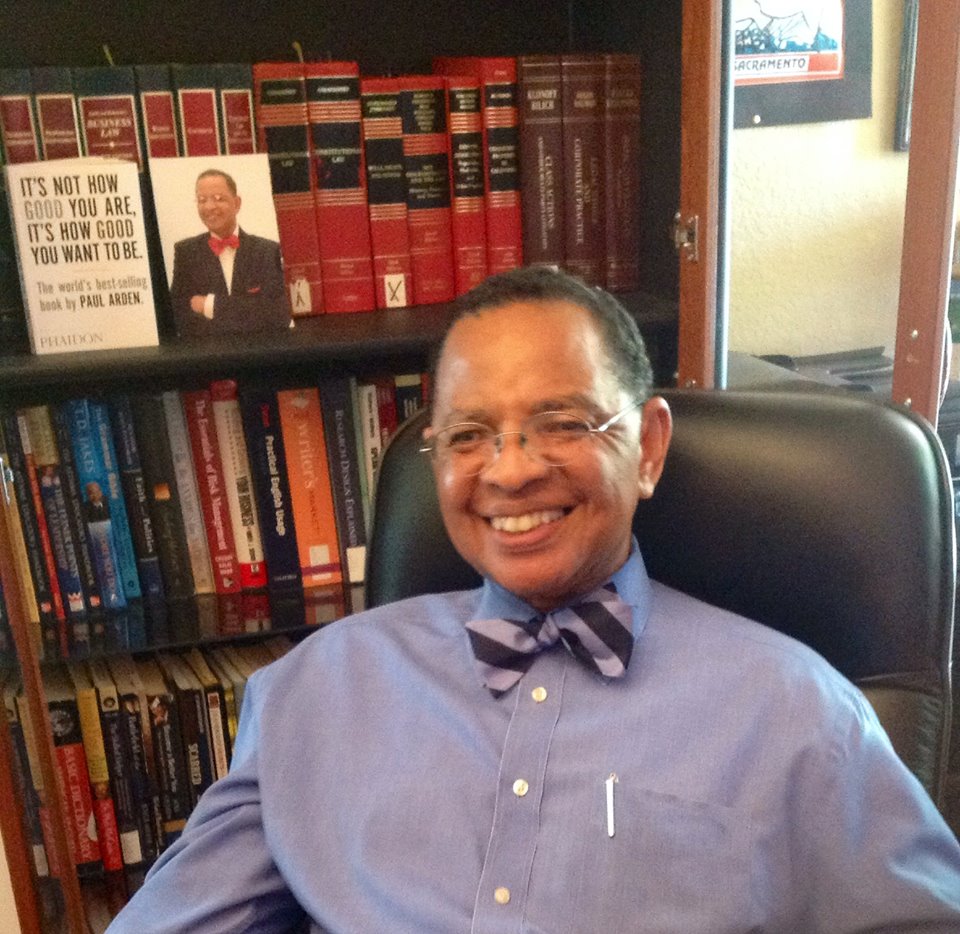
District Attorney files misdemeanor charge against county school board trustee Jeff Belle for lying on ballot statement

Thursday, August 6th, 2015
Jeff Belle

Jeff Belle

By Allen Payton

Following an investigation, Contra Costa District Attorney Mark A. Peterson announced today, Wednesday, August 5, 2015 the filing of a single misdemeanor charge alleging a violation of section 18351 of the California Elections Code against Jeffery J. Belle, Area 5 Trustee for the Contra Costa County Board of Education. Belle DA Complaint 08-05-15

According to a press release from Peterson, “It is alleged that Jeffrey [sic] Belle, a candidate in an election, knowingly made a false statement of a material fact in a candidate’s statement with the intent to mislead the voters in connection with his campaign for election to a nonpartisan office.”

Belle was elected last November, defeating incumbent County School Board Trustee Cynthia Ruehlig.

“Voters are entitled to know the truth about their candidates when they are voting.” Peterson said, “The democratic process is fundamental to our system of government. The integrity of our elections is fundamental to that process and must be protected.”

Section 18351 of the Elections Code reads “Any candidate in an election or incumbent in a recall election who knowingly makes a false statement of a material fact in a candidate’s statement, prepared pursuant to Section 11327 or 13307, with the intent to mislead the voters in connection with his or her campaign for nomination or election to a nonpartisan office is punishable by a fine not to exceed one thousand dollars ($1,000).”

On his ballot statement Belle stated he had a “Bachelor’s degree in Political Science.” Ruehlig & Belle candidate statements

However, in an October article by Herald staff, “according to The Office of the Registrar at Oklahoma City University, although Belle did attend the school, and did study political science, he did not receive a degree from them.”

In an interview with this writer, on October 27, 2014 Belle admitted that he did not have a degree because he still had to pay some fees to the school. He explained that Oklahoma City University works with American University in a program called the Washington Semester, the hours from which applied to his degree.

“I still owe American University for room and board for that semester of almost $3,000,” Belle claimed. “However, in 1989 I walked in the graduation, and they acknowledge it, but they won’t confer the degree, until then.”

“I don’t have to take any more courses,” he added. “That’s why I’m able to take the Master’s degree program in Public Administration, with an emphasis in Health Policy and Public Policy, from the American Public University System.”

However, his explanation about the fees has proven to be false, as well. Earlier this year, his now-estranged wife, Carmen stated the fees had been withheld from her tax return, yet Jeff still didn’t have his degree. He was working toward a Master’s degree, last year, but Belle had to discontinue that since he did not yet have his Bachelor’s degree, which is required in order to obtain a Master’s degree.

Belle’s false claim of a college degree on his candidate’s statement and false explanation appear to be part of a pattern.

The October Herald article further stated:

“Belle has also come under fire for making false claims regarding his education. For example, at one time he claimed to have obtained a Ph.D. from Harrington University, in London. The ‘school’ is well-documented as a diploma mill, where, according to some reports, degrees could be obtained for as little as $1400, and have even been handed out to pet dogs and cats. During his October 22 [2014] press conference, however, Belle admitted he did not have a Ph.D.

Belle has repeatedly given conflicting statements regarding his education. On his application to serve as Antioch’s representative to the Contra Costa Transportation Authority – Citizen’s Advisory Committee (CCTA-CAC), received by the Antioch City Clerk’s office on July 30, 2013, Belle states that he is scheduled to complete a Masters in Public Administration (MPA) in 2014 from Grand Canyon University. On his Linked-in profile, though, he states that he received his MPA from American Public University System in 2014. At the media event he held on October 22, Belle admitted he has no Master’s Degree.

Also on the CCTA-CAC application, Belle states that he has a BS in Political Science from Oklahoma City University / American Public University.

A different statement appears on his linked-in profile, where he says that he obtained that degree from Oklahoma City University in 1988. At the media event he held on October 22, Belle was repeatedly asked by CBS Channel 5 television reporter Da Lin whether or not he had a Bachelor’s degree at all. Belle, at one point, mentioned having obtained a Bachelor’s degree from ‘Biosystems Institute,’ but then quickly backpedaled, and refused to address the question further.”

His LinkedIn profile now states next to Education, “American Public University System.”

More recently, Belle continued his pattern of making false statements with regards to his residency.

When asked where he now lives, in response to both a Facebook post by Carmen, that she and her daughter now live in Sacramento, after he and they were evicted from their rented Antioch home in April, as well as rumors Belle was no longer living in his district, he said he now lives in Brentwood. Carmen said Jeff had told her that he lives in Pittsburg. Yet, the information Belle provided to the County Office of Education was an address for a mailbox inside a mailing business in Antioch.

After emails and a phone call, last month, informing staff for the County Office of Education about the location of Belle’s address that they had on file, the following week, Katie Gaines, Assistant Superintendent, Human Resources provided a new address as reported to her by Belle. That address has been confirmed to be a residence in Antioch, within the district. But, it has not yet been confirmed if he actually lives there.

Belle represents parts of Antioch, Pittsburg, Bay Point and Brentwood, and all of Oakley, Bethel Island, Knightsen and Clyde on the board.

According to the District Attorney’s press release, the maximum penalty for a violation of California Elections Code section 18351 is $1,000.

Check back for more details as this story further unfolds.

Antioch resident files complaint with DA over City’s use of water and sewer funds for police

Tuesday, August 4th, 2015

By Allen Payton

Today, Tuesday, August 4, 2015, Antioch resident and real estate broker, Mark Jordan filed an official complaint with the Contra Costa District Attorney’s office against Antioch’s mayor and council members for their approval of the city’s use of water and sewer funds for police.

This is a continuation and escalation of his effort to end the practice, in response to a Antioch Herald column on the issue posted to the newspaper’s website in June, which can be viewed here.

After placing the council on notice and threatening to file a complaint with Antioch Police Chief Allan Cantando at the most recent City Council meeting on July 28, 2015, Jordan attempted to do so. However, in an email exchange between the two, including Cantando asking Jordan to cite the the specific Penal Code that the Council was violating, the Chief wrote “We have been in discussion with the Contra Costa County District Attorney’s Office, Government Corruption Unit regarding your complaint. They have advised that your best course of action would be to contact them directly via their ;Complaint Form’ available at the link below.”

Jordan has pursued that course of action.

His felony complaint, which can be viewed here, (Jordan Complaint.City of Antioch to DA), states “All Citizens of the City of Antioch” are victims, gives the type of violation as “Illegal transfer of public Funds, et all” [sic] and the nature of complaint as “Violation of Oath of Office, Violation of State of California Constitution,” specifically Propositions 13, 26 and 218. Jordan claims there is no connection between the collection of sewer and water funds paid for by Antioch ratepayers and spending them on police.

“I claim that the illegal transfers from the Antioch Water and Sewer Funds are a taking from the public without basis in law, legal nexus or legal justification and that this taking of public funds is public malfeasance and grand theft pursuant to Penal Code 487, a felony,” the complaint states. “A legal nexus is required by law and none exists.”

Jordan further claims that the transfer from the sewer and water funds to the police department budget amounts to a tax without a vote of the people.

“Also; that this transfer is a creation of windfall for the General Fund and is nothing short of a specific tax without voter approval as required by the State Constitution.”

He cites two lawsuits, one each against the City of San Juan Capistrano and the other against the City of Redding, California to support his argument.

The next step is for the District Attorney’s office to decide whether or not to deliver Jordan’s complaint to the county Grand Jury.

Antioch Council gets earful from residents, city workers, votes to not spend $800,000 in State funds

Tuesday, August 4th, 2015

By Alia Bickham

The room was buzzing with conversation prior to the call to order at the July 28th City Council meeting and the Council got an earful from residents and city workers. This certain meeting was dedicated to the late Council Member Gary Agopian, and his widow, Robin Agopian was appreciative of the full room as her husband was “passionate for negotiations” and always looking out for the needs of the people.

Mayor Wade Harper remembered Agopian saying he “…led by example.”

Council Member Mary Rocha stated, “he won’t be forgotten.”

Community event announcements included: Sizzling Summer Night Fundraiser at Antioch Senior Center August 14, the Clean Energy Meeting at the Nick Rodriguez Community Center on August 15, and the Second Annual Gary Agopian Boat Race October 17 and 18.

Public Comments get heated

During public comments, Antioch Realtor and resident Mark Jordan expressed concern with what he called the illegal actions of the Council regarding transfers from the water and sewer funds for police and tiered water rates. He asked the Council to take a hard look at restructuring the tiered system.

“I will file a complaint with the Chief of Police,” for taxing citizens illegally for water, Jordan stated.

Similarly, Wayne Steffen expressed the way water usage is calculated is flawed.

“It is impossible to reduce by 28%” he said. “If the billing periods are fluctuating the billing is based on number of units per billing periods and not gallons per day. Stephen suggested council uses gallons per day to calculate water usage and tiered rates.

City Workers Complain to Council

Antioch city workers who are members of Local One, spoke during public comments, as well. They were concerned about high health care service costs and the lack of recognition by the Council, and the lack of a contract.

Joe Carrera, a 25 year city employee wore his “Proud to be Local One” shirt, as did many others. He spoke of equality.

“It makes no sense for the people who make the most money have the best health benefits,” he stated. “Those who are hard workers have to pay more for health benefits. We assist the city in times of need. We the employees endured the pay cut. Some cities gave the furlowed employees a thank you check. The city needs to realize the key to maintain a good work force….you need to retain the employees. This is the city’s chance to get it right and make it right for everyone….if the money is there I just want to know why.”

Wayne Burgess spoke about the parks, and said they’re a safe, inviting places for families.

“I’m generally proud of my city,” he stated. Then he mentioned the tough circumstances in 2009 and cuts included seven full-time and two part-time workers.

“Most of us remain content…knowing the economy will eventually turn around,” Burgess shared. “You voted in January to put us back to full time. Thank you.”

Then he mentioned cut backs and work increases.

“Not only has the city’s bargaining team not come through, but it is not interested in COLA increases or medical benefits. No discussion,”he said, then added that there needs to be shared sacrifice.

Todd Northem, President of Local One spoke about his 15 years in street maintenance.

He spoke of potholes and signage.

“We are there when the emergencies happen,” Northem shared. “Working in traffic is one of the most dangerous jobs. We have no labor contract. 2009 furlows we are all in it together at stake was our community “a bankrupt city means” everyone loses.

“The workers of Antioch kept this city afloat,” he stated.

Manuel Hicks has been working for the city for over 21 years.

“The standard of living should be the same for everyone,” he stated. “We sacrifice for the city. It’s a thankless job. Everybody should get medical the same.”

Johnathan Cordaway said “I was raised here…an Antioch High School grad. Times have been tough. Sacrifice is part of survival. We’re doing all we could to help this city survive.”

“Why doesn’t the City of Antioch not appreciate workers?” he asked.

Mike Davis, also a member of Local One, said “Tonight is about relationships. Local One has sacrificed for six years so that the city could keep its lights on. The city is back on it’s feet….but the employees are much worse off. You heard tonight from your residents, why are you treating us this way?”

He spoke of the city’s two budget reserves of 15% and 23%.

“About four million dollars the city hoards,” Davis stated. “For this year $19 million for equal access to health care. Four to five percent of available funds is what we are asking for. We need your direct staff to show us you value the relationship between your citizens and employees.”

Willie Mims, representing the East County Branch of the NAACP, complained about pay and affordable living.

“I came today to let you know I’m still around, I haven’t gone anywhere.”

He asked the council to introduce body cameras for the police, as it “serves two functions. It protects good police and [exposes] verify bad officers.”

eBART Update

BART Director Joel Keller walked the Council through the planned eBART project, to Antioch. The benefits BART brings to the community include the increase of home, renting values as well as the ever important decrease to commute time, Keller shared.

“BART will be a great addition to the city,” he stated. “Better BART means a better Bay Area.”

The extension to Hillcrest Avenue in Antioch is projected to be completed by May, 2018.

The new pedestrian bridge is “a landmark saying BART is coming to Antioch,” Keller added.

Mayor Pro Tem Lori Ogorchock asked if BART would provide the police officers for the station.

Keller said BART will work with the Antioch Police Department to structure a response plan and an adequate security plan.

Highway 4 Update

Randy Iwasaki, Executive Director of the Contra Costa Transportation Authority (CCTA) provided an update on State Route 4 widening projec. Highway 4 is two-thirds of the way done with the overall widening, he shared.

The CCTA is working with BART to get it into the Highway 4 median faster. Iwasaki also said improvements to the State Route 160/4 Connector Ramps are expected to be completed in early 2016.

Future planning will rely on 65% local dollars, 22% State and 13% in Federal funds.

“A strong economy is the key to transportation funding,” he added.

General Plan Update

The Council then heard from consultant Dick Loweke on the General Plan for Land Use Element and Zoning Ordinance update- updating the Land Use Element and Zoning Ordinance and the 19 Focus Areas.

Harper asked about an employment area. “I like the sound of that,” he said. “What does that mean?”

Loweke responded, “Look at policies that will encourage that to happen so it’s efficiently set up to fit in the market place.

The Council then approved the authorization to execute contracts with three potential additional planning consultants, Dudek, Rincon, and M-Group each amounting less than $100,000 for a term of 3 years.

“Pay as you go?” asked Ogorchock. “Yes,” was staff’s reply.

City Gets Unexpected State Funds

City staff asked the council to provide direction on the use of prior unfunded State mandates received by the city and adopt a resolution amending the fiscal 2014-2015 budget amount of $793,767 in “one time monies” from the state, as City Finance Director Dawn Merchant referred to the funds. She suggested possibilities for the funds, including applying some to the police supplementary retirement plan, a build up to the General Fund reserves or use some or all funds for a capital fund project.

Ogorchock wanted to pay down the city’s unfunded liability. Harper supported that but proposed using the funds about solar programs for energy savings.

“If we could outfit community buildings with solar there would be an ongoing savings for the community,” he said.

Ogorchock made a motion to put the money in the General Fund and not spend it. Rocha seconded the motion and it passed, unanimously on a 4-0 vote, because Council Member Monica Wilson absent during the meeting.

New park playground equipment

The Council award a contract of $127,681 for playground equipment for Contra Loma Park. First 5 has been active in ranking our parks. This is the number one priority park by them. From last year, the funds are there. The installation will be completed in 16-20 weeks, but possibly even less in an 8-10 week timeframe. However, improvements such as cameras and lighting are not included in the contract.

“We believe it’s time to take… our parks back,” said resident Debra Polk. “We need lighting, surveillance, and the basketball court to make a major change in the lives of families.”

“It is on our radar,” Harper responded. “Thank you for being our partner on this. This is a good start.”

Road Improvements

The council voted to approve road improvements in downtown.

They amended the 2014-2015 Capital Improvement Budget to increase Gas Tax funding for the Downtown Roadway Pavement Rehabilitation project in the amount of $50,000 and increase the existing contract with MCK Services, Inc. for $73,389.50 totaling $684,514.50

The council also authorized the expenditure of a alittle more than $77,000 for the completion on additional road work.

“They [residents] really appreciate all the work going on,” said Harper.

Rocha encouraged the continuation of beautifying the community.

“Hopefully these streets will last us ten to twenty years,” said Public Works Director/City Engineer Ron Bernal.

The council also approved improvements to Ninth Street, increasing the existing contract with MCK Services, Inc. in the amount of $135,902.82 and also authorized a final payment of $98,236.24.

“From A to H Street this completes that entire road way,” said Bernal. “This project had additional costs such as additional concrete and excavation, water main leakage repair which estimated an amount of $135,000.

The extra costs and investment are “part of a trust factor with the council,” he added.

The next meeting of the Antioch City Council will be on Tuesday, August 11, 2015 at 7:00 p.m. in the Council Chambers on Second Street in downtown. Meetings can also be viewed on Comcast TV Channel 24 or via livestream on the city’s website at www.ci.antioch.ca.us.

Charter high school in Pittsburg, serving Antioch, county students adds arts education

Tuesday, July 14th, 2015
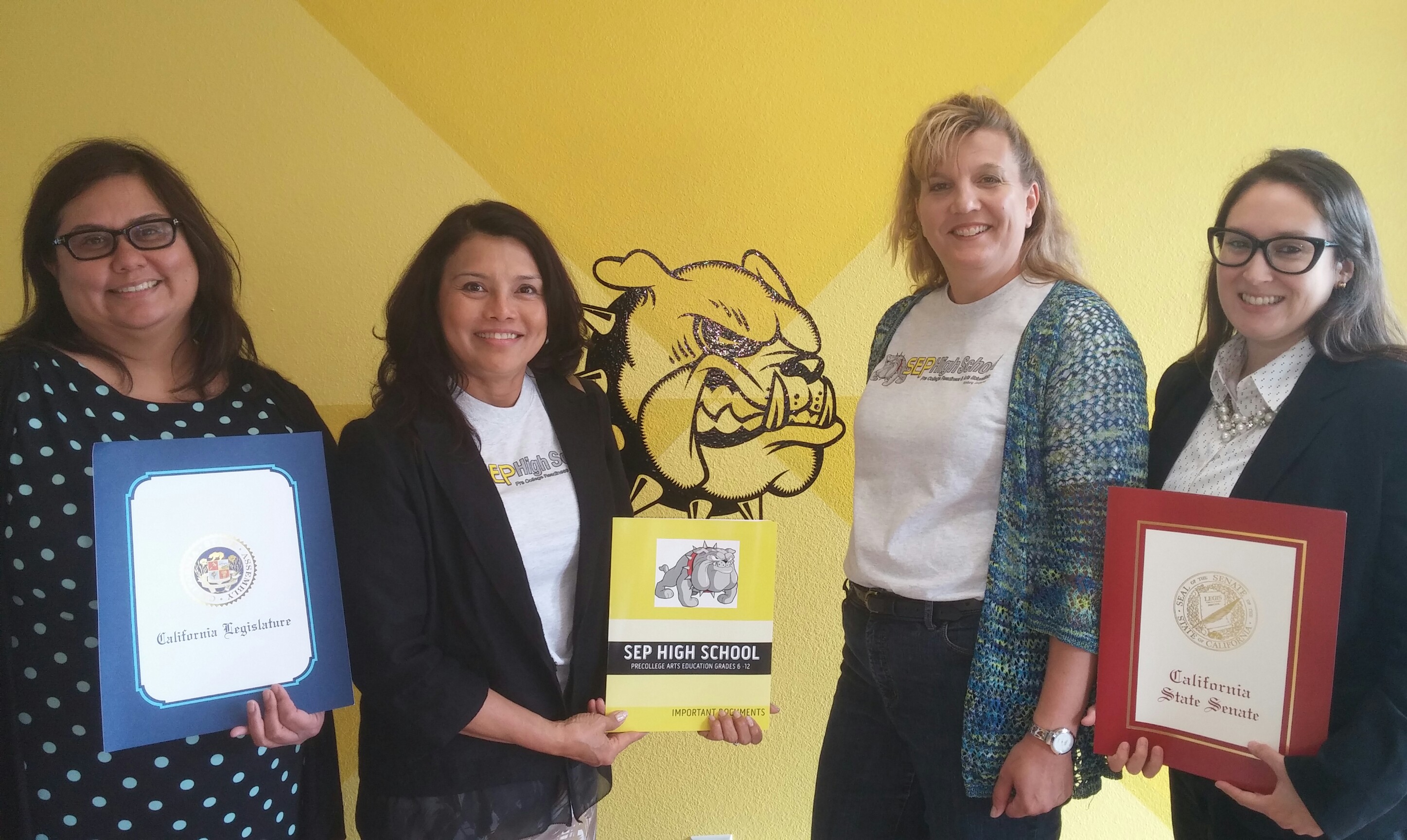
The school was presented with Letters of Recognition. (L-R) Erica Rodriguez-Langley representing State Assemblyman Jim Frazier, Cynthia Ruehlig, President, SEP Board of Directors, Denise Griffin Encore/SEP Executive Director, and Maria Henderson, representing State Senator Steve Glazer.

Synergy Education Project (SEP) celebrated the July 9, 2015 decision of the California State Board of Education to unanimously approved two material revisions to the school’s charter petition; (1) add an arts education component to the curriculum and (2) use Encore Education Corporation to manage SEP’s specific mission to provide students with college readiness while exploring passion for the arts. The school was presented with Letters of Recognition. (L-R) Erica Rodriguez-Langley representing State Assemblyman Jim Frazier, Cynthia Ruehlig, President, SEP Board of Directors, Denise Griffin Encore/SEP Executive Director, and Maria Henderson, representing State Senator Steve Glazer.

By Cynthia Ruehlig

There is plenty to bark about at Synergy Education Project High School (SEP High School), a tuition-free public school serving grades 6-12 students from Pittsburg / Contra Costa County. On July 9, SEP was unanimously approved by the California State Board of Education to add an arts education component to its project-based learning approach; offering electives in dance, vocal music, theater and visual arts starting this fall.

SEP, which accepts 70% socio-economic disadvantaged students, leads in overall performance for English Language Learners for middle schools within a 15 mile radius from its Pittsburg location. SEP has successfully responded to changing demographics and the challenge to overcome the achievement gap. SEP Board of Directors has chosen Encore Education Corporation to manage the school’s new direction.

Encore Executive Director Denise Griffin will apply the same strategy which earned Encore High School, Hesperia a place of distinction in “Top Schools in America” (US News and World Report); boasting the highest high school ranking by the California Department of Education in Hesperia with API of 793, 98% graduation, 100% passing in the 2013 CAHSEE and approximately two million dollars in college scholarships awarded to graduates.

SEP High mascot & logoA new mascot (bulldog), school colors and newly refurbished facility mark the beginning of SEP’s transformation from a good to a great school.

School starts August 13 for all enrolled students grades 6 through 11. For more information call (925) 207-3626 or visit www.sepschool.net.

Ruehlig is President of the Board of Directors for the Synergy Education Project.


Pedestrian overcrossing installed for Antioch BART Station on Friday

Monday, July 13th, 2015
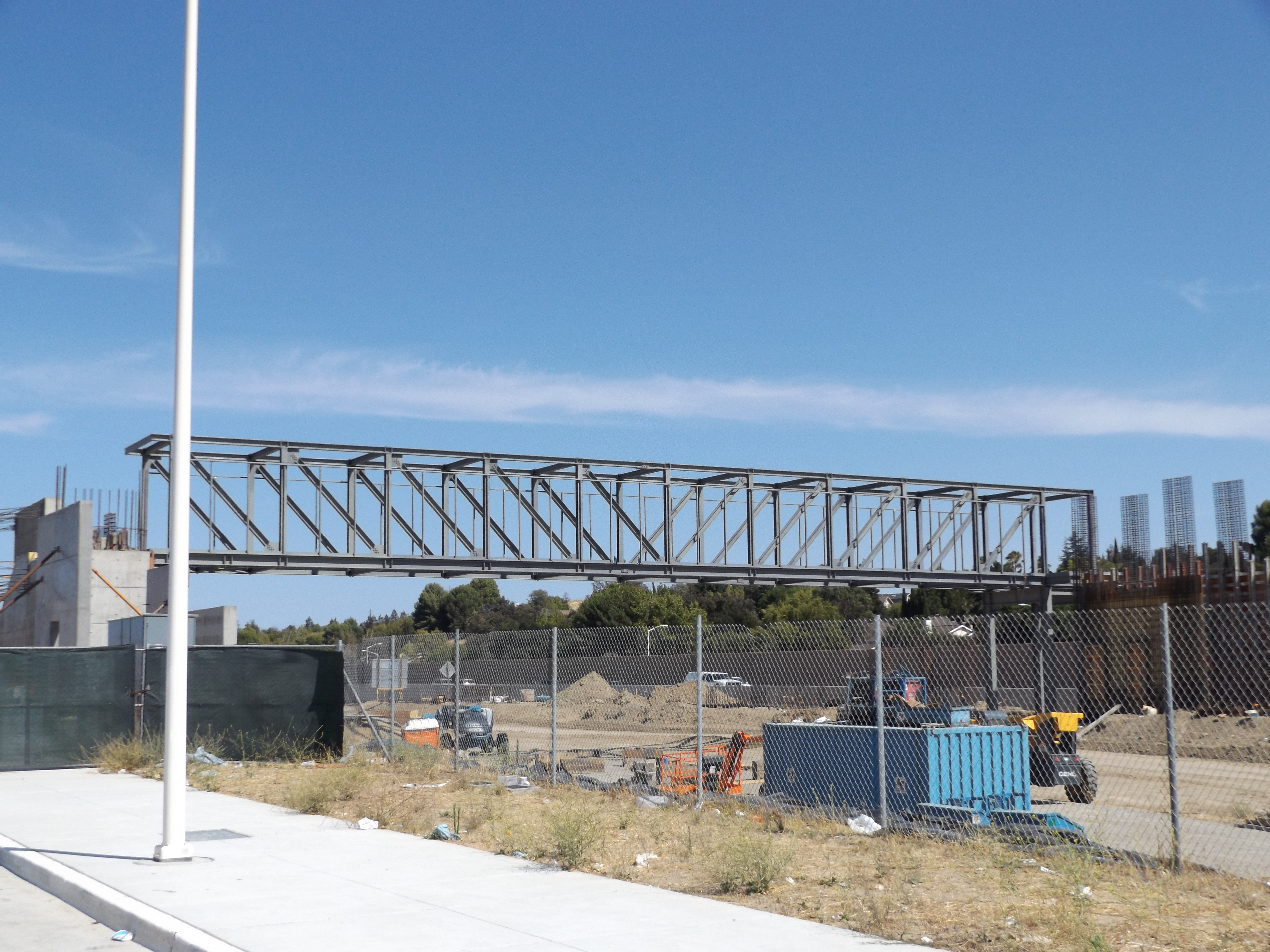
A pedestrian overcrossing was installed at Antioch's BART Station, across the future westbound lanes of Highway 4 on Friday, July 10, 2015.

A pedestrian overcrossing was installed at Antioch’s BART Station, across the future westbound lanes of Highway 4 on Friday, July 10, 2015.

Highway 4 expansion paves way for BART extension to Antioch and East County

By Allen Payton

Progress continues on the Antioch BART Station. On Friday, July 10, the Contra Costa Transportation Authority (CCTA) installed a pedestrian bridge over Highway 4 for the future Antioch BART station at Hillcrest Avenue, marking a major milestone in the journey to bring eBART service to eastern Contra Costa County. The 145-foot-long structure was hoisted into place over Highway 4 by a giant crane about 4pm.

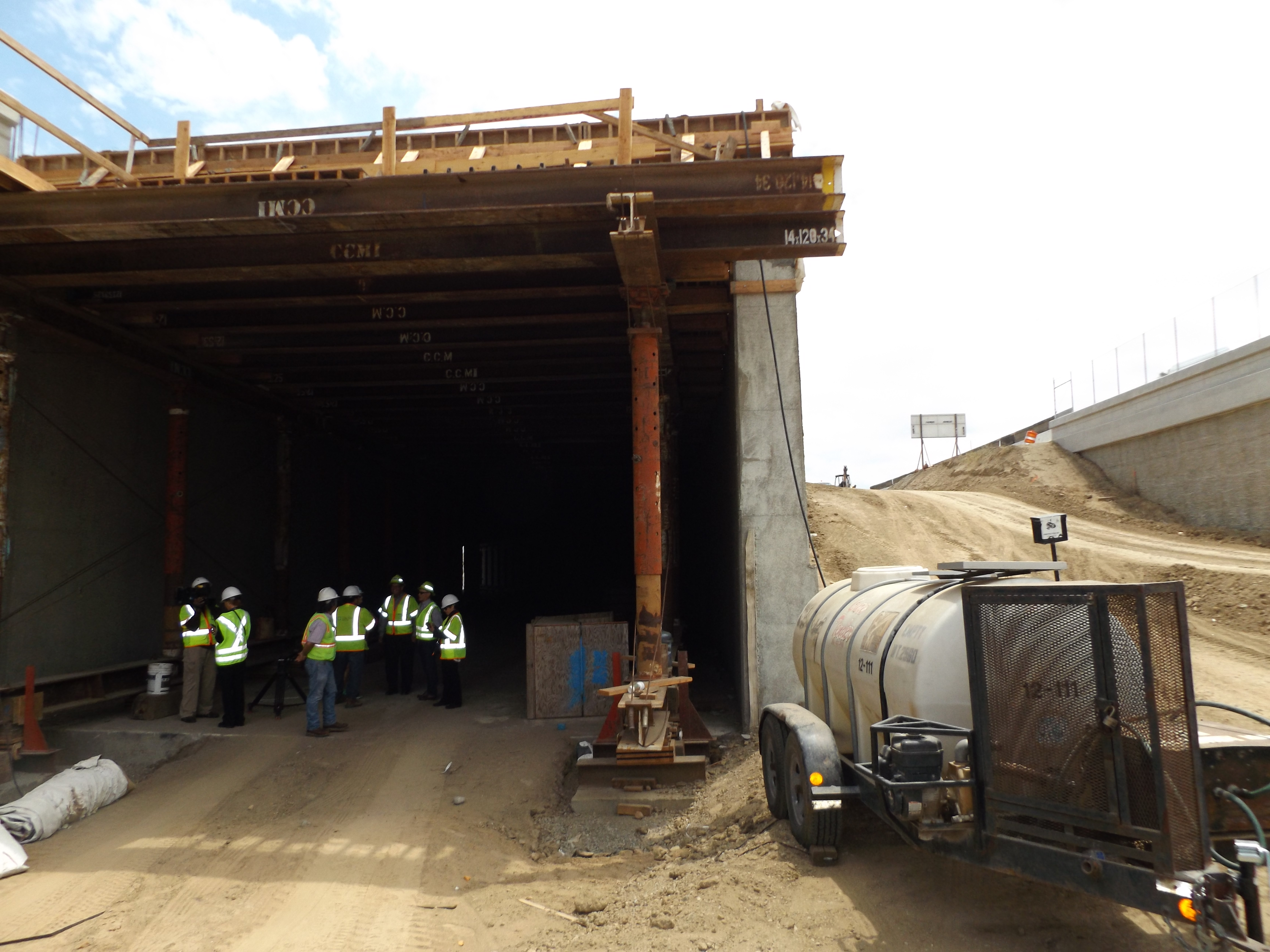
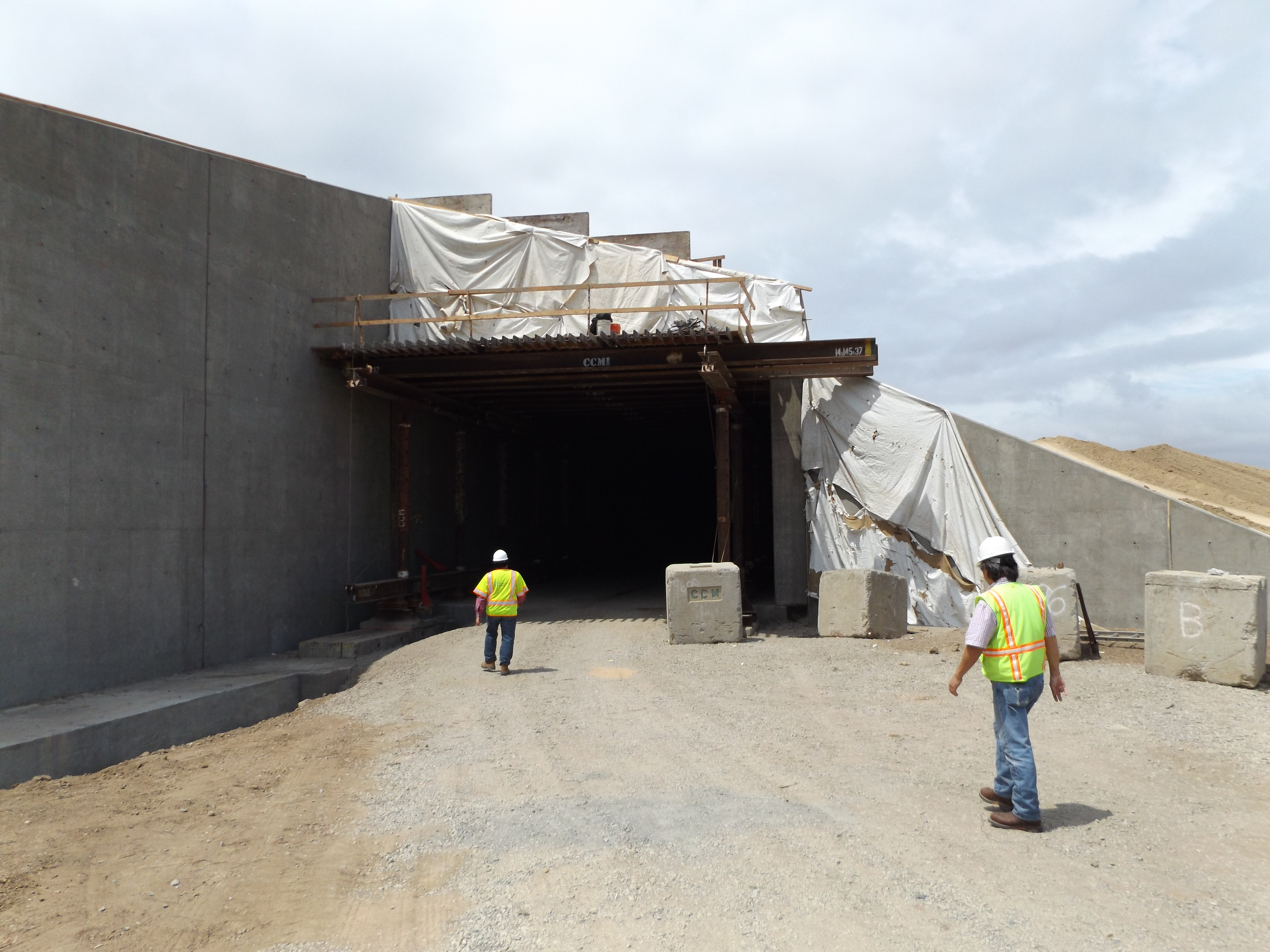
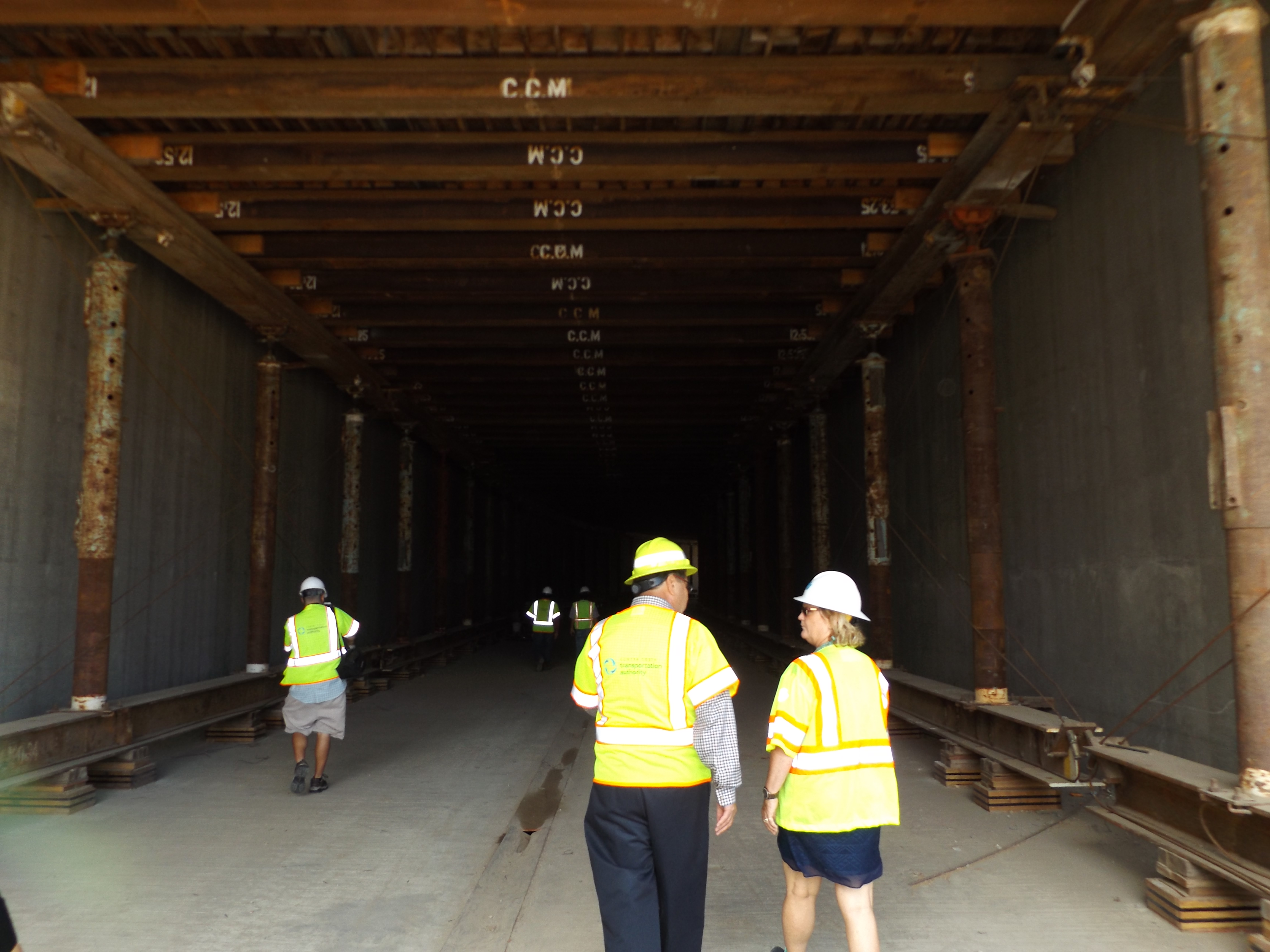
Prior to the installation, a tour of the new BART Station was provided by BART and CCTA staff, and included Director Joel Keller, who represents Antioch on the BART Board, and Antioch Mayor Pro Tem Lori Ogorchock. The tour included a walk through the tunnel beneath the future west-bound lanes of Highway 4, which will run from the BART station to the maintenance facility.

The median is wide enough to allow for both the line to the maintenance facility and two lines of transit for a future extension to Oakley and Brentwood, according to Michael Chann of S&C Engineers, Inc., who are working on the project.

“East County has been waiting a long time for better transit connections to other parts of the Bay Area,” Keller said. “After many, many years of planning and promises, we have started laying the track. The new Antioch Station will provide a high-quality transit connection for the people of East County in just a few years.”

The Highway 4 median includes room for the tunnel to the maintenance facility and two lines of transit for a future expansion further east.

The Highway 4 median includes room for the tunnel to the maintenance facility and two lines of transit for a future expansion further east.

The pedestrian overcrossing will carry BART passengers over the four lanes of westbound Highway 4 to the future Antioch eBART station in the highway median. This station will enable East County residents boarding at Hillcrest Avenue to arrive at the Pittsburg-Bay Point BART Station in 10 minutes. eBART trains will operate on the 20-hour BART schedule and meet BART trains at Pittsburg-Bay Point every 15 minutes. BART’s Pittsburg Center Station is also under construction at Railroad Avenue in Pittsburg.

A video of the bridge lift can be found here: 4eastcounty.org/media/videos

“It’s exciting to see the progress being made at the BART Station at Hillcrest,” Ogorchock stated. “Antioch will finally be getting our long-awaited and promised BART extension. It will not only help our residents who commute out of the area to go to work, it will also open up the opportunity for commercial development and employment around the station.”

The eBART train cars, which are known as DMU’s (for deisel, multilple-unit) can hold up to 200 passengers, and as many as three vehicles can be linked together, allowing the system to move as many as 600 passengers every 15 minutes, for a total of 2,400 passengers per hour, per direction, according to Keller.

The Hillcrest BART extension is projected to be completed and the station open in May, 2018.

“The BART overcrossing installation is a very visible element of progress in providing more mobility to the residents of East County. We are providing not only needed capacity on Highway 4, but expanded transit options, as well,” said Julie Pierce, Chair of the Contra Costa Transportation Authority Board. “That’s how we are working in partnership with other agencies and the community to build a smarter and more efficient transportation network in Contra Costa County.”

BART Director Joel Keller, left, discusses the new extension to Antioch with Antioch Mayor Pro Tem Lori Ogorchock and CCTA Construction Manager Ivan Ramirez.

BART Director Joel Keller, left, discusses the new extension to Antioch with Antioch Mayor Pro Tem Lori Ogorchock and CCTA Construction Manager Ivan Ramirez.

The continued expansion of Highway 4 along the BART route has allowed BART to start laying track in the newly expanded medians. BART service is planned to start in 2018.

The Hillcrest Avenue segment of the Highway 4 Corridor projects is the fifth construction segment in the effort to modernize transportation options in eastern Contra Costa. The construction projects for this segment in Antioch will widen the highway from four to eight lanes, including three mixed flow lanes and one High Occupancy Vehicle (HOV) lane, and provide a median wide enough for BART.

Renderings of the future BART station can be found here: 4eastcounty.org/media/bart-gallery

The Highway 4 projects include improvements that will help modernize eastern Contra Costa County. The projects expand Highway 4 from four to eight lanes between Loveridge Road in Pittsburg to just west of State Route 160 in Antioch, from two to four lanes from Lone Tree Way to Sand Creek Road in Brentwood, add missing connector ramps at the State Route 160/Highway 4 interchange, and add a BART extension from Pittsburg to Antioch. This will greatly improve transit accessibility for the region, help reduce traffic congestion, and enhance the quality of life for the more than 250,000 residents of eastern Contra Costa County. The projects have been carefully staged to keep 130,000 vehicles per day moving as major construction and demolition work continue. These projects, plus previously constructed projects in the region, bring the total investment in East County to $1.3 billion, including State, Federal, Contra Costa Transportation Authority Measures C and J, regional bridge tolls, and other funds.

For more information on the eBART Project, visit www.bart.gov/about/projects/ecc. For more information on the Highway 4 expansion, visit http://4eastcounty.org/.

Heading into the tunnel under Highway 4

Heading into the tunnel under Highway 4.

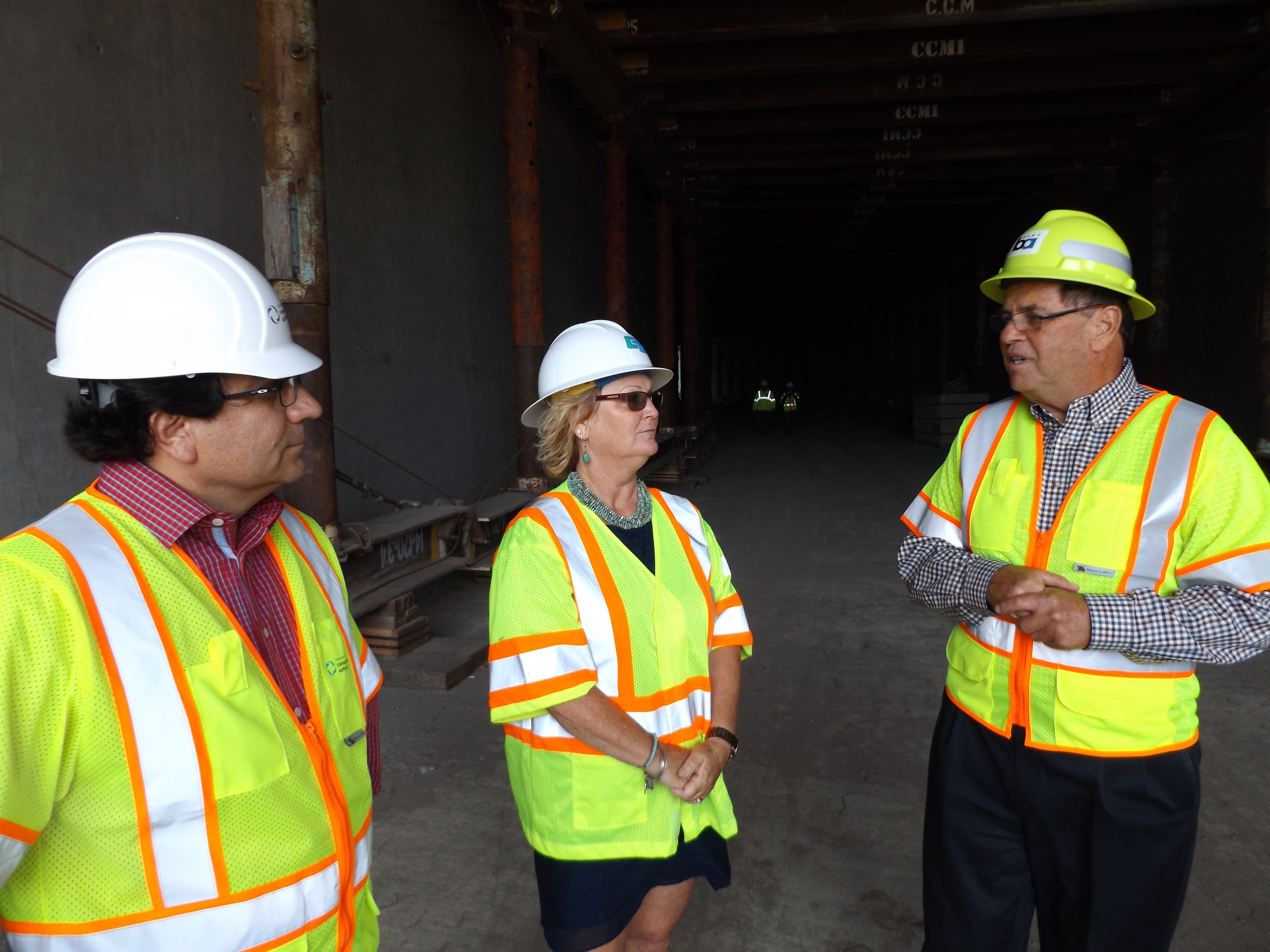
BART Director Joel Keller and Antioch Mayor Pro Tem Lori Ogorchock in the BART tunnel under Highway 4.

BART Director Joel Keller and Antioch Mayor Pro Tem Lori Ogorchock in the BART tunnel under Highway 4.

The median end of the BART tunnel beneath the future westbound lanes of Highway 4 east of Hillcrest Avenue in Antioch.

The median end of the BART tunnel beneath the future westbound lanes of Highway 4 east of Hillcrest Avenue in Antioch.

Antioch School Board continues rejection of site plans, approves continued employment of personnel

Friday, July 10th, 2015

by John Crowder

For the third time in three meetings, the 2015-2016 academic site plans for both elementary and secondary schools in the Antioch Unified School District (AUSD) were unable to gain full approval from the AUSD Board of Education.

At a special meeting held on Monday, June 29, with the plans being the only item on the agenda, the AUSD school board decided to table the review of the plans as a whole, sending them back to each school for further work. AUSD staff is to provide the board with an update as to their status at their next regularly scheduled meeting on August 12.

The board did, however, on a 5-0 vote, authorize the continued employment of personnel listed in the plans who are already working in the District, along with the hiring of any additional school personnel referenced in any of the plans. According to AUSD Chief Human Resources Officer Jessica Romeo, this latter motion allowed for the continued employment of 26.98 “Full Time Equivalents” (FTE’s) currently employed by AUSD. She said their compensation amounted to about $900,000 annually.

While some of the school site plans were praised by both school board members and members of the public, questions continued to be raised about others. Concerns with the latter plans included: improper certification by school site councils and plan content. An additional issue was that public notice of the previous school board meeting at which the plans had come up for review was insufficient.

June 30 Deadline and Risk of Loss of Funding

At the previous board meeting, held on Wednesday, June 24, AUSD staff members had made statements that, according to school board members, had led them to believe that the plans had to be approved by June 30, or the District risked losing funding. According to AUSD School Board President Claire Smith, this belief had caused her to schedule the special meeting to review the plans again, after the board had twice rejected them, for Monday, June 29.

During the June 29 meeting, though, the contention that there was a looming deadline of June 30 was also called into question. Over the few days between the June 24 and June 29 meeting, board members had independently researched questions concerning deadlines and funding issues with respect to site plans.

Board member Walter Ruehlig stated that he had placed eleven calls to the California Department of Education in order to determine the validity of the voiced concerns. “Plain and simple,” he said, the funding is not threatened and the monies for staffing have been budgeted.” He went on to say, “There is no deadline or compelling reason to immediately accept these plans.”

Board member Debra Vinson, who has been the most outspoken critic of the plans on the school board, said, “Not submitting the plans does not effect school site funding, at all.”

Smith said, “There doesn’t appear to be any deadline. But, we were told that [approval was required] by June 30. Now we know, that is not true.”

With the consensus of the board being that there was no deadline, and that no funding was in jeopardy should the plans not be approved, other issues were taken up.

Public Notification

The issue of proper notification seemed to be resolved. During public comments, Julie Young, the parent who had originally raised this concern, told the board that the plans had now been properly posted.

Even so, board members expressed the idea that improvements could be made when dealing with the public.

Board Vice President Diane Gibson-Gray told staff, “Last year was flawed. This year was flawed again…it shouldn’t rely on a person, it should rely on a process.”

Ruehlig said, “We should not just make [the plans] accessible, we should promote them to the public so people know to look at it.”

Certification by School Site Councils

Concerns remained with respect to certification of the academic plans by the school site councils.

Arrieanna Lombard spoke during public comments.

“I take issue with the certification, and who signed it,” she said, referencing the statement at a previous meeting by a site council member at Deer Valley High School (DVHS) that there had never been a proper vote on the academic plan at that school.

Smith expressed her concern with the school site meetings, as well. “You need to have a quorum, she stated.” Advocating for the inclusion of the minutes of school site councils when plans are submitted to the board in the future, she said, “That would, indeed, show that they went through the process.”

Ruehlig said, “I’m concerned about the sign-offs.” He continued, stating that he had looked at the minutes for the DVHS site council after hearing concerns expressed at the last board meeting. “At DVHS, the last meeting was in March,” he said. He also said that he had spoken to another member of the site council who claimed to have never seen the document.

Gibson-Gray noted an additional problem with the certifications. “Some don’t have signatures,” she said.

Additionally, it was revealed that some of the plans had signatures, but no dates.

Content of Plans

The content of the plans was questioned during public comments by Willie Mims, Education Chair of the East County NAACP. While he felt that the plans for two schools, Black Diamond Middle School (BDMS) and Antioch High School (AHS) had merit, he questioned the documents produced by some of the other schools. “The school site plans should be data driven,” he said. “If they are not data driven, they are flawed.”

Young, who addressed this matter during public comments, also expressed concern that there was, “no data.”

Ruehlig, referencing plan content, said, “There is room for improvement. Quite a bit of room for improvement.”

Gibson-Gray complained that, “nothing matched,” and said that, in the future, “maybe an explanation can be given to us.”

On the other hand, Board member Barbara Cowan, who attended the meeting via phone because she was on vacation in Mexico, emphasized the difficulties faced by staff in developing the plans this year.

“I’m looking at the evolution of this whole process,” she said. “The schools had a number of constraints this year, [including] LCFF and [the fact that] the District has not had a vehicle to give each school their own data. They (the principals) don’t have the data,” she continued. Cowan further recommended that crucial expenditures in the plans should be approved, including personnel expenses.

Outcome

With the continuing concerns over plan content, but the desire to continue to employ staff listed in the site plans, Gibson-Gray made a motion to approve the continued employment of staff members mentioned in the plans, and to hire any new employees they referenced. This motion, as noted above, was approved on a 5-0 vote.

With respect to the remainder of the plans, and with the understanding that there was no deadline for their approval, the board, by consensus, determined to send them back to the schools for additional work.

Smith emphasized the importance of each school site evaluating their unique needs. “Each school is different, (each) has its own climate,” she said. “These are the people (school site council) I want to sign off on the academic plans.”

Vinson encouraged those who would be working on the plans to, “be thorough, and work as a team.”

As the meeting concluded, Superintendent of Education, Don Gill, said, “The opportunity to hire is a huge relief. Rather than rush, it is better to be thorough.”

Following the meeting, Gill issued the following statement:

“The academic progress that the District has made in prior years has been built upon the implementation of a continuous cycle of improvement. Meaning, that we are constantly analyzing ways in which we can improve upon past practice. The input that our Board of Education has provided will allow us to further refine this process. We want to demonstrate higher levels of transparency, and to increase parent and community involvement. With timelines attached, that will allow higher levels of participation of all segments of the education community.

As soon as the new school year begins, our school site councils will be convened to review and refine current site plans with consideration of the input that our Board of Education provided at our last meeting. Throughout the year, our principals will meet regularly with their school site councils to ensure that full participation by all segments of the school community is accomplished.

Our expectation is that all school site programs and services will be fully accountable to achieving their stated goals. We want to expand those that are the most successful, and eliminate those that are not meeting the needs of our students.

We want to continue to have the community and the Board involved throughout the entire process so that the plans can be submitted and approved prior to the end of any current school year.”

The next AUSD board meeting is scheduled for Wednesday, August 12, 2015, at which time, as noted above, an update will be given to the board members regarding the school site academic plans. Meetings are held in the school services building, located at 510 G Street, in Antioch.

BART to install overcrossing by giant crane, for new eBART Station, Friday morning, July 10

Thursday, July 9th, 2015

WHAT: Installation of BART pedestrian overcrossing by giant crane in Antioch, California

A crane installing the 145-foot-long pedestrian overcrossing at the future Antioch eBART Station at Hillcrest Avenue on Highway 4 in Antioch. The BART station and new tracks are currently under construction. Media will be allowed access near the construction area for photography or videography, and will be able to interview key agency staff.

The 145-foot-long, 13-foot-wide overcrossing will carry pedestrians over the expanded four-lane westbound Highway 4 to the future BART platform at Hillcrest Avenue, providing a seamless BART connection to and from East Contra Costa County. The Antioch BART Station is one element of the $1.3 billion Highway 4 Corridor projects, which will expand Highway 4 between Pittsburg and Brentwood, add missing connector ramps to the State Route 160 interchange, and add BART service for the 250,000 residents of eastern Contra Costa County.

WHO: Joel Keller, District 2 Director, BART; and Ivan Ramirez, Construction Manager, Contra Costa Transportation Authority.

WHEN: Friday, July 10 at approximately 11am. The lift itself is expected to take approximately 20-30 minutes to complete.

WHERE: The parking lot at the intersection of Sunset Drive and Hillcrest Avenue in Antioch.

The Highway 4 projects include improvements that will help modernize eastern Contra Costa County. The projects expand Highway 4 from four to eight lanes between Loveridge Road in Pittsburg to just west of State Route 160 in Antioch, from two to four lanes from Lone Tree Way to Sand Creek Road in Brentwood, add missing connector ramps at the State Route 160/Highway 4 interchange, and add a BART extension from Pittsburg to Antioch. This will greatly improve transit accessibility for the region, help reduce traffic congestion, and enhance the quality of life for the more than 250,000 residents of eastern Contra Costa County. The projects have been carefully staged to keep 130,000 vehicles per day moving as major construction and demolition work continue. These projects, plus previously constructed projects in the region, bring the total investment in East County to $1.3 billion, including State, Federal, Contra Costa Transportation Authority Measures C and J, regional bridge tolls, and other funds.