







Archive for the ‘News’ Category

Questions raised by mail out of City of Antioch’s annual report on Measure C revenue and spending

Monday, October 24th, 2016
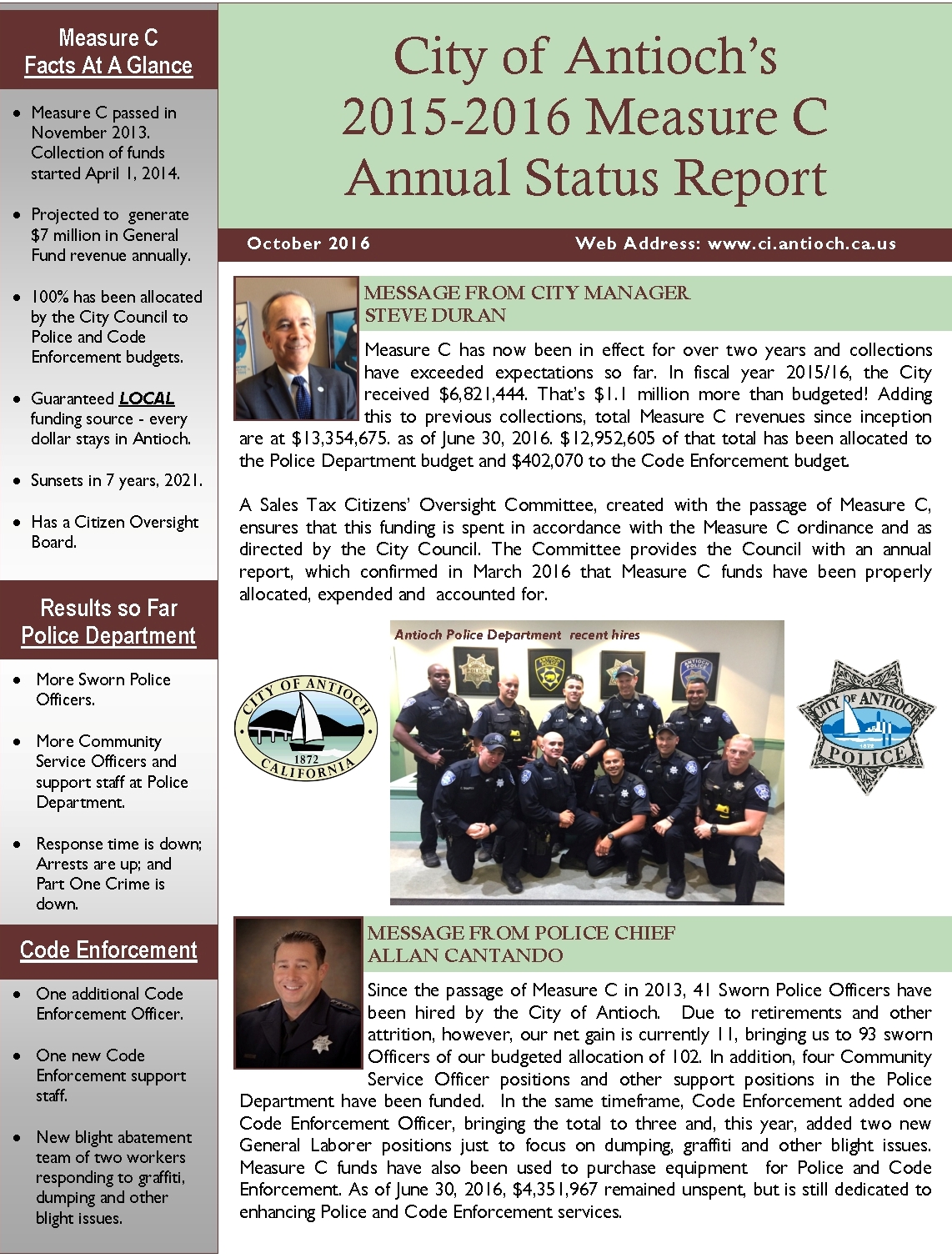
City of Antioch's 2015-2016 Measure C Annual Status Report mailed to all residences, last week.

City of Antioch’s 2015-2016 Measure C Annual Status Report mailed to all residences, last week.

By Allen Payton

Antioch City Manager Steve Duran released the City’s annual report on Measure C to the community last week. It was also mailed to every residence in the City.

In November 2013, Antioch voters passed Measure C, a half cent sales tax that sunsets in 2021. The tax became effective April 2014 and according to the mailer and a press release from Duran, “as of June 30, 2016, the City has received a total of $13,354,674. That’s $1.1 million more than budgeted.”

According to the mailer “that total $12,952,605 has been allocated to the Police Department budget and $402,070 to the Code Enforcement budget. The City Council has allocated 100% of the Measure C (additional 1/2 cent sales tax) revenue to the Police Department and Code Enforcement budgets since its inception and that will continue.”

However, in compliance with the City’s Cost Allocation Plan (CAP) for citywide administration, some of those funds have been transferred out of both departments. When asked about the CAP and how much is being transferred out of both the Police Department and Code Enforcement, Duran responded, “Here’s what I can tell you in a nutshell about how the Cost Allocation Plan works:

  • The 2005 cost allocation plan established the percentage that each department or enterprise would be charged for internal services.
  • That percentage does not change; it is the same every year.
  • The Police are paying the same percentage every year and would be even if measure C never existed.
  • When the costs of internal services went down because of layoffs, furloughs and other cost cutting measures, the percentage stayed the same, but the actual dollars paid for internal services went down. Likewise, when we got off furloughs, hired a few people (still having much fewer than before the cuts) and other costs such as PERS, health benefits and workers comp  went up, the percentage stayed the same, but of course the dollars went up.
  • Internal services includes the departments that provide services to other departments, such as Human Resources, Finance, Information Systems, City Manager, City Attorney, etc.”

Yet, at a Council meeting in May, City Finance Director Dawn Merchant offered information that has caused some confusion over the percentage of funds being transferred out for the CAP. She referred to the elimination of the Friday furloughs, in which city staff took a 10% reduction in pay while giving up 10% of their work time, causing City Hall to be closed on Fridays.

“Citywide costs to the police department decreased 8%, then 13%,” Merchant stated referring to years prior to the passage of Measure C. “Fiscal Year ’13 it went up 7%. Fiscal Year ’14 it went up 11%. Fiscal Year ’15 it went up 15%. Fiscal Year ’16 it did increase 24%. But that’s for a full year of furloughs.”

In an email response to questions of how much is spent via the CAP from the PD and Code Enforcement, Merchant responded:

“While Code Enforcement does have a cost allocation charge, none of that is calculated against measure C as Code Enforcement has only specific positions and equipment charged to it,” she wrote. “With the way the PD measure C is done, any expenditures over the $28M base are considered measure C.  So you cannot definitively say the whole amount of the cost allocation plan is charged to measure C as you could just as easily argue it is all for salary, or it paid for ammunition, etc.  The funds aren’t transferred out either, they appear as an expenditure line item in the PD budget for their share of internally allocated costs.  The CAP isn’t spent on specific expenditure line items per se, it is the share of internal costs (the entire budget) of the allocated departments.”

“For 16/17, City Wide Admin (CAP) is 8.1% of the total PD budget of $38,919,082,” Merchant’s email response continued.  “However, it is important to note that the CAP allocation is not based on what the PD budget is doing only what the budgets being allocated are doing as PD gets the same percentage allocation every year.  Here is a breakdown of last year and this year:

15/16 PD Budget = $35,750,788 and of that $3,107,193 was budgeted for City Wide Admin – so budgeted CAP was 8.7% of total PD budget.

15/16 PD Actual = $35,181,262 and of that, $2,767,235 was actual City Wide Admin – so actual CAP allocated was 7.8% of total PD actual.

16/17 PD Budget = $38,919,082 and of that $3,162,307 budgeted for City Wide Admin – so budgeted CAP is 8.1% of PD budget.”

That means of the Measure C funds received by the PD, $560,138 was spent on citywide administration in Fiscal Year 2015/16 and $884,445 is budgeted for Fiscal Year 2016/17.

Thus, the discrepancy continues between the City staff stating 100% of Measure C funds “has been allocated by the City Council to Police and Code Enforcement budgets,” versus what some members of the public, including former Measure C Oversight Committee Member, Sal Sbranti, have been saying. They are looking at the net amount, which is minus the CAP amount that remains in the police department.

In a comment on Facebook in response to the mailer, Sbranti wrote:

“Antioch Citizens, I just read our City Manager’s fabrication of a report on Measure C. In it he states, ‘The Committee provides the Council with an annual report which confirmed in March 2016 that Measure C funds have been properly allocated, expended and accounted for.’ Actually what we said was, ‘Due to the way the City Budgets the Police Department for Measure ‘C’, the Committee has some concerns as to whether all Measure C monies are being properly utilized to meet the objectives of this measure.

The ‘Further Remark’ section of this report identifies these findings. So who did our stellar City Council members, Mary Rocha, Monica Wilson, Tony Tiscareno, Wade Harper (present Mayor), and Lori Orgochock (want to be Mayor) ask to investigate and look into our concerns? Why the City Manager – The Fox is guarding the hen house and he said all of the chickens were there! Amazing! Like having Nixon investigate Watergate!

In the further remarks section we went on to show that the City Wide Administration (CWA) allocated portion of the Police Department Budget went from 6.36%, where it was for a 3 year period, to 7.87% for the first full year of Measure C funds, increasing the CWA allocation by $724,000 over the previous year and this year’s budget has an 8.1% allocation for an additional $400,000. City Wide Admin gets an allocation of the Police Department Budget each year to fund the City Manager’s office, Legal, HR, Maintenance, City Council, etc. Measure C funds according to the commitment given to the citizens of Antioch by our city council is only to be used for the following; Increased Police Force, Reduction of emergency response time, Increased Code Enforcement, Reduction of Blight. In 2013/14 we used $1.8 million for CWA, in 2014/15 we used $2.043 and in 15/16 a huge jump to $2.767 million and the budget for 16/17 is $3.152 million. Our police department has increased by only 15% (82 to 94) while our CWA has increased in dollars by 54% in the last two years alone( over 70% in 3 years) ($2,043,963 to $3,152,307).

I do not blame this on our Police – the budget is approved by the City Council and Made by the City Manager who sends Mailers to all of our citizens with wrong information or outright lies.”

Furthermore, city staff can’t be held responsible for carrying out the Council’s policy, dating back to when the CAP was adopted in 2005. They are following requirements of the CAP, in which they consider the citywide management expenses as part of the police department budget.

The issue of applying the CAP to funds from both Measure C and Measure O, the residential property owners business license fee, was broached during the forum sponsored by the Herald. Three candidates, Dr. Sean Wright, Kenny Turnage and Lamar Thorpe all said they would be willing to waive the application of the CAP on both Measure C and O funds.

According to Duran’s press release, through June 2016, the Measure C funds have allowed the City to enhance Police Services and Code Enforcement as follows:

Police Department

Continuous hiring is ongoing to bring sworn Police staffing to a total of 102, which is fully funded in the City budget. According to both Duran and Police Chief Allan Cantando, the current sworn Police staffing is at 93. Although 41 officers have been hired, 15 have retired and 14 have left for other reasons for a net gain of 11 since November of 2013 when Measure C was passed. our new officers are currently in the hiring process.

However, at the time the measure was placed on the ballot in August, 2013, Antioch had 89 sworn officers on the force. Therefore, there has only been a net gain of five additional police officers. Between August and November, 2013 the number of officers had decreased to 82 sworn. That is the figure the City Council and staff have chosen to use as the baseline, instead.

In the ballot argument in favor of Measure C, Mayor Harper and the Councilmembers that time (all but Mayor Pro Tem Lori Ogorchock) committed to hiring 22 additional officers if the voters passed the measure. Therefore, the actual goal for staffing should be 111 sworn police officers not 102, but that’s the amount that the Council has approved in the City budget.

The press release about the mailer continued with the following information on Measure C expenditures:

Code Enforcement

  • Hiring of one additional Code Enforcement Officer
  • Hiring of one Development Services/Engineering Tech to support Code Enforcement.
  • Budget for funding of one Code Enforcement Manager (recruitment in progress)
  • Hiring of two General Laborer positions and purchase of related equipment to focus on blight
  • Abatement
  • Purchase of a Code Enforcement vehicle.

Measure C funds are subject to the City’s annual independent audit. In addition, a Sales Tax Citizens’ Oversight Committee reviews receipts and expenditures, and reports to City Council by

April 1st each year regarding use of the funds to ensure monies are being spent in accordance with the Ordinance and as directed by the City Council. These independent audits and reviews have found that the funds have been used in accordance with the Measure C ordinance and have been properly accounted for.

As of June 30, 2016, $4,351,967of the Measure C revenues remained unspent, due mainly to attrition in the Police Department caused by retirements and other separations. However, these funds have been carried forward and are still dedicated to enhancing Police and Code Enforcement services.

  • Funding of four additional Community Service Officers (Two positions have been filled and recruitment in progress for remaining positions).
  • Hiring of one Administrative Analyst to support the Police Department.
  • Hiring of one Police Communications Supervisor.
  • Implementation of a vehicle abatement program.

More information on the City’s budget and Measure C can be found on the City’s website at http://ci.antioch.ca.us/CityGov/Finance/.
Contra Costa annual Rebuilding Lives Luncheon honors Domestic Violence Awareness Month

Saturday, October 22nd, 2016

Concord, CA – On Thursday, October 6th at 11:30 a.m., STAND! For Families Free of Violence’s 24th Annual Rebuilding Lives Luncheon and more than 350 civic, business, and community leaders gathered at the Concord Hilton this year to honor Domestic Violence Awareness Month, celebrate the resilience of domestic violence survivors, and raise more than $140,000 for programs that help survivors of family violence.

Keynote speaker Tony Porter, Co-founder and CEO of A CALL TO MEN, addressed the role of men in ending violence against women. Exploring the influence that men have with boys and other men as fathers and coaches, he discussed how to encourage boys and men to stand up to those promoting men’s violence. “It is time to stop asking why women stay and starting asking men to stop.”

“Today it is clearer than ever that domestic violence is a men’s issue too. We will end this problem only when men, too end their silence around violence and tell each other this is no longer acceptable behavior. We need to change the conversation.” said Gloria Sandoval, CEO of STAND! For Families Free of Violence.

Though the movement to end family violence has made great progress, there is still work to be done: On average, one in four women and one in seven men will experience intimate partner violence severe enough to send them to the hospital; one in five teens will experience teen dating violence; and 3.2 million children will experience domestic violence in their homes annually. Awareness-raising events, such as the Rebuilding Lives Luncheon, are important for strengthening the movement as well as inspiring new supporters to help end domestic violence.

About STAND! For Families Free of Violence

STAND! helps 15,000 people in Contra Costa County break the intergenerational cycle of violence each year by saving lives, rebuilding families, and changing the future: intervening when violence strikes, supporting victims as they rebuild their lives, and guiding the community as a whole toward nonviolence. Visit www.standffov.org for more information.

Highway 4 Bypass at Balfour Road interchange work to begin in late 2016, early 2017

Friday, October 21st, 2016

The low-bid contract, awarded to two Contra Costa firms, is $3.9 million below costs budgeted for this final piece of State Route 4 Bypass Project

On Wednesday, October 19 the Contra Costa Transportation Authority (CCTA) Board voted unanimously to award a contract to Brosamer & Wall, Inc. and Bay Cities Paving & Grading for the construction of a number of improvements to the State Route 4/Balfour Road interchange. The purpose of the project is to improve traffic flow on State Route 4 and enhance safety for everyone who uses the interchange at Balfour Road. It is the final roadway element of the State Route 4 Bypass Project, constructed with over $400 million in local funds and $25 million in State funds, over the last sixteen years. It includes the completion of the two lanes between Sand Creek and Balfour Roads.

Contra Costa-based construction firms Brosamer & Wall and Bay Cities Paving & Grading formed a joint venture to bid on this project (BWBCJV).  BWBCJV’s low-bid is approximately $3.9 million below the $40,855,000 budgeted for the construction phase of the project.

The project has also benefitted from the Contra Costa Water District’s (CCWD) work with Caltrans to lift a mandate that would have required the relocation of a water line near the site. The deal allowed for the 90-inch water main to remain in place and saved Contra Costa taxpayers $18 million.

“I’m excited to see CCTA move forward on the State Route 4/Balfour Road interchange improvements by awarding this contract. That it is going to two Contra Costa construction firms who came in with an extremely competitive bid, makes it even better,” said Brentwood Mayor and CCTA Commissioner Robert Taylor.

The project will result in a new interchange at the junction of State Route 4 and Balfour Road in Brentwood replacing the existing at-grade signals with a new structure which will carry State Route 4 traffic over Balfour Road. New on- and off-ramps will allow traffic to smoothly enter State Route 4 from Balfour Road and vice versa.  This new configuration will ease traffic congestion and improve safety at this busy intersection.

“Finally, we’re going to have this section of the Bypass completed, giving us a safer roadway and allowing people to spend less time sitting in traffic and more time with their family,” said Doug Hardcastle, Chairman of the State Route 4 Bypass Authority and Chair of Transplan, the East County division of the CCTA. “It’s our job as leaders to make sure the money is spent properly and to give the people living in East County a better quality of life. This is part of the progression of the road that will eventually connect to Tracy.”

This portion of the State Route 4 project is budgeted at $74.3 million including Environmental Clearance and Design, Utility Relocation, and Construction and Construction Management. The engineer’s estimate for construction was $40,855,000. BWBCJV’s bid of $36,925,826 results in a savings of $3.9 million. Both Brosamer & Wall, which is based in Walnut Creek and Concord-based Bay Cities Paving and Grading have a long history of providing excellent service on CCTA projects. Brosamer & Wall is currently under contract with the Authority on the I-80/San Pablo Dam Road project. Bay Cities Paving & Grading has worked on a number of projects for CCTA, including the State Route 4 Hillcrest project and the State Route 4 Widening and Sand Creek Interchange project.

“We are incredibly proud to be part of a project that will improve safety and improve the flow of traffic in our home county,” said Bob Brosamer with Brosamer & Wall. “By forming a partnership we’ve been able to offer a very competitive rate and we are putting local measure dollars to work using local residents on our workforce,” added Ben Rodriguez with Bay Cities Paving & Grading.

Utility work has already begun for the new interchange and construction is expected to begin in late 2016 or early 2017 and is expected to be complete in late Summer 2019.

About The Contra Costa Transportation Authority

The Contra Costa Transportation Authority (CCTA) is a public agency formed by Contra Costa voters in 1988 to manage the county’s transportation sales tax program and oversee countywide transportation planning efforts. CCTA is responsible for planning, funding and delivering critical transportation infrastructure projects and programs that connect our communities, foster a strong economy, increase sustainability, and safely and efficiently get people where they need to go. CCTA also serves as the county’s designated Congestion Management Agency, responsible for putting programs in place to keep traffic levels manageable. More information about CCTA is available at ccta.net.

Somersville Towne Center gives big to Ogorchock, Wright in Antioch Mayor’s race

Friday, October 21st, 2016

By Allen Payton

Both Antioch Mayor Pro Tem Lori Ogorchock and Dr. Sean Wright each received a check for $4,500 from the owner of the Somersville Towne Center, this week, to support their campaigns for Mayor, according to form 497 financial disclosure reports submitted to the Antioch City Clerk’s Office. (See reports, below)

The only indoor mall in East County, Somersville Towne Center is located on Somersville Road in Antioch and includes major tenants such as Macy’s, Sears and Fallas department stores, as well as a variety of other retail stores and a few restaurants. It was purchased by Time Equities, LLC of New York, last year.

The owners and management staff are working to improve the mall in the areas of lighting, safety and more tenants for a greater shopping experience for customers.

“I had a nice conversation with the owners back in New York,” Wright stated when asked for comment. “They asked a variety of questions about our community, police and crime. They stressed how they want to be a partner with the City and to revitalize that part of town.”

“The Somersville Towne Center cares about Antioch and improving the safety of the mall and the town,” he continued. “I am proud to be seen as a leader they support to bring about a safer community.”

When reached for comment, Ogorchock said, “I’m very excited that the Somersville Towne Center reached out to me to get my vision and my views for the City of Antioch and the mall. I’m excited to be working with them and was very honored and shocked to receive their contribution, I’m looking forward to working them for their future success.”

For more information about Somersville Towne Center, visit www.somersvilletownecenter.com.

Both candidates are the remaining challengers running to unseat incumbent Mayor Wade Harper who is seeking re-election to a second term. The other candidate whose name will still appear on the ballot, Gil Murillo, suspended his campaign, recently and threw his support to Wright and has asked his supporters to vote for him, instead. The election is Tuesday, November 8th.

ogorchock-497-10-18-16

wright-497-10-19-16

Antioch School Board receives charter school petition amid opposition from faculty, starts 60-day process

Friday, October 21st, 2016
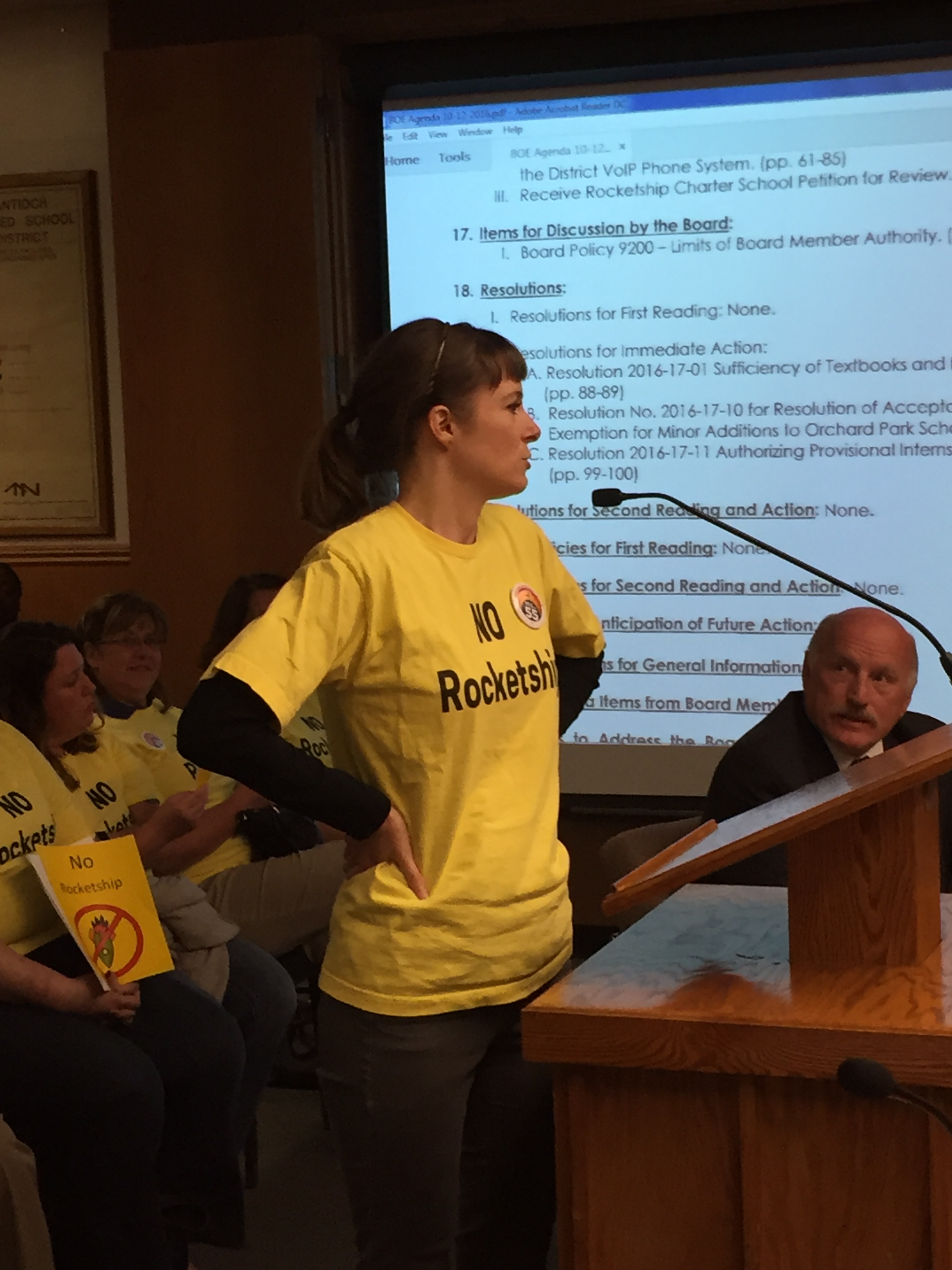
Antioch High School teacher Sara Savacool speaks to the Board wearing a T-shirt with her position on the Rocketship charter school petition at the Board meeting on Wednesday, October 9, 2016.

Antioch High School teacher Sara Savacool speaks to the Board wearing a T-shirt with her position clearly spelled out on the Rocketship charter school petition, as Associate Superintendent Chris Learned looks on, during the meeting on Wednesday, October 9, 2016.

Discusses revisions to policy on Limits of Board Member Authority

By Allen Payton

At their regular meeting on Wednesday, October 12, 2016, the Antioch School Board voted unanimously to receive the petition by Rocketship Education, to establish a public, non-profit charter school in Antioch. The board also dealt with a recently adopted policy believed to be restrictive of board members. Plus the board heard complaints from the public of police interrogations of students, the negative comments about the school district and a vote against Prop. 55 by Trustee Fernando Navarro.

On September 30th, Rocketship presented a charter school petition to Antioch Superintendent Stephanie Anello for a K-5 school. Once the board received the petition, it started both a 30-day timeline for a public hearing and a 60-day timeline to make a decision to approve or deny the charter, according to a report by Chris Learned, Associate Superintendent for Business and Operations.

He said the time-frame was “a little difficult because of the holidays and election.”

“If this board holds a public hearing it only seems right that the current board makes the decision,” Learned stated.

So the Board and staff settled on Wednesday, November 2nd for the public hearing and Monday, November 28th for the vote. Staff is proposing the hearing be held at Deer Valley High because of the capacity.

Three speakers, including two teachers, spoke against the charter for Rocketship, including one, Sara Savacool, who, along with others in the audience, was wearing a yellow T-shirt with the words “No Rocketship” across the front.

“Charter schools are a complicated issue,” she said. “There’s a lot of law. There are different types. You really need to do your homework.”

Savacool mentioned “corporate interests, profit and a very stripped down education for our students.”

“We fought them at Mt. Diablo (Unified School District),” she continued. That board “voted 5-0 against.”

“I’m very disappointed they’re bringing their brand of second-rate education to our community,” Savacool concluded.

Ken Kent, a fifth grade teacher at Kimball Elementary School in Antioch, was the next to speak.

“Antioch has some very good grassroots and research-supported (charter) schools versus a cost analysis model,” he stated. Then he mentioned who are on Rocketship’s board of directors, including one person with an education degree, a financial analyst and for-profit education executives.

Kent said students in Rocketship schools spend “a significant portion of their day behind a (computer) screen.”

“This is not a moral thing to do,” he continued. “Rocketship has had some numbers of improved API scores. But they haven’t held true” and then asked about “how much we’re having to give up for that?” and “Why are we pressing this so fast, now?”

Before the third public speaker shared his thoughts, Marie Gill, the Bay Area Regional Director for Rocketship spoke, offering her own background and local connection, and that she was “coming back to Antioch after 20 years.”

Rocketship has “over 6,000 parents from the Bay Area with students in our schools,” Gill stated. “We’re happy to host you at one of our schools. We want you to be informed as board members.”

She said “we’d like to extend an invitation to tour our facility and school in San Jose.”

Willie Mims, a regular critic of the Antioch School District, representing the NAACP East County Branch and the Pittsburg Black Parents, was the last to speak during public comments.

“I and Rocketship have crossed paths over the past five years,” he stated. “Is there a need? You have some serious issues, here.”

Then referring to test scores, Mims said “they are atrocious. Charter schools are circling. You only have to blame yourself for Rocketship being here. If you don’t address them, then you’ll have more Rocketships.”

Then he explained the process.

“If the Board denies and the County Board denies, the State will help them get their charter approved,” Mims shared. “Once they move you can’t stop it.”

The Board members then shared their thoughts on the matter, with Trustee Debra Vinson speaking first.
“Having a charter school problem for the district isn’t new, since we fought for Dozier-Libbey,” she stated. “We have a mandate to improve academic outcomes for all students. Are they an option? Are they the solution?”

“I’m going to research…and do what is in the best interests of this District,” Vinson added.

Board President Diane Gibson-Gray said “the clock starts, today” referring to the timelines.

“Between the 2nd and 14th (of December) three Board members may have no power,” speaking in favor of the shortened timeline for the hearing and decision.

Trustee Fernando Navarro spoke next, saying “I have to echo what Mr. Mims said. Nature abhors a vacuum and unfortunately we’ve provided a vacuum.”

“They will get it at the state level,” he continued. “I’d rather work with them than work against them.”

Trustee Walter Ruehlig said there are “three most difficult decisions” as a Board member: “hiring a new superintendent, closing a school and considering a petition like this.”

The Board then voted 5-0 to receive the charter school petition and set the hearing and meeting dates for a decision.

Public Comments

Before the discussion on the Rocketship charter school, the Board heard from the public, with both Mims having some concerns and Kent criticizing Navarro for his vote on Prop. 55.

“Looking at the budget,” Mims began, “you’re transferring $400,000 of grand fund for deferred maintenance. That was an illegal move. I found the $400,000 deep into the budget, and now into the General Fund.”

He then complained about “some serious increases in classified (employees) of 22%. An increase of over $4 million.”

His third and final issue had to do with “complaints of police interrogating our children.”

“You faced a lawsuit over that several years ago,” Mims stated. “You have to be careful. They need to be read their rights.”

Gibson-Gray referred Mims to staff, saying he could talk with Dr. Adam Clark, the district’s new Associate Superintendent for Educational Services, who was in attendance at the meeting.

Contra Costa County School Board Member Jeff Belle spoke next, as “a private citizen,” he said.

“A famous general once asked ‘what’s the difference between appeasement and surrender’” Belle stated. “It’s time.”

“It’s time we step up to the plate,” he continued. “There’s activities. But, it’s time that we start getting outcomes for our students. The outcomes do not match the investment. The City’s economic stability and security is dependent on our education system.”

“Before you blink, tomorrow becomes today,” Belle added. “Let’s do a better job than what we’re doing.”

Antioch resident Velma Wilson then spoke about wanting to be more positive.

“I just want to applaud the efforts of the AUSD,” she shared. “2016-2017 has so far been a phenomenal school year. I’m welcoming parents who are coming to me crying. I’m so tired of all the negative from people who are not at our school campuses.”

“I invite you to come out and see the smiling faces,” Wilson continued. “PBIS (Positive Behavior Intervention and Support) is in full effect.”

To those being negative she said “go sit somewhere.”

“I’m always about let’s continually promote the positive,” Wilson added.

Then Kent spoke, chastising Navarro for voting against the Board resolution in favor of Prop. 55 on the November ballot, which would extend by 12 years, the three-year temporary income tax increase, that will expire this year.

“Thank you Board for your vote in support of Prop 55,” Kent said. “I was disappointed to hear that Trustee Navarro voted against it. You have put forward your own ideology ahead of the needs of our students. Shame on you. We need a caring school board member. You are not that board member.”

Michael Sagehorn who teaches history at Deer Valley High and at the Performing Arts Academy said “I’m the one who brought with me the students, tonight.” He spoke of helping students become “artists as activists” and “my history students are participating in government.”

“I really try to implement integrated education, Sagehorn continued. “There’s a rumor going around that it’s going away.”

Restorative Justice

On the issue of ratifying a vendor agreement with Rita Alfred for Restorative Justice, Mims had a question and comments for the Board and staff.

“What are you proposing the outcome with restorative justice,” he asked.

Dr. Clark responded with “this particular goal is part of the LCAP building in inclusive and safe communities.”

He explained that the district is hoping to “lower suspension rates by 10%, and for African American students by 20%.”

Clark shared that the process will include conducting an on-site workshop, three days of training and six days of classroom monitoring.

“My concern is who restorative justice is on,” Mims responded. “Training should be for people who are meting out justice. There needs to be a clear understanding of what restorative justice is.”

Board Member Authority

At Navarro’s urging, the Board discussed concerns and proposed revisions to a new policy they adopted, earlier this year, known as Board Policy 9200 – Limits of Board Member Authority.

Navarro suggested changes to section two regarding interactions with schools and school employees. He was concerned that the policy is “not allowing us to be a listening entity.”

He also suggested eliminating section four, which requires a Board member to inform the Superintendent before volunteering in their own child’s classroom.

“I still retain the right as a parent and my First Amendment rights,” Navarro stated.

“I think a board member retains all of their parental rights,” Vinson shared.

“It’s a very new board policy,” Navarro continued. “It restricts our ability to represent the voters. We should be able to listen to them” referring to teachers, parents and staff.

Gibson-Gray responded with “I have conversations with parents, teachers…I don’t see where this restricts your ability.”

“Why all of a sudden this new board policy?” Navarro asked.

Superintendent Stephanie Anello responded.

“Every other district has this policy,” she explained. “We were missing this policy. It is my job as Superintendent to recommend policies to the Board that are in compliance with state law, which this policy is.”

Vinson then suggested her own alternative language to the policy, to what Navarro proposed.

“I was trying to address some of Fernando’s concerns as to Board authority,” she said. “It didn’t seem like the policy was clear English.”

“I did quite a bit of research on Board policies form other districts,” Vinson continued. She suggested changes “So it doesn’t look like we’re limiting Board authority” and “they’re hands are tied.”

Gibson-Gray then address Navarro, stating “For the get go, you can to talk to anyone you want.”

She then said “I suggest you both send your recommendations to the Superintendent.”

In an email conversation following the meeting, Anello was asked about a concern voiced by residents that teachers and staff in the district have been told they aren’t allowed to speak with Board members.

“Regarding the policy discussed last night about communications between board members and faculty or staff, it’s one thing for Diane to tell Fernando as a board member that he’s free to talk to whomever he wants. It’s another if faculty and staff have been directed not to speak with board members,” this reporter wrote.
Anello was then asked if there have “been any directives from either you or anyone in the administration to any faculty or staff members that they are not allowed to speak with board members.”

She responded with, “Staff has not been directed not to talk to BOE (Board of Education) Members. If you have any further information such as who may have said this and/or who may believe this to be true, I am happy to look into it.”

The next Board meeting will be held on Wednesday, November 26 at 7:00 p.m. at the School Services Building, 510 G Street in downtown Antioch. For more information about the District, visit www.antioch.k12.ca.us.

Three finalists announced for Community College District Chancellor, public forums scheduled

Friday, October 21st, 2016

The Chancellor’s Search Committee has announced the selection of three finalists for the position of Chancellor of the Contra Costa Community College District (District). The finalists are: Eugene Huff, Dr. Kindred Murillo, and Dr. Fred Wood.

The 20 members of the Search Committee have been working since May 24th to recruit and interview candidates and narrow their choices down to the top three.

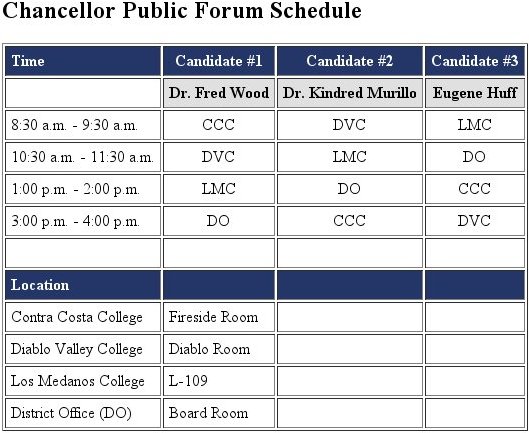
Public forums have been scheduled at each college and the District Office on Monday, October 31, 2016, beginning at 8:30 a.m. The three finalists will make statements and answer questions from attendees. The public forums will be 50 minutes each and are open to the community, students, faculty and staff. A detailed schedule of the public forums is available at www.4cd.edu.

chancellor-public-forum-scheduleIf anyone is unable to attend the scheduled public forums, the public forums held at Contra Costa College will be streamed live, and links to these recorded public forums will be available on the District website. Online comments about the finalists will be accepted through November 1, 2016, 5:00 p.m.

The Governing Board will interview all three finalists on November 1, 2016, and conduct additional deliberations as needed. It is anticipated that a public meeting will be scheduled within a couple of weeks following the interviews at which time the Governing Board will take action on the Chancellor search.

The Chancellor serves as the Chief Executive Officer of the District and reports directly to the five-member elected Governing Board. The Chancellor, in collaboration with the three college presidents and other District leadership, is responsible for assessing, planning, organizing and evaluating the resources, programs and services of the District to meet the educational needs of the students and the community.

As the educational and administrative leader of the District, the Chancellor represents the District to community groups, business and industry, labor organizations, public school districts, the Chancellor’s Office of the California Community Colleges, the University of California, California State University, private colleges and universities, city and county agencies, and the California legislature.

Following are the three finalists for Contra Costa Community College District Chancellor

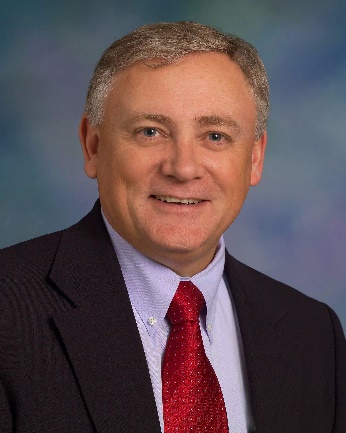
gene-huff-finalGene Huff (top left) has been with the Contra Costa Community College District since 2001. He has served as Executive Vice Chancellor, Administrative Services, since 2013, overseeing the fiscal services, human resources, information technology, police services and risk management areas for the District. He first served as a contract administrator, Vice Chancellor of Human Resources, in 2004 and has been the District’s chief negotiator since that time. Prior to joining the District, Huff worked for Whirlpool Corporation in operations and human resources for eleven years. Huff serves on the Executive Committee and Board of Directors for the Contra Costa County Schools Insurance Group, and chairs the District’s Retirement Board of Authority. He is best known for training and presenting on collective bargaining, and interest-based bargaining in particular, to human resources and other groups for almost a decade. He graduated from Purdue University with a bachelor’s degree in psychology and a master’s degree in management.

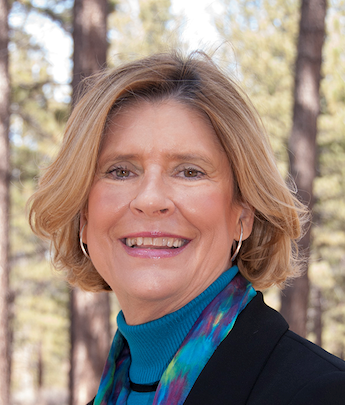
dr-kindred-murilloDr. Kindred Murillo is a passionate college educator serving for twenty years in the California Community College System. Serving for the past five years as the Superintendent/President of Lake Tahoe Community College, Kindred has worked with the campus and the local community to financially stabilize the college through Measure F, transparent and accountable budgets, and a focus on scheduling for “student access and success.” Before arriving in Tahoe, she served as the Vice Chancellor of Administrative Services for Contra Costa Community College District. Kindred also served as the Vice President of Administrative Services at Pasadena Area Community College District. She was promoted to Vice President of Finance and Administrative Services when Copper Mountain Community College became a separate district. Kindred was hired as an adjunct faculty at Desert Community College District in 1996, served as a full-time faculty member, and moved into college administration in 2000. She brings a unique background to community college with 13 years of business and six years of governmental relations experience. Kindred is a product of the community college system, graduating from Barstow College with a liberal arts degree.  She completed her Bachelor of Science in Business Administration at Redlands University and earned a Master of Science in Organizational Development and a doctorate in Organizational Leadership at Pepperdine University. Kindred enjoys spending time with her family riding bikes, hiking, and paddle boarding. She loves to read and is an avid seeker of knowledge.

dr-fred-woodDr. Fred Wood presently serves as Chancellor at the University of Minnesota Crookston (UMC). UMC, which was a two-year technical college beginning in 1966 and transitioned to a baccalaureate granting institution in 1993, is a work-force focused campus of the U of M system of which half of the degree seeking students are on-campus students and the other half are on-line. UMC offers an experiential learning based curriculum where on-campus students are required to complete an internship and currently offers 14 degrees fully on-line. Chancellor Wood joined UMC after a 26-year career at the University of California, Davis, where he served as vice chancellor of student affairs from 2007 to 2012, leading one of the largest student affairs portfolios in the nation. His career at UC Davis included other leadership positions, as well, such as interim vice provost for undergraduate studies and associate dean of the College of Letters and Science, while concurrently serving as a faculty member in chemistry. He began both his college education and professional career at the community college. Prior to UC Davis, Dr. Wood was a faculty member at North Idaho College and his first teaching assignment during graduate school was at Diablo Valley College. A first-generation college graduate, Chancellor Wood earned an A.A from Diablo Valley College, and B.S. and Ph.D. in chemistry from UC Davis. He is married and has three grown children. He enjoys hiking, biking and skiing with his family.

The Contra Costa Community College District (CCCCD) is one of the largest multi-college community college districts in California. The CCCCD serves a population of 1,019,640 people, and its boundaries encompass all but 48 of the 734-square-mile land area of Contra Costa County. The District is home to Contra Costa College in San Pablo, Diablo Valley College in Pleasant Hill, Los Medanos College in Pittsburg, as well as educational centers in Brentwood and San Ramon. The District headquarters is located in downtown Martinez.

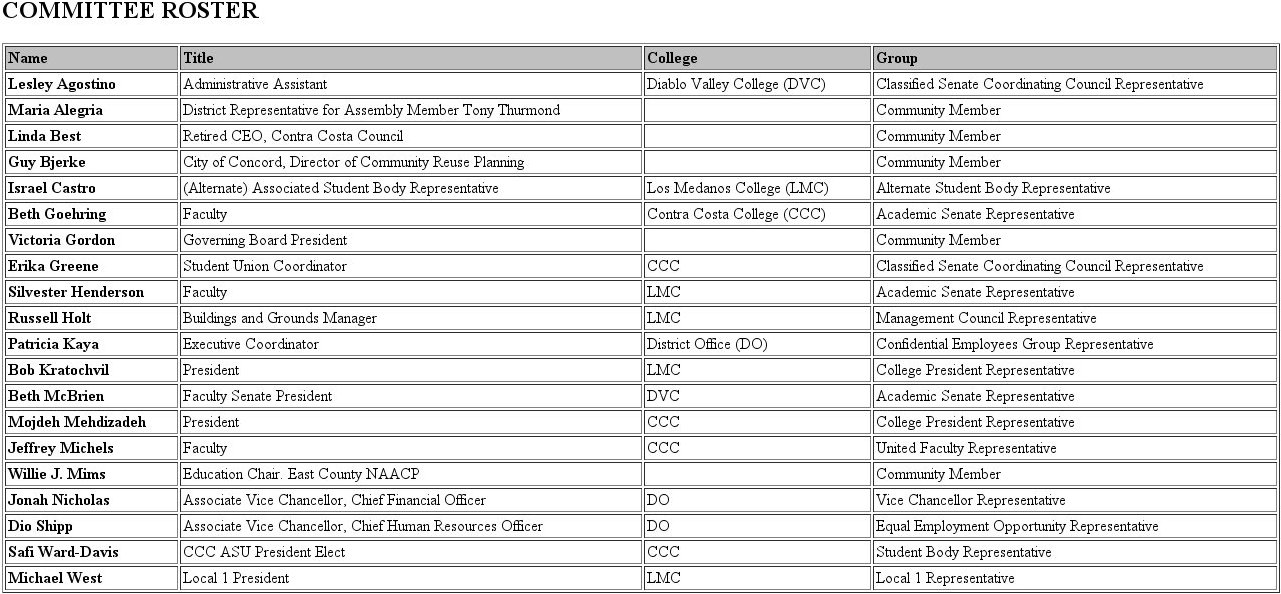
Following are the Members of the Chancellor Search Committee:

chancellor-search-committee-members

Congressman DeSaulnier receives “A” from National Education Association

Thursday, October 20th, 2016

Congressman Mark DeSaulnier (CA-11), the only Bay Area member on the House Committee on Education and the Workforce, received a perfect grade on the National Education Association’s (NEA) annual report card for the first session of the 114th Congress. The NEA is made up of 3 million members who are teachers and staff that work in every level of education, from pre-school to university graduate programs. Their Legislative Report Card measures Members of Congress’ overall support for public education and educators, with each Member receiving a letter grade of A, B, C, D or F.

“We know student success is highly dependent on early investment in their education. In my first year as a Member of Congress, I fought for a high quality and affordable education for every student in every classroom across the country. I am deeply honored to receive an A from the National Education Association and look forward to continuing to work with the NEA to improve our schools and prioritize student’s academic success,” said Congressman DeSaulnier.

“We commend Congressman DeSaulnier for listening to educators and getting the job done for students during the 114th Congress,” said Mary Kusler, NEA director of government relations. “The Congressional passage of the bipartisan Every Student Succeeds Act, which Rep. DeSaulnier supported, is a direct result of what is possible when legislators from both sides of the political aisle put students ahead of partisan politics especially in an era of gridlock in Washington. This result also is an unequivocal recognition that many lawmakers still believe educators – those who know the names of their students – are the most trusted professionals best equipped to make school and classroom decisions to ensure student success regardless of ZIP code. We hope that the bipartisanship displayed at times last year will lead to greater future collaboration. We will continue to work with all elected officials to ensure the success of every student in America.”

Congressman DeSaulnier’s measures to improve Head Start programs, protect student athletes from concussions, and strengthen students’ access to support and “wraparound” services like tutoring, counseling, and other extracurricular activities were successfully included in the Every Student Succeeds Act. Additionally, Congressman DeSaulnier recently completed his Education Listening Tour, during which he visited every school district and in California’s 11th Congressional District.

Antioch Council hears blight and homelessness report, gives go ahead for Sycamore area apartments rehab

Thursday, October 20th, 2016

By Nick Goodrich

On Tuesday, October 11th, the Antioch City Council heard a report on the city’s ongoing efforts to combat blight and homelessness, and also oversaw a public hearing concerning the proposed financing of the Delta Pines Apartments.

Public Comments

During public comments at the beginning of the meeting, and the Council once again heard from Save the Yard supporters, as well as a few Antioch business owners.

Joy Motts, a leader in the Save the Yard effort, read aloud from the city’s General Plan, which presented Antioch’s waterfront as a possible “major attraction.” She and several others expressed their frustration that the city had decided to build townhomes on the property, rather than a park and event center.

“The Beede Lumber Yard is a perfect place for a park,” Motts said. “Houses are not a legacy that anyone will remember you for. It’s time that you incorporate a public discussion into the decision of the Beede Lumber Yard.”

Two business owners in downtown Antioch also spoke before the Council on the state of the city.

Antioch resident Jim Lanter, a 12-year downtown business owner, listed several concerns, including the state of downtown at night, and blight affecting much of the surrounding area. He suggested installing better lighting to make people feel safer in downtown Antioch at night, and encourage businesses to stay open later.

Nicholas Olivier, owner of Urban Jumble in downtown Antioch, agreed with Lanter. He asked for increased police presence downtown, especially at night.

“Downtown is beginning to grow, but we definitely need help,” he said.

Efforts to Eradicate Blight & Homelessness

Ron Bernal, Assistant City Manager and Director of Public Works for the city, was on hand to give the report on blight and homelessness to the Council. He noted that the 2008 recession had contributed greatly to the blight problem by leaving behind a number of neglected residential properties and vacant buildings of businesses that were forced to close their doors.

The city was forced to shut down its Code Enforcement department and let go several park and street workers who had previously helped keep Antioch clean.

Since that time, the city has gradually built up the department, including the hiring of three new Code Enforcement Officers, one technician, and two laborers. The city has also reinstated the 40-hour work week, allowing Code Enforcement to do more each week.

In addition, Bernal reported that the Antioch Police Department’s hiring of an outside company – SP Plus Corp. – to ticket and tow vehicles, has seen great success. In the past six months, 528 unregistered, inoperable, or illegally parked vehicles were removed from Antioch’s streets.

The Council recently approved a three-year extension of the contract with SP Plus Corp. Bernal cited several other successes, such as the restriping of streets and curbs, and a new shopping cart ordinance slated to go into effect on November 1st, as signs that the city is making strides in combating blight.

“We’re trying to be very responsive to things that are offensive in our community, we’re making every effort to do that,” he told the audience at Tuesday’s meeting.

Bernal then addressed the homelessness problem in Antioch. In the last year, the city has seen a 33% increase in its homeless population, from 122 to 164. That increase paces East County’s 33% raise, while West County actually saw a 45% decrease.

The closure of the Don Brown Center earlier this year, which had provided services and resources for many of the East Bay’s homeless, and of Shelter Inc.’s transitional housing on Delta Fair Boulevard, created problems, Bernal said.

The city currently has budgeted $50,000 for the funding of homeless services, and the Antioch Shelter Project, which aims to replace the closed Don Brown Center, is in the process of finding a new location.

But Bernal emphasized the importance of the community in fighting the city’s homelessness problem, noting that faith-based institutions and individual citizens continue to do their part.

“Everybody needs to get involved,” he said. “We all need to try to work together.”

Delta Pines Apartments

Council also oversaw a public hearing on the proposed financing of the Delta Pines Apartments, on Sycamore Drive.

Delta Pines was constructed in the 1970’s and consists of 186 units on 7 acres, and is part of Antioch’s affordable housing stock. The Council voted 5-0 to approve a $35 million bond issued by the California Statewide Communities Development Authority for real estate investment firm Levy Affiliated to finance the complex.

The proposed financing will include its purchase and renovation by Levy Affiliated, which aims to provide energy upgrades, handicap accessibility, and new kitchens, energy-efficient appliances, and floors to the units.

No representatives of Levy Affiliated spoke on behalf of the project during the hearing, and no opponents spoke against it.

“I’m grateful that this is happening,” said Councilmember Monica Wilson, “That we have organizations coming in to rehab some of our older buildings, to make them handicap accessible, and for our low income and affordable housing. So hopefully we see some more of these come up.”

Mayor Pro Tem Lori Ogorchock agreed, citing recent rent increases.

“I’m just happy that they’re doing them, and that they’re making them ADA compliant,” she said. “We have several people with disabilities that were forced out of their rentals because their rents were increasing. So we need more of these.”