Archive for the ‘News’ Category

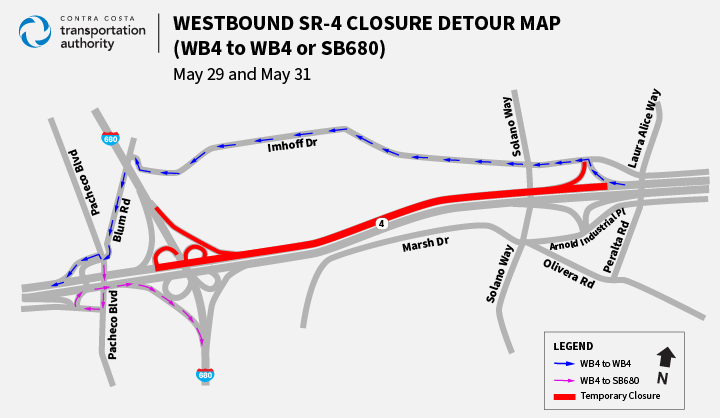
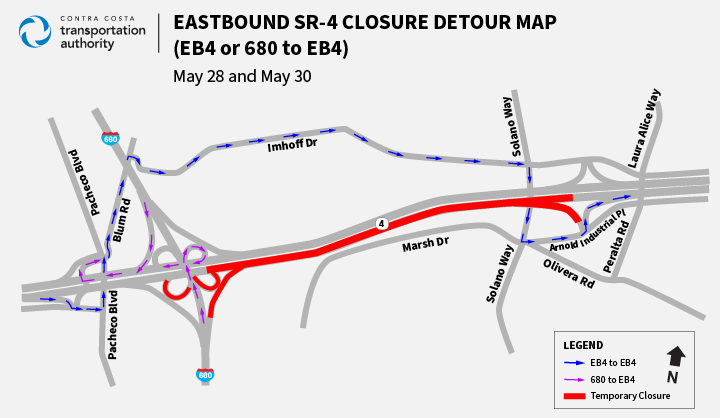
Full nighttime closures of State Route 4/Interstate 680 connector ramps through Sunday, May 31

Friday, May 29th, 2020

The Contra Costa Transportation Authority (CCTA) and the California Department of Transportation (Caltrans) are constructing the first phase of a multi-phased project to improve safety and help reduce congestion at the Interstate-680/State Route 4 Interchange in central Contra Costa County. In order to facilitate a key phase of construction that will shift traffic onto newly constructed facilities, the agencies are planning significant traffic shifts prior to, during and after the Memorial Day Weekend which will impact SR-4 and both of the I-680 connector ramps spanning Martinez, Pacheco, and Concord. CCTA and Caltrans have scheduled the closures during evening/nighttime hours and over the weekend in order to minimize impacts to the motoring public.

Nightly lane closures of SR-4 (from Pacheco Boulevard to Solano Way) and the I-680 connector ramps in both directions (northbound and southbound connectors to SR-4) will continue from May 28 –31, 2020. The work taking place during this time will enable traffic to move onto newly constructed facilities as they are completed, including:

  • Northbound Interstate 680 connector ramp to Eastbound State Route 4
  • Westbound State Route 4 connector ramp to Northbound Interstate 680
  • New Grayson Creek Eastbound and Westbound bridges
  • Shifting traffic onto the new median concrete pavement widening on State Route 4 between Pacheco Boulevard and Walnut Creek Bridge

Planned closures include:
Thursday, May 28 through Sunday May 31, 2020: Varies by evening, see below for specific times

Nightly full freeway closures for Eastbound and Westbound State Route 4 and full closure of the following ramps:

  • Full ramp closure of Eastbound SR-4 connector to Northbound I-680
  • Full ramp closure of Southbound I-680 connector to Eastbound SR-4
  • Full Ramp closure of Northbound I-680 connector to Eastbound SR-4

Thursday, May 28, 2020: 11:00 p.m. and 5:00 a.m.
Full freeway closure of Eastbound SR-4 from Pacheco Boulevard to Solano Way including full ramp closures listed above.

Friday, May 29, 2020: 10:00 p.m. and 8:00 a.m.
Full Freeway closure of Westbound SR-4 between Solano Way and Pacheco Boulevard including full ramp closures listed above.

Saturday May 30, 2020: 12:00 a.m. and 8:00 a.m.
Full Freeway closure of Eastbound SR-4 between Pacheco Boulevard to Solano Way including full ramp closures listed above.

Sunday May 31: 8:00 p.m. and 6:00 a.m.
Full freeway closure of Westbound SR-4 between Solano Way and Pacheco Boulevard including full ramp closures listed above.

Motorists are advised to be alert for on-site closure and detour signs, and to Slow for the Cone Zone.  Please drive with caution through the detours and leave a safe traveling distance between your vehicle and vehicle ahead of you. Please note that the construction schedule and closure information presented here are subject to change based on weather and other conditions. We appreciate everyone’s patience and cooperation as we work to complete these important improvements.

About the Interstate 680/State Route 4 Interchange Improvement Project
The Interstate 680/State Route 4 Interchange Improvement Project will widen approximately four miles of State Route 4 in both directions between Morello Avenue in Martinez and State Route 242 by adding a third lane in the eastbound and westbound directions to improve on-ramp and off-ramp merging.  The project also includes widening of five structures, extending eastbound State Route 4’s carpool lane approximately two miles, installation of safety lighting, and replacement of the Grayson Creek Bridge to bring it up to current State bridge safety codes.  This segment of work in this multi-phased project will lay the groundwork for future improvements to connector ramps, improve traffic safety and enhance traffic flow.


County’s Sustainability Committee considers declaring climate emergency in Contra Costa

Friday, May 29th, 2020

“that threatens the long-term economic and social well-being, health, safety, and security of the County” – proposed language from resolution.

Commission asked for input before making recommendation to full Board of Supervisors later this year.

By Allen Payton

During their meeting on Friday morning, May 29, 2020, the Contra Costa County Board of Supervisors’ Sustainability Committee, heard public input on the proposed Climate Emergency Resolution. Supervisor Federal Glover serves as committee Chair and Supervisor John Gioia, serves as Vice Chair.

“The committee didn’t actually vote on it,” said Jody London, Sustainability Coordinator for the county. “We received a lot of public comment on it. They wanted some modifications. There was argument that it wasn’t strong enough in some areas. The committee wasn’t in agreement with all the ideas but, we’re going to go back and work with the Sustainability Commission.”

“It’s a standing committee of the board that meets every other month,” she explained. “The commission, made up of members of the public appointed by the board, meets during the months in between. They usually happen at 5:00 p.m. on the fourth Monday of the month. It will be held online.”

The next meeting of the commission will be on June 23rd.

A revised resolution that includes input from the commission will return to the committee on July 27th, for final vote of recommendation to the full board, which can happen sometime in August or September depending on vacation schedules, London said.

According to the staff report, “On November 19, 2019, the Board of Supervisors (Board) received a proposal from the Contra Costa County Sustainability Commission that the Board adopt a Climate Emergency Resolution. The Board referred this item to the Sustainability Committee.
On December 9, 2019, the Sustainability Committee discussed options for structuring a climate emergency resolution. Supervisors expressed their opinion that resolutions have greater value when they identify tangible actions we can take. They cited to the recent State Executive Order N-19-19 on reducing greenhouse gas emissions and mitigating impacts of climate change in State government as an example. The Committee expressed interest in seeing the County take action on those issues where it can have the greatest impact. The Committee recognized that the County must balance priorities, it cannot invest in everything people might want at this time.

Community members offered many ideas for a climate emergency resolution. They stressed that this is an emergency and the County should provide bold leadership and action. Community members urged the Board include in any resolution deadlines or dates by which action can be expected. Community members expressed interest in the Board taxing the refineries located in Contra Costa County and determining how the County should plan for a situation where the refineries and other fossil-fuel based industries are not viable.

The Committee directed the Sustainability Coordinator to develop a draft climate emergency resolution in consultation with the Sustainability Commission and come back to the Committee.

The attached draft Climate Emergency Resolution was developed by staff, in consultation with the Sustainability Commission, which has discussed this at several meetings, most recently its February 24, 2020 meeting. The draft Resolution reflects the new realities of the COVID-19 pandemic. It recommends three actions:

  1. The County Department of Conservation and Development is directed to work with the County Administrator and other departments to establish an interdepartmental task force of Department heads, or their immediate deputies, that will focus on implementing the County’s Climate Action Plan and identifying additional actions, policies, and programs the County can undertake to reduce and adapt to the impacts of a changing climate.
  2. The County Sustainability Commission is directed to seek input from the community to help the County anticipate and plan for an economy that is less dependent on fossil fuel extraction and processing, helps plan for a transition from a fossil-fuel dependent economy, and considers how the County’s recovery from the COVID-19 pandemic can incorporate the County’s climate goals. As the State of California adopts policies and goals for reducing pollution and addressing climate change, the County will consider with the assistance of the Sustainabilty Commission what this will mean for County revenues, jobs, health, and infrastructure, including new opportunities and how frontline communities will realize economic and other benefits. The Commission will include this topic in its ongoing advice to the Board of Supervisors.
  3. Health, socio-economic, and racial equity considerations should be included in policymaking and climate solutions at all levels and across all sectors as the consequences of climate change have significant impacts on all County residents, but especially the young, the elderly, low-income or communities of color, and other vulnerable populations.”

The declaration portion of the draft resolution in its current form reads as follows:

NOW, THEREFORE, BE IT RESOLVED that the Board of Supervisors of the County of Contra Costa declares a climate emergency that threatens the long-term economic and social well-being, health, safety, and security of the County.

BE IT FURTHER RESOLVED that the County Department of Conservation and Development work with the County Administrator and other departments to establish an interdepartmental task force of Department heads, or their immediate deputies, that will focus on implementing the County’s Climate Action Plan and identifying additional actions, policies, and programs the County can undertake to reduce and adapt to the impacts of a changing climate.

BE IT FURTHER RESOLVED that the County Sustainability Commission seek input from the community to help the County anticipate and plan for an economy that is less dependent on fossil fuels, helps plan for a transition from a fossil-fuel dependent economy, and considers how the County’s recovery from the COVID-19 pandemic can incorporate the County’s climate goals. As the State of California adopts policies and goals for reducing pollution and addressing climate change, the County will consider with the assistance of the Sustainability Commission what this will mean for County revenues, jobs, health, and infrastructure including new opportunities and how frontline communities will realize economic and other benefits. The Commission will include this topic in its ongoing advice to the Board of Supervisors.

BE IT FURTHER RESOLVED that health, socio-economic, and racial equity considerations should be included in policymaking and climate solutions at all levels and across all sectors as the consequences of climate change have significant impacts on all County residents, especially the young, the elderly, low-income or communities of color, and other vulnerable populations.

Read the entire draft resolution, here – 41815_DRAFT Climate Emergency Resolution

Antioch Police help make Thursday’s graduation parade “amazing” for Antioch special needs students

Friday, May 29th, 2020

All photos by Leslie Reano.

By Leslie Reano and Antioch Police Department

“What a wonderful day today has been,” Lesli Reano an Instructional Aid for Special Needs with the Antioch Unified School District’s Community-Based Instruction program wrote in a Facebook post on Thursday, May 28, 2020. “Our AUSD CBI team had a parade for ALL our graduating young adults today. Our CBI teamed up and brought graduation signs, candy necklace and balloons to all 12 of our graduates. We then did a Graduation parade to each of their homes. The smiles that we saw from our students was priceless! We in CBI all want to thank our wonderful Police force for guiding us on our route to our kids’ homes! They went over and beyond! Thank you, Officer Calvin Prieto, Officer Andrea Rodriguez and Officer Ben Padilla you all were so fun, and your kindness will never be forgotten!! Thank you, Sergeant Smith for reaching out to Lieutenant Mendez and made this all happen. Shout out to our AUSD CBI Team!!!”

“Congratulations to our AUSD CBI graduates!!!” wrote the Antioch Police on their Facebook page. “APD was honored to be part of the graduation parade for the AUSD CBI program. The CBI Program, located on the Deer Valley High School campus, is a community-based instruction (CBI) program for 18- to 22-year-old students with special needs. The program is designed to assist students after earning their certificate of completion, transition into adult life, by helping them to become more independent within the community in the following four basic directions – Vocational Training, Community Access, Independent Living Skills, and Personal Development.

Please join us in congratulating these amazing graduates!”

The program also offers job coaching, Reano said.

Posted by Lesli Reano on Thursday, May 28, 2020


Sheriff’s Marine Patrol continues search for Delta boater missing since Thursday morning

Friday, May 29th, 2020

Photo by CCCSheriff.

By Jimmy Lee, Director of Public Affairs, Contra Costa County, Office of the Sheriff

A search for a missing boater is continuing this morning by the Contra Costa County Office of the Sheriff Marine Patrol Unit.

On Thursday, May 28, 2020, at about 10:30 in the morning, the Sheriff’s Office received a report of a missing boater who had gone into the waters in the San Joaquin River, north of Webb Tract.

The Contra Costa Sheriff’s Office Marine Patrol Unit responded and were assisted by Solano County, Sacramento County, San Joaquin County and the U.S. Coast Guard.

Umut Felik, a 27-year-old man from San Francisco, was swimming when he apparently had trouble staying above the water. At one point he went underwater and did not resurface. His friends on a boat went into the water to search for him but were not able to find him. They reported the incident to the Sheriff’s Office.

A search of the area with a sonar was suspended at 8 PM. Felik was not located.

Anyone with any information on this incident to asked to contact the Contra Costa Sheriff’s Office Marine Patrol Unit at (925) 427-8507.

County Health Officer will consider following state guidelines for churches, Supervisors don’t have authority to overrule him

Thursday, May 28th, 2020

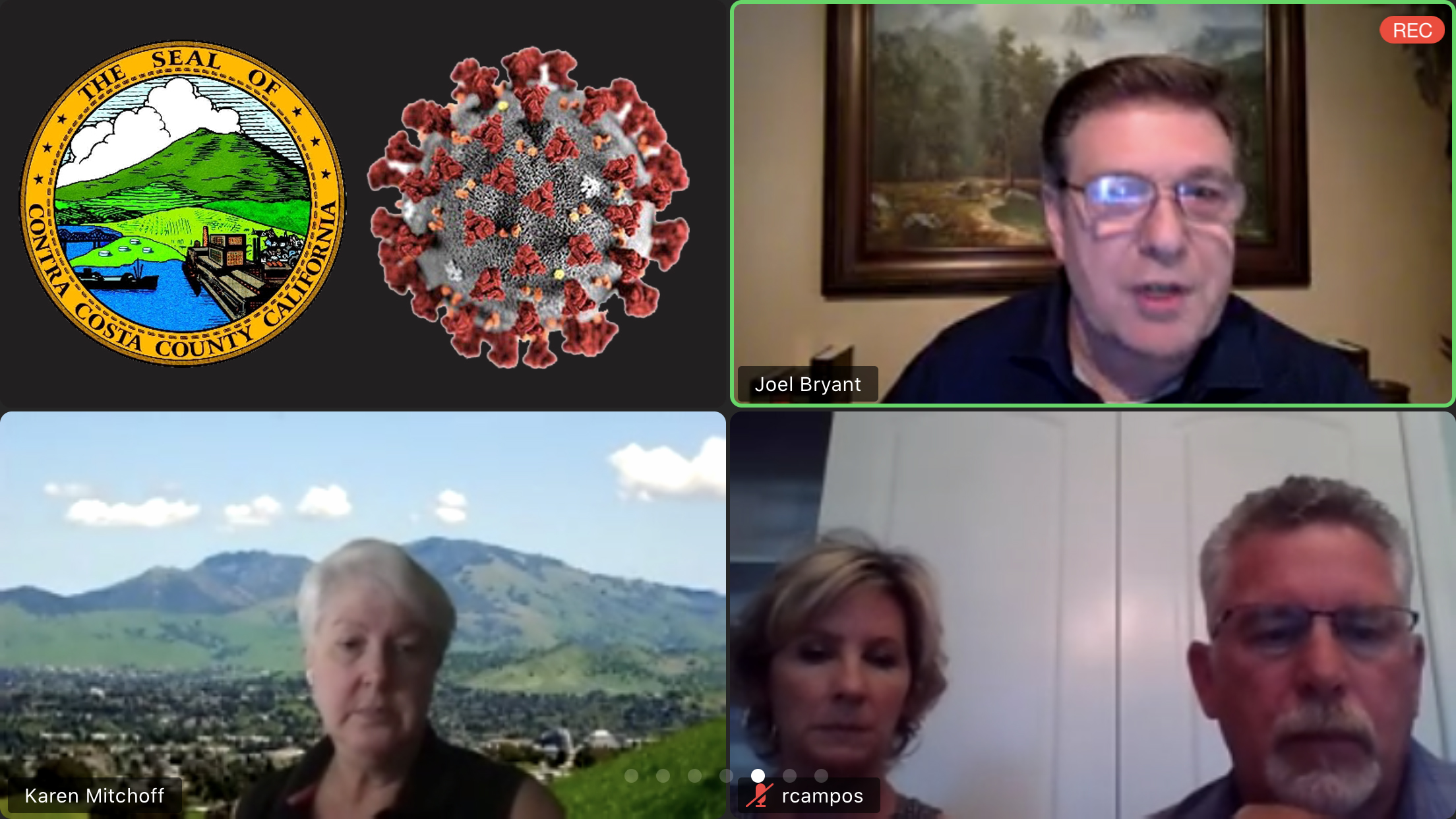
Screenshot of Board of Supervisors’ May 28, 2020 COVID-19 Ad Hoc Committee meeting using Zoom. Brentwood Vice Mayor Joel Bryant (upper right) speaks as Supervisor Karen Mitchoff (bottom left) and Michelle and Ric Campos listen.

Spiritual counseling is allowed in county, church services still aren’t; waiting for update next Tuesday to determine new orders

By Allen Payton

During the meeting of the Contra Costa County Board of Supervisors’ Ad Hoc Committee on COVID-19 Economic Impact and Recovery on Thursday, May 28, 2020, Board Chair Candace Andersen, Supervisor Karen Mitchoff, and County Health Officer Dr. Chris Farnitano heard from frustrated county residents on reopening the county. According to the agenda, the meeting was to “Consider the impacts of COVID-19 on religious gatherings and discuss pathways that may allow them to resume, if possible, within the limitations established by” Farnitano.

General Public Comments

A variety of residents spoke during public comments on issues not on the agenda

“Take back control from the Contra Costa County health officer and move on to Phase 3,” said Gertrud Jeffries.

Brentwood Vice Mayor Joel Bryant said he was, “asking our Supervisors of the Board to tell the county health officer to follow the governor in the guidelines.”

A woman who identified herself as “They Call Me Non-Esssential” spoke about the information provided by a doctor at John Muir Medical Center in Walnut Creek about more suicides than COVID-19 deaths in the county. “Dr. Farnitano said he hadn’t seen that data,” she said.

Robert Jackson, owner and CEO of Proforma Health Club in Walnut Creek, asked for guidance for health clubs that have a large outdoor area, and “more clarity on timeliness for reopening…after the expiration.”

Ric Campos of Campos Family Vineyards in Byron said, “We’re very involved in our community…hosting fundraising events and we have a tasting room. We can meet all the protocols. We submitted them to the supervisors. We also have a church that meets here, on Sundays. These numbers just don’t add up.”

“I understand Dr. Farnitano has a job to do. But he’s focusing on the medical. I’m asking our supervisors to look at the big picture, because this virus is hurting our businesses,” Campos continued. “Only 37 have died, which is horrible. But most of them are over 80 and 90 years old and others are over 70 years old. I’m asking our supervisors to step up. You have the authority to override the doctor. Something has to be done. It’s getting bad. So, please…”

“help this community we’ve elected you to oversee,” said Michelle Campos, concluding her husband’s remarks.

Patricia McBroom spoke of “a community pool we can accommodate small groups. I would like the county to follow the CDC guidelines on small housing…for them to schedule their own uses. It doesn’t make sense to have one category.”

Tricia Wilkalis said, “I want to talk about these small businesses, I’d rather shop at them than the large retailers. I think they’re more safe.” She then spoke of mental health and a young man who attempted suicide. “I want you to reevaluate this lockdown and what it’s doing to our citizens.”

“There are exceptions to wearing masks,” said Supervisor Candace Andersen.

Dr. Farnitano, “About wearing masks, this is about changing science and recommendations from the Centers for Disease Control. Most transmissions are from people without symptoms. Universal face coverings have a big effect on limiting the spread. People with medical conditions where wearing masks restrict their breathing, we need to let business owners know not to interfere with them not wearing masks.”

A question about dance, gymnastics and camps was asked.

“Where do you see dance classes coming in from the state order?” asked Andersen.

“The state has not provided guidance on that, yet. Our current order allows outdoor activities that allow for six feet apart, like Tai Chi classes,” Dr. Farnitano said. “I haven’t seen any differentiation, yet.”

He was then asked by Andersen about suicides, and that “the shelter in place does cause a huge emotional strain.”

“When we see recessions in general, that causes physical stress that leads to mental stress,” Dr. Farnitano said. “The shelter-in-place is causing a tremendous amount of stress. Looking across the county we’re not seeing a change in suicides. We’re reaching out to the hospitals to gather the data. It is a concern.”

Andersen encouraged people to dial 2-11 for crisis intervention or health services, for counseling and for help.

“This issue has been dominant in our calls between supervisors and health staff,” said Supervisor Karen Mitchoff. “Our sheriff will be gathering 24 months of data. There have been additional numbers of suicide in the count. But he’s not seeing a trend there. We don’t have that data, today.”

Andersen asked about outdoor dining, tasting rooms. When do you anticipate…where do you see that falling in, Chris?”

“Seated dining as opposed to take-out is in the state’s Phase 3. The state’s order doesn’t allow that anywhere in the state, yet,” Dr. Farnitano said. “A lot of health officers are talking about outdoor dining, first, because of the air flows and the spacing. It’s probably coming and the state’s going to be coming up with guidance on that.”

“We’re almost at two weeks next Tuesday since the last loosening of restrictions. What will the new order include…so businesses can prepare,” Andersen.

“We are working with the Bay Area. We are one human ecosystem…because a lot of people shop and work among the counties,” Dr. Farnitano explained. He then spoke of “expanding childcare to all folks not just those who are working, but people who are seeking childcare. We are looking at some services that don’t require close customer contact, like house cleaning, car washes, outdoor museums. But the higher risk, like the indoor retail…when to address the religious gatherings, which we know are high risk…there’s a large desire for that. The state just came out with guidance on those in the last few days.”

“We can’t make decisions without data and we need at least two weeks of data to see where the trends are heading,” he continued. “We are looking at next Tuesday, and if the data shows we aren’t looking at a new surge, then we will consider more opening.”

“Will we know before Tuesday so businesses can prepare?” Andersen asked.

Shelter-In-Place Order Doesn’t Expire on May 31st

“The current order expires May 31st” said Mitchoff.

“No, the current order doesn’t expire. It was extended indefinitely,” Dr. Farnitano responded. “Until we get two weeks of data which is Tuesday. We could put out something on Monday that this may be coming. When you put out an order, there is some lag time for it going into effect.”

Asked about a community pool with a small number of houses using the pool, maybe people can sign up with this household using the pool from 9:00 to 9:30 a.m., etc.?” Andersen.

“The state order does not allow for them. The local order cannot be more loose than the state. But I can look into guidance from the state,” Dr. Farnitano replied.

Asked about opening up playgrounds, he replied, “The two concerns about playgrounds are transmission from surfaces, which are difficult to be wiped down between uses and the closeness of those who gather. These prohibitions may be looked at in the future.”

Supervisors Can’t Authority to Override Health Officer

“We were asked about the authority to override the county health officer,” Mitchoff stated. “We do not have the authority to override a health officer according to state law. We have repeatedly check with legal authorities. You can imagine that when there is a public health issue you don’t want politicians interfering with that.”

Asked about housecleaners returning to work in Contra Costa County

“That is something we do have consensus on…and those services that don’t have close contact between the customer and the service provider. “Piano tuners would fall in with that, as well,” Dr. Farnitano replied.

Asked about football teams practicing and preparing for the fall season he said, “There is a lot of outdoor…conditioning that doesn’t require a lot of contact. Throwing back and forth of a football between two people, like throwing a baseball or playing tennis…those are the kinds of things you can stay far apart. Those are the kinds of things that are allowed. There are a lot of…conditioning things you can do.

Religious Gatherings

Andersen then steered the meeting toward the main topic of focus, religious gatherings.

“If we can’t go to the full 100 like the governor’s order…there may be some ways we can allow people to meet in person for worship services,” said Andersen.

Shawna Garvin spoke first during public comments on the item, said she attends “Golden Hills Community Church, a large church, 100 people, I don’t know how we would make that work. But I do know one way we could make it work, small groups. A consistent group of people, four to six people, ours is 14 to 16 people in our group. We are not supposed to be apart and separated in our faith.”

“Hebrews 10:24 and 25 reads ‘we should not make it a habit not to meet together’. This is a command,” she continued. “How can we meet in small groups? Sitting six to 10 feet apart. I’m not going to have my freedoms totally stretched.”

Wendi a member of Community Presbyterian Church in Danville said, “I’m totally in line with not opening churches. But I’m totally in line with what Shawna said about small groups.”

“Personally, I’m dying inside, not just spiritually,” she continued. “This goes for me as a Christian, but this goes way beyond this…about community…waiting for county orders to allow small groups. As if the county health officer can’t decide. He’s the one who decides. We’re stricter than the state.”

Chuck said, “our church has a capacity of 1,200. Why would we have to have seat coverings when restaurants don’t? The 100-person limit, frankly is arbitrary. What I’ve seen is people are starting to disregard rules, period. When you don’t have rules that make sense…that’s more dangerous. You need to relax the rules, now.”

A Mr. Cottle said, “Last Sunday I was in Sacramento and ate inside a BJ’s. It was nice. In addition to being a scientist that deals with infectious disease in healthcare…54% of churches have less than 100 people who attend on a Sunday. I’m privileged to pastor a small church…we seat 177. We could seat 35 people easy with social distance.”

“Back on the 11th you opened up a small group gathering for a graduation event,” he continued. “Allowing one and not allowing the other is a constitutional violation.” Cottle then called for “opening up churches along the state guidelines immediately.”

A member of St. Agnews Church in Concord said they have about 125 who attend their services. “When we put a 100-person limit would we have a problem if those extra 25 people sit outside and listen to the service, while social distancing? I challenge you to show data where people sitting six-feet apart outdoors is a problem from a healthcare perspective.”

“I’m really urging our supervisors to encourage, as well as Dr. Farnitano to really look at this, again,” said Joel Bryant. “As an elected official I feel personally responsible for everyone in my community.”

He then spoke of the need for counseling for those in need. “I encourage opening up and at least match the state…to eliminate some of these tragedies that are being brought on because of the COVID-19 situation.”

Jared Thompson, pastor of a Christian church in Walnut Creek said he was, “Asking what is permitted for me as a pastor. I have people suffering from depression in my congregation. I was told to try to deal with it virtually. We’re a church without a permanent facility. We rent Valle Verde Elementary. As soon as all this went down our services were cancelled.”

He referred to “outdoor fitness where people are six feet apart, I’ve even heard that singing is a deterrent. If a community group can be six feet apart, why can’t a small church meet outdoors? I wish there were more clarity. There are other churches that meet at schools and none of us know what we can do. And the disparity. We’ve been praying for you all as you make these decisions.”

A woman named Barbara said, “I’m from North Creek Church, but I’m not representing them. I’m a counselor there. We have 50 counselors. We’ve seen an increase in counselees…that have a lot of issues that are going on. I’ve been Zooming for 10 weeks, now, two-and-a-half to three hours. Zooming is not enough. You can’t read body language. When you have 0.11% of Contra Costa County that has been affected by COVID this really doesn’t make sense. Mental health is a big thing we deal with…we’re just ignoring that aspect. Also, let our pastors shepherd their flock and let them be responsible.”

Michelle Campos then said, “Doctor, I would like to challenge you. Suicides, violence, child molestation, these are things happening in Contra Costa County because you are keeping us locked down and that goes against how our Father has designed us. I’m not understanding why liquor stores, smoke shops, abortion clinics are deemed essential, but our churches…are not essential.”

“We’ve done our part Zooming for 10-12 weeks,” she continued. “We were not designed to live on science and data. I implore our supervisors to do something.”

“37 deaths, come one,” said her husband Ric Campos. “Doctor, please look at the big picture, not just the science and data. This is killing our society. I’m seeing him (Farnitano) do videos and 99% of the people are asking you to reopen and you just ignore us.”

Michael Weisman spoke of suicides in Contra Costa County and referred to a Bay Area TV news report in which the John Muir doctors presented the information. “Why would two doctors…lie?” he asked.

Weisman then spoke of the statistics from a couple months ago that showed, “3.4% of those who have died. The latest CDC statistics show 10% of that. I believe it is now time for the health official to reconsider his position. The supervisors should make a change in that position. The health officer doesn’t seem to care about our faith.”

Kent Dresdow, Senior Pastor at North Creek Church asked about their 1,200-person sanctuary. “To have a 100-person limit is pretty restrictive for us,” he said. “We want to follow our authorities. We are people waiting on both sides. We can meet with 25% capacity. Not the 100-person or less.”

“Would it allow for us to meet 100 people at different spaces on campus at the same time?” Dresdow asked. “My main concern is to be in compliance and super safe. Other churches…will have the same questions. Larger churches will.”

Igor Skaredoff said, “One of the reasons we have such low numbers of deaths…is because we have been practicing good social distances. But, listening to all these comments…I really commend your guidelines in a step by step fashion. The coronavirus takes two weeks to show up. If you continue to operate the same way…we can get there without losing too many people.”

A man named Stan said, “I hear a complete lack of flexibility in enforcing the rules. I don’t know if Dr. Farnitano can be more strict, or more relaxed. Do you have discretion? Whose interests do you have in mind? What I’m hearing ii your complete lack of flexibility…it’s big brother in Sacramento. To the pastor who wants to have an outdoor service, tell them you’re going to have an outdoor workout.”

Robert said “A lot of what you’re hearing is fairness. Fairness is really, really difficult to see in this. If we’re going to open up churches to 100 people, why are we all suffering so much and ruining our businesses? It’s like why can’t I go exercise at my health club but I can go to McDonald’s. It doesn’t make sense.”

Denise Porchia from Clayton said, “Karen you are my servant, government supervisor.”

“Uh, huh,” responded Mitchoff.

“We the people believe that God is the Creator of as us acknowledged in the Declaration of Independence” which she then read. “Let’s not forget we the people are creators of government…we demand our servant government…of the jealously guarding of our unalienable rights.”

A woman named Karen then said, “We remind you of the oath that you have…sworn when you became our public servants,” and then read the oath of office all elected officials take in California. The Constitution of the U.S. is the supreme law of the land…for every level of government.” She then quoted Alexander Hamilton from Federalist 78.

Paul Taylor then said, “The Supreme Court of the United States…that no law is contrary to the Constitution is valid. Our state is ruling outside of its control. Government is servant to the people not the master. Servant is not authorized to force the people to wear masks…to stay at home…to close their businesses. It does not matter if the servant believes such mandates will keep the people safe or that most people want it. Let us never forget that the Constitution guarantees to each state a Republican form of government where the rights are supreme.”

Michelle O’Connor asked, “Do you know if the de facto orders upon the people are legal? Or do you rely on the advice of the people. If you don’t know the supreme law how do you know if you’re violating them? Do you know what the penalty is for violating them? There is not immunity for acting against the contract. You will be held accountable.”

Scott Bennett a former U.S. Army Officer said he was notifying the supervisors of violating the rights of the people.

“They shall be fined…and imprisoned no more than 10 years” he stated. “I hereby give legal notice…if an rights or any citizens of the United States of wearing a mask, or taking a vaccine…you will be criminally prosecuted and civilly prosecuted. You have been notified.”

Supervisors Respond, Mitchoff Defends Herself

The two supervisors then took up the matter.

Mitchoff spoke first saying, “Candace as a matter of protocol, we have another Zoom meeting at 3:00 p.m. We have to leave ample time for remarks…” from her, Andersen and Dr. Farnitano.

“Some of the questions put to Chris are directed at us,” said Mitchoff. “I found some of the comments to be personal attacks on Dr. Farnitano, which I find to be inappropriate. He has no personal stake in this order. He is using his best medical and scientific background in coordination with other Bay Area health officers. Personal attacks are inappropriate.”

“People who are either for or against an issue appear to be in the majority because they’re engaged, when people speak to it, it appears more or for or against it,” she continued. “We are a representative government, not servant government. We can’t just listen to the loudest voices in the room. Someone said…he was ignoring their pleas. That’s not true.”

“What we have told Dr. Farnitano is to be more consistent with the state,” Mitchoff said. “I’m a faith-oriented person. I know Candace is and the rest of our board is. We are sharing the same concerns you are. So, we understand the issue. I’d love for any of you to take my place and to have any other issue. I’m very aware of what the Constitution says, and I’d be more than happy to be put under scrutiny that I’ve followed the laws of the state of California.”

“There are five indicators issued by the state of California. We don’t even meet three of them,” she said. “Relative to church services…I know it’s hard. My church probably holds 400 people. The smaller number would be the 25% of square footage. We can talk to our health officer about different types of church services. I’m looking at a variety of churches that have a number of different buildings. Church services can be staggered. I feel I must do what is best for everyone in this county.”

“We can have our faith-based communities come together sooner rather than later,” said Supervisor Andersen.

Dr. Farnitano Responds

“I want to thank everyone who has offered me their prayers,” said Dr. Farnitano. “We have passed two key milestones in the last day or so. There have been over 100,000 deaths in the U.S. We have only had 37 deaths in our county…that is because our community has followed the guidelines. If we had the same statistics as the country, we would have had over 300 deaths. We know that Contra Costa County is older than the U.S. and we know that age is a factor in the mortality rate. The other milestone is 100,000 cases in California. The Bay Area put the shelter-in-place order sooner. It has opened up step by step but slower than the state. If we had the same rate of cases as the State of California, we would have had double the cases.”

“Contra Costa County is a more dense county than a lot of the state,” he continued. “We have to look at the deaths that have occurred but also those we have prevented.”

“Worship is really important to me, too,” Dr. Farnitano said. “My church has been doing Zoom services for several weeks, now and I understand it’s not the same. One issue is around spiritual counseling…it’s part of mental health. Spiritual counseling is allowed. I want to make sure our FAQ’s are clear and include that.”

As for churches holding services, again he said, “There’s a lot of science that outdoor meetings are less of a risk. Indoor meetings are more of a risk. There was an outbreak in Mendocino County because of a church service. We can look at following the state guidelines in allowing church services.”

“We have a data team looking at data state by state, what’s leading one state without a surge, are they opening up completely or in stages, has there not been enough time, or testing,” Dr. Farnitano explained. “We’re trying to learn from that. We tried to learn from China’s and Asia’s experience, Europe’s experience, and now the other states’ experiences.”

“Each area is unique. Contra Costa County has unique industries…density,” he stated. “We are also looking across the Bay Area at some surges. In Alameda County we are starting to see a surge in hospitals to the levels in March.”

Dr. Farnitano mentioned patients being transferred from a hospital in Richmond to one in Alameda County. “Some of those hospital numbers in Alameda County are residents of Contra Costa County,” he added.

“These decisions are mine…but I’m not looking at them in a vacuum,” Dr. Farnitano stated. “I’m taking input from meetings such as this. I have several deputy health officers. I take input from the Board of Supervisors…also hearing from businesses. Also talking with other health officers across the Bay Area and at the state.”

“We want to open safely and not have another surge,” he said.

“We want to open as soon as we can,” Andersen said. “We won’t get back to normal. We are hearing from several of you about opening up. We are close to families getting back together.”

“We really are looking at with the state these expanded bubbles…small support groups in the church, having a more expanded group, your extended family, your small groups. We are looking at ways to have that happening,” Dr. Farnitano concluded.

“I do believe we will have more information from the state on their order. Maybe half of the agenda (for next week’s Ad Hoc Committee meeting) can be devoted to the new order that will be coming out,” said Mitchoff. “I do want to address dance and other recreation. I’d like to talk about restaurants. But I don’t think we’re there. I’d like to start with businesses with the least amount of impact.”

With that, Supervisor Andersen concluded the meeting.

Contra Costa supervisors agree to hire pollster for possible half cent sales tax measure, extend ban on evictions to November

Wednesday, May 27th, 2020

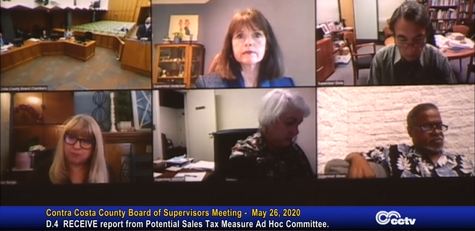
Screenshot of the Contra Costa County Board of Supervisors’ online meeting on Tuesday, May 26, 2020.

County Health Services using Remdesivir for COVID-19 patients; get glimpse of COVID-19 era libraries

By Daniel Borsuk

The Contra Costa County Board of Supervisors discussed possibly placing a half-cent sales tax measure to fund health and social services on the November ballot and approved hiring a pollster on a split vote. The tax measure would be in addition to a proposed Bay Area-wide half-cent sales tax measure for transportation expected to be on the November ballot, as well.

Approve Hiring Pollster for Half Cent Sales Tax Study

In response to the Contra Costa Needs Assessment from the county’s Sales Tax Working Group a countywide half-cent sales tax is being proposed “to shore up access to medical and behavioral health services, and bolster county safety-net programs.” BOS 052620 Contra Costa Needs Assessment

At least for now, it is uncertain if the board will move forward with a sales tax increase measure for the November ballot. Supervisors voted 4-1, with Board Chair Candace Andersen casting the lone, dissenting vote, to spend as much as $60,000 to hire a pollster to test whether voters would support one. But since the outbreak of COVID-19, public support for such a tax measure might have waned.

“We need further direction and getting results from a poll will help,” said Supervisor Karen Mitchoff. “Before COVID, support for a tax increase was optimistic, but with COVID it might be different.”

District 1 Supervisor John Gioia, a big booster of a sales tax increase, said it would cost $30,000 to $40,000 to poll 600,000 to 800,000 prospective voters. Mitchoff said a more realistic cost is $60,000.

Both Gioia and Mitchoff serve on the Potential Sales Tax Measure Ad Hoc Committee.

“Right now, is not the time to spend county funds for a poll,” said chair Andersen of Danville.

Extend Temporary Ban on Evictions and Residential Rent Increase Moratorium

With the supervisors’ month-old ordinance that imposed a temporary ban on evictions and a residential rent increase moratorium at the end of May, supervisors acted to extend the ordinance through July 15. Supervisors also imposed a one-year grace period and defined a commercial real property eligible for the ordinance “…as an independently owned and operated business that is not dominate in its field of operation, has its principal office in California, has 100 or fewer employees, and has average annual gross receipts of $15 million or less over the previous three years.”

Figuring the economy will not recover quickly to restore jobs, some speakers asked supervisors to extend the rent increase moratorium one year.

“Keep pace with Alameda County,” said Dick Offerman of Pleasant Hill. “See that no one is evicted in our county. Extend the moratorium one year.”

Mitchoff took time to warn landlords who are violating the county ordinance. “Landlords know about this ordinance. There are some bad actors who take advantage of people who speak English as a second language, this must stop,” she said.

County Health Uses Remdesivir for COVID-19 Patients

Contra Costa County Public Health Officer Dr. Christopher Farnitano informed supervisors that Contra Costa County Public Health has begun administering the anti-viral drug Remdesivir to COVID-19 patients. A total of 105 dosages were given last week, Dr. Farnitano said.

“The company that is making it (the drug) is giving this to the United States.” Dr. Farnitano said that the drug is “This drug is somewhat beneficial.”

Dr. Farnitano said there were as of Tuesday 13 COVID-19 patients in Contra Costa Medical Center, compared to 19 patients two weeks ago. Since the outbreak of the pandemic in March, 37 persons have died from COVID-19 in the county, four deaths occurred in the past week with one of the deaths in the person’s early 30’s, which is uncommon.

So far, the county is COVID-19 testing daily 95 people per 100,000 residents when the daily goal should be 200 people per 100,000 residents.

This drew Supervisor Mitchoff to question the testing.

“We’re about halfway there,” she said. “I did not want to test, but now I want to test in order to get our numbers up.”

Board Vice Chair Supervisor Diane Burgis of Brentwood asked why the COVID-19 test takers at county sites have to wait for results as long as 10 days when persons at three state sites get results within five days.

Contra Costa County Health Department Director Anna Roth said the average turnaround for COVID-19 results is three to five days, but it could be up to 10 days.

Get Glimpse of COVID-19 Era Libraries

took a glimpse of what the COVID-19 era might look like on Tuesday visualizing the 26 public libraries could offer some type of front door service for patrons to pick up checked out books in bags and when libraries do open doors possibly on June 15 seating capacity will be reduced 20 percent at each location right when outdoor temperatures are peaking above 100 degrees and libraries often serve as cooling centers for the public.

Supervisors unanimously approved the Contra Costa County Library Pandemic Preparedness Plan presented by County Librarian Melinda Cervantes that promotes hygiene, social distancing, and reduced seating. BOS 052620 CCCL Pandemic Preparedness Plan Draft Final

“We plan to begin service as soon as possible,” Cervantes told supervisors during the teleconferenced board meeting.

During the presentation, supervisors learned 36 library accounting positions might be eliminated because of COVID-19 related revenue losses. The potential loss of the library jobs will undermine library book purchasing.

“We need to get through the state budget,” responded county administrator David Twa, who said the 36 library accounting jobs are “potential job layoffs” and are subject to the meet and confer process. The state budget will be unveiled in mid-June.

Approve Purchase of DA’s Office Mobile Forensic Vehicle

In other action, the supervisors approved the District Attorney’s Office request to execute an agreement with the City of San Jose for the expenditure of up to $200,000 to procure a mobile forensic vehicle for the Silicon Valley Internet Crimes Against Children Task Force. The vehicle is expected to cost $48,285.

Antioch School Board cuts 29 classified staff positions on contentious split vote

Wednesday, May 27th, 2020

By Allen Payton

During their Wednesday board meeting, the Antioch School District Trustees voted 3-2 to eliminate almost 29 classified staff positions for the 2020-21 school year in response to the proposed budget cuts by Governor Newsom. AUSD Reduction in Classified Service Resolution 05-27-20

According to the district staff report, “the California Education Code requires that classified employees whose positions will be eliminated or reduced due to lack of work or lack of funds receive at least 60 days written notice prior to the date on which their position reduction and/or layoff becomes effective. Statute also requires that classified employees whose positions are categorically-funded receive notification of layoff on or before April 29 of the calendar year when their positions will end due to the expiration of funding.”

“We’ve tried our best…at keeping as many positions as possible,” said Deputy Superintendent Jessica Romeo. “I will not pretend a different position…is not hard on employees. But we are doing our best to see what other positions we have in the district to keep as many employees as possible. All of these individuals would have the right to substitute…to keep some income.”

Board President Diane Gibson-Gray read public comments, which included those from district teachers and staff.

Amy Gonzales wrote, “As one of the 28.788 jobs being put up for elimination, I understand…cuts must come. I think that the pandemic has shown food workers are essential in our community. I think students will say the library will be high on their list. As a high school registrar, I don’t just enroll new students.” She then provided a long list of other tasks she fulfills. “Enrolling new students only takes up 5% of my job.”

Sheila Driscoll wrote, “It seems like every time the budget gets cut classified takes the brunt of the cuts. Instructional aids are important to each school. I’m willing to hold off on pay raises if it means my fellow workers keep their jobs. It’s too early to be laying people off. We have to work together.”

Teacher Maureen Hatfield wrote, “I am very concerned with layoffs of library staff at the elementary level. With the layoffs…our ability to address those needs (of reading) will be hampered. Please do not take this valuable resource away from our children.”

Staff member Lisa Perry wrote, opposing the elimination of the homeless education liaison. “This is a federally mandated position, so the district will have to find someone else to take on these duties. Homelessness and instability will increase. A high level of financial and emotional support is necessary for these students. This position is completely funded with Title 1 funds from the federal government.”

Julie Cross wrote about her concerns with the cuts to library staff. “Society can’t afford to lose them.”

Jennifer Zamora wrote, “The closing of elementary libraries is one place that shouldn’t be cut.”

Madeline Crooks wrote concerning the cuts to library tech staff and the homeless liaison position. “I truly hope this district can find a way to keep these positions.”

“Why cut so many classified staff who are needed to run our district so much?” wrote someone who chose to be anonymous.

An Antioch High School staff member, Samantha Lipscomb wrote, “When we cut our vital registrars…who has helped me for countless years is frightening. In addition, they are cutting our college and career coordinator. Do what is right for the kids. A smile and helpful heart cannot be replaced by a computer.”

Jenna Wesenhagen, an Antioch High School employee wrote about classified staff, “They are too important to eliminate,” then provided a long list of tasks they perform.

Leslie Scudero wrote, “Essential meaning absolutely necessary. This year cuts the remaining five positions” in the elementary school libraries.

She then suggested the district “eliminate all outside vendors and conferences. We have highly educated staff that can squeak by. Cut the services of Strategic Threat Management, you’re not getting your money’s worth. We have site safety staff who can do the job. I for one would gladly give up a week or two from my work year to save the classified employees. Ask if the jobs…you’re cutting are essential.”

Superintendent Stephanie Anello then read more public comments.

Jessica Kelp wrote, “When I say we, I mean everyone on the high school campus,” then mentioned the difficulty of students having to travel off campus to get transcripts with the elimination of registrars.

Another commenter wrote “If we keep cutting positions, we will have nothing to run our schools. We cannot demand the most while giving the least. Teachers respect the classified staff you are proposing cutting, this evening.”

Jeff Adkins a staff member, wrote, “How does moving someone to the central office more efficient than leaving them on site

Christy Hansen, an elementary teacher, called cutting elementary library positions “short sighted.”

Kimball Elementary teacher Kenneth Kent referring to the COVID-19 wrote, “I worry layoffs in classified staff will make sanitizing impossible” among other concerns with the staff cuts.

Then the board took up the matter.

Trustee Ellie Householder spoke first. “I hear you all very loud and clear. I want to thank the staff for the hard work in developing this recommendation. But it is a recommendation. I don’t see a reason why we have to vote on this, tonight. My preference would be to hold off maybe a week, a couple of days…to sit down and have a study session…so we can say we have no other options. These are unprecedented times call for unprecedented measures. With that I am going to be voting to reject this recommendation. Let’s pump the breaks for a minute. We should triple and quadruple check.”

Trustee Crystal Sawyer-White then shared her thoughts.

“I think that we should, I’m supporting Trustee Ellie Householder as a parent and teacher,” she said, then spoke of going line by line through the proposed cuts, and then teacher safety.

Gibson-Gray then pointed out that Sawyer-White was off topic and asked her to only discuss the staff cuts.

“Safety is the key before we consider the next school year,” Sawyer-White stated. “This is a pandemic and health is the issue.”

Trustee Mary Rocha said, “As a former classified (employee), I feel badly having to make a decision like this. There’s a requirement…we have to take action on. It’s not just going to be classified that will take a brunt.”

Gibson-Gray spoke next saying, “We have to have a qualified budget to stay out of…receivership. We have to make these cuts tonight. This is the layoff notice…many times we’re able to find money by July 1st. I’m confident…this has gone through a thought process. This needs to be done. If anything changes the cuts will be rescinded if there are the funds.”

Rocha then made the motion to approve the resolution eliminating the positions and Trustee Gary Hack seconded it.

“I just wanted to add, tonight isn’t the deadline to make this decision. We do have a little bit of time to make this decision,” Householder reiterated. “I would hope the process would be more transparent. When I hear…staff and the community doesn’t know how this process happened. I want the community to know we’ve done everything to save these people’s jobs. Even though you’ve been in this position, before this is fundamentally different.”

“I’m confident that any position that’s unfilled and not needed for the next school year was eliminated,” said Gibson-Gray. “I would recommend you have a conversation with the superintendent. I am very reflective that these are people. This is how it’s done. It’s a process. By the end of July…if we’re able to save 14 people, then 14 can stay.”

“I have to push back a bit. It’s not fair to say this is a process,” Householder said. “Our board, whose essential existence is that we approve or deny a budge recommendation. We approve this final budget…and we can wait. It’s our decision. It’s not staff. We are the board that approves the budget. I think it’s unfair you characterize it like that.”

“And I think it’s unfair you characterized it like that,” Gibson-Gray shot back.

“We must have a budget by Friday,” Romeo explained. “If you look at a dollar amount in this resolution it does not have all the budget reductions for next year. But, I will continue to do that…to continue to look for ways to…keep as many positions as possible. We do have to follow legal requirements…with whatever contracts we have.”

Sawyer-White then said, “I would like to ask legal counsel. If we could have a closed session and have someone who is an attorney with respect to COVID shelter-in-place. This is a serious matter. I’ve seen several emails. These are people.”

“We have to have a budget that is public as of next Friday” June 5th “that will come before the board on June 10th. Then on June 24th it will be up for adoption by the board and this process has been published,” Romeo explained.

“It’s hard. Some of them are family members,” said Rocha.

“I would like to convey to Trustee Rocha that this can be postponed,” Sawyer-White said.

“It can’t be postponed…June 5th,” Rocha could be heard saying within range of her microphone.

“I can see what’s going on here. Parents are contacting me. They’re depressed. Please postpone this,” Sawyer-White appealed.

“I spent 15 years on a bargaining team. I’ve been here and done that so many times and it’s painful” Hack said. “But there’s rules and there’s laws that have to be adhered to in a timely manner. We had a tentative agreement back in February then all heck happened. But there’s still a timeline. The state won’t let us put it off.”

The motion to approve the cuts then passed on a 3-2 vote with Gibson-Gray, Rocha and Hack voting in favor, and Sawyer-White and Householder voting against.

Following are the positions listed in the adopted resolution that were eliminated for the 2020-21 school year:

Position                                                                                               Full-Time Equivalent

CURRICULUM COORDINATOR                                                               1.000

DISTRICT ATTENDENDANCE LIAISON-BILINGUAL                         1.000

INSTRUCTIONAL ASSISTANT                                                                 6.192

INSTRUCTIONAL ASSISTANT, BILINGUAL                                         1.752

LIBRARY MEDIA TECHNICIAN I                                                            5.000

OFFICE ASSISTANT – CLASSIFIED HUMAN RESOURCES                1.000

PRINT SHOP RECORDS AND INFORMATION TECHNICIAN             1.000

REGISTRAR I                                                                                               4.406

REGISTRAR II                                                                                              3.000

REGISTRAR III                                                                                            2.000

STUDENT FIELD ASSISTANT                                                                   1.000

STUDENT MONITOR                                                                                  0.438

WAREHOUSE WORKER DRIVER                                                            1.000

Total FTE                                                                                                        28.788

Assemblyman Frazier frustrated High Speed Rail Draft Business Plan full of misleading information

Wednesday, May 27th, 2020

Photo from HSR.ca.gov.

Sacramento – Earlier today, Wednesday, May 27, 2020, the Assembly Transportation Committee Chaired by Assemblymember Jim Frazier (D-Fairfield) held an oversight hearing on the California High Speed Rail Authority’s (HSRA) 2020 Draft Business Plan. The HSRA is required to adopt and submit a final business plan to the Legislature on May 1st every two years that details funding, financing and ridership estimates for the entire project.

Since the Legislature first envisioned high-speed rail in the state in 1996 and residents first voted on Prop 1A in 2008 to help fund the project, the general idea for how the state would accomplish this has largely remained the same. The actual business plan authored by the Authority however has been riddled with issues and come under increased scrutiny from the Legislature as costs and deadlines have ballooned while reports of dysfunction and organizational chaos have become widespread.

From CA HSR 2020 Draft Business Plan.

“Once again, it seems the High-Speed Rail Authority has released in the 2020 Draft Business Plan a proposal for its future that it can’t afford and that won’t deliver what is promised. Every version of the Business Plan has increased costs and reduced scope and no longer resembles the vision promised in the 2008 ballot measure’’, said Assemblymember Frazier. “Despite efforts by myself and some of my colleagues, the Authority continues to propose electrifying a segment of a train line in the Central Valley that will add billions of dollars to the project and provide little or no benefit.”

“I believe there is a way to rescue this project from failure, but I think it requires honest evaluation and true cost-benefit analysis, neither of which the Authority has ever been able to provide”, continued Frazier. “Every iteration of the business plan comes with new promises without results. It is going to take a lot of explanation for me to believe that, this time, the Authority’s cost and ridership estimates are legitimate, and this is something the state should continue to invest in.”

Development of high-speed rail in California began more than 20 years ago.  SB 1420 (Kopp), Chapter 796, Statutes of 1996, created HSRA to direct development and implementation of intercity high-speed rail service that would be fully coordinated with other public transportation services.

For more information on this legislation or to learn more about Assemblymember Frazier, please visit his website.

Assemblymember Frazier represents the 11th Assembly District, which includes the communities of Antioch, Bethel Island, Birds Landing, Brentwood, Byron, Collinsville, Discovery Bay, Fairfield, Isleton, Knightsen, Locke, Oakley, Pittsburg (partial), Rio Vista, Suisun City, Travis AFB, Vacaville and Walnut Grove.