







Archive for the ‘News’ Category

Antioch school district shares what’s being done to help third graders reading below grade level

Wednesday, October 20th, 2021

Source: California Reading Coalition

PUBLISHER’S NOTE: The email received by the Herald from AUSD Associate Superintendent, Educational Services,  Christine Ibarra, on Thursday, Sept. 30 was missed until, yesterday. She responded to questions sent on Monday, Sept. 27 for the article entitled, “Statewide report shows 76% of Antioch third graders reading below grade level for 2017-18, 2018-19 school years.” While they’ve been added to the article, it’s best they be published separately. Apologies to Ms. Ibarra, district staff and our readers for the oversight. Allen Payton

9/30/21 UPDATE: AUSD Responds – Following are the Herald’s questions and the answers from Associate Superintendent Christine Ibarra:

Q – What is being done to rectify this situation? What ideas, programs, or suggestions have any of the trustees proposed during their terms on the board? Have any been approved and implemented? If so, what are the results? If so or if not, what do you propose be done?

A – AUSD is heavily invested in a computer adaptive instructional program known as iReady.  All students in grades K-8th participate in this research-based program.  This program provides three diagnostic assessments per year and produces individualized placement levels in reading.  The students then engage in a pathway of instruction that is both done within the computerized program itself and supported by intervention prep teachers on campuses with direct instruction that is tailored to the individual levels and needs of each student.  Since this is our third year utilizing this program, we have data that shows significant growth in students’ reading levels and abilities at all grade levels even during distance learning.

Furthermore, AUSD has provided every elementary school with a full-time intervention teacher who works with small groups providing intentional and targeted support in areas of need, specifically in fluency skills and reading comprehension. These intervention teachers utilize a wide array of differentiation strategies and support to ensure their time with student groups is maximized for the greatest impact on student growth and achievement.

In addition, AUSD has an MOU with UC Berkeley’s California Reading and Literacy Project for the 2021-2022 school year.  This partnership provides professional learning for all teachers TK-6th grade specifically focused on developing teachers’ content knowledge and expanding their teaching strategies guided by the state-adopted frameworks, content standards, and the science of reading.

Read 180 is a research-based program being reintroduced to AUSD intended for secondary students who are performing two or more years behind grade level in Reading.

AUSD is also heavily invested in the AVID programming and professional learning community which has provided hundreds of teachers across all grade levels with outstanding workshops focused on critical reading strategies across content areas so that all teachers have tools and supports to support reading levels at any grade level.  This summer alone, we had 50 teachers attend virtually.

The iReady program, Read 180, the AVID program, and the UC Berkeley partnership are Board approved contracts and the intervention teaching positions were board approved via the LCAP and Expanded Learning Opportunities grant.

Q – Since education begins at home, what is being done to work with the parents or guardians of the students reading below grade level to help them?

A – We provided ongoing trainings and support during school closures remotely in both English and Spanish. The parent trainings were not only for technology support efforts but were designed to also increase parents’ capacity to support their students at home and in their academics.  iReady specifically provided parent institutes that were widely attended virtually.  Since returning to in-person learning, we have worked closely with our District English Language Advisory Committees (DELAC) as well as our Parent Advisory Committees (PACs) and Site Councils from all schools across the district to assess what parents need and are interested in engaging in to support their students’ academic achievement.  Most, if not all of our elementary and middle schools, host parent training nights focused on both literacy and mathematics and are working to determine how to continue that effort with COVID-19 protocols in place this year.

Q – For the Hispanic/Latino students, is it a matter of Spanish being the primary language at home? How many ESL students are there in the district, please?

A – AUSD currently serves 2,687 English Learners (EL) and has over 450 students being tested to determine their English Learner status as of today.  Although Spanish is the largest group of English Learners’ population in AUSD, we have over 30 different languages spoken within our EL population.
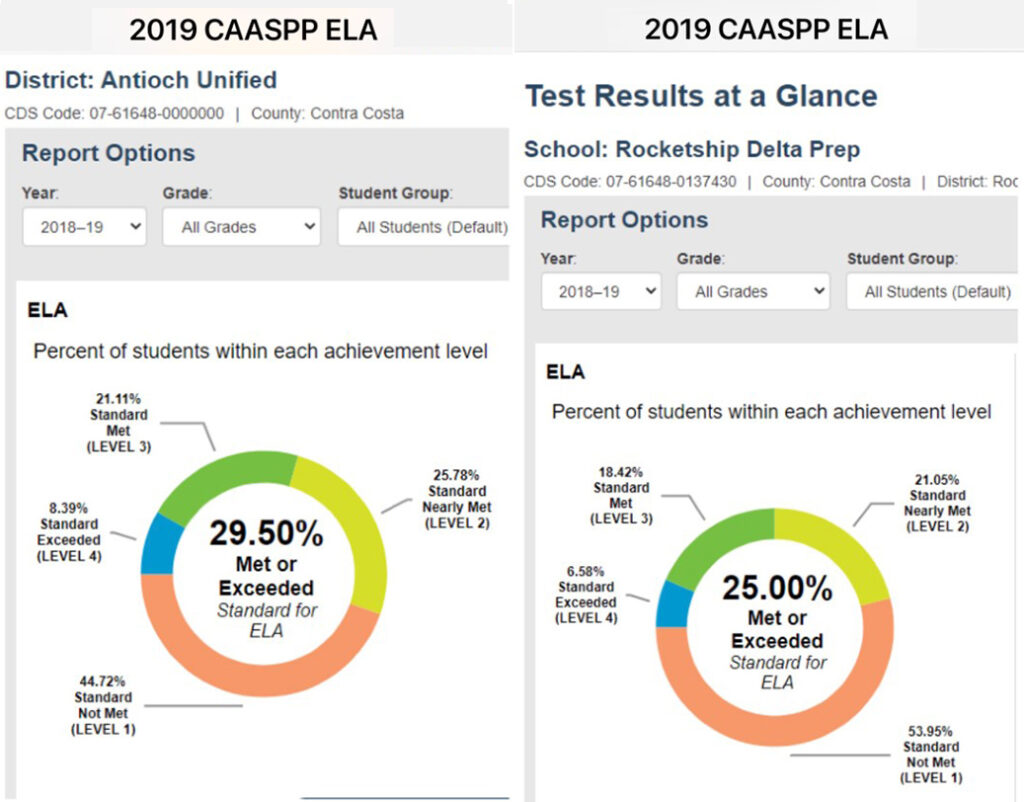
California Assessment of Student Performance and Progress (CAASPP) English Learning Arts AUSD vs Rocketship Delta Prep 2018-19. Source: CAASPP

Q – Have there been any efforts to work with Rocketship Delta Prep to learn what their best practices are which, according to their reports, show significant advancement among their students and in just one school year, and implement them in district schools?

A – The AUSD Educational Services department meets annually with Rocketship and reviews their programming efforts as required. Best practices are shared and exchanged during those meetings.  Since we have not had summative state data results in the last two years, the conversation has not been directly about the improvement of test scores.  In the 2019 CAASPP, AUSD students performed higher in English Language Arts.

Q – On whom does the responsibility lay for this, the board, superintendent, principals, teachers and/or parents?

Are there subject matters being taught in the classroom that aren’t required that take time away from focusing on reading skills?

A – Educating students and ensuring students have all the supports and opportunities they deserve and require is a collective responsibility.  When we can work together to that end, we will see students reach their full potential.

Parents: talk to your teen driver about safe driving during National Teen Driver Safety Week Oct. 17-23, 2021

Tuesday, October 19th, 2021

National Teen Driver Safety Week is Oct. 17-23, 2021. Source: National Highway Traffic Safety Administration

Your teen is in the driver’s seat, but you’re in control

It’s National Teen Driver Safety Week. This week, and every week, parents should have conversations with their teens about the important rules they need to follow to stay safe behind the wheel of a motor vehicle. These rules address the greatest dangers for teen drivers: alcohol, inconsistent or no seat belt use, distracted and drowsy driving, speeding, and number of passengers.

Facts about Teen Driver Fatalities:

According to the National Highway Traffic Safety Administration (NHTSA), motor vehicle crashes are the leading cause of death for teens (15-18 years old) in the United States.

In 2019, there were 2,042 people killed in crashes involving a teen driver, of which 628 deaths were the teen driver.

Parents can be the biggest influencers on teens’ choices behind the wheel if they take the time to talk with their teens about some of the biggest driving risks. You should let your teen drivers know that obeying the rules of the road is a must. Breaking the rules leads to walking, riding the bus, using rideshare or going back to begging for rides from mom and dad.

The Rules of the Road

Wear seat belts

The car doesn’t move until everyone is buckled up — front seat and back, on every trip, every time. Almost half of the passengers killed in cars driven by teen drivers in recent years weren’t buckled up in 2019.

No drinking and no drugs

Emphasize the fact that it’s illegal to drink before you’re 21 — and that driving drunk or high is unacceptable at any age. In 2019, 16% of teen drivers involved in fatal crashes had been drinking.

No distractions

Driving is the first and only task when behind the wheel. That means no phones or texting while driving, and not doing anything else — like eating, drinking, or fixing hair and makeup — when you should fully focus on driving. About 10% of all teen drivers involved in fatal crashes in recent years were distracted at the time of the crash. Teens should activate the “do not disturb” feature on their phones to eliminate the distractions notifications cause.

No speeding

About 27% of teen drivers involved in fatal crashes were speeding in 2019. Faster speeds rob inexperienced teen drivers of the extra reaction time they may need to avoid a crash. Emphasize that they must obey posted speed limits.

Limit extra passengers

Teen drivers are at a greater risk for a crash when they have others in their car. Passengers can serve as a distraction for inexperienced teen drivers, and that’s why many states’ graduated driver licensing (GDL) restrictions prohibit any passengers in vehicles with teen drivers. GDL laws also set other limits on teen drivers for safety.

Drowsy Driving

We all know how important sleep is, especially for your teens during the school year when studying can cause long nights. Remind your teen the importance of a good night’s sleep, and the dangers of drowsy driving.

Don’t just set the rules — set the example

Parents, you’re role models. When a teen driver sees you obeying the rules of the road, they get the message. If you’re breaking the rules, they may adopt those behaviors when they’re on the road. Check yourself: assess how you’re driving (whether you’re following the rules of the road) and think about what your driving communicates to your teen driver.

While National Teen Driver Safety Week is a great reminder to discuss safe driving as a family, keep the conversation going year-round. If you do, you’ll not only better protect your young driver, you’ll be contributing to safer roads in your community. For even more information, visit our Teen Driving section.

The Antioch Police Department contributed to this report.


Antioch hires social justice organization to develop non-emergency crisis response system, survey residents

Monday, October 18th, 2021

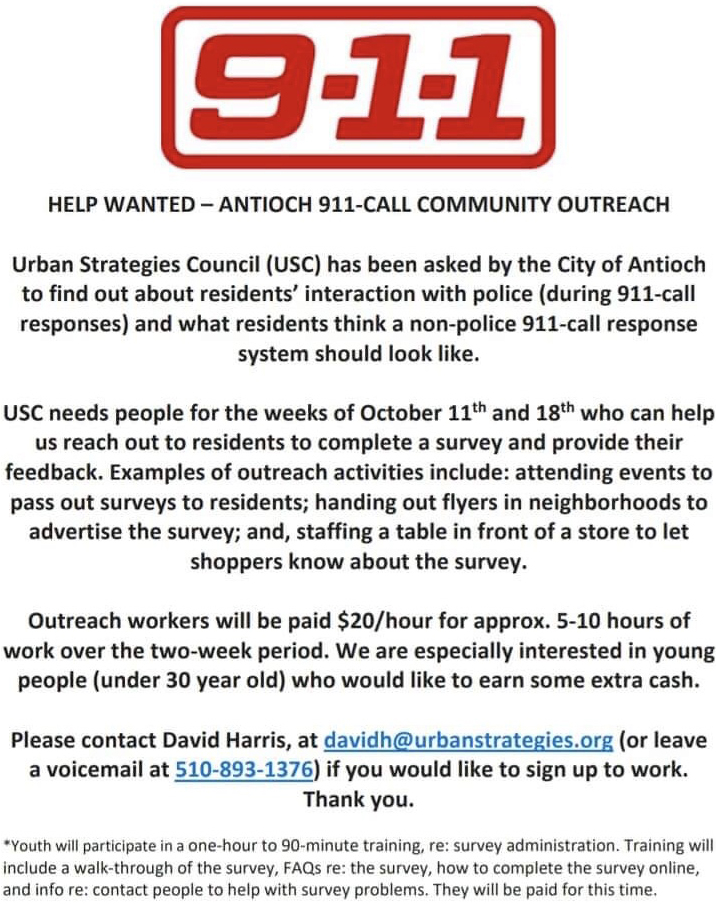
Expertise is in data gathering, but no experience developing a program; recruiting workers at $20 per hour for survey; focus is on people of color and impoverished residents

By Allen Payton

During the August 10th Antioch City Council meeting Urban Strategies Council (USC), a-not-for-profit social justice organization, was introduced and hired to design a mobile, mental health crisis intervention model for the City of Antioch, to address non-emergency calls using well-trained community respondents. Urban Strategies Council presentation ACC081021

According to city staff, some calls to 911 and the City’s non-emergency number are for situations that do not need a police officer to respond. To develop Antioch’s program public feedback is needed. USC is collecting input from Antioch residents who have experience with the 911 system or feedback on how the City addresses non-emergency 911 calls and community needs. This survey aims to understand community needs from the voice of the people most impacted.

According to USC’s presentation to the city council, the community resident survey is “focusing on most impacted residents – African-American, Asian-Pacific Islander, Latinx (Latino/Hispanic).” The presentation also shows they plan to have a pilot program developed by the end of this month.

According to Assistant City Manager Rosanna Bayon Moore, “USC is in the process of outreach for the City’s program design phase.  A survey is one of the many ways they are collecting information to inform the program design.”

USC has been recruiting workers to help with the survey, offering to pay $20 per hour this past week and next. One was sent to all staff at Antioch High School, according to Jon Davis who works for the school district.

According to their website, USC is “a regional research and advocacy organization dedicated to social, economic, and racial equity. We work to hold institutions and systems accountable to community needs.” Their “mission is to eliminate persistent poverty in the Bay Area by working with partners to transform low-income neighborhoods into vibrant, healthy communities.”

Their work focuses on the issue areas of Criminal Justice Reform, Boys and Men of Color, Economic Opportunity, Pathways to Career and College, and Violence Prevention. Regarding USC’s approach, they write, “In order to move the needle on persistent poverty, we need to change the systems that are currently ineffective, and so we focus  on reforming the systems that serve low-income communities.”

Asked why the organization was chosen and what experience they have in developing a non-emergency response system for a city, what does their mission have to do with developing a non-emergency response system, who suggested USC as the organization to hire for this, a staff or council member, and how much the City is paying them to develop the program and do the survey.

Bayon Moore responded Saturday evening with the following: “The City seeks to establish an effective mobile crisis intervention response program.  This initiative is supported by the entire City Council.  Staff’s work in this area is a high priority which is why the program is being overseen by the City Manager’s Office.

Multicultural literacy is a centerpiece of our approach to program design that cannot be ignored or minimized in terms of importance.  This includes but is not limited to being aware and mindful of all resident needs, including our neighbors who may not participate in conventional public processes.

Urban Strategies Council was selected by a multi department interview process that included PD.  The engagement threshold is within the City Manager’s signature authority.

I suggest you take a closer look at USC’s professional skills and capabilities.  The August presentation I’ve already shared includes a link to materials that describe their prior work and Antioch’s actual scope of work, again, including but not limited to a survey.”

In response, some questions were repeated, and further questions were asked of Bayon Moore late Saturday night, including “how much is the contract for with USC? If they do have any experience developing a non-emergency response program/mobile, mental health crisis intervention model, can you please provide that information or point to where it can be found on their website? What does their mission have to do with developing a non-emergency response system? Why is this focused on people of color and impoverished residents? Is the effort of the survey and entire response program focused on them as is USC’s mission and focus areas? Also, how does USC know, as it shows in the presentation to Council on Aug. 10th, without first surveying Antioch residents, that ‘African-American, Asian-Pacific Islander, Latinx’ are the ‘most impacted residents’ of our city? Do they have some previously gathered data to support that claim? Were any other organizations considered for the project that might have more or any experience developing and implementing one in a city? Finally, without having to take the survey, can you please provide a list of the questions they’re asking?”

Questions were also sent Saturday afternoon to David Harris, President and CEO of USC, asking what experience they have in developing a non-emergency response system for cities and how would a system in Antioch fulfill his organization’s mission. He was also asked, without first surveying Antioch residents, how can he claim, as it shows in his presentation, that “African-American, Asian-Pacific Islander, Latinx” are the “most impacted residents” of our city, and does he have some previously gathered data to support that claim. Finally, Harris was asked if it was one of the city staff or council members who contacted him for the presentation and contract with the city, and if he was still recruiting workers for this next week. He did not respond before publication time, early Monday afternoon.

Harris called late Monday afternoon and agreed to call back later that evening following his organization’s board meeting, or the next day, but did not.

The survey is anonymous and confidential and takes seven minutes to complete.

English/Inglés: https://www.surveymonkey.com/r/Antioch_2021

Spanish/Español: https://www.surveymonkey.com/r/Antioch_Spanish

Please check back later for any updates to this report.

Antioch councilwomen claim tenants are being harassed, face eviction, want new protection ordinances

Monday, October 18th, 2021

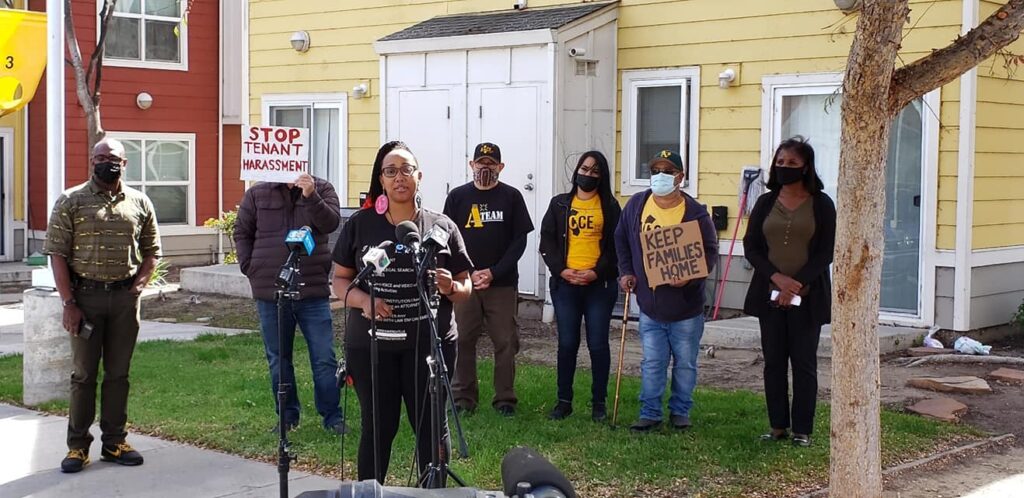
Antioch District 1 Councilwoman Tamisha Torres-Walker speaks as Mayor Pro Tem Monica Wilson (far right) and others, including representatives of Contra Costa County’s chapter of the Alliance of Californians for Community Empowerment listen at the press conference on Tuesday, Oct. 12, 2021. Photo from her official Facebook page.

Hold press conference to ask Mayor Thorpe to place tenant anti-harassment and just cause for eviction policies on next meeting agenda; fail to invite local media; council members and mayor refuse to answer questions about the proposals

By Allen Payton

On Tuesday, Oct. 12, 2021, Antioch Mayor Pro Tem Monica Wilson and District 1 Councilwoman Tamisha Torres-Walker held a press conference to highlight claims of Antioch renters getting harassed by their landlords and facing eviction, and call on Mayor Lamar Thorpe to place both an anti-harassment and a just cause for eviction ordinances on the next council meeting agenda. The councilwomen did not invite local media to attend.

A KTVU FOX2 news article from the press conference reports, “they were joined by members of Contra Costa County’s chapter of the Alliance of Californians for Community Empowerment, which has campaigned for similar tenant anti-harassment ordinances in other cities.” A similar anti-harassment ordinance was adopted by the Los Angeles City Council in June. According to the ordinance, “violation of the ordinance can be either a criminal misdemeanor (up to 6 months in jail or a $1,000 fine for each offense), or a civil violation (damages, rent refunds for reduction in housing services, reasonable attorney’s fees and costs, fine of up to $10,000 per violation, or tenant relocation)”.

Tenant protections against eviction, rent increases and late fees ended in Contra Costa County on Sept. 30. The Board of Supervisors on a 2-3 vote chose not to extend the protections. (See related article)

The state’s protections also ended Sept. 30.

KTVU also reported Thorpe said, “I personally have concerns with Antioch tenants being harassed, especially during the pandemic, so conceptually, I agree with these protections.”

On her official Facebook page, on Oct. 12, Torres-Walker posted the following statement about the effort with photos from the press conference, including three people who spoke, besides the two councilwomen.

“Antioch had the highest rate of evictions out of any Bay Area city during the pandemic, and researchers are predicting it is likely to be a hotspot for evictions after the statewide eviction moratorium lifts. Sadly the highest concentration of evictions in Antioch has been in District 1.

In September I requested that an anti-displacement policy be brought to the council for immediate action as Statewide and County-wide moratoriums were coming to an end and renters facing eviction were calling on us as city leaders to do something. I was honored to have the support of mayor pro tem Monica Wilson who back up that request last month stating that she as well wanted to see policies around anti-landlord harassment and just cause evictions to be brought to the council.

In July I met with over 20 residents in the River Town [sic] area who were facing eviction and devastated about their family’s future I met with even more residents in the Sycamore community who had the same concerns that their families would end up on the streets.

The government assistance that was promised to make renters and landlords whole has been slow to reach the ground, slow to meet the need, and moratoriums have only been a band-aid for a larger issue around housing access and affordability in the region.

Proposed policies:

Anti-Harassment Ordinance

An anti-harassment ordinance defines certain bad-faith landlord behaviors as unlawful harassment. Tenants can then enforce their rights against landlords who engage in these behaviors. Harassment can include lack of repairs, a landlord not taking care while doing construction or other repairs, discriminatory behavior like sexual harassment, racial discrimination, or disability discrimination, a landlord threatening to report tenants to immigration authorities, a landlord threatening violence, and other behaviors designed to make tenants’ lives more difficult or cause them to leave their homes. If a tenant wins in court, their landlord will pay damages and their attorneys’ fees.

Harassment of tenants is a way for some landlords to circumvent other legal tenant protections. When some landlords can’t legally evict a tenant to raise the rent, they will instead harass the tenant until they have no choice but to leave their home. This makes existing tenant protections less effective.

An anti-harassment ordinance removes the financial incentive for harassment by adding penalties for bad actor landlords. Landlords who don’t harass tenants don’t need to worry about the anti-harassment ordinance because they won’t need to change their behavior to comply with it. Instead, an anti-harassment ordinance promotes neighborhood stability and safe and healthy housing.

Just Cause Supplements

Tenants also need effective eviction protections to remain in their homes. The statewide just cause for eviction law, AB 1482, contains several eviction loopholes that allow landlords to evict tenants for ‘no-fault’ reasons and then re-rent the unit at a higher rent once the tenants have been forced out. To prevent unscrupulous actors from using these ‘building clearing’ loopholes, a city can pass a “just cause” supplement.

‘No fault’ evictions can happen to tenants who are paying their rent and complying with their lease. ‘Substantial renovation’ and ‘removal from the rental market’ are examples of two ‘no-fault’ types of evictions that, unless regulated, can result in tenant displacement.

Under the substantial renovation loophole, a landlord can evict a tenant under state law to remodel their unit, and the tenant has no right of return. In contrast, under a local just cause supplement, a tenant may only be required to temporarily move out, once the landlord has secured all necessary building permits, and can return at the same rent amount once the repairs are made.

Similarly, under the ‘withdrawal’ loophole, state law allows a landlord to evict a tenant to remove a property from the rental market for an unspecified amount of time. But under a local just cause ordinance designed to prevent unfair evictions, the removal must be long-term (ten years), give the tenant additional notice, and allow the tenant to return at the same rent if the property is re-rented.

These ‘building clearing’ loopholes, when used by unscrupulous actors, can put entire neighborhoods at risk. However, the loopholes can be easily closed under an ordinance to stop pretextual evictions and prevent displacement.”

Questions for Councilwomen, Mayor

Questions were sent to the councilwomen and mayor early Friday morning asking, what landlords are harassing tenants? In apartments or single-family residences? How many and which tenants were or are being harassed? What do they mean by harassment? Requiring they pay their rent or face eviction? Or was their rent raised or late fees assessed illegally up until Sept 30 when the county protections for tenants ended? Did any of you, including Mayor Thorpe, speak with any of the landlords to get their side of the story? Was it anything to do with COVID that the tenants couldn’t pay their rent or some other reason the tenants were facing eviction?

In response to Torres-Walker’s Facebook post more questions were asked, including, what can the City of Antioch actually do to enforce such an ordinance? Can a general law city, like Antioch, adopt and enforce a just cause evictions ordinance (like Los Angeles, which is a charter city)? Do you have a sample of one you can provide? Would the city sue the landlord or help the tenant sue their landlord? Can the city fine the property owner?”

In addition, Saturday night, questions were posted below the photos on Torres-Walker’s Facebook post asking who are the other that spoke during the press conference and appear in the photos and what did they say.

Thorpe responded Friday morning, but only with “Please remove me from this discussion. This press conference was put together by these two Council members not me. They have requested these items come before council so let’s be cognizant of the Brown Act.”

The same questions were then immediately resent to just the two councilwomen, and a separate email was sent to the mayor.

The questions were resent, again early Sunday morning, Oct. 17 to the councilwomen and mayor, in two separate emails. As of Sunday night, none of the three had responded to the questions from the Herald.

Please check back later for any updates to this report.

Concord carjacking suspects arrested in Antioch following police pursuit Saturday morning

Saturday, October 16th, 2021

Carjacking suspects stopped their car on Golf Course Road near the Lone Tree Way intersection, and fled the scene on foot, Saturday morning, Oct. 16, 2021. Photos by APD.

Armed with AR-15 style weapons and Glock; multi-agency effort with help from APD K9 Purcy

By Sergeant Brian Rose #4309, Antioch Police Field Services

APD K9 Purcy helped apprehend the suspects.

On Saturday, October 16, 2021, at approximately 10:45 a.m., officers from the Antioch Police Department located a vehicle that had been recently stolen during a carjacking that occurred in the City of Concord. APD officers were aware of the fact the suspects in the carjacking were armed with AR-15 style weapons, and a Glock handgun. When officers attempted to stop the vehicle, the driver failed to yield, and a vehicle pursuit ensued.

The driver recklessly drove through Antioch streets, and when they reached the intersection of Golf Course Road and Lone Tree Way, the vehicle’s occupants fled from the car on foot. Three occupants were apprehended shortly after fleeing from the car. APD K9 officer Purcy helped in their apprehension.

The Antioch Police Department would like to send a heartfelt thank you to the California Highway Patrol – Golden Gate Division air support team, as well as the Pittsburg and Brentwood Police Departments who assisted during this incident. We would also like to thank our wonderful citizens for your support and assistance as we work together to keep our community safe.

Anyone with information is asked to call the Antioch Police Department non-emergency line at (925) 778-2441. You may also text-a-tip to 274637 (CRIMES) using the key word ANTIOCH.

Catalytic converter thief caught in Antioch Wednesday night

Saturday, October 16th, 2021

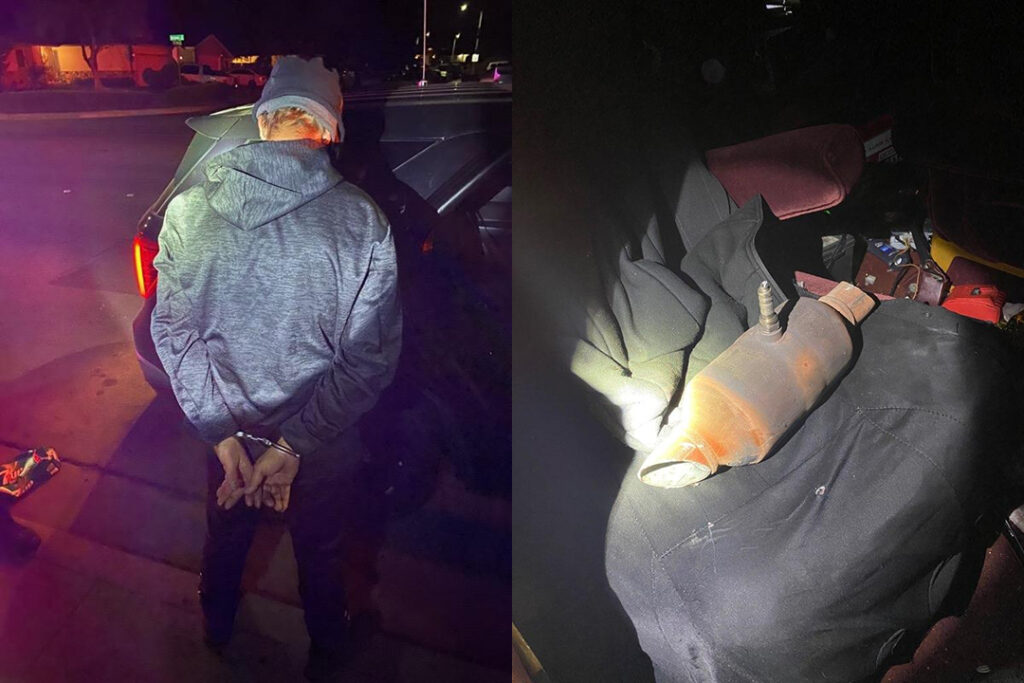
Catalytic converter thief caught and converter found in his van Wednesday night, Oct. 13, 2021. Photos: APD

By Antioch Police Department

The suspect’s van. Photo: APD

Last evening, APD Night Shift officers received a call reporting an individual attempting to steal catalytic converters from a fleet of vehicles at a local business. When Officers Desiderio and Mullholland arrived, they located two power saws near the fleet of vehicles, but the suspect was nowhere around. The business owner showed officers a video of the suspect’s van pulling into the parking lot. Officers Desiderio and Mullholland checked the surrounding area and located the unoccupied van parked at a nearby gas station.

Officers waited around the corner and saw the suspect return to the van. During a traffic stop, they discovered he was wanted out of San Antonio, Texas, for an aggravated assault. Officers also found a catalytic converter and saw blades inside the van. The suspect was arrested on theft charges, along with his out of state warrant, and given a one-way trip to the County Jail in Martinez.

Catalytic converter theft remains a HUGE problem around the nation. Hybrid vehicles (especially the Toyota Prius), Ford F-150s, and fleet vehicles seem to be targeted the most. An experienced thief can remove a catalytic converter in less than two minutes.

There are steps you can take to help prevent yourself from becoming a victim of this expensive crime. Check out this link from the California Bureau of Automotive Repair for some tips:

https://www.bar.ca.gov/…/Smog…/Catalytic_Converter_Theft

Thieves steal $15K of video equipment from Antioch’s Deer Valley High last Saturday morning

Friday, October 15th, 2021

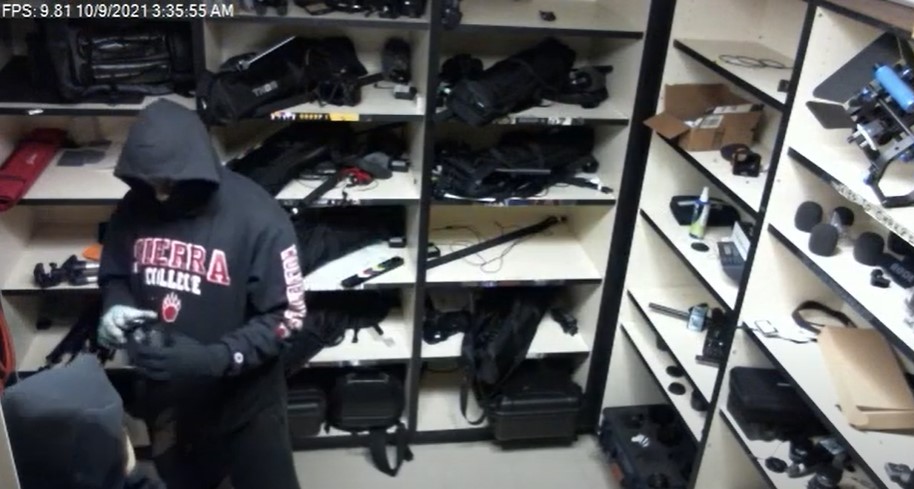
Two thieves can be seen inside the Deer Valley High School video equipment room, early Saturday morning, Oct. 9, 2021. Surveillance video screenshot

Covered by insurance, some replacement equipment already ordered – Superintendent Anello

“the burglars…forced their way into the room” – Principal Oyebade

By Allen Payton

According to a KRON4 TV news report Thursday night, $15,000 of video equipment was stolen from Deer Valley High School, early last Saturday morning. It was used for the class taught by video productions teacher, Kiel Olff “to produce award-winning content for Deer Valley TV, including news, high school sports, and entertainment.” The theft was caught on surveillance video at 3:35 AM. At least two thieves were involved and can be seen and heard talking in the video.

Questions were asked of Superintendent Stephanie Anello, Principal Olubukola “Bukky” Oyebade and Interim Police Chief Tony Morefield: “Were the police contacted about it? Besides video productions teacher, Kiel Olff, how many people have access and/or keys to the room where the equipment is stored? Do they include students? Who knew that equipment was stored there? Any leads on the suspect(s)? Does the district have insurance to cover the loss, so that a GoFundMe page isn’t necessary? Is that a usual and accepted practice for a faculty member to replace stolen school equipment? Are there any other details about the incident so that we can get the information to the public to help in the apprehension of the suspect(s) and return of the equipment?”

Similar questions were also sent to Olff, Friday afternoon.

Anello responded, “Yes, the District has insurance so the choice to do a GoFundMe page appears to be a site or teacher decision. The equipment will be replaced (critical equipment has already been ordered).”

Principal Oyebade also responded with more details, adding, “the burglars did not use keys and forced their way into the rooms.  Access to keys is limited and only on a need basis. No students have keys. We are cooperating with the police on this matter and working with our district to replace the items. As of Wednesday afternoon, we had placed a first round order to replace equipment so the class could continue to function.”

Asked why the public is just now learning about this, she did not respond prior to publication time.

Please check back later for any updates to this report.

Antioch Council to hold special workshop for public input on redistricting Saturday morning

Friday, October 15th, 2021

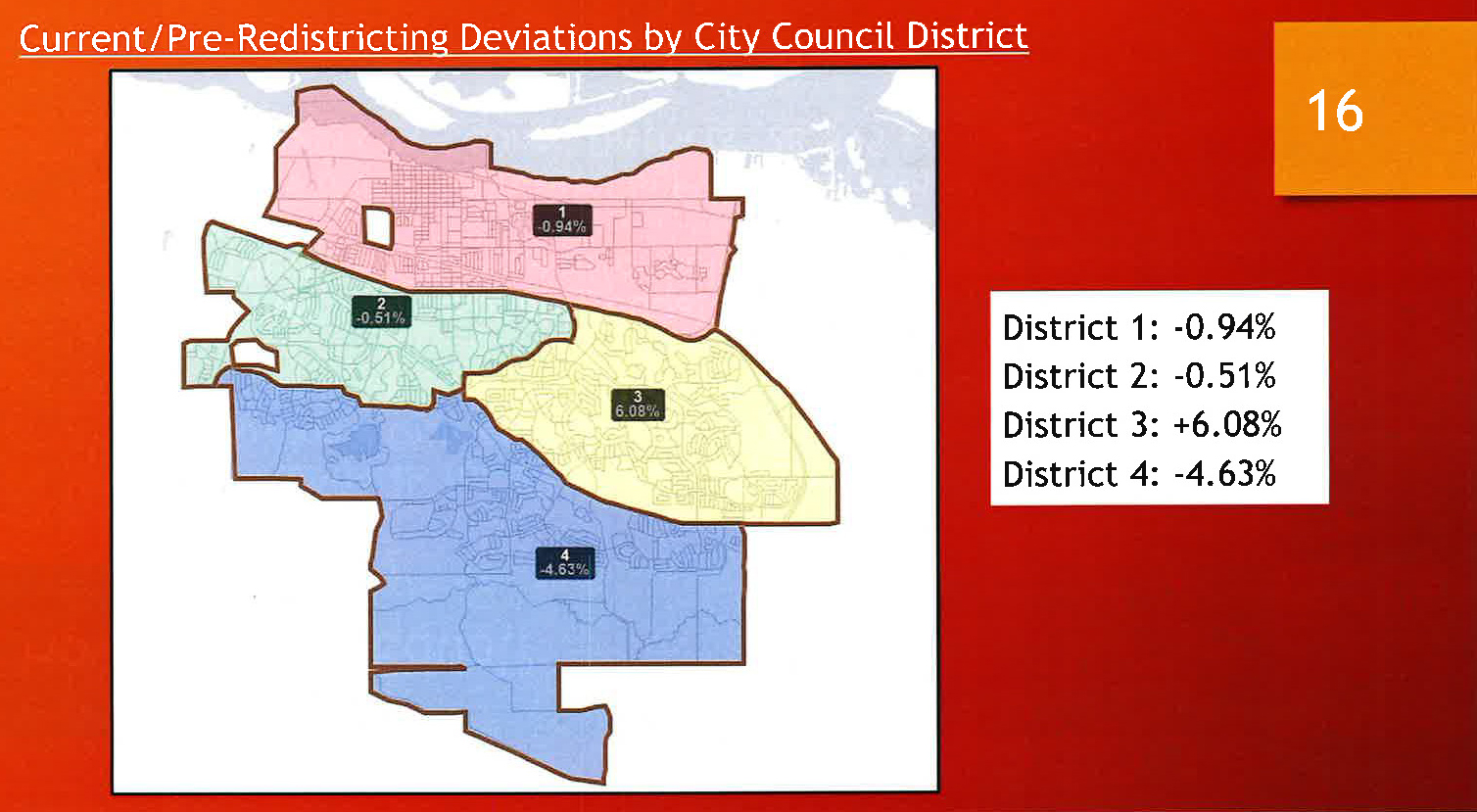
Map of the Antioch City Council districts for the 2020 elections showing the population deviations from average based on 2010 Census data.

Boundaries for at least District 2 will have to expand to the south and east, possibly placing both Barbanica and Mayor Pro Tem and Wilson into the same district.

By Allen Payton

The Antioch City Council will hold a special meeting/workshop for public input on redistricting of the four council districts tomorrow morning, Saturday, Oct. 16 at 10:00 a.m. The meeting will be online.

The council held a study session Tuesday night, prior to their regular meeting during which the consultant, Karin Mac Donald of Q2 Data & Research stated the adjusted population total of 115,580 is only for redistricting. It includes those people who are incarcerated in the state and are included in the geographic areas where their last residence is located. The population from the Census Data is unadjusted for purposes of receiving state and federal funding.

That results in the ideal population of 28,895 residents per district with a +/-5% allowed deviation or +/-1,545 people per district, she shared during her presentation.

The consultant spoke of the federal laws and state laws with which the council districts must comply, including the 14th and 15th Amendments to the U.S. Constitution, the federal Voting Rights Act (VRA), California Voting Rights Act (CVRA), and the state Fair and Inclusive Redistricting for Municipalities and Political Subdivisions (Fair Maps) Act. That law, according to the California Secretary of State’s website, “requires cities and counties to engage communities in the redistricting process by holding public hearings and/or workshops and doing public outreach, including to non-English-speaking communities.” According to the Legislative Counsel’s Digest of the bill, the CVRA “prohibits the use of an at-large election in a political subdivision if it would impair the ability of a protected class, as defined, to elect candidates of its choice or otherwise influence the outcome of an election”. The CVRA was the basis for the threatened lawsuit against the City of Antioch forcing the council into district elections in 2018, which went into effect, last year. While the council cannot intentionally split up a race or language minority population diluting their ability to elect a member of a minority, the U.S. Supreme Court has ruled that race cannot be the primary basis for drawing districts. Minorities include people who are Black, Hispanic, Asian or Native American, Mac Donald explained.

She also explained the other criteria the council should follow in redrawing the district lines, besides the equal population required by the U.S. Constitution, specifically the equal protection clause of the 14th Amendment, and the 5% deviation allowed by state law. Those include Communities of Interest (COI’s), using natural boundaries and those easily identifiable by the public, such as major streets, compactness as well as contiguity, which means districts can’t be split up in parts with gaps in between. In addition, the district boundaries cannot favor or discriminate against political parties.

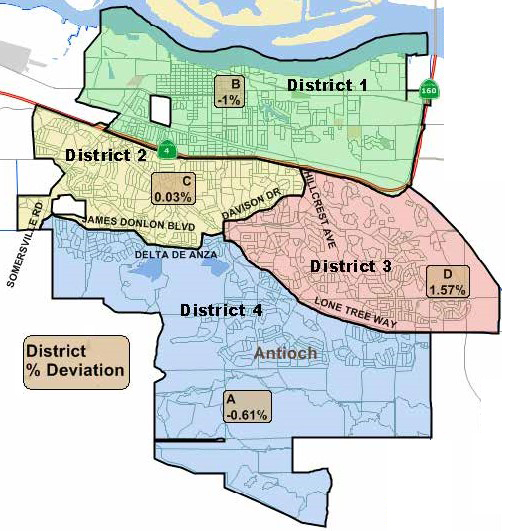
Current Antioch City Council districts approved in 2018 and population deviations from average based on 2020 Census data. Source: Q2 Data & Research presentation.

Included in Mac Donald’s presentation was a map of the current council districts showing the population deviations, showing District 3s and 4, not surprisingly, have experienced the greatest population growth. District 3 has a deviation of 6.08%, greater than the 5% allowed, while District 4 is barely in compliance with a deviation of 4.63% from average. The results will be boundaries for at least District 2 will have to expand to the south and east, possibly placing both District 2 Councilman Mike Barbanica and Mayor Pro Tem and District 3 Councilwoman Monica Wilson into the same district.

Antioch Council redistricting meeting schedule

Tuesday, November 9, 2021 – (Special meeting prior to City Council meeting)

Optional Additional Meeting (e.g. Antioch Community Center)

Tuesday, January 11, 2021 – (Regular City Council meeting. Introduction of Ordinance:

First Reading)

Tuesday, January 25, 2021 – (Regular City Council meeting. Second Reading: Adoption

of Ordinance)

Viewing

Members of the public can watch the meeting at https://www.antiochca.gov/live_stream, on Comcast Channel 24, or AT&T U-Verse Channel 99.

Public Comments

Members of the public wishing to provide public comment may do so one of the following ways (#2 pertains to the Zoom Webinar):

  1. Fill out an online speaker card by 8:00 a.m. the day of the Council Meeting located at:
  1. Provide oral public comments during the meeting by clicking the following link to register in advance to access the meeting via Zoom Webinar: https://www.antiochca.gov/speakers

– You will be asked to enter an email address and a name. Your email address will not be disclosed to the public. After registering, you will receive an email with instructions on how to connect to the meeting.

– When the Mayor announces public comments, click the “raise hand” feature in Zoom. For instructions on using the “raise hand” feature in Zoom, visit: https://www.antiochca.gov/raise_hand. When calling into the meeting using the Zoom Webinar telephone number, press *9 on your telephone keypad to “raise your hand”. Please ensure your Zoom client is updated so staff can enable your microphone when it is your turn to speak.

  1. Email comments to cityclerk@ci.antioch.ca.us by 8:00 a.m. the day of the Council Meeting. The comment will be read into the record at the meeting (350 words maximum, up to 3 minutes, at the discretion of the Mayor). IMPORTANT: Identify the agenda item in the subject line of your email if the comment is for Announcement of Community Events, Public Comment, or a specific Agenda Item number. No one may speak more than once on an agenda item or during “Public Comments”.

All emails received by 8:00 a.m. the day of the Council Meeting will be entered into the record for the meeting. Speakers will be notified shortly before they are called to speak.