“Participants will be informed…that individuals have different rights and obligations depending on their circumstances. The forum will emphasize the importance of complying with the law…” – City Manager Scott
By Allen D. Payton
The City of Antioch in coordination with several non-profit community organizations, will hold an immigrants’ rights forum for those in the country illegally on Feb. 4, 2026. It was announced by District 1 Councilwoman Tamisha Torres-Walker on Jan. 24th in a post on her official Facebook page and at the Council meeting on Tuesday, January 27th. The event is co-hosted by Immigration Institute of the Bay Area, Immigrant Action Network and Hijas Del Campo.
According to City of Antioch Department of Public Safety & Community Resources Director Monserrat Cabral, “this is a City-supported informational event coordinated through the Public Safety & Community Resources Department.
“Outreach was intentionally targeted through specific community groups, schools and partners to ensure the information was shared accurately and in a way that respected the needs of the community the event is designed to serve. The event will also be formally announced during the City Council meeting, which allows for an official and transparent public announcement.
“For your reference, the event is:
An informational session focused on immigration-related resources and updates
Free and open to the public
Offered in English and Spanish
Hosted by the City in partnership with community-based organizations”
Questions for City Staff
The following questions were sent to Director Cabral and City Manager Bessie Scott:
Is this being done under Council direction?
How is the event being funded and what are the associated costs? Was it from a grant? Did the Council approve the expenditure? Or are the organizations paying for it?
If it’s partially or wholly funded by the City, why is the City using our tax dollars to assist those in the U.S. illegally? Shouldn’t that be left up to the non-profit organizations using private funds?
Will those in attendance be informed they don’t have a right to be in our country without permission?
Will the event not just discuss their rights but also their responsibilities as immigrants, legal or illegal, such as following the law and complying with law enforcement?
Will the forum encourage those here illegally to self-deport to give them a future option to return through a legal port of entry to our country and have the opportunity to become a citizen?
Will they also be informed that if they’re deported, they will never have that option?
City Manager Responds
City Manager Bessie Scott responded, “This is a City-supported, informational event coordinated through the Public Safety & Community Resources Department as part of our ongoing community education and outreach efforts. It is not a policy action item and does not require separate Council approval beyond existing departmental authority to conduct community informational programming. The event was publicly announced during the City Council meeting to ensure transparency.
“The event is low-cost and focused on information-sharing. Any City-related costs are covered within existing, Council-approved departmental budgets. Community-based partners are contributing subject-matter expertise and participation. No new or special appropriations are associated with this event. Any City-associated costs are consistent with standard community outreach and public education activities.
“The Immigration Informational Night is designed to provide general, high-level information about available resources, recent changes and community services, delivered by qualified organizations. It is not an enforcement forum, a legal proceeding or an advocacy campaign.
“The City does not determine immigration status, provide legal determinations, or direct federal immigration outcomes. Accordingly, the event is not intended to instruct attendees on enforcement actions, deportation decisions, or federal legal consequences, which fall under federal jurisdiction.
“The City’s role is limited to facilitating access to accurate information and ensuring residents know where to seek appropriate, lawful resources. This approach aligns with longstanding City practice of hosting informational sessions on a wide range of topics that impact residents’ health, safety and well-being.
“Regarding outreach, initial distribution was intentionally targeted through community partners, schools, and trusted networks to ensure accurate information reached intended audiences. The event is open to the public, offered in both English and Spanish, and the finalized flyers are attached for reference.
“Participants will be informed that U.S. immigration law is complex and that individuals have different rights and obligations depending on their circumstances. The forum will emphasize the importance of complying with the law and encourage attendees to seek guidance from qualified legal professionals regarding their individual situations.
“The event does not promote unlawful behavior, nor does it encourage self-deportation or make representations about future immigration outcomes, as those determinations depend on federal law and individual case facts.
“Our goal is to ensure community members have access to accurate information so they can make informed decisions and better understand their responsibilities and options under the law.”
Event Details
The event will be held from 6:00-7:30 PM at Antioch High School in Conference Room B, 700 W. 18th Street. Dinner is provided and translation available. It is not a program of the Antioch Unified School District and AUSD accepts no liability or responsibility for this program. See flier for an additional disclaimer.
By Brian Nash, PIO, Contra Costa Public Defender’s Office
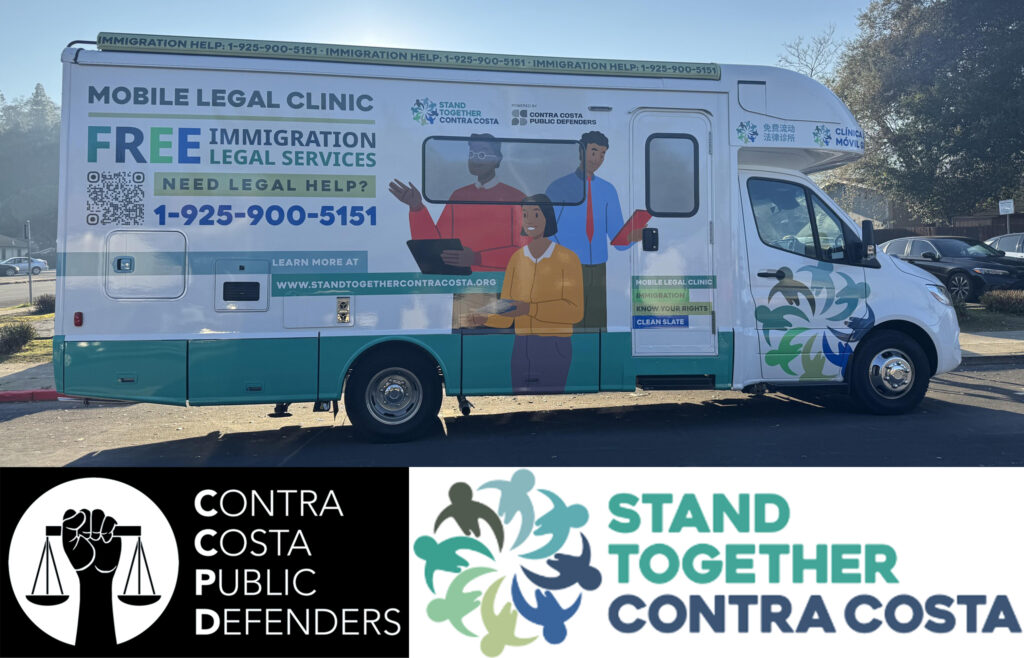
MARTINEZ, CA — Stand Together Contra Costa (STCC), a program of the Contra Costa Public Defender’s Office (CCPD), will unveil a new Mobile Legal Clinic at a press conference at 1026 Escobar in Martinez on Thursday, January 29 at 11:00 am. This marks a major step forward in bringing trusted legal advice directly to communities across Contra Costa County.
The Mobile Legal Clinic is designed to remove barriers that often prevent people from accessing legal help — including transportation challenges, work schedules, childcare responsibilities, language access, and fear of state violence by federal immigration agents. Staffed by CCPD attorneys and support staff, the clinic will provide free legal guidance on immigration legal issues, navigating the legal system, and culturally responsive assistance. It will also provide navigation to other holistic services such as public benefits, housing support, clean slate, and more — helping residents address concerns early, before problems escalate into crises.
“This mobile legal clinic reflects a simple but powerful idea: justice works best when it’s accessible,” said Ali Saidi, a Deputy Public Defender in the CCPD and the Director of Stand Together Contra Costa. “By showing up directly in neighborhoods across the county, we’re removing barriers, building trust, and making sure people know they’re not alone when legal issues arise.”
The office is planning upcoming mobile legal clinic deployments throughout all five Contra Costa County supervisorial districts beginning in early February, with dates, times, and locations to be announced soon through Contra Costa Public Defender and Stand Together Contra Costa channels.
A Countywide Effort
“Our commitment to serving community members in Contra Costa County goes beyond our vigorous advocacy inside of the courtroom,” added CCPD Public Defender Ellen McDonnell. “Access to justice means making sure every community member — no matter their income, background, or neighborhood — understands their legal rights and is able to find help when and where they need it.”
The Mobile Legal Clinic was made possible through collaboration across county departments and community partners, reflecting a shared commitment to expanding access to justice.
“This initiative demonstrates what’s possible when county leaders and departments work together with the community,” Saidi continued. “We’re grateful to the Contra Costa County Board of Supervisors and community partners for making this possible and want to particularly thank Supervisor Ken Carlson — whose support and leadership helped turn this idea into a critical service that will have real impact for families across the county.”
El condado insta a los inmigrantes elegibles para Medi-Cal a inscribirse antes de finales de 2025
By Contra Costa County Office of Communications & Media
(Martinez, CA) – Contra Costa County strongly encourages adult undocumented residents without health insurance to enroll in Medi-Cal this year while they are still eligible.
Starting Jan. 1, people ages 19 and older with what the state defines as unsatisfactory immigration status (UIS) – a category that includes undocumented residents and others who do not meet federal eligibility criteria – will no longer be able to enroll in full-scope Medi-Cal benefits, including seniors. The change in eligibility is the result of state budget cuts.
“We want undocumented members of our community to know they need to act quickly and sign up for Medi-Cal before it’s too late,” said Board of Supervisors Chair Candace Andersen. “Enrolling now will ensure they’re covered when the rules change.”
State residents with UIS status who are already enrolled in Medi-Cal before Jan. 1, 2026, will be able to keep and renew most of their benefits, though adults 19 and older will lose dental coverage beginning in July 2026.
“Under the new rules starting on January 1, 2026, it is very important for Medi-Cal recipients who meet the definition of UIS, to stay in contact with the county and check their mail for any notices or renewal forms. One good way to stay in touch is to create an account in BenefitsCal,” said Marla Stuart, Director of Contra Costa County Employment & Human Services Department (EHSD). “Current UIS Medi-Cal recipients who do not complete a renewal on time will lose their Medi-Cal full coverage and will only be eligible for emergency services when they reapply.”
After the new rules take effect, immigration status will not affect Medi-Cal coverage for children under 19 and pregnant women and their infants. Adults 19 and older who are classified as UIS will still be able to receive Emergency Medi-Cal, which covers emergency medical treatment.
“Sign up today. Having Medi-Cal is one of the best investments you can make in your health,” said Dr. Grant Colfax, CEO of Contra Costa Health. “Whether it is through a primary provider, specialist, in urgent care or in the emergency room, having Medi-Cal it key to getting healthcare for you and your family.”
(Martinez, CA) – El condado de Contra Costa recomienda encarecidamente a los residentes adultos indocumentados sin seguro médico que se inscriban en Medi-Cal este año mientras aún sean elegibles.
A partir del 1 de enero, las personas mayores de 19 años con lo que el estado define como estatus migratorio insatisfactorio (UIS), una categoría que incluye a los residentes indocumentados y otras personas que no cumplen con los criterios federales de elegibilidad, ya no podrán inscribirse en los beneficios completos de Medi-Cal, incluidas las personas mayores. El cambio en la elegibilidad es el resultado de los recortes presupuestarios estatales.
“Queremos que los miembros indocumentados de nuestra comunidad sepan que deben actuar rápidamente e inscribirse en Medi-Cal antes de que sea demasiado tarde”, dijo la presidenta de la Junta de Supervisores, Candace Andersen. “Inscribirse ahora asegurará que estén cubiertos cuando cambien las reglas”.
Los residentes del estado con estatus de UIS que ya estén inscritos en Medi-Cal antes del 1 de enero de 2026 podrán mantener y renovar la mayoría de sus beneficios, aunque los adultos mayores de 19 años perderán la cobertura dental a partir de julio de 2026.
“Según las nuevas reglas que comienzan el 1 de enero de 2026, es muy importante que los beneficiarios de Medi-Cal que cumplan con la definición de UIS, se mantengan en contacto con el condado y revisen su correo para ver si hay avisos o formularios de renovación. Una buena manera de mantenerse en contacto es crear una cuenta en BenefitsCal”, dijo Marla Stuart, directora del Departamento de Empleo y Servicios Humanos del Condado de Contra Costa (EHSD). “Los beneficiarios actuales de Medi-Cal del UIS que no completen una renovación a tiempo perderán su cobertura total de Medi-Cal y solo serán elegibles para los servicios de emergencia cuando vuelvan a presentar la solicitud”.
Después de que entren en vigor las nuevas reglas, el estado migratorio no afectará la cobertura de Medi-Cal para niños menores de 19 años y mujeres embarazadas y sus bebés. Los adultos de 19 años o más que estén clasificados como UIS aún podrán recibir Medi-Cal de emergencia, que cubre el tratamiento médico de urgencia.
“Inscríbase hoy. Tener Medi-Cal es una de las mejores inversiones que puede hacer en su salud”, dijo el Dr. Grant Colfax, director ejecutivo de Contra Costa Health. “Ya sea a través de un proveedor de atención primaria, un especialista, en atención urgente o en la sala de emergencias, tener Medi-Cal es clave para obtener atención médica para usted y su familia.”
Issue Community Message on the Implementation of Immigration Lawsin English & Spanish
Exceptions to law allow officers discretion to cooperate with immigration authorities
“The priorities will focus on public safety threats, national security threats and fugitives… Harboring or concealing undocumented immigrants is a federal crime.” – Tom Homan, Director of U.S. Immigration and Customs Enforcement (ICE)
By Allen D. Payton
In response to the recent executive orders by President Trump on enforcing the nation’s immigration laws and expected mass deportations, The Antioch Police Department issued the following statement on Thursday, January 30, 2025, regarding their cooperation with the U.S. Immigration and Customs Enforcement.
“The Antioch Police Department is committed to the safety and protection of our entire community, regardless of immigration status.
We do NOT participate in ICE raids or the enforcement of federal immigration laws.
We do NOT ask people about their immigration status for law enforcement purposes. (APD Policy 424.4)
We do NOT detain people for civil violations of immigration. (APD Policy 424.5)
Under California Law (SB 54) and our APD Policy (424.2):
Officials cannot use state databases to enforce immigration laws. (APD Policy 424.4.1, 424.4.2)
Victims and witnesses will not be questioned about their immigration status when reporting a crime. (APD Policy 424.3)
Applications for federal immigration assistance must go through a supervisor and are only considered in emergency cases. (APD Policy 424.6)
Public safety for all is our priority. Feel free to contact us—our officers are here to protect and serve, not enforce immigration laws.
Do you need help? Call (925) 778-2441 (or 911 in an emergency) or visit www.antiochca.gov/police.”
District 1 Councilwoman Tamisha Torres-Walker posted the announcement on her official Facebook page and wrote, “I am encouraged about how our police department is addressing the concerns of our immigrant neighbors in Antioch. Look how far we have come.”
Acting Chief Joe Vigil and Lt. Michael Mellone of the department’s Professional Standards were asked when the policies mentioned were adopted and for where they can be found online. Mellone responded, “Our policies can be found here: https://www.antiochca.gov/fc/police/apd-policy-manual.pdf#page336.” He said they were adopted sometime in 2017 after the passage of the bill. In the manual, the policies mentioned in the statement under Immigration Violations are found on pages 336-339.
Exceptions to State Sanctuary Law
However, there are exceptions to SB 54, California’s sanctuary law. According to the bill passed by the legislature and signed into law by Governor Newsom in 2017, law enforcement officials have discretion to cooperate with immigration authorities when dealing with criminal illegal immigrants convicted of either a misdemeanor or felony punishable by imprisonment in a state prison. The following section provides the exceptions:
SEC. 2. Section 7282.5 of the Government Code is amended to read: 7282.5. (a) A law enforcement official shall have discretion to cooperate with immigration authorities only if doing so would not violate any federal, state, or local law, or local policy, and where permitted by the California Values Act (Chapter 17.25 (commencing with Section 7284)). Additionally, the specific activities described in subparagraph (C) of paragraph (1) of subdivision (a) of, and in paragraph (4) of subdivision (a) of, Section 7284.6 shall only occur under the following circumstances: (1) The individual has been convicted of a serious or violent felony identified in subdivision (c) of Section 1192.7 of, or subdivision (c) of Section 667.5 of, the Penal Code. (2) The individual has been convicted of a felony punishable by imprisonment in the state prison. (3) The individual has been convicted within the past five years of a misdemeanor for a crime that is punishable as either a misdemeanor or a felony for, or has been convicted within the last 15 years of a felony for, any of the following offenses: (A) Assault, as specified in, but not limited to, Sections 217.1, 220, 240, 241.1, 241.4, 241.7, 244, 244.5, 245, 245.2, 245.3, 245.5, 4500, and 4501 of the Penal Code. (B) Battery, as specified in, but not limited to, Sections 242, 243.1, 243.3, 243.4, 243.6, 243.7, 243.9, 273.5, 347, 4501.1, and 4501.5 of the Penal Code. (C) Use of threats, as specified in, but not limited to, Sections 71, 76, 139, 140, 422, 601, and 11418.5 of the Penal Code. (D) Sexual abuse, sexual exploitation, or crimes endangering children, as specified in, but not limited to, Sections 266, 266a, 266b, 266c, 266d, 266f, 266g, 266h, 266i, 266j, 267, 269, 288, 288.5, 311.1, 311.3, 311.4, 311.10, 311.11, and 647.6 of the Penal Code. (E) Child abuse or endangerment, as specified in, but not limited to, Sections 270, 271, 271a, 273a, 273ab, 273d, 273.4, and 278 of the Penal Code. (F) Burglary, robbery, theft, fraud, forgery, or embezzlement, as specified in, but not limited to, Sections 211, 215, 459, 463, 470, 476, 487, 496, 503, 518, 530.5, 532, and 550 of the Penal Code. (G) Driving under the influence of alcohol or drugs, but only for a conviction that is a felony. (H) Obstruction of justice, as specified in, but not limited to, Sections 69, 95, 95.1, 136.1, and 148.10 of the Penal Code. (I) Bribery, as specified in, but not limited to, Sections 67, 67.5, 68, 74, 85, 86, 92, 93, 137, 138, and 165 of the Penal Code. (J) Escape, as specified in, but not limited to, Sections 107, 109, 110, 4530, 4530.5, 4532, 4533, 4534, 4535, and 4536 of the Penal Code. (K) Unlawful possession or use of a weapon, firearm, explosive device, or weapon of mass destruction, as specified in, but not limited to, Sections 171b, 171c, 171d, 246, 246.3, 247, 417, 417.3, 417.6, 417.8, 4574, 11418, 11418.1, 12021.5, 12022, 12022.2, 12022.3, 12022.4, 12022.5, 12022.53, 12022.55, 18745, 18750, and 18755 of, and subdivisions (c) and (d) of Section 26100 of, the Penal Code. (L) Possession of an unlawful deadly weapon, under the Deadly Weapons Recodification Act of 2010 (Part 6 (commencing with Section 16000) of the Penal Code). (M) An offense involving the felony possession, sale, distribution, manufacture, or trafficking of controlled substances. (N) Vandalism with prior convictions, as specified in, but not limited to, Section 594.7 of the Penal Code. (O) Gang-related offenses, as specified in, but not limited to, Sections 186.22, 186.26, and 186.28 of the Penal Code. (P) An attempt, as defined in Section 664 of, or a conspiracy, as defined in Section 182 of, the Penal Code, to commit an offense specified in this section. (Q) A crime resulting in death, or involving the personal infliction of great bodily injury, as specified in, but not limited to, subdivision (d) of Section 245.6 of, and Sections 187, 191.5, 192, 192.5, 12022.7, 12022.8, and 12022.9 of, the Penal Code. (R) Possession or use of a firearm in the commission of an offense. (S) An offense that would require the individual to register as a sex offender pursuant to Section 290, 290.002, or 290.006 of the Penal Code. (T) False imprisonment, slavery, and human trafficking, as specified in, but not limited to, Sections 181, 210.5, 236, 236.1, and 4503 of the Penal Code. (U) Criminal profiteering and money laundering, as specified in, but not limited to, Sections 186.2, 186.9, and 186.10 of the Penal Code. (V) Torture and mayhem, as specified in, but not limited to, Section 203 of the Penal Code. (W) A crime threatening the public safety, as specified in, but not limited to, Sections 219, 219.1, 219.2, 247.5, 404, 404.6, 405a, 451, and 11413 of the Penal Code. (X) Elder and dependent adult abuse, as specified in, but not limited to, Section 368 of the Penal Code. (Y) A hate crime, as specified in, but not limited to, Section 422.55 of the Penal Code. (Z) Stalking, as specified in, but not limited to, Section 646.9 of the Penal Code. (AA) Soliciting the commission of a crime, as specified in, but not limited to, subdivision (c) of Section 286 of, and Sections 653j and 653.23 of, the Penal Code. (AB) An offense committed while on bail or released on his or her own recognizance, as specified in, but not limited to, Section 12022.1 of the Penal Code. (AC) Rape, sodomy, oral copulation, or sexual penetration, as specified in, but not limited to, paragraphs (2) and (6) of subdivision (a) of Section 261 of, paragraphs (1) and (4) of subdivision (a) of Section 262 of, Section 264.1 of, subdivisions (c) and (d) of Section 286 of, subdivisions (c) and (d) of Section 288a of, and subdivisions (a) and (j) of Section 289 of, the Penal Code. (AD) Kidnapping, as specified in, but not limited to, Sections 207, 209, and 209.5 of the Penal Code. (AE) A violation of subdivision (c) of Section 20001 of the Vehicle Code. (4) The individual is a current registrant on the California Sex and Arson Registry. (5) The individual has been convicted of a federal crime that meets the definition of an aggravated felony as set forth in subparagraphs (A) to (P), inclusive, of paragraph (43) of subsection (a) of Section 101 of the federal Immigration and Nationality Act (8 U.S.C. Sec. 1101), or is identified by the United States Department of Homeland Security’s Immigration and Customs Enforcement as the subject of an outstanding federal felony arrest warrant. (6) In no case shall cooperation occur pursuant to this section for individuals arrested, detained, or convicted of misdemeanors that were previously felonies, or were previously crimes punishable as either misdemeanors or felonies, prior to passage of the Safe Neighborhoods and Schools Act of 2014 as it amended the Penal Code. (b) In cases in which the individual is arrested and taken before a magistrate on a charge involving a serious or violent felony, as identified in subdivision (c) of Section 1192.7 or subdivision (c) of Section 667.5 of the Penal Code, respectively, or a felony that is punishable by imprisonment in state prison, and the magistrate makes a finding of probable cause as to that charge pursuant to Section 872 of the Penal Code, a law enforcement official shall additionally have discretion to cooperate with immigration officials pursuant to subparagraph (C) of paragraph (1) of subdivision (a) of Section 7284.6.
ICE Director Gives Enforcement Focus, Warning to Sanctuary States, Cities
According to Governing.com, Tom Homan, Director of U.S. Immigration and Customs Enforcement (ICE), said in December, “The priorities will focus on public safety threats, national security threats and fugitives,” those who “got due process at great taxpayer expense and the federal judge ordered them removed, but they didn’t leave, and they became a fugitive.”
He also said, “sanctuary policies can shield dangerous criminals. Harboring or concealing undocumented immigrants is a federal crime.”
Homan said, anyone who “harbors or conceals illegal aliens from federal law enforcement officers” are committing a crime, and federal immigration law, Title 8 USC 13.24 iii, requires officials to do so.
According to a statement on the ICE website on Sunday, Jan. 26, 2025, “U.S. Immigration and Customs Enforcement, along with federal partners, including the FBI, ATF, DEA, CBP and the U.S. Marshals Service, began conducting enhanced targeted operations today in Chicago to enforce U.S. immigration law and preserve public safety and national security by keeping potentially dangerous criminal aliens out of our communities.”
“We do not collect or share information about your immigration status unless required by state or federal law or a court order.” – Contra Costa County
Amid recent changes and concerns about federal immigration policies following executive orders signed by President Trump this past Monday, Jan. 20, 2025, Contra Costa County wants to reassure you about our unwavering commitment to all members of our community, regardless of immigration status.
By the authority vested in me as President by the Constitution and the laws of the United States of America, including the Immigration and Nationality Act (INA) (8 U.S.C. 1101 et seq.) and section 301 of title 3, United States Code, it is hereby ordered:
Section 1. Purpose. Over the last 4 years, the prior administration invited, administered, and oversaw an unprecedented flood of illegal immigration into the United States. Millions of illegal aliens crossed our borders or were permitted to fly directly into the United States on commercial flights and allowed to settle in American communities, in violation of longstanding Federal laws.
Many of these aliens unlawfully within the United States present significant threats to national security and public safety, committing vile and heinous acts against innocent Americans. Others are engaged in hostile activities, including espionage, economic espionage, and preparations for terror-related activities. Many have abused the generosity of the American people, and their presence in the United States has cost taxpayers billions of dollars at the Federal, State, and local levels.
Enforcing our Nation’s immigration laws is critically important to the national security and public safety of the United States. The American people deserve a Federal Government that puts their interaests first and a Government that understands its sacred obligation to prioritize the safety, security, and financial and economic well-being of Americans. This order ensures that the Federal Government protects the American people by faithfully executing the immigration laws of the United States.
Sec. 2. Policy. It is the policy of the United States to faithfully execute the immigration laws against all inadmissible and removable aliens, particularly those aliens who threaten the safety or security of the American people. Further, it is the policy of the United States to achieve the total and efficient enforcement of those laws, including through lawful incentives and detention capabilities.
Sec. 3. Faithful Execution of the Immigration Laws. In furtherance of the policies described in section 2 of this order:
(a) Executive Order 13993 of January 20, 2021 (Revision of Civil Immigration Enforcement Policies and Priorities), Executive Order 14010 of February 2, 2021 (Creating a Comprehensive Regional Framework To Address the Causes of Migration, To Manage Migration Throughout North and Central America, and To Provide Safe and Orderly Processing of Asylum Seekers at the United States Border), Executive Order 14011 of February 2, 2021 (Establishment of Interagency Task Force on the Reunification of Families), and Executive Order 14012 of February 2, 2021 (Restoring Faith in Our Legal Immigration Systems and Strengthening Integration and Inclusion Efforts for New Americans) are hereby revoked; and
(b) Executive departments and agencies (agencies) shall take all appropriate action to promptly revoke all memoranda, guidance, or other policies based on the Executive Orders revoked in section 3(a) of this order and shall employ all lawful means to ensure the faithful execution of the immigration laws of the United States against all inadmissible and removable aliens.
Sec. 4. Civil Enforcement Priorities. The Secretary of Homeland Security shall take all appropriate action to enable the Director of U.S. Immigration and Customs Enforcement, the Commissioner of U.S. Customs and Border Protection, and the Director of U.S. Citizenship and Immigration Services to set priorities for their agencies that protect the public safety and national security interests of the American people, including by ensuring the successful enforcement of final orders of removal. Further, the Secretary of Homeland Security shall ensure that the primary mission of U.S. Immigration and Customs Enforcement’s Homeland Security Investigations division is the enforcement of the provisions of the INA and other Federal laws related to the illegal entry and unlawful presence of aliens in the United States and the enforcement of the purposes of this order.
Sec. 5. Criminal Enforcement Priorities. The Attorney General, in coordination with the Secretary of State and the Secretary of Homeland Security, shall take all appropriate action to prioritize the prosecution of criminal offenses related to the unauthorized entry or continued unauthorized presence of aliens in the United States.
Sec. 6. Federal Homeland Security Task Forces. (a) The Attorney General and the Secretary of Homeland Security shall take all appropriate action to jointly establish Homeland Security Task Forces (HSTFs) in all States nationwide.
(b) The composition of each HSTF shall be subject to the direction of the Attorney General and the Secretary of Homeland Security, but shall include representation from any other Federal agencies with law enforcement officers, or agencies with the ability to provide logistics, intelligence, and operational support to the HSTFs, and shall also include representation from relevant State and local law enforcement agencies. The heads of all Federal agencies shall take all appropriate action to provide support to the Attorney General and the Secretary of Homeland Security to ensure that the HSTFs fulfill the objectives in subsection (c) of this section, and any other lawful purpose that fulfills the policy objectives of this order.
(c) The objective of each HSTF is to end the presence of criminal cartels, foreign gangs, and transnational criminal organizations throughout the United States, dismantle cross-border human smuggling and trafficking networks, end the scourge of human smuggling and trafficking, with a particular focus on such offenses involving children, and ensure the use of all available law enforcement tools to faithfully execute the immigration laws of the United States.
(d) The Attorney General and the Secretary of Homeland Security shall take all appropriate action to provide an operational command center to coordinate the activities of the HSTFs and provide such support as they may require, and shall also take all appropriate action to provide supervisory direction to their activities as may be required.
Sec. 7. Identification of Unregistered Illegal Aliens. The Secretary of Homeland Security, in coordination with the Secretary of State and the Attorney General, shall take all appropriate action to:
(a) Immediately announce and publicize information about the legal obligation of all previously unregistered aliens in the United States to comply with the requirements of part VII of subchapter II of chapter 12 of title 8, United States Code;
(b) Ensure that all previously unregistered aliens in the United States comply with the requirements of part VII of subchapter II of chapter 12 of title 8, United States Code; and
(c) Ensure that failure to comply with the legal obligations of part VII of subchapter II of chapter 12 of title 8, United States Code, is treated as a civil and criminal enforcement priority.
Sec. 8. Civil Fines and Penalties. (a) The Secretary of Homeland Security, in coordination with the Secretary of Treasury, shall take all appropriate action to ensure the assessment and collection of all fines and penalties that the Secretary of Homeland Security is authorized by law to assess and collect from aliens unlawfully present in the United States, including aliens who unlawfully entered or unlawfully attempted to enter the United States, and from those who facilitate such aliens’ presence in the United States.
(b) Within 90 days of the date of this order, the Secretary of the Treasury and the Secretary of Homeland Security shall submit a report to the President regarding their progress implementing the requirements of this section and recommending any additional actions that may need to be taken to achieve its objectives.
Sec. 9. Efficient Removals of Recent Entrants and Other Aliens. The Secretary of Homeland Security shall take all appropriate action, pursuant to section 235(b)(1)(A)(iii)(I) of the INA (8 U.S.C. 1225(b)(1)(A)(iii)(I)), to apply, in her sole and unreviewable discretion, the provisions of section 235(b)(1)(A)(i) and (ii) of the INA to the aliens designated under section 235(b)(1)(A)(iii)(II). Further, the Secretary of Homeland Security shall promptly take appropriate action to use all other provisions of the immigration laws or any other Federal law, including, but not limited to sections 238 and 240(d) of the INA (8 U.S.C. 1228 and 1229a(d)), to ensure the efficient and expedited removal of aliens from the United States.
Sec. 10. Detention Facilities. The Secretary of Homeland Security shall promptly take all appropriate action and allocate all legally available resources or establish contracts to construct, operate, control, or use facilities to detain removable aliens. The Secretary of Homeland Security, further, shall take all appropriate actions to ensure the detention of aliens apprehended for violations of immigration law pending the outcome of their removal proceedings or their removal from the country, to the extent permitted by law.
Sec. 11. Federal-State Agreements. To ensure State and local law enforcement agencies across the United States can assist with the protection of the American people, the Secretary of Homeland Security shall, to the maximum extent permitted by law, and with the consent of State or local officials as appropriate, take appropriate action, through agreements under section 287(g) of the INA (8 U.S.C. 1357(g)) or otherwise, to authorize State and local law enforcement officials, as the Secretary of Homeland Security determines are qualified and appropriate, to perform the functions of immigration officers in relation to the investigation, apprehension, or detention of aliens in the United States under the direction and the supervision of the Secretary of Homeland Security. Such authorization shall be in addition to, rather than in place of, Federal performance of these duties. To the extent permitted by law, the Secretary of Homeland Security may structure each agreement under section 287(g) of the INA (8 U.S.C. 1357(g)) in the manner that provides the most effective model for enforcing Federal immigration laws in that jurisdiction.
Sec. 12. Encouraging Voluntary Compliance with the Law. The Secretary of Homeland Security shall take all appropriate action, in coordination with the Secretary of State and the Attorney General, and subject to adequate safeguards, assurances, bonds, and any other lawful measure, to adopt policies and procedures to encourage aliens unlawfully in the United States to voluntarily depart as soon as possible, including through enhanced usage of the provisions of section 240B of the INA (8 U.S.C. 1229c), international agreements or assistance, or any other measures that encourage aliens unlawfully in the United States to depart as promptly as possible, including through removals of aliens as provided by section 250 of the INA (8 U.S.C. 1260).
Sec. 13. Recalcitrant Countries. The Secretary of State and the Secretary of Homeland Security shall take all appropriate action to:
(a) Cooperate and effectively implement, as appropriate, the sanctions provided by section 243(d) of the INA (8 U.S.C. 1253(d)), with the Secretary of State, to the maximum extent permitted by law, ensuring that diplomatic efforts and negotiations with foreign states include the foreign states’ acceptance of their nationals who are subject to removal from the United States; and
(b) Eliminate all documentary barriers, dilatory tactics, or other restrictions that prevent the prompt repatriation of aliens to any foreign state. Any failure or delay by a foreign state to verify the identity of a national of that state shall be considered in carrying out subsection (a) this section, and shall also be considered regarding the issuance of any other sanctions that may be available to the United States.
Sec. 14. Visa Bonds. The Secretary of Treasury shall take all appropriate action, in coordination with the Secretary of State and the Secretary of Homeland Security, to establish a system to facilitate the administration of all bonds that the Secretary of State or the Secretary of Homeland Security may lawfully require to administer the provisions of the INA.
Sec. 15. Reestablishment of the VOICE Office and Addressing Victims of Crimes Committed by Removable Aliens. The Secretary of Homeland Security shall direct the Director of U.S. Immigration and Customs Enforcement (ICE) to take all appropriate and lawful action to reestablish within ICE an office to provide proactive, timely, adequate, and professional services to victims of crimes committed by removable aliens, and those victims’ family members. The Attorney General shall also ensure that the provisions of 18 U.S.C. 3771 are followed in all Federal prosecutions involving crimes committed by removable aliens.
Sec. 16. Addressing Actions by the Previous Administration. The Secretary of State, the Attorney General, and the Secretary of Homeland Security shall promptly take all appropriate action, consistent with law, to rescind the policy decisions of the previous administration that led to the increased or continued presence of illegal aliens in the United States, and align any and all departmental activities with the policies set out by this order and the immigration laws. Such action should include, but is not limited to:
(a) ensuring that the parole authority under section 212(d)(5) of the INA (8 U.S.C. 1182(d)(5)) is exercised on only a case-by-case basis in accordance with the plain language of the statute, and in all circumstances only when an individual alien demonstrates urgent humanitarian reasons or a significant public benefit derived from their particular continued presence in the United States arising from such parole;
(b) ensuring that designations of Temporary Protected Status are consistent with the provisions of section 244 of the INA (8 U.S.C. 1254a), and that such designations are appropriately limited in scope and made for only so long as may be necessary to fulfill the textual requirements of that statute; and
(c) ensuring that employment authorization is provided in a manner consistent with section 274A of the INA (8 U.S.C. 1324a), and that employment authorization is not provided to any unauthorized alien in the United States.
Sec. 17. Sanctuary Jurisdictions. The Attorney General and the Secretary of Homeland Security shall, to the maximum extent possible under law, evaluate and undertake any lawful actions to ensure that so-called “sanctuary” jurisdictions, which seek to interfere with the lawful exercise of Federal law enforcement operations, do not receive access to Federal funds. Further, the Attorney General and the Secretary of Homeland Security shall evaluate and undertake any other lawful actions, criminal or civil, that they deem warranted based on any such jurisdiction’s practices that interfere with the enforcement of Federal law.
Sec. 18. Information Sharing. (a) The Secretary of Homeland Security shall promptly issue guidance to ensure maximum compliance by Department of Homeland Security personnel with the provisions of 8 U.S.C. 1373 and 8 U.S.C. 1644 and ensure that State and local governments are provided with the information necessary to fulfill law enforcement, citizenship, or immigration status verification requirements authorized by law; and
(b) The Attorney General, the Secretary of Health and Human Services, and the Secretary of Homeland Security shall take all appropriate action to stop the trafficking and smuggling of alien children into the United States, including through the sharing of any information necessary to assist in the achievement of that objective.
Sec. 19. Funding Review. The Attorney General and the Secretary of Homeland Security shall:
(a) Immediately review and, if appropriate, audit all contracts, grants, or other agreements providing Federal funding to non-governmental organizations supporting or providing services, either directly or indirectly, to removable or illegal aliens, to ensure that such agreements conform to applicable law and are free of waste, fraud, and abuse, and that they do not promote or facilitate violations of our immigration laws;
(b) Pause distribution of all further funds pursuant to such agreements pending the results of the review in subsection (a) of this section;
(c) Terminate all such agreements determined to be in violation of law or to be sources of waste, fraud, or abuse and prohibit any such future agreements;
(d) Coordinate with the Director of the Office of Management and Budget to ensure that no funding for agreements described in subsection (c) of this section is included in any appropriations request for the Department of Justice or the Department of Homeland Security; and
(e) Initiate clawback or recoupment procedures, if appropriate, for any agreements described in subsection (c) of this section.
Sec. 20. Denial of Public Benefits to Illegal Aliens. The Director of the Office of Management and Budget shall take all appropriate action to ensure that all agencies identify and stop the provision of any public benefits to any illegal alien not authorized to receive them under the provisions of the INA or other relevant statutory provisions.
Sec. 21. Hiring More Agents and Officers. Subject to available appropriations, the Secretary of Homeland Security, through the Commissioner of U.S. Customs and Border Protection and the Director of U.S. Immigration and Customs Enforcement, shall take all appropriate action to significantly increase the number of agents and officers available to perform the duties of immigration officers.
Sec. 22. Severability. It is the policy of the United States to enforce this order to the maximum extent possible to advance the interests of the United States. Accordingly:
(a) If any provision of this order, or the application of any provision to any person or circumstance, is held to be invalid, the remainder of this order and the application of its other provisions to any other persons or circumstances shall not be affected thereby; and
(b) If any provision of this order, or the application of any provision to any person or circumstance, is held to be invalid because of the failure to follow certain procedures, the relevant executive branch officials shall implement those procedural requirements to conform with existing law and with any applicable court orders.
Sec. 23. General Provisions. (a) Nothing in this order shall be construed to impair or otherwise affect: (i) the authority granted by law to an executive department or agency, or the head thereof; or (ii) the functions of the Director of the Office of Management and Budget relating to budgetary, administrative, or legislative proposals.
(b) This order shall be implemented consistent with applicable law and subject to the availability of appropriations.
(c) This order is not intended to, and does not, create any right or benefit, substantive or procedural, enforceable at law or in equity by any party against the United States, its departments, agencies, or entities, its officers, employees, or agents, or any other person.
Contra Costa County’s Approach:
No Discrimination: Contra Costa County does not single out individuals based on their race, ethnicity, national origin, religion, gender or gender identity, sexual orientation, or immigration status.
Privacy Protection: We do not collect or share information about your immigration status unless required by state or federal law or a court order. Safeguarding your personal information is one of our most important priorities.
Access to Services: Everyone in our community should be able to access essential services, including healthcare. Recent federal actions will not affect how the County provides these services.
We recognize that fear and uncertainty can prevent people from seeking County programs and services, but we want to assure you that our services are here for you. You have the right to feel safe and secure in your community, and our longstanding policies are designed to uphold your safety and trust. Contra Costa County stands united in creating a welcoming, inclusive environment where everyone has the support they need to thrive. We encourage you to reach out for assistance without hesitation, knowing that our commitment to serving and protecting all residents is steadfast.
El Condado de Contra Costa Responde a las Recientes Órdenes Ejecutivas
En medio de los cambios recientes y las preocupaciones sobre las políticas federales de inmigración, el Condado de Contra Costa quiere asegurarle nuestro compromiso inquebrantable con todos los miembros de nuestra comunidad, independientemente de su estatus migratorio.
Nuestro Enfoque:
No discriminación: El Condado de Contra Costa no señala a las personas en función de su raza, etnia, origen nacional, religión, género o identidad de género, orientación sexual o estado migratorio.
Protección de la privacidad: No recopilamos ni compartimos información sobre su estado migratorio a menos que lo exija la ley estatal o federal o una orden judicial. Salvaguardar su información personal es una de nuestras prioridades más importantes.
Acceso a los servicios: Todos los miembros de nuestra comunidad deberían poder acceder a los servicios esenciales, incluida la atención médica. Las acciones federales recientes no afectarán la forma en que el Condado proporciona estos servicios.
Reconocemos que el miedo y la incertidumbre pueden impedir que las personas busquen programas y servicios del Condado, pero queremos asegurarle que nuestros servicios están aquí para usted. Usted tiene derecho a sentirse seguro y protegido en su comunidad, y nuestras políticas de larga data están diseñadas para mantener su seguridad y confianza. El Condado de Contra Costa se mantiene unido en la creación de un ambiente acogedor e inclusivo donde todos tienen el apoyo que necesitan para prosperar. Lo alentamos a que busque ayuda sin dudarlo, sabiendo que nuestro compromiso de servir y proteger a todos los residentes es firme.
Para más información: Recursos de Inmigración e Información de Carga Pública | EHSD
Hosts first of a series of regional convenings with immigrant rights groups, elected officials, and others ahead of Inauguration Day
LOS ANGELES – California Attorney General Rob Bonta on Tuesday, Dec. 17, 2024, issued two guidances to help California immigrants better understand their rights and protections under the law and avoid immigration scams by those seeking to take advantage of fear and uncertainty resulting from the President-elect’s inhumane threats of mass detention, arrests, and deportation. The guidances build on the Attorney General’s announcement earlier this month of updated model policies and recommendations to help public institutions like schools, hospitals, and courts comply with California law limiting state and local participation in immigration enforcement activities. Over the coming weeks, Attorney General Bonta will continue to help Californians prepare for changes to federal immigration policy in convenings with immigrant rights groups, elected officials, and others in Los Angeles, Sacramento, Salinas, San Francisco, and San Diego, where the Attorney General and California Department of Justice (CADOJ) staff will share resources, hear concerns, and discuss ongoing efforts to protect California’s immigrant communities.
“In California, we know that our immigrants are the backbone of our communities, a driving force behind our economy, and an essential part of our history as a state,” said Bonta. “With the President-elect making clear his intent to move forward an inhumane and destructive immigration agenda once he takes office, CADOJ is releasing new and updated guidance to help immigrants understand their rights under the law. In California, we will ensure that the rights of our immigrant communities are respected and protected. I will be convening a series of discussions in the weeks ahead – the first here today in Los Angeles – focused on this essential mission.”
Know Your Immigration Rights and Protections Under the Law
You have the right to apply for and secure housing without sharing your immigration status. California law prohibits housing providers from asking about your immigration status unless you are applying for affordable housing funded by the federal government. Additionally, housing providers cannot harass or intimidate you by threatening or sharing information about your immigration status to ICE, law enforcement, or other government agencies.
You have the right to access emergency medical care. Federal laws and regulations ensure the rights of all people to access emergency medical care, including undocumented immigrants.
You have the right to an attorney. If you are arrested by police, you have the right to a government-appointed attorney. If you are detained by ICE and/or are facing immigration proceedings, you have the right to seek legal assistance through an attorney.
State and local law enforcement cannot ask for your immigration status. California law expressly prohibits law enforcement from inquiring about a person’s immigration status for immigration enforcement purposes.
State and local law enforcement cannot share your personal information. This includes sharing your home or work address for immigration purposes, unless that information is available to the public or unless that information involves previous criminal arrest, convictions or similar criminal history.
State and local law enforcement cannot assist ICE with immigration enforcement, with very limited exceptions. This means they cannot investigate, cannot interrogate, cannot arrest, and cannot detain you unless it is as part of joint federal task force where the primary purpose is not immigration enforcement.
If you need help applying for immigration relief, be careful who you hire. Watch out for immigration scams that can cost you thousands of dollars and/or harm your immigration status! Here are some tips and resources to help:
Go to a legitimate legal aid organization for free legal help. Many nonprofit organizations provide free immigration help to low-income individuals, such as those found through the resources below. To find a legal aid organization near you, go to lawhelpca.org.
Keep your original documents in a safe place. Don’t give your original documents to anyone unless you see proof that the government requires the original document. If you give someone an original, they may lose it or refuse to return it unless you pay them.
Do not hire an immigration consultant or a notary. Only lawyers, accredited representatives, and recognized organizations can give you legal advice or represent you in immigration court. Immigration consultants – who may call themselves immigration experts, notarios, notaries public, or paralegals – cannot do so.
Do not give money or personal information to anyone who calls, texts, or emails you claiming that there is a problem with your immigration matter. No federal or state agency, including USCIS, will ever ask for your personal information or payment over the phone, by email, or text.
If you believe your rights have been violated, report it to the California Department of Justice at oag.ca.gov/report.
If you believe you were subject to discrimination, harassment or retaliation, report it to the California Civil Rights Department at calcivilrights.ca.gov/complaintprocess/.
CA State Superintendent of Public Instruction Tony Thurmond and State Senator Lena Gonzalez want to keep U.S. Immigration and Customs Enforcement agents off California school campuses without a judicial warrant in their efforts to deport illegal immigrants.
Introduced by Senate Majority Leader Lena Gonzalez
“to protect California schools from a drop-off in attendance or funding in response to federal threats of mass deportation.”
By Liz Sanders, Director of Communications, California Department of Education
SACRAMENTO—State Superintendent Tony Thurmond is sponsoring legislation introduced by Senate Majority Leader Lena Gonzalez (D-33) on Monday, December 16, aimed at keeping U.S. Immigration and Customs Enforcement (ICE) agents off of school campuses to protect California schools from a drop-off in attendance or funding in response to federal threats of mass deportation.
The legislation to be introduced by Gonzalez will protect California schools from a potential decline in attendance or funding during potential increased immigration enforcement by protecting school zones, as well as school data and sensitive family information.
The bill would:
prohibit school districts, county offices of education, charter schools, and their personnel from granting U.S. Immigration and Customs Enforcement (ICE) officers or other federal authorities access to campuses without a judicial warrant;
prohibit police cooperation with any immigration enforcement efforts within a one-mile radius of school to ensure a safe corridor for parents to bring their children to and from school; and
prohibit the sharing of any information about students, families, their households, or school employees with ICE officers.
“This bill seeks to push back against threats of deportation that create fear in immigrant families. These practices suppress school attendance and rob schools of needed revenue,” said Thurmond. “I am honored to partner with bill author Senator Lena Gonzalez, other legislators, and immigrant rights groups to support our families and keep ICE off our school campuses—period.”
“All California children deserve safe school environments that prioritize student learning, regardless of immigration status,” said Gonzalez (D-Long Beach). “As Chair of the California Latino Legislative Caucus, I’m proud to be partnering with Superintendent Tony Thurmond to author this important legislation, which will prevent disruptions to student learning, keep children in school, and prevent families from being torn apart.”
Research has shown that immigration enforcement in the area of schools has a chilling effect on school attendance for students from impacted communities, regardless of students’ citizenship or immigration status. It is reasonable to expect such adverse impacts on immigrant communities throughout California.
The legislation would also strengthen safeguards against unauthorized disclosure of education records and personal information to federal agents. Combined, these protections would ensure that families are able to safely send their children to school without fear of being separated from their children, and families would also be able to fill out necessary school forms that are essential to students’ well-being and educational services without fear of being separated from their children.
In California, 93 percent of children who have one or more undocumented parents are U.S. citizens. Additionally, all children in the United States, regardless of immigration status, have a right to a free and appropriate public education.
The proposed bill reflects California’s commitment to ensure that pandemic-era increases in chronic absenteeism do not recur and also reiterates California’s commitment to make sure that schools are welcoming environments where all families can safely bring their children to learn. It aligns with California’s broader efforts to promote equity, inclusion, and the protection of immigrant communities.
As schools continue to face challenges related to student safety and data privacy, this bill sends a strong message that California is committed to safeguarding our students and families.