Archive for the ‘Health’ Category

Kaiser Permanente Nor Cal receives international recognition for life-saving advance alert monitor program

Wednesday, December 15th, 2021

Kaiser Permanente Northern California is recognized at the 44th World Hospital Congress. Pictured, far right, Carrie Owen Plietz, FACHE, president of Kaiser Permanente’s Northern California region accepts the award from representatives of Austco in Barcelona, Spain on Nov. 11, 2021. Source: Austco

The International Hospital Foundation recognizes Kaiser Permanente Northern California with the Autsco Excellence Award for Quality and Patient Safety

By Antonia Ehlers, PR and Media Relations, Kaiser Permanente Northern California

OAKLAND, Calif., – An early detection system that helps care teams predict when Kaiser Permanente Northern California’s hospitalized patients are at risk for clinical deterioration was recognized by the International Hospital Foundation with the Autsco Excellence Award for Quality and Patient Safety.

Kaiser Permanente Northern California received the Gold Award, the highest level possible, for its Advance Alert Monitor (AAM) program, which is in place at all 21 Northern California hospitals. The program is a sophisticated monitoring system that analyzes electronic hospital patient data to identify those at risk of deteriorating and alerts a specialized team of virtual nurses who determine if on-site intervention is needed. The nurses contact a rapid response team, which perform an assessment, and then work with the care team and the patient and/or family to develop a patient-centered treatment plan.

AAM predicts the probability that hospitalized patients are likely to decline, require transfer to the intensive care unit or emergency resuscitation, and benefit from interventions. Early warnings could be helpful for patients at risk of deterioration where intervention may improve outcomes.

An analysis of the program in a recent publication of the New England Journal of Medicine showed outcomes associated with lower hospital mortality, a lower incidence of ICU admission, and a shorter length of stay in the hospital.

“This program reflects our commitment to providing the safest care possible by using technology in the hands of our expert care teams to identify those patients who need immediate attention,” said Carrie Owen Plietz, FACHE, president of Kaiser Permanente’s Northern California region. “Because of this program, we are saving lives and providing the high-quality, exceptional care our patients and families deserve.”

The vital signs of Kaiser Permanente patient Erin Fowler-Jones of Pacifica triggered her to be included in the Advance Alert Monitor program when she was hospitalized last month after developing complications from foot surgery. She said she only knew that nurses were always rounding on her, making sure she was receiving the care she needed to recover.

“Staff was constantly monitoring me, which was a huge comfort,” said Fowler-Jones, a retired Kaiser Permanente nurse. “I had no idea I had been flagged for a special monitor program. I just knew that I was getting good care and safe care.”

The 2021 International Hospital Foundation Awards were revealed during the 44th World Hospital Congress in Barcelona, Spain in November. The IHF Awards celebrate and recognize hospitals and health care organizations with demonstrable excellence, innovations, and outstanding achievements in the health care industry. This year 250 entries were submitted from more than 38 countries/territories – a record since the awards were established in 2015.

Kaiser Permanente Northern California’s monitoring program was heralded as an example of how hospitals are committed to providing high-quality care and patient safety. The success of the program has reached other health care systems, which are inquiring about implementing it in their hospitals.

“This program demonstrates our expertise in using a predictive algorithm and standardized response workflow to provide the best care possible to our patients,” said Dr. Vanessa Martinez, DNP, MHA, RN, who is the Director of Virtual Nursing Care at Kaiser Permanente Northern California. “This innovative program is a major step forward in making sure our hospitals are the safest in the world and ensuring our patients are well-cared for as we focus on identifying problems, intervening early, and providing the appropriate medical treatment.”

About Austco

Austco is a worldwide provider of IP Nurse Call Solutions with over 27 years’ experience in the healthcare market, across 4500+ sites, in over 60 countries. With products designed to comply with global healthcare standards, the Austco team is fully committed to providing quality products and global support services to all our clients. Our flexibility to integrate into various technologies enables a healthcare facility to continue to drive efficiencies to achieve an overall quality healthcare solution. Austco is a wholly owned subsidiary of Austco Healthcare Ltd (ASX:AHC).

About International Hospital Foundation

The International Hospital Federation (IHF) is an international not for profit, non-governmental membership organization.

Our members are worldwide hospitals and healthcare organizations having a distinct relationship with the provision of healthcare. We provide them with a platform for the exchange of knowledge and strategic experience as well as opportunities for international collaborations with different actors in the health sector.

Established in 1929 after the first International Hospital Congress in Atlantic City, USA as the International Hospital Association, it was re-named after the Second World War in 1947. With its Headquarters in Geneva the IHF is constituted under the Civil Code of Switzerland. The IHF recognizes the essential role of hospitals and health care organizations in providing health care, supporting health services and offering education. Our role is to help international hospitals work towards improving the level of the services they deliver to the population with the primary goal of improving the health of society.

About Kaiser Permanente

Kaiser Permanente is committed to helping shape the future of health care. We are recognized as one of America’s leading health care providers and not-for-profit health plans. Founded in 1945, Kaiser Permanente has a mission to provide high-quality, affordable health care services and to improve the health of our members and the communities we serve. We currently serve almost 12.5 million members in 8 states and the District of Columbia. Care for members and patients is focused on their total health and guided by their personal Permanente Medical Group physicians, specialists, and team of caregivers. Our expert and caring medical teams are empowered and supported by industry-leading technology advances and tools for health promotion, disease prevention, state-of-the-art care delivery, and world-class chronic disease management. Kaiser Permanente is dedicated to care innovations, clinical research, health education, and the support of community health. http://about.kaiserpermanente.org

Contra Costa’s local indoor-masking order remains in effect with limited exceptions for gyms and offices

Wednesday, December 15th, 2021

By Contra Costa Health Services

new statewide masking order now requires everyone to wear masks in indoor public spaces regardless of their vaccination through Jan. 15, 2022. Since Contra Costa already has a local masking order in place, the new statewide masking mandate doesn’t affect us – and we will retain limited exceptions for certain indoor settings not open to the general public such as offices and gyms where everyone is vaccinated.

People in Contra Costa, regardless of vaccination status, will have to keep wearing face coverings in public settings as they have been doing since August.

While cases in Contra Costa have gone up since Thanksgiving, the county has one of the highest vaccination rates in California and hospitalizations are far below levels seen during the past summer and lower than in many other counties.

“The limited exceptions we made are for very low-risk scenarios where everyone is vaccinated,” said Health Officer Dr. Chris Farnitano. “Our community already understands and is following these rules and it would be confusing to change them for just one month.”

Contra Costa’s indoor-masking order will stay in place unless the county meets criteria for lifting the local mandate. The order is as follows:

The counties of Alameda, Contra Costa, Marin, Napa, San Francisco, San Mateo, Santa Clara, Sonoma and the City of Berkeley will lift the indoor masking requirement in public spaces not subject to state and federal masking rules when all the following occur:

  1. The jurisdiction reaches the moderate (yellow) COVID-19 transmission tier, as defined by the Centers for Disease Control & Prevention (CDC), and remains there for at least three weeks;
    AND
  2. COVID-19 hospitalizations in the jurisdiction are low and stable, in the judgment of the health officer
    AND
  3. 80% of the jurisdiction’s total population is fully vaccinated with two doses of Pfizer or Moderna or one dose of Johnson & Johnson (booster doses not considered) OR Eight weeks have passed since a COVID-19 vaccine has been authorized for emergency use by federal and state authorities for 5- to 11-year-olds

To see our progress for meeting those criteria, visit our Indoor Mask Mandate Dashboard.

Antioch Council approves police department Positional Asphyxia Policy on 4-0-1 vote

Wednesday, December 15th, 2021

After revising language to satisfy both the interim police chief, police officers association; Torres-Walker votes to abstain, calls it “a public hatchet job

“It puts the onus on the officer if the policy says, ‘you should not do it.’” – Interim Police Chief Morefield.

By Allen Payton

As the final act of this year’s police reform efforts, the Antioch City Council, during their Tuesday night meeting, approved a new Positional Asphyxia Policy for inclusion in the Antioch Police Department Policy Manual on a 4-0-1 vote. District 1 Councilwoman Tamisha Torres-Walker voted to abstain.  APD Positional Asphyxia Policy ACC121421

The development of the policy was recommended by the council acting as the Police Oversight Standing Committee in September. (See related article)

A debate surrounded the words “shall” and “will”, which were the stated desire of members of the public who spoke on the matter, including family members of Angelo Quinto, versus “should” which was the recommendation of the Antioch Police Officers Association (APOA) regarding language in the policy of what officers must do. Interim Police Chief Tony Morefield supported and advocated the recommended APOA revisions during his presentation to the council.

Quinto’s father and sister spoke about the new law, Assembly Bill 490, The Justice for Angelo Quinto Act of 2021, that will go into effect on January 1, and ban positional asphyxia by police, statewide. The law reads, “(1) A law enforcement agency shall not authorize the use of a carotid restraint or choke hold by any peace officer employed by that agency” and (2) A law enforcement agency shall not authorize techniques or transport methods that involve a substantial risk of positional asphyxia. (See related articles here and here)

Council Discussion and Approval

The council then discussed the recommended revisions by the APOA. The council members all agreed to add the words “and suffocation” to “asphyxia” in the language of the policy.

District 2 Councilman Mike Barbanica, a retired police lieutenant, said he supported using the word “should”.

Morefield said, “it puts the onus on the officer if the policy says, ‘you should not do it.’”

“The ‘shalls’ are there at the important spots,” he continued. “But in those incidents of a physical struggle…we have some officers who are 120 pounds. Having two of them on a 300-pound man on meth…this prevents the dog pile situations. I honestly think the simplest way to do it is to adopt a ‘should’ instead of a ‘shall’.”

City Attorney Thomas Lloyd Smith offered, “shall make every reasonable effort to avoid placing weight on the persons neck…that’s a middle response.”

Barbanica and District 3 Councilwoman Ogorchock said they were comfortable with the word “should”.

When asked Torres-Walker simply said, “no”.

Mayor Pro Tem Monica Wilson asked for Smith to repeat his proposed language, which he did.

Barbanica then asked to hear from the chief for his view on Smith’s proposed language.

“It’s an interesting way to create a policy for a police department,” Morefield said. “I would certainly say two officers is sufficient for restraining a person’s head. There are times when a suspect is banging his head against a wall or a police vehicle.”

Smith then offered the additional language of “unless necessary to protect an individual from injuring themselves or others”. That was acceptable to Morefield.

“In the same spirit of ‘should’ the officer would have to explain why they did it,” Mayor Lamar Thorpe stated.

Barbanica then made the motion to adopt the policy with the city attorney’s recommendations and it passed on a 4-0-1 vote with Torres-Walker voting to abstain without explanation. At the end of the meeting, she explained her vote.

“The last vote I abstained from because the community spoke…What I witnessed was a public hatch job that didn’t take into consideration what the public said,” Torres-Walker said. “I thought the policy should have gone back to the committee. I want to thank the Antioch Police Department for their work on the policy and for Interim Chief Morefield for supporting progressive policies.”

2019 Study Showed Knee-on-Back Techniques Not Dangerous

The Antioch council adopted the policy in spite of a 2019 study concluding “none of four knee-on-back techniques commonly taught and used in law enforcement transfers any amount of weight even close to being dangerous, regardless of how heavy the officer applying the force is,” according to Force Science News.

The six-person research team was headed by Dr. Mark Kroll, an internationally renowned biomedical scientist with the University of Minnesota and California Polytechnic State University who testifies frequently as an expert witness in police litigation. He said, “Our data do not support a risk of restraint asphyxia occurring from standard knee-on-back techniques.”

“Our findings are important,” Kroll told Force Science News, “because North American officers control and restrain agitated and resistant subjects in the prone position over half a million times each year. Subjects end up being proned out in about 60 percent of physical force encounters—without a death or serious injury resulting. Prone restraint is needed for officer safety, and the stake needs to be driven into the heart of the stubborn myth that this procedure is inherently excessive and dangerous.”

Kroll’s report on the knee research appears in the American Journal of Forensic Medicine & Pathology, under the title “Applied Force During Prone Restraint: Is Officer Weight a Factor?

According to Science1 website by Lexipol, “The Force Science Institute (FSI), (publisher of Force Science News), is comprised of a team of physicians, lawyers, psychologists, scientists, police trainers and law enforcement subject matter experts dedicated to the advancement of knowledge and training in criminal justice matters.

FSI conducts sophisticated scientific research studies into human behavior documenting the physical and mental dynamics associated with the societal demands of the peace-keeping function, including high-pressure situations and use-of-force incidents. Its findings apply to citizen-involved uses of force, as well as impacting investigations of officer-involved force applications. FSI research when applied to training enhances officer performance and public safety.”

Positional Asphyxia Susceptibility Factors

According to an article entitled “How To Prevent Positional Asphyxia” on PoliceMag.com, “The following is a closer look at some factors and circumstances that can make an individual more susceptible to death from positional asphyxia.

Violent Struggle—People who have engaged in a difficult and aggressive struggle may be more susceptible to respiratory muscle fatigue and failure.

Excited Delirium—Subjects who are under the influence of cocaine or methamphetamine while in restraints may experience a condition known as excited delirium. This disorder results in disorientation, hallucinations, and impaired thinking. Excited delirium may raise the individual’s susceptibility to a sudden increase in heart rate, which can rise to a critical level and result in cardiac arrest. (NOTE: The Contra Costa County Coroner’s Office ruled Angelo Quinto succumbed to excited delirium and prescription drugs during the physical altercation with officers).

Alcohol Intoxication and Drugs—Alcohol is a significant risk factor in positional asphyxia because it lowers the respiratory drive. Individuals who have been drinking heavily are among the most likely to die in custody from medical events.

Body Position—Death due to a head-down position with hyper flexion of the neck is a rare event. It is however a critical condition arising out of particular body positions that can lead to mechanical obstruction of respiration. Studies have suggested that restraining a person in a face-down position is likely to cause greater restriction of breathing than restraining a person face-up.”

Antioch Council moves forward $2 million one-year non-police healthcare response program pilot

Tuesday, December 14th, 2021

Antioch Care Team one-year pilot will operate 24 hours, 7 days a week at an estimated cost of $1.8 to $2.2 million

By Allen Payton

During the Antioch City Council voted unanimously to formally accept the Final Report from Urban Strategies Council for the Antioch Care Team Program Pilot and direct City staff to proceed with the process to hire an organization to operate it. The one-year pilot program at an estimated cost of $1.8 to $2.2 million, is projected to begin in June 2022 with full implementation beginning in October 2022.

According to the City staff report, “following a panel interview process that included the Interim Police Chief, City Attorney, Youth Services Network Manager and Medical Director from the Contra Costa Fire Protection District, the City selected and engaged Urban Strategies Council in late July of 2021. Urban Strategies Council is a research and advocacy organization dedicated to social, economic, and racial equity. They aim to hold institutions and systems accountable to community needs. Prior experience in developing local adaptations of community crisis response models and the organization’s mission were determined to align with the City’s intent to design a program that recognizes and incorporates the complexity of Antioch’s diverse needs.”

During the August 10th Antioch City Council meeting the not-for-profit social justice organization was introduced and hired to design a mobile, mental health crisis intervention model for the City of Antioch, to address non-emergency calls using well-trained community respondents.  (See related article)

According to the 219-page report by Urban Strategies Council, “The desired impacts of ACT are to: reduce non warrant arrests that result during a 911 response; reduce the number of individuals transported to the emergency department for non-life threatening medical-related issues that could instead be addressed in a pre-hospital care setting; and reduce the number of behavioral health and lower acuity medical calls traditionally responded to by Police and Fire.”

David Harris, President and CEO of Urban Strategies Council said it will be 24-hour, citywide healthcare, non-police response model for low-level 9-11 calls which will reduce arrests and save money for the police department.

He read from his organization’s report saying, “Cities across the country, including the City of Antioch (CA), are working to advance innovation and best practices in local law enforcement and public safety services. Specifically, in non-violent, non-health (life-threatening) response situations where a gun and badge isn’t needed or helpful, both the individuals involved, and the police are better served by alternative non-police responses.”

According to the report, “From 2018 to 2020, the Antioch Police Department (APD) received approximately 90,000 911 calls for service per year. In 2020, 4,142 of the total calls were either for homelessness-related or mental health/drug-related issues. Of these calls, approximately 1,373 were categorized as potentially low-level calls.”

Types of Calls ACT Will Respond To

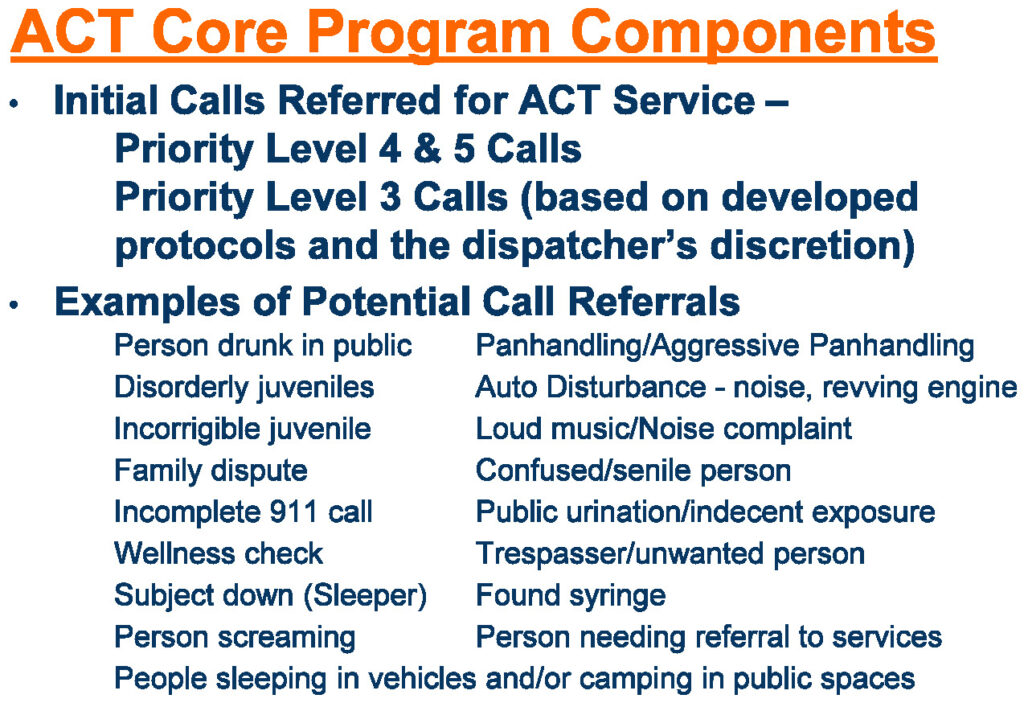
Also, according to the report, “For the pilot program, APD Dispatch will refer calls from priority levels 4 & 5 to the ACT unit, with some priority level 3 calls (based on developed protocols and the dispatcher’s discretion). Initially, ACT will respond to dispatch-referred calls initiated through the 911 system. A sample of the call situations that ACT may respond to includes: Person drunk in public Panhandling/Aggressive Panhandling Disorderly juveniles – group Auto Disturbance – noise, revving engine Loud music – Noise complaint Incorrigible juvenile Confused/senile person Family dispute Incomplete 911 call Public urination/indecent exposure (without criminal intent) Wellness check Subject down (typically a resident asleep in public) Trespasser/unwanted person Found syringe Person screaming Person needing referral to services w/o access to phone People sleeping in vehicles and/or camping in public spaces.”

The primary design components of the program include: Program scope, Core personnel, Support personnel, Staff development, Pilot facilities, Community outreach / engagement, Prevention planning, APD integration, Evaluation planning, Program budget, Pilot startup phases / timetable, and APD call referrals.

The Antioch Care Team will consist of a program director, community response specialist, an EMT, case manager/network developer and a clinical coordinator. It will take about 14.5 full-time equivalent employees to staff the 24-hour operation.

“We recommend a one-year pilot after the vendor is selected,” Harris said. “It’s scheduled to coincide with the end of your Fiscal Year 2023.”

Five members of the public spoke in favor of the program, including Angelo Quinto’s aunt, sister and father.

In response to a question from District 1 Councilwoman Tamisha Torres-Walker about costs, Interim Antioch Police Chief Tony Morefield said, “I’ll say that we’ve been supportive of this process from the start. The only costs I see would be police radios.”

“The one thing that was brought up was coordinating with the county. I want to make sure we are in partnership with the county going forward,” said District 3 Councilwoman Lori Ogorchock. She also asked about costs.

“Being that this would be a non-profit organization we did not include pension costs for employees,” Harris responded.

With no further discussion the council adopted the resolution on a 5-0 vote.

To see the complete report, visit Antioch-Care-Team.pdf (antiochca.gov)

Kaiser claims bargaining in good faith with striking engineers’ union, best compensated in profession

Tuesday, December 14th, 2021

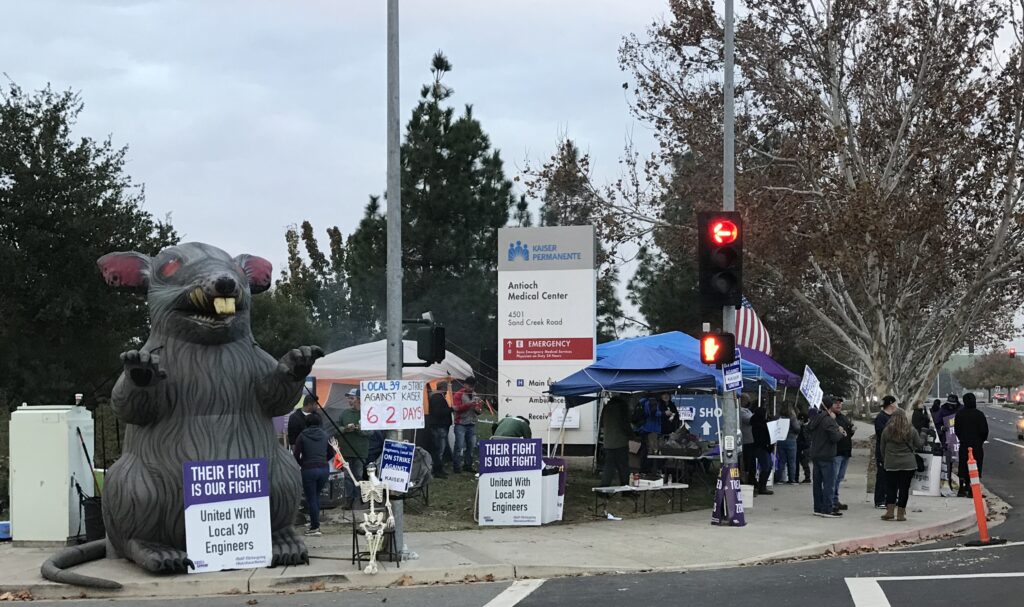
A large inflatable rat was on display at the Antioch Kaiser strike on Thursday afternoon, Nov. 18, 2021. Photo by Allen Payton

On strike for nearly three months

By Antonia Ehlers, PR and Media Relations, Kaiser Permanente Northern California

Kaiser Permanente has been bargaining in good faith with Local 39 IUOE (International Union of Operating Engineers Local 39 Stationary Engineers), the union that represents about 600 Kaiser Permanente operating engineers, for several months. The union decided to call a strike and have kept employees out for nearly three months. Our proposals to Local 39 will keep our engineers among the best compensated in their profession, at an average of more than $180,000 in total wages and benefits. We are not proposing any take-aways. (See related article)

In bargaining with IOUE Local 39, we delivered a comprehensive proposal that offers across-the-board pay increases and cash payments that are similar to our other employees’ and continues to include all our industry-leading benefits. Further, engineers’ retirement benefit would continue to be substantial, with several improvements.

Right now, Local 39’s position is the same as before it went on strike. The union continues to insist it receive much more – in some cases nearly 2 times more – than other union agreements covering Kaiser Permanente employees. It simply is not in line with other employees, nor is it in line with our obligation to continue addressing the affordability of health care for our more than 4.5 million members.

We will continue to bargain in good faith, and we hope that Local 39 leaders will continue to do the same. That means more discussion, fresh ideas, and compromise. At this time, we do not have any further dates scheduled to meet.  We are optimistic that we can resolve the remaining issues with Local 39 at the bargaining table and reach an agreement that continues to reward our employees and supports health care affordability, just as we have with several unions recently.

Contra Costa Supervisors put Health Services Chief on hot seat over 13 COVID rule violating restaurants

Wednesday, December 8th, 2021

“The time has come to shut down those establishments that don’t obey the code.” – District 4 Supervisor Karen Mitchoff

“There are no Omicron variant cases yet in our county.” – CC Health Services Director Anna Roth

Approve East County Groundwater Plan; approve $95.5 million for new West County Reentry Treatment & Housing Facility

By Daniel Borsuk

A defensive Contra Costa Health Services Director Anna Roth faced criticism from county Supervisors, especially emanating from District 4 Supervisor Karen Mitchoff on why 13 restaurants remain open in defiance of county COVID-19 health orders. As of Sept. 22, by order of the county’s Health Officer Dr. Chris Farnitano, restaurants, gyms, movie theaters and other entertainment venues must require patrons show proof of vaccination or a recent negative COVID test in order to enter. (See related article)

“There is no change in enforcement,” Roth said at Tuesday’s supervisors meeting. As of November, 99 percent of restaurants in the county are compliant. We have 13 outstanding cases.”

But Roth’s statement did not satisfy Mitchoff, the supervisor who initially unveiled the code enforcement issue with the county health services.

“The time has come to shut down those establishments that don’t obey the code,” Mitchoff said. “We have done the education. We’ve done the warning.”

None of the owners of the 13 restaurants spoke at Tuesday’s supervisors meeting. Lumpy’s Diner in Antioch, and MJ’s Downtown Café are among eating establishments that the county has tagged as out of compliance of COVID-19 health code.

One of the 13 restaurants on the county’s red tag list, the In-n-Out in Pleasant Hill has been closed for indoor dining health code violations.

District 5 Supervisor Federal Glover of Pittsburg came to the defense of Roth and her department’s code enforcement division commenting, “I think you’re doing an outstanding job out there. The volume of people out there who are out of compliance is small. I enjoy eating inside a restaurant. I understand the stress,”

In the meantime, Roth reported that while 75.6 percent of Contra Costa County residents are fully vaccinated, twenty-seven persons are hospitalized in county hospitals with COVID-19 symptoms One patient dies daily on average from COVID-19 symptoms, she noted.

“There are no Omicron variant cases yet in our county,” said Roth.

In an interview for a KRON4 news report, County Health Officer Dr. Chris Farnitano said, “We don’t just jump right in there with a fine at the get go. We give the businesses the opportunity. Because our goal is to get to compliance for people to follow the order. Our goal isn’t to issue a bunch of fines.” The report also shared that Farnitano said only four restaurants in the county have been fined.

East County Groundwater Sustainability Plan Approved

Supervisors also approved the East Contra Costa Subbasin Groundwater Sustainability Plan on a 5-0 vote. The $1.4 million groundwater study applies to the cities of Antioch and Brentwood, Byron-Bethany Irrigation District, Diablo Water District, Discovery Bay Community Services and East Contra Costa Irrigation District.

Even under drought like conditions, the plan found, “Groundwater conditions in the ECC Subbasin are favorable and reflect stability over the past 30 years or more. Using various analogies, the Subbasin can be described as generally full through various water-year types, including drought and is in good “health.” The favorable conditions are in part due to surface water availability that represents the largest sources of supply for municipal and agricultural uses in the Subbasin.”

Ryan Hernandez of the Department of Conservation and Planning said if the board of supervisors did not adopt the ECC-GSP, the county would be in violation of the Sustainable Groundwater Management Act, which would result in the State Water Resources Board intervening in local groundwater management.

Rendering of the entrance of the West County Re-entry Treatment and Housing Facility. Source: Contra Costa County

$95.5 Million West County Detention Facility Expansion Plan Approved

Supervisors unanimously approved a $95.5 million design-build contract with Montana-based contractor Sletten Construction Company to design and build five secure housing units, a medical treatment center, reentry program space and building, and visitation facilities at the West County Detention Facility in Richmond. It will be known as the West County Re-entry Treatment and Housing Facility. WRTH presentation CCCBOS120721

One of the objectives of the project is to reduce overcrowding by 128 inmate beds to 288 high-security inmate beds in five housing units. Ninety-six beds will still be mental health treatment beds.

Possible Relocation of Marsh Creek Shooting Range

In a related matter, supervisors approved as a consent item a report on the future use and potential relocation of the shooting range at the Marsh Creek Detention Facility possibly to the Concord Naval Weapon Station. At the low-security detention facility inmates learn wood making skills and other basic education skills.

Used also as a training facility for the Office of the Sheriff and law enforcement agencies from Contra Costa County and surrounding counties, the Marsh Creek Range Facility generates revenue for the county. The range will bring about $113,000 for fiscal year 2021-2022, wrote County Administrator Monica Nino in her report to the supervisors.

Allen Payton contributed to this report.


Contra Costa College District COVID-19 vaccine mandate for staff, students now in effect

Saturday, November 20th, 2021

Photo source: CDC

Unanimous vote by trustees; all visitors, including vendors and subcontractors, required to complete health assessment prior to visiting a 4CD facility.

By Timothy Leung, Public Information Officer, Contra Costa Community College District

At their September 8, 2021, meeting, the Contra Costa Community College District (4CD) Governing Board passed a resolution on a unanimous vote establishing a COVID-19 vaccine requirement for all employees, and students who attend at least one in-person class or visits a 4CD facility or campus. All visitors, including vendors and subcontractors, are strongly encouraged to be vaccinated and will be required to complete a health assessment prior to visiting a 4CD facility. Ward 2 Trustee and Board Vic President Dr. Walters made the motion, and it was seconded by Ward 5 Trustee Fernando Sandoval. The vote was unanimous, including the student trustee. (See Item 21.A.)

The vaccine requirement became effective on Monday, November 1, 2021, in order to provide time for those currently unvaccinated to become fully vaccinated. The 4CD Governing Board determined that requiring vaccines for students and employees is necessary to ensure the health and safety of the 4CD community.

Employees and students can apply for a vaccination exception or deferral in the following situations: (a) medical excuse from receiving COVID-19 vaccine due to medical conditions or precaution; b) disability; (c) during the period of any pregnancy; or (d) religious objection based on a person’s sincerely held religious beliefs, practice or observance. When an exception or deferral has been approved, regular weekly COVID-19 testing with evidence of negative test results will be required for any unvaccinated person accessing District campuses or facilities.

4CD is evaluating various technology solutions that will track the vaccination status and test results in a secure system designed to protect the privacy of students and employees in accordance with applicable laws.

“In making this decision, 4CD reached out to its students, faculty, classified professionals, and managers and received overwhelming support to take this action,” said Chancellor Bryan Reece. “COVID-19 and its many variants will be with us for a while, so we must take prudent steps like this one so we can continue providing face-to-face instruction and services for our students, while ensuring we have a safe place to learn and work for our students and staff.”

4CD continues to monitor and adhere to health guidelines from federal, state and local health authorities, and advocates vaccination is the most effective way to prevent transmission and limit COVID-19 hospitalizations and deaths.

Visit 4CD’s website at https://www.4cd.edu/covid19/index.html for more information.

About the College District

The Contra Costa Community College District (4CD) is one of the largest multi-college community college districts in California. The 4CD serves a population of 1,019,640 people, and its boundaries encompass all but 48 of the 734-square-mile land area of Contra Costa County. 4CD is home to Contra Costa College in San Pablo, Diablo Valley College in Pleasant Hill, Los Medanos College in Pittsburg, as well as educational centers in Brentwood and San Ramon. The District headquarters is located in downtown Martinez. For more information visit www.4cd.edu.

Kaiser Permanente issues statements about claims made by the California Nurses Association, bargaining with NUHW and claims they’ve made

Friday, November 19th, 2021

By Antonia Ehlers, PR and Media Relations, Kaiser Permanente Northern California

Members of both the California Nurses Association and National Union of Healthcare Workers (NUHW) are participating in sympathy strikes on Friday, Nov. 19, at all Kaiser facilities in Northern California in support of the Engineers, Local 39 who have been on strike for 63 days, as of today.

Kaiser Permanente statement about claims made by the California Nurses Association

November 19, 2021

Note: Kaiser Permanente is not in bargaining with the California Nurses Association, whose contract runs through August 2022.

The last 20 months of this pandemic have been an incredibly challenging and stressful time to work on the front lines of health care. We are extremely grateful for our frontline health care workforce, including our nurses, whose commitment to providing care and service throughout the COVID-19 pandemic has been nothing short of inspiring.

And while staffing continues to be a challenge across health care, we have hired hundreds of nurses and other care team members in recent months and continue to support our teams and their need for respite by bringing in experienced temporary staff.  In fact, in spite of the acute shortage of nurses in the state, Kaiser Permanente Northern California will have hired an estimated 1,800 experienced nurses by the end of the year, in addition to adding 300 new nurses who will graduate from Kaiser Permanente’s nurse residency program.

We want to thank our nurses, who demonstrate resilience, expertise and compassion every day. We recognize and have worked hard to ease the stresses that this pandemic has caused our people. Since early in the pandemic response, Kaiser Permanente has provided nearly $600 million in employee assistance to ensure that our frontline employees had access to alternate housing, special childcare grants, and additional paid leave for COVID-19 illness and exposure. When it became clear at year-end that our workers’ performance bonuses could be reduced by the effects of the pandemic, we instead chose to guarantee all eligible union-represented employees at least a 100% payout of their performance bonus, amounting to thousands of dollars a person on average.

Kaiser Permanente statement about bargaining with NUHW and claims made by the union

November 19, 2021

Kaiser Permanente and the National Union of Healthcare Workers (NUHW), which represents nearly 2,000 of our mental health professionals in Northern California, began bargaining in late July. While the union is issuing press statements about staffing, the real issue at the table is how much therapists are paid. 

This strike is a bargaining tactic this union has used every time it is bargaining for a new contract with Kaiser Permanente, over the past 11 years of its existence. We are still bargaining and are committed to resolving the issues and reaching an agreement.  

There is a national shortage of mental health clinicians that was already a challenge before the pandemic, and over the past year-and-a-half the demand for care has increased everywhere. We have been taking action to address the shortage of caregivers and to ensure care is available to our members. Over the past five years we have added hundreds of new mental health clinicians to our workforce; we currently have more than 300 open positions. We’ve worked hard to expand the number of therapists in California and are investing $30 million to build a pipeline to educate and train new mental health professionals across the state, with an emphasis on expanding the number of bilingual and diverse students entering the mental health field.

We have significantly expanded our ability to provide virtual care to patients who want it, increasing convenience and access, even though NUHW initially objected to this effort. We also continue to scale up our collaborative care programs that have proven to effectively treat patients with anxiety and depression diagnoses. 

As a result of these efforts and more, Kaiser Permanente offers timely access to initial and return appointments that meets all state standards and is above the average of other California providers. While this is an accomplishment during this time of caregiver shortage and increased demand, we are not finished. We know that every appointment is important and matters to each patient, every person’s needs are unique and every Kaiser Permanente member who needs care deserves timely access to that care. 

We have the greatest respect and gratitude for our mental health professionals and we are dedicated to supporting them in their important work. In addition to working with us to improve access to high quality mental health care, we are asking NUHW to work constructively to help address future costs to ensure we continue to be affordable for our members. 

At the heart of the issues in bargaining is this: Health care is increasingly unaffordable, and escalating wages are half of our costs. Kaiser Permanente is indisputably one of the most labor-friendly organizations in the United States. We are committed to remaining an employer of choice for mental health professionals, and to continuing to offer our employees market-leading wages and benefits. But we cannot continue to allow costs to grow beyond what our members can afford.  

The wages our mental health care professionals receive are significantly higher than average in some markets. For example, in the San Francisco Bay Area, licensed marriage family therapists at Kaiser Permanente earn more than $126,000 on average, which is more than $21,000 higher than market average wages, and licensed clinical social workers make more than $128,000, which is more than $16,000 higher than the market average. The same trend is true in the other parts of Northern California. In Sacramento, licensed clinical social workers earn an average of more than $127,000 in wages, which is $24,000 more than the market average. In addition, we provide among the most generous benefits available. 

The challenge we are trying to address is that if we continue to increase costs so high above the marketplace, our members will not be able to afford to get the care they need. We have to work together to address this challenge in a way that honors and rewards our employees and recognizes the increasing difficulty our members and customers face in paying for care. 

NUHW leadership has called for strikes every time we are in bargaining. It is a key part of their bargaining strategy, and it is especially disappointing that they are asking our dedicated and compassionate employees to walk away from their patients when they need us most. We take seriously any threat to disrupt care. We urge our employees to reject any call for a strike, continue to focus on providing care, and work with us through the bargaining process to finalize a new agreement.