







Archive for the ‘Government’ Category

Antioch Council spends $2.3 million in extra tax revenues but nothing for homeless or more cops

Wednesday, November 24th, 2021
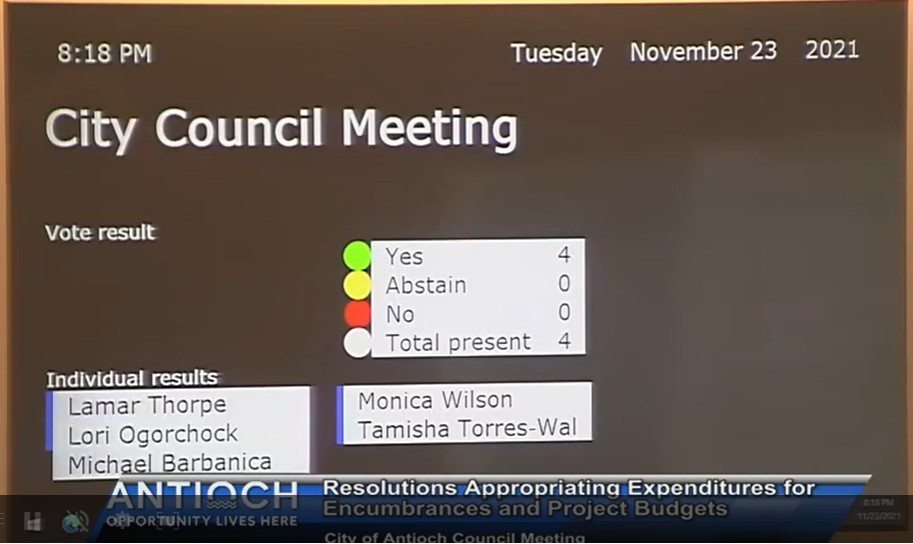
The Antioch City Council uses their new display board showing how they voted during their meeting on Tuesday, Nov. 23, 2021. Video screenshot.

Approve $1,500,000 for renovation of City Hall second floor

Thorpe, Torres-Walker want to renovate Hard House for council member offices, plus staff for each council member

By Allen Payton

During Tuesday night’s meeting, Nov. 23, 2021, Antioch Finance Director Dawn Merchant said the city council will have an additional $2.3 million to spend in this year’s budget, with over $2.5 million additional from sales tax, including over $1.5 million more from Measure W’s 1% sales tax revenues. The council members chose to allocate the funds but included nothing to pay for more police officer or to help the homeless.

According to the City staff report on the item, “The major contributing factors to net revenues higher than projected are:

  • $1,542,781 higher Measure W/1% sales tax than projected.
  • $1,006,854 higher sales tax than projected.
  • $435,820 more in building permit revenue than anticipated.
  • $231,737 more in property tax revenue than anticipated.
  • $160,000 more in interest and rental revenue than anticipated.
  • Approximately $532,000 additional revenues than anticipated from various miscellaneous sources.

There was also a $1,571,461 reduction in revenues for the amount billed to the Department of Water Resources (DWR) for our usable river water days as the money was not received until October 2021 requiring us to record this revenue in FY22 instead.”

Plus, there were $6,425,217 less in expenditures than projected for Fiscal Year 2021. The major contributing factors to net expenditures lower than projected are:

$383,762 less in operating subsidy than projected to the Animal Shelter.

$557,686 less in operating subsidy than projected to Recreation programs.

$2,007,481 in salary savings from all unfilled positions. $1,051,661 represents non- Police salary savings which the City Council will need to allocate to one-time projects and/or unfunded liabilities per the City’s one-time revenue policy. The appropriation has been included in the budget amendments in Exhibit C to Attachment A.

$271,532 in purchase orders as of June 30,2021 not yet entirely spent. The carry forward of the budgets for these is included in the budget amendments in Exhibit A to Attachment A.

$1,941,089 in project budgets outstanding as of June 30, 2021, not yet entirely spent. The carryforward of the budgets for these is included in the budget amendments in Exhibit B to Attachment A.

$1,054,466 in non-salary savings in the Police Department budget.

$328,786 in non-salary savings in Public Works.

$2.85 and $3.1 Million More in FY22 and FY23

As a result, city staff is projecting increases to Fiscal Year 2022 General Fund sales tax and 1% sales tax projections by $2,849,683 and FY23 by $3,121,657 based on FY21 closing numbers and current sales tax projection trends.

Council Allocates Funds But, None for More Police Officers or Homeless

Staff also proposed how to spend the additional funds, including paying for projects the City has already begun and moving up items from the FY22 budget.

Mayor Lamar Thorpe suggested holding off on approving costs related to establishing the new Community Resources Department.

Then without any comments from the public, District 3 Councilwoman Lori Ogorchock made, and District 2 Councilman Mike Barbanica seconded a motion to approve the remaining items. But both Mayor Pro Tem Monica Wilson and Thorpe said they would rather discuss them on a item by item basis. The motion failed 2-3 with District 1 Councilwoman Tamisha Torres-Walker joining Thorpe and Wilson in voting no.

The council members then reviewed the other proposed budget items, with Thorpe seeking consensus

  • Consideration of vehicles and equipment for the seven (7) new Code Enforcement Officers approved in the budget at a General Fund FY22 cost of $245,000 and $21,000 in FY23.
  • Consideration of an Administrative Assistant for Human Resources. The FY22 General Fund budget cost would be $30,769 (includes $5,000 for computer and other startup costs) and $110,479 in FY23.
  • Consideration of a Finance Analyst for Finance. Finance would request this not be budgeted until FY23 with a General Fund cost of $181,981, which includes $5,000 for computer and other startup costs.
  • Consideration of a Community Development Technician for Community Development at a FY22 General Fund budget cost of $42,513 (includes $2,000 startup costs) and $167,253 in FY23.
  • Consideration of a GIS Technician position for Public Works at a FY22 General Fund budget cost would be $32,039 and $137,554 in FY23.
  • Consideration of an Administrative Assistant position for Public Works at a FY22 cost of $24,290 and $104,068 in FY23.

Items Without Consensus or to Be Brought Back Later

  • Community Resources Department for an Administrative Analyst at a cost of $40,426 in FY22 and $166,894 in FY23; an Administrative Assistant at a cost of $24,290 in FY22 and $104,068 in FY23; building furnishings/remodel and repairs at an estimated cost of $1,000,000 to accommodate the staffing of the new department.
  • Consideration of Prewett Park Perimeter Fence Replacement at a FY23 General Fund budget cost of $200,000.
  • L Street Improvements project at a FY22 unknown funding source cost of $9,281,000.
  • The plan is to wait for possible funds from the recently approved federal infrastructure bill.
  • Wilson wanted a study session to discuss the various “corridors”.
  • Thorpe responded, “there will be a study session.”
  • Dedicated CORE Team at a General Fund cost of $250,000 in FY22 and FY23. – Both Ogorchock and Barbanica supported it, now.
  • Consideration of Police Department Community Room Technology Upgrades at a FY22 General Fund cost of $300,000. – Barbanica argued that the room serves as the Emergency Operations Center.

Approve New Budget Requests

According to the city staff offered a list of new budget requests all of which the council supported. They are:

  1. A Recreation Coordinator for Youth Services was approved in the adopted 2021-23 budget for funding approved in FY23. This is being requested to begin funding in FY22 to assist the Youth Network Services Manager getting programs and services running. This request would add $47,726 to the FY22 General Fund budget assuming funding for 5 months.
  1. Promotion of a Senior Computer Technician position to a Network Administrator. The FY22 and 23 budget impacts are $2,741 and $8,724 respectively funded from the Information Services Internal Service Fund.
  2. Addition of one (1) Administrative Analyst I position in the City Clerk’s office to meet the work demands of running the office. The FY22 General Fund budget impact, assuming the position is filled for 3 months is $40,426 and the annual FY23 impact would be $166,894.
  3. Reclassification of one (1) Administrative Assistant I position in the City Clerk’s office to an Administrative Analyst I position. The FY22 and FY23 General Fund budget impact would be $6,181 and $27,060 respectively.
  4. Addition of two (2) General Laborer positions to be funded with NPDES funds at a FY22 cost of $47,692 and $211,960 in FY23. If these positions are approved, the NPDES reserves will be depleted beginning in FY24 and the positions will need to be funded with the General Fund starting in FY24. Public works has been installing trash capture devices in the City’s storm drain system to comply with State requirements to keep trash and pollutants from entering our streams and waterways. These trash capture devices require monthly inspections and cleaning. Public Works does not have adequate staffing to perform this work on an ongoing and continuing basis so a request for bids was issued. Bids were received and the cost of contracting this service exceeded the cost of performing this work in house with these two (2) additional positions being requested.
  1. Add $150,000 to the Information Systems Fund FY22 budget to cover cybersecurity measures to be put in place to protect the City’s network.
  2. Addition of one (1) Payroll Specialist position at a FY22 General Fund cost of and $40,527 and $168,132 in FY23. Payroll processing is a critical function of the City and is processed bi-weekly for over 350 full time employees and up to a couple hundred more part time employees depending on the season. The City currently has one full time Payroll Specialist with some additional support from an Accounting Technician and the Deputy Finance Director to process payroll. Another position is severely needed to not only handle the volume, especially with all the additional positions added in this new budget cycle, but to be able to continue processing payroll when the one position is absent.
  1. Reclassification of two (2) Office Assistant positions in Recreation to Administrative Assistant II positions at an estimated cost of $10,030 in FY22 and $20,254 in FY23 to the General Fund.
  2. Reclassification of one (1) Administrative Assistant III position in Recreation to an Administrative Analyst I position at an estimated cost of $3,849 in FY22 and $13,730 to the General Fund.
  3. Remodel of 2nd floor and basement of City Hall at an estimated cost to the General Fund of $1,500,000 in FY22.

City to Receive $10.8 Million More in Federal COVID Relief Funds

The City of Antioch will be receiving a total of $21,550,900 in funds from the American Rescue Plan Act (“ARPA”). $10,775,450 was received in May 2021, with the remaining balance of $10,775,450 to be received in May 2022.

A discussion item was brought to City Council on July 27th whereby City Council Members discussed holding town hall meetings within each of their respective districts to speak with community members regarding the use of funds. As a reminder, the main priorities and principals of the funding are to provide relief to:

  • Support urgent COVID-19 response efforts to continue to decrease the spread of the virus and bring the pandemic under control;
  • Replace public sector revenue to strengthen support for vital public services and help retain jobs;
  • Support immediate economic stabilization for households and business; and
  • Address systemic public health and economic challenges that have contributed to the unequal impact of the pandemic on certain populations.
  • Recipients may use these funds specifically to:
  • Support public health expenditures (as outlined in the interim final rule);
  • Address negative economic impacts caused by the public health emergency, including economic harms to workers, households, small businesses, impacted industries and the public sector for those within a Qualified Census Tract or to other populations, households or geographic areas disproportionately impacted by the pandemic;
  • Replace lost public sector revenue to provide government services to the extent of lost revenue (for the first measurement period ending calendar year December 2020, the City of Antioch has no revenue loss and therefore government services cannot be funded in this category); and
  • Invest in water, sewer, and broadband infrastructure (as outlined in the interim final rule).

The Department of the Treasury has not yet issued final rules for spending of the funds which may provide further clarification and guidance from the interim final rule initially released. It is recommended that the City Council set a date for a future study session on allocation of the funds.

$1 Million in One-Time Funds, Mayor Wants to Use Them on Hard House for Council Member Offices
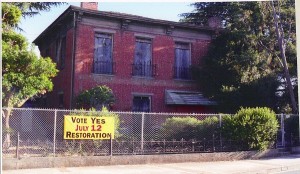
The Hard House on W. 1st Street in Antioch. Herald file photo from 2011.

Thorpe wanted the city to put money into the Hard House “as an extension of city hall…with offices for council members.” The brick building was the home of the City’s first mayor and is located on W. First Street next to the Lynn House Gallery and across from the Amtrak Station.

The Hard House was once proposed to be donated to a non-profit organization that planned to reinforce it to earthquake standards and completely restore the building. Other ideas were to turn it into a bistro or offices.

“It was pretty disappointing to show up here and see there was no space for city council members which is pretty telling of our role, here,” Torres-Walker said. She also asked to have staff for individual council members to come back for a future discussion.

“I agree with Councilwoman Torres-Walker regarding staffing support,” Thorpe said. “The public believes we are full-time, but we have full-time jobs. I believe it’s long past due.”

Ogorchock wanted all the funds to be spent to pay down the City’s unfunded liabilities.

But upon advice from City Manager Ron Bernal who said the staff could come back with more details on the proposals, it was decided the council will hold off on deciding how to spend the one-time funds.
 

Antioch Council approves another cannabis business, votes down committee for city manager recruitment

Wednesday, November 24th, 2021

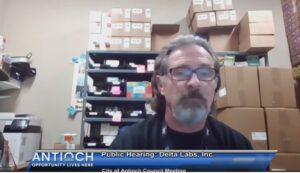
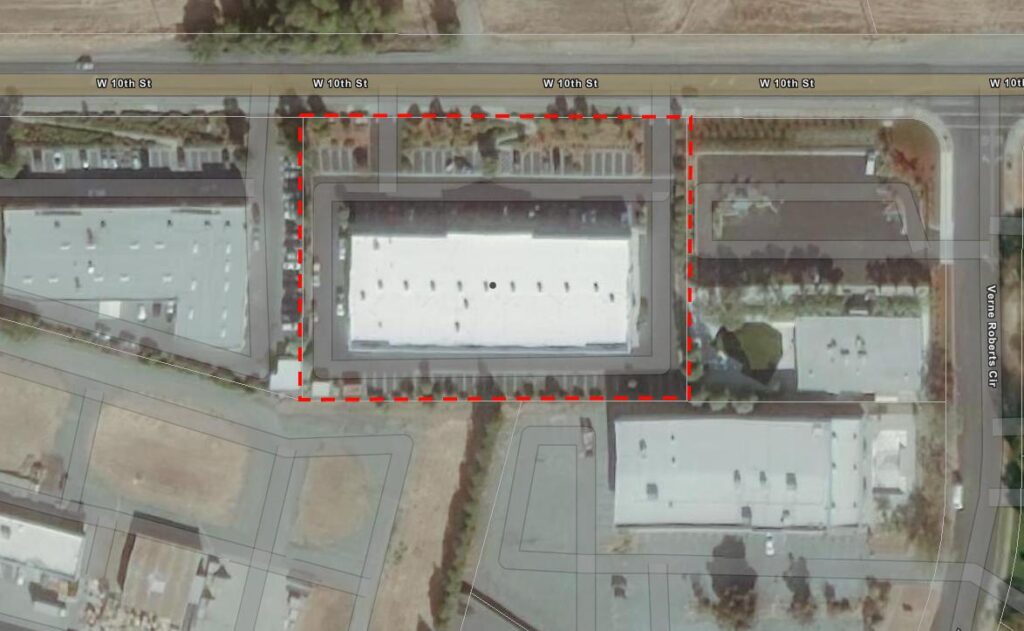
Delta Labs site on W. 10th Street. From presentation during Antioch City Council meeting on Tuesday, Nov. 23, 2021

Thorpe nominates Barbanica, Ogorchock to city manager recruitment ad hoc committee then votes against appointing them

Agree to settle employment discrimination lawsuit by former female Antioch cop against police department on 4-1 vote

Extend contract for city Public Information Officer at $8,000 per month for another six months

By Allen Payton

During their meeting Tuesday night, Nov. 23, 2021, the Antioch Council approved another cannabis business, one that processes marijuana through a cold-water extraction, on a unanimous vote, approved settling a former female cop’s employment discrimination lawsuit against the police department on a split vote, and fails to form an ad hoc committee for the hiring of a new city manager on another split vote. They also voted unanimously to extend the city’s PIO contract for another six months.

Before the regular meeting began, following the council’s closed session, City Attorney Thomas Lloyd Smith reported out regarding the lawsuit of Blanco v. City of Antioch, United States District Court Northern District of California, Case No. 3:20-cv-02764-TSH. The city council decided to settle the case, with Barbanica voting no, Smith said.

On April 21, 2020, former Antioch Police Officer Brittney Blanco filed a Civil Rights Employment Discrimination lawsuit against the police department. The case was filed in U.S. District Court, California Northern District. Blanco served on the force from July 2017 until August 2019. No word was given regarding the details of the settlement.

Extend $8K Monthly PIO Contract

During the Consent Calendar, the council voted unanimously to extend the contract for the City’s public information officer, Rolando Bonilla, of San Francisco-based Voler Strategic Advisors at $8,000 per month for another six months, through May 15, 2022. The total contract is not to exceed $256,000. Bonilla has been the City’s PIO since fall 2019. PIO Contract Extension ACC112321

Public Comments Now In-Person, Still Online and By Phone

At the start of the regular meeting, Mayor Lamar Thorpe stated that public comments from those in attendance at the council meetings would be heard first, followed by those who submitted their comments online or call in.

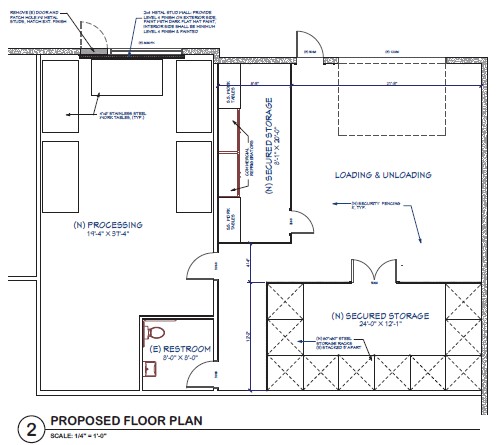
Delta Labs floorplan. From Antioch City Council meeting Nov. 23, 2021.

Unanimously Approve Another Cannabis Business

Delta Labs owner Rick Oak speaks about his business during the council meeting.

The council then held a public hearing on another cannabis business. According to City staff, “Delta Lab is proposing a cannabis operations facility with non-volatile extraction” manufacturing. It will be located in the same building where the same family owns Delta Dispensary on W. 10th Street. Delta Labs – city staff report ACC112321

The applicant, Rick Oak, along with his two sons, Dustin and Richard, spoke about their project which is “a cold-water extraction facility and family owned.” He showed a floorplan of the project and explained the product is dropped off process using small washing-type machines using ice to “knock off the hash from the product”. Then it’s stored in refrigerators until sold and picked up by truck.

District 3 Councilwoman Lori Ogorchock was the only member to ask a question about security.

“There’s a guard in our lobby in the dispensary,” Oak said.

With no one from the public speaking against the project, the council approved it on a 5-0 vote.

City Manager Recruitment Ad Hoc Committee

The council then considered forming an ad hoc committee on the recruitment of a permanent city manager.

“I think we have too much going on, right now,”said Wilson. “I think we should hold off until after the new year.”

Ogorchock volunteered to be on the ad hoc committee and Barbanica volunteered, too.

Thorpe then offered them as his nominees to the ad hoc committee.

Ogorchock made the motion and Barbanica seconded it, to approve the formation of the ad hoc committee, the appointment of the two council members, and a termination date of seven months.

“I’m looking at an estimated timeframe of April 30, 2022,” said Administrative Services Director Nickie Mastay.

The motion then failed on a 2-3 vote with Thorpe, Wilson and District 1 Councilwoman Torres-Walker voting no.

“Since that didn’t pass, it will come back, later,” Thorpe said.


House passes Biden’s $2.2 trillion Build Back Better Act spending bill, see what’s in it

Sunday, November 21st, 2021

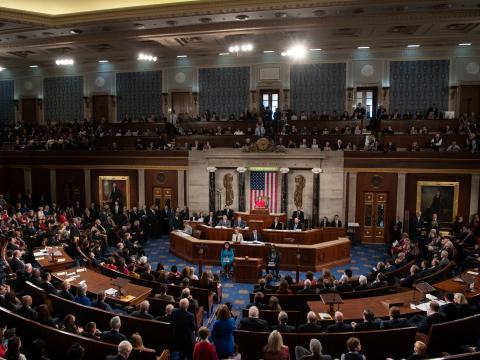
Source: U.S. House of Representatives.

All five Contra Costa Congressmen vote in favor; DeSaulnier praises passage calling it historic investment in American families; likely to be changed in the Senate, where support of all 50 Democrats is needed; CBO says it will increase deficit by almost $800 billion over next five years

By Allen Payton

The U.S. House of Representatives passed President Biden’s $2.2 trillion Build Back Better Act, H.R. 5376, also known as the budget reconciliation package, on Friday, on a mainly partisan vote of 220-213 with all Republican members and only one Democrat voting no. It now moves on to the Senate.

According to Roll Call, “Two key holdouts —West Virginia’s Joe Manchin III and Arizona’s Kyrsten Sinema — have yet to offer a public endorsement of the package. Senate Majority Leader Charles E. Schumer, (D-N.Y.), set a Christmas deadline for final passage.”

The 2,702-page bill passed following a record-breaking, 8 1/2-hour filibuster speech by Minority Leader Kevin McCarthy, (R-Bakersfield). He said, “it’s the most irresponsible spending bill in the history of America.”

According to the Summary of Cost Estimate by the Congressional Budget Office the legislation will increase the deficit by almost $800 billion through Fiscal Year 2026. However, “The CBO estimates that enacting this legislation would result in a net increase in the deficit totaling $367 billion over the 2022-2031 period, not counting any additional revenue that may be generated by additional funding for tax enforcement.”

However, according to the Committee for a Responsible Federal Budget, the legislation could result in a net deficit increase of $2.2 to $2.7 trillion if temporary provisions are made permanent without offsets.

DeSaulnier’s Statement on Passage

On Friday, Congressman Mark DeSaulnier (D, CA-11), who  represents portions of Antioch, issued the following statement upon passage of the Build Back Better Act (H.R. 5376), which passed the U.S. House of Representatives by a vote of 220-to-213.

“Today’s passage of the Build Back Better Act is a victory for families across the country and in Contra Costa. Through its historic investments in early, primary, and secondary education and childcare, we are finally ensuring that all children have the opportunity to thrive both in and out of the classroom, no matter where they live or how much their parents earn. From free preschool for three- and four-year-olds to lowering the cost of high-quality childcare, this bill would give over 90% of parents with young children the opportunity to reenter the workforce knowing their children are safe, cared for, and learning.

By finally calling on the wealthiest Americans and big corporations to pay their fair share, every provision in this bill is paid for and we are making a statement that our children are our priority. I urge the Senate to pass the Build Back Better Act without delay to deliver this much needed relief to families as quickly as possible. American families are counting on it.”

In addition, Build Back Better would:

  • Provide monthly payments of $300 per child under 6 and $250 per child ages 6 to 17 for more than 35 million families under the Child Tax Credit;
  • Devote the necessary resources to combat the climate crisis through expanded tax credits for clean energy and programs to drive down pollution;
  • Lower the cost of prescription drugs and expanding Medicare, Medicaid, and the Affordable Care Act;
  • Bring down costs of long-term care and supporting care workers;
  • Expand opportunities for workforce development programs; and
  • Create affordable housing.

Unpopular Provisions in Bill

According to polling, only 39% of battleground voters support “Build Back Better” while 46% oppose it.

Some of the most unpopular items in the bill include:

  • A natural gas tax that will increase home heating costs, electricity rates, and raise gas prices.
  • An eighty-thousand-dollar tax break to wealthy homeowners in New York, New Jersey, and California.
  • A $3,600 a year child tax credit to illegal immigrants for every child they bring into America or give birth to after arriving.
  • 87,000 new IRS agents to increase audits of taxpayers that will look through the bank accounts of every American earning or spending more than $600 per year to make sure they are paying enough taxes, disproportionally affecting small business owners.

What’s In the Bill

According to the National Review, the legislation includes:

$555 billion in subsidies to move America from one source of energy to another, including up to $12,500 per new electric car purchase;

$220 billion for clean energy & climate resilience;

$190 billion to establish or expand clean energy & electric tax credits;

$60 billion to establish or expand clean fuel & vehicle tax credits;

$75 billion to establish or expand other climate-related tax benefits; and

$10 billion to enact infrastructure & related tax breaks;

$400 billion for universal pre-school and day care, including $18 billion in the first three years to create universal pre-kindergarten. Then, the program would be funded by a mixture of federal and state funds;

$300 billion for restoration of the state and local tax (SALT) deduction eliminated in the Tax Cuts and Jobs Act of 2017. According to CNBC the bill, “raises the cap on the state and local tax deduction from $10,000 to $80,00 in 2021, which will benefit the richest households in the country, according to the Tax Foundation.”

$200 billion to extend and expand both the Child Tax Credit and the Earned Income Tax Credit, for four weeks of paid parental, sick or caregiving leave;

$90 billion for what the White House describes as “Equity and Other Investments”;

$38 billion in new energy taxes;

$9 billion to higher-learning institutions for “qualified environmental justice programs”;

$7 billion for service groups for projects related to “climate resilience and mitigation”;

$3.5 billion for ports to purchase “zero-emission” equipment;

$3 billion to fund pandemic preparedness;

$3 billion for better records and hospitals for veterans;

$3 billion in “climate justice block grants” that go into projects in disadvantaged communities. The criterion for grants is based on the race of the projects’ sponsors;

$450 million for nontraditional climate apprenticeship programs;

$350 million to “rebuild” the National Labor Relations Board and $321 million to “rebuild” the Equal Employment Opportunity Commission;

$275 million to upgrade the health-care system in Hawaii which also gets $5 million to save endangered plants;

$200 million to preserve Native American languages;

$150–$250 million (estimated) as tax credits to “local” news organizations, excluding government entities, except NPR and PBS. Note: “Local” is broadly defined, and appears to include almost all news organizations, including the New York Times and Washington Post. The bill also contains a rich new deduction for trial lawyers;

$124 million to combat substance abuse;

$85 million for studying the risks of climate change for “pregnant, lactating or post-partum individuals”;

$50 million to train and certify more doulas; and

$5 million to save desert fish.

According to CNBC, “To pay for the bill, House Dems are proposing increasing some taxes on businesses and the wealthiest Americans. It includes a 5% surtax on adjusted gross income (AGI) over $10 million for individuals and an additional 3% on AGI over $25 million.”

See more details on the Committee for a Responsible Federal Budget website.

Biden issues Executive Order on Implementation of the Infrastructure Investment and Jobs Act

Sunday, November 21st, 2021

Executive Order on Implementation of the Infrastructure Investment and Jobs Act

NOVEMBER 15, 2021

By the authority vested in me as President by the Constitution and the laws of the United States of America, and in order to effectively implement the historic infrastructure investments in the Infrastructure Investment and Jobs Act (the Act), it is hereby ordered as follows:

Section 1.  Background.  The Infrastructure Investment and Jobs Act is a once-in-a-generation investment in our Nation’s infrastructure and competitiveness. It will help rebuild America’s roads, bridges, and rails; expand access to clean drinking water; work to ensure access to high-speed Internet throughout the Nation; tackle the climate crisis; advance environmental justice; and invest in communities that have too often been left behind.  It will accomplish all of this while driving the creation of good-paying union jobs and growing the economy sustainably and equitably for decades to come.

Critical to achieving these goals will be the effective implementation of the Act by my Administration, as well as by State, local, Tribal, and territorial governments.

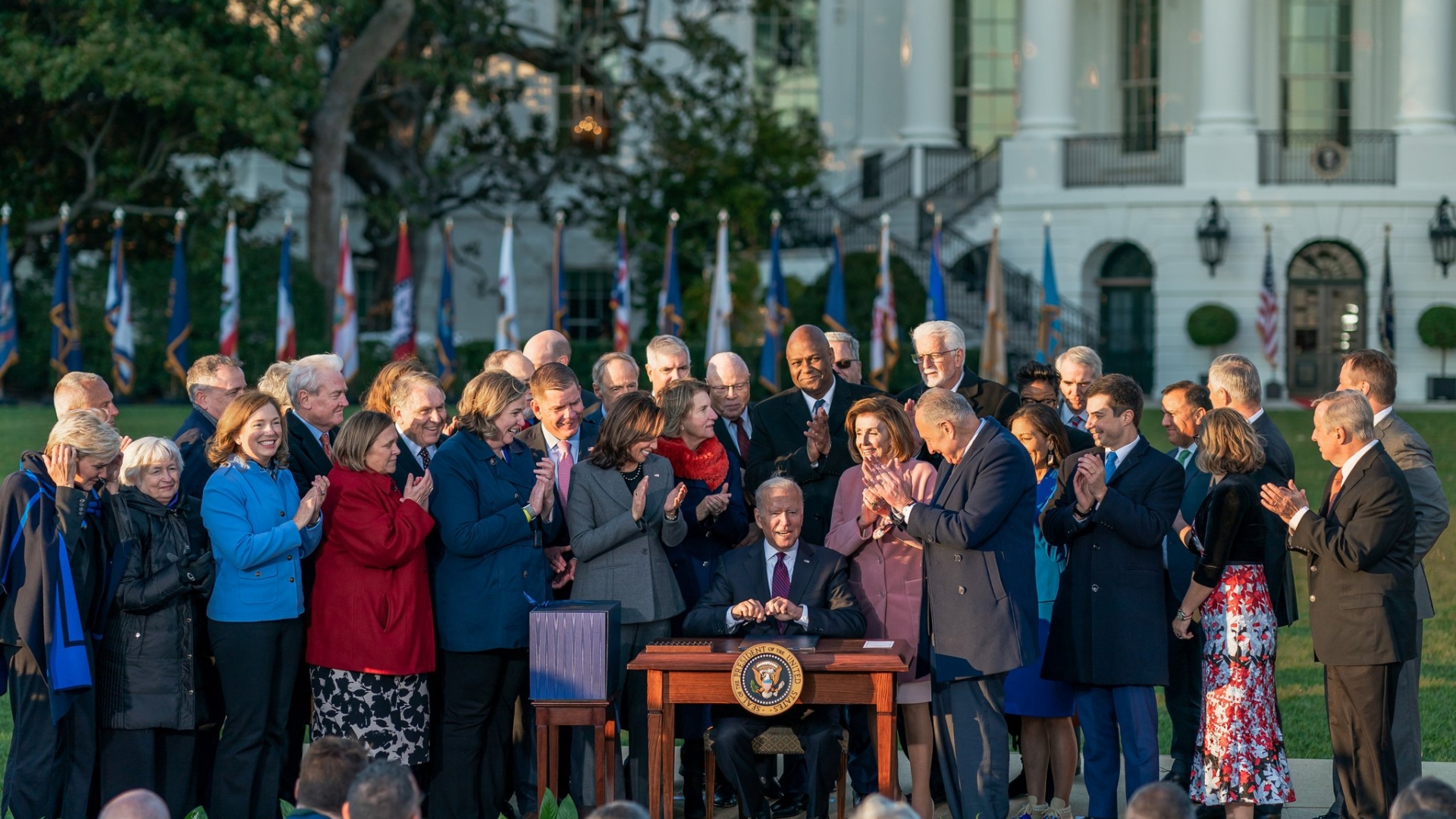
President Biden signed the infrastructure bill during a ceremony on the back lawn of the White House surrounded by members of his cabinet, the House and Senate on Monday, Nov. 15, 2021. Source: U.S. Speaker of the House website

Sec. 2.  Implementation Priorities.  In implementing the Act, all agencies (as described in section 3502(1) of title 44, United States Code, except for the agencies described in section 3502(5) of title 44), shall, as appropriate and to the extent consistent with law, prioritize:

(a)  investing public dollars efficiently, working to avoid waste, and focusing on measurable outcomes for the American people;

(b)  increasing the competitiveness of the United States economy, including through implementing the Act’s Made-in-America requirements and bolstering United States manufacturing and supply chains;

(c)  improving job opportunities for millions of Americans by focusing on high labor standards for these jobs, including prevailing wages and the free and fair chance to join a union;

(d)  investing public dollars equitably, including through the Justice40 Initiative, which is a Government-wide effort toward a goal that 40 percent of the overall benefits from Federal investments in climate and clean energy flow to disadvantaged communities;

(e)  building infrastructure that is resilient and that helps combat the crisis of climate change; and

(f)  effectively coordinating with State, local, Tribal, and territorial governments in implementing these critical investments.

Sec. 3.  Infrastructure Implementation Task Force.  (a)  There is established within the Executive Office of the President the Infrastructure Implementation Task Force (Task Force).  The function of the Task Force is to coordinate effective implementation of the Infrastructure Investment and Jobs Act and other related significant infrastructure programs within the executive branch.

(b)  The Assistant to the President for Economic Policy and Director of the National Economic Council shall serve as Co‑Chair of the Task Force.

(c)  There is established within the Executive Office of the President the position of White House Infrastructure Coordinator, who shall serve as Co-Chair of the Task Force.

(d)  In addition to the Co-Chairs, the Task Force shall consist of the following members:

(i)     the Secretary of the Interior;

(ii)    the Secretary of Agriculture;

(iii)   the Secretary of Commerce;

(iv)    the Secretary of Labor;

(v)     the Secretary of Transportation;

(vi)    the Secretary of Energy;

(vii)   the Administrator of the Environmental Protection Agency;

(viii)  the Director of the Office of Management and Budget;

(ix)    the Director of the Office of Personnel Management;

(x)     the Assistant to the President and Director of the Domestic Policy Council;

(xi)    the Assistant to the President and National Climate Advisor; and

(xii)   the heads of such other executive departments, agencies, and offices as the Co-Chairs may from time to time invite to participate.

(e)  The Co-Chairs may coordinate subgroups consisting of Task Force members or their designees, as appropriate.

Sec. 4.  General Provisions.  (a)  Nothing in this order shall be construed to impair or otherwise affect:

(i)   the authority granted by law to an executive department or agency, or the head thereof; or

(ii)  the functions of the Director of the Office of Management and Budget relating to budgetary, administrative, or legislative proposals.

(b)  This order shall be implemented consistent with applicable law and subject to the availability of appropriations.

(c)  This order is not intended to, and does not, create any right or benefit, substantive or procedural, enforceable at law or in equity by any party against the United States, its departments, agencies, or entities, its officers, employees, or agents, or any other person.

JOSEPH R. BIDEN JR.

THE WHITE HOUSE,

November 15, 2021.


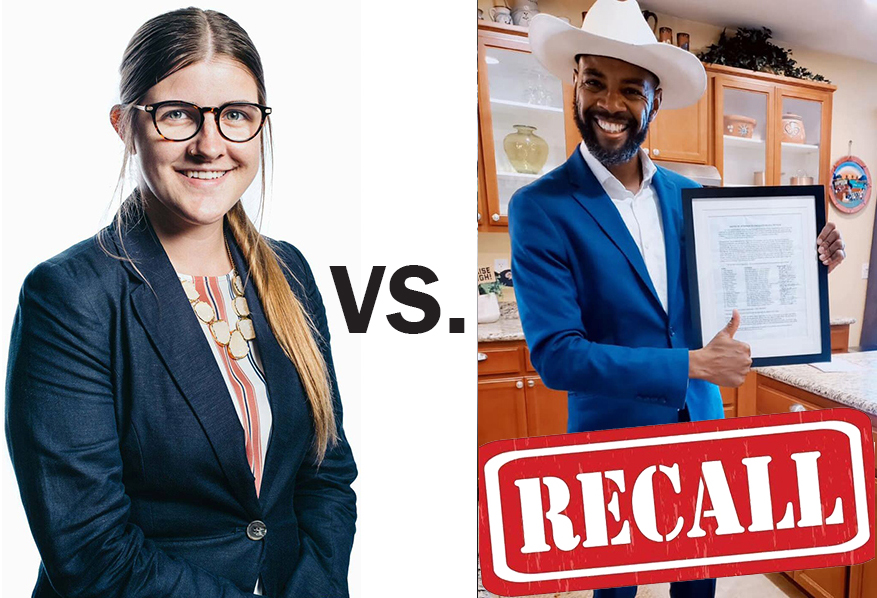
Antioch City Clerk for third time mails response letter to petition for Mayor Thorpe’s recall further delaying signature gathering

Saturday, November 20th, 2021

State Elections Code only requires it be “in writing”; Householder ignores organizers repeated requests to receive letter via email; refuses to answer questions, admit her mistake in second response letter

By Allen Payton

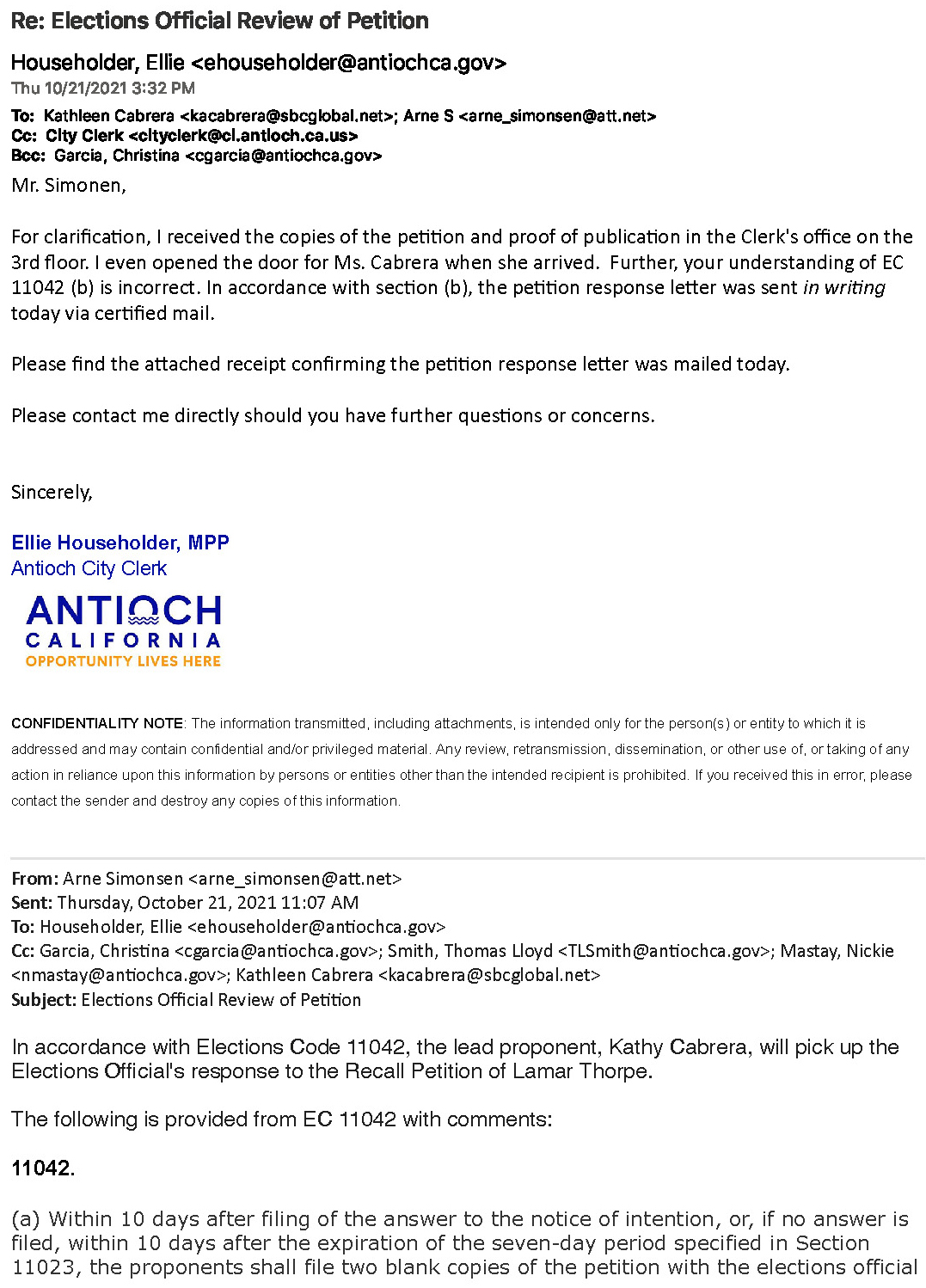
Antioch City Clerk Ellie Householder, a political ally of Mayor Lamar Thorpe, has once again chosen to mail her printed response letter to proponents of his recall, further delaying the signature gathering. On Friday, Nov. 19, 2021, organizer Kathy Cabrera was informed that Householder had mailed her response letter This is the third time the city clerk has chosen to do so. (See related article)

It was on the 10th day since they submitted their recall petition for the third time, which is the legal limit for Householder’s response.

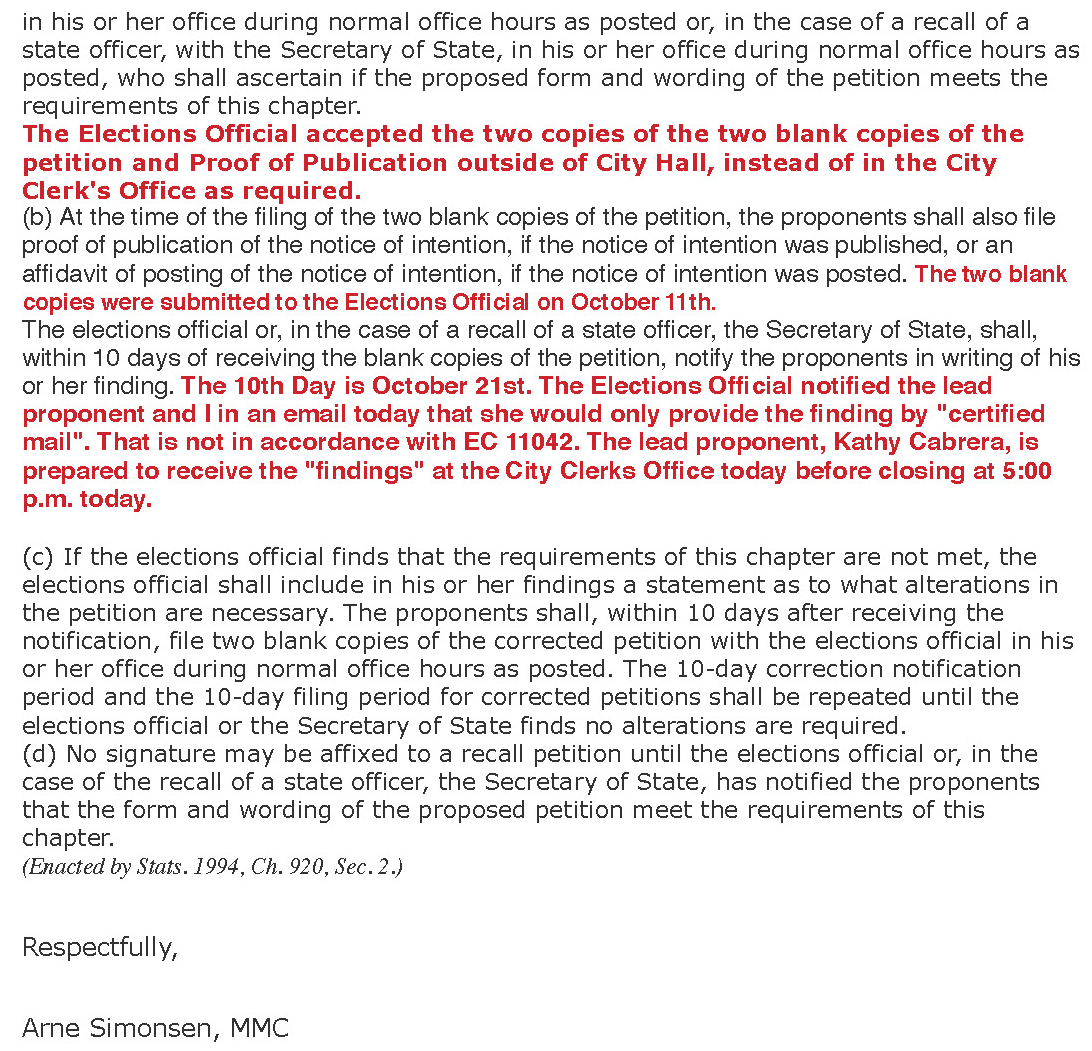
The second time the city clerk was due to provide her response letter to the petition on Oct. 21, fellow organizer and former Antioch City Clerk Arne Simonsen, who earned the advanced, professional designation of Master Municipal Clerk from the International Institute of Municipal Clerks, emailed Householder, writing, “In accordance with Elections Code 11042, the lead proponent, Kathy Cabrera, will pick up the Elections Official’s response to the Recall Petition of Lamar Thorpe.” He further shared the language from that code section.

In an email response that same day, Householder, who has not yet earned the lesser designation of Certified Municipal Clerk wrote, “For clarification, I received the copies of the petition and proof of publication in the Clerk’s office on the 3rd floor. I even opened the door for Ms. Cabrera when she arrived. Further, your understanding of EC11042 (b) is incorrect. In accordance with section (b), the petition response letter was sent in writing today via certified mail. Please find the attached receipt confirming the petition response letter was mailed today.” (The designation of MPP Householder uses in her email correspondence refers to her Master in Public Policy degree.)

However, the state’s Elections Code section 11042 (b) only requires, as both Simonsen and Householder pointed out that, “The elections official…shall…notify the proponents in writing of his or her finding.”

Following is the complete subsection they referenced.

Elections Code Section 11042 “(b) At the time of the filing of the two blank copies of the petition, the proponents shall also file proof of publication of the notice of intention, if the notice of intention was published, or an affidavit of posting of the notice of intention, if the notice of intention was posted.  The elections official or, in the case of a recall of a state officer, the Secretary of State, shall, within 10 days of receiving the blank copies of the petition, notify the proponents in writing of his or her finding.”

Questions for Householder Go Unanswered

A voicemail was left on Householder’s cell phone Friday afternoon and an email was sent to her Friday night asking why she mailed the response letter instead of emailing it, as Cabrera has repeatedly asked Householder, including in emails sent on Sept. 27, Nov. 2, 3, 4 and 16. Emails_Cabrera Householder

Additional questions were asked of Householder in the Friday night email, including, “can you please provide the requirement that ‘in writing’ means on a physical piece of paper to support your reasoning? Also, where does it require you to mail your response letter? If it must be printed on a piece of paper, couldn’t you have called Ms. Cabrera and let her know she could meet you or your staff at the City Clerk’s office for one of you to hand it to her the day you issued it? If so, why didn’t you instead of making her and the other recall proponents wait two or three more days to receive it in the mail?”

Householder was also asked, “Did it really take you and/or your staff 10 days to review their petition? If so, what took so long? Asking again, why couldn’t you follow the petition template provided by the County Clerk’s office that was used for your recall, instead of the template provided by the California Secretary of State’s office? Finally, will you admit to making a mistake in your last response letter requiring them to provide the names of the Top Funders when they have yet to form a campaign committee?”

Householder did not respond prior to publication time on Saturday afternoon.

Cabrera expects to receive Householder’s response letter by Monday, Nov. 22, almost two months after Thorpe was served with his recall notice on Sept. 24. (See related article)

Please check back later for any updates to this report.

Ribbon cutting for renovated Antioch City Council Chambers Monday, Nov. 22

Saturday, November 20th, 2021

$2 million in improvements including plaza and Leo Fontana Fountain still under construction

By Allen Payton

The Antioch City Council Chambers renovation is finally complete. After spending about $1.5 million, the City invites the public to join the council and staff on Monday, November 22, 2021, from 5:00 – 6:00 PM for a ribbon cutting ceremony.

According to the various bids for the council chambers, walkway, plaza and Leo Fontana Fountain, the costs for renovations totals about $2 million and construction began in 2019. The plaza and fountain are still under construction which began earlier, this year.

Improvements

According to Swatt | Miers Architects, hired by the city council for the renovation redesign, “The City of Antioch has long been proud of their public buildings including the Police Facility, Animal Services Facility, and Prewett Family Park — all designed by Swatt | Miers Architects partner George Miers. So, when it came time to renovate their 1980’s Council Chamber, they awarded the commission to SMA.

This project included both the interior renovation of the existing Council Chamber and the enclosure of an existing open-air breezeway that connects the City Hall to the Council Chamber.

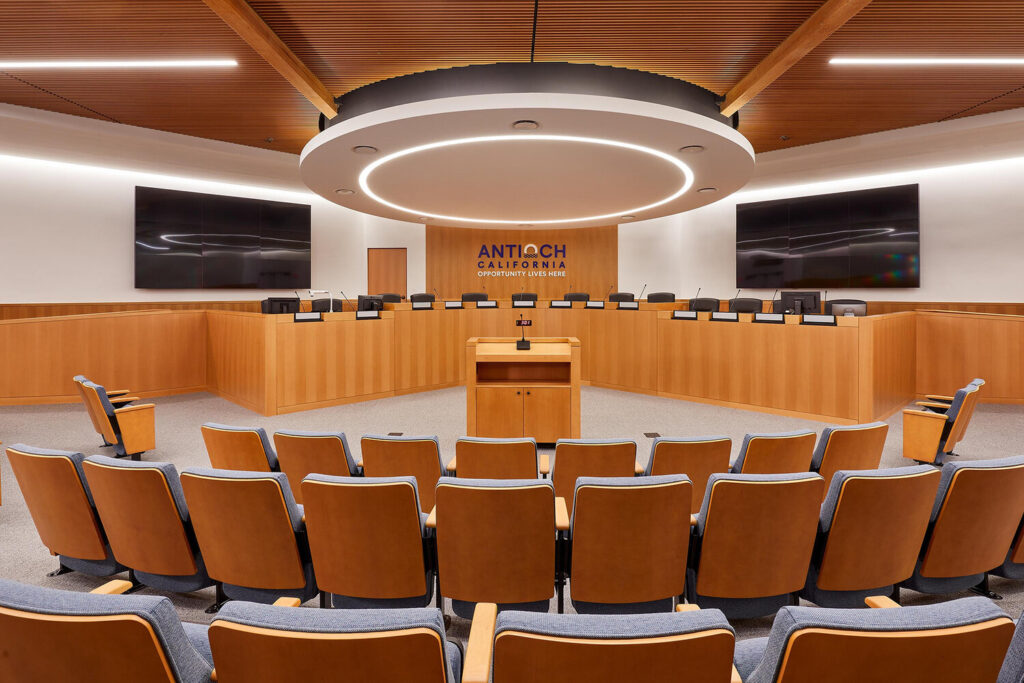
City of Antioch Council Chambers renovation view from the audience. Photo: Swatt | Miers Architects

Designed in 1980 by Mackinley, Winnaker and McNeil Architects, this well-used 3,083 SF, stand-alone facility was long overdue in meeting current code and modern functional requirements including ADA, audio-visual/closed circuit TV, modern lighting/energy design and acoustical attenuation. Additionally, public restrooms had not been provided in the Council Chamber structure. Rather, the public needed to leave the building via a covered walkway and use the main City Hall restrooms. Aside from the inconvenience, security was a significant City concern. Operating on a limited budget, the following design features were implemented;

  • The existing 450 SF covered walkway was converted into an enclosed interior Entry Vestibule linking City Hall and Council Chambers.
  • The existing semi-circular seating layout was redesigned to meet ADA accessibility and related requirements for all public, staff and Council member seating.
  • A comprehensive lighting design focusing on user and TV broadcast needs.

  • A comprehensive AV/TV broadcast design.
  • New seating, acoustical wall panels and floor finishes.
  • New dais, speaker podium and staff seating casework.
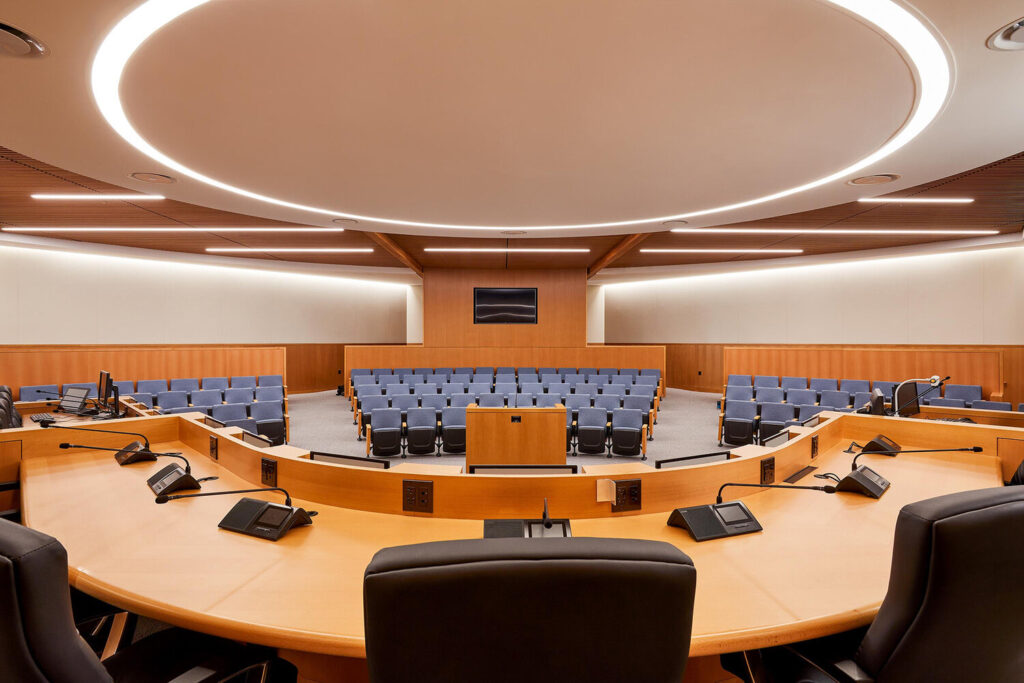
  • A new acoustical wood ceiling featuring a unique, tilted plane above the dais designed to enhance both acoustics and lighting.
  • Redirection of existing axial public entrance to the sides.”

View from the dais in the renovated Antioch Council Chambers. Photo by Swatt | Miers Architects

Antioch City Hall and Council Chambers are located at 200 H Street between W. 2nd and W. 3rd Streets in Antioch’s historic, downtown Rivertown.


Contra Costa College District COVID-19 vaccine mandate for staff, students now in effect

Saturday, November 20th, 2021

Photo source: CDC

Unanimous vote by trustees; all visitors, including vendors and subcontractors, required to complete health assessment prior to visiting a 4CD facility.

By Timothy Leung, Public Information Officer, Contra Costa Community College District

At their September 8, 2021, meeting, the Contra Costa Community College District (4CD) Governing Board passed a resolution on a unanimous vote establishing a COVID-19 vaccine requirement for all employees, and students who attend at least one in-person class or visits a 4CD facility or campus. All visitors, including vendors and subcontractors, are strongly encouraged to be vaccinated and will be required to complete a health assessment prior to visiting a 4CD facility. Ward 2 Trustee and Board Vic President Dr. Walters made the motion, and it was seconded by Ward 5 Trustee Fernando Sandoval. The vote was unanimous, including the student trustee. (See Item 21.A.)

The vaccine requirement became effective on Monday, November 1, 2021, in order to provide time for those currently unvaccinated to become fully vaccinated. The 4CD Governing Board determined that requiring vaccines for students and employees is necessary to ensure the health and safety of the 4CD community.

Employees and students can apply for a vaccination exception or deferral in the following situations: (a) medical excuse from receiving COVID-19 vaccine due to medical conditions or precaution; b) disability; (c) during the period of any pregnancy; or (d) religious objection based on a person’s sincerely held religious beliefs, practice or observance. When an exception or deferral has been approved, regular weekly COVID-19 testing with evidence of negative test results will be required for any unvaccinated person accessing District campuses or facilities.

4CD is evaluating various technology solutions that will track the vaccination status and test results in a secure system designed to protect the privacy of students and employees in accordance with applicable laws.

“In making this decision, 4CD reached out to its students, faculty, classified professionals, and managers and received overwhelming support to take this action,” said Chancellor Bryan Reece. “COVID-19 and its many variants will be with us for a while, so we must take prudent steps like this one so we can continue providing face-to-face instruction and services for our students, while ensuring we have a safe place to learn and work for our students and staff.”

4CD continues to monitor and adhere to health guidelines from federal, state and local health authorities, and advocates vaccination is the most effective way to prevent transmission and limit COVID-19 hospitalizations and deaths.

Visit 4CD’s website at https://www.4cd.edu/covid19/index.html for more information.

About the College District

The Contra Costa Community College District (4CD) is one of the largest multi-college community college districts in California. The 4CD serves a population of 1,019,640 people, and its boundaries encompass all but 48 of the 734-square-mile land area of Contra Costa County. 4CD is home to Contra Costa College in San Pablo, Diablo Valley College in Pleasant Hill, Los Medanos College in Pittsburg, as well as educational centers in Brentwood and San Ramon. The District headquarters is located in downtown Martinez. For more information visit www.4cd.edu.

With minimal public input Contra Costa Supervisors choose redistricting map

Monday, November 15th, 2021

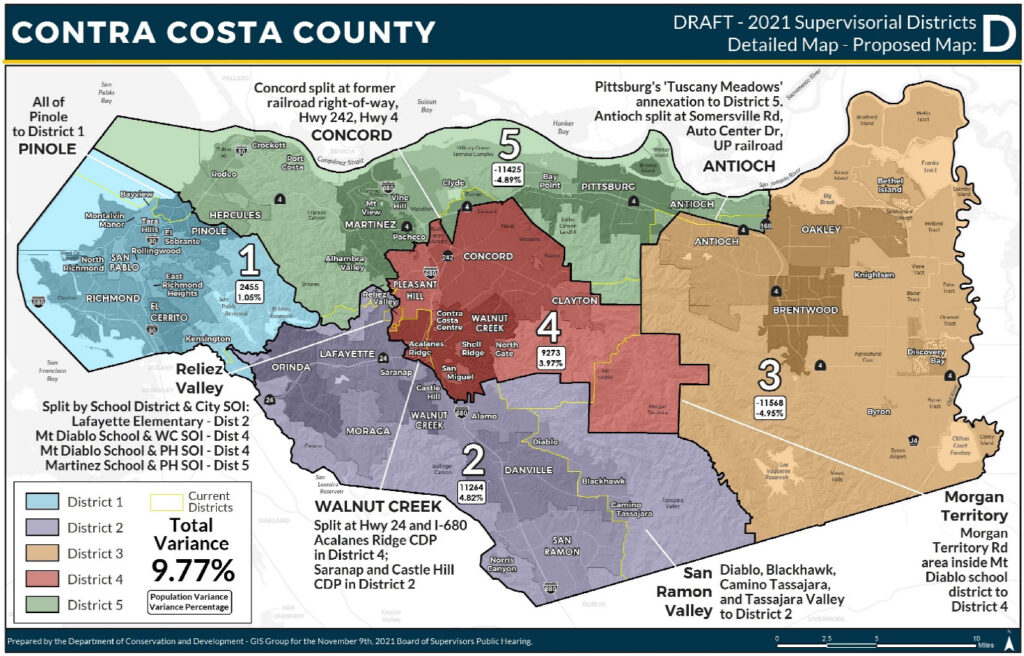
Contra Costa County Board of Supervisors 2021 Redistricting Map D.

Endorse Map D keeping their districts mostly the same

Antioch remains split but along different lines

County receives $7.4 million more in federal American Rescue Plan Act funds

By Daniel Borsuk

With scant public testimony and only three complete community map submissions, during their meeting on Tuesday, Nov. 9, Contra Costa Supervisors decided to move forward with the 2021 redistricting effort by selecting Map D as the preferred alternative. It creates proposed supervisorial boundaries that will be in place for the next 10 years. CCCBOS Redistricting 2021 NOV 9 presentation

With the clock ticking for supervisors to wrap up the federally mandated redistricting effort by Dec. 15, county officials have not received an abundance of public input at public hearings and workshops on proposed supervisorial maps, but after supervisors again heard meager public input on the proposed maps, the elected officials decided to move forward to comply with federal law.

At the end of day, of the four maps proposed by county staff and the three complete alternative maps submitted by the public, supervisors chose Map D mainly because it presents the fewest revisions from the current districts. However, it offers districts with the greatest deviation of 9.77% in population between districts of all four maps offered by county staff. It only splits up the cities of Concord, Antioch and Walnut Creek.

Impacts

The chosen map results in Districts 3 and 5 with the least population, 11,568 and 11,425 fewer residents than average, respectively, and Districts 2 and 4 with the most population of 11,264 and 9,273 greater than average. So, Districts 3 and 5 Supervisors will represent about 21,000 to 23,000 fewer residents than Districts 2 and 4. District 1 will have the lowest deviation from average population of just 2,455 residents or 1.05%.

Map D keeps Antioch split in two between Districts 3 and 5, as the city currently is, but along different streets. This time the districts are split along Somersville Road and Auto Center Drive and the Union Pacific Railroad right-of-way.

It moves Alamo, Blackhawk and Tassajara Valley from the current District 3 into District 2, allowing them to join the rest of the San Ramon Valley.

It reunites Pinole moving a portion from the current District 5 into District 1 in West County.

It keeps the Rossmoor community of Walnut Creek split from the rest of that city, and leaves it in District 2, while the rest of the city will be in District 4.

The map also shifts a portion of Concord from District 4 into District 5.

District 4 Supervisor Karen Mitchoff, who announced she will not seek re-election next year, liked Map D because it presents the “least intrusion into Concord.”  District 4 would also pick up the Morgan Territory area.

“If I could have all of Antioch I would,” said Board Chair Burgis.

District 1 Supervisor John Gioia, whose seat is also up for election next year, acknowledged with Map D his district cannot go beyond Pinole and El Sobrante. The neighboring and nearby communities of Hercules and Crockett will be fully represented by District 5 Supervisor Federal Glover.

Contra Costa Herald proposed CCC Board of Supervisors Redistricting Map and statistics. (Note: The district numbers are incorrect as the Herald’s publisher couldn’t figure out how to choose the correct ones while using the county’s online mapping tool.)

Alternative Maps

There were only 12 community submissions with eight complete maps and four community of interest maps, using the county’s online mapping tool. Two of the complete maps were submitted by one person and three by another, So, only five people submitted complete, alternative maps.  CCCBOS Redistricting 2021 Community Submission Maps Oct05&19    CCCBOS Redistricting 2021 Community Submission Maps Nov09

Two of the complete maps offered total population deviations between the districts of 10.55% and 13.38%, which is greater than the 10% maximum deviation legally allowed. The population of each district can only be 5% greater or lesser than average. The other five maps split up communities of interest

The community submission of a complete map of the five districts, by the Contra Costa Herald, complied with the population deviation requirement of no greater or fewer than 5% from average. The map offers districts with the least population deviation of just 1.67% compared to the four maps proposed by county staff, while respecting both city and community boundaries, except for Concord and Antioch, the county’s largest cities. In general, the Contra Costa Herald map uses major city streets as the dividing lines, such as A Street in Antioch, and the districts are as compact as possible.

County Receives $7.4 million in American Rescue Plan Act Funds

Supervisors learned additional federal American Rescue Plan Act (ARPA) funds will be heading to county coffers in ensuing months after $7.4 million have been spent during the first quarter of 2021.

The county Employment and Human Services Department has received $4,694,377, the county Health Services Department has received $2,604,182 and the Department of Conservation and Development has received $90,215, said assistant County Administrative Officer Tim Elway.

Through Sept. 30, county departments spent $71.6 million ARPA funds for rental assistance services. The Health Services Department submitted an expenditure of $20.9 million for pandemic responses.

Last August, the County Administrator’s Office had identified $317,327.304 in ARPA funds allocated to the county. Of that amount, $127,606.231 had been received by the county and represents two of the largest funding sources for the county – $112,029,451 for the Coronavirus State and Local Fiscal Recovery Fund and $15,576,780 for the Emergency Rental Assistance Program.

Hire New Director of Child Support Services from San Joaquin County

Supervisors voted 5-0 to hire San Joaquin County Director of Child Support Services Lori Cruz as the new Contra Costa County Director of Child Support Services at an annual salary of $345,796 of which $56,489 are pension costs.

Cruz, a California licensed attorney, who holds a Juris Doctor from Catholic University of America, Columbus School of Law, and a Bachelor of Arts Political Science and Print Journalism from the University of Southern California, has served as the Director of Child Support Services in San Joaquin County, the same county where Contra Costa County Administrator Monica Nina was county administrator until her appointment late last year.

Cruz replaces the current director of child support services Melinda Self, who is retiring on Dec. 31, 2021.

Upon accepting the supervisors’ hiring, Ms. Cruz said, “I can bring my 31 years of child support experience to Contra Costa County and bring positive outcomes to your constituents.”

Cruz, who has been a member of the California State Bar since 1989, has served as director of San Joaquin County Child Support Services from April 2014 to present date. From June 2002 to April 2014, she was employed as the Deputy Director of Operations of the Los Angeles County Child Support Services Department. During her career she developed programs to analyze departmental data to measure performance and effectiveness of services, leading a statewide effort to obtain significant data to measure performance and effectiveness of services, and leading a statewide effort to obtain a new funding model for local child support agencies.

Allen Payton contributed to this report.