







Archive for the ‘Finance’ Category

Secretary of State Padilla assigns numbers to November ballot measures, invites ballot arguments

Monday, July 6th, 2020

Two tax increases included in Props 15 and 19; Prop 18 lowers voting age to 17

SACRAMENTO, CA – Secretary of State Alex Padilla on Wednesday, July 1, assigned proposition numbers to the legislative, initiative, and referendum measures set to appear on the November 3, 2020 General Election ballot. Secretary Padilla also invited interested Californians to submit arguments to be considered for inclusion in the Official Voter Information Guide. The guide is mailed to every voting household in California and posted on the Secretary of State’s website.

The propositions are listed below, along with the Legislative Counsel’s digest or the Attorney General’s official circulating title and summary.

Proposition 14

AUTHORIZES BONDS TO CONTINUE FUNDING STEM CELL AND OTHER MEDICAL RESEARCH. INITIATIVE STATUTE. Authorizes $5.5 billion in state general obligation bonds to fund grants from the California Institute of Regenerative Medicine to educational, non-profit, and private entities for: (1) stem cell and other medical research, therapy development, and therapy delivery; (2) medical training; and (3) construction of research facilities. Dedicates $1.5 billion to fund research and therapy for Alzheimer’s, Parkinson’s, stroke, epilepsy, and other brain and central nervous system diseases and conditions. Limits bond issuance to $540 million annually. Appropriates money from General Fund to repay bond debt, but postpones repayment for first five years. Summary of estimate by Legislative Analyst and Director of Finance of fiscal impact on state and local governments: State costs of $7.8 billion to pay off principal ($5.5 billion) and interest ($2.3 billion) on the bonds. Associated average annual debt payments of about $310 million for 25 years. The costs could be higher or lower than these estimates depending on factors such as the interest rate and the period of time over which the bonds are repaid. The state General Fund would pay most of the costs, with a relatively small amount of interest repaid by bond proceeds. (19-0022A1.)

Proposition 15

INCREASES FUNDING FOR PUBLIC SCHOOLS, COMMUNITY COLLEGES, AND LOCAL GOVERNMENT SERVICES BY CHANGING TAX ASSESSMENT OF COMMERCIAL AND INDUSTRIAL PROPERTY. INITIATIVE CONSTITUTIONAL AMENDMENT. Increases funding for K-12 public schools, community colleges, and local governments by requiring that commercial and industrial real property be taxed based on current market value. Exempts from this change: residential properties; agricultural properties; and owners of commercial and industrial properties with combined value of $3 million or less. Increased education funding will supplement existing school funding guarantees. Exempts small businesses from personal property tax; for other businesses, exempts $500,000 worth of personal property. Summary of estimate by Legislative Analyst and Director of Finance of fiscal impact on state and local governments: Net increase in annual property tax revenues of $7.5 billion to $12 billion in most years, depending on the strength of real estate markets. After backfilling state income tax losses related to the measure and paying for county administrative costs, the remaining $6.5 billion to $11.5 billion would be allocated to schools (40 percent) and other local governments (60 percent). (19-0008.)

Proposition 16

ACA 5 (Resolution Chapter 23), Weber. Government preferences.

The California Constitution, pursuant to provisions enacted by the initiative Proposition 209 in 1996, prohibits the state from discriminating against, or granting preferential treatment to, any individual or group on the basis of race, sex, color, ethnicity, or national origin in the operation of public employment, public education, or public contracting. The California Constitution defines the state for these purposes to include the state, any city, county, public university system, community college district, school district, special district, or any other political subdivision or governmental instrumentality of, or within, the state.

This measure would repeal these provisions. The measure would also make a statement of legislative findings in this regard.

WHEREAS, Equal opportunity is deeply rooted in the American ideals of fairness, justice, and equality. Programs to meet the goals of equal opportunity seek to realize these basic values. Equal opportunity not only helps individuals, but also helps communities in need and benefits our larger society. California’s equal opportunity program was upended by the passage of Proposition 209 in 1996; and

WHEREAS, Proposition 209, entitled the California Civil Rights Initiative, amended Article I of the California Constitution to prohibit race- and gender-conscious remedies to rectify the underutilization of women and people of color in public employment, as well as public contracting and education; and

WHEREAS, Proposition 209 invalidated a series of laws that had been enacted by the California Legislature over the 20 years prior to it that required state agencies to eliminate traditional patterns of segregation and exclusion in the workforce, to increase the representation of women and minorities in the state service by identifying jobs for which their employment was underrepresented due to discrimination, and to develop action plans to remedy such underrepresentation without effectuating quota systems; and

WHEREAS, Proposition 209 also overshadowed other landmark civil rights and antidiscrimination laws. In 1959, after a 37-year campaign by labor and civil rights groups, the Unruh Civil Rights Act was passed, which was the forerunner of the Civil Rights Act of 1964; and

WHEREAS, As a result of the passage of Proposition 209, women and people of color continue to face discrimination and disparity in opportunities to participate in numerous forms of association and work that are crucial to the development of talents and capabilities that enable people to contribute meaningfully to, and benefit from, the collective possibilities of national life; and

WHEREAS, The State of California has provided employment opportunities for people of color and women of all races. However, lingering, and even increasing, disparity still exists, particularly for Asian Americans, Pacific Islanders, Black Americans, Latino Americans, Native Americans, and women, and should be rectified; and

WHEREAS, Proposition 209 has impeded California’s continuing interest in supporting the equal participation of women in the workforce and in public works projects, in addressing the historical and present manifestations of gender bias, and in promulgating policies to enforce antidiscrimination in the workplace and on public projects; and

WHEREAS, In the wake of Proposition 209, California saw stark workforce diversity reductions for people of color and women in public contracting and in public education. Studies show that more diverse workforces perform better financially and are significantly more productive and focused; and

WHEREAS, Since the passage of Proposition 209, the state’s minority-owned and women-owned business enterprise programs have been decimated. A 2016 study conservatively estimates that the implementation of Proposition 209 cost women and people of color over $1,000,000,000 annually in lost contract awards. Most procurement and subcontracting processes remain effectively closed to these groups due to the changes brought on by Proposition 209; and

WHEREAS, Women are vastly underrepresented among firms receiving public contracts and the dollars awarded to certified women-owned business enterprises fell by roughly 40 percent, compared to levels before Proposition 209. In addition, only one-third of certified minority business enterprises in California’s transportation construction industry are still in operation today, compared to 20 years ago; and

WHEREAS, Women, particularly women of color, continue to face unequal pay for equal work. White women are paid 80 cents to every dollar paid to white men doing the same work. Black women are paid 60 cents for every dollar paid to white men doing the same work and would theoretically have to work an extra seven months every year to overcome that differential. This persistent gender wage gap continues to harm women, their families, and communities; and

WHEREAS, Despite a booming economy with almost full employment, a persistent racial wealth gap remains rooted in income inequality. Improving minority access to educational and labor market opportunity reduces the wealth gap and strengthens the economy; and

WHEREAS, Proposition 209 has had a devastating impact on minority equal opportunity and access to California’s publicly funded institutions of higher education. This violates the spirit of the California Master Plan for Higher Education by making it more difficult for many students to obtain an affordable and accessible high quality public education. While federal law allows schools to use race as a factor when making admissions decisions, California universities are prohibited by Proposition 209 from engaging in targeted outreach and extra efforts to matriculate high-performing minority students. This reduces .the graduation rates of students of color and, in turn, contributes to the diminution of the “pipeline” of candidates of color for faculty positions; and

WHEREAS, Since the passage of Proposition 209, diversity within public educational institutions has been stymied. Proposition 209 instigated a dramatic change in admissions policy at the University of California, with underrepresented group enrollment at the Berkeley and Los Angeles campuses of the University of California immediately falling by more than 60 percent and systemwide underrepresented group enrollment falling by at least 12 percent. Underrepresented group high school graduates faced substantial long-term declines in educational and employment outcomes as a result of these changes; and

WHEREAS, Among California high school graduates who apply to the University of California, passage of Proposition 209 has led to a decreased likelihood of earning a college degree within six years, a decreased likelihood of ever earning a graduate degree, and long-run declines in average wages and the likelihood of earning high wages measured by California standards. The University of California has never recovered the same level of diversity that it had before the loss of affirmative action nearly 20 years ago, a level that, at the time, was widely considered to be inadequate to meet the needs of the state and its young people because it did not achieve parity with the state’s ethnic demographics; and

WHEREAS, The importance of diversity in educational settings cannot be overstated. The Supreme Court of the United States outlined the benefits that arise from diversity, as follows, “the destruction of stereotypes, the promotion of cross-racial understanding, the preparation of a student body for an increasingly diverse workforce and society, and the cultivation of a set of leaders with legitimacy in the eyes of the citizenry”; and

WHEREAS, Federal courts continue to reaffirm the value of diversity in favor of race conscious admissions, as exemplified by United States District Judge Allison D. Burroughs who stated, “race conscious admissions programs that survive strict scrutiny have an important place in society and help ensure that colleges and universities can offer a diverse atmosphere that fosters learning, improves scholarship, and encourages mutual respect and understanding. Further, Judge Burroughs recognized that there are no race-neutral alternatives that would allow a university to achieve an adequately diverse student body while still perpetuating its standards for academic and other forms of excellence; and

WHEREAS, It is the intent of the Legislature that California remedy discrimination against, and underrepresentation of, certain disadvantaged groups in a manner consistent with the United States Constitution and allow gender, racial, and ethnic diversity to be considered among the factors used to decide college admissions and hiring and contracting by government institutions; and

WHEREAS, It is further the intent of the Legislature that California transcend a legacy of unequal treatment of marginalized groups and promote fairness and equal citizenship by affording the members of marginalized groups a fair and full opportunity to be integrated into state public institutions that advance upward mobility, pay equity, and racial wealth gap reduction; now, therefore, be it Resolved by the Assembly, the Senate concurring, That the Legislature of the State of California at its 2019-20 Regular Session commencing on the third day of December 2018, two-thirds of the membership of each house concurring, hereby proposes to the people of the State of California, that the Constitution of the State be amended as follows:

That Section 31 of Article I thereof is repealed.

Proposition 17

ACA 6 (Resolution Chapter 24), McCarty. Elections: disqualification of electors.

The California Constitution requires the Legislature to provide for the disqualification of electors while mentally incompetent or imprisoned or on parole for the conviction of a felony. Existing statutory law, for purposes of determining who is entitled to register to vote, defines imprisoned as currently serving a state or federal prison sentence.

This measure would instead direct the Legislature to provide for the disqualification of electors who are serving a state or federal prison sentence for the conviction of a felony. This measure would also delete the requirement that the Legislature provide for the disqualification of electors while on parole for the conviction of a felony. The measure would provide for the restoration of voting rights upon completion of the prison term.

Resolved by the Assembly, the Senate concurring, That the Legislature of the State of California at its 2019-20 Regular Session commencing on the third day of December 2018, two-thirds of the membership of each house concurring, hereby proposes to the people of the State of California, that the Constitution of the State be amended as follows:

First-That Section 2 of Article II thereof is amended to read:

SEC. 2. (a) A United States citizen 18 years of age and resident in this State may vote.

(b) An elector disqualified from voting while serving a state or federal prison term, as described in Section 4, shall have their right to vote restored upon the completion of their prison term.

Second-That Section 4 of Article II thereof is amended to read:

SEC. 4. The Legislature shall prohibit improper practices that affect elections and shall provide for the disqualification of electors while mentally incompetent or serving a state or federal prison term for the conviction of a felony.

Proposition 18

ACA 4 (Resolution Chapter 30), Mullin. Elections: voting age.

The California Constitution authorizes any person who is a United States citizen, at least 18 years of age, and a resident of the state to vote.

This measure, in addition, would authorize a United States citizen who is 17 years of age, is a resident of the state, and will be at least 18 years of age at the time of the next general election to vote in any primary or special election that occurs before the next general election in which the citizen would be eligible to vote if at least 18 years of age.

Proposition 19

ACA 11 (Resolution Chapter 31), Mullin. The Home Protection for Seniors, Severely Disabled, Families, and Victims of Wildfire or Natural Disasters Act.

The California Constitution limits the amount of ad valorem taxes on real property to 1% of the full cash value of that property, defined as the county assessor’s valuation of real property as shown on the 1975–76 tax bill and, thereafter, the appraised value of the property when purchased, newly constructed, or a change in ownership occurs after the 1975 assessment, subject to an annual inflation adjustment not to exceed 2%. The California Constitution authorizes the Legislature to authorize a person over 55 years of age or any severely and permanently disabled person residing in property eligible for the homeowner’s exemption to transfer the base year value of that property to a replacement dwelling of equal or lesser value located in the same county, or another county that has adopted an ordinance allowing base years value transfers from other counties, as provided. The California Constitution also provides that the purchase or transfer of the principal residence, and the first $1,000,000 of other real property, of a transferor in the case of a transfer between parents and their children, or between grandparents and their grandchildren if all the parents of those grandchildren are deceased, is not a “purchase” or “change in ownership” for purposes of determining the “full cash value” of property for taxation.

This measure, beginning on and after April 1, 2021, would authorize an owner of a primary residence who is over 55 years of age, severely disabled, or a victim of a wildfire or natural disaster, as defined, to transfer the taxable value, defined as the base year value plus inflation adjustments, of their primary residence to a replacement primary residence located anywhere in the state, regardless of the location or value of the replacement primary residence, that is purchased or newly constructed as that person’s principal residence within 2 years of the sale of the original primary residence. The measure would limit a person who is over 55 years of age or severely disabled to 3 transfers under these provisions.

The measure, beginning on and after February 16, 2021, would exclude from the terms “purchase” and “change in ownership” for purposes of determining the “full cash value” of property the purchase or transfer of a family home or family farm, as those terms are defined, of the transferor in the case of a transfer between parents and their children, or between grandparents and their grandchildren if all the parents of those grandchildren are deceased. In the case of a transfer of a family home, the measure would require that the property continue as the family home of the transferee. The measure would require that the taxable value of the property be determined as provided. In the case of property tax benefits provided to a family home under these provisions, the bill would require the transferee to claim the homeowner’s or disabled veteran’s exemption within one year of the transfer. The measure would specify that the above-described provisions relating to transfers between parents or grandparents and children or grandchildren would apply to transfers occurring on or before February 15, 2021.

The measure would establish the California Fire Response Fund in the State Treasury. The measure would require the Controller to annually transfer a specified amount, based on calculations by the Director of Finance, of the additional revenues and savings that accrued to the state from the implementation of this measure’s provisions from the General Fund to that fund. However, the measure would provide that, if the amount required to be transferred to the California Fire Response Fund exceeds the amount transferred for the previous fiscal year by more than 10%, that excess amount would not be transferred to the California Fire Response Fund. The measure would require the Legislature to appropriate moneys in the fund solely for the purpose of funding fire suppression staffing by the Department of Forestry and Fire Protection and underfunded special districts that provide fire protection services, as provided.

The measure would also establish the County Revenue Protection Fund and continuously appropriate moneys in that fund for the purpose of reimbursing eligible local agencies, as provided. The measure would require the Controller to annually transfer a specified amount, based on the above-described calculations by the Director of Finance, from the General Fund to that fund. The measure would require each county to annually determine the gain of the county and any local agency within the county resulting from the implementation of this measure and, if that amount of gain is negative, provide that specified eligible local agencies may receive a reimbursement from the County Revenue Protection Fund. The measure would require the California Department of Tax and Fee Administration to provide a reimbursement to each eligible local agency that has a negative gain, determined every 3 years based on the aggregate gain of the eligible local agency, as provided, and require the Controller to transfer any remaining balance in the County Revenue Protection Fund to the General Fund at the end of each 3-year period, to be available for appropriation for any purpose.

Proposition 20

RESTRICTS PAROLE FOR NON-VIOLENT OFFENDERS. AUTHORIZES FELONY SENTENCES FOR CERTAIN OFFENSES CURRENTLY TREATED ONLY AS MISDEMEANORS. INITIATIVE STATUTE. Imposes restrictions on parole program for non-violent offenders who have completed the full term for their primary offense. Expands list of offenses that disqualify an inmate from this parole program. Changes standards and requirements governing parole decisions under this program. Authorizes felony charges for specified theft crimes currently chargeable only as misdemeanors, including some theft crimes where the value is between $250 and $950. Requires persons convicted of specified misdemeanors to submit to collection of DNA samples for state database. Summary of estimate by Legislative Analyst and Director of Finance of fiscal impact on state and local government: Increased state and local correctional costs likely in the tens of millions of dollars annually, primarily related to increases in penalties for certain theft-related crimes and the changes to the nonviolent offender release consideration process. Increased state and local court-related costs of around a few million dollars annually related to processing probation revocations and additional felony theft filings. Increased state and local law enforcement costs not likely to exceed a couple million dollars annually related to collecting and processing DNA samples from additional offenders. (17-0044.)

Proposition 21

EXPANDS LOCAL GOVERNMENTS’ AUTHORITY TO ENACT RENT CONTROL ON RESIDENTIAL PROPERTY. INITIATIVE STATUTE. Amends state law to allow local governments to establish rent control on residential properties over 15 years old. Allows rent increases on rent-controlled properties of up to 15 percent over three years from previous tenant’s rent above any increase allowed by local ordinance. Exempts individuals who own no more than two homes from new rent-control policies. In accordance with California law, provides that rent-control policies may not violate landlords’ right to a fair financial return on their property. Summary of estimate by Legislative Analyst and Director of Finance of fiscal impact on state and local governments: Potential reduction in state and local revenues of tens of millions of dollars per year in the long term. Depending on actions by local communities, revenue losses could be less or more. (19-0001.)

Proposition 22

CHANGES EMPLOYMENT CLASSIFICATION RULES FOR APP-BASED TRANSPORTATION AND DELIVERY DRIVERS. INITIATIVE STATUTE. Establishes different criteria for determining whether app-based transportation (rideshare) and delivery drivers are “employees” or “independent contractors.” Independent contractors are not entitled to certain state-law protections afforded employees—including minimum wage, overtime, unemployment insurance, and workers’ compensation. Instead, companies with independent contractor drivers will be required to provide specified alternative benefits, including: minimum compensation and healthcare subsidies based on engaged driving time, vehicle insurance, safety training, and sexual harassment policies. Restricts local regulation of app-based drivers; criminalizes impersonation of such drivers; requires background checks. Summary of estimate by Legislative Analyst and Director of Finance of fiscal impact on state and local governments: Increase in state personal income tax revenue of an unknown amount. (19-0026A1)

Proposition 23

AUTHORIZES STATE REGULATION OF KIDNEY DIALYSIS CLINICS. ESTABLISHES MINIMUM STAFFING AND OTHER REQUIREMENTS. INITIATIVE STATUTE. Requires at least one licensed physician on site during treatment at outpatientkidney dialysis clinics; authorizes Department of Public Health to exempt clinics from thisrequirement due to shortages of qualified licensed physicians if at least one nurse practitioner orphysician assistant is on site. Requires clinics to report dialysis-related infection data to state andfederal governments. Requires state approval for clinics to close or reduce services. Prohibitsclinics from discriminating against patients based on the source of payment for care. Summaryof estimate by Legislative Analyst and Director of Finance of fiscal impact on state and local governments: Increased state and local health care costs, likely in the low tens of millions of dollars annually, resulting from increased dialysis treatment costs. (19-0025A1.)

Proposition 24

AMENDS CONSUMER PRIVACY LAWS. INITIATIVE STATUTE. Permits consumers to: (1) prevent businesses from sharing personal information; (2) correct inaccurate personal information; and (3) limit businesses’ use of “sensitive personal information”—such as precise geolocation; race; ethnicity; religion; genetic data; union membership; private communications; and certain sexual orientation, health, and biometric information. Changes criteria for which businesses must comply with these laws. Prohibits businesses’ retention of personal information for longer than reasonably necessary. Triples maximum penalties for violations concerning consumers under age 16. Establishes California Privacy Protection Agency to enforce and implement consumer privacy laws, and impose administrative fines. Requires adoption of substantive regulations. Summary of estimate by Legislative Analyst and Director of Finance of fiscal impact on state and local governments: Increased annual state costs of roughly $10 million for a new state agency to monitor compliance and enforcement of consumer privacy laws. Increased state costs, potentially reaching the low millions of dollars annually, from increased workload to DOJ and the state courts, some or all of which would be offset by penalty revenues. Unknown impact on state and local tax revenues due to economic effects resulting from new requirements on businesses to protect consumer information. (19-0021A1.)

Proposition 25

REFERENDUM TO OVERTURN A 2018 LAW THAT REPLACED MONEY BAIL SYSTEM WITH A SYSTEM BASED ON PUBLIC SAFETY RISK. If this petition is signed by the required number of registered voters and timely filed, a referendum will be placed on the next statewide ballot requiring a majority of voters to approve a 2018 state law before it can take effect. The 2018 law replaces the money bail system with a system for pretrial release from jail based on a determination of public safety or flight risk, and limits pretrial detention for most misdemeanors. (18-0009.)

Ballot Arguments

Arguments may be submitted for or against the measures. Arguments selected for the Official Voter Information Guide will be on public display between July 21 and August 10. If multiple arguments are submitted for a proposition, state law gives first priority to arguments written by legislators in the case of legislative measures and to proponents of an initiative or referendum; subsequent priority goes to bona fide citizen associations and then to individuals. No more than three signers are allowed to appear on an argument or rebuttal to an argument.

Ballot arguments cannot exceed 500 words and rebuttals to ballot arguments cannot exceed 250 words. All submissions should be typed and double-spaced.  Arguments may be hand-delivered to the Secretary of State’s Elections Division at 1500 11th Street, 5th Floor, Sacramento, California 95814; faxed to (916) 653-3214; or emailed to VIGarguments@sos.ca.gov. If faxed or emailed, the original documents must be received within 72 hours.  The deadline to submit ballot arguments is July 7 by 5:00 p.m. The deadline to submit rebuttals to the ballot arguments is July 16 by 5:00 p.m.

Candidate Statements in the County Voter Information Guide

Candidates for the United States House of Representatives, California State Senate, and California State Assembly have until August 7 to submit candidate statements to their county elections official for the local sample ballot in the county or counties in which the district lies.

For more information on ballot measures, candidate filing requirements, and election deadlines, please visit: https://www.sos.ca.gov/elections/upcoming-elections/general-election-november-3-2020/


Antioch School Board adopts $247 million annual district budget, revisions expected in August

Wednesday, June 24th, 2020

By Allen Payton

During their Wednesday, June 24, 2020 meeting, the Antioch School Board voted unanimously to approve the district’s 2020-21 fiscal year budget of $247.7 million. However, many changes to the district’s budget are expected based on the final negotiations between the governor and legislature, and the governor’s line item vetoes in the state budget. The school board will consider revisions in early August. (See the entire 224-page budget, here)

“We have the opportunity to adopt our budget even if the state hasn’t adopted theirs… we are obligated to meet our obligation by June 30,” said Deputy Superintendent Jessica Romeo. “If there is a budget adopted after we adopt ours, we do a 45-day revision to our budget. There are significant revisions from the May Revise. We will do that at the first meeting in August.”

According to the staff report, “The California Legislature met its constitutional deadline of passing the state budget on or before June 15, and it is anticipated that a budget will be signed by the Governor on or before June 30, 2020.”

However, “the Governor and the Legislature are negotiating the differences between the two plans, and it is currently expected that an agreement will be reached before the end of June.”

“We will maintain our mandatory reserve of 3.7%, and actually 3.8%,” Romeo stated. “I’m

The District’s Budget is comprised of eleven separate funds, the General Fund is the primary fund of the District AUSD Budget. The other 10 funds are Adult Education, Cafeteria Special Reserve, Deferred Maintenance, Building Fund, Capital Facilities, Special Reserve for Capital Outlay, Capital Projects Fund for Blended Component Units, Bond Interest and Redemption, Retiree Benefit Fund and Foundation Private-Purpose Trust fund.

However, the General Fund, which pays for all district employee salaries and benefits, is more than 83% of the budget and is divided into two parts. The Unrestricted portion is 56.59% of the AUSD Total Budget, and the Restricted portion makes up 27.34%.

“We’re just going to anticipate that this is going to change drastically,” Trustee Ellie Householder said.

“Yes,” responded Romeo.

The budget was adopted on a motion by Trustee Mary Rocha and second by Trustee Gary Hack, passing on a 5-0 vote by the board.

“Thank you to staff. It’s not over, yet,” Board President Diane Gibson-Gray said.

Antioch School Board president donates annual stipend, training and travel allocation back to district

Thursday, June 11th, 2020

“I’m going to stand in solidarity with the employees” – Trustee Diane Gibson-Gray

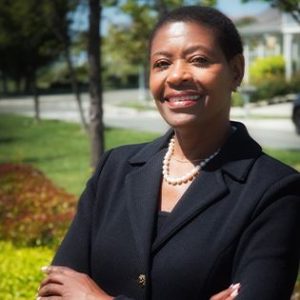
Antioch School Board President Diane Gibson-Gray. Herald file photo.

By Allen Payton

In light of the recent layoffs to district classified staff, during the Antioch School Board meeting on Wednesday night, June 10, 2020, Board President Diane Gibson-Gray gave back her $10,800 in monthly stipend, and annual training and travel budget allocation, and suggested the board members do the same.

Each trustee receives $400 per month in stipend and annual travel and training budgets totaling $6,000 each.

“That would be $54,000 per year if we all do it,” she said.

“I’m not in agreement with that,” said Sawyer-White. “I have health care benefits for myself and my son. Other districts are considering cuts with administrators.”

She then mentioned wanting to complete governance training using her travel and training budget allocation.

“No one has completed governance training. There can be cuts, elsewhere,” Sawyer-White added.

“I’m just suggesting people volunteer. I’m going to do it on my own,” Gibson-Gray stated.

“This is kind of a tie back. This is why a budget study session would be important,” said Trustee Ellie Householder. “What impact $54,00 would have on the budget? I do not feel comfortable in doing that at this time.”

“When I put this on, we weren’t going to be in the position we’re going to be in June,” Gibson-Gray explained. “I’m just going to give mine back. I’m going to stand in solidarity if we’re unable to give employees raises.”

The board then moved on to other matters.

Approve Job Description for New Centralized Registration & Enrollment Technician

In other action, the board approved the job description of the new Centralized Registration and Enrollment Technician on a 4-1 split vote, with Trustee Crystal Sawyer-White voting against.

According to the staff report, the Centralized Registration/Enrollment Technician will assist parents/guardians and students with District programs, student assignment procedures and enrollment under the direction of a Director, Educational Services or other assigned administrator. The position will perform a variety of technical and specialized functions unique to the Centralized Enrollment Center.

The position will consolidate the responsibilities of all the school site registration and enrollment staff that were given layoff notices effective the end of July, due to the board’s vote at their last meeting on May 27, 2020. (See related article).

Sawyer-White was not happy with the creation of the new position and wanted the registrars for each school restored.

“It took my son over two hours to go through registration,” she complained. “We need the registrars back at the schools.”

To watch and listen to the complete Antioch School Board meeting on YouTube click here. For this discussion see the 2:09 mark of the video and item 11 of the meeting agenda by clicking here.

Antioch Police services are just 27.3% of overall city budget, not 62%

Tuesday, June 9th, 2020

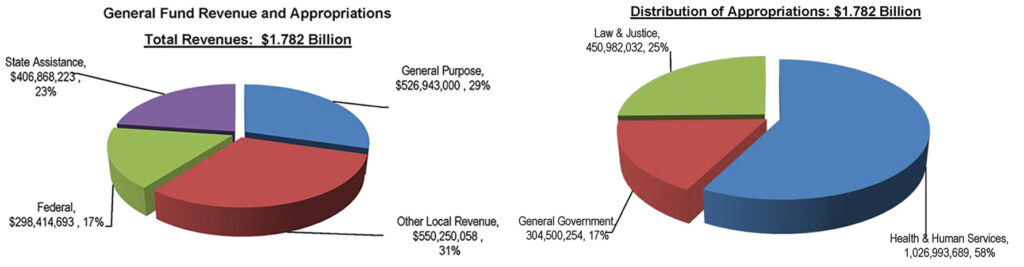
From page 55 of the City of Antioch’s Adopted Budget for 2019-21 (page 70 of the overall document).

With total annual budget revenues of $158 million the City of Antioch spends $43 million on police services.

By Allen Payton

This is in response to public comments during the Antioch City Council meeting on Tuesday, June 9, 2020 which included calls for the defunding of the police department claiming it takes up 62% of the city’s budget. In addition, copies of the city’s General Fund pie chart were distributed to participants during a Black Lives Matter protest held in Antioch on Tuesday. Hopefully, this will help educate them so they make policy suggestions in the future based on the facts, not rumor and misinformation.

From page vi of the City of Antioch’s Adopted Budget for 2019-21 (page 10 of the overall document).

What all of those people didn’t do was their homework, which could have been accomplished with a simple online search to learn about the actual details in the city’s two-year budget for the 2019-2020 and 2020-21 fiscal years. Please click here to view and see pages vi (10) and vii (11) of the 330-page document that can be found on the Finance Department’s page on the City’s website. (NOTE: This last sentence has been corrected. The previous pages referred to the June 25, 2019 Antioch Council meeting agenda in which the proposed two-year budget was included for council adoption and was 776 pages long).

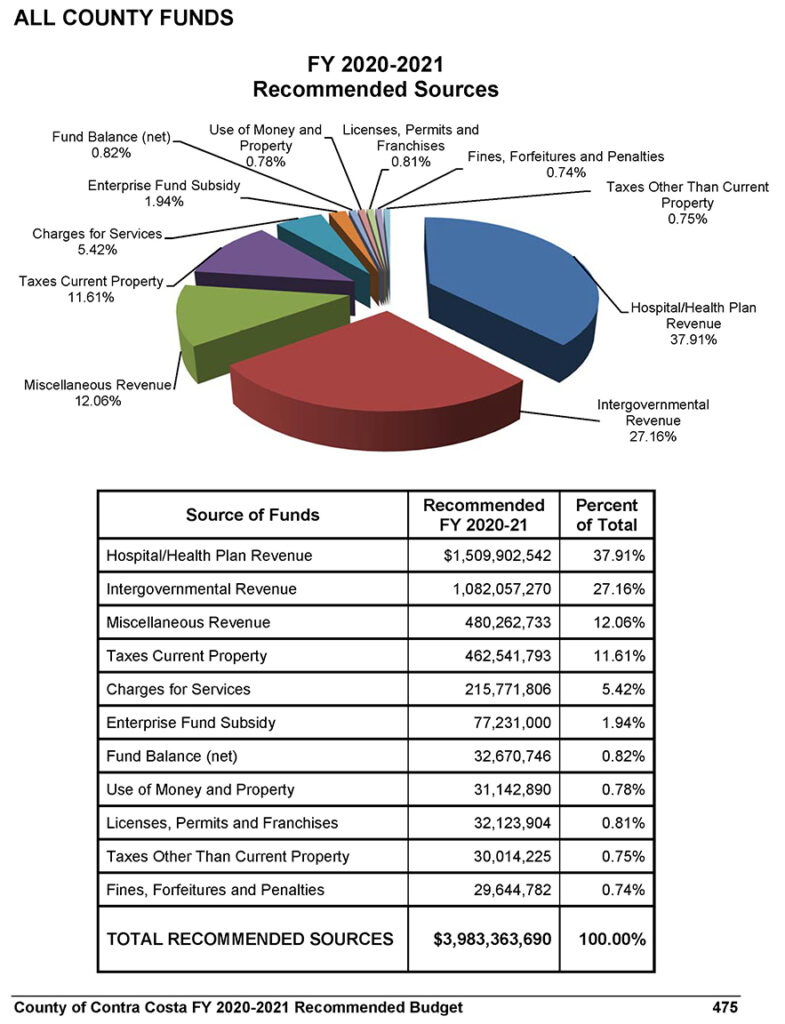
In the current 2019-20 fiscal year ending on June 30th, the General Fund makes up just 44% of the city’s overall budget. That figure is projected to rise slightly to 44.1% in the next fiscal year beginning July 1st. Of that 62% was spent on police and public safety this year and 62.1% is budgeted in the 2020-21 fiscal year. So, that means only 27.3% to 27.4% of the city’s budget was and will be spent on police services during the current two-year budget cycle.

From page vii of the City of Antioch’s Adopted Budget for 2019-21 (page 11 of the overall document).

What the people who spoke during the council meeting also don’t seem to understand, remember or be aware of – most likely because they are young and couldn’t vote when the ballot measures passed or don’t live here – is that the voters of Antioch voted twice to pass a sales tax increase and spend most of the additional revenue on more police and public safety.

As a result, the City of Antioch has been hiring more police since 2013, and just last year, finally fulfilled the promise made in 2013 by the then-mayor and council members of 22 more police officers, immediately. That was when there were 89 sworn officers on the force and Antioch now has 115 sworn officers.

Then, with the passage of Measure W in 2018, increasing the sales tax to one percent, the voters told the council to spend most of the funds to “restore the number of police officers patrolling City streets” and “to increase investment in code enforcement, clean up blight, road repairs, support youth and senior services, and attract new business and jobs to Antioch.” The priorities for use of the Measure W sales tax funds are as follows:

  • Continuing to maintain 911 police response and restore the number of police officers patrolling City streets
  • Ensuring water quality and safety
  • Maintaining Antioch’s quality of life and financial stability
  • Cleaning up illegal dumping
  • Restoring after-school and summer programs for youth

Going back to the City’s original formation documents in 1872, the City of Antioch was incorporated for the purpose of “police and other matters.” Police services and public safety have always been the number one reason the city government exists and the top budget priority. But, it does not make up more than a majority of the City’s overall budget. It’s closer to one-fourth.

Antioch Council approves spending $1.4 million of Coronavirus CARES Act funds, $7.5 million in federal funds overall

Tuesday, May 12th, 2020

“The council subcommittee is recommending an unprecedented $2,924,946 in CDBG funds,” said Terri House, the City’s CDBG Consultant.

By Allen Payton

During their meeting on Tuesday night, May 12, 2020, on a unanimous vote, the council approved spending plans for $7.5 million of federal funds, including $1.4 million of Coronavirus CARES Act funding. ACC Federal Funds presentation

According to the staff presentation, the City of Antioch has joined with the cities of Concord, Pittsburg, Walnut Creek and the County on behalf of the rest of the cities to create the Contra Costa HOME/CDBG Consortium to plan for entire county, and prepare the joint Consolidated Plan.

According to the city staff report – Action #1: The recommended action has no immediate fiscal impact; however, it will guide the funding decisions of approximately $6,000,000 in future CDBG and other funding over the 2020-25 Consolidated Plan period, and commits a total of $1,404,946 in CDBG and CDBG-CV (Corona Virus CARES funding) for FY 2020-21 to address identified high priority needs of the City in general public services, homeless services, housing and prevention, senior and youth services, economic development, infrastructure, housing, and CDBG administration.

Of the $1.4 million Antioch will receive $509,257 to address effects of the pandemic.

Highest priorities include:

  • Emergency assistance for rent, mortgage, and utility payments for those affected by “Stay At Home” order or other effects of Covid-19;
  • Assistance for renters to understand City’s Eviction and Rent Moratorium, and to direct them to City emergency assistance and other resources; and
  • Food assistance for homeless and seniors.

The process will begin in October with applications by non-profit organizations due in December.

Action #2: The recommended action has no impact to the General Fund but commits a total of $1,520,000 in Housing Successor Low Income Housing funds for FY 2020-21 to address identified high priority housing and homeless needs of the City.

“The council subcommittee is recommending an unprecedented $2,924,946 in CDBG funds,” said Terri House, the City’s CDBG Consultant.

The council approved the expenditure plans for Fiscal Years 20-21 and 20-25 on a 5-0 vote.

The meeting will be rebroadcast on Comcast local cable channel 24 on Thursday at 7 p.m. and Saturday at 1 p.m. or can be viewed on the City’s website.

Applications for Pandemic Unemployment Assistance for business owners, self-employed and independent contractors begins April 28

Wednesday, April 22nd, 2020

Information on State and Federal Benefit Payments

From – https://edd.ca.gov/about_edd/coronavirus-2019/pandemic-unemployment-assistance.htm

As part of the federal CARES Act, the new Pandemic Unemployment Assistance (PUA) program helps unemployed Californians who are business owners, self-employed, independent contractors, have limited work history, and others not usually eligible for regular state UI benefits who are out of business or services are significantly reduced as a direct result of the pandemic. The provisions of the program once operational include:

  • Up to 39 weeks of benefits starting with weeks of unemployment beginning February 2, 2020, through the week ending December 26, 2020*, depending on when you became directly impacted by the pandemic.
  • An additional $600 to each PUA weekly benefit amount you may be eligible to receive, as part of the separate CARES Act Pandemic Additional Compensation program. Only the weeks of a claim between March 29 and July 25* are eligible for the extra $600 payments.

* Under the CARES Act of 2020, the $600 additional benefits are available through 07/31/20. However, the U.S. Department of Labor has issued guidance to clarify that, for most Californians, the last full week of benefits will end on 07/25/20. Similarly, the PUA program has a legislative end date of 12/31/20, but for Californians the last full week of benefits will end on 12/26/20.

Benefits can be retroactive to weeks starting on or after February 2, 2020, depending on your last day of work due to COVID-19 and regardless of when you submitted your claim application. The effective date of your claim will begin the Sunday of the week when you last worked and became unemployed due to reasons directly related to COVID-19.

Important Information

Note: Because this is a brand new program, each state will need time to develop all of the necessary system programming, forms, processes, and procedures. This page will be updated as information becomes available, including when and how to apply for these benefits. Once this new complex program is built and staffed, it will likely rival the size of the regular UI program the EDD already administers.

As we work to implement this new program, you can:

Eligibility

The PUA benefits are payable if you don’t qualify for regular UI benefits in California or another state and also do not qualify for State Disability Insurance or Paid Family Leave benefits. This includes:

  • Business owners
  • Self-employed individuals
  • Independent contractors

You can also be eligible if you qualified for regular UI benefits, but have collected all benefits for which they are eligible.

If you are not a citizen of the United States, you cannot be paid PUA benefits unless you were legally permitted to work in the United States at the time such services were performed. In addition, you must be authorized to work for any week of PUA benefits claimed to be eligible for payments.

You must also meet one of the following criteria:

  • You have been diagnosed with COVID-19 or are experiencing symptoms of COVID-19 and are seeking a medical diagnosis.
  • You are unable to work because a health care provider advised you to self-quarantine due to concerns related to COVID-19.
  • A member of your household has been diagnosed with COVID-19.
  • You are providing care for a family member or a member of your household who has been diagnosed with COVID-19.
  • A child or other person in the household for whom you have primary caregiving responsibility is unable to attend school or another facility that is closed as a direct result of the COVID-19 and the school or facility care is required for you to work.
  • You became the breadwinner or major support for a household because the head of the household has died as a direct result of COVID-19.
  • You have to quit your job as a direct result of COVID-19.
  • Your place of employment is closed as a direct result of COVID-19.
  • You were scheduled to start a job that is now unavailable as a direct result of the COVID-19 public health emergency.
  • You are unable to reach the place of employment as a direct result of the COVID-19 public health emergency.
  • If you work as an independent contractor with reportable income, you may also qualify for PUA benefits if you are unemployed, partially employed, or unable or unavailable to work because the COVID-19 public health emergency has severely limited your ability to continue performing your customary work activities, and has thereby forced you to stop working.

Benefit Payments

In order to provide benefits as quickly as possible, payments will be issued in phases. If you qualify for PUA, and depending on the effective date of your PUA claim, the initial payments you will receive are as follows:

  • Phase 1 – $167 per week for each week you were unemployed from February 2, 2020 to March 28, 2020 due to a COVID-19 related reason.
  • Phase 2 – $167 plus $600 per week for each week you were unemployed from March 29, 2020 to July 25, 2020, due to a COVID-19 related reason.
  • Phase 3 – $167 per week, for each week from July 26, 2020 to December 26, 2020, that you are unemployed due to a COVID-19 related reason, up to a total of 39 weeks (minus any weeks of regular UI and certain extended UI benefits that you have received).

Note: If you qualify for your claim to be backdated to an earlier PUA effective date based on your last day of work, you could receive payment for prior weeks you were unemployed due to COVID-19.

You will be required to “certify” for your benefit payment. Certifying is the process of answering basic questions every two weeks that tells us you’re still unemployed and otherwise eligible to continue receiving biweekly payments.

When to File a Claim

We have a dedicated team working around the clock with state partners to build this new program as quickly as possible. The EDD will begin accepting online applications for this program on Tuesday, April 28. This page will be updated with instructions for filing a claim for PUA benefits when details become available.

If you are unsure if you are an independent contractor or an employee who could be eligible for benefits, file for regular Unemployment Insurance benefits and we will determine your eligibility.

After you have filed, refer to our step-by-step UI claims process. You’ll learn what to expect and the actions you need to take through the course of your claim for receiving benefit payments as long as you’re eligible.

Supervisors ban evictions, rent increases during COVID-19 shelter in place with 6-month grace period

Wednesday, April 22nd, 2020

No late fees for 120 days

By Daniel Borsuk

Residential and commercial renters will get some rental and eviction relief during the COVID-19 pandemic after the Contra Costa County Board of Supervisors voted 5-0 to approve an ordinance containing a 180-day grace period, two months more than what supervisors initially had in mind, during a special meeting on Tuesday. (See entire ordinance, here).

By liberally extending the grace period an extra two months, supervisors are handing over to thousands of renters in the county more financial and housing relief during this stressful period when COVID-19 has decimated their financial livelihood. In March, the county’s unemployment rate was 4 percent and April’s unemployment rate will very likely rise sharply when it is release later on.

Instead of inserting a 120-day grace period that other counties like Santa Clara County have inserted in its COVID-19 rent control and eviction moratoria ordinance, Contra Costa County supervisors at the request of District 1 Supervisor John Gioia of Richmond convinced other supervisors that a longer grace period is needed given the uncertainty of the duration of the medical and economic repercussions from the current local and state-mandated stay-at-home orders.

Gioia said he favored the more expansive 180-day grace period because the ordinance, as it was proposed to supervisors, does not protect all tenants whether they are delinquent or current in their rent.

“You have to be up to date on rent in order to be protected by the ordinance presented by counsel,” said Gioia. “It’s very unfortunate that the governor’s order requires this. Tenants must be current on rent to qualify for the grace period.”

Supervisors listened to 45 emailed comments from county residents, most of whom were in support of at least a 120-day grace period, little knowing that Gioia would propose a more expansive 180-day grace period.

“We’re dealing with uncertain times,” said District 3 Supervisor Diane Burgis of Brentwood. “We’re dealing with people who have not paid rent. People who have lost jobs because businesses have shut down.”

District 4 Supervisor Karen Mitchoff of Pleasant Hill preferred to retain the ordinance’s 120-day grace period clause saying it was sufficient for renters, but eventually agreed to the 180-day grace period for rent and eviction moratoria purposes until May 25 when supervisors plan to revisit the issue.

Other features of the ordinance taken mainly from the Santa Clara County ordinance include countywide, no-fault evictions, definition of owner, attorney fees, and no late fees.

Public Health Ad Hoc Committee Created

While COVID-19 health measures will remain in place for the foreseeable future, Board Chair Andersen proposed the creation of an ad hoc Public Health Committee that will weekly with county health department officials.

The committee that will consist of Burgis and Board Chair and District 2 Supervisor Candace Andersen of Danville. The committee’s key role is to be advisory to supervisors and Contra Costa County Health Officer Dr. Christopher Farnitano who will retain ultimate authority on health issues.

“This is not meant to replace the health officer’s directive,” said Supervisor Mitchoff. “There’s been some concern about communication. People are getting frustrated.”

Antioch Council given two mid-year budget projections with reduced revenues due to coronavirus

Tuesday, April 14th, 2020

While both budgets project a healthy reserve with a transfer in from the Stabilization Fund, one budget projects the city “will completely run out of money in Fiscal Year ‘25”

By Allen Payton

During their meeting on Tuesday night, the Antioch City Council was presented with two proposed mid-year budgets for Fiscal Years 2019-21 for them to review and give input for a final vote on April 28. Both budgets show a deficit in Fiscal Year ‘19-20 of approximately $4 million mostly from a previous legal settlement and re-appropriated funds from the previous fiscal year. The results of the coronavirus pandemic is projected to have an impact on the proposed FY ‘20-21 budgets. See complete agenda item, here: 2019-21 Mid-Year Budget Review ACC041420

“This budget report is unique, as we are three to four weeks into the COVID-19 pandemic. It’s having an impact on revenue,” said City Manager Ron Bernal.

“We’ve prepared two budgets for council, tonight. We’ll come back on April 28 for a final, Mid-Year Budget that we’ll ask you to adopt. Then have us come back in August with a study session with a better idea of impacts of COVID-19,” he continued. “Fortunately, for the City of Antioch, our property taxes are well diversified. Antioch is in a good position. But what we want to do is make you aware that there is a possibility we could be running into difficulties.” See budget details, here: 2019-21 Mid-Year Budget Comparisons

According to the staff report, both budgets project healthy reserves at the end of each fiscal year and reflect a transfer in from the Stabilization Fund to balance the budget.

“The CAL-PERS (state’s public employee retirement) fund has lost a great amount of its value. So, that will have impacts for years to come,” Bernal explained. “There’s a lot of uncertainties in this budget. But we have enough certainties to ask for your input.”

“We really do not know how this is going to roll down to the City of Antioch. We have best projections on sales tax revenues,” said City Finance Director Dawn Merchant. “We are fortunate to have a Costco, Walmart and Target, all three businesses that are operating during this time.”

“The city could have a $4 million short fall in sales tax, next year. It will be a deferral. But, that’s only if all businesses take the sales tax deferral” being offered by the state, she explained.

Merchant said the budget version one expects that “sales tax will start to rebound in Fiscal Year ’22.”

In version two “the city completely runs out of money in Fiscal Year ’25,” she explained. “We don’t know where we’re going to lie. I don’t want to be too optimistic. But we want to be fiscally prudent, at this time.”

Mayor Sean Wright and the council members then offered direction to staff.

Wright proposed holding off on contributions to OPEB (Other Postemployment Benefits for retired city employees) of $1.3 million and $500,000 in one-time expenditures to “allow us to go into ‘20-21 without a deficit.”

His suggestions include the public information officer and risk manager positions.

“I’m a stickler on the OPEB,” said Council Member Lori Ogorchock. “On the other ones you mentioned, I don’t have a problem,” except for cutting the funds for median improvements.

“Related to the PIO…the current contract extension is through September ’20,” said Bernal. “So, we will have a $24,000 commitment to complete the contract.”

“It may be something to come back and consider in September, depending on how hard COVID hits us,” Wright responded.

“What if we look at version one and we come back closer to August and consider the changes we’re going to make?” asked Ogorchock “Do we have to before August or can we wait until August?”

“You can give direction to the city manager with positions and hold off on any definitive hiring. You do have that alternative…to stall on the hiring until we know more,” Merchant responded.

“I’m OK on holding off, that includes holding off on some of these projects, like the utility box (painting),” Wright said.

“We’re not going to get all these positions hired before April 28, not even until August,” Ogorchock responded. “I think if we go with version one…we are moving in a positive direction. Like Ron said, we are in a good position. Property taxes still have to be paid and the property values haven’t gone down.”

“Some of these have already gone out, correct?” Council Member Monica Wilson asked.

“We have the artists lined up, but we haven’t given them the work to do, yet,” Bernal explained. “What we have listed here are things we haven’t committed to, yet.”

“I’m OK with going forward with version one…if that’s what council wants to do,” Wright stated.

“I just want to make sure is we do include the $75,000 for the part-time unhoused resident coordinator for FY 20-21,” said Mayor Pro Tem Joy Motts. “I’m OK with going forward with versions one and two and reviewing it in August.”

“I’m OK with version one then going forward to August,” Wilson stated.

“I’m not for stopping anything. Let’s keep the ball rolling, particularly with OPEB,” Council Member Lamar Thorpe said.

“For the $850,000 in OPEB for Fiscal Year 2020, we have to put it in the budget by June 30th,” Merchant explained.

“If we have to do it by the final June meeting, we can hold off,” Ogorchock said.

“The direction I heard, Dawn was that we would keep rolling forward with the OPEB,” Wright stated.

Regarding the parking abatement team, “they’re pulling all those cars off our streets,” Ogorchock said.

“It’s not included in either budget version, so, it will add approximately $21,000,” Merchant said. “Council Member Thorpe said he was fine holding off on it.”

“We can hold off on deciding on it,” Motts said.

Merchant asked about Motts’ proposal to add in $75,000 for the unhoused resident coordinator.

“Let’s hold off on that so we can talk with our consultants,” Thorpe said.

The council held off making any cuts or additions to the proposed budgets, for now.

Approves $27 Million Settlement with Department of Water Resources

In other action, on a unanimous vote the city council approved the settlement agreement with the Department of Water Resources (“DWR”) of $27 million, replacing the 1968 agreement over the city’s pre-1914 rights to the river water. (See related article)

Approves Urgency Ordinance on Land Use, Subdivision and Zoning Applications

In addition, in response to the Emergency Declaration by City Manager Bernal on March 17, the council approved an “Urgency Ordinance Suspending Automatic Deemed Complete and Approval Deadlines for all Land Use, Subdivision, and Zoning Applications”.

According to the staff report by Forrest Ebbs, Community Development Director, “Both state and local land use laws impose a variety of timelines for the review and action on land use applications. Failure to comply with these timelines can lead to applications being deemed incomplete at the front end of the process or actually not being deemed approved at the back end. In either event, the impact of failing to meet these timelines is limit on the City’s (and the public’s) ability to review and comment on pending land use applications.”

Due to the current situation “it is difficult or impossible for the City of Antioch to process land use applications within normal time limits imposed by state and local laws,” Ebbs added in his report.

Formed Transitional Housing Ad Hoc Committee

In the council’s final action of the meeting, they approved the formation of a Transitional Housing Ad Hoc Committee. Motts and Thorpe want the City Council to continue their work helping the homeless, now that the Homeless Encampment Ad Hoc Committee was dissolved, earlier this year.

The committee will “explore transitional housing opportunities, which are designed to provide homeless individuals and families with the interim stability and support to successfully move to and maintain independent permanent housing, and support services for unhoused residents of the City of Antioch.”

The council approved a motion to form the committee for six months and appoint Motts and Thorpe to serve on it.

The meeting was adjourned at 9:03 p.m.