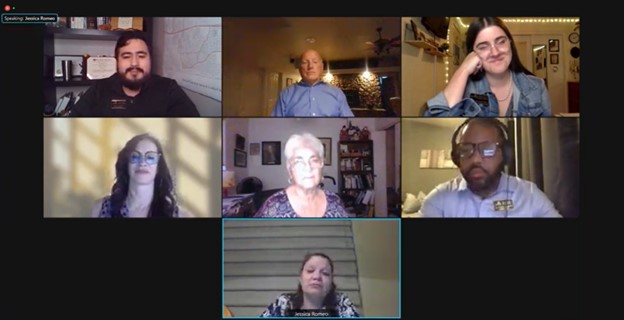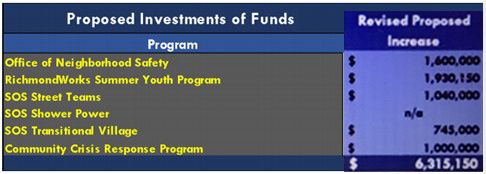
RPSCTF Revised Proposed Reallocation of RPD funds as of June 9, 2021. Composite of task force meeting video screenshots.
Tamisha Torres-Walker serves on that city’s Re-imagining Public Safety Community Task Force along with one or two others from out-of-town; absent for first vote on recommendations, abstains on second without explanation
“Why the people of Antioch elected someone like that to represent them. Maybe she thinks she can get more done in Richmond than in Antioch.” – Richmond Mayor Tom Butt
By Allen Payton
The City of Richmond’s Re-imagining Public Safety Community Task Force is recommending reallocating $10 million from the police department’s budget and using it on other emergency response, prevention and homeless programs, instead.
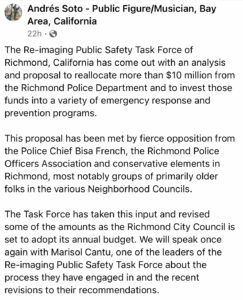
Soto’s Facebook post on June 11, 2021.
In a Friday morning post on his Facebook page, KPFA radio personality and task force member, Andres Soto wrote, “The Re-imaging [sic] Public Safety Task Force of Richmond, California has come out with an analysis and proposal to reallocate more than $10.28 million from the Richmond Police Department and to invest those funds into a variety of emergency response and prevention programs.
This proposal has been met by fierce opposition from the Police Chief Bisa French, the Richmond Police Officers Association and conservative elements in Richmond, most notably groups of primarily older folks in the various Neighborhood Councils.
The Task Force has taken this input and revised some of the amounts as the Richmond City Council is set to adopt its annual budget. We will speak once again with Marisol Cantu, one of the leaders of the Re-imaging Public Safety Task Force about the process they have engaged in and the recent revisions to their recommendations.”
However, the latest recommendations, with Soto supported, is for reallocating $6.3 million from the police budget.
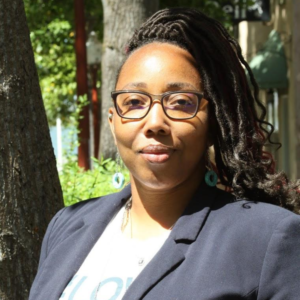
Tamisha Torres-Walker. Photo from her campaign Facebook page.
Antioch District 1 Councilwoman Tamisha Torres-Walker also serves on the task force, having been appointed along with Soto and others, last October 6, prior to her election to the city council. According to the task force’s June 9th meeting, Torres-Walker participated as a member.
Staff Liaison Johann Fragd was asked why Richmond would allow a non-resident, who does not have a business or organization based in their city, to serve on one of their city’s task forces and if it’s appropriate, especially a council member from another city. She responded, “According to my records, Tamisha Walker remains an active member of the Reimagining Public Safety Task Force. According to the original direction of the Richmond City Council the Task Force will be ‘composed by members of the public, including community organizations, individuals who were impacted by law enforcement, and law enforcement.’ We have several members and persons from the Interdepartmental Team, who are not Richmond residents.”
Asked why she, as an Antioch resident and council member can or should serve on another city’s task force and if her non-profit organization, Safe Return Project, is based there, since the location is not provided on either their website or Facebook page. Torres-Walker was also asked if her participation on another city’s task force is taking time and attention away from representing District 1 in Antioch which she was elected to serve. She was absent for the task force’s May 12th meeting, when they approved the recommendations to reallocate $10.2 million from the Richmond Police Department to other services and programs. She was asked if she supported those recommendations.
Finally, during the June 9th meeting, Torres-Walker attempted to get the motion to approve the recommendation to reduce the police department cuts to $6.3 million, “to go line item by line item for each vote,” but didn’t and said, “we can go forward with the vote.”
She then abstained on the vote that approved the recommendations on a slim majority of 11 votes out of the 21 members on the task force. Torres-Walker was asked why she voted that way and if it was because she supported some of the recommendations but not all of them.
The councilwoman did not respond prior to publication time.
Residency Challenged, Defended
Task force member Don Gosney, who claims to be “a truly hated and despised member for actually thinking that we need public safety officers” shared his concerns with the residency of Walker and Soto, and two others.
“Along with Ms. Walker and Mr. Soto, I see from my voter registration spreadsheet from August of 2020 that Luis Chacon is registered to vote in San Pablo,” Gosney wrote. “We also have Eddy Chacon on the task force (I believe he may be Luis’ brother…) and I cannot find him registered to vote in West County. Voter registration is not an entirely reliable tool to use to determine residency but it’s a starting point.”
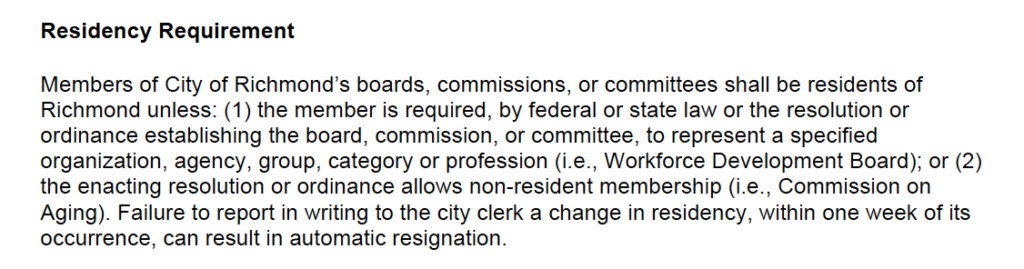
“When Councilmember Nat Bates tried to ascertain the residency of the task force members, the pushback was fierce,” Gosney continued. “By the way, almost immediately after we were appointed, the City Clerk sent us all the 80-page handbook on committees and board. On Page 13 it reads:”
 During the June 9th meeting, task force member Randy Joseph complained about Torres-Walker and Soto being “attacked by the mayor” and others for not being a Richmond resident.
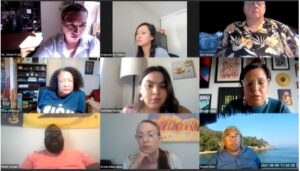
Member Randy Joseph (bottom left) speaks about Torres-Walker and Soto during the June 9, 2021. task force meeting. Video screenshot
“I wanted to bring up something that’s been bothering me over this last month that was going on in the City of Richmond, with people coming and attacking people on this task force for not living in Richmond and being part of Richmond,” he said. “I think that’s disgusting, especially with all the work and all the things that Tamisha Walker and Andrés Soto has put into this city and done for the city.”
“To be attacked by not only the mayor, but other community members that do not know half of the work that these two have done in the history of Richmond, is disgusting and it’s just flat out irritating,” Joseph continued. “It shows the divisive nature that people have made this up to be, to make this trite and just to generalize this process, to make this process illegitimate, to attack two people who have been Richmond community members and done so much for Richmond for so long.”
Member Marcus Njissang added echoed Joseph’s comments saying, “I just want to second what Randy just said. I don’t know what was said about Andrés but… What was said about Mrs. Walker…it made me kind of sick actually, some of the comments that were made by the mayor. Just dragging her through the mud. As a fellow task force member, I feel the same way. I thought it was despicable. That’s just my opinion. I thought that it was disgusting, and I just wanted to second what Randy was saying.”
“This is not the first time I’ve been attacked for this and other things,” said Soto. “When you stand up for the people, they always try to tear you down. But I don’t let that deter me.”
“Perhaps, not at this meeting, but if we ever want to consider a resolution condemning those kind of remarks, that’s something perhaps we can look at,” he continued. “But we have more work ahead of us right now that’s more important to worry about small little people like that.”
Task Force Recommendations
During the April 14th meeting, an overview of the Smart Budget & Resource Allocations “subgroup’s recommendation was provided by subgroup member A. Soto on a Richmond Police Department budget analysis and reallocation proposal. There is a recommendation to have a proposed amount of RPD funds roughly estimated at $10.2 million to be reallocated to other programs such as ONS, RichmondWORKS Summer Youth Program, SOS Street Teams, SOS Shower Power, and the SOS Transitional Village.”
According to their website, SOS! Richmond, which stands for Safe Organized Spaces, “improves encampment and neighborhood living conditions through direct service, engagement, advocacy, and collaborations.”
During the task force’s May 12th meeting, (see minutes) for which Torres-Walker, Soto and other members were absent, they voted to approve the following recommendations: reallocate $2.5 million to the Office of Neighborhood Services which pays gang members $1,000 a month to not commit violent crimes in Richmond; $1,930,150 for the Youth Works Proposal; $1,190,907 million on SOS Street Teams; $627,774 on the SOS Shower Power program; $1,585,658 on the SOS Transitional Village; and $2,455,600 on the Community Crisis Response Program for a total of $10,280,089 in reallocations from the police department budget.
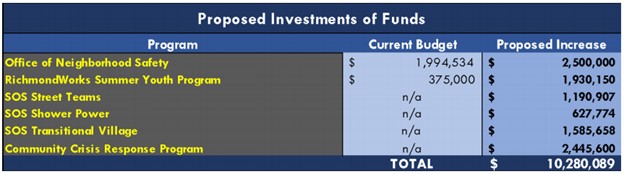
Original proposed reallocation of RPD funds from the task force’s May 12, 2021 meeting.
The Richmond PD’s annual budget is currently $67.2 million. A $10.2 million cut would be over 15% and result in a reduction of 32 officers, according to the Richmond Police Officers Association (RPOA).
Richmond Police Officers Respond
In a May 16th post on the RPOA Facebook page, it reads, “The Richmond City Council is proposing a cut to the Richmond Police Department’s budget, which would mean 32 less officers out protecting our community. We’ve seen what defunding the police would mean for the city – our police department is already understaffed, and crime has increased in cities like Vallejo and Oakland after similar cuts were made to their police forces. Richmond deserves better.
Please visit www.SaferRichmond.com to ask the City Councilmembers to keep us safe. Be sure to share this with your friends, family and neighbors to sign, too.”
On that website, it reads:

Tell the City Council to Vote No on Cutting the Richmond Police
The Richmond City Council is proposing a cut to the Richmond Police Department’s budget, which would mean 32 less officers out protecting our community. We’ve seen what defunding the police would mean for the city— our police department is already understaffed, and crime has increased in cities like Vallejo and Oakland after similar cuts were made to their police forces.
Richmond deserves better.
We understand the need for reform to provide the best levels and types of services to every Richmond resident. We also support additional funding for community services and intervention programs, but we have serious concerns about the current proposal to cut funding from the police department without a clear plan on how the city will make sure our friends, family and neighbors are not placed at increased risk.
We don’t need to defund our police. We need REAL reform with REAL solutions that protect the health and safety of us all.
The Richmond community and its police are working together to make Richmond safer. We need to come together now to keep it safe. Cutting 32 police officers makes no sense. There are other options to fund new services and keep our community police officers. The City Council needs to explore these options. The City Council must vote against defunding our Police Department’s budget until a more thorough plan has been proposed to make Richmond safer for everyone.
Please use this form to ask the City Councilmembers to keep us safe. Be sure to share this with your friends, family and neighbors to sign, too.
It offers a letter for residents to add their name and information which they can email through the website or print and mail it to the mayor and council members.
Subgroups Develop Recommendations in Secret
Gosney says he was not allowed to participate in any of the subgroups. “They wanted everyone to participate in two subgroups.” Everyone else was allowed to participate, “as far as I know.”
Asked why, he said, “anybody who disagrees with their positions is bullied into silence.”
“Half of the task force I think hates me,” Gosney shared. “The other half stay silent because they’re bullied into silence.”
“They were ad hoc subgroups, so they did not have to follow the Brown Act, did not have to give public notice and not have to take any public comment,” he explained. “The first time their recommendations were presented was at the task force meeting and the public had no opportunity to know what the recommendations were before the meeting.”
“The recommendations from one of the subgroups was rejected. They didn’t explain why,” Gosney shared. “That included training police on de-escalation techniques.”
Latest Recommendations Reduce Cuts to $6.3 million
“We’ve had multiple votes and made recommendations on a piecemeal basis,” Gosney explained. “In fact, they just took another vote the other night to reduce the recommended cuts down to about $6.3 million.”
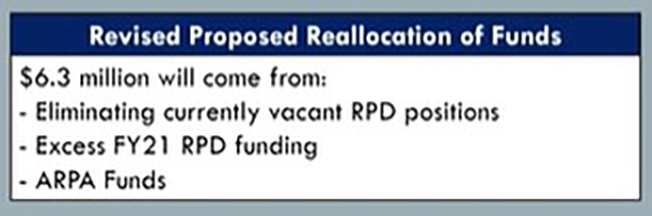
Revised Proposed Reallocation sources from June 9, 2021 task force meeting.
That occurred at the task force’s June 9th meeting. Minutes of that meeting are not yet, available as of publication time. Torres-Walker
“Our new, revised proposed allocation of monies has been reduced by almost $4 million. There would be no layoffs and no additional hiring” by the Richmond Police Department, said task force member Deborah Small. She explained that the recommendations are “to better reflect our values and priorities as a city…so that the fire department and police department don’t consume as much of the resources as they do.”
Member Marisol Cantu mentioned, “using American Rescue Plan (ARPA) funds” and Soto clarified that “it’s a motion to amend the reallocation recommendation.”
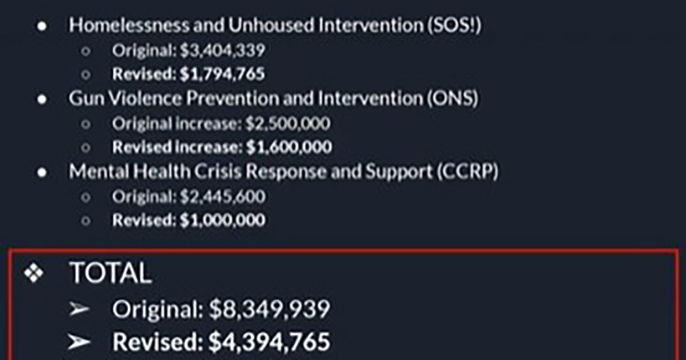
Video screenshot from June 9, 2021 task force meeting recommendation from one subcommittee.
The motion was adopted on a 11-2-4-3-1 with four members abstaining, three members absent and one not voting.
Mayor Butt Explains Residency Issue, Opposes Recommendations
Asked for his thoughts on non-residents serving on his city’s task force, Mayor Tom Butt said, “The way this went down was the city council established this task force. By our charter, the mayor has the authority to make the appointments to all boards and commissions. I proposed that each of the six council members and I get three appointments. They made their recommendations and I appointed them. That’s where the 21-person task force came from. Turns out two of them were from out of town.”
Soto lives in Benicia, the mayor shared.
Regarding the task force’s recommendations Butt said, “I’m dead set against it. This whole thing has been a huge mistake. I think the vast majority of Richmond residents do not want to reduce the police force and don’t want to defund the police. But right now, the council is made up of a majority of radical progressives. It started most recently with the George Floyd’s death.”
“Nationwide it’s kind of rebounded. There were a lot of cities that went in this direction but they’ve kind of pulled back,” he continued.
“We have a police review commission and they recently voted 5-1 opposing defunding the police. And the people on that police commission are pretty progressive, yet they voted against it,” Butt stated. “There have been some social media polls run on it and it’s about 70% against and 30% for. But this is what they were elected to do and they’re probably going to do it.”
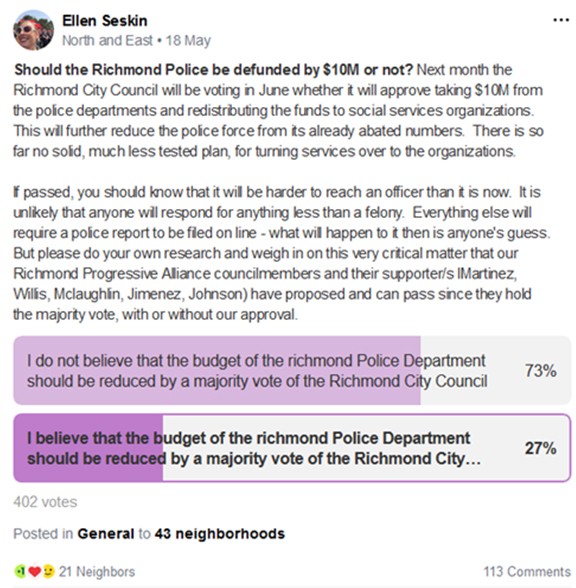
Next Door survey on task force’s proposed cuts to Richmond Police Department budget.
“As far as Tamisha goes, what they jumped on me about, I brought up the fact that there are two out-of-towners on the task force and questioned why that doesn’t make a lot of sense,” he said. “Both Tamisha and Andres have a bone to pick with police. They’ve both have had run-ins with police with Tamisha even sharing, I think on her website, that she was arrested 22 times and did time for arson.”
“They pointed out that her vast experience with law enforcement make her imminently qualified to serve on the task force and she worked in Richmond in the past,” Butt shared. “They have a re-entry facility in Richmond, and she has experience working with that. I’m not saying I agree just that’s what they said as the reason.”
“Why the people of Antioch elected someone like that to represent them,” he continued. “Maybe she thinks she can get more done in Richmond than in Antioch.”
In an online discussion, entitled “E-FORUM: City Manager Recommends Defunding Police” Butt wrote, “The biggest mistake I made, in a moment of excessive collegiality, was to agree to let each City Council member choose three members of the Reimagine Public Safety Task Force. The Richmond Charter vests the mayor with the sole power to make appointments to boards and commissions, subject to Coty Council approval. I should have paid more attention to who my colleagues were appointing.
I had hoped my colleagues would select people who represent all Richmond residents for an objective and balanced task force, but instead we got an organization dominated by anti-police radicals, including two who don’t even live in Richmond. Apparently, City Council members could not find task force members radical enough in Richmond, so they looked elsewhere. Task Force members Andres Soto and Tamisha Walker live in Benicia and Antioch, respectively, and both continue to nurse grudges against police that stem from incidents decades ago.
Soto had an unfortunate run-in with Richmond police way back in the last millennium when Isiah Turner was city manager and Joseph Samuels was police chief. that incident still defines his world view of law enforcement. Since then, the RPD world changed dramatically with Chief Chris Magnus, community policing and a precipitous drop in homicides, but Soto has never forgotten his alleged mistreatment by police, all of whom are now long gone.
Tamisha Walker lives in Antioch where she serves on the City Council, and works in Pittsburg. In her campaign pitch, Walker stated that she “… lives in District 1 and wants to make Antioch a home for her family for generations to come.” (https://www.tamishaforantioch.com/). Walker continues to nurse a grudge that dates back over a decade when, by her own account, she was arrested 22 times and jailed for committing arson. More recently, she had another run-in with Antioch police, shown in a “tearful, profanity-laced video shortly after police stopped her 23-year-old and 13-year-old sons on Dec. 29 for riding off-road vehicles on city streets. She accused the officers of overreacting and trying to run over her 13-year-old son and later handcuffing him after her older son escaped.” (https://youtu.be/pph35cdcPFI)”
Council Discussion June 15th
The Richmond City Council will make their decision on the task force’s recommendations as part of their budget hearings during the June 15th meeting. The city manager is recommending cutting $2.3 million from the police budget.
According to the mayor, the Agenda Report for item H-1 on the June 15, City Council meeting provides the City Council six options for addressing the recommendations of the Reimagine Public Safety Task Force, all but one of which, Option F, defunds police by amounts ranging from $2.3 million to $10.28 million.
Option F is the best choice, but with funding coming from ARPA instead of $1.7M from “the elimination of the budgeted use for facilities improvements and $1.6M from budgeted expenditures for vehicles.”











 On Monday, May 10, 2021, Assemblymember Jim Frazier’s (D-Fairfield) bill,