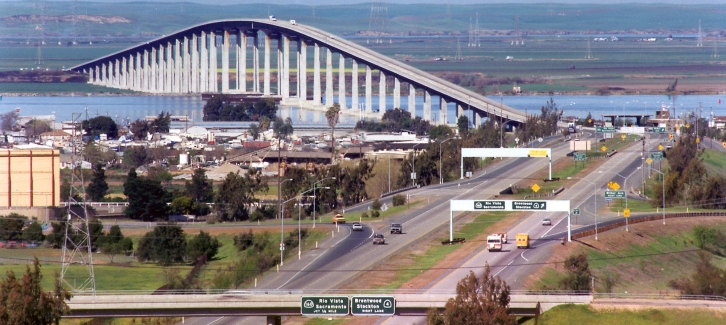
The John A. Nejedly Bridge in Antioch. Photo: BATA
By Marc Joffe
As if the $1 toll hike on January 1, 2025, is not enough, commissioners at the Bay Area Toll Authority (BATA) plan to approve a series of five fifty cent increases starting in 2026. By 2030, tolls on the Bay Area’s seven state-owned bridges will reach $10.50 for FasTrak users and $11.50 for drivers paying by invoice. Included in the increase are these four bridges with landings in Contra Costa County:
Antioch (Senator John A. Nejedly) Bridge
Benicia-Martinez (George Miller) Bridge
Carquinez Bridge
Richmond-San Rafael Bridge
Aside from toll hikes, motorists are facing a gasoline price increase arising from the California Air Resources Board’s recent imposition of the Low Carbon Fuel Standard. According to a research center at the University of Pennsylvania, LCFS could cost drivers up to 85 cents extra per gallon. And this is on top of California’s highly elevated fuel prices, driven by taxes that rise annually under SB1 (2018).
Despite increasing maintenance costs, the Bay Area bridges are quite profitable. BATA expects total revenue of $1.058 billion this year. The costs of operating the bridges, running FasTrak, and paying debt service are projected to total just $757 million, leaving $300 million to spare.
As BATA admits in its own FAQ on the toll increase, $3.00 of the current $7.00 toll is already being siphoned off for purposes other than bridge operations, maintenance, and seismic safety (this will increase to $4.00 of $8.00 on January 1). For example, almost $6 million is diverted annually to the Transbay Joint Powers Authority to operate its empty bus terminal and to pursue its hopeless plan to bring high-speed rail trains into the Salesforce Transit Center. Bridge toll money is also being used to subsidize Bay Area ferries, SF Muni, AC Transit, Golden Gate Transit, and the NAPA Vine bus service.
The toll hike on the Antioch Bridge is especially egregious. BATA is charging the same tolls on all its bridges despite their vastly different lengths. The Bay Bridge is 8.4 miles long while the Antioch Bridge is just 1.8 miles long. Also, unlike all other Bay Area bridges, the Antioch Bridge has just one lane in each direction.
And then there is the question of income. While many Bay Area drivers are wealthy enough to easily absorb the toll hike, that is less true of people living near the Antioch Bridge. According to Census Reporter, Antioch’s per capita income is only 56 percent of the average for the San Francisco-Oakland-Fremont metro region. Rio Vista, the first sizable community on the north side of the bridge, clocks in at just 67 percent of the metro area’s income per person.
At minimum, BATA should exempt the Antioch Bridge from its planned toll hikes. But better yet, the Authority should shelve its entire toll increase plan, stop siphoning off toll money for other purposes, and live within its means.
Marc Joffe is President of the Contra Costa Taxpayers Association.
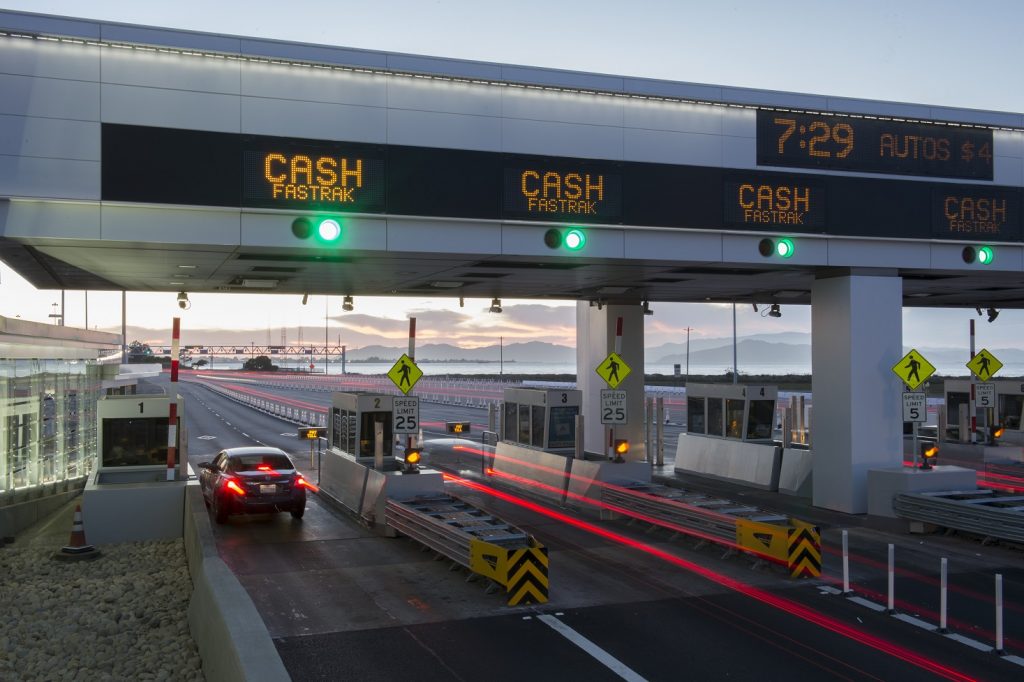
Bay Bridge Toll Plaza photos taken 9 /16 & 8/13. By Karl Nielsen courtesy of MTC
Until Dec. 18
Board considering increasing to as high as $11.50 to pay “exclusively for bridge preservation and operations” in spite of three voter-approved $1 increases
“A Thanksgiving/holiday season decision is a hide the ball strategy. Not good.” – State Senator Steve Glazer
By John Goodwin & Rebecca Long, MTC
November 20, 2024 update: The public comment period on the Bay Area Toll Authority’s proposed toll increase and HOV policy changes is extended through the end of public comment heard on the agenda item for BATA’s December 18, 2024 meeting. All public written and oral comments provided through that time will be incorporated into the record. However, in order for comments to be summarized and published in the agenda packet and distributed in advance of consideration of this item at the December 11, 2024, BATA Oversight Committee meeting, they must be submitted by 5 p.m. December 3, 2024.
BATA — which is required by state law to fund projects to preserve and protect the Bay Area’s seven state-owned toll bridges — today heard again a proposal for a toll increase that would be used only to pay for the maintenance, rehabilitation and operation of the San Francisco-Oakland Bay Bridge and the Antioch, Benicia-Martinez, Carquinez, Dumbarton, Richmond-San Rafael and San Mateo-Hayward bridges. If approved by BATA at its December 18 meeting, the toll increase would be phased in over five years, beginning Jan. 1, 2026.
Source: BATA
The toll increase proposal includes a tiered rate structure aimed at encouraging more customers to pay electronically with FasTrak® toll tags, as this form of payment carries lower administrative costs than payment through a license plate account or returning payment with an invoice received by mail. Under the proposal, customers would pay a premium for using a pre-registered license plate account or for invoiced tolling. To give customers ample time to sign up for FasTrak, this premium would not begin until 2027.
The proposed toll hike is separate from the $3 increase approved by Bay Area voters in 2018 through Regional Measure 3 to finance a comprehensive suite of highway and transit improvements around the region. The first of the three $1 Regional Measure 3 toll increases went into effect in 2019, followed by another in 2022. The last of the RM 3 toll hikes will go into effect Jan. 1, 2025, bringing the toll for regular two-axle cars and trucks to $8.
The proposal heard today by BATA calls for tolls for all regular two-axle cars and trucks to increase to $8.50 on Jan. 1, 2026. Tolls for customers who pay with FasTrak tags would then rise to $9 in 2027; to $9.50 in 2028; to $10 in 2029; and then to $10.50 in 2030. Tolls for customers who use a pre-registered license plate account would rise to $9.25 in 2027; to $9.75 in 2028; to $10.25 in 2029 and to $10.75 in 2030. Invoiced tolls would rise to $10 in 2027; $10.50 in 2028; $11 in 2029; and $11.50 in 2030. The Golden Gate Bridge has used a tiered pricing schedule since 2014. Golden Gate Bridge tolls by July 2028 will range from $11.25 for FasTrak to $11.50 for license plate accounts to $12.25 for invoice customers.
Source: BATA
Under the proposed toll increase, tolls for large freight trucks and other vehicle/trailer combinations with three or more axles would rise by 50 cents per axle each year from 2026 through 2030.
“I’m sensitive to the overall cost of living in the Bay Area,” acknowledged Napa County Supervisor Alfredo Pedroza, who also serves as chair of both BATA and the Metropolitan Transportation Commission (MTC). “Working families really feel the impact, not just in transportation but back at home with utilities, groceries, children. This one is hard. But it’s the right thing to do.”
BATA and MTC invite members of the public to weigh in on the proposed toll increase during a comment period that begins Monday, Nov.4, and continues through the end of BATA’s Dec. 18 meeting. Comments may be sent via email to info@bayareametro.gov. As part of its regular November meeting, BATA today held a public hearing in San Francisco to receive testimony about the proposal from Bay Area residents, businesses and other interested parties.
Today’s presentation by BATA and MTC staff also proposed updates to the policies for high-occupancy vehicles on approaches to the Bay Area’s state-owned toll bridges. These updates would take effect Jan. 1, 2026, concurrent with the proposed toll increase. BATA’s existing toll schedule allows vehicles with three or more occupants (HOV 3+) a discounted toll, with a two-person (HOV 2) occupancy requirement for half-price tolls at the Dumbarton and San Mateo-Hayward bridges. BATA and MTC staff propose to establish a uniform three-person occupancy requirement for half-price tolls during weekday commute periods at all seven bridges. Carpool vehicles at all state-owned bridges must use a dedicated carpool lane and pay their tolls with a FasTrak Flex toll tag set to the ‘3’ position to receive the 50 percent discount available weekdays from 5 a.m. to 10 a.m. and from 3 p.m. to 7 p.m.
The proposed carpool policy changes also would allow vehicles with two occupants and a switchable FasTrak Flex toll tag set to the ‘2’ position to use the carpool lanes on the approaches to the Antioch, Benicia-Martinez, Carquinez, Dumbarton, Richmond-San Rafael and San Mateo-Hayward bridges. These two-occupant vehicles would not receive the 50 percent carpool discount but would be able to use the carpool lanes to save time traveling through the toll plazas. Use of the carpool lanes on approaches to the San Francisco-Oakland Bay Bridge still would require a minimum of three occupants.
The new carpool policy proposals are designed to improve safety on the toll bridge approaches by minimizing ‘weaving’ between lanes and to increase person-throughput by prioritizing access for buses and carpools. The policy change also would optimize lane configurations as now-obsolete toll booths are removed as part of the coming transition to open-road tolling.
Removing spalled on concrete on pier cap 305. Photo: CalTrans
BATA, which is directed by the same policy board as MTC, administers toll revenues from the Bay Area’s seven state-owned toll bridges. Toll revenues from the Golden Gate Bridge are administered by the Golden Gate Bridge, Highway and Transportation District, which joined with BATA to operate a single regional FasTrak customer service center in San Francisco. MTC is the transportation planning, financing and coordinating agency for the nine-county San Francisco Bay Area.
In response to a post of the link to this press release on X/Twitter on Wednesday, Nov. 30, State Senator Steve Glazer, who represents most of Contra Costa County, protested the proposed toll hikes writing, “Why was this need not identified and incorporated during the last toll increase in 2018? You don’t buy a boat and a new car when you don’t have the $ to fix the roof! A Thanksgiving/holiday season decision is a hide the ball strategy. Not good.”
The Antioch City Council approved a variety of items during one of two lame-duck sessions on Tuesday, Nov. 12, 2024. District 2 Councilman Mike Barbanica was absent due to a family medical emergency. Video screenshot.
Approve double-time for Antioch Police officers as part of Violence Reduction Initiative
New city manager withdraws request for second assistant city manager position
Agree to move forward proposed Sycamore Square police substation
By Allen D. Payton
During their meeting on Tuesday, November 12, 2024, the Antioch City Council agreed to spend $1.3 million on improvements to the police department and Animal Services. It was the second to last regular meeting for both Mayor Lamar Hernandez-Thorpe and District 3 Councilwoman Lori Ogorchock, as well as District 2 Councilman Mike Barbanica, who was absent due to a family medical emergency. The council also approved double-time pay for Antioch Police Officers who choose to work extra hours to supplement the currently depleted force, voted to accept the $6.8 million state grant to clear out homeless encampments, agreed to pursue leasing the lot on Sycamore Drive to develop something there in the long-term and a community garden in the meantime, as well as directed staff to pursue leasing space at the Sycamore Square shopping center for a possible police substation.
Before public comments and council discussion on the budget-related item, it was announced City Manager Bessie Scott, who was also absent, withdrew her request for a second assistant city manager position, and would be brought back at a later, more appropriate time, according to Economic Development Director Kwame Reed who was sitting in for her during the meeting.
Budget Savings and ARPA Funds Allocation
The $1.3 million were from item #10 on the agenda entitled, “Appropriating Expenditures for Encumbrances and Project Budgets Outstanding to the 2024/25 Fiscal Year Budget and Approving Other Amendments to the 2024/25 Fiscal Year Budget.”
For the use of the remaining one-time federal ARPA funds for COVID relief which have to be allocated or contracted for by Dec. 31st, the council, instead of using it to help local need meeting organizations in the amount of $25,000 each as suggested by Mayor Lamar Hernandez-Thorpe they instead moved them to the General Fund to pay for government services.
District 1 Councilwoman Tamisha Torres-Walker wanted instead to “Go through a grant making process then those organizations could apply,” she said. But Mayor Pro Tem and District 4 Councilwoman Monica Wilson and District 3 Councilwoman Lori Ogorchock supported transferring the funds to the General Fund for future use by the next council.
The council than approved that on two motions which passed 4-0.
Approve Double-Time Pay for Antioch Police Personnel in Violence Reduction Initiative
After approving the Violence Reduction Initiative last month, allocating up to $500,000 for overtime pay and costs for the assistance of police and equipment from outside agencies, under item #11 the city council approved “a resolution authorizing the Chief of Police to pay double the standard hourly wage (“double-time”) to Antioch Police Department Sergeants, Corporals, Officers, Community Service Officers, and Dispatch personnel for working extra shifts in designated areas of the City to reduce violence.”
“I do think we need to approve that. But we can’t rely solely on outside officers,” said Interim Police Chief Brian Addington. “Nobody knows this area…better than our Antioch Police Officers.”
“These officers would be over and above the regular patrol officers,” he stated. “We don’t want our officers overworked and working fatigued. I’m not asking for any more money. You already allocated $500,000. I believe that will be sufficient. I believe it would benefit us all as a community we spend these funds up front…rather than after the fact. It is a short-term solution. We need a wholistic approach. We need to work with our faith-based organizations, our community-based organizations.”
Torres-Walker flipped her position from the previous vote on the initiative saying, “I do support this…knowing officers will be well-rested. Because I’ve been told by other chiefs that it would be difficult to provide their officers. I’m going to go ahead and support this.”
Following the motion by Ogorchock and seconded by Torres-Walker, it passed 4-0.
Accept $6.8 Million State Homeless Encampment Cleanout Grant
The council also adopted “a resolution accepting the Department of Housing and Community Development Division of Housing Policy Development (HCD) Encampment Resolution Funding (ERF)” Round 3 award in the amount of $6,812,686. The proposed project will clear out a homeless encampment located near the intersection of Sunset Drive and Devpar Court. As one of the City’s two large encampments, it has been prioritized for resolution due to the vulnerability of its 30-40 residents and the hazardous conditions present at the site.
“I understood the site was not selected,” Ogorchock stated and asked about the Economy Inn.
“When we first wrote the grant we were looking at a couple options and no one said they were interested except Economy Inn,” said Tasha Johnson, Director of the Public Safety and Community Resources Department.
The council approved the motion to accept the grant on a 4-0 vote.
Approve Rescinding City Attorney Oversight of City Clerk’s Office
Under agenda item #13, the council approved outgoing City Clerk Ellie Householder recommendation to rescind a previous resolution, “Approving the City Clerk’s Request for the City Attorney to Provide Managerial Oversight of the City Clerk’s Department in Cooperation with the City Clerk.”
“This resolution will transfer back the responsibility to the city manager,” said City Attorney Thomas L. Smith.
The motion to approve passed on a 4-0 vote.
Lease of Lot on Sycamore Drive
The council also considered, at Torres-Walker’s request, leasing the vacant property across from the Sycamore Square shopping center on the corner of Sycamore Road and L Street, or space in the center.
According to resident and former councilman Ralph Hernandez, the empty lot was formerly the location of a gas station. He questioned whether it was cleaned up and for the council to consider any environmental hazards.
Resident and affordable housing advocate Andrew Becker said, “That lot has an R-20 zoning designation. So that city has plans for housing on that property.”
“That lot definitely does need some funding put into it. Not City of Antioch General Fund. That property is in an Opportunity Zone. It’s in one of the lowest income areas of the city. You submit it to the state…you go to the front of the line,” he stated. “You land-lease this property. You create a viable development plan and you target those funds and I’m happy to help along the way.”
“Before we buy the property, we made sure it was clear,” said the lot owner named Mike. “There was a gas station there in 1974.”
Torres-Walker then said, “I connected Andrew to Mike. In order to do things like that you have to show interest as the City to move forward. Even Mike said, ‘we could lease this lot for a dollar.’ After 30 years this city would finally be willing to invest in their community.”
“There’s nothing to vote on tonight. We either have to put up or shut up and stop complaining,” she added.
“It’s not been closed since 1974,” Ogorchock pointed out.
“I didn’t say it’s been 30 years since it was a gas station. I’m saying it’s been 30 years of neglect,” Torres-Walker responded.
“I think this is something that could be a land-lease,” Mayor Pro Tem Monica Wilson stated. “I definitely want to hear more about this.”
Hernandez-Thorpe mentioned a “community garden there. The long-term plans are the long-term plans. In the meantime, a community garden is what she’s asking for.”
Lease of Space at Sycamore Square for Police Substation
Regarding a police substation inside a space at the Sycamore Square shopping center Torres-Walker explained, “A police substation is not a mini police station.”
“In fairness to Mike, he already reserved the space two years ago,” Hernandez-Thorpe stated. “This is not a new idea. The unfortunate circumstances of what happened made it difficult.”
Commissioner Leslie May said, “I think that would be a good idea as long as the Community Engagement Committee of the Police Oversight Committee could be in there working.”
Ralph Hernandez said, “I just don’t see it. The community already has security in the Contra Loma Estates, the cameras there and you still have the violence. It’s an illusion…that’s going to create some kind of security for the community. “How many police buildings are patrolling and keeping our city safe?” he asked. “You’re not going to get more safety by having a substation.”
“I like her idea, of having a community room with non-police,” he continued referring to Ms. May’s idea. “I know what’s going on there. You just don’t know the game, there.”
Another resident, who the mayor referred to as Ms. Smith said, “I was born and raised in Antioch on the old Sycamore, William Reed Drive. I’ve noticed since we have patrol officers sitting over there in Sycamore Square, I feel safe. It’s not an illusion.”
“The bullets started flying. A shell casing was found in a neighbor’s yard. Real estate agents were showing a house then the 50 shots,” she stated. “I’m all for the substation. When the police are there, it’s quiet. Sycamore has always been bad. It’s never been this bad.”
Increased policing is not the intent, here. It’s not going to solve the community’s problems. Increased presence,” Andrew Becker said. “It’s to provide a space to show that community they’re not forgotten. That the City is invested in them 24/7. Be more ambitious. Be more bold.”
He then suggested pursuing federal grant funds for electric vehicle charging stations at the shopping center to attract people to it.
“This is a step in a process of steps that have already been taken,” Hernandez-Thorpe stated.
“This is not giving up on community-based violence solutions,” Torres-Walker said. “Antioch’s never done that before. The approach has been police response, police response, police response. What I would like is for the city manager and the police chief to meet with the owner of Sycamore Square…what can we do in three months, what can we do in six months.” “We’re all agreeing with the direction? Is the direction clear?” Hernandez-Thorpe asked.
Property owner Mike said, “When the police show up it was better. I do everything that I’ve been asked. I’ve been trying to help the community. This is something beyond, out of my hands. If we can work together.”
“The security guards don’t feel safe. These are armed security guards,” Torres-Walker stated. “The HOA feels so safe…they move to…Brentwood. We need to do something.”
Council Communications
During the Council Communications portion of the meeting, Torres-Walker said she wanted to bring back to a future meeting a discussion of, “What is the mayor’s office and how do we get rid of it?” She also asked, “To change the name of the Mayor’s Apprenticeship Program to something more suitable for sustainability.”
“You do realize all that sounded like a dig towards me,” Hernandez-Thorpe said.
“It’s not a dig. I just want to have a discussion about it,” Torres-Walker responded with a laugh.
“The $20,000 for each council members’ districts. We need to have guidelines on them,” Ogorchock then requested.
The council then voted to adjourn the meeting at 11:23 p.m.
Double-time pay for Antioch cops, Sycamore Drive land lease for possible police substation, potential upgrades to Amtrak Station to stave off closure
Fiscal Year ends with $3.5 million surplus, mainly due to vacant position savings, mostly in police dep’t
Will respond to Grand Jury report noncompliance letter
City awarded $6.8 million grant to clear homeless encampments
By Allen D. Payton
During tonight’s Antioch City Council meeting, on Tuesday, November 12, 2024, the mayor and two members who will no longer be on the council as of early December, will, along with the other two members, consider multiple items, including adding a second assistant city manager at a cost of over $425,000 per year, even though the current position is still vacant.
Under agenda item #’s 15 and 16, at the request of District 1 Councilwoman Tamisha Torres-Walker, the council will consider leasing the vacant property across from the Sycamore Square shopping center on the corner of Sycamore Road and L Street, and space in the center for a police substation, even though the Antioch Police Facility is just one mile away.
In addition, under agenda item #1, the council will consider upgrades to the Amtrak Station to avoid its decommissioning. According to the staff report, “the fiscal impact is unknown at this time until direction on this item is provided.”
Those are in spite of the fact the City is facing double-digit deficits over the next three years, and federal funding for a variety of current projects and programs, including the Opportunity Village, homeless hotel, runs out at the end of December. However, the council will receive good news in the form of a net surplus of $3.5 million for Fiscal Year 2023/24 that ended on June 30th which will reduce those future fiscal year deficits.
Budget Adjustments – Agenda Item #10
That good news comes in the form of the Fiscal Year 2023/24 Unaudited Closing Numbers. According to the staff report, “Fiscal Year 2023/24 closed on June 30, 2024. Revenues exceeded expenditures by $8,862,934, however, $5,358,842 of this ‘excess’ is from encumbrances and project budgets unspent as of June 30th being rolled over into FY25…for a realized net surplus of $3,504,092. This amount is being set aside in the Budget Stabilization Fund at June 30, 2024, leaving a General Fund reserve balance of $43,258,769 and a balance in the Budget Stabilization Fund of $41,131,470 as of June 30, 2024.”
The report also shows FY2024 Revenues were $2,371,877 higher than projected due mainly to $1.36M in additional interest income from the high interest rate environment of the City’s investment portfolio. Expenditures were $11,726,745 less than projected. Yet, a large amount was due to $4,866,210 in salary savings from all unfilled positions, of which $3,554,451 was in the police department due to its understaffing.
During discussion of item #10 entitled, “Appropriating Expenditures for Encumbrances and Project Budgets Outstanding to the 2024/25 Fiscal Year Budget and Approving Other Amendments to the 2024/25 Fiscal Year Budget” the new city manager is requesting a second assistant city manager. According to the city staff report for the item, “The estimated annual salary and benefit cost of the position at Step E is $425,494, with the budget impact and amendment required for 6 months of $212,747.”
The current assistant city manager position is vacant, as Parks and Recreation Director Brad Helfenberger is no longer serving as the Acting Assistant City Manager.
Response to Civil Grand Jury’s Noncompliance Letter – Agenda Item #2
In response to Mayor Lamar Hernandez-Thorpe’s letter dated Sept. 11, 2024, responding to the Civil Grand Jury’s investigation report issued earlier this year, entited, “Challenges Facing the City of Antioch”, the Grand Jury rejected the council’s response. In two letters dated Oct. 3, 2024, and received by the City on Oct. 7, Foreperson Ed Sarubbi wrote in the first, “The Grand Jury…finds that it does not comply with the requirements of Section 933.05 of the California Penal Code in the following respects: Response to Findings 6 and 13: A response of ‘The City disagrees with this finding requires an explanation.’ The Grand Jury requests that you resubmit your responses in its entirety within 10 days of the date of this letter, following the directions in the original letter of transmittal.”
Letters from the Contra Costa County Grand Jury to Antioch rejecting the council’s response to the investigation report issued in June. Source: City of Antioch
In the second letter, Sarubbi requested the same writing, “Response to Recommendations 1, 2, 3, 4, and 5: A response of ‘The City agrees with this recommendation’ is not a valid response.” He’s asking for the mayor to resubmit the council’s responses to those recommendations, also within 10 days.
The City is already out of compliance as a draft response letter was written and dated in October, but the council has yet to approve it, as the matter was not placed on the agenda until the Oct. 22nd meeting and then was continued to tonight’s meeting.
Double-Time Pay for Antioch Police Personnel in Violence Reduction Initiative – Agenda Item #11
After approving the Violence Reduction Initiative last month, allocating up to $500,000 for overtime pay and costs for the assistance of police and equipment from outside agencies, under item #11 the city council will consider adopting “a resolution authorizing the Chief of Police to pay double the standard hourly wage (“double-time”) to Antioch Police Department Sergeants, Corporals, Officers, Community Service Officers, and Dispatch personnel for working extra shifts in designated areas of the City to reduce violence.”
State Homeless Encampment Cleanout Grant – Agenda Item #12
More good news on the agenda includes the council considering adopting “a resolution accepting the Department of Housing and Community Development Division of Housing Policy Development (HCD) Encampment Resolution Funding (ERF)” Round 3 award in the amount of $6,812,686.
According to the city staff report for the item, #12, “The proposed project in Antioch aims to address a significant encampment located on wooded land near the intersection of Sunset Drive and Devpar Court. As one of the City’s two large encampments, it has been prioritized for resolution due to the vulnerability of its 30-40 residents and the hazardous conditions present at the site.”
City Attorney Oversight of City Clerk’s Office – Agenda Item #13
Under agenda item #13, outgoing City Clerk Ellie Householder is recommending that the city council adopt a resolution rescinding Resolution No. 2022/167, “Approving the City Clerk’s Request for the City Attorney to Provide Managerial Oversight of the City Clerk’s Department in Cooperation with the City Clerk” that had previously been approved.
Council Meeting Details
The meeting begins at 6:00 p.m. with a Closed Session on two lawsuits the City is facing, followed by the Regular meeting at 7:00 p.m. in the Council Chambers at City Hall, 200 H Street in historic, downtown Rivertown. The meeting can also be seen via livestream on the City’s website or viewed on either Comcast local cable channel 24 or AT&T U-verse channel 99. See the complete agenda packet.
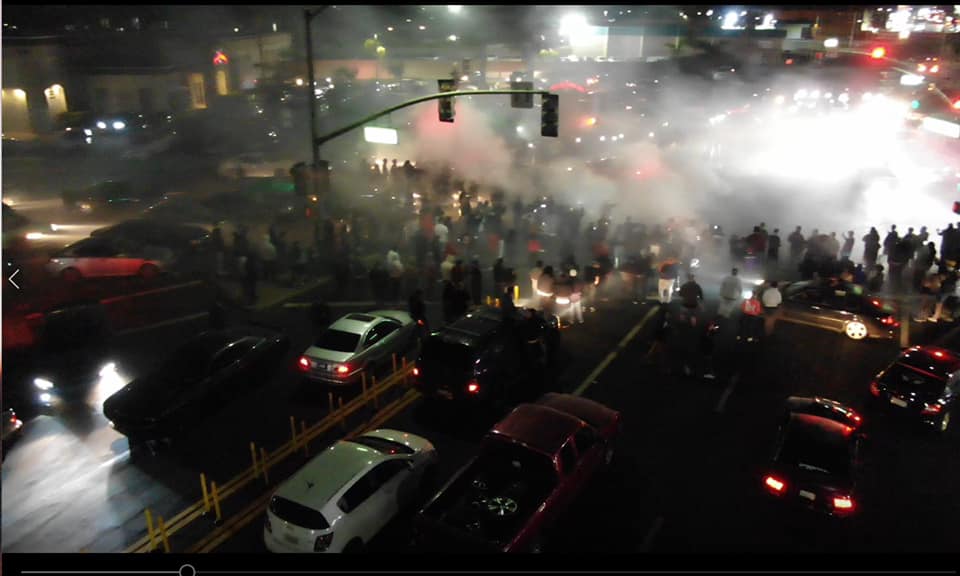
Sideshow at W. 10th Street and Auto Center Drive on Saturday night, May 29, 2021. Source: Antioch PDdrone video screenshot
Helps fund the STREET III – Sideshow, Takeover, Racing, Education, and Enforcement Taskforce
By CHP Media Relations
SACRAMENTO, Calif. – The California Highway Patrol (CHP) received $2 million in federal funding that will expand its major crackdown on dangerous sideshows and street racing statewide, holding participants and organizers accountable for reckless driving behaviors.
Federal funding for the Sideshow, Takeover, Racing, Education, and Enforcement Taskforce (STREET III) grant comes after the CHP received $5.5 million in state funding to combat illegal street racing and sideshow activities, resulting in a 40% decrease in illegal sideshow incidents from 2021 to 2022. The STREET III grant aims to reduce the number of fatal and injury traffic crashes attributed to reckless driving, street racing, and sideshows. The CHP will implement a public awareness campaign to tackle these unlawful activities and conduct specialized enforcement operations such as excessive speeding behaviors where motorists are traveling more than 100 mph on state highways. Last year, CHP officers participating in specialized speed enforcement operations from January 2023 to July 2024 issued over 30,000 citations to motorists exceeding 100 mph.
“Sideshows and street takeovers are reckless, criminal activities that endanger our communities and make streets less safe. We have seen too many people killed or hurt at these illegal events. California will continue to ramp up our efforts to crack down on sideshows. For anyone considering attending a sideshow: know that not only do you risk getting hurt at these events, but you also risk the potential loss of your vehicle,” said Governor Gavin Newsom.
Since February, the CHP has made 1,125 arrests, seized 110 illegal guns, and recovered more than 2,000 stolen vehicles in Alameda County and the East Bay alone. Last month, Governor Newsom signed four bills into law that impose stricter penalties and strengthen law enforcement’s ability to combat sideshows and street takeovers.
“The CHP’s top priority is the safety of our communities. This new grant allows us to strengthen our efforts in addressing the growing issues of sideshows and illegal street racing, which endanger lives and disrupt neighborhoods,” said CHP Commissioner Sean Duryee.“By increasing patrols, deploying advanced technology, and partnering with local organizations, we are committed to making our roads safer and holding those responsible for reckless driving accountable.”
Alongside allied agencies, the CHP established task forces to tackle the challenges posed by street racing and sideshows. In addition, social media initiatives have been introduced to enhance public awareness regarding the dangers associated with aggressive driving behaviors, including illegal street racing and sideshows. The STREET III grant allows for a campaign starting this month through September 30, 2025.
Funding for this program was provided by a grant from the California Office of Traffic Safety through the National Highway Traffic Safety Administration.
The mission of the CHP is to provide the highest level of Safety, Service, and Security.
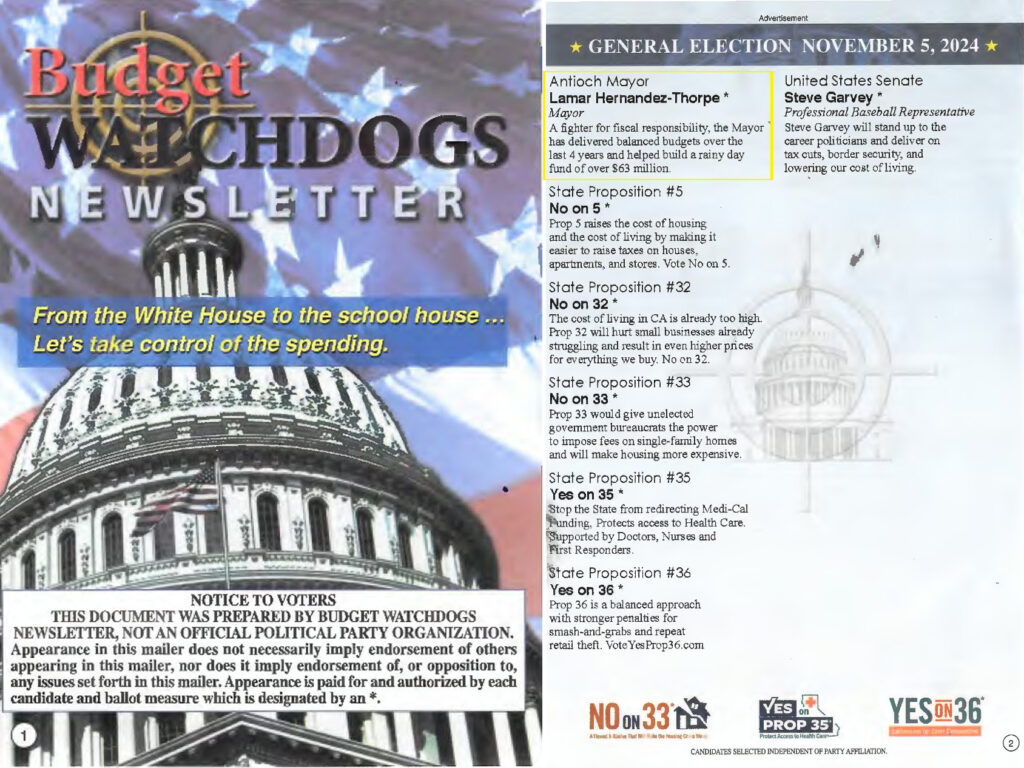
The “Budget Watchdogs Newsletter” slate mailer on which the mayor’s campaign paid for him to appear and make his claims.
City ran deficits three out of four years he’s been mayor and are projected to increase
By Allen D. Payton
In the slate mailer entitled, “Budget Watchdogs Newsletter” received by voters this past week, which Antioch Mayor Lamar Hernandez-Thorpe’s campaign paid for him to appear on, he claims to be “A fighter for fiscal responsibility” and “has delivered balanced budgets over the last four years and helped build a rainy day fund of over $63 million.”
The first claim has been determined to be false while the second is considered accurate. The mayor was twice asked about both of his claims, but he did not respond.
Rainy Day Fund – Accurate According to the City staff report for the General Fund Budget Stabilization Fund in the Fiscal Year (FY) 2023-25 Budget adopted by the council on June 13, 2023, “In fiscal year 2018, the City established a Budget Stabilization Fund to set aside monies for future budget variances, unexpected occurrences, emergencies and the like. General Fund reserves over 20% of unassigned fund balance were used to establish the fund and future General Fund unassigned reserves over 20% can be moved into this fund. Per City Council direction, beginning in fiscal year 2020, these funds will be used to pay the difference in the full Actuarial Determined Contribution for OPEB payments from the pay as you go costs currently made by the City to address the unfunded liability for OPEB.”
OPEB refers to Other Post-Employee Benefits for retirees.
When asked about the claim of the “rainy day fund” without mentioning who made it, City Finance Director Dawn Merchant responded, “I am not sure about the claim as we do not have a $63M rainy day fund. I can only assume that claim is adding the Stabilization Fund and General Fund reserves, however, again, I am not sure.”
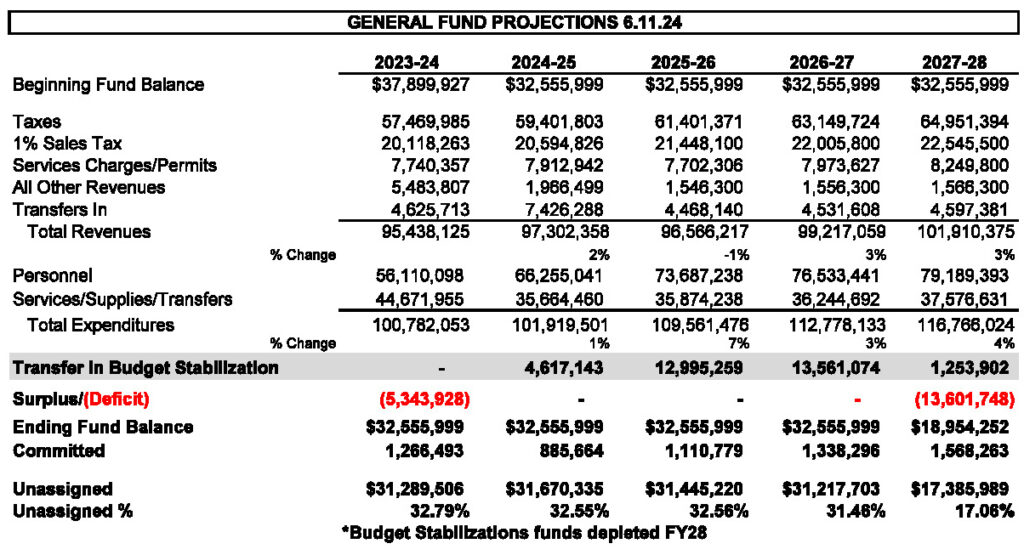
She also shared, “As of 7/1/24, the Budget Stabilization Fund balance is $37,627,378.” On that same date, the General Fund reserves balance was $32,555,999. So, by adding the two the total was $70,183,377 which supports the mayor’s claim as accurate.
UPDATE: Later, Merchant shared, “The $32,555,999 beginning fund balance is based on the revised FY24 budget, so that is not an actual, that is a projected based on the FY24 budget. Once the books for 6/30 are wrapped up, we will have the actual ending 6/30/24 fund balance.”
The City of Antioch’s General Fund Projections 6.11.24 presented to the City Council on that date. Source: City of Antioch Finance Department
Balanced Budgets Claim – False However, Hernandez-Thorpe’s claim he “has delivered balanced budgets over the last four years” is false. Because the budgets approved by the City Council for the current and past two of the four years during his term as mayor, have spent or are spending more than the City has been or is receiving in sales, property and other tax revenues. The budgets include the following deficits: $3,995,625 in FY2022-23. $5,343,928 in FY 2023-24; and $4,617,143 projected for the current, FY 2024-25.
That last amount is being covered by the Budget Stabilization Fund.
City Budget Projects Increasing Deficits In addition, according to the General Fund Projections for 2023-2028 presented to the city council on June 11, 2024, the General Fund is projected to run the following deficits: $12,995,259 in FY 2025-26; $13,561,074 in FY 2026-27; and $14,855,649 in FY 2027-28.
The first two are expected to be covered by transfers from the Budget Stabilization Fund, but it will only cover $1,253,902 in the third year of what could be Hernandez-Thorpe’s second term as mayor if he’s re-elected because that Fund will be depleted in FY 2028. That would result in a projected net deficit for the City of $13,601,748 by June 30, 2028, which would be covered by the General Fund reserve leaving it with an Ending Balance of just $17.4 million or 17.06% in reserves versus over 31% and 32% for the previous fiscal years.
The mayor faces two challengers in the campaign, former Antioch city manager, Ron Bernal and second-time candidate for mayor, Rakesh Christian.
The election is November 5th.
Please check back later for any updates to this report.
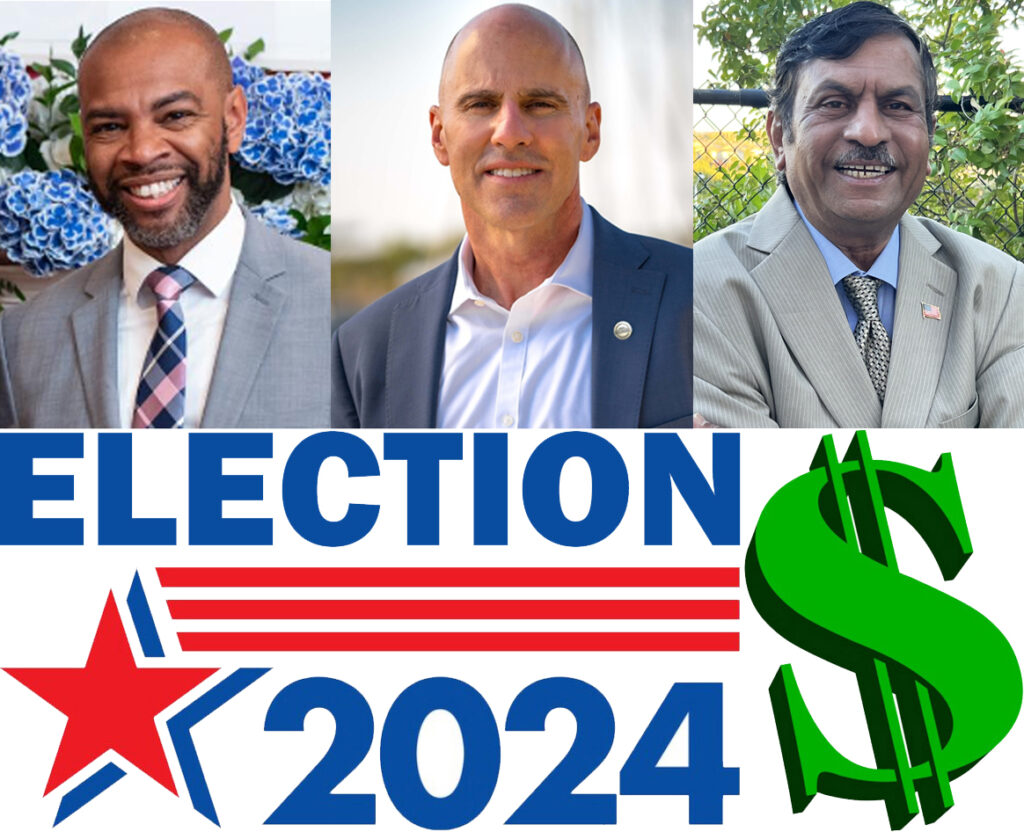
Antioch City Council District 3 candidate Don Freitas, center is leading opponents Antwon Webster (right) and Addison Peterson (left) in campaign fundraising to date.
Over $30K raised so far
By Allen D. Payton
With one month remaining in the battle for the bucks for the Antioch City Council District 3 race on the November ballot, as of Tuesday, October 15, 2024, Don Freitas has raised significantly more than his two opponents combined. The former mayor and councilman has raised $30,184.68 compared to $11,190.09 raised by second-time council candidate Antwon Webster and $10,209.83 by newcomer Addison Peterson.
Freitas’ Finances
During the reporting period, Freitas’ fundraising resulted in $22,172 plus, an additional $2,000 received since Sept. 21st using a required Form 497, for a total of $30,184.68 received during the campaign, including $1,012.68 in Nonmonetary Contributions.
Freitas’ largest contributions were $5,000 from SR Ventures LLC in Brentwood, owned by businessman and Antioch commercial property owner Sean McCauley, $2,500 each from Republic Services, Antioch’s garbage company, and GBN Partners, LLC of Danville, developers of the approved Promenade new home projects in the Sand Creek Area, $2,000 each from I.B.E.W. 302 Community Candidates PAC in Martinez and Michael Hurd of Antioch, listed as Principal, Commercial Real Estate Consulting, $1,100 from Linda Terranova of Antioch, listed as retired, $1,000 each from Melody Weintraub of Lafayette, listed as retired and Guy Bjerke of Concord, the City of Concord Director of Economic Development, a peculiar $900 contribution amount from County Assessor Gus Kramer of Martinez (who was obviously too cheap to make it a grand), $500 each from County Fair Board Member Richard Hobin of Antioch, attorney with Hobin & Hobin LLP also in Antioch, Arnold Linscheid of Danville, the CEO of the Walnut Creek Chamber of Commerce, Earlene Lanter of Antioch, listed as retired and Martin Fernandez of Antioch, also retired. Freitas also received $250 from City Councilwoman Lori Ogorchock’s 2022 re-election campaign committee and $150 from the councilwoman.
Freitas spent $10,899.10 for the period for a total of $13,016.30 spent through Sept. 21st. His campaign’s largest expenditure was for $5,057.30 to The Tucker Group of Antioch for consulting, $1,500 to Carla Marymee of Antioch for website design, $900 to Political Data Intelligence of Long Beach for campaign software, $859 to Election Digest of Torrance for a Voter Guide slate mailer to Democrats and $549 to the City of Antioch for filing fees.
The former mayor and councilman had an Ending Cash Balance of $15,168.38, plus, the $2,000 received after the filing period for a total of $17,168.38 remaining to be spent on his campaign. See Freitas’ Form 460 0701-092124 and Form 497 092824.
Webster’s Wealth Works
In a distant second place in fundraising, Webster’s report shows he raised $7,779.09 during the period for a total of $12,690.09 for the campaign. Those amounts include loans from himself of $5,441.26 for the period and $8,792.26 total for the campaign.
His largest contributions were $2,500 from Quincy and Mitchell Hardin of Antioch, owners of Hi-Lite Janitorial, and the most unique contribution of the campaign, $465.83 from Nigerian American Public Affairs in Los Angeles.
Webster spent $5,352.27 during the period for a total of $8,752.07 for the campaign. His largest expenditures include $1,750 to The Wright Social Spot of Antioch for a comedy fundraising event, $1,250 to Precision Politics of Marina Del Rey, CA for literature, $758.65 to Vista Print of Waltham, MA for literature and $500.98 to Young’s Consulting LLC of Antioch for campaign consulting.
Webster had an Ending Cash Balance of $3,441.02 left to spend on his campaign. See Webster’s Form 460 0701-092124
Peterson’s Proceeds & Payments
Peterson’s finance reports show he’s received $5,765.32 during the period including another $1,500 in a nonmonetary contribution from his wife for campaign website design, for a total of $6,209.83 for the campaign. But his Form 460 shows he forgave $454.58 in loans from himself, reducing the total received for the period to a net $5,310.74. Also, the Calendar Year to Date column is missing the previous $1,500 nonmonetary contribution from his wife for campaign website design received in the previous reporting period ending on June 30th. So, the total amount received for the campaign should be $7,709.83, plus $2,500 after Sept. 21st for a total of $10,209.83 received for the campaign.
He was his campaign’s largest contributor with a total of $2,974.58 in contributions and loans for the period including the forgiven loan amount. Peterson received the $2,500 from Sander Straus of Lafayette, listed as retired, but according to InfluenceWatch.org, he is a “mathematician and financial investment consultant who is a major donor to Democratic Party candidates and…a major contributor to progressive-left immigration, social policy, and environmental organizations.”
Peterson spent $4,879.27 during the period of which $3,379.27 was in the form of cash payments for a total of $5,351.48 or $6,851.48 when including the additional $1,500 for website design. His largest expenditures were $813.27 to Signs on the Cheap in Austin, TX, $549 to the City of Antioch for filing fees and $541 to the Antioch Recreation Department for room rental for an event.
While most of the missing information in Peterson’s first Form 460 campaign finance report for the first six months of the year appeared on his latest report, his totals are off by $60. On Aug. 30th Peterson responded to questions about the report for the period of Jan. 1 through June 30, 2024, with, “I am reaching out to the Antioch City Clerk’s office to fix the issues with my 460 shortly.” However, as of Oct. 15th, he had not yet submitted an Amended 460 Report.
Peterson had an Ending Cash Balance of $858.35 for the period. Adding the $2,500 received after Sept. 21st, it left his campaign with $3,358.35 remaining to be spent. See Peterson’s Form 460 0701-092124 and Form 497 100124
Next Reports Due Oct. 24th
According to the California Secretary of State, the next reporting period ends on Oct. 19th and the candidates’ campaign committees must submit another Form 460 by Oct. 24th. All the campaign finance reports for mayor and city council candidates can be found on the City of Antioch Public Portal for Campaign Finance Disclosure.
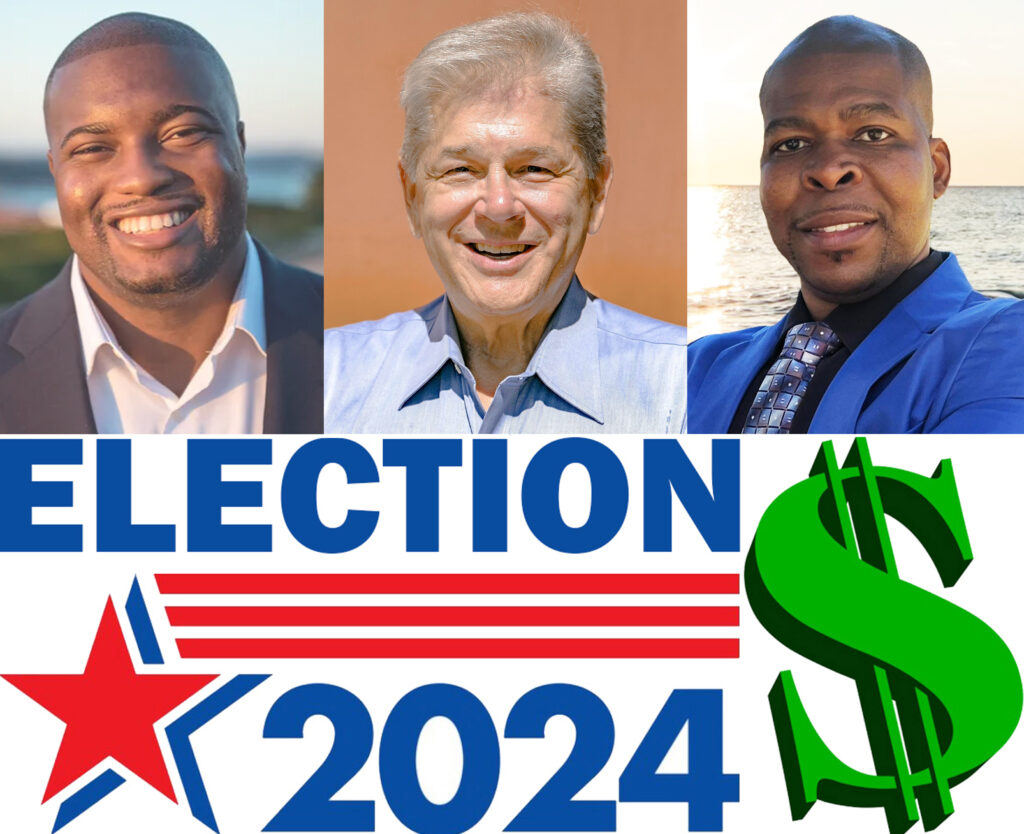
Incumbent Lamar Hernandez-Thorpe and challengers Ron Bernal and Rakesh Christian are battling for the top leadership position in the City of Antioch.
With almost $156K for the former city manager, a little over $139K for the incumbent and $8,500 for the other challenger
By Allen D. Payton
There are several battles in a political campaign war: ground – door-to-door precinct walking, air – including direct mail and TV, endorsements, signs, advertising and fundraising. The most recent campaign finance reports in the race for Mayor of Antioch show former city manager Ron Bernal has slightly increased his lead over Mayor Lamar Hernandez-Thorpe, while the other challenger, Rakesh Christian, is trailing in a distant third in the battle for the bucks.
Known as a Form 460, the report shows for the period of July 1 through Sept. 21 plus, a Form 497 report showing $1,000 contributed since then, the challenger had raised another $28,322 for a total of $155,967.34 for the year. The incumbent raised $22,375 for the period and an additional $3,000 since then for a total of $81,169. However, that amount does not include the $58,171.60 left over from his Stop the #Karen Recall committee that Hernandez-Thorpe transferred to his re-election committee. That has given the mayor a total of $139,340.60 to spend during the campaign.
The Form 460 report for the third candidate in the race, challenger and second-time candidate for mayor, Rakesh Christian, shows he’s loaned his committee $8,543.17 and spent it all during the period.
Bernal
The 460 report for the period shows Bernal’s largest contributions were $5,500 each from Dave and Thea Shupe, of Oakley, owners of Drill Tech Drilling & Shoring, Inc. in Antioch, $3,500 from rancher and farer Robert McGrew of Dixon, $2,000 from Michael Hurd of Antioch, self-employed in commercial real estate consulting and the former track and field coach at Antioch High School for whom the track is named, $1,000 from Antioch State Farm Insurance Agent James Lanter, $500 each from Pruthviraj Desai of Antioch, owner and manager of Antioch Executive Inn, the location of the City’s homeless hotel, Duane Shoemake of Antioch, listed as retired, Joe Stokley of Pleasant Hill, Broker of Stokley Properties, and $250 from Lori Ogorchock’s 2022 city council campaign committee and an additional $150 from the councilwoman.
His Form 497 filed on Sept. 29th shows two $500 contributions from Steven Abfalter of Antioch, listed as retired.
Bernal’s campaign committee spent almost all of the $47,228.72 during the period outside of Antioch and East County. The largest expenditures included $27,461.65 to Praetorian Public Relations of Walnut Creek for campaign consulting, $11,500 to J Wallin Opinion Research of Newport Beach for polling, $3,000 to Corey Agopian for social media content creation, $1,449 to the City of Antioch for candidate filing, $1,281 to the California Homeowners Voter Guide for a slate mailer and $981 to No Party Preference Voter Guide in Sacramento for another slate mailer.
Of the funds paid to Praetorian they in turn paid $8,756.36 to Imprint of Houston, TX for campaign paraphernalia, $3,705.43 to Landslide Communications in Laguna Niguel for literature, $3,006.80 to Prompt.io of Seattle, WA for phone banking, $2,298.76 to SignsOnTheCheap.com in Austin, TX and $774 to the COPS Voter Guide in Sacramento for a slate mailer.
Bernal’s committee began the period with a Beginning Cash Balance of $87,797.97, and as of Sept. 21st, had spent a total of $87,076.09 leaving him an Ending Cash Balance of $68,241.10 for the remainder of the campaign. See Bernal Form 460 0701-092124, Form 497 092924
Hernandez-Thorpe
The mayor’s largest contributions for the period were $5,000 each from Prestige One Investment, LLC of Brentwood, a company owned by businessman and Antioch commercial real estate owner Sean McCauley and Gary’s Liquor and Cigarettes for Less of Antioch, $1,000 each from Doralee Montague of Lawrenceville, Georgia listed as Director, Cox Communications, Robert Collins of Antioch listed as retired, Teresa Moye of Atlanta, GA, Partner of Moye Properties, $500 each from DASS Sweets, Inc. of Antioch, form Contra Costa College Board Trustee Gregory Enholm of Bay Point listed as retired, Mary Simms of Antioch, owner of Simms Enterprises, Victor Baker of Pleasant Hill, CEO of EquitiFy, Pruthviraj Desai of Antioch, listed as a hotelier, owner of the Executive Inn on E. 18th Street and Taylor Drivon of Stockton, listed as a homemaker,
Plus, an additional $3,000 was received on Oct. 3 from Maria Quinto Collins of Antioch, the mother of the late Angelo Quinto for whom the City’s Crisis Response Team is named and listed as the Founder for the Angelo Quinto Foundation. Her husband is Robert Collins listed above. Thorpe voted to settle their family’s lawsuit against the City and police department for $7.5 million.
Unlike Bernal’s campaign, the Hernandez-Thorpe re-election campaign spent a large amount of his $66,481.49 in expenditures locally in Antioch and East County. The largest expenditures for the period include $19,244.59 paid to Belleci Signs of Pittsburg for literature and lawn signs, $11,393 for five slate mailers paid to a company in Torrance, $10,627.64 to Copyworld of Berkeley for literature, $2,898 to the City of Antioch for candidate filing fees, $2,689.63 to La Plazuela in Antioch for a fundraiser, $2,500 to Chef Clarinne LeGrone of Antioch for catering and event space for the Mayor’s Democratic Unity Rally, $2,155 to LowKii Photography of Antioch, $792 to FastSigns of Antioch for 4’x8’ signs, $750 to Vicki Robinson of Antioch the campaign’s treasurer, $729.34 to Facebook for online advertising, $566.30 to Cheapestees of Burlingame and $549.60 to Political Data, Inc. of Norwalk for literature.
The mayor’s campaign committee started the period with a Beginning Cash Balance of $99,204.31 and as of Sept. 21st had spent $81,742.78 and had an Ending Cash Balance of $54,597.82. Add the $3,000 from Mrs. Quinto Collins and Hernandez-Thorpe had $58,597.82 to spend for the remainder of the campaign.
Of the funds Christian loaned to and were spent by his campaign, the largest expenditures were $4,713.58 to Sign-A-Rama of Antioch, $1,954.59 to the City of Antioch for the candidate filing fee and $1,500 to Kingdom Graphix of Antioch for website design. He had no Ending Cash Balance. See Christian Form 460 0701-092124
According to the California Secretary of State, the next reporting period ends on Oct. 19th and the candidates’ campaign committees must submit another Form 460 by Oct. 24th.