Archive for the ‘Education’ Category

Campaigning for three board candidates by Antioch school staff discovered inside District office

Thursday, November 3rd, 2016

By Allen Payton

Political flyers from the California School Employees Association (CSEA) of the Antioch Unified School District recommending the election of three candidates for school board, were distributed to members of the Board of Trustees in their joint mailbox and individual mail packets, inside the District office, on Friday, October 28th.

The flyer labeled “Classified Chit Chat shows the names of photos of Board President Diane Gibson-Gray and former Board members Gary Hack and Joy Motts with the title “Special Edition – Election 2016” and the subtitle “CSEA Recommendations for School Board.” It gives the background of each of the three candidates and reasons to vote for them.

About Gibson-Gray, the flyer reads, “She successfully guided the School Board to approve our most recent contract which resulted in raises for all employees and improved health benefits.” The flyer also states, “Mr. Hack has always supported not just teachers, but the Classified employees who are a big part of his constituency.” About Motts, it reads “If it seems like we’re going ‘old school’ in selecting candidates that’s not really the case” and “During her tenure on the Board, it was a time of stability which was good for our members.”

In an email response to questions about the matter, Superintendent Stephanie Anello wrote, “The Board has a mailbox here. This was mail received. We don’t open or read mail.”

Asked if it was for U.S. mail or internal District mail, she responded, “It is for the collection of both US Mail and internal mail.”

Asked if this or any other political campaign material is also being distributed on the campuses and/or by faculty or staff, Anello replied, “There have been no reports of political campaign material being distributed on campuses by staff.”

However, Trustee Debra Vinson said she “also received it.”

When asked if it was it mailed, she responded, “No. It was in the Board packet.”

“It was not mailed,” Vinson continued. “I was a little surprised.”

She said she would inform District staff to put an end to it.

Vinson also mentioned trucks with large campaign signs parked in school parking lots.

“I think the public is fairly tired of the campaigning,” she added.

Board President Diane Gibson-Gray has been seen driving around in a truck with a trailer attached, with her large campaign signs on each side.

Asked if she was parking it in school parking lots, she did not respond before publication time.

In an email response, Trustee Fernando Navarro, who is running for election, but is not supported by the AEA, wrote “No it was inserted loose leaf in the envelope no postage added.
Which brings up the point.  I think this is inappropriate material [to] be sending to the board in general considering two of the board members weren’t even endorsed. It’s kind of a slap in the face in my opinion.”

Anello responded to Navarro, “I’m sorry you felt it was a slap in the face. In short, neither I nor Nancy (Belleci, Anello’s executive assistant) read correspondence – either external or internal that is intended for Board Members.”

Anello and all of the Board members were then asked via email, which staff member placed the flyers in the trustees’ mailbox and packets, and what can and would be done about the distribution of the CSEA flyer. In addition, questions were asked of Anello regarding who delivered the flyers to be distributed, what the procedure is for distributing mail to Board members, if any staff member can bring in things to give to them without them being checked.

8:58 P.M. UPDATE: In an email response at 4:07 P.M., Anello provided answers to the following questions:

Q. Who brought in the flyers for placement in the Board’s mailbox(es) for distribution to the Board members?

A. Anyone can place things in the Board’s mailbox. I have no knowledge of who put it in their box.

Q. What is the procedure for having things distributed to Board members?

A. We distribute the Board’s mail at a time when we are delivering district-related materials.

Q. Can just any staff member bring in things to give to them without it being checked?

A. Yes. Our job is not to screen or censure public comment to elected officials. Additionally, employees do not shed their first amendment rights because they are employed by the school district.

11/04/16 5:43 P.M UPDATE: In a follow up email, Anello was asked “so, what you’re saying…that campaigning is allowed on school property and by staff and during work hours. Correct? Her response was a simple “No.”

Further questions asking if staff doesn’t “shed their First Amendment rights” do they shed them on school district property and during the work day were sent after the work day on Friday. Please check back later for Anello’s response.

Please check back later for Anello’s response.

Antioch Family Night Fundraisers at Warriors – Dec. 5th game tickets deadline extended

Thursday, November 3rd, 2016
LIMITED space is available for kids to be Anthem Buddies where they stand with the Warriors players during the National Anthem and the Courtside Shoot Around. Support our schools and enjoy the game.

LIMITED space is available for kids to be Anthem Buddies where they stand with the Warriors players during the National Anthem and the Courtside Shoot Around. Support our schools and enjoy the game.

Analysis: In Antioch School Board race it’s the ostriches versus the camels

Wednesday, November 2nd, 2016

By Allen Payton, Publisher & Editor

After observing the actions of the Antioch School Board and now the election for three seats on the Board, this past year, here’s what I see is really going on in the Antioch Unified School District. It’s a story of the proverbial ostriches versus camels, of those in the status quo establishment who want to keep their heads in the sand, ignore the facts and keep the public in the dark, versus those with their “nose under the tent” finding out what’s really going on and letting the public know, and wanting to actually do something about it.

There’s an effort to keep control of the Board in the hands of the status quo establishment, which believes things are going pretty well in the district, by electing three of their own and opposing two appointed Board members and another candidate, who are learning the facts and have been letting the public know. That isn’t sitting well with the establishment – made up of one current Board member, three candidates, the leaders of the local teachers’ union, management employees and the certified employees. They say the three change agent candidates and their supporters are being negative.

Now, the establishment is going after one of the current Board members who isn’t up for re-election, this year, to get their fourth candidate on the Board, by recalling Trustee Debra Vinson, because they can’t seem to control her or get her to fall in line, either.

First, the new Board majority, who speak of wanting to improve things in the district, forced out Dr. Don Gill as Superintendent. But, then they appointed two new members to the Board who, like the proverbial camel with his nose under the tent, discovered that things aren’t going as well as the establishment has led the public to believe.

Alarming District Facts Being Learned, Shared

Appointed Trustees Fernando Navarro and Alonzo Terry have learned that the students in the District are in fact not doing so well, nor are the District’s finances. They learned and have pointed out to the public that an average of 67% of children in Kindergarten through Fifth grades are not proficient in English and an average of 81% are not proficient in math. In fact, in one elementary school in Antioch only 8% of the students are proficient in math.

Trustee Debra Vinson, who is not facing re-election this year, has also been pushing for the facts and having them shared publicly. Following her request of staff for a report on the Smarter Balanced Assessment Consortium (SBAC) scores, a presentation was made during a recent workshop.

“The scores are horrific,” she said. “They didn’t want them out to the public.”

The appointed school board members also learned about the problem of truancy in the District, meaning students are not showing up for school.

Under Goal 3 in the District’s state required Local Control Accountability Plan (LCAP) it states “During the 2014-15 school year, 34% of AUSD students were truant. 13.4% were severely or chronically truant. Chronic truancy is especially high (16.1%) in the primary grades (k-3)…Students who don’t read proficiently by 3rd grade are 4 times more likely to drop out of school. 19.4% (941) of African American students were chronically truant… 40% of the students at Antioch High School were chronically truant.”

During the campaign, Navarro, Terry and the third candidate offering a different approach to the status quo, Crystal Sawyer-White, have been speaking out about these challenges, as well as the practice of promoting students prematurely.

In addition, enrollment in the District has been declining for the past decade, with 4,000 fewer students in the schools. The three candidates are saying part of the decline is due to parents choosing other schools for their students, both private and in other, better districts. The establishment’s narrative is that it’s due to the natural aging of the population in Antioch. But demographic statistics don’t support their argument.

In fact student-age population figures have been increasing in the district, at the same time enrollment has been declining by over 400 students per year. The establishment is concerned because the money the District receives from the state is based on Average Daily Attendance (ADA). Fewer students in the classrooms results in less money for the district.

But, Navarro and the others are more concerned about the academic achievement of the students, and if that changes, it will result in fewer students being removed by their parents for greener pastures.

District finances are another challenge, as they were facing a budget deficit, this year of $1.2 million and is facing deficits of over $2 million per year for the following two fiscal years. But, some one-time money was received by the District since the budget was approved in June, which produced a budget surplus, for this year.

Yet, it’s still not a pretty picture and the reserves are not at the level the District needs, and are only one month of staff salaries.

Immediately, the establishment candidates – backed by the teachers union, management and certified staff – are wanting to spend the surplus and get the reserves down to as low as 3% the minimum required by state law, as stated by Gibson-Gray at a candidates forum. But, according to AUSD Chief Business Officer Chris Learned, that “doesn’t even cover one payroll for the district. We want to keep reserves at 7%, preferably 10%.”

Those are alarming statistics and if they were happening in say, Walnut Creek, Lafayette or San Ramon, there would be an insurrection by parents, and the entire school board would be recalled and the top staff fired and replaced.

Negative Information Criticized, But Correct

Now that the facts are being shared, while the establishment is not denying all of them, they’ve turned their tactics to attacking those who are informing the public of them.

Navarro was criticized by status quo candidate Mike Burkholder, for giving the District a grade of F-minus-minus in a private conversation with Antioch Mayor Wade Harper, after Harper shared Navarro’s comment with Burkholder.

But, Navarro is correct. On an A through F grading scale, with an A having a score of 90 to 100 and an F being anything less than a score of 60, then scoring a 20 in math and a 30 in English is an F-minus-minus.

Burkholder and the rest of the establishment and their three other candidates don’t want that information out there. Why? Because it’s too negative, makes the District look bad, and is being critical of the teachers, and hurts Antioch’s reputation. They think the public somehow either doesn’t have a right to know what’s going on with our students, our government and our tax dollars the District is spending, or they don’t think we can handle knowing, which is rather elitist if they do.

One of the new superintendent’s goals is to “rebrand the District.” But, what’s the purpose of that? If the vast majority of K-5 students are failing in English and math, what’s there to re-brand, until they aren’t? Besides to whom are they wanting to market the District, which is the purpose of a branding campaign?

New Superintendent

Then the Board majority, on a split vote, hired a Superintendent from within the District staff sending a message that things are doing just fine in the district. Navarro voted against the contract because he thought it was too rich, at a time enrollment is declining and the District facing deficits for the next three years. He also said he preferred hiring someone from outside of the District with a different perspective, preferably with more successful schools.

While I believe Stephanie Anello wants to and can be an agent of change for the better for our students, it’s going to require a new Board majority to offer a new direction for her and the District. Because as the hired CEO of the organization, she has to do what the Board majority wants her to, if she wants to keep her job.

White Candidates vs. Candidates of Color

The agents of change in this election happen to be the one Hispanic man and an African-American man and woman. The status quo establishment candidates all happen to be white. That fact hasn’t gone unnoticed by some in the Antioch community and has some, who have chosen to remain silent, upset.

This is at a time students in the district are 41% Hispanic, 26% African-American and only 17% white. That doesn’t reflect the population of the city, which is 31.7% Hispanic, 30.7% white, and 21.9% African-American, which is a possible indicator that the white parents are removing their students from district schools and placing them in either private schools or those in other districts, or homeschooling them.

Yet, it’s the students of color in the district who have been suffering more under the establishment’s leadership, and they don’t want the three candidates of color or the other, current African-American Trustee to be on the Board, who will more likely be motivated to do something about it.

The establishment is hoping to get three of the white candidates elected, and their fourth one on the board by replacing Vinson with whomever doesn’t win, next Tuesday.

“It has not been easy because I’m not the status quo,” Vinson said. “I’ve been told Burkholder or one of them wants my seat.”

“When I asked the staff for the SBAC scores is when they stepped up the attack,” she explained. “They are not happy that all of this is coming out because the previous board didn’t do a good job and they don’t like it.”

Asked about the racial aspect of the current election, Antioch resident and former NAACP East County Branch President Odessa Lefrancois shared her concerns.

“I don’t like what is happening,” she said. “When I saw what happened at the school board meeting, last week. That shouldn’t have happened. They let that happen.”

“I have a belief the voters know what is happening and they will get elected,” Lefrancois continued. “I would love to have all three elected because they reflect the make-up of the school district.”

Charter School Battle

Antioch currently has two public charters schools, Antioch Charter Academy and Antioch Charter Academy II. Of the students at Antioch Charter Academy 41.3% are white. Even though the AUSD Hispanic students make up 40% of the population, but only 28% of the students at Antioch Charter Academy. African-American students make up 26% of the population in AUSD schools but only 9.7% of the students at Antioch Charter.

Yet, teachers in the district say they like the district’s current charter schools while berating the effort of the private, non-profit Rocketship Education to bring one of their public charter schools in Antioch.

But, Rocketship’s model is one of taking the least performing students in a district, most of whom are Hispanic and African-American children, and helping them advance in their education, like a “rocketship.” In fact, Rocketship’s lowest English and math proficiency statistics are at the same level or better than any of the elementary schools in the AUSD.

The fact the District has been performing so poorly is the reason Rocketship has chosen Antioch for one of their schools, as AUSD observer and former teacher Willie Mims pointed out at the October 12th Board meeting.

The organization is trying to get one of their schools approved in Antioch and the public hearing on the matter is scheduled for Wednesday, November 9th and a meeting for the final vote will be held on December 7th.

That would mean more students being removed from the regular schools and even though Rocketship pays their teachers more than AUSD teachers get paid, AUSD teachers’ union leadership doesn’t want one of their charter schools in Antioch.

Yet, even Antioch’s own Tom Torlakson, a former AUSD teacher and cross country coach, Antioch Councilman, County Supervisor, State Assemblyman, State Senator and now State Superintendent of Public Instruction is supportive of charter schools, specifically Rocketship. He along with the State School Board majority, voted in favor of the one in the Mt. Diablo School District, earlier this year even in the face of opposition from that district’s teachers and no votes by that Board and the County School Board.

Campaign Support, Battle Lines Drawn

The California Charter Schools Assocation has been backing the agents of change, by paying for three mailers with their names and photos on them. The Antioch Education Association, which is the local teachers’ union, as well as the certified employees’ union and Antioch Management Association, representing the District’s management staff are backing the status quo establishment candidates, both with endorsements and paying for mailers to support them. The AMA actually endorsed all four of the status quo establishment candidates for the three seats, indicating they want Vinson gone and replaced with one of theirs.

Unfortunately, it’s gotten a little nasty. But desperate people do desperate things. In fact the establishment went so far as to illegally shut down Navarro and prevent him from making a lawful motion to have an urgency item placed on the last school board meeting’s agenda, to nail down the schedule of the meetings for Rocketship’s charter school petition. Then they criticized him on social media for attempting to do so.

So, the battle lines are drawn. On one side we have the status quo candidates, the ostriches with their heads in the sand who want the public to do the same and not know the facts of how bad things are in the district, and who will keep doing the same things over and over again hoping things will improve – which is one definition of insanity – and are backed by those who have been embarrassed by the revelations of the facts by the other side.

On that side are the candidates of change, the proverbial camels with their noses under the tent, who have learned the truth and are exposing it, and who want to represent the best interests of the students, their parents, the taxpayers and the Antioch community in general, which will benefit by improved schools with better property values and attracting employers to our City.

That’s what’s really going on in the Antioch school district and school board race. Now it’s up to the voters to decide which direction they want for our students and community.

University of California President Napolitano tells Deer Valley High students they can get into a UC school

Tuesday, November 1st, 2016
University of California system President Janet Napolitano speaks to a gymnasium full of students, faculty and staff at Deer Valley High School on Wednesday morning, November 1st, 2016.

University of California system President Janet Napolitano speaks to a gymnasium full of students, faculty and staff at Deer Valley High School on Wednesday morning, November 1st, 2016.

Alumnus, U.C. Berkeley grad Hammed Suleman encourages students with his own experience

By Allen Payton

Deer Valley High alum and U.C. Berkeley graduate student Hammed Suleman speaks to students as U.C. system President Janet Napolitano looks on, Wednesday morning, November 1, 2016.

Deer Valley High alum and U.C. Berkeley graduate student Hammed Suleman speaks to students as U.C. system President Janet Napolitano looks on, Wednesday morning, November 1, 2016.

University of California system President Janet Napolitano visited Deer Valley High School in Antioch, today and encouraged the students in the standing room only gymnasium, that they can get into a U.C. school if they do the work. Before she spoke, however, Deer Valley High and U.C. Berkeley graduate student Hammed Suleman shared his experience of how he was able to get into “the best school in the world,” as he put it.

“I never thought I was college material or smart enough to get a college education,” Suleman said. “But I knew I could never achieve my goals if I didn’t do the work.”

He was on the track and field team at Deer Valley and became the number one triple jumper in the U.S., resulting in him receiving scholarship offers from colleges across the US.

Suleman chose UC Berkeley.

“It was and still is the number one university in the world,” he stated. “It has had a profound influence on who I am today and who I want to be.”

While at Berkeley Suleman was a track and field champion and earned the Most Academically Improved Student Athlete award in 2014.

Suleman is now completing his masters degree, also at Berkeley.

He then introduced Napolitano, who is also served as Secretary of Homeland Security under President Obama.

Napolitano was given a warm welcome by Deer Valley High students.

Napolitano was given a warm welcome by Deer Valley High students.

“You do the work and take the SAT or ACT and some community service, work and all those things go into your application to the University of California,” she told the students. “That’s your part. Our part is to give you a great college education.”

“You’re at a great stage of your life,” Napolitano continued. “I kinda wish I was back in high school.”

Speaking of a college education, she stated, “It does matter.”

“Where do you see yourself in five or ten years?” Napolitano asked the students. “What do you want to contribute?”

She then quoted President John F. Kennedy, “Ask not what your country can do for you but what you can do for your country.”

“One-third of our students start at community college and transfer to UC,” Napolitano shared. “Ask yourself what you’re good at; what you think you’ll be good at. Take some classes.”

“I want to leave you here with this message. Only you can answer the question ‘what are you prepared to do?’ Get ready,” she said. “California is the only state with the higher education we have in this state.”

The former two-time governor of Arizona said while serving in that position she wished she could have brought one of the U.C. schools to her state.

“Find some quiet time. Turn off your screens. Turn off your phone,” Napolitano said in encouraging the students to think about their future.

“You won’t get where you want to go without…preparation,” she added. “UC is for you – a place to grow, to learn and leave the nest for the next generation.”

Napolitano then ended with “Thank you. Go Wolverines!” to a roar from the audience.

Before the assembly, Napolitano met and spoke with the school district’s college counselors and students interested in attending a U.C. school. During the assembly was treated to music by the Deer Valley jazz band and a song by Divine Voices.

Principal Ken Gardner welcomed everyone and then handed the event off to teacher Bernard Stephens who served as Master of Ceremonies and had been Suleman’s track and field coach, while he was in high school. Congressman Jerry McNerney was in attendance and offered his thoughts. The students also heard from Eloy Oakley, the Chancellor of the California Community College system.

Antioch School Board violated state law when President Gibson-Gray denied Navarro’s urgency agenda item effort

Monday, October 31st, 2016

By Allen Payton

At last week’s Antioch School Board meeting an attempt was made by Trustee Fernando Navarro to place an urgency item on the agenda, regarding the scheduling of meetings for the required public hearing and final vote for Rocketship Education’s charter school petition. Both of his attempts during the meeting were denied by Board President Diane Gibson-Gray in violation of the state’s Ralph M. Brown Act Open Meeting law.

Navarro’s efforts were blasted on social media by faculty and staff of the district, writing such things as how the meeting was difficult to watch and how they wished the meetings had been televised so the public could see how bad he was.

Yet, it was Gibson-Gray who was wrong in how she handled things. Navarro, one of the newest members of the Board and only serving in his first year in office, was actually the one who was doing things properly.

His first attempt at making the urgency item motion was during the discussion of the minutes from the previous meeting, was a bit awkward, but allowable. Gibson-Gray pointed out to him that it was not the right time for his motion, even though Trustee Alonzo Terry had seconded the motion and no other motion including one to approve the minutes had been made. Yet, it was in the minutes from the previous Board meeting on October 12th, that it was discovered a vote by the Board at that meeting on receiving the Rocketship charter petition, did not include the dates discussed for the public hearing and final vote.

So, Gibson-Gray could and should have allowed Navarro’s motion at that time, especially since it was seconded and no other motion was on the table.

A discussion, about the Rocketship charter petition meetings, was held at the October 12th meeting and it was understood that November 2nd was the date proposed by district staff for the public hearing and November 28th for the final vote, and at least verbally agreed to by Board members, including Gibson-Gray. This reporter included the dates in the article about that night’s meeting.

However, in an email response to questions sent to her following the meeting, last week, Superintendent Stephanie Anello claims the meeting dates were not included in the motion during the meeting on October 12th.

“No dates were agreed to at a previous meeting,” she wrote.

Therefore, with “the clock ticking” as Trustee Walter Ruehlig mentioned in his email response to questions of Gibson-Gray and the rest of the Board members, the matter was urgent. That’s because once the Board had received the charter petition, they had 30 days to set a public hearing and 60 days within which to schedule the final vote.

Yet, even after the vote on the minutes from the previous meeting was taken, Gibson-Gray didn’t immediately bring Navarro’s effort to make his urgency agenda item motion back to the table for discussion, as she should have. When he did attempt to make his motion, later in the meeting, she again denied him, being told by district staff that it violated the Brown Act.

Instead, the Board scheduled a special meeting for last Friday at 4:00 p.m. to discuss the matter of the Rocketship charter petition meetings for the public hearing and final vote. At that meting, the board approved the public hearing be set for Wednesday, November 9th and the final vote on December 7th.

Asked why Navarro’s urgency item couldn’t have been placed on the agenda on Wednesday night’s meeting, Anello responded, “Navarro wanted to discuss the issue tonight but the item was not agendized nor did he request that it be placed on the agenda prior to tonight’s Board Meeting. The Board is conducting the public’s business so the public must always be afforded the opportunity to provide input on the topics contained on the agenda. Since the public was unaware that Mr. Navarro wanted to discuss the item because it was not agendized, discussing it last night would have been a violation of the open meeting laws as outlined in the Ralph Brown Act.”

However, both Anello and Gibson-Gray, as were those who wrote against Navarro’s efforts on social media, were wrong.

Urgency Items Are Allowed

The fact is the Brown Act does allow for urgency items to be placed on an agenda during a meeting, as happens periodically at Antioch City Council meetings. They require a few things. First, that the matter meets the narrow definition of an “emergency situation”, with one meaning being that it arose after the meeting agenda was set. Second it requires a 2/3’s vote of members, which means four of the five members of the school board have to approve the urgency item.

According to a guide on the Brown Act, published by the League of California Cities, “The Brown Act generally prohibits any action or discussion of items not on the posted agenda. However, there are three specific situations in which a legislative body can act on an item not on the agenda:

  • When a majority decides there is an “emergency situation” (as defined for emergency meetings);
  • When two-thirds of the members present (or all members if less than two-thirds are present) determine there is a need for immediate action and the need to take action “came to the attention of the local agency subsequent to the agenda being posted.” This exception requires a degree of urgency. Further, an item cannot be considered under this provision if the legislative body or the staff knew about the need to take immediate action before the agenda was posted. A new need does not arise because staff forgot to put an item on the agenda or because an applicant missed a deadline; or
  • When an item appeared on the agenda of, and was continued from, a meeting held not more than five days earlier.

The exceptions are narrow, as indicated by this list. The first two require a specific determination by the legislative body. That determination can be challenged in court and, if unsubstantiated, can lead to invalidation of an action.

A legitimate immediate need can be acted upon even though not on the posted agenda by following a two-step process:

First, make two determinations: 1) that there is an immediate need to take action, and 2) that the need arose after the posting of the agenda. The matter is then placed on the agenda.

Second, discuss and act on the added agenda item.”

10/31 10:44 AM UPDATE: In an email response from Anello, she wrote, “You are correct that exceptions can be made to discuss a non-agendized item, but the scope of the exception is very limited as stated below. No emergency situation existed as evidenced by the fact that the BOE met 48 hours after the meeting and the issue was resolved. The purpose of a Special Meeting (distinct from an Emergency Meeting) is to discuss or take action on an item prior to the next Regularly scheduled BOE Meeting. I think the following statement from below sums it up nicely, ‘The prudent course is to place an item on the agenda for the next meeting and not risk invalidation.’”

10/31/16 3:10 PM UPDATE: An email was sent to Anello with the following questions: Who is the school board’s parliamentarian? Is it you? Is it the district’s attorney? Was the attorney in attendance on Wednesday night to advise President Gibson-Gray on the matter of Navarro’s urgency item? If not who made the determination that it wasn’t allowed?

Anello responded, “The Board’s President is the parliamentarian. The District’s attorney was not present at the regularly scheduled meeting.”

Yet, according to the National Association of Parliamentarians, a parliamentarian is to be someone who “is an expert in interpreting and applying the “Rules of Order” for meetings.  A parliamentarian’s main function is to give advice on parliamentary procedure to the president, officers, committees, and members of a group or organization. Parliamentarians also have knowledge of the nomination and election process, which can be of great assistance in close or difficult elections.”

The Board President who chairs the meeting, can’t effectively or objectively hold both roles.

Navarro’s Matter Was an Emergency Situation

Because Fernando’s motion was about adding an item to the agenda after it was discovered that the minutes did not reflect a vote on the schedule of meetings for the Rocketship charter in the motion and action by the Board at the previous meeting, after the agenda was set and distributed, and because the matter included the need for setting the public hearing prior to the next scheduled regular board meeting, it can easily be argued that the matter was one of emergency.

Plus, since the Board subsequently held a special board meeting to discuss the matter, just two days later, it was definitely a matter of urgency, and thus another argument to support it being an emergency item for being placed on Wednesday night’s agenda.

Gibson-Gray is now serving in her eighth year on the school board, and she previously served on the City of Antioch Planning Commission. Yet, it appeared she didn’t understand the Brown Act or how to run a meeting, and prevented Navarro, as a Board member – whom she voted to appoint – from making his motion and doing what he thought was necessary to properly represent the public.

This is the second time Gibson-Gray operated outside of the bounds of proper procedure for running a school board meeting. Earlier this year, during the matter of hiring the new superintendent, she was going to allow Navarro to offer his comments after the vote. This writer had to make a point of order and explain that Robert’s Rules of Order, under which the Board operates its meetings, does not allow discussion after a vote is taken. The proper procedure is a motion is made and seconded, discussion is held and a vote is taken. Then the agenda item is completed with no more discussion allowed.

There has been a concern that there was an effort to postpone the Rocketship charter petition vote to a date after the new board members will take office, following the November 8th election. When asked if staff was attempting to make that happen, Anello simply replied, “No.”

Board Member Responds

In response to questions about Navarro’s urgency item effort, why Gibson-Gray denied it, if they were they not aware of the Brown Act allowing them, and why they held a public Board meeting during a week day, twice emailed to all of the Board members, Ruehlig, who is the Board Vice President, was the only one to respond.

“Because we had future meetings and future agenda times still ahead of us on that night’s agenda and because I was determined come hell or high water to stay with the original direction, as was recommended by Staff, and given a nod of consent by Trustees, to calendar two public meetings before the Board changed composition I thought an emergency inclusion for that meeting might not be necessary,” he wrote. “That said, there is a good argument to be made that since it was a lingering ‘confusion’ from the past meeting and since by not clearing it up we would have to call another meeting it may have been an emergency.

“Certainly the clock was ticking on a public hearing and time was already lost,” Ruehlig continued. “Emergency or not, there is no doubt in my mind that we could have spared energy and avoided the messiness of:  a) all that meeting commotion; b) the irritating inconvenience of coming back yet for a meeting yet again when we thought direction was clearly set on who was to vote on the application; c) loss of citizen attendance due to short notice of a special meeting and one in the afternoon all by inserting right then and there.”

The Board members and Anello were also asked who the parliamentarian is, if it’s the school district’s attorney and if their attorney was present at last Wednesday’s meeting, and who made the determination that Navarro’s motion was not allowed. They were also asked why does it make sense to hold a meeting to discuss the matter at a time when most of the public couldn’t attend, instead of placing it on the agenda during a public meeting when the public is actually there to witness the discussion and possibly give input before the vote, and how is that keeping with the spirit of the Brown Act Open Meeting law. No responses were received as of the time of publishing of this report.

Please check back later for any updates.


Community College District board to fill Nejedly’s seat through appointment process

Saturday, October 29th, 2016

Applications now available to fill vacancy on Governing Board by Provisional Appointment-Trustee Ward IV

The Contra Costa Community College District (District) is accepting applications to serve as an appointed member for Ward IV of the Governing Board until the next regularly scheduled election for Governing Board members in 2018. The vacancy was created by the recent death of Trustee John Nejedly.

Applicants must be registered voters and residents of Ward IV, which includes Blackhawk, Byron, Danville, Diablo, Discovery Bay, San Ramon, and parts of Alamo, Antioch, Brentwood, Clayton, and Concord.

The Governing Board gave approval at its October 18, 2016, special meeting, to fill this position by provisional appointment instead of the more costly option of an election. Applications are being sought from candidates who have the ability and time to fulfill the responsibilities of being a member of the Board, which includes:

  • full participation in the work of the Board by attending all Board meetings and key college and District events, studying and discussing policy issues, and participating in trustee education programs;
  • knowledge of the communities served by the colleges and willingness to act on behalf of and for the benefit of those communities;
  • commitment to community colleges and their missions; understanding of educational, social, and economic policy issues;
  • balancing the needs of many diverse groups; being able to build consensus; and
  • contribution to effective Board functioning and supporting the authority of the Board as a whole.

Those interested in applying shall complete and submit a cover letter, application form, resume, and no more than three letters of reference by 4:30 p.m., November 15, 2016, to the Human Resources Department, c/o Mr. Eugene Huff, Contra Costa Community College District, 500 Court Street, Martinez, CA, 94553.  All forms are located on the District website at www.4cd.edu, or can be picked up at the District Office.

A special Governing Board meeting will be held on November 29, 2016, to review all applications and determine persons to be interviewed.  Another special Governing Board meeting will be held on December 1, 2016, to interview three finalists.  If a third special meeting is needed, it will be held on December 5, 2016.

The goal will be to administer the oath of office for the new member at the regular Governing Board meeting on Wednesday, December 14, 2016, at 6:00 p.m.

For more information, please contact the Communications and Community Relations department at (925) 229-6823.

Antioch Schools Trustee Vinson served with recall papers at meeting, Wednesday night

Wednesday, October 26th, 2016

Board to hold another meeting to reschedule dates for Rocketship charter hearing, vote

By Nick Goodrich                         

At their regular meeting on Wednesday, October 26th, the Antioch School Board witnessed Trustee Debra Vinson served with recall paper and heard district staff’s endorsements of candidates in the upcoming election. They also postponed a discussion on the Superintendent’s goals for the 2016-17 school year, and scheduled an emergency board meeting for Friday to discuss scheduling the meetings for the Rocketship Charter school petition.

During Public Comments at the beginning of the meeting, several Antioch residents stepped up to speak about Vinson, who has drawn attention in recent weeks after allegedly berating a District employee and making offensive comments.

District employee Nicole Cedano, who had promised to begin the process of recalling Vinson, served the Board Member with recall papers after speaking about the incident.

“She has failed to issue an apology or show remorse for her actions,” Cedano said of Vinson. “I came before you in previous meetings supporting her recall, and I still feel that way.”

Vinson found support from two Antioch residents, however, who were disturbed to hear the reports of the recall petition.

One 20-year resident, Reginald Johnagin, whose wife is a teacher in the district, stated that Vinson always responds to problems and inquiries in a timely and positive manner, and is both dependable and likable. He stated further that she brings “sensitivity” to the increasingly diverse neighborhoods of Antioch, wherein many families may feel that they do not have a voice in District proceedings.

“Just because there was a personal disagreement with someone doesn’t mean someone should be immediately recalled,” he told the audience.

Rocketship Charter Meeting Dates

Not on the agenda Wednesday night was the issue of Rocketship Education’s charter school petition public hearing and final vote. Board Member Fernando Navarro attempted to add the issue to the agenda as an urgency item, but was withheld by District staff and Board President Diane Gibson-Gray, who cited board policy interpretations after conferring with the School District’s attorney.

Rocketship is a private non-profit corporation that currently operates a network of charter schools with 6,000 students in the Bay Area and three more schools outside of California. They have submitted a petition to operate a charter school in Antioch. Dates that appeared to be finalized, for the public hearing and final vote meeting, were suddenly up in the air, leaving Rocketship to wait for the go ahead from the Board.

According to an article by Herald staff, the Board had voted 5-0 in its previous meeting on October 12th, to set the dates for the hearing and vote for November 2nd and 28th, respectively. The minutes of the October 12th meeting, however, do not reflect this Board decision, stating only that the dates were “tentatively suggested.”

Navarro attempted to get the matter placed on the Wednesday night’s meeting agenda as an urgency item but failed, after Gibson-Gray twice refused his efforts. However, he was able to schedule a special board meeting to discuss the issue and confirm the dates. He was supported by fellow Board Members Walter Ruehlig and Alonzo Terry, who agreed with Navarro on the urgency of the issue.

The special board meeting will occur on Friday, October 28th, at 4:00 p.m. in the School Services Building, at 510 G Street. The Board will have the opportunity to finalize the dates for both the public hearing and final vote on Rocketship’s petition, within the legal timeframe.

Superintendent’s Goals

Before a discussion could be held on Superintendent Stephanie Anello’s goals for this school year, a motion was made by Navarro to table the item, until next meeting. The proposed goals were discussed at a public meeting, held on Wednesday afternoon, October 12th, before the last regular Board meeting. However, no members of the public were in attendance. Anello asked the Board to take formal action on the goals at the next meeting. The motion to table passed 3-2 with Gibson-Gray and Ruehlig voting against.

Candidate Endorsements by Staff

Also during public comments at the beginning of the meeting, Scott Bergerhouse, Principal of Dozier-Libbey Medical High School, acting in his capacity as President of the Antioch (schools) Management Association, delivered the endorsements of the AMA, Antioch Education Association, and California School Employee’s Association for the Antioch School Board in the November elections. The candidates endorsed by all the organizations are current Board President Diane Gibson-Gray and former members Joy Motts, Gary Hack.  The AMA also endorsed a fourth candidate, Mike Burkholder.

After conducting interviews with the candidates, Bergerhouse said, the organizations looked at qualities like a collaborative spirit, strong interpersonal skills, knowledgeable in the field of education, and a passion for improving the system.

“These candidates are committed to the District, strong, and willing to roll up their sleeves,” Bergerhouse stated after delivering the endorsements.

Speaker Defends Navarro

Also, during public comments, John Crowder, the director of the Math Intensive Program in the district spoke in support of Navarro and what he has been doing since being appointed to the Board, last year.

“Over the last several weeks, political opponents have stepped forward to use the public comments portion of this meeting to attack one of our Trustees, Mr. Navarro,” Crowder stated. “They’ve called him out for expressing his views on important matters related to this school district, including his shining a light on the dismal academic outcomes revealed by the SBAC test results.”

“Tonight, I want to commend Mr. Navarro for having the courage, in the face of increasing vitriol, to address a long-standing problem: academic results that are the worst of any major school district in Contra Costa County,” he continued. “As far as academic outcomes are concerned, AUSD has a very big problem.  Less than 20% of AUSD students achieve basic proficiency in math.  What’s more appalling is the fact that students of color post results that are even worse.  Results for English Language Arts aren’t much better.”

“Parents are not waiting for you to address this crisis,” Crowder shared. “They’re moving their children.  I can personally cite scores of parents that have removed their kids from this district, and are now either paying for a private school education, or commuting to other communities, to obtain solid educational opportunities.”

“Your jobs, as school board members, is to oversee the education of Antioch’s children.  When that job’s not getting done, it needs to be addressed, boldly and forthrightly.  Mr. Navarro, you need to continue to speak out about this. By doing so, you’re fulfilling your obligation to truly represent the children of our community,” Crowder added.

Questions were emailed to Board Members and staff following the meeting regarding the urgency item and special Board meeting, tomorrow. Check back later for updates to this article.

Antioch School Board receives charter school petition amid opposition from faculty, starts 60-day process

Friday, October 21st, 2016
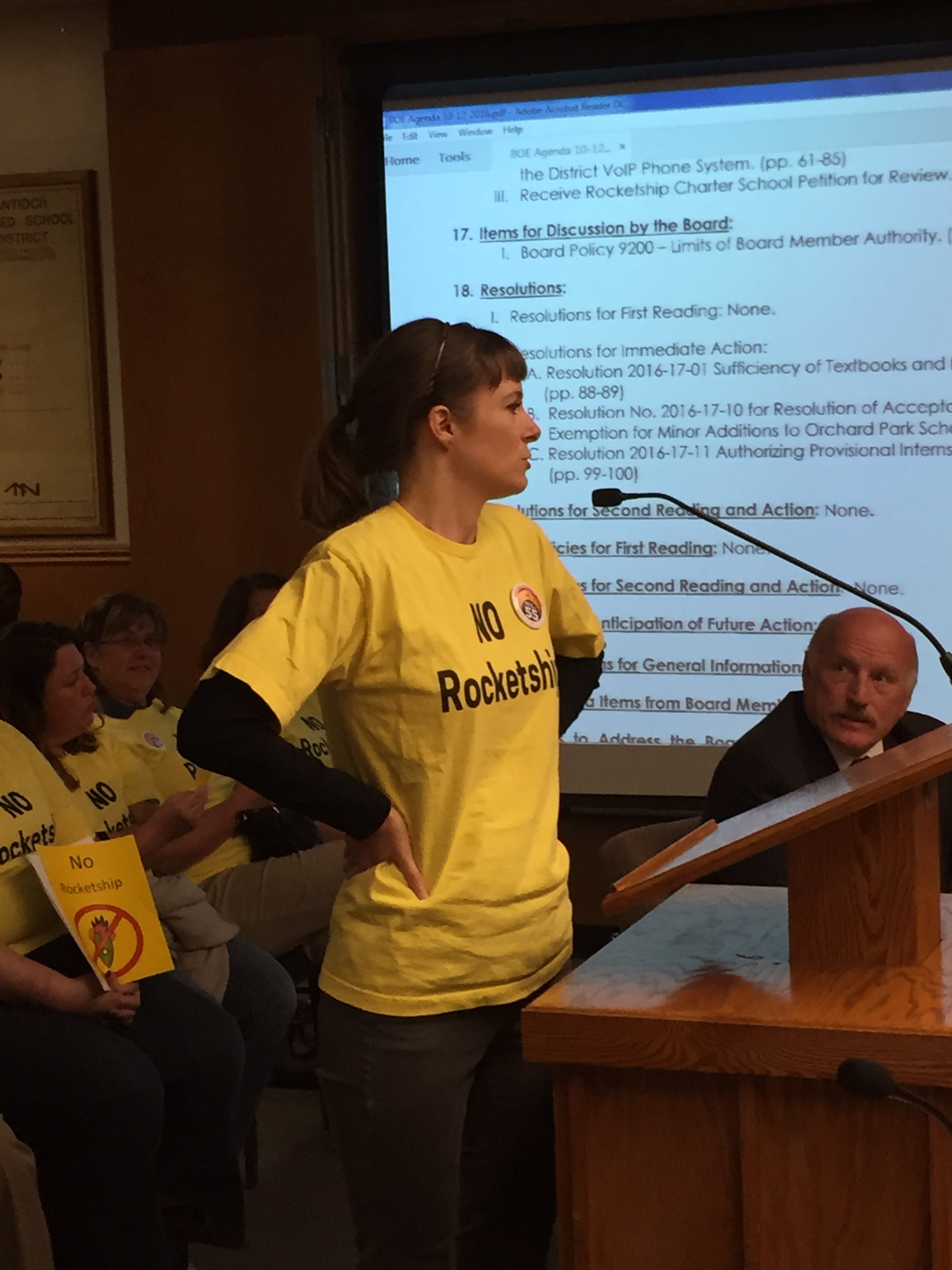
Antioch High School teacher Sara Savacool speaks to the Board wearing a T-shirt with her position on the Rocketship charter school petition at the Board meeting on Wednesday, October 9, 2016.

Antioch High School teacher Sara Savacool speaks to the Board wearing a T-shirt with her position clearly spelled out on the Rocketship charter school petition, as Associate Superintendent Chris Learned looks on, during the meeting on Wednesday, October 9, 2016.

Discusses revisions to policy on Limits of Board Member Authority

By Allen Payton

At their regular meeting on Wednesday, October 12, 2016, the Antioch School Board voted unanimously to receive the petition by Rocketship Education, to establish a public, non-profit charter school in Antioch. The board also dealt with a recently adopted policy believed to be restrictive of board members. Plus the board heard complaints from the public of police interrogations of students, the negative comments about the school district and a vote against Prop. 55 by Trustee Fernando Navarro.

On September 30th, Rocketship presented a charter school petition to Antioch Superintendent Stephanie Anello for a K-5 school. Once the board received the petition, it started both a 30-day timeline for a public hearing and a 60-day timeline to make a decision to approve or deny the charter, according to a report by Chris Learned, Associate Superintendent for Business and Operations.

He said the time-frame was “a little difficult because of the holidays and election.”

“If this board holds a public hearing it only seems right that the current board makes the decision,” Learned stated.

So the Board and staff settled on Wednesday, November 2nd for the public hearing and Monday, November 28th for the vote. Staff is proposing the hearing be held at Deer Valley High because of the capacity.

Three speakers, including two teachers, spoke against the charter for Rocketship, including one, Sara Savacool, who, along with others in the audience, was wearing a yellow T-shirt with the words “No Rocketship” across the front.

“Charter schools are a complicated issue,” she said. “There’s a lot of law. There are different types. You really need to do your homework.”

Savacool mentioned “corporate interests, profit and a very stripped down education for our students.”

“We fought them at Mt. Diablo (Unified School District),” she continued. That board “voted 5-0 against.”

“I’m very disappointed they’re bringing their brand of second-rate education to our community,” Savacool concluded.

Ken Kent, a fifth grade teacher at Kimball Elementary School in Antioch, was the next to speak.

“Antioch has some very good grassroots and research-supported (charter) schools versus a cost analysis model,” he stated. Then he mentioned who are on Rocketship’s board of directors, including one person with an education degree, a financial analyst and for-profit education executives.

Kent said students in Rocketship schools spend “a significant portion of their day behind a (computer) screen.”

“This is not a moral thing to do,” he continued. “Rocketship has had some numbers of improved API scores. But they haven’t held true” and then asked about “how much we’re having to give up for that?” and “Why are we pressing this so fast, now?”

Before the third public speaker shared his thoughts, Marie Gill, the Bay Area Regional Director for Rocketship spoke, offering her own background and local connection, and that she was “coming back to Antioch after 20 years.”

Rocketship has “over 6,000 parents from the Bay Area with students in our schools,” Gill stated. “We’re happy to host you at one of our schools. We want you to be informed as board members.”

She said “we’d like to extend an invitation to tour our facility and school in San Jose.”

Willie Mims, a regular critic of the Antioch School District, representing the NAACP East County Branch and the Pittsburg Black Parents, was the last to speak during public comments.

“I and Rocketship have crossed paths over the past five years,” he stated. “Is there a need? You have some serious issues, here.”

Then referring to test scores, Mims said “they are atrocious. Charter schools are circling. You only have to blame yourself for Rocketship being here. If you don’t address them, then you’ll have more Rocketships.”

Then he explained the process.

“If the Board denies and the County Board denies, the State will help them get their charter approved,” Mims shared. “Once they move you can’t stop it.”

The Board members then shared their thoughts on the matter, with Trustee Debra Vinson speaking first.
“Having a charter school problem for the district isn’t new, since we fought for Dozier-Libbey,” she stated. “We have a mandate to improve academic outcomes for all students. Are they an option? Are they the solution?”

“I’m going to research…and do what is in the best interests of this District,” Vinson added.

Board President Diane Gibson-Gray said “the clock starts, today” referring to the timelines.

“Between the 2nd and 14th (of December) three Board members may have no power,” speaking in favor of the shortened timeline for the hearing and decision.

Trustee Fernando Navarro spoke next, saying “I have to echo what Mr. Mims said. Nature abhors a vacuum and unfortunately we’ve provided a vacuum.”

“They will get it at the state level,” he continued. “I’d rather work with them than work against them.”

Trustee Walter Ruehlig said there are “three most difficult decisions” as a Board member: “hiring a new superintendent, closing a school and considering a petition like this.”

The Board then voted 5-0 to receive the charter school petition and set the hearing and meeting dates for a decision.

Public Comments

Before the discussion on the Rocketship charter school, the Board heard from the public, with both Mims having some concerns and Kent criticizing Navarro for his vote on Prop. 55.

“Looking at the budget,” Mims began, “you’re transferring $400,000 of grand fund for deferred maintenance. That was an illegal move. I found the $400,000 deep into the budget, and now into the General Fund.”

He then complained about “some serious increases in classified (employees) of 22%. An increase of over $4 million.”

His third and final issue had to do with “complaints of police interrogating our children.”

“You faced a lawsuit over that several years ago,” Mims stated. “You have to be careful. They need to be read their rights.”

Gibson-Gray referred Mims to staff, saying he could talk with Dr. Adam Clark, the district’s new Associate Superintendent for Educational Services, who was in attendance at the meeting.

Contra Costa County School Board Member Jeff Belle spoke next, as “a private citizen,” he said.

“A famous general once asked ‘what’s the difference between appeasement and surrender’” Belle stated. “It’s time.”

“It’s time we step up to the plate,” he continued. “There’s activities. But, it’s time that we start getting outcomes for our students. The outcomes do not match the investment. The City’s economic stability and security is dependent on our education system.”

“Before you blink, tomorrow becomes today,” Belle added. “Let’s do a better job than what we’re doing.”

Antioch resident Velma Wilson then spoke about wanting to be more positive.

“I just want to applaud the efforts of the AUSD,” she shared. “2016-2017 has so far been a phenomenal school year. I’m welcoming parents who are coming to me crying. I’m so tired of all the negative from people who are not at our school campuses.”

“I invite you to come out and see the smiling faces,” Wilson continued. “PBIS (Positive Behavior Intervention and Support) is in full effect.”

To those being negative she said “go sit somewhere.”

“I’m always about let’s continually promote the positive,” Wilson added.

Then Kent spoke, chastising Navarro for voting against the Board resolution in favor of Prop. 55 on the November ballot, which would extend by 12 years, the three-year temporary income tax increase, that will expire this year.

“Thank you Board for your vote in support of Prop 55,” Kent said. “I was disappointed to hear that Trustee Navarro voted against it. You have put forward your own ideology ahead of the needs of our students. Shame on you. We need a caring school board member. You are not that board member.”

Michael Sagehorn who teaches history at Deer Valley High and at the Performing Arts Academy said “I’m the one who brought with me the students, tonight.” He spoke of helping students become “artists as activists” and “my history students are participating in government.”

“I really try to implement integrated education, Sagehorn continued. “There’s a rumor going around that it’s going away.”

Restorative Justice

On the issue of ratifying a vendor agreement with Rita Alfred for Restorative Justice, Mims had a question and comments for the Board and staff.

“What are you proposing the outcome with restorative justice,” he asked.

Dr. Clark responded with “this particular goal is part of the LCAP building in inclusive and safe communities.”

He explained that the district is hoping to “lower suspension rates by 10%, and for African American students by 20%.”

Clark shared that the process will include conducting an on-site workshop, three days of training and six days of classroom monitoring.

“My concern is who restorative justice is on,” Mims responded. “Training should be for people who are meting out justice. There needs to be a clear understanding of what restorative justice is.”

Board Member Authority

At Navarro’s urging, the Board discussed concerns and proposed revisions to a new policy they adopted, earlier this year, known as Board Policy 9200 – Limits of Board Member Authority.

Navarro suggested changes to section two regarding interactions with schools and school employees. He was concerned that the policy is “not allowing us to be a listening entity.”

He also suggested eliminating section four, which requires a Board member to inform the Superintendent before volunteering in their own child’s classroom.

“I still retain the right as a parent and my First Amendment rights,” Navarro stated.

“I think a board member retains all of their parental rights,” Vinson shared.

“It’s a very new board policy,” Navarro continued. “It restricts our ability to represent the voters. We should be able to listen to them” referring to teachers, parents and staff.

Gibson-Gray responded with “I have conversations with parents, teachers…I don’t see where this restricts your ability.”

“Why all of a sudden this new board policy?” Navarro asked.

Superintendent Stephanie Anello responded.

“Every other district has this policy,” she explained. “We were missing this policy. It is my job as Superintendent to recommend policies to the Board that are in compliance with state law, which this policy is.”

Vinson then suggested her own alternative language to the policy, to what Navarro proposed.

“I was trying to address some of Fernando’s concerns as to Board authority,” she said. “It didn’t seem like the policy was clear English.”

“I did quite a bit of research on Board policies form other districts,” Vinson continued. She suggested changes “So it doesn’t look like we’re limiting Board authority” and “they’re hands are tied.”

Gibson-Gray then address Navarro, stating “For the get go, you can to talk to anyone you want.”

She then said “I suggest you both send your recommendations to the Superintendent.”

In an email conversation following the meeting, Anello was asked about a concern voiced by residents that teachers and staff in the district have been told they aren’t allowed to speak with Board members.

“Regarding the policy discussed last night about communications between board members and faculty or staff, it’s one thing for Diane to tell Fernando as a board member that he’s free to talk to whomever he wants. It’s another if faculty and staff have been directed not to speak with board members,” this reporter wrote.
Anello was then asked if there have “been any directives from either you or anyone in the administration to any faculty or staff members that they are not allowed to speak with board members.”

She responded with, “Staff has not been directed not to talk to BOE (Board of Education) Members. If you have any further information such as who may have said this and/or who may believe this to be true, I am happy to look into it.”

The next Board meeting will be held on Wednesday, November 26 at 7:00 p.m. at the School Services Building, 510 G Street in downtown Antioch. For more information about the District, visit www.antioch.k12.ca.us.