






Archive for the ‘Contra Costa County’ Category

Walgreens to pay $2.25 million in price scanner and expired products case in Contra Costa, other Bay Area counties

Wednesday, January 31st, 2018

At the corner of happy, healthy and higher prices? Violations attributed to human error.

The Contra Costa County District Attorney’s Office announced on Tuesday that its Consumer Protection Unit joined with the District Attorneys of Santa Clara, San Mateo and Santa Cruz Counties in a civil law enforcement action against Walgreen Co., the operator of more than 600 Walgreens stores in California. Walgreens, a nationwide corporation, has its headquarters in Deerfield, Illinois.

The civil action was based in part upon scanner inspections conducted by local Weights and Measures offices, including the office of Contra Costa County Department of Agriculture Division of Weights & Measures, Humberto Izquierdo Director. The District Attorneys alleged that Walgreens violated state law by charging customers more than the lowest posted or advertised price for items.

The alleged violations also included Walgreens’ failure to comply with laws prohibiting selling or offering to sell infant formula or baby food after the “use by” date and over-the-counter drugs after the expiration date has passed. These violations were discovered as a result of inspections by the County Environmental Health Services Divisions and District Attorney Investigation Units. The Santa Clara County Superior Court approved the Modified Stipulated Judgment on January 29, 2018.

“It seems that Walgreen’s couldn’t get their act together here, more than other counties,” said Deputy District Attorney Gary E. Koeppel of the Consumer Protection Unit. He was the lead Deputy DA from Contra Costa County, prepared much of the documentation and was the main contact for negotiations with Walgreens’ law firm in San Francisco. “We were having probably a larger problem here in Contra Costa.”

Without admitting wrongdoing, Walgreens agreed to pay $2,250,000 in civil penalties and costs. The judgment also prohibits violating applicable laws and requires Walgreens to institute a compliance program. That program includes procedures to ensure the removal of infant formula, baby food and over-the counter drugs prior to the “use by” or “expiration” dates. The program also requires procedures to ensure that consumers are charged accurate prices, such as removal of shelf tags from store shelves prior to expiration and adjusting charges at point of sale to reflect the lowest advertised, posted or quoted price on the sales floor for in-store purchases.

The present Modified Stipulated Final Judgment “superseded” or replaced a 2013 pricing violations judgment against Walgreens, by adding new injunctive, compliance and civil penalty and costs provisions to address the new pricing and expired product violations. Walgreens cooperated with prosecutors during the investigation and the resolution of this case.

District Attorneys work with Departments of Weights & Measures to protect consumers from pricing errors and with Environmental Health Divisions to enforce laws prohibiting the sale of certain expired products. Consumers should always check receipts to verify that they are charged the correct price and make sure that the products they purchase are not beyond their expiration dates.

“If there’s a tag on the shelf that indicates a price and when scanned it indicates a higher price, it’s a violation,” Koeppel said. “The provisions in the state Business and Professions Code are clear. You have to sell it at the lowest, advertised price, even if it has expired. If it’s still on the shelf at the lower price with a tag in black and white, they have to sell at the expired price.”

“The County Agriculture Department’s County Weights and Measures are responsible for this, including gas stations,” he added.

“During the course of our negotiations over the scanner violations we did an undercover operation with our health departments throughout the state and we came up with about 33% of the stores that came back with over the counter pain medication and baby formula that had expired dates,” he stated.

Part of the injunction includes the requirement that at least 90 days before the expiration on pain medication and 30 days for baby formula Walgreens must remove those items from the shelves,” Koeppel explained, “Then other requirements such as posting of conspicuous signs.”

“Regarding the scanner violations, we’ve had this term placed in other injunctions with other big box stores, requiring managers have to walk through the aisles once a week and pull expired tags,” he continued. “Plus, they’re required to keep records whenever customers complain any time prices are higher and enter that data into a system that keeps track of scanner price modifications, when the shelf price was lower than the scanned price.”

Asked if the stores are required to provide a period report, Koeppel replied, “No. But, Weights & Measures has the right to go in any time and request a copy of the report.”

He wanted to point out that “Walgreens has been very cooperative and primarily blame the violations on human error,” due to “the turnover in employees and difficulty training them. Nothing constitutes an intentional violation. For clarity, they’re not alone. I’m not going to name other stores. But, scanner violations are very common in big box situations. It’s been pretty rampant, over the years. Unintentionally, for the most part.”

Asked about the liability the stores face, Koeppel responded, “It’s a big, potential liability issue with the baby formula and pain medication if someone got sick. But, from our discussions with experts, the best would be weaker potency, not greater health risks.”

Allen Payton contributed to this report.

County offers “Destination Wedding” location this Valentine’s Day

Saturday, January 13th, 2018

The historic John Muir House in Martinez. Photos courtesy of Contra Costa County Clerk-Recorder

Couples can get married at the historic John Muir House by Clerk-Recorder officiants

Get hitched in style this year! The Contra Costa Clerk-Recorder office is offering a special venue for couples who wish to exchange wedding vows at a special location on Valentine’s Day.

The Clerk-Recorder Division, in partnership with the National Park Service, will host weddings at the historic John Muir House from 10:20 am to 3:20 pm on February 14th. There are 16 appointments available for this “Destination Wedding” opportunity.

“We are excited to partner with the National Park Service and the staff of the John Muir National Historic Site to offer couples the option of being married at this historic location on Valentine’s Day,” Clerk-Recorder Joe Canciamilla said. “It is with a great deal of local pride that we can highlight the history of our region and of Martinez while offering this memorable option for couples’ special day.”

“We think it’s great that the local community can use the grounds for a really special day,” said Jim MacDonald, Supervisory Park Ranger at the John Muir National Historic Site.

MacDonald shares a quote from Louisa Strentzel Muir, John Muir’s wife, that he says is applicable to what weddings represent.

“Now I know that neither time nor space can ever separate us, and that wherever you be, here or there, I am with you truly.”

Weddings will be held inside one of the well-decorated rooms of the Italianate Victorian-style home, which was built in 1882. The room features an elegant chandelier and grand piano, detailed architecture and a stunning backdrop for the ceremony with an archway in front of a window overlooking the property.

Couples interested in a ceremony at the John Muir House should call 925-335-7908.

Couples can also make appointments to have their Valentine’s Day wedding ceremony at the Contra Costa Clerk-Recorder Office, located at 555 Escobar Street in Martinez. The office features two beautifully appointed ceremony rooms adorned with handcrafted stained glass windows. Appointment times are from 8:30 am to 4:30 pm. Walk-in couples are welcome and will be accommodated based on availability of ceremony rooms. Appointments are recommended, as Valentine’s Day is one of the busiest days of the year for civil ceremonies.

Those looking to book a ceremony at Clerk-Recorder’s office can do so online at www.contracostacore.us.

A civil marriage ceremony is $60. Couples can obtain a public marriage license for $86 or a confidential license for $90.

To save time, marriage license applications are available for completion online at www.contracostacore.us prior to visiting the office and may also be purchased before the ceremony date.

For more information, contact Joseph Barton, Clerk-Recorder Services Supervisor at (925) 335-7928.

County Office of Education to manage county’s EdTV Channel

Thursday, December 28th, 2017

CCCOE to partner with Contra Costa County in expanding community access television programming focused on local education

The Contra Costa County Office of Education (CCCOE) announced Wednesday that the agency will begin to coordinate local education programming for the Contra Costa County Education Channel, EdTV. CCCOE, with support from Contra Costa Television (CCTV), will be providing more access of quality, local pre-K through College educational programming to residents, students, educators and stakeholders in Contra Costa County.

“We are extremely excited to begin promoting education in Contra Costa County through the power of community access television,” said Karen Sakata, Contra Costa County Superintendent of Schools. “This partnership with the County will enable us to provide a voice and a forum to students, schools, school districts and higher education in our County so they can effectively tell their stories through video.”

EdTV, an Educational Access channel, is a basic cable TV service on Comcast Channel 32 and AT&T U-verse Channel 99, and is available throughout most of Contra Costa County. Currently, EdTV is unavailable to cable subscribers in San Ramon as well as WAVE subscribers. EdTV is one of a handful of PEG (Public, Education and Government) Access Channels that operate in Contra Costa County. All of these channels are carried in Standard Definition. Contra Costa Television (CCTV) currently manages five PEG channels. Online streaming of EdTV and availability of online video on demand will also be explored.

“Contra Costa County is home to nearly 400 K-12 public and private schools, 18 school districts, as well as several institutions of higher education, said Terry Koehne, Chief Communications Officer for the Contra Costa County Office of Education. “Each of these local education agencies would have the ability to publish unique, locally produced content and bulletin board material to EdTV, thus providing direct access to a majority of Contra Costa County residents and businesses; that is our goal.”

The role of the County Office of Education will be to work in collaboration with CCTV to direct the overall content and programming schedule for the channel, approve video and bulletin board content through the development of content submission guidelines, and promote EdTV using all communication tools available.

“It is a natural fit for the County Office of Education to take on this role,” said Chris Verdugo, Interim Director of Communications and Media for Contra Costa County. “We look forward to more quality content that promotes and impacts our local education communities.”

Sheriff releases response to DOJ inquiry on immigration law compliance following Herald request

Tuesday, December 26th, 2017

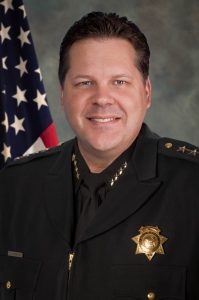
Sheriff David O. Livingston. From CCCSheriff website.

By Daniel Borsuk

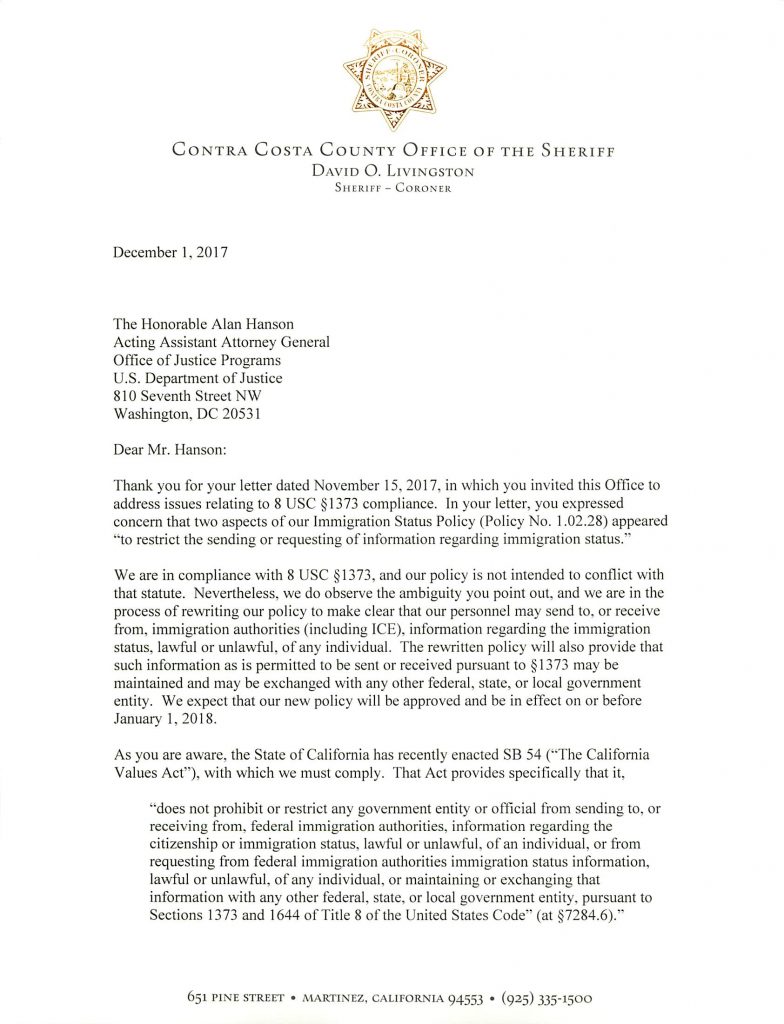
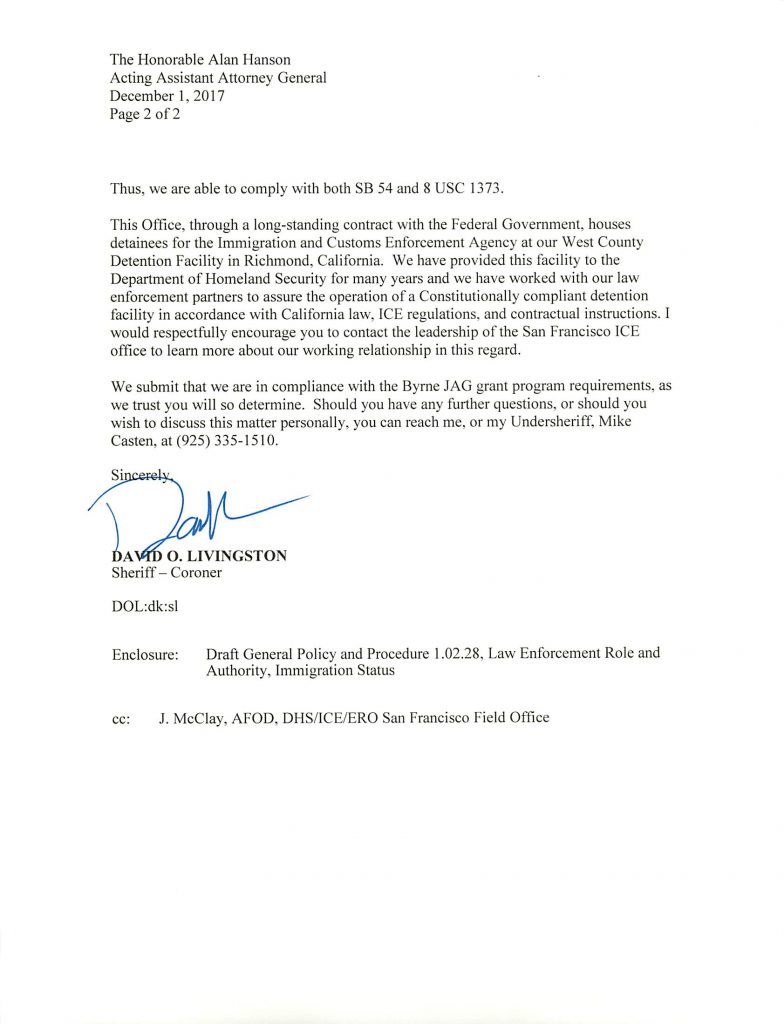
Contra Costa County Sheriff-Coroner David Livingston has provided at the request of the Contra Costa Herald a copy of his Dec. 1 letter to answer questions whether the department is out of compliance with federal immigration laws that entitled the Coroner-Sheriff Office to nearly $25 million in federal grants in 2016. CCSheriff ltr to DOJ re 8 USC 1373 Compliance 12-1-17

The sheriff’s letter was due Dec, 8, and he essentially informed U. S. Acting Assistant Attorney General Alan Hanson that the Office of the Contra Costa County Sheriff-Coroner is in compliance with federal immigration policy. That is in spite of the fact that beginning Jan. 1, 2018 California law enforcement agencies must begin to enforce Senate Bill 54, the California Values Act or what is better known as the sanctuary state law.

Livingston included with the letter his department’s draft policy on how it will and won’t cooperate with U.S. Immigration and Customs Enforcement (ICE) which was issued Dec. 3, 2013 and updated on Nov. 16, 2017.

In his letter to Hanson, Livingston wrote:

“The California Values Act, with we must comply. That Act provides specifically that it does not authorize information regarding the citizenship or immigration status, lawful or unlawful of an individual, or from requesting from federal immigration authority’s immigration status information lawful or unlawful of an individual, or maintaining or exchanging that information with any other federal, state, or local government entity.”

Sheriff Livingston missed attending the Dec. 7 meeting of the Board of Supervisors’ Public Safety Committee meeting, disappointing a number of committee members who wanted to hear him comment and answer questions about the draft policy on ICE-undocumented jail inmates, but obviously were unable to do so.

“I am surprised and disappointed that the sheriff is not here,” said District 1 Supervisor John Gioia of Richmond at the committee meeting. “I don’t know if this has ever happened before where the sheriff has not appeared at a Public Protection Committee meeting.”

Please see related article.

Contra Costa Sheriff announces findings in ICE detention complaints investigation

Friday, December 22nd, 2017

Sheriff David Livingston, center, speaks with Congressman Mark DeSaulnier (to his left) and staff during a tour of the West County Detention Facility in Richmond on Monday, Nov. 27, 2017. Herald file photo.

Refutes claims made by illegal alien female inmates against West County Detention Facility

The West County Detention Facility. Herald filed photo

The Office of the Sheriff has completed its investigation into complaints raised by several Immigration & Customs Enforcement (ICE) female detainees at the West County Detention Facility (WCDF) in Richmond, California. The complaints were first reported in a local newspaper. The Sheriff’s Office immediately launched an investigation. Investigators interviewed 110 witnesses, with audio recordings and translators where necessary, and viewed hundreds of hours of video surveillance recordings. They also examined log books, computer entries and other evidence. (See related article)

The investigation found that nearly all of the complaints were unfounded and unsubstantiated. Claims of being “locked down” for 23 hours a day were false. The most time any ICE detainee was confined to their dormitory room was one hour and 24 minutes. These “lock downs” are commonly done for facility counts or for administrative reasons. At WCDF the detainees have keys to their rooms and free use of common bathroom facilities.

Sheriff David O. Livingston. From CCCSheriff website.

In one example, the person who complained in the article of being confined to her room for 23 hours was in fact confined for several days in a room with a full toilet and sink. She was confined in such a manner for disciplinary purposes after she assaulted another detainee.

Regarding the use of “red” biohazard bags for toilet needs, there was no evidence that any detainee was forced to use the bags in that manner. In very few cases detainees did use the bags for that purpose in violation of policy. Biohazard bag distribution is now limited to those detainees who are ill or have other medical needs. All inmates are free to use the bathrooms at any time, and even during “lock down” periods of approximately one hour, by notifying a Deputy Sheriff by using the call button in their rooms.

There were two complaints alleging limited access to healthcare that also appear to be unfounded based on detainee interviews. However, Contra Costa Health Services will be reviewing those specific complaints.

“Consistent with independent ICE inspections, we found that the alleged policy violations were largely unfounded,” said Sheriff David Livingston. “In fact, many detainees told us they are well treated at the West County Detention Facility.”

Sheriff Livingston added, “Some issues were identified, such as the use of profanity by a staff member or the quicker replacement of detainees’ room keys when they are lost or damaged. We will use this opportunity to improve wherever we can.”

The investigation will now be provided to the California Attorney General as Sheriff Livingston promised he would do.

County to refund $8.8 million in excessive Juvenile Hall housing, electronic monitoring fees

Wednesday, December 13th, 2017

Example of an ankle monitor. By securitycameraking.com

By Daniel Borsuk

Beginning next month, 6,000 and as many as 12,000 Contra Costa County residents will receive letters from the county that they could be entitled to refunds to be disbursed because the county Probation Department overcharged them fees for Juvenile Cost of Care and Cost of Electronic Surveillance of Minors. (See agenda item,  here.)

County Supervisors initiated the notification process at Tuesday’s board meeting on a 4-0 vote.  Letters printed in English and Spanish will be mailed to up to 6,000 individuals who may be due a refund because they may have been overcharged when they had a juvenile housed at a county juvenile hall facility from 2010 to 2016.  The county ceased assessing the fees in 2016.  The letters will instruct the recipients how to file for a claim.

District 2 Supervisor Candace Andersen of Danville was absent for the vote.

The county estimates parents of juveniles held in county juvenile hall facilities were overcharged $8.8 million dating back to 1990.

The board’s Public Safety Committee will review whether another 6,000 residents living in the county between 1990 and 2010 might be eligible for refunds.  Supervisors would also establish a procedure whereby residents could claim money that was improperly withheld when youths were detained in juvenile hall facilities.  Supervisors will determine if the county improperly overcharged for electronic monitoring fees.

Assistant County Administrator Timothy Ewell told supervisors there are about 12,000 cases that the county has identified from 1990 to 2016 that might be entitled to refund checks averaging $262 per account because of the work by Contra Costa supervisors did, and support from citizen organizations like the Racial Justice Coalition, statewide to make juvenile hall housing fees illegal on racial and financial hardship grounds.

Contra Costa is the first county in the state to begin the procedure of refunding money to parents or guardians of juveniles who were held in juvenile hall facility and were overcharged.

“No one is expecting a mad rush of people to file claims,” said District 1 Supervisor John Gioia of Richmond, who was a key player at the county and state level in igniting the juvenile hall overcharge refund movement.

District 4 Supervisor Karen Mitchoff said it should be up to the claimants to show proof in the form of canceled checks, bank statements or some other proof of payment when filing a claim.

“Family members should never have been penalized,” admonished Willie Mims of the East County Branch of the NAACP.  “You should have the records and not lay that responsibility on the persons who might receive these letters.”

The fiscal impact to the General Fund is projected to be $136,000.

Supervisors OK Bonds for Multi-Family Housing Projects

Site of the approved Heritage Point Senior Apartments in North Richmond.

On a 5-0 vote, supervisors flashed the green light for construction to get underway for a $27 million senior housing project in North Richmond fronting the east side of Fred Jackson Way between Grove Avenue and Chelsey Avenue.  The 42-unit, Heritage Point Senior Apartments will be financed by the county with up to $17 million in Multifamily Housing Revenue Bonds.

It is a project of the Community Housing and Development Corporation of North Richmond (CHDC). According to their website, the organization was “founded in 1990 by local leaders…to eliminate blight, improve housing opportunities for current and future residents, and create better economic conditions.” It has since “added over 200 owner-occupied homes to the Richmond area along with street improvements, public services, senior and family rental housing.”

According to the staff report, there is “No impact to the General Fund. At the closing for the Bonds, the County is reimbursed for costs incurred in the issuance process. Annual expenses for monitoring of Regulatory Agreement provisions ensuring units in the Development will be rented to low income households will be reimbursed through issuer fees established in the documents for the Bonds. The Bonds will be solely secured by and payable from revenues (e.g. Development rents, reserves, etc.) pledged under the Bond documents. No County funds are pledged to secure the Bonds.”

Supervisors were informed that financing for the Heritage Point development is secure.  However, future affordable housing developments might be in jeopardy depending how the 2018 United States budget reform bill shapes up. Contra Costa County could potentially lose $3.5 million in bond financing for the North Richmond project if the budget reform bill is passed by Congress, said Maureen Toms of the Contra Costa County Conservation and Development Department.  Fortunately, the county has enough money in reserves to fill in funding gaps for projects like the Heritage Point development, she added.

“This could be the tip of the iceberg on the potential elimination of public funding for future affordable housing developments,” Gioia warned.

Riviera Family Apartments. Rendering by RCD.

In addition, the board approved converting $1.6 million in taxable bonds into tax-exempt bonds for a 58-unit, multi-family affordable housing apartment project in Walnut Creek. The Riviera Family Apartments will be located on two separate parcels, at 1515 and 1738 Rivera Avenue. The County had previously approved $19.2 million in tax-exempt bonds for the development in May 2016. The developer is Resources for Community Development in Berkeley. According to the staff report, no County funds are pledged to secure the bonds.

Honor 35-Year County Employee

In other action, the board honored Carmen Piña-Delgado who is the Supervising Real Property Agent with the Public Works Department in the Real Estate Division for her 35 years as a county employee. She started her career with the County Administrator’s Office as a Clerk-Experienced Level under the Affirmative Action Officer and due to budget cuts was let go. But, then in October, Piña-Delgado was rehired by the Health Services Department as a Clerk-Experienced Level in the Public Health Division.

In January 1992 she was promoted to the position of Real Property Technical Assistant in the Real Estate Division, where she has worked for the remainder of her career. In May 2001, Piña-Delgado graduated from Los Medanos College completing the Associate of Science Degree in Real Estate in order to qualify for advancement into the Real Property Agent Series. The resolution adopted by the Board recognizing her service states, she “has a great work ethic and has made a difference in the Public Works Department by delivering quality services in each division, County-wide, and with outside agencies/consultants.”

Allen Payton contributed to this report.


County eyes MicroPAD miniature homes as new tool to reduce homelessness

Wednesday, November 15th, 2017

A MicroPAD miniature home can be towed to its location. Photos from Panoramic Interests website.

By Daniel Borsuk

Perhaps by this time next year, Contra Costa County officials will be offering MicroPADs as a new alternate form of housing in its repertoire of programs designed to reduce homelessness, a major economic and social issue that is, at least in this East Bay county showing signs of fading away.

Rendering of a MicroPAD interior.

The number of homeless individuals in the county declined seven percent from 2016 to 1,607 homeless persons as of Jan. 25, 2017, an annual report stated and accepted by the supervisors on a 3-0 vote at Tuesday’s Board of Supervisors meeting.

Board chair Federal Glover was absent due to a death in the family and Supervisor Diane Burgis of Brentwood was absent because she was recovering from a surgical procedure.

The county’s success in decreasing the number of homeless individuals or families living outdoors or in cars can be credited to the county’s wide array of federal and state funded programs and services worth $15 million last year.  Those services range from emergency shelters, support services only, transitional housing, rapid rehousing, permanent supportive housing, street outreach and preventive programs.

MicroPAD interior view.

Next month the county expects to learn how much money it will receive from the United States Department of Housing and Urban Development in its newest service designed to further drive down homelessness – the MicroPAD, said Lavonna Martin, Director of Contra Costa County Health, Housing and Homeless Services.

The MicroPAD miniature, stackable home is a relatively new weapon in the fight against homelessness.  It is now in use in San Francisco, a city and county well known for its high cost of housing and homeless population problems.

Each 160-square foot modular prefabricated dwelling unit comes with a furnished bedroom, private bathroom, and kitchenette.  In Contra Costa, in order for a homeless individual to be eligible to occupy a MicroPAD he or she would have to pay 30 percent of their monthly income (i.e. SSI) towards rent, said Martin.

Contra Costa County could have as many as 50 MicroPADs available for eligible homeless persons.

Supervisors wanted to know if a site had been selected to place the MicroPADs, but the county homeless director said that a site has not been selected even though the county and City of Richmond were co-sponsoring a presentation at the same time the Board of Supervisors meeting was in session.  At the Richmond Civic Center presentation, a MicroPAD was on display for the public to see.  A similar MicroPAD presentation was conducted on Wednesday at the Richmond Civic Center.

Another interior view of a MicroPAD miniature home.

District 1 Supervisor John Gioia of Richmond was slated to appear at Tuesday’s civic center presentation following the board meeting.

“We do not have a site set yet,” Martin told supervisors.  “We’ll be working on that over the next few months.”

“It’s going to be challenging to find the right location,” acknowledged Gioia.  “The homeless will not get off the street if you offer them shelter, but this (i.e. MicroPADs) will get them off the street because it is housing.  The challenge will be finding an appropriate location.”

Supervisor Candace Andersen of Danville was also supportive of the MicroPAD concept that the county is pursuing.  “What can we do to effect a positive situation?” she asked.  “I am excited about the MicroPAD program with its small units and the support services that will be available for occupants.”

To view a news report by KRON 4 TV news with video of a MicroPAD home, click here. To learn more about MicroPADs click here.

Supervisors Accept Winter Storm Preparedness Report

During the Tuesday meeting, Supervisors also approved a report that the county is prepared for whatever amount of rainfall this winter season will bring.  The report on Winter Storm Preparedness in Contra Costa County was presented by Tim Jensen of the Public Works Department.

The report highlighted Walnut Creek Intermediate School’s “Stay Out Stay Alive” publicity campaign to warn students and the public about the dangers of Walnut Creek especially when it is full of raging water during a major rain storm.  Two years ago, two persons died when they fell into the rain swollen creek that that bisects the school.

The report also informed the public about the county’s sand bag stations, media outreach, newsletter, and flood control district webpage – http://www.cccounty.us/5906FloodPreparedness

New carpool “Scoop” app pays you $2 for any trip to or from Contra Costa

Wednesday, November 8th, 2017

Between the 12-cent-per-gallon increase in the gas tax and being able to earn $2 credit each trip, there’s never been a better time to trade your solo commute for a shared ride. Whether you fill an empty seat in your car or catch a ride as a passenger, carpooling is a great way to save money.

Thanks to a partnership between 511 Contra Costa and Scoop, when you use the Scoop app to match with another commuter for your ride to work, you get a $2 credit. As long as your trip starts or ends in Contra Costa, each person in the carpool will receive a $2 credit. Passengers will see the credit automatically applied to their trip, while drivers can cash out the credits they earn.

If you commute to Concord, Pleasant Hill/Contra Costa Centre or Dublin/Pleasanton BART using Scoop, you also get guaranteed parking! (Passengers: use the code CCTA05 to get an additional $5 in Scoop credit – the combined $7 in credit covers the cost of most first rides.)

As part of a carpool, you’ll have access to the HOV lanes and can use the I-680 and I-580 Express Lanes toll-free. (Note: If you’re crossing the Bay Bridge, the Scoop app will match you with two other commuters so you can use the HOV lanes.) If you’re driving to Pleasant Hill/Contra Costa Centre BART, Concord BART or Dublin/Pleasanton BART Stations you’re also guaranteed parking if you arrive before 10am and parking is free.

It’s time to give sharing the ride to work a try.

Earning the $2 credit is easy:

1. Download the Scoop app

2. Enter your account information

3. Use the Scoop app to carpool

$5 SCOOP CREDIT: Enter the code CCTA05 in the Scoop app to get a $5 credit towards your first ride.

To download the Scoop app and get a $5 first-time rider credit, visit our Scoop Special Offer page.