Archive for the ‘Contra Costa County’ Category

Contra Costa Coronavirus Update: 631 cases, 46 in Antioch, 16 total deaths in county

Thursday, April 16th, 2020

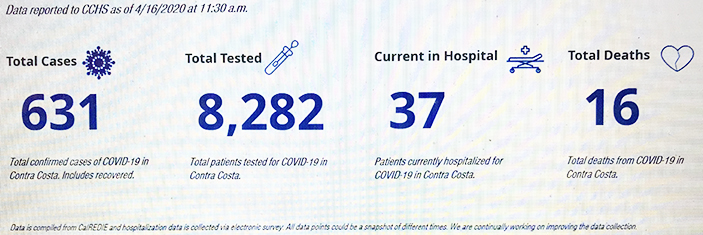
CC Health Services Coronavirus Dashboard statistics as of April 16, 2020 at 11:30 a.m.

By Allen Payton

As of Thursday, April 16, 2020 at 11:30 a.m. Contra Costa Health Services (CCHS) is reporting a total of 631 cases of COVID-19/coronavirus, and a total of 16 deaths in the county on their dashboard. There are 37 people diagnosed with the virus currently hospitalized.

There were 41 new cases reported on Monday, 16 more on Tuesday and 18 more cases reported on Wednesday.

Of those who have tested positive in the county, Antioch has a total of 46 cases.

A total of 8,282 people have been tested for the virus in the county.

The county’s coronavirus dashboard is now offering hospital information. It shows the daily Intensive Care Unit Occupancy Rate and Ventilator Utilization for all hospitals in the county.

The largest category of those who have been diagnosed with the virus continue to be people ages 41-60 with 227 cases, 188 cases for those age 21-40, 144 cases among those age 61-80, another 47 cases of those age 81-100 and 24 cases of those age 20 and under.

To see the all the statistics provided by CCHS, click here.

Contra Costa County delivers sanitation stations to slow COVID-19 in homeless camps

Thursday, April 16th, 2020


By Kim McCarl, Assistant to the Director, Communications, Contra Costa Health Services

Contra Costa County and several of its cities are working to reduce the spread of COVID-19 in local homeless encampments by placing handwashing stations and portable toilets near them.

Four handwashing stations and four portable toilets with attached handwashing stations were placed at Martinez’s Waterfront Amphitheater on Tuesday, the first of several sanitation equipment deliveries planned in coming days.

The stations were ordered through the Contra Costa County Emergency Operations Center in support of local cities that requested the assistance, including Antioch, Richmond and Walnut Creek.

“We must work proactively with our homeless population to reduce the spread of COVID-19, and to save lives,” said Candace Andersen, chair of the Contra Costa County Board of Supervisors. “People who lack housing are particularly vulnerable. Without running water, it is very difficult to wash your hands and practice the hygiene needed to reduce your risk of infection.”

City governments in Antioch, Richmond and Walnut Creek are now determining where to place as many as 10 handwashing or portable toilet stations each, based on locations frequented by residents in their communities who are experiencing homelessness.

“During this challenging time, we need to support each other. We have been working closely with all cities in Contra Costa to ensure they have what they need to meet the most pressing response needs at the local level,” said Supervisor Federal Glover, whose district includes Martinez.

Nearly 2,300 people need housing on any given night in Contra Costa, according to the most recent data available through the county’s annual homeless point-in-time count.

“Assisting people who need housing during this challenging time helps everyone,” Martinez City Councilmember Noralea Gipner said. “To flatten the curve and keep our healthcare system ready to respond, we need to reduce the risk of COVID-19 to the most vulnerable people in our community.”

CORE outreach teams from Contra Costa Health Services’ Division of Health, Housing and Homeless Services (H3) have been delivering sanitation supplies, such as hand sanitizer, to people living outdoors for several weeks to help improve sanitation at area homeless encampments.

H3 has also coordinating closely with county homeless service providers to identify clients who are at elevated risk due to age or health and place them in hotel rooms, and to temporarily transfer occupants of crowded shelters to hotels to better maintain physical distancing.

Through California’s Project Roomkey, H3 has secured 450 hotel rooms in the county for temporary use by homeless residents. As of Tuesday, no COVID-19 outbreaks have been reported at homeless shelters or service providers in Contra Costa County.

Visit cchealth.org/coronavirus to read the order or for more information about COVID-19.

Supervisors order COVID-19 moratorium on evictions, rent control

Thursday, April 16th, 2020

By Daniel Borsuk

Contra Costa County residential and commercial tenants clobbered from COVID-19 financial impacts might be on the receiving end of some monetary relief as county supervisors requested Assistant County Counsel Mary Ann Mason on Tuesday to draft an emergency ordinance that could deliver rent and eviction moratoria.

Supervisors will meet at a special Tuesday, April 21 afternoon meeting to potentially act on a countywide rent control and eviction moratorium ordinance modeled after one the Santa Clara County Board of Supervisors adopted recently.

About 70 persons submitted written comments asking supervisors meeting remotely via teleconference to adopt a moratoria ordinance. Each comment was read into the record.

Amelia Hernandez, a single mother who rents a room in a San Pablo house, requested that supervisors adopt a moratoria ordinance in order to “protect all tenants like her who has seen her work cut to 3 days a week.”

Mark Mahone told supervisors “the best solution is a countywide solution” citing that only a few Contra Costa cities have addressed moratoria on evictions and rent. Those cities are Antioch, Concord, Richmond, and Pittsburg.

District 1 Supervisor John Gioia of Richmond, who two weeks ago initiated the request to have the board adopt a moratoria ordinance, recommended the Santa Clara County ordinance because it also best addresses the needs of citizens and property owners in Contra Costa County.

In a comment on Facebook, during the meeting, explaining his support for the moratorium, Gioia wrote “What I said and the majority of the Board agreed was that only during this health emergency, an owner cannot evict a tenant who is paying their rent just so the owner can leave the unit vacant. Think about that – you want a tenant who is paying rent evicted during this crisis and leave the unit unoccupied? I stand by my and the Board majority’s decision! The owner can evict if the owner and immediate family wants to move back in or for a health and safety reason.”

The Santa Clara County moratoria on evictions applies countywide. Residential evictions are prohibited if due to nonpayment of rent caused by COVID-19 until May 31, 2020 unless extended. Small business evictions are prohibited only if due to nonpayment of rent caused by COVID-19 Until May 31, 2020. The Santa Clara ordinance includes a 120-day grace period from the expiration of the ordinance. The ordinance bans “no fault” evictions. The Santa Clara ordinance does not have a rent freeze provision, except for Costa-Hawkins Rental Housing Act exemption cases.

Supervisors said cities like Antioch, Concord, Richmond and Pittsburg that already have rent and eviction moratoria in place will have those moratoria honored if and when a county ordinance that is adopted.

“Ordinarily I’m not in favor of moratoria,” said board chair Candace Andersen of Danville. “but I realize we have a high number of unemployed. I know we need to find ways to help people reenter the economy.”

“I feel this should be countywide for cities that don’t have ordinances in place,” said District 5 Supervisor Federal Glover of Pittsburg. “I am also concerned what will happen when this moratoria ordinance is lifted.”

In the meantime, Contra Costa County Health Director Anna Roth reported since the supervisors last met two weeks ago, the number of persons stricken with COVID-19 symptoms has risen from 187 cases to 552 cases and the number of deaths has quadrupled from 3 to 12 deaths.

County Health Officer Dr. Chris Farnitano said the county along with efforts of John Muir and Kaiser Permanente have stepped up training at county nursing home facilities to combat the spread of COVID-19 infections among the population’s most vulnerable, senior citizens.

In addition, the county health officials have begun to move the homeless into 300 hotel rooms that the county has bought mostly in the Richmond area, Dr. Farnitano reported.

Approve Executive Order to Conduct November Election by Mail

Supervisors unanimously approved a resolution presented by County Clerk-Recorder Deborah Cooper to conduct the November election only by mail. The board resolution in coordination with other counties will request Gov. Gavin Newsom to issue an Executive Order directing that the November 2020 election be conducted by mail.

Given the COVID-19 pandemic state of emergency will be in place for an indefinite period, County Clerk-Recorder Cooper said the county would best serve the voting needs of its citizens and save the county thousands of dollars.

“Eliminating polling places, poll workers and their training, election day ballots, and voting supplies would provide significant costs savings in the vicinity of $320,000,” Cooper wrote in her letter to supervisors. “Increased vote-by-mail costs, including postage, and processing time, are estimated to be $360,000.”

Cooper wrote: “Many of our polling places and volunteers have indicated that they will not serve in November due to the virus and the state of emergency. On March 3, 2020, over 200 volunteers failed to show up to work at the polls. Experts indicate that it is likely that the virus will remain active or re-emerge this fall during the election season posing a persistent risk to citizens.”

“Our request is that the Board, possibly in coordination with other counties, pass a resolution requesting the Governor to issue an Executive Order substantively the same as the March 20, 2020 order directing the election to be conducted by mail, “wrote Cooper.

So Far, No Deaths in County Jails

Contra Costa County Sheriff David Livingston reported that since the board of supervisors passed a state of emergency on March 17, there has not been one reported COVID-19 related death in county jails.

“Eighty-nine percent of the prisoners are in single cells to help prevent the spread of COVID-19,” the sheriff said.

Among those being held for serious offenses are murder, 164; children underage, 98; rape, 22; robbery, 108; burglary, 101; and deadly weapon, 186, the sheriff reported.


Rapid Response Fund formed to bring emergency relief to county residents impacted by COVID-19

Saturday, April 11th, 2020

Contra Costa Regional Health Foundation’s first round of grants will go to the Food Bank of Contra Costa and Solano, the Contra Costa Crisis Center, Shelter, Inc., Catholic Charities East Bay and White Pony Express

By Kim McCarl, Assistant to the Director, Communications, Contra Costa Health Services
MARTINEZ — Beyond its devastating health implications, COVID-19 is undermining basic living conditions for tens of thousands of people living in the Bay Area, especially those that are most vulnerable. The Contra Costa Regional Health Foundation (CCRHF) has established a COVID-19 Rapid Response Fund and has been selected as a lead partner organization in the newly formed COVID-19 Regional Response Fund supported by the Silicon Valley Community Foundation.  The COVID-19 Rapid Response Fund is also supported by the Chan Zuckerberg Initiative as well as individual donors.

The CCRHF Rapid Response Fund is moving quickly to help those individuals in desperate need. Locally, the Contra Costa Regional Health Foundation will play an important role in identifying highest risk populations and funding organizations to provide needed assistance.

“The economic impact of COVID-19 in the Bay Area is immense, with the biggest impact on people who have been living on the margins. These are families that can’t wait for government assistance in a few weeks, they are suffering and in jeopardy now,” explains CCRHF Chair Bette Felton. “Thanks to the amazing generosity of the Silicon Valley Community Foundation and the Chan Zuckerberg Initiative, as well as individual donors, we can now move rapidly, locate the organizations best suited to safeguard those people at high risk and make sure they have the funds and resources to help protect our communities.”

We understand this is a dynamic and changing situation.  Based on our understanding of the greatest needs at this time, the Fund is supporting four key areas: food distribution, financial assistance, shelter and emergency housing, and support for essential workers.

“Grants will be made on a timely basis to organizations best equipped to address these needs among the county’s most vulnerable populations. Given the urgency of the crisis, our priority is to find organizations with the proven capacity that can move quickly,” says Felton.

In light of that urgency, in its first round of funding, the CCRHF is extending grants to five organizations: the Food Bank of Contra Costa and Solano, the Contra Costa Crisis Center, Shelter, Inc., Catholic Charities East Bay and White Pony Express.  These initial grants will quickly amplify the impact these organizations are positioned to make.

Additional organizations will be considered in future funding cycles, based on:

  • the organization’s ability to reach populations most vulnerable to the economic or health risks posed by this public health crisis,
  • its capacity to move expeditiously and
  • the ability of the organization to deploy the funds expediently.

For additional information about the COVID-19 Rapid Response Fund and the Contra Costa Regional Health Foundation visit https://www.ccrhfcovid-19.org/

About the Contra Costa Regional Health Foundation

Established in 2003, the Contra Costa Regional Health Foundation is a 501 (c)3 non-profit organization that supports Contra Costa Health Services in its work to care for and improve the health of all the people in Contra Costa County with special attention to those who are the most vulnerable.

Contra Costa coronavirus Update: 2 more deaths for 11 total, 530 cases

Saturday, April 11th, 2020

From CCHealth.org

More cases in people ages 41-60 than any other age range

By Allen Payton

As of Saturday, April 11, 2020 at 11:30 a.m. Contra Costa Health Services (CCHS) is reporting a total of 530 cases of COVID-19/coronavirus, and two more deaths for a total of 11 in the county. There are 37 people diagnosed with the virus currently hospitalized. There are 38 cases in Antioch.

A total of 6,938 people have been tested for the virus. 

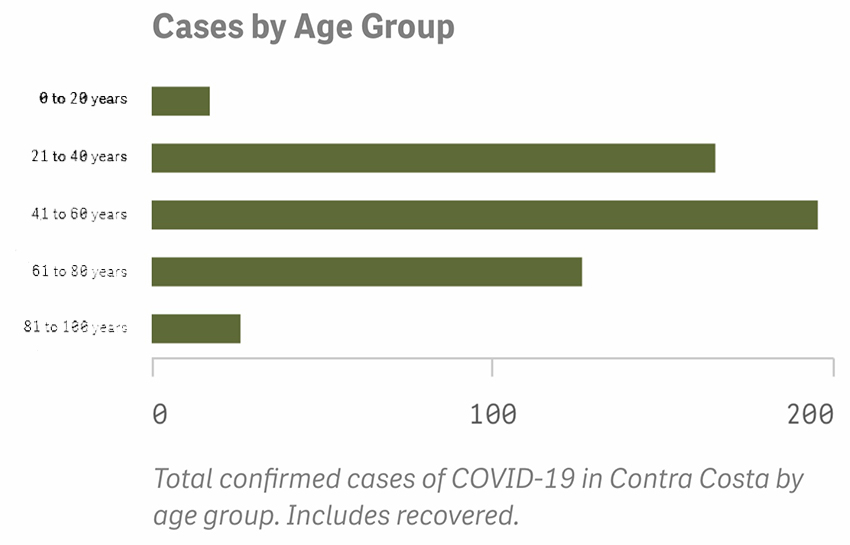
The majority of those who have been diagnosed are ages 41-60 with 195 cases, 165 cases for those ages 21-40, 126 cases among those ages 61-80, another 26 cases of those ages 81-100 and 17 cases of those age 20 and under.

To see the all the coronavirus statistics provided by CCHS, click here.

Contra Costa coronavirus Update: Now 442 cases, 7 total deaths

Tuesday, April 7th, 2020

By Allen Payton

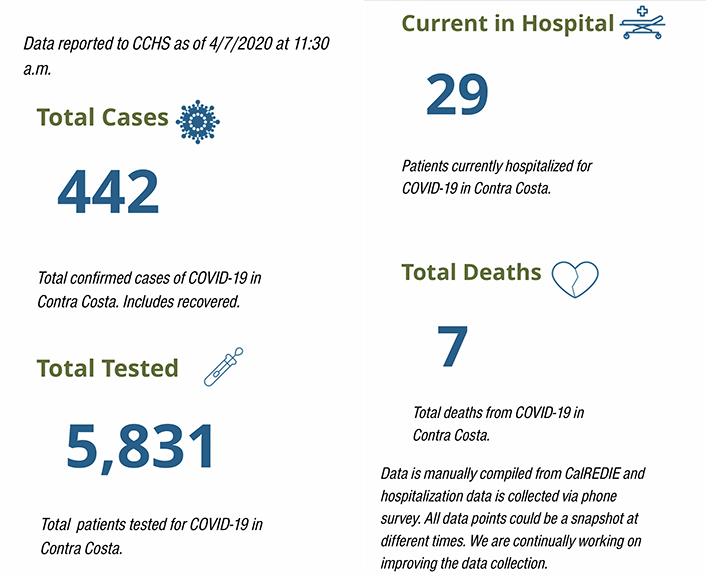
As of Tuesday, April 7, 2020 at 11:30 a.m. Contra Costa Health Services (CCHS) is reporting a total of 442 cases of COVID-19/coronavirus, and two more deaths for a total of 7 in the county. There are 29 people diagnosed with the virus currently hospitalized, a decrease of three since Friday.

A total of 5,831 people have been tested for the virus. To see the all the statistics provided by CCHS, click here.

Contra Costa issues mass isolation and quarantine orders for people with COVID-19 and their close contacts

Saturday, April 4th, 2020

Latest county stats: 4,929 tested, 353 cases, 31 currently hospitalized, 5 deaths as of Saturday morning, April 4

“Our resources are stretched extremely thin and business as usual is not an option.” – Health Officer Dr. Chris Farnitano

From Contra Costa Health Services

Contra Costa County Health Officer Dr. Chris Farnitano announced Friday evening that the county is issuing a mass order for residents with COVID-19 and their close contacts to isolate and quarantine themselves.

The mass order is being issued to help slow COVID-19’s spread, protect vulnerable individuals, and prevent the healthcare system in the County from being overwhelmed. The county’s public health staff no longer have the capacity to individually notify and track everyone with COVID-19 and their close contacts who may have been exposed to the virus.  

As of Friday, 307 county residents have tested positive for COVID-19 and five people have died from the virus. Contra Costa County had no local cases at the beginning of March.

“We’ve reached a critical point in the COVID-19 crisis here in Contra Costa,” Dr. Farnitano said. “Our resources are stretched extremely thin and business as usual is not an option. We believe this mass order is a creative and effective way of getting the job done to keep the sick isolated from others.”

Residents must isolate themselves in their home or another residence if they test positive for COVID-19. They may not leave their home except to receive necessary medical care or during an emergency that requires evacuation.  

COVID-positive individuals without symptoms must isolate for 7 days from the date of a positive test. Those with symptoms must isolate at least 7 days have passed since their symptoms started. Initially symptomatic people must also wait at least 72 hours have passed since after symptoms go away. Symptoms of COVID-19 include fever, coughing and shortness of breath.

County residents who test positive for COVID-19 will now be required to tell their close contacts that they need to quarantine themselves if they may have been exposed. Close contacts must then remain at home or another residence for 14 days from the last date that they were in contact with the person infected or with COVID-19.

People considered “close contacts” are persons who, during the sick individual’s infectious period, live in, or have stayed overnight, at the individual’s residence; are intimate sexual partners of the individual; or provided care to the individual without wearing a mask, gown, and gloves.

People can access instructions on how to isolate and quarantine themselves at cchealth.org/coronavirus.

County braces for jump in COVID-19 cases, big deficit expected for 2020-2021 budget

Wednesday, April 1st, 2020

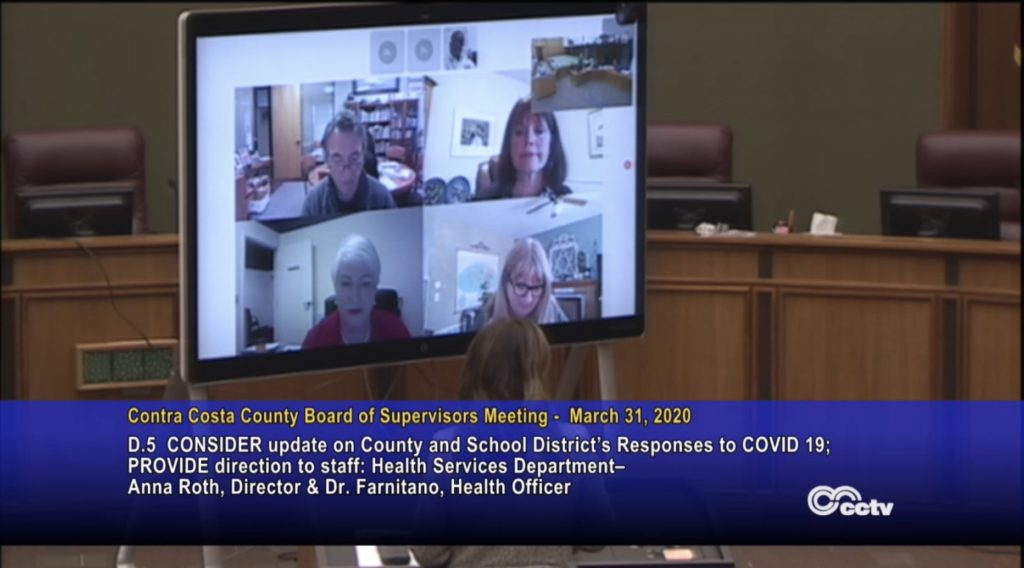
A county staff member addresses the members of the Board of Supervisors during their now, virtual weekly meeting, on Tuesday, March 31, 2020. Video screenshot.

Three deaths in county from 212 cases, so far

By Daniel Borsuk

Since the last time the Contra Costa County Board of Supervisors met two weeks ago, the number of Contra Costa residents with COVID-19 symptoms have tripled, Contra Costa County Health Services Director Anna Roth told Supervisors during a live-streamed meeting Tuesday.

Roth told supervisors the county had 212 cases of patients with COVID-19 symptoms and there had been three deaths. Two weeks ago, there 70 patients had COVID-19 symptoms and one patient had died from the virus.

In the meantime, county medical professionals are barely treading water in providing life-saving ventilators for COVID-19 stricken patients. County Health Officer Dr. Christopher Farnitano said hospitals have 76 ventilators in use and 100 more ventilators are on order, but over time additional equipment will be need.

“We are not going to save most of our patients who will need to be on ventilators. We will have 1,000 patients or more who will need to be on ventilators. Most will die. We need to reduce the number of people coming down with COVID-19 symptoms,” said Dr. Farnitano.

Dr. Farnitano said an alternate health care site is scheduled to open at the Antioch Fair Grounds next week to help accommodate additional COVID-19 patients.

County Administrator David Twa, who will retire at the end of the year, said rising health costs stemming from COVID-19 will force the county to plug up funding holes totaling $43 million a year for the next three years. The rising medical costs stem from recently signed labor agreements for hospital professionals and in-home care attendant workers.

Twa projected an 11 percent decline in property values will trigger a $27 million decrease in property tax revenue at least for the upcoming 2020/2021 fiscal year.

That projection from Twa caused District 4 Supervisor Karen Mitchoff of Pleasant Hill to warn her colleagues, “We may need to reduce the work force. We could be facing difficult times.”

Supervisors will get a better picture of the proposed 2020-2021 budget on April 21 when it is presented publicly. The budget will be formally adopted on May 12.

County Treasurer-Tax Collector Russell Watts said his office anticipates an increase in the number of property owners to file online penalty cancellation requests on April 10 because of COVID-19. Watts told supervisors he would inform property owners if any of the hundreds of financial institutions holding $450 million in impound escrow funds miss depositing funds in the county treasury the financial institutions will be held accountable. He also will report to the board of supervisors if any financial institutions fail to submit impound funds to the county.

“This revenue is essential for keeping the county, our cities and schools, and other local government agencies running and providing vital services that the public relies on, especially in times like these,” said Watts in a press release.

Under the current stay-at-home orders, the county’s more than 177,000 K-12 public school students are coping under while the stringent shelter-in-place mandate stays in place, Contra Costa County Office of Education Superintendent Lynn Mackey told supervisors.

Students are learning via distance learning although students in some school districts fall through the technology gaps more than others, said Mackey. Noting that 42 percent of the county’s students qualify for the free lunch program, the county superintendent said, “We are making sure that students don’t fall through the cracks in providing the computers and resources for distance learning.”

District 1 Supervisor John Gioia of Richmond succeeded in getting Supervisors’ support to have Deputy County Counsel Mary Ann Mason prepare a comprehensive report on the feasibility of the Board adopting a moratorium on evictions, a ban that Alameda, San Francisco, San Mateo, and Santa Clara Counties have already adopted.

The proposed imposition of an eviction moratorium was one of major topics supervisors heard from 120 emailed letters from residents. Other issues citizens wrote about connected to the COVID-19 pandemic were: Imposition of a moratorium on rent, Depopulating the county jails, and Protecting county social workers.

Temporary Emergency Worker Classification Created

Citing the possibility, the County might need temporary emergency workers during the COVID-19 pandemic, Supervisors unanimously approved County Administrator David Twa’s request to establish the classification with a salary range of $12 an hour to $35 an hour.

Supervisors approved County Administrator Twa’s request on a   5-0 vote even though Twa said he did not have the time to consult with labor representatives about the creation of the classification.

“Due to the COVID-19 pandemic, the county will need to hire additional workers to be able to continue providing current essential services to county residents, as well as services to provide information, protect health and save lives,” Twa’s request stated. “The County Administrator is recommending establishing the hourly classification of Temporary Emergency Worker.”

In other business, Supervisors appointed Walnut Creek-based commercial and residential developer Ross Hillesheim to fill the At-Large 2 seat on the Contra Costa County Planning Commission. Other applicants for the position, a four-year appointment, recommended by the Internal Operations Committee were former City of Concord planning commissioner LaMar Anderson, journalist Daniel Borsuk of Pittsburg, and North Richmond Residential Leadership team member Johana Gurdian.