








Antioch Council votes down ad hoc committee on police reform, will hold study sessions with all five members and Police Crime Prevention Commission
Thursday, June 18th, 2020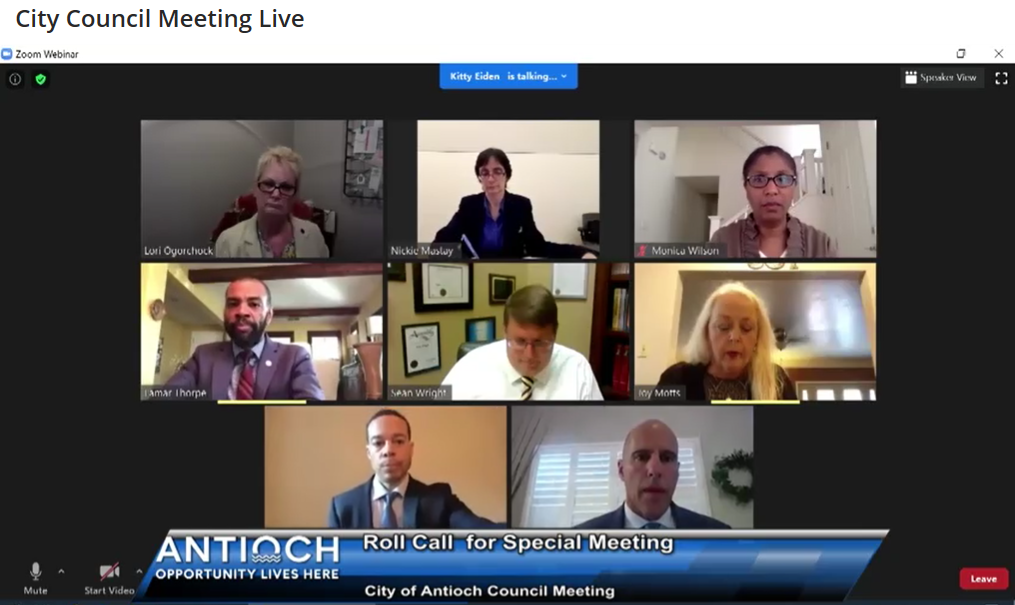
Antioch Council Members, City Attorney Thomas Smith and City Manager Ron Bernal listened as city staff members read the final 200 public comments during the continuation of Tuesday night’s special meeting on Thursday, June 18, 2020. Screenshot from City website.
“this is too big, too important for our community (to settle for a two-member ad hoc committee). What I see is a series of forums…but it would be inclusive of everyone on the council.” – Mayor Sean Wright
By Allen Payton
During the second of two special meetings this week and after listing to seven hours of public comments from over 700 people, the Antioch City Council voted on a split vote Thursday night to oppose the formation of a two-person ad hoc committee on police reform as Councilman Lamar Thorpe had called for. He and Councilwoman Monica Wilson voted for it while the other three members voted against. Instead the council agreed to have Mayor Sean Wright call the first, of what is expected to be a series of public study sessions to discuss the matter as a whole, that will include the Police Crime Prevention Commission, and set it for Tuesday night, June 30.
At the first session, Antioch Police Chief T Brooks is expected to speak first, followed by those who have had issues with the police department, as Wright put it.
The meeting ran much smoother than Tuesday’s, as the various form letters submitted by several people on both sides of the issue were read once by city staff members, while just reading the names of all those who submitted the same letters. Wright opened the meeting saying there were about 200 public comments left to read.
Dan Stills was the first of only two members of the public available on Zoom to speak. He said, “now that we get staff, along comes the notion of…defunding police and the ad hoc committee. I am one of the silent majority, opposed to the ad hoc committee. We will be voting in November. I implore all of you to work with the police chief to make any necessary changes. We don’t need to dismantle…now is not the time to tear it down and rebuild it.”
City Finance Director Dawn Merchant then read some of the form letters and mentioned the names of all those who had submitted them.
One comment quoted the city’s Vision Statement and wrote in favor of forming the ad hoc committee.
“Chief Brooks has explained that the department has already implemented six of the eight reforms” read one letter opposing the ad hoc committee.
“Why do we need another politician run committee? We’re tired of your committees and lack of action,” wrote retired Antioch Sergeant Larry Hopwood and five others.
Another letter asked for a community forum led by Chief Brooks and submitted by several people.
“Racism is something that needs to be discussed by the entire community,” wrote one letter submitted by several members of the public
“I’ve been in Antioch since 1965…this is just a kneejerk reaction to what’s going on,” read a letter by one resident.
Carol Allen wrote, “We need our police not a committee of grandstanding politicians.”
Matt Vargas wrote, “Have you ever been burglarized, assaulted? I have. You defund our police and it takes longer to respond. We’re already understaffed.”
“I’ve seen no improvement in my neighborhood and it’s only gotten worse,” read another letter.
“Now is not the time to cut funding. Measure C is scheduled to sunset in 2021,” read another. That last part is not correct. Measure C’s half-cent sales tax was replaced by a full cent sales tax with the passage of Measure W.
“Please do not follow the cities of Oakland and San Francisco that have citizen boards run the police department,” read another letter by a Mr. Crum.
Michael Gobel wrote opposing the ad hoc committee, “We need to support these men and women who lay their lives on the line for us.”
Gary Shu opposed the ad hoc committee writing, “Do not defund our police. If we do our peaceful world as we know it will end. What about the school kids with no protection?”
“If you defund the police in Antioch, I want every dollar back I paid in taxes,” read another letter from a member of the public.
Wayne Butler wrote, “Leave the police alone. We still don’t have enough cops in this crime-ridden city. 97.3% of cops don’t even fire their gun in their entire 30-year career.”
“I would like to defund the police, they are fat and only go after women and minorities,” read another letter in support of the ad hoc committee.
“Antioch police activity must remain at the current level,” wrote another member of the public.
Nancy Green wrote, “I think APD is doing a good job.”
Sal Sbranti wrote, “I do not believe that the actions of the Antioch Police Department require us to support a witch hunt sponsored by Lamar Thorpe and Monica Wilson. Lamar’s comments and endorsement of “8 can’t wait” displays his bias and that alone should eliminate him from being a member of any ad hoc committee. The statements that Lamar has made, makes Antioch and our stellar police department look bad. Stellar?- violent crime down 15% from 2015 to 2019, citizens complaints down 40% from 2017 to 2019. Antioch Citizens passed “Measure C” in November of 2013 and “Measure W” in November of 2018, and it was April of this year when we finally met the goal number of Police that this City Council Authorized. If a committee is to be formed, it should not be called “Police Reform Committee” as again, that displays Lamar’s and the City Attorneys bias and the pre-judgement of this council.”
“I’ve personally heard stories of police brutality by people, here in Antioch. I expect the city council to put their full effort into this,” read another letter.
“I’ve seen the quality of life in Antioch deteriorate every year I’ve lived, here. Because the members of the committee will not be held accountable, I’m against it,” read another.
Megan wrote, “Countless lives have been taken. Antioch is not an exception. You must disarm and dismantle the police. We want a new community not cops.”
Steve Libator wrote against the ad hoc committee but in favor of a community forum, “You want to bring attention to yourself. Please stop.”
“Maybe you can teach officers how to love people who don’t look like them. While I do support the police, I was disappointed with the way the chief handled the COVID-19 situation and left us to fend for ourselves,” wrote another member of the public in favor of forming the ad hoc committee.
Sara Gubeer, a 2018 graduate of Dozier-Libbey wrote supporting the ad hoc committee about the deaths of people across the country. “The police don’t actually serve or protect anyone. First, we must start with our own community.”
Robert Pohl wrote against forming the ad hoc committee. “We voted twice to increase funding for police Now people want to defund it, which doesn’t make sense. Antioch has a diverse and progressive police department.”
Luis Crockett wrote “I don’t support our chief and police officers, they are racist and constantly profile black and brown members of our community. This has to stop now.”
Victor Wen, a DVHS alumni class of 2020 submitted the same form letter making accusations against the police department and called for it to be defunded and disarmed.
Beverly Knight who opposed the ad hoc committee wrote, “The police portrayed on the national news are not the Antioch Police Department. Chief Brooks works hard to make community policing an imperative. I will believe APD will embrace positive change. Don’t try to fix something that’s not broken.”
Sarah Laughlin, a 2015 DVHS graduate who is getting her law degree wrote, “I’ve seen this community’s ability to lift people up but also tear it down. I’ve seen how the local school system that targets black and brown students.”
Vanessa Helmann wrote, “I don’t believe a special committee will serve our community.”
John Fischer wrote, “This attempt…is a slap in the face of the police department. The letter sent out by Chief Brooks was well written. I don’t agree with all that he wrote.
“I do not agree with an ad hoc committee…there is a need to begin a comprehensive approach…to build trust between the police and the community,” wrote another member of the public, citing new legislation introduced in Congress.
Tina Gillette wrote, “I live in District 1…that is represented by Joy Motts. While most of us support the protesters” and called for community forum.
Lucy Meinhardt wrote, “Our entire country is in a state of upheaveal. Continiuing to improve our policing is what is needed. There’s no reason Antioch cannot be part of this national movement” and asked that representatives of color lead the effort.
“Antioch PD works with people of all races in the community. We all need to live together as one. Focus on our real problems,” wrote another.
Harry Raymond wrote, “The City of Antioch is blessed by a very well run police department. The citizens of Antioch…twice agreed to more taxes. APD finally reached the target minimum after a number of years.”
Ariana Edwards wrote, “This community needs care not cops. It’s time for reform” and supported the ad hoc committee.
“It’s time to defund the police…and invest in the community and schools, instead,” another letter read.
“The council can look past the current hysteria” wrote another person who called for a standing committee of three council members. But that would violate the state’s Brown Act open meeting law, which is why sub- and ad hoc committees
NAACP East County Branch submitted a comment calling for, “wholly and unequivocally a police oversight committee in the City of Antioch…that will mete out discipline.”
Mike Barbanica wrote, “What we don’t need is more political grandstanding by members of our city council. Vote no on the ad hoc and look at alternatives that will involve the entire community.”
Willie Mims, a Pittsburg resident and member of the NAACP East County Branch, wrote, “Since the murder of George Floyd, the whole country and the world are protesting police brutality, white racism and white supremacy. You, who live in the City of Antioch, must not place your heads in the sand and put a mask over your eyes in order to cover up the fact that you have not experienced some of these same incidents here in your own town. You had and still do have some officers operating under the Color of Law.
This city must not be afraid to welcome a thorough review and reevaluation of the police department’s excessive force policy, an examination of its accountability component, and its use and misuse of its canine unit when dealing with non-aggressive citizens. Not only that, but there should be some serious ongoing training in racial profiling, racial bias and de-escalation techniques, especially when dealing with mental health issues, black people, and other peoples of color.
A civilian oversight commission would be best for the city of Antioch and should be put in place to address any complaints against the police department.
And lastly, I stand with the city council as they grapple with this American racial problem. I take issue, however, with the police association and their attack upon certain council members. Their resistance to either review or to even consider a citizen oversight committee is quite troubling. Whatever the case, the issue of race is placed back on both Antioch’s and America’s table of destiny. I hope that the council will do what is right. Know this, that I stand with those people wanting change at this time in our history.”
Joel Firstenberger praised Chief Brooks and wrote, “I don’t support the political views of Black Lives Matter. I do not want the council to take on this agenda to please two board members.”
“Antioch can be a beacon of how to operate the police department. This isn’t political. It’s personal. I have black sons and want to know this town embraces their beautiful lives,” wrote one resident.
Another member of the public wrote about “an instigator and a follower…is this leadership we need…? Absolutely not.”
Gary Walker wrote, “My husband and I would like to support an ad hoc committee…to give voice to the people…and has a laser focus agenda. We only see positive change from this initiative.”
Zoe Jones wrote, asking for the council to defund the police and spending it on other things in the community.
Ruth Pastor wrote, “We don’t have enough police as it is, now.”
Sandy McGee wrote, “I think an ad hoc committee is a slap in the face” to the police department. Councilman Thorpe needs to pick something else to help your campaign.”
“I am a rare species of a Republican in this town, but I support the formation of an ad hoc committee…” wrote another member of the public.
Edward Piller wrote, “We must listen to our hearts and the youth. Please support the ad hoc committee.”
“Being a roofing contractor is four times more dangerous” than being a police officer, read another letter.
Community Development Director Forrest Ebbs continued to read the remainder of the emailed public comments.
One of the form letters, mainly submitted by recent, local high school graduates, called for the implementation of 8 to Abolition which claims the 8 Can’t Wait effort won’t work and instead, wants to simply abolish police departments and prisons.
According to their website, “Campaign Zero released its 8 Can’t Wait campaign, offering a set of eight reforms they claim would reduce police killings by 72%. As police and prison abolitionists, we believe that this campaign is dangerous and irresponsible, offering a slate of reforms that have already been tried and failed, that mislead a public newly invigorated to the possibilities of police and prison abolition, and that do not reflect the needs of criminalized communities.”
“The end goal of these reforms is not to create better, friendlier, or more community-oriented police or prisons. Instead, we hope to build toward a society without police or prisons, where communities are equipped to provide for their safety and wellbeing.” The organization wants to Defund the Police and city officials to, “Reject any proposed expansion to police budgets. Demand the highest budget cuts per year, until they slash police budget to zero. Slash police salaries across the board until they are zeroed out.”
“Our police should be part of the solution,” read one letter. “Let’s create a community-based committee…not an ad hoc for a political agenda.”
“I support the ad hoc committee for police reform…if you believe the Antioch PD. The entire institution of police is based on racism. I can almost guarantee that the top level of police in Antioch have not taken a class on diversity,” read another letter.
Andrew Johnson wrote, “this is a political stunt. There are other issues the council should be focused on. More action and less political propaganda. It’s a dumpster fire of an idea.”
Jim Lanter wrote, “I believe Chief Brooks and the department would take a big step back if this committee was formed. Do we need conversation? Yes. Can it be done in another form? Yes…in a peaceful, open forum…”
“All cops are thugs…of a racist, capitalist system. Shame on all of you,” read another letter.
“Mr. Thorpe, a lot of the items you told us you would work on when you were elected haven’t gotten done,” read another letter.
Another member of the public wrote, “Thank you for supporting the police…in brutalizing the poor. All hail capitalism. All hail our ruling class.”
Theresa Householder wrote, “we need more police training…police reform. Period.”
Antioch School Board Member Ellie Householder wrote, “There’s no reason our community can’t have a conversation about police reform. I respect our police. It’s not a political action to call for police reform. Don’t listen to the voice of the minority.”
“Please for the safety of our residents, defund the APD,” read another letter.
Linda Reilly wrote, “You already moved funds from Measure W against the will of Antioch voters. Quit fighting the race war.” However, the funds from Measure W cannot all be spent on police, as that would violate the law, since it was passed as a general tax requiring only a majority vote to pass, and not a special tax, which would require a two-thirds vote to pass. So, some of the funds – as was written in the language of the measure – must be spent on other things in the city, such as youth programs.
Shagoofa Khan wrote, “People are finally realizing change needs to happen, now. This ad hoc committee is not an attack on the police department. All I want is to see Antioch to thrive and be the best it can be. It’s not just the police that can keep us safe, but all of us, together.”
Former Antioch Mayor Pro Tem and Planning Commissioner Manny Soliz, Jr. wrote, “I am categorically opposed to the creation of an ad hoc committee to review Police and Public Safety issues. In light of events at the state and federal level, this proposal is a politically motivated gimmick, a trick to portray certain city leaders as concerned about the public. They are motivated by the upcoming election in November, and nothing else. These committees have a long history of weakening public safety, creating an environment where criminal elements can thrive and endanger citizens, private property and precious business interests. We have a police Chief and department dedicated to protecting the city, and doing so in accordance with accepted ethical policing practices. Our police department is already adopting the measures outlined to avoid the recent events happening in other communities. So, I ask, what problem are we trying to solve?”
“Focus on the issues Antioch is facing: crime prevention, code enforcement, homelessness and economic development,” he continued. “Just a final thought, what do you think a manufactured problem says about our image? Weak leadership leads to a weak community. Abandon this ill-conceived, politically motivated committee. Let’s not create problems where they really don’t exist.”
Kerry Ingvardsen opposed the ad hoc committee writing, “We already have a Police Crime Prevention Commission.”
Former Police Crime Prevention Commissioner Harry Thurston wrote, “The Antioch Police Department, as with all city police departments, has been granted by the citizens of Antioch extensive rights, including the use of deadly force, to apprehend and detain citizens accused of violating federal, state, county and city laws, ordinances. It imperative, within a democracy, community oversite and control is fully implemented over any department that has been granted such rights.
Within the city of Antioch, a significant percentage of the City’s citizenry feel they have little to no oversight control on the development, implementation or changes to the Antioch Police Department policies and associated departmental funding. In addition, there is a feeling of a lack of accountability by the Antioch Police Department, including the administration of grievances pertaining to the excessive use of force, racial and/or ethnic profiling and police misconduct.
Whether or not these perceptions are correct, they are real within various communities of Antioch. Thus, with input from the community, these perceptions need to be examined and when found valid, addressed to the satisfaction of the Antioch citizenry.”
Nichole Gardener wrote about a cleanup of a homeless encampment. “I witnessed the city spending $50,000…defund the Antioch Police Department and start funding services for the homeless on our streets.”
“The police are a stain on our city. People feel unsafe by their presence. Antioch spends over 60% of the budget on police. (which is false) Redirecting at least 50% of the police budget to other programs would give our children a city we can be proud of,” read another letter.
Antioch School Board Trustee Mary Rocha wrote, “I do not support the ad hoc committee. It is a conflict of interest if council members sit if it the committee is established.”
Frank Sterling wrote of his own attack by APD in which he passed out. “When I awoke, I was kicked in the face. After two years I was cleared.”
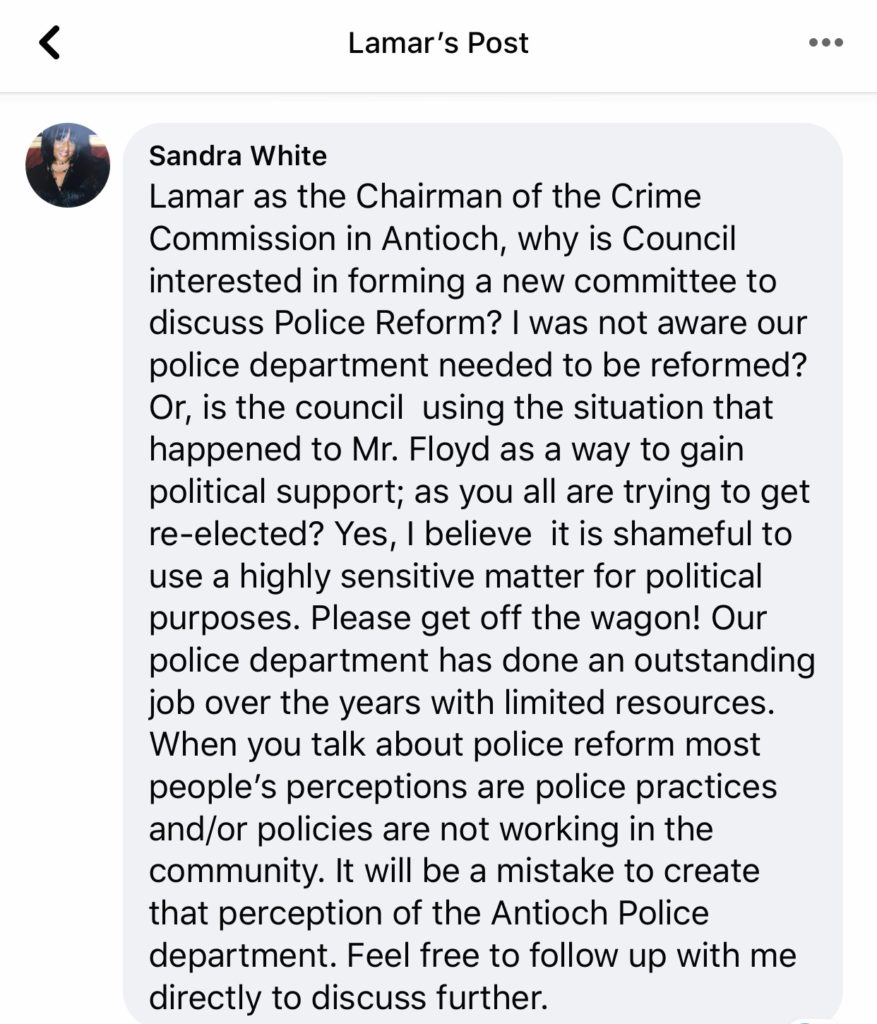
Retired Antioch Police Chief Allan Cantando wrote, “I have to question the motives of councilmember Thorpe in calling for an ad-hoc committee especially as it comes on the heels of Mr. Thorpe sending out a press release regarding APD practices that he knew contained incorrect information. What was your motive in misleading the citizens of Antioch then Mr. Thorpe, and what is it now? It appears that Mr. Thorpe is planting those proverbial weeds in his backyard, just so he can pull them and appear to be a hero.
This is the epitome of political grandstanding and a disservice to the community you are paid to serve. If the city council decides to move forward with this, it should not be an ad-hoc committee, but rather a conversation with our community. Complete a community survey with our residents and then have a community discussion with our residents about the things Antioch police are doing well as well as the things they can improve upon. Once again, Councilman Thorpe, you continue to show that you are nothing more than an opportunist intent on dividing the City of Antioch.”
Jim Becker supporting the formation of an ad hoc committee wrote, “I would support forming it with transparency.”
“Funding police will only increase crime,” another member of the public wrote.
“I do stand with the blue. Without them this city would be hell,” read another letter.
Velma Wilson wrote, “I’m against forming an ad hoc committee…it undermines the leadership of Chief Brooks. T is a black man who has black sons and deals with the same issues as the black community. Let’s not be divisive…that will lead to bitterness in our community. No to the ad hoc committee and yes to a community forum.”
“Every person of color is affected by this system. We need change in this city,” wrote another resident.
The final comment read was by someone named Amber who wrote, “The money taken from the APD budget can be used for more important funds.”
Bill Bunting was on the Zoom call and wanted to know what do police officers have to know to be hired.
However, City Attorney Thomas Smith explained to him, that “Public comment is the time for people to make comment not for Q and A.”
Council Discusses Matter Votes Down Ad Hoc Committee
The council then took up the matter.
“This is obviously a very important topic. I don’t believe we’ve ever had this many comments form the public on a topic,” said Mayor Wright. “I wish we could have allowed three minutes each but that would have taken three times long. There was a lot shared over the seven hours of listening. We heard from both sides. The common thread was that we want to have a discussion. It’s important we have a conversation. Tonight, we’re not talking about what reforms that need to take place. Just what
Mayor Pro Tem Joy Motts was called on, first and attempted to make a motion, but it was disallowed.
“If this is a conversation you want to hold, what is the vehicle you want to use?” Attorney Smith asked. “There is an option of a study session. The ad hoc is outside of the Brown Act, so, there isn’t a public notice required. If the council decides to use that” they would have to decide “who are the members, who would sit on it. It could go on as long as nine months, or even a year. The council would decide the scope of what to be discussed.”
“The study sessions would be the entire city council with reports from the ad hoc,” he explained. “You could have both. You could also add panelists. There would be checklists for the public to have input. This study session is an idea by Mayor Wright. You’d have the entire public involved in the dialogue. If you decide you don’t want to use the tools listed on the agenda, the mayor could call a special meeting to decide the tools you want to use.”
“I just wanted to thank the community for sharing their views,” Motts continued. “This is an important issue. I see Pittsburg already held a town hall in which the police department and the entire council participated. It’s too important of an issue to not include the entire council. I’d like to make a motion that we hold a town hall or community forum as soon as possible and bring the full council together, the police department and community, rather than doing an ad hoc at this time.”
“This is just a process point…the agenda doesn’t identify a town hall as an option,” Smith said. “What you’re calling for if it includes the council as a whole, you can decide tonight…it’s letting the mayor know, then the mayor can call that special meeting.”
“Are you saying that motion is invalid?” asked Wright.
“If it’s the will of the council, you can call a special meeting at any time, mayor, you have the authority to do that,” Smith stated.
Councilwoman Lori Ogorchock said she seconded the motion and then said, “I’ll ask Joy that you include the Police Crime Prevention Commission handle that as a special study session.”
However, Smith reiterated that the motion was invalid because that option wasn’t on the council’s meeting agenda.
“It’s on here, formation of a police ad hoc committee. If she changes it to a study session with the police commission,” Ogorchock responded.
“I don’t think this is something that can be handled by the Police Crime Commission,” Motts said. “I think it’s something we all need to be involved with.”
Smith said the mayor can call a special meeting at any time without this motion.
“When we discussed the motion… it was some sort of ad hoc committee,” Wright said. “The first and the second is a motion they can’t make?”
“We know there are two members that want to have a meeting such as that, if there is a third, which could be you, you can go ahead and take that into consideration and call a special meeting,” Smith reiterated to the mayor.
Thorpe Reads Prepared Speech
“Normally when someone suggests an ad hoc, the person who suggested it gives their two cents,” Councilman Lamar Thorpe said. “I like what Mayor Tem Motts suggested. But not absent the ad hoc committee. All our meetings were public, but they were workshops.”
He then read a prepared statement.
“I’m somewhat blown away,” he said. “I do want to apologize to Councilwoman Wilson. I’m the one who suggested the ad hoc committee. You had nothing to do with that. So, I’m somewhat blown away by that.”
He then said, “I’m not a politician, I’m a father, a homeowner…”
“How long anyone has lived here does not give their voice any more power than anyone else,” Thorpe stated. “Because I love my city, I’m willing to have difficult conversations. I want to make a difference and serve all the people of Antioch. All the people of Antioch,” he repeated.
“I want to just have a conversation about reform. That doesn’t mean a negative,” he continued.
“I find it ironic that a small group of special interests are fighting to keep this from happening,” he said. “Isn’t that why people are protesting on the streets of our nation, today?”
“Let me be clear, I have not attacked the police department. Why is the police department so above us all we can’t ask questions in a public setting?” he asked.
Thorpe then called for the formation of the ad hoc committee.
Councilwoman Monica Wilson spoke next, saying, “All of us tried really hard to hear everyone. The world is changing and communities all over the world are having these discussions.”
“I’m also amazed at the resistance to have this conversation,” she continued. “I always wanted to begin a dialogue with our community. The desire to have an ad hoc committee is because our city can always do better.”
“For those in our community who feel everything is fine, I want them to recognize there are some in our community who don’t feel the same way,” Wilson said. “When we do have these town halls…show up and make your voices be heard.”
Ogorchock, Wright, Motts Push for Study Sessions With All Council Members Present
Ogorchock then said, “I thank everyone for all their emails and phone calls. There is one common thread…everyone wants their voices heard. All council members want to be heard. An ad hoc committee would only allow two council members. We don’t want just one. We need quarterly meetings. I personally want to see us all sit together, so everybody’s voice gets to be heard.”
“To have 700 citizens share how much they care how important this is, and to have a community to want to be a part of it,” Wright said. “To be on an ad hoc committee is very powerful, to go out and do the research. When I wasn’t on an ad hoc committee I didn’t get all the information. Everybody in their own way, everyone of these five council members have let me know they want to be on this ad hoc committee.”
“To be honest, this is too big, too important for our community,” he continued. “What I see is a series of forums…but it would be inclusive of everyone on the council. That’s how big this moment is. Let’s do something that would include all of us to have this conversation. This is a bigger moment, not that ad hoc committees aren’t good and can do a lot of research.”
“We tried to do that before with the cannabis, but it didn’t work, no one showed up. It was too formal for people,” Thorpe said. “I think it limits folks’ participation.”
“When we tried cannabis, we tried to get people to make comments, no one did,” Wright said. “But we had 700 people participate. If we don’t get anyone to participate, we can then go to the ad hoc committee.”
Thorpe then made the motion to create the police reform ad hoc committee. Wilson seconded his motion.
“I just think it’s too big to have an ad hoc committee,” said Wright.
“I was encouraged what Pittsburg was able to pull off,” Motts said.
“What did they do?” asked Thorpe. “They had a meeting and looked at their budget. They didn’t make any change to their police. They didn’t do anything.”
“That’s what I read,” Motts said. “Nevertheless, I do have faith we as a council can handle it. The community has expressed themselves like never before. I can’t see moving forward without their participation and have everyone at the table. I’d really like to try this first and come together as a community.”
The motion failed on a vote with Ogorchock, Motts and Wright voting no.
“Now that we’re talking about an open forum, I really don’t want to wait on that,” Ogorchock said.
“If we look at the next Tuesday, as a fifth Tuesday, we could have our first session,” Wright said. “We really need to have a conversation…what our series of panelists we want to hear. Who should be there?”
“Faith leaders, NAACP,” suggested Ogorchock.
“Let’s make sure it’s a broad group of people,” Wilson stated.
“It’s a series,” Wright explained.
“I think police reform advocates, the 8 Can’t Wait, what are the changes they really want to see,” one of the council members said.
“Crime commissioners,” added Ogorchock.
“I think the Police Crime Prevention Commissioners should be added to it,” Wright agreed.
“We need to hear from the chief, what changes are already being made,” Wright said. “At some point we need to hear from the community, what are our blind spots.”
“I’d like to hear from members of our community who have had issues with the police,” he added. “Maybe an hour for the chief, first. Then members of the community.”
“The sooner, the better, we’re wanting to hear what everyone wants to say,” said Ogorchock.
“So, Thomas I’m going to look to you, if this is what the majority wants to do,” Wright then said wrapping up the discussion.
“Yes. I think you have substantial direction from the council for you to call a special meeting,” City Attorney Smith said. “At the end of that meeting you can have a time for council to discuss items moving forward.”
“I just want to thank everyone for their comments,” Ogorchock reiterated to conclude the meeting. “We want all those 700, there.”
 The Antioch City Council will hold a