




Archive for the ‘City Council’ Category

Antioch Council majority moves forward on bridge housing for homeless using motel, still no details on funds approved in 2019

Wednesday, February 24th, 2021
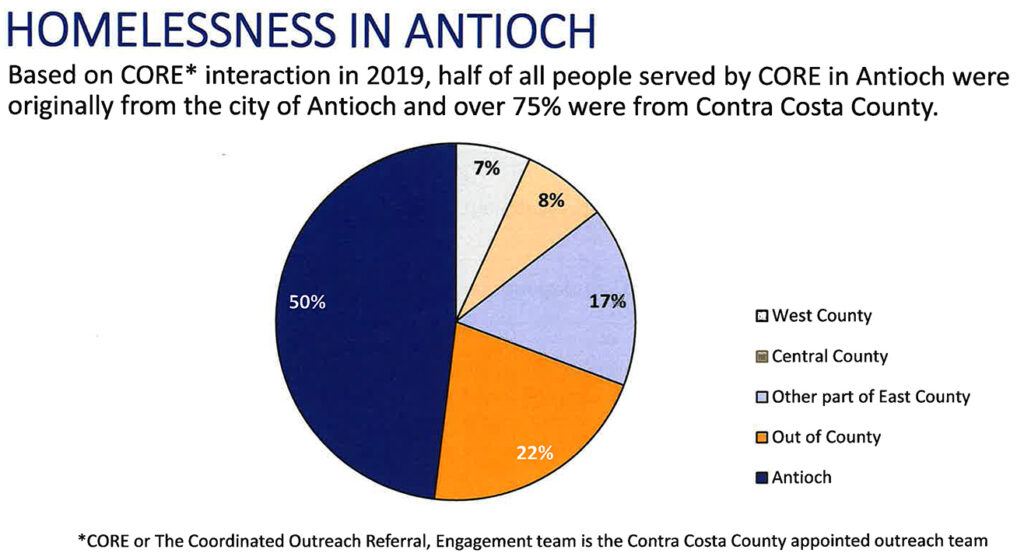
Figures add up to greater than 100%. Graphic from City of Antioch Update on Unhoused Strategies.

3 support 2 oppose before total costs are known; council will also consider Barbanica’s use of Pittsburg motel for Antioch homeless residents; motel not yet selected, only one responded to City’s RFP last year; another RFP will be sent out seeking program operator

Council wants to postpone sewer rate increases due to COVID-19, will decide during public hearing on June 8th

By Allen Payton

During their meeting Tuesday night, Feb. 23, the Antioch City Council split 3-2 on giving direction to city staff to develop a request for proposal on establishing a bridge housing program using a local motel. Councilmembers Mike Barbanica (District 2) and Ogorchock (District 3) opposed the effort. Barbanica instead wants the city to coordinate with the county in securing rooms at the former Motel 6 in Pittsburg to be used for homeless Antioch residents. Ogorchock was concerned about both the “astronomical costs” of the proposed program that will increase each year, and the lack of a total budget.

The council was not provided the total costs for the program because the proposal presented did not include the lease of a motel. Only one motel responded to the request for proposal (RFP) sent out by the city asking if any were interested, last year. Discussions with the owner were ended until the council made the decision to move forward with the bridge housing program and to determine what kind of program would be offered there.

Now, another request for proposal will be sent out seeking an organization that wants to operate the program and will provide what the real and total cost figures will be.

The result is the city still has yet to spend most of the funds from the $517,000 the council approved in November 2019 to help the homeless. Mayor Lamar Thorpe pointed that out and wanted to remind Jazmin Ridley, the city’s unhoused resident coordinator, that he wanted her to implement a motel voucher program amid other ideas, such as providing showers, using the remaining funds. However, Barbanica, said that City Manager Ron Bernal told him only $140,000 of those funds are remaining. Yet, in the city staff report no information was provided to the council of how much of those funds has been spent and on what. A request for a list of expenditures from those funds has been requested from Bernal.

Unhoused Strategies Report

The city’s new Unhoused Resident Coordinator, Jazmin Ridley presented the staff report on the Unhoused Strategies for the city. She shared the statistics on homeless residents in Antioch, that 75% are from within the county, including half from Antioch.
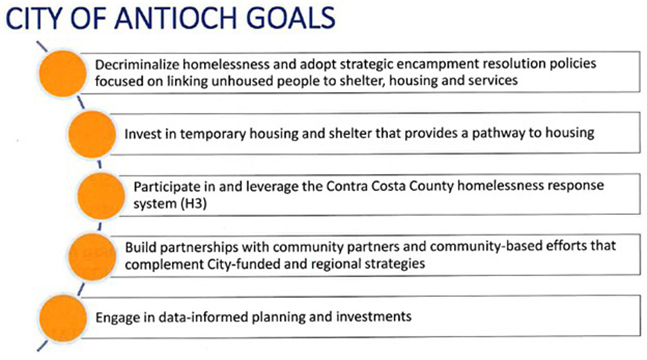
City of Antioch Goals on Homelessness

Ridley also shared about “the goals that we can meet” including:

  • Decriminalize homelessness and develop strategic encampment resolution policies focused on linking unhoused people to shelter, housing and services.
  • Invest in temporary housing and shelter that provides a pathway to housing.
  • Participate and leverage the Contra Costa County homelessness response system (H3 – Health Housing & Homeless Services)
  • Build partnerships with community partners and community-based efforts that complement City-funded and regional strategies
  • Engage in data-informed planning and investments

The program would include 30 beds to serve the estimated 238 homeless residents in Antioch, with stays of up to four months.
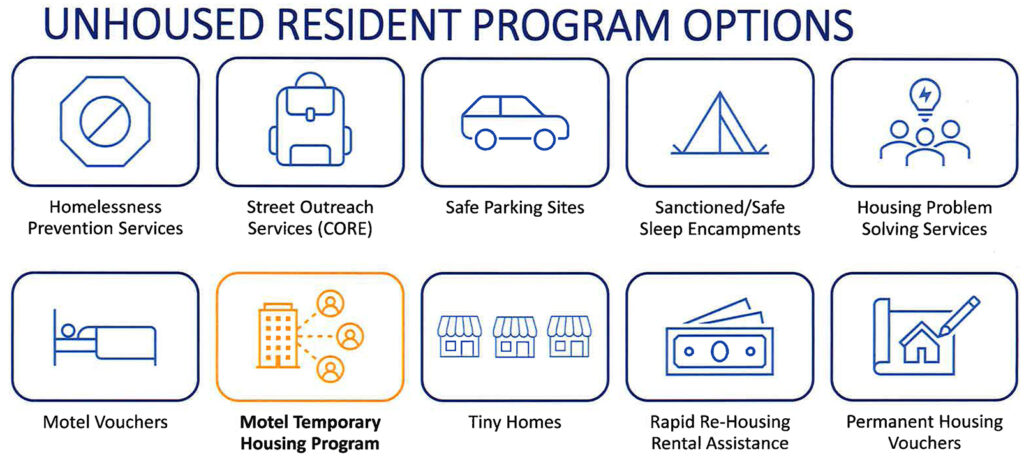
Program Options

Ridley also shared a list of options to assist homeless residents, which include: Homelessness Prevention Services; Street Outreach Services (CORE – the county’s Coordinated Outreach, Referral and Engagement team); Safe Parking Sites; Sanctioned/Safe Sleep Encampments; Housing Problem Solving Services; Motel Vouchers; Tiny Homes; Rapid Re-Housing Rental Assistance; Permanent Housing Vouchers and Motel Temporary Housing Program, which is the bridge housing approach the council directed staff to pursue.

Estimated Program Services Budgets (Without Motel Lease)

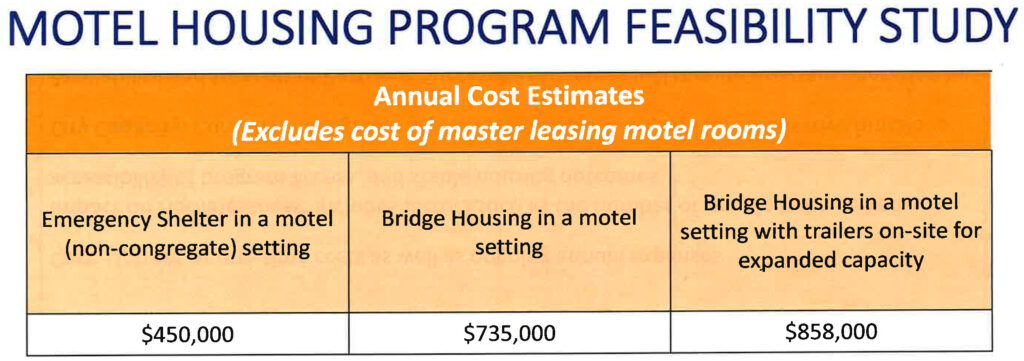
In the proposed annual Services Budgets for the three options for a bridge housing program, most of the money would be used to pay staff salaries and benefits of about $310,300 to $506,219 out of the total estimated $450,000 to $858,000. The remainder would be spent on operations. Only $18,000 to $45,000 would be spent on financial assistance for those in the program. Services Budgets for 3 Bridge Housing Program Options

Public Comments

“The amount of money that the city could potentially spend is outrageous,” wrote George Medeiros. “This way of thinking is why residents are wanting to move out of Antioch. This is not what I call Opportunity Lives Here.”

Michelle Lujan wrote that she supports the bridge housing program.

Nichole Gardner wrote about the help she and her team provided to one woman to stay in a motel, recently.

“This type of project could help so many people,” she said. “Because they too are seniors, are Black and brown and endure injustices by our police department, they too are veterans. It is up to you to be bold enough to do it.”

Lucille Meinhardt wrote, “I support any effort to help those on the streets.”

Joy Motts wrote in support of the effort.

“You have the choice before you tonight to do something about it,” she wrote. “You may say it’s too expensive. But the City of Antioch spent over $1 million moving homeless encampments, last year.”

Mina Guevara spoke on behalf of her father, George offering prepared remarks. (NOTE: Not all of the remarks fit within the three-minute limit. They are provided in their entirety below.)

“He asked me to speak on his behalf,” she said. “As life-long residents of Antioch, we are concerned with how the City of Antioch has dealt with the unhoused population.

Even listening to the speakers tonight, it is painfully frustrating. I respect the work that the consultants and Ms. Jazmin have mentioned. But this is not a new problem. The roots of this problem are not new.  Yet, we are spending thousands of dollars on programs that have yet to culminate in anything besides adding more jobs to people in the city and our unhoused neighbors being overlooked and unwanted.

Today, we know the root of most homelessness – mental health needs, addiction, domestic violence, and often people who work jobs but do not earn enough to live in this increasingly expensive community.  We know what people need. Why can’t we just stop “researching” and “proposing” and start providing?

My family runs a 501(C)3 dedicated to providing food to those in need. We work closely with the homeless in Antioch and East Contra Costa.   As in, often six days a week we are visiting with the unhoused, using the act of breaking bread to build relationships and help find solutions and avenues for supporting these community members who need help.

The thing is, in the last nine months, as we feed people and connect daily – we have yet to see anyone from the City reaching out to help.  Excuse me – I do want to give Councilwoman Orgorchalk credits as she has met with many unhoused neighbors with us many times and has worked to provide the help that we or the individuals were not able to obtain.   For example, one unhoused member had been desperate calling for medical aid from CORE for months.  It wasn’t until Councilwoman Ogorchalk made persistent calls and she get CORE to visit this man and provide him the medical aid he needed.

The unhoused are just as frustrated by the City of Antioch as we are.

How the city is spending our tax dollars is concerning.  As someone who works compassionately and tirelessly with the homeless, I am concerned that thousands of dollars are available, but not available for the people who can benefit most.

I have asked city leadership and staff about where the money for the FEMA trailers has gone. I have asked about the job position of a homeless advisor.   Porta-potties were given and then taken away – the same with water stations.  CORE is inconsistent and offers a band-aid for a solution.  And when I say band-aid, I literally mean band-aids.  And now there is a new program on the agenda – but what faith should we have in you as city leadership to do what you saying you are going to do.  The track record is not great.

Even listening to Mr. Curt, the amount of debris from homeless encampments is frustrating to listen to.  He does acknowledge it is a complicated problem.  But, just as recently as December, a camp was razed and there is more debris now than there was when people lived there.  The dumping problem is easy to blame on the unhoused, but – I’ve seen people come in a make major debris dumps in the camp.  I’ve seen stolen cars stripped.  It’s easy to blame the unhoused – but that is a resident issue – irresponsible residents not wanting to pay for legal dumping.

Ms. Ridley even just stated that data leads to the solution.  So, what I get from that is that thousands of dollars have been invested into this problem and there have been no solutions. And solutions will be layers. But what data can you show me that supports the actions that have been taken in correlation to the money that has been provided for the city.  Transparency to showcase data-led solutions would be welcomed by the community.

It seems like there are problems. We all see them.  We see there is money to be provided for the issues around the unhoused.  But all we see is money being used in non-transparent ways and the problem being pushed from one side of the city to another.

I question how this new program is going to benefit the actual unhoused population in Antioch?  How this money is being spent should be clearly communicated to the public.  How can we trust that you are going to do what you say you are going to do?”

“Antioch residents, housed and unhoused, deserve better leadership and better solutions than this,” Guevara concluded.

Council Discussion & Decision

“We need wrap-around services there…to get to some type of permanent housing,” Mayor Pro Tem Monica Wilson said.

“If you’ll look at the back of the services budget, you’ll see you will have a couple case manager and a couple service managers,” said Kate Bristol of Focus Strategies, the city’s consultant on homeless issues. “The county has a robust variety of services but they’re hard to access. You’re going to have a whole array of different pathways for people to get out back into housing. There’s no one-size fits all.”

“The service providers might be on sight all the time or during the week,” Wilson said.

“The case managers will be there during regular hours,” Bristol said. “But you will want to have someone there all the time. The intensive services will be there during regular working hours.”

Torres-Walker “I get the frustration from the last speaker and it definitely felt heartfelt and my heart is open. As someone who spent their young adult years homeless and sleeping in parks…then moving on to home ownership I can understand how difficult it is to get all the streets.”

“Tonight, we’re not voting on a hotel or a hotel for trailers but a budget and recommendation for services,” she said.

“No. What we will do is be asking staff to put out an RFP (request for proposal)…and giving staff direction to look for great opportunities, like the state’s Homekey program,” Thorpe responded. “We would be asking for the bridge housing request for proposals. We’ve already done the request for proposals for the hotel. We received one. But the negotiations stopped because we didn’t know what kind of services we’ll be providing.”

“I just want to be clear about that,” Torres-Walker continued. “I did talk to Mr. Bernal about the whole motel model and it’s my understanding that’s on hold for several months. Because the Executive Inn is in my district and right up the street from my home. Living here, as well has not been a walk in the park and there’s a lot of work in the community around this motel…that raise a lot of concerns for me.”

She asked that the council “consider as we are spending time to get this set up that we spend time and resources in making the community safe.”

“All of the hotels are in District 1,” Ogorchock said. “So, if this program goes forward it will be in District 1.”

“Do you have the costs for the lease on the motel because it’s not in here,” she said.

“We’re talking about the bridge housing concept,” Thorpe said.

“But that would be part of the cost,” Ogorchock said. “So, even if you’re looking at the bridge housing and motel setting those aren’t the total costs.”

“The final costs will come once we have a service provider,” Thorpe said. “We will send out an RFP and agencies will respond to it and give us the final numbers. We’re not budgeting anything…because there has been no proposal that has the services and hotel.”

Ogorchock pressed again about the total costs.

“These aren’t real numbers. These are rough numbers that Kate Bristol and her agency put together to say this is what they could look like,” Thorpe responded. “We will be able to show what the costs will be once the request for proposal comes back. These are just concepts.”

“What model of best practices have you seen on this kind of project?” Ogorchock asked.

“On bridge housing…is it still the best practice over a community shelter?” Bristol asked. “If you identify the right providers who know what they are doing they will bring their best practices. They are embedded in the way the services are delivered.”

“Can you share the benefits versus the cost on a proven model…another city or someone else that’s doing this?” Ogorchock asked. “One that is city-funded.”

“I don’t have an example of a city of your size. There are some that larger cities have invested in. I can get you their costs and the results,” Bristol responded.

“Are you talking about the San Francisco one? Because it failed, I believe,” Ogorchock said.

“I’m not sure which one you’re talking about. They have several,” Bristol stated. “They started one on Mission Street then started replicating around the city…but that was before COVID. But they’ve been kind of shifting to motels. But the direction in the field in California around best practices is to move to these, somewhat more service enriched shelter approach, that when you leave you exit to housing.”

“Where would they go after four months? Would they just go back to the streets? Ogorchock asked.

“No. That wouldn’t be the goal. You can set a target for a length of stay. You can start with 120 days. That would be an average. Some would stay fewer months, some would stay longer,” Bristol responded. “They could get bridge funding from the county or find another pathway to get to housing. That’s really the job of the folks doing the case management.”

“It’s a difficult topic, trying to find the right fit for the city,” Ogorchock said. “What are the costs versus benefits? What are we looking at? What are the expected outcomes?”

“I would say that the goal of this is to reduce the unhoused population as much as possible within the community,” Barbanica responded. “But my belief…is that we can’t do nothing. Not only is there a human cost, here. But there’s also a cost to the community. The costs you’re seeing here the city is already experiencing.”

“But those costs aren’t going away. You’re talking about 28 individuals going into a hotel,” Ogorchock responded.

“I’m not saying I’m for this program, here. But the time for doing nothing is over,” Barbanica stated. “We have an opportunity…to do something…whether we’re doing all of this or none of this. I don’t want to say the city has done nothing, but there are individuals staying in those hotels, right now. If you don’t find housing for them, you’re going to put them back on the street (at the end of four months).”

“The costs are astronomical,” Ogorchock said. “It’s not going to stop the dumping or the feces or the urine in the river. But if you don’t have the services for them, the mental, drugs and alcohol. If we’re not going to oversee what they’re doing in the room then what are we changing? Instead of giving a helping hand we want to help them out of their situation.”

“We probably should have prefaced this…cities have a choice. We can either continue spending resources…reacting to the situation. That’s solved absolutely nothing. All we have done is accommodate people on the streets,” Thorpe said. “Or we can help house people…so we can stabilize people’s lives so they can get the services.”

“We’ve been paying millions of dollars chasing people from corner to corner,” he continued. “This is bridge housing…Fresno just opened their fourth hotel to adopt this concept to move folks forward into permanent housing. Breaking news, there are no services in East Contra Costa County. Literally we have a CORE Team that we share with all the other cities as an entry point for services that don’t exist in our community.”

“We can stay reactive and waste taxpayer money or we can come up with solutions and provide interim, bridge housing then get them into permanent housing,” Thorpe added.

“We are looking at spending a lot of money. Something needs to occur here, for the community for those who are unhoused,” Barbanica said. “In 2019…over $500,000 has been earmarked to go to the unhoused. We used part of that money to hire the unhoused resident coordinator. There’s at least $140,000 to be spent on temporary housing and literally none of that has been used.”

He spoke of his tour of the former Motel 6 in Pittsburg. It has 176 rooms. “30% of the residents there are from Antioch. It’s a 90- to 120-day program. Again, wrap around services. There’s a doctor on-site. Within 10 days they meet someone to get into permanent housing…either to reunite with family or get them into a program.”

“The county has just received 100 Section 8vouchers…and $3 million for permament housing,” Barbanica continued. “I’ve asked Jazmin to use that $140,000 to help get people off the street.”

“I spoke to (Pittsburg Police) Chief Addington. Calls (for police service) at the hotel, itself have decreased over time. The calls to the surrounding commercial areas have increased,” he pointed out. “They are actually now paying two officers…because of the calls for service in those shopping centers. I’m asking for a hybrid of this.”

“I’ve spoken to Lavonna Martin of the county and she said the cost for this type of program would be about $2.5 million,” Barbanica stated. He then suggested using the $140,000 to pay for rooms for Antioch residents at the motel in Pittsburg.

“It won’t house everybody, but neither solution will house everybody,” he continued. “There’s not enough people in CORE. We need to partner with the county to get some people assigned to Antioch. Let’s not reinvent the wheel.”

“One thing I want to know, Homekey is being 100% paid for by the state,” Ogorchock said. “First responder calls have increased…at that motel. Doing a hotel ourselves is going to be a cost that we’re going to have year after year. These increase year after year, right?”

“You’re going to have to factor in costs going up,” Bristol responded. “You’re going to have that at the Motel 6.”

“But that’s paid for by the county,” Ogorchock said.

“If you get the county to dedicate a certain amount of rooms at that motel, then you can get started sooner,” Bristol responded.

“I know that we are not talking about a motel, tonight. If we were I would be in full support of it, but we are not. It would only be viable in District 1,” Councilwoman Torres-Walker said. “A community that you neglect and overlooked for years and don’t invest in and provide quality police services…I’m not saying this isn’t something that anybody will support. But we should be served as residents, as well. Quality of life is important…you can’t keep asking people to be burdened and give and give and give and not get something in return.”

Wilson said, “We do also need to think about the surrounding community. The Motel 6 idea I would like to hear more about. I know that with the county program that is set up there, most the residents there are either COVID-positive or high-risk for COVID. Is there going to be a way to keep people safe and keep people healthy. If we have a healthy, COVID-free unhoused resident, we don’t want to have them mix in that environment. But I want to hear more about Motel 6.”

“We need to give direction on bridge housing…do we want to move forward on that?” Thorpe asked. “I see Torres-Walker nodding her head.”

Barbanica said “no” as did Ogorchock.

“I see we have a majority to move forward on the bridge housing,” Thorpe said.

“We asked if there was any outreach to the residents around that hotel,” Ogorchock then said.

“We can still do that,” Thorpe said. “We had two community conversations, Mike and I. There seems to be good feedback. Other folks say it should focus on emergency housing, quick and fast. We’ve talked with Rocketship (Delta Prep K-8 school nearby).”

“We are to pursue an RFP on a bridge housing type model and look for grant funding opportunities,” City Manager Ron Bernal said.

“The Motel 6 concept I will bring back to council. If we can do both…let’s get all the information and do a determination,” Thorpe then said. “I know there’s frustration around the lack of spending $500,000. We haven’t wasted the money because we haven’t spent the money. I really want Jazmin to get going on the motel vouchers.”

“I know all council members have been out there. We all get calls. It tears our hearts out to see fellow human beings living in the conditions they are,” he said. “I know every staff member, every council member is committed to this issue to get people on the right path and get them into permanent housing. I want to applaud my fellow colleagues. I also want to applaud the advocates out there for holding the fire to our feet.”

Council Opposes Sewer Rate Increase, But Will Still Hold Public Hearing Process

In other council action, the members unanimously agreed that they want to postpone increases in sewer rates. But the Prop. 218 mailed notification of a potential rate increase and public hearing will still be done.

“It doesn’t mean we have to do the rate increase,” Ogorchock said.

If council postpones the rate increase, city staff said that will mean a greater rate increase next year, rather than smaller rate increases for both years.

“Is it possible CARES money or whatever it’s going to be called, that it can be used to help individuals?” Ogorchock asked. “Or is that a gift of public funds?”

“I believe that will be a question for counsel…because we have a lot of leeway in the use of the (federal) relief funds,” Thorpe pointed out. “That will be a separate agenda item. We need to have staff do what they’re going to do. But when it comes back we don’t have to raise the rates.”

“We are not voting to increase rates. We are just voting to examine this issue,” he said. “After we do the Prop. 218 and have our public hearings, then we will decide if we’re going to raise rates. We are in the middle of a global pandemic and the last thing we want to do is raise rates.”

The public hearing date is set for June 8th.

The council still approved the process for the notification and public hearing, but on a 4-1 vote with Barbanica voting against.

The council then took a break before listening to 215 written public comments, according to the mayor. Plus, 10 people in the audience would speak live, according to City Clerk Ellie Householder.

But Ogorchock asked to suspend the rules to finish the consent calendar, first. The council agreed and approved all the items on the consent calendar.

Thorpe then reduced the time for each public comment from three-minutes to one. Click here to watch the entire council meeting, and listen to all the public comments at the end of the meeting.
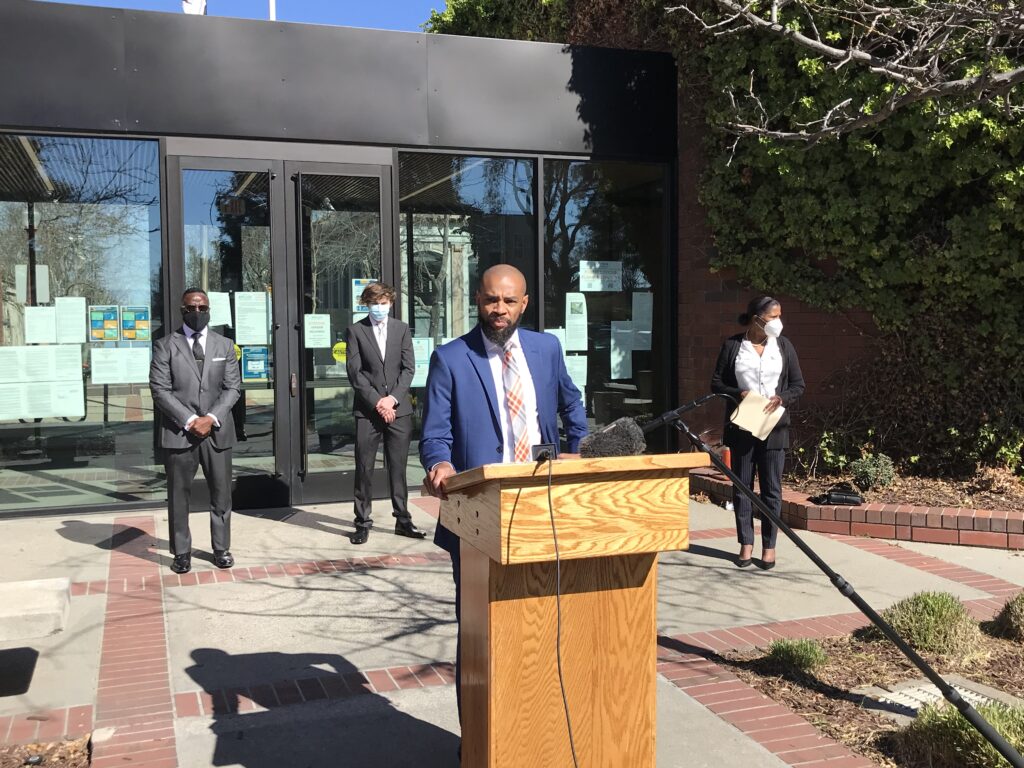
Antioch Council to discuss possible Bridge Housing Program using local motel

Tuesday, February 23rd, 2021

Source: City of Antioch

Program would be part of City’s strategy to transition unhoused community; might include use of five FEMA trailers at an estimated annual cost range of $450,000 to $858,000 for staff and operating costs, does not include cost for leasing motel

By Rolando A. Bonilla, Public Information Officer, City of Antioch

Tonight, as part of the update by city staff on Unhoused Strategies for the City of Antioch the City Council will explore the possibility of implementing a Bridge Housing Program for the City of Antioch. (See staff and consultants’ report here: Unhoused Strategies for Antioch report)

In October of 2018, the City of Antioch was forced to declare a shelter crisis due to the fact that there were no shelter beds available to meet the demand for the city’s unhoused community. From that point, through a series of task forces and ad hoc committees, the city council began the process of developing its policy framework with short- and long-term strategies to support Antioch’s unhoused community, including approving spending $517,000 in one-time funds. To date most of those funds have not been spent. The remainder could be used to help fund the program.

According to the staff report on the agenda item, last year the council approved hiring consultant Focus Strategies who conducted a Motel Housing Program Feasibility Study “looking at temporary program program options that could be operated out of a motel site.” Estimated costs of the program range from $450,000 to $858,000 depending on which option the council chooses.

The report also states, “The planned project will obligate the City to an annual expenditure of between $450,000 and $858,000 for the services and program operating costs excluding the costs of master leasing.”

An email was sent to City Manager Ron Bernal and all five council members asking how much the cost will be for the master leasing of the motel, in other words the cost for renting the 30 rooms from the motel owner.

“There needs to be a strategy that will lead people to permanent housing,” the report also reads.

“As a community, Bridge Housing is the answer we need to solve the chronic issue of unhoused members of our community living on Antioch streets,” said Mayor Lamar Thorpe. “There is nothing more basic and fundamental than the dignity of a place to call home. Through Bridge Housing, we will be able to help our most vulnerable while also strengthening our city as a whole.”

If the council directs staff to further pursue a Bridge Housing Program, Antioch will formally move towards a model that integrates housing and robust supportive services that ensures all residents have access to the assistance they need to navigate into permanent housing.

“As a city, the needs of unhoused residents challenge us on a daily basis.  Contra Costa County is a large geographical area and Antioch is one of 19 cities competing for the County’s regional resources.  A local framework enables us to take direct action and best position Antioch to reduce the number of unhoused residents living in encampments,” said City Manager Ron Bernal. “This kind of approach will improve the quality of life for the entire community.”

According to a recent study, in 2020, the City of Antioch identified 238 individuals as unhoused with half being identified as Antioch natives. Council action to proceed would provide a green light to solicit bids for support services and formally launch grant seeking efforts.  Grant opportunities may encompass support services, housing costs and any capital needs to establish the program, in addition to other strategies identified in the City framework.

Allen Payton contributed to this report. Please check back later for any updates.

Thorpe holds press conference on proposed police reforms ahead of “Police Reform Month”

Monday, February 22nd, 2021

Antioch Mayor Lamar Thorpe speaks on police reform proposals during a press conference at City Hall as Antioch resident and advisor on police reform Con Johnson, the mayor’s policy intern, Lucas Bowman and Mayor Pro Tem Monica Wilson look on, Monday morning, Feb. 22, 2021.

Held prior to report from Bridging the Gap forums is completed; doesn’t invite all council members to attend; interrupted by protester ending presser; media, resident questions answered later

His proposed reform of demilitarizing the police is “so our officers can be seen as public servants not an occupying force.” – Antioch Mayor Lamar Thorpe

By Allen Payton

A press conference by Antioch Mayor Lamar Thorpe, was held Monday morning in front of City Hall, to announce his and Mayor Pro Tem Monica Wilson’s police reform proposals. Announced on his official Facebook page Sunday, it was shown live there, as well. He held it, today in time for what he’s labeled March as “Police Reform Month.” (See video beginning at the 6-minute mark)

Thorpe also invited District 2 Councilman Mike Barbanica to participate, but did not invite Districts 1 and 3 Councilwomen Tamisha Torres-Walker and Lori Ogorchock. When contacted before the press conference, Barbanica said the mayor had invited him, last week to an event, today but didn’t tell him until yesterday what it was about. He heard from residents on Saturday morning that it was going to be a press conference on police reform. The councilman said he respectfully declined Thorpe’s invite.

Ogorchock also confirmed that she wasn’t invited and didn’t know anything about the press conference. When asked why he didn’t invite her, since she has asked several times to have bodycams and dashcams be placed on the council agenda, Thorpe said “Barbanica has been asking for them”. When pressed further he said, “Ogorchock could have held her own press conference if she really wanted to push for bodycams and dashcams.” Torres-Walker did not respond to an effort to reach her for comment.

During the press conference Thorpe said he didn’t know why Barbanica wasn’t there.

“Councilman Mike Barbanica was supposed to be here this morning to talk about body cameras and dash cams,” Thorpe said, and that he hadn’t heard from him. The mayor was later informed by the Herald that the councilman had sent him a message declining to attend.

Thorpe also introduced retired police officer and Antioch resident Con Johnson, who is part of the mayor’s Transition Team, advising on police reform. But he didn’t introduce Lucas Bowman, who said he is the mayor’s policy intern and a student at Stanford University where’s he’s taking a gap year from majoring in either political science or public policy. Bowman said his position is to look into whatever the mayor asks him to but that it’s not an official position and that he hasn’t been hired through City Hall.

Thorpe said the reforms are “Important measures that I’ll be proposing to the city council over the next few weeks. I’ll be working with the chief, city manager and police union.”

First, I’ll start by acknowledging…we did lose a resident who was in police custody,” referring to the death of an Antioch resident, Angelo Quinto following a 9-11 call and interaction with Antioch Police officers on Dec. 23. He died in the hospital three days later. The Antioch Police Department has yet to release any details about the incident. Later Thorpe said, “I learned about it the first week in January on social media and I reached out to the chief about that.”

He then spoke about the drive-by shooting in Antioch on Saturday night which injured a firefighter and paramedic.

“In my hour and a half conversation with the chief last night” he said “there is an 11-and-a-1/2-year-old daughter of the suspect who is still missing with her mother,” Thorpe stated.  “Community cameras did help” in the capture of the suspect. (See related articles here and here)

“Police reform has made it to the halls of Congress,” Thorpe then said, and that there are some government agencies that haven’t taken on the issue. “I’m saddened to say, in the area of police reform that’s Antioch. Luckily, the voters have more foresight than those who will divide us over political rhetoric of pro- and anti-police views.”

He then spoke of “common sense solutions…police reforms…so our officers can be seen as public servants not an occupying force,” and that the “reform measures are really a framework.”

Antioch Mayor Pro Tem Monica Wilson speaks on police reforms dealing with mental health.

Mental Health

“The first area is around mental health which has to be the focal point of our reforms,” Thorpe said. “We will seek to have a mental health crisis response team here, in Antioch.” That includes his plan to “have our officers and dispatch workers have mental health review each year.”

That includes the formation of a Mental Health Crisis Response Team, to have mental health professionals respond with police to 5150 calls.

Mayor Pro Tem Monica Wilson then offered prepared remarks about mental health issues on a national level and called for “reducing fatal police shootings in the United States,” and “treating the untreated.”

Wilson then spoke of local government dealing with “homeless related 9-11 calls” and “investing in community-based violence prevention” and to “invest in evidence-based programs that work” and “restorative justice school-based programs.”

“Without the financial investment…we will miss the moment to impact change,” she added.

Police Training

“Ongoing training is critically important,” Thorpe said. He proposed “we establish a training paradigm that is reviewed annually” that includes “implicit bias training, conflict resolution” and how to deal with “LGBT and gender nonconforming individuals,” among others.

Demilitarizing Police

His next proposed reform is on “demilitarizing our police,” saying “sometimes our local police department looks like an occupying force…tanks on our street.” Thorpe proposed an “immediate ban on purchasing military equipment.”

Police Accountability & Transparency

The next reform he spoke about was police accountability. Thorpe pointed out that it’s the mayor’s responsibility to place items on the agenda.

“If it never came back the former mayor decided to not bring it forward,” he said. “We will bring it forward in March.”

Thorpe spoke of having an independent review of “on-duty complaints of police – either in City Hall or establishing an independent” body to review complaints “within 120 days.”

“The police investigating their own department…not everyone believes that that’s fair,” he added.

He wants to “ensure when police officers conduct a stop they give their names and badge numbers and give out a card” with how complaints can be lodged.

Thorpe proposed forming a “council subcommittee on police oversight, first.”

“We will review and audit all police complaints,” he said. “We will proactively review our use of force policies. We can do it here and move those responsibilities over to an independent group.”

Hiring Policies

“We want to make sure that moving forward that all candidates who are currently under investigation will be disqualified from the process,” Thorpe said, as well as those lateral officers who have a history of citizen complaints. He mentioned requiring officers take an “implicit association test.”

His reforms include the hiring process for the chief of police, “that is open, transparent and inclusive of the community.”

Communications With City Officials

“Lastly, the first phase of police reform is…what the mayor and when the mayor and city council will be communicated to,” Thorpe stated. “We can’t be left to social media to find out what’s happening…(it) is simply inappropriate.”

“There will be more to come as we’re wrapping up the community conversations,” he added. “If anything that derives that is out of this framework then we will discuss those.”

Questions & Answers

Asked why the he held the press conference, now, before the report by CNA on the Bridging the Gap forums, Thorpe responded, “that was never intended to inform for police reform for what I’m proposing. We’re at the end. We’re going to hear it. But laying out this information, now is not premature.”

In response to a question about the mental health response team, Wilson said, “we looked at several models in Eugene, OR which has been taking place for the past 30 years. It’s a team that works with the police.”

The press conference was then interrupted by a man complaining that the mayor blocks people on Facebook. When the man wouldn’t stop yelling Thorpe abruptly ended the presser. He then took questions from members of the media and the public.

When asked, “where will the money come to pay for the crisis response team?” Thorpe responded, “That’s what we’ll discuss as policy makers. We have a $40 million budget reserve. All of this talk of defunding this and taking it from there has not come from council members. I believe there are plenty of funds.”

Asked if the Unhoused Resident Coordinator will be going out with police when they engage with homeless residents he responded the existing Community Engagement Team and the Crisis Response Team may be a combined. “We may disband the Community Engagement Team and have them handle issues with the homeless,” Thorpe stated.”

“Do you support turning on the police radios?” he was asked by Antioch resident Lacey Brown by telephone.

“That is something I believe the police department should have over them,” Thorpe responded.

Regarding the death of Quinto, Thorpe said, “I learned about it the first week in January on social media and I reached out to the chief about that.”

Thorpe’s Prepared Remarks:

“Since the murder of George Floyd, there has been a national and global awakening that has made the streets of our nation the epicenter for expression, frustration and hope including right here in Antioch.

Nationally, the awakening made its way to the halls of Congress, made its way to state legislatures, and made its way to many, many local jurisdictions throughout our state. With one notable exception, Antioch City Hall.

If our police department is doing the same things in five, ten, twenty years, we have failed as a city because we did not evolve with the times including our changing demographics.

Luckily, the voters have more foresight than those who seek to divide with “pro” and “anti” law enforcement political rhetoric.

Voters recognized that “reform” is synonymous with progress, improvement, betterment, refinement and adaptation.

In that spirit, today, I am announcing a series of police reform measures that I am proposing as a major first step towards building a police department that every segment of our community can trust.

If looked at objectively, I am seeking to implement common sense solutions that will provide our police department with the necessary tools to do their job in a manner that will allow for our community to feel safe and respected, and equally, will allow for our officers to be seen as public servants and not an occupying force. At the end of the day, the police is the community, and the community is the police.

I firmly believe that police officers are public servants who enter a very difficult vocation where they put their lives at risk on a daily basis, however, it cannot be ignored there are major structural problems in law enforcement when the very members of the community that they are tasked with protecting are afraid of law enforcement.

Through these reforms, I am seeking to build a pathway that will bring us to a place where the community and the Antioch Police Department are partners in preventing and solving crime in our city.

Until then, we have much work to do.

Conceptually, these police reform measures are a framework to begin our work as policy makers.

1. Mental health has to be a focal point of our reforms and not just limited to how law enforcement responds to mental health distress calls but the actual mental health and wellness of our law enforcement personnel. Therefore, I’ll seek to:

a. Require an annual mental health assessment of police officers and dispatch workers

b. Establish a local mental health crisis response team (For that I’m handing over to Vice Mayor Monica Wilson to discuss a measure she’s been developing regarding mental response).

2. Establish a training paradigm, publicly reviewed/updated annually, built around the following principles: 1. Procedural justice; 2. Relationship-based policing; 3. Implicit bias training; 4. Crisis intervention, mediation, and conflict resolution; 5. Appropriate engagement with youth, LGBTQ, and gender nonconforming individuals, English language learners, individuals from different religious affiliations, and individuals who are differently abled; 6. De-escalation and minimizing the use of force.

3. Demilitarize the Antioch Police Department:

a. Ban the City of Antioch Police Department from purchasing and/or accepting military style equipment from federal, state and private entities.

b. Ban the City of Antioch Police Department from deploying any militarized equipment.

4. Increasing police accountability and transparency:

a. Equipping our officers with body worn cameras;

b. Outfitting our police vehicle with dash cameras;

c. Independent review of on-duty police officer complaints either by moving components of the current process out of the police department or establishing an office of police officer accountability (receive, investigate and resolve all civilian complaints against on duty police in 120 days).

d. Require that during all police stops, officers give civilians their name, badge number, reason for the stop and a card with instructions for filing a complaint.

e. Establishing an additional avenue to on-duty officers to report misconduct outside of the current process that requires officers to go directly to a supervisor and chain of command.

f. Establish an interim City Council Committee for Police Oversight (Committee of the whole) until the establishment of an independent police oversight commission, to:

i. Review and approve policy for the police department with community input and expertise.

ii. Review and audit police complaints.

iii. Review resolutions of disciplinary actions.

iv. Proactively review police use of force policies updating the community regularly.

5. Improving police hiring practices to ensure Antioch is not a stop for police officers with troubled pasts:

a. Establish a Chief of Police hiring process that is open, transparent and inclusive of the community

b. Consider incorporating Implicit Association Test (IAT) into hiring process

c. Lateral candidates who are currently under investigation for “excessive use of force” and/or ‘misconduct’ or have a sustained ‘excessive use of force’ and/or ‘misconduct’ complaint on their records will be disqualified from the process

6. And, establishing a notification system that clearly lays out what and when the Mayor, City Council, City Manager and City Attorney should be communicated to concerning major incidents related to the Antioch Police Department.

Today, we take a first step in giving the Antioch Police Department back to all of its residents.

It is my hope that my colleagues rise to the challenge and recognize that those who are fighting to stop us from having this conversation are already on the wrong side of history.”

Please check back later for any updates to this report. Wilson also agreed to send her prepared remarks which, once received, will be published verbatim.

Payton Perspective: Equity is code word for socialism, what will be the cost for Antioch?

Thursday, February 18th, 2021

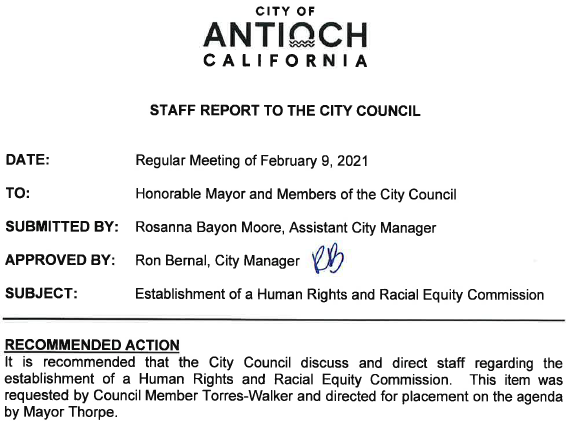
Antioch’s new Councilwoman, Tamisha Torres-Walker and her supporters, including those from outside of our city, have been pushing to include the term “equity” in the City’s vision and goals, and want the council to establish a Human Rights and Racial Equity Commission, as well.
During last Saturday’s Vision and Strategic Planning session held by the council and city staff, Torres-Walker was asked to explain the difference between equity and equality. She basically said equality is the government giving each person the same thing while equity is giving more to one person who doesn’t have as much as another. The challenge is where does government get what it gives out? Taxpayers. So, what Torres-Walker is advocating is more redistribution of wealth. That’s pretty much the definition of socialism or even communism.

She used the example of a short boy standing next to a tall boy behind a fence, who are both trying to watch a game. Torres-Walker  said equality is the government giving each boy a box to stand on, which gives the tall boy a better view while the short boy still can’t see over the fence. Equity, she said, is giving the short boy two or three boxes to stand on to see over the fence.

Torres-Walker also mentioned later in the meeting that she wants the city “to make sure that the development of the waterfront that some of that equity or you know whatever revenue generation is spent to also revitalize some other parts of District 1” further defining the term as redistribution of city revenues. (See related article)

However, what our government in the U.S. is designed to do is offer equality of opportunity, that we all start off equal with regards to life, liberty and the pursuit of happiness, or in other words ownership of property. But what Torres-Walker is advocating for is equality of result. That’s unrealistic and simply unattainable. There is simply no way that government can or should ensure we all end off equal.

I would love to have that happen to me, too. Using equity, I can claim that it’s not fair Bill Gates has so much more money than me. Therefore, I need the government to take half of his money and give it to me. Then I could have a nicer car, bigger home and invest in all the various causes like he and his wife have done. I would also like some equity in the area of pro sports. I can claim it’s not fair that I didn’t and don’t get to play for the Oakland A’s, the San Francisco 49ers or Golden State Warriors and earn all the money the players on those teams do. I need the government to offer some special dispensation for older, out of shape guys like me, without as much talent as the other players, so I too, can enjoy playing and earn a nice living.

See how ridiculous that is? Where does it end?

Why shouldn’t I have half of Bill Gates’ money? It would mean we would be equal and achieved equity. But would that be fair? Of course not, because I haven’t earned it. Why shouldn’t I have been allowed to play professional sports when I was younger or get to play, now? Because I didn’t make the effort or have the talent to do so, and because I’m certainly no longer in shape. (Maybe I could be a designated hitter, as long as I wouldn’t have to run around the bases! LOL) Seriously, why then, should the government step in and attempt to balance the scales that I chose to leave unbalanced by my own life choices?

Why should the government give the short boy more boxes to stand on? Why don’t his family and friends do that for him? Or some nice “box for viewing sports” charity? We need to stop looking to government to solve all our problems and let it focus on what it’s designed to do.

I have and always will support the efforts of churches and charities to help, as Jesus said, “the least of these” and as the Disciple James wrote, “to look after widows and orphans in their distress”. But that’s through voluntarily helping others, not through coercion by a larger and more powerful government.

Of course, government must treat all of us equally in the provision of justice and services, and the City of Antioch needs to ensure all residents are treated equally and fairly, as well. When and where that doesn’t occur, it must be addressed. But that’s equality, which our government can guarantee, not equity which it can’t, in general.

However, if it’s the government that has caused the inequity, then it is government’s job to address it in very limited circumstances. I believe the only way equity should be addressed in our country is at the national level through the federal government, specifically in the area of reparations for descendants of slaves – who for generations were denied, due to laws and other actions by the government, their God-given, constitutionally-guaranteed rights to liberty, property and in many cases life, itself, as well as an education and to earn from their labors. The descendants of slaves need to be compensated with land – as ordered by President Lincoln’s Union Army General William Tecumseh Sherman but was later overturned by Lincoln’s predecessor, President Andrew Johnson, following the assassination – an asset that can be owned, used, earned from and passed on to future generations, which is a current, major challenge among African-Americans. That’s due to the fact their ancestors were denied the right to own property for 250 years because they were property! But that’s a discussion for another time.

While I recognize we already have implemented forms of socialism at the state and national levels through health and welfare programs (some of which have had questionable results), the issue for the council members to determine is how much would such an effort cost the City of Antioch? The city budget has already experienced a $3 million reduction due to the COVID-19 orders, this past year and that in spite of Measure W’s one-cent sale tax that we the people voted for. This at a time we’re trying to increase the number of police on our force to continue to reduce crime in our city. Stepping back, the council actually would first need to show that inequity exists in the dispensing of city services. That burden frankly rests on the shoulders of Torres-Walker and her supporters who are advocating for the use of the term and the commission’s formation.

The mayor and council members need to be very careful with the terms they include in the City’s vision, mission statement, goals or any and all other documents, and be sure what they mean and that the public understands them. Because equity is such a loaded word, with a broad definition, that it could end up either costing us taxpayers a lot more money or take away funds from the more basic services the city needs to be providing that serve all of us, specifically police – the number one reason our city government was formed in the first place, because the number one reason government is instituted in America is to protect your rights from me and my rights from you – Code Enforcement, streets, water, sewer, landscaping, parks and keeping things clean. Plus, recreation.

I’d like to see the city improve and be great in those areas, first before taking on more programs and efforts with unknown price tags.

If the council members want to ensure children and other residents from low-income households get to participate in city recreation programs that are too expensive for them, then the council members can work with local charities or their own Antioch Community Foundation to provide subsidies or scholarships.

As for forming a commission, Torres-Walker doesn’t seem to realize we already have officials in place to address any human rights or racial equity issues – that she has yet to provide examples of – and she’s one of them. The City Council as a whole and any individual member can take complaints that any resident or business owner might have and address them on a case-by-case basis, just like a commission could do. If the complaints begin to be too many, then that can be brought before the council. If the complaints are mainly police related, then perhaps increase the role of the existing Police Crime Prevention Commission as has been suggested during the Bridging the Gap sessions. Or the council might just need to ensure whomever on city staff is causing the problems is replaced.

But unless and until there is clear evidence that such a commission is needed, it shouldn’t be formed as the Board of Supervisors recently did. Let’s see what their county-wide commission does and how they deal with such matters that come before them, first.

The council should not include the term equity in their vision, goals or any other guiding document for the City of Antioch nor form the proposed commission. If they do, the council members will be opening a Pandora’s Box of all kinds of potential increase to the size and scope of our city government and will most likely lead to a decrease in the basic services the city already is and should be providing which benefit all of us.


Antioch Council members push for more spending, programs and “equity” during Vision and Strategy Planning sessions

Tuesday, February 16th, 2021

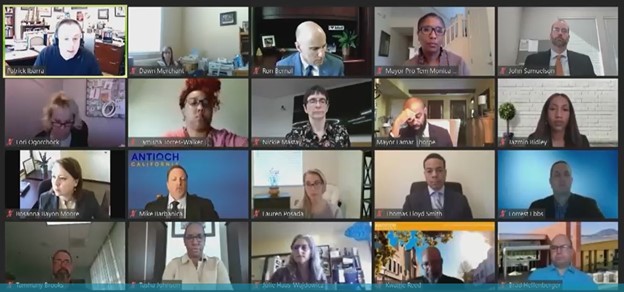
Antioch Councilmembers and city staff participated in Vision and Strategic Planning sessions under the guidance of a facilitator on Friday and Saturday, Feb. 12 & 13, 2021. Video screenshot.

By Allen Payton

During their Vision and Strategy Planning sessions Friday night and Saturday morning, Feb. 12 and 13, the Antioch City Council members proposed spending more on current programs, creating new ones and spoke of including “equity” in their plans. Mayor Lamar Thorpe wants youth programs, not just youth recreation, funded; Mayor Pro Tem Monica Wilson wants a youth representative on each city commission; District 1 Councilwoman Tamisha Torres-Walker pushed to include equity in the City’s goals and wants the city to pay for cleaning up trash and ensure food security in her district; District 2 Councilman Mike Barbanica wants to double the size of Code Enforcement; and Councilwoman Lori Ogorchock proposed more senior housing projects.

They also heard from several members of the public, including residents of other cities, the word “equity” multiple times and that it isn’t but should be included in the City’s vision statement. One speaker used Oakland as the example of a city with the word equity in their vision statement. (See the City’s adopted 2019 Strategic-Plan-for-Antioch)

Friday Night Session (View here)

Much of Friday night’s session was devoted to the hired facilitator, Patrick Ibarra, laying the ground for their work on Saturday. But it also included the opportunity for council members to define their roles and those of the city manager and department directors. All the members but Torres-Walker offered their comments on those matters. However, she was much more vocal during Saturday’s session.

City Manager Ron Bernal also gave an overview of the city council’s accomplishments and actions over the past three years.

The session concluded with public comments. In addition to racial, social and gender equity, comments either submitted in writing or called in were about racial and housing justice, as well as downtown revitalization and taking advantage of the city’s waterfront.

Saturday Session (View here)

At the beginning of Saturday morning’s session, the consultant asked the council members for input on the vision and mission of the city.

“Local government isn’t to just sit there and move public policy but to give services,” said Torres-Walker “What services do we have the authority to do and advocate for? So, I’ve been appreciative of that type of my thinking because I’m new here. Being able to challenge those things we can’t do or don’t have the political will to do.”

“There’s been some shifts in who we say we are,” she continued. “People are demanding more dialogues around race and equity. It’s been a great demand. I think people are demanding a more robust conversation about those things especially here, in Antioch.”

“I also want to bring up another thing and that is we are volunteering,” Torres-Walker said, although council members now each receive $1,600 per month stipend plus medical benefits. “Most of work full time. It’s a thankless job, sometime. We are volunteering, trust me. People who are serving…are volunteering. Staff are being paid, and paid well in this city, to serve residents. And it’s our job as a council to work with Ron to make sure morale is up. Not everybody is here volunteering. Some people are here being paid and paid well to serve our community. I just wanted to make sure that was clear.”

“I want to make clear that most of us have been open to change,” Thorpe said. “Most of us don’t get caught up in the social media, stuff. We’ve gone directly to the public on certain issues. We’ve had opinion polls. That’s how we found out homelessness was a top issue with the public.”

“One of the things I use social media for is to get public input,” Barbanica said. “I ended up getting pages from people. It was at that point a tool to get input from people.”

“I saw that. Some of us do that, as well. I hope you don’t take that comment. The social media nonsense. He blogs and the newspaper articles and comments on there,” Thorpe said.

“I want to point out…Facebook. Not every resident can be engaged on Facebook,” Torres-Walker then said. “That doesn’t capture the entire need. It doesn’t capture the story of the entire community. Older people don’t use social media. And young people don’t use Facebook. Sometimes it just looks like getting out there in the streets and talking to people.”

“Like my teenage niece tells me, Facebook is for old people,” Wilson. “And social media is a double edged sword. Sometimes you have people attacking you and they’re from a city 50 miles away. You have to make sure you’re communicating with the community. Social media, yes, I agree, it’s important, but we have to learn how to use it. People use it more times than not to attack you. But you have to be careful with it because it’s a double-edged sword.”

“Cities are revisiting the content and the delivery system,” said the consultant. “Both in print. People still read that. How people are gathering their information and on all the different platforms. We’re way past websites. Some are conventional.”

“All those points are great points. What’s interesting is people want to hear from their elected officials. And it’s amazing when the city has a meeting about a particular issue, we had

“When council members had ad hoc meetings, I was blown away by the participation. Because council members were promoting their meetings,” Thorpe said.

“One thing I want to bring up is technology and service delivery. Since COVID, now we’re more proactive. More services are available online,” Ogorchock said.

Current Role of the Council

Ibarra then asked about “the current role of this council as a community builder. Is it just the continuation of the past? Are residents’ expectations rising or falling?”

“They’re rising. In the past it’s always been reactionary,” Barbanica said. “When you have businesses come into the community I thought never would. But cannabis businesses…had a tax base there that got us through this time. What is the forward-looking vision of this city with the participation of the community?”

“There are great roles for the council, at this time. There’s a great demand for advocacy…for resources. From that silent majority, from those who feel like they’re not heard,” Torres-Walker said. “It’s become more of a demand in Antioch over the past two to three years.”

“Local government is by nature a demand-based business,” said Ibarra. “Sometimes it was functional, water, sewer, roads. But…you also have an infrastructure…which is outside the traditional local government role.”

“Looking at the things we’ve been doing, I think we’ve been on a continual change. I’ve not been an advocate for cannabis. Is that on a money thing? No.  I don’t think we sit on our laurels,” Ogorchock said. “We’ve had influencers from outside our city. We need to find a way to get more involvement from our community. Council meetings people don’t attend… is it because us council members are pushing them more on social media? Advocacy. I think we’re starting that. It’s an exciting time. I think it’s a difficult time.” Ogorchock

“We definitely need to keep the out of the box thinking…finding comfort in discomfort,” Wilson said. Then referring to cannabis businesses she said. “at a time we received a bunch of push back. But pushing things people aren’t thinking about. Have we thought about hydro energy. We are at a time we have to push the envelope and thing outside the box. I would like to keep going in the direction…take the chance of moving our community in a positive direction.”

“Now everyone is jumping on the cannabis bandwagon,” she said.

“Too late for them,” Thorpe interjected.

“Why don’t we try to be a leader in the next industry?” Wilson asked.

“It’s not a bottomless checkbook. So, we have to prioritize those things with what’s going to benefit the community,” Barbanica said. “The pie is only so big.”

“I like that point…because it isn’t a bottomless checkbook,” Thorpe said. “But I feel our role changed post-Measure W. We took a mind shift that we’re not just going to fund one department. It allowed council members to start looking at…homeless services and youth programs. Not just parks and recreation. The community was already there. It just took time for government to catch up.” (But what has the city actually done for either the homeless or youth programs?)

Vision Statement

The City’s current Vision Statement reads, “Antioch is a desired destination in the Bay Area: Building on our historic legacy, creating bright opportunities for families to grow, offering places to play, enabling businesses to thrive and cultivating a unique downtown experience.”

Speaking about it, Barbanica said that, while the downtown area is important. “We have a broader city”.

“I don’t see anything in there about building healthy communities,” said Torres-Walker. “It felt like a hotel commercial. It is kind of dry. But I know everyone did the best that they could.”

“I remember when we were doing this…someone told me a camel is a horse built by a committee,” Wilson said. “I don’t know our vision by heart. We were using the Chamber’s vision. It can be more inviting.” But she wanted more public input, first.

“I kinda just went back to the first page of the Strategic Plan…opportunity lives here, enhance, transform, revitalize,” Torres-Walker said. “I’m wondering if that’s what drove the words going into the mission. The whole opportunity lives here means something and I’m hoping to hear from council members who’ve been here, longer and could the vision expand on what that means. We can’t wordsmith, today but

“Opportunity actually came from the community, from focus groups,” Thorpe said. “Some people had more of an opinion about our vision than others.”

“There’s an actual intro to the actual mission and vision…and it actually has words…thriving community…bright future…high quality of life,” Torres-Walker pointed out. “I think, yeah…some of those words…a community where you want to be could trickle down to be the words of a new vision statement.”

“Maybe use this as a baseline, or starting from scratch,” said the consultant. “There are a lot of ways communities create visions…rather than checking boxes.”

“If you look at the efforts under our branding…it required people to look introspectively,” Thorpe said. “So, it’s something around this word opportunity…things that already exist that we could work with.”

“Your brand is your reputation and what you’re trying to aspire to,” the consultant said. “Maybe we could have more opportunity to do outreach.”

Mission

The City’s current Mission Statement is, “To deliver quality services with integrity, excellence and innovation.”

“The vision is where you’re going the mission is how you get there,” said the consultant.

“A suggestion…would be to have some kind of competition,” Ogorchock said. “Wouldn’t it be fun to adopt it from some kind of competition? It’s not about us five but the community.”

“Isn’t a mission statement longer than a vision statement?” she asked.

“Less is more…it should be compelling. If people can’t remember it then it’s less effective,” the consultant.

“I personally don’t see a problem…I think it’s clear,” Torres-Walker said. “What I want to get into is the values.”

Values

The council then discussed the City’s values. Currently they are listed as, Integrity, Honesty, Respect, Diversity, Transparency, Innovation, Fiscal Responsibility and Accountability.

“We draw strength from these in our personal lives…they are the thread that binds us, together,” Ibarra said.

“A lot came up around the county’s commission on Racial Equity,” said Torres-Walker. “So, I was just looking at these values and think racial values or at least equity should be in there. Stuff like belonging came up, justice came up. Just a couple words. Equity is not in the strategic plan. I don’t think it’s in there, once.”

“I would say that values like integrity, honesty and respect all mean the same,” Thorpe said. “I don’t recall why we called them out like that. And transparency. You can’t be transparent without integrity. I think we need to call out things like the environment, as well…environmental sustainability.”

Equity Defined

“When we’re looking at this and saying racial equity, how does that change from equality for everybody,” Barbanica asked Torres-Walker.

“Equality doesn’t always mean equity,” she responded. “A difference between inclusion…for those who have not had access whether to service or rooms…like BIPOC, Black, indigenous, people of color community. And I want to point out poor people, as well. Poor people need to know they have equity. If you’ve ever done educational organizing…there are two children both trying to see a game…behind this fence. The taller child has a better view. What does society do? We give a crate to each. But the short child still can’t see over the fence. Then we have equity, and we give the shorter child two or three crates so the shorter child can have the same view. So, that’s the difference between equality and equity.”

“On the equity, it’s kind of open, so wouldn’t it be more fair to say racial and social equity?” Ogorchock asked. “Equity is very open. Two words I’ve also written down are diverse and inclusionary.”

“I would say that diversity and inclusion are included in equity,” Thorpe said. “But when you stop short at diversity…you miss the mark on equity and who has access to what. Who has access to community parks? Who has access to participate in the astronomical costs of our parks and recreation programs? So, diversity can almost be dangerous as it hides what is systemically wrong in some of our institutions.”

Hot Topics

“These are issues brought up to me by the mayor and council in our pre-session phone calls…to ask your perspective. You’re not voting on these,” said Ibarra. “Some of these were mentioned by several of you.”

Youth Programs and Services

“Being very inclusionary…when youth are voicing their opinions…making sure their voices are heard,” Wilson said. “I’ve said we should have youth voices on all of our commissions.”

“Youth programming, we shouldn’t cconfuse it with some sort of parks and recreation. What we wanted is a city that’s meeting the needs of all of our youth at all levels,” Thorpe said. “This has to do when police interact with our youth. When we do summer hiring of youth.”

“Youth development is totally different than providing a program that youth can go to…it’s about next generation leadership in the city,” said Torres-Walker. “And when young people own the community they live in, they protect it and aspire to lead it, someday. So, it’s about who we invite in the community. We have high population of foster youth in the community. We have a lot of youth who have experienced trauma. We have homeless youth. You may not see them but they’re there. We have a lot of youth in Antioch affected by the justice system. So, I think that it’s a bigger discussion than just programs. And I’m hoping we can get more youth voice involved in the process.”

“I agree, we need to do something in our community, if you look back years ago, we always had something for the youth to do,” Barbanica said. He spoke about the Youth Center in Concord, funded by developer Ken Hoffman that included activities and tutoring. “We have CVS on Somersville that’s been empty forever. A lot of these kids didn’t have funds for these programs. But there was enough money for them. Why can’t we have things like that?”

“You have capacity issues, time, staff and money,” Ibarra said. “You have partners. Some of these are your role. Is it about expanding the role going forward?”

“So that there’s context, the city has been working on this issue and we’ve been putting the pedal to the metal as hard as we can,” Thorpe shared. “We’ve hired a youth services network manager…we passed Measure W. So, the city is dedicated to youth programs. It was a clear mandate by the citizens of Antioch. This is a citywide effort that we’re committed to youth development in coordination with the school district.”

“I just want to caution us to be careful…when we create programs and services, we sit down with youth and ask them what they want,” Wilson added.

“We want to make sure…the services are so important for our youth, to make sure they have WiFi,” Ogorchock added. “We have good number of group homes. How can we be of help to the youth in those group homes? We need to make sure they continue after COVID.”

Downtown

“People have called the downtown the living room of the community,” Ibarra said.

The council then discussed what they defined as downtown.

“I think it as the waterfront,” Barbanica said.

“For me there’s the downtown and then there’s the waterfront,” Wilson said. “The waterfront runs from Oakley to Bay Point.”

“When I think of downtown, I think of Rivertown,” she added.

“Me being an old timer, here, it’s 10th Street north to the water from L Street to A,” Ogorchock said.

“The Downtown Strategic Plan, it’s what Lori said,” Community Development Director Forrest Ebbs said. “From 10th Street north, and Auto Center Drive to A Street.”

“We’ve heard things in the past like ‘a destination’, ‘an experience’,” Thorpe said. “I’m not always clear that we’re clear about the policies that need to be enacted.”

“I would love to see more use of the river,” Barbanica said. “We have this huge resource. We could have a river walk down there. A beach has been proposed. My thought is we drive shops and businesses down there. But we have a night life…where people can walk and there’s dining and entertainment.”

The city’s current riverwalk, known as the promenade and approved by the city council in the 1980’s, runs from the circle at the end of G Street to the circle next to the Veterans Memorial at the end of L Street, and includes the zig zag into the circle at Waldie Plaza. It also runs from E Street toward A Street where the white metal barrier runs next to the sidewalk.

“The river is a gem. The downtown is a gem,” Ogorchock said. “We need to do infill projects down there. Things are happening down there. You can see the change. You can feel the change. I enjoy being down there and walking around. It’s just a huge asset and one we need to monopolize on.”

“There was some confusion,” Wilson said. “Maybe even four or five years ago, there was a push of being the antique destination. Some are still there but most have moved on. The dining district that’s being created…we’re starting to see some livelihood down there. That seems to be the target industry. We also need to hear from people who live there, from District 1, what you want to see. We don’t want to put a dining district down there and not have people come, they can’t afford. We want it to be somewhere everyone can go. Some of our brokers are working, some are just sitting on the property. We also need…the properties owned by outside folks, we need to light a fire underneath them.”

“I just would like to acknowledge everything 10th Street north is downtown…is set for revitalization,” Tamisha-Walker said. “We have a document here that seems to be hyper-focused on housing development, recreation centers, walkability, WIFI accessibility, where people can go, have coffee and hang out. I’d like a place like that so I can stop having to go to Walnut Creek. Safety…it’s not a consensus that it’s safe down there.”

“There’s areas with trash, blight and folks not feeling safe. It’s not the revitalization of the entire downtown,” she continued. “It’s good to have that geographic context. What is the trickle-down effect? In order to get to the waterfront, you have to drive through Cavallo, East 18th Street, you have to pass by the Sycamore corridor. You have to feel safe doing it.”

“I see Sycamore in there, but nothing about E. 18th, Cavallo,” Torres-Walker continued.

“There needs to be more intentionality, because these are commercial zones,” Thorpe said. “I think in the past we’ve just waited for the private sector to come along and fix some of these issues. I think it would be nice…that we dig up some of those old reports and maybe go through them as a community, as a council, what are opportunities…that we can invest in, that we can prioritize? There are policies like form-based zoning that will cut through the red tape. We have to be intentional about them. We can’t just keep saying them.”

“Under the Goal 6…there is a line where it says the waterfront offers an opportunity for growth,” Torres-Walker said. “For the entire city?”

“When we say growth, I think we mean economic growth,” Thorpe responded.

Homeless

“There were funds a couple years ago that were dedicated to help folks get off the street. Those funds are just now starting to be used,” Barbanica said on the issue of homeless. “Do we have programs where we provide vouchers…or bridge housing?”

“When I’m looking at the current, strategic plan, homelessness is mentioned once, in the downtown revitalization” Torres-Walker said. “It should be under public safety. It’s a safety issue. It’s a public health issue. When we only put it in downtown it seems like it’s not an issue throughout the city.”

“For a long time, we believed homelessness was an issue the county needed to deal with,” Thorpe responded. “There was a lot of concern that unhoused residents impeded on economic growth. It was the wrong approach. We were naïve in our thinking. Demands from the public around homelessness…we are in a different place, today.

“When you take the entranceways to our downtown, you literally have to drive over homeless encampments,” he added.

“If we’re going to update this…it will help staff if things are placed where they need to be,” Torres-Walker said.

“We need to be clear about public safety. Some folks think it’s only about police, and some are asking ‘why are we criminalizing homeless,’” Thorpe said.

“I agree we do need to expand the definition of public safety,” Torres-Walker said. “We have mismanaged the police department and have criminalized homeless and used enforcement tactics.”

“There’s a lot of compounding issues going on with homeless residents,” Wilson said. “We need to make sure the right resources and individuals are going out.”

“I’d like to see the city continue involvement with the county mental health evaluation team…to help people get into programs that they need,” Barbanica said.

“That goes back to having the 2-11 program, so people don’t have to wait,” Ogorchock said.

Senior Housing

“Currently, in the city we don’t have a lot of senior or affordable housing,” she then said. “We have two housing projects within the city that are based upon their aggregate income. Housing for seniors are going up like our mobile home parks. The rent is going up and astronomical. They have to think about other things other than paying for their housing. They’re the number one residents becoming homeless, right now.”

“Investment in some sustainable, anti-displacement policies might benefit this city,” Torres-Walker said. “Seniors are becoming a large part of the homeless population and affordability is an issue. Anti-displacement policies help keep people in their homes, for fixed and low-income residents.”

“Housing overall is an issue,” Thorpe said.

Beautification

“The next issue is beautification. Several of you brought that up. It was brought up, last night…the condition of parts of town,” said consultant Ibarra.

“A lot of that is being worked on…they’re doing a phenomenal job,” Ogorchock said. “We’re doing the murals. We’ve done the art on the utility boxes.”

“Hopefully we can get all the parks up to where they need to be,” Barbanica said.

“The way your community looks and feels has a lot to do with if you feel safe,” Torres-Walker said. “You can  hit the corner and there’s trash and abandoned cars that have been there for weeks. Then on another corner it’s cleaned. Do we have street sweeping in this city? Do we have garbage cans on the corner somewhere? We have illegal dumping. There needs to be policy on that. We also need to have parking enforcement, in real time to get some of the abandoned vehicles.”

“But, I think beautification can be a source of community pride, particularly in my district,” she continued.

“When you exit some of our freeways it looks terrible. I think we’ve done minimal. I would never give anyone a high-five, yet,” Thorpe said. “I appreciate it. But we can do a lot more. The issue of the cars is very frustrating.”

“In fairness to staff, we have a Code Enforcement team that is reactive,” he continued. “We are complaint-driven. We need to have a serious conversation on prioritization. I hate when people come here for the first time and people see trash on A Street…and on the way to Lone Tree Golf Course they see broke down cars on Lone Tree.”

“We do have street cleaners. But we don’t have notices that says don’t park here on particular days,” Thorpe said.

“There has to be ways to hold property owners accountable,” Torres-Walker said. “There’s just some nuisance properties. I’ve actually had questions around, who in the city meets with property owners. Properties where there’s always trash. You have absentee owners…and then you have property owners who don’t mind paying a fine.”

Code Enforcement

“On those things we’ve just raised, you have to have community buy in or it’s not going to change,” Ogorchock said. “Those street sweepers are not out there to pick up people’s garbage. If council wants to bring back during budget time to have more parking enforcement, I’m the first to say, ‘hell yeah’.”

“You’re going to have people who do dumping,” she continued. “I’ve had to call Republic Services. We need

“We are the second-largest city in the county, and we have seven people who are out for 114,000 residents…in Code Enforcement,” Barbanica said. “I believe over the next 14 months double the size of Code Enforcement…to be proactive.”

“Give the Code Enforcement officers a tablet so they can stay out in the field and do their reports instead of having to come back to the office,” he continued. “We are undersized and understaffed.”

“We need to take another look at ‘See, Click, Fix,’” Wilson said. “I think we’re having trouble with the real-time with that. Maybe we have to look at another program…take a second look at that technology.”

“There was a church or small organization going around and cleaning up the trash,” Torres-Walker said. “There are other communities with these streets teams…which the city pays. It provides a handful of jobs, job training…cleaning up the community. They could also just show some folks that we are being…proactive and not just reactive.”

“We used to have under Code Enforcement a housing officer…I think it was a HUD officer,” Ogorchock said.

“We used to use HUD funding for Code Enforcement,” said Ebbs. “We now have funding from Measure C.”

“If we had just a couple housing officers dedicated, just doing housing issues,” Ogorchock said.

“Parking enforcement is a contract, but they don’t have tablets in the cars,” she continued.

“Paying people to pick up the trash, it’s still not teaching the homeowners or the tenants to be responsible for their trash,” Ogorchock stated. “If you pay someone to do it, people are going to continue to throw trash. The church groups go out on Saturday. By Sunday the place is a mess. They go out,  out of the kindness of their heart. If you don’t change the mindset you won’t change the mindset.

“I don’t think it’s an either or, I think it’s a both and,” Torres-Walker responded. “Correct me if I’m wrong, but you all participate in the clean ups each year. These are just some ideas. But continuing to volunteer to pick up after people…there is a benefit. You have to create that environment to understand Republic Services. Some people don’t know what pickup services they have available to them. There’s a disparity, if I’m a renter and want to get rid of a large couch. These multi-family residents don’t have the same access to services.”

“If graffiti is called in through See, Click, Fix, I want it cleaned up within 24 hours,” Barbanica said. “If you leave graffiti up there, more is coming.”

“We’re already paying people to pick up trash. We have an Abatement Team,” Thorpe said. “We have four people on our Abatement Team.”

He then suggested looking at the contract with Republic Services about service for multi-family residents.

Zoning

“In looking for more mixed-use development…in looking for ways to grow up not grow up,” Thorpe said, as the only council member

“I think economic growth is tied into downtown revitalization, and into beautification and the zoning I was talking about,” Thorpe said.

“We have it on the south side of town,” Ogorchock mentioned.

“We have a lot of property in southeast…that’s zoned incorrectly, and mainly zoned commercial,” Thorpe added.

Somersville Corridor

“We’re going to have to repurpose a lot of this land,” Barbanic said. “That area draws in more of a dumping ground. We need to rethink what are we going to do with these shopping centers. We have a great location…for senior housing.”

“I don’t think we’re going to see a rush to bring back a mall,” he continued. “I’m not talking about high-density housing. There would be less of a footprint in there. We just let this land sit, and sit, and sit and it’s attracted a lot of dumping. That area needs to be repurposed.”

“Since we don’t own those properties, it’s kind of hard to put into play, but we can go back to the owners and encourage them to do it,” Ogorchock said. “There was a housing project…on the Chiu property. That was voted down. We need to go back to the table and meet with these owners and see what we can do to spur growth in that area.”

“I know we don’t own the land. So, if we have a developer who could look at that…and see if they are interested in working with the city to develop that,” Barbanica said.

“Kaiser has that medical facility over there and how do we work with that?” Wilson asked. “How do we take advantage of that in talking with potential brokers. Maybe we look at some dual benefit…working with the senior community.”

“We control the zoning, the five of us,” Thorpe pointed out. “For a developer to have to go through a process to get final approval, that’s a risky proposition. So, if we want to look at things…we have to look at form-based zoning…to eliminate the red tape. There are housing bonuses that we can look at to incentivize developers.”

“We are about to embark on a General Plan update that will encompass everything that’s been brought up,” Ebbs said. “We anticipate this to be a two- to three-year process. It will be about infill and reinvestment. This is number one on the Planning Divisions workplan, right now.”

Before taking a lunch break Ogorchock asked that public safety be added to the list of issues to discuss.

“Also, access to healthy and affordable food options…in my district,” Torres-Walker said as another issue to be added to the list.

Partnership With Schools

“I would say expand it and I think we have new, strong leaders at the school district, and we’ll be able to work more on that,” Thorpe said.

“To date I don’t think they have anyone assigned to that committee,” Ogorchock said. “I’m just waiting for the school board to appoint two trustees.”

Torres-Walker asked about the purpose and role of the City-Schools Committee.

“I felt like the city had no authority to addressing school policy, that’s the authority of the school board,” she said. “We are two separate powers, and we can work together…what are safe schools. But as far as policy and budget those are two separate things.”

“Some of us don’t know what you mean by school policy,” Thorpe said.

“In most recently, it was with the SRO’s. I don’t think it was the city’s role to vote. It should be the school board to go after funding. Not necessarily us taking the lead on that as a council,” Torres-Walker responded.

“I’m not necessarily sure how you’re describing events…as what happened,” Thorpe said. “In the past we’ve had a majority of council members who supported SRO’s…and that was the sentiment among a majority of school board members. So, we didn’t just go out and do it.”

“I do think the timing…that’s how I mean about administrative decisions having political impact and that was horrible,” Thorpe said.

“It started out as an ad hoc committee, then became a standing committee,” Ogorchock said. “We want to work with the district. Now we have Tasha Johnson working on youth programs. So, we need to work with the district on that.”

“We have nothing to do with their policy and they have nothing to do with our policy,” she added.

“When I was first on the council I was appointed to that committee and really it’s just about how the two entities can work together,” Wilson said. “Because there was a lot of miscommunication and misfires.”

“I was supportive of creating this committee…but I had some hesitations because I wasn’t sure what the outcomes and the goals were,” Thorpe added. “So, I’m hoping there will be a greater focus on that.”

Public Safety

“Community cameras, tasers, cameras on the cars,” Ogorchock mentioned.

“I could email my comments if that’s helpful.

“I want to go back up to police reform is not the same as public safety. We so far have talked about the training side of things. Public safety is more about keeping the community safe. There are more that makes a community safe. Like food safety. Like green space.

I want to push back on public safety, it doesn’t just mean policing,” she added.

Food Security

“When I first moved here we had two grocery stores within a 10 to 15 minute walking distance,” Torres-Walker said. “Food should be a priority for the city, not just in my district. What is the commitment? I can go to three or four liquor stores. But only Dollar General for food.”

She asked about a farmer’s market and what the city can do about the issue.

“We need to look at this in a totality in how we create a healthy environment,” Wilson said, also mentioning health.

Environment

“We should have added the environment. Shame on us,” Thorpe said. “We should always be talking about the environment. Every decision we make should take into account the environment. And equity, frankly. Just to get everyone thinking about these things…and our General Plan update the environment has to be central to that.”

Seven Goals & Specific Objectives

“Who else is addressing these issues besides the city? You have capacity issues,” Ibarra said. “Who else might be positioned? We have talked about what more we want the city to do and haven’t talked about what less we want the city to do.”

“That will be brought back to you at a future council meeting. The seven goals you have…are pretty solid,” he continued. “The master list of potential objectives. What do you think needs to be added or given more emphasis?”

“On financial stability I would like to hear from our City Treasurer Lauren Posada,” Wilson said.

“I think the main thing that’s been discussed is the partnerships” in getting others to help pay for services, Posada offered.

“I would like a Youth Center, Somersville/Buchanan senior housing,” Barbanica said. Regarding a youth center he said, “we’d have to fund that, the majority, from the outside. I’d love to see that in the Somersville area.”

“I don’t believe the best days of that part of town are in our rearview mirror,” he continued. “I think there are things we can do in that area.”

“The growth of Code Enforcement over the next 12 to 18 months. I’d like to see we double that,” Barbanica stated.

“More youth involvement on our boards and commissions, between the ages of 16 and 24,” Wilson said.

“I’d like to invest in a mental health team…to go out and know how to work with someone who is working with trauma and mental illness, but that person would still have a line of communication with our police department,” she continued.

“This seems like it’s all over the place,” Thorpe interjected. “Are you asking for us to fit things into the seven goals or additional goals?”

“Potential objectives underneath those goals,” Ibarra responded. “Instead of trying to shoehorn it in, right now, I would work on it and (City Manager) Ron (Bernal) would work on it, then polish it up and bring it back to you.”

“Some of these are policy areas,” he continued. “What we’re trying to do is put it up on the list…to have a broader discussion, later. Talking about it, now doesn’t mean something is going to be done about it.”

“I want to go over the goals, first and make sure there’s consensus for these things,” Thorpe then said.

On the goal of Ensuring Financial Stability Thorpe said, “I think we still need this.”

“I’m good with this document,” Ogorchock said.

“I’m fine with it. I read through all of it,” Barbanica said.

Goal #2 – Public Safety – Law Enforcement, Water System

“I’m fine with it,” Barbanica said.

“I’m good with it,” Ogorchock added.

“I think I made it clear, previously that public safety encompasses a lot more than just law enforcement,” Torres-Walker said. “We talked about housing. We talked about access to food. We talked about environment and racial equity. All of those things contribute to making people feel safe. When I look at this document it centers around police. Just maybe expanding what public safety means, expanding on this.”

Goal #3 – Support Sustainable Economic Development

“I’ll just add that one of the things missing in economic development is the word invest,” Thorpe said. “If these things are going to happen, we have to invest. This assumes the private sector is magically going to get here and it just hasn’t. It can be a host of things, bond measures…we have to look at all these things. Unless we’re going to invest in them, they’re not going to happen.”

Goal #4 – Promote Community Pride

“When I looked through this, it sounded more like PR,” Torres-Walker said. “I saw one bullet point on community engagement. Events was in there. I like the idea of murals and what they can mean for culture and around community pride. They can also allow for cultural content.”

“Maybe bullet point four can be encompassing of arts and culture to help build community pride,” Thorpe said.

Goal #5 – Strive to Be a Healthy Community

“Can I offer a healthy community framework?” Torres-Walker said. “It’s a lot different than recreation.”

“It encompasses safe and healthy homes, adequate employment, transportation, physical activity and nutrition,” she continued. “In this strategic plan it seems to be more inclusive of…like recreation programs, parks and trails and those things. There seems to be things that are missing. Maybe we could expand on this goal, as well.”

Goal #6 – Support Historic Downtown Revitalization

Wilson reiterated Torres-Walker’s call to improve the entrances to the waterfront. “Some of the areas we drive through to get to downtown and the inclusivity with that,” she said.

“Yeah, just some intention to make sure that the development of the waterfront that some of that equity or you know whatever revenue generation is spent to also revitalize some other parts of District 1, which I guess is old Antioch. Especially the Cavallo and Wilbur, East 18th and A Streets, the Sycamore corridor,” Torres-Walker responded. “There’s just a lot that we need to consider investing in the whole downtown rather than just near the water.”

Goal #7 – Promote Sustainable Development

None of the council members commented on this goal.

More Ideas

The council members then revisited the issues they previously discussed to add to them.

Barbanica spoke about job training and developing a program that incentives business to employ unhoused residents. “Maybe with business licenses,” he said.

“What I would like to see is clear community benefits agreements with developers and partner. Clear local hire guidelines and commitments in all city contracts,” Torres-Walker said. “I would like to see us explicitly and clearly take on race and racial equity in this city and I already proposed us look into the establishment of a human rights and racial equity commission…hopefully we can discuss where it might fit in our new-found goal to address racial and social equity as city leaders.”

However, her proposed goals, as with the goals and vision, have yet to be adopted by the council.

“I would like to see us work with our partners, labor unions,” Torres-Walker said. “How do we work with labor partners and our potentially our neighbor, Pittsburg and their free apprenticeship program, and how our residents and the next generation of labor can still access those jobs that are still good jobs? And some anti-displacement policies around keeping in their homes, their apartments and community.”

During a break the online video feed had cut out. When it started again Torres-Walker could be heard halfway through some remarks saying, “Antioch does not have its own fire department. So, I’m interested in exploring that conversation.”

“We dropped off of Comcast,” Bernal then said. At City Attorney Smith’s urging, the council decided to wait until it was back on before beginning again, so the public could watch.

The council and staff then resumed their meeting about 15 minutes later at 2:00 p.m. and spent another hour discussing matters and hearing more public comments.

Please check back later for more information from the final hour of the session.

Antioch Council to hold virtual Vision and Strategic Planning Workshop Friday night and Saturday

Tuesday, February 9th, 2021

Antioch Council delays discussion of forming Human Rights and Racial Equity Commission

Tuesday, February 9th, 2021

Will discuss during this weekend’s Vision and Strategic Planning Workshop; Thorpe won’t commit to placing police tasers, bodycams, dashcams on future agenda; Torres-Walker shares thoughts, refuses to apologize for video comments against Antioch police

By Allen Payton

During the Antioch City Council’s regular meeting on Tuesday night, Feb. 9, 2021, they discussed Councilwoman Tamisha Torres-Walker’s proposal to establish a city Human Rights and Racial Equity Commission.

“Ms. Walker if you have anything you’d like to talk about. At this point we’re just talking about this conceptually,” Mayor Lamar Thorpe said to introduce the matter.

“I brought this forward when I first came to the council because there seems to be a great disparity in how many people are treated in the community, the BIPOC community, which is Black, indigenous and people of color” Torres-Walker said. “There doesn’t seem to be any place to go to have your complaints heard.”

“I’m grateful that this is brought forward today,” she said, then read from a prepared statement.

“We should all be able to envision a society…where everyone’s human rights are protected. I would think about this…Commission mission to be…to create a culture of human rights and equity in our city…by exposing structures of discrimination of education…and litigation,” Torres-Walker read.

“I really think a commission like this can really help our community,” she continued. “Housing is a human rights issue. Racial justice is a human rights issue.”

She spoke of “green space and quality education. I’m hoping we can take the lead in Antioch, all of us to establish this commission. To that end I’m asking that the council direct city staff to research and bring back a proposal…. covering the potential mission…in the next 60 days.”

(A request to Torres-Walker was made for her entire prepared remarks. If and when those are received they will be added to this report).

During public comments on the item, Antioch resident Sal Sbranti wrote in opposition to the formation of the commission but then volunteered to serve on the commission to ensure accurate data be used.

Mayor Pro Tem Monica Wilson then said, “I understand the City of Martinez has already moved forward on this kind of commission. I think all of our commissions should have, and that’s a youth member part of it.”

“A lot of good points,” she continued. “I would like to see what staff brings back to us.”

Councilwoman Lori Ogorchock then spoke of the council’s Vision and Strategic Planning sessions scheduled for this Friday and Saturday.

“Would it not be more productive to have this be part of that?” she asked. “Maybe this is something that comes from the districts. We have staff working on the CNA, on the Visions and Strategy. How do we direct staff to work on this?”

“This is where I wanted to interject,” Thorpe then said. “This is a conceptual idea. If we want to talk about this, that’s fine. Who composes it? That’s fine and dandy. But giving staff more work to do. Discussing goals and outcomes is important. So, if we do give direction to staff, we need that before we come back.”

Another member of the public, Pittsburg resident Victoria Adams, President of the NAACP East County Branch said, “I do concur with Councilwoman Torres-Walker. I would like to see you placing this type of commission, here in Antioch. I believe it’s sorely needed. I would love to be a part of it. The idea is for all to work together to ensure equity across the board.”

Torres-Walker then said, “I could see this being a part of the Vision and Strategic Planning process. Our Mission, Vision and Values doesn’t mention racial equity, racial justice.”

“This planning process could take longer than just an update,” she continued. “This is very meaningful to the community. We have to take it seriously and I do. I get that staff can be overworked. But I trust they could bring us back some information and we could all participate in the gathering of this information.”

Councilmember Mike Barbanica then said, “We don’t know what this really looks like. We can then start talking about what does this look like in other communities.”

“I was thinking about some of the great new staff that we have. On homelessness we have a new Unhoused Resident Coordinator,” Thorpe said. “I think we have the quality staff to put something like this together. This is my pet peeve about ad hocs…which is where we got things ready to bring back from staff. I will say that April is dedicated to some of these types of issues, related to homelessness, human rights. I think we can talk about this in strategic planning. But I see bringing this back in April. But we need to talk about outcomes and not just set up another commission.”

“So, are you good with that, that we have more discussion about this at strategic planning then bring back something in April,” he asked Torres-Walker.

“Yes,” she replied.

“Is everyone else good with that?” Thorpe asked. “I see everyone nodding their head.”

“I think it’s important council members do their own homework…so staff doesn’t start from scratch,” he added.

Approve New Park Maintenance Contract

In other action, the council approved on a 5-0 vote a new parks maintenance contract replacing the current contractor, with whom city staff cancelled the current contract effective Wednesday, Feb. 10th, for lack of performance. The contractor disputed that in comments before the council made their decision.

Future Agenda Items

“Tasers and community cameras, will that be part of the conversation in March?” Councilwoman Lori Ogorchock asked during the Future Agenda Items portion of the meeting. “Do you have a date for when that will be on the agenda?”

“No. Not for those items. I will speak to (City Manager) Ron (Bernal),” Thorpe responded. “That’s if I decide to bring it back.”

“I asked for a Code of Conduct from the council. That was about the League (of Cities),” Ogorchock explained, responding to something Thorpe had mentioned during his Mayor’s comments, earlier in the meeting, “But I asked about the other action, what is the new norm for this council, what’s acceptable. We can discuss that at the Feb. 16 meeting.”

“I agree with you. I don’t think we need to bring it back as a separate item,” Thorpe said in response

Regarding Torres-Walker’s video, during the council’s Jan. 12 meeting, Ogorchock said, “I believe there should be accountability and consequences for these actions, and I will be asking that council add an agenda item to discuss any course of action deemed appropriate.” (See related article)

“I know we’re bringing bodycams back in March…it’s an all-inclusive package,” Barbanica said.

“My request is that when that comes, all of those items are included in one conversation, one agenda item…bodycams, dashcams, incarceration cams, tasers.”

“I will take that under consideration for March and then I’ll let you know what I decide,” Thorpe responded.

Torres-Walker Speaks Out, Refuses to Apologize

“I would like to say to the community, I’m very well educated,” Torres-Walker said during Council Communications at the end of the meeting. “I’m the head of a countywide organization. I’m a homeowner. I have traveled…even out of this country.”

“I am a great mother. My sons are amazing. Sometimes kids make mistakes. I represent youth. That is what I bring to the table,” she continued. “I have been silent because I’m very thoughtful. I’ve no intention of apologizing. I deserve quality policing.”

“I think it’s unfortunate to be called a nig**r, bi**h, hood rat,” Torres-Walker shared. “I’ve had people come to my house. You have to reflect on your own behavior and consider a higher standard.”

“We all have to get out from behind our keyboards…instead of making assumptions of who we are and what we have to bring to the table,” she concluded.

The council then voted 5-0 to adjourn the meeting.

Please check back later for any updates to this report.

Antioch Council honors city’s first African American resident Tuesday night

Tuesday, February 9th, 2021

Thomas Gaines. Photo: City of Antioch

Part of Black History Month

During last night’s meeting the Antioch City Council adopted a resolution honoring the city’s first African American, declaring yesterday, February 9, 2021 as Thomas Gaines Day in Antioch. Following is the text of the resolution: Thomas Gaines Day resolution 020921

CELEBRATING THOMAS GAINES DAY IN ANTIOCH

FEBRUARY 9, 2021

WHEREAS, Since the beginning of Antioch in the 1800’s our community has become home for new residents from around the world; and

WHEREAS, In the 1860’s an emancipated slave named Thomas Gaines came to Antioch and worked as a laborer on the Antioch docks; and

WHEREAS, Thomas Gaines was the only African American resident of Antioch between 1860 and the 1940’s; and

WHEREAS, He lived in a red brick shack on the waterfront in the back of the Antioch Lumber Company; and

WHEREAS, On February 28, 1875, Thomas Gaines became a member of the First Congregational Church by profession of faith; and

WHEREAS, Thomas Gaines was highly regarded around town for his noble work and his caring attention towards others – he regularly walked women and children home from church for safety; and

WHEREAS, Today Antioch celebrates a rich cultural heritage and inspiring diversity, and collaborates with several community partners to recognize Black History Month in February with special events and impressive exhibits.

NOW, THEREFORE, I, LAMAR THORPE, Mayor of the City of Antioch, do hereby proclaim February 9, 2021, as “THOMAS GAINES DAY” during Black History Month and the Black History Month Exhibit Days and I encourage all citizens, schools, and organizations to learn more about Antioch’s cultural history, Black History Month, and Thomas Gaines, the first African American resident.