BART is accepting applications for four volunteer position(s) on the BART Police Civilian Review Board (BPCRB) from Thursday, March 12, 2026 through Friday, June 12, 2026.
The BPCRB is comprised of 11 members and residents of the following counties: Contra Costa, Alameda, San Mateo or San Francisco. The Appointments will be made by President Melissa Hernandez, District 5; and Director Janice Li, District 8. The full BART Board of Directors will appoint the vacant Public-at-Large seat.
Members of the BPCRB work to increase the public’s confidence in BART’s Policing services by:
Reviewing, recommending and monitoring the implementation of changes to police policies, procedures, and practices
Receiving citizen allegations of on-duty police misconduct
Advising Board of Directors, General Manager, Independent Police Auditor, and Police Chief
Participating in recommending appropriate disciplinary action
Meeting periodically with representatives of the BART Police associations
Participating in community outreach
Duties and Responsibilities:
Receive citizen allegations of on-duty police misconduct
Participate in recommending appropriate disciplinary action.
Advise Board of Directors, Independent Police Auditor and Police Chief
Review, recommend and monitor implementation of changes to police policies, procedures & practices.
Meet periodically with representatives of the BART Police associations
Participate in community outreach
BPCRB Member Qualifications:
Must reside within Contra Costa, Alameda, San Francisco or San Mateo counties
Fair minded and objective
Demonstrated commitment to community service
Not currently employed in a law enforcement capacity, either sworn or non-sworn
Not a relative of current or former BART Police Department personnel
No felony convictions
Final Filing Date – Application deadline is Thursday, June 12, 2026, at 5:00 P.M. (PST)
Please download the printable application and return the application form and relevant attachments to the BART Office of the District Secretary at:
2150 Webster Street, 10th Floor, Oakland, CA 94612
You may also submit your application using DocuSign by clicking on the following link: E-Application Please feel free to call the Office of the District Secretary at (510) 464-6083 with any questions. Learn more about the BPCRB by visiting the webpage or BPCRB Recruitment Flyer
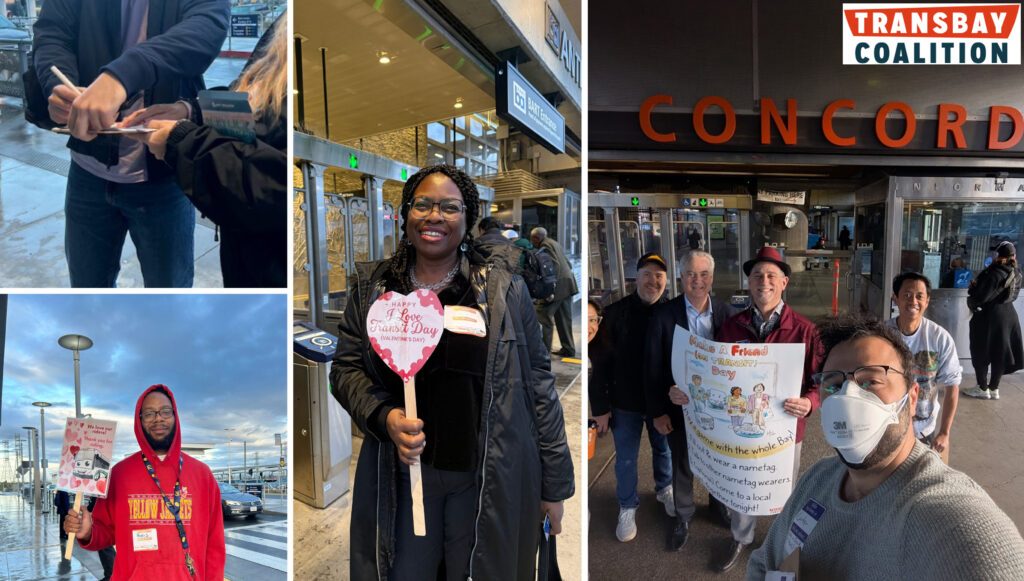
Riders at the Antioch (left & center) and Concord BART Stations (right) make friends on transit Wednesday, Feb. 11, 2026. Photos left & center by Tri Delta Transit and right by Transbay Coalition
Morning and evening riders participated in a game to make personal connections while riding transit
By Transbay Coalition
Yesterday, Wednesday, February 11th, was International Make A Friend Day, and transit advocates were helping people throughout the region to make a friend on transit. Morning and evening riders participated in a game across Contra Costa, Alameda, Santa Clara, San Mateo and San Francisco counties to make personal connections while riding transit.
Early that morning hundreds of Bay Area residents participated in Make a Friend (On Transit) Day and wore name tags as they went about their regular BART, Caltrain, ferry and bus trips to celebrate the day and build camaraderie in the Bay.
“It’s good for us all to remember the old saying that strangers are just friends you haven’t met yet.” said Carter Lavin, Transbay Coalition Co-Founder. “Transit is a shared public resource, connects us all, and is an integral part of our community. Make A Friend (On Transit) Day may be simple and a bit silly, but we hope it can bring a little more joy and connection.”
Between 7:30 and 9am at 10 BART stations, five Caltrain stations and one ferry terminal across the region, transit advocates across the region passed out materials at all corners of the Bay from Antioch to San Jose, San Francisco to Dublin/Pleasanton, Redwood City to Oakland. Despite a drizzly morning, transit riders wearing name tags with, “Hi my name is _____, ask me about ______” got to know one another while chatting about a range of topics including Bad Bunny, 3D printing, R&B, dancing, hobbits, and much more. A nice reminder that making a new friend can be as simple as getting to know your fellow transit rider.
“Make a Friend Day reminds us that friendship is a powerful bond that connects us all. Let public transit be that bridge; a simple hello to a fellow passenger today has the potential to brighten someone’s world,” says Tri Delta Transit CEO Rashidi Barnes.
In the evening, Transbay Coalition hosted free events at five locations around the Bay for people to gather and have another opportunity for folks to make some new friends.
“Make A Friend on Transit Day is a great reminder that our buses and stations are shared community spaces,” said Bill Churchill, General Manager of County Connection. “A simple hello can go a long way.”
Tri Delta Transit, County Connection and LAVTA Wheels helped with nametag distribution at Antioch, Concord and Dublin/Pleasanton BART stations– which are also bus hubs served by the agencies. BART, Caltrain and SF Bay Ferry promoted the events on social media.
“SF Bay Ferry loves to welcome enthusiastic riders onboard our vessels. We hope that Make a Friend on Transit Day is an opportunity for passengers to connect about their favorite experiences on the ferry,” shared Teo Saragi, SF Bay Ferry spokesperson.
About Transbay Coalition
The Transbay Coalition is a grassroots public transportation advocacy group championing bold near-term solutions to the Bay Area’s regional transportation crisis. Founded to campaign for dedicated bus-only lanes on the Bay Bridge and its approaches, we’re striving to create an equitable and efficient public transit system and reduce greenhouse gas emissions. Our Mission and Vision is to build an equitable, seamless, and successful transportation network in the Bay Area by building a broad-based, ongoing, grassroots movement to advocate for equitable, sustainable public transportation.
“They should go back to the drawing board and give us a cost savings plan that demands more sacrifice from BART management, senior staff, and retirees.”
By Marc Joffe
BART has published a plan to balance its budget in the event voters reject the half-cent additional transit sales tax slated for the November 2026 ballot. BART’s plan appears to be well thought out but imposes far more inconvenience on riders than is necessary to close an expected $376 million deficit.
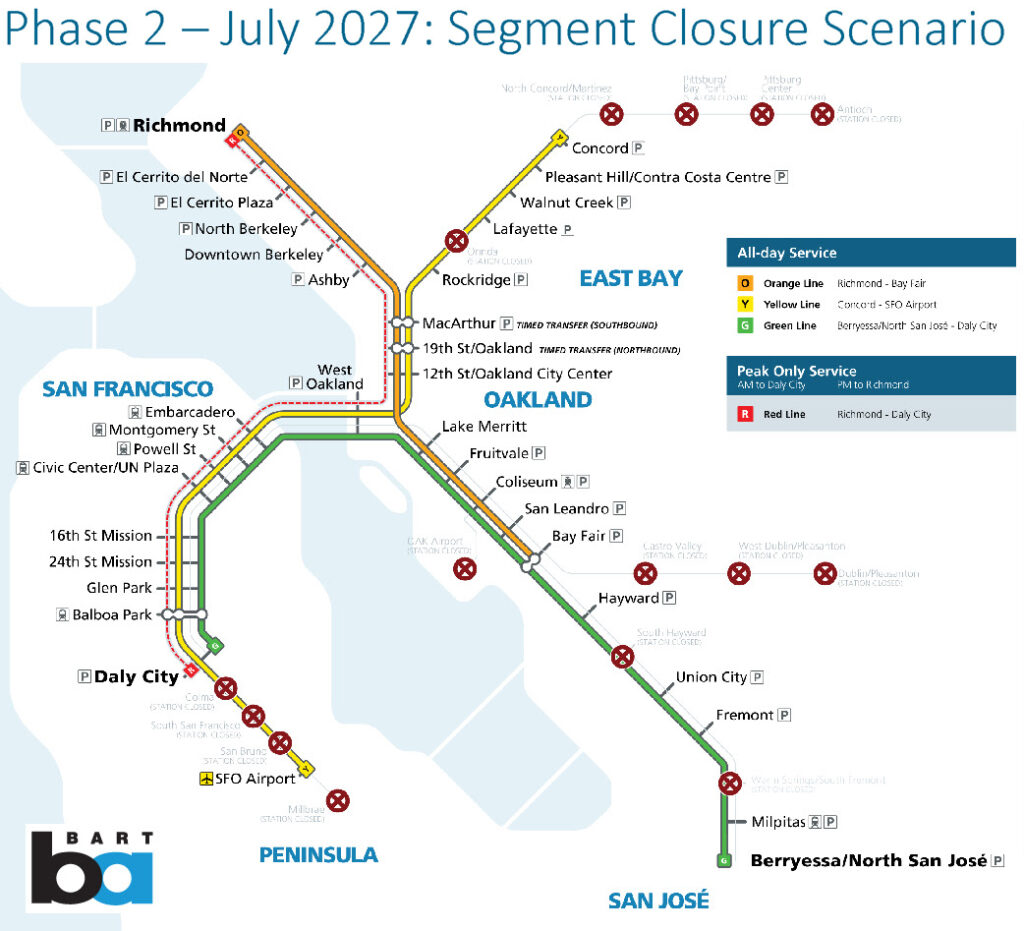
The most visible change is the station closures. Under its more extreme Phase 2 plan, BART would close 15 stations systemwide, including these five in Contra Costa: Orinda, North Concord, Pittsburg Bay Point, Pittsburg Center, and Antioch. Oakland Airport station would close, but SFO would stay open. Five other stations in Alameda County south of Oakland would be shuttered, as would four stations in San Mateo County south of Daly City. (See related article)
But most of these stations should not close. As BART itself recognizes, the savings from shuttering stations are not that large. And there is an alternative that would achieve a large portion of the expected savings, which is to operate the stations on an unstaffed basis. This idea may seem strange to BART riders expecting to see a station agent, but the fact is that many train stations in California operate without staff, including several on Capitol Corridor and Caltrain. Even Pittsburg Center on e-BART often operates without staff.
That said, both Pittsburg Center and North Concord have very low utilization (less than 1000 riders on an average weekday) and are reasonable candidates for closure. Indeed, BART should demolish the North Concord station and sell the parking lot to a developer for conversion to single family housing, a use consistent with the adjoining neighborhood.
Pittsburg Center, being in the median of Highway 4, does not offer a similar redevelopment option. It is one of three stations on the eBART extension connecting Antioch, Pittsburg and Bay Point using standard-gauge diesel multiple-unit trains which are incompatible with the rest of BART. The BART retrenchment plan envisions closing the whole eBART extension. A better choice would be to find a private operator to take it over.
That operator should be given discretion over fares and the option to convert the line to driverless technology in hopes of achieving a profit or at least minimizing the need for taxpayer subsidies.
As anyone who has visited an airport in the last few decades knows, driverless trains are nothing new. Outside the Bay Area, they are used for non-airport systems such as Honolulu’s Skyline and Vancouver’s Skytrain. Paris, Singapore, and other cities have successfully converted some of their lines to autonomous operation and Washington DC’s Metro is looking into doing the same thing.
Over the longer term, the entire BART system should be driverless: it could achieve large operational cost savings while maintaining or even increasing service frequency. Yet BART is not giving serious consideration to transitioning to driverless trains. When BART Director Matt Rinn spoke to CoCoTax in November I asked him about the idea and saw that he was unfamiliar with it. Staff should be discussing this option with the governing board.
They don’t do so because BART operates primarily for the benefit of staff and the labor unions that collect a portion of their salaries via dues. Riders are second, and taxpayers are a distant third.
Contra Costa taxpayers already pay plenty for transit, and, this November, it is time for us to tell BART and other agencies “no more.” They should go back to the drawing board and give us a cost savings plan that demands more sacrifice from BART management, senior staff, and retirees.
One change that should be considered is a 10% salary reduction for all BART employees receiving over $100,000 per year. Based on my analysis of 2024 wage and overtime data, this option would save $54 million. Costly overtime hours should also be limited: in 2024 alone five BART employees collected over $200,000 in overtime a piece.
BART’s plan defers advanced payments for retiree health benefits. This saves $38 million, but only by pushing the cost onto future taxpayers when the fund holding the advance retiree health funding is exhausted. Instead, the BART retiree health benefit should be eliminated just as it was for Stockton employees when that city went bankrupt in 2012. With BART facing functional bankruptcy in 2026, a similar economy is needed. Retirees can get subsidized healthcare through Covered California or Medicare just as those of us who work in the private sector usually do.
Salary and benefit cuts in addition to the layoffs BART already has planned may seem harsh, but these are the types of reductions companies have to make when they are losing money and there is less demand for their product. Because BART now needs more of our money, we have the power to veto any cost-saving plan that fails to prioritize the needs of beleaguered taxpayers and riders. Let’s exercise that veto. In November, say NO to the transit sales tax.
Marc Joffe is the President of the Contra Costa Taxpayers Association
If new funding not identified such as if Nov. 2026 ballot measure sales tax increase doesn’t pass
East Contra Costa, North Concord, Orinda Stations could be shuttered
By BART
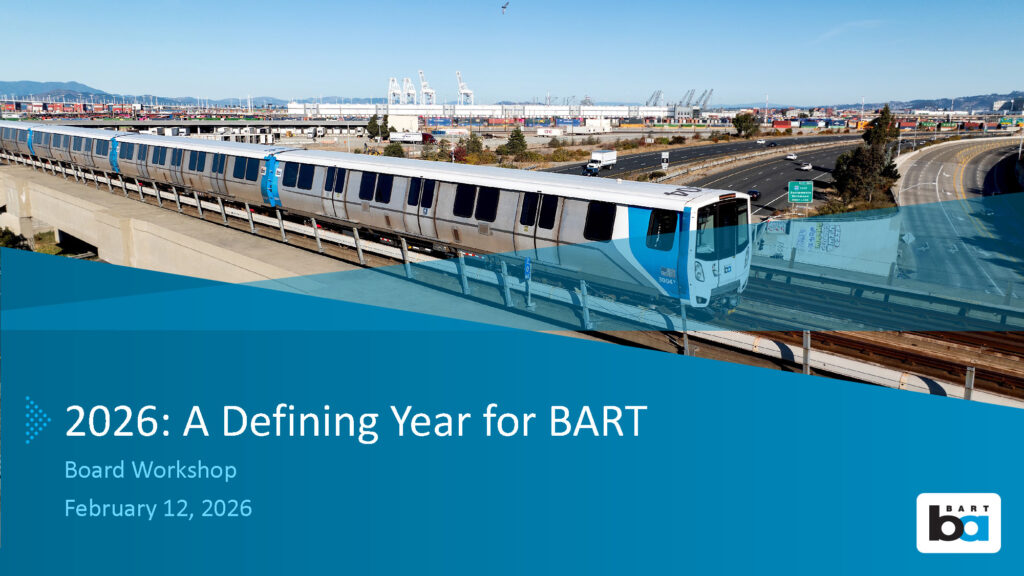
At the annual BART Board Workshop on Thursday, February 12, BART staff will present Directors with detailed plans for an alternative service framework if a November 2026 ballot measure fails and no other operating revenue source is identified. 10 stations could be closed by January 2027 and three segments by July 2027.
During the workshop, staff will outline the risks and tradeoffs for service and non-service reductions. Because rail has high fixed costs and low marginal savings, it is impossible to close the projected FY27 $376M deficit with service cuts and fare increases alone.
BART staff evaluated multiple aspects of service including routes, stations, headways, peak, evening, and weekend service and hours of operation. The proposed framework outlines, for the very first time, specific details including which stations would need to be closed due to a lack of operating funds and the recommended phased approach to triggering further cuts. The plan retains as many riders as possible, while still cutting service to realize savings. System support services would need to be reduced by 40% as cost savings from cutting service would be largely offset by the resulting lost fare revenue.
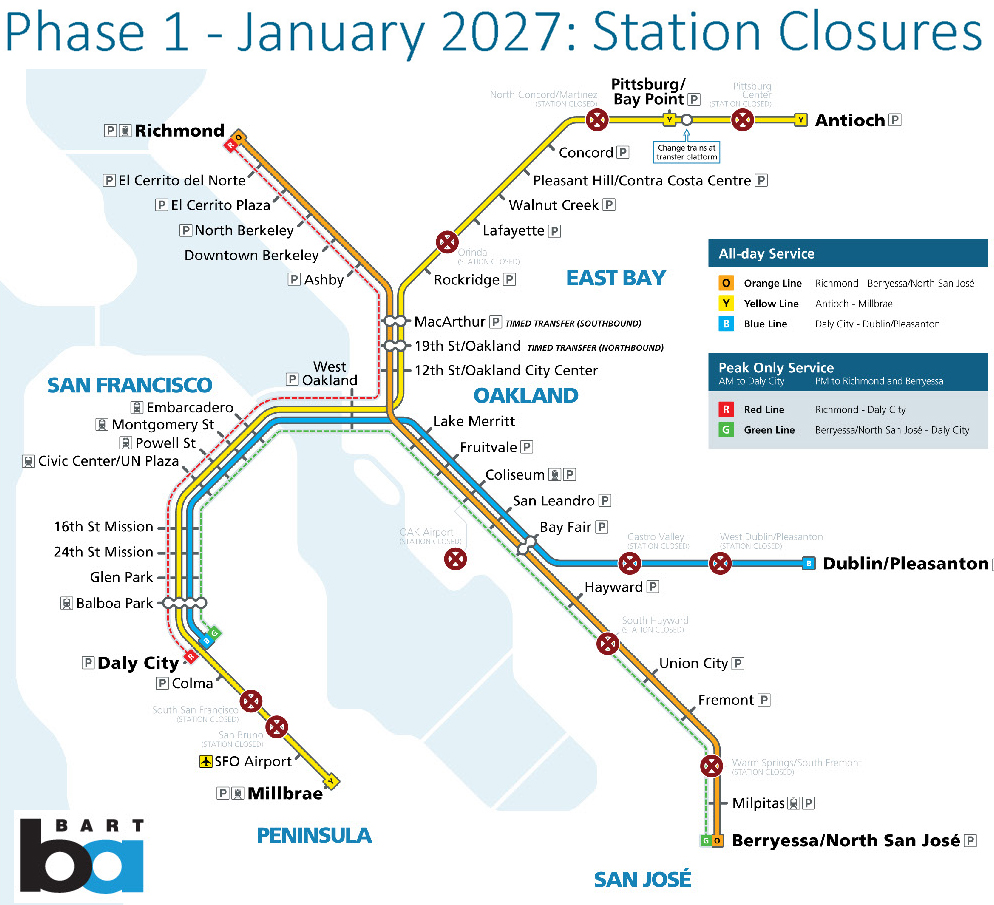
Source: BART
Phase 1 – North Concord, Orinda, Pittsburg Center Stations Would Close
The stations on the list for potential Phase 1 closure in January 2027 include the 10 lowest ridership stations: North Concord, Orinda, Pittsburg Center, Oakland International Airport, West Dublin/Pleasanton, Castro Valley, San Bruno, South Hayward, South San Francisco and Warm Springs/South Fremont.
In addition, the proposed Phase 1 proposal includes Service Frequencies of a 63% reduction in train hours; Reduced base schedule: 3-line base schedule each with 2 trains/hour and 240% more transfers (Percentage of trips requiring a transfer increases from 7% to 22%); Test retaining peak service: Peak Green/Red/Yellow trains operate in peak hours/direction only; and No evening service: the lines would Close at 9 PM (7 days) and Open at 8 AM (Saturday and Sunday).
Source: BART
Phase 2 – Yellow Line Service Would End at Concord Station, Pittsburg/Bay Point & Antioch Stations Would Close
The Phase 2 – July 2027: Segment Closure Scenario, Contingent on Phase 1 implementation, would result in a 70% reduction in train hours and 25% reduction in system miles; Segment closures would stop service on most system segments opened after 1976: Yellow line service would end at Concord, shuttering the Pittsburg/Bay Point and Antioch Stations; Orange line service would end at Bay Fair,; Blue line service would be discontinued shuttering the West Dublin/Pleasanton Station; Most stations south of Daly City would be closed except for direct service to SFO would continue for revenue retention; Service continues to Milpitas and Berryessa due to terms of BART/VTA agreements.
Board Vote at Feb. 26 Meeting
There will not be a Board vote at the workshop on February 12. After receiving feedback from Directors at the workshop, staff plans to return to the Board on Thursday, February 26, with a resolution to adopt a finalized alternative service framework that would be implemented if new funding is not secured.
You can participate in the workshop. You may join in person (2150 Webster Street, Oakland, CA 94612) or via Zoom videoconferencing (https://us06web.zoom.us/j/89025424156).
Written comments may be addressed to the BART Board in advance via email to Board.Meeting@BART.gov, using “public comment” as the subject line, before 3:00 p.m. on Wednesday, February 11th.
Provides “fiscal bridge” until revenue from possible 5-county sales tax increase measure on November ballot kicks in
By Rebecca Long, Director, Legislation & Public Affairs and John Goodwin, Assistant Director of Communications, Metropolitan Transportation Commission
SAN FRANCISCO, Jan. 30, 2026… The Office of Governor Newsom, the California Department of Finance and the Metropolitan Transportation Commission (MTC) on Friday reached an agreement on a $590 million loan for Bay Area transit agencies that will avert major service cuts at AC Transit, BART, Caltrain and SF Muni during the 2026-27 fiscal year that begins July 1. Negotiated in close coordination with the affected transit agencies — which together face a projected deficit of more than $800 million in the next fiscal year — the new agreement will sustain operations used by hundreds of thousands of daily transit riders across the region.
“California is following through in our support for Bay Area transit and the riders who rely on it every day,” said Gov. Newsom. “This agreement between my Administration and the Metropolitan Transportation Commission provides essential short-term financing to support Bay Area transit operations while the region works together on long-term funding solutions. Public transit is essential to our economy and to communities across California, and through continued partnership with regional and local agencies, we are delivering a more stable and reliable system – now and for the future.”
A regional funding measure authorized by the Legislature last year via state Senate Bill 63, authored by senators Scott Wiener of San Francisco and Jesse Arreguín of Berkeley, may appear on the November 2026 ballot in Alameda, Contra Costa, San Francisco, San Mateo and Santa Clara counties. If the measure qualifies for the ballot and is approved by voters, it would establish a temporary 14-year sales tax to support transit operations. But these funds would not begin flowing until around July 1, 2027. The state loan provides a fiscal bridge until the sales tax dollars potentially could be available. (See related articles here and here)
“Today is a huge win for Bay Area transit and for both transit riders and drivers,” said Sen. Wiener. “For the past year, we’ve worked hard to craft a bridge loan to ensure BART, Muni, Caltrain and AC Transit are not forced to enact massive service cuts — potentially going into a death spiral — as we build toward a regional revenue measure to stabilize and strengthen these systems for the long run. I’m proud of our work with regional stakeholders and the Governor to make this loan a reality. Public transportation is part of the Bay Area’s lifeblood, and we must do everything in our power to strengthen it and protect it from service cuts. So many Bay Area residents rely on transit to get to work, school, or family, and service cuts would also explode traffic congestion. We must not let this happen, and we won’t let it happen.”
Today’s agreement authorizes the loan to be funded no later than July 1, 2026, using money awarded but not yet allocated for Bay Area projects by the California Transportation Commission through the state Transit Intercity Rail Capital Program (TIRCP). Because many transit capital projects have long construction timelines and the TIRCP is continuously replenished, the loan is structured to uphold the state’s commitments to awarded projects while minimizing risk to project schedules.
“MTC greatly appreciates the time and energy the Department of Finance and the Governor’s office put into this loan negotiation,” said Commission Chair Sue Noack, who represents Contra Costa County and also serves as mayor of Pleasant Hill. “It was critical to reach agreement on funding that would avert major service cuts this year while also protecting the Bay Area’s priority capital projects and this agreement does just that.”
Consistent with state Senate Bill 105 enacted last fall, the loan agreement includes a clearly defined repayment structure, a guaranteed revenue source to secure the loan and an agreed-upon interest rate:
12-year repayment term, with interest-only payments during the first two years.
Repayment secured by the “revenue-based” portion of State Transit Assistance (STA) that goes directly to the transit agencies.
Variable interest rate tied to the state’s Surplus Money Investment Fund, ensuring the state is fully repaid at the same rate it would have earned had the funds remained in state accounts.
BART General Manager Bob Powers noted that his agency, “is currently developing detailed budget plans for two funding scenarios to close our projected $376 million operating deficit for Fiscal Year 2027 through either new revenue and efficiencies or through service reductions, station closures, fare increases, layoffs, and across-the-board internal cuts. A state loan gives us reassurance money will be available to continue to deliver the best service possible for the Bay Area. We are thankful to Governor Newsom and the Department of Finance for finding a path to fund transit operations during such an unprecedented scenario brought on by the pandemic and remote work. We also thank the Bay Area Legislative Caucus for their supportive efforts and look forward to working with the Legislature on early action to include the loan within the state budget.”
“This bridge loan will help us maintain Muni service for one crucial year for everyone who depends on transit to get where they need to go,” said Julie Kirschbaum, Director of Transportation at the San Francisco Municipal Transportation Agency, which operates Muni. “We thank the Metropolitan Transportation Commission for its leadership and the Governor and the Department of Finance for their collaboration. We are deeply appreciative of the tireless efforts of Mayor Daniel Lurie, State Senator Scott Wiener, State Senator Jesse Arreguín, the Bay Area Legislative Caucus, the Board of Supervisors and the transit advocates who kept this loan alive last year. With this key agreement completed, securing the additional funding we need to address our ongoing deficit is the critical priority.”
“San Francisco’s recovery is essential to the success of our region and our state,” noted Mayor Daniel Lurie. “Our city cannot continue its comeback without a safe, reliable transit system. This agreement is a major step forward towards securing the bridge loan needed to sustain our comeback and ensure transit systems can continue serving the families, seniors, students, and workers who rely on them every day. We’re already delivering greater accountability and efficiency for Muni, and ridership is continuing to climb toward pre-pandemic levels. I’m grateful to our partners at MTC and Governor Newsom for finalizing the agreement and prioritizing our city and our region’s recovery.”
Caltrain General Manager Michelle Bouchard made a similar point, “We are so grateful to the Governor, our delegation members, and our state and regional partners for stepping in and supporting public transit in the Bay Area at this critical time. This loan will allow us to preserve the service that made Caltrain the fastest growing transit agency in the U.S.”
“For 65 years, AC Transit’s north star has been delivering safe, reliable, and affordable bus service to the East Bay,” said Salvador Llamas, AC Transit General Manager and CEO. “That legacy was put at risk by unprecedented pandemic-related budget shortfalls. This state loan safeguards existing service levels and brings immediate relief to the more than 3 million riders each month who were at risk of losing some of the service they rely upon for the essentials of life. We thank Governor Newsom and our local and state partners for making this possible, and while long-term funding challenges remain, today we celebrate a critical win for our riders and communities.”
Senate Bill 63 co-author Jesse Arreguín also sounded a note of thanks, “I am grateful to the Governor and my legislative colleagues for supporting Bay Area transit with this loan. This agreement is a huge win to keep our transit agencies running and ensure that the Bay Area can continue as a major economic engine, while not compromising critical transit projects. At a time when we are at risk of significant service cuts that would grind the region to a halt, this additional funding will provide a vital lifeline to the Bay Area’s major transit agencies and provide fiscal stability as we move forward on a broader regional self-help measure this year.”
Systemwide property crime down 43%, auto thefts decrease by half, robberies by 60%; aggravated assaults up 12%; smaller decreases in Contra Costa County
By San Francisco Bay Area Rapid Transit District
Crime on BART plummeted in 2025, a testament to the hard work of the BART Police Department and the effectiveness of BART’s investment in initiatives and infrastructure that both increase safety and enhance the customer experience.
Source: BART Police Chief’s December 2025 Report
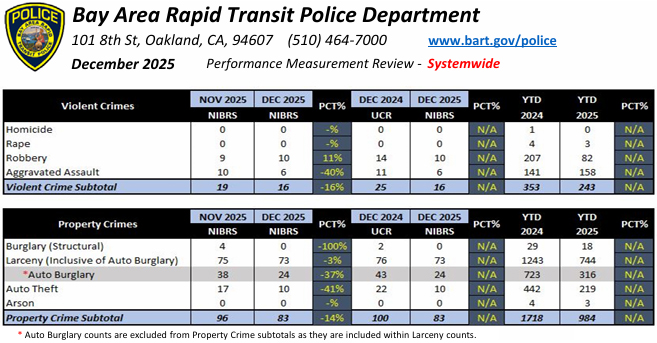
Overall crime on BART dropped 41% in 2025 compared to the previous year, with violent crime down 31% and property crime down 43%, according to the December 2025 Chief’s Monthly Report. Additional highlights include auto thefts decreasing by half year over year and robberies decreasing by 60%. The only crime category to see an increase was aggravated assaults which were up 12% over 2024.
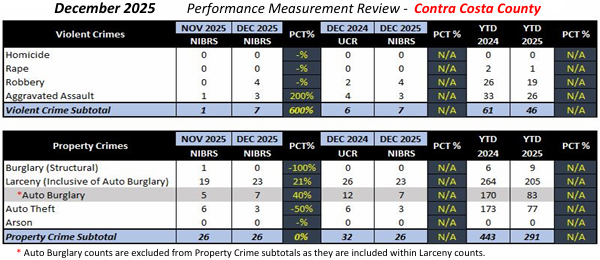
In Contra Costa County violent crime was down 24.6% from 61 incidents to 46 and property crime decreased 34.3% from 443 incidents to 291. The only category to increase was burglary structural with 50% more incidents from six to nine.
“Safety is about more than enforcement. It’s about presence, partnership, and creating an environment where all riders feel comfortable using BART,” said BART Police Chief Kevin Franklin. “BART PD is committed to deterring criminal activity, responding quickly when help is needed, and ensuring riders feel safe throughout their journeys. These numbers demonstrate the impact of officers who are engaged and focused on building trust with the communities BART serves.”
Source: BART Police Chief’s December 2025 Report
“Riders are witnessing firsthand the improvements to safety, cleanliness, and customer experience that define the New BART,” said BART General Manager Bob Powers. “We’ve combined infrastructure upgrades, such as improved fare gates and station lighting, with additional safety presence and customer-centered service to make BART a comfortable experience for everyone who rides. I want to thank BART PD for their tireless commitment to serving the public.”
BART PD boosted the visible safety presence in the system by doubling officer presence systemwide and ensuring police are riding trains more. This approach is strengthened by BART’s ongoing use of unarmed Crisis Intervention Specialists, Transit Ambassadors, Fare Inspectors, and Community Service Officers.
Source: BART Police Chief’s December 2025 Report
Safety efforts were also bolstered by the installation of 715 new fare gates at all 50 stations, a project completed in August 2025, four months ahead of schedule. The taller, stronger fare gates are improving the station environment and deterring fare evasion and unwanted behavior. The number of riders who say they’ve witnessed someone not paying has dropped 59% in the last year.
BART also maintains a network of 4,000+ surveillance cameras, minimizing response time and holding suspects accountable, and continues to install LED lighting on platforms and in parking facilities to eliminate dark corners. Efforts such as these not only improve safety, but the entirety of the BART experience by making the system more welcoming and comfortable.
Source: BART Police Chief’s December 2025 Report
In 2025, BART PD continued its robust officer recruitment campaign with a $15,000 hiring bonus ($5,000 upon hire and $10,000 upon completion of the Field Training Program) for laterals and academy graduates and a robust outreach strategy, including a dedicated JoinBARTPD.com recruitment site and the recent launch of a BART PD Instagram to reach potential recruits where they are.
Businesses, labor unions, civic foundations join effort for 5-county Nov. 2026 ballot measure to prevent threatened catastrophic transit service cuts, promote reliable, safe public transit
Includes Contra Costa; would generate about $1 billion per year
SAN FRANCISCO BAY AREA, CA — The Connect Bay Area Transit committee today announced that it has already raised nearly $3 million to support a region-wide effort to qualify Connect Bay Area, a voter-proposed regional transportation funding measure, for the November 2026 ballot. With strong early financial backing secured, the campaign will now begin signature gathering while continuing to fundraise to qualify and pass a five-county sales tax to save public transit.
The five counties that would be included in the tax measure vote. Source: Connect Bay Area
About the Tax Measure
The measure if adopted would increase the sales tax in Contra Costa, Alameda San Mateo and Santa Clara Counties by a half cent and one cent in San Francisco County for 14 years. As previously reported, the measure would generate approximately $980 million annually across the five counties.
Revenue from the tax measure will benefit multiple transit agencies in the region including Tri Delta Transit, County Connection and WestCat, as well as AC Transit and BART which serve Contra Costa County residents.
Following is a county-by-county breakdown of the County Specific Dollars. It does not include money going to BART, Muni, AC Transit and Caltrain, or to regional improvements that aren’t designated by county, such as coordinated fare programs and accessibility improvements.
County Agencies:
Contra Costa County Transportation Authority (2.5%, $26.51M)
Alameda County Transportation Commission (1%, $10.26M)
San Mateo County Transit District (4.7%, $50M)
Santa Clara Valley Transportation Authority (25.1%, $264.07M)
Small Operators:
Contra Costa County small operators (1.5%, $15.75M)
Alameda County small operators (0.5%, $5.25M)
SF Bay Ferry (0.7%, $7M)
Golden Gate Transit (0.1%, $1M)
Without new and sustainable operations funding, the Bay Area will face a true emergency:
● BART: Could shut down two of its five lines, reducing service from 4,500 trains per week to just 500, with trains running only hourly and no weekend service.
● AC Transit: Would reduce service by 37%, bringing operations down to just half of pre-pandemic levels.
● Muni: Would face 50% cuts to all bus and Metro lines, including elimination of entire neighborhood routes and San Francisco’s iconic historic trolleys and cable cars.
● Caltrain: Trains would run only once per hour, end service by 9 p.m. on weekdays, and eliminate all weekend service.
Transit agencies that will benefit by the revenue from the tax measure. Source: Connect Bay Area
The Connect Bay Area measure will support the future of public transportation in the Bay Area:
● Protect and improve service on BART, Muni, Caltrain, SamTrans, VTA and AC Transit
● Prevent catastrophic service cuts that could devastate the Bay Area
● Keep traffic and emissions down, preventing gridlock and protecting climate progress;
● Support the Bay Area’s economy, ensuring that downtown recovery and regional mobility remain strong.
The Connect Bay Area Transit measure will include strong accountability provisions. This ensures new funding delivers real improvements, not just short-term fixes. Transit agencies must:
● Independent financial review and cost-efficiency: Operators will undergo a third-party financial review and be required to improve financial efficiency and use public funds wisely
● Better regional coordination to benefit riders: Operators will be required to comply with MTC’s Regional Network Management Policies to coordinate across systems and simplify fares and signage to create a more seamless experience for riders.
● Oversight Committee: An oversight committee will ensure that the expenditure plan is adhered to and hold MTC and operators accountable to all provisions of SB63.
About the Campaign
The campaign’s initial fundraising success reflects broad alignment across business, labor, philanthropy, and community leaders that a reliable, safe, and efficient public transportation system is vital to the future of the Bay Area. Major early donors include Chris Larsen, Herzog Contracting Corporation, Genentech, HNTB Corporation, Meta, and SEIU 1021. For a full list of donors, see below.
“Public transportation connects everyone. We are proud of the broad coalition uniting to prevent catastrophic service cuts and to build an affordable, safe, and efficient public transportation system,” said Jeff Cretan, a spokesperson for the Connect Bay Area Transit Committee. “The commitments we are seeing from business, labor, and civic leaders shows that everyone is ready to get this measure across the finish line in November.”
Connect Bay Area is a five-county regional tax measure designed to prevent catastrophic transit service cuts and provide reliable operating funding for major transit systems and local bus operators throughout the region. The measure also funds improvements to transit systems, capital projects within counties, and targeted road improvements. The measure is critical to supporting the Bay Area’s economy, promoting an affordable region, reducing traffic congestion, and ensuring access to jobs, schools, and healthcare.
Early financial support for the campaign includes commitments from:
Chris Larsen
Herzog Contracting Corporation
Genentech
HNTB Corporation
Meta
SEIU 1021
Jacobs
Silicon Valley Community Foundation
ATU Local 1555
PG&E
San Francisco Foundation
WSP
Golden State Warriors
AFSCME Local 3993
Boston Properties
Visa
AFSCME Council 57
T.Y. Lin
GILLIG
HDR, Inc.
Fehr & Peers
AFSCME 3916
Arup North America
Olson Remcho
Additional major employers, labor organizations, and philanthropic partners have indicated commitments that are expected to be finalized as the campaign continues to build momentum.
With signature gathering starting, the Connect Bay Area campaign will focus on qualifying the measure for the ballot while continuing to expand its coalition across the region. The Campaign must secure over 186,000 signatures from the five counties by June 6, 2026 to qualify for the November ballot.
The campaign’s early momentum comes as Bay Area transit agencies face an unprecedented funding crisis. Without a sustainable solution, public transportation in the the region could see devastating impacts, including:
BART could eliminate 2 full lines, stop service at 9pm on weekdays, and eliminate all weekend service.
Muni could eliminate entire routes, make 50% cuts to major bus and metro lines, gut historic train and cable car service.
Caltrain could cut weekday service to once an hour, stop service at 9pm on weekdays, and eliminate all weekend service.
AC Transit could cut up to 37% of overall service.
Recent polling on the proposed Connect Bay Area measure shows a clear path to passage, with strong support across counties and voter demographics. A survey conducted by EMC Research for the Metropolitan Transportation Commission found that 59% of Bay Area voters would support a proposed regional sales tax measure for public transportation. The threshold for passage for a signature-gathering initiative is 50%+1.
The Connect Bay Area Transit Committee is led by labor, business, and transit supporters, including the Bay Area Council, SEIU 1021, ATU 1555, SPUR, SAMCEDA, among others, as well as a broad advocacy council. The advocacy council includes more than 20 organizations including transit advocates, housing advocates, safe streets advocates, senior and disability advocates, and environmentalists. The Committee is focused on delivering a successful 2026 ballot measure that will strengthen public transportation to keep the Bay Area affordable for residents and support critical economic growth and climate resilience.
Five-county half-centsales tax would include Contra Costa County, last 14 years; in addition to existing half-cent BART operations sales tax
By John Goodwin, Assistant Director of Communications & Rebecca Long, Director, Legislation & Public Affairs, Metropolitan Transportation Commission
Gov. Gavin Newsom on Monday, October 13, 2025, signed into law state Senate Bill 63, authorizing a November 2026 ballot measure to prevent major service cuts at BART and other Bay Area transit systems and to make improvements to transit affordability, accessibility and reliability in the region. The new law allows the measure to be placed on the ballot either through action by a newly formed Public Transit Revenue Measure District governed by the same board as the Metropolitan Transportation Commission (MTC) or via a citizen’s initiative.
The half-cent sales tax would be in addition to the half-cent sales tax for BART operations in Contra Costa, Alameda and San Francisco counties in place since the 1960’s.
Enactment of the bill — authored by state senators Scott Wiener (D-11) of San Francisco and Jesse Arreguín (D-7) of Berkeley, and co-authored by Sen. Laura Richardson of Los Angeles County and Assemblymembers Mia Bonta (D-18) of Alameda County and Matt Haney (D-17) and Catherine Stefani (D-19) of San Francisco — clears the way for voters in Alameda, Contra Costa, San Francisco, San Mateo and Santa Clara counties to consider a 14-year regional transportation sales tax that would generate approximately $980 million annually across the five counties. The bill authorizes voter consideration of a half-cent sales tax in Alameda, Contra Costa, San Mateo and Santa Clara counties and a one-cent sales tax in San Francisco.
Approximately 60 percent of the revenue that would be raised if voters approve the measure will be dedicated to preserving service on BART, Muni, Caltrain, AC Transit — which an independent analysis confirmed face annual deficits of more than $800 million annually starting in fiscal year 2027-28 — as well as San Francisco Bay Ferry and smaller transit agencies providing service in the five counties to keep buses, trains and ferries moving. About one-third of the revenue would go to Contra Costa Transportation Authority, Santa Clara VTA, SamTrans and the Alameda County Transportation Commission, with flexibility to use funds for transit capital, operations, or road paving projects on roads with regular bus service.
If a regional tax measure wins voters’ approval next fall, about 4.5 percent, equivalent to $43 million in fiscal year 2027-28, will go toward improving the rider experience, funding priorities identified in the 2021 Bay Area Transit Transformation Action Plan.
“In addition to averting major service cuts for regional operators, MTC advocated for the measure to include dedicated funding to make Bay Area transit more affordable, reliable, and easy to use so that it becomes a system that will attract more riders,” noted Commission Chair and Pleasant Hill Mayor Sue Noack.
The suite of rider-focused improvements includes:
Free and reduced-fare transfers that could save multi-agency riders up to $1,500 per year and are estimated to increase transit ridership by some 30,000 trips per day.
Expansion of the Clipper START® program, which provides a 50% fare discount, to reach 100,000 additional low-income adults.
Improvements to accessibility for seniors and people with disabilities.
Transit-priority projects to make bus trips faster, and mapping and wayfinding improvements to make transit easier to use.
Bay Area transit riders take more than 1 million trips each day, with over 80 percent of these trips on Muni, BART, Caltrain or AC Transit. Riders include tens of thousands of students, seniors, people with disabilities, and low-income residents who can’t afford to own a car. Clipper START customers accounted for nearly 400,000 transit trips across the region in August 2025 and the fare-discount program is growing at a rate of more than 20,000 customers each year.
SB 63 includes several oversight and accountability provisions to reassure voters their tax dollars will be used responsibly. These include establishing an independent oversight committee to ensure expenditures are consistent with the law. Membership will include at least one representative from each county in the Public Transit Revenue Measure District, appointed by each county’s board of supervisors.
The new law also requires BART, Muni, Caltrain and AC Transit to undergo a two-phase independent third-party financial efficiency review overseen by its own oversight committee composed of four independent experts, four transit agency representatives, and an MTC Commissioner. MTC is responsible for procuring the third-party consultant to conduct the review and for staffing the Oversight Committee.
A maintenance-of-effort clause in SB 63 requires BART, Muni, Caltrain, AC Transit, Golden Gate Transit, SF Bay Ferry and the bus operators in Alameda and Contra Costa counties to maintain existing levels of funding for operating purposes if a 2026 tax measure is passed by voters. The legislature established this requirement to ensure the measure supplements, rather than replaces, current operations support, with provisions for exceptions that are subject to MTC approval.
To provide additional oversight regarding the quality of the transit service provided in each county participating in the measure, the legislation allows a county transportation agency or board of supervisors within the District’s geography to require review by an ad-hoc adjudication committee if they believe a transit agency funded by that county’s portion of the measure’s revenue is not applying standards (such as service levels, fare policy, cleanliness, maintenance, access and safety) consistently across counties or if those standards disproportionately disadvantage service or transit equipment/station quality in that county. The committee is composed solely of representatives from counties contributing revenue measure funds to the transit agency under review. Its determinations are binding and may result in withholding up to 7 percent of the transit agency’s funds, a strong incentive for agencies to deliver high quality service that follows consistent standards across all five counties.
What Local Transportation Officials are Saying:
“The BART Board of Directors supported SB 63 because it will cover a significant portion of BART’s operating deficit caused by remote work and will allow us to maintain current service levels and improve the rider experience,” said BART General Manager Bob Powers.
“SB 63 is a step towards protecting essential Muni service and will equip us with resources to continue meeting the needs of San Francisco and the growing region,” said Julie Kirschbaum, San Francisco Municipal Transportation Agency Director of Transportation.
“Through Governor Newsom’s leadership and the support of voters, SB 63 will help protect transit for our more than three million monthly riders. In fact, this summer, we took proactive steps to preserve service by redesigning 103 bus lines through our new Realign network. Designed over two years, this all-new network maintains service at 85 percent of pre-pandemic levels. SB 63 gives voters a chance to ensure that these vital bus lines – and our riders’ lifelines – are protected for the future,” said AC Transit Board President Diane Shaw.
“Caltrain has been reinvented as a state-of-the-art rail system, delivering the best service this corridor has seen in its 161-year history. We are seeing the benefits every day with growing ridership, cleaner air, quieter trains, and less-congested roads. To sustain these benefits, it is essential that Caltrain be funded. We are deeply grateful to Governor Newsom and the California Legislature for their leadership in crafting and supporting this legislation, which gives voters the opportunity to consider the vital Connect Bay Area measure in November 2026,” said Caltrain Executive Director Michelle Bouchard.
“SB 63 represents a transformative opportunity to invest in the future of public transit,” she said. With this measure, we can deliver faster, more frequent service and ensure better connections for all riders across Santa Clara County,” said Carolyn Gonot, Santa Clara Valley Transportation Authority General Manager and CEO.
“We’re excited the Connect Bay Area Act is moving forward and voters will soon have the opportunity to shape the future of public transit along the Peninsula and surrounding Bay Area communities. Next November’s vote will be a pivotal moment to secure reliable, connected and sustainable transportation. With this measure, we can ensure SamTrans, Caltrain and our regional transit partners have the stable funding needed to serve riders for years to come,” said SamTrans Board of Directors Chair Jeff Gee.
MTC is the transportation planning, financing and coordinating agency for the nine-county San Francisco Bay Area.
BART Issues Statement of Support
BART issued the following statement on Governor’s signing transit funding measure SB 63:
“BART is grateful to Governor Newsom for signing Senate Bill (SB) 63 into law. The Governor has been a steadfast advocate of transit and BART specifically, recognizing our role in moving the region and strengthening the economy. SB 63 is a historic opportunity to allow voters in five counties of the Bay Area to consider a sales tax measure in November 2026 aimed at preserving and improving transit.
A regional transportation funding measure would provide a reliable funding source for BART and other agencies to address deficits caused by remote work. The BART Board of Directors supported SB 63 because it will cover a significant portion of BART’s operating deficit and allow us to maintain current service levels and improve the rider experience.
Before measure funds become available, BART will rely on internal cuts, efficiency measures, and a series of one-time solutions to pay for operations. BART will continue to identify additional cost savings and efficiencies to address our deficit, and we welcome the enhanced accountability measures and financial efficiency review included in SB 63.
BART is also grateful to Senators Scott Wiener and Jesse Arreguín for championing this legislation and their fierce advocacy for transit funding.”