







Author Archive

Glover takes one year pass on gavel, hands chair to Mitchoff in her final year on Contra Costa Board of Supervisors

Thursday, October 7th, 2021
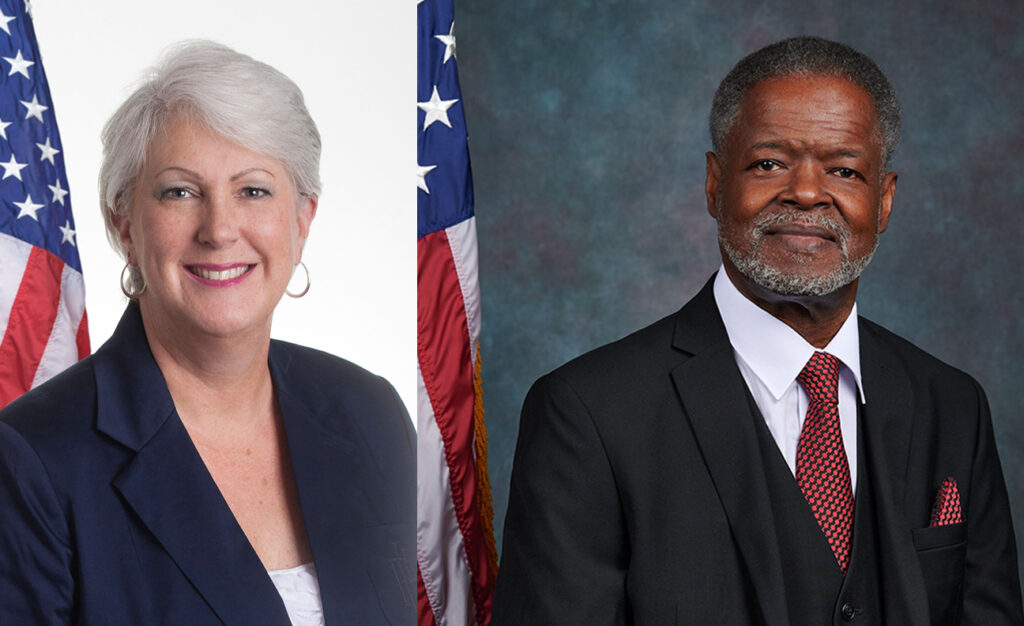
New Contra Costa County Board of Supervisors Chair Karen Mitchoff and Vice Chair Federal Glover. Photos: CCC

County public meetings to continue online for 30 more days; COVID cases decrease by 27.9% over past two weeks

By Daniel Borsuk

In a show of respect for her 34 years of public service, retiring Contra Costa County Board of Supervisor Karen Mitchoff will manage the board’s gavel in 2022, a year when vice chair Federal Glover would have taken over the board leadership duties from current chair Diane Burgis of Brentwood.

Vice chair Glover of Pittsburg, who would have customarily been automatically approved by his supervisorial colleagues as chair for 2022, made the motion to transfer the board chair duties to Mitchoff as an act of respect for her public service dating back to 1981 in the office of late Contra Costa Sherriff-Coroner Richard Rainey as his executive secretary.

Glover, who represents District 5 on the board, will continue to serve as vice chair in 2022 and assume the chair duties in 2023.

Mitchoff of Pleasant Hill has served as District IV Supervisor since January 2011.

Supervisor Mitchoff had initially announced her candidacy for the position of Contra Costa County Recorder-Clerk when former officer holder Joe Canciamilla resigned and sentenced for violating Fair Political Practices Commission laws by spending more than $130,000 in campaign funds for personal uses. Mitchoff eventually stepped away from actively pursuing the County Recorder-Clerk post when Assistant Recorder-Clerk Debbi Cooper announced her candidacy and eventually won the supervisors’ approval to accept the top post.

“I talked to Supervisor Mitchoff, who plans to not run for reelection after next year, to serve as our chairperson as an honor,” said Supervisor Glover. “Therefore, I would make a motion to nominate Karen Mitchoff as chair for 2022 and Glover serve as vice chair for 2022.”

Glover’s motion passed on a 5-0 vote.

“I want to thank Mr. Glover to allow me to serve as board chair in my final year on the board,” said Mitchoff. “It shows how wonderful it is to be on this board. We are always respectful and kind.”

Mitchoff’s eventual departure raises the question of who might run for her position.

Among some of the potential candidates are Ken Carlson, a gay retired Concord police officer who serves on the Pleasant Hill City Council. Concord City Councilmember Edi Birsan has also frequently said he would run for the supervisorial post.

Mitchoff, a Portland, OR native, is a Cal State East Bay B.A. graduate in Human Development and has an elected and appointed public service record that includes election to the Pleasant Hill City Council in 2008 and service as mayor in 2010. She was appointed to the Pleasant Hill Recreation and Park District Board of Directors in 2003 and election to the Board of Directors in 2004 and 2006. From 1992 to 1996 she served on the Pleasant Hill Planning Commission.

Online Meetings for 30 More Days

The return of in person public meetings, especially at the Contra Costa County Board of Supervisors’ brand new $100 million county administration building in downtown Martinez, will be on hold for at least another 30 days because of Gov. Gavin Newsom’s signing of Assembly Bill 361. The law now allows public meeting to be held onlin through January 31, 2022. At least through November the supervisors and all county commissions and advisory panels – the Assessment Appeals Board, Merit Board, Planning Commission, and Measure X Advisory Commission – will continue to conduct meetings remotely.

The supervisor’s resolution states:

“The Board of Supervisors finds that in person meetings of the Board of Supervisors would present risks to the health or safety of the public, staff and officials attending meetings, in light of the high case rate of COVID-19 infections in the county.

“As authorized by Assembly Bill 361, effective immediately and for the next 30 days the Board of Supervisors, acting in all its capacities and all its subcommittees, will use teleconferencing for meetings with the provisions of Government Code section 54953e.”

County COVID-19 Cases and Vaccinations

In the meantime, the Contra Costa Health Services reported there were 1,532 COVID-19 cases reported in the past two weeks, for a 36.8 percent decrease. Seventy-three COVID-19 patients were hospitalized, a 27.9 decrease over the past two weeks, department records show.

The Contra Costa County Health Services also reported the county’s vaccination rate for residents ages 12 and older, who have received at least one dose of the COVID-19 vaccine, is 86.3 percent compared to a 75.9 percent national rate.
 

Meet Acting Antioch Police Chief Tony Morefield

Thursday, October 7th, 2021

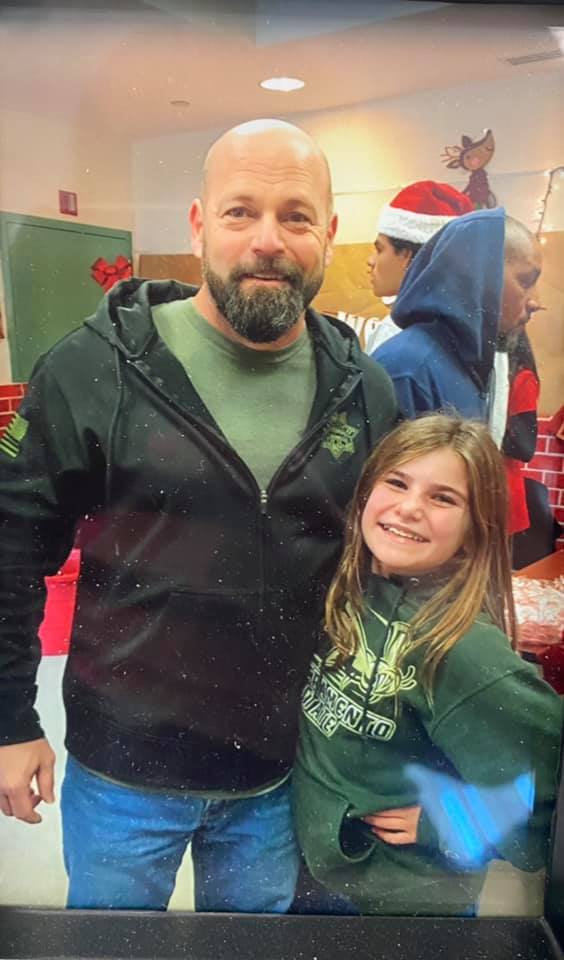
Interim Antioch Police Chief Tony Morefield with his daughter Faith during the APD annual Christmas event in 2019. Photo: APD

Marine, 20 years with APD; will become interim chief on Sunday, Oct. 10, Brooks is still chief through Saturday

By Antioch Police Department

Meet your Beat! We would like to take a moment to introduce you to Acting Police Chief Tony Morefield. Tony was born and raised in Stockton, California; he eventually moved to the Lodi area, where he attended High School in the early 90’s.

Out of high school, Tony enlisted in the United States Marine Corps, where he served honorably for four years. In 1996, Tony married the love of his life, DeAnna. Tony and DeAnna have two children together, Luke and Faith. They’re active in their church along with several non-profit organizations in their community and beyond.

Tony attended San Joaquin Delta Community College, earning an Associates Degree in 2000 before being hired by the Antioch Police Department and attending the Criminal Justice Training Center at Los Medanos College. Tony was sworn in as an Antioch Police Officer in May of 2001, where he has worked ever since.

As an officer, Tony worked a variety of assignments including Patrol, Field Training Officer, and Investigations. He was promoted to the rank of Sergeant in 2007 and went back to Patrol for a time before returning to the Investigations Bureau as the Special Operations Unit (SOU) Supervisor. He earned a bachelor’s degree in Criminal Justice Management from Union Institute and University in 2014. Later that year, Tony promoted to Lieutenant and worked as a Patrol Watch Commander and then, Investigations Lieutenant. In 2017, Tony promoted to the rank of Captain, overseeing the Support Services Division and later the Field Services Division. Tony has been a member of the APD SWAT team since 2002 moving through the ranks as an Operator, Team Leader, Tactical Commander, and Commander.

A fun fact about Tony is that on his first day of being the Acting Chief, his daughter, Faith, sent him with a note saying not to mess anything up. Tony is looking forward to the challenges ahead and to continuing to serve the great people of Antioch in his new assignment.

Morefield will become Interim Chief beginning this Sunday, Oct. 10, as Chief Tammany Brooks is still in his position through Saturday, which is final official day.


Under pressure from fellow Antioch councilmembers, Torres-Walker resigns as chair of police committee

Wednesday, October 6th, 2021

Announces on Facebook, claims “negative and retaliatory behaviors from APD.” No details from police, yet. Expected soon.

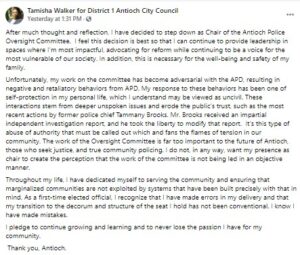
Torres-Walker’s post on her official Facebook page on Tuesday, Oct. 5, 2021.

By Allen Payton

Under pressure from her fellow council members who voted to appoint her as chair of their Police Oversight Standing Committee, Antioch District 1 Councilwoman Tamisha Torres-Walker announced her resignation from the position. It was in response to the police incident at her home Friday night/early Saturday morning following noise complaints from neighbors that included loud music, dirt bikes in the street and gunshots. (See related article)

In a post on her official Facebook page on Tuesday afternoon, the councilwoman agreed to step down, but not resign from the committee completely, as District 3 Councilwoman Lori Ogorchock is calling for, nor from the council as District 2 Councilman Mike Barbanica and Economic Development Commission Chair Tim McCall are calling for.

Torres-Walker wrote: “After much thought and reflection, I have decided to step down as Chair of the Antioch Police Oversight Committee. I feel this decision is best so that I can continue to provide leadership in spaces where I’m most impactful, advocating for reform while continuing to be a voice for the most vulnerable of our society. In addition, this is necessary for the well-being and safety of my family.

Unfortunately, my work on the committee has become adversarial with the APD, resulting in negative and retaliatory behaviors from APD. My response to these behaviors has been one of self-protection in my personal life, which I understand may be viewed as uncivil. These interactions stem from deeper unspoken issues and erode the public’s trust, such as the most recent actions by former police chief Tammany Brooks. Mr. Brooks received an impartial independent investigation report, and he took the liberty to modify that report. It’s this type of abuse of authority that must be called out which and fans the flames of tension in our community. The work of the Oversight Committee is far too important to the future of Antioch, those who seek justice, and true community policing. I do not, in any way, want my presence as chair to create the perception that the work of the committee is not being led in an objective manner.

Throughout my life, I have dedicated myself to serving the community and ensuring that marginalized communities are not exploited by systems that have been built precisely with that in mind. As a first-time elected official, I recognize that I have made errors in my delivery and that my transition to the decorum and structure of the seat I hold has not been conventional. I know I have made mistakes.

I pledge to continue growing and learning and to never lose the passion I have for my community.

Thank you, Antioch.”

Police and City Response

To date, the Antioch Police Department has not issued a statement or press release about the incident. Questions were sent to Acting Chief Tony Morefield and City Attorney Thomas L. Smith, including when will a press release be issued about this very serious incident? Also, how soon can the police body and dash cam videos be released? I know it’s new technology for our city, but how quickly can that happen?

In addition, a Public Records Act request for the body and dash cam videos of the incident was made on Monday.

Captain Trevor Schnitzius responded, “This is an open and ongoing criminal investigation. We do not have additional information to release at this time. With respect to your PRA, that is being evaluated for any items that may be available for release pursuant PRA. You should receive correspondence regarding your PRA request in accordance with established timelines as outlined in PRA legislation.”

The city has 10 days to release the videos and up to an additional 14 days, if deemed necessary. Ogorchock has asked that the “footage be released as soon as possible”.

In addition, City Manager Ron Bernal responded that he would discuss the matter with the city’s public information officer, Rolando Bonilla, by their 4:00 p.m. meeting, Wednesday afternoon.

Torres-Walker Offers Additional Comment

In a Thursday morning email Torres-Walker offered an additional comment about her resignation, writing, “I had decided to step down as chair long before my colleagues made the request given what I know regarding Chief Brooks interference in the first investigation.”

‘Absurd’ pro-abortion laws in California highlight need for parent-child communication, policy expert says

Tuesday, October 5th, 2021

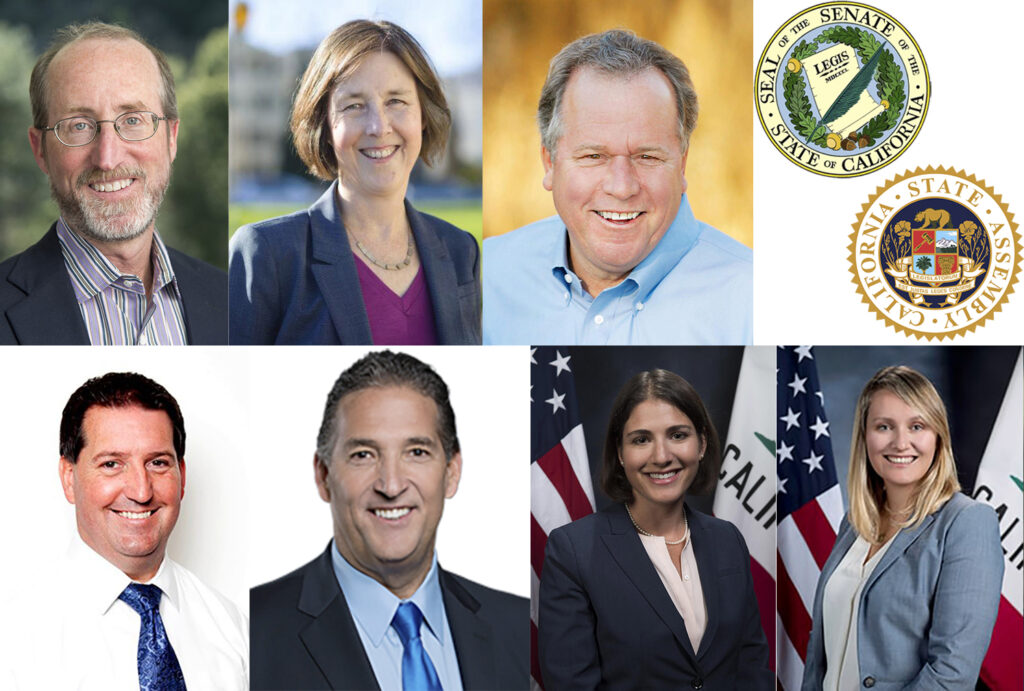
State Legislators representing Contra Costa County: Senators Steve Glazer, Nancy Skinner and Bill Dodd (top row), and Assemblymembers Tim Grayson, Jim Frazier, Rebecca Bauer-Kahan and Buffy Wicks (bottom row) voted for the two bills.

All seven state legislators representing portions of Contra Costa County voted for both bills

By Jonah McKeown | Catholic News Agency

California Governor Gavin Newsom signed a pair of bills Sept. 22 that relate to privacy surrounding abortion, and a policy expert commented to CNA that the laws highlight the importance of parent-child communication regarding difficult topics such as abortion.

All seven state legislators representing portions of Contra Costa County voted for both bills, including Senators Steve Glazer, Nancy Skinner and Bill Dodd, and Assemblymembers Tim Grayson, Jim Frazier, Rebecca Bauer-Kahan and Buffy Wicks.

Kathleen Domingo, Executive Director of the California Catholic Conference, told CNA that the new laws, while “absurd” and harmful, are just the latest in a pattern of performative pro-abortion actions taken by California lawmakers over a period of decades.

“The reality is that this isn’t really anything new, and I think this is important for people to know…this has been the agenda of California for decades,” she said.

AB 1184 allows insured individuals, including minors, to keep “sensitive services” confidential from the insurance policyholder, generally their parents.

The law requires insurance companies to “accommodate requests for confidential communication of medical information” regardless of whether “disclosure would endanger the individual.” Set to take effect in July 2022, the law specifically mentions “sexual and reproductive health” and “gender affirming care” as potentially “sensitive services.”

California has a parental consent law for minors seeking abortions on the books, but the law is permanently enjoined by court order, meaning minors in California can seek abortions without their parents’ knowledge or permission. Planned Parenthood provides resources instructing teens how to hide abortions from their parents, Domingo noted.

Also signed Sept. 22 was AB 1356, which makes it illegal to film or photograph patients or employees within 100 feet of an abortion clinic “with the specific intent to intimidate a person from becoming or remaining a reproductive health services patient, provider, or assistant.” Domingo said this law could affect pro-life campaigners and sidewalk counselors, who may merely want to film or photograph themselves and their work outside abortion clinics.

Domingo said laws of this kind reinforce the importance of parents and guardians talking to and building trust with their children, and encouraging them to seek their parents’ advice in difficult situations.

“It really comes down to having conversations in your own families, and making sure that your children understand what your values are, and understand that they can come and talk to you if they have situations that are difficult,” Domingo said.

“If they know of someone who has a situation, if they themselves get into a situation where they need help, I think more than anything it’s just continuing that conversation and making sure are families are equipped to know what to do in those moments, that our parishes are equipped to know what to do, so that if you have a situation where a young woman finds herself in need, she knows who to talk to: our pregnancy resource centers and our pro-life pregnancy clinics up and down the state.”

Domingo said while performative pro-abortion laws will likely continue to be passed in California, supporting pro-life alternatives is the best way to combat them.

“That truly is the work that is needed. We can’t necessarily combat these laws that keep compounding abortion in California, but we can do the grassroots efforts that we have been doing for almost 50 years in California of helping people one at a time and saving families one at a time.”

A group of Republican lawmakers wrote to Newsom before he signed the bills into law, urging him to veto them instead.

“We should be encouraging parents and family to be involved in their children’s lives, not removing them further from it,” the letter reads, which was signed by nine state senators.

They also argued, in a more pragmatic vein, that AB 1184 would put policyholders in the “impossible position” of being financially responsible for bills incurred by their dependent children, but which they have no means of verifying because of the new confidentiality rules.

Newsom’s office heralded the laws as a strengthening of California’s status as a “haven” for women seeking abortions.

“This action comes in the wake of attacks on sexual health care and reproductive rights around the country, including the U.S. Supreme Court’s failure to block Texas’ ban on abortion after six weeks,” a statement from Newsom’s office reads, referring to a pro-life law in that state that took effect Sept. 1.

“California is a national leader on reproductive and sexual health protections and rights, and Governor Newsom’s actions today make clear that the state will remain a haven for all Californians, and for those coming from out-of-state seeking reproductive health services here.”

Allen Payton contributed to this report.

Learn the ABC & D’s of Medicare at TreVista Antioch Oct. 23

Tuesday, October 5th, 2021

Following police incident at Antioch councilwoman’s home fellow council members, commissioner call for her resignation as chair of police oversight committee, from council

Tuesday, October 5th, 2021

Second incident between Torres-Walker and police in less than a year

“This is an embarrassment to the city, again. Enough is enough.” – Councilman Barbanica

By Allen Payton

According to reports, police were dispatched to District 1 Antioch Councilwoman Tamisha Torres-Walker’s home shortly after midnight Saturday night, following calls to APD of noise complaints including dirt bikes riding in the street, loud music and gunshots. When officers arrived multiple shell casings were found in front of her home, she emerged from the house, appeared intoxicated, confronted and berated the officers, and interfered in their investigation, including taking the papers of a woman to whom they were speaking to at the scene, from one of the officer’s hand.

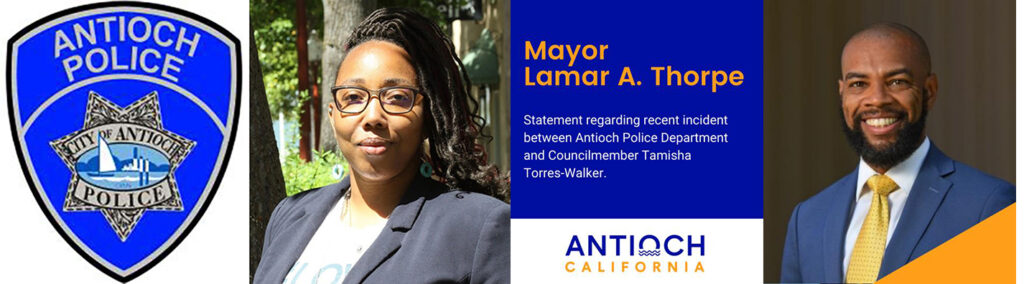
In response, Mayor Lamar Thorpe and Mayor Pro Tem Monica Wilson are calling for her resignation as chair of the Antioch Police Oversight Standing Committee, while District 2 Councilman Mike Barbanica and Antioch Economic Development Commission Chair Tim McCall are calling for Torres-Walker to resign from the council. District 3 Councilwoman Lori Ogorchock is taking it further than Thorpe and Wilson, but not as far as Barbanica and McCall, by calling for Torres-Walker’s complete removal from all council appointed committees. She has also asked that the police body cam video “footage be released as soon as possible.”

Thorpe issued the following statement, posted on his official Facebook page, Monday afternoon:

“I have been briefed about a recent incident over the weekend involving the Antioch Police Department and Councilmember Torres-Walker. As the mayor of the city of Antioch, I am requesting that Councilmember Torres-Walker immediately step down from her role as the chair of the Antioch Police Oversight Committee.

As elected officials, we do not have to always agree on issues, but we must always agree on the fact that we must set an example for the rest of the city and treat our public employees with respect and dignity for their contributions to our community.”

In a post on her official Facebook page, Monday night, Wilson simply wrote, “Given recent events, it is in the best interest of our city that Councilwoman Torres-Walker step aside in her role as Chair of the Police Oversight Committee.”

Barbanica posted on his official Facebook page more extensive remarks on Monday night.

“This afternoon, I started receiving calls about this weekend’s incident with Council Member Torres-Walker. At 12:46 I began to reach out to Council Member Torres-Walker and asked her to meet in person. This was so I could ask her to immediately resign from the Antioch City Council. I did want her to hear it directly from me. She told me that she could meet me Wednesday, but I requested that it happen today, even if by phone. She told me that she would call and I didn’t hear from her, later stating that we could possibly meet after 5 PM. At 4:38 PM Council Member Torres-Walker did not respond to my request to again meet in person.

I requested to meet with Chief Morefield. He confirmed that there was an active investigation, but details were limited because the PD is investigating this as a shooting. I did confirm that multiple body cameras were active as officers were on scene.

I spoke with the press at 4:53 PM and told them that I am calling for her immediate resignation from the City Council. I also am calling for the APD to release the body cam footage as soon as possible. Total transparency was the reason many of us supported these cameras. We do not need the city dragged through another year of this.”

When reached later for additional comment, the councilman said, “this is an embarrassment to the city, again. Enough is enough. We’re coming up on a year of her previous incident.” Barbanica was referring to the incident, last December, between Antioch police officers, Torres-Walker and her two sons who were illegally riding off road vehicles on city streets. (See related articles herehere, here, here and here)

“This is not conduct becoming of a city council member. It is my belief she should not put the city through this, again. She should do the right thing and resign her position,” he reiterated.

McCall wrote Monday evening, “As chairman of the Antioch Economic Development Commission, I am calling for the resignation of City Council Member Torres-Walker.  Her multiple displays of poor judgement in the City of Antioch is negatively affecting the City’s ability to attract and retain businesses which supply jobs and goods to our residents and community. In addition, I am calling on Mayor Thorpe to remove Torres-Walker from the police oversight committee.”

10/05/21 UPDATE: When reached for comment Tuesday morning, District 3 Councilwoman Lori Ogorchock shared a statement she issued on Monday calling for Torres-Walker to step down completely from the Police Oversight Standing Committee, as well as all council-appointed committees.

“Due to recent events over the weekend at Councilmember Torres-Walker’s home, I believe it is in the best interest of the city that she immediately, step down from the Police Oversight Standing Committee and all council-appointed committees she has been appointed to. I would also ask that she be censured at this time until the on-going investigation is completed.

We as council have to hold ourselves to a higher standard and not degrade or be verbally abusive to our police officers. No city employee should be treated in such a manner.

This incident should not overshadow the good work by our Antioch Police Department, nor the progress being made throughout the City of Antioch.”

In addition, in a post on her official Facebook page on Tuesday, Ogorchock wrote, “For those of you who are asking the City Council to remove Councilmember Torres-Walker as a Councilmember, we cannot do that. She is an elected official, District 1 voted her into office, we do not have the power to remove her. We as council can have her released from the committees/commissions she’s part of and this should be on council’s upcoming agenda.

We all want to see the video footage from the body cams, but this is part of the APD’s investigation. I have asked that that footage be released as soon as possible.”

Efforts to reach Torres-Walker for comment, via text and email Monday evening, were unsuccessful prior to publication time, and no comment has been posted on either her official or personal Facebook pages about the incident.

A call was made to the APD Media line for more information Monday afternoon, and an email was sent to both Acting Chief Morefield and City Attorney Smith requesting more details, as well as a public records act request for copies of the police body and dash cam footage of the incident, after work hours.

In a Wednesday email, Captain Trevor Schnitzius responded, “This is an open and ongoing criminal investigation.  We do not have additional information to release at this time.  With respect to your PRA, that is being evaluated for any items that may be available for release pursuant PRA.  You should receive correspondence regarding your PRA request in accordance with established timelines as outlined in PRA legislation.”

10/12/21 UPDATE: In an email received on Tuesday, Oct. 12, 2021, Police Records Supervisor Lynn Dansie wrote, “The Antioch Police Department is in receipt of your recent Public Records Act request for body camera footage and dash camera footage of a recent incident that resulted in case #21-8418, involving a local Councilwoman.  Because this is an active investigation and still considered to be an open case, the records that may be responsive to your request are being denied for release under GC 6254(f), GC 6254(k) and GC 6255(a), at this time.”

Incident Details

In addition, Dansie wrote, “A press release is not planned to be released.  As described in GC 6254(f)(2), the following details regarding the call, are available.  Officers responded to the 500 block of Gary Ave on October 3, 2021 at 0027 hours, for a report of a loud party and shots heard, in the area.  There were no victims, no injuries, and no property loss determined at the time of officers’ arrival.  As mentioned, this is an open and continuing investigation at this time.”

Free online mapping tools for redistricting now available for public use

Monday, October 4th, 2021

Help draw your representatives’ districts the way you’d like to see them; provided by 2020 California Citizens Redistricting Commission and Statewide Database

SACRAMENTO, CA—On Saturday, Oct. 2, the 2020 California Citizens Redistricting Commission announced the Statewide Database’s release of two free-to-use tools to help Californians submit redistricting plans to the Commission. These are the only redistricting applications through which users can submit their input directly to the state of California’s official redistricting process.

“The Commission is excited to share these free resources to help people draw their own district maps,” stated Commission Chair Sara Sadhwani. “The success of this decennial process depends on the participation of all Californians. We want to hear from everyone and want to know if our line drawing is heading in the right direction.”

“The Statewide Database is proud to provide two map creation tools that are free of charge,” said Karin Mac Donald, Director of the Statewide Database. “The key to participation is access. These online tools aim to expand access to every Californian in hopes that they have the tools necessary to participate in the redistricting process.”

Tell the CRC about your community today!

The previously released Draw My CA Community allows users to draw a map of and respond to a few simple prompts about their Communities of Interest. When finished, users can submit community input directly to the California Citizens Redistricting Commission for consideration in the statewide redistricting process. (https://drawmycacommunity.org/)

Draw My CA Districts is a free-to-use online tool for creating district maps

Through the newly released Draw My CA Districts web application, users can create district maps throughout the state of California and submit those maps directly to the Commission. (https://drawmycadistricts.org/)

Draw My CA is a free-to-use plugin for the open-source GIS platform, QGIS

Today’s release of the Draw My CA QGIS plugin allows users to download a California redistricting application to their own computer.  With this plugin, users can create redistricting plans for the state of California and submit those maps directly to the Commission while having access to a full GIS platform. Draw My CA will be available 10/03/2021 at: https://www.redistrictinggroup.org/installer/.

To learn more about these tools, please visit https://drawmycalifornia.org/.

Both the online district mapping tools (Draw My CA Districts and Draw My CA) include functionality to assist users to comply with population deviation, contiguity and assignment checks.

  • % Deviation check – tells the user to what extent any of their districts are above or below the ideal population of the distinct type they are working on
  • Contiguity check – lets the user know if their districts are contiguous or not
  • Assignment check – lets the user know if they have unassigned areas in their redistricting plan

The Commission must follow the following criteria, in this order, when drawing district maps:

  1. Districts must be of equal population to comply with the US Constitution.
  2. Districts must comply with the Voting Rights Act to ensure that minorities have an equal opportunity to elect representatives of their choice.
  3. Districts must be drawn contiguously, so that all parts of the district are connected to each other.
  4. Districts must minimize the division of cities, counties, neighborhoods and communities of interest to the extent possible.
  5. Districts should be geographically compact: such that nearby areas of population are not bypassed for a more distant population. This requirement refers to density, not shape. Census blocks cannot be split.
  6. Where practicable each Senate District should be comprised of two complete and adjacent Assembly Districts, and Board of Equalization districts should be comprised of 10 complete and adjacent State Senate Districts.

In addition, the place of residence of any incumbent or political candidate may not be considered in the creation of a map, and districts may not be drawn for the purpose of favoring or discriminating against an incumbent, political candidate, or political party.

Every 10 years, after the federal government publishes updated census information, California must redraw the boundaries of its electoral districts so that the state’s population is evenly allocated among the new districts.

In 2008, California voters passed the Voters First Act, authorizing the creation of the independent California Citizens Redistricting Commission to draw new State Senate, State Assembly, and State Board of Equalization district lines. In 2010, the Voters First Act for Congress gave the Commission the responsibility of drawing new Congressional districts following every census.

For more information, please visit WeDrawTheLinesCA.org.


California school choice initiative for Nov. 2022 ballot filed with Attorney General

Monday, October 4th, 2021

Would allow creation of “Education Savings Account” for each K-12 student; organizers will need to gather signatures of one million voters

By Michael Alexander

Labor Day is the traditional end of the summer and the beginning of fall.  Before government created the perpetual school year, Labor Day also marked the beginning of the school year. This year, Labor Day marked the beginning of what will be a decisive and tumultuous year.  Californians will have the opportunity to establish true educational freedom in our wonderful Golden State.

School Choice Initiative Filed with Attorney General

In August, key leaders of the California School Choice Foundation joined other Californians to formally present a school choice initiative to the California Attorney General’s office for what is known as “Title and Summary.”  We expect to receive that summary no later than October 12, 2021.  Once that happens, we can then begin to gather the 1.0 million valid signatures necessary to place it on the November 2022 ballot.  Just to make sure, we plan to gather 1.5 million signatures.

Empowers Parents and Revolutionizes Education in California

The key four points of the initiative are these:

Educational Freedom Act

  1. An Education Savings Account (“ESA”) will be established for each K-12 child in California on request.
  2. Each year, that account will be credited with the student’s share of what are known as Prop 98 funds. That share will begin at $14,000 per year per student.
  3. The parent will be able to direct the ESA trust funds to a participating, accredited private or parochial school. The money will follow the student not the politicians.
  4. Any unspent funds will accumulate and can be spent on college, vocational training or other qualified educational expense.

This plan is both simple and revolutionary.  Once passed, California will become the first state to enact universal school choice.  More important, it will be the first state to recognize that It’s Your Kids, Your Money and Your Choice!

Get Ready and Get Involved NOW!

I need not tell you that school choice is the hottest issue in the country.  It was the linchpin of at least two candidates in the recall election:  Larry Elder and Kevin Kiley.  Each endorsed our school choice initiative. You can understand why this is initiative is already driving bureaucrats and social engineers insane.  No matter what happened in the recall election, school choice is not going anywhere.  Thousands of supporters are now mobilizing to get it on the ballot and pass it.  Scores of candidates for statewide and local offices will make school choice the focal point of their campaigns.

This is why you need to get involved right now.  We don’t have a moment to lose.

Super Sunday – Happy Halloween!  Trick or Treat? 

As I mentioned above, we are not standing still for a moment.  We know we will be able to start gathering signatures a month from now.  We have been organizing and advocating for the last three years.

We want to hit the ground running.  That’s why we are pre-planning a major event for October 30-31.  Whether you call it Super Sunday or Halloween, you need to let us know what church or other venue you will be covering on that weekend.  Our goal is to calendar at least 1,000 events statewide.  Nothing will send a more powerful message than this.  Friends and foes alike will know we are serious about our freedom and the future of our children.

This campaign will run for the next 13 months, ending in victory on Tuesday, November 8, 2022.

The following was provided by Stephen Smith.

Q1.  What about California’s public education system led to this grassroots effort for the initiative?

The reasons are legion.

  1. California schools can hardly be called an “education” system. Despite spending $20,000 per student per year – – that’s an average of $500,000 per classroom of 25 – – California schools rank near the bottom of the nation at 48th place. This has happened even though per pupil spending has almost doubled in the last decade.
  2. Increasingly, California schools preferred to indoctrinate rather than educate. In the face of vigorous parental opposition, social engineers (*1) disguised as “educators” continue their efforts to implement critical race theory. They also have frustrated efforts of parents to opt out of equally controversial “sex-ed” programs. (*2)
  3. Parents are outraged by the closure of the schools and mask mandates. Eighteen months after the start of the Covid panic, schools are still not fully reopened.
  4. Parents are frustrated by being ignored by school boards, teachers’ unions and politicians. They feel strongly – – and correctly – – that they are the parents and should be making basic decisions about the health, education and formation of their children. This is a basic human right that is frustrated daily by a leviathan system that cares little for them for their children. (*3)

(*1) https://freebeacon.com/coronavirus/la-teachers-union-president-there-is-no-such-thing-as-learning-loss/  “There is no such thing as learning loss,” the union president told Los Angeles Magazine. “Our kids didn’t lose anything. It’s OK that our babies may not have learned all their times tables. They learned resilience. They learned survival. They learned critical thinking skills. They know the difference between a riot and a protest. They know the words insurrection and coup.” Cecily Myart-Cruz, president of the United Teachers Los Angeles (UTLA)

(*2) https://capitolresource.org/ca-sex-education/

(*3) CPC report and polling data https://californiapolicycenter.org/new-polling-shows-covid-19-shifted-california-voters-opinions-on-schools-2/

Q2. How will the state provide the $14K per student?

  1. The principal source will be Proposition 98 tax revenues which, in the coming school year, will average approximately $14,000 per student. In fact, as noted above, the State spends approximately $20,000 per student per year.
  2. Ultimately, of course, parents, like every other taxpayer in California, will pay dearly for their own K-12 education as well as that of their children. Politicians and other advocates of centralized, inefficient, and incompetent government schools, never let on that under proposition 98, 40% of California state tax revenues are earmarked for what they are pleased to call “education.” As a practical matter, therefore, everyone in California will pay for K-12 education their entire lives. The only question is whether they get the education they pay for. Therefore, we say: It’s Your Kids, Your Money, and Your Choice.

Q3. Why do students and families need school choice?

  1. It should be recognized that what we call “school choice” is another way of describing parental choice. As discussed above, California schools, dominated by corrupt teachers’ unions and politicians have utterly failed to educate our children. This system particularly affects poor and minority communities who have no ability to escape the system. Therefore, they have no opportunity to escape the cycle of poverty and ignorance that so often characterizes our inner cities.
  2. It is not only that they need school choice. It benefits all of us. In California, indeed in America itself, real progress depends upon economic, social, and political mobility. The foundation of this mobility is a decent education without which our poorest citizens cannot hope to participate fully in our complex economy and our form of government. The current government school monopoly both creates and sustains a permanent underclass. This system is not only immoral, but also dangerous.  Therefore, our school choice initiative must first be understood as a preferential option for the poor.
  3. School choice is wildly popular among parents and citizens at large. There are several polls showing that approximately 70% of black and Latino Democrat parents desire some form of school choice.
  4. Another example is homeschooling. It is estimated that there were only 73,000 homeschooled children in 1973.  In the wake of school closures and the rapid decline in education, that number has swollen to as much as 5 million.  These parents are tired of arguing with the teacher unions and politicians.

Q4. Is this the first ballot initiative of its kind in the U.S.?

  1. This is not the first time that Californians have tried to get some form of school choice. There was an initiative on the ballot in the early 90’s and again in 2000.  Both failed.  That said, there are several states that have various forms of school choice that often include the ability of parents to choose a public school to attend but only within the system.  Other state programs do allow limited funds to attend a private school or provide funds for certain educational expenses procured outside the system.  Arizona and Florida are examples of each.  Some states have put Education Savings Accounts into place to implement parental choice.
  2. The Educational Freedom Act initiative goes further than any other proposal of which we are aware. It grants the right of any parent to request the creation and funding of an Education Savings Account that they can use to enroll their child in any accredited school of their choice and save anything left over for college or vocational training.  It is both simple and revolutionary.

Q5. Why does it need to happen through a voter referendum instead of the state legislature?

  1. This is simple. The politicians, special interests and the teachers’ unions have a monopoly on what millions of Californians say, think and do.  They also control for their own benefit 40% — over $100 billion – of the California budget.  They will not give up this power willingly.  We anticipate that the enemies of educational freedom will spend $100 – 200 million to defeat parents’ rights.

Q6. What is most important for people to know?

  1. The most important thing for people to know is that help is on the way. For the first time:
  2. Parents, not politicians, bureaucrats or zip codes, will determine how and where their children will be education.
  3. Because all schools, both public and private, will have to compete for students, ALL schools will get better.
  4. Because of competition, all schools will have to deal respectfully with parents who will be customers with a choice.
  5. Parents, including homeschoolers, will be able to shape their children’s education in a way best suited to their needs and talents, not the government’s.
  6. Because educational funding will now follow the student and empower parents, California will experience unprecedented innovation in education. California will once again lead the nation in educational innovation and excellence.

For more information visit www.CaliforniaSchoolChoice.org or our Facebook page.

Michael Alexander is President and Chairman of the Board and Stephen Smith is Vice President of Californians for School Choice.

Allen Payton contributed to this report.